Showing posts with label Hesiod. Show all posts

 The beautiful thing about our religion is that not only do we have a clear way to honor the Theoi, and incentive to do so, we also get to live in a world governed completely by the Theoi. Hellenismos is special in that regards because it also largely matches up with science. To me--and many others with me--that is something very comforting. Now, as you are probably all aware, I live in a world full of Gods and Nymphs; for example, I take great strength in greeting Eos each morning as she paves the way for Helios, but there are many Gods who are, or who control, the cycle of day and night, and I would like to write out this cycle, if I may.


For all things geneological, I will always turn to Hesiod first. In his 'Theogony', he speaks of the birth of the Dawn, Sun and Moon:

"And Theia was subject in love to Hyperion and bare great Helios, and clear Selene, and Eos." [177]

Diodorus Siculus, in his 'Library of History' shares this world vieuw and moves a (pseudo-scientific) step beyond it:

"Of Hyperion we are told that he was the first to understand, by diligent attention and observation, the movement of both the sun and the moon and the other stars, and the seasons as well, in that they are caused by these bodies, and to make these facts known to others; and that for this reason he was called the father of these bodies, since he had begotten, so to speak, the speculation about them and their nature." [5.67.1]

Hyperion (Ὑπερίων), meaning 'The High-One', was a Titanes God born from Gaea and Ouranos. Theia and Euryphaessa (as mentioned in, for example, the Homeric Hymns) are generally regarded as the same Deathless woman: 'Theia' is the Hellenic word for 'Goddess', so it was likely 'Theia Euryphaessa' translated to 'Goddess Euryphaessa'. This means that the family tree is as follows:

     Khaos ------------ Gaea
         |         |
   Ouranos --- |
                       Hyperion --- Euryphaessa
                   |
                  Eos - Helios - Selene

The three of them--put into motion by Hyperion--form the basic cycle of these planets associated with specific times of day. Yet, the ancient Hellenes saw Night and Day as quite seperate from the heavenly bodies that are associated with them today. I have spoken before of the Protogenoi, and how They--contrary to the Olympians--are actually of the world; They, together, form the tapistry of earth and life. They literally make up our universe. As such, the further towards the Big Bang you go, the more abstract the Theoi become; They take on large, mostly unformed, chunks of the material that makes up our world and the further away you go from Khaos, the more specialized the Gods become--as well as numerous.

As such, starting this explination with Hyperion is actually incorrect--I should have started with Khaos itself, but if not there, than at least with Nyx, who is the deep Night, and Her daughter Hêmera (Ἡμερα), who is the Protogenos of the Day and the sister-wife of Aither (Light). In Hellenic mythology, Nyx draws a veil of darkness between the shining atmosphere of the aither and the lower air of earth (aer) at set times in the day, bringing night to man. In the morning, Hêmera removes this veil, and exposed the Earth once more to Light. As Hesiod writes in the Theogony:

"[At the ends of the earth, where lie the roots of earth, sea, Tartaros :] There stands the awful home of murky Nyx wrapped in dark clouds. In front of it [Atlas] the son of Iapetos stands immovably upholding the wide heaven upon his head and unwearying hands, where Nyx and Hemera draw near and greet one another as they pass the great threshold of bronze: and while the one is about to go down into the house, the other comes out at the door. And the house never holds them both within; but always one is without the house passing over the earth, while the other stays at home and waits until the time for her journeying come; and the one holds all-seeing light (phaos) for them on earth." [744]

Once we reach AD times, Hêmera is often identified with Eos, but in centuries prior, she was very much Her own Goddess, and Hêmera was as well. Hómēros, for example, in the 'Odysseia' writes: 

"The ship [of Odysseus] in due course left the waters of the river Okeanos and reached the waves of the spacious sea and the island of Aiaia; it is there [Okeanos] that Eos the early-comer (Erigeneia) has her dwelling place and her dancing grounds, and the sun himself has his risings. We came came in; we beached our vessel upon the sands and disembarked upon the sea-shore; there we fell fast asleep, awaiting ethereal Dawn." [12.1]

So, to recapitulate: Nyx and Hêmera continually work to both create and dissolve darkness on Earth; Selene moves with Nyx, and Helios with Hêmera, as heralded by Eos. In this recap, it is quite obvious we are yet missing a speciffic time of the day: dusk, or the evening. This was in the domain of the Nymphs, in this case the Hesperides (Ἑσπεριδες), who--depending of source--are either the daughters of Nyx or Atlas. Diodorus Siculus, in the 1st Century BC., wrote in his 'Library of History': 

"Now Hesperos (Evening) begat a daughter named Hesperis (Evening), who he gave in marriage to his brother [Atlas] and after whom the land was given the name Hesperitis; and Atlas begat by her seven daughters, who were named after their father Atlantides, and after their mother Hesperides." [4. 26. 2]

Yet, older sources agree that the Hesperides were born from Nyx; Hesiod, for example:

"And Nyx (Night) bare hateful Moros (Doom) and black Ker (Violent Death) and Thanatos (Death), and she bare Hypnos (Sleep) and the tribe of Oneiroi (Dreams). And again the goddess murky Nyx, though she lay with none, bare Momos (Blame) and painful Oizys (Misery), and the Hesperides who guard the rich, golden apples and the trees bearing fruit beyond glorious Okeanos."

Of course, there are more Gods--motly Titans--who are in some way connected to the cycle of night and day, but these are the most important ones and it's quite a hand full already. So perhaps next time when you awake, you will think of Hêmera, and rosy Eos, and when the sun is high in the sky, you will think of Him as well, and when you look upon the Moon before going to bed, you will give honors to Selene and Nyx, who holds Her and Gaea in Her embrace. Our Gods are everywhere; you only have to be aware of Them to notice.

 The story of Oedipus (Οἰδίπους, Oidípous) was written by playwright Sophocles. The playwright wrote three plays about him: Oedipus the King, Oedipus at Colonus, and Antigone. Together, these are called the Theban plays. Sophocles was not the only one to write about him, though: fragments of his story exist in the works of Hómēros, Hesiod, Pindar, Aeschylus and Euripides. Sophocles was simple one of the latest authors to write about him, and the version that was preserved best was his. He has Oedipus wander to Thebes after killing his father. Here, he finds the Sphinx at the gates to the city--a city that is starving and slowly emptying out, as the Sphinx will not allow anyone to pass without answering her riddle. Those who answer the riddle incorrectly, get killed or eaten (depending on the author).


The Sphinx is not mentioned by every author. Some, like Hómēros, only mention the oracle that Oedipus' father got, and Oedipus' murder of his father, and marriage to his mother. Hesiod mentions the Sphinx, but does not mention Oedipus. The Sphinx in Sophocles' Oedipus the King never speaks, and the words of the riddle are never conveyed. The sole mention of the riddle is as follows:

"See, for this crown the State conferred on me.
A gift, a thing I sought not, for this crown
The trusty Creon, my familiar friend,
Hath lain in wait to oust me and suborned
This mountebank, this juggling charlatan,
This tricksy beggar-priest, for gain alone
Keen-eyed, but in his proper art stone-blind.
Say, sirrah, hast thou ever proved thyself
A prophet? When the riddling Sphinx was here
Why hadst thou no deliverance for this folk?
And yet the riddle was not to be solved
By guess-work but required the prophet's art;
Wherein thou wast found lacking; neither birds
Nor sign from heaven helped thee, but I came,
The simple Oedipus; I stopped her mouth
By mother wit, untaught of auguries."

Apollodorus is one of the first to mention the very words of the riddle and has them as follows, including the tale of Oedipus' involvement:

"For Hera sent the Sphinx, whose mother was Echidna and her father Typhon; and she had the face of a woman, the breast and feet and tail of a lion, and the wings of a bird. And having learned a riddle from the Muses, she sat on Mount Phicium, and propounded it to the Thebans. And the riddle was this:— What is that which has one voice and yet becomes four-footed and two-footed and three-footed? Now the Thebans were in possession of an oracle which declared that they should be rid of the Sphinx whenever they had read her riddle; so they often met and discussed the answer, and when they could not find it the Sphinx used to snatch away one of them and gobble him up. When many had perished, and last of all Creon's son Haemon, Creon made proclamation that to him who should read the riddle he would give both the kingdom and the wife of Laius. On hearing that, Oedipus found the solution, declaring that the riddle of the Sphinx referred to man; for as a babe he is four-footed, going on four limbs, as an adult he is two-footed, and as an old man he gets besides a third support in a staff. So the Sphinx threw herself from the citadel, and Oedipus both succeeded to the kingdom and unwittingly married his mother, and begat sons by her, Polynices and Eteocles, and daughters, Ismene and Antigone. But some say the children were borne to him by Eurygania, daughter of Hyperphas."

There are other versions of the riddle, but this is the one best known. Note that in older versions of the tale, Oedipus was not such a smart man at all. In fact, he was more of a warrior-hero like Hēraklēs. With the popularity of Odysseus, it was convenient to transform Oedipus into a cunning man, instead of a brawler. In the older art depicting the encounter between Oedipus and the Sphinx, he outright kills her. There is no riddle, and no suicide. She is a monster, who is vanquished by the hero, who collects his reward in the form of a wife.

Personally, I like the inclusion of the Riddle of the Sphinx. In general, I prefer the clever heroes over the brawling ones. I'm also a big fan of these types of riddles, although I'm terrible at solving them. 

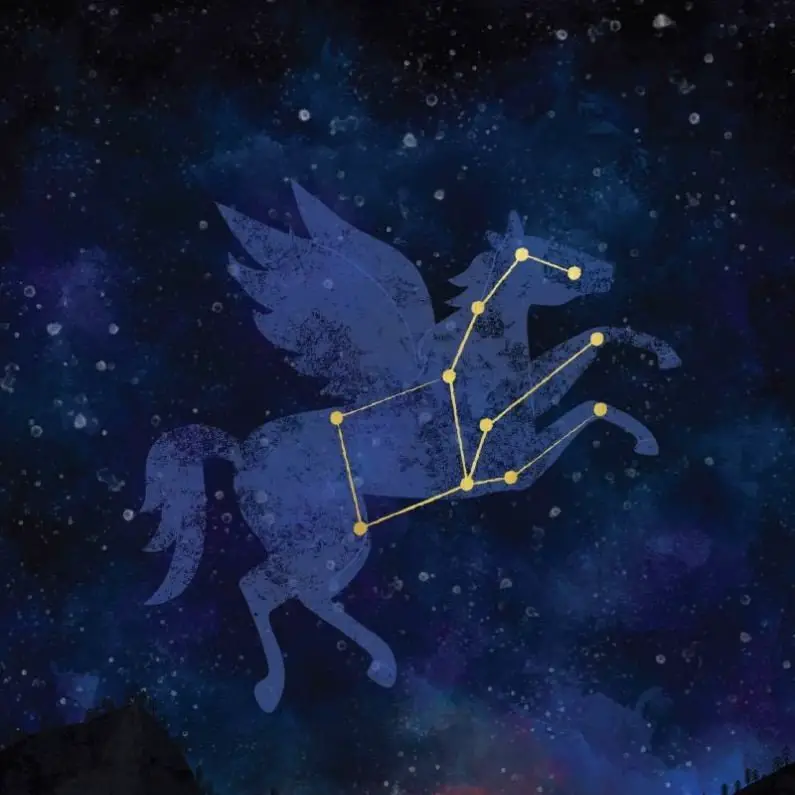
Welcome to another constellation post; this one is one of my favourites. Who doesn't love a winged horse? The constellation is called 'Hippos' (the Horse) in Greek and has some badass mythology attached to it.


Pegasos was originally only one winged horse, born from the neck of Médousa when she was beheaded by the hero Perseus. Poseidon, Tamer of Horses, is his father. Hesiod describes in his 'Theogony' the curious circumstances of his birth:


"...Medusa who suffered a woeful fate: she was mortal, but the two [of her Gorgon sisters] were undying and grew not old. With her lay the Dark-haired One [Poseidon] in a soft meadow amid spring flowers. And when Perseus cut off her head, there sprang forth great Chrysaor and the horse Pegasus who is so called because he was born near the springs [pegae] of Ocean [Okeanos]; and that other, because he held a golden blade [aor] in his hands. Now Pegasus flew away and left the earth, the mother of flocks, and came to the deathless gods: and he dwells in the house of Zeus and brings to wise Zeus the thunder and lightning." [ll 270-294]

Pegasos was tamed by Bellerophon, a Korinthian hero, who rode him into battle against the fire-breathing Khimaira. Pindar, in his beautiful Olympian Odes describes this cooperation wonderfully:

"Bellerophon, who once suffered greatly when beside the spring he wanted to harness Pegasus, the son of the snake-entwined Gorgon; until the maiden Pallas brought to him a bridle with golden cheek-pieces. The dream suddenly became waking reality, and she spoke: “Are you sleeping, king, son of Aeolus? Come, take this charm for the horse; and, sacrificing a white bull, show it to your ancestor, Poseidon the Horse-Tamer.” The goddess of the dark aegis seemed to say such words to him as he slumbered in the darkness, and he leapt straight up to his feet. He seized the marvellous thing that lay beside him, and gladly went to the seer of the land,  and he told the son of Coeranus the whole story: how, at the seer's bidding, he had gone to sleep for the night on the altar of the goddess, and how the daughter herself of Zeus whose spear is the thunderbolt had given him the spirit-subduing gold. The seer told him to obey the dream with all speed; and, when he sacrificed a strong-footed bull to the widely powerful holder of the earth, straightaway to dedicate an altar to Athena, goddess of horses. The power of the gods accomplishes as a light achievement what is contrary to oaths and expectations. And so mighty Bellerophon eagerly stretched the gentle charmed bridle around its jaws and caught the winged horse. Mounted on its back and armored in bronze, at once he began to play with weapons. And with Pegasus, from the chilly bosom of the lonely air,7 he once attacked the Amazons, the female army of archers, [90] and he killed the fire-breathing Chimaera, and the Solymi. I shall pass over his death in silence; but Pegasus has found his shelter in the ancient stables of Zeus in Olympus." [13. 63]

As a constellation, it's arrival in the sky notes the arrival of the warmer weather of spring and seasonal rainstorms, which is also why it got the job and title of thunderbolt-bearer of Zeus. Hyginus in his 'Astronomica' speaks of the events that led up to Pegasos' immortalization in the sky:

"Others say that at the time Bellerophon came to visit Proetus, son of Abas and king of the Argives, Antia, the king’s wife, smitten with love for the guest, begged to visit him, promising him her husband’s kingdom. When she couldn’t obtain this request, out of fear that he would accuse her to the king, she anticipated him by telling Proetus that he had offered violence to her. Proetus, who had been fond of Bellerophon, was reluctant to inflict punishment himself, but knowing that he had the horse Pegasus, sent him to the father of Antia (some call her Sthenoboea), for him to defend his daughter’s chastity and send the youth against the Chimera, which at that time was laying waste with flames the country of the Lycians.

Bellerophon was victor, and escaped, but after the creation of the spring, as he was attempting to fly to heaven, and had almost reached it, he became terrified looking down at the earth, and fell off and was killed. But the horse is said to have flown up and to have been put among the constellations by Jove [Zeus]. Others have said that Bellerophon fled from Argos not because of Antia’s accusations, but so as not to hear any more proposals which were distasteful to him, or to be distressed by her entreaties." [II.18]

Although most would agree that it is Pegasos whom the constellation denotes, there is one other explanation, there because her mythology is usually tied to the constellation Equuleus: the little horse. Her name is Melanippe (Εὐίππη), daughter of the kéntauros Kheiron. She became pregnant and could not let her father know. As such, she begged the Gods to be transformed into a mare. Also from Hyginus's Astronomica:
 
"Euripides in his Melanippe, says that Melanippe, daughter of Chiron the Centaur, was once called Thetis. Brought up on Mount Helicon, a girl especially fond of hunting, she was wooed by Aeolus, son of Hellen, and grandson of Jove, and conceived a child be him. When her time drew near, she fled into the forest, so that her father, who supposed her a virgin, might not see that she had given birth to a grandchild. And so when her father was looking for her, she is said to have begged the power of the gods not to let her father see her in childbirth. After the child was born, by the will of the gods she was changed into a mare which was placed among the stars."

He also gives another reason for her change:

"Some say that she was a prophetess, and because she used to reveal the plans of the gods to men, she was changed into a mare. Callimachus says that because she ceased hunting and worshipping Diana [Artemis], Diana changed her into the shape we have mentioned. For the reason above, too, she is said to be out of sight of the Centaur, who some say is Chiron, and to show only half her body, since she didn’t want her sex to be known."

The constellation is visible at latitudes between +90° and −60°, and best visible at 21:00 (9 p.m.) during the month of October.

I get a lot of questions from readers, and most of the time, the answers are fairly short. When I feel the question or the reply would be valuable to others as well, I make a post with a collection of them and post them in one go. Today's post is one of those.


"Is the word daemon pronounced day-mon, dee-mon, or as something else entirely?"

The words ‘dæmon’ and ‘daímōn’ are Latinized versions of the Greek ‘δαίμων’. Hesiod, in ‘Works and Days’ speak of only one race who became daímōns; those of the Golden Age. He makes clear distinction between the Theoi and daímōns: the Theoi are Gods, daímōns are members of the Gold Age who gained immortality. This differentiation is much less pronounced in the writings of Hómēros, where God and daímōn are used virtually interchangeably.

Daímōns fulfill an important role in mythology and life: all aspects of life can be overseen by Deathless beings, without taking away from—or needlessly adding to—the portfolio of the Theoi.

Especially through Neo-Platonics, comes the placement of daímōns between the Theoi and mankind. Daímōns are less powerful than the Theoi, with lesser domains; more concerned with the daily happenings of life than the Theoi are, but they, too, are immortal, and deserve honours. Important to note is the distinction made between daímōns and Heroes; similar in terms of power over the lives of man, but different in their identities, with the Heroes having very pronounced personalities, accomplishments and cult worship, and the daímōns having none of those.

In this context, the words ‘dæmon’ and ‘daímōn’ are pronounced the same: ‘dahy-mohn’, and not like the demons of Christianity (‘dee-muh n’).


"Which translation of Sappho have you read? There are several, right? Do you have a book with a collection of Sappho's poetry? If so, which book do you have? (I'm trying to figure out which is the best to buy) thank you!!! :) "
 

Sappho (Σαπφώ) was a Hellenic lyric poet, born on the island of Lesbos (Λέσβος) around 620 BC, although the exact date is unknown. She wrote beautiful and highly romantic poetry that comes and goes straight to the heart.

I have read many, many, many versions of Sappho's poetry--and I have enjoyed different things about every single version. My favourite translation of the hymn to Aphrodite is by Elizabeth Vandiver, but as an overall book, I enjoy the translation by Mary Barnard, who has applied a bit of creative freedom in her work. It's not a literal translation, but it truly brings to life the spirit of the words. It can be found in the book 'Sappho: A New Translation', University of California Press; Reissue edition (December 8, 1999).

The last few days have been....rough. Not so much for me personally, but looking at the world and seeing dividedness, anger, and fear. It can't have escaped anyone's notice that America has been having a rough go at it, so let me post up some words of Hesiod to ponder.

"And now I will tell a fable for princes who themselves understand. Thus said the hawk to the nightingale with speckled neck, while he carried her high up among the clouds, gripped fast in his talons, and she, pierced by his crooked talons, cried pitifully. To her he spoke disdainfully: `Miserable thing, why do you cry out? One far stronger than you now holds you fast, and you must go wherever I take you, songstress as you are. And if I please I will make my meal of you, or let you go. He is a fool who tries to withstand the stronger, for he does not get the mastery and suffers pain besides his shame.' So said the swiftly flying hawk, the long- winged bird.

But you, Perses, listen to right and do not foster violence; for violence is bad for a poor man. Even the prosperous cannot easily bear its burden, but is weighed down under it when he has fallen into delusion. The better path is to go by on the other side towards justice; for Justice beats Outrage when she comes at length to the end of the race. 

But only when he has suffered does the fool learn this. For Oath keeps pace with wrong judgements. There is a noise when Justice is being dragged in the way where those who devour bribes and give sentence with crooked judgements, take her. And she, wrapped in mist, follows to the city and haunts of the people, weeping, and bringing mischief to men, even to such as have driven her forth in that they did not deal straightly with her. 

But they who give straight judgements to strangers and to the men of the land, and go not aside from what is just, their city flourishes, and the people prosper in it: Peace, the nurse of children, is abroad in their land, and all-seeing Zeus never decrees cruel war against them. Neither famine nor disaster ever haunt men who do true justice; but light-heartedly they tend the fields which are all their care. The earth bears them victual in plenty, and on the mountains the oak bears acorns upon the top and bees in the midst. Their woolly sheep are laden with fleeces; their women bear children like their parents. They flourish continually with good things, and do not travel on ships, for the grain-giving earth bears them fruit.

But for those who practise violence and cruel deeds far-seeing Zeus, the son of Kronos, ordains a punishment. Often even a whole city suffers for a bad man who sins and devises presumptuous deeds, and the son of Kronos lays great trouble upon the people, famine and plague together, so that the men perish away, and their women do not bear children, and their houses become few, through the contriving of Olympian Zeus. And again, at another time, the son of Kronos either destroys their wide army, or their walls, or else makes an end of their ships on the sea.

You princes, mark well this punishment you also; for the deathless Gods are near among men and mark all those who oppress their fellows with crooked judgements, and reck not the anger of the Gods. For upon the bounteous earth Zeus has thrice ten thousand spirits, watchers of mortal men, and these keep watch on judgements and deeds of wrong as they roam, clothed in mist, all over the earth. And there is virgin Justice, the daughter of Zeus, who is honoured and reverenced among the Gods who dwell on Olympus, and whenever anyone hurts her with lying slander, she sits beside her father, Zeus the son of Kronos, and tells him of men's wicked heart, until the people pay for the mad folly of their princes who, evilly minded, pervert judgement and give sentence crookedly. Keep watch against this, you princes, and make straight your judgements, you who devour bribes; put crooked judgements altogether from your thoughts.

He does mischief to himself who does mischief to another, and evil planned harms the plotter most." 

[Works and Days, 202 - 266]

Where do we, as Hellenists, and I, as a person, find our ethical framework? Most of mine comes from Hesiod's Works and Days. Long before I knew Hesiod, or his writings existed, my ethics mirrored his. I want to share some of his writings with you today, because they are solid, sincere, ethical guidelines and pieces of advice that I believe will bring anyone who follows them closer to the Theoi, and themselves. That is what they did for me, anyway. You can read Works and Days here, in a translation by Evelyn-White, but the words below are taken from the Loeb translation, as done by Glenn W. Most, as that translation makes a lot more sense to me.

  • Give heed to Justice and do not foster Outrageousness, for Outrageousness is evil in a worthless mortal; and even a fine man cannot bear her easily.

  • Those who give straight judgements to foreigners and fellow-citizens and do not turn aside from Justice at all, their city blooms and the people in it flower.

  • A man contrives evil for himself when he contrives evil for someone else, and an evil plan is most evil for the planner.

  • If someone is willing to speak it out publicly, then far-seeing Zeus gives him wealth, but whoever willfully swears a false oath, telling a lie in his testimony, he himself is incurably hurt at the same time as he harms Justice.

  • Misery is there to be grabbed in abundance, easily, for smooth is the road, and she lives very nearby; but in front of Excellence the immortal Gods have set sweat, and the path to Her is long and steep, and rough at first--yet when one arrives at the top, then it becomes easy, difficult though it still is.

  • The man who thinks of everything by himself, considering what will be better, later and in the end--this man is the best of all. That man is fine too, the one who is persuaded by someone who speaks well. But whoever neither thinks by himself nor pays heed to what someone else says and lays it to his heart--that man is good for nothing.

  • Whatever sort you are by fortune, working is better, if you turn your foolish spirit away from other men's possessions towards work, taking care for the means of life.

  • Shame is not good at providing for a needy man.

  • If someone grabs great wealth with his hands by violence, or plunders it by means of his tongue, as often happens when profit deceives the mind of human beings and Shamelessness drives Shame away, then the Gods easily make him obscure.

  • Invite your friends to the feast, but let your enemy be; and above all call whoever lives near to you.

  • Do not seek profit evilly: evil profit is as bad as calamities.

  • Be friendly to your friends, and go visit those who visit you. 

  • Give to him who gives and do not give to him who does not give: for one who gives is a giver, but no one gives to a non-giver--Give is good, Grab is bad, a giver of death. For whatever a man gives willingly, even if it is much, he rejoices in the gift and takes pleasure in his spirit; but whomever snatches, relying upon shamelessness, this congeals his own heart, even if it is little.

  • It is fine to take from what you have, but it is woe for the spirit to have need of what you do not have.

  • Let the payment agreed for a man who is your friend be reliable; and smile upon your brother--but add a witness too: for both trust and distrust have destroyed men.

  • If the spirit in your breast longs for wealth, then act in this way, and work at work upon work.
Listverse released a list of ten ancient Hellenic writers you should know. It's a good list, and the reasoning why these were chosen is a great read in and of itself. The ten who made the cut are:

10. Hómēros -- writer of the Iliad and the Odysseia
9. Sophocles -- the tragedian who wrote (amongst others) Antigone, Oedipus the King and Electra
8. Herodotos -- whose book The Histories is considered the first work of history in Western literature
7. Euripides -- the tragedian who wrote (amongst others) Alcestis, Medea and The Bacchus
6. Hippokrátēs -- who fathered modern medicine, mostly with his Hippocratic Corpus
5. Aristophanes -- the comic playwright who wrote (amongst others) The Clouds, The Wasps and Lysistrata
4. Plato -- one of the fathers of Western philosophy
3. Aristotle -- the last of the great Hellenic philosophers 
2. Euclid -- a mathematician and the father of geometry, whose main work--The Elements--is still used as a textbook in mathematics 
1. Archimedes -- a mathematician, engineer, inventor, physicist and astronomer whose ideas are as the basics of all these disciplines

I most certainly concur that this list lists some of ancient Hellas' most influential writers, but the list is far from complete. Today, I want to add five more to it, and most of my picks will no surprise you.

5. Sappho
Sappho (Σαπφώ) was a Hellenic lyric poet, born on the island of Lesbos (Λέσβος) around 620 BC, although the exact date is unknown. She wrote beautiful and highly romantic poetry that comes and goes straight to the heart. One of the most famous of her works is her Hymn to Aphrodite.

4. Aeschylos
As the original list includes both Sophocles and Euripides, it seems only fair to include Aeschylos. Aeschylos (Aiskhulos, Αἰσχύλος) was the first of the three Hellenic tragedians whose plays can still be read or performed. According to Aristotle, he expanded the number of characters in plays to allow for conflict amongst them, whereas previously characters had interacted only with the chorus. Aescholos' most famous works are undoubtedly the Seven against Thebes, the Supplicants and the Orestia. 

3. Pythagoras
Pythagoras of Samos ( Πυθαγόρας ὁ Σάμιος) was an Ionian Hellenic philosopher, mathematician, and the father of the religious movement called Pythagoreanism. He lived from about 570 BC to about 495 BC, and made influential contributions to philosophy, religious teaching, math, ethics, and science. His most famous work is, undoubtedly, the Pythagorean theorem (a^2 + b^2 = c^2), that's standard in every math textbook. Interestingly enough, not a single bit of writing has been preserved--if he ever wrote anything down to begin with. His works are mostly quoted by his students, or known through critiques by Aristotle.

2. Plutarch
Plutach (Ploútarkhos, Πλούταρχος) was an ancient Hellenic historian, biographer, and essayist who lived between 46 and 120 AD. He is known primarily for his Parallel Lives and Moralia, but much of his work is lost to us. Plutarch's writings are full of details about people and places, and are therefor a true treasure trove.

1. Hesiod
Hesiod (Hesiodos, Ἡσίοδος) was a Hellenic oral poet who lived between 750 and 650 BC, around the same time as Hómēros. I would dare say that his work--especially 'Works and Days' and the 'Theogony'--has shaped the way scholars and practitioners of Hellenismos view ancient Hellenic society, religion and way of life. This is why I strongly feel that anyone who feels drawn to the Theoi, might benefit from investing some time in reading his words.

 When I find myself in troubled times, I turn to the ancient writers for the comfort of their now familiar words. Yesterday I picked up Hesiod's Works and Days. Works and Days is a very soothing piece of writing for me. It describes the day to day; it looks in, not out. While the world burns, it gives reprieve. 


Works and Days (Erga kaí Hemérai, Ἔργα καὶ Ἡμέραι) is a didactic poem written by the very early ancient Hellenic poet Hesiod. It was probably written around 700 BCE or earlier and is the first example we have of Hellenic didactic poetry (poetry that emphasizes instructional and informative qualities). It embodies the experiences of his daily life and work, forming a sort of shepherd's calendar, interwoven with episodes of myth, allegory, advice and personal history. It may have been written against a background of an agrarian crisis in mainland Hellas, which inspired a wave of documented colonization in search of new land. It was written for his son Peres, as advice to him.

While I was reading last night, I recognized that turmoil in the pages and I found his words even more sound and soothing. They reminded me that I can only control my own actions and through them inspire others to take good and just action. As much as I would like to do more, I cannot shoulder that burden, nor can any individual. So, listen to Hesiod today and remember his still very timely advice.

Hesiod - Works and Days
"...And there is virgin Justice, the daughter of Zeus, who is honoured and reverenced among the gods who dwell on Olympus, and whenever anyone hurts her with lying slander, she sits beside her father, Zeus the son of Cronos, and tells him of men's wicked heart, until the people pay for the mad folly of their princes who, evilly minded, pervert judgement and give sentence crookedly. Keep watch against this, you princes, and make straight your judgements, you who devour bribes; put crooked judgements altogether from your thoughts.

He does mischief to himself who does mischief to another, and evil planned harms the plotter most. 

The eye of Zeus, seeing all and understanding all, beholds these things too, if so he will, and fails not to mark what sort of justice is this that the city keeps within it. Now, therefore, may neither I myself be righteous among men, nor my son -- for then it is a bad thing to be righteous -- if indeed the unrighteous shall have the greater right. But I think that all-wise Zeus will not yet bring that to pass.

But you, Perses, lay up these things within you heart and listen now to right, ceasing altogether to think of violence. For the son of Cronos has ordained this law for men, that fishes and beasts and winged fowls should devour one another, for right is not in them; but to mankind he gave right which proves far the best. For whoever knows the right and is ready to speak it, far-seeing Zeus gives him prosperity; but whoever deliberately lies in his witness and forswears himself, and so hurts Justice and sins beyond repair, that man's generation is left obscure thereafter. But the generation of the man who swears truly is better thenceforward.

To you, foolish Perses, I will speak good sense. Badness can be got easily and in shoals: the road to her is smooth, and she lives very near us. But between us and Goodness the gods have placed the sweat of our brows: long and steep is the path that leads to her, and it is rough at the first; but when a man has reached the top, then is she easy to reach, though before that she was hard."
[250-292]
The beautiful thing about our religion is that not only do we have a clear way to honor the Theoi, and incentive to do so, we also get to live in a world governed completely by the Theoi. Hellenismos is special in that regards because it also largely matches up with science. To me--and many others with me--that is something very comforting. Now, as you are probably all aware, I live in a world full of Gods and Nymphs; for example, I take great strength in greeting Eos each morning as she paves the way for Helios, but there are many Gods who are, or who control, the cycle of day and night, and I would like to write out this cycle, if I may.

For all things geneological, I will always turn to Hesiod first. In his 'Theogony', he speaks of the birth of the Dawn, Sun and Moon:

"And Theia was subject in love to Hyperion and bare great Helios, and clear Selene, and Eos." [177]

Diodorus Siculus, in his 'Library of History' shares this world vieuw and moves a (pseudo-scientific) step beyond it:

"Of Hyperion we are told that he was the first to understand, by diligent attention and observation, the movement of both the sun and the moon and the other stars, and the seasons as well, in that they are caused by these bodies, and to make these facts known to others; and that for this reason he was called the father of these bodies, since he had begotten, so to speak, the speculation about them and their nature." [5.67.1]

Hyperion (Ὑπερίων), meaning 'The High-One', was a Titanes God born from Gaea and Ouranos. Theia and Euryphaessa (as mentioned in, for example, the Homeric Hymns) are generally regarded as the same Deathless woman: 'Theia' is the Hellenic word for 'Goddess', so it was likely 'Theia Euryphaessa' translated to 'Goddess Euryphaessa'. This means that the family tree is as follows:

     Khaos ------------ Gaea
         |         |
   Ouranos --- |
                       Hyperion --- Euryphaessa
                   |
                  Eos - Helios - Selene

The three of them--put into motion by Hyperion--form the basic cycle of these planets associated with specific times of day. Yet, the ancient Hellenes saw Night and Day as quite seperate from the heavenly bodies that are associated with them today. I have spoken before of the Protogenoi, and how They--contrary to the Olympians--are actually of the world; They, together, form the tapistry of earth and life. They literally make up our universe. As such, the further towards the Big Bang you go, the more abstract the Theoi become; They take on large, mostly unformed, chunks of the material that makes up our world and the further away you go from Khaos, the more specialized the Gods become--as well as numerous.

As such, starting this explination with Hyperion is actually incorrect--I should have started with Khaos itself, but if not there, than at least with Nyx, who is the deep Night, and Her daughter Hêmera (Ἡμερα), who is the Protogenos of the Day and the sister-wife of Aither (Light). In Hellenic mythology, Nyx draws a veil of darkness between the shining atmosphere of the aither and the lower air of earth (aer) at set times in the day, bringing night to man. In the morning, Hêmera removes this veil, and exposed the Earth once more to Light. As Hesiod writes in the Theogony:

"[At the ends of the earth, where lie the roots of earth, sea, Tartaros :] There stands the awful home of murky Nyx wrapped in dark clouds. In front of it [Atlas] the son of Iapetos stands immovably upholding the wide heaven upon his head and unwearying hands, where Nyx and Hemera draw near and greet one another as they pass the great threshold of bronze: and while the one is about to go down into the house, the other comes out at the door. And the house never holds them both within; but always one is without the house passing over the earth, while the other stays at home and waits until the time for her journeying come; and the one holds all-seeing light (phaos) for them on earth." [744]

Once we reach AD times, Hêmera is often identified with Eos, but in centuries prior, she was very much Her own Goddess, and Hêmera was as well. Hómēros, for example, in the 'Odysseia' writes: 

"The ship [of Odysseus] in due course left the waters of the river Okeanos and reached the waves of the spacious sea and the island of Aiaia; it is there [Okeanos] that Eos the early-comer (Erigeneia) has her dwelling place and her dancing grounds, and the sun himself has his risings. We came came in; we beached our vessel upon the sands and disembarked upon the sea-shore; there we fell fast asleep, awaiting ethereal Dawn." [12.1]

So, to recapitulate: Nyx and Hêmera continually work to both create and dissolve darkness on Earth; Selene moves with Nyx, and Helios with Hêmera, as heralded by Eos. In this recap, it is quite obvious we are yet missing a speciffic time of the day: dusk, or the evening. This was in the domain of the Nymphs, in this case the Hesperides (Ἑσπεριδες), who--depending of source--are either the daughters of Nyx or Atlas. Diodorus Siculus, in the 1st Century BC., wrote in his 'Library of History': 

"Now Hesperos (Evening) begat a daughter named Hesperis (Evening), who he gave in marriage to his brother [Atlas] and after whom the land was given the name Hesperitis; and Atlas begat by her seven daughters, who were named after their father Atlantides, and after their mother Hesperides." [4. 26. 2]

Yet, older sources agree that the Hesperides were born from Nyx; Hesiod, for example:

"And Nyx (Night) bare hateful Moros (Doom) and black Ker (Violent Death) and Thanatos (Death), and she bare Hypnos (Sleep) and the tribe of Oneiroi (Dreams). And again the goddess murky Nyx, though she lay with none, bare Momos (Blame) and painful Oizys (Misery), and the Hesperides who guard the rich, golden apples and the trees bearing fruit beyond glorious Okeanos."

Of course, there are more Gods--motly Titans--who are in some way connected to the cycle of night and day, but these are the most important ones and it's quite a hand full already. So perhaps next time when you awake, you will think of Hêmera, and rosy Eos, and when the sun is high in the sky, you will think of Him as well, and when you look upon the Moon before going to bed, you will give honors to Selene and Nyx, who holds Her and Gaea in Her embrace. Our Gods are everywhere; you only have to be aware of Them to notice.
These nine muses were born from Zeus and his aunt and fifth wife, Mnemosyne, who was the personification of memory. The Muses, back then, were simply Deities, in charge of Their own aspects of mortal life. Euterpe was the 'Giver of light', for example. Their function and status as Muses was a later, Roman, addition.

Although most sources say there are nine Muses, the archaic poet Sappho of Lesbos was called the tenth by Plato, a great compliment. It's Sappho's status as 'the tenth Muse' that paved the way to the conventional compliment paid to female poets and those who inspire.

I refer to the muses often; when I'm trying to write but can't find the inspiration, or when I'm trying to sleep but can't because my mind is full of words that want to come out are the most common occurrences. I also thank Them for the inspiration I have gotten to write blog posts or articles.

The muses are well represented in both mythology as Hellenic art. Not only does nearly every hero, poet and even some of the Theoi call out for Them when They're in a bind, but there is even a tragic story in which nine young women get turned into birds for their hubris. In this myth, King Pierus, king of Macedon named his nine beautiful and talented daughters after the muses and went on to boast that the Pierides--his daughters--were equal or even better in their arts than the Muses ever were. Needless to say, neither the Muses, nor the Gods took to this kindly. As punishment for his hubris, Pierus had to watch as his beautiful daughters were transformed into Magpies.

Apollon Mousagetēs, an epithet of Apollon, is said to lead the Muses. His name means 'Apollon Muse-leader'. As such, he can be seen depicted on vases and murals with the Muses.


Here is Apollon to the left, followed by the Muses. If I tell you Calliope carries a writing tablet, Clio carries a scroll and books, Erato is often seen with a lyre and/or a crown of roses, Euterpe carries a flute, Melpomene is often seen with a tragic mask, Polyhymnia is often seen with a pensive expression, Terpsichore is often seen dancing and carrying a lyre, Thaleia is often seen with a comic mask and Urania carries a pair of compasses and the celestial globe, how many can you pick out?

Within Hellenismos, worship, libations and offerings to the Muses is an individual choice. If you feel a need to do so--and poets, musicians, writers and other artists might definitely feel that need--do so. I know I do. As did the ancient writers; there is both an Homeric and an Orphic Hymn to the Muses one can use to honor Them:

Homeric Hymn to the Muses:

I will begin with the Muses and Apollon and Zeus. For it is through the Muses and Apollon that there are singers upon the earth and players upon the lyre; but kings are from Zeus. Happy is he whom the Muses love: sweet flows speech from his lips. Hail, children of Zeus! Give honour to my song! And now I will remember you and another song also.

Orphic Hymn to the Muses:

Daughters of Jove, dire-sounding and divine,
Renown'd Pierian, sweetly speaking Nine;
To those whose breasts your sacred furies fire
Much-form'd, the objects of supreme desire:

Sources of blameless virtue to mankind,
Who form to excellence the youthful mind;
Who nurse the soul, and give her to descry
The paths of right with Reason's steady eye.

Commanding queens who lead to sacred light
The intellect refin'd from Error's night;
And to mankind each holy rite disclose,
For mystic knowledge from your nature flows.

Clio, and Erato, who charms the sight,
With thee Euterpe minist'ring delight:
Thalia flourishing, Polymina fam'd,
Melpomene from skill in music nam'd:

Terpischore, Urania heav'nly bright,
With thee who gav'st me to behold the light.
Come, venerable, various, pow'rs divine,
With fav'ring aspect on your mystics shine;
Bring glorious, ardent, lovely, fam'd desire,
And warm my bosom with your sacred fire.

Yet, I strongly feel one honors the Muses best when being creative and inspired. Write, make art, sing, make music, do whatever you can that invites the inspiration of the Muses. Be aware of your inspiration, allow it to flow freely, and if you feel the need, give honor to the Deities who granted it.
Mythologically speaking, Pegasos was originally only one winged horse, born from the neck of Médousa when she was beheaded by the hero Perseus. Poseidon, Tamer of Horses, is his father. Hesiod describes in his ‘Theogony’ the curious circumstances of his birth:

"…Medusa who suffered a woeful fate: she was mortal, but the two [of her Gorgon sisters] were undying and grew not old. With her lay the Dark-haired One [Poseidon] in a soft meadow amid spring flowers. And when Perseus cut off her head, there sprang forth great Chrysaor and the horse Pegasus who is so called because he was born near the springs [pegae] of Ocean [Okeanos]; and that other, because he held a golden blade [aor] in his hands. Now Pegasus flew away and left the earth, the mother of flocks, and came to the deathless gods: and he dwells in the house of Zeus and brings to wise Zeus the thunder and lightning." [ll 270-294]

Pegasos was tamed by Bellerophon, a Korinthian hero, who rode him into battle against the fire-breathing Khimaira. Pindar, in his beautiful Olympian Odes describes this cooperation wonderfully:

"Bellerophon, who once suffered greatly when beside the spring he wanted to harness Pegasus, the son of the snake-entwined Gorgon; until the maiden Pallas brought to him a bridle with golden cheek-pieces. The dream suddenly became waking reality, and she spoke: “Are you sleeping, king, son of Aeolus? Come, take this charm for the horse; and, sacrificing a white bull, show it to your ancestor, Poseidon the Horse-Tamer.” The goddess of the dark aegis seemed to say such words to him as he slumbered in the darkness, and he leapt straight up to his feet.

He seized the marvellous thing that lay beside him, and gladly went to the seer of the land,  and he told the son of Coeranus the whole story: how, at the seer’s bidding, he had gone to sleep for the night on the altar of the goddess, and how the daughter herself of Zeus whose spear is the thunderbolt had given him the spirit-subduing gold. The seer told him to obey the dream with all speed; and, when he sacrificed a strong-footed bull to the widely powerful holder of the earth, straightaway to dedicate an altar to Athena, goddess of horses.

The power of the gods accomplishes as a light achievement what is contrary to oaths and expectations. And so mighty Bellerophon eagerly stretched the gentle charmed bridle around its jaws and caught the winged horse. Mounted on its back and armored in bronze, at once he began to play with weapons. And with Pegasus, from the chilly bosom of the lonely air,7 he once attacked the Amazons, the female army of archers, [90] and he killed the fire-breathing Chimaera, and the Solymi. I shall pass over his death in silence; but Pegasus has found his shelter in the ancient stables of Zeus in Olympus." [13. 63]

Pegasos was not worshipped with ritual and sacrifices like the Theoi—the Hellenic Gods—were; only the Theoi were worshipped in that manner, and even then there were huge differences in Ouranic, Khthonic, and hero worship. He/they were featured in art, though, and was/were a beloved part of the Hellenic mythology; especially the Pegasos Bellerophon rode on, as he was featured on many coins throughout the years.
The story of Oedipus (Οἰδίπους, Oidípous) was written by playwright Sophocles. The playwright wrote three plays about him: Oedipus the King, Oedipus at Colonus, and Antigone. Together, these are called the Theban plays. Sophocles was not the only one to write about him, though: fragments of his story exist in the works of Hómēros, Hesiod, Pindar, Aeschylus and Euripides. Sophocles was simple one of the latest authors to write about him, and the version that was preserved best was his. He has Oedipus wander to Thebes after killing his father. Here, he finds the Sphinx at the gates to the city--a city that is starving and slowly emptying out, as the Sphinx will not allow anyone to pass without answering her riddle. Those who answer the riddle incorrectly, get killed or eaten (depending on the author).

The Sphinx is not mentioned by every author. Some, like Hómēros, only mention the oracle that Oedipus' father got, and Oedipus' murder of his father, and marriage to his mother. Hesiod mentions the Sphinx, but does not mention Oedipus. The Sphinx in Sophocles' Oedipus the King never speaks, and the words of the riddle are never conveyed. The sole mention of the riddle is as follows:

"See, for this crown the State conferred on me.
A gift, a thing I sought not, for this crown
The trusty Creon, my familiar friend,
Hath lain in wait to oust me and suborned
This mountebank, this juggling charlatan,
This tricksy beggar-priest, for gain alone
Keen-eyed, but in his proper art stone-blind.
Say, sirrah, hast thou ever proved thyself
A prophet? When the riddling Sphinx was here
Why hadst thou no deliverance for this folk?
And yet the riddle was not to be solved
By guess-work but required the prophet's art;
Wherein thou wast found lacking; neither birds
Nor sign from heaven helped thee, but I came,
The simple Oedipus; I stopped her mouth
By mother wit, untaught of auguries."

Apollodorus is one of the first to mention the very words of the riddle and has them as follows, including the tale of Oedipus' involvement:

"For Hera sent the Sphinx, whose mother was Echidna and her father Typhon; and she had the face of a woman, the breast and feet and tail of a lion, and the wings of a bird. And having learned a riddle from the Muses, she sat on Mount Phicium, and propounded it to the Thebans. And the riddle was this:— What is that which has one voice and yet becomes four-footed and two-footed and three-footed? Now the Thebans were in possession of an oracle which declared that they should be rid of the Sphinx whenever they had read her riddle; so they often met and discussed the answer, and when they could not find it the Sphinx used to snatch away one of them and gobble him up. When many had perished, and last of all Creon's son Haemon, Creon made proclamation that to him who should read the riddle he would give both the kingdom and the wife of Laius. On hearing that, Oedipus found the solution, declaring that the riddle of the Sphinx referred to man; for as a babe he is four-footed, going on four limbs, as an adult he is two-footed, and as an old man he gets besides a third support in a staff. So the Sphinx threw herself from the citadel, and Oedipus both succeeded to the kingdom and unwittingly married his mother, and begat sons by her, Polynices and Eteocles, and daughters, Ismene and Antigone. But some say the children were borne to him by Eurygania, daughter of Hyperphas."

There are other versions of the riddle, but this is the one best known. Note that in older versions of the tale, Oedipus was not such a smart man at all. In fact, he was more of a warrior-hero like Hēraklēs. With the popularity of Odysseus, it was convenient to transform Oedipus into a cunning man, instead of a brawler. In the older art depicting the encounter between Oedipus and the Sphinx, he outright kills her. There is no riddle, and no suicide. She is a monster, who is vanquished by the hero, who collects his reward in the form of a wife.

Personally, I like the inclusion of the Riddle of the Sphinx. In general, I prefer the clever heroes over the brawling ones. I'm also a big fan of these types of riddles, although I'm terrible at solving them. 
These nine muses were born from Zeus and his aunt and fifth wife, Mnemosyne, who was the personification of memory. The Muses, back then, were simply Deities, in charge of Their own aspects of mortal life. Euterpe was the 'Giver of light', for example. Their function and status as Muses was a later, Roman, addition.

Although most sources say there are nine Muses, the archaic poet Sappho of Lesbos was called the tenth by Plato, a great compliment. It's Sappho's status as 'the tenth Muse' that paved the way to the conventional compliment paid to female poets and those who inspire.

I refer to the muses often; when I'm trying to write but can't find the inspiration, or when I'm trying to sleep but can't because my mind is full of words that want to come out are the most common occurrences. I also thank Them for the inspiration I have gotten to write blog posts or articles.

The muses are well represented in both mythology as Hellenic art. Not only does nearly every hero, poet and even some of the Theoi call out for Them when They're in a bind, but there is even a tragic story in which nine young women get turned into birds for their hubris. In this myth, King Pierus, king of Macedon named his nine beautiful and talented daughters after the muses and went on to boast that the Pierides--his daughters--were equal or even better in their arts than the Muses ever were. Needless to say, neither the Muses, nor the Gods took to this kindly. As punishment for his hubris, Pierus had to watch as his beautiful daughters were transformed into Magpies.

Apollon Mousagetēs, an epithet of Apollon, is said to lead the Muses. His name means 'Apollon Muse-leader'. As such, he can be seen depicted on vases and murals with the Muses.


Here is Apollon to the left, followed by the Muses. If I tell you Calliope carries a writing tablet, Clio carries a scroll and books, Erato is often seen with a lyre and/or a crown of roses, Euterpe carries a flute, Melpomene is often seen with a tragic mask, Polyhymnia is often seen with a pensive expression, Terpsichore is often seen dancing and carrying a lyre, Thaleia is often seen with a comic mask and Urania carries a pair of compasses and the celestial globe, how many can you pick out?

Within Hellenismos, worship, libations and offerings to the Muses is an individual choice. If you feel a need to do so--and poets, musicians, writers and other artists might definitely feel that need--do so. I know I do. As did the ancient writers; there is both an Homeric and an Orphic Hymn to the Muses one can use to honor Them:

Homeric Hymn to the Muses:

I will begin with the Muses and Apollon and Zeus. For it is through the Muses and Apollon that there are singers upon the earth and players upon the lyre; but kings are from Zeus. Happy is he whom the Muses love: sweet flows speech from his lips. Hail, children of Zeus! Give honour to my song! And now I will remember you and another song also.

Orphic Hymn to the Muses:

Daughters of Jove, dire-sounding and divine,
Renown'd Pierian, sweetly speaking Nine;
To those whose breasts your sacred furies fire
Much-form'd, the objects of supreme desire:

Sources of blameless virtue to mankind,
Who form to excellence the youthful mind;
Who nurse the soul, and give her to descry
The paths of right with Reason's steady eye.

Commanding queens who lead to sacred light
The intellect refin'd from Error's night;
And to mankind each holy rite disclose,
For mystic knowledge from your nature flows.

Clio, and Erato, who charms the sight,
With thee Euterpe minist'ring delight:
Thalia flourishing, Polymina fam'd,
Melpomene from skill in music nam'd:

Terpischore, Urania heav'nly bright,
With thee who gav'st me to behold the light.
Come, venerable, various, pow'rs divine,
With fav'ring aspect on your mystics shine;
Bring glorious, ardent, lovely, fam'd desire,
And warm my bosom with your sacred fire.

Yet, I strongly feel one honors the Muses best when being creative and inspired. Write, make art, sing, make music, do whatever you can that invites the inspiration of the Muses. Be aware of your inspiration, allow it to flow freely, and if you feel the need, give honor to the Deities who granted it.