Showing posts with label métoikos. Show all posts
'If you are a stranger, act like one' is a Delphic Maxim that can be interpreted in many, many ways. I'm going to try to cover all the angles, but I am sure your interpretation of this maxim will be slightly different than mine, regardless. 

Traveling in ancient Hellas was not done on a whim. Most people stayed at home, or at least near their city or village, unless work or emergency called them away. The road could be a treacherous place, and the sea even more so. Family tended to stay close together, so people rarely had to travel out to visit parents or other loved ones. While there were mot certainly reasons to visit or move to other city states, a lot of people in ancient Hellas never had to, so why the maxim?

As I have written before, ancient Hellenic society was notoriously strict about who was part of it and who was not. If you were not a citizen, you were either a doûlos--slave--or a métoikos, more commonly referred to as 'metic'. All three classes had their parts to play in Classical Hellas. Métoikos were citizens of other Hellenic cities and beyond who came to Athens because of the unique opportunities the metropolis offered.

In ancient Athens, métiokos, while welcomed, were disadvantaged from the get-go. They had to register their status within a month of arrival. They had no political influence, were not entitled to governmental aid in case of emergencies, the could own no farm land or real estate unless they were given special permission by the government, and they were not allowed to procure a contract with the government to work the mines. They were, however, expected to enter the army, and pay taxes if they were wealth enough, like citizens. On top of that, they also had to pay a métoikos poll tax--the metoikon--which was twelve drachmas ($ 720,-) a year for men and six for women, as well as another special tax--xenikon telos--if they wanted to set up a stall in the market place.

Métiokos did have access to the judicial system; they could both prosecute others and be prosecuted themselves. Unlike citizens and very much like slaves, métiokos were not allowed to represent themselves; they needed a citizen to vouch for them--a sponsor, called prostates. Métiokos were entitled to take part in religious ceremony. Like slaves but unlike citizens, métiokos could be made to undergo judicial torture. The penalties for killing a métiokos were not as severe as for killing a citizen.

While citizens, métiokos and doûlos were indistinguishable in appearance and behavior, society functioned largely on their separation. Only Corinth and Athens had large populations of métoikos, but all city states had rules concerning their legal, religious, and societal status. Athens had the most lenient ones, but it was still easy for a métoikos to step out of line, and that could easily lead to a life of slavery. As such, knowing to 'act like a stranger' was a vital piece of knowledge for anyone choosing to visit or live in a city that was not the one he was born in. As such, the maxim in this regard does not so much allude to attitude, but awareness: a constant sense of knowing your place, even if you lived in a city for many years. You, as a métoikos, had a role to fulfill, and clear lines which not to cross. As such, specific behavior was asked of you, and you had to be familiar with these rules.

A second interpretation is related to xenia. Hospitality in ancient Hellenic was a complicated ritual within both the host and the guest has certain roles to fill and tasks to perform. Especially when someone unknown to the host came to the door, the ritual held great value. The host has many tasks in his process, but the guest has an important part to play as well: the guest is expected to be courteous and not be a burden to the host. The house was a sanctuary in ancient Hellas with a lot of social rules attached to it. Guests could not enter certain parts of the house, and male guests were kept away from women at all times. Long term guests had a slightly different statues, as they became part of the oikos, but they were still subject to restrictions when it came to social an religious behavior. Again, the maxim would have reminded guests to be mindful of their hosts and to be grateful to be included in the oikos of another.

The last point from ancient Hellas I want to make is religious. Métoikos and houseguests were almost always passive participants of religious rites. In the oikos, the kurios performed the rites, and in state festivals, Archons and priests performed that function. Métoikos were barred from attending a number of festivals. That said, the way Hellenic ritual structure worked, meant that even visitors of a city would recognize what was going on, and they would be able to partake of the rite fairly easily. There were undoubtedly differences between city states, but the basics were always there. This meant that rituals did not have to be adjusted for métoikos, and kharis would be preserved. In this spirit, I still call for standardization of practices within modern Hellenismos.

In a modern context, acting like a stranger, when you are one, means to be an attentive guest, to not overstay your welcome, to follow the rules of the house you are in and to ask for clarification if you are not sure what the host expects of you. It means investing time and energy into getting to know the place and people you are visiting, and to observe that this place and these people are not there to serve you: you are a guest, and as such, it is your place to follow their lead. To me, this maxim calls for modesty and attentiveness, and those are not bad virtues to foster within yourself. 
Most of the questions I am asked are positive. I am very, very blessed that way. Some are... a little less positive, but that does not mean the question is not valid. This is the ask I got from an anonymous user in tumblr:

"Sadly it took me 17 years on this earth to find out that people outside of Greece practice Hellenism. When will you white people ever stop appropriating our culture. Hellenism is a religion bound to Greece, our history, blood, language and culture. Things you will never be part of. Or be able to properly practice since the traditions are BOUND to places in Greece. The gods will never respect your ugly xeno blood anyway, but not like you'll ever learn, even if a native tells you that."

Ancient Hellenic society was notoriously strict about who was part of it and who was not. If you were not a citizen, you were either a doûlos--slave--or a métoikos, more commonly referred to as 'metic'. All three classes had their parts to play in Classical Hellas. In Athens, about half of the population were doûloi and métoikoi. Métoikoi were citizens of other Hellenic cities and beyond who came to Athens because of the unique opportunities the metropolis offered. Doûloi who bought their freedom also became métoikoi. Because of their skill sets, métoikoi were welcomed with open arms in Athens, but they very rarely became neutralized citizens; the best they could hope for was to become an isoteleia. As an isoteleia, they were freed from the liabilities the métoikoi had. Former slaves never received either status; isoteleia or citizen.

In Athens, métiokoi, while welcomed, were disadvantaged from the get-go. They had to register their status within a month of arrival. They had no political influence, were not entitled to governmental aid in case of emergencies, the could own no farm land or real estate unless they were given special permission by the government, and they were not allowed to procure a contract with the government to work the mines. They were, however, expected to enter the army, and pay taxes if they were wealth enough, like citizens. On top of that, they also had to pay a métoikoi poll tax--the metoikon--which was twelve drachmas ($ 720,-) a year for men and six for women, as well as another special tax--xenikon telos--if they wanted to set up a stall in the market place.

Like doûloi, métiokoi did have access to the judicial system; they could both prosecute others and be prosecuted themselves. Unlike citizens and very much like slaves, métiokoi were not allowed to represent themselves; they needed a citizen to vouch for them--a sponsor, called prostates. For a freed slave the sponsor was automatically his former owner. Métiokoi were entitled to take part in religious ceremony. Like slaves but unlike citizens, métiokoi could be made to undergo judicial torture. The penalties for killing a métiokoi were not as severe as for killing a citizen. Although doûlos could become métiokoi, it was fairly easy for métiokoi to become doûloi; a failure to pay the metoikon tax, not finding a citizen sponsor, causing trouble, marrying a citizen or claiming to be a citizen themselves could all cost them their status.

The term 'métiokos' began to lose its distinctive legal status in fourth century BC, when métiokoi were allowed to act in the court without a prostates, and came to an end in Athens, when the purchase of citizenship became very frequent. Until that time, citizenship was a guarded treasure. While citizens, métiokoi and doûloi were indistinguishable in appearance and behavior, society functioned largely on their separation.

Outside of Athens, métiokoi were not treated as equally. Of all the poleis, only Corinth had a decently seized population of métiokoi. Their legal status is unknown, however. In Sparta and Crete, foreigners were hardly ever allowed to stay.

Many famous contributors to Athenian culture and Hellenic history--like the philosopher Aristotle and the painter Polygnotos--were not Athenian citizens. Many builders of temples, as well as some of the richest businessmen and women weren't Athenian citizens. Egyptians, Cypriots and Phoenicians, all came to Athens and founded their own districts, with temples in which they could pray to their own Gods.

As for worshipping the ancient Hellenic Gods: in the religious sphere all métiokoi were able to participate in the festivals central to the life of the city, except for some roles that were limited to citizens. Only citizens could be priests, for example. In ancient Hellas, the role of priest(ess) was a largely temporary, governmental, function. The profession of priest could be bought, and usually only lasted a few years at best. Minding a temple was almost exactly like minding a house; clean-up, clean-up, clean-up. In fact, religious celebrations weren't led by the priest(ess), but by the magistrate or other high ranking government official. The sole task of the priest(ess) was the animal sacrifice, but that was vitally important.

Now, as for the Hellenic Gods being somehow bound to Greece—many, if not all members of the Hellenic pantheon were imported into it from other places or the remnants of older religions. Zeus is the Greek continuation of '*Di̯ēus', the name of the Proto-Indo-European God of the daytime sky, Hera most likely already existed for the pre-Hellenic people who moved into the area. Archaeologists suspect that Athena, Médousa and Poseidon found their origins in Libya. They came to Hellas through Crete at the dawn of Hellas. In the beginning of Her rein, Athena may have been a snake and fertility Goddess and Poseidon solely a God of horses. Scholars have long suspected that Dionysus is in fact a fusion of a local Greek nature God and another more potent God imported rather late in Greek pre-history from Phrygia (the central area of modern day Turkey) or Thrace. Aphrodite's oldest non-Greek temple lay in the Syrian city of Ascalon where she was known as Ourania, an obvious reference to Astarte. I really could go on and on and on.

I understand the asker's frustration. In this time of economic hardship and foreign interference in your country, the last thing you are open to is the—what they consider—appropriation of their ancient Gods. But here is the thing: the ancient Hellenes were open to allowing non-Hellenes to worship the ancient Gods because they understood that the Theoi appreciate worship—from anyone. It is Their due share; a sign of respect as shown in The Odysseia. The colour of my skin has nothing to do with my ability to worship the ancient Hellenes. Even in ancient times, people of all skin colours worshipped the ancient Hellenic Gods, after all. My blood has nothing to do with my ability to worship the ancient Hellenic Gods. Not even my language has anything to do with my ability to worship the Theoi, although I do think practicing in ancient (not modern, ancient) Greek is important. As it stands, no one is able to practice at most of the ancient monuments in Greece, Turkey, Spain or anywhere else that the ancient Hellenistic empire reached, so that also does not stand between us.

All I am doing is giving worship, love and respect to the same Gods the asker prays to, something that the ancients would have allowed me to do (disregarding the fact that I am a woman here). Why doesn't the asker?
Someone in the Elaion Facebook group brought in a valid point: while some universal ideals and ideas about Hellenismos seem to be shared between various groups and individual followers of the Hellenic Gods, there are also huge differences. How much deviation can there realistically be before you are no longer practicing the same thing? What follows is my personal opinion and doesn't have a single fact in it. That said, this is one of those issues that need to be addressed every now and again, because we're reestablishing a shared religion and the focus should be on both 'religion' and 'shared'.

This post is going to rehash some points from a post I wrote in August of 2012 of standardizing Hellenismos. As I said then, Hellenismos does not have the luxury of being a 'do as thou wilt' religion. As a Reconstructionistic Tradition, Hellenismos has source material it needs to draw from in order for it to truly reconstruct anything. I have spoke to you about my problems with reconstruction before but it bears repeating; I greatly believe and fear that reconstruction is only possible within the confines of modern day society, thus limiting its validity by default.

We're a diverse bunch, even though we all use the same terms to describe ourselves; various Traditions popped up in various places and it's only logical that all groups took the available source material and ran with it in their own way. The situation in Hellas is much different from the situation in North America, and judging by the minimal availablitity of Hellenists in the Benelux, Traditions where I live are going to be different from the previous two. It happens; we're all people trying to figure it out.

What I hear often when this issue is brought up is that the religion of the ancient Hellenes varied so much from city-state to city-state--and even city to city--that any differences that we have in practices today are completely fine. I am on the fence about that. A part of me agrees; there is nothing wrong with a difference in practice, and as logn as we all worship the Hellenic Gods in a way that is at least Reformed Hellenistic, we should be good, right? That said, as a Traditional Hellenist, there are rituals I will not participate in--even if they are Hellenic. Worshipping the Khthonic deities as a part of standard practice, for example, especially if They are worshipped in the same manner or breath as the Ouranic deities. That is not my religion. Is it Hellenic, though? Now there is the big question.

My way is not the 'right' way; there is no 'right' way. None of us traveled the whole of ancient Hellas and brought back their practices. We are missing a lot of information. Fact remains, though, that a métoikos or traveller joining a ritual in a city(-state) not his or her own would have recognized the general structure. They would know in broad strokes what was going to happen and what was expected of them. Procession, hymns and prayers, purification, (animal) sacrifice, etc. There were some things that were universal even though the weight placed on certain Gods differed, festivals had different dates, and local cusoms were often unknown to these métoikos.

I wonder if, if I joined in with a Labrys festival in Hellas or a Hellenion one in the US, if I would know what to do. How great would the differences be with how I do things? What differences in ethics would we have? Would I be asked to do things I can't do because of my interpretation of the religion? I see videos of group rituals sometimes, and while it's always interesting to watch, I often feel like I am watching something entirely unrelated to my religion.

When I talked about standardizing Hellenismos, I didn't look to do that because I think there is something wrong with what we are doing now; I was saying it because these differences will only increase in the years to come. Those are the laws of natural development. There is nothing wrong with that, but it does fracture an already small religion. Personally, I thinkw e are too young to start falling apart into denominations.

We all worship the ancient Hellenic Gods, and essentially, that should be enough. We are all equal but different because of the focus we have and the culture we practice in. The availability of sources, the availability of others, all these things influence what we do and how we think. There is beauty in diversity, but I do stress that we need to be mindful of each other. I still think we would benefit from a frew guidelines that stretch the globe; guidelines that visitors can hold on to and not suddenly get confronted with an animal sacrifice or hymns to Hades. We need some standard practices and some warning labels, that way we can all enjoy our religion while knowing we at least connect to (all) other practicioners around the globe.
Yesterday--at dusk--the Lênaia (Λήναια) festival started. It's dedicated to Dionysos Lênaios (Ληναιος, of the wine press), and is almost undoubtedly a fertility festival, which was celebrated to encourage the earth to thaw and soften, and become ready for sowing. This three-day festival honors Dionysos and has a multitude of links to the Lesser Dionysia. In fact, it's been described as an urban version of the Lesser Dionysia, but without the grander of the greater Dionysia. I have written about the festival before, and those looking to celebrate might want to read up on the history of it.


The Lênaia starts at the twelfth and ends either on the fourteenth or fifteenth of the month. Personally, I feel it ends at dusk on the fifteenth, as that would make up the full three days attested to (from dusk on the twelfth, to dusk on the fifteenth). It can be celebrated with wine, by seeing a show or movie, and by spending some time in bed with your lover--in fact, it's much like the Haloa festival in this regard. It's a festival mostly aimed at having a good time, and enjoying the good things in life, despite the cold outside. Offer wine to Dionysos, and dance for Him, if you feel so inclined. I'm pretty sure He would appreciate it. As a personal note, dancing for Dionysos is always my favourite part of my celebration, and I look forward to dancing for Him on Thursday night.

Ah, one more 'Q' post, and then I'll be without them for another year. That's a good thought! On that cheery note, I figured out another subject for the 'Q's: quorum votes. The word 'quorum' reminds me of Battlestar Galactica, which has the 'Quorum of Twelve': the governing body of the Twelve Colonies of Kobol, composed of one representative from each colony. The 'Quorum of Twelve' was actually a Christian reference by the creator of the series, but in a universe heavily influenced by the Greek legacy--where the names of the Twelve Colonies and their planets are similar to the names of the constellations in the Greco-Roman zodiac, many people are devout followers of the Theoi, and characters often had nicknames like 'Athena' and 'Apollo'--the quorum is actually fairly reminiscent of ancient Hellas.

Ostraka

A quorum is the minimum number of members of a deliberative assembly necessary to conduct the business of that group. I have written a little about the ancient Athenian quorum before, but before I get to that, let me explain the Athenian government body really quick--or at least the parts relevant to this post. There is a longer summary to be found here, but as that is a Pagan Blog Project post as well, I am just going to assume you have read it. So, short summary:

Back in Classical ancient Athens, if you were adult male Athenian citizens who had completed their military training as ephebes, you were required to partake in the democratic assembly of citizens, called the ekklesia. It consisted of about 25,000 voting citizens. The ekklesia, in turn, was managed by the boule of 500 citizens, taken from the ranks of the ekklesia. The boule, finally, was managed by 50 members of the boule, called the prytaneis. Everyone in the ekklesia voted, but their votes were tallied by the boule-members of their tribe, who related the votes to the prytanis of their tribe, who then tallied and proclaimed the votes. Previous to the Classical age, smaller assemblies would dispense judgment, or the judgment was dispensed by the king.

Perhaps the most well-known example of voting in ancient Athens comes from Aeschylus' Eumenides where Orestes faces divine judgment after slaying his mother in revenge for the death of His father. Athena presides over this judgment, and Apollon speaks for Orestes, but the vote is in the hands of the Athenian people, although Athena has the winning vote in case of a tie.

"O men of Athens, ye who first do judge the law of bloodshed, hear me now ordain. Here to all time for Aegeus' Attic host shall stand this council-court of judges sworn, here the tribunal, set on Ares' Hill where camped of old the tented Amazons, what time in hate of Theseus they assailed Athens, and set against her citadel a counterwork of new sky-pointing towers, and there to Ares held their sacrifice, where now the rock hath name, even Ares' Hill. And hence shall Reverence and her kinsman Fear pass to each free man's heart, by day and night enjoining, Thou shalt do no unjust thing, so long as law stands as it stood of old unmarred by civic change. Look you, the spring is pure; but foul it once with influx vile and muddy clay, and none can drink thereof. Therefore, O citizens, I bid ye bow in awe to this command, Let no man live, uncurbed by law nor curbed by tyranny; nor banish ye the monarchy of Awe beyond the walls; untouched by fear divine, no man doth justice in the world of men. Therefore in purity and holy dread stand and revere; so shall ye have and hold a saving bulwark of the state and land, such as no man hath ever elsewhere known, nor in far Scythia, nor in Pelops' realm. Thus I ordain it now, a council-court pure and unsullied by the lust of gain, sacred and swift to vengeance, wakeful ever to champion men who sleep, the country's guard. Thus have I spoken, thus to mine own clan commended it for ever. Ye who judge, arise, take each his vote, mete out the right, your oath revering. Lo, my word is said."

In the Eumenides, twelve judges then come on stage and cast their vote in one of two urns--one to vote Orestes guilty, the other to vote him not guilty. The results are tallied and Orestes is cleared of blood guilt.

Voting in Classical Athens would have been much the same. Prior to the changes to the political landscape of Athens in the sixth century BC and onwards, made by Solon and Kleisthénês, it appears votes were more often settled by talking or shouting during assemblies. As this was of voting was decidedly personal, those of higher birth or greater power would have been able to sway votes. Solon, especially, worked hard to abolish these influences in decision making. The far more neutral voting system of 'bind' votes, where votes were cast in urn or other holders was considered far preferable.

Votes were tallied in a few different ways: one was to use stones of varying colors, and ascribe one color to 'yes' votes, and the second color to 'no' votes. All lots were case into a single urn, which was cracked open after everyone had voted, and tallied. The second option was the one portrayed in Eumenides: two urns, one type lot. A third option was a particular one; it was only used when deciding who would be ostracized. When a person was ostracized, potsherds (ostraka, ὄστρακα) with names scratched on them were used as lots, and he who received the most votes, was ostracized for ten years.

During an ostracism (ostrakismos, ὀστρακισμός) each member of the ekklesia would choose a politician they wished to have 'ostracized', or exiled for ten years. If any one name received a majority and a total of 6,000 or more votes, that man would have to leave Athens. The picture up top features some excavated ostraka naming prominent politicians still well-known to historians today: at the top, Aristeides, son of Lysimachus on the left, and Themistokles, of the deme Phrearios on the right. At the bottom, Kimon, son of Miltiades on the left, and Perikles, son of Xanthippos on the right. Ostracism was often used preemptivel, as a way of neutralizing someone thought to be a threat to the state or potential tyrant. As such, ostracism had no relation to the processes of justice; there was no charge or defense, and the exile was not in fact a penalty; it was simply a command from the Athenian people that one of their number be gone for ten years.

For a small category of votes a quorum of 6000 men was required, and ostracisms were included in that number. Another was the granting of citizenship to métoikos, if they had done something important for the city of Athens. These decisions were considered too important to leave up to smaller numbers.

The Athenian direct democracy we are now unfamiliar with besides when judging rounds of Top Model or Idols, allowed every (adult male) citizen the exact same vote, and equalized the political landscape. Quorum votes were especially important, as the decision was not only backed up by 6000 men, but they had voted on it together, bringing these men--and the city of Athens--closer.
I was absolutely sure I had already covered the Delphic Maxim 'If you are a stranger, act like one' (Ξνος ων ισθι) in a previous blog post, as it is one of my favorites. It was brought up on the Elaion Facebook page yesterday, and when I went to hunt for the post about that maxim on the blog, it simply was not there. Seeing as I doubt it grew legs and walked off, I need to rectify my error right away.

'If you are a stranger, act like one' can be interpreted in many, many ways. I'm going to try to cover all the angles, but I am sure your interpretation of this maxim will be slightly different than mine, regardless. Traveling in ancient Hellas was not done on a whim. Most people stayed at home, or at least near their city or village, unless work or emergency called them away. The road could be a treacherous place, and the sea even more so. Family tended to stay close together, so people rarely had to travel out to visit parents or other loved ones. While there were mot certainly reasons to visit or move to other city states, a lot of people in ancient Hellas never had to, so why the maxim?

As I have written before, ancient Hellenic society was notoriously strict about who was part of it and who was not. If you were not a citizen, you were either a doûlos--slave--or a métoikos, more commonly referred to as 'metic'. All three classes had their parts to play in Classical Hellas. Métoikos were citizens of other Hellenic cities and beyond who came to Athens because of the unique opportunities the metropolis offered.

In ancient Athens, métiokos, while welcomed, were disadvantaged from the get-go. They had to register their status within a month of arrival. They had no political influence, were not entitled to governmental aid in case of emergencies, the could own no farm land or real estate unless they were given special permission by the government, and they were not allowed to procure a contract with the government to work the mines. They were, however, expected to enter the army, and pay taxes if they were wealth enough, like citizens. On top of that, they also had to pay a métoikos poll tax--the metoikon--which was twelve drachmas ($ 720,-) a year for men and six for women, as well as another special tax--xenikon telos--if they wanted to set up a stall in the market place.

Métiokos did have access to the judicial system; they could both prosecute others and be prosecuted themselves. Unlike citizens and very much like slaves, métiokos were not allowed to represent themselves; they needed a citizen to vouch for them--a sponsor, called prostates. Métiokos were entitled to take part in religious ceremony. Like slaves but unlike citizens, métiokos could be made to undergo judicial torture. The penalties for killing a métiokos were not as severe as for killing a citizen.

While citizens, métiokos and doûlos were indistinguishable in appearance and behavior, society functioned largely on their separation. Only Corinth and Athens had large populations of métoikos, but all city states had rules concerning their legal, religious, and societal status. Athens had the most lenient ones, but it was still easy for a métoikos to step out of line, and that could easily lead to a life of slavery. As such, knowing to 'act like a stranger' was a vital piece of knowledge for anyone choosing to visit or live in a city that was not the one he was born in. As such, the maxim in this regard does not so much allude to attitude, but awareness: a constant sense of knowing your place, even if you lived in a city for many years. You, as a métoikos, had a role to fulfill, and clear lines which not to cross. As such, specific behavior was asked of you, and you had to be familiar with these rules.

A second interpretation is related to xenia. Hospitality in ancient Hellenic was a complicated ritual within both the host and the guest has certain roles to fill and tasks to perform. Especially when someone unknown to the host came to the door, the ritual held great value. The host has many tasks in his process, but the guest has an important part to play as well: the guest is expected to be courteous and not be a burden to the host. The house was a sanctuary in ancient Hellas with a lot of social rules attached to it. Guests could not enter certain parts of the house, and male guests were kept away from women at all times. Long term guests had a slightly different statues, as they became part of the oikos, but they were still subject to restrictions when it came to social an religious behavior. Again, the maxim would have reminded guests to be mindful of their hosts and to be grateful to be included in the oikos of another.

The last point from ancient Hellas I want to make is religious. Métoikos and houseguests were almost always passive participants of religious rites. In the oikos, the kurios performed the rites, and in state festivals, Archons and priests performed that function. Métoikos were barred from attending a number of festivals. That said, the way Hellenic ritual structure worked, meant that even visitors of a city would recognize what was going on, and they would be able to partake of the rite fairly easily. There were undoubtedly differences between city states, but the basics were always there. This meant that rituals did not have to be adjusted for métoikos, and kharis would be preserved. In this spirit, I still call for standardization of practices within modern Hellenismos.

In a modern context, acting like a stranger, when you are one, means to be an attentive guest, to not overstay your welcome, to follow the rules of the house you are in and to ask for clarification if you are not sure what the host expects of you. It means investing time and energy into getting to know the place and people you are visiting, and to observe that this place and these people are not there to serve you: you are a guest, and as such, it is your place to follow their lead. To me, this maxim calls for modesty and attentiveness, and those are not bad virtues to foster within yourself.
In modern religious worship, 'liturgy' often means a form or formulary according to which public religious worship, especially Christian worship, is conducted. It's seen as an established ceremony prescribed by a religion. The term is based upon the ancient Hellenic word 'leitourgia' (λειτουργία), which had nothing to do with established ceremony, and everything with money. It is leitourgia we will be talking bout today.

Leitourgia comes from the ancient Helenic word 'leitos' (from leos, people) meaning public, and, 'ergo', 'to do'. As such, a leitourgos was 'a man who performs a public duty'; a public servant. Leitourgia were semi-voluntary financial contributions made by the most wealthy of citizens and métoikos in order to finance the state's public expenses in areas of war, theater, and religious worship. The practice was not just prevalent in ancient Athens, it stretched all the way to Rhodos and beyond. The system dates back to the early days of Athenian democracy, but gradually fell into disuse by the end of the 4th century BC. Liturgies came in two main categories; religious and military.

Cities were capable of creating new liturgies in accordance with their immediate needs, or of suppressing them temporarily or permanently. Many of the liturgies were religious in nature, and most were recurring. Examples of the religious leitourgia include:
  • the gymnasiarchia (γυμνασιαρχία): the management and financing of the gymnasium
  • the choregia (χορηγία): the maintenance of the choir members at the theater for dramatic competitions
  • the hestiasis (ἑστίασις): funding of a public dinner for the tribe to which the liturgist belonged during the Panathenaia
  • the architheoria (ἀρχιθεωρία): to lead delegations to the four sacred Panhellenic Games
  • the arrephoria (ἀρρηφορία): to cover the cost of taking care of the arrhephoroi
By comparison, the military liturgies were used only when needed, but they covered the cost of most--if not all--war expenses. Again, some examples:
  • the trierarkhia: maintaining and captaining a war ship (trireme) and its crew for a year; a concession could be paid to make this post solely financial
  • the hippotrophia (ἱπποτροφία): maintaining the horses of the cavalry; it is unsure if this office actually existed, but it was speculated to exist after the Persian Wars.
Demosthenes, a prominent statesman and orator in ancient Hellas, estimated the number leitourgia in ancient Athens to be sixty around 355 BC, but he might have been on the low side, as we know the following numbers were most likely correct: the Dionysia required 23-32 choregoi and ten hestiatores, the Panathenaia ta mikra required at least 19 liturgists per year, and the Panathenaia ta magala around 30 - 40, the Lenaia annually had 5 choregoi, and the Thargelia 10. Some liturgists were also required for other religious holidays, which must be added to the theoroi (sacred messengers, θεωροὶ) of the Panhellenic Games and the oracle of Delphi. It is estimated therefore that and average year required at least 97 civilian leitourgia in Athens, and at least 118 in years of the Panathenaia ta magala.

Leitourgoi were selected by various governmental organs. For most, the Archōn Epōnymos was responsible, but the selection of certain others fell to the Archōn Basileus (most notably the choregoi for the comedy competitions during the Lenaia), and to the strategos (most notably the symmoiai). Hestiatores were appointed by the tribe they belonged to. Decisions on who should become leitourgos were made based on wealth of the person, their ability to lead and their willingness for the post. The financial investment required of the leitourgos varied, but was always substantial, and there were several systems in place that assured breaks between terms served by the leitourgos. Even so, many men had to borrow money in order to pay his leitourgia.

Men became leitourgoi because of the prestige it brought to them and their family. It was a matter of honor to take part in the practice. The leitourgoi to the festival or war effort were loudly declared, and often plaques with their name on it were put up to show everyone who had financed the affair. Still, many were exempt from serving, and others tried to get out of it at all cost.

Demosthenes' 'Against Leptines' gives us the mot information on the ancient leitourgia. In it, he lists some notable exemptions for the post of leitourgos: orphans, females without a legal guardian, minors, those below the age requirement, archōns in office, citizen soldiers, and invalids are amongst them. Some leeway was given to those who had rendered exceptional services to the city. One could not be forced to undertake two liturgies at once, or to take on the same civil liturgy two years in a row, but you were allowed to do so if you wished. A trierarch was entitled to a respite of two years. There were two other ways to get out of serving: either by hiding the fact that you were wealthy, or by suing someone wealthier and forcing them to take on the position. This practice was called 'antidosis' (ἁντιδοσις, 'exchange'), and happened quite often.

The system functioned very well until the Peloponnesian War, when the amount of leitourgoi (especially trierarchs) required begun to weigh down even the wealthiest of citizens. Resistance rose, and the system was abandoned for a voluntary system of gift-giving to the people, called 'euergetism'. This system preserved at least partially the honor system tied to the leitourgia, and helped cover state expenses.
On the 19th of Thargelion, an Athenian festival for the Thrakian Goddess Bendis (Βενδις) was held. This festival, which went on into the night of the 20th of the month, was designed especially for Bendis, who was introduced to Attika by Thrakian métoikos who took the opportunity to introduce their Goddess into the Athenian pantheon after the Oracle of Dodona decreed that Thrakian worshippers should be granted the right for ground to build a sanctuary on. Their shrine to Her was built on the hill Mounykhia, near to the temple of Artemis, with whom She was identified. The temenos was completed somewhere before 429 BC, and at least one Thrakian festival to the Goddess was held before the Athenians got involved.

 
The Goddess Bendis originated in Thrake, to the north of Hellas. Her cult was imported into Athens around 432 BC, at the outbreak of the Peloponnesian War between Athens and Sparta. Athens had always had close ties with Thrake, but besides the oracle's decree, it seems that the acceptance of the foreign cult into the city at this time was probably connected with Athens' military alliance with the Odrysian Thrakians, who supplied mercenaries throughout the war.
 
The Bendideia (Βενδίδεια) itself was celebrated in the port town of Peiraeeus. At first, only the Thrakians honored Her, but within a few years, the Athenians held their own procession alongside the Thrakians, theirs winding down from the Prataneion (Πρυτανεῖον)--the seat of government in ancient Hellas--in the morning  to the sanctuary of the Goddess in the Peiraios, while the Thrakian procession was entirely within the port town. The six-mile procession of the Athenians was so unusual, that a decree called for basins, water and sponges to bathe after it, and garlands. It seems obvious to place a meal here in the timeframe, followed by a period of rest until it became dark enough to perform the most telling of cult worship to the Goddess: an evening torch race on horseback; a true novelty. Plato, in his 'Republic' tells us a little it about this race:
 
"Polemarchus said to me: I perceive, Socrates, that you and our companion are already on your way to the city.
You are not far wrong, I said.
But do you see, he rejoined, how many we are?
Of course.
And are you stronger than all these? for if not, you will have to remain where you are.
May there not be the alternative, I said, that we may persuade you to let us go?
But can you persuade us, if we refuse to listen to you? he said.
Certainly not, replied Glaucon.
Then we are not going to listen; of that you may be assured.
Adeimantus added: Has no one told you of the torch-race on horseback in honour of the goddess which will take place in the evening?
With horses! I replied: That is a novelty. Will horsemen carry torches and pass them one to another during the race?
Yes, said Polemarchus, and not only so, but a festival will he celebrated at night, which you certainly ought to see. Let us rise soon after supper and see this festival; there will be a gathering of young men, and we will have a good talk. Stay then, and do not be perverse.
Glaucon said: I suppose, since you insist, that we must.
Very good, I replied."
 
What, exactly, Bendis presided over to either the Thrakians or the Athenians is unclear. She was identified mostly with Artemis, but not equated with Her, as She received a temple of Her own. Due to a connection with grain and the growth cycle of plants, she was identified with Demeter, and sometimes Persephone and/or Hekate. She was also associated with Selene. What we do know is that the worship of Bendis outside of Thrake and Athens never caught on; she was revered almost solely at these places. Yet, the Athenians seemed to have held her in high regard for a Theia not of their pantheon.
 
Whether or not you want to celebrate the Bendideia hinges on a couple of factors. Those who reconstruct the archaic period might see no reason at all to pay homage to a Goddess who was not worshipped in Hellas in their time period. Similarly, if you feel no need to worship 'imported' Gods, this festival might not be for you either. If you do want to celebrate his festival, I would suggest something with horses and torches besides offerings to the Goddess. Alternatively, you could look at the Goddesses She was associated with for clues about Her worship. Whatever the case, enjoy your Bendideia tonight, and deep into the night tomorrow.
Those who visit this blog on a regular basis know that I'm a fan of Solon and his reformations of the political landscape of Athens in the sixth century BC. I wrote about some of his reforms a little while ago. Solon (Σόλων) was an Athenian statesman, lawmaker, and poet, who lived from 638 BC to 558 BC. He spent most of his adult life trying to legislate against political, economic, and moral decline in archaic Athens. His ideologies are often credited with having laid the foundations for Athenian democracy. Today, I want to discuss one of his most important reforms: the move from a judicial system where the Zeus-born kings decided the fate of the accused, to the basic foundations of democracy. I fully admit that I'm hanging this off of a 'J'-post, because 'J' is a hard letter for a Hellenist--no such letter in the Greek language--so expect the 'jury' part to be a somewhat loose interpretation.

I have written about the Zeus-born kings and the democracy in ancient Athens before, in separate Pagan Blog Posts. I suggest reading those posts before reading this one, but I'll add the highlights of those post below just in case, with links to these articles (mostly) so you know where to find more information on the terms.

Back in ancient Hellas, if you were a citizen--and especially one from an important family--you could trace your family line back to a Theos. For Athenians, this divine link was first through Gaea (autochthonous, αὐτός χθών, 'earth-born') and/or Athena (with links to Zeus), and then through Poseidon. The kings of Athens were legendary, mythological, even in the time of ancient Hellas. With the death of Codrus, this system came to an end and was replaced by a political system were the decadents of these kings became árchōntes.

The árchōntes did not rule as kings; where kings were sole rulers of the city state, archons ruled first in threes, then in nines, then in tens and their power did not extend to law-making. Indeed, the Athenians had a clear understanding of the difference between sovereign power and executive government, and they kept the two separate far more than any modern government. The system started with three árchōntes: the 'Archōn Epōnymos' (ἄρχων Ἐπώνυμος), the 'Polemarchos' (πολέμαρχος), and the 'Archōn Basileus' (Ἄρχων Βασιλεύς). Together, these three oversaw the tasks the ancient kings had carried alone.

Originally the árchōntes were chosen from the 'eupatridae'--those who were 'good fathered'--by elections every ten years, but after 508 BC the titles were held for only a single year. Other changes came in 487 BC, when the archonships became assigned by lot to any citizen. Before this assignment by lots, for which I have described the procedures here, there was another system in place for a while: Solon's system, which still operated by lot, but with a few more rules to placate the aristocracy.

When Solon came to power, he pushed a few very important changes through the system. As a statesman, Solon put principles before expediency. In a time when Athens was struggling under the burden of civil war, his reforms strove to bridge the gap between the rich an the poor. He cancelled all debts, and purchased the freedom of all slaves, allowing everyone to start with a clean slate. This caused a massive financial crisis, for which new reforms were necessary, including new trade ties, and an halt in the export of all foodstuffs but olive oil, of which there was plenty. Solon did not stop there, however. Once he was given full legislative powers, he abolished political distinctions of birth in politics. Instead, he created four new groups:
  • Thetes, the lowest group, who paid no taxes, provided no equipment city state or its army, and who were not eligible to hold an office of any kind.
  • Zeugitae, the second lowest group, who paid tax at the lowest rate, provided body armor to the Athenian army, and who were eligible to hold office.
  • Hippeus, the second highest group, who paid higher taxes at the middle rate, provided their own war horse when they served in the army, and they were eligible for higher offices.
  • Pentacosiomedimni, the top class of citizens, who paid the highest amount of taxes, and were eligible for all top positions of government in Athens. Archōntes were chosen from this class.
A person belonged to the first class if he could produce more than five hundred measures of goods, to the second class for more than three hundred, to the third class for more than two hundred, and everybody else belonged to the last class, the thetes. Members of the first three classes could hold offices such as those of the archons and the treasurers. The last class gathered at the assembly and could act as jury in court.
Especially the latter of the reforms created a system where the power was in the hands of the people, because instead of leaving justice to be administered by the aristocracy, Solon formed a 'boule' (βουλή), who met at the 'bouleterion'. The term comes from the ancient Greek word for 'citizens': bouleutai (βουλευταί). About a hundred years after these reforms took place, in 508 BC, the árchōntes Kleisthénês (Κλεισθένης) organized the citizens of Athens into ten tribes, but in Solons time, there were only four, and every Athenian belonged to one of them. It may have been that these tribes were originally small villages which came together to form the foundation of Athens, but this is pure speculation on my part. No evidence of this--or any other theory--survives. At any rate, in Kleisthénês' time, the boule was assembled from 50 men, chosen from each of the ten tribes of Athens, for a total of 500 men. Solon founded the boule with 400 men, one hundred from each of the four tribes, but only with members from the three most wealthy of classes. This council was responsible for processing  public matters before bringing them to the assembly, or 'ekklesia'.
In the ancient Athens after Solon and Kleisthénês, sovereign power was held by the ekklesia, and only by the ekklesia: they were the jurors of ancient Athens. The árchōntes didn't factor into lawmaking at all. Every citizen in ancient Hellas had the right to vote on new or changing laws and was thus required to be aware of them and have an opinion on them; a direct democracy. In fact, Solon introduced a controversial law punishing those who did not take part in public decisions on crucial matters, following the view that everybody should care about public issues. This law was overturned in later times, but there were still reminders of it in Athenian life afterwards, like the miltos. In Solon's time, however, the árchōntes did still have the power to act as judge in disputes, as they--and he kings before them--had always had. However, after Solon's reforms, anyone could appeal to the jury of the ekklesia if a decision of the árchōntes was not acceptable. Furthermore, one could seek justice for other persons who could not represent themselves, something that had not been possible before. 
When I say 'everyone' it is important to distinguish that there were quite a few people who were not entitled to serve on the ekklesia; women, for example, and children, but also métoikos--resident aliens--and slaves, because in no way did Solon's reforms end slavery; his reforms only bought the freedom of indentured citizens. Very roughly measured, about a quarter of the inhabitants of ancient Athens were eligible to vote.

Solon's reforms were substantial, and took a lot of power away from the aristocracy. They gave every free man the hope that they could hold office one day, if they worked hard to reach the upper class. For those without political aspirations, Solon's reforms provided judicial safety and a sense of power: no matter who you were, if you were an adult male citizen, your opinion counted, and you could influence the course of the city's political and social landscape. Obviously, Solon's reforms did not create a democracy, but they did lay the groundwork for further reforms, and they did so wisely, and with consent from the elite--at least for his lifetime.
Sorry for the title, it's a bit fabricated. It was the only way to make this timely post about the Dionysia ta en Astei fit in the Pagan Blog Project structure, which posts every friday. As for this post, it will be about the Dionysia ta en Astei, and the theatrical plays that were performed there. I have written about both before, although the focus of that post was slightly different.

The Dionysia ta en Astei (Διονύσια τὰ ἐν Ἄστει), Dionysia ta Megala (Διονύσια τὰ Μεγάλα), Great(er) Dionysia, or City Dionysia, was and is a true theatric festival of Dionysos. The City Dionysia is held on the 10th to 17th days of Elaphebolion. It is thought to have been founded, or at least revived, by the tyrant Pisistratus (around 530 BC), and was held in Athens, when the city was once again full of visitors after the winter. The festival honors Dionysos Eleuthereus (Διονυσος Ελευθερευς), who was said to have been introduced into Athens from the village of Eleuterae (Ελευθέραι). The festival focuses on the performance of tragedies, but has included the performing of comedies since 487 BC. It was the second-most important festival after the Panathenaia.

We've looked at the archōns of Athens before. The archōns served one-year terms for most of the time the system was in place. Organizing the Dionysia ta en Astei was prepared by the Archōn Epōnymos, not the Archōn Basileus, who was in charge of religious affairs. The Archōn Epōnymos chose three tragic poets to compete in the Greater Dionysia, right after he was elected. He then chose the chorêgos (χορηγός) for the festival, and three actors. The chorêgos was always a wealthy Athenian, who would train the selected actors,  the chorus, and would pay for any part of the productions not paid for by the state. These expenses included costumes, masks, rehearsal costs, all sets, props, special effects like sounds and lights, as well as the musicians--all except the flute player, who was paid for by the state.

According to myth, the festival was established after Eleutherae, a border-town between Attica and Boeotia, chose to become part of Attica. The Eleuthereans had an established festival of Dionysos--which then became the rural Dionysia--and celebrated to occasion by bringing a statue of Dionysos to Athens. The Athenians, by then not big on the worship of Dionysos, initially rejected the statue, but Dionysos punished the Athenians with a plague affecting the male genitalia. The Athenians, rightfully spooked, accepted the statue and honor of Dionysos, and the plague was cured. These events were recalled each year by  two processions, the first, carrying the statue of Dionysos from His temple outside of the city of Athens into the city, and the second where various groups proceeded through the city to the theater, arrayed in groups distinguishable by color or other articles of dress.

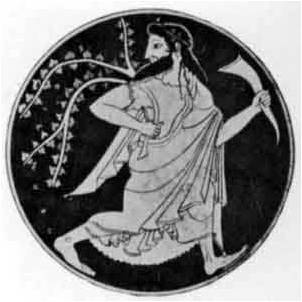
Dionysos was a métoikos in a city of Athens, a resident alien, and on the first two days of the festival, the métoikoi of the city got to wear brightly colored festival clothes--mostly purple--and carried trays of offerings in the processions, something métoikoi never got to do otherwise. The Athenian citizens, on the other hand, wore their day-to-day clothes and carried wine and bread with them, or herded the bulls which would be sacrificed. At the end of the processions, the statue of Dionysos was placed in His temple in the theater district, and sacrifices were made to Him. Flute players and poets held contests, and were eager to outdo each other. After all of this, the festival most likely became very Dionysian, indeed.

Singing and dancing had always been a big part of the City Dionysia, but after a while, the structure of the seven day festival became more apparent. Instead of random singing and dancing, from the third day onward, everyone flogged to the theaters to view the plays, whose names and creators had been announced the day prior. The next three days of the festival were devoted to the tragic plays. The three chosen playwrights performed three tragedies and one satyr play each, one set of plays per day. Famous playwrights include Aeschylus, Euripides, and Sophocles. They were judged by judges (agonothetai) chosen on the second day.

On the sixth day of the festival, five comedies by famous playwrights like Philemon, Chionides, and Aristophanes were performed. Comedies were of secondary importance at the Dionysia--the Lenaia was far more important for those--but winning the comedic prize at the Dionysia was still regarded a great honor. It seems that, from the fifth century BC onwards, plays could be recycled, and the audience seemed to have appreciated it. These plays were fan favorites, and were not rushed to completion.

Another procession and celebration was held on the final day, and the winners of the competitions were declared. The winning playwrights won a wreath of ivy, or a goat, although, when old plays were performed, the producer was awarded the prize rather than the long-dead playwright.

The Dionysia ta en Astei always seems like the perfect time for an impromptu karaoke competition, or one of those performance nights you had at camp. Personally, I think it would be a hoot to perform plays or other forms of entertainment for other members of your thiasoi. Alternatively, watching movies, attending plays, or even engaging in a few rounds of Rock Band or Guitar Hero would greatly amuse Dionysos. It's a time to have fun, but also to take a critical look at humanity and society: that was the purpose fo many of the tragedies. Remember that undercurrent while you revel, and the Dionysia ta Megala should be a great success.

Image source: Dionysos
"On top of the Acropolis, the oxen are released from the temple of Zeus Polieus. Outside, put out in sacrifice to the mighty Protector of the City, lie cakes on a table, and the oxen sniff them readily as they are herded past them. Nearby, two women with bowls of water in their hands stand by a man who is sharpening an axe and knife, using the water sporadically to cool and clean the blades. They watch as the third oxen in line reaches for one of the cakes with eager lips, devouring the sweet product merrily. One of the nearby men shouts at the ox, and--enraged at the cow's desecration--rushes to the man who is sharpening his weapons. He grabs the double-bladed axe and with one big swing, ends the life of the ox. As the ox falls dead on the ground, the Ox-Slayer realizes what he has done, and drops the axe in mortification. As fast as his legs can carry him, he flees the scene. 

Those who have witnessed the events rush to butcher the slain animal and sacrifice it properly to Zeus Polieus. All who witnessed the slaying, eat the flesh of the murdered ox. The hide of the ox is stuffed with hay and sewn closed. The filled skin is put in front of a yoke, out in the field. Afterwards, a hunt begins for the murderer of Zeus' sacred ox. He is found, eventually, and brought to trial. The man says it was not his fault he slew the animal; the man who had been sharpening the axe should not have been there. If he had not been there, he would never have been able to slay the ox. And so, the sharpener is heard. He, also, pleads innocence: if the women with the water had not been there, he could not have sharpened the axe, and he would not have been there. The women are called to explain themselves. They, too, claim the death of the ox is not their fault: they would not have been there if the axe had not needed sharpening. And so, the axe is heard, as well as the knife used to cut up the animal, but the objects remain silent. Because they will not defend themselves, they are found guilty of the murder of the ox, and as punishment, are tossed off of a cliff, into the sea below."

Every year on the fourteenth day of Skirophorion, from the time of Erechtheus (1397 - 1347 BC) to--at least--the second century AD, this odd ritual was reenacted. It was called the 'Bouphónia' (βουφόνια), and was part of another festival; the 'Dipolieia' (τὰ Διπολίεια), a feast in honor of Zeus Polieus (Zeus of the City). Philosopher Porphyrios (Πορφύριος) (234 - 305), a Neoplatonist, in book two of his 'De Abstinentia' (On Abstinence) writes the following on its origins:

"...And Diomus, who was a priest of Jupiter Polieus was the first that slew an ox; because, when the festival sacred to Jupiter and called Diipolia, was celebrated, and fruits were prepared after the ancient manner, an ox approaching tasted the sacred cake. But the priest, being aided by others who were present, slew the ox." (2.10)

"The ox, therefore, being killed, Diomus, whose anger was now appeased, at the same time perceived what kind of deed he had perpetrated. And the ox, indeed, he buried. But embracing a voluntary banishment, as if he had been accused of impiety, he fled to Crete. A great dryness, however, taking place in the Attic land from vehement heat, and a dreadful sterility of fruit, and the Pythian deity being in consequence of it consulted by the general consent the God answered, that the Cretan exile must expiate in the crime; and that, if the murderer was punished, and the statue of the slain ox was erected in the place in which it fell, this would be beneficial both to those." (2.29)

"From that time also, even till now, during the festival sacred to Jupiter, in the Acropolis at Athens, the sacrifice of an ox is performed after the same manner. For, placing cakes on a brazen table, they drive oxen round it, and the ox that tastes of the cakes that are distributed on the table, is slain. The race likewise of those who perform this, still remains. And all those, indeed, who derive their origin from Sopater [Diomus] are called boutupoi [i.e. slayers of oxen]; but those who are descended from him that drove the ox round the table, are called kentriadai, [or stimulators.] And those who originate from him that cut the throat of the ox, are denominated daitroi, [or dividers,] on account of the banquet which takes place from the distribution of flesh. But when they have filled the hide, and the judicial process is ended, they throw the knife into 
the sea."(2.29)

Various authors name various people to commit the first slaying; Porphyrios names Diomus, priest of Zeus Polieus; Theophrastos (371 – 287 BC), a student of Aristotle, names a man called 'Sopatros' as the culprit, a métiokos who occupied a farm in Attika; and Androtion, a Hellenic orator from around 350 BC names a man called Thaulon as the killer, although he offers no more details than his name. The myth remains largely the same, though; the man in question slays the ox, flees, and is pursued to stand trial--usually because a drought or famine plagued Athens afterwards and an oracle (usually the oracle at Delphi) decreed that the punishment would only be lifted once the culprit was brought to justice. In all versions, those who witness the murder of the ox eat of the ox's flesh, and otherwise perform tasks in its processing. In most versions, the ox's skin is filled with hay and put in front of the plough. In almost all versions, the axe is eventually blamed for the murder, and destroyed--usually by tossing it off of a cliff; only once, is the axe aquatinted in tribunal. Porphyrios goes on to describe the ritual above and then writes:

"An inquiry therefore being made into the affair, and Sopater [Diomus], together with the deed, having been discovered, he, thinking that he should be liberated from the difficulty in which he was now involved, through the accusation of impiety, if the same thing was done, by all men in common, said to those who came to him, that it was necessary an ox should be slain by the city. But, on their being dubious who should strike the ox, he said that he would undertake to do it, if they would make him a citizen, and would be partakers with him of the slaughter. This therefore, being granted, they returned to the city, and ordered the deed to be accomplished in such a way as it is performed by them at present."

Porphyrios, who was an avid proclaimer of vegetarianism, has two interesting theories: that the ancient Hellenes only sacrificed bloodless offerings to the Theoi before Diomus killed one of Zeus Polieus' sacred oxen, and that is was a criminal offense to sacrifice domesticated animals (like plow oxen) to the Theoi, because these animals had been exposed to us human for so long that they became 'too human' to sacrifice--to do so, and to eat the meat of them, was cannibalistic, according to Porphyrios.

Interesting in this myth and ritual are the miasma occurred in the sacrifice, and the guilt that is evident in it. Mind, this version of the myth stems from the second century AD, and is undoubtedly colored by its time. The death of the ox is always described as 'a kill', or 'killing'; it's not a 'death', or 'sacrifice'. The kill only becomes a sacrifice when the animal is cut up and properly offered to Zeus Polieus. Diomus goes into voluntary exile after his kill--a clear sign that what he has done is a crime, but perhaps not in the way we might look at it; that Zeus Polieus was angry for slaying one of His sacred animals, but more because of the type of animal he has killed, a crime against humankind, not the Theoi--and when he comes back, the community shares the blame for the kill. In Porphyrios' vision, everyone who commits sacrifice and partakes in the meat of an animal, is tainted in some way; they are fundamentally impure--tainted, with miasma.

In true mythic fashion, it takes a drought or plague, as well as an oracular message, to symbolize the ethical struggle of the Athenians: the corruption of morals Porphyrios (and others like him) subscribed to the Athenians in the start of the sacrifice of (domesticated) animals and the relief of said guilt when the Bouphónia became a ritual to relief such guilt and pollution. It's even possible that the few lonely participants in later versions of the annual sacrifice--because sources indicate this festival became rather obscure in later years, and thus likely to be visited only by those who had familial roles in it--absolved this miasma and guilt for all Hellenes who committed animal sacrifice. Of course, these priests might have had absolutely no clue why they performed these rites; it was tradition to do so, and the rite was overseen by a very important Theoi, so they acted it out, year after year.

It seems to me that there is an underlying theme to this myth, and its subsequent festival: that an animal which is slaughtered by a man alone, is killed, yet an animal which is slaughtered by a group becomes a sacrifice. Not really a great case for abstinence of animal flesh, but my take on the myth, regardless. I come to this conclusion from Diomus' demand to become a citizen in exchange for sacrificing the oxen in years to come--a role inherited by his family line, sources say. By joining the Athenians, it is not just Diomus who slays the animal each year, but the community. It's another form of The Blame Game, which is also played with the axe and knife; because everyone is responsible, no one is responsible. No longer is animal sacrifice the act of one man, but it is an act everyone is involved in, because everyone has a part. No longer is one man polluted by the act, everyone is, and because of that, no one is truly polluted by the killing of an animal--when that animal is subsequently sacrificed tot he Theoi.

Although the community shares the blame, the entire ritual is aimed at relieving this blame: in most versions of the myth, it is a métoikos who commits the crime, the ox, the axe, and the knife that is used to cut up the animal, are equally to blame for the death. In some versions of the myth, the animal is buried like a man. The weapons are ritualistically tossed away. There is a term in psychology which applies to what happens in the Bouphónia myth; a term now mostly used in the setting of (domestic) violence. The term is 'reciprocal violence'; it pertains to the cancellation of guilt when two parties inflict the same thing (upon each other or together). In the case of domestic violence, it relates to the notion that partners psychologically cancel out the pain they inflict upon each other, reasoning it away as saying 'but I did it to', or 'he/she did it first, but I did it as well'.

Here, we see the same cycle; everyone is 'to blame' for the death of the ox, simply by being there, and in order to break the circle, an inanimate object--which, obviously, can not defend itself, thus the cycle can not possibly continue--it chosen to bear the blame, thus relieving it off of everyone else. The blame (and miasma) is placed on either the axe alone, or the knife as well, and relieved by destroying the object(s) it is placed upon. I'm reminded of the dog that was sometimes sacrificed to Hekate at the Deipnon--touched by all members of the family so miasma was transfered onto it--although it seems irreverent to compare Porphyrios' main case against animal sacrifice with an animal sacrifice. Yet, it is also telling that the animal is 'resurrected', in a fashion, by stuffing it and putting it back out on the field, in front of a plough. By denying the murder happened, the whole reason to blame anyone is taken away. It's the ultimate break of the cycle.

The Bouphónia is an ancient ritual, archaic even in classical times. Much of it founding is lost to us. We do know that animal--and prior to that, human--sacrifice was committed for a long, long time, probably way before Diomus slayed this fabled ox. Exactly what function it served to the ancient Hellenes, we will most likely never know. When June rolls around, it's most likely best to simply celebrate the Dipolieia, and not the Bouphónia. A simple libation to Zeus Polieus will do. If you feel the need, you could always perform a version of the Bouphónia where no animals are killed, but a (clay or wax) figurine is slain, sacrificed, and the blade that killed it (also clay or wax) is destroyed. If the festival did have to do with the relieving of guilt over animal sacrifice, reenacting the Bouphónia might be a pleasant ritual for those who practice some form of it. Again, I stress that this is one of the few festivals that one can simply leave in the past. It served a purpose we are not sure about today, and while the sacrifice was important to the ancient Athenians, the worship of Zeus Polieus on the same day was more important, even then.

Image source: ox.
Today--at dusk--the Lênaia (Λήναια) festival starts. This three-day festival honors Dionysos and has a multitude of links to the Lesser Dionysia. In fact, it's been described as an urban version of the Lesser Dionysia, but without the grander of the greater Dionysia.


The Lênaia is held--roughly--at the coldest time of year in Hellas. It's dedicated to Dionysos Lênaios (Ληναιος, of the wine press), and is almost undoubtedly a fertility festival, which was celebrated to encourage the earth to thaw and soften, and become ready for sowing. It is said that the Lênaia celebrates the birth of Dionysos--or at least the version of His birth from Zeus's thigh, but this is most definitely not a supported theory by the whole of the scholastic community. This festival is tied to Dionysos' role as Year-Daímōn in which He was conceived at Agrai, located on the banks of the Ilissus River on the Hellenic peninsula near Athens. The word 'Agrai', pertains to both the place name and the rites of Dionysos held there--most commonly referred to as the 'lesser Mysteries' (20-26 Anthesterion). Another reason for the name of the festival might be the female revelers that often partook of Dionysos' worship and were named Maenads, or Lenai.

The Lênaia was an ancient, local, mostly Athenian, festival, although it was locally celebrated elswhere as well. In Athens, no one from another city could attend. This was partly an inevitability, seeing as the seas at this time were the most dangerous of the year. It's documented that the Lenaion--most likely a theatre outside of the city or a section of the Agora--was the stage for the Lênaia, and might have been the earliest shrine of Dionysos at Athens. Eventually, the Theatre of Dionysos was built, and the Greater Dionysia became the main festival for the performance of drama, but tragedies and comedies were also put on during the Lênaia. In fact, they were the main event.

At the public level this was primarily a theatrical and civic affair, and the city invoked the god Dionysos in his role as bringer of wealth and the blessings of civilization. The festival might have started with a procession from the wilds outside of Athens, into the civilization of Athens itself. During the procession, the Daidukhos (Torch-bearer) yelled, “Invoke the God!” and the celebrants responded, "Son of Semele, Iakkhos, Giver of Wealth!”. (Parke, Festivals of the Athenians, p 104–4) This procession might have played out (parts of) the early myths surrounding Dionysos, where He and his revelers came to His cousin Pentheus, but were imprisoned. Dionysos broke Himself and His revelers out, and tried to explain His worship to His cousin. Yet, Pentheus would not listen, so Dionysos left him to his anger. He took His followers--including many local women, including Pentheus' mother and sister--to the hills. When Pentheus pursued Him, He drove the women mad. To them Pentheus appeared to be a moutain lion. In a berserk rage, they attacked him, and his mother--who was first to reach him--ripped his head off, while the others tore off his limbs.

At midnight on at least one of the days, revelers took to an all-night ecstatic dance, dressed up and bearing various musical instruments (the thyrsus, castanets, tambourines and flutes, primarily). They danced in front of a representation of Dionysos, usually a simple post, dressed in a man’s tunic, with garlanded branches like upraised arms, and with a bearded mask of Dionysos. It's this bear that often discourages scholars from interpreting the Lênaia as a festival to celebrate Dionysos' birth. Wine was a large part of the dance and stood on a table in front of the idol; generally, this wine was the last of the old.

There were massive parades through the streets during the days, which were led by the Archōn Basileus and the officials who oversaw the sacred ceremonies of the Eleusinian mysteries. There were speeches by political figures, awards were given to outstanding citizens, veterans and their families, and business was discussed in the open, and with gusto. Tragedies and comedies were performed, but comedies were the main focus. While the plays were wonderful, many people looked forward to the household part of the festival more, though, as it was encouraged to get at least somewhat tipsy and ward off the cold in bed with your partner.

It's interesting to note that during the midwinter celebrations of Dionysos, a group of revelers roamed Mount Parnassos at Delphi (we mostly know this from an account where they had to be rescued off of the mountain when a blizzard struck), and it is attested that every second year, the Delphic women were joined by women from Athens. The Lênaia might have been the main Dionysian festival for these Athenian women.

The Lênaia starts at the twelfth and ends either on the fourteenth or fifteenth of the month. Personally, I feel it ends at dusk on the fifteenth, as that would make up the full three days attested to (from dusk on the twelfth, to dusk on the fifteenth). It can be celebrated with wine, by seeing a show or movie, and by spending some time in bed with your lover--in fact, it's much like the Haloa festival in this regard. It's a festival mostly aimed at having a good time, and enjoying the good things in life, despite the cold outside. Offer wine to Dionysos, and dance for Him, if you feel so inclined. I'm pretty sure He would appreciate it.
Alright, so I'm writing this with a fever. If it makes a little less sense than usual, I'm sorry. Right, on we go. Last week, for the last Pagan Blog Project post of 2012, I listed the mythical kings of ancient Athens. I ended that list with Codrus (Κόδρος), who ruled Athens from 1089 to 1068 BC. His son Medon was (probably) the first who ruled the city-state as árchōntes. From that post:

During the Dorian invasion, the Oracle of Delphi prophecied that the Dorians would win, as long as the king of Athens was not harmed. Hearing of this prophecy, Codrus disguised himself as a peasant and snuck to the Dorian camp. Here, he made a fuss, and was prompty killed. The Dorians retreated upon learning what had happened. It was decreed that no one would be worthy enough to succeed Codrus on the throne, and so, Athens only had archons afterwards.

The árchōntes did not rule as kings; where kings were sole rulers of the city state, árchōntes ruled first in threes, then in nines, then in tens and their power did not extend to law-making. Indeed, the Athenians had a clear understanding of the difference between sovereign power and executive government, and they kept the two separate far more than any modern government.

The system started with three archons: the 'Archōn Epōnymos' (ἄρχων Ἐπώνυμος), the 'Polemarchos' (πολέμαρχος), and the 'Archōn Basileus' (Ἄρχων Βασιλεύς). Together, these three oversaw the tasks the ancient kings had carried alone.
  • The Archōn Epōnymos was the chief magistrate. He was in charge of the affairs of Athens' citizens. He served as an ancient mayor for the city, and the year was named after him. 
  • The Polemarchos--in the early days--was charged with all affairs of war. The entire army fell to him, and it was up to him to make military decisions for the whole of the city-state. As we will see later on, this part of his job was transfered to the 'stratēgoí' when it became too large a job for one man. From that time on, he would be in charge of the city's métoikos, the resident aliens. He became a mayor in his own right, but for anyone not citizen or slave.
  • The Archōn Basileus were the spiritual inheritors of the mythic kings of Athens. Most notably, the Archon Basileus was in charge of religious and artistic festivals.
As Athens grew, it became impossible for three men to take on this job on their own. Six others were commissioned. These were the Thesmothétai (Θεσμοθέται), 'junior' archons, who worked at the thesmotheteion. A tenth position was added to the árchōntes (ἄρχοντες) around the fifth or fourth century BC. It was called the 'Grammateîs' (γραμματεῖς) and he who took up the role, served as a secretary with a large variety of tasks.

Originally the árchōntes were chosen from the 'eupatridae'--those who were 'good fathered'--by elections every ten years, but after 508 BC the titles were held for only a single year. Other changes came in 487 BC, when the archonships became assigned by lot to any citizen, and the Polemarchos' military duties were taken over by a new class of generals known as 'stratēgoí' (στρατηγοί). The ten stratēgoí were elected from the ten tribes of Athens, and the office of Polemarchos was rotated among them on a daily basis. The Polemarchos himself had only minor religious duties from that point forward, as well as titular headship over the stratēgoí. When democracy was instituted in Athens, the Archōn Epōnymos remained the titular head of state, although his position became a lot less important.

So, how were these people chosen for the árchōntes? Well, the ancient Athenians fiddled with the system quite a bit to get it functioning the way they wanted it, but there was one common element that--as said--was always included: lot. Every single citizen had a chance to serve a term as árchōntes. Each of the ten Athenian tribes supplied candidates, who were selected by lottery from across the tribe. All citizens of Athens then voted on the thee to ten people they thought would do the best job. Some years, this meant that some of the least-capable men of a tribe ruled the entire city-state, but that was something that the citizens just dealt with.

This democracy I just spoke of, by the way, was a lot different than the democracy of modern times. In fact, I think the ancient Hellenes would have raised an eye-brow or two if someone were to tell them about our modern ideas about democracy. In ancient Athens, sovereign power was held by the ekklesia, and only by the ekklesia. The árchōntes didn't factor into lawmaking at all. Every citizen in ancient Hellas had the right to vote on new or changing laws and was thus required to be aware of them and have an opinion on them; a direct democracy. Very roughly measured, about a quarter of the inhabitants of ancient Athens were eligible to vote. At the height of ancient Athens, this would have constituted about 25,000 men. 6,000 were needed before any vote even went up. On slow days, serfs who were part of the Scythian Guard literally wrangled citizens(!) into the halls, with a rope smeared with red ochre--called a 'miltos'--to get enough bodies in the seats.

Getting 25,000 people--or even 6,000--to do anything in union is a very daunting task, so the ancient Athenians formed a 'boule' (βουλή), who met at the 'bouleterion'. The term comes from the ancient Greek word for 'citizens': bouleutai (βουλευταί). I touched briefly upon the ten tribes of ancient Athens, and I will do so again now. In the near future, I'll come back to them in greater detail, because to do so now would be beyond the scope of this post. Suffice to say that every citizen in Athens had to belong to one of the ten tribes, eight of which were named after the mythical kings. The boule was assembled from 50 men, chosen from each tribe, for a total of 500 men. They oversaw the daily workings of the city, administered justices, looked after the placement of orphans, etc.

The boule still consisted of far too many people to get anything done in an orderly fashion. The next step was to dilute an even smaller group from the 500 members of the boule. Five men from each of the ten tribes represented in the boule were chosen to form a subgroup called the 'prytaneis' (πρυτάνεις), for a total of fifty. Membership of the prytaneis was rotated each tenth of a year. This meant that if you were a member of the boule, you would serve roughly 36 days as a prytanis (πρύτανις).

During their days as prytanis, members of the prytaneis ate at public expense in the 'Tholos' (θόλος), a circular edifice constructed for them next to the bouleterion. In effect, they lived there for the duration of their time as prytanis. My guess as to why, is because they would be easy to find that way. Prythaneis were the only people who could summon the ekklesia in case of emergencies so, in case of emergencies, they needed to be locatable.

In short: ancient Athens was ruled by the ekklesia of about 25,000 voting citizens. The ekklesia, in turn, was managed by the boule of 500 citizens, taken from the ranks of the ekklesia. The boule, finally, was managed by 50 members of the boule, called the prytaneis. Everyone in the ekklesia voted, but their votes were tallied by the boule-members of their tribe, who related the votes to the prytanis of their tribe, who then tallied and proclaimed the votes.

With so many people living in modern countries, this system of árchōntes and direct democracy is outdated at best, but in that fever dream I have of a standardized Hellenismos, wouldn't this serve as the perfect base for standardization? With the on-line possibilities we have today, it would be easy for anyone who would want to, to join video conferences, vote through on-line voting tools and remain in contact through yahoo-groups, forums and/or social media. Never going to happen, you say? No, probably not, but a girl can dream, right?