Hellenismos, otherwise known as Greek Reconstructionist Paganism, is the traditional, polytheistic religion of ancient Hellas, reconstructed in, and adapted to, the modern world. It's a vibrant religion which can draw on a surprising amount of ancient sources. Baring the Aegis blogger Elani Temperance blogs about her experiences within this Tradition. For contact, please use the gmail address 'baring.the.aegis'.
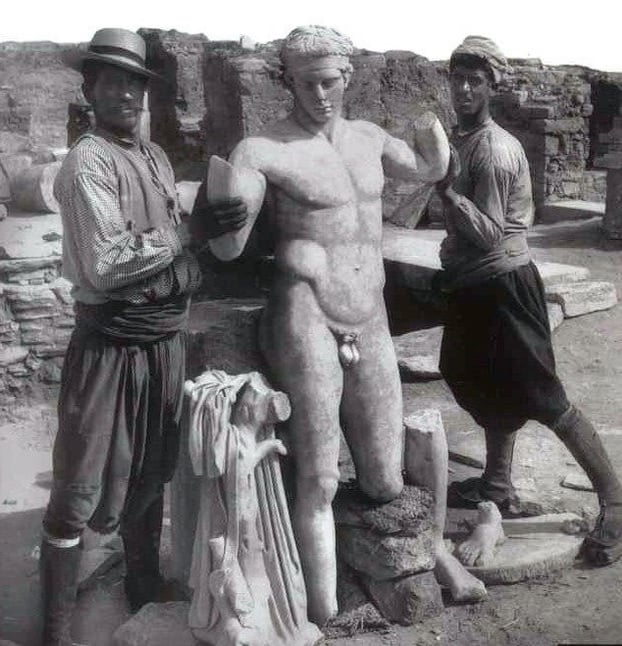
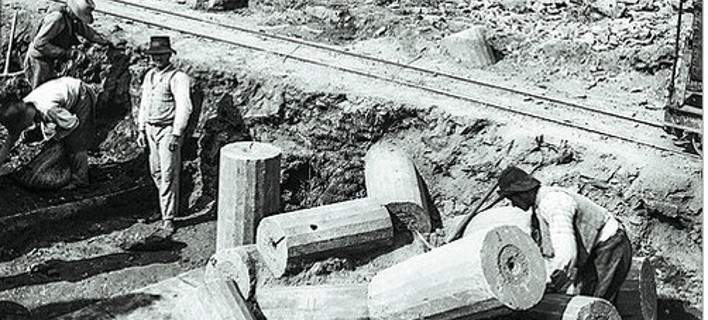
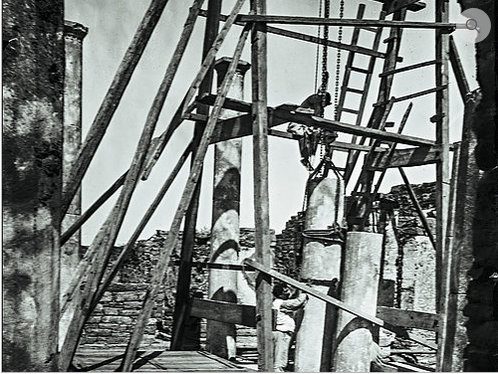
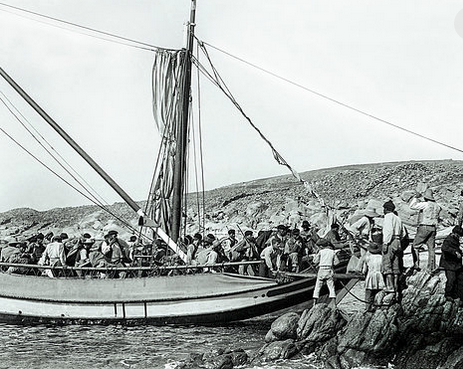
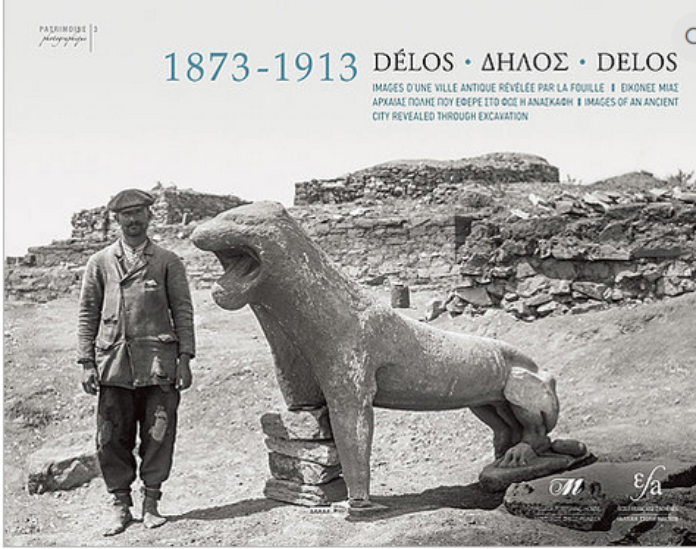
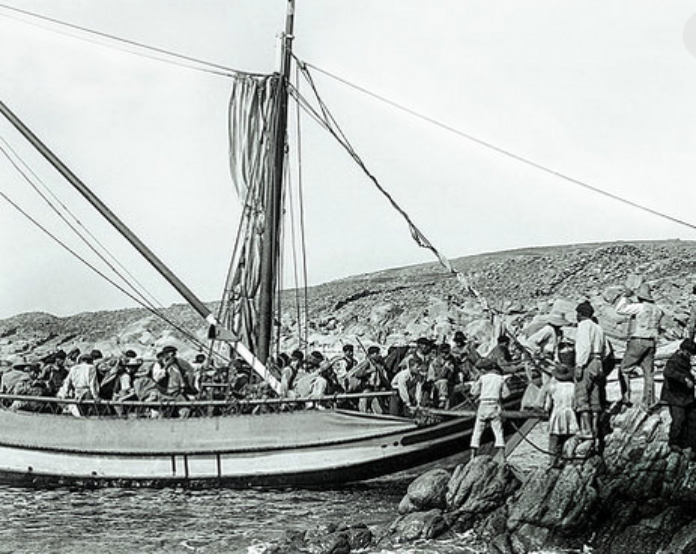
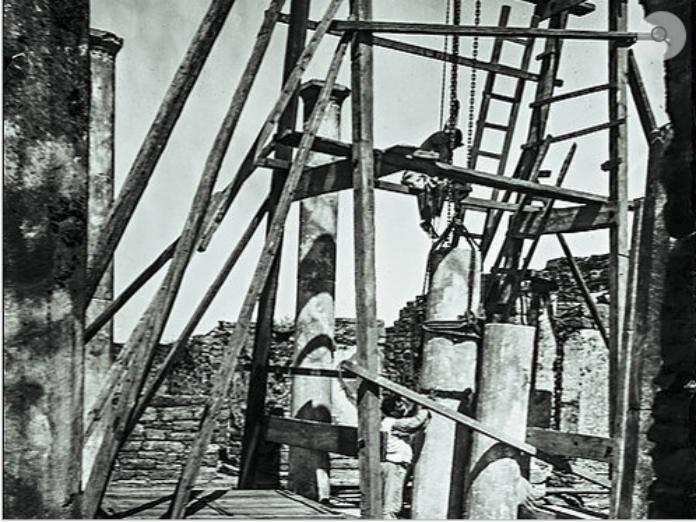
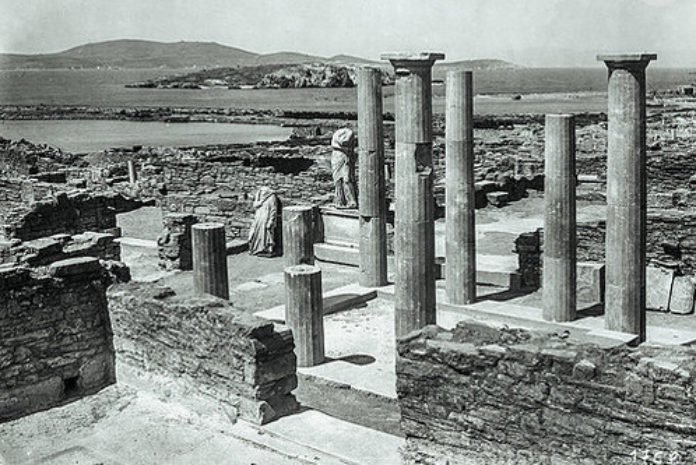
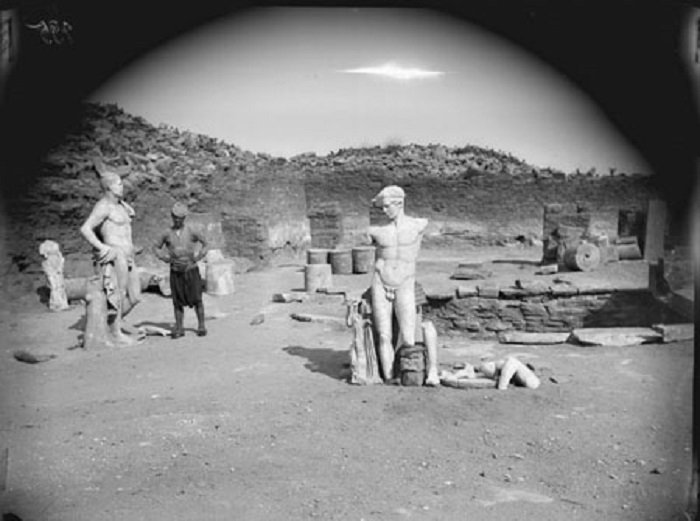
Rare photographs of the excavations at the Greek island of Delos from the 19th Century have come to light in a book by French archaeologists. The book “Delos 1873-1913” sheds light on the challenges facing the scientists and other skilled and unskilled workers who unearthed ancient monuments and artifacts in one of most important mythological, historical and archaeological sites in Greece.
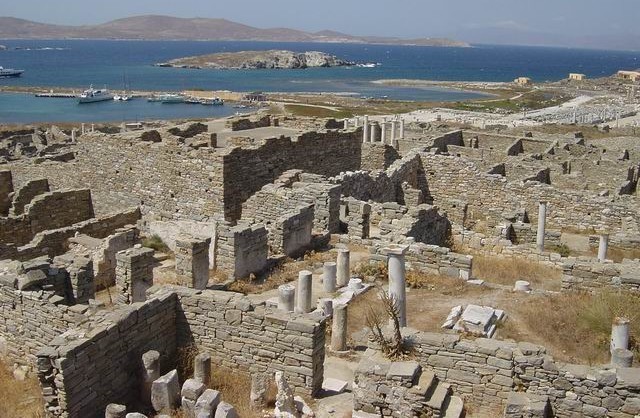
Delos (Δήλος) was one of the most sacred places of ancient Greece, and one of the most robust trade centers as well. Its claim as the birthplace of Apollo gave Delos a strong religious identity that lasted all the way until Byzantine times.
Over the centuries, Delos was truly a cosmopolitan center with a diverse population that included people from all around the Mediterranean, but in 88 BCE the Romans razed the island during their war with Mithridates (and ally of the Athenians who controlled the island), a calamity Delos never recovered from.
Until the First World War, on the instigation of T. Homolle and then M. Holleaux, the emphasis was on the clearing of large areas in the Sanctuary zone and on the northern slopes of Cynthus, although the rest of the island was not neglected.
Several years apart (1894 and 1907), two archaeological maps of the island were drawn up, while a study of its physical geography was successfully completed by the geologist L. Cayeux (EAD IV). From 1903 onwards, the excavations enjoyed annual financial support from Joseph Florimont, Duke of Loubat (1831-1927), a rich American philanthropist and foreign corresponding member of the Academy of Inscriptions and Belles-Lettres.
This major contribution to work in the field was complemented in 1920 by the creation of a Greek epigraphy fund to support the Institute, from which the income was used for the publication of the Choix d’inscriptions de Délos by F. Durrbach (1921) and the Corpus des inscriptions de Délos.
From the 1920s onwards, the efforts of the School’s members focused on the study of monuments, batches of equipment and inscriptions discovered in the previous decades, and exploratory research concentrated more on buildings than groups of monuments.
For those of you who, like me, are not blessed with the ability to write poetry beyond the level of an eight-grader, or for those who simply wish to draw they eyes of the Theoi by reciting poetry--or actually singing the hymns if your mastery of the Greek language allows it--which is familiar to Them, hymns form a wonderful addition to your practice. The oldest, and most well know, of the hymns are undoubtedly the Homeric ones, with the Orphic ones a close second, but there are many more out there.
Homeric Hymns - a collection of thirty-three Hellenic hexameter poems in epic style well known from Hómēros' Iliad and Odysseia. They range in length from three to five-hundred lines, and were composed in various time periods, by a variety of--now largely anonymous--authors. Hómēros might have actually written some of them, Pamphos might have penned the 'Hymn to Demeter', and Cynaethus of Chios might have penned the 'Hymn to Apollon'. Most of the poems were written between 800 and 300 BC, a few of the shorter poems are clearly from the Hellenistic (third or second century BC) period, and the Hymn to Ares was probably added to the whole in Roman times. Who actually combined the thirty-three is unclear. The first and second hymns ('To Dionysos', and 'To Demeter') were lost for a long time, until a chance discovery in Moscow in 1777 unearthed a fifteenth century manuscript with the two poems largely intact. The 'Hymn to Apollon' was noted down on the walls of Artemis' temple at Delos, and was most likely a large part of the festivals held there for Apollon. For all Homeric Hymns, go here.
Orphic Hymns - a collection of eighty-seven short religious poems composed in either the late Hellenistic or early Roman (first or second century AD) era. They are based on the beliefs of Orphism, a mystery cult or religious philosophy which claimed descent from the teachings of the mythical hero Orpheus. The Mysteries were mostly connected to Demeter, Persephone, life after death and reincarnation. From the Orphic Hymns also comes a list of which incenses to offer to which deity. For all Orphic Hymns, go here.
Hymns of Kallimachos (Καλλίμαχος) - a lesser known collection of poems, written by Kallimachos of Kyrēnē (Κυρήνη, Cyrene), who was a Hellenic poet and scholar of the Library of Alexandria. He rose to greatness around the third century BC and was the author of a large number of works. Unfortunately, only six hymns and sixty-three epigrams have survived to this day. Kallimachos despised the 'outdated' poetry type of Hómēros and wrote many testimonials against it. His hymns are, therefor, different to the eye than the Homeric and Orphic ones. For the complete hymns, go here.
Delphic Hymns - two musical compositions from ancient Hellas, dating back to 128 BC. They were recovered from the walls of the treasury of Apollon at Delphi, and were most likely performed in His worship at the Pythian festival. The first of the hymns was written and composed by Athenios, son of Athenios, the second by Limenios, son of Thoinos. For the first hymn, go here, for the second, go here.
Hymns of Proklos - Proclus (Πρόκλος) was a Greek Neoplatonist philosopher, one of the last major Classical philosophers. He was alive from 8 February 412 AD to 17 April 485 AD), and while a very late addition to this list, he wrote five beatiful hymns about the Roman Gods, which can be interpreted for the Hellenic ones as well. The surviving works consist of two hymns to Venus (Aphrodite), one to the Sun (Helios), one to the Muses, and one to Minerva (Athena). The surviving hymns can be found here, in both Greek and English.
Hymns of Mesomedes - Mesomedes of Krete (Μεσομήδης ὁ Κρής) was a Roman-era Hellenic lyric poet and composer of the early second century AD. He was a freedman and court musician to the emperor Hadrian (reigned 117-138 CE), and created three hymns and fifteen poems which have survived to this day. The hymns to Nemesis, the muse Calliope, and the Sun can be read here and listened to here. I am partial to this translation of the 'Hymn to Nemesis'.
Hymn to Aphrodite - This most wonderful hymn was written by Sappho (Σαπφώ) as she was struggling with love. It's unique in that it shows both petitioner and Aphrodite Herself. I am partial to this translation.
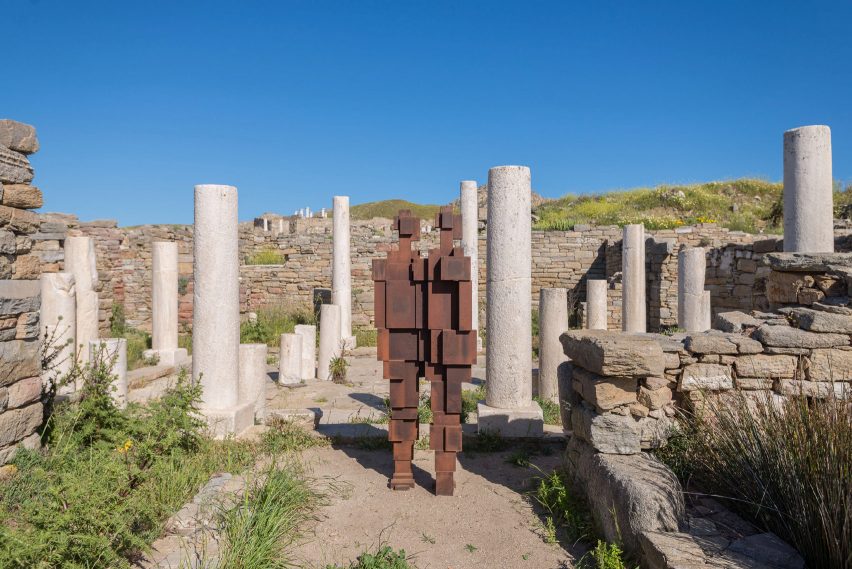
Delos, the mythological birthplace of the Apollon and Artemis is a three-mile-long granite outcrop in the middle of Cyclades archipelago that is one of Greece's most important archaeological sites. The ancient Greeks made Delos a cult centre for the worship of Apollo and Artemis between 900 and 100 BC, although the ancient stone huts on the island date from the third millennium BC. Under the Romans the island became a free port and the site of one of the region's largest slave markets. And now, artist Antony Gormley has unveiled Sight, an exhibition of 29 of his humanoid sculptures on the island.
British sculptor Gormley has installed the forms across the island taking advantage of both the scenery and ruined ancient Hellenic and Roman architecture.
"In this atmosphere of light there is a feeling of timeliness, of being outside industrial time. Sculpture is a threshold to another attitude to time; it provides the invitation to escape mechanised time as we know it."
Sight, which was commissioned by nonprofit art foundation Neon, includes five new works, displayed alongside 24 existing Antony Gormley pieces. The figures are displayed across the island, including among ruined ancient columns, at the centre of an amphitheatre, at the water's edge and standing in the sea.
The project was organised in collaboration with the Ephorate of Antiquities of Cyclades. Sight was curated by director of the Whitechapel Gallery Iwona Blazwick and Neon director Elina Kountouri. The exhibition, which is accessible via boat from Mykonos, Paros and Naxos Islands, is on display until 31 October 2019
I'm not going to lie, I'm conflicted. Considering the supervision, I doubt any harm has come to the ruins, but this is a holy site for me and many others. I also don't quite understand why the show had to be organized at that exact location.
The Greek Embassy in Berlin received an unexpected and heavy parcel a few weeks ago, the sender was a German citizen. On opening the suspicious parcel, authorities and experts were met with a surprise, three fragments of ancient Hellenic mosaics stolen from Greece decades ago, as a note clarified.
Two of the fragments were removed from the island of Delos in the Cyclades and the other one had been extracted from the Hadrian Liberality in Athens back in the 1960’s. According to a first examination by pharmacologists the two mosaics from Delos, had most likely been detached from the floor of a Hellenistic house dating back to 323 – 31 BC and the pieces are measured between 7 x 8 cm. Meanwhile, the mosaic from Athens, a 10 x 9 cm piece has been removed from the floor of the four-story building which dates back to back to the fifth century AD.
All three mosaics were sent back to Greece on 10 October and were handed to the Antiquities Departments in Cyclades and Athens respectfully.
Rare photographs of the excavations at the Greek island of Delos from the 19th Century have come to light in a book by French archaeologists. The book “Delos 1873-1913” sheds light on the challenges facing the scientists and other skilled and unskilled workers who unearthed ancient monuments and artifacts in one of most important mythological, historical and archaeological sites in Greece.
Delos (Δήλος) was one of the most sacred places of ancient Greece, and one of the most robust trade centers as well. Its claim as the birthplace of Apollo gave Delos a strong religious identity that lasted all the way until Byzantine times. Over the centuries, Delos was truly a cosmopolitan center with a diverse population that included people from all around the Mediterranean, but in 88 BCE the Romans razed the island during their war with Mithridates (and ally of the Athenians who controlled the island), a calamity Delos never recovered from.
The French School of Athens (FSA) in 1873 sent archaeologist A. Lebègue to begin excavating Delos. Until the First World War, on the instigation of T. Homolle and then M. Holleaux, the emphasis was on the clearing of large areas in the Sanctuary zone and on the northern slopes of Cynthus, although the rest of the island was not neglected.
Several years apart (1894 and 1907), two archaeological maps of the island were drawn up, while a study of its physical geography was successfully completed by the geologist L. Cayeux (EAD IV).
From 1903 onwards, the excavations enjoyed annual financial support from Joseph Florimont, Duke of Loubat (1831-1927), a rich American philanthropist and foreign corresponding member of the Academy of Inscriptions and Belles-Lettres.
This major contribution to work in the field was complemented in 1920 by the creation of a Greek epigraphy fund to support the Institute, from which the income was used for the publication of the Choix d’inscriptions de Délos by F. Durrbach (1921) and the Corpus des inscriptions de Délos.
From the 1920s onwards, the efforts of the School’s members focused on the study of monuments, batches of equipment and inscriptions discovered in the previous decades, and exploratory research concentrated more on buildings than groups of monuments.
The remains of ancient coastal structures and a port, a large number of shipwrecks dating back to various eras and significant smaller finds were found in underwater archaeological excavations conducted by the Ephorate of Underwater Antiquities at the island of Delos from May 2 until May 20, the Culture and Sports Ministry announced on Monday.
Archaeologists carried out an in-depth investigation of the ancient breakwater that protected the island’s central port in antiquity from the strong northwestern winds, which is now underwater because the sea level has risen by two meters since that time. According to the ministry, the breakwater was:
"[an] impressively strong structure, roughly 160 meters long and at least 40 meters wide, built on a pile of unshaped rocks, while its upper structure was for the great part constructed of granite blocks of impressive size."
The date of its construction remains unknown and further archaeological and geological research will be needed to discover this, it added. Other finds included the remains of walls and a fallen colonnade, the remains of a later Hellenistic era shipwreck carrying amphorae of oil and wine from Italy and the western Mediterranean, as well as another two shipwrecks from the same era off the southern tip of Delos and at Rineia, in Fylladi Bay. The mission also had the opportunity to photograph and map two more shipwrecks found in previous underwater explorations, at Kato Kerenale and near Fournoi. All the shipwrecks found date to the period between the end of the 2nd century and the 1st century B.E.C. when the island was at the height of its prosperity, before it was sacked by Mithridates and the pirates of Cilicia.
Archaeologists also stressed the discovery of amphorae dating to various periods and geographical regions, noting that these helped in the reconstruction of Delos' history through the ages. Finds from regions outside the Aegean--such as Italy, Spain and North Africa--demonstrated that the island had trade transactions throughout the Mediterranean during the Hellenistic period, while there were also earlier finds dating to the 5th century B.C. when little is known about the island's trade and transactions. Finds that antedate the sacking of the island, meanwhile, show that it continued to be inhabited and still played an important role in trade and navigation. The ministry announcement stated:.
"The finds confirm that Delos was an important trading base and an important maritime trade route through the ages, linking the east and west Mediterranean."
The exploration was carried out in collaboration with the French Archaeological School and the head of the Delos excavations Dr. Jean Charles Moretti, as well as Dr. Mantha Zarmakoupi of the National Hellenic Research Foundation, with assistance from underwater topographer Lionel Fantin of the French School and Spyridon Moureas providing technical support. The cost of the excavation was covered by the Ephorate of Underwater Antiquities, the French Archaeological School and the Society for the Promotion of Roman Studies. Many more images of the dives here.
Greece’s Central Archaeological Council has given the go-ahead to a project to help restore some of the most important monuments on the island of Delos, using a grant donated by the Paul and Alexandra Canellopoulos Foundation.
The project will launch a new era for the ‘sacred isle’ of Delos, which was considered the most important sanctuary of antiquity and the birthplace of the gods Apollo and Artemis. The project will be begin with the Stoa of Philip V, which is one of the first monuments that a visitor comes across but also the hardest to understand, since it is missing its ‘3rd dimension’.
The Cyclades Antiquities Ephorate, using the 550,000-euro donation from the Kanellopoulos Foundation, will now take action to restore the damage and the result of wear caused by salt water to the various architectural elements on the ground.
According to the head of the Cyclades Antiquities Ephorate Dimitris Athanasoulis, the restoration work on Delos – as in the case of the Philip V Stoa – was essential for the protection of the monuments, not just to help visitors understand them.
“Delos is a small island, where the salt corrodes everything. Architectural elements in such a hostile environment degenerate rapidly. Their restoration on the monument will greatly reduce the wear.”
While the urban neighbourhoods on Delos were well-preserved, Athanasoulis said, the same was not true of the sanctuary. He said the Ephorate’s strategy was to use EU and state funds on the 'emergency' projects and try to find sponsors and grants for the rest. He pointed out that the needs on Delos, due to the special conditions prevailing on the island, were similar to those in Pompeii where millions of euros in European funds were given each year.
A news roundup today as I am incredibly pressed for time. Lots happening in the world, after all!
Amazonian 'Wonder Woman' found on ancient Hellenic vase The Archaeological News Network reports that an accidental archeological discovery on a small cylindrical vase dated between 480-450 BC in the University of Mississippi’s David M. Robinson Memorial Collection revealed a warrior woman on horseback who had previously gone unnoticed. The image, drawn on a cyindrical box with a lid used by women of antiquity to keep jewelry or cosmetics showed an image of a woman embroiled in battle against an Hellenic warrior. More intriguingly, the woman, much like the DC Comics heroine Wonder Woman, has a lariet, a lasso, that she is preparing to throw over the warrior as he crouches behind his shield.
Amazons depicted in battle are not unusual per se, however Stanford University’s Departments of Classics and History of Science Professor Adrienne Mayor says that it is the only ancient artistic image of an Amazon using a lariat in battle though historians have given us descriptions of the warrior women using these. She discovered the vase while researching her book, titled 'Amazons: Lives and Legends of Warrior Women across the Ancient World'. Mayor says that ancient Hellenic women would have enjoyed scenes of Amazons getting the better of their male counterparts. She says that the illustration on the vase is both erotic and subversive.
At the presentation of an ancient marble head depicting the god Hermes, returned to Greece on Monday from Bonhams auction house as the product of illegal antiquities smuggling, Alternate Culture Minister Nikos Xydakis said it was proof of what Greece's archaeological service could accomplish. The ancient marble head is a Roman copy of a major Classical-era Hellenic sculpture by Alkamenes, originally housed in the south wing of the Acropolis Propylaea.
Xydakis went on to say that these actions are a reply to some of the exaggerated claims that the Greek government does not pursue stolen or auctioned antiquities. He noted that the case was unprecedented in that the artifact had not been on any of the archaeological service's lists and the evidence showing it was illegally exported had to be put together from scratch but was sufficiently strong as to convince the auction house.
The ancient marble head, about 24 cm high, was discovered among the works put up for auction by Bonhams and it was withdrawn after the culture ministry intervened. The minister stressed that Greece's efforts for the protection of its heritage were constant and in recent years had given the country considerable prestige and influence within international organisations. He also noted that changes during the EU presidency of the European Council had strengthened the EU legal framework for the return of stolen antiquities.
1-euro screenings at the Acropolis Museum
Every Saturday and every Sunday, the Acropolis Museum welcomes visitors to its Virtual Reality Theater where visitors have the opportunity to learn more about the Acropolis monuments from brief 3D video screenings. The ten-minute film “Acropolis in Antiquity” presents the topography and the monuments of the Rock of the Acropolis during the prehistoric, the Archaic and the classical period. The film aims to help visitors recreate and imagine the impressive sanctuary with the aid of 3D models.
Projections are held every Saturday and Sunday, at 11:00 a.m. in English and at 12 noon in Greek (1 euro special admission fee). For group reservations (more than 10 persons) a telephone booking is required on +30 210 9000903. Bookings can be made Monday to Friday, 9 a.m. to 5 p.m..
Concert at Athens Panathinaiko Stadium to fund new Delos museum
The new archaeological museum of Delos will be 'built' through voices of Greek and foreign artists, during the grand performance of July 2 in the Panathinaiko Stadium. The concert is being organized by the International Foundation for Greece (IFG). Proceeds will be donated for the building of the new Delos Museum, the design and study of which has been undertaken by the aforementioned Foundation.
The stage will play host to the following: Eleftheria Arvanitaki, Dimitra Galani, Alexandra Gravas, El Q, Luz Casal, Marc Lavoine, Lavrentis Mahairitsas, Yorgos Mihail – Alexandros Iakovou, Panos Mouzourakis, Nana Moushouri, Maria Nazionale, Yorgos Dalaras, Lambert Wilson, Vasilis Papakonstantinou, Dimitra Papiou, Yorgos Perris, Nikos Portokaloglou, Alkistis Protopsalti, Marios Frangoulis, Yannis Haroulis and Yorgos Horafas.
The presenters of the fabulous concert will be Nikos Aliagas and Stephan Bern.
In a time where economic crisis rules Greece and budget cuts in the culture sector are severe, I have two bits of good news for you: the Archaeology New Network reports that plans to built a Delos museum have been approved, and Ekathimerini reports that Athens has gotten the OK for the erection of an Alexander the Great statue.
Delos museum construction plans approved
The plans for the construction of a new museum on the Greek island of Delos were approved by the Central Archaeological Council, after the funds for the plans were collected.
According to the plans, the new museum will have to adhere to strict bio-climatic architectural standards and must be situated as far away as possible from the sea, in order to better protect the antiquities and the museum itself from the elements.
The new museum will occupy a space of at least 5,000 square meters and will feature all of the exhibits displayed in the existing museum, along with many other artefacts located on the island’s archaeological sites and in storage. The funds for the construction plans were donated by the London-based International Foundation for Greece.
Athens gets OK for erection of Alexander the Great statue
The Central Archaeological Council (KAS) has given the City of Athens the green light to erect a bronze statue of Alexander the Great at either of two places proposed by the municipal authorities.
The statue, which depicts the ancient conqueror at an early age, was crafted by Yiannis Pappas in 1992 but has never gone on public display due to bureaucratic problems.
Earlier this week, the mayor of Delta, in the northern region of Macedonia, asked the City of Athens, which now owns the statue, to donate the artifact. Athens officials said the statue would eventually be installed either on the junction of Vassilissis Olgas and Vassilissis Amalias avenues or at Asomaton Square in Thiseio.
For those of you who, like me, are not blessed with the ability to write poetry beyond the level of an eight-grader, or for those who simply wish to draw they eyes of the Theoi by reciting poetry--or actually singing the hymns if your mastery of the Greek language allows it--which is familiar to Them, hymns form a wonderful addition to your practice. The oldest, and most well know, of the hymns are undoubtedly the Homeric ones, with the Orphic ones a close second, but there are many more out there.
Homeric Hymns - a collection of thirty-three Hellenic hexameter poems in epic style well known from Hómēros' Iliad and Odysseia. They range in length from three to five-hundred lines, and were composed in various time periods, by a variety of--now largely anonymous--authors. Hómēros might have actually written some of them, Pamphos might have penned the 'Hymn to Demeter', and Cynaethus of Chios might have penned the 'Hymn to Apollon'. Most of the poems were written between 800 and 300 BC, a few of the shorter poems are clearly from the Hellenistic (third or second century BC) period, and the Hymn to Ares was probably added to the whole in Roman times. Who actually combined the thirty-three is unclear. The first and second hymns ('To Dionysos', and 'To Demeter') were lost for a long time, until a chance discovery in Moscow in 1777 unearthed a fifteenth century manuscript with the two poems largely intact. The 'Hymn to Apollon' was noted down on the walls of Artemis' temple at Delos, and was most likely a large part of the festivals held there for Apollon. For all Homeric Hymns, go here.
Orphic Hymns - a collection of eighty-seven short religious poems composed in either the late Hellenistic or early Roman (first or second century AD) era. They are based on the beliefs of Orphism, a mystery cult or religious philosophy which claimed descent from the teachings of the mythical hero Orpheus. The Mysteries were mostly connected to Demeter, Persephone, life after death and reincarnation. From the Orphic Hymns also comes a list of which incenses to offer to which deity. For all Orphic Hymns, go here.
Hymns of Kallimachos (Καλλίμαχος) - a lesser known collection of poems, written by Kallimachos of Kyrēnē (Κυρήνη, Cyrene), who was a Hellenic poet and scholar of the Library of Alexandria. He rose to greatness around the third century BC and was the author of a large number of works. Unfortunately, only six hymns and sixty-three epigrams have survived to this day. Kallimachos despised the 'outdated' poetry type of Hómēros and wrote many testimonials against it. His hymns are, therefor, different to the eye than the Homeric and Orphic ones. For the complete hymns, go here.
Delphic Hymns - two musical compositions from ancient Hellas, dating back to 128 BC. They were recovered from the walls of the treasury of Apollon at Delphi, and were most likely performed in His worship at the Pythian festival. The first of the hymns was written and composed by Athenios, son of Athenios, the second by Limenios, son of Thoinos. For the first hymn, go here, for the second, go here.
Hymns of Proklos - Proclus (Πρόκλος) was a Greek Neoplatonist philosopher, one of the last major Classical philosophers. He was alive from 8 February 412 AD to 17 April 485 AD), and while a very late addition to this list, he wrote five beatiful hymns about the Roman Gods, which can be interpreted for the Hellenic ones as well. The surviving works consist of two hymns to Venus (Aphrodite), one to the Sun (Helios), one to the Muses, and one to Minerva (Athena). The surviving hymns can be found here, in both Greek and English.
Hymns of Mesomedes - Mesomedes of Krete (Μεσομήδης ὁ Κρής) was a Roman-era Hellenic lyric poet and composer of the early second century AD. He was a freedman and court musician to the emperor Hadrian (reigned 117-138 CE), and created three hymns and fifteen poems which have survived to this day. The hymns to Nemesis, the muse Calliope, and the Sun can be read here and listened to here. I am partial to this translation of the 'Hymn to Nemesis'.
Hymn to Aphrodite - This most wonderful hymn was written by Sappho (Σαπφώ) as she was struggling with love. It's unique in that it shows both petitioner and Aphrodite Herself. I am partial to this translation.