Showing posts with label Helios. Show all posts

I love knowing how far Hellenic mythology and the Gods still reach and how they impact our lives without us even being aware of it. Today, I want to present you with a list of the Hellenic influence on the names of chemical elements--either through mythology or simply through language.


Argon (Ar) From the Greek word "argos" which means idle or lazy. Argon is one of the laziest, least reactive elements of all. There are also many mythological figures named "Argos", but those are not whom the element was named after.

Bromine (Br) - From the Greek word "bromos" which means stench. Bromine has an unpleasant smell.

Chlorine (Cl) From the Greek word "chloros" which means green. Chlorine is a green gas.

Helium (He) - Named after the God Helios. In 1868, during an eclipse of the Sun, scientists observed a spectral line caused by an unknown element. They named the element Helium. Twenty seven years later, in 1895, the element was discovered on Earth.

Hydrogen (H) - From the Greek words "hydro" and "genes" which mean water and forming. When hydrogen burns in the air, it forms water.

Iodine (I) - From the Greek word "iodos" which means violet. Iodine is a grey solid at room temperature. It gives off a violet colored vapor when warmed.

Niobium (Nb) - It is a soft, grey, ductile transition metal, which is often found in the pyrochlore mineral, the main commercial source for niobium, and columbite. Its name comes from Niobe, daughter of Tantalus, the namesake of tantalum (see below). The name reflects the great similarity between the two elements in their physical and chemical properties, making them difficult to distinguish.

Oxygen (O) - From the Greek words "oxy" and "genes" meaning acid forming. Most non-metals burn in oxygen to form acids eg. sulphur.

Phosphorous (P) - From the Greek word "phosphorus" which means "light bearing". It was also the ancient name for the planet Venus, usually the brightest "star" in the night sky. Phosphorous glows in the dark and catches fire in the air to give a bright flame.

Tantalum (Ta) - Named after King Tantalos. It was discovered in 1802 and great difficulties were encountered in dissolving its oxide in acid to form salts, which is most likely how it got its name--King Tantalos was imprisoned in Tartaros for serving the son he murdered to the Gods when They came to dinner. Tantalos' punishment for his actions was to stand in a pool of water beneath a fruit tree with low branches. Whenever he reached for the fruit, the branches raised his intended meal from his grasp. Whenever he bent down to get a drink, the water receded before he could get any. 

Titanium (Ti) - Named after Titans, members of the second generation of divine beings, descending from the primordial deities and preceding the Olympian deities. They are giant deities of incredible strength. Titanium is an extremely strong metal which resists attack by acids.

I love knowing how far Hellenic mythology and the Gods still reach and how they impact our lives without us even being aware of it. Today, I want to present you with a list of the Hellenic influence on the names of chemical elements--either through mythology or simply through language.


Argon (Ar) From the Greek word "argos" which means idle or lazy. Argon is one of the laziest, least reactive elements of all. There are also many mythological figures named "Argos", but those are not whom the element was named after.

Bromine (Br) - From the Greek word "bromos" which means stench. Bromine has an unpleasant smell.

Chlorine (Cl) From the Greek word "chloros" which means green. Chlorine is a green gas.

Helium (He) - Named after the God Helios. In 1868, during an eclipse of the Sun, scientists observed a spectral line caused by an unknown element. They named the element Helium. Twenty seven years later, in 1895, the element was discovered on Earth.

Hydrogen (H) - From the Greek words "hydro" and "genes" which mean water and forming. When hydrogen burns in the air, it forms water.

Iodine (I) - From the Greek word "iodos" which means violet. Iodine is a grey solid at room temperature. It gives off a violet colored vapor when warmed.

Niobium (Nb) - It is a soft, grey, ductile transition metal, which is often found in the pyrochlore mineral, the main commercial source for niobium, and columbite. Its name comes from Niobe, daughter of Tantalus, the namesake of tantalum (see below). The name reflects the great similarity between the two elements in their physical and chemical properties, making them difficult to distinguish.

Oxygen (O) - From the Greek words "oxy" and "genes" meaning acid forming. Most non-metals burn in oxygen to form acids eg. sulphur.

Phosphorous (P) - From the Greek word "phosphorus" which means "light bearing". It was also the ancient name for the planet Venus, usually the brightest "star" in the night sky. Phosphorous glows in the dark and catches fire in the air to give a bright flame.

Tantalum (Ta) - Named after King Tantalos. It was discovered in 1802 and great difficulties were encountered in dissolving its oxide in acid to form salts, which is most likely how it got its name--King Tantalos was imprisoned in Tartaros for serving the son he murdered to the Gods when They came to dinner. Tantalos' punishment for his actions was to stand in a pool of water beneath a fruit tree with low branches. Whenever he reached for the fruit, the branches raised his intended meal from his grasp. Whenever he bent down to get a drink, the water receded before he could get any. 

Titanium (Ti) - Named after Titans, members of the second generation of divine beings, descending from the primordial deities and preceding the Olympian deities. They are giant deities of incredible strength. Titanium is an extremely strong metal which resists attack by acids.
The Iliad (Ἰλιάς) is an ancient Hellenic epic poem, traditionally attributed to Homeros. It's set during the Trojan War, the ten-year siege of the city of Troy (Ilium) by a coalition of Hellenic states, it tells of the battles and events during the weeks of a quarrel between King Agamemnon and the warrior Achilles. Although the story covers only a few weeks in the final year of the war, the Iliad mentions or alludes to many of the Hellenic legends about the siege; the earlier events, such as the gathering of warriors for the siege, the cause of the war, and related concerns tend to appear near the beginning. Then the epic narrative takes up events prophesied for the future, such as Achilles' imminent death and the fall of Troy, although the narrative ends before these events take place. However, as these events are prefigured and alluded to more and more vividly, when it reaches an end the poem has told a more or less complete tale of the Trojan War. Over the course of the story, many Gods are invoked and petitioned, and I'd like to collect some of these invocations here today, for use in your own rites.

An invocation is a request for the spiritual presence and blessing of a deity during a rite. To invoke is to call upon earnestly, so an “invocation” in the context of prayer is a serious, intentional calling upon a God or Goddess. In Hellenic ritual, it's common for prayers of invocation to be offered every time a new deity is invoked, so we can be sure They will the hymns and prayers of petition offered to Them. Invocations fit into the rite like so:

- Lighting of the incense burner with frankincense
- Invocation to Demeter: Khaire Demeter, you who taught us to work the earth and provides for us so bountifully… 
- Libation of a kykeon and sacrifices
- Orphic Hymn 40 To Eleusinian Demeter
- Prayers

Apollon:
"O god of the silver bow, that protectest Chryse and holy Cilla, and rulest Tenedos with thy might..."
"Hear me O king from your seat, may be in the rich land of Lycia, or may be in Troy, for in all placesyou can hear the prayer of one who is in distress, as I now am..."

Athena:
"Hear me, daughter of aegis-bearing Zeus, unweariable..."
"Holy Athena, protectress of [Athens], mighty goddess..."
"Hear me, daughter of aegis-bearing Zeus, you who spy out all my ways and who are with me in all my hardships; befriend me in this mine hour..."

Erinyes:
"I call the Erinyes who dwell below and take vengeance on him who shall swear falsely..."

Helios:
"Oh Sun, that seest and givest ear to all things, Earth and Rivers..."

Zeus:
"Zeus, most glorious, supreme, that dwellest in heaven, and ridest upon the storm-cloud..."
"Father Zeus that rulest in Ida, most glorious in power..."
"Zeus, most great and glorious, and ye other everlasting gods..."
"King Zeus, lord of Dodona, god of the Pelasgi, who dwellest afar, you who hold wintry Dodona in your sway, where your prophets the Selli dwell around you with their feet unwashed and their couches made upon the ground- if you heard me when I prayed to you aforetime, [...]vouchsafe me now the fulfilment of yet this further prayer..."
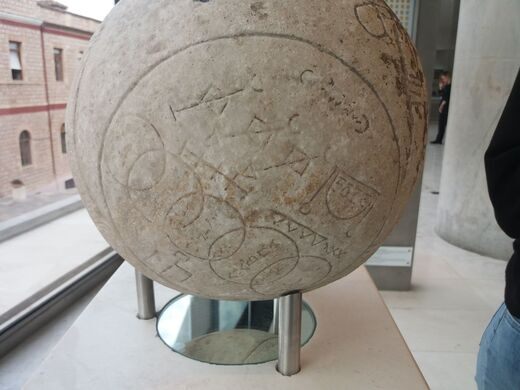
I have a research project. I came across this blog post yesterday, which talks about the "sphere of Helios". It's currently in the Acropolis Museum. I had never heard of it, which is not odd, considering the many things there are to hear about. How about you guys?


"The celestial symbols covering this odd orb bewitch the imagination. And according to some, that’s exactly the point, as it’s thought the ancient Greeks may have used the sphere in magic rituals.
The large marble sphere was found in 1866 at the Theater of Dionysus, which stands at the foot of the famed Acropolis. It’s believed the curious orb was created sometime between the second and third centuries CE.

Not much is known about the strange sphere. Because it was found buried near the Theater of Dionysus—a place where duels and other sporting events were held—it’s said the ball may have been used in magic rituals by those hoping to win.

The carvings adorning the sphere are mysterious and mystical. Most agree the human figure is a depiction of Helios, the god of the Sun. He sits atop a grand throne, clutching a whip in one hand and three lit torches in the other. A great beast rests at his feet, which is said to be either a lion or a dog and is thought to represent a constellation.

Other animal and celestial symbols cover the rest of the sphere. Scan the globe, and you’ll come across a whole medley of magical, alchemistic, and astral symbols."
One of those days, people... one of those days... I'm going to have to leave you with a bit of ancient text, and I want to broaden the horizon a little today by giving you one of the spells/prayers from the Papyri Graecae Magicae, also known as the 'Greek Magical Papyri'. They are a body of papyri from Graeco-Roman Egypt, which each contain a number of magical spells, formulae, hymns and rituals. The materials in the papyri date from the 2nd century BC to the 5th century AD. The manuscripts came to light through the antiquities trade, from the 18th century onwards. As part of the papyri, spells for a variety of things were recorded. Two include prayers to Helios. I'd like to share those today.


Prayer to Helios: A charm to restrain anger and for victory and for securing favor
Instructions: Say to the Sun (Helios) seven times, and anoint your hand with oil and wipe it on your Head and Face.

"Rejoice with me, You who are set over the East Wind and the World, for whom all the Gods serve as Body-Guards at Your Good Hour and on Your Good Day, You who are the Good Daimon (God) of the World, the Crown of the Inhabited World, You who arise from the Abyss, You who Each Day rise a Young Man and set an Old Man. I beg You, Lord, do not allow me to be Over-Thrown, to be Plotted Against, to receive Dangerous Drugs, to go into Exile, to fall upon Hard Times. Rather, I ask to obtain and receive from You Life, Health, Reputation, Wealth, Influence, Strength, Success, Charm, Favor with all Men and all Women, Victory over all Men and all Women. Yes, Lord, accomplish this Matter which I want, by means of Your Power.”
[PGM XXXVI.211-30]

Spell to Helios: Consecration for All Purposes
“I invoke You, the Greatest God, Eternal Lord, World Ruler, who are over the World and under the World, Mighty Ruler of the Sea, rising at Dawn, shining from the East for the Whole World, setting in the West. Come to me, Thou who risest from the Four Winds, benevolent and lucky Agathos Daimon, for whom Heaven has become the Processional Way. I call upon Your Holy and Great and Hidden Names which You rejoice to hear. The Earth flourished when You shone forth, and the Plants became fruitful when you laughed; the Animals begat their Young when You permitted. Give Glory and Honor and Favor and Fortune and Power to this, NN, Stone which I consecrate today (or to the Phylactery [charm] being consecrated) for [or in relation to] NN. I invoke You, the greatest in Heaven, the Shining Helios, giving Light throughout the Whole World. You are the Great Serpent, Leader of all the Gods, who control the Beginning of Egypt and the End of the Whole Inhabited World, who mate in the Ocean. You are He who becomes Visible each Day and Sets in the Northwest of Heaven, and Rises in the Southeast.

In the 1st Hour You have the Form of a Cat.
Give Glory and Favor to this Phylactery.
In the 2nd Hour You have the Form of a Dog.
Give Strength and Honor to this Phylactery, or to this Stone, and to [name].
In the 3rd Hour You have the Form of a Serpent.
Give Honor to the God [name].
In the 4th Hour You have the Form of a Scarab.
Mightily strengthen this Phylactery in this Night, for the Work for which it is consecrated.
In the 5th Hour You have the Form of a Donkey.
Give Strength and Courage and Power to the God, [name].
In the 6th Hour You have the Form of a Lion, the Ruler of Time.
Give Success to this Phylactery and Glorious Victory.
In the 7th Hour You have the Form of a Goat.
Give Sexual Charm to this Ring (or to this Phylactery, or to this Engraving).
In the 8th Hour You have the Form of a Bull, who becomes visible everywhere.
Let all Things done by the use of this Stone be accomplished.
In the 9th Hour You have the Form of a Falcon, the Lotus Emerged From the Abyss.
Give Success and Good Luck to this Phylactery.
In the 10th Hour You have the Form of a Baboon.
[Prayer for gift omitted?]
In the 11th Hour You have the Form of an Ibis.
Protect this great Phylactery for Lucky Use by [name], from this Present Day for All Time.
In the 12th Hour You have the Form of a Crocodile.
[Prayer for gift omitted?]

You who have set at Evening as an Old Man, who are over the World and under the World, Mighty Ruler of the Sea, hear my Voice in this Present Day, in this Night, in these Holy Hours, and let all done by this Stone, or for this Phylactery, be brought to fulfillment, and especially NN matter for which I consecrate It. Please, Lord! I conjure Earth and Heaven and Light and Darkness and the Great God who created All, SAROUSIN, You, Agathon Daimon the Helper, to accomplish for me everything done by the Use of this Ring or Stone!”

When you complete the Consecration, say, “The one Zeus is Serapis!”
[PGM IV.1596-1715]
The Iliad (Ἰλιάς) is an ancient Hellenic epic poem, traditionally attributed to Homeros. It's set during the Trojan War, the ten-year siege of the city of Troy (Ilium) by a coalition of Hellenic states, it tells of the battles and events during the weeks of a quarrel between King Agamemnon and the warrior Achilles. Although the story covers only a few weeks in the final year of the war, the Iliad mentions or alludes to many of the Hellenic legends about the siege; the earlier events, such as the gathering of warriors for the siege, the cause of the war, and related concerns tend to appear near the beginning. Then the epic narrative takes up events prophesied for the future, such as Achilles' imminent death and the fall of Troy, although the narrative ends before these events take place. However, as these events are prefigured and alluded to more and more vividly, when it reaches an end the poem has told a more or less complete tale of the Trojan War. Over the course of the story, many Gods are invoked and petitioned, and I'd like to collect some of these invocations here today, for use in your own rites.

An invocation is a request for the spiritual presence and blessing of a deity during a rite. To invoke is to call upon earnestly, so an “invocation” in the context of prayer is a serious, intentional calling upon a God or Goddess. In Hellenic ritual, it's common for prayers of invocation to be offered every time a new deity is invoked, so we can be sure They will the hymns and prayers of petition offered to Them. Invocations fit into the rite like so:

- Lighting of the incense burner with frankincense
- Invocation to Demeter: Khaire Demeter, you who taught us to work the earth and provides for us so bountifully…
- Libation of a kykeon and sacrifices
- Orphic Hymn 40 To Eleusinian Demeter
- Prayers

Apollon:
"O god of the silver bow, that protectest Chryse and holy Cilla, and rulest Tenedos with thy might..."
"Hear me O king from your seat, may be in the rich land of Lycia, or may be in Troy, for in all places you can hear the prayer of one who is in distress, as I now am..."

Athena:
"Hear me, daughter of aegis-bearing Zeus, unweariable..."
"Holy Athena, protectress of [Athens], mighty goddess..."
"Hear me, daughter of aegis-bearing Zeus, you who spy out all my ways and who are with me in all my hardships; befriend me in this mine hour..."

Erinyes:
"I call the Erinyes who dwell below and take vengeance on him who shall swear falsely..."

Helios:
"Oh Sun, that seest and givest ear to all things, Earth and Rivers..."

Zeus:
"Zeus, most glorious, supreme, that dwellest in heaven, and ridest upon the storm-cloud..."
"Father Zeus that rulest in Ida, most glorious in power..."
"Zeus, most great and glorious, and ye other everlasting gods..."
"King Zeus, lord of Dodona, god of the Pelasgi, who dwellest afar, you who hold wintry Dodona in your sway, where your prophets the Selli dwell around you with their feet unwashed and their couches made upon the ground- if you heard me when I prayed to you aforetime, [...]vouchsafe me now the fulfilment of yet this further prayer..."
A little over a week or so ago, I posted a description of categories of minor planets and minor planets named from Hellenic mythology. I love things like that. I love knowing how far Hellenic mythology and the Gods still reach. Today, I want to present you with a new list, this time of the Hellenic influence on the names of chemical elements--either through mythology or simply through language.


Argon (Ar) From the Greek word "argos" which means idle or lazy. Argon is one of the laziest, least reactive elements of all. There are also many mythological figures named "Argos", but those are not whom the element was named after.

Bromine (Br) - From the Greek word "bromos" which means stench. Bromine has an unpleasant smell.

Chlorine (Cl) From the Greek word "chloros" which means green. Chlorine is a green gas.

Helium (He) - Named after the God Helios. In 1868, during an eclipse of the Sun, scientists observed a spectral line caused by an unknown element. They named the element Helium. Twenty seven years later, in 1895, the element was discovered on Earth.

Hydrogen (H) - From the Greek words "hydro" and "genes" which mean water and forming. When hydrogen burns in the air, it forms water.

Iodine (I) - From the Greek word "iodos" which means violet. Iodine is a grey solid at room temperature. It gives off a violet colored vapor when warmed.

Niobium (Nb) - It is a soft, grey, ductile transition metal, which is often found in the pyrochlore mineral, the main commercial source for niobium, and columbite. Its name comes from Niobe, daughter of Tantalus, the namesake of tantalum (see below). The name reflects the great similarity between the two elements in their physical and chemical properties, making them difficult to distinguish.

Oxygen (O) - From the Greek words "oxy" and "genes" meaning acid forming. Most non-metals burn in oxygen to form acids eg. sulphur.

Phosphorous (P) - From the Greek word "phosphorus" which means "light bearing". It was also the ancient name for the planet Venus, usually the brightest "star" in the night sky. Phosphorous glows in the dark and catches fire in the air to give a bright flame.

Tantalum (Ta) - Named after King Tantalos. It was discovered in 1802 and great difficulties were encountered in dissolving its oxide in acid to form salts, which is most likely how it got its name--King Tantalos was imprisoned in Tartaros for serving the son he murdered to the Gods when They came to dinner. Tantalos' punishment for his actions was to stand in a pool of water beneath a fruit tree with low branches. Whenever he reached for the fruit, the branches raised his intended meal from his grasp. Whenever he bent down to get a drink, the water receded before he could get any.

Titanium (Ti) - Named after Titans, members of the second generation of divine beings, descending from the primordial deities and preceding the Olympian deities. They are giant deities of incredible strength. Titanium is an extremely strong metal which resists attack by acids.
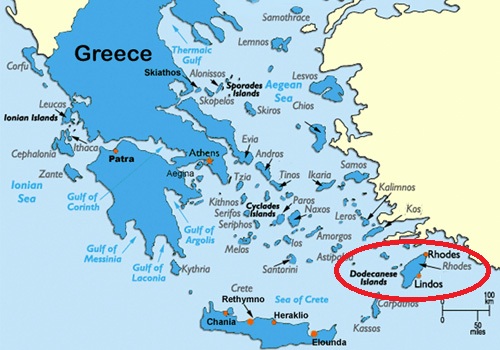
Most of the ancient Hellenic islands have an origin story, recorded in ancient Hellenic writings. One of my favorites is that of Rhodes. Rhodes (Ρόδος, Ródos) is the largest of the Dodecanese islands in terms of land area and also the island group's historical capital. It is located northeast of Crete, southeast of Athens and just off the Anatolian coast of Turkey. In ancient times, it was home to the Colossus of Rhodes, one of the Seven Wonders of the Ancient World.


It's Pindar who recounts the founding myth of the island. He explains how the island was a gift to Helios after the Gods divided the world between Them and there was nothing left for Him. Zeus raised the island from the depths of the ocean and Helios lay with the nymph Rhodos who came into existence with it. From their union came three children, and the cities that were established on Rhodes were named for their three sons. From Pindar's odes:

"Now the ancient story of men saith that when Zeus and the other gods made division of the earth among them, not yet was island Rhodes apparent in the open sea, but in the briny depths lay hid. And for that Helios was otherwhere, none drew a lot for him; so they left him portionless of land, that holy god. And when he spake thereof Zeus would cast lots afresh; but he suffered him not, for that he said that beneath the hoary sea he saw a certain land waxing from its root in earth, that should bring forth food for many men, and rejoice in flocks. And straightway he bade her of the golden fillet, Lachesis ['disposer of lots', one of the Moirai], to stretch her hands on high, nor violate the gods' great oath, but with the son of Kronos promise him that the isle sent up to the light of heaven should be thenceforth a title of himself alone.

And in the end of the matter his speech had fulfilment; there sprang up from the watery main an island, and the father who begetteth the keen rays of day hath the dominion thereof, even the lord of fire-breathing steeds. There sometime having lain with Rhodos he begat seven sons, who had of him minds wiser than any among the men of old; and one begat Kameiros, and Ialysos his eldest, and Lindos: and they held each apart their shares of cities, making threefold division of their father's land, and these men call their dwelling-places. There is a sweet amends for his piteous ill-hap ordained for Tlepolemos leader of the Tirynthians at the beginning, as for a god, even the leading thither of sheep for a savoury burnt-offering, and the award of honour in games." [Pythian Odes VII]

I enjoy this story because it's nothing but fair and filled with respect. Zeus realized Helios--one of the most important Titans in regards to life on earth--had been denied His fair share and so He granted Him one of the grandest islands of the ancient Hellenic world and through the island's guardian nymph strong children. It's soothing and beautiful. Blessed be Rhodes!
I'm just going to come out and say it: I do not, and will not, celebrate modern festivals within Hellenismos, no matter how 'historically correct' they are in their execution. You're still turning an event which was completely secular for the ancient Hellens--if they observed it at all--into a religious event, and that does not work for me in the spirit of a Reconstruction religion.

I understand that the ancient Hellens invented new festivals all the time, I understand things change, but there is a certain rigidity implied in the practice of reconstructing that one should not overlook; especially if that practice causes a cross-over between modern--conglomerated--Traditions.

An example: the Heliogenna. It's a modern festival created by Hector Lugo as a sort of Yule-for-Hellenists. It was intended to be a nine day celebration in three parts of equal days: on days one to three--which are called 'Sunset' (ηλιοβασίλεμα - iliovasilema)--the heavenly Theoi are honored, most notably Helios (who mourns the death of His son), Selene and Eos. On days four to six (with day five being the Winter Solstice)--which are called 'Night' (νύχτα - nichta)--no Theoi are honored, but They are all remembered in their darker epithets. The focus is on Helios, Hekate, Hades, Persephone and Hermes, and silence is a large part of these days. The last three days--called 'Sunrise' (ανατολή - anatoly)--are a huge celebration; Helios has risen anew after His 'journey to the Underworld'.

This is the short version. Please see here, here, here, and here for better sources. I'm going to say this as respectfully as I can, but just the thought of celebrating the Heliogenna makes me a little nauseous, and angry.  For one, it's not a reconstructive celebration. I have nothing against finding modern interpretations for ancient festivals; after all, we all practice with a lot of limitations these days, and there is reason to believe the ancient Hellens celebrated something on the Winter Solstice; most ancient cultures did. Yet, what--exactly--they celebrated is unknown, and I'm pretty sure this was not it.

I haven't celebrated the Heliogenna, but from what I have read about it, it's a bit of a mixture between the Kemetic God Ra's nightly journey into the Duat to replenish Himself for the day to come, the Celtic Yule log practice and Hellenic mythology, connected with a splash of--Horned God--Wiccan glue. It doesn't work for me, for various reasons. I'm going to try listing them all, but I know I won't be able to. This is a 'heart' post, not a 'head' post, and that usually means I haven't figured it all out yet.

Alright, for one, the Heliogenna seems to celebrate the death and rebirth of a Deathless God. Pause on that a second. Secondly, it has an Ouranic deity traveling into the Underworld. Even if we leave miasma out of it, there are still a good few ancient sources that are against this notion. Hómēros for one:

"At the entrance to the Underworld, Odysseus and his crew beached their ship on a mist covered shore where the radiant Helios never sheds his light."

In a broader sense, I also question if adding modern festivals is not hubris? Not only do we bend the ways of the ancient Hellens--and their mythology--but we do it from the viewpoint of modern worship. From a hard polytheistic viewpoint, slapping the persona of the Wiccan Horned God onto Helios and calling it Hellenistic is pretty ballsy. To be fair, I am probably associating Helios with the Horned God within the confinds of this festival because of my own previous practice, but you have to admit there are some similarities.

I know I'm being mean and petty about this, but if I wanted a practice where I could conglomerate my practice from a variety of sources and feel perfectly alright about it--and rightfully so--I would have stayed an Eclectic Religious Witch. That was not my intention, however, and so the celebration of these modern festivals is not for me. It may be for you, I don't know. If they are, please, enjoy the heck out of them.

I'm struggling with how Recon my Recon practice should be. I want to keep it as Recon as possible, but I can see that the religion may become--or stay--too static if we don't adapt Hellenismos to modern practice. I may start agreeing with that--and the Heliogenna--in the years to come, but right now, I'm resisting. I'm staying Recon as much as I possibly can, and in that spirit, I also resist the Heliogenna.