Showing posts with label Theseus. Show all posts

 I have already written quite a lot about the Hellenic hero Hēraklēs, whose name was later Romanized as 'Hercules'. In fact, I am writing a continuing series about his labours. That said, this post will not be just about him, because there were others associated with the myth, despite the name.


The name of the constellation in ancient Hellas was Ἐγγόνασιν, The Kneeler, or On His Knees. That said, the ancient Hllenes already associated the myth with the hero Hēraklēs. Hyginus, for example, in his 'Atronomica' describes:

"Eratosthenes says he is Hercules, placed above the dragon we have already mentioned, and prepared to fight, with his left hand holding his lion skin, and his right the club. He is trying to kill the dragon of the Hesperides, which, it is thought, never was overcome by sleep or closed its eyes, thus offering more proof it was placed there as a guard. Panyassis in the Heraclea says of the sign that Jupiter, in admiration of their struggle, placed it among the stars; for the dragon has its head erect, and Hercules, resting on his right knee, tires to crush the right side of its head with his left foot. His right hand is up and striking, his left extended with the lion skin, and he appears to be fighting with all his strength.

Aeschylus, in the play entitled Prometheus lyomenos, says that he is Hercules, fighting not with the dragon, but with the Ligurians. For he says that at the time Hercules was driving away the cattle of Geryon, he journeyed through the territory of the Ligurians. They joined forces in trying to take the herd from him, and pierced many of the beasts with arrows. But after Hercules’ weapons failed, worn out by the number of the barbarians and lack of arms, he fell to his knees, already suffering from many wounds. Jove, however, out of pity for his son, provided that there should be a great supply of stones around him. With these Hercules defended himself and put the enemy to flight. And so Jove [Zeus] put [t]he image of his fighting form among the constellations." [II.6]

Yet, Hyginus also mentions other possibilities and other noteworthy people who have an opinion on the matter; Araethus, for example, who calls this figure Ceteus, son of Lycaon, and father of Megisto:

"He seems to be lamenting the change of his daughter to bear form, kneeling on one knee, and holding up outstretched hands to heaven, asking for the gods to restore her to him." [II.2]

For those who these names are unfamiliar, Megisto is in some writers another form for Kallistô, the mother of Arcas, who is also called Themisto. I have discussed the happenings with this family before, for the constellation Boötes, but will recap for the unity of this post. Arcas (Ἀρκάς), son of Zeus and Kallistô (Καλλιστω). After Arcas was born, Hera caught wind of the affair and turned Kallistô into a bear. Alternatively, Kallistô was a priestess of Artemis, and Artemis punished her for losing her virginity by turning her into a bear. Because of the metamorphosis, the boy was raised by his maternal grandfather Lycaon, who would later kill and serve up his grandson to the Theoi as dinner, for which he was turned into a (were)wolf. When Arcas grew up, he went out to hunt and found a beautiful bear. He chased her through the woods. The bear--his transformed mother Kallistô--ran towards him as soon as she recognized her son. Arcas was terrified and raised his bow to shoot her. Zeus intervened swiftly and placed Kallistô and her son in the sky. Kallistô became Ursa Major and Arcas either Ursa Minor or Boötes.

Hyginus goes on to quote Hegesianax, who says that:

"...he is Theseus, who seems to be lifting the stone at Troezene. Aegeus is thought to have put [corrupt] and a sword under it, and warned Aethra, the mother, not to send him to Athens until he could lift the stone by his own strength and bring the sword to his father. And so he seems to try to lift the stone as high as he can. In this connection, too, some have said that the Lyre, placed nearest this sign, is the lyre of Theseus, for he was skillful in all the arts and seems to have learned the lyre as well. This, too, Anacreon says: Near Theseus, son of Aegeus, is the Lyre." [II.6]

Theseus was fathered by Aegeus and Poseidon, whom had both slept with his mother Aethra, and was thus destined to become a hero. In order to claim his rightful place as ruler over Athens, he had to uncover his father's sandals and sword from under a stone in his mother's birth land where Theseus grew up, and bring it to his mortal father. Theseus lifting the stone at Troezene would have been his first heroic act, and thus worthy of immortalization in the stars.

Hyginus offers a few more options:

"Others call him Thamyris, blinded by the Muses, kneeling as a suppliant; others, Orpheus, killed by the Thacian women because he looked on the rites of Father Liber. Again, some have said that he is Ixion with his arms bound, because he tried to attack Juno. Others say he is Prometheus, bound on Mt. Caucasus." [II.6]
 
I have written about the affairs with Ixion and Prometheus, so for reference, please visit those posts. I have also written about Orpheus, but with a different constellation: Cygnus: the swan. In it I describe how Orpheus wanders the world after loosing his wife for good, and stumbles upon revelers who rip him apart. His lyre is placed into the sky and Plato describes that Orpheus is turned into the constellation Cygnus because he does not want to be reincarnated as a woman, a risk he would run if he stayed in human form. It seems others thought he was put into the sky as a man regardless, and near his lyre at that.

Thamyris  (Θάμυρις) is new to this blog. He was the son of Philammon and the nymph Argiope, and a Thracian singer who was so proud of his skill that he boasted he could outsing the Muses. He competed against them and lost. As punishment for his presumption they blinded him, and took away his ability to make poetry and to play the lyre. Hómēros outlines the tale in the Iliad:

"From Pylos, and lovely Arene; from the ford of the Alpheius at Thryum, from well-built Aepy, from Cyparisseis, and Amphigeneia, Pteleos, Helos, and Dorium, where Thamyris the Thracian met the Muses, as he came from Eurytus’ house in Oechalia, and they put an end to all his singing: he who had boasted he would win his contest with those aegis-bearing daughters of Zeus, they blinding him in anger, robbing him of his sweet gift of song, so he forgot the cunning of his harp; in their fleet of ninety hollow ships the warriors came, led by Nestor the Gerenian charioteer." [II: 581-644]

It seems there is great variety in the interpretation of the person the constellation depicts, but whomever it is, they are visible at latitudes between +90° and −50°, and best visible at 21:00 (9 p.m.) during the month of July.

On Mounuchion 6, the Athenian festival of the Delphinia (Δελφίνια) starts in honor of Apollon and Artemis. To celebrate this festival, Elaion is hosting a PAT ritual at 10 am EDT on April 18. Will you be joining us?


The Delphinia is a festival to ask for the protection of all ships and sailors, to ask for guidance for young boys and girls transitioning into adulthood and--as a festival of purification--the Delphinia can be interpreted to be open to all who are going through a time of transition and/or struggle.

What is known about this festival is that virgin girls walked to the Delphinion (Δελφίνιον) atop the Acropolis in procession, carrying olive branches bound with wool (known as 'iketiria') and baked cakes known as Popana, made of soft cheese and flower. There is overwhelming evidence that the festival was held on the sixth of the month of Mounukhion, most notably from Plutarch, but the seventh of same month is also considered a possible date, quite possibly because the festivities could have taken place in the daylight hours of the sixth day, which is the same day as the start of the seventh of the month, as dusk rained in a new day.

Plutarch connects the sixth of the month Mounukhion to Apollon and Theseus--most importantly to Theseus' quest for the Minotaur--in his 'Life of Theseus'. Theseus vows to look over those the lots choose to be offered to the Minotaur in the maze on Krete. Roughly in the month of Mounukhion, the seafaring season started. It's therefor not odd that lots would have been cast about this time, for the youths--and everyone else with business across the sea--would set sail as soon as the weather allowed. The rising of the Pleiades, located in the constellation of Taurus, around late April, the beginning of May, was a signal for the boldest of sea-goers that the treacherous sea was at least moderately accessible. Still, it would be at least several months before the favoured seafaring season started, so anyone braving the sea, could probably use some protection. Somewhere shortly after the Delphinia would have been Theseus' first opportunity to sail to Krete, but it would place his return almost five months later; quite some time for a three day journey (one way) in favourable conditions.

During the Delphinia, young maidens presented Apollon Delphinion, and perhaps Artemis Delphinia, with the iketiria Theseus had presented them with as well, in the hopes of receiving for the Athenians the same guidance and protection at sea as the Kretan colonists, as well as Theseus and the youths, had gotten.

A connection can also be made with Theseus visiting the shrine of Apollon Delphinios as an opportunity for purification before his great quest, as the young supplicants who prepared for their personal collective journeys into adulthood would desire purification of their own, and Apollon in many of his epithets is a purifier. Also, in a little less than a month, the Thargelia took place in Delos, an event where the births of Artemis, and especially Apollon were celebrated. The rites at the Delphinia might have been part of the purification processes for those who were to go to Delos (with thanks to Daphne Lykeia for this interpretation).

As a festival of purification, the Delphinia can be interpreted to be open to all who are going through a time of transition and/or struggle. A divine purification of miasma might allow you to focus better on these issues, and receive guidance from the Theoi more easily--like Theseus, who purified himself  at the Delphinion and prayed for the guidance of Aphrodite directly thereafter. Aphrodite made Ariadne fall for him, saving his life and those of the young men and women in the process.

One can celebrate this day by offering both Apollon and Artemis hymns, libations, and Popana cakes, and presenting Artemis with an iketiria, an olive branch wrapped with white wool, if you are a young female looking for aid. An iketiria was primarily used in rites of supplication.

The popana (or popanon) should be a flat cake with a single 'knob' in the center. We don't have a surviving recipe, but Cato's recipes for 'libum' seems to hold many of the same ingredients. It goes as follows:

"'Make libum by this method. Break up two pounds of cheese well in a mortar. When they will have been well broken up, put in a pound of wheat flour or, if you wish it to be more delicate, half a pound of fine flour and mix it well together with the cheese. Add one egg ...and mix together well. Then make into bread, places leaves beneath, and cook slowly on a hot hearth under an earthen pot."

That's a lot of Popana. Make this if you're with a large group, else the recipe would look something like this for something the size of a good loaf of bread or its equivalent in smaller portions:

- 14 ounces good ricotta or any fresh cheese, preferably unpasteurized (ricotta should always be drained overnight in a colander)
- 4 ounces (approx) flour, preferably farro
- 1 large egg
- a pinch of salt
- several bay leaves, preferably fresh
- olive oil, for the pan

Preheat the oven to 350°F/180°C.

You can either make large cakes or small ones. If you're making large ones, line a baking pan or sheet with bay leaves and brush them lightly with olive oil. If you don't have enough leaves to cover the surface, distribute the leaves as best you can. If you are going to make smaller cakes, brush one leaf with oil for each cake you are going to make.

Knead all the ingredients (except the bay leaves) until well blended. Add flour until the dough is no longer sticky. Shape the dough into a single, or several smaller cakes. Place either the large cake on top of the bay leaves, or put each little one on top of one. Then put it in a baking pan and into the oven.

Bake for about 30 minutes for a large cake, or (much) less long for smaller cakes. Just watch them until they are firm and light golden brown. Don't forget to enjoy it yourself!

The ritual for the event can be found here and you can join the community here.

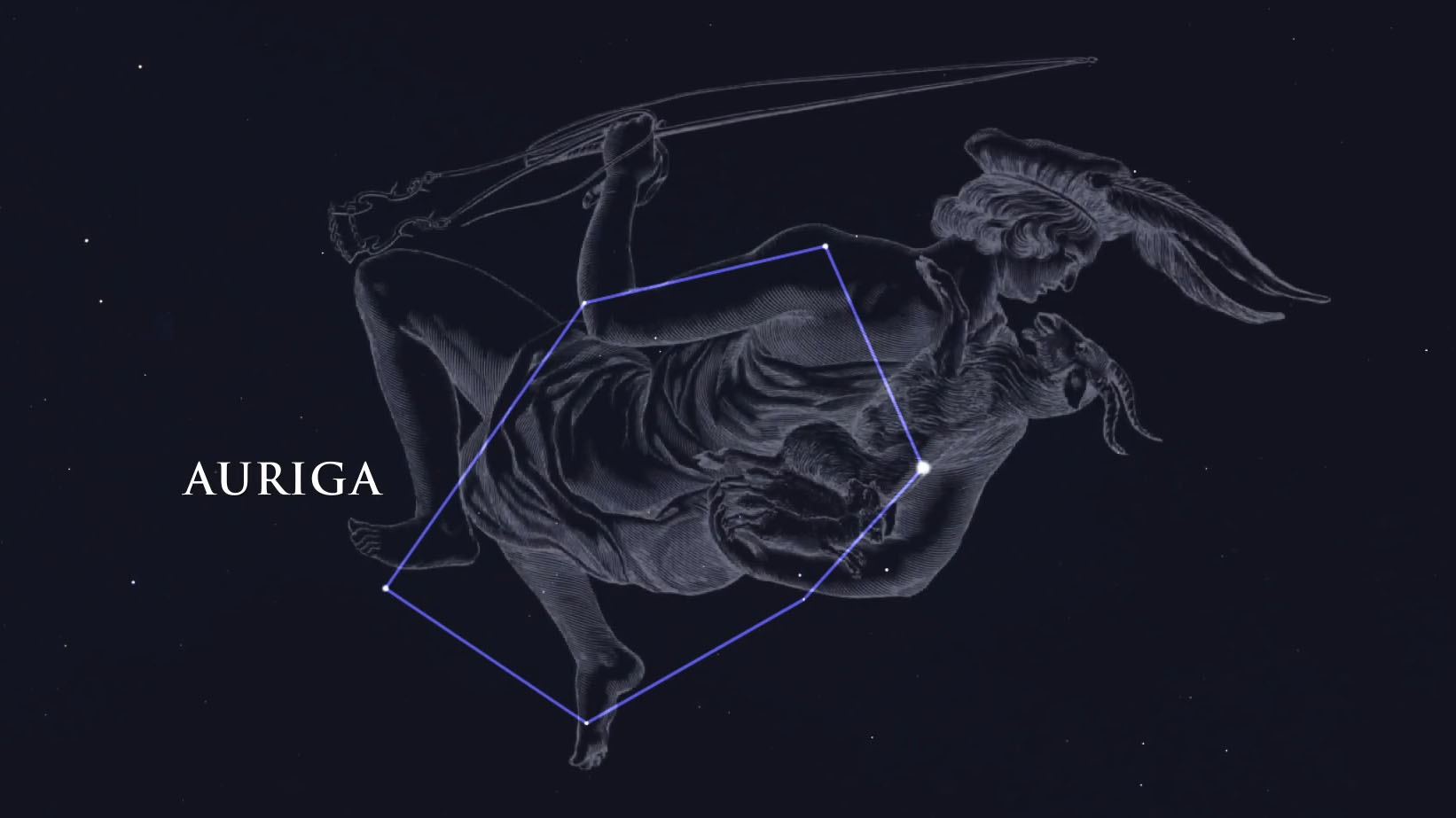
There are many well known chariots and charioteers in ancient Hellenic mythology. All of the Theoi have one, and Helios and Apollon use one to bring light to the world. Hades kidnapped Persephone with His. Kastor and Polideukes were very skilled at driving the fast, light, open, two-wheeled conveyance drawn by two or more horses. Helios lost a son when he let his son Phaethon (Φαέθων) drive his chariot for its morning track through the sky. Phaethon flew too close to the earth and scorched it all; Zeus then cast him down with a lightning-bolt. Yet, these are not the charioteers the constellation is associated with. In this next installment of the constellation series, we will look at the Divine child the constellation refers to... and a few others, because the constellation Auriga has had many interpretations over the years.


For a very long time, war chariots were pulled by two horses only. The charioteer of the constellation is therefor most likely Erichthonios (Ἐριχθόνιος), child of Hēphaistos and Athena, through Gaea, as he invented a chariot pulled by four horses. 

As the myth of his birth goes; Athena went to Hēphaistos' workshop for weaponry, but Hēphaistos--overcome with lust--tried to rape Her instead. Athena fled, but could not flee fast enough. Hēphaistos caught up to Her. Athena fought off Her attacker, but could not prevent Hēphaistos from ejaculating on Her thigh. She wiped Hēphaistos' semen away with a scrap of wool (ἔριον, erion) and flung it to the earth (χθών, chthôn). From it was born Erichthonios, who was part man, and part snake.

In my post about the many legends of Médousa, I posed the following about Athena and the source of Erichthonius' myth and birth as part-snake:

"Athena's role as a snake and fertility Goddess is still visible in the myth about the child she had with Hephaestus; Erichthonios (Ἐριχθόνιος), who was half man, half snake. It's even posed that in the early days, Athena was married to Hephaestus and had His child willingly. As Athena was stripped of Her roles as a fertility and snake Goddess, Médousa's myth came into being, where Athena distances Herself from sex and snakes, by punishing an epithet of herself (Athena Tritogeneia, perhaps: 'born of Trito', a lake which was supposedly located in Libya), or the Libyan snake Goddess Médousa, who may have still been attached to Her worship. By placing Médousa's head on Her breastplate or shield, Athena's mythology is continuously linked to Her Libyan heritage, but harmlessly so, to Her new image of a virginal warrior."

No matter the source, Erichthonios was born, and placed in a box by Athena. She placed the box in the care of three of Her attendants at the Acropolis, with clear instructions not to open the box. They did, of course, and were scared so by the sight of either a snake in the box, or Erichthonios' deformities, they cast themselves off of the Acropolis in terror. Yet, despite his deformities, Erichthonios became king of Athens and ruled it long and well.

He married Praxithea (Πραξιθέα), a naiad, and had a son, Pandion I. He founded the Panathenaiac Festival in the honor of Athena, and set up a wooden statue of her on the Acropolis. He taught his people to yoke horses and use them to pull chariots, to smelt silver, and to till the earth with a plough. His deformities and lameness inspired him to invent the quadriga--or four-horse chariot--to get around easier. He was very skilled as a charioteer, and won many games. Zeus was said to have been so impressed with his skill that he raised him to the heavens to become the constellation Auriga after his death.

There are also other charioteers to whom the constellation could refer; Myrtilus (Μυρτίλος), for example, who was Hermes's son and the charioteer of Oenomaus. Myrtilus's chariot was destroyed in a race intended for suitors to win the heart of Oenomaus's daughter Hippodamia. Myrtilus earned his position in the sky when Hippodamia's successful suitor, Pelops (Πέλοψ), killed him, although he helped him win the woman's hand. After his death, Myrtilus's father Hermes placed him in the sky. 

The constellation could also represent Theseus's son Hippolytos who was rejected from Athens after he refused the romantic advances of his stepmother Phaedra, who committed suicide as a result. He was killed when his chariot was wrecked, but revived by Asklepios. Another possibility is that the constellation does not represent a whole person at all, but is a limb of Mēdeia's brother after she killed and dismembered him.

Occasionally, Auriga is also seen as the Charioteer but as Bellerophon (Βελλεροφῶν), the mortal rider of Pegasus who dared to approach Mount Olympus. In this version of the tale, Zeus pitied Bellerophon for his foolishness and placed him in the stars.

Whomever--or whatever--it represents, Auriga reminds us that the chariot had an important place in ancient Hellenic society. As for the constellation, it is visible at latitudes between +90° and −40°, and best visible at 21:00 (9 p.m.) during the month of late February to early March.

The Theseia was an ancient festival held in Athens in the honor of Theseus--as there were many others this month. The focus of this one is actually on his bones and lasting memory; it's a memorial rite. Will you join us in honoring Theseus? In remembering his deeds and the lessons he taught us? Join us on the 26th of September at the usual 10 am EDT.


Theseus (Θησεύς) was fathered by Aegeus and Poseidon, whom had both slept with his mother Aethra, and was thus destined to become a hero. All heroes were given at least one divine parent--usually one connected to their later deeds. The same held true for kings. When he heard about the Minotaur of Krete, and the nine-yearly sacrifices to it--a punishment by King Minos of Krete for the death of his son Androgeus, at the hands of Athenian assassins--Theseus offered to be one of the youths who sailed for Krete. Once there, Ariadne, daughter of the king, fell for him and offered him a ball of yarn so he would be able to find his way out off the labyrinth that housed the Minotaur the youths would be sacrificed to. With Ariadne's aid, Theseus defeated the Minotaur, and brought the sacrificial children home.

The Theseia (Θησεῖα) was not instituted till BC. 469, when Athenian statesman and strategos Cimon brought the (alledged) remains of Theseus from Scyros to Athens. After the Persian wars, around 476/5 BC, Athenian Archon Phaedo was prompted by a Pythian priestess at Delphi to return the bones of Theseus to their city. Cimon, upon hearing the oracle, sailed to Skyros to retrieve them. Plutarch, in 'Theseus' tells the story of discovery, collection and retrieval as follows:

"...when Cimon took the island (as is related in his life), and had a great ambition to find out the place where Theseus was buried, he, by chance, spied an eagle upon a rising ground pecking with her beak and tearing up the earth with her talons, when on the sudden it came into his mind, as it were by some divine inspiration, to dig there, and search for the bones of Theseus. There were found in that place a coffin of a man of more than ordinary size, and a brazen spear-head, and a sword lying by it, all which he took aboard his galley and brought with him to Athens."

The Athenians were delighted with the return and the bones that either were or were not Theseus' were laid to rest where they became an intrical part of Athenian life:

"Upon which the Athenians, greatly delighted, went out to meet and receive the relics with splendid processions and sacrifices, as if it were Theseus himself returning alive to the city. He lies interred in the middle of the city, near the present gymnasium. His tomb is a sanctuary and refuge for slaves, and all those of mean condition that fly from the persecution of men in power, in memory that Theseus while he lived was an assister and protector of the distressed, and never refused the petitions of the afflicted that fled to him."

The festival of the Theseia was held on the eighth of every month, but the eighth of Pyanepsion was especially important because the ancient Athenians considered this the day that Theseus returned from Krete:

"The chief and most solemn sacrifice which they celebrate to him is kept on the eighth day of Pyanepsion, on which he returned with the Athenian young men from Crete. Besides which they sacrifice to him on the eighth day of every month, either because he returned from Troezen the eighth day of Hecatombaeon, as Diodorus the geographer writes, or else thinking that number to be proper to him, because he was reputed to be born of Neptune, because they sacrifice to Neptune on the eighth day of every month. The number eight being the first cube of an even number, and the double of the first square, seemed to be an emblem of the steadfast and immovable power of this god, who from thence has the names of Asphalius and Gaeiochus, that is, the establisher and stayer of the earth."

The festival was celebrated with donations of bread and meat, which were given to the poor people so they could 'fancy themselves equal to the wealthiest citizens'. This happened on the evening portion of the eigth of the month (the ancient Hellenes started the new day at sundown). I suspect the offerings that went along with the shared banquet had a slightly Khthonic character. Heroes and heroines have a special place in Hellenismos, as they had in ancient Hellas. These were humans--most with at least a part divine heritage--who were considered so brave, so skillful, so extraordinary in their lifetime that they became revered. Hero worship was very specific and it's a concept that translates with more difficulty than straight-up deity worship.

Archeological evidence suggests that hero worship was closer to khthonic sacrifice in execution than ouranic ones the further back in time you go; especially in the archaic period, it seems that hero worship consisted of destructive sacrifices--sometimes in the form of a holókaustos where the entire animal was burned, sometimes in a sacrifice where only a part (most often 'a ninth' of the animal) was burned and the rest remained on the altar for the heroes to eat from until gone. The sacrifices were generally burned in an offering pit known as a bothros. The food offered to heroes consisted of meat, blood, and 'food eaten by men' like grains, fruits and other every-day dishes. These were usually offered to the heroes on a table--known as a trapeza--and the heroes were sometimes offered chairs or a bench to sit on. As time went on, the living began to eat part of the meal laid out for the heroes, joining them in celebration.

Contests were also part of the festival, during the daylight hours, but we don't know much about these contests; we don't know what sort of contests they were, for example. All we know is that they were 'gymnastic contests'.

We hope you will join us for the event! If you feel like doing so, the ritual can be found here and you can join the community here.

As you may have noticed, it's a new month and thus many festivals are taking place in the coming days. Two today: the Pyanepsia and the Oskhophoria. The Pyanepsia will take place on the 25th of September, at 10 am EDT and the Oskophoria at 11 am.


The Pyanepsia


The Pyanepsia (Πυανέψια) was one of the many harvest festivals of the season, but instead of focusing on the actual harvest, the Pyanepsia focusses almost completely on the myth of Theseus and the Minotaur.

Theseus (Θησεύς) was fathered by Aegeus and Poseidon, whom had both slept with his mother Aethra, and was thus destined to become a hero. In order to claim his rightful place as ruler over Athens, he had to uncover his father's sandals and sword from under a stone in his mother's birth land where Theseus grew up, and bring it to his mortal father. He did, taking the long and dangerous route over land, and fought many Khthonic creatures and mortal bandits in the process. This was long before he would vow to bring down the Minotaur and thus, set in motion the events that led up to the strange festival of Pyanepsia.

Theseus' father, Aegeus, had taken Medea as his new wife. Afraid hat Theseus would claim the throne and take her position of power from her, Medea pressed Theseus to capture the Marathonian Bull. This, he did, but upon returning, Medea tried to poison him. Aegeus recognized his son just in time and Medea fled while father and son reunited. Theseus then heard about the Minotaur of Crete, and the nine-yearly sacrifices to it. These sacrifices were a punishment by King Minos of Crete for the death of his son Androgeus, at the hands of Athenian assassins.

Theseus offered to be one of the youths who sailed for Crete. Once there, Ariadne, daughter of the king, fell for him and offered him a ball of yarn so he would be able to find his way out off the labyrinth that housed the Minotaur the youths would be sacrificed to. Theseus defeated the Minotaur and took Ariadne and her sister Phaedra from their home in thanks for their help. That night, they slept on the beach but Athena woke up Theseus and told him to sail out now, and to leave Ariadne and Phaedra behind. He did, although it pained him greatly. In his dismay, he forgot to sail with the white sails he had promised his father to sail with if he was alive. As he reached the main land, Aegeus saw the black sails and figured his son dead. He then cast himself off of the cliffs overlooking the sea, and drowned.

Theseus blamed himself for his father's death, but was very relieved to be home none the less. He wished to thank Apollon for his safe journey and his victory over the Minotaur and thus, he ordered his men to gather all the foodstuffs that remained. This was mostly beans and grains, and he ordered the food to be cooked up for a feast and a sacrifice.

In celebration, Theseus then put together an eiresiône (εἰρεσιώνη), a branch of olive or laurel bound with purple or white wool. It was decorated with fruits of the season, pastries, and small jars of honey, oil and wine. The eiresiône was also called a 'supplicant branch', as it was intended as a thank-offering for blessings received, and at the same time as a prayer for similar blessings and protection against evil in future. He walked through the streets of Athens with his eiresiône, to signal his victory and the end of scarcity.

In ancient Hellas, and especially Athens, both observances were conglomerated into the Pyanepsia, and boys tended to carry their home made eiresiône through the streets in a Halloween-esque manner. They knocked on the doors of every house and sang a song. In return, they expected a gift. The eiresiône song from Plutarch, Life of Theseus, 22.5, goes as follows:

'eiresiône suka pherei kai pionas artous
kai meli en kotulêi kai elaion apopsêsasthai
kai kulik' euzôron, hôs an methuousa katheudêi.'

Modern Greek pronunciation:
(Capitalized syllables are emphasized according to the poetic meter)
'EE-re-si-ON-NE SEE-ka fe-RE KE PEE-on-as AR-tous
KE me-lee EN ko-tee-LEE ke e-LE-on a-POP-SEE-SAS-the
KE kee-lik EF-ZO-RON, OS AN me-thee-OU-sa ka-THEV-dee.'

Plutarch has the song:
“Eiresione for us brings figs and bread of the richest,
brings us honey in pots and oil to rub off from the body,
Strong wine too in a cup, that one may go to bed mellow.”

A special eiresiône was brought to the temple of Apollon by a boy whose parents were both alive. He was encouraged to recite the song during the procession. By the Classical Period an eiresione was hung over almost every door in Athens and remained here a full year before being replaced by a new one.

The sacrifice to Apollon was upheld for a long while as well. The ship Theseus used on his return from Crete to Athens was kept in the Athenian harbor as a memorial for several centuries. It was maintained and kept in proper shape. Often, this meant replacing parts of the ship, a practice which led to the question if the ship could still ethically be called the ship of Theseus after so much of it had been replaced. This dilemma became known as the 'Ship of Theseus paradox'. 

At any rate, the ship was sailed out to the island of Delos--which housed a sanctuary of Apollon--yearly after Theseus' return. To ensure the sanctity of the sacrifice, executions were not allowed to take place during the weeks it took to sail to Delos and back.

You can join us for this event on Facebook. The ritual for it can be found here. We would love for you to share your experiences and images of your eiresiône.


The Oskhophoria


The Oskhophoria (ὀσχοφόρια), or Oschophoria when Latinized, was an ancient Hellenic festival dedicated to Dionysos, Ariadne, Athena Skiras, and Apollon. This month, festivals are either related to the Eleusinian Mysteries or the mythology surrounding Theseus. This festival is one of the latter. It was a vintage festival and we would like to invite you to celebrate with us.

The Oskhophoria falls during the vintage season in Attica. The principal feature of this festival, the procession, featured ripe grapevines. As such, we can assume that this festival was a thanksgiving for the grape harvest. In fact, branches of vines with fresh grapes were carried in a great procession from the temple of Dionysos in Athens, to the ancient temple of Athena Skiras in Phalerus. This was the main feature of the festival. After Theseus, hero and king, the festival was augmented to include the recounting of his many exploits with accommodation to earlier traditions. It seems that this recounting was done at the banqueting after the ritual and there would be much recounting indeed. Because the festival adopted features from mythology, Apollon also became one of the Theoi sacrificed to, as He is closely tied to the mythology of Theseus.

Many sources have snippits of information about the Oskhophoria and most disagree, as we have come to expect. We can be fairly certain the ancient Hellenes attributed the mythical foundation of the festival to Theseus, however, and many details of the festival relate back to his journey to Krete:
  • the procession featured two youthful men in female attire, said to recall the trick of Theseus in which he substituted two of the seven female tributes with young male fighters
  • mothers carrying dinner baskets also featured, representing the mothers of the fourteen tributes who made a last meal for their children before they sailed
  • the Oskophoria was an occasion for storytelling, as the youths sailing to Krete would have needed their spirits raised
Plutarch's account, in 'Theseus', recounts the origins of the festival as follows, obviously trying to make a coherent whole out of contradictory evidence:

"The feast called Oschophoria, or the feast of boughs, which to this day the Athenians celebrate, was then first instituted by Theseus. For he took not with him the full number of virgins which by lot were to be carried away, but selected two youths of his acquaintance, of fair and womanish faces, but of a manly and forward spirit, and having, by frequent baths, and avoiding the heat and scorching of the sun, with a constant use of all the ointments and washes and dresses that serve to the adorning of the head or smoothing the skin or improving the complexion, in a manner changed them from what they were before, and having taught them farther to counterfeit the very voice and carriage and gait of virgins so that there could not be the least difference perceived, he, undiscovered by any, put them into the number of the Athenian maids designed for Crete. At his return, he and these two youths led up a solemn procession, in the same habit that is now worn by those who carry the vine-branches.
Those branches they carry in honour of Bacchus and Ariadne, for the sake of their story before related; or rather because they happened to return in autumn, the time of gathering the grapes. The women, whom they call Deipnopherae, or supper-carriers, are taken into these ceremonies, and assist at the sacrifice, in remembrance and imitation of the mothers of the young men and virgins upon whom the lot fell, for thus they ran about bringing bread and meat to their children; and because the women then told their sons and daughters many tales and stories, to comfort and encourage them under the danger they were going upon, it has still continued a custom that at this feast old fables and tales should be told.
 For these particularities we are indebted to the history of Demon. There was then a place chosen out, and a temple erected in it to Theseus, and those families out of whom the tribute of the youth was gathered were appointed to pay tax to the temple for sacrifices to him. And the house of the Phytalidae had the overseeing of these sacrifices, Theseus doing them that honour in recompense of their former hospitality."

In the myth of Theseus and the minotaur, Theseus, looking to become king of Athens, hears about the Minotaur of Krete, and the nine-yearly sacrifices to it. These sacrifices were a punishment by King Minos of krete for the death of his son Androgeus, at the hands of Athenian assassins. Theseus offered to be one of the youths who sailed for Krete. Once there, Ariadne, daughter of the king, fell for him and offered him a ball of yarn so he would be able to find his way out off the labyrinth that housed the Minotaur the youths would be sacrificed to. Theseus defeated the Minotaur and took Ariadne and her sister Phaedra from their home in thanks for their help. That night, they slept on the beach but Athena woke up Theseus and told him to sail out now, and to leave Ariadne and Phaedra behind. He did, although it pained him greatly. It was here, Dionysos found Ariadne and fell in love with her. He would later end up marrying her and she became his immortal wife.

Because the Oskophoria is in many ways two festivals in one, it is a hard one to pin down in terms of modern worship. The Oschophoria was essentially a banquet celebration in honor of Theseus and the rescue of youths and maidens and even more so, an older celebration of the vintage combining traditions of Salamis and Athens. Well into the fourth century BC, two branches of the Salaminians were involved in preparation, were Deipnophoroi, and received equal portions of the meat. The vintage rituals of the Salamic Goddess Skiras became associated with Athena Skiras and naturally Dionysos. The various Theseus mythos was explained through the numerous recounting which we have added to the ritual.

We hope you join us in celebrating this festival. You can join the Facebook community here and find the ritual here.

 Rather randomly, I thought of Ariadne today. You'll know Ariadne best from her role in the myth about Theseus and the Minotaur. Theseus was fathered by Aegeus and Poseidon, whom had both slept with his mother Aethra, and was thus destined to become a hero. All heroes were given at least one divine parent, usually one connected to their later deeds. When he heard about the Minotaur of Krete, and the nine-yearly sacrifices to it--a punishment by King Minos of Krete for the death of his son Androgeus, at the hands of Athenian assassins--Theseus offered to be one of the youths who sailed for Krete. 


Once there, Ariadne, daughter of the king, fell for him and offered him a ball of yarn so he would be able to find his way out off the labyrinth that housed the Minotaur the youths would be sacrificed to. With Ariadne's aid, Theseus defeated the Minotaur and took Ariadne and her sister Phaedra from their home in thanks for their help. That night, they slept on the beach but Athena woke up Theseus and told him to sail out now, and to leave Ariadne and Phaedra behind. He did, although it pained him greatly.

This is the best known version of the myth, but there are others. Plutarch already summarized them in 75 AC in "Theseus." I'd like to quote those passages to you today. 


“There are many other versions circulated about these matters still and also about Ariadne, none of which agree. For some say that she hanged herself after she was abandoned by Theseus. Others claim that after she was taken to Naxos by sailors she lived with Oinaros a priest of Dionysus and that she was abandoned by Theseus because he loved another.

“A terrible lust for Aiglê the daughter of Panopeus ate at him” [fr. 105]—this is a line Hereas the Megarean claims Peisistratus deleted from the poems of Hesiod, just as again he says that he inserted into the Homeric catalogue of dead “Theseus and Perithoos, famous children of the gods” [Od. 11.631] to please the Athenans. There are some who say that Ariadne gave birth to Oinipiôn and Staphulos with Theseus. One of these is Ion of  Khios who has sung about his own city “Oinopiôn, Theseus’ son, founded this city once.” [fr. 4D]

The most reputable of the myths told are those which, as the saying goes, all people have in their mouths. But Paiôn the Amathousian has handed down a particular tale about these events. For he says that Theseus was driven by a storm, to Cyprus and that he had Ariadne with him, who was pregnant and doing quite badly because of the sea and the rough sailing. So he set her out alone and he was carried back into the sea from the land while he was tending to the ship. The native women, then, received Ariadne and they tried to ease her depression because of her loneliness by offering her a counterfeit letter written to her by Theseus and helping her and supporting her during childbirth. They buried her when she died before giving birth.

Paiôn claims that when Theseus returned he was overcome with grief and he left money to the island’s inhabitants, charging them to sacrifice to Ariadne and to have two small statues made for her—one of silver and one of bronze. During the second day of the month of Gorpiaon at the sacrifice, one of the young men lies down and mouns and acts as women do during childbirth. They call the grove in which they claim her tomb is that of Ariadne Aphrodite.

Some of the Naxians claim peculiarly that there were two Minoses and two Ariadnes. They claim one was married to Dionysus on Naxos and bore the child Staphulos, and the young one was taken by Theseus and left when he came to Naxos with a nurse named Korkunê—whose tomb they put on display. They claim that Ariadne died there and has honors unequal to those of the earlier one. The first has a festival of singing and play; the second has one where sacrifices are performed with grief and mourning.”
On Mounuchion 6, the Athenian festival of the Delphinia (Δελφίνια) starts in honor of Apollon and Artemis. To celebrate this festival, Elaion is hosting a PAT ritual at 10 am EDT on March 31. Will you be joining us?


The Delphinia is a festival to ask for the protection of all ships and sailors, to ask for guidance for young boys and girls transitioning into adulthood and--as a festival of purification--the Delphinia can be interpreted to be open to all who are going through a time of transition and/or struggle.

What is known about this festival is that virgin girls walked to the Delphinion (Δελφίνιον) atop the Acropolis in procession, carrying olive branches bound with wool (known as 'iketiria') and baked cakes known as Popana, made of soft cheese and flower. There is overwhelming evidence that the festival was held on the sixth of the month of Mounukhion, most notably from Plutarch, but the seventh of same month is also considered a possible date, quite possibly because the festivities could have taken place in the daylight hours of the sixth day, which is the same day as the start of the seventh of the month, as dusk rained in a new day.

Plutarch connects the sixth of the month Mounukhion to Apollon and Theseus--most importantly to Theseus' quest for the Minotaur--in his 'Life of Theseus'. Theseus vows to look over those the lots choose to be offered to the Minotaur in the maze on Krete. Roughly in the month of Mounukhion, the seafaring season started. It's therefor not odd that lots would have been cast about this time, for the youths--and everyone else with business across the sea--would set sail as soon as the weather allowed. The rising of the Pleiades, located in the constellation of Taurus, around late April, the beginning of May, was a signal for the boldest of sea-goers that the treacherous sea was at least moderately accessible. Still, it would be at least several months before the favoured seafaring season started, so anyone braving the sea, could probably use some protection. Somewhere shortly after the Delphinia would have been Theseus' first opportunity to sail to Krete, but it would place his return almost five months later; quite some time for a three day journey (one way) in favourable conditions.

During the Delphinia, young maidens presented Apollon Delphinion, and perhaps Artemis Delphinia, with the iketiria Theseus had presented them with as well, in the hopes of receiving for the Athenians the same guidance and protection at sea as the Kretan colonists, as well as Theseus and the youths, had gotten.

A connection can also be made with Theseus visiting the shrine of Apollon Delphinios as an opportunity for purification before his great quest, as the young supplicants who prepared for their personal collective journeys into adulthood would desire purification of their own, and Apollon in many of his epithets is a purifier. Also, in a little less than a month, the Thargelia took place in Delos, an event where the births of Artemis, and especially Apollon were celebrated. The rites at the Delphinia might have been part of the purification processes for those who were to go to Delos (with thanks to Daphne Lykeia for this interpretation).

As a festival of purification, the Delphinia can be interpreted to be open to all who are going through a time of transition and/or struggle. A divine purification of miasma might allow you to focus better on these issues, and receive guidance from the Theoi more easily--like Theseus, who purified himself  at the Delphinion and prayed for the guidance of Aphrodite directly thereafter. Aphrodite made Ariadne fall for him, saving his life and those of the young men and women in the process.

One can celebrate this day by offering both Apollon and Artemis hymns, libations, and Popana cakes, and presenting Artemis with an iketiria, an olive branch wrapped with white wool, if you are a young female looking for aid. An iketiria was primarily used in rites of supplication.

The popana (or popanon) should be a flat cake with a single 'knob' in the center. We don't have a surviving recipe, but Cato's recipes for 'libum' seems to hold many of the same ingredients. It goes as follows:

"'Make libum by this method. Break up two pounds of cheese well in a mortar. When they will have been well broken up, put in a pound of wheat flour or, if you wish it to be more delicate, half a pound of fine flour and mix it well together with the cheese. Add one egg ...and mix together well. Then make into bread, places leaves beneath, and cook slowly on a hot hearth under an earthen pot."

That's a lot of Popana. Make this if you're with a large group, else the recipe would look something like this for something the size of a good loaf of bread or its equivalent in smaller portions:

- 14 ounces good ricotta or any fresh cheese, preferably unpasteurized (ricotta should always be drained overnight in a colander)
- 4 ounces (approx) flour, preferably farro
- 1 large egg
- a pinch of salt
- several bay leaves, preferably fresh
- olive oil, for the pan

Preheat the oven to 350°F/180°C.

You can either make large cakes or small ones. If you're making large ones, line a baking pan or sheet with bay leaves and brush them lightly with olive oil. If you don't have enough leaves to cover the surface, distribute the leaves as best you can. If you are going to make smaller cakes, brush one leaf with oil for each cake you are going to make.

Knead all the ingredients (except the bay leaves) until well blended. Add flour until the dough is no longer sticky. Shape the dough into a single, or several smaller cakes. Place either the large cake on top of the bay leaves, or put each little one on top of one. Then put it in a baking pan and into the oven.

Bake for about 30 minutes for a large cake, or (much) less long for smaller cakes. Just watch them until they are firm and light golden brown. Don't forget to enjoy it yourself!

The ritual for the event can be found here and you can join the community here.
The Theseia was an ancient festival held in Athens in the honor of Theseus--as there were many others this month. The focus of this one is actually on his bones and lasting memory; it's a memorial rite. Will you join us in honoring Theseus? In remembering his deeds and the lessons he taught us? Join us on the 7th of  October at the usual 10 am EDT.


Theseus (Θησεύς) was fathered by Aegeus and Poseidon, whom had both slept with his mother Aethra, and was thus destined to become a hero. All heroes were given at least one divine parent--usually one connected to their later deeds. The same held true for kings. When he heard about the Minotaur of Krete, and the nine-yearly sacrifices to it--a punishment by King Minos of Krete for the death of his son Androgeus, at the hands of Athenian assassins--Theseus offered to be one of the youths who sailed for Krete. Once there, Ariadne, daughter of the king, fell for him and offered him a ball of yarn so he would be able to find his way out off the labyrinth that housed the Minotaur the youths would be sacrificed to. With Ariadne's aid, Theseus defeated the Minotaur, and brought the sacrificial children home.

The Theseia (Θησεῖα) was not instituted till BC. 469, when Athenian statesman and strategos Cimon brought the (alledged) remains of Theseus from Scyros to Athens. After the Persian wars, around 476/5 BC, Athenian Archon Phaedo was prompted by a Pythian priestess at Delphi to return the bones of Theseus to their city. Cimon, upon hearing the oracle, sailed to Skyros to retrieve them. Plutarch, in 'Theseus' tells the story of discovery, collection and retrieval as follows:

"...when Cimon took the island (as is related in his life), and had a great ambition to find out the place where Theseus was buried, he, by chance, spied an eagle upon a rising ground pecking with her beak and tearing up the earth with her talons, when on the sudden it came into his mind, as it were by some divine inspiration, to dig there, and search for the bones of Theseus. There were found in that place a coffin of a man of more than ordinary size, and a brazen spear-head, and a sword lying by it, all which he took aboard his galley and brought with him to Athens."

The Athenians were delighted with the return and the bones that either were or were not Theseus' were laid to rest where they became an intrical part of Athenian life:

"Upon which the Athenians, greatly delighted, went out to meet and receive the relics with splendid processions and sacrifices, as if it were Theseus himself returning alive to the city. He lies interred in the middle of the city, near the present gymnasium. His tomb is a sanctuary and refuge for slaves, and all those of mean condition that fly from the persecution of men in power, in memory that Theseus while he lived was an assister and protector of the distressed, and never refused the petitions of the afflicted that fled to him."

The festival of the Theseia was held on the eighth of every month, but the eighth of Pyanepsion was especially important because the ancient Athenians considered this the day that Theseus returned from Krete:

"The chief and most solemn sacrifice which they celebrate to him is kept on the eighth day of Pyanepsion, on which he returned with the Athenian young men from Crete. Besides which they sacrifice to him on the eighth day of every month, either because he returned from Troezen the eighth day of Hecatombaeon, as Diodorus the geographer writes, or else thinking that number to be proper to him, because he was reputed to be born of Neptune, because they sacrifice to Neptune on the eighth day of every month. The number eight being the first cube of an even number, and the double of the first square, seemed to be an emblem of the steadfast and immovable power of this god, who from thence has the names of Asphalius and Gaeiochus, that is, the establisher and stayer of the earth."

The festival was celebrated with donations of bread and meat, which were given to the poor people so they could 'fancy themselves equal to the wealthiest citizens'. This happened on the evening portion of the eigth of the month (the ancient Hellenes started the new day at sundown). I suspect the offerings that went along with the shared banquet had a slightly Khthonic character. Heroes and heroines have a special place in Hellenismos, as they had in ancient Hellas. These were humans--most with at least a part divine heritage--who were considered so brave, so skillful, so extraordinary in their lifetime that they became revered. Hero worship was very specific and it's a concept that translates with more difficulty than straight-up deity worship.

Archeological evidence suggests that hero worship was closer to khthonic sacrifice in execution than ouranic ones the further back in time you go; especially in the archaic period, it seems that hero worship consisted of destructive sacrifices--sometimes in the form of a holókaustos where the entire animal was burned, sometimes in a sacrifice where only a part (most often 'a ninth' of the animal) was burned and the rest remained on the altar for the heroes to eat from until gone. The sacrifices were generally burned in an offering pit known as a bothros. The food offered to heroes consisted of meat, blood, and 'food eaten by men' like grains, fruits and other every-day dishes. These were usually offered to the heroes on a table--known as a trapeza--and the heroes were sometimes offered chairs or a bench to sit on. As time went on, the living began to eat part of the meal laid out for the heroes, joining them in celebration.

Contests were also part of the festival, during the daylight hours, but we don't know much about these contests; we don't know what sort of contests they were, for example. All we know is that they were 'gymnastic contests'.

We hope you will join us for the event! If you feel like doing so, the ritual can be found here and you can join the community here.