Hellenismos, otherwise known as Greek Reconstructionist Paganism, is the traditional, polytheistic religion of ancient Hellas, reconstructed in, and adapted to, the modern world. It's a vibrant religion which can draw on a surprising amount of ancient sources. Baring the Aegis blogger Elani Temperance blogs about her experiences within this Tradition. For contact, please use the gmail address 'baring.the.aegis'.
Busy day, sorry, so have a hymn to Poseidon, hidden away in Aristophanes's The Knights. It's sung by two of the characters and is quite lovely, so I thought I'd share.
Oh, Lord! Oh, Lord, protector and lover of horses! Lover of the brazen clang and thud of the horses’ hooves, lover of the horses’ neighing. Lover, too, of the swift war ships with their blue emblems of rams at the prow! Oh, God, whose heart gladdens at the sight of the rich booty those ships carry! A heart that also gladdens at the sight of young men in contest, particularly when they climb proudly upon their chariots chasing their Fate -victory or defeat, no matter! Come, God of the horse, come now and join our dance! Poseidon, God of the golden trident, come join us!
God, chief of the dolphins! God whose name is praised at Sounion! God, son of Kronos, Geraestus! God, most loved by the folk of Phormion to whom you granted a naval victory! God most loved by all the citizens of Athens at this hour of their naval need!
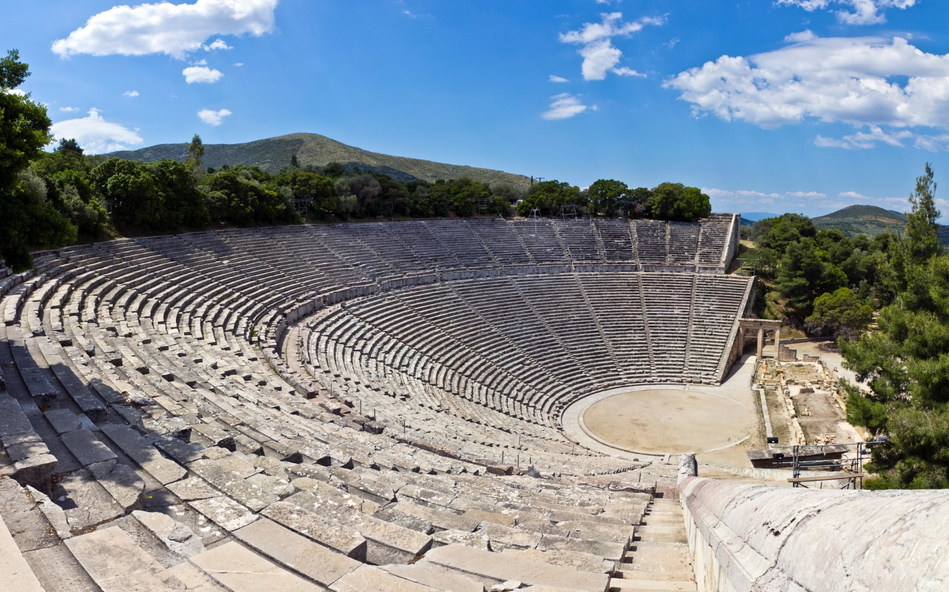
As the world is still reeling from the pandemic and exploring new ways to re-ignite theatre in the COVID-19 era, the Athens Epidaurus Festival invites international audiences to the most beautiful theatre of the ancient world for a live broadcast of Aristophanes' comic masterpiece The Frogs, by acclaimed director Argyro Chioti in her Ancient Theatre of Epidaurus debut. The play includes a stellar cast of renowned Greek theatre actors and a strikingly original musical performance.
Following last year's hugely successful live streaming of The Persians by the National Theatre of Greece, watched by over 100,000 viewers worldwide, The Frogs will be streamed live on July 10 at 21:00 Athens time (GMT +3), with the support of the Hellenic Ministry of Culture and Sports, in collaboration with Google Greece. The performance will be available worldwide (with the exception of Greece) and exclusively through livefromepidaurus.gr and at the Festival's official YouTube channel, Athens Epidaurus Festival, free of charge, although donations are welcome. The performance will be in Greek, with English subtitles, and lasts approximately 1 hour and 45 minutes.
Written in 405 BC, at the end of the Golden Age of Pericles, The Frogs is one of Aristophanes' timeless and most beloved masterworks. The play tackles the descent of god Dionysus to the Underworld, where he embarks on a quest to bring the best tragic poet back to the world of the living, in an attempt to restore theatre to its former glory. Thank to this play, culminating in an iconic scene of poetic "duel" between Aeschylus and Euripides, Aristophanes provides a scathing commentary on the bankrupt political values of his time. A delightful gem by a writer whose work remains as relevant as ever.
10. Hómēros -- writer of the Iliad and the Odysseia 9. Sophocles -- the tragedian who wrote (amongst others) Antigone, Oedipus the King and Electra 8. Herodotos -- whose book The Histories is considered the first work of history in Western literature 7. Euripides -- the tragedian who wrote (amongst others) Alcestis, Medea and The Bacchus 6. Hippokrátēs -- who fathered modern medicine, mostly with his Hippocratic Corpus 5. Aristophanes -- the comic playwright who wrote (amongst others) The Clouds, The Wasps and Lysistrata 4. Plato -- one of the fathers of Western philosophy 3. Aristotle -- the last of the great Hellenic philosophers 2. Euclid -- a mathematician and the father of geometry, whose main work--The Elements--is still used as a textbook in mathematics 1. Archimedes -- a mathematician, engineer, inventor, physicist and astronomer whose ideas are as the basics of all these disciplines
I most certainly concur that this list lists some of ancient Hellas' most influential writers, but the list is far from complete. Today, I want to add five more to it, and most of my picks will no surprise you.
5. Sappho Sappho (Σαπφώ) was a Hellenic lyric poet, born on the island of Lesbos (Λέσβος) around 620 BC, although the exact date is unknown. She wrote beautiful and highly romantic poetry that comes and goes straight to the heart. One of the most famous of her works is her Hymn to Aphrodite.
4. Aeschylos As the original list includes both Sophocles and Euripides, it seems only fair to include Aeschylos. Aeschylos (Aiskhulos, Αἰσχύλος) was the first of the three Hellenic tragedians whose plays can still be read or performed. According to Aristotle, he expanded the number of characters in plays to allow for conflict amongst them, whereas previously characters had interacted only with the chorus. Aescholos' most famous works are undoubtedly the Seven against Thebes, the Supplicants and the Orestia.
3. Pythagoras Pythagoras of Samos ( Πυθαγόρας ὁ Σάμιος) was an Ionian Hellenic philosopher, mathematician, and the father of the religious movement called Pythagoreanism. He lived from about 570 BC to about 495 BC, and made influential contributions to philosophy, religious teaching, math, ethics, and science. His most famous work is, undoubtedly, the Pythagorean theorem (a^2 + b^2 = c^2), that's standard in every math textbook. Interestingly enough, not a single bit of writing has been preserved--if he ever wrote anything down to begin with. His works are mostly quoted by his students, or known through critiques by Aristotle.
2. Plutarch Plutach (Ploútarkhos, Πλούταρχος) was an ancient Hellenic historian, biographer, and essayist who lived between 46 and 120 AD. He is known primarily for his Parallel Lives and Moralia, but much of his work is lost to us. Plutarch's writings are full of details about people and places, and are therefor a true treasure trove.
1. Hesiod Hesiod (Hesiodos, Ἡσίοδος) was a Hellenic oral poet who lived between 750 and 650 BC, around the same time as Hómēros. I would dare say that his work--especially 'Works and Days' and the 'Theogony'--has shaped the way scholars and practitioners of Hellenismos view ancient Hellenic society, religion and way of life. This is why I strongly feel that anyone who feels drawn to the Theoi, might benefit from investing some time in reading his words.
Awww, this is pretty cute! According to a myth by the comic playwright Aristophanes, recounted in Plato’s Symposium, humans were once two-bodied creatures until they challenged the gods. Zeus, angered by humans overstepping their bounds, sliced them all in two, leaving us destined to yearn for partnership. Here is a video describing the alternative creation myth. Read more about it below.
"Aristophanes professed to open another vein of discourse; he had a mind to praise Love in another way, unlike that either of Pausanias or Eryximachus. Mankind; he said, judging by their neglect of him, have never, as I think, at all understood the power of Love. For if they had understood him they would surely have built noble temples and altars, and offered solemn sacrifices in his honour; but this is not done, and most certainly ought to be done: since of all the gods he is the best friend of men, the helper and the healer of the ills which are the great impediment to the happiness of the race. I will try to describe his power to you, and you shall teach the rest of the world what I am teaching you. In the first place, let me treat of the nature of man and what has happened to it; for the original human nature was not like the present, but different. The sexes were not two as they are now, but originally three in number; there was man, woman, and the union of the two, having a name corresponding to this double nature, which had once a real existence, but is now lost, and the word "Androgynous" is only preserved as a term of reproach. In the second place, the primeval man was round, his back and sides forming a circle; and he had four hands and four feet, one head with two faces, looking opposite ways, set on a round neck and precisely alike; also four ears, two privy members, and the remainder to correspond. He could walk upright as men now do, backwards or forwards as he pleased, and he could also roll over and over at a great pace, turning on his four hands and four feet, eight in all, like tumblers going over and over with their legs in the air; this was when he wanted to run fast. Now the sexes were three, and such as I have described them; because the sun, moon, and earth are three;-and the man was originally the child of the sun, the woman of the earth, and the man-woman of the moon, which is made up of sun and earth, and they were all round and moved round and round: like their parents. Terrible was their might and strength, and the thoughts of their hearts were great, and they made an attack upon the gods; of them is told the tale of Otys and Ephialtes who, as Homer says, dared to scale heaven, and would have laid hands upon the gods. Doubt reigned in the celestial councils. Should they kill them and annihilate the race with thunderbolts, as they had done the giants, then there would be an end of the sacrifices and worship which men offered to them; but, on the other hand, the gods could not suffer their insolence to be unrestrained.
At last, after a good deal of reflection, Zeus discovered a way. He said: "Methinks I have a plan which will humble their pride and improve their manners; men shall continue to exist, but I will cut them in two and then they will be diminished in strength and increased in numbers; this will have the advantage of making them more profitable to us. They shall walk upright on two legs, and if they continue insolent and will not be quiet, I will split them again and they shall hop about on a single leg." He spoke and cut men in two, like a sorb-apple which is halved for pickling, or as you might divide an egg with a hair; and as he cut them one after another, he bade Apollo give the face and the half of the neck a turn in order that the man might contemplate the section of himself: he would thus learn a lesson of humility. Apollo was also bidden to heal their wounds and compose their forms. So he gave a turn to the face and pulled the skin from the sides all over that which in our language is called the belly, like the purses which draw in, and he made one mouth at the centre, which he fastened in a knot (the same which is called the navel); he also moulded the breast and took out most of the wrinkles, much as a shoemaker might smooth leather upon a last; he left a few, however, in the region of the belly and navel, as a memorial of the primeval state. After the division the two parts of man, each desiring his other half, came together, and throwing their arms about one another, entwined in mutual embraces, longing to grow into one, they were on the point of dying from hunger and self-neglect, because they did not like to do anything apart; and when one of the halves died and the other survived, the survivor sought another mate, man or woman as we call them, being the sections of entire men or women, and clung to that. They were being destroyed, when Zeus in pity of them invented a new plan: he turned the parts of generation round to the front, for this had not been always their position and they sowed the seed no longer as hitherto like grasshoppers in the ground, but in one another; and after the transposition the male generated in the female in order that by the mutual embraces of man and woman they might breed, and the race might continue; or if man came to man they might be satisfied, and rest, and go their ways to the business of life: so ancient is the desire of one another which is implanted in us, reuniting our original nature, making one of two, and healing the state of man.
Each of us when separated, having one side only, like a flat fish, is but the indenture of a man, and he is always looking for his other half. Men who are a section of that double nature which was once called Androgynous are lovers of women; adulterers are generally of this breed, and also adulterous women who lust after men: the women who are a section of the woman do not care for men, but have female attachments; the female companions are of this sort. But they who are a section of the male follow the male, and while they are young, being slices of the original man, they hang about men and embrace them, and they are themselves the best of boys and youths, because they have the most manly nature. Some indeed assert that they are shameless, but this is not true; for they do not act thus from any want of shame, but because they are valiant and manly, and have a manly countenance, and they embrace that which is like them. And these when they grow up become our statesmen, and these only, which is a great proof of the truth of what I am saving. When they reach manhood they are loves of youth, and are not naturally inclined to marry or beget children,-if at all, they do so only in obedience to the law; but they are satisfied if they may be allowed to live with one another unwedded; and such a nature is prone to love and ready to return love, always embracing that which is akin to him. And when one of them meets with his other half, the actual half of himself, whether he be a lover of youth or a lover of another sort, the pair are lost in an amazement of love and friendship and intimacy, and would not be out of the other's sight, as I may say, even for a moment: these are the people who pass their whole lives together; yet they could not explain what they desire of one another. For the intense yearning which each of them has towards the other does not appear to be the desire of lover's intercourse, but of something else which the soul of either evidently desires and cannot tell, and of which she has only a dark and doubtful presentiment. Suppose Hephaestus, with his instruments, to come to the pair who are lying side, by side and to say to them, "What do you people want of one another?" they would be unable to explain. And suppose further, that when he saw their perplexity he said: "Do you desire to be wholly one; always day and night to be in one another's company? for if this is what you desire, I am ready to melt you into one and let you grow together, so that being two you shall become one, and while you live a common life as if you were a single man, and after your death in the world below still be one departed soul instead of two-I ask whether this is what you lovingly desire, and whether you are satisfied to attain this?"-there is not a man of them who when he heard the proposal would deny or would not acknowledge that this meeting and melting into one another, this becoming one instead of two, was the very expression of his ancient need. And the reason is that human nature was originally one and we were a whole, and the desire and pursuit of the whole is called love. There was a time, I say, when we were one, but now because of the wickedness of mankind God has dispersed us, as the Arcadians were dispersed into villages by the Lacedaemonians. And if we are not obedient to the gods, there is a danger that we shall be split up again and go about in basso-relievo, like the profile figures having only half a nose which are sculptured on monuments, and that we shall be like tallies.
Wherefore let us exhort all men to piety, that we may avoid evil, and obtain the good, of which Love is to us the lord and minister; and let no one oppose him-he is the enemy of the gods who oppose him. For if we are friends of the God and at peace with him we shall find our own true loves, which rarely happens in this world at present. I am serious, and therefore I must beg Eryximachus not to make fun or to find any allusion in what I am saying to Pausanias and Agathon, who, as I suspect, are both of the manly nature, and belong to the class which I have been describing. But my words have a wider application-they include men and women everywhere; and I believe that if our loves were perfectly accomplished, and each one returning to his primeval nature had his original true love, then our race would be happy. And if this would be best of all, the best in the next degree and under present circumstances must be the nearest approach to such an union; and that will be the attainment of a congenial love. Wherefore, if we would praise him who has given to us the benefit, we must praise the god Love, who is our greatest benefactor, both leading us in this life back to our own nature, and giving us high hopes for the future, for he promises that if we are pious, he will restore us to our original state, and heal us and make us happy and blessed." [189c onwards]
Aristophanes' speech is an alternative creation myth which accounts for homosexuality (although not polyamory), as well a why people in love say they feel "whole" when they have found their love partner. He says that, before the Gods separated us, we had four hands, four arms, and two heads. There were three sexes: the all male, the all female, and the androgynous--who was half male, half female. The males were said to have descended from the sun, the females from the earth and the androgynous couples from the moon. The creatures tried to overtake Olympus, so Zeus devised a plan to cut their power but not deprive himself of their devotions and offerings. He decided to separate them from each other.
Apollon pulled the two heads to the side and let Zeus chut tem in two before stitching them up to form the navel, which he chose not to heal so Man would always be reminded of this event. The women who were separated from women became lesbians, the men split from other men and became homosexuals and those that came from androgynous beings became heterosexuals. From this point forward, mankind would always be looking for the other half of them, and thus not thinking of overthrowing the Gods.
Aristophanes admits readily that this is just a thought, a theory, and that it is not--in fact--myth at all. It would, however, explain the sensation of never wanting to be separated from the person you love. It's a cautionary tale of the price disrespecting the Gods can cost us, but also a way of trying to explain the human emotion of 'love'.
I adore this passage in the Symposium, although, obviously, it has it's flaws in the treatment of homosexuality. It's a brave speech to make, however, and I'll be damned if it does not explain a couple of things about this incredibly complicated thing called love.
A reader recently reminded me of a hymn to Poseidon hidden away in Aristophanes's The Knights. It's sung by two of the characters and is quite lovely, so I thought I'd share. Thank you for the inspiration!
Oh, Lord! Oh, Lord, protector and lover of horses!
Lover of the brazen clang and thud of the horses’ hooves, lover of the horses’ neighing. Lover, too, of the swift war ships with their blue emblems of rams at the prow!
Oh, God, whose heart gladdens at the sight of the rich booty those ships carry! A heart that also gladdens at the sight of young men in contest, particularly when they climb proudly upon their chariots chasing their Fate -victory or defeat, no matter!
Come, God of the horse, come now and join our dance!
Poseidon, God of the golden trident, come join us!
God, chief of the dolphins!
God whose name is praised at Sounion!
God, son of Kronos, Geraestus!
God, most loved by the folk of Phormion to whom you granted a naval victory!
God most loved by all the citizens of Athens at this hour of their naval need!
Whenever I am a little tired or down, there is one piece of ancient Hellenic literature that always cheers me up--and since I have been swamped lately and on my last legs, I need it today! That piece? 'Peace' by Aristophanes--especially the start. Why? Because it's basically about a guy so obsessed with the Gods that he tries to fly up to Them on a dung beetle. It's abolutely awesome.
Peace (Εἰρήνη, Eirēnē) is an Athenian comedy written and produced by the Hellenic playwright Aristophanes. It won second prize at the City Dionysia where it was staged just a few days before the Peace of Nicias was validified (421 BC), which promised to end the ten-year-old Peloponnesian War. The play is notable for its joyous anticipation of peace and for its celebration of a return to an idyllic life in the countryside. However, it also sounds a note of caution, there is bitterness in the memory of lost opportunities and the ending is not happy for everyone. As in all Aristophanes' plays, the jokes are numerous, the action is wildly absurd and the satire is savage.
The play starts with two serves who are frantically working outside an ordinary house in Athens, kneading unusually large lumps of something and carrying them one by one into the stable. They are feeding a giant dung beetle that their crazy master Trygaeus has brought home from the Mount Etna region and on which he intends flying to a private audience with the Gods. He makes it, too, only to find just Hermes home--the rest of the Gods have retured to somewhere far away where there are no idiot humans looking for war. Then Trygaeus discovers that the new tennant War has imprisoned Peace in a cave and After a lot of back nd forth, Trygaeus frees Peache, Harvest and Festival and it becomes Trygaeus' goal in life to ban war in all forms.
Let me quote the first few lines of the play. If it inspires you, you can find the rest here:
FIRST SERVANT Quick, quick, bring the dung-beetle his cake.
SECOND SERVANT There it is. Give it to him, and may it kill him! And may he never eat a better.
FIRST SERVANT Now give him this other one kneaded up with ass's dung.
SECOND SERVANT There! I've done that too. And where's what you gave him just now? Surely he can't have devoured it yet!
FIRST SERVANT Indeed he has; he snatched it, rolled it between his feet and bolted it. Come, hurry up, knead up a lot and knead them stiffly.
SECOND SERVANT Oh, scavengers, help me in the name of the gods, if you do not wish to see me fall down choked.
FIRST SERVANT Come, come, another made from the stool of a fairy's favourite. That will be to the beetle's taste; he likes it well ground.
SECOND SERVANT There! I am free at least from suspicion; none will accuse me of tasting what I mix.
FIRST SERVANT Faugh! come, now another! keep on mixing with all your might.
SECOND SERVANT By god, no. I can stand this awful cesspool stench no longer.
FIRST SERVANT I shall bring you the whole ill-smelling gear.
SECOND SERVANT Pitch it down the sewer sooner, and yourself with it.
To the AUDIENCE Maybe, one of you can tell me where I can buy a stopped-up nose, for there is no work more disgusting than to mix food for a dung-beetle and to carry it to him. A pig or a dog will at least pounce upon our excrement without more ado, but this foul wretch affects the disdainful, the spoilt mistress, and won't eat unless I offer him a cake that has been kneaded for an entire day.... But let us open the door a bit ajar without his seeing it. Has he done eating? Come, pluck up courage, cram yourself till you burst! The cursed creature! It wallows in its food! It grips it between its claws like a wrestler clutching his opponent, and with head and feet together rolls up its paste like a rope-maker twisting a hawser. What an indecent, stinking, gluttonous beast! I don't know what angry god let this monster loose upon us, but of a certainty it was neither Aphrodite nor the Graces.
Every writer, movie buff, theatre lover, and game connoisseur knows the term: deus ex machina; 'God from a machine'. The term (pronounced as 'Day-oos eks MAH-kee-nah') is a calque from the Hellenic ἀπὸ μηχανῆς θεός (apò mēkhanês theós), which has roughly the same meaning. The term has evolved into a plot device whereby a seemingly unsolvable problem is suddenly and abruptly resolved by the contrived and unexpected intervention of some new event, character, ability or object. Depending on how it is done, it can be intended to move the story forward when the writer has stuffed up and sees no other way out, to surprise the audience, to bring the tale to a happy ending, or as a comedic device.
The term was coined in Hellenic tragedy, where a machine was (and still is) used to bring actors playing Gods onto the stage. The machine could be either a crane (mechane) used to lower actors from above or a riser that brought actors up through a trapdoor. The idea was introduced by Aeschylus and was used often to resolve the conflict and conclude the drama. Although the device is associated most with Hellenic tragedy, it also appeared in comedies.
Aeschylus used the device in his 'Eumenides', but it was with Euripides that it became an established stage machine. More than half of Euripides' extant tragedies employ a deus ex machina in their resolution, and some critics claim that Euripides, not Aeschylus, invented it.
In Aristophanes' play 'Thesmophoriazusae', the playwright parodies Euripides' frequent use of the crane by making Euripides himself a character in the play and bringing him on stage by way of the mechane. Aristotle was the first to use deus ex machina as a term to describe the technique as a device to resolve the plot of tragedies. Antiphanes believed that the use of the deus ex machina was a sign that the playwright was unable to properly manage the complications of their plot:
"When they don't know what to say, and have completely given up on the play, just like a finger they lift the machine, and the spectators are satisfied. Here is none of this for us."
Aristotle also wasn't a fan and he criticized the device in his Poetics:
"As in the structure of the plot, so too in the portraiture of character, the poet should always aim either at the necessary or the probable. Thus a person of a given character should speak or act in a given way, by the rule either of necessity or of probability; just as this event should follow that by necessary or probable sequence. It is therefore evident that the unraveling of the plot, no less than the complication, must arise out of the plot itself, it must not be brought about by the Deus ex Machina- as in the Medea, or in the return of the Greeks in the Iliad. The Deus ex Machina should be employed only for events external to the drama- for antecedent or subsequent events, which lie beyond the range of human knowledge, and which require to be reported or foretold; for to the gods we ascribe the power of seeing all things. Within the action there must be nothing irrational. If the irrational cannot be excluded, it should be outside the scope of the tragedy. Such is the irrational element the Oedipus of Sophocles."
Despite that, the effect of the device on Hellenic audiences was attested as a direct and immediate emotional response. Audiences would have feeling of wonder and astonishment at the appearance of the gods and often adds to the moral effect of the drama. Even in modern plays, books, and movies, the deus ex machina can have this effect. How about the Hulk showing up near the end of The Avengers to punch that alien battleship/whale on the nose? Or the Eagles showing up at the end of the Lord of the Rings trilogy to carry our near-dead heroes home? I, for one, felt extreme elation and excitement at both. When used too much, or too obviously, the deus ex machina can be a cheap trick, but when done well, it can be quite brilliant.
The Archaeological News Network reports that the open air plays of the ancient Hellenes may offer us a valuable insight into the Mediterranean climate of the time. According to the article, new research into the ancient plays and the artwork about them has identified 'halcyon days'--days of theatre friendly weather even in (what now equates as) January and February--or so says Dr. Christina Chronopoulou, from the National and Kapodestrian University of Athens.
"We explored the weather conditions which enabled the Athenians of the classical era to watch theatre performances in open theatres during the midwinter weather conditions. We aimed to do so by gathering and interpreting information from the classical plays of Greek drama from 5th and 4th centuries B.C."
In order to conduct this research, the writings of 43 plays--7 by Aeschylus, 7 by Sophocles, 18 by Euripides and 11 by Aristophanes--were examined for references about the weather, and many did. If the plays are to be believed, the ancient Hellenes enjoyed long, hot, dry summers, yet also were treated to the rare theatre friendly 'halcyon days' of clear, sunny weather during winter.
"The comedies of Aristophanes, often invoke the presence of the halcyon days. Combining the fact that dramatic contests were held in mid-winter without any indication of postponement, and references from the dramas about the clear weather and mild winters, we can assume that those particular days of almost every January were summery in the fifth and maybe in the fourth centuries BC."
According to the research conducted, the Halcyon days, a phenomenon also observed nowadays, has its origins in an ancient myth. According to one version, the goddess Halcyon, daughter of Aeolus, the ruler of the winds, insults Zeus and Hera. So, the father of gods transformed her into a bird and condemned her to lay her eggs only in the mid-winter. Consequently, the little birds were hardly able to survive. Crying and praying endlessly, Halcyon managed to make Zeus feel pity for her and so he decided to give her 14 days of good and calm weather in mid-January in order to lay her eggs in security. The Halcyon days were named after this Greek myth, and in Aristotle's Histories about animals (p. 5.8; 350 BC) he writes The halcyon breeds at the season of the winter solstice. Accordingly, when this season is marked with calm weather, the name of “halcyon days” is given to the seven days preceding and to as many following the solstice (Wentworth Tompson, 2007).
The report als shows that the ancient Hellenes used to forecast by looking for the signs of diosimies, which are phenomena caused by Zeus. Meteorological calendars called ‘Parapigmata’ were being circulated in the ancient Agora (a place of gathering and a market) since the fifth century (McCormick et al., 2012). Philosophers were observing weather phenomena from mountains such as Mithimna, Idi and Lycabettus (Theophrastus, third to fourth century BC), and by combining astronomy with their empirical knowledge of the local meteorology they composed the Parapigmata, a kind of empirical forecast report.
The entire article is well worth the read and was published in the magazine 'Weather', Volume 69, Issue 3, pages 66–69, March 2014. The entire article can be found here.
Yesterday, I came across one of the best representations of one of Aristophanes' theories as quoted in Plato's Symposium. Some of you will now know exactly what is going to come next; for those who don't, please read the comic first.
"Aristophanes professed to open another vein of discourse; he had a mind to praise Love in another way, unlike that either of Pausanias or Eryximachus. Mankind; he said, judging by their neglect of him, have never, as I think, at all understood the power of Love. For if they had understood him they would surely have built noble temples and altars, and offered solemn sacrifices in his honour; but this is not done, and most certainly ought to be done: since of all the gods he is the best friend of men, the helper and the healer of the ills which are the great impediment to the happiness of the race. I will try to describe his power to you, and you shall teach the rest of the world what I am teaching you. In the first place, let me treat of the nature of man and what has happened to it; for the original human nature was not like the present, but different. The sexes were not two as they are now, but originally three in number; there was man, woman, and the union of the two, having a name corresponding to this double nature, which had once a real existence, but is now lost, and the word "Androgynous" is only preserved as a term of reproach. In the second place, the primeval man was round, his back and sides forming a circle; and he had four hands and four feet, one head with two faces, looking opposite ways, set on a round neck and precisely alike; also four ears, two privy members, and the remainder to correspond. He could walk upright as men now do, backwards or forwards as he pleased, and he could also roll over and over at a great pace, turning on his four hands and four feet, eight in all, like tumblers going over and over with their legs in the air; this was when he wanted to run fast. Now the sexes were three, and such as I have described them; because the sun, moon, and earth are three;-and the man was originally the child of the sun, the woman of the earth, and the man-woman of the moon, which is made up of sun and earth, and they were all round and moved round and round: like their parents. Terrible was their might and strength, and the thoughts of their hearts were great, and they made an attack upon the gods; of them is told the tale of Otys and Ephialtes who, as Homer says, dared to scale heaven, and would have laid hands upon the gods. Doubt reigned in the celestial councils. Should they kill them and annihilate the race with thunderbolts, as they had done the giants, then there would be an end of the sacrifices and worship which men offered to them; but, on the other hand, the gods could not suffer their insolence to be unrestrained.
At last, after a good deal of reflection, Zeus discovered a way. He said: "Methinks I have a plan which will humble their pride and improve their manners; men shall continue to exist, but I will cut them in two and then they will be diminished in strength and increased in numbers; this will have the advantage of making them more profitable to us. They shall walk upright on two legs, and if they continue insolent and will not be quiet, I will split them again and they shall hop about on a single leg." He spoke and cut men in two, like a sorb-apple which is halved for pickling, or as you might divide an egg with a hair; and as he cut them one after another, he bade Apollo give the face and the half of the neck a turn in order that the man might contemplate the section of himself: he would thus learn a lesson of humility. Apollo was also bidden to heal their wounds and compose their forms. So he gave a turn to the face and pulled the skin from the sides all over that which in our language is called the belly, like the purses which draw in, and he made one mouth at the centre, which he fastened in a knot (the same which is called the navel); he also moulded the breast and took out most of the wrinkles, much as a shoemaker might smooth leather upon a last; he left a few, however, in the region of the belly and navel, as a memorial of the primeval state. After the division the two parts of man, each desiring his other half, came together, and throwing their arms about one another, entwined in mutual embraces, longing to grow into one, they were on the point of dying from hunger and self-neglect, because they did not like to do anything apart; and when one of the halves died and the other survived, the survivor sought another mate, man or woman as we call them, being the sections of entire men or women, and clung to that. They were being destroyed, when Zeus in pity of them invented a new plan: he turned the parts of generation round to the front, for this had not been always their position and they sowed the seed no longer as hitherto like grasshoppers in the ground, but in one another; and after the transposition the male generated in the female in order that by the mutual embraces of man and woman they might breed, and the race might continue; or if man came to man they might be satisfied, and rest, and go their ways to the business of life: so ancient is the desire of one another which is implanted in us, reuniting our original nature, making one of two, and healing the state of man.
Each of us when separated, having one side only, like a flat fish, is but the indenture of a man, and he is always looking for his other half. Men who are a section of that double nature which was once called Androgynous are lovers of women; adulterers are generally of this breed, and also adulterous women who lust after men: the women who are a section of the woman do not care for men, but have female attachments; the female companions are of this sort. But they who are a section of the male follow the male, and while they are young, being slices of the original man, they hang about men and embrace them, and they are themselves the best of boys and youths, because they have the most manly nature. Some indeed assert that they are shameless, but this is not true; for they do not act thus from any want of shame, but because they are valiant and manly, and have a manly countenance, and they embrace that which is like them. And these when they grow up become our statesmen, and these only, which is a great proof of the truth of what I am saving. When they reach manhood they are loves of youth, and are not naturally inclined to marry or beget children,-if at all, they do so only in obedience to the law; but they are satisfied if they may be allowed to live with one another unwedded; and such a nature is prone to love and ready to return love, always embracing that which is akin to him. And when one of them meets with his other half, the actual half of himself, whether he be a lover of youth or a lover of another sort, the pair are lost in an amazement of love and friendship and intimacy, and would not be out of the other's sight, as I may say, even for a moment: these are the people who pass their whole lives together; yet they could not explain what they desire of one another. For the intense yearning which each of them has towards the other does not appear to be the desire of lover's intercourse, but of something else which the soul of either evidently desires and cannot tell, and of which she has only a dark and doubtful presentiment. Suppose Hephaestus, with his instruments, to come to the pair who are lying side, by side and to say to them, "What do you people want of one another?" they would be unable to explain. And suppose further, that when he saw their perplexity he said: "Do you desire to be wholly one; always day and night to be in one another's company? for if this is what you desire, I am ready to melt you into one and let you grow together, so that being two you shall become one, and while you live a common life as if you were a single man, and after your death in the world below still be one departed soul instead of two-I ask whether this is what you lovingly desire, and whether you are satisfied to attain this?"-there is not a man of them who when he heard the proposal would deny or would not acknowledge that this meeting and melting into one another, this becoming one instead of two, was the very expression of his ancient need. And the reason is that human nature was originally one and we were a whole, and the desire and pursuit of the whole is called love. There was a time, I say, when we were one, but now because of the wickedness of mankind God has dispersed us, as the Arcadians were dispersed into villages by the Lacedaemonians. And if we are not obedient to the gods, there is a danger that we shall be split up again and go about in basso-relievo, like the profile figures having only half a nose which are sculptured on monuments, and that we shall be like tallies.
Wherefore let us exhort all men to piety, that we may avoid evil, and obtain the good, of which Love is to us the lord and minister; and let no one oppose him-he is the enemy of the gods who oppose him. For if we are friends of the God and at peace with him we shall find our own true loves, which rarely happens in this world at present. I am serious, and therefore I must beg Eryximachus not to make fun or to find any allusion in what I am saying to Pausanias and Agathon, who, as I suspect, are both of the manly nature, and belong to the class which I have been describing. But my words have a wider application-they include men and women everywhere; and I believe that if our loves were perfectly accomplished, and each one returning to his primeval nature had his original true love, then our race would be happy. And if this would be best of all, the best in the next degree and under present circumstances must be the nearest approach to such an union; and that will be the attainment of a congenial love. Wherefore, if we would praise him who has given to us the benefit, we must praise the god Love, who is our greatest benefactor, both leading us in this life back to our own nature, and giving us high hopes for the future, for he promises that if we are pious, he will restore us to our original state, and heal us and make us happy and blessed." [189c onwards]
Aristophanes' speech is an alternative creation myth which accounts for homosexuality, as well a why people in love say they feel "whole" when they have found their love partner. He says that, before the Gods separated us, we had four hands, four arms, and two heads. There were three sexes: the all male, the all female, and the androgynous--who was half male, half female. The males were said to have descended from the sun, the females from the earth and the androgynous couples from the moon. The creatures tried to overtake Olympus, so Zeus devised a plan to cut their power but not deprive himself of their devotions and offerings. He decided to separate them from each other.
Apollon pulled the two heads to the side and let Zeus chut tem in two before stitching them up to form the navel, which he chose not to heal so Man would always be reminded of this event. The women who were separated from women became lesbians, the men split from other men and became homosexuals and those that came from androgynous beings became heterosexual.s From this point forward, mankind would always be looking for the other half of them, and thus not thinking of overthrowing the Gods.
Aristophanes admits readily that this is just a thought, a theory, and that it is not--in fact--myth at all. It would, however, explain the sensation of never wanting to be separated from the person you love. It's a cautionary tale of the price disrespecting the Gods can cost us, but also a way of trying to explain the human emotion of 'love'.
I adore this passage in the Symposium, although, obviously, it has it's flaws in the treatment of homosexuality. It's a brave speech to make, however, and I'll be damned if it does not explain a couple of things about this incredibly complicated thing called love.
Last week's Pagan Blog Project post was about the virtues of women and throughout the week, I realized that I wanted to do a 'virtues of...' post for men as well. It's a little more obvious, obviously, but for the guys reading this blog, it might be nice to know what to live up to, if you were so inclined.
In short, I would say that it was a man's job to be positively remembered; to add something so good to society, or do something so heroic that their name would be remembered forever. I don't often quote modern sources, as time seems to change perceptions far too much for my liking, but the following quote from C. M. Bowra's 'The Greek Experience' is so telling that it must be shared. This is a description of the Hellenic heroic ideal, which was also prevalent in the minds of non-mythical men:
"The great man is he who, being endowed with superior qualities of body and mind, uses them to the utmost and wins the applause of his fellows because he spares no effort and shirks no risk in his desire to make the most of his gifts and to surpass other men in his exercise of them. His honour is the centre of his being, and any affront to it calls for immediate amends. He courts danger gladly because it gives him the best opportunity of showing of what stuff he is made. Such a conviction and its system of behaviour are built on a man’s conception of himself and of what he owes to it, and if it has any further sanctions, they are to be found in what other men like himself think of him. By prowess and renown he gains an enlarged sense of personality and well-being; through them he has a second existence on the lips of men, which assures him that he has not failed in what matters most." [p. 20-21]
As men wrote the great classics, it's easy to see what qualities they held in high regard for their characters and their fellow men: a man is in excellent physical condition. He is both strong and athletic, and if the Gods bless him, he is also physically beautiful. He is wise and able to understand his own limitations. He has a good grasp of the situation he is in and if it's a problematic one, he knows how to get out of it again. In order to do this, he must also be intelligent. A true man is couragious and willing to risk his life for his loved ones, and that includes his brothers-in-arms. He is a good host and practices xenia. In order to do this, he must be aware of all unwritten social laws and play his part in them.
He can be found at political assemblies where he will speak up, and at the symposium where he will speak until he should no longer. A man does not get drunk on wine, although he remains at the symposium until it ends. At home, he makes love to his wife and performs the household rituals to the Gods in his role as kurios. He is expected to be leader of the house if his age and standing grant him that right, and it is his job to raise good sons when they become old enough to be taught. It is his job to introduce the child to the Gods in various stages of his life, and to integrate him into society so he can assume his proper place in it when time comes. A man is expected to join in the army, and to be a good soldier: strong, powerful, and reliable. Men are expected to develop themselves in the arts, be it orration, acting, music, or poetry. He is expected to be a good husband to his wife, meaning he must provide for her and the rest of the household in their necessities.
Aristophanes, in 'Clouds', writes a beautiful monologue of how a man should be, having one of the characters, Better (or Superior, depending on the translation) Argument, tell it to the son of Strepsiades, Pheidippides, who is having trouble behaving like a good man should. Better Argument tells him:
"And so, young man, that’s why you should choose me, the Better Argument. Be resolute. You’ll find out how to hate the market place, to shun the public baths, to feel ashamed of shameful things, to fire up your heart when someone mocks you, to give up your chair when older men come near, not to insult your parents, nor act in any other way which brings disgrace or which could mutilate your image as an honourable man. You’ll learn not to run off to dancing girls, in case, while gaping at them, you get hit with an apple thrown by some little slut, and your fine reputation’s done for, and not to contradict your father, or remind him of his age by calling him Iapetus—not when he spent his years in raising you from infancy.
You’ll spend your time in the gymnasium—your body will be sleek, in fine condition. You won’t be hanging round the market place, chattering filth, as boys do nowadays. You won’t keep on being hauled away to court over some damned sticky fierce dispute about some triviality. No, no. Instead you’ll go to the Academy, to race under the sacred olive trees, with a decent friend the same age as you, wearing a white reed garland, with no cares. You’ll smell yew trees, quivering poplar leaves, as plane trees whisper softly to the elms, rejoicing in the spring. I tell you this—if you carry out these things I mention, if you concentrate your mind on them, you’ll always have a gleaming chest, bright skin, broad shoulders, tiny tongue, strong buttocks, and a little prick. But if you take up what’s in fashion nowadays, you’ll have, for starters, feeble shoulders, a pale skin, a narrow chest, huge tongue, a tiny bum, and a large skill in framing long decrees." [990]
While many gripe on the unjust lives of women in ancient Hellas, I'm not so sure men had an easier time of it. It was--and in many ways is--hard to be a man: there was a lot expected of you, and you were not allowed to drop the ball. Heck, for the longest time, you weren't even allowed to bath in warm water.
Being a man in ancient Hellas came with a strong moral and physical code to live up to, and while of course not everyone did so, it were the men who did that were remembered--the highest goal in a society where the dead live on in society as long as their names are spoken out loud. There are a lot of ancient Hellenic virtues for men that a modern practitioner of Hellenismos can adopt if he so desires. Undoubtedly, it would make him a better person--not just a better man. Personally, I would still prefer to be a woman in ancient Hellas as opposed to a man, but I might be biased by my own gender and predisposition towards the female virtues laid out by the ancient Hellenes.
I must address one more thing before I end this blog post: the gender binary is a tricky thing and in general it was strictly enforced in ancient Hellas. Today, more and more people become aware that gender is made up of a mixture of nature, nurture, and common sense, and that the binary is not so binary after all. For any woman reading this, and any man reading the piece about the virtues of women; if it resonates with you, make it your ideal. The point is to become a better person, and I firmly believe--call it that feminist streak I mentioned in the first part of this two-part series--that a person is not defined by the equipment they were born with. We create our own person and while our biological gender (still not a binary) is a part of that, it most certainly has no business being the defining part.
Yesterday, I received an e-mail from a frequent reader of Baring the Aegis who had seen my post on the small packages of the ancient statues and the post about taboos where nudity also plays an important role, and had begun to wonder about nudity at large in ancient Hellas, and specifically in a religious setting. They also wondered how I feel about nudity in modern Hellenismos. I would like to share my--slightly edited--reply with the readers of this blog, because others might be wondering about the ancient Hellenic attitude towards nakedness as well.
‘Naked’, gymnos, in the ancient Hellenic language has a double meaning: it means both nudity and ‘to go without chiton’, which complicates drawing conclusions from the written word. As such, most of the information gathered on this topic is based upon artwork, with a few exceptions. The ancient Hellenes had a very complicated view of nudity, and I don’t think I did that view justice back in 2012.
Before I get to the religious part, I feel I must look at every day life first. I want to start with ancient Hellenic clothing, which varied for males and females, although both only wore one or two rectangular pieces of cloth. Undergarments of any kind were unknown to the ancient Hellenes, and they were thus naked under them. Men throughout the whole of the ancient Hellenic time period wore either a chiton and himation, only a chiton, or only the himation. Socrates is famous for wearing only the latter, and so is Agesilaus, King of Sparta, and Phocion, who Plutarch joked about in ‘Phocion’, saying:
“His countenance was so composed that scarcely was he ever seen by any Athenian either laughing or in tears. He was rarely known, so Duris has recorded, to appear in the public baths, or was observed with his hand exposed outside his cloak, when he wore one. Abroad, and in the camp, he was so hardy in going always thin clad and barefoot, except in a time of excessive and intolerable cold, that the soldiers used to say in merriment, that it was like to be a hard winter when Phocion wore his coat.“
There were very strict social rules about what was considered proper and improper for men when wearing only one of the two layers of clothing, and even when wearing both. Under no circumstances was the clothing to slide up above the knee during social affairs. It seems that any setting where nudity was not required--something we will come to below--nudity was forbidden quite strictly. Partial exposure like that was considered not only improper but irreverent, again, something I must explain later.
Women, whose style of clothing varied greatly throughout the ancient Hellenic time period, had to hold fast to different social rules concerning nudity. Statues and frescos show that in very archaic Knossos, for example, highly placed women wore garments which proudly exposed their breasts. When this style faded, others took its place. For their clothing, women in ancient Hellas often wore translucent materials, which left very little to the imagination. Many ancient writers, including Lucian, Petronius, and Seneca write about this, Seneca most tellingly:
“I see silk clothes, if they can be called clothes, which can protect neither the body nor the modesty.” [De Beneficiis, 7.9.5.]
It seems that women, while not nude, displayed a nakedness in the streets that was completely accepted. The social rules concerning these displays of the body depended on the intent of the nudity: either natural or erotic. Erotic nudity had no function in public, and was heavily frowned upon. Natural nakedness went accepted. For ancient Hellenic men, a woman’s girdle holding in place her dress was much more erotic than seeing her breasts through the thin fabric of her clothing.
“The Athenians were the first to lay aside their weapons, and to adopt an easier and more luxurious mode of life; indeed, it is only lately that their rich old men left off the luxury of wearing undergarments of linen, and fastening a knot of their hair with a tie of golden grasshoppers, a fashion which spread to their Ionian kindred and long prevailed among the old men there. On the contrary, a modest style of dressing, more in conformity with modern ideas, was first adopted by the Lacedaemonians, the rich doing their best to assimilate their way of life to that of the common people. They also set the example of contending naked, publicly stripping and anointing themselves with oil in their gymnastic exercises. Formerly, even in the Olympic contests, the athletes who contended wore belts across their middles; and it is but a few years since that the practice ceased. To this day among some of the barbarians, especially in Asia, when prizes for boxing and wrestling are offered, belts are worn by the combatants. And there are many other points in which a likeness might be shown between the life of the Hellenic world of old and the barbarian of to-day.“ [1.6]
Sports were a frequent platform of nudity: not only did males (and in Sparta and a few other choice city-states, females) who studied at the gymnasium practice sports and even their classes in the nude, there is evidence to support that the two genders did not hide their bodies from each other when women were permitted, and even that they wrestled each other while naked, showing that this type of nakedness was considered completely natural and accepted. Athenaeus records a Spartan custom of this, saying:
“The fashion, too, of Sparta is much praised, I mean that of displaying their maidens naked to their guests; and in the island of Chios it is a beautiful sight to go to the gymnasia and the race-courses, and to see the young men wrestling naked with the maidens, who are also naked.” [13, 566e]
Sporting competitions were always in the nude. It seems that in antiquity, the athletes did wear something to hide their nether regions, but when this covering slipped off of a sprinter, and he tripped and fell to his death, any type of covering was forbidden. Married women, in most city states, (interestingly enough) were not allowed to watch sporting events, not even the major ones like to Olympics, although testimony Pindar (in Pythia) hints at the possibility that the Hellenic city-state of Cyrene allowed married women to watch. Maidens were more often allowed to view the games. Scholars pose that the distinction between maiden and married is made purely aesthetically: the ancient Hellenes valued beauty very much, and maidens were considered beautiful. They were virtuous and thus desirable. Married women were not to be seen as desirous; they were married.
Before I come to the religious part of this longwinded tale, I must address two more points: bathing and the ancient Hellenic practice to either be completely dressed, or completely naked. Bathing, in ancient Hellas, had quite an interesting set of social rules attached to it, especially before the Peloponnesian war. ’Baths’, when referred to in ancient texts, unless otherwise specified, nearly always alluded to bathing in hot or warm water, as many bathing house offered. at least until the previously mentioned war, bathing in warm water was considered taboo for men. Warm water was for women; men were supposed to be a heartier breed and thus bathed in cold water. Aristophanes, in Clouds, forbids men from entering the baths, because they are baneful and effeminizing. From the writings of Plato, Demothenes, and Plutarch, we can see that this view was quite widespread (see Plutarch on Phocion above).
For my last point before I get to religion, it must be said that the ancient Hellenes felt no shame about their body, quite the opposite, in fact. The ancient Hellenes took great pride in beauty, and displayed their bodies proudly. Especially young males were considered pleasing, as described in my post about the small packages of statues. Sexual organs of both sexes were considered not only natural, but sacred. Aidos (Αἰδώς) is a term (and Goddess) interpreted often as ‘shame’ or ‘modesty’, and linked to he displaying of a person’s genitals, but the term can also mean ‘awe’ and ‘reverence’. The ancient Hellenes were well aware that their sexual organs--when brought together in an intimate setting--produced children. As such, these body parts were treated with an almost religious reverence as the mystical tools of propagation. These instruments produced life, something definitely awe inspiring. This is also how the phallus became a religious symbol; it represents the inexhaustible fruitfulness of human nature and the gratitude that came with this understanding.
Because sexual organs were considered somewhat sacred, covering them up--especially when otherwise naked--was considered impious, and so any socially acceptable situation where clothes were deemed cumbersome, unnecessary or impossible led to a state of complete nakedness. The ancient Hellenes took great pride in this fact, and to cover up one’s groin was considered barbaric. As Herodotos puts it so beautifully in his ‘Histories’:
“For among the Lydians, and indeed among the barbarians generally, it is reckoned a deep disgrace, even to a man, to be seen naked. ” [1, 7-11]
To conclude, nudity was generally accepted by the ancient Hellenes, although social rules had to be observed. Women rarely went completely uncovered in every day life, but displayed their bodies through their clothing. Men could cast off their clothing more readily. If either gender undressed, it was seen as irreverent to do so partly, and thus they appeared either fully clothed or naked. Partial nudity was frowned upon in almost all social settings, while full nudity was often accepted.
Now, as for religious worship: there are definitely some instances where complete nudity became required. In other festivals, I would assume--based on the above--that nudity was allowed, if the person went completely uncovered. A few examples of rituals where we know nudity was included:
The young maidens who ‘played the bear’ to Artemis at the Brauronia are depicted naked at various stages of the ritual
Athenaeus describes a 'naked-boy dance' in relation to the cult of Dionysos: “The naked-boy-dance is like what is called the anapale among the ancients. For all the boys who dance it are naked, performing certain rhythmical movements and describing certain positions with the arms gently, so as to represent certain scenes in the wrestling-school during a wrestling-and-boxing match, but moving the feet in time to the music. Variations of it are the Oschophoric and the Bacchic, so that this dance also is traceable to the worship of Dionysus. Aristoxenus says that the ancients, practicing first the naked-boy-dance, proceeded into the pyrriche before entering the theatre.”
Arisophanes in ‘Clouds’ hints at this type of dance being performed during the Panathenaea as well: “But you, you teach the children of to-day to bundle themselves quickly into their clothes, and I am enraged when I see them at the Panathenaea forgetting Athene while they dance, and covering their tools with their bucklers.”
Stabo recorded the following example of public nudity at Acharaca in ancient Hellas: “On the road between Tralles and Nysa is a village of the Nysaeans, not far from the city Acharaca, in which is the Plutonium, to which is attached a large grove, a temple of Pluto and Proserpine, and the Charonium, a cave which overhangs the grove, and possesses some singular physical properties. The sick, it is said, who have confidence in the cures performed by these deities, resort thither, and live in the village near the cave, among experienced priests, who sleep at night in the open air, on behoof of the sick, and direct the modes of cure by their dreams. The priests invoke the gods to cure the sick, and frequently take them into the cave, where, as in a den, they are placed to remain in quiet without food for several days. Sometimes the sick themselves observe their own dreams, but apply to these persons, in their character of priests and guardians of the mysteries, to interpret them, and to counsel what is to be done. To others the place is interdicted and fatal. An annual festival, to which there is a general resort, is celebrated at Acharaca, and at that time particularly are to be seen and heard those who frequent it, conversing about cures performed there. During this feast the young men of the gymnasium, and the ephebi, naked and anointed with oil, carry off a bull by stealth at midnight, and hurry it away into the cave. It is then let loose, and after proceeding a short distance falls down and expires.”
Vase paintings and frescos of Dionysios’ festivals often have men and women dancing naked.
I’m sure I have read somewhere that Aphrodite’s worship was also sometimes conducted naked, but I simply can not find the reference again.
Nudity was a part of ancient Hellenic religion, but not often a requirement. In most cases, clothes were cot considered a burden, so they remained on. In the case of Dionysian worship, clothes would hinder the ecstatic dances usually tied to them, so clothes were discarded. Functional nudity. That said, I have not found any references to festivals where public nudity was expressly forbidden.
I come from a Neo-Pagan background and was quite accustomed to performing rituals in the nude. It was a big shift to go to clothed ritual for me, but it does seem fitting somehow. The ancient Hellenic viewpoint of functional nudity seems practical and a good standard to uphold. That said, I am not against nudity in Hellenic ritual at all, if agreed upon by all participants and the occasion warrants it.
If you have a question for me, please, do not hesitate to contact me at the gmail address 'baring.the.aegis'.
Oh guys, you know I love you, right? Yesterday I got not one but two e-mail from readers. One was a very sweet note abut the quality of the blog and how much they like reading it, the other was a very simple question, and I really appreciate that the reader (who has opted to remain anonymous) was comfortable enough with me to ask it. The message reads:
"Hello Elani,
I'm a frequent reader of your blog, and I read the post about the Greek statues being returned because the Qatar government did not want to display them naked. I saw the image that went with it and I want to ask you something I have been wondering about. Why do all the male statues from ancient Greece and Rome have small [packages]? Were ancient Greek men all that small? Sorry if this is inappropriate.
Thanks in advance!"
It's a very good question, and I don't feel it is inappropriate at all. I will, however, not use the most common word for the male genitalia, because that attracts a lot of weird attention to the blog. That is why I have changed the word to 'package' above. I assume we all know what we're talking about here. One more thing: I'm a lesbian, so besides the random reveal here and there, I have not seen a male member--relaxed or enticed--in my life. If one of my male readers or well-informed female readers wants to contribute to this discussion, I welcome their input.
Before we start on the 'why', I first want to nuance the question a bit. Yes, many classical sculptures feature relatively small genitalia, but there are many examples of huge penises as well. The herms, placed on the threshold between the yard and the street of ancient Hellenic homes, often sported erect members of impressive size. The temple of Dionysos on the island of Dolos sports very impressive erect statues--shown on the right here--which unfortunately have been broken off throughout the years. These statues, and the herms dedicated to Hermes, especially, were apotropaic, meaning they warded off evil. There was nothing sexual about erect members, generally speaking.
In the case of Dionysos, Pan, and other fertility Gods, or those known for chasing nymphs around, a big package was absolutely normal on statues. It showed that they were wild Gods, speaking to an untamed part of men that lusted, and literally walked after whatever their members were pointing at. As such, big members were associated with unrestrained, barbaric, men who were only interested in chasing tail. It was also seen as comical, or even grotesque. This stood in direct contrast to the ideal man, who showed restrained, led with his (big) head, and showed sophistication and class. A big member was thus associated with barbarism, where a small member became associated with sophistication.
Secondly, the ideal beauty was young and chiseled, and young men, it seems, still need to grow into their size and pubic hair. Aristophanes, in 'The Clouds', describes this ideal beauty in a male with great detail:
"You’ll spend your time in the gymnasium—your body will be sleek, in fine condition. You won’t be hanging round the market place, chattering filth, as boys do nowadays. You won’t keep on being hauled away to court over some damned sticky fierce dispute about some triviality. No, no.
Instead you’ll go to the Academy, to race under the sacred olive trees, with a decent friend the same age as you, wearing a white reed garland, with no cares. You’ll smell yew trees, quivering poplar leaves, as plane trees whisper softly to the elms, rejoicing in the spring.
I tell you this—if you carry out these things I mention, if you concentrate your mind on them, you’ll always have a gleaming chest, bright skin, broad shoulders, tiny tongue, strong buttocks, and a little prick. But if you take up what’s in fashion nowadays, you’ll have, for starters, feeble shoulders, a pale skin, a narrow chest, huge tongue, a tiny bum, and a large skill in framing long decrees." [1278 - 1300]
As a third option, there might simply have been practical reasons: the model really was that small (although wiki says the average member in relaxed state is ten centimeters (four inches) long), it was chilly, the sculptor wanted the eye to focus somewhere else, or maybe he was scared of the member breaking off, leaving the statue member-less. Who knows? The most important reasons, it seems, were cultural.
I hope this answers the question for anyone who as also wondering about the same thing, and if you have a question--no matter what it is--or a topic you would like me to write about, don't be afraid to use the gmail e-mail address baring.the.aegis.
10. Hómēros -- writer of the Iliad and the Odysseia
9. Sophocles -- the tragedian who wrote (amongst others) Antigone, Oedipus the King and Electra
8. Herodotos -- whose book The Histories is considered the first work of history in Western literature
7. Euripides -- the tragedian who wrote (amongst others) Alcestis, Medea and The Bacchus
6. Hippokrátēs -- who fathered modern medicine, mostly with his Hippocratic Corpus
5. Aristophanes -- the comic playwright who wrote (amongst others) The Clouds, The Wasps and Lysistrata
4. Plato -- one of the fathers of Western philosophy
3. Aristotle -- the last of the great Hellenic philosophers
2. Euclid -- a mathematician and the father of geometry, whose main work--The Elements--is still used as a textbook in mathematics
1. Archimedes -- a mathematician, engineer, inventor, physicist and astronomer whose ideas are as the basics of all these disciplines
I most certainly concur that this list lists some of ancient Hellas' most influential writers, but the list is far from complete. Today, I want to add five more to it, and most of my picks will no surprise you.
5. Sappho
Sappho (Σαπφώ) was a Hellenic lyric poet, born on the island of Lesbos (Λέσβος) around 620 BC, although the exact date is unknown. She wrote beautiful and highly romantic poetry that comes and goes straight to the heart. One of the most famous of her works is her Hymn to Aphrodite.
4. Aeschylos
As the original list includes both Sophocles and Euripides, it seems only fair to include Aeschylos. Aeschylos (Aiskhulos, Αἰσχύλος) was the first of the three Hellenic tragedians whose plays can still be read or performed. According to Aristotle, he expanded the number of characters in plays to allow for conflict amongst them, whereas previously characters had interacted only with the chorus. Aescholos' most famous works are undoubtedly the Seven against Thebes, the Supplicants and the Orestia.
3. Pythagoras
Pythagoras of Samos ( Πυθαγόρας ὁ Σάμιος) was an Ionian Hellenic philosopher, mathematician, and the father of the religious movement called Pythagoreanism. He lived from about 570 BC to about 495 BC, and made influential contributions to philosophy, religious teaching, math, ethics, and science. His most famous work is, undoubtedly, the Pythagorean theorem (a^2 + b^2 = c^2), that's standard in every math textbook. Interestingly enough, not a single bit of writing has been preserved--if he ever wrote anything down to begin with. His works are mostly quoted by his students, or known through critiques by Aristotle.
2. Plutarch
Plutach (Ploútarkhos, Πλούταρχος) was an ancient Hellenic historian, biographer, and essayist who lived between 46 and 120 AD. He is known primarily for his Parallel Lives and Moralia, but much of his work is lost to us. Plutarch's writings are full of details about people and places, and are therefor a true treasure trove.
1. Hesiod
Hesiod (Hesiodos, Ἡσίοδος) was a Hellenic oral poet who lived between 750 and 650 BC, around the same time
as Hómēros. I would dare say that his work--especially 'Works and Days' and the
'Theogony'--has shaped the way
scholars and practitioners of Hellenismos view ancient Hellenic society,
religion and way of life. This is why I strongly feel that anyone who feels
drawn to the Theoi, might benefit from investing some time in reading his words.
Sorry for the title, it's a bit fabricated. It was the only way to make this timely post about the Dionysia ta en Astei fit in the Pagan Blog Project structure, which posts every friday. As for this post, it will be about the Dionysia ta en Astei, and the theatrical plays that were performed there. I have written about both before, although the focus of that post was slightly different.
The Dionysia ta en Astei (Διονύσια τὰ ἐν Ἄστει), Dionysia ta Megala (Διονύσια τὰ Μεγάλα), Great(er) Dionysia, or City Dionysia, was and is a true theatric festival of Dionysos. The City Dionysia is held on the 10th to 17th days of Elaphebolion. It is thought to have been founded, or at least revived, by the tyrant Pisistratus (around 530 BC), and was held in Athens, when the city was once again full of visitors after the winter. The festival honors Dionysos Eleuthereus (Διονυσος Ελευθερευς), who was said to have been introduced into Athens from the village of Eleuterae (Ελευθέραι). The festival focuses on the performance of tragedies, but has included the performing of comedies since 487 BC. It was the second-most important festival after the Panathenaia.
We've looked at the archōns of Athens before. The archōns served one-year terms for most of the time the system was in place. Organizing the Dionysia ta en Astei was prepared by the Archōn Epōnymos, not the Archōn Basileus, who was in charge of religious affairs. The Archōn Epōnymos chose three tragic poets to compete in the Greater Dionysia, right after he was elected. He then chose the chorêgos (χορηγός) for the festival, and three actors. The chorêgos was always a wealthy Athenian, who would train the selected actors, the chorus, and would pay for any part of the productions not paid for by the state. These expenses included costumes, masks, rehearsal costs, all sets, props, special effects like sounds and lights, as well as the musicians--all except the flute player, who was paid for by the state.
According to myth, the festival was established after Eleutherae, a border-town between Attica and Boeotia, chose to become part of Attica. The Eleuthereans had an established festival of Dionysos--which then became the rural Dionysia--and celebrated to occasion by bringing a statue of Dionysos to Athens. The Athenians, by then not big on the worship of Dionysos, initially rejected the statue, but Dionysos punished the Athenians with a plague affecting the male genitalia. The Athenians, rightfully spooked, accepted the statue and honor of Dionysos, and the plague was cured. These events were recalled each year by two processions, the first, carrying the statue of Dionysos from His temple outside of the city of Athens into the city, and the second where various groups proceeded through the city to the theater, arrayed in groups distinguishable by color or other articles of dress.
Dionysos was a métoikos in a city of Athens, a resident alien, and on the first two days of the festival, the métoikoi of the city got to wear brightly colored festival clothes--mostly purple--and carried trays of offerings in the processions, something métoikoi never got to do otherwise. The Athenian citizens, on the other hand, wore their day-to-day clothes and carried wine and bread with them, or herded the bulls which would be sacrificed. At the end of the processions, the statue of Dionysos was placed in His temple in the theater district, and sacrifices were made to Him. Flute players and poets held contests, and were eager to outdo each other. After all of this, the festival most likely became very Dionysian, indeed.
Singing and dancing had always been a big part of the City Dionysia, but after a while, the structure of the seven day festival became more apparent. Instead of random singing and dancing, from the third day onward, everyone flogged to the theaters to view the plays, whose names and creators had been announced the day prior. The next three days of the festival were devoted to the tragic plays. The three chosen playwrights performed three tragedies and one satyr play each, one set of plays per day. Famous playwrights include Aeschylus, Euripides, and Sophocles. They were judged by judges (agonothetai) chosen on the second day.
On the sixth day of the festival, five comedies by famous playwrights like Philemon, Chionides, and Aristophanes were performed. Comedies were of secondary importance at the Dionysia--the Lenaia was far more important for those--but winning the comedic prize at the Dionysia was still regarded a great honor. It seems that, from the fifth century BC onwards, plays could be recycled, and the audience seemed to have appreciated it. These plays were fan favorites, and were not rushed to completion.
Another procession and celebration was held on the final day, and the winners of the competitions were declared. The winning playwrights won a wreath of ivy, or a goat, although, when old plays were performed, the producer was awarded the prize rather than the long-dead playwright.
The Dionysia ta en Astei always seems like the perfect time for an impromptu karaoke competition, or one of those performance nights you had at camp. Personally, I think it would be a hoot to perform plays or other forms of entertainment for other members of your thiasoi. Alternatively, watching movies, attending plays, or even engaging in a few rounds of Rock Band or Guitar Hero would greatly amuse Dionysos. It's a time to have fun, but also to take a critical look at humanity and society: that was the purpose fo many of the tragedies. Remember that undercurrent while you revel, and the Dionysia ta Megala should be a great success.