Showing posts with label Socrates. Show all posts

In Aristophanes’ comedy The Frogs, a nosy slave listens to his master’s conversations and spreads them around town, resulting in his master’s horrible misfortunes. The Aristophanes character, however, was not put there just for laughs. Gossip was a real tool in the hands of serfs who wanted to punish their masters if they had treated them badly in ancient Hellas.
Masters were justifiably worried that a slave might see or hear something in the household which could end up being used against them in a court of law or public opinion. There is even a Goddess who has gossip as her domain:Pheme (“fame” or “rumor” in English), daughter of Gaia. She was depicted as a terrible winged creature who delighted in ruffling her feathers. Beneath every feather there was a prying eye, a pricked ear and a wagging tongue. She flew from place to place at great speed, gabbling and screeching lies and half-truths to any person who would listen.

Idle gossip was a favorite pastime in ancient Hellas, as many historians have attested. People from all walks of life constantly indulged in sharing hearsay, rumors and half-truths. Serfs and low-status women without strong family connections could use gossip as their only weapon against their enemies. This propensity to gossip in almost every member of society served to open up conduits between the weak and the strong, the rich and the poor, the master and the servant.

The great philosopher Aristotle viewed gossiping as a frequently trivial, enjoyable pastime, but also saw that gossiping could have malicious intent when spoken by someone who has been wronged. Malicious gossip could damage a person’s reputation and irreparably hurt him or her.

In ancient Athens, court decisions were based heavily on a character evaluation of the defendant and very little on hard evidence. Therefore, an individual’s reputation was important when it came to judicial cases. In the absence of professional judges, speakers aimed to discredit their opponents’ characters in the eyes of the jurors, while presenting themselves as upstanding citizens.

The power of gossip was feared by litigants, so they carefully outlined how the negative stories the jurors might have heard about them weren’t true, and had been spread intentionally by their opponents. Because of the great crowds which gathered there, public places such as the Agora were prime locations to spread gossip and outright lies aimed at discrediting an opponent. In these instances, the intention of the gossipers was to spread false information across the city to generate an impression of the individuals involved which would help them win their legal cases.

In ancient Athens, women had few legal rights and depended on male relatives to act for them. However, women had one very powerful outlet – gossip – to serve as a useful tool in attacking an enemy.

Women’s gossip was used effectively to discredit the character of an opponent in court. Low-status women, with absolutely no access to legal help, could still use gossip to help achieve retribution when they were wronged.

The presence of gossip in legal cases shows that Athenians did not discriminate about the source, but freely took advantage of all kinds of rumors and innuendo in their attempts to defeat their adversaries.

Through calculated use of gossip, women, non-citizens and even serfs with no access to official legal channels whatsoever in ancient Hellas wielded a potent weapon in their attempts to attain justice against those who had wronged them.

Socrates, one of the greatest Hellenic philosophers, who lived from 469 – 399 BC, shunned gossip. It is said that one day he came upon an acquaintance who ran up to him excitedly and said, “Socrates, do you know what I just heard about one of your students?”

“Wait a moment,” Socrates replied. “Before you tell me I’d like you to pass a little test. It’s called the Triple Filter Test.”

“Triple filter?” his friend asked.

“That’s right,” Socrates continued. “Before you talk to me about my student let’s take a moment to filter what you’re going to say. The first filter is Truth. Have you made absolutely sure that what you are about to tell me is true?”

“No,” the man said, “actually I just heard about it and…”

“All right,” said Socrates. “So you don’t really know if it’s true or not. Now let’s try the second filter, the filter of Goodness. Is what you are about to tell me about my student something good?”

“No, on the contrary… “

“So,” Socrates continued, “you want to tell me something bad about him, even though you’re not certain it’s true?” The man shrugged, a little embarrassed. Socrates continued. “You may still pass the test though, because there is a third filter – the filter of Usefulness. Is what you want to tell me about my student going to be useful to me?”

“No, not really,” the man admitted.

“Well,” concluded Socrates, “if what you want to tell me is neither True nor Good nor even Useful, why tell it to me at all?”

The man who had tried to spread gossip to the great thinker was defeated and ashamed.

Italian artist Alessandro Tomasi has reconstructed the faces of ancient Greek and Roman philosophers and statesmen using as reference statues and busts kept in various museums around the world.

Tomasi, who is based in Florence, has gained thousands of followers on social media around the globe for his painstaking work of bringing the past back to life.


Ask any college student who Plato is, and if they have heard of him at all, they will undoubtedly also know the 'cave theory'. The Allegory of the Cave--as it is better known as--was written by Hellenic philosopher Plato in his work The Republic to illustrate 'our nature in its education and want of education'.
In The Republic, Plato has his mentor Socrates describe a group of people who have been chained to a wall in a cave their whole lives. In front of them is a blank wall. The only thing these people have seen all their lives lived are shadows, projected onto the wall by a fire burning behind the people. Everyone and everything that passes between the fire and the people is projected upon the wall. As humans do, the people begin to ascribe forms to these shadows, even though they can not see--and do not know--what or whom has caused these shadows. As the walls echo back sound, the people think that it is actually the shadows that speak, not the people behind them. When the people are released and look around, they will be shocked, horrified, and blinded by the light. They will fear what they see and for them, the shadows will be truer than everything around them, as they are used to the shadows.

Plato saw in these people the philosopher's struggle to look beyond the obvious, and look deeper into the fabric of the world, despite pain, fear, and shock. In Plato's words:

"...the prison-house is the world of sight, the light of the fire is the sun, and you will not misapprehend me if you interpret the journey upwards to be the ascent of the soul into the intellectual world according to my poor belief, which, at your desire, I have expressed whether rightly or wrongly God knows. But, whether true or false, my opinion is that in the world of knowledge the idea of good appears last of all, and is seen only with an effort; and, when seen, is also inferred to be the universal author of all things beautiful and right, parent of light and of the lord of light in this visible world, and the immediate source of reason and truth in the intellectual; and that this is the power upon which he who would act rationally, either in public or private life must have his eye fixed."

Many of us have heard this allegory in high school or college, but you've probably never heard it quite in the way Tim Wilson tells it in the following video, wherein he explains the entire analogy in great--and humorous--detail. If this theory was something you were struggling with, this video should fix that. You're welcome.


PS: I did not hear about this analogy in school, I heard it from a stoned friend while watching The Matrix. That movie, when you about it, is incredibly close to the allegory: Neo thinks he's living life, but in fact, he's trapped in a kind of shadow play. Once he yanked out violently, he is forced to learn about real life. After that, goes back in to free those still trapped inside. After that, he gets distracted, but that is besides the point. All of this to say that Plato's ideas are still very much relevant to this day.
Plato (Πλάτων, Plátōn) was a philosopher in Classical Hellas who lived from 428/427 or 424/423 to 348/347 BC. He was the founder of the Academy in Athens, the first institution of higher learning in the Western world. He is widely considered the most pivotal figure in the development of philosophy, especially the Western tradition. Unlike nearly all of his philosophical contemporaries, Plato's entire œuvre is believed to have survived intact for over 2,400 years. I would like to quote from one of these works, namely 'Euthyphro'--named after one of two chracters in the writing (the other being Socrates)--today.

Euthyphro (Εὐθύφρων, Euthuphrōn) was written around 399–395 BC. It is a dialogue that occurs in the weeks before the trial of Socrates (399 BCE), for which Socrates and Euthyphro attempt to establish a definitive meaning for the word piety. Euthyphro of Prospalta (Εὑθύφρων Προσπάλτιος, Euthύphrōn Prospáltios) lived around 400 BC. He was an ancient Athenian religious prophet (mantis) whose ideas gave rise to the Euthyphro dilemma: is the pious loved by the Gods because it is pious, or is it pious because it is loved by the Gods? 

Piety, by definition, is reverence for the Gods or devout fulfillment of religious obligations, but as Plato has Socrates question: what does that actually mean? I'll let Euthyphro and Socrates answer--or attempt to, at least.


Socrates: Tell me what is the nature of [piety], and then I shall have a standard to which I may look, and by which I may measure actions, whether yours or those of any one else, and then I shall be able to say that such and such an action is pious, such another impious.
Euthyphro: Piety, then, is that which is dear to the gods, and impiety is that which is not dear to them.
Soc. Does not every man love that which he deems noble and just and good, and hate the opposite of them?
Euth. Very true.
Soc. But, as you say, people regard the same things, some as just and others as unjust,-about these they dispute; and so there arise wars and fightings among them.
Euth. Very true.
Soc. Then the same things are hated by the gods and loved by the gods, and are both hateful and dear to them?
Euth. True.
Soc. And upon this view the same things, Euthyphro, will be pious and also impious?
Euth. So I should suppose.
Soc. Then, my friend, I remark with surprise that you have not answered the question which I asked. For I certainly did not ask you to tell me what action is both pious and impious: but now it would seem that what is loved by the gods is also hated by them. [...] How do I know anything more of the nature of piety and impiety? for granting that this action may be hateful to the gods, still piety and impiety are not adequately defined by these distinctions, for that which is hateful to the gods has been shown to be also pleasing and dear to them." And therefore, Euthyphro, I do not ask you to prove this; [...] but I will amend the definition so far as to say that what all the gods hate is impious, and what they love pious or holy; and what some of them love and others hate is both or neither. Shall this be our definition of piety and impiety?
[...]
Euth. We should enquire; and I believe that the statement will stand the test of enquiry.
Soc. We shall know better, my good friend, in a little while. The point which I should first wish to understand is whether the pious or holy is beloved by the gods because it is holy, or holy because it is beloved of the gods.
Euth. I do not understand your meaning, Socrates.
Soc. I will endeavour to explain: we, speak of carrying and we speak of being carried, of leading and being led, seeing and being seen. You know that in all such cases there is a difference, and you know also in what the difference lies? [...] My meaning is, that any state of action or passion implies previous action or passion. It does not become because it is becoming, but it is in a state of becoming because it becomes; neither does it suffer because it is in a state of suffering, but it is in a state of suffering because it suffers. Do you not agree?
Euth. Yes.
[...]
Soc. And what do you say of piety, Euthyphro: is not piety, according to your definition, loved by all the gods?
Euth. Yes.
Soc. Because it is pious or holy, or for some other reason?
Euth. No, that is the reason.
Soc. It is loved because it is holy, not holy because it is loved?
Euth. Yes.
Soc. And that which is dear to the gods is loved by them, and is in a state to be loved of them because it is loved of them?
Euth. Certainly.
Soc. Then that which is dear to the gods, Euthyphro, is not holy, nor is that which is holy loved of God, as you affirm; but they are two different things.
Euth. How do you mean, Socrates?
Soc. I mean to say that the holy has been acknowledge by us to be loved of God because it is holy, not to be holy because it is loved.
Euth. Yes.
Soc. But that which is dear to the gods is dear to them because it is loved by them, not loved by them because it is dear to them.
Euth. True.
Soc. But, friend Euthyphro, if that which is holy is the same with that which is dear to God, and is loved because it is holy, then that which is dear to God would have been loved as being dear to God; but if that which dear to God is dear to him because loved by him, then that which is holy would have been holy because loved by him. But now you see that the reverse is the case, and that they are quite different from one another. For one (theophiles) is of a kind to be loved cause it is loved, and the other (osion) is loved because it is of a kind to be loved. [...] And does piety or holiness, which has been defined to be the art of attending to the gods, benefit or improve them? Would you say that when you do a holy act you make any of the gods better?
Euth. No, no; that was certainly not what I meant.
Soc. And I, Euthyphro, never supposed that you did. I asked you the question about the nature of the attention, because I thought that you did not.
Euth. You do me justice, Socrates; that is not the sort of attention which I mean.
Soc. Good: but I must still ask what is this attention to the gods which is called piety?
Euth. It is such, Socrates, as servants show to their masters.
Soc. I understand-a sort of ministration to the gods.
Euth. Exactly. [...] I have told you already, Socrates, that to learn all these things accurately will be very tiresome. Let me simply say that piety or holiness is learning, how to please the gods in word and deed, by prayers and sacrifices. Such piety, is the salvation of families and states, just as the impious, which is unpleasing to the gods, is their ruin and destruction.
So, someone sent me a link to something being advertised as "Socrates's triple filter test." It's a story about how Socrates stops a man who wants to gossip by giving him an ethical lesson. The person who linked me wanted to know what the ancient source for the story was. Let's start with the obvious question: what's the story? Well, here it is:

One day the great philosopher came upon an acquaintance who ran up to him excitedly and said, "Socrates, do you know what I just heard about one of your students?"

Wait a moment," Socrates replied. "Before you tell me I'd like you to pass a little test. It’s called the Triple Filter Test."

"Triple filter?"

"That's right," Socrates continued. "Before you talk to me about my student let's take a moment to filter what you're going to say. The first filter is Truth. Have you made absolutely sure that what you are about to tell me is true?"

"No," the man said, "actually I just heard about it and..."

"All right," said Socrates. "So you don't really know if it's true or not. Now let's try the second filter, the filter of Goodness. Is what you are about to tell me about my student something good?"

"No, on the contrary..."

"So," Socrates continued, "you want to tell me something bad about him, even though you're not certain it's true?"

The man shrugged, a little embarrassed.

Socrates continued. "You may still pass the test though, because there is a third filter - the filter of Usefulness. Is what you want to tell me about my student going to be useful to me?"

"No, not really..."

"Well," concluded Socrates, "if what you want to tell me is neither True nor Good nor even Useful,! why tell it to me at all?"

The man was defeated and ashamed.

In some versions of the story, the man actually wants to talk about Socrates's wife because she is cheating on him.


Well, just by the wording, I can tell you that you won't be finding an ancient source for this story. Taking the wording out of it, it's still very suspect. Yes, Socrates liked to lecture others on ethics, and yes, he was quite fond of the truth, but "usefulness" and "goodness" in this fashion are not his style, so to say. I'm sorry, reader. It's good ethical advice, but is a modern story, and not anything recorded by Plato or any other ancient author as an authentic story of Socrates’ life. I checked.
Every few months, about three quarters of a year, the press seems to cycle back to a single subject when it comes to ancient Hellas: homosexuality. Most glorify (or condemn) the ancient Hellenes for their support of it. Some--in my opinion, better informed--messages nuance the statement some by saying that, despite the artistic examples of it,there were laws against it as well. The problem is in the terminology.

Homosexuality is defined as: 'of, relating to, or characterized by a tendency to direct sexual desire toward another of the same sex', or 'of, relating to, or involving sexual activity between persons of the same sex'.

The first definition is subjective; we can't objectively know if there was genuine attraction. There certainly was appreciation for the naked form in ancient Hellas, but did that translate to attraction? The ancient Hellens were very proud of their bodies. Both men and women worked hard to retain or attain beauty. The men were warriors and athletes, women could be athletes as well. Both had the highest beauty ideals one could ever look to live up to: the Theoi themselves. There were very strict social rules about what was considered proper and improper when it came to nudity--very strict rules that dictated when nudity was permitted and where. The social rules concerning displays of the body depended on the intent of the nudity: either natural or erotic. Erotic nudity had no function in public, and was heavily frowned upon. Natural nakedness went accepted.

The second definition: we know from literary works as well as art at least men engaged in sexual activity with each other. Even if these pottery cases represent a minute percentage of the thousands of ancient Hellenic items found, there is no denying sex between men and men (and potentially women and oher women) happened. So yes, by this definition there was homosexuality. Now, here is the crux: for me personally, homosexuality is about more than the physical act of sex with someone of the same gender. What defines homosexuality for me is having a meaningful relationship with them in line with a heterosexual relationship. And that, in ancient Hellas, was very much frowned upon.

All three of the greatest Hellenic philosophers, Socrates, Plato, and Aristotle, regarded homosexual conduct intrinsically immoral. Plato went so far as to deny that homosexual behavior occured in nature and thus considered the practice of men (very few of the ancient philosophers ever considered or wrote about women) as especially unnatural. He actively criticised any man who looked at the male form not just as something aesthetically pleasing but sexually arousing. These believes were founded upon the following three theses:

- the commitment of a man and a woman to each other in the sexual union of marriage is intrinsically good and reasonable, and is incompatible with sexual relations outside of marriage
- homosexual acts are radically and peculiarly non-martial, and for that reason intrinsically unreasonable and unnatural.
- homosexual acts have a special similarity to solitary masturbation, and both types of radically non-martial act are manifestly unworthy of the human being and immoral

Hellenic society revolved around the household, and the household was founded upon the husband and wife. The ancient Hellenes knew of no other household foundation as this combination alone produced children. As many children died of illness, accidents and war and the continuation of the family line was one of the--if not the--most important desire and responsibility of every citizen. This was also why adultery was frowned upon so greatly: birth control was available in ancient Hellas, but rarely applied. To bring an illegitimate child into the household was a terrible offense, and one for which the male was blamed. that said, a man could only commit legally punishable adultery if he had sex with a married woman, and even then she had to be a citizen for the full punishment to be enacted upon them--often death. Husbands were free to find pleasure with any woman who was not married. As such, prostitution (with women, male prostitution was actually punishable by death) was common and men tended to have concubines. Some even lived at the house. Plato, Socrates and Aristotle were against this practice, too.

Now, the ancient Hellenes seemed to have viewed all social interactions (so male-male, female-female and even male-female interactions) not only through a gender filter but also through a power filter. Male citizens had more power than slaves, for example, and female citizens had more power than male slaves, even though women were bound by other social structures than any man was. Older men had more power than younger men and the same held true for women. Married people even had more power than unmarried people. Gender was, if you will, merely a factor in the equation of who had more power during the exchange.

The one with more power was the active party and he (or she) was to be obeyed. When it came to the law, this partner was punished less severely for a crime both partook of (like adultery)--the complete opposite of how we'd view it today. The passive party was usually younger, a slave or a woman. This power equation also dictated sexual relations. The ancient Hellenes viewed male-female relationships not solely as defined by gender that but as a relationship of active vs passive and applied that theorum to male-male (and most likely female-female) relationships as well. One partner was always the clear submissive and became, through that, the 'female' while the other always assumed the active role and through that became the 'male'. They equated any relationship that applied these roles and rejected (heavily!) any that did not. And they did not consider these relationships true relationships in a marriage sense because, as I said above, a household could not be formed around it as the union could not provide children--which was the main function of a marriage.

So if that was the case, what's with all the artwork of men giving each other gifts and having sexual intercourse? They portray a very specific type of relationship known as pederasty. Pederasty was a socially acknowledged but illegal erotic relationship between an adult male and a younger male usually in his teens, which was practiced mostly in the Archaic and Classical ages of Hellenic history. Due to the age difference and the societal function the practice served, this type of relationship was accepted and not considered homosexual. The younger partner was always the passive party and performed to role of 'woman' in the exchange, thus making it a heterosexual relationship between two men (as contradictory as that may sound).

In ancient Hellas, what mattered was the role you played in bed. The males, especially when older or higher up in the hierarchy, were supposed to be the dominant ones, the active ones, while the women, the young and those lower in the hierarchy, the passive ones. Because of the age difference and the difference in social standing, the young male assuming a passive role was permitted in pederasty, but a grown man assuming that role was a social and sexual taboo. A wife who took charge in the bedroom would have been frowned upon as well. Especially within the marriage, sex served to make babies, nothing more. Prostitutes and concubines were still supposed to assume a passive, female, role, even if they were male. Prostitutes were lower in power than citizen women, though, and they performed the lowliest and most frowned upon of sexual acts--like fellatio--that even wives were not allowed (or required) to perform. For a husband to force his wife to perform these acts would have been considered extremely shameful upon the husband.

So, to conclude this very long and complicated post: yes, men had sex with men. In that way homosexuality existed. But there were strict social and even legal rules against it and it was only barely condoned--and only under very specific circumstances. It was not an accepted practice at all. Sadly, I suppose, but not surprisingly: even today homosexuality is only barely accepted socially, let alone legally.
I've been working a little too hard. Maybe a lot too hard. I've been spending too much time juggling too many projects. I'm always quite busy with projects but with the holidays and all manner of special events, well, let's just say I look forward to the long busy days where I at least get to relax a little in the evening.

I believe in determination, in sticking with the grind until it ends, in drawing strength from times of hardship and strain. I believe in mind over matter, as the saying goes. And alongside that mental strength, I believe in exercise and the development of the body to support the riggors the mind goes through.

I'm not alone in that. Socrates is said to work his body hard and in turn, it sharpened his mind. Perhaps the most famous of statements about that practice comes from the latin text of Aulus Gellius entitled 'Noctes Atticae', or Attic Nights. Aulus Gelliu was a Latin author and grammarian, who lived from 125 - 180 AD. He was educated in Athens, after which he returned to Rome, where he held a judicial office. Attic Nights is his most famous work. It was a compilation of notes on grammar, philosophy, history, antiquarianism, and other subjects, preserving fragments of many authors and works who otherwise might be unknown today. He wrote on Socrates:

"Among voluntary tasks and exercises for strengthening his body for any chance demands upon its endurance we are told that Socrates habitually practised this one: he would stand, so the story goes, in one fixed position, all day and all night, from early dawn until the next sunrise, open-eyed, motionless, in his very tracks and with face and eyes riveted to the same spot in deep meditation, as if his mind and soul had been, as it were, withdrawn from his body. When Favorinus in his discussion of the man's fortitude and his many other virtues had reached this point, he said: "He often stood from sun to sun, more rigid than the tree trunks."

His temperance also is said to have been so great, that he lived almost the whole period of his life with health unimpaired. Even amid the havoc of that plague which, at the beginning of the Peloponnesian war, devastated Athens with a deadly species of disease, by temperate and abstemious habits he is said to have avoided the ill-effects of indulgence and retained his physical vigour so completely, that he was not at all affected by the calamity common to all." [Bk II, I.I]
The ancient Hellenic writers were dedicated historians, but they often neglected to mention the achievements of ancient Hellenic women. Now it so happens that I am a woman and I quite like having a few female heroes to look up to, so I want to introduce you to them. Today: Diotima of Mantinea.

Diotima of Mantinea (Διοτίμα) is a female philosopher and priestess known solely through the works of Plato. She is best portrayed in his Symposium. It is uncertain whether she truly existed or is merely a fictional creation, but nearly all of the characters named in Plato's dialogues have been found to correspond to real people living in ancient Athens. aS such, I feel free to assume she, indeed, existed.
As a philosopher, the ancient Hellenic writers focussed on her ideas, not her life so we don't know much about her as a person. The name Diotima means 'honoured by Zeus'. She came from Mantinea, and ancient Hellenic city on the Peloponnese which was the site of the largest battle of the Peloponnesian War.

All we have to base our knowledge of Diotima on are Plato's words--and those words have been 'filtered' through the character of Socrates, too! Based on the writing, however, she seems to have possessed a very strong personality and she was very sure of herself. She could see things that were beyond the scientists’ universe and that puzzled Socrates--who was at the time of meeting her very much a scientist. Socrates sees in her a natural philosopher to whome understanding of the world came easy. He admired (and desired) that in her. She is described as incredibly beautiful but in describing her as such, Socrates hints that she was also witty and very intelligent--qualities he admired greatly. Meeting Diotima changed how Socrates percieved the world and--perhaps more importantly--how he wanted to percieve it. She put him onto the path of philosophy, which is quite a legacy to leave behind!

Diotima's ideas are the origin of the concept of Platonic love. In Plato's Symposium the members of a party discuss the meaning of love. Socrates says that in his youth he was taught 'the philosophy of love' by Diotima. In her view, love is a means of ascent to contemplation of the Divine. For Diotima, the most truthful way to love others is to embrace a love that transcends the earthly plane, to touch divinity. A genuine Platonic love recognizes the beauty and loveliness in another person in a way that inspires the mind and soul to the spiritual, rather than the physical.
This week is suicide prevention week. This is an important week because suicide is a serious issue in modern life. As long time readers know, suicide is something I am intimately familiar with. Not because I considered it myself but because I have lost friends to it and I have grown up under the threat (and attempt) of it. I am ambivalent about suicide. I understand the urge and reasoning. I understand the desire for the pain, or loneliness, or all other crippling emotions to end. Yet, on the other hand, suicide forces others to carry that burden for you. And the constant threat of suicide is a yoke upon the necks of loved ones. For me, it was a yoke that nearly broke me.

Don't commit suicide. If you will listen to me on anything, if you are contemplating suicide, don't do it. Reach out. Reach out to loved ones, reach out to professionals, reach out to friends or trusted third parties. Depression lies and suicide is not the answer. Life has a lot to offer--you might not see it right now, or feel it right now, but it does. I have seen many suffer through the deepest, darkest, valleys in their lives. not commiting suicide even though they really, really wanted to, and realizing after all that time that life gets better. That it's worth it. So reach out, okay?

Personal (and very conflicted) feelings aside, Hellenismos, in general, does not condemn it. I find that comforting. In general, suicide was an accepted form of death and it even became an accepted form of capital punishment. Athenian philosopher Socrates, for example, was condemned to death for 'refusing to recognize the Gods recognized by the state' and for 'corrupting the youth.' He died by drinking down a cup of poison hemlock.

In Hellenic myth, suicide has different causes for males than for females. Males often take their own lives out of shame, fear of disgrace, self-sacrifice, grief or the loss of honor. Women kill themselves mostly out of grief over the death of a male child or husband, out of shame or through self-sacrifice although their self-sacrifice is often for different reasons and by different means than that of males. I have written a lot more about suicide in mythology, which you can find here.

Stepping away from mythology, suicide became a more frowned-upon practice as time went by. Pythagoras and Aristotle, for example, were against the practice. Pythagoras believed there were only a finite number of souls so suicide upset the balance. Aristotle was against suicide because he felt that the community suffered a loss. A lot later, with the arrival of the Christians, suicide became an act of the Devil.

Hellenists have not reached a consensus about condoning or not condoning suicide yet. We might, in the future, but for now our societies, our personal experiences and our own (political) preferences influence our views more than our Reconstructionistic practices.

Some may call suicide hubris. I can see where this idea comes from. I used to agree with this but I'm not so sure now.  The idea was that you have taken yourself from the Olympians, taking the decission of your death out of Their hands. But the Gods don't always judge over the time of our deaths. And who am I to say that suicide was not a choice the Gods made for this person? And who am I to pass judgement anyway?

I feel Hades would welcome the soul of someone who has committed suicide. I feel this very, very strongly. I don't think He would judge a person at all on committing suicide. That having been said, please read the part of this post about not committing suicide again. Once you're dead, you're dead and although the Underworld isn't that horrible a place, no one should wish to leave the sunlight before their time, no matter how hard life can get.

In the spirit of suicide prevention week, take look at how open you are for being talked to about suicide. Take a loot at your friends and family and see if anyone needs help. Ask if they need help. Suicide can be prevented, if those around the person are willing to intervene. So be willing, please. We're all special. We're all valuable. And we should all stay here as long as wel can, to live life, to enjoy the good things, to make an impact... and to honor the Theoi.
Plato (Πλάτων, Plátōn) was a philosopher in Classical Hellas who lived from 428/427 or 424/423 to 348/347 BC. He was the founder of the Academy in Athens, the first institution of higher learning in the Western world. He is widely considered the most pivotal figure in the development of philosophy, especially the Western tradition. Unlike nearly all of his philosophical contemporaries, Plato's entire œuvre is believed to have survived intact for over 2,400 years. I would like to quote from one of these works, namely 'Euthyphro'--named after one of two chracters in the writing (the other being Socrates)--today.

Euthyphro (Εὐθύφρων, Euthuphrōn) was written around 399–395 BC. It is a dialogue that occurs in the weeks before the trial of Socrates (399 BCE), for which Socrates and Euthyphro attempt to establish a definitive meaning for the word piety. Euthyphro of Prospalta (Εὑθύφρων Προσπάλτιος, Euthύphrōn Prospáltios) lived around 400 BC. He was an ancient Athenian religious prophet (mantis) whose ideas gave rise to the Euthyphro dilemma: is the pious loved by the Gods because it is pious, or is it pious because it is loved by the Gods? 

Piety, by definition, is reverence for the Gods or devout fulfillment of religious obligations, but as Plato has Socrates question: what does that actually mean? I'll let Euthyphro and Socrates answer--or attempt to, at least.


Socrates: Tell me what is the nature of [piety], and then I shall have a standard to which I may look, and by which I may measure actions, whether yours or those of any one else, and then I shall be able to say that such and such an action is pious, such another impious.
Euthyphro: Piety, then, is that which is dear to the gods, and impiety is that which is not dear to them.
Soc. Does not every man love that which he deems noble and just and good, and hate the opposite of them?
Euth. Very true.
Soc. But, as you say, people regard the same things, some as just and others as unjust,-about these they dispute; and so there arise wars and fightings among them.
Euth. Very true.
Soc. Then the same things are hated by the gods and loved by the gods, and are both hateful and dear to them?
Euth. True.
Soc. And upon this view the same things, Euthyphro, will be pious and also impious?
Euth. So I should suppose.
Soc. Then, my friend, I remark with surprise that you have not answered the question which I asked. For I certainly did not ask you to tell me what action is both pious and impious: but now it would seem that what is loved by the gods is also hated by them. [...] How do I know anything more of the nature of piety and impiety? for granting that this action may be hateful to the gods, still piety and impiety are not adequately defined by these distinctions, for that which is hateful to the gods has been shown to be also pleasing and dear to them." And therefore, Euthyphro, I do not ask you to prove this; [...] but I will amend the definition so far as to say that what all the gods hate is impious, and what they love pious or holy; and what some of them love and others hate is both or neither. Shall this be our definition of piety and impiety?
[...]
Euth. We should enquire; and I believe that the statement will stand the test of enquiry.
Soc. We shall know better, my good friend, in a little while. The point which I should first wish to understand is whether the pious or holy is beloved by the gods because it is holy, or holy because it is beloved of the gods.
Euth. I do not understand your meaning, Socrates.
Soc. I will endeavour to explain: we, speak of carrying and we speak of being carried, of leading and being led, seeing and being seen. You know that in all such cases there is a difference, and you know also in what the difference lies? [...] My meaning is, that any state of action or passion implies previous action or passion. It does not become because it is becoming, but it is in a state of becoming because it becomes; neither does it suffer because it is in a state of suffering, but it is in a state of suffering because it suffers. Do you not agree?
Euth. Yes.
[...]
Soc. And what do you say of piety, Euthyphro: is not piety, according to your definition, loved by all the gods?
Euth. Yes.
Soc. Because it is pious or holy, or for some other reason?
Euth. No, that is the reason.
Soc. It is loved because it is holy, not holy because it is loved?
Euth. Yes.
Soc. And that which is dear to the gods is loved by them, and is in a state to be loved of them because it is loved of them?
Euth. Certainly.
Soc. Then that which is dear to the gods, Euthyphro, is not holy, nor is that which is holy loved of God, as you affirm; but they are two different things.
Euth. How do you mean, Socrates?
Soc. I mean to say that the holy has been acknowledge by us to be loved of God because it is holy, not to be holy because it is loved.
Euth. Yes.
Soc. But that which is dear to the gods is dear to them because it is loved by them, not loved by them because it is dear to them.
Euth. True.
Soc. But, friend Euthyphro, if that which is holy is the same with that which is dear to God, and is loved because it is holy, then that which is dear to God would have been loved as being dear to God; but if that which dear to God is dear to him because loved by him, then that which is holy would have been holy because loved by him. But now you see that the reverse is the case, and that they are quite different from one another. For one (theophiles) is of a kind to be loved cause it is loved, and the other (osion) is loved because it is of a kind to be loved. [...] And does piety or holiness, which has been defined to be the art of attending to the gods, benefit or improve them? Would you say that when you do a holy act you make any of the gods better?
Euth. No, no; that was certainly not what I meant.
Soc. And I, Euthyphro, never supposed that you did. I asked you the question about the nature of the attention, because I thought that you did not.
Euth. You do me justice, Socrates; that is not the sort of attention which I mean.
Soc. Good: but I must still ask what is this attention to the gods which is called piety?
Euth. It is such, Socrates, as servants show to their masters.
Soc. I understand-a sort of ministration to the gods.
Euth. Exactly. [...] I have told you already, Socrates, that to learn all these things accurately will be very tiresome. Let me simply say that piety or holiness is learning, how to please the gods in word and deed, by prayers and sacrifices. Such piety, is the salvation of families and states, just as the impious, which is unpleasing to the gods, is their ruin and destruction.
I get a lot of questions from readers, and most of the time, the answers are fairly short. When I feel the question or the reply would be valuable to others as well, I make a post with a collection of them and post them in one go. Today is one of those posts.


"Do the Theoi mind if you worship other gods?"

As an individual? I doubt it. The Theoi, in general, are unconcerned with a specific worshipper. Our religion is at its core one of group worship. They remember us when we draw Their attention to us but only then. Stop praying to Them and you'll be forgotten. As a species, though? Yeah, I bet that pissed Them off something royal! But there is not much They could have done about that (see below).

~~~

"Hope this isn't a bad question, but why couldn't the Theoi save Hellas when the Romans, then Christianity, came?"

You are assuming the Romans conquering Hellas was a bad thing. Perhaps it fitted Their plan? Even without that, though, the invasion of the Romans and then the rise of Christianity was of human design and humanity abandoned the Theoi of their own free will. I think that might be waht you are really asking, is it not? Why did the Theoi allow humanity to convert to Christianity?

Hellenismos believes in free will of humanity; not even the Gods can end the will of a human being, but they can certainly influence the lives we live and instil in us through our environment a need to serve, a need to find Them, a need to honour Them. The concept of free will was a grateful one to the ancient Hellenic philosophers. After all, free will in a religious world poses a problem: if you believe in the Gods, and that the Gods have powers beyond ours--foresight, mostly, and a claim to the end of our lives--how can you make the case for free will?

 In the early days, a form of compatibilism was found where the idea that causal determinism and logical necessity are compatible with free will. As time and philosophy progressed, great thinkers like Anaximander and Heraclitus around the sixth century BC came up with theories to grapple with the supernatural as it ruled over the natural while leaving free will intact. Their resolution was to assign earthy causes to physical events like floods, taking them out of the realm of the supernatural and into the realm of the natural.

In a quest to give humanity back a sense of responsibility for their own actions, materialist philosophers Democritus and Leucippus posed a new theory: that everything--including humans--existed from atoms from the same source. It were great thinkers like the Pythagoreans, Socrates,  Plato, and Aristotle who attempted to reconcile an element of human freedom with material determinism and causal law, in order to hold man responsible for his actions. Aristotle, especially, introduced the notion of 'accidents' into Leucippus' thinking, paving the way for an element of chance to be introduced into the theory.

Aristotle's views were the foundation for a slew of new theories that built upon his, the most famous, perhaps, being Epicurus, who thought human agents had the ability to transcend necessity and chance. He argued that as atoms moved through the void, there were occasions when they would 'swerve' from their otherwise determined paths, thus initiating new causal chains. This paved the way for Lucretius, who saw the randomness as enabling free will.

 It was the Stoic school of philosophy that solidified the idea of natural laws controlling all things, including the mind. Their influence persists to this day, in philosophy and religion, even though most of their work on free will has been lost--most likely to the Christian church, who preached a dogma of determinism by way of an omnipotent God.

Free will is powerful: it gives us the agency we need to aspire to greatness. It gives us a sense of control over our lives. We choose to become servants to the Gods--we are not forced to do so, even though it might be destined we become servants; this makes all the difference in our joy of the execution of the Divine will. If we felt pressured and ordered into it, we would not find the same joy in it as we do now we are free to choice our path--or believe we are free to choose our path.

Sadly, or perhaps necessarily, this also paves the way for us to choose to denounce the Theoi, both as individuals as well as as a species.

~~~

"I was conducting a few actions for the Deipnon tonight, and one of my parents disapproved (I'm 14). What should I do about that?"

Nothing. They're your parents and until you are eighteen, you are under their rule and guidance. You don't mention if they are actively keeping you from further worship. I also don't know your home situation. What's perhaps a good course of action is to talk to them. Talk to them about your faith and your desire to practice. Ask them for their reasons for disapproving an see if they have the right idea about Hellenimsos (I doubt it). If at all possible, conversation is always the most prudent of courses of action.

If you do want to continue practicing, try to fidn a way to use regular things already in your room for it and choose times when they are not at home if at all possible. There are ways to hide it, but again, respecting your elders (and parents, especially), is one fo the core ethics of Hellenismos. Good luck!

~~~

"Is it normal to worry about not doing the rituals correctly?"

Especially when first starting out, I would say yes. I know I worried about it for a while when I first started. But truly, there is not much to Hellenistic ritual. Walk to your bomos (altar), cleanse yourself with water that has had something burning tossed into it, recite a hymn to the God(s), make your offerings, say your prayers, and make sure not to catch the house on fire during any part of it. That's basically it. You can get a lot more elaborate but it will still come down to procession, cleansing, hymns and prayers, and offerings.

~~~

"How can I get an involuntary, offensive-to-the-Theoi thought out of my mind?"

The Theoi, in general, don't look into our heads. Have you ever read Zeus getting ticked of at Herakles because he thought something bad? Have you ever read anything about the Gods judging a person upon their thoughts? Our Gods are not all-seeing (except for Helios, and that applies only to things actually visible to the naked eye as He beholds the earth from above and thus has a great range of vision). Our Gods need to be drawn to us to get attention, let alone randomly look into our heads at the exact moment you may or may not think something that They may or may not take offense to. Our minds are our own, which is why we say our prayers out loud. It's our actions that speak for us and draw the Theoi. It's through our actions that we must practice arete. Truly, you are safe from your thoughts.
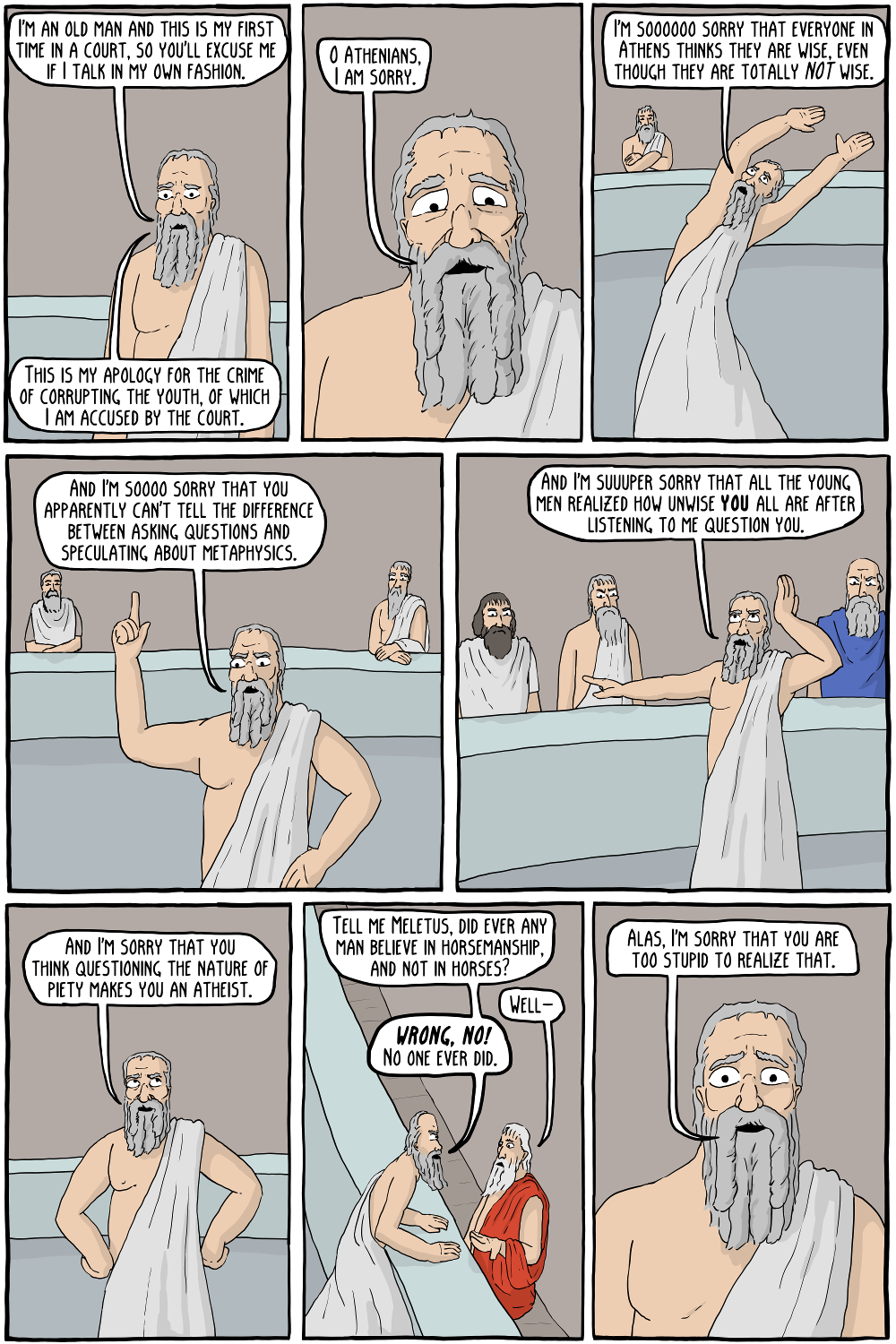
There have been many comics about Socrates' trial through the years. Many stories, videos, articles, essays, and books, too. Many of them have been satirical in nature, as it is very easy to make fun of someone who pretty much signed his own death warrant. As long as it's 2000+ years ago, of course.

2414 years ago, one of Hellas' greatest thinkers stood trial before a jury of 500 men, chosen by lot. Socrates (Σωκράτης), a philosopher who was of the opinion that people should not be self-governing; they needed to be led, like a shepherd led a flock of sheep. He was of the opinion that the average Athenian neither had the basic virtue necessary to nurture a good society, nor the intelligence to foster such virtue within themselves. As such, he was against the democratic system that came to fruition in the city of Athens at the same time he did.

Socrates was vocal about his ideas. He took to the streets and proclaimed them loudly, often while looking down upon those who passed him. Socrates' anti-governmental and reformatory speeches spoke to the Athenian youth. In a trying time after the loss of a major offensive against Sparta, old and young Athenian men--and their ideals--collided, and Socrates put fuel on the fire. Socrates' actions seem to go from being laughable to being subversive around 417 BC.

After a brief stint of tiranic rule over Athens, flueled by Socrates' ideas, Socrates managed to make himself even more unpopular by continuing the teachings and speeches that had caused the death or exile of hundreds of Atenians during the rule of the tirans. Another uprising in 401 against the democracy--although unsuccessful--might have been the straw that broke the proverbial camel's back; Socrates was sued by Melitus, a poet. Laertios, who appears to have seen the original trial minutes describes the vote that concludes one of the most famous trials in history:

"So when he had been condemned by two hundred and eighty-one votes, being six more than were given in his favour, and when the judges were making an estimate of what punishment or fine should be inflicted on him, he said that he ought to be fined five and twenty drachmas; but Eubulides says that he admitted that he deserved a fine of one hundred. And when the judges raised an outcry at this proposition, he said, "My real opinion is, that as a return for what has been done by me, I deserve a maintenance in the Prytaneum for the rest of my life." So they condemned him to death, by eighty votes more than they had originally found him guilty. And he was put into prison, and a few days afterwards he drank the hemlock, having held many admirable conversations in the meantime, which Plato has recorded in the Phaedo."

In short: Socrates would have lived if he had kept his mouth shut--and the comic I'd like to share today pretty much nails Socrates'attitude! I loved reading it, and I hope you do, too!

A news roundup today as I am incredibly pressed for time. Lots happening in the world, after all!


Green light to archeologists exploring the Antikythera Shipwreck
Protothema reports that the Greek Central Archeological Council (KAS) gave the green light for the Antikythera Shipwreck in southern Greece and will continue its investigation into the area for the next five years. The test excavations are to focus on areas where numerous metal objects and pottery has been discovered and where archeologists have discovered evidence of one or two more shipwrecks.

The last expedition launched in 2012 was a joint effort between the Hellenic Ephorate of Underwater Antiquities and the American Woods Hole Oceanographic Institute (WHOI). During their endeavours, archeologists discovered a segment of an anchor and a lead joint from a Roman anchor among other findings. In 2013, information of a second Roman shipwreck close to the first one was discovered.

Last year, archeologists used new robotic diving equipment known as the Exosuit and captured a digitized 3D location of the wreck and pulled out sections of a bed decoration and bronze spear. The excavation is led by Dr. Angeliki Simosi and WHOI’s marine archeologist Brendan Foley.

Two thousand year old Mercury figurine found in Yorkshire
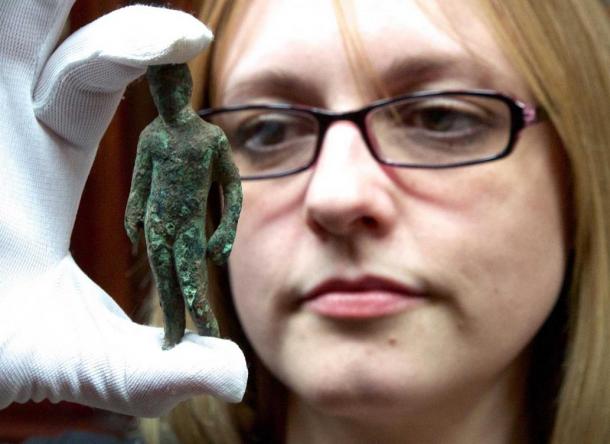
Ancient Origins reports that a metal detector enthusiast has discovered a 2000-year old figurine depicting the Roman god Mercury in a field near Selby, Yorkshire, UK. The Mercury figurine found in Yorkshire is made of copper alloy. Although it depicts the god wearing a cap, this garment has lost its famous wings. It is just one of many similar figures that have been found across the UK, according to the Yorkshire Post.

The York Museums Trust regularly receives artifacts found by the general public. According to Rebecca Griffiths, the Finds Liaison Officer for the Portable Antiquities Scheme at the York Museums Trust:

“Every year thousands of archaeological objects are discovered. While the majority of these come from metal-detector users, we also see many finds from people field-walking, gardening, renovating houses and even those out walking particularly inquisitive dogs.”

Ms Griffiths added that every year, she and her team of volunteers add more than 2,000 items to the museum’s collection, ranging from Roman coins to medieval buckles, to stone tools and post-medieval toys.


Vandalism at Athenian Long Walls
Football supporters defaced the ancient Athenian Long Walls with graffiti. The walls, originally erected in the 5th century BC, were destroyed by Sparta in 403 BC and were rebuilt with the help of the Persians during the Corinthian War.

Vandals also defaced the prison cell in the Acropolis where philosopher Socrates is believed to have been held prior to being made to kill himself in 399 BC by drinking hemlock for corrupting the youth of Athens.

Staff of the Greek Ministry of Culture removed the graffiti. The incident comes as the Greek state granted 24-hour access to major archeological sites. Staff are worried that the new hours coupled with the short-staffed personnel will lead to greater vandalism.

Designs for cutting-edge museum for underwater artifacts unveiled
A presentation of designs for a new state-of-the-art museum for underwater antiquities at the port of Piraeus took place this week at the site where the new museum will be transformed from a current industrial site, Protothema reports. The presentation took place aboard a Liberty-class freighter now also serving as a floating museum.

The current site served as a grain storage facility complete with silo, constructed in 1936, itself an example of industrial design. The new facility is expected to house nearly 2,000 antiquities and artifacts found at the bottom of seas around Greece. Most of the exhibits are currently in storage, the product of nearly 40 years of archaeological research. Total exhibition space will be 6,500 square meters within the 13,500 sq. meter building.

Another highly-anticipated facet of the new museum is the opportunity to finally salvage and preserve several ancient, medieval and more contemporary shipwrecks still languishing at the bottom of the sea.
2414 years ago, one of Hellas' greatest thinkers stood trial before a jury of 500 men, chosen by lot. Socrates (Σωκράτης), a philosopher who was of the opinion that people should not be self-governing; they needed to be led, like a shepherd led a flock of sheep. He was of the opinion that the average Athenian neither had the basic virtue necessary to nurture a good society, nor the intelligence to foster such virtue within themselves. As such, he was against the democratic system that came to fruition in the city of Athens at the same time he did.

 
Two years ago, when a Chicago court held a new trial. Dan Webb and Robert A. Clifford, who represented Socrates, were unable to successfully defend their long deceased client and he was convicted again.

Top legal minds in Australia recently gave Socrates another retrial at the Hellenic Museum. Greek-Australian actors interacted with top lawyers as Socrates was allowed to appeal his case.. Justice Lex Lasry, justice Emilios Kyrou and judge Felicity Hampel presided over the case, while QC Julian Burnside, QC Nicholas Papas and QC Ronald Merkel and Elizabeth King were tasked with his defence and prosecution of Socrates, played by Greek-Australian actor Tony Nikolakopoulos.

The trial managed to revive the ancient philosopher’s story for modern audiences in Melbourne. The retrial was based on the opinions of current legal professionals in Australia with the modern law being used to evaluate the case of Socrates as well as to address moral and social philosophica questions that transcend time. This time, Socrates was found 'not guilty' by the jury, although I am not sure which points were made to secure his freedom. It seems this trial is long from over.