Showing posts with label Athena. Show all posts

An invocation is a request for the spiritual presence and blessing of a deity during a rite. To invoke is to call upon earnestly, so an “invocation” in the context of prayer is a serious, intentional calling upon a God or Goddess. In Hellenic ritual, it's common for prayers of invocation to be offered every time a new deity is invoked, so we can be sure They will the hymns and prayers of petition offered to Them. Invocations fit into the rite like so:


- Lighting of the incense burner with frankincense
- Invocation to Demeter: Khaire Demeter, you who taught us to work the earth and provides for us so bountifully…
- Libation of a kykeon and sacrifices
- Orphic Hymn 40 To Eleusinian Demeter
- Prayers

A few days ago, I put up a list of invocations from the Iliad. People seemed to like it, so let's do another one today: from the Odysseia, because that is the logical step! The Odyssey (Ὀδύσσεια) is, in part, a sequel to the Iliad, the other work ascribed to Homeros. The Odyssey was composed near the end of the 8th century BC and focuses mainly on the hero Odysseus, king of Ithaca, and his journey home after the fall of Troy. It takes Odysseus ten years to reach Ithaca. In his absence, it is assumed Odysseus has died, and his wife Penelope and son Telemachus must deal with a group of unruly suitors, who compete for Penelope's hand in marriage. Needless to say, Odysseus keeps his lady love! There aren't as many invocation in this story as most of the characters tell their story themselves, but there are a few.

Artemis:
"Great Goddess Artemis, daughter of Zeus..."

Athena:
"Hear me, daughter of Aegis-bearing Zeus, unweariable..."

Eos:
"Rosy-fingered Eos, child of morning..."

Poseidon:
"O thou that encirclest the earth, vouchsafe to grant the prayers of thy servants that call upon thee..."

Themis:
"I pray you by Themis, who is the beginning and the end of councils..."

Zeus:
"Hear me, O King..."
"Father Zeus, and all you other gods who live in everlasting bliss..."
"Father Zeus, you who rule over heaven and earth, you have thundered from a clear sky without so much as a cloud in it, and this means something for somebody; grant the prayer, then, of me your poor servant who calls upon you..."

 Two PAT ritual announcements, both for September 10th. We will hold a PAT ritual for the Niketeria, followed by the Plataia.

The Niketeria
We are coming upon another festival celebrated in ancient Athens: the Niketeria. Surviving sources date the festival to the third of Boudromion, and it was in honor of one of the most important events in Athens' history: its naming and tutelage by Athena. We will be celebrating it at the usual 10 AM EDT.


Many of us know there was a contest between Poseidon and Athena over who would rule the growing city of Athens (in the name it had before being called 'Athens'), and it is clear who won that contest. The earliest reference to this event we still have access to is from the fourth century BC by Plato, but it does not quite have the poetic touch Ovid's account has. For that reason, I will give the account of Ovid, and build from there. From the Metamorphoses, (trans. Melville):

"The rock of Mavors [Ares] in Cecrops' citadel is Pallas' [Athena's] picture [in her weaving contest with Arakhne] and that old dispute about he name of Athens. Twelve great gods, Jove [Zeus] in their midst, sit there on lofty thrones, grave and august, each pictured with his own familiar features: Jove [Zeus] in regal grace, the Sea-God [Poseidon] standing, striking the rough rock with his tall trident, and the wounded rock gushing sea-brine, his proof to clinch his claim. Herself she gives a shield, she gives a spear sharp-tipped, she gives a helmet for her head; the aegis guards her breast, and from the earth struck by her spear, she shows an olive tree, springing pale-green with berries on the boughs; the gods admire; and Victoria [Nike] ends the work." [6. 70]

Ancient Hellenic Neoplatonist philosopher Proklos (Πρόκλος) in 'On the Timaeus of Plato' speaks of this event as well, and notes that there is still a festival held to commemorate this event in his time (between 412 and 485 AD)

 "Farther still, the victories of Minerva are celebrated by the Athenians, and there is a festival sacred to the Goddess, in consequence of her having vanquished Neptune, and from the genesiurgic being subdued by the intellectual order, and those that inhabit this region betaking themselves to a life according to intellect, after the procurement of necessaries. For Neptune presides over generation; but Minerva is the inspective guardian of an intellectual life." [p. 153]

When this was celebrated, Proklos does not mention, but Plutarch does. One of these is in the Quaestiones Convivales, from the Moralia. Here, he answers the question: 'What is Signified by the Fable About the Defeat of Neptune? And Also, Why Do the Athenians Omit the Second Day of the Month Boedromion?'.

"While all were making a disturbance, Menephylus, a Peripatetic philosopher, addressing Hylas: You see, he said, how this investigation is no foolery nor insolence. But leave now, my dear fellow, that obstinate Ajax, whose name is ill-omened, as Sophocles says, and side with Poseidon, whom you yourself are wont to tell has often been overcome, once by Athene here, in Delphi by Apollo, in Argos by Here, in Aegina by Zeus, in Naxos by Bacchus, yet in his misfortunes has always been mild and amiable. Here at least he shares a temple in common with Athene, in which there is an altar dedicated to Lethe. And Hylas, as if he had become better tempered: One thing has escaped you, Menephylus, that we have given up the second day of September [Boudromion], not on account of the moon, but because on that day the gods seemed to have contended for the country." [Book 9, question 5]

Because of this, the official view of Elaion is that the festival of Niketeria--'Victory'--was celebrated not on the second of Boudromion as many modern researchers say, but on the third. The second day, after all, was no longer a part of the month. The question remains why the victory of one Goddess over one God was commemorated at all, and there is no adequate ancient explanation. None of the surviving works mention why and how the festival was celebrated. All we know is that it was noted--it might not even have been a true festival at all. We believe that by omitting the second day, the defeat of Poseidon was omitted, so as not to anger Him. A day later--in a somewhat unrelated fashion to Poseidon's defeat--there was a (possibly somewhat subdued) celebration of the victory of Athena, with sacrifices to Athena, Niké, and perhaps even Poseidon for the many wonderful gifts They had provided--and would hopefully continue to provide--for the city of Athens.

We will hold a subdued PAT ritual in honor of the Niketeria at 10 AM EDT on August 22rd. Will you be joining us? The ritual can be found here and you can join the community here.


The Plataia
The Plataia (or Plataea) seems to have been a commemorative festival, for the Hellenes fallen at the battle of Plataea. The Battle of Plataea was the final land battle during the second Persian invasion of Hellas. It took place in 479 BC near the city of Plataea in Boeotia, and was fought between an alliance of the Greek city-states, including Sparta, Athens, Corinth and Megara, and the Persian Empire of Xerxes I. Some 38,700 Hellenes stood their ground against 300.000 Persians. The Hellenes marched out of the Peloponnesus and the Persians retreated to Boeotia and built a fortified camp near Plataea. The Hellenes surrounded the camp, but refused to enter the bare terrain surrounding the camp. They waited for eleven days, and then found their supplies dwindled. They attempted to retreat, and Persian general Mardonius ordered his forces to pursue them. The Hellenes, however--particularly the Spartans, Tegeans and Athenians--stood their ground, and won a great victory over the Perians. The Persian infantry was slaughtered, and Mardonius killed. Plutarch gives the date for the battle to be the fourth of this month, but also attested that the Athenians commemorated the event on the third. In Boeotia (and especially in Plataea), the remembrance seems to have been held on the fourth.

Herodotus, in his Histories (9. 52. 1), and Plutarch, in his 'Life of Arestides' both remark the following about what is most likely this battle:

"The seer slew victim after victim, Pausanias turned his face [historical general of the Persian Wars], all tears, toward the Heraion, and with hands uplifted prayed Kithaironion Hera and the other gods of the Plataian land that, if it was not the lot of the Hellenes to be victorious, they might at least do great deeds  before they fell."[Life of Aristides, 18. 1]

As such we can assume that, besides the fallen, a sacrifice to Hera was also made. For this ritual, you can join us here. The ritual can be found here. We'll perform the ritual at 11 am EDT.

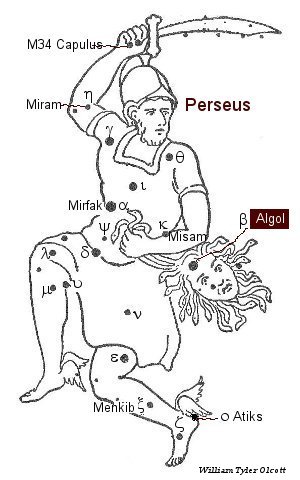
Perseus is one of ancient Hellas' greatest heroes, and it is not odd that he was immortalized in the night's sky. He is--of course--linked to the many constellations dedicated to the rescue of Androméda, but there is far more tot he hero Perseus.

 
http://www.constellationsofwords.com/stars/Algol.html

Perseus was born to Danae, who was locked in a bronze chamber by her father Akrisios, where she was impregnated by Zeus in the form of a golden shower. Akrisios put both mother and child in a chest and set them adrift on the sea, but they washed safely ashore on the island of Seriphos. From Hyginus' 'Fabulae':

"Danaë was the daughter of Acrisius and Aganippe. A prophecy about her said that the child she bore would kill Acrisius, and Acrisius, fearing this, shut her in a stone-walled prison. But Jove, changing into a shower of gold, lay with Danaë, and from this embrace Perseus was born. Because of her sin her father shut her up in a chest with Perseus and cast it into the sea. By Jove’s will it was borne to the island of Seriphus, and when the fisherman Dictys found it and broke it open, he discovered the mother and child. He took them to King Polydectes, who married Danaë and brought up Perseus in the temple of Minerva. When Acrisius discovered they were staying at Polydectes’ court, he started out to get them, but at his arrival Polydectes interceded for them, and Perseus swore an oath to his grandfather that he would never kill him. When Acrisius was detained there by a storm, Polydectes died, and at his funeral games the wind blew a discus from Perseus’ hand at Acrisius’ head which killed him. Thus what he did not do of his own will was accomplished by the gods. When Polydectes was buried, Perseus set out for Argos and took possession of his grandfather’s kingdom." [63]

The story of Perseus is somewhat chaotic; his myths have been told and retold many times--even in ancient times--and what happens to Perseus next is most certainly up for debate. To quote the 'Dictionary of Greek and Roman Biography and Mythology':

"According to a later or Italian tradition, the chest was carried to the coast of Italy, where king Pilumnus married Danaë, and founded Ardea (Virg. Aen. vii. 410; Serv. ad Aen. vii. 372); or Danaë is said to have come to Italy with two sons, Argus and Argeus, whom she had by Phineus, and took up her abode on the spot where Rome was afterwards built (Serv. ad Aen. viii. 345). But, according to the common story, Polydectes, king of Seriphos, made Danae his slave, and courted her favour, but in vain. Another account again states that Polydectes married Danae, and caused Perseus to be brought up in the temple of Athena. When Acrisius learnt this, he went to Polydectes, who, however, interfered on behalf of the boy, and the latter promised not to kill his grandfather. Acrisius. however, was detained in Seriphos by storms, and during that time Polydectes died. During the funeral gaines the wind carried a disk thrown by Perseus against the head of Acrisius, and killed him, whereupon Perseus proceeded to Argos and took possessions of the kingdom of his grandfather (Hygin. Fab. 63)."

No matter the version of the tale, Perseus' greatest heroic deed is what follows: the hunt for Médousa. In the most common versions of the story, Polydektes did not yet marry Danae, but wished to. A now grown up Perseus did not trust Polydektes and tried to keep him away from his mother, so Polydektes had to come up with a plan. He said he would marry Hippodameia--tamer of horses--and asked Perseus for a horse to give as a wedding present. Perseus didn't have one to give, so he told Polydektes to name any other favour, and that he would not refuse. Polydektes then instructed him to cut off and bring back the head of a Gorgon, and Perseus was trapped. From Apollodorus' 'Bibliotheca' we learn the following:

"So with Hermes and Athene as his guides Perseus sought out the Phorkides (daughters of Phorkys), who were named Enyo, Pephredo, and Deino. The three of them possessed only one eye and one tooth among them, which they took turns using. Perseus appropriated these and when they demanded them back, he said he would return them after they had directed him to the Nymphai. These Nymphai had in their possession winged sandals and the kibisis, which they say was a knapsack. (Pindaros and Hesiodos in the Shield of Herakles, describe Perseus as follows : `The head of a terrible monster, Gorgo, covered all his back, and a kibisis held it.’ It is called a kibisis because clothing and food are placed in it.). They also had the helmet of Haides. When the Phorkides had led Perseus to the Nymphai, he returned them their tooth and eye. Approaching the Nymphai he received what he had come for, and he flung on the kibisis, tied the sandals on his ankles, and placed the helmet on his head. With the helmet on he could see whomever he cared to look at, but was invisible to others.

Perseus took flight and made his way to the Okeanos, where he found the Gorgones sleeping. Their names were Stheno, Euryale, and the third was Medousa, the only mortal one : thus it was her head that Perseus was sent to bring back. The Gorgones’ heads were entwined with the horny scales of serpents, and they had big tusks like hogs, bronze hands, and wings of gold on which they flew. All who looked at them were turned to stone. Perseus, therefore, with Athena guiding his hand, kept his eyes on the reflection in a bronze shield as he stood over the sleeping Gorgones, and when he saw the image of Medousa, he beheaded her. (As soon as her head was severed there leaped from her body the winged horse Pegasos and Khrysaor, the father of Geryon. The father of these two was Poseidon.) Perseus then placed the head in the kibisis and headed back again, as the Gorgones pursued him through the air. But the helmet kept him hidden, and made it impossible for them to identify him.” [2. 36 - 42]

With Médousa's head secured, Perseus headed back to Polydektes, but was stopped while on route by the vision of a woman, chained to a rock, about to be devoured by a sea monster. It had been a dark day for Cepheus, king of Aethiopia, when he had heard his wife Cassiopeia boast that her daughter Androméda was more beautiful than the Nereids. Shocked, he had tried to silence his wife, but it was too late. The father of the Nereids, the sea God Nereus, had heard Cassiopeia's prideful boast and had brought his grievance to Poseidon. Poseidon had ruled in favour of Nereus and sent Cetus, a huge sea monster, to ravage the coasts of Aethiopia. Nereus would only be appeased when Cepheus sacrificed his daughter to Cetus. Cepheus had refused, but when the terror continued, Androméda had offered herself up to be sacrificed. Fast forward to Andromeda, chained to the rocks, about to die. Perseus pulled Médousa's head out of his bag and petrified Cetus with it before undoing Androméda's bindings. He fell for the beautiful princess instantly, and desired to take her as his wife. In most versions of the myth, he is allowed, but Hyginus in his 'Fabulae' has a different story to tell:

"When he wanted to marry her, Cepheus, her father, along with Agenor, her betrothed, planned to kill him. Perseus, discovering the plot, showed them the head of the Gorgon, and all were changed from human form into stone. Perseus with Andromeda returned to his country." [64]

Perseus eventually married Androméda and took her off to his native island of Serifos. They had many children; sons Perses, Alcaeus, Heleus, Mestor, Sthenelus, and Electryon, as well as daughters, Autochthe and Gorgophone. According to Hyginus in his 'Astronomica', Perseus was committed to the stars for the following reasons:

"He is said to have come to the stars because of his nobility and the unusual nature of his conception."

The constellation Perseus is visible at latitudes between +90° and −35° and best visible at 21:00 (9 p.m.) during the month of December.

On 12 Metageitnion, two separate rites were held, one in Erkhia and one in Athens. The first was in honor of Demeter, the other in honor of Zeus Polieus, Athena Polias, and Apollon Lykeios. On 21 August, so today, at 10:00 AM EDT, we will combine both rites into a single PAT ritual.


Demeter, we all know, and she is not listed with a specific epithet. Zeus, Athena, and Apollon, however, are. Zeus Polieus and Athena Polias were protectors of the city. That is literally the translation of their epithet: 'of the city'. Apollon Lykeios means 'of the wolves'.

From the Erkhian ritual calendar, we know that the sacrifices to Apollon, Zeus, and Athena were not to be removed from the site and were thus to be eaten on the spot after part of the offering was sacrificed. In all cases, this offering was a white sheep, male for the male Gods, female for the female Gods. Demeter also got a female sheep, but her entry does not have a note to not remove the meat from the location, meaning the meat could potentially be taken away to be eaten later, or sold at shops founded especially for the purpose.

Will you be joining us in honoring these Gods on 21 August, at 10:00 AM EDT? The ritual can be found here, and you can join our community here.

The 25th of the month of Thargelion marks the day of the Plynteria festival. This minor festival was held solely in Athens and surrounding areas and was in honor of Athena Polias, protector of the city. It was considered an auspicious day by the ancient Athenians because on this day, they did not have the protection of Athena. Around the time of the Pynteria the Kallunteria also took place, a festival during which the temple of Athena was cleaned thoroughly and Her sacred fires relit. Elaion will organize PAT rituals for both celebrations and invites you to join us on 5 and 8 June. Note! The Plynteria is a nighttime festival and thus not at the usual 10 am EDT.


Plutarch, in his 'Life of Alkibiades' describes the Plynteria festival beautifully:

"But while Alcibiades was thus prospering brilliantly, some were nevertheless disturbed at the particular season of his return. For he had put into harbour on the very day when the Plynteria of the goddess Athene were being celebrated. The Praxiergidae celebrate these rites on the twenty-fifth day of Thargelion, in strict secrecy, removing the robes of the goddess and covering up her images. Wherefore the Athenians regard this day as the unluckiest of all days for business of any sort. The goddess, therefore, did not appear to welcome Alcibiades with kindly favour and good will, but rather to veil herself from him and repel him. However, all things fell out as he wished, and one hundred triremes were manned for service, with which he was minded to sail off again; but a great and laudable ambition took possession of him and detained him there until the Eleusinian mysteries." [34.1]

During the Plynteria, the wooden statue of Athena was disrobed of the Peplos that she received during the Panathenaia by Her priestesses, veiled, and then taken down to the sea for a wash. Veiling a Theos' image from head to toe was considered apophras, unlucky, as it removed Their presence.

The women who removed the robe and jewelry from the ancient wooden image and then veiled her, were part of an Athenian family traditionally entrusted with this task. They were called the Praxiergidai. The procession to the sea, several miles away, was a city-affair. As all other sanctuaries and temples in Athens remained closed on this day, it's likely many attended.

In front of the procession was a single woman, carrying a basket of fig pastries (known as 'hegeteria'), for the fig was believed to be the first cultivated food, and was--like the sea water--a purifier. Mounted young men, known as 'epheboi' escorted the statue deep into the water before coming back to shore. Thee, it was bathed by two girls, the bathers (loutrides). A single priestess was most likely in charge of washing the peplos of the Goddess. her title has not survived. In the evening, a torch-lid procession brought the statue back to Her temple and she was redressed by the Praxiergidai. The statue may have remained veiled for the remainder of the day.

There is another, smaller, festival connected to the Plynteria: the Kallunteria, which was celebrated somewhere in the vicinity of the Plynthria. During this festival, the temple of Athena was swept out--the name of the festival means 'sweeping out' or 'to beautify by sweeping'--and cleaned thoroughly, so that the washed statue would have a clean home to return to. The lamp of Her eternal flame was also refilled and relit by the priestesses on this day. The lamp was a golden vessel, created in the late fifth century by Kallimakhos, and was big enough to hold enough oil to burn day and night for the whole year. It's therefor logical to assume that the festival was held on a day close to the twenty-fifth, possibly the twenty-fourth or twenty-sixth. Ancient sources state that the festival must have taken place after the Bendideia. From Proklos' 'Timaeus of Plato':

"For they say, that the Bendideia were celebrated in the Piraeus on the twentieth day of [Thargelion], but that the festival sacred to Minerva followed these."

Mikalson, in his 'The sacred and civil calendar of the Athenian year', gives the 24th as the date but stresses that the 24th is merely a estimation, and we, in fact, do not know when the festival was held. He assumes it could even have taken place after the Plynteria, and places the Kallunteria between the 24th and the 28th of the month, with the exception of the 25th, as that was the date of the Plyneria. Christiane Sourvinou-Inwood in 'Athenian Myths and Festivals' sets the date as the 27th with a somewhat unshakable certainty. We have accepted the 27th as the possible date of the Kallunteria festival for our PAT ritual although we again stress that the date of the Kallunteria is unknown.

The rituals for the event can be found here for the Plynteria and here for the Kallunteria, and you can join the community page for the Plynteria here, and that of the Kallunteria here.

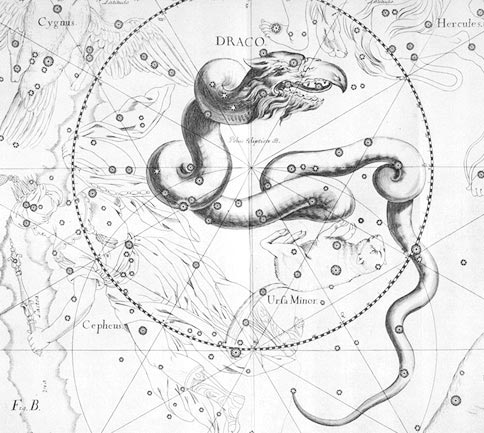
The constellation Draco (from the Greek Drakon, meaning dragon) is identified--funnily enough--with some dragons in Hellenic myth but not others. There are quite a few creatures, after all, who would qualify as a dragon in Hellenic myth. For a dragon or hydra not connected to the constellation, think of the one Kadmos vanquished, for example, or the one Apollon vanquished at Delphi, or even the dragon who guarded the Golden Fleece and was slain by Iásōn. In truth, only two dragons were associated with the myth in ancient times, most notably by Hyginus in his Astronomica: Drakon Hesperios, the Hesperian Dragon, and Drakon Gigantomakhios, the Gigantomachian Dragon.


The first of the myths associated with the constellation is the legend of the Drakon Hesperios (Δρακων Ἑσπεριος), who was slain by Hēraklēs during one of his Labours. I will tell the whole myth of the labour soon enough, but I will share what Hyginus wrote about this labour, and Hēraklēs' encounter with Ladôn (Λαδων), as the dragon was often called.

"This huge serpent is pointed out as lying between the two Bears. He is said to have guarded the golden apples of the Hesperides, and after Hercules killed him, to have been put by Juno [Hera] among the stars, because at her instigation Hercules set out for him. He is considered the usual watchman of the Gardens of Juno. Pherecydes says that when Jupiter [Zeus] wed Juno, Terra [Gaea] came, bearing branches with golden applies, and Juno, in admiration, asked Terra to plant them in her gardens near distant Mount Atlas. When Atlas’ daughters kept picking the apples from the trees, Juno is said to have placed this guardian there. Proof of this will be the form of Hercules above the dragon, as Eratosthenes shows, so that anyone may know that for this reason in particular it is called the dragon." [II.3]

The sole other dragon this myth is linked to is Drakon Gigantomakhios (Δρακων Γιγαντομαχιος), who rose up during the Gigantomachy. When the Olympians rose to power, they first fought the Titans during the Titanomachy. Vanquishing them, the Theoi thought They had won. Yet, there was one who sought revenge for the defeat of his father: Typhôeus, the most-feared son of Tartaros and Gaea. Some versions of the myth say that Typhôeus was actually the Drakon Gigantomakhios, or one of his offspring. Hyginus shares what happened to the dragon:

"Some also say this dragon was thrown at Minerva [Athena] by the Giants, when she fought them. Minerva, however, snatched its twisted form and threw it to the stars, and fixed it at the very pole of heaven. And so to this day it appears with twisted body, as if recently transported to the stars."

The constellation Draco is visible at latitudes between +90° and −15°, and best visible at 21:00 (9 p.m.) during the month of July. Tomorrow, we will talk a little more about the types of dragons in Hellenic myth, because I suddenly realized the association with medieval dragons is very easily made when reading 'dragon', but I assure you, the ancient Hellenes were unaccustomed to giant, fire breathing, lizards.

In the last three years, as part of the Imathia Ephorate of Antiquities’ research for the maintenance study of the large building complex of Aegae located near the wall’s northwest gate and the queens’ burial cluster, new extremely interesting findings have come to light clarifying its picture and helping to identify its function. 


Head of the Imathia Ephorate Angeliki Kottaridi says:

“The inscriptions on the tiles allow us to associate the building we are excavating with the worship of members of the royal family. This is a building of the 4th century BC with major modifications in the era of Philip V, the late 3rd-early 2nd century BC. These floors come from this phase, as do the plasters, the roof and the figurines; elements that point us to a sanctuary.”

A rare find was also found during the works; a poem, which is probably a student exercise, on a vase. “Very interesting and very special”, notes Ms. Kottaridi, who will present the “New Finds in the City of Aegae” at the 33rd Archaeological Conference on excavations in Macedonia and Thrace (April 22-24 2021), taking place online.

Like the palace and the temples, the complex is built of precious tufa stone that reached Aegae from the quarries of Vermion, covering a distance of 10-20 km. It is made up of a sequence of square and rectangular spaces, some of which are over 100 sq.m., organized in a regular manner round a large courtyard (the south and part of its east and west sides have been uncovered). To the east stands a temple-shaped space with a very deep antechamber and two Doric columns, facing the courtyard.

The building acquires its basic form before the end of the 4th century BC, but in the times of Philip V (221-179 BC) extensive renovation works are carried out. In this phase there are floors with marble inlay , such as those of the palace, the walls are covered with multicoloured plaster, purple being dominant, with touches of ochre and green and are joined with architectural formations in relief foreshadowing the decorations of the houses of Pompeii. 

Like the palace, sanctuaries and walls, the complex was destroyed in the mid 2nd century BC after Macedonia’s final occupation by Metellus’ army. Immediately after the destruction, however, part of its west wing and some spaces next to the east one were rebuilt, while in the years of Augustus (31 BC-14 AD), a large peristyle/colonnade of 1,000 sq.m. was added to its southeast along with an auxiliary building with a patio; building activity particularly remarkable for Aegae which was now in a period of decline.

“Its form, dimensions and elaborate construction, the rich materials and decorative elements, but also the obsession with the use of space, show that it is a public building”, notes the head of the Imathia Ephorate. “Monolithic altars, a marble support for a table, parts of a marble frieze with impressive plant ornaments and figurines of deities found in situ despite the savage looting, form the impression that it was a sanctuary complex; an impression that seems to have been confirmed in the most striking manner just when we started investigating the layer of tiles from its fallen roof that covered the area”.

Stamps with the Macedonian shield, the symbol used on their coins by the Macedonian kings of the Hellenistic period, and signs/panels with the name AMYNTOΥ printed on the tiles of its roof, revealed its close relationship with the royal family and more. 

As in the case of the tiles with the corresponding inscription ΠΕΛΛΗΣ, the name indicates the owner who in this particular sacred building, at least in a part of it, cannot be other than the father of Philip II, Amyntas III who was given hero status and is known from the sources that his cult also existed in neighbouring Pydna. 

Eurydice, wife of Amyntas, is depicted as the goddess Hera in the statue commissioned for the sanctuary of Eucleia in Aegae, and it is certainly no coincidence that in the times of the Antigonids a temple-shaped building was built round the statue of the queen-mother.

“The cult of Alexander and his generation in the years of the successors was a source for legitimizing their power and it is very likely that the large building complex unearthed at the ancestral royal seat and grave site of the Temenides was one of its centers, which yielded another extremely valuable and unexpected finding in 2020. In a modest clay cup found broken in the destruction layer of the 2nd century BC, someone, perhaps a student who confused the o with the ω and the ει with the ι while doing his exercises, carefully carved, as if on a papyrus, an epigram by an anonymous author, which has been handed down to us in its oldest and most authentic form: “the rose blooms for a while and when its time passes and you search for it, you will no longer find a flower, but only  thorns”.

Known from the Palatine Anthology, the epigram of Aegae urges the reader not to waste time that flies by relentlessly and gives us in the most direct and original way a picture of culture in the ancient Macedonian metropolis as it draws its final breath. 

“The first finding is tremendously important for a greater understanding of the city and of history, but the second is very moving.”


 In 430 BC, an 11-year-old girl from Athens called “Myrtis” − a victim of the great plague of Athens — could not imagine that after 2500 years, she would take part in the global effort in the fight against the COVID-19 pandemic. Myrtis, with her wisdom and her 2,500 years of experience, is being used to impart knowledge and to strengthen the global resolve in the fight against the scourge threatening the world today.


The ancient girls’ remains were discovered in 1994–95 in a mass grave during the construction works to build the metro station in the Kerameikos neighborhood of Athens. Her face, which was painstakingly recreated by a team under Professor Manolis Papagrigorakis, appears prominently in an animated video calling on us all to listen to the experts, fully respect the new sanitation and distancing rules, and take special care of our loved ones so that we can have them by our side tomorrow.

In the video, which was a created after a joint initiative of Papagrigorakis and the United Nations, the 11-year-old Greek girl who lived so long ago quotes the Secretary General of the United Nations, Antonio Guterres, and agrees with him that the whole of humanity, united together, will again win the fight against today’s common enemy.

The little girl, who used to play in the foothills of the Athens Acropolis, no doubt gazing at the Parthenon just as we do today, began her second journey around the world in 2010 in the Acropolis Museum.

Her collaboration with the United Nations also began during that same year. The UN named Myrtis a “Friend of the Millennium Development Goals” along with other international personalities such as the UN Secretary General, Kofi Annan, the President of Ireland Mary Robinson, and the activist Bianca Jagger.

In this capacity, Myrtis sent a widely-translated message to the leaders of the world, asking them to save the lives of millions of children who are dying of diseases such as the one that killed her. Diseases that nowadays can be prevented and even cured. The Athens girl continues her impressive journey around the world today. She has become an exhibition, a postage stamp, an image on a coin, and a painting.

Her story, which is taught in schools in Greece and abroad, has now been told to thousands of students across the world. She has even served as the theme of scientific conferences. The tiny ancient Greek girl has inspired thousands of people, carrying her timeless message warning us about the ravages of war, poverty and child mortality. In this way, an ancient Greek has become the very symbol of not only science but the universal values which have accompanied humans from ancient times up to the present day.

A man has been arrested on suspicion of antiquities smuggling for trying to sell an ancient marble statue of “exceptional artwork” that once likely adorned a temple on Athens’ famed Acropolis or the slopes around it, Greek authorities said Friday.


Police said the 5th century B.C. statue was recovered following a months-long police operation that involved an investigation by the Cultural Heritage and Antiquities Department.

Measuring only about 37 centimeters (14.5 inches) high, the statue depicts a seated young man who reclines slightly to the right. The head, arms and most of both legs are missing, and two small holes are visible behind the left shoulder, from which rods would likely have attached the statue to a pediment — the triangular gable-end above the short sides of an ancient temple.

“It is an exceptional work of art, of the kind not easily found, not even in systematic excavations,” archaeologist Dimitris Sourlas said during a presentation Friday at police headquarters in Athens. The statue, he said, could have been part of a larger composition, but more research was needed.

Authorities didn’t say why they linked it with the Acropolis area, and what made them suspect it came from a temple — which would narrow down the search for its provenance.

The work was found in the possession of a man in the southern town of Corinth, who was arrested Wednesday on suspicion of seeking a buyer for the statue for the price of 100,000 euros ($119,000), police said.

An investigation is under way into how the piece came into his hands, and whether he had managed to contact potential buyers for it. The statue appears to have been buried for a long time, and bore signs of damage from digging tools.

It is illegal to own, buy, sell or excavate antiquities in Greece without a permit.

Two more sacrifices took place at the start of Gamelion: a sacrifice to Apollon Apotropaios, Nymphegetes, and the Nymphs, and a sacrifice to Athena. Will you join us for these on January 22th and January 23th, at the usual 10 am EST?


Sacrifice to Apollon Apotropaios, Nymphegetes, and the Nymphs
On 22 January, 10 am EST, we honour Apollon in His epithets of Apotropaios and Nymphegetes as well as His consorts, the Nymphs. This ancient sacrifice was held at Arkhia on Gamelion 8 and we invite you to join us.


Apollon Apotropaios (Ἀποτρόπαιοs) was and is the averter of evil. Rituals dedicated to the deity were apotropaic, intended to turn away harm or evil influences, as in deflecting misfortune. This could be anything from warding off a plague to keeping mice out of the grain storage.

Apollon Nymphegetes (Νυμφηγέτης) is 'Apollon who looks after nymphs', or 'Apollo who leads nymphs'. In this epithet, Apollon was and is a pastoral God, who was considered the protector of shepherds and pastoral life.

Nymphs are the female divinities of the natural features of the landscape, and there are many kinds, depending on the landscape they frequent.

Combining these traits into a single ritual can tell you all about it you need: this was a ritual to ward of the dangers of rural living (by addressing Apollon in his two protective epithets) and to invite blessings (from the nymphs) onto those who partook.

We welcome you to worship with us at 10 am EST on 4 January. You can join the community here and find the ritual here.


Sacrifice to Athena
At ancient Erkhia, on the 9th of Gamelion, a sacrifice was performed in honour of Athena. The calendar does not state a specific epithet or further details, so we will be honouring Her in all Her glory. Will you join us at 10 am EST on 23 January?


The ritual for the event can be found here and the community page here.

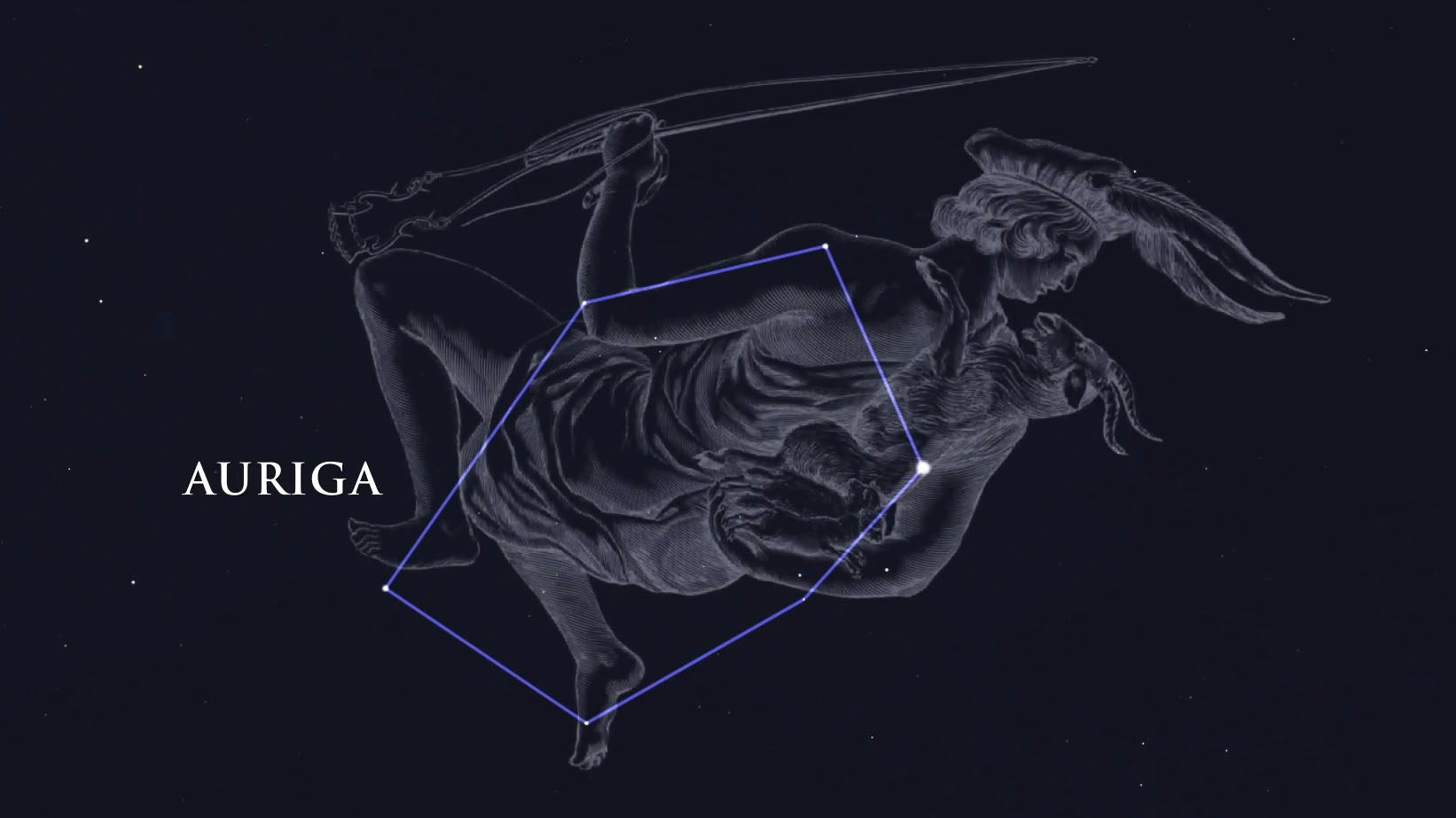
There are many well known chariots and charioteers in ancient Hellenic mythology. All of the Theoi have one, and Helios and Apollon use one to bring light to the world. Hades kidnapped Persephone with His. Kastor and Polideukes were very skilled at driving the fast, light, open, two-wheeled conveyance drawn by two or more horses. Helios lost a son when he let his son Phaethon (Φαέθων) drive his chariot for its morning track through the sky. Phaethon flew too close to the earth and scorched it all; Zeus then cast him down with a lightning-bolt. Yet, these are not the charioteers the constellation is associated with. In this next installment of the constellation series, we will look at the Divine child the constellation refers to... and a few others, because the constellation Auriga has had many interpretations over the years.


For a very long time, war chariots were pulled by two horses only. The charioteer of the constellation is therefor most likely Erichthonios (Ἐριχθόνιος), child of Hēphaistos and Athena, through Gaea, as he invented a chariot pulled by four horses. 

As the myth of his birth goes; Athena went to Hēphaistos' workshop for weaponry, but Hēphaistos--overcome with lust--tried to rape Her instead. Athena fled, but could not flee fast enough. Hēphaistos caught up to Her. Athena fought off Her attacker, but could not prevent Hēphaistos from ejaculating on Her thigh. She wiped Hēphaistos' semen away with a scrap of wool (ἔριον, erion) and flung it to the earth (χθών, chthôn). From it was born Erichthonios, who was part man, and part snake.

In my post about the many legends of Médousa, I posed the following about Athena and the source of Erichthonius' myth and birth as part-snake:

"Athena's role as a snake and fertility Goddess is still visible in the myth about the child she had with Hephaestus; Erichthonios (Ἐριχθόνιος), who was half man, half snake. It's even posed that in the early days, Athena was married to Hephaestus and had His child willingly. As Athena was stripped of Her roles as a fertility and snake Goddess, Médousa's myth came into being, where Athena distances Herself from sex and snakes, by punishing an epithet of herself (Athena Tritogeneia, perhaps: 'born of Trito', a lake which was supposedly located in Libya), or the Libyan snake Goddess Médousa, who may have still been attached to Her worship. By placing Médousa's head on Her breastplate or shield, Athena's mythology is continuously linked to Her Libyan heritage, but harmlessly so, to Her new image of a virginal warrior."

No matter the source, Erichthonios was born, and placed in a box by Athena. She placed the box in the care of three of Her attendants at the Acropolis, with clear instructions not to open the box. They did, of course, and were scared so by the sight of either a snake in the box, or Erichthonios' deformities, they cast themselves off of the Acropolis in terror. Yet, despite his deformities, Erichthonios became king of Athens and ruled it long and well.

He married Praxithea (Πραξιθέα), a naiad, and had a son, Pandion I. He founded the Panathenaiac Festival in the honor of Athena, and set up a wooden statue of her on the Acropolis. He taught his people to yoke horses and use them to pull chariots, to smelt silver, and to till the earth with a plough. His deformities and lameness inspired him to invent the quadriga--or four-horse chariot--to get around easier. He was very skilled as a charioteer, and won many games. Zeus was said to have been so impressed with his skill that he raised him to the heavens to become the constellation Auriga after his death.

There are also other charioteers to whom the constellation could refer; Myrtilus (Μυρτίλος), for example, who was Hermes's son and the charioteer of Oenomaus. Myrtilus's chariot was destroyed in a race intended for suitors to win the heart of Oenomaus's daughter Hippodamia. Myrtilus earned his position in the sky when Hippodamia's successful suitor, Pelops (Πέλοψ), killed him, although he helped him win the woman's hand. After his death, Myrtilus's father Hermes placed him in the sky. 

The constellation could also represent Theseus's son Hippolytos who was rejected from Athens after he refused the romantic advances of his stepmother Phaedra, who committed suicide as a result. He was killed when his chariot was wrecked, but revived by Asklepios. Another possibility is that the constellation does not represent a whole person at all, but is a limb of Mēdeia's brother after she killed and dismembered him.

Occasionally, Auriga is also seen as the Charioteer but as Bellerophon (Βελλεροφῶν), the mortal rider of Pegasus who dared to approach Mount Olympus. In this version of the tale, Zeus pitied Bellerophon for his foolishness and placed him in the stars.

Whomever--or whatever--it represents, Auriga reminds us that the chariot had an important place in ancient Hellenic society. As for the constellation, it is visible at latitudes between +90° and −40°, and best visible at 21:00 (9 p.m.) during the month of late February to early March.

Welcome to another installment of the constellation series. As the fourth constellation, I have for you Argos Navis, a collection of constellations which together form the ship Argo, on which the Argonauts (Argonautai, Ἀργοναῦται) sailed to find the Golden Fleece.


The Argo Navis was an ancient constellation which has since been disband. It was a huge constellation, the largest in existence.  In 1752, the French astronomer Nicolas Louis de Lacaille subdivided it into Carina (the keel of the ship), Puppis (the stern), and Vela (the sails). Back in ancient Hellas, it was still one, large, constellation and it represented the ship on which one of Hellas' greatest heroic journeys was undertaken: Iásōn's (Ἰάσων, Jason) quest for the Golden Fleece.

The Argo (Ἀργώ), meaning 'swift', was built by the shipwright Argus. He was a member of the Argive royal house, and his fmily was favored by Hera. Becasue of this, anyone who sailed on the Argo, would have Her aid. Argus was aided in the planning and construction of the Argo by Athena, and possessed in its prow, a magical piece of wood from the sacred forest of Dodona, which could speak and render prophecies.

The tale of the Argonautai is long, and complicated. As so many kings in ancient Hellas, Pelias (Πελίας) unrightfully laid claim to his half-brother's throne. He became the king of Iolkos in Thessaly, and fell in disfavor of the Theoi because of his actions. It was prophesied that a member of the rightfully royal bloodline would one day punish him, and he was likewise warned to watch out for a man with only one sandal.

Pelias didn't believe in half measures and murdered every prominent descendant of Aeolus he could, but spared his mother Tyro's youngest son, Aeson. Instead, he imprisoned him and forced him to renounce his claim to the throne. Aeson complied, and eventually was set free. He married  Alcimede, who bore him a son named Diomedes. Alcimede successfully saved her son from certain death by having her nursemaids keen as if the boy had been stillborn. She secretly packed him off to Mount Pelion, where he was raised by the kéntauros Kheiron (Χείρων), who changed the boy's name to Iásōn.

From Kheiron, Iásōn learned the arts of combat, sports, medicine and music. When he reached adulthood, he was send back to Iolkos with proof of his royal birth. On the way there, he had to cross a river and found an old woman on the bank of it, who begged everyone who passed by to carry her through the water. All but Iásōn ignored her. He took her onto his back and he helped her across, although he found the journey tougher than he had ever thought possible. He also lost one of his sandals in the mud. As he put down the old woman, she turned into the magnificent Hera, of whom he would continue to receive support now he had passed her test.

As soon as Pelias laid eyes on the youth with one sandal, he knew what would happen now. And thus, he devised a plot to get rid of Iásōn. As Iásōn presented him with an offer to keep some farms and cattle, while Iásōn claimed his rightful place on the throne, Pelias happily accepted, but warned Iásōn that one task had to be completed first: the proper burial of king Phrixos.

Phrixos, thus told Pelias, Iásōn, had been saved from being sacrificed to the Theoi by a ram with golden wool. The Theoi had not demanded this sacrifice, but his step-mother Ino had paid off messengers from the oracle of Delphi to demand so of her husband out of hatred for the boy. The ram had carried him off to Helios' palace, where he was accepted into the household. The ram was sacrificed to Zeus, and the fleece was hung from a tree in a sacred grove of Ares, guarded night and day by a dragon that never slept. Pelias was haunted by Phrixos, and swore to Iásōn Phrixos would not rest until his ghost was taken back to Iokos, along with the Golden Fleece. If Iásōn did this, he swore by Zeus, to relinquish his throne to him.

Iásōn jumped at the chance. Kheiron had taught him well, and a chance to prove himself was all he desired. And so, he hired Argus to build him a ship, and send out messages to the various royal families to send them their young heroes for this voyage. Many jumped at the chance, although it's unclear how many, exactly. Argus may have undertaken the journey himself, as did Atalanta, Bellerophon, Kastor and Polideukes, Hēraklēs, Nestor, Orpheus, Perseus and Theseus. The number of Argonautai lay somewhere between forty and fifty.

The journey would take the brave Argonautai to many dangerous places. The first was Lemnos, where the women had been struck with madness by Aphrodite for failing to properly honor her. they had killed all men on the island, and all slave women as well. When the Argonautai reached the island, Aphrodite enchanted the women to seduce them, and thus halt their journey. Hēraklēs was the only one who did not go off of the ship, so he was able to convince the others to ship out after a long, long wait.

The next challenge came in the form of the Gegeines; Earthborn giants with six arms. The Argo sailed to Doliones where king Cyzicus ruled. In search of supplies, he allowed then to look for supplies on Bear Mountain, but failed to warn the crew of its inhabitants. When most of the crew left for the mountains, the Gegeines attempted to raid the ship, but Hēraklēs, along with a few others, held them off long enough for Iásōn and his men to return. They set sail int he dead of night but got turned about. They ended up on the same shore where the Argonautai and the people of king Cyzicus failed to recognize each other and many of them were killed, the king amongst them. When morning came, the Argonautai were shocked and ashamed, and organized a burial for the dead king. Hēraklēs took his leave here, as his tasks were not yet completed.

For twelve, long, days, the weather was so bad that the Argo could not set sail. The crew waited and grew hungry and thirsty. Mopsos, a bird auger, eventually deduced that the men should sacrifice to Rhea, mother of the Theoi. They did, and food and drink came to them by way of animals and low hanging fruit. The wind also died down, and the expedition was saved.

Next, they reached Bebryken, where they were challenged to a fist fight by king Amykos. He was so strong, he killed every opponent with one hit, and tossed those who refused to fight into the sea to die there. It was Pollux, son of Zeus, who accepted the challenge. He managed to win his fight gloriously, but the followers of the king were furious and wanted revenge. They fought the Argonautai, but were no match.

Soon they reached the court of Phineus of Salmydessus in Thrace. The king had been blessed with the gift of prophecy, but had shared too much of Zeus' secrets. For that, Zeus send Harpies to his door every day to take his food. The starving king begged the Argonautai for help, and received it. The Harpies were killed (or, in some versions of the myth, chased off) and the expedition continued.

The only way to reach their destination was to sail through the Symplegades, or Clashing Rocks. These huge rock cliffs came together and crushed anything that traveled between them. Phineas told the crew to release a dove when they approached these islands, and if the dove made it through, to row with all their might. If the dove was crushed, he was doomed to fail. Iásōn released the dove as advised, which made it through, losing only a few tail feathers. They went for it and, with the aid of Athena, made it through with only minor damage to the stern of the Argo. The clashing rocks were forever joined, leaving the way free for others to travel.

Before reaching Kolchis, their destination, the Argonautai would halt twice more. Once in the land of the Mariandyn, where they lost their navigator to illness, and Hera just barely saved the expedition by making Ankaios speak winged words of confidence that he could steer the ship. And he did. The second wait came in the form of a terrible storm for which the Argo needed to be protected. When the storm died down, they found the shipwrecked nephews of Iásōn, who had been on their way back from Kolchis, and were accepted into the Argonautai right away.

Once the Argonautai reached Kolchis, their struggle wasn't over. King Aeetes was unwilling to part with the Fleece, as it had brought great prosperity to his lands. He devised three tasks for Iásōn: to plow a field with fire-breathing oxen, to sow the teeth of a dragon into the field, and to overcome the sleepless dragon guarding the Fleece. Aided by Mēdeia (Μήδεια)--who was made to fall in love with Iásōn by Athena and Hera, who convinced Aphrodite to convince Eros to shoot his arrow--Iásōn completed his tasks and fled with Mēdeia and her younger brother Absyrtus, aboard the Argus.

As king Aeetes' war fleet hunted them down, Mēdeia did the unthinkable: she killed her brother and, in some versions of the myth, dismembered him, throwing his body parts into the sea one by one. His father made sure all parts were recovered and the Argo was able to get away. In all versions of the myth, Iásōn is shocked by this act, as well as the magick she implored to aide him in his other quests, but in some, he takes Mēdeia onto dry land to allowed her to cleanse herself of the miasma incurred by the murder she had committed.

After this, the Argo makes it home safely, after first passing by the Sirens who are so well known from the Odysseia--harmless because of Orpheus' louder and more beautiful music--and the boulder throwing Taltos, a bronze man with one blood vessel which ran from his neck to his toe. The blood vessel was held closed by a single nail. Mēdeia practiced her magick again, and put the giant to sleep. Then, she removed the nail, and Taltos bled to death.

Again, it was Mēdeia who saved the expedition, as Pelias refused to give in. Yet, he had become an old man in the time Jason had been gone, and when Mēdeia offered to make him young again, his daughters jumped at the chance. Mēdeia told the women that they should kill and cut up their father and put them in her cooking pot. This way, she would be able to perform her magick and the king would be reborn in his prime. The girls did as told but Mēdeia did not add the magickal herbs needed to complete the spell, and Pelias remained quite dead. Iásōn and Mēdeia were exiled for their crime by Pelias' son.

Yet the story of the Argo is not quite over. According to playwright Euripides, Iásōn betrayed Mēdeia, and wedded Kreousa (Κρέουσα), daughter of king Kreon of Korinth, instead of her. Mēdeia recounted all the help she had given him, and reminded him of his vow to marry her, but he told her that she should not be angry at him, but at Aphrodite, who had made her fall in love with him. Angered and ashamed, Mēdeia enchanted the dress Kreousa would wear for her wedding, and it caught fire as soon as she put it on. The fire killed both her and her father. Out of fear for retaliation, or out of a desire to hurt Iásōn even further, Mēdeia killed the two sons she had with Iásōn and fled.

Iásōn was punished for his treachery: Hera abandoned him and the mast of the Argo squashed him as he lay sleeping on the Argo one night late into his lonely and tortured life. The Argo was consecrated to Poseidon in the Isthmus, and was later placed into the sky and turned into the constellation of Argo Navis. The constellation has fallen apart over the years. Carina is visible at latitudes between +20° and −90°. It is best visible at 21:00 (9 p.m.) during the month of March. Puppis is visible at latitudes between +40° and −90°, and is best visible at 21:00 (9 p.m.) during the month of February. Vela is visible at latitudes between +30° and −90° and is best visible at 21:00 (9 p.m.) during the month of March.

I really love Aeschylus' Eumenides play, and I also greatly enjoy the fact that it has prayers and parts you can use for prayers in it that one can use for their own household worship. Today, I will post some of the possible prayers in Eumenides. Enjoy!


"First, in this prayer of mine, I give the place of highest honor among the gods to the first prophet, Earth; and after her to Themis, for she was the second to take this oracular seat of her mother, as legend tells. And in the third allotment, with Themis' consent and not by force, another Titan, child of Earth, Phoebe, took her seat here. She gave it as a birthday gift to Phoebus, who has his name from Phoebe. Leaving the lake1 and ridge of Delos, he landed on Pallas' ship-frequented shores, and came to this region and the dwelling places on Parnassus. The children of Hephaistos,2 road-builders taming the wildness of the untamed land, escorted him with mighty reverence. And at his arrival, the people and Delphus, helmsman and lord of this land, made a great celebration for him. Zeus inspired his heart with prophetic skill and established him as the fourth prophet on this throne; but Loxias is the spokesman of Zeus, his father.

These are the gods I place in the beginning of my prayer. And Pallas who stands before the temple3 is honored in my words; and I worship the Nymphs where the Corycian4 rock is hollow, the delight of birds and haunt of gods. Bromius has held the region—I do not forget him—ever since he, as a god, led the Bacchantes in war, and contrived for Pentheus death as of a hunted hare. I call on the streams of Pleistus and the strength of Poseidon, and highest Zeus, the Fulfiller; and then I take my seat as prophetess upon my throne. And may they allow me now to have the best fortune, far better than on my previous entrances. And if there are any from among the Hellenes here, let them enter, in turn, by lot, as is the custom. For I prophesy as the god leads." [Pythia in the temple of Apollon at Delphi - 1]

"Lord Apollo, you know how to do no wrong; and, since you know this, learn not to be neglectful also. For your power to do good is assured." [Orestes to Apollon - 85]
"So now with a pure mouth I piously invoke Athena, lady of this land, to come to my aid. Without the spear, she will win me and my land and the Argive people as faithful and true allies for all time. But whether in some region of the Libyan land, near the waters of Triton, her native stream, she is in action or at rest, aiding those whom she loves, or whether, like a bold marshal, she is surveying the Phlegraean plain, oh, let her come—as a goddess, she hears even from far away—to be my deliverer from distress!" [Orestes to Athena - 287]

"I will accept a home with Pallas, and I will not dishonor a city which she, with Zeus the omnipotent and Ares, holds as a fortress of the gods, the bright ornament that guards the altars of the gods of Hellas. I pray for the city, with favorable prophecy, that the bright gleam of the sun may cause blessings  that give happiness to life to spring from the earth, in plenty." [Chorus of Eumenides - 916]
"Gracious and favorable to the land, come here, venerable goddesses, with flame-fed torch, rejoicing as you go—cry aloud now in echo to our song! Peace endures for all time between Pallas' citizens and these new dwellers here. Zeus who sees all and Fate have come down to lend aid—cry aloud now in echo to our song!" [Chorus of the processional escort to the Eumenides - 1032]

The 29th of Pyanepsion is the date for the Khalkeia. It's the only festival to be held on a Deipnon and we will be celebrating it on 17 October, 10 am EDT.


The Khalkiea was the festival of bronze workers, a religious festival devoted to the God Hēphaistos and the Goddess Athena Ergane (Εργανη, Worker). In ancient Hellas, this was the day priestesses of Athena started work on a special peplos to be presented to Her during the Panathenaia. This festival involved a procession of workers with baskets of grain for offerings as well as meat sacrifices. Originally, it seems to have been a festival for Athena solely but over the centuries the focus shifted to Hēphaistos instead.

Elaion is holding a PAT ritual for the Khalkeia on 17 October, EDT. You can find the ritual here and join the community here. Also, make sure to celebrate the day by doing something crafty!
The Apatouria was a paternity festival. The first day was celebrated with a communal feast within the brotherhood, the second day sacrifice were made to Zeus Phratrios and Athena Phratria, and the third day young boys admitted to their father's brotherhood. We don't have these kinships anymore and we won't be celebrating all days of the festival because of it. What we do want to do is sacrifice to Zeus Phratrios and Athena Phratria in gratitude of the kinship we have found in Hellenismos and Elaion. Will you join us on the 4th of October at the usual 10 AM EDT?


The Apaturia (Ἀπατούρια) was an ancient Hellenic festival held annually by all the Ionian towns, except Ephesus and Colophon. In Athens, the Apatouria was the central element in the ritual calendar of the phratries, the kinship organizations crucial for determining Athenian citizenship. The three-day festival occurred in the autumn in the month Pyanepsion and was celebrated at the separate phratry shrines throughout Attica.

On the first day of the festival, called Dorpia or Dorpeia (Δορπεία), banquets were held towards evening at the meeting-place of the phratries or in the private houses of members.

On the second, Anarrhysis (from ἀναρρύειν, 'to draw back the victim's head'), a sacrifice of oxen was offered at the public cost to Zeus Phratrios and Athena Phratria.

On the third day, Kureōtis (κουρεῶτις), children born since the last festival were presented by their fathers or guardians to the assembled phratores, and, after an oath had been taken as to their legitimacy and the sacrifice of a goat or a sheep, their names were inscribed in the register. The name κουρεῶτις is derived either from κοῦρος, 'young man', i.e., the day of the young, or less probably from κείρω, 'to shear', because on this occasion young people cut their hair and offered it to the gods. The children who entered puberty also made offerings of wine to Herakles. On this day also it was the custom for boys still at school to declaim pieces of poetry, and to receive prizes.

Ancient scholarship links the Apatouria to the myth of the ritual combat between the Athenian Melanthos (the 'dark one') and the Boiotian Xanthos (the 'fair one') for the kingship of Attica, which Melanthos won through a trick (apate). Although some modern scholars have therefore seen a connection to the ephebes and to rites of passage involving social inversion, the rituals of the festival have no apparent connection to the narrative of the myth, and most modern scholars now link the Apatouria to the control, maintenance, and affirmation of kinship and of membership in society at every level.

Will you join us for this event? The ritual can be found here, the community page here.

As you may have noticed, it's a new month and thus many festivals are taking place in the coming days. Two today: the Pyanepsia and the Oskhophoria. The Pyanepsia will take place on the 25th of September, at 10 am EDT and the Oskophoria at 11 am.


The Pyanepsia


The Pyanepsia (Πυανέψια) was one of the many harvest festivals of the season, but instead of focusing on the actual harvest, the Pyanepsia focusses almost completely on the myth of Theseus and the Minotaur.

Theseus (Θησεύς) was fathered by Aegeus and Poseidon, whom had both slept with his mother Aethra, and was thus destined to become a hero. In order to claim his rightful place as ruler over Athens, he had to uncover his father's sandals and sword from under a stone in his mother's birth land where Theseus grew up, and bring it to his mortal father. He did, taking the long and dangerous route over land, and fought many Khthonic creatures and mortal bandits in the process. This was long before he would vow to bring down the Minotaur and thus, set in motion the events that led up to the strange festival of Pyanepsia.

Theseus' father, Aegeus, had taken Medea as his new wife. Afraid hat Theseus would claim the throne and take her position of power from her, Medea pressed Theseus to capture the Marathonian Bull. This, he did, but upon returning, Medea tried to poison him. Aegeus recognized his son just in time and Medea fled while father and son reunited. Theseus then heard about the Minotaur of Crete, and the nine-yearly sacrifices to it. These sacrifices were a punishment by King Minos of Crete for the death of his son Androgeus, at the hands of Athenian assassins.

Theseus offered to be one of the youths who sailed for Crete. Once there, Ariadne, daughter of the king, fell for him and offered him a ball of yarn so he would be able to find his way out off the labyrinth that housed the Minotaur the youths would be sacrificed to. Theseus defeated the Minotaur and took Ariadne and her sister Phaedra from their home in thanks for their help. That night, they slept on the beach but Athena woke up Theseus and told him to sail out now, and to leave Ariadne and Phaedra behind. He did, although it pained him greatly. In his dismay, he forgot to sail with the white sails he had promised his father to sail with if he was alive. As he reached the main land, Aegeus saw the black sails and figured his son dead. He then cast himself off of the cliffs overlooking the sea, and drowned.

Theseus blamed himself for his father's death, but was very relieved to be home none the less. He wished to thank Apollon for his safe journey and his victory over the Minotaur and thus, he ordered his men to gather all the foodstuffs that remained. This was mostly beans and grains, and he ordered the food to be cooked up for a feast and a sacrifice.

In celebration, Theseus then put together an eiresiône (εἰρεσιώνη), a branch of olive or laurel bound with purple or white wool. It was decorated with fruits of the season, pastries, and small jars of honey, oil and wine. The eiresiône was also called a 'supplicant branch', as it was intended as a thank-offering for blessings received, and at the same time as a prayer for similar blessings and protection against evil in future. He walked through the streets of Athens with his eiresiône, to signal his victory and the end of scarcity.

In ancient Hellas, and especially Athens, both observances were conglomerated into the Pyanepsia, and boys tended to carry their home made eiresiône through the streets in a Halloween-esque manner. They knocked on the doors of every house and sang a song. In return, they expected a gift. The eiresiône song from Plutarch, Life of Theseus, 22.5, goes as follows:

'eiresiône suka pherei kai pionas artous
kai meli en kotulêi kai elaion apopsêsasthai
kai kulik' euzôron, hôs an methuousa katheudêi.'

Modern Greek pronunciation:
(Capitalized syllables are emphasized according to the poetic meter)
'EE-re-si-ON-NE SEE-ka fe-RE KE PEE-on-as AR-tous
KE me-lee EN ko-tee-LEE ke e-LE-on a-POP-SEE-SAS-the
KE kee-lik EF-ZO-RON, OS AN me-thee-OU-sa ka-THEV-dee.'

Plutarch has the song:
“Eiresione for us brings figs and bread of the richest,
brings us honey in pots and oil to rub off from the body,
Strong wine too in a cup, that one may go to bed mellow.”

A special eiresiône was brought to the temple of Apollon by a boy whose parents were both alive. He was encouraged to recite the song during the procession. By the Classical Period an eiresione was hung over almost every door in Athens and remained here a full year before being replaced by a new one.

The sacrifice to Apollon was upheld for a long while as well. The ship Theseus used on his return from Crete to Athens was kept in the Athenian harbor as a memorial for several centuries. It was maintained and kept in proper shape. Often, this meant replacing parts of the ship, a practice which led to the question if the ship could still ethically be called the ship of Theseus after so much of it had been replaced. This dilemma became known as the 'Ship of Theseus paradox'. 

At any rate, the ship was sailed out to the island of Delos--which housed a sanctuary of Apollon--yearly after Theseus' return. To ensure the sanctity of the sacrifice, executions were not allowed to take place during the weeks it took to sail to Delos and back.

You can join us for this event on Facebook. The ritual for it can be found here. We would love for you to share your experiences and images of your eiresiône.


The Oskhophoria


The Oskhophoria (ὀσχοφόρια), or Oschophoria when Latinized, was an ancient Hellenic festival dedicated to Dionysos, Ariadne, Athena Skiras, and Apollon. This month, festivals are either related to the Eleusinian Mysteries or the mythology surrounding Theseus. This festival is one of the latter. It was a vintage festival and we would like to invite you to celebrate with us.

The Oskhophoria falls during the vintage season in Attica. The principal feature of this festival, the procession, featured ripe grapevines. As such, we can assume that this festival was a thanksgiving for the grape harvest. In fact, branches of vines with fresh grapes were carried in a great procession from the temple of Dionysos in Athens, to the ancient temple of Athena Skiras in Phalerus. This was the main feature of the festival. After Theseus, hero and king, the festival was augmented to include the recounting of his many exploits with accommodation to earlier traditions. It seems that this recounting was done at the banqueting after the ritual and there would be much recounting indeed. Because the festival adopted features from mythology, Apollon also became one of the Theoi sacrificed to, as He is closely tied to the mythology of Theseus.

Many sources have snippits of information about the Oskhophoria and most disagree, as we have come to expect. We can be fairly certain the ancient Hellenes attributed the mythical foundation of the festival to Theseus, however, and many details of the festival relate back to his journey to Krete:
  • the procession featured two youthful men in female attire, said to recall the trick of Theseus in which he substituted two of the seven female tributes with young male fighters
  • mothers carrying dinner baskets also featured, representing the mothers of the fourteen tributes who made a last meal for their children before they sailed
  • the Oskophoria was an occasion for storytelling, as the youths sailing to Krete would have needed their spirits raised
Plutarch's account, in 'Theseus', recounts the origins of the festival as follows, obviously trying to make a coherent whole out of contradictory evidence:

"The feast called Oschophoria, or the feast of boughs, which to this day the Athenians celebrate, was then first instituted by Theseus. For he took not with him the full number of virgins which by lot were to be carried away, but selected two youths of his acquaintance, of fair and womanish faces, but of a manly and forward spirit, and having, by frequent baths, and avoiding the heat and scorching of the sun, with a constant use of all the ointments and washes and dresses that serve to the adorning of the head or smoothing the skin or improving the complexion, in a manner changed them from what they were before, and having taught them farther to counterfeit the very voice and carriage and gait of virgins so that there could not be the least difference perceived, he, undiscovered by any, put them into the number of the Athenian maids designed for Crete. At his return, he and these two youths led up a solemn procession, in the same habit that is now worn by those who carry the vine-branches.
Those branches they carry in honour of Bacchus and Ariadne, for the sake of their story before related; or rather because they happened to return in autumn, the time of gathering the grapes. The women, whom they call Deipnopherae, or supper-carriers, are taken into these ceremonies, and assist at the sacrifice, in remembrance and imitation of the mothers of the young men and virgins upon whom the lot fell, for thus they ran about bringing bread and meat to their children; and because the women then told their sons and daughters many tales and stories, to comfort and encourage them under the danger they were going upon, it has still continued a custom that at this feast old fables and tales should be told.
 For these particularities we are indebted to the history of Demon. There was then a place chosen out, and a temple erected in it to Theseus, and those families out of whom the tribute of the youth was gathered were appointed to pay tax to the temple for sacrifices to him. And the house of the Phytalidae had the overseeing of these sacrifices, Theseus doing them that honour in recompense of their former hospitality."

In the myth of Theseus and the minotaur, Theseus, looking to become king of Athens, hears about the Minotaur of Krete, and the nine-yearly sacrifices to it. These sacrifices were a punishment by King Minos of krete for the death of his son Androgeus, at the hands of Athenian assassins. Theseus offered to be one of the youths who sailed for Krete. Once there, Ariadne, daughter of the king, fell for him and offered him a ball of yarn so he would be able to find his way out off the labyrinth that housed the Minotaur the youths would be sacrificed to. Theseus defeated the Minotaur and took Ariadne and her sister Phaedra from their home in thanks for their help. That night, they slept on the beach but Athena woke up Theseus and told him to sail out now, and to leave Ariadne and Phaedra behind. He did, although it pained him greatly. It was here, Dionysos found Ariadne and fell in love with her. He would later end up marrying her and she became his immortal wife.

Because the Oskophoria is in many ways two festivals in one, it is a hard one to pin down in terms of modern worship. The Oschophoria was essentially a banquet celebration in honor of Theseus and the rescue of youths and maidens and even more so, an older celebration of the vintage combining traditions of Salamis and Athens. Well into the fourth century BC, two branches of the Salaminians were involved in preparation, were Deipnophoroi, and received equal portions of the meat. The vintage rituals of the Salamic Goddess Skiras became associated with Athena Skiras and naturally Dionysos. The various Theseus mythos was explained through the numerous recounting which we have added to the ritual.

We hope you join us in celebrating this festival. You can join the Facebook community here and find the ritual here.