It's hot in Greece. Anyone who has ever been to Greece in the summer months knows this. And it's always even hotter in an urban area because biology is sloppy and people are warm. It was equally hot in ancient Hellas, and the ancient Hellenes found a way to make the heat work for them: solar architecture. Technically the term 'solar architecture' refers to the integration of passive solar, active solar or solar panel technology with modern building techniques. In ancient Hellas, the only method was passive integration, but they were the first to do so!

The idea of passive solar building design first appeared in ancient Hellas around the fifth century BC. Up until that time, the main source of fuel was charcoal, but due to a major shortage of wood to burn they were forced to find a new way of heating their houses. With necessity as their motivation, the ancient Hellenes revolutionized the design of their cities. They began using building materials that absorbed solar energy--mostly stone--and also started orienting the buildings so that they faced south. These revolutions, coupled with an overhang that kept out the hot summer sun, created structures which required very little heating and cooling. It was Socrates who instigated the trend. In 'Memorabelia' he mentions:

"When someone wishes to build the proper house, must he make it as pleasant to live in and as useful as it can be? And is it not pleasant to have the house cool in summer and warm in winter? Now in houses with a southern orientation, the sun’s rays penetrate into the porticoes, but in summer the path of the sun is right over our heads and above the roof, so we have shade. It is in such a house that the owner can find a pleasant retreat in all seasons…which makes the house at once the most useful and most beautiful." [3.8.9]
 The Ancient Hellenes built entire cities which were optimal for solar exposure. In the fifth century BC, for example, a neighbourhood for about 2500 people was built in the city of Olynthus, an ancient city of Chalcidice. The city plan of Olynthus can be found above. The streets were built perpendicular to each other, running long in the east-west direction, so that each of the five houses on each side of the street could be built with southern exposure. A street plan oriented at the cardinal points was not new at the time, but the Greeks did more. It seems that not all houses were consistently built around a south-facing courtyard. The houses that faced south on the street and south to the sun were entered through the court, straight from the street. The houses that faced north to the street and south to the sun were entered through a passageway that led from the street through the main body of the house and into the court, from which access was gained to all other spaces.

Why is this important? In keeping with the democratic ethos of the period, the height of buildings was strictly limited so that each courtyard received an equal amount of sunshine. In winter, rays from the sun traveling low across the southern sky streamed across the south-facing courts, through the portico, and into the house, heating the main rooms. The north walls were made of adobe bricks one and a half feet thick, which kept out the cold north winds of winter.

Another obvious example of Ancient Greek solar planning was Priene, rebuilt in 350 BC and located in present-day Turkey. The city had about 4000 inhabitants living in 400 houses. Its buildings and street plan were similar to those in Olynthus, but because the city was built on the slope of a steep mountain, many of the fifteen secondary streets, running north-south, were actually stairways. The seven main avenues were terraced on an east-west axis.

After Olynthus, other cities followed, and eventually Socrates architectural design was being implemented as far away as central Bulgaria. Solar cities became the norm and the ‘modern choice’ and those who did not have the intelligence to construct their homes in such a way were considered primitives.
For Boedromion 2015, the members of Pandora's Kharis have three great causes to choose from, submitted by our members. Two are related to the refugee situation and Syria, the other is Pagan related.


Doctors of the World Greece
Médecins du Monde / Doctors of the World is an international Non – Governmental, independent, humanitarian organization, which was founded in 1980 by 15 French doctors that believed in bearing witness and providing direct access to medical care for the world’s most vulnerable populations.

The first and foremost mission of Médecins du Monde is to provide treatment. Actions though are not limited to medical care: always based on its medical experience and acting independently, MdM is vocal against the obstruction of access to healthcare and the violation of human rights and dignity. Firm supporters of human rights, they are against racism, xenophobia and the social isolation and marginalization of social groups.

These are the principles underlying the establishment of the organization «Médecins du Monde» which later began to spread in other countries (Argentina, Belgium, Canada, France, Germany, Greece, Japan, Luxembourg, the Netherlands, Portugal, Spain, Sweden, Switzerland, UK and USA), creating an international network of Humanitarian Relief organizations dedicated to provide medical care to populations while fighting for equal access to healthcare worldwide. MdM has become today an integral and important part of the international network of Non-Governmental Humanitarian Organizations.

SyrianAid
SyrienHilfe e.V. (SyriaAid , Aid to Syria Association) is an Organization that provides Humanitarian Aid in Syria. In order to provide personal and direct aid to the victims of the conflict in Syria, a group of doctors, engineers, archaeologists, teachers, and artists came together to found the charitable organization SyrienHilfe e.V. (SyriaAid).

The foundation works primarily inside Syria, but also in Lebanon and Turkey, to provide humanitarian and emergency aid to Syrian refugees. They undertake and support various self-help projects as well as training and education projects. And as far as they are able, they help with the care of orphans in Syria.

The aid SyriaAid provides is purely humanitarian and without any political motivation. Thanks to your donation and to the tireless engagement of our local helpers, they hope to deliver direct aid to as many people in Syria as possible. They aim to provide the victims of this crisis not only with food, clothing, lodgings, and medical services, but to give them psychological and moral support as well, to help them reestablish their sense of dignity. To give them support and to show them: You are not forgotten!

The Wild Hunt
The Wild Hunt is primary destination for those interested in following news relating and of interest to modern Pagan religions and other minority faiths. Founded by Jason Pitzl-Waters in 2004, The Wild Hunt has grown to become one of the most-visited and popular destinations exploring these topics. Recruited to Patheos.com in the Summer of 2011, The Wild Hunt decided to exist as an independent entity once more in the Summer of 2012. In addition, The Wild Hunt has now expanded into a media outlet with paid contributors and three paid staff members.

Every year, The Wild Hunt organises a Fall Funding Drive, and this year, they are asking for a base budget of $15,000 dollars to run for another year, and are hoping that supporters will help them not only meet this goal, but surpass it and allow them to do even more. $15,000 dollars will allow The Wild hunt to pay their hosting bills for another year, pay their staff, and cover other expenses related to running the website.

The Wild Hunt has a proven track record that stretches over nearly ten years, and over those years they've become an essential news source and inspired many to create their own media. They've interviewed big-name Pagans like Margot Adler and Starhawk, reported on controversies and inspirational moments that have affected our community deeply, and acted as a watchdog when the mainstream media reports on modern Pagans and other minority faith traditions. However, the commitment, time, and energy needed to make this sustainable can only happen if others in the community are willing to step forward and help them fund it.


Do you have a favourite out of these five? Vote for your favourite in our poll until October 9. We will announce this month's winner on October 10, 2015.
Marine geoarchaeological and geophysical surveys at the Methoni Bay and the northern part of the island Sapienza (SW Peloponnese, Greece) have been conducted by the Greek Ephorate of Underwater Antiquities in collaboration with the Laboratory of Marine Geology & Physical Oceanography of the Geology Department of the University of Patras. This reports the Archaeological News Network.

The surveys had two aims. First to locate ancient and historic shipwrecks laying on the seabed or buried in its sediment. Secondly, to create the palaeogeographic map of the Methoni Bay from the last 10,000 years. To fulfill both tasks, state of the art marine geophysical systems were used, namely the subbottom profiler, which located targets buried several feet under the seabed, a side scan sonar to locate surface targets, a marine magnetometer for detecting metal and magnetic targets (even amphorae) on the surface of the seabed and underneath it. Also, a multibeam echosounder was used for the accurate bathymetric mapping of the area, which is crucial for its palaeogeographic reconstruction and the 3D representation of natural and anthropogenic formations on the seabed surface.
The marine geophysical surveys have located and mapped two shipwrecks laying on the seabed. More detailed investigations followed with the use of a tomograph and the above mentioned magnetometer at the shipwrecks’ site in order to confirm the presence of metallic and magnetic elements related to the shipwrecks, while more parts of them buried in the seabed were located and mapped. At one of the two shipwrecks the magnetometer showed buried metal targets possibly related to the vessel’s canons. At the Methoni Bay a big number of metal and magnetic targets were detected, which will be confirmed optically in due time.

At the northern coast of Sapienza two known shipwrecks were mapped in detail with geophysical methods for the first time: a) the shipwreck of the stone sarcophagi and b) the shipwreck of the columns of reddish granite. The results of the geophysical survey of these two shipwrecks are expected to give important information regarding the area of their sinking.

The geoarchaeological surveys further focused on the sunken Middle Bronze Age settlement located in the Methoni Bay. The investigations shed light to this significant archaeological site, as this time the whole settlement was located; an important part of the settlement seems to be buried under the seabed sediments and thus remains unexplored until now. Furthermore, the tomograph detected a geological formation upon which the prehistoric settlement was built, showing the geological reason of its sinking under the sea surface. The synthesis of all geophysical data will allow experts to construct a palaeogeographical map of the area during prehistoric times.

The surveys are headed by Director of the Ephorate of Underwater Antiquities A. Simosi, the Director of the Laboratory Of  Marine Geology & Physical Oceanography of the Department of Geology (University of Patras) Professor G. Papatheodorou. Assistant Professor M. Gerage will participate in the palaeogeographical reconstruction of Methoni Bay.
Very slowly, we are moving on to the end of the Eleusinian Mysteries. The last few days were dedicated to the transition back to one’s own home, family, community, and work--to the rest of one’s life, with a new way of seeing.

Day nine was called both 'Plemochoai', Pourings of Plenty, and 'Epistrophe', Return. It is possible that these terms describe both the ninth and tenth day, but like much about the Mysteries, this is unclear. This day was a time for offering libations. We are not quite sure to whom, but it makes sense that the libations were twofold, or either of the following: libations to the ancestors as part of the mysteries of the Afterlife, and/or libations to the 'regular' household deities as part of the return to regular life.

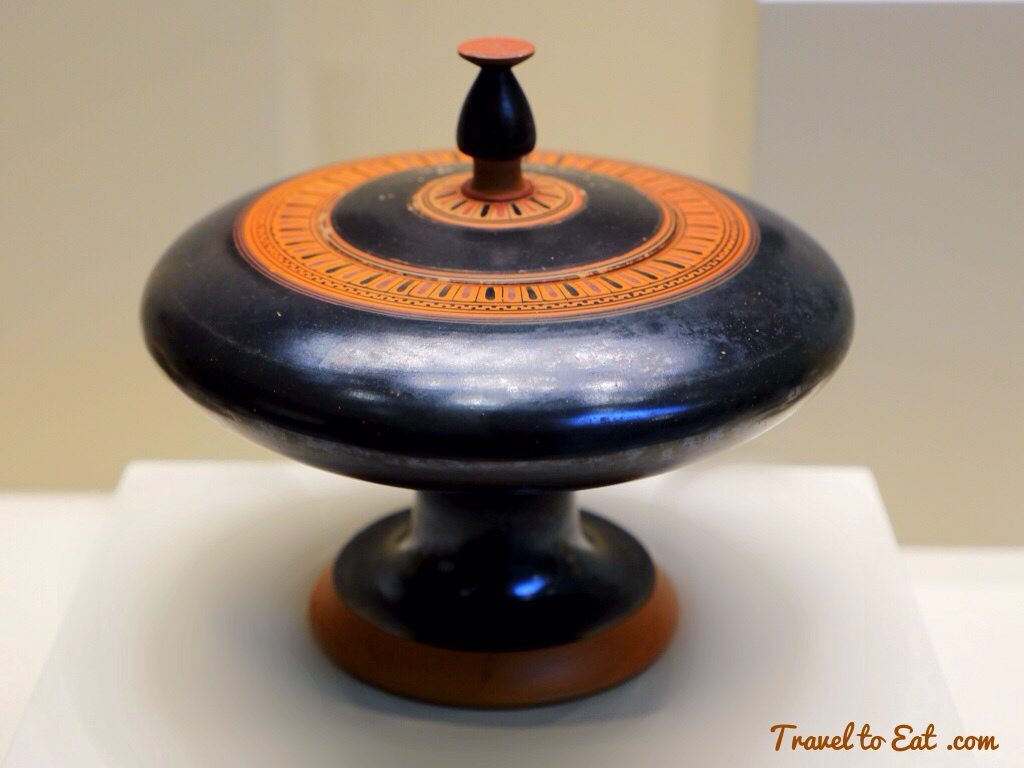
What we do know for certain was that special ritual vessels were used to make these libations. They were called 'plemochoai' and were specific to the Mysteries. They were vessels with a turned-in rim, a high foot, and a lid. Possibly, the same vessels were used to tip out water sacrifices to Demeter and Persephone the day after the major initiation rite.

'Epistrophe' implies re-crossing boundary between the liminal realm of sacred ritual to return to the more ordinary experiences of daily life. These libations, but also the simple acts of packing bags, cleaning up the fields and sactuaries, and and saying goodbye to newly made friends and acquaintances would have brought with it a sense of normalcy after the long days in which the whole point was to put aside everything normal. In these days, all things regula would slowly have been re-introduced and once ready, it was time to travel back home. The Mysteries were over, but the experience would have lingered forever.
An update on some Hellenic themed entertainment. A new series announcement, one likely to bite the dust, an a little more information on another project: 'The Odyssey'.


'Troy: A Fall Of A City' being developed
Rejoice or brace yourself, the BBC has announced they will be producing an 'epic TV series on the Fall of Troy'. The series will be a re-telling of the siege of Troy titled ‘Troy: A Fall Of A City’. The upcoming TV series, which will reportedly cost 2.7 million euros per episode, which will make it one of the most expensive ever produced in BBC’s history. So far it has been described as ‘a bold and visceral drama’ and hopes to rival HBO’s great hit: 'Game of Thrones'. As BBC1 controller, Charlotte Moore revealed it will be ‘intimate and epic, gripping and exhilarating, rich with psychological intrigue and human drama’. According to reports, the Troy series could span across 8 or more episodes.   

'Olympus' most likely cancelled
This series follows the adventures of Hero (Tom York, Tyrant), the bastard son of King Aegeus (Graham Shiels, Guardians of the Galaxy), who is the holder of the Lexicon. The Lexicon is the secret code that allows man to enter Olympus, the legendary home of the Gods. The first season has come to a conclusion and Syfy has yet to cancel or renew Olympus for Season 2. Olympus wrapped up its first season averaging just a 0.1 rating in the 18-49 demographic based on the overnights. If it is relying on its Syfy ratings, then its chances of a second season are considered to be very slim. But if its international partnerships and financing are strong enough, then it might still have a chance.

'The Odyssey' might net itself Hugh Jackman
I was already quite excited about this project spearheaded by 'Hunger Games' director Francis Lawrence and producer Nina Jacobson, but recent news has my inner geek girl tingling with joy. TheWrap reports Jackman is in early talks to play Odysseus, the legendary hero who encounters all manner of trials and tribulations on his epic ten-year quest to get back home after the Trojan War. While he hasn’t locked in a deal just yet, he’s had “multiple conversations” with the filmmakers about the project. The Odyssey shoots in 2016.
If you have been followign along with my posts about our Eleusinian Mysteries celebration, you know that today is a voluntary fasting day. But why are we fasting? And should you do it?

The mythical foundation for the Eleusinian rites is of course described in the second Homeric hymn, to Demeter, as assumed to be written by Pámphōs (Πάμφως), an early Hellenic poet, who is mentioned by Pausanias to have lived earlier than Hómeros himself. Pámphōs was the author of various hymns to deities, including the hymn to Demeter, and was connected to the mysteries as such. From the Homeric hymn to Demeter:

"Bitter pain seized [Demeter's] heart, and she rent the covering upon her divine hair with her dear hands: her dark cloak she cast down from both her shoulders and sped, like a wild-bird, over the firm land and yielding sea, seeking her child. But no one would tell her the truth, neither god nor mortal men; and of the birds of omen none came with true news for her. Then for nine days queenly Demeter wandered over the earth with flaming torches in her hands, so grieved that she never tasted ambrosia and the sweet draught of nectar, nor sprinkled her body with water."
 
Initiates were also instructed to fast each day from dawn until sunset, following the example of Demeter who would neither eat nor drink while searching for her lost daughter. In the evenings initiates could eat and drink, except for the traditionally forbidden foods.
 
Fasting is a very ancient phenomenon. In fact, an original starting date cannot be given. Fasting is the act of voluntarily withholding food from your body for a longer period of time than you would normally be without it. Great thinkers like Hippocrates, Plato and most of their students were avid practitioners and promoters of medicinal fasts and felt that a fast helped them think clearer.

I have fasted in the past, finding it a very useful tool for cleansing my body, clearing my mind and regaining focus on the things that matter. Regulars fasts have been proven to be very healthy, if you do it right. There is a method to fasting, and it depends greatly on the length of the fast. A fast is a cathartic tool because it cleans up the toxins in our organs and blood. It's a natural purge. Fasting also strengthens the will, and allows us to focus on something other than meals and snacks. It frees us up to pursue intellectual endeavor, and that process is also part of katharmos.

Fasting is a beautiful practice and I feel it should be a regular part of the Hellenic Tradition, but it's important to listen to your body before even attempting it. A short fast should only be done when your body needs it or, in this case, when your body is in a good enough shape to do it for a religious festival. If not, cheat a little and use the fruit shakes. If that's also too much, pick something else you love to go without; if you smoke, vow to go without cigarettes for the day, if you're a big coffee drinker, give it up for the duration of your 'fast'. What matters is that you give something up. That you go without.

So, for today, grieve with Demeter over the loss of Her daughter and remember a time when people went without food because Demeter had not shared Her secrets yet. Once you get hungry, remmeber to be grateful of the source of your food. Take no bit for granted once you have completed your night time 'initiation' rite and make sure to thank Demeter for Her gentle care.
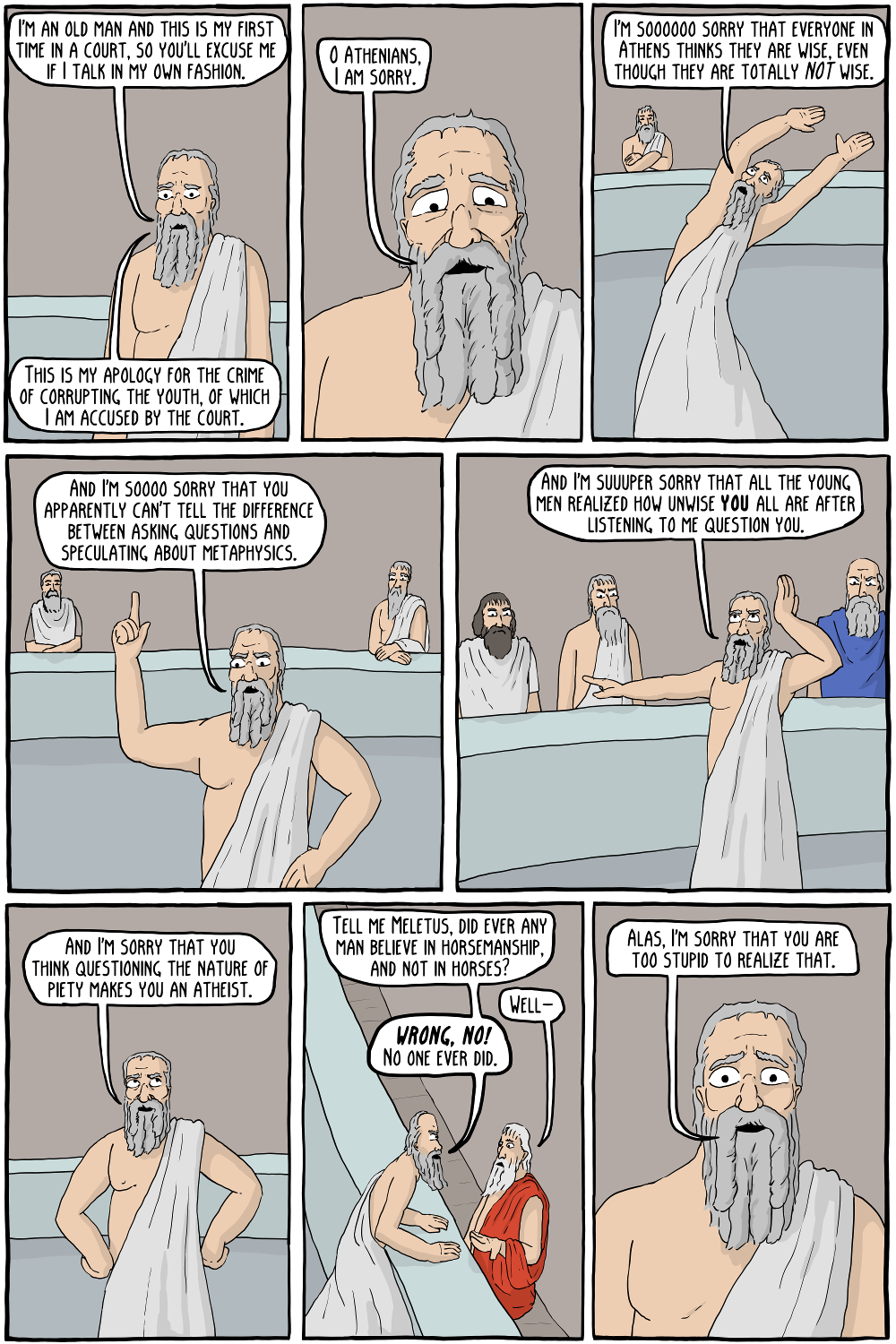
There have been many comics about Socrates' trial through the years. Many stories, videos, articles, essays, and books, too. Many of them have been satirical in nature, as it is very easy to make fun of someone who pretty much signed his own death warrant. As long as it's 2000+ years ago, of course.

2414 years ago, one of Hellas' greatest thinkers stood trial before a jury of 500 men, chosen by lot. Socrates (Σωκράτης), a philosopher who was of the opinion that people should not be self-governing; they needed to be led, like a shepherd led a flock of sheep. He was of the opinion that the average Athenian neither had the basic virtue necessary to nurture a good society, nor the intelligence to foster such virtue within themselves. As such, he was against the democratic system that came to fruition in the city of Athens at the same time he did.

Socrates was vocal about his ideas. He took to the streets and proclaimed them loudly, often while looking down upon those who passed him. Socrates' anti-governmental and reformatory speeches spoke to the Athenian youth. In a trying time after the loss of a major offensive against Sparta, old and young Athenian men--and their ideals--collided, and Socrates put fuel on the fire. Socrates' actions seem to go from being laughable to being subversive around 417 BC.

After a brief stint of tiranic rule over Athens, flueled by Socrates' ideas, Socrates managed to make himself even more unpopular by continuing the teachings and speeches that had caused the death or exile of hundreds of Atenians during the rule of the tirans. Another uprising in 401 against the democracy--although unsuccessful--might have been the straw that broke the proverbial camel's back; Socrates was sued by Melitus, a poet. Laertios, who appears to have seen the original trial minutes describes the vote that concludes one of the most famous trials in history:

"So when he had been condemned by two hundred and eighty-one votes, being six more than were given in his favour, and when the judges were making an estimate of what punishment or fine should be inflicted on him, he said that he ought to be fined five and twenty drachmas; but Eubulides says that he admitted that he deserved a fine of one hundred. And when the judges raised an outcry at this proposition, he said, "My real opinion is, that as a return for what has been done by me, I deserve a maintenance in the Prytaneum for the rest of my life." So they condemned him to death, by eighty votes more than they had originally found him guilty. And he was put into prison, and a few days afterwards he drank the hemlock, having held many admirable conversations in the meantime, which Plato has recorded in the Phaedo."

In short: Socrates would have lived if he had kept his mouth shut--and the comic I'd like to share today pretty much nails Socrates'attitude! I loved reading it, and I hope you do, too!