Plato (Πλάτων, Plátōn) was a philosopher in Classical Hellas who lived from 428/427 or 424/423 to 348/347 BC. He was the founder of the Academy in Athens, the first institution of higher learning in the Western world. He is widely considered the most pivotal figure in the development of philosophy, especially the Western tradition. Unlike nearly all of his philosophical contemporaries, Plato's entire œuvre is believed to have survived intact for over 2,400 years. I would like to quote from one of these works, namely 'Euthyphro'--named after one of two chracters in the writing (the other being Socrates)--today.

Euthyphro (Εὐθύφρων, Euthuphrōn) was written around 399–395 BC. It is a dialogue that occurs in the weeks before the trial of Socrates (399 BCE), for which Socrates and Euthyphro attempt to establish a definitive meaning for the word piety. Euthyphro of Prospalta (Εὑθύφρων Προσπάλτιος, Euthύphrōn Prospáltios) lived around 400 BC. He was an ancient Athenian religious prophet (mantis) whose ideas gave rise to the Euthyphro dilemma: is the pious loved by the Gods because it is pious, or is it pious because it is loved by the Gods? 

Piety, by definition, is reverence for the Gods or devout fulfillment of religious obligations, but as Plato has Socrates question: what does that actually mean? I'll let Euthyphro and Socrates answer--or attempt to, at least.


Socrates: Tell me what is the nature of [piety], and then I shall have a standard to which I may look, and by which I may measure actions, whether yours or those of any one else, and then I shall be able to say that such and such an action is pious, such another impious.
Euthyphro: Piety, then, is that which is dear to the gods, and impiety is that which is not dear to them.
Soc. Does not every man love that which he deems noble and just and good, and hate the opposite of them?
Euth. Very true.
Soc. But, as you say, people regard the same things, some as just and others as unjust,-about these they dispute; and so there arise wars and fightings among them.
Euth. Very true.
Soc. Then the same things are hated by the gods and loved by the gods, and are both hateful and dear to them?
Euth. True.
Soc. And upon this view the same things, Euthyphro, will be pious and also impious?
Euth. So I should suppose.
Soc. Then, my friend, I remark with surprise that you have not answered the question which I asked. For I certainly did not ask you to tell me what action is both pious and impious: but now it would seem that what is loved by the gods is also hated by them. [...] How do I know anything more of the nature of piety and impiety? for granting that this action may be hateful to the gods, still piety and impiety are not adequately defined by these distinctions, for that which is hateful to the gods has been shown to be also pleasing and dear to them." And therefore, Euthyphro, I do not ask you to prove this; [...] but I will amend the definition so far as to say that what all the gods hate is impious, and what they love pious or holy; and what some of them love and others hate is both or neither. Shall this be our definition of piety and impiety?
[...]
Euth. We should enquire; and I believe that the statement will stand the test of enquiry.
Soc. We shall know better, my good friend, in a little while. The point which I should first wish to understand is whether the pious or holy is beloved by the gods because it is holy, or holy because it is beloved of the gods.
Euth. I do not understand your meaning, Socrates.
Soc. I will endeavour to explain: we, speak of carrying and we speak of being carried, of leading and being led, seeing and being seen. You know that in all such cases there is a difference, and you know also in what the difference lies? [...] My meaning is, that any state of action or passion implies previous action or passion. It does not become because it is becoming, but it is in a state of becoming because it becomes; neither does it suffer because it is in a state of suffering, but it is in a state of suffering because it suffers. Do you not agree?
Euth. Yes.
[...]
Soc. And what do you say of piety, Euthyphro: is not piety, according to your definition, loved by all the gods?
Euth. Yes.
Soc. Because it is pious or holy, or for some other reason?
Euth. No, that is the reason.
Soc. It is loved because it is holy, not holy because it is loved?
Euth. Yes.
Soc. And that which is dear to the gods is loved by them, and is in a state to be loved of them because it is loved of them?
Euth. Certainly.
Soc. Then that which is dear to the gods, Euthyphro, is not holy, nor is that which is holy loved of God, as you affirm; but they are two different things.
Euth. How do you mean, Socrates?
Soc. I mean to say that the holy has been acknowledge by us to be loved of God because it is holy, not to be holy because it is loved.
Euth. Yes.
Soc. But that which is dear to the gods is dear to them because it is loved by them, not loved by them because it is dear to them.
Euth. True.
Soc. But, friend Euthyphro, if that which is holy is the same with that which is dear to God, and is loved because it is holy, then that which is dear to God would have been loved as being dear to God; but if that which dear to God is dear to him because loved by him, then that which is holy would have been holy because loved by him. But now you see that the reverse is the case, and that they are quite different from one another. For one (theophiles) is of a kind to be loved cause it is loved, and the other (osion) is loved because it is of a kind to be loved. [...] And does piety or holiness, which has been defined to be the art of attending to the gods, benefit or improve them? Would you say that when you do a holy act you make any of the gods better?
Euth. No, no; that was certainly not what I meant.
Soc. And I, Euthyphro, never supposed that you did. I asked you the question about the nature of the attention, because I thought that you did not.
Euth. You do me justice, Socrates; that is not the sort of attention which I mean.
Soc. Good: but I must still ask what is this attention to the gods which is called piety?
Euth. It is such, Socrates, as servants show to their masters.
Soc. I understand-a sort of ministration to the gods.
Euth. Exactly. [...] I have told you already, Socrates, that to learn all these things accurately will be very tiresome. Let me simply say that piety or holiness is learning, how to please the gods in word and deed, by prayers and sacrifices. Such piety, is the salvation of families and states, just as the impious, which is unpleasing to the gods, is their ruin and destruction.
The Archaeological News Network reports problematic news, the ancient city of Pavlopetri off of the coast of southern Laconia is currently facing three kinds of threats: pollution caused by commercial ships; shifting sediment caused by smaller boats traveling over the archaeological remains that can potentially damage the foundations and walls; and looting of findings from the sea floor.


Dr Nicholas Flemming, a marine geo-archaeologist at the Institute of Oceanography at the University of Southampton was the first to discover, in 1967, the Bronze Age city of Pavlopetri, underwater off the coast of southern Laconia in the Peloponnese. He recently went back to the site he first explored almost half a century ago, to observe the delineation of the underwater archaeological site.
 
Pavlopetri was listed on the 2016 World Monuments Watch in October 2015. Launched in 1996, the World Monuments Watch is issued every two years by the World Monuments Fund, an independent organization devoted to saving the world’s treasured places. The listing of Pavlopetri, it is believed, will help raise awareness about the threats facing the site and foster public participation in its protection.
 
"The community is the best guardian for Pavlopetri and it needs to be helped."
 
Early research at Pavlopetri was carried out in the late 1960s by a team of archaeologists from Cambridge University who mapped the ancient city. About four decades after the first divers visited Pavlopetri, interest in the site resurfaced. In 2009 the Ephorate of Underwater Antiquities of the Greek Ministry of Culture, the Hellenic Center for Maritime Research and the University of Nottingham launched a five-year project to outline the history and development of Pavlopetri.
 
 Having explored about 400 underwater archaeological sites, Flemming believes that Pavlopetri still holds many secrets. The city was gradually covered by water thousands of years ago as the sea level rose due to earthquakes and the end of the ice age. However, he says, the ancient city serves as a model of a fishing village that was turned into a port and commercial center, well protected from the natural environment.
 
“Seamen never make a mistake when they pick a port, and that was true five thousand years ago.”
 
the Ephorate, the Municipality of Elafonisos and the Regional Authority of the Peloponnese, recently joined forces to promote the site by installing underwater signs, handing out informative material, preparing a waterproof map and designing a tour for visitors. Creating a sea park is a possibility, Flemming says, adding, however, that authorities should be extremely careful about how they run a Bronze Age underwater site so as to prevent any damage.
I get a lot of questions from readers, and most of the time, the answers are fairly short. When I feel the question or the reply would be valuable to others as well, I make a post with a collection of them and post them in one go. Today is one of those posts.


"Do the Theoi mind if you worship other gods?"

As an individual? I doubt it. The Theoi, in general, are unconcerned with a specific worshipper. Our religion is at its core one of group worship. They remember us when we draw Their attention to us but only then. Stop praying to Them and you'll be forgotten. As a species, though? Yeah, I bet that pissed Them off something royal! But there is not much They could have done about that (see below).

~~~

"Hope this isn't a bad question, but why couldn't the Theoi save Hellas when the Romans, then Christianity, came?"

You are assuming the Romans conquering Hellas was a bad thing. Perhaps it fitted Their plan? Even without that, though, the invasion of the Romans and then the rise of Christianity was of human design and humanity abandoned the Theoi of their own free will. I think that might be waht you are really asking, is it not? Why did the Theoi allow humanity to convert to Christianity?

Hellenismos believes in free will of humanity; not even the Gods can end the will of a human being, but they can certainly influence the lives we live and instil in us through our environment a need to serve, a need to find Them, a need to honour Them. The concept of free will was a grateful one to the ancient Hellenic philosophers. After all, free will in a religious world poses a problem: if you believe in the Gods, and that the Gods have powers beyond ours--foresight, mostly, and a claim to the end of our lives--how can you make the case for free will?

 In the early days, a form of compatibilism was found where the idea that causal determinism and logical necessity are compatible with free will. As time and philosophy progressed, great thinkers like Anaximander and Heraclitus around the sixth century BC came up with theories to grapple with the supernatural as it ruled over the natural while leaving free will intact. Their resolution was to assign earthy causes to physical events like floods, taking them out of the realm of the supernatural and into the realm of the natural.

In a quest to give humanity back a sense of responsibility for their own actions, materialist philosophers Democritus and Leucippus posed a new theory: that everything--including humans--existed from atoms from the same source. It were great thinkers like the Pythagoreans, Socrates,  Plato, and Aristotle who attempted to reconcile an element of human freedom with material determinism and causal law, in order to hold man responsible for his actions. Aristotle, especially, introduced the notion of 'accidents' into Leucippus' thinking, paving the way for an element of chance to be introduced into the theory.

Aristotle's views were the foundation for a slew of new theories that built upon his, the most famous, perhaps, being Epicurus, who thought human agents had the ability to transcend necessity and chance. He argued that as atoms moved through the void, there were occasions when they would 'swerve' from their otherwise determined paths, thus initiating new causal chains. This paved the way for Lucretius, who saw the randomness as enabling free will.

 It was the Stoic school of philosophy that solidified the idea of natural laws controlling all things, including the mind. Their influence persists to this day, in philosophy and religion, even though most of their work on free will has been lost--most likely to the Christian church, who preached a dogma of determinism by way of an omnipotent God.

Free will is powerful: it gives us the agency we need to aspire to greatness. It gives us a sense of control over our lives. We choose to become servants to the Gods--we are not forced to do so, even though it might be destined we become servants; this makes all the difference in our joy of the execution of the Divine will. If we felt pressured and ordered into it, we would not find the same joy in it as we do now we are free to choice our path--or believe we are free to choose our path.

Sadly, or perhaps necessarily, this also paves the way for us to choose to denounce the Theoi, both as individuals as well as as a species.

~~~

"I was conducting a few actions for the Deipnon tonight, and one of my parents disapproved (I'm 14). What should I do about that?"

Nothing. They're your parents and until you are eighteen, you are under their rule and guidance. You don't mention if they are actively keeping you from further worship. I also don't know your home situation. What's perhaps a good course of action is to talk to them. Talk to them about your faith and your desire to practice. Ask them for their reasons for disapproving an see if they have the right idea about Hellenimsos (I doubt it). If at all possible, conversation is always the most prudent of courses of action.

If you do want to continue practicing, try to fidn a way to use regular things already in your room for it and choose times when they are not at home if at all possible. There are ways to hide it, but again, respecting your elders (and parents, especially), is one fo the core ethics of Hellenismos. Good luck!

~~~

"Is it normal to worry about not doing the rituals correctly?"

Especially when first starting out, I would say yes. I know I worried about it for a while when I first started. But truly, there is not much to Hellenistic ritual. Walk to your bomos (altar), cleanse yourself with water that has had something burning tossed into it, recite a hymn to the God(s), make your offerings, say your prayers, and make sure not to catch the house on fire during any part of it. That's basically it. You can get a lot more elaborate but it will still come down to procession, cleansing, hymns and prayers, and offerings.

~~~

"How can I get an involuntary, offensive-to-the-Theoi thought out of my mind?"

The Theoi, in general, don't look into our heads. Have you ever read Zeus getting ticked of at Herakles because he thought something bad? Have you ever read anything about the Gods judging a person upon their thoughts? Our Gods are not all-seeing (except for Helios, and that applies only to things actually visible to the naked eye as He beholds the earth from above and thus has a great range of vision). Our Gods need to be drawn to us to get attention, let alone randomly look into our heads at the exact moment you may or may not think something that They may or may not take offense to. Our minds are our own, which is why we say our prayers out loud. It's our actions that speak for us and draw the Theoi. It's through our actions that we must practice arete. Truly, you are safe from your thoughts.
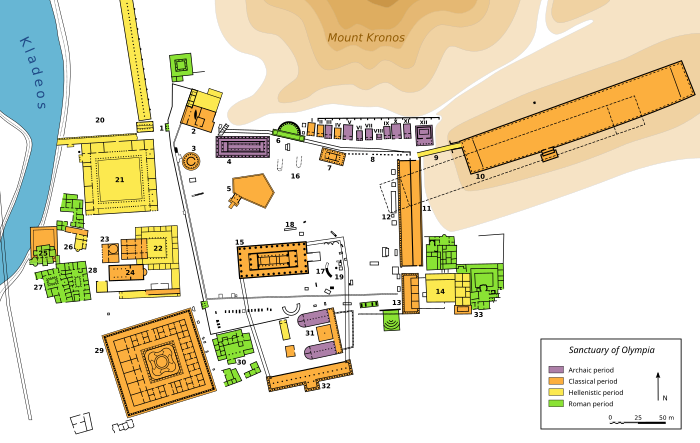
In preparation of the Olympic Games, I'm posting something every now and again about the ancient version of the Games. Today, I would like to discuss some of the speciffics of Olympia, the location of the ancient games.


Olympia was a rural sanctuary in a fertile valley between two rivers. It was named for Mount Olympos, home of the Gods. The sanctuary, known as the Altis, consists of an unordered arrangement of various buildings. Enclosed within the temenos (sacred enclosure) are the Temple of Hera (or Heraion/Heraeum), the Temple of Zeus, the Pelopion, and the area of the altar, where the sacrifices were made.

To the north of the sanctuary stood the Prytaneion and the Philippeion, as well as the array of treasuries representing the various city-states. The Metroon lay to the south of these treasuries, with the Echo Stoa to the east. The hippodrome and later stadium were located east of the Echo Stoa. To the south of the sanctuary is the South Stoa and the Bouleuterion, whereas the Palaestra, the workshop of Pheidias, the Gymnasion, and the Leonidaion lie to the west.

The map above displays the location of: 1. Northwest Propylon, 2. Prytaneion, 3. Philippeion, 4. Temple of Hera, 5. Pelopion, 6. Nymphaeum of Herodes Atticus, 7. Metroon, 8. Treasuries, 9. Crypt (arched way to the stadium), 10. Stadium, 11. Echo Stoa, 12. Building of Ptolemy II and Arsinoe II, 13. Hestia stoa, 14. Hellenistic building, 15. Temple of Zeus, 16. Altar of Zeus, 17. Ex-voto of Achaeans, 18. Ex-voto of Mikythos, 19. Nike of Paeonius, 20. Gymnasion, 21. Palaestra, 22. Theokoleon, 23. Heroon, 24. Pheidias' workshop and paleochristian basilica, 25. Baths of Kladeos, 26. Greek baths, 27. and 28. Hostels, 29. Leonidaion, 30. South baths, 31. Bouleuterion, 32. South stoa, 33. Villa of Nero. Treasuries. I. Sicyon, II. Syracuse, III. Epidamnus(?), IV. Byzantium(?), V. Sybaris(?), VI. Cyrene(?), VII. Unidentified, VIII. Altar(?), IX. Selinunte, X. Metapontum, XI. Megara, XII. Gela. [Courtesy of Wikipedia]

Its many foundation myths were emblazoned in sculptures on the fifth-century BC. temple of Olympian Zeus:

- The games were held in celebration of Zeus defeating his father Kronos at Olympia and seized supreme power
- After cleansing the Augean stables and then defeating the local king in battle, Herakles inaugurated the early Games in Zeus’ honor, at this place
- Pelops, Zeus’ grandson, established the games, having won the hand of a local princess, Hippodameia, after sabotaging her father’s chariot to win a race, for which she was the prize. Her father died as a result, and Pelops set up the early competitions in his honor

Whatever the case, the games were a fact and established at Olympia. Most impressive about the temple of Zeus were not the sculptures but the seated statue of Zeus that stood inside the temple. The seated statue, created by the Greek sculptor Phidias, was thirty-nine feet, or twelve meters, tall. Ancient accounts say that, if Zeus would have stood, he would have unroofed the temple.

The statue was richly decorated with ivory and gold-plated bronze. The sculpture was wreathed with golden olive shoots and sat on a grand throne  cedarwood, inlaid with ivory, gold, ebony, and precious stones. He held a small statue of crowned Nike, goddess of victory, in his right hand, and in his left hand, a sceptre inlaid with gold, on which an eagle perched.

The statue was eventually destroyed, either in the fire that also destroyed the temple, or before, when it was carried off by Romans who either used the stone and precious metals to create something new, or to repurpose the statue as a representation of one of their own emperors. While it stood at Olympia, it was the literal seat of Zeus' power, and a focal point of His worship.
As the Roman Stoic philosopher Epictetus wrote:

“You journey to Olympia to gaze on the statue of Zeus and every one of you would think it a great misfortune to die never having seen it.”

The tempe to Hera was used to store some of the key paraphernalia of the Olympic Games, including a discus on which were inscribed the terms of the 'Olympic Truce', proclaimed by itinerant heralds months before the festival began to ensure that participants and spectators could enjoy safe passage.
Very few heroes in ancient Hellas had quite the impact of Hēraklēs. Both mythologically speaking as as a practical part of the religion, Hēraklēs has a special place and he is honoured during the Herakleia. Will you honour him with us on August 5 at the usual 10 am EDT?


Hēraklēs was conceived by Zeus upon Alkmene, as He disguised Himself as her husband, returning early from war. Alkmene accepted Him in her bed gladly, as she was happy to see her husband again. When the real Amphitryon did return later that night, Alkmene realized what had happened, and told her husband. Amphitryon accepted her in his bed, regardless, and so she became pregnant with twins, one fathered by Zeus, and one by her mortal husband.

Hera, hearing of the affair, took an instant disliking to the unborn child. When it became time for Alkmene to give birth, Hera made Zeus swear a vow that a child born in the line of Perseus on this day would become King. Zeus agreed, and Hera hurried off to delay the birth of Hēraklēs and Iphikles, and hurry along the birth of Eurystheus (Εὐρυσθεύς), grandson of Perseus. The two had unknowingly become part of a contest of wills between Zeus and Hera, to decide who would be the hero to drive off the last of the great monsters and pave the way for the Olympians.

Eventually, Hera was tricked into allowing the children born, as She would have postponed their delivery indefinitely. Alkmene, aware of the divine spark in one of her sons, took her distance from him, but the young Hēraklēs was taken up by Athena and taken to Hera, who did no recognize the newborn nemesis of Her candidate, and took pity on him. She fed him from Her breast, but when he suckled so hard that he caused Her pain, She realized who he was, and cast him off. Athena rescued the infant and took him back to his mortal parents. Alkmene took him back and raised him with her husband.

Hēraklēs was a strong child, so strong, in fact, that he inadvertently killed his music teacher Linos (Λῖνος) with a lyre, for which he was tried and found not guilty. He was still made to leave the city, however. Hēraklēs set out to perform feats of strength, starting by defeating the lion of Kithairon, which had been a bane to his stepfather for far too long. Thespios, King of Thespiae, housed Hēraklēs for fifty days as he hunted for the lion, and every night Thespios placed one of his fifty daughters in his bed, although Hēraklēs thought he was only sleeping with one. Hēraklēs eventually vanquished the lion. He dressed himself in the skin, and wore the scalp as a helmet. The Gods lavished him with gifts: a sword from Hermes, bow and arrows from Apollon, a golden breastplate from Hēphaistos, and a robe from Athena. His famous club he made himself at Nemea.
 
Next, Hēraklēs was drawn into a war between the Thebans and the Minyans. He happened upon heralds from King Klymenos, who had won a previous battle with Thebes and now demanded tribute from them. Hēraklēs, who had been living in Thebes, cut the ears, noses and hands off of all but one of the heralds and told the last remaining one to take them back to his king as tribute. In the battle that followed, Hēraklēs fought bravely with the king's army, and his side eventually won, earning him his wife Megara, eldest daughter of King Kreōn of Thebes.
 
Due to Hera's jealousy, he was stricken mad and killed the five sons he had by his wife. When he was released from his madness by a hellebore potion--provided by Antikyreus--and realized what he had done, he cried out in anguish, and went on a long journey to cleanse himself of the miasma caused by these killings. First, he visited the oracle at Delphi, who, unbeknownst to him, was whispered to by Hera. The Oracle told Hēraklēs to serve the king of Tiryns, Eurystheus, for ten years and do everything Eurystheus told him to do. Eurystheus gladly provided Hēraklēs with these labors--ten of them, one for each year--and eventually ended up adding two more, resulting in the Twelve Labors of Hēraklēs.

The Herakleia (Ἡράκλεια ἐν Κυνοσάργει, Herakleia en Kynosargei) were ancient festivals commemorating the death of Hēraklēs. In Athens, the celebration was held just outside the city walls, in a sanctuary dedicated to Hēraklēs. His priests were drawn from the list of boys who were not full Athenian citizens (nothoi, illigitimate children, like him) and were named 'parasitoi'. The Attic cults of Hēraklēs were often closely connected with youth: at several of his cult sites there was a gymnasion attached, and there was a mythological tradition (perhaps originating in Boeotia) that after Hēraklēs died he was taken up to Olympus, where he married Hebe, the personification of youth. Because of this, Hēraklēs is sometimes worshipped as a God and sometimes as a dead hero.

In Thebes, the center of the cult of Hēraklēs, the festivities lasted a number of days and consisted of various athletic and musical contests (agones), as well as sacrifices. They were celebrated in the gymnasium of Iolaus, the nephew and eromenos of Hēraklēs, and were known as the Iolaeia. The winners were awarded brass tripods.

Will you join us in honouring Hēraklēs on this day? You can join the community here and find the ritual here.
On the day of the Hene kai Nea, I post a monthly update about things that happened on the blog and in projects and organizations related to it. I will also announce Elaion's coming PAT rituals.

Changes to the blog:
  • The A woman to know series page has been updated
  • I am currently on (work) vacation and will be back by the 15th. Until then, there might be some shorter posts or a few more news items. In the hopes of your understanding!
Statistics:
PAT rituals for Metageitnion:
Anything else?
Are you looking for an online shop to buy incenses and other Hellenistic basics from? Try The Hellenic Handmaid on Etsy.
I get a lot of questions from readers, and most of the time, the answers are fairly short. When I feel the question or the reply would be valuable to others as well, I make a post with a collection of them and post them in one go. Today is one of those posts.


"Hello. I have been believing in the Greek Gods (excuse my uneducated termanology) for some time now and have been considering taking part in daily sacrifices and rituals and such. The problem however is that I am underage to consume alcohol and your guides for libations call for drinking and using wine. Do you have any suggestions as to how I can get around this? I would very much appreciate your advice. Thanks"

Grape juice. My answer to this has been and will forever be grape juice. Wine, after all, is nothing more than fermented grape juice. If a carton of that is hard to hide, water will suffice. But grape juice comes as close to the real thing as you can get without adding alcohol.

~~~

"I saw on your post about miasma that any distracting thing can be considered miasmic, but I have adhd and am distracted by literally everything. My thoughts are always in a million different directions at once and Incan't help it. Is this miasma?"

No, having ADHD is not a source of miasma. At all. After all, yes, it causes distraction but for you and those around you the behaviours associated with your ADHD are commonplace. What I mean when I say ‘miasma is caused by distraction’ (paraphrasing a very long and intricate post here) I don’t mean distraction as such, I mean something that is out of the norm and that takes away the spotlight from the Gods. Your ADHD is nothing new, not for you and not for those around you. It’s just something you have, something that makes you who you are. Well, one of the building blocks of who you are. And no, it is not miasmic in the least.

~~~

"Am I a bad hellenic polytheist if I like reading the percy jackson books?"

Haha! No, I quite liked them myself. What would make you a bad Hellenic Polytheist is only reading the Percy Jackson books and believing that what you read is accurate in terms of history or mythology. It's not. Not even close. Read it as amusement, as long as you do that, it's perfectly alright to enjoy them!

~~~

"Is being more revival instead of recon disrespectful or bad or anything? Like, I'm not talking abt like hellenic wicca or anything i mean just things adapted to modern stuff, since im unable to be mostly recon due to my household"

No, not at all, the two are simply different approaches that one can either be drawn to or be forced into. Both honour the Theoi and both take the ancient Hellenic practice as a base. How much of that base survives differs but that's not good or bad. Just different. I try for a Traditional approach (as much as possible), but that it not better than anything else, or more authentic. It's just what works for me. What matters is that you find what works for you.

~~~

"I really want to wear the veil, but I'm terrified to do so in public. I'm scared I'll offend someone, especially since I am very obviously white, but also people who wear hair coverings are not treated well in public where I live. I'm also worried about seeing someone I know and if they would judge me. How can I gain the confidence to express my devotion in the way I want to?"

In ancient Hellas the word for veil was 'kalyptra' (καλύπτρα), or 'kalyptrē' (καλύπτρη) in Ionic Greek. It comes from the verb 'kalyptō' (καλύπτω), 'I cover'. Veiling was a huge part of social life in ancient Hellas, and retained its importance well into the Roman era. While we don't know how many men and women veiled--because veiling was important for men as well, especially in the Roman era--we can assume that especially in ancient Hellas adult women tended to veil whenever they left the house. The fact that so few ancient writers mention the veil is indicative of one of two things: either it rarely happened, or it happened so often that it was not worth mentioning. Seeing as we have a lot of depictions of veiling on statues and other forms of art, we can only assume the latter to be true.

While we cannot accurately establish the frequency of veiling, we can most definitely try to discern 'why'. I say 'try' because veiling was a very complicated practice and it was done (and not done) for a great variety of reasons. Let's start with religious veiling: during rites to the Ouranic Gods at least, women tended to veil. At least in Roman times men did as well, but because of the words of Plutarch we can assume that the ancient Hellenic men frequently did not. Veiling during religious rites was seen as an act of dedication. By veiling, women--and by Roman times, men--put themselves below in status to the Gods as an act of piety. As Plutarch says in his 'Quaestiones Romanae':

[T]here is only one matter that needs investigation: why men cover their heads when they worship the gods; and the other [why men uncover their heads when they meet any of their fellow-men worthy of honour] follows from this. For they uncover their heads in the presence of men more influential than they: it is not to invest these men with additional honour, but rather to avert from them the jealousy of the gods, that these men may not seem to demand the same honours as the gods, nor to tolerate an attention like that bestowed on the gods, nor to rejoice therein. But they thus worshipped the gods, either humbling themselves by concealing the head, or rather by pulling the toga over their ears as a precaution lest any ill-omened and baleful sound from without should reach them while they were praying. That they were mightily vigilant in this matter is obvious from the fact that when they went forth for purposes of divination, they surrounded themselves with the clashing of bronze. " [10]

Plutarch (Ploútarkhos, Πλούταρχος) was a Greek historian, biographer, and essayist, who later in his life became a Roman citizen. As such, he was extraordinarily qualified to write two standard works: the 'Quaestiones Graecae' (Αἴτια Ἑλληνικά, or 'Greek Questions'), and the 'Quaestiones Romanae' (Αἴτια Ῥωμαϊκά, or 'Roman Questions'). These essays are part of the book series 'Moralia' (Ἠθικά, loosely translatable as 'Matters relating to customs and mores'), and can be found in book IV of the series. The Greek Questions contain fifty-nine questions, the Roman version hundred-thirteen, and all pertain to matters concerned with their respective culture. Many of the answers are names or customs, and because Plutarch often refers (back) to Hellenic customs, both are extremely valuable for research on ancient Hellenic life.

This dedication extended into the social as well: veiling and unveiling was a large part of wedding ceremonies for both men and women--who were both veiled for the ceremony. In ancient Hellenic times, men veiled during funerary rites, while women unveiled (in ancient Roman times, this was reversed) as anything associated with the underworld and death required a reversal of the usual. Plutarch, again in the 'Quaestiones Romanae' questions 'why do sons cover their heads when they escort their parents to the grave, while daughters go with uncovered heads and hair unbound?' and answers, partly, with the following:

"Is it because fathers should be honoured as gods by their male offspring, but mourned as dead by their daughters, that custom has assigned to each sex its proper part and has produced a fitting result from both? Or is it that the unusual is proper in mourning, and it is more usual for women to go forth in public with their heads covered band men with their heads uncovered? So in Greece, whenever any misfortune comes, the women cut off their hair and the men let it grow, for it is usual for men to have their hair cut and for women to let it grow." [14]
 
 Now, for women in ancient Hellas, there was another obvious--although very much linked--reason to veil: as a way to move freely outside of the oikos. Ancient Hellenic homes were simple structures, made from clay, wood, and stone. In many cases, a large wall with a single door connected the house to the street, while insuring maximum privacy to the occupants of the house. Women and men lived almost entirely separately within the home. Male-only rooms were called 'andron' (ανδρών), female-only rooms were called 'gynaikon' (γυναικῶν). Men were not allowed to enter female-only rooms, and a visiting male guest would be punished most severely if he entered the gynaikon.

Women, at least while in the gynaikon, were likely not veiled. When a married woman was alone with her husband, she most likely was not veiled either. When surrounded my other men, however, she most likely be veiled without fault unless the social rules dictated she must go unveiled. There was a good reason for this: women, for men, were near-mythological creatures; they didn't see many of them in their daily lives--safe for their mothers and wives, and even them, they hardly saw because they spent most of their time separate. Men feared women a little; they were closer to their primal nature because they bled once a month. That made them unpredictable.

Females started veiling around their first menstrual cycle: from that point on they were viewed as women and they developed their appeal on men. Ancient Hellenic men viewed women as having an uncontrolled sexuality, as well as a natural miasma linked to that sexuality, both of which posed serious threats to the social order. Men were attracted and aroused by women, who shook their self-control and their ideals of temperance. Instead of looking inward, changing their own behaviour and controlling their own desires, they lay the fault with women. As such, the veil shielded males from the female's dangerous gaze, controlled her enticing hair, and symbolically contained her siren's voice.

In ancient Hellenic society, women were regarded as being the property of the men in their lives--first their father, then their husband. They rarely had interactions with men not from their oikos. This was explainable: lawful and legitimate parentage was extremely important in ancient Hellenic society. A man who caught his wife cheating could bring the man she was cheating with to court. Plutarch, in a discussion of law, says that Solon gave 'to the one who catches a moichos (an adulterer) the right to kill him, but if anyone seizes a free woman and forces her, he assigned the penalty of one hundred drachmas’.

Veiling, like sexual separation, helped to preserve the Hellenic female's chastity, which, in turn, ensured both the legitimacy of her husband's heirs and the highly valued honour of her husband and family. When the woman left her home and the protection of her male guardians, the veil rendered her both socially invisible and sexually inviolate and marked her as the property of the male whose honour was reinforced by both her invisibility and chastity. The veil, essentially, served as an extension of the oikos: when women left the house veiled, they were safe. They became untouchable.

Veiling, however, was not simply a cultural mandate that underscored the woman's powerlessness relative to men. While women's adoption of the veil supported the male ideology that advocated female subordination, veiling also gave women a certain degree of authority by allowing them to claim both respectability and assert their own position in the social hierarchy. Because of this it is not surprising that the practice of veiling for women increased as their power in society increased.

Veiling for religious reasons is a pious act, one that speaks of dedication and devotion. If veiling outside of ritual in a modern context makes sense to you, I applaud it. I think it's a beautiful practice. It is, however, not worth your safety. Personally, I bind my hair when an ancient Hellenic woman would have veiled. It's my way to honour the practice and ensure only my spouse sees me in the state that the ancient Hellenic men agreed was a woman's fairest.

Fact is: times have changed. The veil has come to be associated with a fair deal of negativity in modern time--especially in Western countries. Which is a shame as I find it a beautiful practice in pretty much all religions. Now, there are ways to veil that are not as triggering: a bandana worn about the hair, for example, or even a hat or baseball cap. Or using a wrapping style not currently associated with negativity.

As with all new things, easing into it is probably best. Wrap up your hair with a bandana, go out and see what happens. Do it again after a few days, then build up the frequency and alternate styles until you are happy and the outside world has adjusted. And remember: 'because', just like 'no' is a full sentence answer to the question of '(may I ask) why you're wearing something on your head'. Good luck!