Elaion co-core member and co-founder of Elaion, Robert Clark, came upon  very interesting video lecture recently and I would like to share it with you today. I'll copy/paste his accompanying message on the Elaion Facebook page.

"Pandora's Kharis cause for Mounukhion was ‘Giving for Greece’ set up by the Bodossaki Foundation. There is a very interesting video on the Bodossaki Foundation website of a lecture by Michael Hoff 'From Friend to Foe: Athens and Rome during the Roman Republic' in which he sheds light on the complex and shifting relationship between Athens and Rome."

Michael Hoff is professor of Art History in the Department of Art and Art History at the University of Nebraska-Lincoln where he has been on the faculty since 1989. He received his A.B. in Art History and Archaeology from the University of Missouri, M.A. in Classics from Florida State University, and his Ph.D in Art History from Boston University. Hoff specializes in Greek and Roman archaeology in which he has focused his research on the history of Roman Athens as well as the archaeology of Asia Minor.

As the video can't be embedded, please click on the image below to get taken directly to it. Alternatively, click here.

http://www.blod.gr/lectures/Pages/viewlecture.aspx?LectureID=2691
In november, 2015, I reported on the discovery of the remnants of the Acra, a fortress built by the Hellenic King Antiochus IV more than 2,000 years ago and sought for over 100 years, which emerged from a parking lot in Jerusalem. Now there is more news on the ancient site: new discoveries, new pictures and most of all, new conflict.


National Geographic recently posted an update on the find, which includes more background on the fortress, an overview of new discoveries and more images of the site. It also includes coverage of a conflict that has emerged over the preservation of the site.

Alexander the Great conquered Judea in the 4th century B.C., and his successors quarreled over the spoils. Jerusalem, Judea’s capital, sided with Seleucid King Antiochus III to expel an Egyptian garrison, and a grateful Antiochus granted the Jews religious autonomy. For a century and a half, Greek culture and language flourished here. Yet conflicts between traditional Jews and those influenced by Hellenism led to tensions, and Jewish rebels took up arms in 167 B.C. The revolt was put down and Antiochus IV Epiphanes sacked the city, banned traditional Jewish rites, and set up Hellenic gods in the temple.

According to the Jewish author of 1 Maccabees, a book written shortly after the revolt, the Seleucids built a massive fort in 'the city of David with a great and strong wall, and with strong towers'. It was called 'the Acra', from the Greek for a high, fortified place. It was a thorn in the side of Jews who resented Hellenic dominance.

In 164 B.C., Jewish rebels led by Judah Maccabee took Jerusalem and liberated the temple, an event commemorated in the festival of Hanukkah. But the rebels failed to conquer the Acra. For more than two decades, the rebels tried in vain to overwhelm the fortress. Finally in 141 B.C., Simon Maccabee captured the stronghold and expelled the remaining Hellenes.

What happened next has confused and divided scholars for more than a century. According to historian Josephus Flavius, a Jew who served Rome in the first century A.D., Simon Maccabee spent three years tearing down the Acra, ensuring that it no longer towered over the temple. The temple was located to the north of the City of David, on ground more than a hundred feet above the boundaries of early Jerusalem, so Josephus’s story explained this geographical puzzle. But the author of 1 Maccabees insisted that Simon actually strengthened the fortifications and even made it his residence. This discrepancy spawned many theories in the past century, but no solid archaeological evidence.

When an Israeli organization named the Ir David Foundation announced plans to build a museum on top of the parking lot, Doron Ben-Ami, an archaeologist with the Israeli Antiquities Authority who is leading the effort, began a salvage excavation in 2007. His team dug through successive layers, from an early Islamic market, through a Byzantine orchard and a hoard of 264 coins from the seventh century, under an elaborate Roman villa, and then beyond a first-century place for ritual Jewish bathing. Under buildings that pottery and coins demonstrated to be from the early centuries B.C., the archaeologists found layers of what looked like random rubble. But the rubble turned out to be carefully placed rocks that formed a glacis, or a defensive slope protruding from a massive wall.

“The stones are in layers, at an angle of 15 degrees at the bottom and 30 degrees at the top. This wasn’t a building that collapsed; this was put here on purpose.”

The team also found coins that date from the time of Antiochus IV to the time of Antiochus VII, who was the Seleucid king when the Acra fell.

“We also have Greek arrowheads, slingshots, and ballistic stones and also amphorae of imported wine.”

Since observant Jews drank only local wine, that suggests the presence of foreigners or those influenced by non-Jewish ways. Ben-Ami found no sign that the fortress was dismantled abruptly, or that the entire hill was leveled, as Josephus claimed. Instead, the succeeding Jewish kingdom under Hasmonean rule cut into the glacis during construction in later years. Hasmonean and later Roman builders reused the cut stones for other structures, eating away at the Hellenic citadel.

The finds lay to rest theories that placed the Acra north of the temple, immediately adjacent to it, or on the high ground to the west that is now covered by the current walled city. No one is more delighted by the discovery than Bezalel Bar-Kochva, an emeritus historian at Tel Aviv University. He wrote a 1980 article suggesting that the fort could be found exactly where Ben-Ami dug—a few hundred meters south of the Temple Mount, in the midst of the old City of David. Bar-Kochva believes that the author copied a spurious tale by an Hellenic historian about Simon’s effort to level the Acra in order to account for this.

Oren Tal, an archaeologist at Tel Aviv University not associated with the dig, said that Ben-Ami’s discovery is the 'best possible candidate' for the Acra. Israeli archaeologist Yonathan Mizrachi is fascinated by the find:

“This suggests that Jerusalem was for a longer time a Hellenistic city in which foreigners were dominant, and who built more than we thought.”

Mizrachi, who heads a consortium of scholars called Emek Shaveh, opposes the museum development because it will damage the ruins. An Israeli planning board last June ordered the Ir David Foundation to scale back the size of the complex. Mizrachi also complains that local residents, who are mostly Palestinian, have not been consulted or involved in the dig that is, almost literally, on their doorsteps. He noted that Ir David supports Jewish settlement of the occupied territories, including the Silwan neighborhood. Meanwhile, Palestinians in Silwan said that the work has led to dangerous cracks in walls and foundations of neighboring houses that threaten their safety. There is a deeper concern among residents that the dig, however illuminating for scholars, is a step toward dismantling their village. Jawad Siam, director of the Madaa Community Center based in Silwan stated:

“This excavation is not searching for history, it’s designed to serve a settlement project.”

In a land as politically charged as Israel, a relatively small conflict can quickly escalate and lead to a much greater one. As such, the situation is handled with utter most care at this point and the archaeologists have mostly refused to comment on the political side of things.
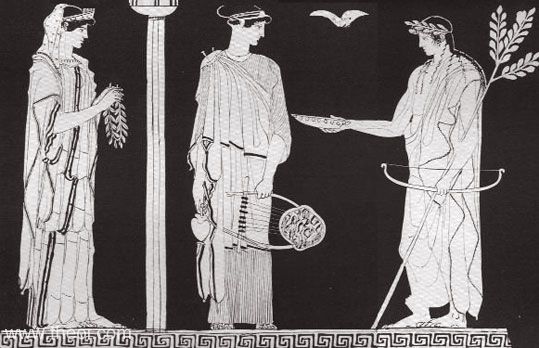
I came across these yesterday and thought they might prove useful or at least entertaining. This is the source I have found but please correct me if the source is different. The Theoi and the sign they are most associated with, based on core domain and/or lore. For more symbols of these Theoi, go here.


Elaion is proud to announce that on the sixth and seventh of Thargelion (so 13 and 14 May, 2016), we will be hosting another PAT ritual, this time for the Thargelia. PAT rituals, or Practicing Apart Together rituals, have become a staple for Elaion, where we, as an organisation, provide a date, time, and ritual for the festival at hand, and around the globe, as many of our members as possible perform the ritual at their homes. Some do it alone, some in groups, and we create an event to share experiences and photographs of the altar or the festivities on the Elaion Facebook page.


The Thargelia (Θαργήλια) was, as said, held over the course of two days. It was an agricultural festival as well as a kathartic one. The purpose was to purify the city in order to please the Theoi and ensure a succesful harvest come harvesting time. It also celebrates the birth of the divine twins Apollon and Artemis.

The first day, a sheep was sacrificed to Demeter Khloe on the Acropolis, and perhaps a swine to the Fates, but most telling about that first day was the following that took place:

In ancient times, two poor, ugly men (or a man and one woman) were chosen each year to be Pharmakoi.  They were fed for a while at public expense and were then paraded around Athens as scapegoats for the people, one wearing a string of black figs to represent the men, the other white figs to represent the women. At the end of the procession, they were driven out of the city by flogging and beaten them with branches and squills (sea onions), and killed. The bodies were burned and the ashes thrown into the sea or land, to fertilize.

This sacrifice became symbolic as time wore on, first with banishment, then with play acting where they were beaten with branches of figs and pelted with squills instead of beaten with branches and stoned to death.What matters was that they were driven out and with them, so was the pollution of ever man and woman in the city.

The first day focussed on purification and appeasement but the second day was a lot less gruesome: a great pot of vegetables was prepared as an offering of the first fruits to Apollon. A panspermia was ritually sown into the earth. The Thargelia also featured choral contests among pairs of phratriai, and was recognized by phratriai as a day of festival and sacrifice. An eiresione (olive branch of supplication) with fillets of white wool and first fruits attached was carried in procession along with a winnowing basket full of fruit.

Sources tell us clearly that Apollon was linked to the festival as well as the sun, Helios, and the seasons, the Horai. With Apollon's birth, so came the light that grew the vegetation, that ripened the corn and barley. And in line with Apollon is Helios who jouneys across the sky every day and the Horai who precide over the lengthening and shortening of the days, giving Apollon and Helios more or less time with us to ripen our crops.

At its core this festival is a festival of Apollon, but myth tells us Artemis helped bring Him into the world and thus She is honoured as well. And we bring Demeter offerings because She taught us how to grow crops and once Persephone leaves for the Underworld again, She will kill them all. Add to that the Horai and Helios and you have a very involved and intricate festival that was absolutely essential to ensure a good harvest. And so we shall celebrate it as well and honour to all these Theoi in appeasement.

You can find the rituals for the events here: day one, day two, and the community page here.
I got an interesting question asked a few days ago, about the term 'Theoi'. It was a simply worded question: 'why do you use 'Theoi' instead of 'Gods'. Well, I use both, but I prefer 'Theoi'. If I am talking about both Hellenic and non-Hellenic Gods, I will always use 'Theoi' for the Hellenic Gods.

Needless to say, 'Theoi' (Θεοί) means 'Gods' in Greek. But where does it come from? Well, Plato has an explanation that I quite enjoy. From his 'Cratylus':

"I think the earliest men in Greece believed only in those gods in whom many foreigners believe today—sun, moon, earth, stars, and sky. They saw that all these were always moving in their courses and running, and so they called them gods (θεούς) from this running (θεῖν) nature; then afterwards, when they gained knowledge of the other gods, they called them all by the same name."

[For those interested, the Greek: φαίνονταί μοι οἱ πρῶτοι τῶν ἀνθρώπων τῶν περὶ τὴν ῾Ελλάδα τούτους μόνους [τοὺς θεοὺς] ἡγεῖσθαι οὕσπερ νῦν πολλοὶ τῶν βαρβάρων, ἥλιον καὶ σελήνην καὶ γῆν καὶ ἄστρα καὶ οὐρανόν• ἅτε οὖν αὐτὰ ὁρῶντες πάντα ἀεὶ ἰόντα δρόμῳ καὶ θέοντα, ἀπὸ ταύτης τῆς φύσεως τῆς τοῦ θεῖν “θεοὺς” αὐτοὺς ἐπονομάσαι• ὕστε-ρον δὲ κατανοοῦντες τοὺς ἄλλους πάντας ἤδη τούτῳ τῷ ὀνό-ματι προσαγορεύειν.]

This kind of old entymology, especially once addressed by someone like Plato, gives the term something extra for me. Using it makes me feel connected to these ancient Hellenes mentioned by Plato and to Plato himself. That is something I always--always--strive for.

I also get asked a ot how to pronounce 'Theoi'. It’s supposed to sound 'th' as in 'think' (at least in a more late Greek, although it was supposed to have sound like 't' in more archaic times), 'e' like in 'bet' (it’s supposed to be a very short 'e', so make it shorter than when you pronounce 'read' as in 'I have read') and 'oi' as a diphthong, more or less like in 'oyster'. In θεοί, the accent, and thus, the stressed letter, is the final 'i', so it has to be something like 'the-o-EE'.
On the fourth of Thargelion, in the deme of Erkhia--located near the modern Spata, approximately twenty kilometers (twelve miles) east of Athens, with the deme center located at Magoula--a series of sacrifices were held. Most likely, these were in relation to the Thargelia which was soon to follow and to which I will soon dedicate a full blog post. Preporatory rites, of a sort. Elaion will hold a PAT ritual to follow in their footsteps on Wednesday 11 May, 2016 at the usual 10 am EDT. Will you be joining us?


The Thargelia was one of the major festivals of Athens, and most of ancient Hellas. It celebrates the birthday of Apollon and Artemis and was held over the course of two days, one with the focus on Artemis--the first, as she was born first--and Apollon on the second day, held on the sixth and seventh day of the month of Thargelion, respectively. The thargelia was both an agricultural and a purifying festival: it was a festival intended to lift miasma from the city of Athens (and anywhere else it was celebrated) in order to ensure a good harvest. It was of vital importance and it could be that the people of Erkhia hosted these sacrifices in order to feel entitled to have Erkhia's harvest fall under the results of the katharthic rites of Athens once they would be held a few days later.

The ancient Erkhians would have held separate rituals for (almost) all of the listed deities, more often than not at different locations. It could therefore be that not all of these sacrifices are linked to the Thargelia. The sacrifices to Leto, Apollon and Zeus most likely were. Hermes, perhaps, but it is more likely that He, along with the Dioskuri was honoured due to the influence of Sparta, of whom all three were patrons. Perhaps the sacrifice to Zeus had a joined function as the father of all (Depending on the mythological account, of course).

We won't be distinguishing between the two 'branches' and have made a single rite to be performed on the 11th, at 10 am EDT. You can join the community here and find the ritual here. We hope you will join us!
Elaion is proud to announce that Pandora's Kharis members have raised $110,- for our democratically decided upon cause, Giving for Greece, set up in 2016 by the Bodossaki Foundation, one of the oldest charitable foundations set up in Greece. As always, you have all given generously, and in the spirit of the Gods!


The Giving Centre is a welcoming environment for anyone who shares the vision of giving for a better Greece. Their mission is to inspire, empower and enable people, stakeholders and business entities to contribute to Greece’s well-being. You have helped them make this mission possible. Thank you!

From this moment on, the Pandora's Kharis Facebook page is open to pitches. If you do not have Facebook, feel free to pitch your cause in the comments. We will relay the message to the community. Please pitch your cause before May 17th. On to another month of pitching, voting, and giving. Thank you for your generosity!