The 12th of Hekatombion marks the start of the ancient Hellenic Kronia festival. The Kronia honours Kronos, Zeus' father, not to be confused with Khronos; creator of the Gods and Lord of Time. Will you be joining us for the celebration on July 17th, at the usual 10 am EDT?
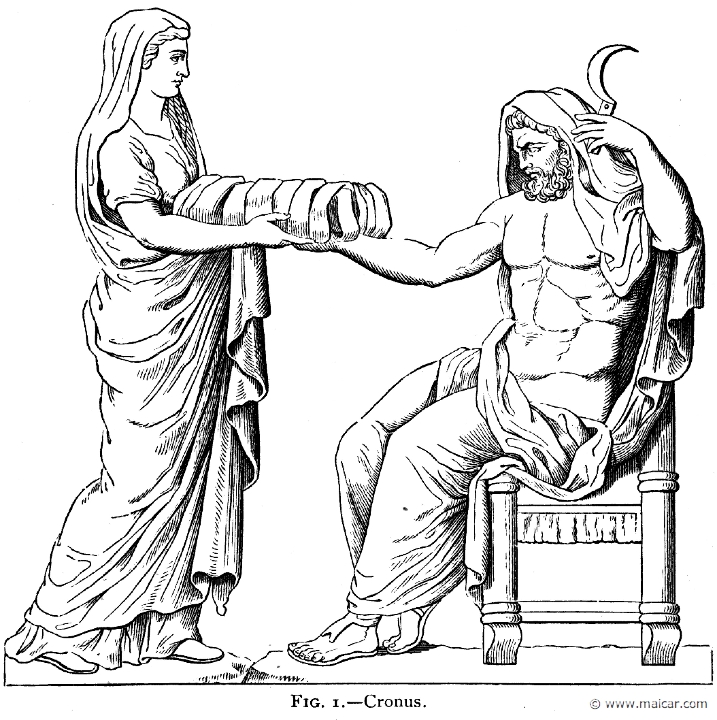

In Athens, Kronos and Rhea--His wife and sister--shared a temple. They represented an age before the Theoi took to rule; a time when societal rules did not exist yet, and there was no hierarchy. As such, on the day Kronos was worshipped, the fixed order of society was suspended, and slaves joined--and even ruled over--a banquet given by their masters; they ran through the streets screaming and hollering. On Krete, they could whip their masters. As much fun as this was, the day served as a reminder that for a society to function, societal rules were necessary, and as such, it was also necessary for Zeus to overthrow His father and assume the throne.

Besides a banquette, the Kronia must have been celebrated with an official sacrifice as well, in the temple to Him and Rhea, as the Kronia was a harvest festival of sorts. Unlike many rites to Demeter, the Kronia focused on the harvest--most likely of cereals--that was completed around this time. It was the end of a hectic period where slaves were worked hard, and their masters as well. A communal meal and a little bit of payback on the side of the serfs was most likely at the root of this festival, along with gratitude for the successful harvest; the Hellenic summers were too hot to grow much of anything, so the food eaten in this barren season ahead needed to be taken in and thrashed (where needed) prior to the swell of summer heat. The Kronia was a good mark for this.

There is a little bit of evidence that human sacrifice--in the form of 'scapegoat' rituals was performed on or around the date of the Kronia in the very distant past, but by the time Hellas--and especially Athens--became civilized in the way we speak of today, this practice was long outdated. It seems that a criminal condemned to death was taken outside of the city gates for a reason now lost to us, possibly fed copious amounts of wine, and then killed in honor (or placation) of Kronos. Needless to say, there is no reason to bring this practice back.

You can find the ritual here and the community page here.
Good morning, afternoon or evening/night to you lovely folks. Today I have but a PSA for you that I know some of you will be jumping for joy for. I was recently contacted to join the Hellenic Polytheist Chat, a Skype group for Hellenic Polytheists to come together and talk about the religion (as well as the occasional other thing). I've joined in a lurky manner because my days are too full as is, but I did want to offer its creator a platform to reach others on.


"[The Hellenic Polytheist Chat] is a safe place to come to when you want to chat with others about your religion - knowing that fellow members are also of similar beliefs. You'll be able to share your experiences and thoughts, and the hope is that it'll be a place for the love of your religion to thrive."

The good thing about a Skype group is that it's free, it's safe, and everyone has access to it, so I support creator Graysen in this endeavor. If you would like to join, go to that link and send them a message. The option to do so will be on the top right of your screen and you can send a message even if you're not on Tumblr. You'll get a link that'll take you straight to the group and you'll be set to chat!

As a note, I would like to say that you are always welcome to pitch anything that supports the community to me and I'll happily give it a platform if I endorse the idea! Enjoy the chat, everyone, and maybe I'll see you guys around!
I get a lot of questions from readers, and most of the time, the answers are fairly short. When I feel the question or the reply would be valuable to others as well, I make a post with a collection of them and post them in one go. Today is one of those posts.


"I have lost the connection to the Hellenic Gods and I want to say goodbye to the Hellenic ones. Any ideas what I can do?"

As a long time reader I think you know that I greatly encourage anyone to follow their specific call to the Gods--whatever pantheon that might be.

Concerning your question: needless to say there is no ancient Hellenic formula for it. Believe in the Hellenic Gods was somewhat optional but you still took part in the festivals--if only because they were fun. I've been thinking about what I would do and I have found that I feel the same way about this as I do about (re-)establishinbg a connection with the Theoi: anything you do is for you, not for Them. They were fine with you and fine without you; it's us humans that need closure.

So do a final rite in which you thank Them for what They provided you in the time you gave Them sacrifice and worship. Explain your choice if you want. Get everything out of the rite -you- need to move on to what feels right. Let go of any guilt or obligation you might be feeling; it's not needed.

~~~

"I came across the following passage in Victor Davis Hanson's The Other Greeks, and immediately thought of you: "Both political and religious authority in most Greek city-states was colored by agrarianism.  Political leadership and cult figures were careful not to infringe the economic and social position of the small farmer. Public properties, for example, at least at Athens during the life of the polis never grew beyond more than five to ten percent of the total arable land available. Land for religious sanctuaries was always dubbed 'a slice' (temenos), never the whole; the gods'property, not that of individual farmers, was to be 'cut out' of the grid." I find that explication of the origin of the term temenos intriguing, and not one I'd encountered before."

From Liddell & Scott, essentially ’temenos’ is 'a piece of land cut off and assigned as an official domain especially to kings and chiefs. II. a piece of land marked off from common uses and dedicated to a god, precinct, a grove of Zeus, of sacred groves. III. temple. It stems from ‘temenizo’ 'to make a sacred precinct', 'consecrate'. ‘Temenios’ is an epithet of Hestia and it also means ‘of or belonging to the temenos.’

I agree that there was no big agribusiness in the sense of large farms in ancient Hellas. In fact, it is mostly that way today. It was the large number of small farms that fed everyone and farmers were essential. Thus agriculture and the agricultural year are a major part of our religion.

The quote: 'Athens during the life of the polis never grew beyond more than five to ten percent of the total arable land available' most likely applied to other cities as well. It couldn’t sustain itself if it were to grow beyond that certain point. Even so, Athens had to import grain on occasion.

In my opinion, a ‘slice’ is not the best translation but does mean a piece cut off, which a temenos was and is. More appropriately, it is a piece of land cut off and assigned as an official domain or marked off from common uses and dedicated to a God. It really isn’t an explanation of the origin of ‘temenos’ as the origin is to make a sacred precinct, consecrate. ‘Slice’ comes from the root ‘temno’ which means to cut or wound and that root is used for slices to make fillets or slices of meat or fish and originally to cut or wound.

I hope this helps!

~~~

"Hi! So I'm just getting started in this religion- literally like today- and I was wondering the best way to start my practice?"

Welcome to Hellenismos! Truthfully, there isn’t a single way to start your practice. Or, more accurately, the question is too broad. You begin by having faith in the Theoi. You begin by learning about Them. If you are asking me how to start the physical part of your practice--sacrifice and worship--then I’d like to send you to my post on ritual and sacrifice in Hellenismos. It’ll help you understand what we do and why we do it. For the practice of it, I’ll link you to my videos on how to prepare khernips and how to perform a simple libation. The rest can be inferred from the information in these three. If you have a specific question, feel free to contact me with it!

~~~

"Ive been looking into divination through the hellenic alphabet and im wondering if you got any further with your investigation into it?"

Any further since when? Currently it’s not an active pursuit for me, but what I know about it is written here<. Basically, the Limyran Oracle, or ‘Alphabet Oracle’, is marketed as an authentic ancient Hellenic alphabet oracle, which was taken from an inscription in Olympos, a city in ancient Lycia. I haven’t been able to find much on it save a few websites, but the University of Tennessee Department of Electrical Engineering and Computer Science website has a version of it up for inspection. Good luck with your search!

~~~

"Hi!, I was wondering if you know any information about curse tablets and if could share your ideas for their use in modern practice?"

The ancient Hellenes were a competitive people, and struggled with many of the issues we do today: the urge to perform well, the desire for justice to be served, and a need for love. Prayers for these things were made often, usually in their normal ritualized form at the house altar. If these requests were made against, or at the expense of another person, however, they were generally taken out of the realm of regular worship and kharis, and into the realm of the khthonic. The preferred form were tablets called 'katadesmoi', curse tablets.

Katadesmoi are relatively small tablets, inscribed with a desire asked of the Theoi to fulfil. The Katadesmoi that have survived were generally made out of very thin sheets of lead, which were then rolled, folded or pierced with nails. Wax, papyrus, stone, precious metals, and precious minerals would also have been used as a medium. Some katadesmoi were accompanied by a small doll representing the intended victim or even a lock of their hair, especially in the case of love spells. In general, the katadesmoi always included the name of the intended victim and the name(s) of the appropriated Gods--most often Hades, Kharon, Hekate, and Persephone. Exceptions have been found, of course.

Katadesmoi were usually deposited where they would be closest to the Underworld: in chasms, pools of water, wells, caves, temples to the deity in question, buried underground, or placed in graves. The latter was usually a special form, however, and the katadesmoi placed with the dead were usually requests to avenge the death of the deceased.

In general, katadesmoi were used out of desperation: regular channels had been exhausted, human courts would never convict the perpetrator of a crime, or the murderer could no be found. Pleading with the Gods--who knew more, saw more, ad had a much farther reach--was considered the only alternative to get justice. This was even the case in many love spells. Katadesmoi were not made willy-nilly: there needed to be a strong incentive to make one.

Personally, I see no need for katadesmoi, and have struggled against these urges in times of need. I see their appeal, but my modern frame of mind would not do them justice, I think, and therein lies lots of potential for trouble. I wouldn't encourage anyone to use katadesmoi, but would understand if they did in times of need. Still, I would rather place my trust in the Theoi, regardless of curses or bindings.
Italian and Pakistani archaeologists have discovered large layers of an Indo-Greek city with weapons, coins and pottery forms, in Barikot, Pakistan, according to a Dawn report. Barikot was called Bazira in ancient times, a city captured by Alexander the Great during his advance to India.

discovery (1)

Dr. Luca Maria Olivieri, head of the Italian Archaeological Mission in Pakistan, told Dawn that during their recent excavation in April-June they unearthed some very important discoveries in Barikot, in the Swat river valley. Excavations at Barikot are funded by the Pakistan-Italian Debt Swap Program.

“Very little is known in the archaeology of the sub-continent about the material culture of the Indo-Greek. However, this time we discovered at Barikot ample layers associated not only to the Indo-Greek city (when the settlement was encompassed by the Defensive Wall, 2nd century BC), but also to the pre-Greek city, the Mauryan settlement (3rd century BC).”

The archaeologist also said that during the excavations it was discovered that all pre-Greek layers were destroyed along the Defensive Wall at the time of its construction, to make space for the fortification, revealing conspicuous traces of the Iron Age village (7th century BC).


One of the questions I get often--usually from young people still living at home or others who have to practice in secret--is if dedicating time to do volunteer work counts as a way of dedication in the same way a sacrifice might. It doesn't, but that does not mean volunteer work is not important or does not have a place in Hellenismos!

The traditional manner of prayer is accompanied by physical sacrifice and is performed in a ritual context. A sacrifice to the Gods is a way of bonding, of kharis. It's a way of showing our devotion to the Gods and bringing Them, actively, into our homes and lives. It's a way of acknowledging Their greatness and recognizing our loyalty to Them.

Traditionally, dedicating activity is not a way to honour the Gods. After all, it does not relate to Them directly, does not strengthen our bond with Them and They get nothing out of it. The energy is directed at the people you are helping, not upwards to the Gods. A small portion of that energy might 'bleed' up to Them but it's not going to establish kharis in the same way as sacrifice does. But it does relate to Hellenismos.

Hellenismos is a religion of Gods and ethics. Both matter and they strengthen each other. We are called by the Theoi to practice arete, the act of living up to one's full potential. The term arete was applied to anything and anyone superior. It is linked to knowledge and wisdom as well as physical beauty. It could even be applied to an exceptionally well crafted vase, the person who made it or even the seller, who sold it for more than it was worth. Needless to say it is also applied to those who live an ethical life.

Living up to arête is not easy: it challenges up to be our best mentally, physically, and spiritually. It means taking control of our life, to become an active participant in it. To place blame only on yourself when things go wrong, and to keep trying to reach your goals, no matter what setbacks you suffer. Arête should become a way of life, and in that way of life, an ethical framework is essential. Ethics give you the tools to create internal order and consistent action. Both are necessary for happiness. Ethics will remove doubt, fears and regrets from your life, as you know exactly what you should and should not do to become the best you can be. 
A part of becoming that very best version of yourself is to help those who need help. That could be your friend who is struggling through a rough period, donating money to good causes (which is why Pandora's Kharis was founded), or donating your time and energy to those who need it. There is even a Delphic Maxim that adresses it:

"Share the load of the unfortunate (Ατυχουντι συναχθου)"

I read this as: give what you have to help them through, be it time, energy, skills, food and drink, clothes  or anything else. I apply it to the refugee crisis currently taking place and I apply it to simpeler things like always giving money to those trying to raise it for good causes. It means having an open outlook on life and realizing that you, most likely, are a lot better off than many people around you. That is certainly true in my case.

So no, volunteering your time is not a sacrifice to the Theoi as such but it makes you a better person to honour Them. So it matters and I feel we should all do something--anything we can. Practice Arete every day and kharis will come to you.
In a massive coming together of Pandora's Kharis members, we have raised $ 135,- (€ 122,-) for our democratically decided upon cause, Sea-Watch. As always, you have all given generously, and in the spirit of the Gods!

Since the year 2000 more than 23.000 people have died trying to reach Europe’s shores. Three business partners from Germany decided to found the non-profit NGO Sea-Watch e.V. in an effort to bring down those numbers. Since November 2015 Sea-Watch is working between Lesbos and the Turkish mainland to prevent further deaths in this part of the Mediterranean Sea, recording the highest number of drowned refugees in 2015.

The ship MS Sea-Watch was bought and refitted with a crew of volunteers, working day and night to make the vessel suitable for Search and Rescue (SAR) operations. Due to scarce financial resources Sea-Watch had to improvise in terms of technical solutions. The success of the project was based mostly on hard work and the collaborative effort of a highly professional and motivated team. This was and remains Sea-Watch’s biggest asset. At the end of the launch season of the project, Sea-Watch can look back on a summer where it has been able to save the lives of more than 2.000 people found in distress at sea throughout seven missions.

From this moment on, the Pandora's Kharis Facebook page is open to pitches. If you do not have Facebook, feel free to pitch your cause in the comments. We will relay the message to the community. Please pitch your cause before July 15th. On to another month of pitching, voting, and giving. Thank you for your generosity!
July 9, at 10 am EDT, we will hold a rite for Aphrodite Pandamos and Peitho, as on this day, the fourth of Hekatombaion, They were traditionally honoured during a festival of unification. Will you join us?

 
Pandêmos (Πανδημος) occurs as an epithet of Aphrodite. It identifies her as the Goddess of low sensual pleasures, and the epithet is often translated as 'common to all the people'. She united all the inhabitants of a country into one social or political body. In this respect She was worshipped at Athens along with Peitho (persuasion), and Her worship was said to have been instituted by Theseus at the time when he united the scattered townships into one great body of citizens.

According to some authorities, it was Solon who erected the sanctuary of Aphrodite Pandemos, either because her image stood in the agora, or because the hetaerae had to pay the costs of its erection. The worship of Aphrodite Pandemos also occurs at Megalopolis in Arcadia and at Thebes. 'Pandemos' also occurs as a surname of Eros.

Peithô is the personification of persuasion, seduction and charming speech. She was worshipped as a divinity at Sicyon, where she was honoured with a temple in the agora. Peitho also occurs as a surname of other divinities, such as Aphrodite, whose worship was said to have been introduced at Athens by Theseus, when he united the country communities into towns, and of Artemis.

At Athens the statues of Peitho and Aphrodite Pandemos stood closely together, and at Megara, too, the statue of Peitho stood in the temple of Aphrodite, so that the two divinities must he conceived as closely connected, or the one, perhaps, merely as an attribute of the other. For our rite, we will honour both divinities separately.

There is actually not much known about the Aphrodisia. It was most likely linked to the synoikismos, or unification, of the Attic demes into poleis, or city-states. In early Hellas, ancient society was split between the 'demos', country villages, and the 'asty', or 'polis', the seat of the aristocracy. The distinction between the 'polis' and the 'demos' was of great political importance in the ancient states. There was much antagonism between these two bodies, the country and city. In the city-states of ancient Hellas, synoecism occurred when the 'demos' combined with--usually by force--a polis to form one political union. The most notable synoikistes was the mythic or legendary Theseus, who liberated Attica from Kretan hegemony and gave independency back to Hellas under leadership of Athens. Like the Synoikia that was celebrated in a few days--which was a truly political festival and we will thus not celebrate it--the Aphrodisia seems to celebrate Theseus' efforts.

An inscription on a stele of Hymettian marble found near the Beulé Gate at the site of the aedicula on the south-west slope of the Acropolis may tell us something of the preparations for the Aphrodisia festival. Dated between 287 and 283 BC, the inscription records that at the time of the procession of Aphrodite Pandemos, Kallias, son of Lysimachos of the deme of Hermai, was to provide funds for the purification of the temple and the altar with the blood of a dove, for giving a coat of pitch to the roof, for the washing of the statues, and for a purple cloak for the amount of two drachmas.

From this and other ancient sources, we can conclude that the first ritual of the festival would be to purify the temple with the blood from a dove, which we know is the sacred bird of Aphrodite. Needless to say, we won't do this, but we do encourage you to give your altar a good scrub! Afterwards, worshippers would carry sacred images of Aphrodite and Peitho in a procession to the sea to be washed. In Cyprus, participants who were initiated into the Mysteries of Aphrodite were offered salt, a representation of Aphrodite's connection to the sea, and bread baked in the shape of a phallus (feel free to make some of those!). During the festival it was not permitted to make bloody sacrifices, since the altar could not be polluted with the blood of the sacrifice victims, which were usually white male goats. This of course excludes the blood of the sacred dove, made at the beginning of the ritual to purify the altar. In addition to live male goats, worshippers would offer flowers and incense.

As a celebration of the unfication of Attica, the Aphrodisia festival may seem redundant, since the Synoikia festival also took place in the month of Hekatombaion, between the Aphrodisia and the Panathenaia. Yet, without help of Aphrodite Pandemos and Peitho, whose powers bring people together, unification would not have been possible. While the Synoikia celebrates a very specific event that is no longer current, the Aphrodisia celebrates not only Aphrodite (and Peitho) as divine, but also represents the beauty of community, solidarity, and the end of strive. In this day and age where it seems the entire world is at war, we offer sacrifice to Aphrodite and Peitho humbly in hopes that They will interfere and lay to rest this terrible animosity.

Will you be joining us on July 9? Join the community here, and download the ritual here.