I came across a wonderful and insightful post by Kiya over at Peaceful Awakenings entitled Reconstruction is a Lie. Read it, seriously, it's good food for thought even if it's about Kemetic religion. I love the post and yet, I disagree with it--or at least, I disagree with her reasoning. LEt me set you up with the two most relevant bits:

"The illusion of reconstruction is that the process results in something that is “what the ancients/the ancestors practiced”. That’s the inner mythology. And that’s the lie. The big one. The imaginary comfortable place that lets people believe that they’re digging in to finding something secretly More True than what they had before. It’s comforting. It’s comfortable. It’s complacent. And it’s wrong.

[...] It’s construction. It has to be. There is no option otherwise, and perhaps the idea there might be is poisonous. It creates the idea that there is a true cultus, a true way of worship, that one group’s interpretation of the facts that have been recovered is the true way, that others are failures; at its worst, it unthinkingly copies the Christian notion of the fall from Eden: our ancestors had paradise (a “true” relationship with the gods) and fucked it up by changing traditions, whether by choice or force, and we must live with the terrible consequences of their sinful choice." 

This is 100% not how I define "reconstruction", how I imagine my practice to be, how I view reconstruction as a whole. In fact, reading the above explanation feels very...modern to me. Let's have a go at trying to explain why.

We can't practice like the ancient Hellenes did. Kiya is right, that is a complete lie. Animal sacrifice, massive group (city wide!) worship, festival days, Mysteries, etc., etc., there is so much that we don't have and we will most likely never have again. That is a fact. That is reality. Everyone who tells you they "practice like the ancient Hellenes did" is lying to your face--and if they aren't, point me to them! I will literally move to wherever they live that has a whole city full of Hellenists practicing exactly like the ancient Hellenes 2000+ years ago.

My definition of 'reconstruction isn't "[this is] what the ancients practiced". My definition is: "I understand why the ancients practiced the way they did, and the way I practice is true to that why." Reconstruction is a mindset to stay true to the fundamentals of your religion. It's understanding the do's and don't the ancient Hellenes put in place, it's understanding how religion, ethics, and philosophy interact to build a society and then translating the spirit of that into the present where you keep what you can and adapt what you can't.

I get a lot of questions from readers saying "I don't have [...], so can I use [...]?". Usually the answer is "yes", because usually it stays in the spirit of the "why". If you don't have laurel or olive leaves to make khernips, for example, use another type of leaf (one they had in ancient Hellas if you can manage) or even use a match. I see absolutely no problem with that. There is something I do have a problem with in this example, though, and it comes down to the same things: laziness and underlying disrespect. There are two replies I get a lot: "I can't do that because I don't have [matches, money, time to go to the store, etc.]", and "Can't I just use water?"

I rarely get annoyed with readers, but answers like that are exactly the reason I call my self a Traditional Reconstructionist and I differentiate between Traditional and Reformed Hellenismos. "Can I just use water?" is a reformed reply. "I don't have time to walk out my door and get a leaf" is a reformed reply. It's applying some things from ancient Hellas in your practice "just 'cuz", without making the effort to understand it. I don't mind that. How you practice is up to you. I just can't help you with it because it makes my head and heart hurt. I am a Traditional Reconstructionist. My whole practice, my whole life, is aimed towards understanding the "why" and building on that ever-growing foundation.

The ancient Hellenes burned things (like sacrifices, incense, but also the firebrand to make khernips) because smoke was the only way the sacrifice reached the Ouranic Gods. That's how the sacrifice traveled to Olympos and how the sacrifice itself became sacred. Pure. Burning something and dropping it into the water is what makes it khernips. Not using a burning something, anything, to make khernips is promising someone food and giving them an empty plate along with a message saying "just imagine it's food. I'm sure you'll feel full". I don't care that you don't burn the exact thing the ancient Hellenes did--that is not what Reconstruction should be about--it's understanding the "why" of it and being true to the spirit of it--because the ancient Hellenes did nothing "just cuz". Everything had a reason, and it's all tied up and interwoven with every other aspect of their life.

There is no True Way (tm) in religion. There just isn't. Reformed Hellenismos is equally valid as Traditional Hellenismos (which is, I suppose, closer to the label of "reconstruction" as discussed here). I don't think the Gods care either way--but I care. I care a lot about sticking to the "why", and in that way, yes, I am a reconstructionist. I am not a reconstructionist in the sense that if you time traveled an ancient Athenian here, he'd be able to jump in with my practice without some serious learning curve, but I know that he would understand it. He would see that--no matter how warped in the actual execution--the spirit of it is intact. The building blocks of his own practice are there, and he will be able to see I worked hard to understand and adapt his practice. That is what reconstruction is to me and it is absolutely possible! It just takes time, energy, and a willingness to learn.
The ancient Hellenes kept a lot of animals--mostly farm animals like cows, oxen, pigs and chickens--but also dogs for hunting and probably also cats, weasels, ferrets, birds of prey and a variety of other animals. In ancient Hellas, animals had functions to fulfil and weren't just solely there for company. They weren't pets like we have them today and they didn't usually get buried with rites. Dogs (and very seldom other animals) did sometimes get buried with grave markers, though, so they definitely did care!

Every once in a while, I get the question how to do a ritual for the death of a pet. The most common animals being commemorated are dogs and cats, so I'm going to tell you a bit about those two today.
A while ago, I posted a basic outline for a rite of passage on my blog. I would adapt this rite to include the Gods mentioned in the text below. You can find the rite here.


Dogs
Dogs had a very special and particular place in ancient Hellenic society. The Hellenic word for 'dog' is 'kuón' (κύων), and they were used as guards and in hunts for game. Dogs used for the hunt had to have very different qualities than those needed to guard a house, herd, field or person. For hunting dogs, swiftness was paramount and for guard and shepherding dogs, Marcus Varro, a notable Roman scholar and writer, advised the following: a large head, drooping ears, thick shoulders and neck, wide paws, thick tail, a deep bark, and be white in color so as to be more easily recognized in the dark, were important.

Artemis is associated with a lot of dog-related mythology. As the Goddess of the hunt, she is often depicted amongst her own hunting pack. Another Goddess associated with dogs is Hekate. She is often described as being of dog-shape or tended to by dog. The dog was also her favored sacrificial animal and the meat of the dog was eaten solemnly. That it was eaten at all is a testament to Hekate's rule extending even beyond the Underworld, as Khthonic (Underworld) Deities often received their sacrificial offerings in a holókaustos. In the rite, Hekate should replace Hermes and Artemis should be added before Persephone.

Cats
Modern Athens is home to countless feral cats, however, the status of the cat in ancient Hellas is unclear, as images of cats are fairly rare. Cats were probably kept by Hellenic households as liminal animals--animals who were free to come and go as they pleased, roaming houses and streets alike. This may account for the fact that few cat bones have been found in domestic situations. Historically, the main reason to keep cats is to get rid of mice, only in ancient Hellas the job of 'mouser' seems to have been handled by weasels and ferrets, many of which were also considered liminal pets. Yet some clear representations of cats do exist, primarily on funeral stele. These show cats on leashes, or being shown off as prized possessions, so we do know that some cats were updated to the status of 'pet'.

There isn't a God or Goddess of cats, but there is a Goddess associated with cats: Hekate. There is one single piece of mythology I have to base this on: the myth of Galinthias, the nurse of Alkmene, transformed by the angry Eileithyia, but received by Hekate as Her animal. Dionysos is the God of wild, predatory, felines--of those felines who pose a wild threat, who can rip flesh and inspire fear. He might look out for the smaller felines as well. In the ritual, Hekate should replace Hermes and Dionysos should be added before Persephone.
Remember when Greece’s Central Archaeological Council (KAS) gave a big 'Zeus no!' to Gucci’s request to host and film a fashion show at the archaeological site of the Acropolis? It seems fashion designer Karl Lagerfeld had asked a similar sort of question and was flat out denied too. To my amusement, they brought 'ancient Greece' to Paris instead:


The New York Times reported on the event, saying:

"Karl Lagerfeld may have hoped for blazing sunshine and Aegean blue skies in Paris. After all, he staged Chanel’s 2018 cruise show, inspired by the glories of ancient Greece, under the rounded glass ceiling of the Grand Palais. His models wore gold: gilded laurels swirled into sunglasses, Delphos-pleated dresses corded with sequins, even beach cover-ups licked with golden vines. King Midas has nothing on Kaiser Karl.

But alas, it was Paris in May. The sky was a sullen shade of Elgin-marble gray on Wednesday.
The weather was, perhaps, the only factor Chanel couldn’t control. Rather than going to Greece, the fashion house brought Greece to Paris. What could be a larger display of its might? Perhaps presenting the collection in Greece itself; Mr. Lagerfeld had originally wanted to show at a historic venue, but was vetoed by the country’s officials, company representatives said. Hence the decision to show in Paris. (Earlier this year, the Central Archaeological Council in Athens also publicly rebuffed Gucci in its bid to stage its cruise show on the Acropolis. Instead it will be held in Florence.)

No matter. Instead of showing amid the original ruins, Chanel spent a king’s ransom erecting its own. The set was based on the Parthenon as well as the Temple of Poseidon on Cape Sounion. It took 50 craftspeople three weeks of construction, and nine days of assembly, to complete.

Ideologically, Mr. Lagerfeld asserted that his re-creation was conceptual: “Reality is of no interest to me,” he said. “I use what I like. My Greece is an idea.”"

All I can say is: with that attitude, I am very happy the Central Archaeological Council rejected the request out of hand.
I get a lot of questions from readers, and most of the time, the answers are fairly short. When I feel the question or the reply would be valuable to others as well, I make a post with a collection of them and post them in one go. Today is one of those posts.


"In a conversation with a professor of Imperial (Roman) Literature a reference was made to an Hellenic having said that "the greatest gift you can give your ancestors is to change nothing they have handed down to you". I'm struggling to locate a source, let alone a name for the speaker, and as there is not a large Hellenic scholarship community near me, you are the only person who comes to mind who would likely know the answer. Please also tell me if this is misquoted or never existed at all, as there would at least then be closure."

I've tried to hunt down the source of your quote and I've also send it to Robert Clark, who co-runs Elaion with me as he is a walking encyclopedia on things like this. We can't find the quote--let alone the source--anywhere and neither of us recalls ever having read it. So I am sorry, I can't help you. I'm putting it up here as well in the hope one of my readers recognizes it.

I would like to add, as a personal note, that the spirit of the quote is much more Roman than Hellenic. Ancestors in ancient Hellas were honoured and 'kept alive' through remembering their lives and recounting their good qualities and brave actions, but they were very much considered a thing of the past. Innovation was a great Hellenic good and I personally don't feel that, generally speaking, the ancient Hellenes would have held the sentiment that things must remain as they are in spirit of the ancestors. My knowledge about Roman culture is limited but as it is much more 'stately' and there was a system of supreme power in place through a line of emperors, the quote seems to match that thinking much better. The Romans had more of a 'masterplan' to conquer the world and emperors were all but revered as Gods; honouring them by not changing a thing makes more sense.

---

"I'm 16 and I heard girls in ancient Greece were already married then. Do you think that is a good thing?"

Women in ancient Hellas got married young for a reason: very few people lived longer than forty/fifty years old. At sixty you were ancient. Because many children died in childbirth, and the risks are greater either mother or child died during it the older the woman was, it was important women started having babies early. We live longer today, and childbirth is a lot less risky. We also don't need to have ten kids anymore to make sure the family line survives. Respectively speaking, we still marry around the same timeline point in life (about a third in), but because we live longer, we are older when we do. I think this is a good thing: it allows us to get educated, to build careers, and to mature before we have children or make other important life choices. At sixteen, the brain isn't even close to being fully developed and hormones cause us to make rash decisions we might later regret. Giving young people time to develop before forcing them to make life defining decisions is a very good thing to me. I wish we could do that better in the educational system as well.

---

"Are there still people in this world who considered themselves better than the Gods?"

Yes, I am sure there are, but I think you're asking to follow up with the question about if the Gods will punish them for it, like in mythology? That depends. I suppose all people who do not believe in the Gods/a God perceive themselves as better than Gods. But I don't think any God punishes them for it, or the world would be a very different place. So, I suppose we can assume that, in order to be punished by the Gods, one has to believe in the Gods. Those who believe in the Gods would be hesitant to go against Them, I feel, but they might.

---

"Do the Gods judge criminals? And will They punish the president?"

I'm assuming we're talking Trump here? Crimes tend to be frowned upon by the Gods. They disrupt social order--and social order is required for people to sacrifice continuously and faithfully. Miasma will have to be cleansed from the criminal before he or she can resume worship, for example. In most cases, the human judicial system, coupled by rites of purification sufficed. Gods usually leave human affairs up to humans, but They might assist in helping catch the criminal, or They could be petitioned to take vengeance on criminals who escaped that judicial system.

As for Trump: no, I don't think They will. Trumps presidency is a human affair. The Gods gave us the freedom of choice, and we chose. Same with Erdogan, same with all other right-wing parties and people being elected into office and parliament around the globe. Within the democratic rules of society, they were chosen. And like all ancient Hellenic tyrants, the Gods will probably leave them be. Humans deal with humans, sadly. this is our mess to get through and clean up.
A few years ago, Christos Tsirogiannis was looking through the Metropolitan Museum of Art's online collection when he had a flash of recognition. While studying an ancient Hellenic krater something 'suddenly clicked'. The vase was decorated with a painting of Dionysos, and he knew that he had seen the subject on that krater before. This led to a startling realization: the krater came from a seized private collection of looted items, and it wasn't the only one. National Geographic's Nick Romeo tells the story.

Greek-born archaeologist Christos Tsirogiannis

A forensic archaeologist affiliated with the University of Glasgow’s Scottish Centre for Crime and Justice Research, Tsirogiannis has access to restricted databases containing tens of thousands of photographs and documents seized during raids. Searching through the online archives, he found five photos of the Met’s Greek krater among items confiscated from Giacomo Medici, an Italian antiquities dealer convicted in 2005 of receiving stolen goods and conspiracy to traffic looted antiquities.

So why was an object that may have been dug up and sold by looters on display at a famous American museum, and how did it get there? Uncomfortable questions like these are becoming more common in the digital age as museums, universities, and private collectors publish online catalogs of their collections, creating a valuable resource for anti-looting detectives like Tsirogiannis.

Although his influence is rarely acknowledged, Tsirogiannis’s sleuthing has spurred major museums and auction houses in the United States, Europe, and Asia to return dozens of treasured objects to their rightful owners in Greece, Italy, and other countries.

“I always liked jigsaw puzzles as a kid. My work now resembles a gigantic jigsaw puzzle made of thousands of smaller puzzles.”

After studying archaeology and art history at the University of Athens, Tsirogiannis worked for the Greek Ministries of Culture and Justice dating and classifying looted artifacts. He earned a doctorate at Cambridge University in 2013, writing his dissertation on international networks of illicit antiquities traders.

With a voluminous visual memory that can call to mind thousands of images of looted artifacts—and a willingness to send dozens of emails that are never answered—Tsirogiannis is actively researching hundreds of objects from museums around the world. He recently tipped off authorities in Manhattan that an Etruscan vessel displayed at a Midtown gallery was stolen, leading to its repatriation, or official return, to Italy.

In the case of the Dionysus krater at New York's Metropolitan Museum of Art, photos seized from Giacomo Medici, the convicted antiquities dealer, show the vase crusted with soil and salt, literally fresh from the earth. Because Medici took Polaroid photos—a technology not available in Europe until 1972—Tsirogiannis knew that the krater was dug up after 1970, the year a major UNESCO treaty made it illegal to export cultural property from signatory nations.

In 1989 the krater turned up at Sotheby's, where it sold at auction for $90,000. Like other major auction houses, Sotheby’s doesn’t reveal the names of consignors or buyers and declined to speak on the record for this article. But the Metropolitan Museum added the krater to its collection soon after Sotheby's sold it.

The Met’s website states that the krater was acquired by the Bothmer Purchase Fund. Dietrich von Bothmer was a longtime Met curator who died in 2009. Interrogations of convicted antiquities dealers, and evidence from their confiscated archives, have established that Bothmer was one of their regular clients. Forty fragmentary artifacts from Bothmer’s collection at the Met have been returned to Italy since 2005.

The Odd Couple of Antiquities & Art Theft A former art smuggler and the former head of the Art and Antiquities Squad of the British Police join forces to expose the illegal smuggling of ancient treasures, a multi-billion dollar business. Once Tsirogiannis identified the origin of the Dionysus krater, he promptly sent multiple emails to valid addresses at the Met. He received no reply, and the vase remains on display in Gallery 161 of the museum.

The Met’s only comment for this story was opaque: "The Museum has been in touch with the Italian Ministry of Culture regarding the Terracotta Bell Krater (1989.11.4)". The museum’s acquisitions policy states that before purchasing an object curators will investigate "whether the work of art appears in relevant databases of stolen works and the circumstances under which the work of art is being offered to the museum".

Tsirogiannis is skeptical about the stated intentions of the Met and other museums.

“They hang on to illicit objects as long as they can, until someone finds out. It’s all about money, fame, and ownership.”

There are approximately 10,000 fragments from the Bothmer collection that haven’t yet been published online, and the Met has declined to say when they might be published. It’s unclear how many of the fragments might match pieces in other museums’ collections or recorded in criminal databases. But when they do go online, it’s likely Tsirogiannis and other detectives like him will be watching.
I really, really, really need some help of the Muses. They are usually pretty kind to me, but lately finding creativity and inspiration has been a struggle. Today, I will sacrifice to the Muses and I am posting in Their honor today as well, this time in the words of my all-time favorite ancient Hellenic person: Solon. Solon (Σόλων,  c.638 – c.558 BC) was an Athenian statesman, lawmaker, and poet, who lived from 638 BC to 558 BC. He spent most of his adult life trying to legislate against political, economic, and moral decline in archaic Athens.


You glorious children of Memory and Olympian Zeus, Muses of Pieria, hear me as I pray.  Grant me from the blessed gods prosperity, and from all mankind the possession ever of good repute; and that I may thus be a delight to my friends, and an affliction to my foes, by the first revered, by the others beheld with dread.  Wealth I do desire to possess, but to gain it unjustly I have no wish; without fail in after-time comes retribution.

The wealth that the gods give stays with a man firm-planted from bottom-most foundation to summit; whereas that which men pursue through arrogance comes not in orderly wise, but, under constraint of unjust deeds, against her will she follows; and swiftly is ruin mingled therewith. 

The beginning, as of a fire, arises from little; negligible at first, in its end it is without remedy; the works of men's arrogance have no long life.  Zeus watches over the end of all things; and all at once, like a wind, that suddenly scatters the clouds, a wind of spring, that having stirred the deeps of the many-billowed unharvested sea, and razed the fair works of husbandry over the wheat-bearing earth, reaches the abode of the gods, the lofty sky, and makes it bright again to behold; and the sun in his might shines fair over the rich earth, and no longer is any cloud to be seen — such is the retribution of Zeus.

Not over single happenings, like a mortal, does he show himself swift to wrath; yet no man who has a sinful heart escapes his eye for ever; in the end without fail he is brought to light.  But one man pays the penalty straightaway, another at a later time; and if the offenders themselves escape, and the fate of the gods in its oncoming alight not on them, yet it comes without fail at another time; the innocent pay for those deeds, either the children or the generations that come after.

We mortals, good and bad alike, think thus — each one has a good opinion of himself, before he comes to grief; then at once he begins to lament; but up to that moment in gaping folly we gloat over our vain hopes. The man who is crushed by cruel disease sets his thought on the hope of becoming well. Another who is a coward thinks himself a brave man, and the uncomely man thinks himself handsome.  The needy man, whom the works of poverty constrain, thinks that he will assuredly win great wealth.

One man spends his effort in one direction, another in another.  One wanders over the sea, home of fishes, striving to bring back gain in ships, borne along by the fierce winds, having no mercy on his life.  Another, one of  those whose business is with curved plows, cleaves the earth rich in trees, doing service throughout the year.  Another, skilled in the works of Athene and Hephaistos the able craftsman, collects a living by means of his two hands. 

Another, trained in the gifts of the Olympian Muses, has knowledge of lovely poesy's measure.
Another the Lord Apollo, worker from afar, has appointed to be a seer, and he if he be one whom the gods accompany, discerns the distant evil coming upon a man; yet that which is fated assuredly neither omen of bird nor of victim shall avert.  Others, who follow the profession of Paion, god of medicines, are physicians; and for their work, too, no certain issue is set; often from a slight pain comes great suffering, nor can any one relieve it by the giving of soothing medicines; again, when a man is afflicted with disease fell and fierce, by a touch of his hands at once the physician makes him whole.

Truly, Fate brings to mortals both evil and good; the gifts of the immortal gods may not be declined.  In every kind of activity there is risk, and no man can tell, when a thing is beginning, what way it is destined to take.  One man trying to do his work well, falls unexpectedly into great and bitter ruin; to another who blunders in his work the god grants good luck in everything, to save him from his folly.

In wealth no limit is set up within man's view; those of us who now have the largest fortune are doubling our efforts; what amount would satisfy the greed of all?  Gain is granted to mankind by the immortals; but from it arises disastrous Folly, and when Zeus sends her to exact retribution, she comes now to this man, now to that.
I don't know how things are where you live, but here, it's been a week of gloomy, rainy, shitty weather. Zeus Ombrios reigned strong! And then this morning, spring started. It's warm, it's sunny, and I said my prayers to Helios with pure delight! To honor Him, I am going to post a compilation of His ancient representations. Bless you, Helios, for brightening my life!

For those of you who don't know: Helios is a Titan, born from Hyperion and Theia (Hesiod, Pindar), or Hyperion and Euryphaessa (Homeric Hyms). Helios is also often confused with Apollon, mostly because of their conglomeration as a single Deity in the Roman era. In ancient Hellas, it was Phoibos (or 'Aiglêtos') Apollon who drove the chariot of the sun through the sky each morning, following the lovely Eos out of the heavenly gates. Phoibos Apollon is associated with carrying sunlight, but He is in no way the sun itself. That honor befalls Helios.


Let the heavens be silent, 
the earth, the sea, the winds.
Mountains, valleys, echoes 
and the sons of birds, keep silent!
Phoebus of the long and beauteous hair is coming.
Father of the dawn, with eye of dazzling white,
you, with the glorious golden tresses, 
lead your rosy chariot along the limitless roads of the sky, 
following the winged footprints of the steeds,
intertwining your curling rays, 
surrounding the whole earth with your resplendent light. 
Your rivers of immortal fire give life to the smiling day. 
For your, the imperturbable chorus of stars dances on Olympus
accompanying their free melody on Phoebus' lyre; 
and in front, the pale Moon leads the rhythmic times 
of the seasons by the cadenced movement of white calves. 
Your benevolent spirit rejoices in turning the myriad-robed earth.

[Mesomedes of Krete, Hymn to Helios]


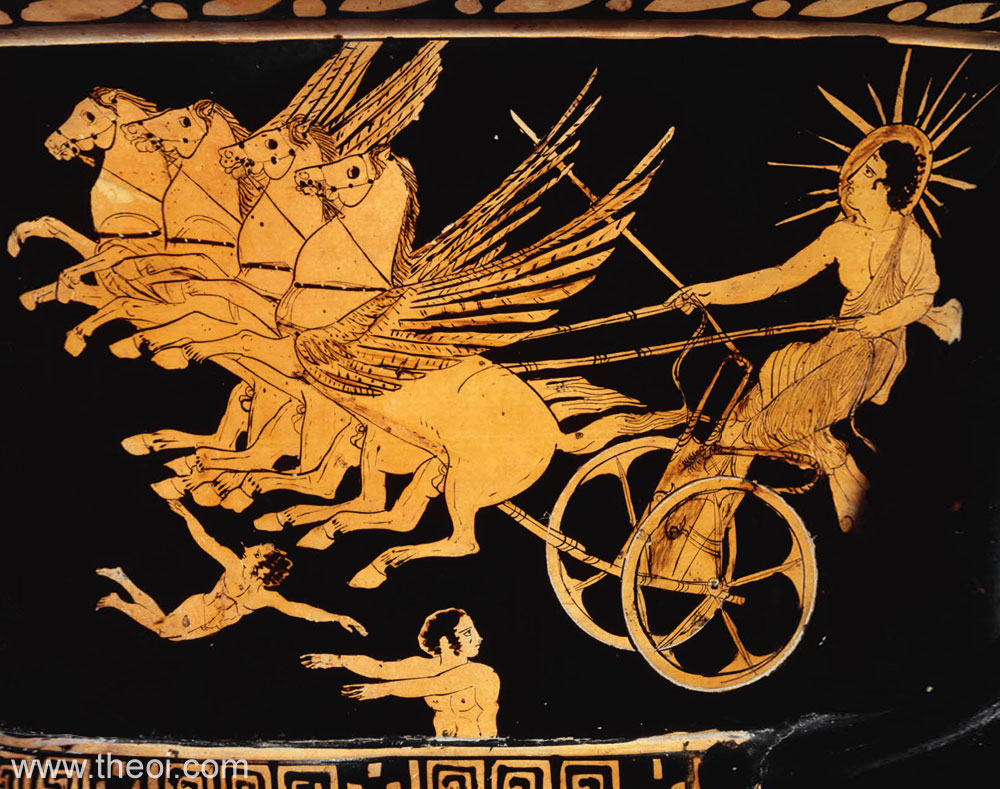
Helios, or perhaps his son Phaethon, rises into the sky at dawn. The God is crowned with the aureole of the sun and drives a four-horse chariot of winged horses. The Astra Planeta (Gods of the wandering stars) dive into the sea before Him. Selene and Eos chasing the hunter Kephalos (not shown) complete the scene. [source]

Helius & Astra Planeta | Attic red figure vase painting

The Astra Planeta dive into the sea from their heavenly perches as Helios rides into the sky. [source]

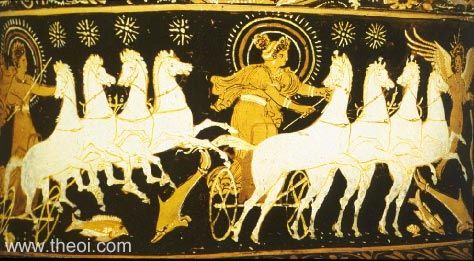
Helius, Eos & Eosphorus | Apulian red figure vase painting

The Gods Helios, Eos and Eosphoros--Sun, Dawn and Dawn-Star--form the procession of day. Eosphoros is depicted as a winged youth crowned with a shining aureole. Helios and Eos drive four-horse (quadriga) chariots and are crowned with the aureoles of sun and the light of dawn. Fish and dolphins dance beneath the chariot-wheels as the Gods emerge from the river Okeanos. [source]

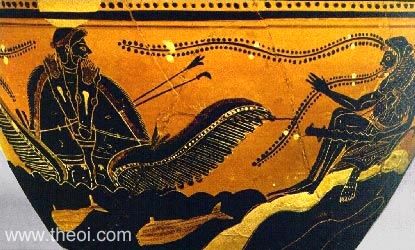
Helius & Heracles | Attic black figure vase painting

Herakles, seated on the banks of the River Okeanos, shoots arrows at Helios. The God is crowned with the aureole of the sun and drives a chariot drawn by a pair of winged horses. A pair of arrows protrude from the chariot. The hero wears a lion-skin cape and holds a club and bow. [source]