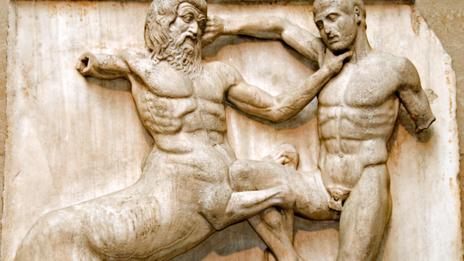
The BBC recently published an article entitled 'The fantastical beasts of ancient Greece', which is a wonderful read about ancient Hellenic art and the mythological monsters depicted in it, including Centaurs and Médousa. They also make a very good attempt in explaining the ancient Hellenic viewpoint on these monsters.

(Peter Horree / Alamy)    
The Metopes of the Parthenon depicts battle between Centaurs and men (Peter Horree / Alamy)

According to Peter Stewart, director of the Classical Art Research Centre at the University of Oxford:

"I don’t believe that Greeks really expected to meet a centaur or sphinx, or even a satyr, out in the countryside, and maybe they were always regarded as the stuff of legend. But a recurring trait of Greek art is that monstrous creatures seem to be held up as a foil to the Greeks’ concept of civilization – a sort of distorting mirror in which the Greeks could look at themselves. The Greeks seem to have found these monstrous or semi-human creatures useful to explore and express their world-view, their ideas about humanity and civilization, the mortal and divine. Fantastical beings were part of the furniture of the Greek mind."

Read more over at the BBC.
The Greek reporter reports that Scientists in Italy were able to read for the first time part of the Greek Herculaneum papyri--texts that were written on ancient scrolls and which were burnt when Mount Vesuvius erupted.

_71846499_rs4155_img_0800_scroll624

The Herculaneum papyri are more than 1,800 scrolls found in the ancient Italian village Herculaneum in the 18th century, carbonized by the eruption of Mount Vesuvius in 79 AD. After various attempts of manipulation, a method was found so that scientists were able to read them.

Herculaneum was a resort during ancient times and it is often referred to as 'the other Pompeii', because it was buried in superheated pyroclastic material after the volcano eruption. It is also famous as one of the few ancient cities that can now be seen in almost its original splendor. In the 18th century, a group of archaeologists uncovered a remarkable library scroll that had been carbonized. In the beginning scientists attempted to unroll the burnt papyri, however, due to their fragile state many of them were destroyed.

Now, a team of physicists from the National Research Council’s Institute for Microelectronics and Microsystems in Italy, used a 3D X-ray imaging technique used by doctors for breast scans to look for variations on the scroll make-up and created 3D representations of its internal structure. Dr. Vito Mocella has used this technique to identified a handful of Greek letters within a rolled-up scroll for the very first time. Mocella, a physicist with a background in photonics, first came up with the idea on a visit to the European Synchrotron in Grenoble, France.

"I was in Grenoble for a collaboration, and they explained to me some new developments using phase contrast for science, for palaeontology.... They sounded like exotic applications, and I said, I have another idea."

Conventional X-ray imaging simply measures how much X-ray light gets through different parts of the tissue. But this newer method uses the fact that X-rays passing through an object are slightly distorted, or slowed down (a change in the "phase" of the light waves). Even tiny variations in the object's make-up will affect that distortion - so measuring 'phase contrast' can produce a very detailed, 3D picture of its internal structure.

When Dr Mocella's team placed one of the scrolls in the path of a very bright X-ray beam from the synchrotron, it was bumps on the paper rather than chemicals in the ink that yielded the long-hidden letters. Fortunately, however, the ink never penetrated into the fibres of the papyrus, but sat on top of them.

"What we see is that the ink, which was essentially carbon based, is not very different from the carbonised papyrus. So the letters are there in relief, because the ink is still on the top."

The work was time-consuming and involved a lot of guesswork, particularly because the layers of paper were not just rolled, but squashed and mangled by their encounter with Vesuvius.
Furthermore, the grid of papyrus fibres within the paper posed complications, because it disguised many of the letters' vertical and horizontal strokes. For this reason, letters with curved lines were easier to pick out.

The project required many hours of work and a lot of imagination because in several cases the scrolls had been crushed and their layers were stuck together. However, Dr. Vito Mocella, head of the scientific team, is currently trying to improve the method so that they can decipher more text in the future.
"I'm very interested in Hellenismos. I've read numerous negative opinions on the few 101 books that have been released. In your opinion, what should be the first book that a newcomer to Hellenismos dives into?"

When I started out, I had no idea there even were Hellenismos 101 books and went straight to academic texts. It proved a steep learning curve, but I did rather enjoy the sudden submersion. In general, that is the way in which I take on any new subject: go straight to the hard stuff and let myself be overwhelmed until things click in my head.

Once I finally discovered there were 101 books, I was beyond them and found most of them to be biased towards personal preference and low on general information on ancient Hellas to explain why our modern practices are as they are. Because I had my own personal preference by then, going through modern texts about Hellenismos became grating really quickly. I only read Timothy Jay Alexander's 'A Beginner's Guide to Hellenismos' fully. I have some others but I only leafed through those.

It is my firm belief that when you start out, you should invest in neutral sources. Hellenismos is not standardized. There are huge differences in belief and practice between practitioners from various countries and even between various groups. Learn about ancient Hellas and the ancient practices, then get in touch with the community--perhaps through 101 books--and merge the two. I gave out my source book list a while back, and it's not odd my favourite '101' books are on there as well. Personally, I would say invest in three books (in this order) when you think this might be the religion for you:

Kindt, Julia - Rethinking Greek Religion
Who marched in religious processions and why? How were blood sacrifice and communal feasting related to identities in the ancient Greek city? With questions such as these, current scholarship aims to demonstrate the ways in which religion maps on to the socio-political structures of the Greek polis ('polis religion'). In this book Dr Kindt explores a more comprehensive conception of ancient Greek religion beyond this traditional paradigm. Comparative in method and outlook, the book invites its readers to embark on an interdisciplinary journey touching upon such diverse topics as religious belief, personal religion, magic and theology. Specific examples include the transformation of tyrant property into ritual objects, the cultural practice of setting up dedications at Olympia, and a man attempting to make love to Praxiteles' famous statue of Aphrodite. The book will be valuable for all students and scholars seeking to understand the complex phenomenon of ancient Greek religion.

Mikalson, Jon D. - Ancient Greek Religion
Ancient Greek Religion provides an introduction to the fundamental beliefs, practices, and major deities of Greek religion. It focuses on Athens in the classical period, includes detailed discussion of Greek gods and heroes, myth and cult, and vivid descriptions of Greek religion as it was practiced, ancient texts are presented in boxes to promote thought and discussion, and abundant illustrations help readers visualize the rich and varied religious life of ancient Greece. The revised edition includes additional boxed texts and bibliography, an 8-page color plate section, a new discussion of the nature of Greek “piety,” and a new chapter on Greek Religion and Greek Culture.

Burkert, Walter - Greek Religion
In this book Walter Burkert, the most eminent living historian of ancient Greek religion, has produced the standard work for our time on that subject. First published in German in 1977, it has now been translated into English with the assistance of the author himself. A clearly structured and readable survey for students and scholars, it will be welcomed as the best modern account of any polytheistic religious system.

Kindt's work is easily accessible and is a venerable fount of practical information. 'Rethinking Greek Religion' will help you form a realistic image of ancient religious practices and give you the understanding you need to get through any further scholastic reading. It doesn't tell you much about modern Hellenism, but once you have read this book, you should be able to understand why certain modern practices exist. Mikalson's text is more linear and condensed. It attempts to explain the whole of ancient Hellas in one breath. You could switch between reading either Kindt's or Mikalson's work first, but I have found that it's much easier to nuance Mikalson's words if you have read Kindt's work first.

Burkert is a phenomenon and 'Greek Religion' is quite a step up from the previous two works in complexity and academic speech. Still, in his attempt to make an exhaustive whole out of the ancient Hellenic religion, Burkert provides a framework to base a practice off of like no other has managed to do before or since. It's a hard read, but so worth it.

All in all, this collection will set you back about $100,-. That's a fair investment, but well worth it, I promise you.
Are you an avid diver? The Archaeological News Network reports that the Central Archaeological Council of Greece has approved a study regarding the possibility of allowing visitations to four shipwrecks near the Sporades and Western Pagasetic Gulf. This development aims to promote diving tourism and take advantage of Greece’s underwater treasures.
Ancient Greek shipwrecks open to public
The shipwreck near Peristera Island (Alonissos) [Credit: Ethnos]
According to the study, the four archaeological sites are:
  • The shipwreck near Peristera Island (Alonissos), which has been dated to the 5th century BC and features two layers of amphorae.
  • The plundered Byzantine-era shipwreck near Kikynthos, which has been dated between the 9th and 13th century AD thanks to ceramics.
  • The Byzantine-era shipwreck near the Akra Glaros area, where another shipwreck may also be hidden.
  • The shipwreck near Tilegrafos, which dates back to 4th century AD.
The ministerial plan regarding visitations to the underwater archaeological sites stipulates that visitors may be guided up to a depth of 40 meters, under the supervision of the Ephorate of Underwater Antiquities. While amateur photography is permitted, there is a strict ban on any form of intervention in the seabed or scattered items.
Did you know that every continent has a different world map? Well, the continents are pretty much the same but the way they are portrayed are different. Some examples?

European:

United States:

Canada:
 
Asia:
 
And my favourite, Australia:
 
 
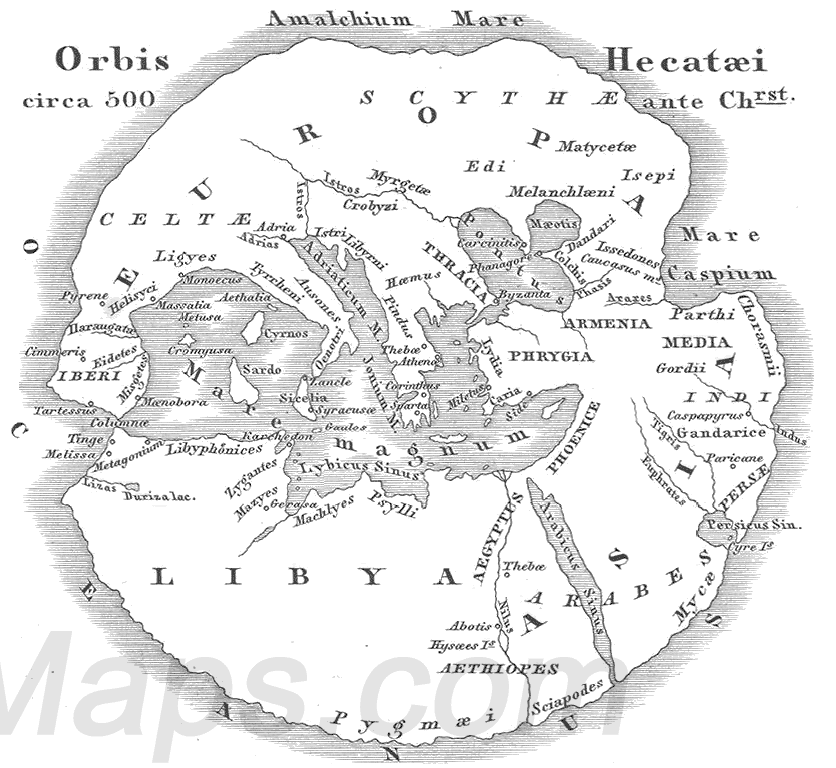
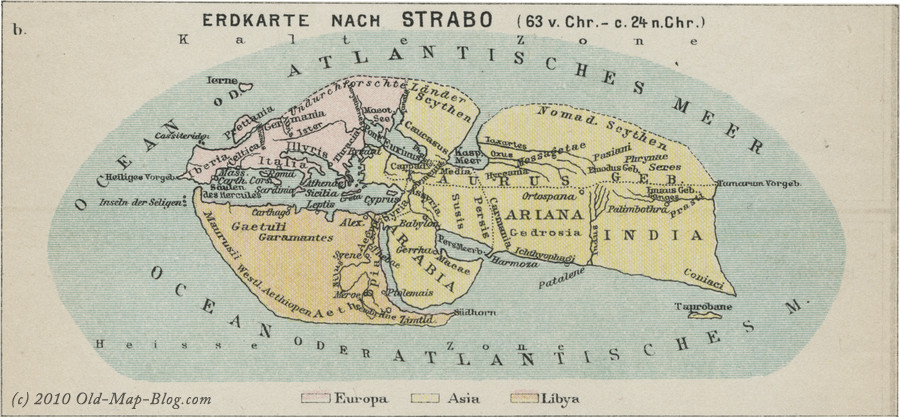
The ancient Hellenes also made world maps. Land ownership and geography was changed mainly according to new rulers and natural disasters, such as earthquakes and volcanoes, and of course the ancient Hellenes didn't exactly have the grasp on geography we have today. Here are some of the major maps of Ancient Hellas:
 
Anaximander (c. 610 – c. 546 BC)


Hecataeus of Miletus (c. 550 BC – c. 476 BC)


 Eratosthenes (276 – 194 BC)


Strabo (64/63 BC – c. 24 AD)
 
 
As you can see, not entirely accurate but very amusing--and it worked for them. These maps helped along trade and travel, brought perspective to the world and pushed the art of geography forward. Most of these are reconstructed maps based on descriptions as the original work has been lost, but they are still brilliant to behond.
In a time where economic crisis rules Greece and budget cuts in the culture sector are severe, I have two bits of good news for you: the Archaeology New Network reports that plans to built a Delos museum have been approved, and Ekathimerini reports that Athens has gotten the OK for the erection of an Alexander the Great statue.


Delos museum construction plans approved

Delos museum construction plans approved The plans for the construction of a new museum on the Greek island of Delos were approved by the Central Archaeological Council, after the funds for the plans were collected.

According to the plans, the new museum will have to adhere to strict bio-climatic architectural standards and must be situated as far away as possible from the sea, in order to better protect the antiquities and the museum itself from the elements.

The new museum will occupy a space of at least 5,000 square meters and will feature all of the exhibits displayed in the existing museum, along with many other artefacts located on the island’s archaeological sites and in storage. The funds for the construction plans were donated by the London-based International Foundation for Greece.


Athens gets OK for erection of Alexander the Great statue

The Central Archaeological Council (KAS) has given the City of Athens the green light to erect a bronze statue of Alexander the Great at either of two places proposed by the municipal authorities.
The statue, which depicts the ancient conqueror at an early age, was crafted by Yiannis Pappas in 1992 but has never gone on public display due to bureaucratic problems.

Earlier this week, the mayor of Delta, in the northern region of Macedonia, asked the City of Athens, which now owns the statue, to donate the artifact. Athens officials said the statue would eventually be installed either on the junction of Vassilissis Olgas and Vassilissis Amalias avenues or at Asomaton Square in Thiseio.
Assistant Art History Professor Heather Sharpe and her students of West Chester University recently invested a fair amount of time deciphering ancient Hellenic texts and artworks in order to recreate a drinking game. The game, known as kottabos, involved men gathered in a circle during a symposion (συμπόσιον), a meeting of men and their courtesans to discuss philosophy and network, and flinging dregs of wine at a target in the centre of the room from a special cup known as a kylix.


The students used a 3D-printed drinking cup, some diluted grape juice and willing students who soon got the hang of the game and the findings were presented at the annual meeting of the Archaeological Institute of America this month.

There are two ways of playing, according to texts and art works. The goal is to knock down a disc carefully balanced a tall metal stand in the middle of the room. In another version the goal was to sink small dishes floating in a larger bowl of water. Players hit their target with the leftover wine-dregs at the bottom of their cup. To achieve the best results in kottabos participants had to toss the wine-dregs overhand at their target as though they were pitching a baseball or throwing a frisbee. Ancient Hellenic players would utter the name of the object of their affection before flinging the wine. Winners received all sorts of prizes, such as sweets and even sexual favours from the available courtesans.

Now you know what to do after your group comes together to honour the Gods!