What I love most about Hellenismos is the treasure trove of ancient texts at our disposal. This wisdom, information, and simple insights into daily life or ritual worship help us form our practice, and shape our world views. As I try to devote as much time to research for this blog and my personal practice as I can responsibly spare, I come across many of these gems in scholarly notes, or straight there by way of Google. Today's beautiful text, however, comes courtesy of my good friend and fellow core member of Elaion, Robert Clark. In many of our PAT rituals that honour Zeus, he includes this text to recite. It was written by Aratos, and comes from his excellent Phaenomena.

Aratos of Soli (Ἄρᾱτος ὁ Σολεύς) was a Hellenic poet who flourished in Macedonia in the early third century BC. His major extant work is his hexameter poem Phaenomena (Φαινόμενα, 'Appearances'), the first half of which is a verse setting of a lost work of the same name by Eudoxus of Cnidus. It describes the constellations and other celestial phenomena. The second half is called the Diosemeia (Διοσημεῖα, 'Forecasts'), and is chiefly about weather lore. Although Aratos was somewhat ignorant of Hellenic astronomy, his poem was very popular in the Hellenic and Roman world, as is proved by the large number of commentaries and Latin translations, some of which survive.

Aratos kicks off his Phaenomena off with something of a hymn to Zeus, a bit of text to praise the King of the Gods which has become a favourite of Robert and I. I have not shared it on this blog yet, so I would like to do so today. Enjoy!


Aratos - Hymn to Zeus
From the Phaenomena, translated by G. R. Mair

From Zeus let us begin;
him do we mortals never leave unnamed;
full of Zeus are all the streets and all the market-places of men;
full is the sea and the havens thereof;
always we all have need of Zeus.
 
For we are also his offspring;
and he in his kindness unto men giveth favorable signs
and wakeneth the people to work, reminding them of livelihood.
He tells what time the soil is best for the labor of the ox and for the mattock,
and what time the seasons are favorable both for the planting of trees
and for casting all manner of seeds.
 
For himself it was who set the signs in heaven,
and marked out the constellations,
and for the year devised what stars chiefly should give to men right signs of the seasons,
to the end that all things might grow unfailingly.
 
Wherefore Him do men ever worship first and last.
Hail, O Father, mighty marvel, mighty blessing unto men.
Hail to thee and to the Elder Raced!
Hail, ye Muses, right kindly, every one!
But for me, too, in answer to my prayer direct all my lay,
even, as is meet, to tell the stars.

"Do you have a soft spot in your heart for Greece? If the answer is "yes", this probably has a lot to do with the magic of Greek nature! But what will Greece look like if it loses the most precious pieces of its natural heritage?"

That is how WWF Greece starts of this indigogo campaign start off their plea for funding. Over the past five years, Greece has featured regularly in global media headlines. The well-publicised financial crisis has certainly had a painful social and humanitarian impact. However, there is also a hidden victim of this crisis: Greek nature.

Right now, nature protection laws are under attack. Their dismantling is helping to sell off Greece’s natural heritage to make a quick profit. The stakes are high and now is the time we can really make a difference! Your support will give WWF Greece the means to fight for Greece’s future. Here are a few reasons to be optimistic:
  • Last summer they stopped legislation that would effectively turn the Greek coastline and beaches into large scale concrete tourist developments.
  • Last winter they worked in a broad coalition to stop legislation that would remove protection for forests burnt by wildfires and enable illegal and environmentally destructive appropriation of forest land.
  • Throughout the crisis, they have provided a lifeline for threatened species like the loggerhead sea turtle and the Mediterranean monk seal. These are rare Mediterranean species struggling for survival, precious pieces of Greece’s living future.
Many more threats will be coming their way in the next few months, but your support can give us the power to deal with them. WWF Greece will work on the ground to protect Greek nature and stop the laws that aim to destroy it.

I love Greece. I love its nature. This is the land of my Gods. These mountains and seas and forest feauture in the myths I love. I will be pushing this campaign for Pandora's Kharis as well, but if you want to donate to this amazing cause, feel free to do so here. Don't let the land of our Gods end up the victim of this man-made crisis!
It's been a while since we last journeyed with Hēraklēs. In fact, the last time we did, he had just completed the tenth labour: obtain the cattle of the monster Geryon. Geryon (Γηρυών) was the son of Khrysaor and Kallirrhoe and grandson of Medusa, was a fearsome giant who dwelt on the island Erytheia of the mythic Hesperides in the far west of the Mediterranean. Hēraklēs did away with him easily, even though getting to him proved to be quite the journey.

Now, the original mission in order to be cleansed of the act of killing his own children in a rage brought on by Hera was to perform ten heroic labours in ten years for the king of Tiryns, Eurystheus. But Eurystheus discounted two of the labours, labour two: slay the nine-headed Lernaean Hydra, and labour five: clean the Augean stables in a single day because he felt Hēraklēs had cheated on both. Now it is up to Hēraklēs to perform an eleventh labour: to steal the apples of the Hesperides (Ἑσπεριδες).

The Hesperides are nymphs, Goddesses of the evening and golden light of sunset. The three nymphs were daughters of either Nyx or the heaven-bearing Titan Atlas. They were entrusted with the care of the tree of the golden apples which was first presented to the Goddess Hera by Gaia on her wedding day. They were assisted in their task by a hundred-headed guardian drakon named Ladon (Λαδων). As Appolodoros writes in his 'Library':

"When the labours had been performed in eight years and a month, Eurystheus ordered Hercules, as an eleventh labour, to fetch golden apples from the Hesperides, for he did not acknowledge the labour of the cattle of Augeas nor that of the hydra. These apples were not, as some have said, in Libya, but on Atlas among the Hyperboreans. They were presented <by Earth> to Zeus after his marriage with Hera, and guarded by an immortal dragon with a hundred heads, offspring of Typhon and Echidna, which spoke with many and divers sorts of voices. With it the Hesperides also were on guard, to wit, Aegle, Erythia, Hesperia, and Arethusa." [2.5.11]

Of course, nothing is ever easy for our hero. Getting to the apples is harder than getting them! Before he could even get to work, Hēraklēs met Cycnus, a fellow hero, son of Ares . Zeus stopped the battle before it could get out of hand. Traveling on, Hēraklēsfought the sea God Nereus for the location of the garden where the tree of the golden apples stood. He wrestled the location out of the Gods and travelled to Lybia where he was challenged by Antaeus, son of Poseidon, who had the habit of challenging and killing strangers, only Hēraklēs killed him instead. Afterwards, Apollodorus tells us:

"After Libya he traversed Egypt. That country was then ruled by Busiris, a son of Poseidon by Lysianassa, daughter of Epaphus. This Busiris used to sacrifice strangers on an altar of Zeus in accordance with a certain oracle. For Egypt was visited with dearth for nine years, and Phrasius, a learned seer who had come from Cyprus, said that the dearth would cease if they slaughtered a stranger man in honor of Zeus every year. Busiris began by slaughtering the seer himself and continued to slaughter the strangers who landed. So Hercules also was seized and haled to the altars, but he burst his bonds and slew both Busiris and his son Amphidamas.

And traversing Asia he put in to Thermydrae, the harbor of the Lindians. And having loosed one of the bullocks from the cart of a cowherd, he sacrificed it and feasted. But the cowherd, unable to protect himself, stood on a certain mountain and cursed. Wherefore to this day, when they sacrifice to Hercules, they do it with curses.

And passing by Arabia he slew Emathion, son of Tithonus, and journeying through Libya to the outer sea he received the goblet from the Sun. And having crossed to the opposite mainland he shot on the Caucasus the eagle, offspring of Echidna and Typhon, that was devouring the liver of Prometheus, and he released Prometheus, after choosing for himself the bond of olive, and to Zeus he presented Chiron, who, though immortal, consented to die in his stead.

Now Prometheus had told Hercules not to go himself after the apples but to send Atlas, first relieving him of the burden of the sphere; so when he was come to Atlas in the land of the Hyperboreans, he took the advice and relieved Atlas. But when Atlas had received three apples from the Hesperides, he came to Hercules, and not wishing to support the sphere <he said that he would himself carry the apples to Eurystheus>, and bade Hercules hold up the sky in his stead. Hercules promised to do so, but succeeded by craft in putting it on Atlas instead. For at the advice of Prometheus he begged Atlas to hold up the sky till he should put a pad on his head. When Atlas heard that, he laid the apples down on the ground and took the sphere from Hercules. And so Hercules picked up the apples and departed. But some say that he did not get them from Atlas, but that he plucked the apples himself after killing the guardian snake. And having brought the apples he gave them to Eurystheus. But he, on receiving them, bestowed them on Hercules, from whom Athena got them and conveyed them back again; for it was not lawful that they should be laid down anywhere."

According to Hyginus, Ladôn was put into the sky as the constellation Draco.

"This huge serpent is pointed out as lying between the two Bears. He is said to have guarded the golden apples of the Hesperides, and after Hercules killed him, to have been put by Juno [Hera] among the stars, because at her instigation Hercules set out for him. He is considered the usual watchman of the Gardens of Juno. Pherecydes says that when Jupiter [Zeus] wed Juno, Terra [Gaea] came, bearing branches with golden applies, and Juno, in admiration, asked Terra to plant them in her gardens near distant Mount Atlas. When Atlas’ daughters kept picking the apples from the trees, Juno is said to have placed this guardian there. Proof of this will be the form of Hercules above the dragon, as Eratosthenes shows, so that anyone may know that for this reason in particular it is called the dragon." [II.3]
Hellenic Reconstruction is sometimes jokingly referred to as 'Athenian Reconstruction', as so much of our information about ancient Hellas was preserved in the city of Athens. As soon as you set foot outside the city of Athens, only a few 'hot spots' provide any information about ancient Hellenic life, and in between the hotspots, there is no information at all. The annual sacrifice at Erchia to Zeus Epoptes (Εποπτες) is a perfect example of this. Still, it is a sacrifice to the King of the Gods, and we will celebrate it on Wednesday, September 9, at 10 AM EDT. Will you be joining us?

 
'Epoptes' (sometimes 'Epopteus') is often translated as 'overseer' or 'watcher'; 'to look down upon'. Among the ancient Hellenes, the title of 'epoptes' was used of those who had attained the third grade of initiation, the highest, of the Eleusinian Mysteries; a religious cult at Eleusis, with its worship, rites, festival and pilgrimages open to all Hellenes willing to undergo initiation. The epopteia were--appropriately--charged with overseeing the proceedings at Eleusis, but seemingly received the name mostly because they had beheld the full mysteries of the Mysteries.

From the calendar we have recovered from Erchia, we know that the sacrifice to Zeus Epoptes was a pig, burned completely in a holókaustos, without an offering of wine. It cost the Erchians three drachmas. As little information as that is, it is still quite telling. A holókaustos was almost solely offered to Underworld deities, or those who oversaw he darker aspects of life. Zeus Meilichios, for example, received His sacrifices as a holókaustos when sacrificed to in order to remove blood guilt. As such, we can tentatively conclude that a holókaustos was either given to Gods of the dead, in appropriation, or placation--or all of them.

I have my own theory of the relevance and meaning of this sacrifice and I encourage you to read it here. I'm not saying it is right, but I do think it is a valid theory.

You can find the ritual for the sacrifice here, and if you would like to join our community page for it, come on over to Facebook here. We would jove it if you could join us on Wednesday!
Some news items of little victories! A statue of Persephone whcih has been imported to Great Brittain has been diclared smuggled in, an ancient octadrachm will be repatriated from Switzerland, and the Ashmolean Museum of Art and Archaeology hosts a special event about ancient Hellas.


Statue of Persephone eclared illigally taken
A UK judge ruled that a 1.5-million-GBP ancient Greek statue was illegally transferred from a world heritage site in Libya to the United Kingdom. The case revolves around a four-foot statue that was looted from the Libyan archaeological site of Cyrene and smuggled to Britain.

The ancient Greek statue was found in a west London warehouse by customs officials in 2013 and handed to the British Museum, according to the Independent. Meanwhile, a court had taken over the case and the decision over its ownership was pending until this week.

The UK judge ruled that the statue had been misdeclared upon its arrival in the United Kingdom, since customs officers reported that they were told the statue came from Turkey and it was a garden decoration. However, according to experts, the Greek marble statue, thought to depict Persephone, goddess of the underworld, was in fact an ancient artifact looted from Cyrene. Here is to hoping it gets returned to Cyrene soon!


Rare ancient octadrachm to be returned to Greece
An important ancient Greek coin will be repatriated from Switzerland in September following a Swiss court's ruling that the coin is a product of illegal excavation. The coin, a silver octadrachm, was located on the website of an auction house in September 2009 by the Greek authorities. It dates back to the end of the 6th century BC at the era of King of Visaltia Mossi.

The coin depicts a man holding a spear next to a horse on one side and on the back side the word "Mosseos" is carved. It constitutes a very important find because the coins that were found from this specific era were all silver drachmas.


Ashmolean Museum of Art and Archaeology hosts a special event about ancient Hellas
The Ashmolean Museum of Art and Archaeology, the world’s first university museum situated on Beaumont Street in Oxford, UK, opened its doors on Wednesday to young visitors, offering them the opportunity to travel back in time and experience the majesty of the ancient Greek world.

The museum, whose first building was erected in 1678–1683 to host the cabinet of curiosities that Elias Ashmole gave to the University of Oxford in 1677, organized a two-day special event in which children became familiar with the significant role of ancient Greece to the evolution of Western civilization and democracy.

During the event, young visitors also learned about the first Olympic Games that were held in Greece, while they were urged to create their own laurel wreaths, similar to those offered to victors of poetic and athletic competitions.
The ancient Hellenes were excellent stonemasons, sculptors, and mosaic artisans. They decorated their temples, squares, and parks with representations of famous generals, mythical beings, and most of all: the Gods they lived with every day. We are lucky enough to have much surviving iconography and some of them have become downright famous. Today, we'll take a look at some of these iconic images.


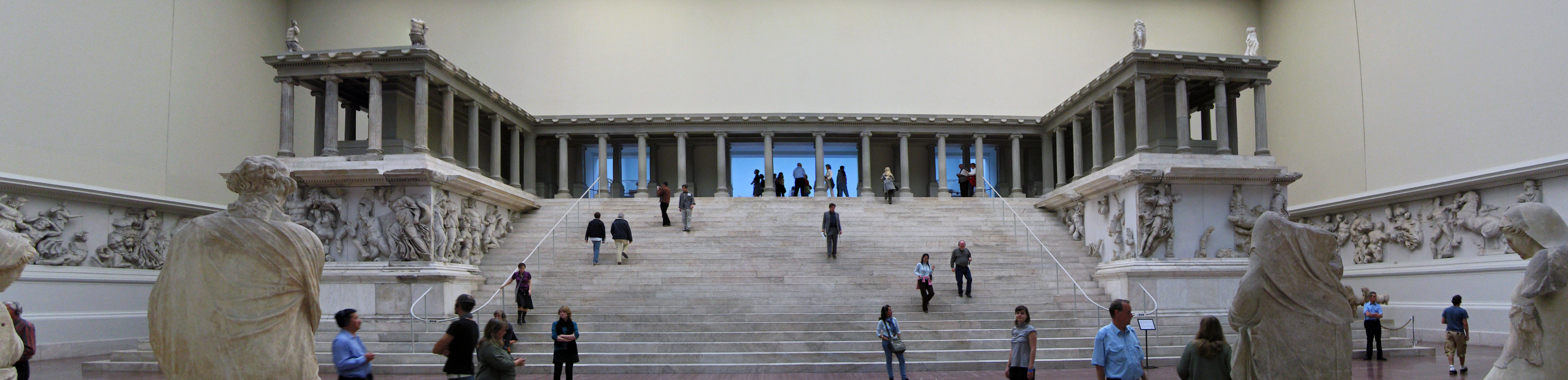
The Pergamon altar (180 - 160 BC)
Pergamon (τὸ Πέργαμον) was a small settlement during the Archaic Period, located in Aeolis, today located 16 miles (26 km) from the Aegean Sea on a promontory on the north side of the river Caicus. The main sites of ancient Pergamon are to the north and west of the modern city of Bergama in Turkey. One of the most famous buildings that once stood on the property is the Altar of Zeus and Athena, which used to be located to the south of the theater. Eumenes II constructed it as a memorial of the victory against the Galatians. The Altar has the shape of a horseshoe and its dimensions are 36.44 by 34.20 meters. The high reliefs on the outsides of the altar depict the Gigantomachy. At Pergamon, nothing remains of the altar but its foundations; the rest was removed from the site and shipped to Berlin.


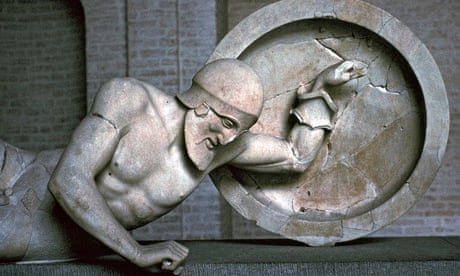
The Fallen Warrior from Temple of Aphaia (c 480-470 BC)
The marbles from the Late Archaic temple of Aphaia, comprising the sculptural groups of the east and west pediments of the temple, are on display in the Glyptothek of Munich, where they were restored by the Danish neoclassic sculptor Bertel Thorvaldsen. Each pediment centered on the figure of Athena, with groups of combatants, fallen warriors, and arms filling the decreasing angles of the pediments. The theme shared by the pediments was the greatness of Aigina as shown by the exploits of its local heroes in the two Trojan wars, one lead by Heracles against Laomedon and a second lead by Agamemnon against Priam. According to the standard myths, Zeus raped the nymph Aigina, who bore the first king of the island, Aiakos. This king had the sons Telamon (father of the Homeric hero Ajax) and Peleus (father of the Homeric hero Achilles). The sculptures preserve extensive traces of a complex paint scheme, and are crucial for the study of painting on ancient sculpture. The marbles are finished even on the back surfaces of the figures, despite the fact that these faced the pediment and were thus not visible. The most famous statue from the temple shows a strong man fallen, heroic to his last breath.


Artemision Bronze (Zeus or Poseidon) (c. 470 BC)
The Artemision Bronze (often called the God from the Sea) is an ancient Greek sculpture that was recovered from the sea off Cape Artemision, in northern Euboea. It represents either Zeus or Poseidon, is slightly over lifesize at 209 cm, and would have held either a thunderbolt, if Zeus, or a trident if Poseidon. The empty eye-sockets were originally inset, probably with bone, as well as the eyebrows (with silver), the lips, and the nipples (with copper). The Poseidon/Zeus is a highlight of the collections in the National Archaeological Museum of Athens. The sculptor is unknown.


The Siren Vase (480 - 470 BC)
Also called 'Odysseus and the Sirens', or the 'Vase of the Siren Painter', this ancient vase shows Odysseus tied to the mast of his ship as he listens to the song of the Sirens. It currently resides in the British Museum.


Lady of Auxerre


The Lady of Auxerre (7th century BC)
The 75-cm Lady of Auxerre is a Kretan sculpture currently housed in the Louvre Museum in Paris. It depicts an archaic Greek goddess during the 6th century, Persephone. A curator from Louvre named Maxime Collignon found the mini statue inside a storage vault in the Museum of Auxerre in 1907. Historians believe that the sculpture was created during the 7th century, when Greece was moving on from its Dark Age.


The (Winged) Nike of Samothrace (2nd century BC)
The Winged Victory of Samothrace, discovered in 1863, is estimated to have been created around 200–190 BC. It is 8 feet (2.44 metres) high. It was created to not only honor the goddess, Nike, but to honor a sea battle. It conveys a sense of action and triumph as well as portraying artful flowing drapery, as though the goddess was descending to alight upon the prow of a ship.


Hermes Statue

Hermes and The Infant Dionysos (4th century BC)
Also known as the Hermes of Praxiteles or the Hermes of Olympus, this statue is an ancient Hellenic sculpture of Hermes and the infant Dionysos, discovered in 1877, in the ruins of the Temple of Hera at Olympia. It is displayed at the Archaeological Museum of Olympia. It is traditionally attributed to Praxiteles and dated to the 4th century BC, based on a remark by the 2nd century Greek traveler Pausanias, and has made a major contribution to the definition of Praxitelean style. Its attribution is, however, the object of fierce controversy among art historians.


Discusa3

The Discus Thrower (460-450 BC)
The Discus Thrower, or the Discobolus, is a famous lost Hellenic bronze original. The sculpture of it is still unknown. The Discobolus was completed towards the end of the severe period. It is known through numerous Roman copies, both full-scale ones in marble, such as the first to be recovered, the Palombara Discopolus, or smaller scaled versions in bronze. As always in Hellenic athletics, the Discus Thrower is completely nude.


Alexander the Great

Alexander the Great (280 BC)
The statue of Alexander the Great was discovered inside the Pella Palace in Greece. Coated with marble patina and made of bonded marble, the statue was built in 280 BC to honor Alexander the Great, the popular Hellenic hero who sprawled over several parts of the world and led battles against Persian Armies, particularly in Granicus, Issus and Gaugamela. The statue of Alexander the Great is now among the Greek art collections of the Archaeological Museum of Pella in Greece.


Lacoon and His Sons

Lacoon and His Sons
This statue currently resides at the Vatican Museum in Rome. Lacoon and his Sons is also known as the Lacoon Group and was originally created by three great Hellenic sculptors from the island of Rhodes: Agesander, Polydorus and Athenodoros. This life-size statue is made of marble and depicts a Trojan priest named Lacoon, together with his sons Thymbraeus and Antiphantes, being throttled by sea serpents.
Sorry guys, managed to trigger my intolerances again and it's all pain and discomfort. Poetry blogging it is. Today, I turn to one of my favourite poets agian: John Keats 31 October 1795 – 23 February 1821). He was an English Romantic poet and one of the main figures of the second generation of Romantic poets, along with Lord Byron and Percy Bysshe Shelley, despite his work having been in publication for only four years before his death. He very frequently used Greek mythology as a theme in his work, and used in this poem as well.

'To Sleep' summons images of Hypnos (Ὕπνος), the God of sleep. Dreams (Oneiroi - Ὄνειροι) are sons of Hypnos, sent by Zeus, and delivered by Hermes, but Hypnos is the one who lets us fall asleep. According to myth, Hypnos lives underneath one of the Greek islands, hidden away in a cave without doors. The entrance is overrun by poppies and other hypnogogic plants. The river Lethe--the river of forgetfulness--runs through the cave. Morpheus (Μορφεύς), the leader of the Oneiroi and God of dreams, stands guard to assure none wake Hypnos.


O soft embalmer of the still midnight,
Shutting, with careful fingers and benign,
Our gloom-pleas'd eyes, embower'd from the light,
Enshaded in forgetfulness divine:
O soothest Sleep! if so it please thee, close
In midst of this thine hymn my willing eyes,
Or wait the "Amen," ere thy poppy throws
Around my bed its lulling charities.
Then save me, or the passed day will shine
Upon my pillow, breeding many woes,—
Save me from curious Conscience, that still lords
Its strength for darkness, burrowing like a mole;
Turn the key deftly in the oiled wards,
And seal the hushed Casket of my Soul.