Showing posts with label Anaximander. Show all posts
Modern society always seems to put itself above the ancient societies that preceded it, but without their inventions, we wouldn't be what we are today, and we certainly would not have what we have today. The ancient Hellenes were masters of literature, art, philosophy, mathematics, geometry, astronomy, medicine and many other sciences, but they also constructed some inventions we use to this day. Here is a list of 25 of them. How many were you aware of?


Anchor: the Hellenic contribution to ship construction is huge. You've heard of the Argo, right? The Hellenes were also some of the firsts who made long sea voyages and who build ships that could not be brought to shore, thus forcing them to find a way to tie their ships down when there was nothing to tie them to. Anchors of huge stones have been around since the Bronze Age, but the Hellenes were the first to solve the problem in a technological manner. Most often these anchors--often referred to 'teeth' (ὀδὁντες, dentes) in Hellenic poetry--consisted of sacks or buckets which were filled with stones, although later versions were made of stone and already had the shape of anchors so well know today. Every ship had several anchors.

Alarm Clock: the ancient Greek philosopher Plato (428–348 BC) was most likely the first to possess an alarm clock. It was a water clock of some design that, when having counted to the desired time, played something with the sound of a water organ. Ctesibius (285–222 BC) had a device which would drop balls of some sort onto a metal plate at a specified time, thus waking up the sleeping party.

Automatic Doors: Heron of Alexandria created a hydraulic system, based on steam power, which automatically opened the doors to an Alexandrian temple. The engine used air from a closed chamber heated by an altar fire to displace water from a sealed vessel; the water was collected and its weight, pulling on a rope, opened temple doors.

Catapult: accounts of Hellenic versions of the catapult date back to 399 BC. They often shot out arrow-shaped projectiles, not boulders, but the mechanism was very much the same as the later medieval catapults.

Cement: cement is a binder, a substance that sets and hardens independently, and can bind other materials together. Although the word is Roman, the Hellenes already had a version of it, adding limestone to a mixture of clay, water and sand. It was used from 100 BC onwards, and mostly in what is now the coast of Turkey.

Central Heating: although the Romans perfected the design, the ancient Hellenes already had a system in place where a fire heated up air, which was then forced through pipes hidden under the floor. The air warmed up the floor and, in turn, the room. Slaves kept the fire burning, of course.

Clock Tower: the ancient  Tower of the Winds dates back to about 100 BC. It housed a water clock which was connected to eight sundials on the outside of the tower. The entire mechanism has since vanished, but the tower remains, including the depictions of the eight wind deities: Boreas (N), Kaikias (NE), Eurus (E), Apeliotes (SE), Notus (S), Livas (SW), Zephyrus (W), and Skiron (NW). I have seen the Tower of the Winds in person, and it's beautiful. It's also (one of the) first clock towers of the world.

Coin Money: long before the rule of the Hellenes, we developed a trade system that relied on a token, not goods. Commodity money was born, but the Hellenes were the first to develop coins of different sizes and materials and put a value on various trading goods.

Crane: in the sixth century BC, the Hellenes invented a way to lift the heavy stone blocks onto the emerging temple walls: a crane. Holes drilled into the stone suggest ropes were attached to the blocks, and pulled up to be fitted in place.

Crossbow: like the catapult, crossbows emerged in ancient Hellas and were a favored weapon. The arrows they fired traveled far, were absolutely deadly, and the weapon was relatively easy to load.

Lighthouse: the famous lighthouse of Alexandria was constructed around 300 BC, by Sostratus of Cnidus. With a height around 400 ft (120 m), it stood as one of the tallest man-made structures on Earth for many centuries. It was one of the original Seven Wonders of the Ancient World.

Maps: Anaximander, who lived from 610 to 546 BC, was the first to create maps with the concept of latitude and longitude, and it were later Hellenes Eratosthenes and Strabo who created maps of the entire known world at the time, which--granted--was not the known world as we know it today.

Odometer: an odometer--as car enthusiasts will most likely know--is an instrument that indicates distance traveled by a vehicle. In ancient Hellas, it was used to measure the distance between cities. Although the actual device was never recovered, some of the measurements were. They were so accurate that some form of technology had to be involved.

Plumbing: in the 400s BC, Athens began to develop highly extensive plumbing systems for baths and fountains, as well as for personal use within individual homes. Many houses in ancient Greece were equipped with closets or latrines that drained into a sewer beneath the street. They seemed to have been flushed by waste water. Some of the sewers were fitted with ventilating shafts.

Sinks: the ancient Hellenes were the first to have an automated sink with running water, so both hands could be washed at the same time.

Showers: especially in gymnasia, large, communal, showers could be found. As it wasn't manly to wash with anything but cold water, it was doubtful the water was heated. There are also vase paintings of female athletes using showers.

Spiral Staircase: Temple A at Selinunte, Italy, was special. It was build around 480 BC. Selinunte was one of the most important of the Greek colonies in Sicily. There were five temples, but of only the 'E'-temple, it is sure whom it was dedicated to: Hera. Who the A-temple was dedicated to is not clear, but it had a unique design feature: the first spiral staircase in history.

Steam Engine: it was a children's toy, designed by Heron of Alexandria. He called it an aeolipile; a cylinder, arranged to rotate on its axis, having oppositely bent or curved nozzles projecting from it. When the cylinder is pressurized, steam blows through the nozzles and the aeolipile spins around. It was the first steam-powered anything, and extraordinary in its own way.

Surveying tools: the Hellens were well aware that a building needed a solid foundation, and a city needed proper planning in order to stand safely for a long time. More on the latter below, but for both, it was incredibly important to pick out a good building site. In order to do this, the Hellens devised many tools to test the soil, measure out the slope of the ground, and gather other valuable information before building their structures. It shows; much of what stood then, survives to this day, more or less intact.

Thermometer: Philo of Byzantium was a Hellenic Jewish philosopher who discovered that air expanded when heated. He attached a tube to a hollow sphere and extended it over a jug of water. When the device was in the sun, air expanded out of the sphere and into the water, creating bubbles. When he put the device in the shade, nothing happened. Around that same time (+/- 50 AD) Heron of Alexandra worked on the first thermometer for medicine.

Umbrella: they were made from larger bones, wood or plant leaves, and used to block rain or sun. While they certainly were not up to par with modern umbrella's, they served their purpose well.

Urban Planning: in the Hellenic city of Miletus, a grid formation was used for residential and public streets and areas. This was around 400s BC.

Vending Machine: Heron of Alexandria made another contribution to our current wellbeing. He invented the original vending machine. It dispensed water when a coin was put in. When the coin went in, it fell on a pan that was itself attached to a lever, which opened a valve. The pan would tilt until the coin fell off, thereby turning off the water.

Water Mill: even back in the day, power was needed to set mechanisms to work. In 300 BC, in Perachora, the first waterwheel was most likely created, and toothed gearing is also attributed to the Hellenes, who managed to set in motion various devices with it.

Wheelbarrow: it seems like something someone in the stone age would have come up with, but it wasn't. The Hellenes were the first to create a one wheeled cart around 400 BC. They were used on many construction sites throughout ancient Hellas, and who can blame them? Every little bit helps when you're creating massive temples.
I get a lot of questions from readers, and most of the time, the answers are fairly short. When I feel the question or the reply would be valuable to others as well, I make a post with a collection of them and post them in one go. Today is one of those posts.


"Do the Theoi mind if you worship other gods?"

As an individual? I doubt it. The Theoi, in general, are unconcerned with a specific worshipper. Our religion is at its core one of group worship. They remember us when we draw Their attention to us but only then. Stop praying to Them and you'll be forgotten. As a species, though? Yeah, I bet that pissed Them off something royal! But there is not much They could have done about that (see below).

~~~

"Hope this isn't a bad question, but why couldn't the Theoi save Hellas when the Romans, then Christianity, came?"

You are assuming the Romans conquering Hellas was a bad thing. Perhaps it fitted Their plan? Even without that, though, the invasion of the Romans and then the rise of Christianity was of human design and humanity abandoned the Theoi of their own free will. I think that might be waht you are really asking, is it not? Why did the Theoi allow humanity to convert to Christianity?

Hellenismos believes in free will of humanity; not even the Gods can end the will of a human being, but they can certainly influence the lives we live and instil in us through our environment a need to serve, a need to find Them, a need to honour Them. The concept of free will was a grateful one to the ancient Hellenic philosophers. After all, free will in a religious world poses a problem: if you believe in the Gods, and that the Gods have powers beyond ours--foresight, mostly, and a claim to the end of our lives--how can you make the case for free will?

 In the early days, a form of compatibilism was found where the idea that causal determinism and logical necessity are compatible with free will. As time and philosophy progressed, great thinkers like Anaximander and Heraclitus around the sixth century BC came up with theories to grapple with the supernatural as it ruled over the natural while leaving free will intact. Their resolution was to assign earthy causes to physical events like floods, taking them out of the realm of the supernatural and into the realm of the natural.

In a quest to give humanity back a sense of responsibility for their own actions, materialist philosophers Democritus and Leucippus posed a new theory: that everything--including humans--existed from atoms from the same source. It were great thinkers like the Pythagoreans, Socrates,  Plato, and Aristotle who attempted to reconcile an element of human freedom with material determinism and causal law, in order to hold man responsible for his actions. Aristotle, especially, introduced the notion of 'accidents' into Leucippus' thinking, paving the way for an element of chance to be introduced into the theory.

Aristotle's views were the foundation for a slew of new theories that built upon his, the most famous, perhaps, being Epicurus, who thought human agents had the ability to transcend necessity and chance. He argued that as atoms moved through the void, there were occasions when they would 'swerve' from their otherwise determined paths, thus initiating new causal chains. This paved the way for Lucretius, who saw the randomness as enabling free will.

 It was the Stoic school of philosophy that solidified the idea of natural laws controlling all things, including the mind. Their influence persists to this day, in philosophy and religion, even though most of their work on free will has been lost--most likely to the Christian church, who preached a dogma of determinism by way of an omnipotent God.

Free will is powerful: it gives us the agency we need to aspire to greatness. It gives us a sense of control over our lives. We choose to become servants to the Gods--we are not forced to do so, even though it might be destined we become servants; this makes all the difference in our joy of the execution of the Divine will. If we felt pressured and ordered into it, we would not find the same joy in it as we do now we are free to choice our path--or believe we are free to choose our path.

Sadly, or perhaps necessarily, this also paves the way for us to choose to denounce the Theoi, both as individuals as well as as a species.

~~~

"I was conducting a few actions for the Deipnon tonight, and one of my parents disapproved (I'm 14). What should I do about that?"

Nothing. They're your parents and until you are eighteen, you are under their rule and guidance. You don't mention if they are actively keeping you from further worship. I also don't know your home situation. What's perhaps a good course of action is to talk to them. Talk to them about your faith and your desire to practice. Ask them for their reasons for disapproving an see if they have the right idea about Hellenimsos (I doubt it). If at all possible, conversation is always the most prudent of courses of action.

If you do want to continue practicing, try to fidn a way to use regular things already in your room for it and choose times when they are not at home if at all possible. There are ways to hide it, but again, respecting your elders (and parents, especially), is one fo the core ethics of Hellenismos. Good luck!

~~~

"Is it normal to worry about not doing the rituals correctly?"

Especially when first starting out, I would say yes. I know I worried about it for a while when I first started. But truly, there is not much to Hellenistic ritual. Walk to your bomos (altar), cleanse yourself with water that has had something burning tossed into it, recite a hymn to the God(s), make your offerings, say your prayers, and make sure not to catch the house on fire during any part of it. That's basically it. You can get a lot more elaborate but it will still come down to procession, cleansing, hymns and prayers, and offerings.

~~~

"How can I get an involuntary, offensive-to-the-Theoi thought out of my mind?"

The Theoi, in general, don't look into our heads. Have you ever read Zeus getting ticked of at Herakles because he thought something bad? Have you ever read anything about the Gods judging a person upon their thoughts? Our Gods are not all-seeing (except for Helios, and that applies only to things actually visible to the naked eye as He beholds the earth from above and thus has a great range of vision). Our Gods need to be drawn to us to get attention, let alone randomly look into our heads at the exact moment you may or may not think something that They may or may not take offense to. Our minds are our own, which is why we say our prayers out loud. It's our actions that speak for us and draw the Theoi. It's through our actions that we must practice arete. Truly, you are safe from your thoughts.
I recently came across a very interesting article on armillary spheres. An armillary sphere is a model of objects in the sky (in the celestial sphere), consisting of a spherical framework of rings, centred on Earth or the Sun, that represent lines of celestial longitude and latitude and other astronomically important features such as the ecliptic. As such, it differs from a celestial globe, which is a smooth sphere whose principal purpose is to map the constellations. With the Earth as center, an armillary sphere is known as Ptolemaic. With the sun as center, it is known as Copernican.


Armillary spheres may be divided into two main categories based on their function – demonstrational armillary spheres and observational armillary spheres. The former is used to demonstrate and explain the movement of celestial objects, whilst the latter is used to observe the celestial objects themselves. Therefore, observational armillary spheres are generally larger in size when compared to their demonstrational counterparts. The observational armillary spheres also had fewer rings, which made them more accurate and easier to use.     

The armillary sphere is believed to have originated from the ancient Hellenic world. The inventor of this device, however, is less than certain. Some, for instance, claim that the armillary sphere was invented sometime during the 6th century BC by the Hellenic philosopher Anaximander of Miletus. Others credit the 2nd century BC astronomer, Hipparchus, with the invention of this device.

The earliest reference to the armillary sphere, however, is said to have come from a treatise known today as the Almagest (known also as the Syntaxis), written by the 2nd century AD Greco-Egyptian geographer, Claudius Ptolemy. In this treatise, Ptolemy describes the construction and use of a zodiacal armillary sphere, an instrument used to determine the locations of celestial bodies in ecliptic co-ordinates. Furthermore, Ptolemy also gives examples of his use of this device for the observation of stars and planets.

Astronomy is often considered to be one of the oldest branches of science. In many ancient societies, astronomical observations were used not only for the practical job of determine the rhythm of life, (e.g. the various seasons of the year, the celebration of festivals, etc.) but also for the philosophical exploration of the nature of the universe as well as that of human existence. Therefore, various instruments were invented to aid the important science of astronomy. One of these instruments was called the armillary sphere and it was what the ancient Hellenes would have used to plan out their festivals.
Did you know that every continent has a different world map? Well, the continents are pretty much the same but the way they are portrayed are different. Some examples?

European:

United States:

Canada:
 
Asia:
 
And my favourite, Australia:
 
 
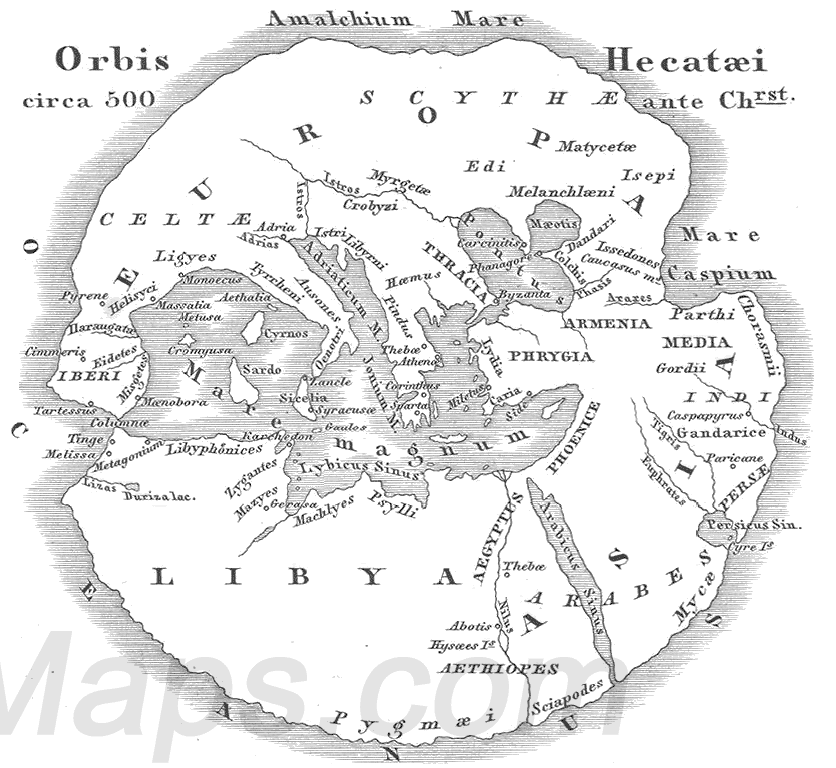
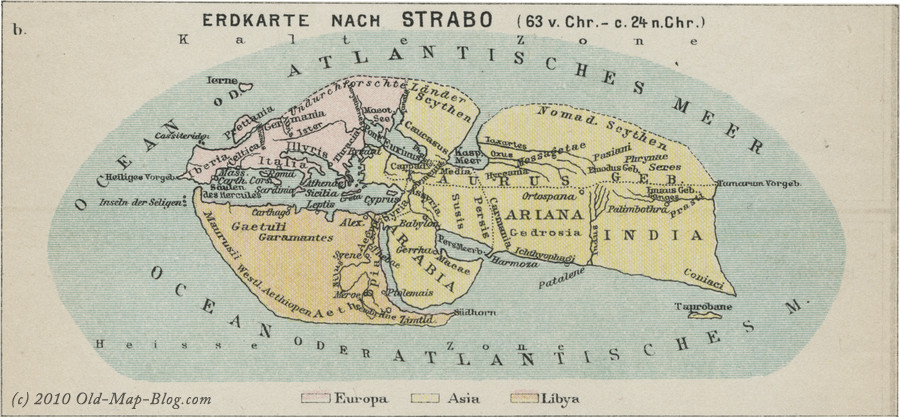
The ancient Hellenes also made world maps. Land ownership and geography was changed mainly according to new rulers and natural disasters, such as earthquakes and volcanoes, and of course the ancient Hellenes didn't exactly have the grasp on geography we have today. Here are some of the major maps of Ancient Hellas:
 
Anaximander (c. 610 – c. 546 BC)


Hecataeus of Miletus (c. 550 BC – c. 476 BC)


 Eratosthenes (276 – 194 BC)


Strabo (64/63 BC – c. 24 AD)
 
 
As you can see, not entirely accurate but very amusing--and it worked for them. These maps helped along trade and travel, brought perspective to the world and pushed the art of geography forward. Most of these are reconstructed maps based on descriptions as the original work has been lost, but they are still brilliant to behond.
I've gotten another reader question, this time concerning the nature of the Gods and how They came to be. The question, in full, was: "Do you believe the gods created us? How do you believe they came to be?"

I have explained before how I differentiate between mythology and philosophy, where I feel myth was inspired by the Theoi Themselves, while philosophy was created by humans who saw society and drew conclusions from it. These conclusions often included a religious aspect because society was religious (even though the ancient Hellenes didn't have a word for 'religion'), but at its core, they deal not with religious matters. They deal with the influence of religion on humanity and society. As such, philosophy--of which I am a great fan, by the way--will never be the foundation of my faith, because religion and philosophy have a different goal; one to guide mankind in the way of the Theoi, the other to understand mankind. There is nothing religious about the latter.

The ancient Hellenic philosophers and mythographers were pretty much in agreement, however, that the Gods, indeed, created us. How, exactly, that happened varies greatly. Let's do a bit of cosmology first, however. The most famous account of how everything came to be comes from Hesiod. His 'Theogogy' is a complete recounting of the story, starting with Khaos:

"Verily at the first Chaos came to be, but next wide-bosomed Earth, the ever-sure foundations of all  the deathless ones who hold the peaks of snowy Olympus, and dim Tartarus in the depth of the wide-pathed Earth, and Eros, fairest among the deathless gods, who unnerves the limbs and overcomes the mind and wise counsels of all gods and all men within them. From Chaos came forth Erebus and black Night; but of Night were born Aether and Day, whom she conceived and bare from union in love with Erebus. And Earth first bare starry Heaven, equal to herself, to cover her on every side, and to be an ever-sure abiding-place for the blessed gods. And she brought forth long Hills, graceful haunts of the goddess-Nymphs who dwell amongst the glens of the hills. She bare also the fruitless deep with his raging swell, Pontus, without sweet union of love. But afterwards she lay with Heaven and bare deep-swirling Oceanus, Coeus and Crius and Hyperion and Iapetus, Theia and Rhea, Themis and Mnemosyne and gold-crowned Phoebe and lovely Tethys. After them was born Cronos the wily, youngest and most terrible of her children, and he hated his lusty sire." [ll. 116-138]

He goes on to list a great many deities, cutting out a rough shape of the cosmos while doing so. There are many variations of this family tree, and in the ancient writings, there are also creation stories that range beyond this basic framework. In the Orphic Theogonies, for example, the universe does not start with Khaos, but with Thesis and Hydros, reaching back to Hómēros:

"Originally there was Hydros (Water), he [Orpheus] says, and Mud, from which Ge (the Earth) solidified: he posits these two as first principles, water and earth . . . The one before the two [Thesis], however, he leaves unexpressed, his very silence being an intimation of its ineffable nature. The third principle after the two was engendered by these--Ge (Earth) and Hydros (Water), that is--and was a Serpent (Drakon) with extra heads growing upon it of a bull and a lion, and a god’s countenance in the middle; it had wings upon its shoulders, and its name was Khronos (Unaging Time) and also Herakles. United with it was Ananke (Inevitability, Compulsion) , being of the same nature, or Adrastea, incorporeal, her arms extended throughout the universe and touching its extremities. I think this stands for the third principle, occuping the place of essence, only he [Orpheus] made it bisexual [as Phanes] to symbolize the universal generative cause." [Theogonies Fragment 54]

Or, also from the Theogonies:

"The gods, as they [the Greeks] say, did not exist from the beginning, but each of them was born just as we are born. And this is agreed by them all, Homer saying `Okeanos the genesis of the gods, and mother Tethys [Thesis],’ and Orpheus--who was the original inventor of the gods’ names and recounted their births and said what they have all done, and who enjoys some credit among them as a true theologian, and is generally followed by Homer, above all about the gods--also making their first genesis from water : `Okeanos, who is the genesis of the all.’ For Hydros (Water) was according to him the origin of everything, and from Hydros (the Water) Mud [primordial Gaia] formed, and from the pair of them a living creature was generated with an extra head growing upon it of a lion, and another of a bull, and in the middle of them a god’s countenance; its name was Herakles and Khronos (Time). This Herakles generated a huge egg [which formed the earth, sea and sky]." [Fragment 57]

Obviously, there are many others as well, and which version of mythology you accept as truth is mostly up to you. There are so many versions of the birth of the universe floating around, as well as stories of who sired whom, choosing one really is a gamble.

As for our creation, the most well known is most likely the one where we were created by Prometheus from the mud. It's the start of the story of Pandôra. From Plato's Protagoras we know of this account of how we came to be:

"Once upon a time there were gods only, and no mortal creatures. But when the time came that these also should be created, the gods fashioned them out of earth and fire and various mixtures of both elements in the interior of the earth; and when they were about to bring them into the light of day, they ordered Prometheus and Epimetheus to equip them, and to distribute to them severally their proper qualities. Epimetheus said to Prometheus: "Let me distribute, and do you inspect." This was agreed, and Epimetheus made the distribution. There were some to whom he gave strength without swiftness, while he equipped the weaker with swiftness; some he armed, and others he left unarmed; and devised for the latter some other means of preservation, making some large, and having their size as a protection, and others small, whose nature was to fly in the air or burrow in the ground; this was to be their way of escape. Thus did he compensate them with the view of preventing any race from becoming extinct. And when he had provided against their destruction by one another, he contrived also a means of protecting them against the seasons of heaven; clothing them with close hair and thick skins sufficient to defend them against the winter cold and able to resist the summer heat, so that they might have a natural bed of their own when they wanted to rest; also he furnished them with hoofs and hair and hard and callous skins under their feet. Then he gave them varieties of food-herb of the soil to some, to others fruits of trees, and to others roots, and to some again he gave other animals as food. And some he made to have few young ones, while those who were their prey were very prolific; and in this manner the race was preserved.
 
Thus did Epimetheus, who, not being very wise, forgot that he had distributed among the brute animals all the qualities which he had to give-and when he came to man, who was still unprovided, he was terribly perplexed. Now while he was in this perplexity, Prometheus came to inspect the distribution, and he found that the other animals were suitably furnished, but that man alone was naked and shoeless, and had neither bed nor arms of defence. The appointed hour was approaching when man in his turn was to go forth into the light of day; and Prometheus, not knowing how he could devise his salvation, stole the mechanical arts of Hephaestus and Athene, and fire with them (they could neither have been acquired nor used without fire), and gave them to man. Thus man had the wisdom necessary to the support of life, but political wisdom he had not; for that was in the keeping of Zeus, and the power of Prometheus did not extend to entering into the citadel of heaven, where Zeus dwelt, who moreover had terrible sentinels; but he did enter by stealth into the common workshop of Athene and Hephaestus, in which they used to practise their favourite arts, and carried off Hephaestus' art of working by fire, and also the art of Athene, and gave them to man. And in this way man was supplied with the means of life. But Prometheus is said to have been afterwards prosecuted for theft, owing to the blunder of Epimetheus." [320c - 322a]

In much the same manner, women came to be. According to Hesiod:

"Forthwith he made an evil thing for men as the price of fire; for the very famous Limping God formed of earth the likeness of a shy maiden as the son of Cronos willed. And the goddess bright-eyed Athene girded and clothed her with silvery raiment, and down from her head she spread with her hands a broidered veil, a wonder to see; and she, Pallas Athene, put about her head lovely garlands, flowers of new-grown herbs. Also she put upon her head a crown of gold which the very famous Limping God made himself and worked with his own hands as a favour to Zeus his father. On it was much curious work, wonderful to see; for of the many creatures which the land and sea rear up, he put most upon it, wonderful things, like living beings with voices: and great beauty shone out from it.
 
But when he had made the beautiful evil to be the price for the blessing, he brought her out, delighting in the finery which the bright-eyed daughter of a mighty father had given her, to the place where the other gods and men were. And wonder took hold of the deathless gods and mortal men when they saw that which was sheer guile, not to be withstood by men. For from her is the race of women and female kind: of her is the deadly race and tribe of women who live amongst mortal men to their great trouble, no helpmeets in hateful poverty, but only in wealth." [561 - 612]

Years later, when Zeus would flood the earth, Pyrrha and her husband Deukalion would survive and re-create the human race by throwing pebbles behind themselves as they walked; Deukalion would create the men and Pyrrha the women.

I believe in the theory of the Big Bang, where the universe was in an extremely hot and dense state and began expanding rapidly. After the initial expansion, the universe cooled sufficiently to allow energy to be converted into various subatomic particles, including protons, neutrons, and electrons. [...] Giant clouds of these primordial elements later coalesced through gravity to form stars and galaxies, and the heavier elements were synthesized either within stars or during supernovae (courtesy of Wikipedia, because of ease). I see no issue in overlaying this theory with Heiod's cosmology, however. The Big Bang theory does sound like first there was Khaos, and from that, matter came into being to eventually form the Earth as it is now. So as far as the creation of the universe and the Gods goes, I will go with Hesiod and his explanation, although a variation of his work is also fine by me.

As for how we came to be, I believe in evolution. I don't think we were put on the Earth ready-made by the Gods. That said, the proposal that one type of animal could descend from an animal of another type goes back to some of the first pre-Socratic Hellenic philosophers, such as Anaximander and Empedocles, so it's not an odd frame of mind to have for a Hellenist; even the ancient Hellenes flirted with the idea that at least animal species evolved from one another. I love the myth of Prometheus, but no, that is not how I think we came to be, although I won't rule out that the Gods had a hand in our formation through evolution.
Modern society always seems to put itself above the ancient societies that preceeded it, but without their inventions, we wouldn't be what we are today, and we certainly would not have what we have today. The ancient Hellens were masters of literature, art, philosophy, mathematics, geometry, astronomy, medicine and many other sciences, but they also constructed some inventions we use to this day. Here is a list of 25 of them. How many were you aware of?


Anchor: the Hellenic contribution to ship construction is huge. You've heard of the Argo, right? The Hellens were also some of the firsts who made long sea voyages and who build ships that could not be brought to shore, thus forcing them to find a way to tie their ships down when there was nothing to tie them to. Anchors of huge stones have been around since the Bronze Age, but the Hellens were the first to solve the problem in a technological manner. Most often these anchors--often referred to 'teeth' (ὀδὁντες, dentes) in Hellenic poetry--consisted of sacks or buckets which were filled with stones, although later versions were made of stone and already had the shape of anchors so well know today. Every ship had several anchors.

Alarm Clock: the ancient Greek philosopher Plato (428–348 BC) was most likely the first to possess an alarm clock. It was a water clock of some design that, when having counted to the desired time, played something with the sound of a water organ. Ctesibius (285–222 BC) had a device which would drop balls of some sort onto a metal plate at a specified time, thus waking up the sleeping party.
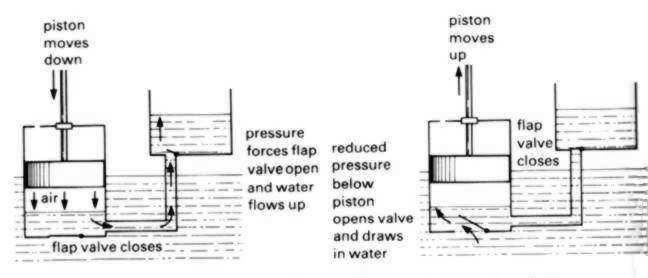
Automatic Doors: Heron of Alexandria created a hydraulic system, based on steam power, which automatically opened the doors to an Alexandrian temple. The engine used air from a closed chamber heated by an altar fire to displace water from a sealed vessel; the water was collected and its weight, pulling on a rope, opened temple doors.

Catapult: accounts of Hellenic versions of the catapult date back to 399 BC. They often shot out arrow-shaped projectiles, not boulders, but the mechanism was very much the same as the later medieval catapults.

Cement: cement is a binder, a substance that sets and hardens independently, and can bind other materials together. Although the word is Roman, the Hellens already had a version of it, adding limestone to a mixture of clay, water and sand. It was used from 100 BC onwards, and mostly in what is now the coast of Turkey.

Central Heating: although the Romans perfected the design, the ancient Hellens already had a system in place where a fire heated up air, which was then forced through pipes hidden under the floor. The air warmed up the floor and, in turn, the room. Slaves kept the fire burning, of course.
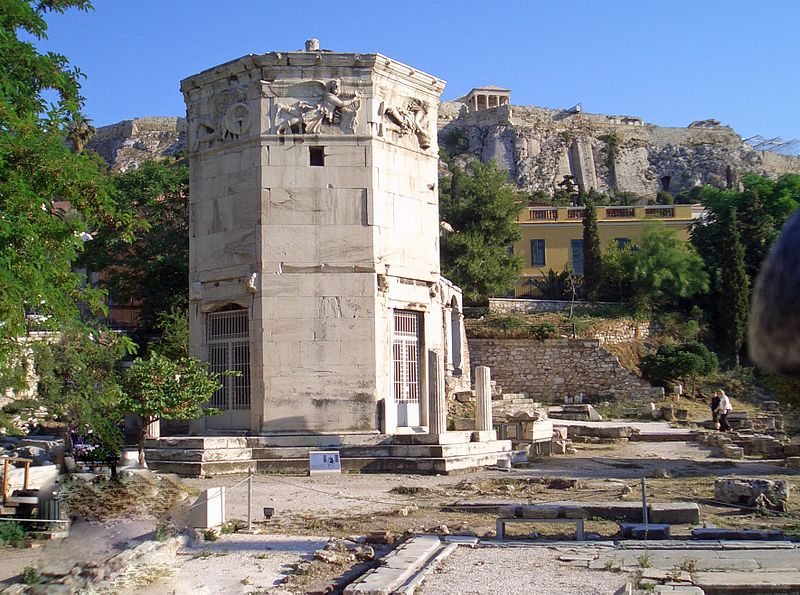
Clock Tower: the ancient  Tower of the Winds dates back to about 100 BC. It housed a water clock which was connected to eight sundials on the outside of the tower. The entire mechanism has since vanished, but the tower remains, including the depictions of the eight wind deities: Boreas (N), Kaikias (NE), Eurus (E), Apeliotes (SE), Notus (S), Livas (SW), Zephyrus (W), and Skiron (NW). I have seen the Tower of the Winds in person, and it's beautiful. It's also (one of the) first clock towers of the world.

Coin Money: long before the rule of the Hellens, we developed a trade system that relied on a token, not goods. Commodity money was born, but the Hellens were the first to develop coins of different sizes and materials and put a value on various trading goods.

Crane: in the sixth century BC, the Hellens invented a way to lift the heavy stone blocks onto the emerging temple walls: a crane. Holes drilled into the stone suggest ropes were attached to the blocks, and pulled up to be fitted in place.

Crossbow: like the catapult, crossbows emerged in ancient Hellas and were a favored weapon. The arrows they fired traveled far, were absolutely deadly, and the weapon was relatively easy to load.

Lighthouse: the famous lighthouse of Alexandria was constructed around 300 BC, by Sostratus of Cnidus. With a height around 400 ft (120 m), it stood as one of the tallest man-made structures on Earth for many centuries. It was one of the original Seven Wonders of the Ancient World.

Maps: Anaximander, who lived from 610 to 546 BC, was the first to create maps with the concept of latitude and longitude, and it were later Hellens Eratosthenes and Strabo who created maps of the entire known world at the time, which--granted--was not the known world as we know it today.

Odometer: an odometer--as car enthusiasts will most likely know--is an instrument that indicates distance traveled by a vehicle. In ancient Hellas, it was used to measure the distance between cities. Although the actual device was never recovered, some of the measurements were. They were so accurate that some form of technology had to be involved.

Plumbing: in the 400s BC, Athens began to develop highly extensive plumbing systems for baths and fountains, as well as for personal use within individual homes. Many houses in ancient Greece were equipped with closets or latrines that drained into a sewer beneath the street. They seemed to have been flushed by waste water. Some of the sewers were fitted with ventilating shafts.

Sinks: the ancient Hellens were the first to have an automated sink with running water, so both hands could be washed at the same time.

Showers: especially in gymnasia, large, communal, showers could be found. As it wasn't manly to wash with anything but cold water, it was doubtful the water was heated. There are also vase paintings of female athletes using showers.

Spiral Staircase: Temple A at Selinunte, Italy, was special. It was build around 480 BC. Selinunte was one of the most important of the Greek colonies in Sicily. There were five temples, but of only the 'E'-temple, it is sure whom it was dedicated to: Hera. Who the A-temple was dedicated to is not clear, but it had a unique design feature: the first spiral staircase in history.

Steam Engine: it was a children's toy, designed by Heron of Alexandria. He called it an aeolipile; a cylinder, arranged to rotate on its axis, having oppositely bent or curved nozzles projecting from it. When the cylinder is pressurized, steam blows through the nozzles and the aeolipile spins around. It was the first steam-powered anything, and extraordinary in its own way.

Surveying tools: the Hellens were well aware that a building needed a solid foundation, and a city needed proper planning in order to stand safely for a long time. More on the latter below, but for both, it was incredibly important to pick out a good building site. In order to do this, the Hellens devised many tools to test the soil, measure out the slope of the ground, and gather other valuable information before building their structures. It shows; much of what stood then, survives to this day, more or less intact.

Thermometer: Philo of Byzantium was a Hellenic Jewish philosopher who discovered that air expanded when heated.He attached a tube to a hollow sphere and extended it over a jug of water. When the device was in the sun, air expanded out of the sphere and into the water, creating bubbles. When he put the device in the shade, nothing happened. Around that same time (+/- 50 AD) Heron of Alexandra worked on the first thermometer for medicine.

Umbrella: they were made from larger bones, wood or plant leaves, and used to block rain or sun. While they certainly were not up to par with modern umbrella's, they served their purpose well.

Urban Planning: in the Hellenic city of Miletus, a grid formation was used for residential and public streets and areas. This was around 400s BC.

Vending Machine: Heron of Alexandria made another contribution to our current wellbeing. He invented the original vending machine. It dispensed water when a coin was put in. When the coin went in, it fell on a pan that was itself attached to a lever, which opened a valve. The pan would tilt until the coin fell off, thereby turning off the water.

Water Mill: even back in the day, power was needed to set mechanisms to work. In 300 BC, in Perachora, the first waterwheel was most likely created, and toothed gearing is also attributed to the Hellens, who managed to set in motion various devices with it.

Wheelbarrow: it seems like something someone in the stone age would have come up with, but it wasn't. The Hellens were the first to create a one wheeled cart around 400 BC. They were used on many construction sites throughout ancient Hellas, and who can blame them? Every little bit helps when you're creating massive temples.