Showing posts with label Asklēpiós. Show all posts

Serpens ("the Serpent", Ὄφις) is a constellation of the northern hemisphere. It is one of the 48 constellations listed by the 2nd century astronomer Ptolemy, and remains one of the 88 modern constellations defined by the International Astronomical Union. It is unique among the modern constellations in being split into two non-contiguous parts, Serpens Caput (Serpent's Head) to the west and Serpens Cauda (Serpent's Tail) to the east. Between these two halves lies the constellation of Ophiuchus, the 'Snake-Holder'.

The constellation Ophiuchus (Ὀφιοῦχος) has has had its stars interpreted in a number of ways throughout the years, and the Hellenic-era interpretations are mostly lost to us. Hyginus is our primary source on this constellation, and he was a Roman man. Many men could be represented with the constellation, but for Serpens, only one really applies: the healer-God Asklēpiós.


Asklēpiós splits Serpens into two distinct halves, as he was known for killing a snake that was resurrected because a different snake had placed a certain herb on it before its temporary death.  Hyginus has the following to say about Serpens and the affairs of this uplifting into the sky in his 'Astronomica':

"Many astronomers have imagined that he is Aesculapius, whom Jupiter, for the sake of Apollo, put among the stars. For when Aesculapius was among men, he so fare excelled the rest in the art of medicine that it wasn’t enough for him to have healed men’s diseases unless he could also bring back the dead to life. He is said most recently, according to Eratosthenes to have restored to life Hippolytus who had been killed by the injustice of his stepmother and the ignorance of his father. Some have said that by his skill Glaucus, son of Minos, lived again. Because of this, as for a sin, Jove struck and burned his house with a thunderbolt, but because of his skill, and since Apollo was his father, put him among the constellations holding a snake.
 
Certain people have said that he holds the snake for the following reason. When he was commanded to restore Glaucus, and was confined in a secret prison, while meditating what he should do, staff in hand, a snake is said to have crept on to his staff. Distracted in mind, Aesculapius killed it, striking it again and again with his staff as it tried to flee. Later, it is said, another snake came there, bringing an herb in its mouth, and placed it on its head. When it had done this, both fled from the place. Where upon Aesculapius, using the same herb, brought Glaucus, too, back to life.
 
And so the snake is put in the guardianship of Aesculapius and among the stars as well. Following his example, his descendants passed the knowledge on to others, so that doctors make use of snakes." [II.14]

Serpens is depicted as either winding around Ophiuchus in the night sky or simply passing through him, although the precise reason for either of these is unknown. In some ancient atlases, the constellations Serpens and Ophiuchus were depicted as two separate constellations, although in most they were shown as a single constellation.

Serpens is visible at latitudes between +80° and −80°, and best visible at 21:00 (9 p.m.) during the month of July.

I get a lot of questions from readers, and most of the time, the answers are fairly short. When I feel the question or the reply would be valuable to others as well, I make a post with a collection of them and post them in one go. Today is one of those posts.


"Do you know if there is a specific rule what you can libate or offer a God or Goddess. Like Water for Demeter and Semele. If you could answer, that would be great."

There is no rule, but there are some guidelines. Ouranic deities tended to receive wine libations that were mixed with water. Khthonic deities received either wineless libations (water, milk, and honey, usually), or wine libations of unmixed wine. 'Ouranic' is a term that applies to Theoi and practices who reside or that are associated with Mount Olympos, home of many of the Theoi. As such, Ouranic deities are also referred to as 'Olympians'. 'Kthonic' refers to deities or spirits of the Underworld or the earth, and the rituals associated with Them. Then there are some we know from the ancient writings.

So, some examples: Apollon (ouranic)? Mixed wine. Gaia (kthonic, earth)? Water (usually khernips), or milk, or honey. Water for the nymphs (kthonic, earth), unmixed wine to Persephone (kthonic), milk (usually kykeon) to Demeter (kthonic, earth), etc. Does that make sense?

~~~
 
"So I really want to celebrate the traditional festivals. What do you think of the idea of starting them on the days they take place on this year, and doing them on that same day onwards. I know it actually changes each year, but I feel like it would help me be a better worshipper to just have a set date each year."
 
I believe everyone should do as they feel called to do. But I do want to make a case for sticking to the traditional lunar calendar isntead of the solar calendar that was introduced in Roman times. For one, the major monthly festivals (Hene kai Nea (Hekate's Deipnon), Noumenia and Agathós Daímōn) would no longer fall around the new moon--which is Hekate's time and would make celebrating those festivals... not useless but most certainly less valuable. The other festivals are also linked to days sacred to the Gods being worshipped, or connected to a certain phase of the moon, or to a certain time of he year. All of that would shift if you connect the festivals to the solar calendar.

An example: the Elaphebolia takes place on the sixth of Elaphebolion. Elaphebolion relates roughly to March/April, so it would stand to reason to then celebrate the Elaphebolia on March 6 with the above reasoning, right? On the lunar calendar, it would be celebrated on the 14th and 15th of March (note that the ancient Hellenes started a new day at sundown the day before).That is not a major difference, right? Just a few days? March 6, however, would be 26 Anthesterion, the last day of the Lesser Eleusinian Mystries, an impure day and right before the Hene kan Nea--definitely not the right day to commemorate a Phocian victory over the Thessalians, which is what the Elaphebolia celebrates besides honouring Artemis.

There are many people who struggle with keeping up with the ancient Hellenic calendar. That is why Elaion (with whom I am associated) organizes rituals you can perform at home (we call them PAT rituals--Practicing Apart Together) for the major festivals and many of the smaller sacrifices. That is also why I keep a Google calendar you can load into your phone calendar or access online to take all the thinking and math out of it. It doesn't have to be difficult to keep in tune with the lunar calendar, and personally, I have always found it very rewarding to do so.

~~~
 
"I was wondering if you have any books or e-resources on Asclepius. I've been looking everywhere and I can really only find bare basics."
 
Not much, I fear. Many sources have information about Him, but they are often about the same things: That He is the God of medicine and reputed ancestor of the Asklepiades, the ancient Hellenic doctors' guild. That He is the son of Apollon and the Trikkaian princess Koronis. That His mother died in labour and was laid out on the pyre to be consumed, but his father rescued the child, cutting him from her womb. That He recieved His name from this: Asklepios means 'to cut open'.
 
He was then raised by the kentauros (centaur) Kheiron who instructed Him in the art of medicine. Asklepios grew so skilled in the craft that he was able to restore the dead to life. However, because this was a crime against the natural order, Zeus destroyed him with a thunderbolt.
 
After His death Asklepios was placed amongst the stars as the constellation Ophiochus. Some say His mother was also set in the heavens as Corvus, the crow /raven (korônê in Greek). Asklepios' apotheosis into godhood occurred at the same time.
 
For more reading, please turn to these sources:
 
Homer, The Iliad - Greek Epic C8th B.C.
Hesiod, Catalogues of Women - Greek Epic C8th-7th B.C.
The Homeric Hymns - Greek Epic C8th-4th B.C.
Pindar, Odes - Greek Lyric C5th B.C.
Greek Lyric III, Stesichorus - Greek Lyric C7th-6th B.C.
Greek Lyric IV Sophocles, Fragments - Greek Lyric C5th B.C.
Greek Lyric V Cinesias, Fragments - Greek Lyric C5th B.C.
Greek Lyric V Anonymous, Fragments - Greek Lyric B.C.
Hippocrates, The Hippocratic Oath – Greek Medicine C5th-4th B.C.
Aeschylus, Agamemnon - Greek Tragedy C5th B.C.
Plato, Republic - Greek Philosophy C4th B.C.
Isyllus, Hymn to Asclepius - Greek Poetry C4th-3rd B.C.
Apollodorus, The Library - Greek Mythography C2nd A.D.
Aristophanes, Plutus - Greek Comedy C5th-4th B.C.
Lycophron, Alexandra - Greek Poetry C3rd B.C.
Diodorus Siculus, The Library of History - Greek History C1st B.C.
Strabo, Geography - Greek Geography C1st B.C. - C1st A.D.
Pausanias, Guide to Greece - Greek Travelogue C2nd A.D.
Quintus Smyrnaeus, Fall of Troy - Greek Epic C4th A.D.
The Orphic Hymns - Greek Hymns C3rd B.C. - C2nd A.D.
Aelian, On Animals - Greek Natural History C2nd-3rd A.D.
Philostratus, Life of Apollonius of Tyana - Greek Biography C2nd A.D.
Hyginus, Fabulae - Latin Mythography C2nd A.D.
Hyginus, Astronomica - Latin Mythography C2nd A.D.
Ovid, Metamorphoses - Latin Epic C1st B.C. - C1st A.D.
Ovid, Fasti - Latin Poetry C1st B.C. - C1st A.D.
Propertius, Elegies - Latin Elegy C1st B.C.
Cicero, De Natura Deorum - Latin Philosophy C1st B.C.
Statius, Silvae - Latin Epic C1st A.D.
Apuleius, The Golden Ass - Latin Novel C2nd A.D.
Suidas - Byzantine Greek Lexicon C10th A.D.

~~~
 
"This is a stupid question but I don't have a fireplace or hearth and right now I can't practice out in the open but I still want to give offerings to the Theoi. What can I use instead of burning something?"
 
Burning, obviously, is the Traditional way to go about things. The smoke is what carries the offerings up to the Gods, after all. But if you can't do that, then the next best thing is probably to simply lay out the offerings on the altar and remove them once you are done with the ritual. Focus on the act of giving.
 
~~~
 
"How did you explain your beliefs to your girlfriend? I always struggle with how to tell people because so many have false ideas of hellenismos is because of what they were taught in school."
 
My girlfriend is the sweetest, most beautiful woman I have ever met. She is an incredibly skilled artist and painter, and a fantastic teacher. She is the only woman I see myself marrying and possibly having children with. She is also the most religiously-skeptical atheist you could ever meet. My girlfriend finds it incredibly hard to believe in anything that is not proven by science or in another way quantifiable.
 
My girlfriend knows about my practice and she supports it as much as she can. Because she went to artschool, she is aware of Hellenic mythology and appreciates it, but she views it simply as stories. We have religious conversations sometimes but since we will never agree, they are usually short-lived. So how do I explain them? I don't. We've gone over the most important bits in the past and beyond that, we let each other be. We both get the freedom to believe what we want and it works. Some battles you can't win, I fear ;-)

 It's been a while since I last tackled a constellation. Sorry about that. I am happy to announce we have reached the 'O''s, which means there are just fourteen left after this one, and thirty-two behind us. There will, however, be a bonus at the end. The constellation Ophiuchus (Ὀφιοῦχος) has has had its stars interpreted in a number of ways throughout the years, and the Hellenic-era interpretations are mostly lost to us. Hyginus is our primary source on this constellation, and he was a Roman man. Lets hope he built upon existing opinion.


Ophiuchus has known many interpretation, but was almost solely called 'Serpent-holder'. In the night's sky, he is located above Scorpio, and holds in his hands a serpent which coils about his body. Hyginus, in his 'Astronomica' gives us five possible men this snake holder could represent: Karnabon, Herakles, Triopas, Phorbas, and Asklēpiós. I will let Hyginus speak for a moment:

"Many have called him Carnabon, king of the Getae, who lived in Thrace. He came into power at the time when it is thought grain was first given to mortals. For when Ceres was distributing her bounties to men, she bade Triptolemus, whose nurse she had been, go around to all the nations and distribute grain, so that they and their descendants might more easily rise above primitive ways of living. He went in a drgon car, and is said to have been the first to use one wheel, so as not to be delayed in his journey. When he came to the king of the Getae, whom we mentioned above, he was at first hospitably received. Later, not as a beneficent and innocent visitor, but as a most cruel foe, he was seized by treachery, and he who was ready to prolong the lives of others, almost lost his own life. For at the order of Carnabon one dragon was killed, so that Tiptolemus might not hope his dragon car could save him when he realized an ambush was being prepared. But Ceres is said to have come there, and restored the stolen chariot to the youth, substituting another dragon, and punishing the king with no slight punishment for his malevolent attempt. For Hegesianax says that Ceres, for men’s remembrance, pictures Carnabon among the stars, holding a dragon in his hands as if to kill it. He lived so painfully that he brought on himself a most welcome death.

Others point out that he is Hercules, killing in Lydia near the river Sagaris a snake which kept destroying many men and stripping the river banks of grain. In return for this deed, Omphale, the queen of that region, sent him back to Argos loaded with gifts, and because of his bravery he was placed by Jove among the constellations.

Some, too, have said that he is Triopas, king of the Thessalians, who, in trying to roof his own house, tore down the temple of Ceres, built by the men of old. When hunger was brought on him by Ceres for this deed, he could never afterward be satisfied by any amount of food. Last of all, toward the end of his life, when a snake was sent to plague him, he suffered many ills, and at last winning death, was put among the stars by the will of Ceres. And so the snake, coiling round him, still seems to inflict deserved and everlasting punishment.

Polyzelus the Rhodian, however, points out that this is Phorbas, who was of great assistance to the Rhodians. The citizens called their island, overrun by a great number of snakes, Ophiussa. In this multitude of beasts was a snake of immense size, which had killed many of them; and when the deserted land began finally to lack men, Phorbas, son of Triopas by Hiscilla, Myrmidon’s daughter, when carried there by a storm, killed all the beasts, as well as that huge snake. Since he was especially favored by Apollo, he was put among the constellations, shown killing the snake for the sake of praise and commemoration. And so the Rhodians, as often as they go with their fleet rather far from their shores, make offerings first for the coming of Phorbas, that such a happening of unexpected valor should befall the citizens as the opportunity for glory which brought Phorbas, unconscious of future praise, to the stars.

Many astronomers have imagined that he is Aesculapius, whom Jupiter [Zeus], for the sake of Apollo, put among the stars. For when Aesculapius was among men, he so fare excelled the rest in the art of medicine that it wasn’t enough for him to have healed men’s diseases unless he could also bring back the dead to life. He is said most recently, according to Eratosthenes to have restored to life Hippolytus who had been killed by the injustice of his stepmother and the ignorance of his father. Some have said that by his skill Glaucus, son of Minos, lived again. Because of this, as for a sin, Jove struck and burned his house with a thunderbolt, but because of his skill, and since Apollo was his father, put him among the constellations holding a snake.
Certain people have said that he holds the snake for the following reason. When he was commanded to restore Glaucus, and was confined in a secret prison, while meditating what he should do, staff in hand, a snake is said to have crept on to his staff. Distracted in mind, Aesculapius killed it, striking it again and again with his staff as it tried to flee. Later, it is said, another snake came there, bringing an herb in its mouth, and placed it on its head. When it had done this, both fled from the place. Where upon Aesculapius, using the same herb, brought Glaucus, too, back to life. And so the snake is put in the guardianship of Aesculapius and among the stars as well. Following his example, his descendants passed the knowledge on to others, so that doctors make use of snakes." [II.14]

The snake that is being wrangled by our mystery man is actually not part of the constellation Ophiuchus: it's a separate one named Serpens, which we will get to a little later on. Linked to Serpens, the constellation Ophiuchus wasn't known under that name in ancient Roman times, but took the title 'Serpentarius', which also means 'Snake-Holder', or 'Snake-Bearer'.

The Sun passes through the constellation between November 30 and December 17, which is why some astrologers consider Ophiuchus to be the thirteenth sign of the zodiac. It is, however, not included in most astrological zodiacs, and the saying confuses sign with constellation. The constellation is visible at latitudes between +80° and −80°, and best visible at 21:00 (9 p.m.) during the month of July.

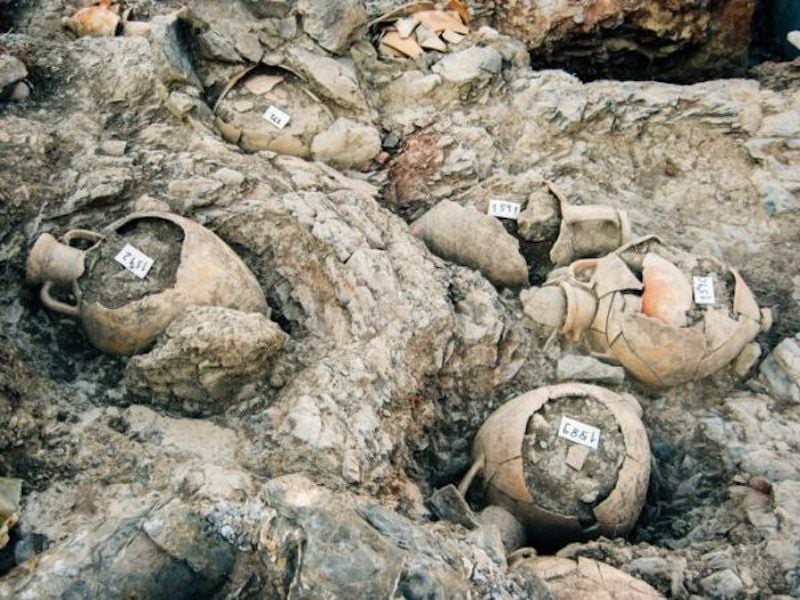
The study of the largest ancient cemetery for infants found on Astypalea island in Greece continues, shedding light on the worship of the goddess of childbirth and the Earth mother. The Dodecanese Ephorate of Antiquities that is carrying out the study has found that almost all the infants buried there were newborns or, at most, a few months old. There are also a few toddlers that were up to two years of age.

The bodies of the babies were placed in ceramic containers, mainly amphorae or hydrias, whichwere buried in shallow pits with stones on top, which indicated that there was a tomb there. Burial of newborns and babies in such receptacles was a rather common way of burial in ancient times. What distinguishes the infants’ cemetery of Astypalea is the huge number of tombs and its use for almost an entire millennium. So far, a total of 3,000 vessels containing the skeletons of babies have been excavated, but many more are buried in the cemetery.

With few exceptions, the tombs did not contain favorite objects of the dead, which was common for newborns and infants since they were not considered “full” persons at that point, thus were not buried ceremoniously and traditionally as all adults were.

The number of tombs and the fact that the containers come from various parts of the Mediterranean indicate that it is possible that many of the infants did not belong to  Astypalea’s inhabitants.

The uniqueness of the ​​Kylindra area on the island lies in the fact that it is a burial ground exclusively for newborns and infants, most of whom died at birth. Such a large cemetery for infants is certainly not justified by the size of the island’s population. There was a city there, but it was not one of the most important in ancient Hellas.

The most realistic theory for the existence of a cemetery for infants on the island is that there could have been a sanctuary on Astypalea where women went to give birth. Indeed, inscriptions have been found on the island that mention not only Asclepius, but also Eileithyia, the goddess of childbirth and midwifery. She helps women give birth and endure its great pains. She is also worshiped as a goddess who takes care of newborns.

The latter seems more likely to be associated with the presence of newborns and infants on the island. Such sanctuaries existed in other parts of the Hellenic world, but perhaps that of Astypalea was one of the most famous and had pan-Hellenic significance. Thus, women who were not from Astypalea would prefer to give birth there, much like, for example, patients from all over Greece would visit the Asclepieion of Epidaurus for cures of their diseases.

It is even possible that there were doctors specializing in obstetrics in the sanctuaries of Eileithyia, something that would be especially helpful to midwives at a time when childbirth was particularly dangerous and many newborns and mothers died in the process. Even under these conditions, many newborns would die in the sanctuary, and perhaps these were the ones who were buried in the cemetery of Astypalea.

Eileithyia had many sanctuaries in Crete. The most famous places of her worship were in Amnisos, Olounda, Diktynnaio and Inato, but the main seat of the Goddess was in ancient Lato.

I'm tackling a little constellation today,  Corvus, the Latin word for 'raven' or 'crow'. It comes from the Hellenic 'korax'. It's one of three constellations linked to a myth I will only partly reveal today, as it makes much more sense to place it with the constellation Crater, which will be the next one I tackle.


The raven and/or crow is connected to Apollon. For a variety of reasons, Hermes is often associated with these birds as well, but there is no ancient evidence for this. Apollon, on the other hand, has a long history with the birds. It seems odd that a deity associated with light is also associated with an animal with an image as negative as the raven. Ravens are often associated with battlegrounds, cemeteries, and death, with the rotting of carcasses, and funerals. In Hellenic myth, they are also associated with vision beyond that which is present. With oracular visions, and with spotting that which can not, or should not, be spotted.

One myth associated with the constellation Corvus is that of Apollo and Koronis (Κορωνίς). Koronis was Apollon's lover, and was pregnant with His son, when she fell for another man, a mortal man, Ischys (Ἰσχύς). A raven--then white--had been assigned by Apollon to watch over His lover, and when the raven returned to tell Apollon of Coronis' betrayal, Apollon was furious the raven had not pecked out the eyes of the mortal whom his lover fell in love with. In a fit of rage, Apollon turned its feathers black. Apollodorus wrote about this event (3:10:3), and the events that followed:

"Besides them Leucippus begat Arsinoe: with her Apollo had intercourse, and she bore Aesculapius. But some affirm that Aesculapius was not a son of Arsinoe, daughter of Leucippus, but that he was a son of Coronis, daughter of Phlegyas in Thessaly. And they say that Apollo loved her and at once consorted with her, but that she, against her father's judgment, preferred and cohabited with Ischys, brother of Caeneus. Apollo cursed the raven that brought the tidings and made him black instead of white, as he had been before; but he killed Coronis. As she was burning, he snatched the babe from the pyre and brought it to Chiron, the centaur, by whom he was brought up and taught the arts of healing and hunting."

In another myth, Corvus represents a raven or crow in service to Apollon, who was sent out on an errant for the Theos. He was asked to bring water to Him, but instead, he paused in his quest, most commonly assumed is that he stopped for a meal of figs. When the raven returned without water, Apollon questioned him. Instead of giving a straight answer, the raven lied, and said he had been kept from the water by a snake. In some accounts, he actually had a snake in his talons as he said this. Apollon, however, saw that the raven was lying, and flung the raven, the krater with which the raven was supposed to collect water, as well as the snake into the sky, where they remain to this day. To punish the bird further, Apollon made sure the krater would forever be just out of reach of the bird.

This Apollon-oriented constellation is visible at latitudes between +60° and −90°, and best visible at 21:00 (9 p.m.) during the month of May.

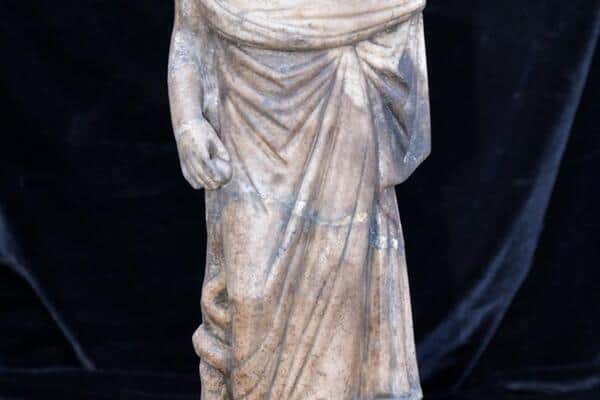
A statue of the ancient Hellenic God of health Asklepios and a bust of the God Zeus-Serapis were found during an excavations in the ancient city of Cibyra (Κιβύρα), also referred to as Cibyra Magna, in southern Polydorion (Πολυδώριον, Turkish: Burdur) province.

Stating that the discovery of the statuette of Asklepios and the bust of Zeus-Serapis in Cibyra is very important, the head of excavations, Mehmet Akif Ersoy University (MAKU) Archeology Department faculty member Şükrü Özüdoğru said:

“The Asclepius statue was found during excavations in the Kaisarion [Emperor Cult Temple] structure in Kibyra. This 38-centimeter-high figurine was unearthed in six pieces in a fire layer during excavations. These pieces were integrated after careful cleaning, conservation and consolidation by experts.”

Stating that it is known that Kibyra was once a very famous city in the field of medicine according to ancient sources and referring to the inscriptions found in Kibyra, Özüdoğru said:

“The statue has verified what we know about it. The figurine was traced back to 2nd century A.D.”

Stating that during the excavations carried out in the Roman Bath Complex in Kibyra in 2019, a bust without a head made of Afyon marble was found and it was taken under protection in the excavation house.

“In the 2020 excavation season, a bearded head was found during the short-term cleaning and excavation work in the same part of the Roman Bath Complex. This head merged with the bust found in 2019 so that the bust of Serapis was completed in full. It is an Egyptian god with many attributes such as the god of light.”

By this time, the worship of Serapis was combined with Zeus.

He said that the statue of Asklepios and the bust of Zeus-Serapis, delivered to the Burdur Archeology Museum, will be displayed in the coming days

Asklepios is the ancient Hellenic God of medicine, and he was also credited with powers of prophecy. The God had several sanctuaries across Greece. The most famous was at Epidaurus which became an important centre of healing in both ancient Greek and Roman times and was the site of athletic, dramatic, and musical games held in Asklepios’ honour every four years.

Zeus-Serapis is a Greco-Egyptian God of the Underworld and fertility. He is also the main deity of Alexandria in northern Egypt, established by Alexander the Great.

The unearthing of the Archaic building located in 2019 near the Tholos of the Asclepieion of Epidaurus continued in August this year in collaboration with the Ephorate of Antiquities of Argolis and the University of Athens.


The excavations were headed by professor emeritus of Classical Archaeology Vassilis Lambrinoudakis. Minister of Culture and Sports Lina Mendoni recently visited the excavation near the Tholos of the Asclepieion. She was briefed by her professor, Mr. Vassilis Lambrinoudakis, about the new important findings, which prove that the Tholos was the chthonic residence of the god, from the beginning of his presence in Epidaurus.

The building dating from the end of the 7th or the beginning of the 6th c. BC, based on the findings, had a form unknown till now in ancient Greek architecture. Below the ground floor there was a deep basement carved into the rock. The rock face was covered by stone walls coated with deep red plaster. The basement floor, a extremely strong mosaic of small white pebbles, is the largest and best preserved among the rare examples of its time. The ground floor, with brick walls built above the basement was surrounded by a wooden colonnade on stone bases.

This year’s excavation revealed the building’s full width and a large part of its length. The width inside the basement is 3.6m and reaches 8.2m on the ground floor along with the colonnade. 10.2m of the building has now been uncovered, but it continues to the west and partly (on its north side) beneath the Tholos. The continuation of the excavation is expected to reveal its full length on its south side or at least to add more information on the form and function of this important archaic building. Already a square recess found on the mosaic floor is interpreted as the trace of a staircase by which one went down from the ground floor to the basement. Professor Vassilis Lambrinoudakis said:

“Asclepius seems to have arrived in Epidaurus much earlier than we had thought until now, and in fact with the twofold nature/dual hypostasis of god and hero, of chthonic and celestial deity, putting down deep roots in this spot which quickly evolved into the largest place of healing in the ancient world. In the Classical Age, the highly decorated Tholos building was the residence of the god in his chthonic nature, in the basement of which he was greeted by offerings of the mortals. By the process of enkoimesis, a dreamlike state of induced sleep (sleep being the brother of death), the god healed his supplicants with his chthonic powers, i.e. with the regenerative power of the earth. The dormitory was typically built next to the Tholos. It now turns out to have been the chthonic residence of the god since the beginning of his presence in Epidaurus. The very early date, the advanced construction technique for the time, the location in essentially the exact same place where the Tholos was later erected, and the monumental basement, which obviously was of similar importance to and had the same function as the underground circular corridors of the Tholos that succeeded it, show the exceptional importance of the building for the cult of Asclepius and its history”.

It is worth noting that in its heyday the sanctuary included the famous temple for the worship of the celestial nature of Asclepius and other important buildings associated with his worship; the large banqueting hall for ritual dinners, the stadium and theatre used both during the festivals and for the patients to exercise and be entertained and the baths also for healing purposes. The essence however of the god’s worship and his healing power was his chthonic nature, which from the beginning was architecturally expressed in Epidaurus with the building that is now being excavated.

The Epidauria was a festival of Asklepios placed smack in the middle of the Mysteries--exactly six months after the other major festival of Asklepios in Athens: the one during the Greater Dionysia. The day was named after Asklepios' healing centre to the south at Epidauros. It was said that on this day, the cult of Asklepios and Hygeia joined the Eleusinian Mysteries rites in Athens.


What, exactly, happened during the Epidauria is unclear as discussing the rites that took place at Eleusis carried a death sentence, but I think we can safely say that the rites at Eleusis involving Asklepios were most likely similar to the rites to Asklepios that took place at other places--including Epidauros. What we do know is that the evening rites of sacrifices were held at Demeter’s Eleusinion temple in Athens to honor Asklepios, His daughter Hygeia, and Demeter and Persephone, who also were revered as healing deities. Special blessings were invoked for doctors and healers, and perhaps healing practices were offered at Demeter’s Eleusinion temple.

Then started the part that we have to guestimate by way of other practices involving Asklepios. Asklepios' worship almost always included a 'night watch'; a night time period of meditation and contemplation at a temple to Asklepios; the Asklepion. During the Mysteries, the initiates would most likely sit, contemplate, and cleanse themselves of ailments, distress, and anything that might distract them form the proceedings to follow. The temple of Asklepios was built near the enclosure of a sacred spring in a small cave and it included an abaton, a sleeping hall sacred to Asklepios where initiates could sleep while watched over by priests of Asklepios who prayed to Asklepios to visit these initiates in their sleep and give them messages intended to heal and cleanse. The following morning, initiates would tell their dream to a priest of Asklepios or Hygeia, called 'therapeutes'. The initiate would then be encouraged to put the advice he or she had gotten into practice.

The Epidauria took place as a preparatory intermezzo: afterwards, the initiates were cleaned and focused, ready to be drawn further into the Mysteries. As these proceedings took place late at night, a certain lack of sleep might also occur, leaving the initiates more susceptible to the coming proceedings. Whatever the case, the initiates would soon be enveloped in the hectic but highly ritualized proceedings of the Mysteries, and likely feel far more ready--and worthy--to face them.

In Athens, a separate ritual took place. The night of the 18th may have been spent by the very devout in sleeping in the Temple of Aesculapius, southwest of the Acropolis, or in the Iaccheum, also called the Temple of Demeter. It was just where the road from the Piraeus entered Athens. The early morning of that day till about 9 a.m. was devoted to ordinary business, as we find decrees issued bearing that date. After this hour the Epidauria was celebrated in the Temple of Demeter or Iacchus and in the Temple of Aesculapius.

For those who have decided to join the Eleusinian Mysteries, both a night watch and the daytime ritual are included in the rituals provided. For those not participating, a separate ritual will be held on the 18th of Boedromion, which is on the 6th of September this year. You can find this separate ritual here and join the community here.
Today, I would like to announce the last PAT ritual for Skirophorion, the Diisoteria. It will be held on 22 June, 10 am EDT--our usual time--and we would like you to join us in honoring Zeus, Athena, Asklēpiós, and Hygeia.


The Diisoteria was held on the last day of Skirophorion in the Piraeus, the ancient port of Athens. Fourth century accounts show that a large number of bulls were sacrificed at the festival. The sum set aside for the sacrifice in 323 BC is reported as either 50 talents or 30 talents but neither figure can be regarded as wholly realistic since Demosthenes, who was put in charge of the sacrifice for that year, was expected to pay the bulk of an outstanding fine from the money allocated. It was presided over by the archon.

The sacrifice was performed to mark the end of the old year and beginning of the new. It was held in honor of Zeus Soter and Athene Soteira, as well as Asklēpiós and Hygeia. The purpose of the sacrifice was to place the state under the protection of the God and Goddess during the upcoming year.

Will you join us in this PAT ritual to reign in the new year? You can find the ritual here and join the community here.
These are trying times for all and most of us could use a bit of divine help when it comes to our mental well-being, on top of our physical well-being. I'd like to share the names of some of the Gods and Goddesses especially willing to assist when you are dealing with a low level of mental health spoons. I'm sure it won't surprise you that many of Them also take care of the body--the two are intrinsically linked, after all.

Asklēpiós and Hygeia
The most obvious deities associated with any form of health are Asklēpiós and His daughter Hygeia. the ancient Hellenes didn't really distinguish between mental and physical health, and so both came to be petitioned for both, although Hygeia seemed especially receptive to lending aid in the mental department.

Apollon
Apollon is a healing God, and the father of Asklēpiós. By extension alone, He can also be petitioned for mental health aid, and UPG-wise, it makes sense to me; as a God of Light, that tends to be exactly what is missing in my head when I trigger; light. Hope. All I can see is what happened over and over again, and I get sad, and guilty, and dark. Apollon can burn that darkness away and offer relief to an aching head and heart.

Dionysos
Dionysos can bring madness, and take it away as well. He is a God whose main influence is felt on the mind, and His influence can be both positive and negative. Let me tell you a story; sometimes I can feel the darkness coming on. It used to happen a lot when I was still a teen and in my early twenties, although it's been blissfully stable the last few years. Whenever I would feel that, I would dance to the loudest music I could find--uplifting music that I put on high volume on my speakers or headphones, and then I would just dance. I'd dance until I was out of breath and my feet hurt, and my back hurt, and I would pray to Dionysos to lift my burdens from me all the while. I'd dance until I collapsed, and I would always, always, feel better. That is the kind of relief Dionysos offers--the one you need to work for, the one that hurts, but also the one that is so very rewarding in the end.

Stay strong, everyone. This too shall pass.
On the eighth day of Elaphebolion, the Asklepieia (Ἀσκληπίεια) was held in honor of Asklēpiós, who was honored monthly on the eighth. The Asklepieia is linked to the Epidausia, celebrated six months later, as both were special days where those in the medical profession--as well as those seeking medical counsel--made sacrifices to Asklēpiós. Will you join us tomorrow, on the thirth of March, at 10 am EST?


In 242 BC, during the Mercenary War, the sanctuary at Epidaurus was granted immunity from war, and the Asklepieia Megala was established as a festival of athletic and musical competitions, held every four years, for a nine day period. Theater performances were also a huge part of the festival, and the famous theater of Epidaurus still stands today, one of the seven wonders of ancient Hellas.

The first of the festival days was spent preparing for the actual festival. The second day, religious exercises were undertaken. All temples and shrines were richly decorated and sacrifices were made to Apollon, Asklēpiós, Artemis, and Leto. Perhaps and the children of Asklēpiós--Hygieia (health, cleanliness, and sanitation), Iaso (recuperation from illness), Aceso (the healing process), Aglaea (beauty, splendor, glory, magnificence, and adornment), and Panakea (universal remedy)--also received sacrifice. Apollon received the first offering along with Asklēpiós: a cock, the fowl associated with Asklēpiós. They also received barley meal, wheat, and wine. Asklēpiós was then gifted a bull, a second bull was sacrificed to His male associates, and a cow to His female associates.

On the eve of the third day, a statue of Asklēpiós was driven through the precinct, and followed by torch-bearers and priests, who sung hymns to Him. The priests sang and spoke the praise of the Theos. There were vigils throughout the night, and during the daylight hours of the third day, there were feasts. The succeeding days were given up to athletic contests in the stadium, races, wrestling contests, singing contests and theater performances.

The Asklepieia Megala was only held at Epidaurus; all other asklepieia--as well as at Epidausus the other three years--held only a small ceremony for the Theos. The festival did not include athletic games outside of the Asklepieia Megala, but there might have been a focus on singing, and there might have been large banquets, held after sacrifices were made to the Theos.

You can find the ritual here, and we really hope you will join us on the Elaion Facebook page for this one, too!
A new building found at Epidaurus’ Asclepeion area, which was dedicated to Asklepios, gives new insight into the famous sanctuary, mainly concerning the early years of its creation. The newly-uncovered building is a structure from the archaic era, whose function is currently unknown. It was built on a site adjacent to where the Tholos, or dome, the most iconic building of the Asclepeion, is situated.


The building, rectangular in plan, had a basement space corresponding to the ground floor, with mosaics placed in a peristyle form. According to the information gleaned so far from the excavation, which is still in progress, the building dates back to around the year 600 BC.

University of Athens Professor Vassilis Lamprinoudakis, head of the excavations in ancient Epidaurus, explained to the Athens-Macedonian News Agency:

"This means the worship of Asclepius appears to have begun earlier in the Asclepeion of Epidaurus. Until now, it was believed to have begun around 550 BC, i.e., in the middle of the sixth century BC. Now it is evident that the structures are earlier, and this is particularly important for the history of the sanctuary and for the history of Asclepius himself. At the place where the Tholos was later built, a part of a building, a ‘double’ building, with basement and ground floor has been found. 

"Since there is a basement, like in the Tholos, we consider it to be a forerunner of this ‘mysterious’ building called the Tholos. When it was decided to build the Tholos, this building was demolished. The empty space created by its basement was filled with relics from the old building, but also from other parts of the sanctuary. That is because (when) the great program of the 4th century BC began, some other buildings were also demolished, the material of which was buried with respect in the place."

The archaeologist explained that the name Tholos "was only given to the structure by the ancient traveler Pausanias in the second century AD. Its original name, as we know from the inscriptions of the 4th century BC, was ‘Thymeli.’ Thymeli was a kind of altar (used in sacrifice), in which offerings were made without blood." Lamprinoudakis continued, saying:

"Research tells us that the Tholos was a kind of underground house of Asclepius, where patients were treated by injection. The patient who slept in this special place would dream of the God Asklepios to reveal to him the cure for his illness. This former building had a function similar to that of the Tholos, that is, its basement served as the seat of Asclepius on earth. The new building, however, also gives important clues to the topography of the sanctuary. It explains the orientation of some other constructions that follow."

The archaeological dig at the sanctuary of Asclepius of Epidaurus, which has been carried out by the Department of History and Archeology of the University of Athens since 2016, continues today. The excavations, carried out with the support of the Ephorate of Antiquities of Argolis, were funded by the organization “Asclipiades” in 2016-2017 and by the Stavros Niarchos Foundation in the years 2018-2019.
The ancient Hellenes were not fearful of snakes. They might have been cautious of poisonous ones, but in general, happening across a snake was a good omen. Unlike in Jewish and Christian mythology, where the Devil working though a snake got Eve to eat the apple, Hellenic mythology usually reserves a very positive place for snakes. Today, I'm giving some examples of the positive images surrounding serpents and snakes, although there are, surely, also negative ones to take into account.
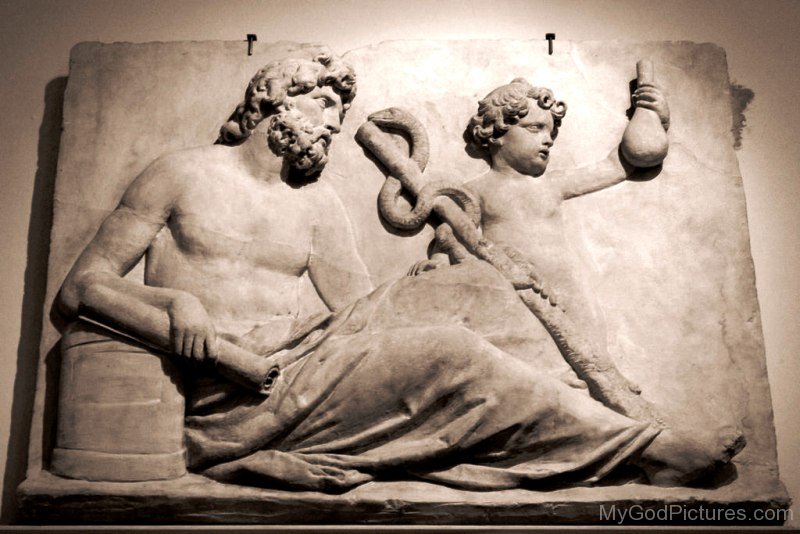
Asklēpiós was, and is, a much beloved Theos. He started out being honored as a hero--the son of Apollon and Koronis--but became a God in His own right because of his healing skill. Worship places of Asklēpiós were called 'asklepieia' (Ἀσκληπίεια). An asklepieion (Ἀσκληπιεῖον) served as a temple, a hospital, and as a training-institute of the healing arts. In ancient Hellas, the sick would come to an asklepieion and offer a sacrifice to Asklēpiós--amongst the recorded sacrifices are black goats or sheep, gold, silver, or marble sculptures of the body part that required healing, and coins--in hopes of healing. They would then settle into the abaton (άβατον) or enkoimeterion (εγκοιμητήριοn), a restricted sleeping hall, which was occupied by the sick alone, or sometimes by a group of them, as well as a good few snakes, which are considered sacred animals of Asklēpiós.

In mythology, after His training is complete, Asklēpiós receives the blood of Médousa from Athena. Drawn from two different blood vessels in Médousa's neck, some of it can kill, and some of it can heal even the dead. Asklēpiós uses the blood to resurrect the dead, but this is against the wishes of Zeus, who kills Him. He is either placed amongst the stars as the constellation Ophiuchus, the Serpent Holder, or revived by Zeus as a God to satisfy a furious Apollon.

The Drakones were named after the Greek 'drakein' and 'derkomai, meaning 'to see clearly' or 'gaze sharply'. These were guardians, usually of wells and springs, groves, Gods, or treasure. As guardians, they were usually equipped with sharp fangs, deadly poison and/or multiple heads. In essence, they were however seen as giant snakes which--and this is wholly a personal observation--makes sense when most protective and purifying Theoi were depicted as snakes.

All sources but the ones where Agathós Daímōn is identified as Theos, represent the Agathós Daímōn as a snake; this applies to both artwork as assumed physical appearance. The Agathós Daímōn was always a positive in one's life, and was generally seen as the source of personal or familial good fortune. Libations of (unmixed) wine were given to Him with each newly opened case of wine, and during feasts and symposium, Agathós Daímōn received the first libation. When crossing a snake on the road, it was also customary to pour out a libation, just in case it was a herald of Agathós Daímōn, or Agathós Daímōn Himself.

It should be said that Harrison believes Zeus Meilichios is an epithet of Zeus superimposed over an existing snake God: Meilichios, a 'home-grown, autochtonous [deity, from] before the formulation of Zeus'. Even more telling: the cult of Meilichios was very pronounced in Boeotia, where He was worshipped as a provider of wealth (Harrison, p. 21). I pose that, at the same time Zeus became equated with Meilichios, so did the Agathós Daímōn; a daímōn of good fortune (most likely through fertility and good harvest, the two greatest blessings from the Theoi), superimposed over the snake God Meilichios, exchanging positive qualities while assuming immortality for Himself. Zeus Meilichios adopted Meilichios' cleansing and purifying qualities.

In some cult worship, Agathós Daímōn was a male deity, who was married to the Theia (daímōn?) Agathe Tyche. Their worship was known in Athens, and They had a temple at Lebadeia, in Boeotia, where one could visit the oracle of Trophonios--but only after spending a fixed number of days in a building, which was sacred to the 'Agathei Theoi'--which probably refers to Agathe Tyche and Agathós Daímōn together--and most likely housed one or several snake(s). It was this building the suplicant was brought back to when he returned from the oracle--usually passed out from the experience--in order to recover.

Archaeologists suspect that Athena, Médousa and Poseidon found their origins in Libya. They came to Hellas through Crete at the dawn of Hellas. In the beginning of Her rein, Athena may have been a snake and fertility Goddess--a trait she shared with her Libyan counterpart, who had Her own cult--and may have either had a priestess who fit the Médousa myth or--and this is more likely--Médousa had her own cult as a snake, fertility and (menstrual) blood Goddess. Especially the latter may be linked to the myths concerning Médousa's blood.

Athena's role as a snake and fertility Goddess is still visible in the myth about the child she had with Hēphaistos;  Erichthonios (Ἐριχθόνιος), who was half man, half snake. It's even posed that in the early days, Athena was married to Hēphaistos and had His child willingly. As Athena was stripped of Her roles as a fertility and snake Goddess, Médousa's myth came into being, where Athena distances Herself from sex and snakes, by punishing an epithet of herself (Athena Tritogeneia, perhaps: 'born of Trito', a lake which was supposedly located in Libya), or the Libyan snake Goddess Médousa, who may have still been attached to Her worship. By placing Médousa's head on Her breastplate or shield, Athena's mythology is continuously linked to Her Libyan heritage, but harmlessly so, to Her new image of a virginal warrior.

Few references remain to Médousa's Libyan cult. There's vague reference to Médousa being a patron of Libya as a whole, or that she was the Goddess most worshipped by the Amazons. She was linked to protection, snakes, menstrual blood, blood, fertility, and femininity in general. If this is true, it's understandable why her worship did not match the Hellenic religion: for one, she's most likely a very powerful female deity. This did not match the hierarchy of the ancient Hellens, and so, Médousa became a monster, and was dealt with accordingly. Blood was one of the fluids that caused serious miasma, and menstrual fluid wasn't even spoken of in ancient Hellas, let alone revered. Not a single Goddess would have it in their portfolio.
Of course, this is not a complete list, but it is a starting point, and one I might build further on. Now our snake season is about to start again (and my girlfriend is fearfully eying the pond in our garden) I figured it would be good to have a reminder of the important mythology and customs surrounding snakes.
Mental illness in ancient Hellas was often considered as sent by the Gods, either in punishment, as a lesson, or even a reward. It depended on the illness. I'd like to share some of the Gods and Goddesses especially willing to assist when you are suffering from mental illness or a dangerously low level of mental health spoons. I'm sure it won't surprise you that many of Them also take care of the body--the two are intrinsically linked, after all.

The most obvious deities associated with any form of health are Asklēpiós and His daughter Hygeia. the ancient Hellenes didn't really distinguish between mental and physical health, and so both came to be petitioned for both, although Hygeia seemed especially receptive to lending aid in the mental department.

Apollon
For neither Apollon, nor Dionysos who follows, I have 'from the top of my head'-sources, so file this one under UPG for today. I'll get back to it. Apollon is a healing God, and the father of Asklēpiós. By extension alone, He can also be petitioned for mental health aid, and UPG-wise, it makes sense to me; as a God of Light, that tends to be exactly what is missing in my head when I trigger; light. Hope. All I can see is what happened over and over again, and I get sad, and guilty, and dark. Apollon can burn that darkness away and offer relief to an aching head and heart.

Dionysos
Again, file under UPG for now, but Dionysos can bring madness, and take it away as well. He is a God whose main influence is felt on the mind, and His influence can be both positive and negative. Until I get the research in, let me tell you a story; sometimes I can feel the darkness coming on. It used to happen a lot when I was still a teen and in my early twenties, although it's been blissfully stable the last few years. Whenever I would feel that, I would dance to the loudest music I could find--uplifting music that I put on high volume on my speakers or headphones, and then I would just dance. I'd dance until I was out of breath and my feet hurt, and my back hurt, and I would pray to Dionysos to lift my burdens from me all the while. I'd dance until I collapsed, and I would always, always, feel better. That is the kind of relief Dionysos offers--the one you need to work for, the one that hurts, but also the one that is so very rewarding in the end.
It's the holiday season, and that means vacationing! For those who are visiting Greece this year--or who are planning to visit it in the future--I would like to give you my top fifteen of sites to visit, things to do, and thing to see as a Hellenist visiting this beautiful country. Let's start the countdown and happy holidays!

15. Klaros
This was an ancient Hellenic sanctuary on the coast of Ionia, an ancient region of central coastal Anatolia in present-day Turkey. It contained a temple and oracle of Apollon, honoured here as Apollo Klarios, and was considered a very important centre of prophecy as in Delphi and Didyma. It may have dated back to the sixth or seventh century BC, and is perhaps even older. It was also the site of ancient games, held every five years.

Aristotle is one of the most famous Greek philosophers and scientists. He was born in Northern Greece in a town called Stagira, in 384 BC. He founded the Peripatetic School (Wandering School), an informal institution where members tried to answer difficult scientific and mostly philosophical questions. After Aristotle’s death, a legend travelled around Greece that he used to walk while teaching, mainly around Stagira. There are various paths for visitors to choose from, depending on difficulty and length, and there are paths for mountain biking also. In addition to the trail, the local community recently opened an Aristotle theme park.

The Athens Festival institution, in collaboration with the Diazoma association, have taken the initiative of opening 25 ancient Greek theatres and archaeological sites to the public in order to promote the country’s cultural heritage. Most are ancient Hellenic theatres will host various theatrical productions during the summer. For an overview of the sites, go here.

12. Samothrake
Samothrake is a Greek island in the northern Aegean Sea. It was the home of the Sanctuary of the Great Gods, site of important Hellenic and pre-Hellenic religious ceremonies. In ancient times, the site served as a worship area to Axieros, a deity related to Cybele and Demeter, Kadmilos, an ithyfallic deity identified with Hermes, and the Cabeiri, ithyfallic demons identified with the Dioskouroi. It was also the site of a Mystery Cult. Currently, the site houses some fo the treasures found at the site, in both a storehouses and a museum.

11. Naxos
Naxos is a Greek island, the largest island in the Cyclades island group in the Aegean. It was the centre of archaic Cycladic culture. According to Hellenic mythology, young Zeus was raised in a cave on Mount Zas ('Zas' meaning 'Zeus'). It boasts ruins of a temple of Apollon, as well as one of Demeter, and it also has many beaches that draw heaps of tourists.

Built c. 330 BC over the remains of an earlier temple, the Temple of Zeus lies in the centre of the Sanctuary of Zeus at Nemea. The 9,240 square foot Temple played a significant role in the Nemea Games, one of the original Pan-Hellenic Games of Ancient Greece. It was before this Temple that, prior to the Nemea Games, the athletes would pay homage to the father of their gods, Zeus. The Temple’s construction included three Greek architectural forms, the Doric, the Corinthian, and the Ionic. 32 limestone columns each standing 42 feet tall, and composed of 13 cylindrical stones, called “drums”, each weighing approximately, 2.5 tons, surrounded the Temple of Zeus.

This is a local community within the regional unit of Messenia, and is located in the far south of modern Greece. Most of the area of Ancient Messene contains the ruins of the large classical city-state of Messene refounded by Epaminondas in 369 BC, after the battle of Leuctra and the first Theban invasion of the Peloponnese. The ancient city can be visited and is a major tourist attraction. In ancient times, it was founded by helots (Spartan slaves) running from Sparta. The defensive wall they built around the city to keep them out still exists in some places. The most important monuments of the archaeological site are the Asklepieion (see 7), the Temple of Poseidon, the Sanctuary of Demeter and the Dioskouroi, the stadium and gymnasium of Heroon where sons of noble families were trained, as well as the Theatre of Messeni, which has recently been cleared for a make-over.

8. The palace of Knossos
The palace of king Minos at Knossos is legendary because it was home to the minotaur who roamed the maze beneath it. In the myth, Theseus--a young, brave, hero--lets himself be amongst those who will be sacrificed to it, and with the help of Ariadne's string, is able to kill the minotaur and leave the maze again, unharmed. It's one of the myths that everyone knows. The palace in which the myth takes place, however, is less well known but equally impressive. It is an architectural marvel, which was incredibly ahead of its time. Even the ruins are impressive. Knossos was undeniably the capital of Minoan Crete. The ruins of the palace are located about twenty minutes south of the modern port town of Iraklio.

7. Epidaurus
Worship places of Asklēpiós were called 'asklepieia'. An asklepieion served as a temple, a hospital, and as a training-institute of the healing arts. The most famous of all the asklepieia was located at Epidaurus, and large parts of it are preserved. The site is open to visitors. In ancient Hellas, the sick would come to an asklepieion and offer a sacrifice to Asklēpiós--amongst the recorded sacrifices are black goats or sheep, gold, silver, or marble sculptures of the body part that required healing, and coins--in hopes of healing. They would then settle into the abaton or enkoimeterion, a restricted sleeping hall, which was occupied by the sick alone, or sometimes by a group of them, as well as a good few snakes.

Epidaurus also boasts a famous theatre. It's was--and is--a huge theatre, seating 15.000 people. The theatre was designed by Polykleitos the Younger in the 4th century BC. In the time of the Hellens, the theatre had thirty-four rows. Another twenty-two were added in the time of the Romans. While there were many theatres in ancient Hellas, the theatre of Epidaurus is famous for its perfect acoustics. Even today, you can hear a match being struck on the stage from any point in the theatre. For a limestone construction that's 2400 years old, that's pretty impressive.

6. Olympia
A sanctuary located in Elis, known for having been the site of the Olympic Games in classical times. The sanctuary consists of an unordered arrangement of various buildings including the Temple of Hera, the Temple of Zeus, the Pelopion (the alleged tomb of Pelops) and the area of the altar where the sacrifices were made. The hippodrome (a stadium for horse racing and chariot racing) and later stadium were also nearby. The Prytaneion (the building where the officials and winners of the Olympic games mets) and the Philippeion (an Ionic circular memorial) are located to the north of the sanctuary, as well as the array of treasuries representing the various city states. In Ancient Hellas, Olympia was sacred ground to the Greeks.

5. Kórinthos
Kórinthos, or Corinth, is a city and former municipality in Corinthia, Peloponnese, Greece. It is located about 78 kilometres (48 miles) southwest of Athens. Ancient Kórinthos was a city-state (polis) on the Isthmus of Corinth, the narrow stretch of land that joins the Peloponnesus to the mainland of Greece, roughly halfway between Athens and Sparta. The modern town of Corinth is located approximately 5 kilometres (3.1 miles) northeast of the ancient ruins. Ancient Corinth was one of the largest and most important cities of Greece, with a population of 90,000 in 400 BC. After the Romans built a new city in its place and made it the provincial capital of Greece in 44 BC, the city population was between 100,000 to 700,000 according to different sources. It boasts many museums filled to the brim with findings from various ancient sites, and boasts the 'Acrocorinthis', the acropolis of ancient Corinth, two ports, a converted a temple to Aphrodite, a temple of Apollon, and many, many, other site to visit.

4. Delos
The island of Delos near Mykonos, near the centre of the Cyclades archipelago, is one of the most important mythological, historical and archaeological sites in Greece. Investigation of ancient stone huts found on the island indicate that it has been inhabited since the 3rd century BC. By the time of the Odyssey the island was already famous as the birthplace of the twin gods Apollo and Artemis. Between 900 BC and AD 100, sacred Delos was a major cult centre where Dionysus is also in evidence as well as the Titaness Leto, mother of the divine twins. Eventually acquiring Panhellenic religious significance, Delos was initially a religious pilgrimage for the Ionians. The island houses the Temple of the Delians (Apollon and Artemis), the famous Terrace of the Lions, several market squares, the Temple of Hera, the House of Dionysus', and much, much, more.

The temple complex at Eleusis was one of the most elaborate and widely used sanctuaries around in ancient Hellas. It was the home of the Eleusinian Mysteries, and thus served as the cult's sanctuary. The Mysteries had festivals throughout the year, which were tied to agriculture through Demeter'srefusal to perform her duties as an agricultural Theia while her daughter Persephone is with Hades, and to the afterlife and Underworld through Persephone's return to the surface of the earth after Her mandatory stay with Hades has ended. Initiation ceremonies were held every year at Eleusis. Of all the mysteries celebrated in ancient times, the mysteries at Eleusis are assumed to be of great importance to a large portion of the ancient Hellens. The cult itself likely has origins dating back to the Mycenean period of around 1600 to 1100 BC, and it is believed that the cult of Demeter Herself was established in 1500 BC.

2. Athens
Athens is a sprawling city established among seven historic hills and surrounded by remarkable mountains. Inhabited for more than 3,000 years, Athens is widely known as the cradle of Western civilization and the birthplace of democracy. As the largest and capital city of Greece, Athens is also the political, commercial, financial and cultural centre of Greece. It boasts a great variety of sites for the Hellenistic tourist to visit, from the Acropolis, to the New Acropolis Museum, to the National Archaeological Museum, to the temple of Olympian Zeus, to Aristotle’s lyceum,and much, much, more. The Acropolis boasts the Parthenon, the Propylaia, the Erechtheion and the Temple of Athena Nike, and the The 'Lyceum' was a gymnasium and before that a public meeting place in a grove of trees in Classical Athens. It was named in honour of Apollo Lyceus. Though best known for its connection with Aristotle, the Lyceum was in existence long before his founding the school there in 334 / 335 BCE, providing a teaching ground for long list of philosophers and sophists, including Prodicus of Ceos, Protagoras, Isocrates, Plato, and Socrates.

1. Delphi
The number one always had to be Delphi. The Delphi complex held the temple of Apollon, the Amphictyonic Council (a council of representatives from six Greek tribes that controlled Delphi and also the sports events), various treasuries where the votive offerings to Apollon and/or the oracle were stored, the altar of the Chians (the main altar, located in front of the temple of Apollon, funded by the people of Chios, the stoa of the Athenians (A series of seven futed columns, used to house Athenian war trophies and collect the stories of freed slaves), Sibyl rock (the rock where the prophet Sibyl sat to deliver her prophecies), a theatre, the Tholos (the sanctuary of Athena Pronaia), a gymnasium, a stadium, the Hippodrome (where the running events took place), the Polygonal wall, the Castalian spring, and a large variety of athletic statues. The complex was also the site of one of the Panhellenic Games.

The site was at the epicenter of important travel routes; the road leading from northeastern and eastern Hellas to the plain of Amfissa--where it met the road joining northern Hellas with Naupactus--passed through Delphi. From the beach of Itea, it was easy to pass to nearby Peloponnesus. This not only made Delphi an important religious site, but a commercial one, and it was one of the major keys to its success.