Showing posts with label Samothrace. Show all posts
Emory University and the Institute of Fine Arts at New York University completed a summer of excavations at the Sanctuary of Great Gods on Samothrace in northern Greece on August 8, the Greek Ministry of Culture said on Friday.


It was the first excavation session after a 22-year hiatus, focused on the stoa in the western section of the sanctuary and the monuments on the terrace it stood on, as well as on the publication of the area's findings. Emory professor Bonna Wescoat was lead excavator for a new five-year research project, carried out through the American School of Classical Studies in Athens and supervised by the Evros Ephorate of Antiquities.

The sanctuary was dedicated to the mystery cult of the Great Gods, and was first excavated in 1873 by Austrians. Findings suggest that there was religious activity on the site in the 7th century BC, but construction of the monumental buildings began in the 4th century BC and is associated with the royal house of Macedon. The sanctuary attained its greatest glory in the 3rd and 2nd centuries BC, and was abandoned towards the end of the 4th century AD.

This year’s excavations on the western section of the sanctuary included the stoa, the perivolos (a court surrounded by a low wall) where the famed Nike of Samothrace statue stood, and the theatre.
Excavations at the theatre brought to light anew some architectural pieces found at excavations in 1923, fragments of statue bases made of red rhyolite and white limestone, and the remnants of a large ceramic pipe with a diameter of around 0.25 m, which ran under the theatre, the ministry said.

“The stoa is impressive both for its scale - around 104 metres in length - and its material, because it is the only large monument in the sanctuary that has been constructed solely of local limestone, which came from the quarry of Akrotiri, near the present area of Kamariotissa. The terrace surrounding the Stoa was an excellent spot of showcasing large-scale votive offerings which surrounded the Stoa. The most impressive of all undoubtedly was the Nike of Samothrace monument.” (The statue is in the Louvre Museum in Paris.)

It added that although there is no single stone on its retaining wall that survives in its original position, a multitude of architectural pieces have been found: more than 1,700 limestone pieces, 1,000 fragments from the roofing and multiple fragments from the decoration of interior walls.

The excavating team also worked further on a 3D digital model of the Sanctuary, the ministry added, on the measurements and ratios of architecture on Samothrace, and on the analysis of local stones used in architecture and statuary of the sanctuary.
Let's do another news round-up, shall we, as much has happened in and concerning Greece--and no, I am nto talking about the current economic situation, which is of course horrible. Today on the agenda: signs of second shipwreck found at Antikythera, the Kore of Thera will be on display as of next year, and the Acropolis Museum celebrates its sixth anniversary with antiquities from Samothrace.


Signs of second shipwreck found at Antikythera

The Archaeology News Network reports that the Ephorate of Underwater Antiquities, in collaboration with the American Woods Hole Oceanographic Institution, has completed the digital underwater surveying and dimensional precision display of the Shipwreck of Antikythera.

Last year’s imprinting pinpointed the exact shipwreck site of the vessel that carried the Antikythera Mechanism. However, the proximity of other findings such as anchors and amphorae from the same era made archaeologists consider the possibility that there was a second cargo vessel that accompanied the original ship. Therefore it became imperative to map a wider area of 350X45 meters approximately.

Archaeologists now can put all the findings together and draw conclusions about the possible relationship between the two wreck positions. The detailed mapping creates a clearer picture of the relationship between the two sites, while the placement of the findings in the now imprinted area enhances the understanding of all the findings in the two positions.

Resources for the investigation/excavation were provided by the Woods Hole Oceanographic Institute, American, European and Greek organizations, to meet the needs in qualified technical and scientific personnel. The Catherine Laskaridis Foundation contributed greatly by offering the vessel that was used as the basis of the research team.

The Ephorate of Underwater Activities and its partners will continue research at the end of the summer season. The Antikythera shipwreck research is conducted on a five-year plan. The mapping was done by a specialized team of the University of Sydney using the autonomous underwater vehicle Sirius.

Kore of Thera will be on display as of next year
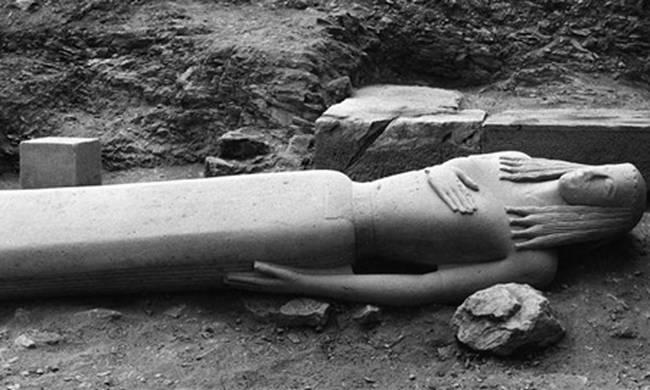
A 2.3-meter-high archaic-era statue dubbed the 'Kore of Thera', which was found during excavations on Santorini 15 ago will be exhibited on the renowned holiday island’s archaeological museum next year, the culture ministry announced. Additionally, an agreement between the ministry and the island’s municipal government will fund excavation in the area of Medieval Kastelia. Thera is the ancient name of the island.


Acropolis Museum celebrates its sixth anniversary with antiquities from Samothrace
The Acropolis Museum is celebrating its sixth anniversary on June 20 with the inauguration of the temporary exhibition 'Samothrace. The mysteries of the great gods'. The exhibition, a cooperation of the Acropolis Museum and the Antiquity Ephorates of the prefectures of Rodopi and Evros and the expert of Samothrace antiquities Dimitris Matsas, will open for the public on June 20 and will run until September 30. The museum’s Board of Directors President, Dimitris Pandermalis, stressed in a Press Conference about the exhibition that:

“In our country we have the advantage that most of the exhibitions presented in museums can be related to archaeological sites and excavations. Moreover, the history of the discovery and preservation of antiquities enriches our knowledge and allow for a better interpretation of the exhibits”

The relationship between the ancient Hellenes and their Gods was well known and existed publicly in daily life. However, from very early times, mystery cults began to emerge that were accessible only to those who had been accepted into the rites following certain trials. The most famous ‘Mysteries’ in antiquity were those of Eleusis and Samothrace. The strict prohibition against insiders ever divulging the contents of the sacraments has not allowed much information to be gleaned about the ancient mysteries. Archaeological excavations in the Sanctuary at Samothrace, however, have brought to light buildings and paraphernalia belonging to the cult that allow us to form an impression of events.

“Insiders believed that by invoking the Great Gods they would be saved from any serious dangers at sea and, as members of the Mysteries, they would become more just and pious people. The rituals were held at night, the Sanctuary illuminated with torches, during which initiates had to participate in a purification ceremony, to confess their greatest sins, to attend the sacred narrative speech that included mythological stories, to wear the wide, purple sash around their waists and to witness the unveiling of sacred symbols."

As an introduction to the Mysteries of Samothrace, an assortment of finds has been selected from the site of Mikro Vouni, located a few kilometers southwest of the sanctuary, where excavations have revealed a settlement with an organized social structure of the 2nd millennium BC. Of particular importance are the Minoan stamp seals and seal impressions with representations of a double ax and fish, which have counterparts at Knossos. Perhaps the ancient tradition that gave rise to the Mysteries originated in prehistoric Crete and from there spread to other places, where it became the basis for subsequent historical developments.

The arrangement of the exhibition within the gallery is inspired by two circular constructions in the sanctuary. The first is the Theatral Circle with tiers for standing spectators, an altar in the center and pedestals around the periphery for statues from which survive many examples of bronze eyelashes. In this place was also discovered the golden lion of Persian origin, which once adorned a garment or object. For the content of the exhibition, please visit this article on The Archaeological News Network.
Well, the government might be having some trouble, but Greece is not forgetting the ancient monuments. News of the continuation of not one, not two, but three restoration projects recently came over The Archeology News Network; Delphi, the Sanctuary of the Great Gods and the Medieval castle of Samothrace, and the Temple of Apollo in the ancient city of Side are all getting make-overs.


Delphi:
The Operational Program Thessaly will invest €600,000,- ($803,000,-) to enhance and preserve the ancient holy site of Apollon. The restoratory work will focus mostly on the Temple of Apollo, the sanctuary of Athena Pronaia, the Gymnasium and Castalia.

After the site is thoroughly surveyed, the work will focus on cleaning up and restoring several key features of Delphi's survived monuments. The mosaics will be cleaned, the fixation of surfaces of monuments will be checked and restored where needed, and an ancient bronze column will be constructed and placed at the Hippodrome of Constantinople. Another primary focus will be the improvement of the functionality and aesthetics of the site as well as some interventions which aim at a better serving of disabled people. 

Samothrace:
The National Strategic Reference Framework (NSRF)-- the reference document for the programming of European Union Funds at national level for the 2007–2013 period--will fund the conservation works at the Sanctuary of the Great Gods and the Medieval castle of Samothrace. In ancient times, the site served as a worship area to Axieros, a deity related to Cybele and Demeter, Kadmilos, an ithyfallic deity identified with Hermes, and the Cabeiri, ithyfallic demons identified with the Dioskouroi. Surrently, the site houses some fo the treasures found at the site, in both storehouses and a museum.

The Archeology News Network reports that excavations at the area have ceased since 1995.  There are, nevertheless, some areas where conservation works are urgent. The work will be carried out in two phases, both taking three years. From the article:

"The first phase of the project includes the reconstruction of the terraces, the conservation of the architectural members and the rest of the monuments at the Easter Sector. Among them is the Propylon of Ptolemy II. In the second phase, the monuments on the western side of the Sanctuary will be restored, and in the third phase the works will focus on the central area of the site, where the most significant buildings of the Great Gods’ worship are."

Another feature of Samothrace is its castle. The aim of the renovations is to make the castle visitable, which means that work on the fortification of the walls will continue, the last of the surfaces of structural members with decayed plaster will be jointed, and when summer arrives, the area surrounding the castle will be cleaned up and made safe, opening the way for tourists and other interested parties to wander the castle itself, and not just look upon it from a distance.

Side:
The Turkish Ministry of Culture and Tourism has launched a restoration project for the historic Temple of Apollo in the ancient city of Side, stating that the project is undertaken to preserve the cultural and historic assets of the ancient city of Side, which has great importance as a tourist attraction in the country. The temple's remainig columns suffer from corrosion from the moisture and saltwater right next to the temple, and are in need of some fortification.

The Ministry of Culture attempts to cycle through restoration and preventitive work on its national treasures, being well aware of the national value of these monuments. The 2000 year old temple to Appollon is next on the list, after a 35 year waiting period since its last restauration.

The Networt reports that the project is being led by Assistant Professor Hüseyin Alanyalı and his wife, Assistant Professor Feriştah Alanyalı, who also launched a landscaping project around the restored sites in Side--the Temple of Apollo, the Temple of Tyche, the Temple of Dionysus, the Temple of Athena and a basilica--last year. It seems ot me the temple of Apollo is in good hands, indeed.


All images taken from their respective articles, as linked to in this post.