Showing posts with label Magick. Show all posts
One of those days, people... one of those days... I'm going to have to leave you with a bit of ancient text, and I want to broaden the horizon a little today by giving you one of the spells/prayers from the Papyri Graecae Magicae, also known as the 'Greek Magical Papyri'. They are a body of papyri from Graeco-Roman Egypt, which each contain a number of magical spells, formulae, hymns and rituals. The materials in the papyri date from the 2nd century BC to the 5th century AD. The manuscripts came to light through the antiquities trade, from the 18th century onwards. One of the best known of these texts is the so-called Mithras Liturgy.

Today I would like to quote the logos--the invocatory utterance--of the document. It would have been spoken upon entering the magical rites and it's uzzeling and deliciously un-Hellenic. Enjoy!


Logos

"O Primal Origin of my origination; Thou Primal Substance of my substance; First Breath of breath, the breath that is in me; First Fire, God-given for the Blending of the blendings in me, [First Fire] of fire in me; First Water of [my] water. the water in me; Primal Earth-essence of the earthy essence in me; Thou Perfect Body of me - N. N. son of N. N., son of N.N. (fem.) - fashioned by Honoured Arm and Incorruptible Right Hand, in World that's lightless, yet radiant with Light, [in World] that's soulless, yet filled full of Soul!
If, verity, it may seem good to you, translate me, now held by my lower nature, unto the Generation that is free from Death; in order that, beyond the insistent Need that presses on me, I may have Vision of the Deathless Source, by virtue of the Deathless Spirit, by virtue of the Deathless Water, by virtue of the [Deathless] Solid, and [by virtue of] the [Deathless] Air; in order that 1 may become re-born in Mind; in order that 1 may become initiate, and that the Holy Breath may breathe in me; in order that 1 may admire the Holy Fire; that 1 may see the Deep of the [New] Dawn, the Water that doth cause [the Soul] to thrill; and that the, Life-bestowing Æther which surrounds [all things] may give me, Hearing.
For 1 am to behold to-day with Deathless Eyes - I, mortal, born of mortal womb, but [now] made better by the Might of Mighty Power, yea, by the Incorruptible Right Hand - [I am to see to-day] by virtue of the Deathless Spirit the DeathlessÆon, the master of the Diadeins of Fire - I with pure purities [now] Purified, the human soul-power of me subsisting for a little while in purity; which [power] I shall again receive transmitted unto me beyond the insistent Bitterness that presses on me, Necessity whose debts can never go unpaid - I, N. N., son of N. N. (fem.) - according to the Ordinance of God that naught can ever change.
For that it is beyond my reach that, born beneath the sway of Death, I should [unaided] soar into the Height, together with the golden sparklings of the Brilliancy that knows no Death. Stay still, O nature doomed to Perish, [nature] of men subject to Death! And straightway let me pass beyond the Need implacable that presses on me; for that I am His Son; I breathe; I am!"
Thirty lead tablets engraved with curses have been discovered at the bottom of a 2,500 year old well in ancient Athens. Discovered in the area of Kerameikos, ancient Athens’ main burial ground, the small tablets invoked the Gods of the underworld in order to cause harm to others. They were called katadesmoi and I have written about them before here.


These curses were ritual texts, usually scratched on small lead objects. “The person that ordered a curse is never mentioned by name, only the recipient,” observes Dr. Jutta Stroszeck, director of the Kerameikos excavation on behalf of the German Archaeological Institute in Athens.

Before the discovery of the 30 specimens in the well, dozens of curses from the classical period (480-323 B.C.E.) had been found mainly in tombs of dead people who had died in an untimely manner and were therefore thought suitable to carry the spell to the underworld. One had also been found in another well. But there was good reason for the transition of ill-will from graves to wells in ancient Athens.

The well where the curses were found was excavated in 2016 by a team under Stroszeck’s direction while investigating the water supply to a bathhouse about 60 meters beyond the Dipylon - the city-gate on the road to the Academy. It was a public bathhouse, not a private one, that operated from Classical to Hellenistic times,  the fifth to the first centuries B.C.E., and is thought to be the spa referred to by the comic playwright Aristophanes (Knights, 1307-1401). It was also mentioned in a speech by the 4th century B.C.E. Greek rhetorician Isaeus (against Kalydon, fragment 24).

Despite more than a century of excavations in Kerameikos, the well had not been excavated before. Previous work in the area had been done by the architect Heinz Johannes and the archaeologist Kurt Gebauer, but was interrupted by World War II. None of the excavators survived the war: Johannes was sent to the Russian front and died there in 1945, and Gebauer died in an airplane crash over Vienna in 1942. Only recently were the excavations at the bathhouse resumed.

Inside the well the archaeologists found a wealth of material, including drinking vessels (skyphoi), wine mixing vessels (krater), clay lamps, cooking pots, special broad-mouthed clay pots used to draw water (kadoi), wooden artifacts including a trinket box, a scraper used by potters, a wooden pulley, part of the drawing mechanism of the well) a number of bronze coins, as well as organic remains such as peach pits. And the curses.

Apparently, there’s a reason the hexes were in the well. According to Cicero (De Legibus II 66), Demetrios of Phaleron, who ruled Athens in 317-307 B.C.E. enacted legislation to govern the management of tombs. He also created a new magistrate’s office to oversee adherence to the law: et huic procurationi certum magistratum praefecerat.

“Black arts” were frowned on in Athens to begin with, and with the new law governing the cemetery, hexes couldn’t just be placed in tombs any more, as had been the habit (35 had been found in the graves of Kerameikos, in previous excavations).

So, ill-wishers by the last years of the fourth century B.C.E. had to find other points of contact with the underworld gods, Stroszeck explains. It seems they came up with the stratagem of covertly tossing their curses into wells.

The well is ten meters deep and at its bottom, the archaeologists found a built-in pedimented niche about a meter in height, made of limestone. It is true that the denizens of Athens would never see it, but it wasn’t for them. It was dedicated to the well’s water nymph.

“Water, and in particular drinking water, was sacred. In Greek religion, it was protected by nymphs, who could become very mischievous when their water was treated badly.”

To appease these emotionally precarious godlets, offerings such as miniature vessels containing liquids and other gifts were thrown into in the water.


The 30 new tablets have been documented using reflectance transformation imaging, an digital technique that enables even the smallest inscriptions on lead to be read. The archaeologists hope to ultimately learn the name of the nymph, the nature of the curses and whether the targets of the hexes were any of the famous Athenians living in the city during the late fourth century B.C.E.

The excavations conducted by the German Archaeological Institute in the Kerameikos since 1913 unearthed about 6,500 burials.

The Kerameikos graves from the Classical period were ornate, marked with stelai, reliefs, sculpted animals, or marble vases. Grave markers in Hellenistic times were much simpler. In any case, this area was characterized by transition: from urban to rural land, and from the city of the living to the realm of the dead.

Why would the ancient Athenians place their curses in graves anyway? Because of the superstition that the souls of certain types of dead remained active around the tombs for a while after death, making them suitable bearers of the curses to the netherworld, where hopefully the chthonic gods would do the curser’s bidding.

Inscriptions found at ancient Kourion in Cyprus in the 1930s give precise instructions on how cursing was to be done. A tablet hexing a person very much alive had to be put in the tomb of the fresh corpse of a person who died prematurely – having failed to complete the “normal” life cycle, such as a child or an unmarried person; or a person who died by violence, like murder victims or war casualties, Stroszeck says. As their souls were believed to be “unquiet,” they could carry messages between the underworld and the mortal sphere.

All 35 curse tablets from tombs of the Kerameikos cemetery were situated at the necropolis’ borders, including in the children’s necropolis and in a polyandrion, a communal grave for fallen soldiers.

There seemed to have been four main types of reasons to curse someone: to win a lawsuit (by cursing the opponent’s tongue and hands, for example); for business purposes, for instance cursing metalsmiths, bankers, prostitutes and pimps; to win athletic contests; and – of course – because of love and hate.

The norm was to hire a professional curse writer, who was believed to possess supernatural powers and would know the requisite procedures and spells. The completed curse tablet was folded up, pierced with an iron nail (defixio), and was sometimes nailed to the wooden coffin of the deceased conveyer.

And then there were the curses that weren’t done in secret. One of Athens’ most infamous sons, the general Alcibiades, was cursed very much in public.

Alcibiades had been a disciple of Socrates and was known for adopting the customs of whatever places he visited. For instance, in Sparta he was renowned for his cold baths and drinking black broth; in Thrace he was reportedly always drunk; and in Athens he became an orator who deliberately pronounced his r’s as l’s, since in this city, it was considered virtuous to lisp.

However, the day after his election as the admiral of an Athenian expeditionary force to Sicily during the Peloponnesian War, it so happened that the citizens of Athens discovered that the stone genitalia of the city’s hermes (rectangular boundary stones featuring a phallus and a head) had been broken off. Rumor spread that Alcibiades and his drunken companions were responsible for the vile deed. When the news reached Alcibiades, he became so afraid that he fled to Sparta and turned traitor. This merited him to be publically cursed in Athens.

Another person with the ill fortune to be publically cursed was Cassandros, one of Alexander the Great’s generals. The tablet cursing him was found inside a well near the Dipylon, the main gate of Athens and the principal point of entry of everyone in the city.

Although the curse tablet was cleverly deposited so that Cassandros would be cursed when he made his first public appearance upon entering Athens, the spell seemed to have had little effect on him. He died a natural death, unlike many of his Macedonian peers, who were mostly either poisoned or killed in battle.

One has to wonder why a civilization that developed philosophy, science and logic would stoop to black magic. The answer may be very concrete, and may date back to the mid fifth century B.C.E. at the time of the dedication of the Parthenon atop the acropolis, the acme of the ambitious building program on that hill at the initiative of the Athenian statesman Pericles.

The construction of the Parthenon met with a fair amount of opposition. Some felt, not without reason, that it was not right to use the federal (union) treasury for municipal purposes in Athens.

Pericles answered that as long as Athens was fulfilling its defense obligations, it owed no accounting to its allies over its use of the tribute money.

But the criticism did not ebb, and Pericles was attacked both by satirists and in the general assembly. During a famous speech by Thucydides, son Melesias, against Pericles construction program at the Pnyx, the meeting place of the Athenian assembly, Thucydides managed to incite passions of the assembly against his political opponent –but in the middle of his speech his jaw suddenly dropped and he had to leave the platform. Probably he had been struck by stroke, but to the people it looked like Thucydides had been effectively cursed. This incident could explain the sudden increase of curse tablets in the Kerameikos during the 5th century B.C.E.

Far more images here.
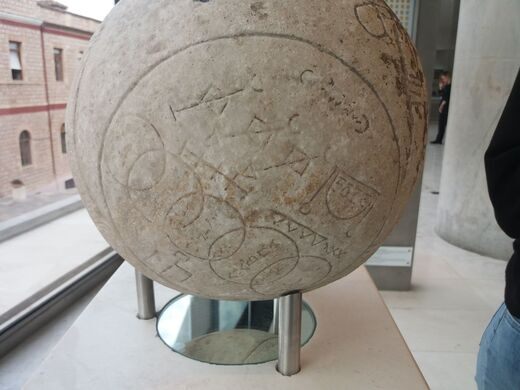
I have a research project. I came across this blog post yesterday, which talks about the "sphere of Helios". It's currently in the Acropolis Museum. I had never heard of it, which is not odd, considering the many things there are to hear about. How about you guys?


"The celestial symbols covering this odd orb bewitch the imagination. And according to some, that’s exactly the point, as it’s thought the ancient Greeks may have used the sphere in magic rituals.
The large marble sphere was found in 1866 at the Theater of Dionysus, which stands at the foot of the famed Acropolis. It’s believed the curious orb was created sometime between the second and third centuries CE.

Not much is known about the strange sphere. Because it was found buried near the Theater of Dionysus—a place where duels and other sporting events were held—it’s said the ball may have been used in magic rituals by those hoping to win.

The carvings adorning the sphere are mysterious and mystical. Most agree the human figure is a depiction of Helios, the god of the Sun. He sits atop a grand throne, clutching a whip in one hand and three lit torches in the other. A great beast rests at his feet, which is said to be either a lion or a dog and is thought to represent a constellation.

Other animal and celestial symbols cover the rest of the sphere. Scan the globe, and you’ll come across a whole medley of magical, alchemistic, and astral symbols."
Papyri Graecae Magicae, also known as the "Greek Magical Papyri," are a body of papyri from Graeco-Roman Egypt, which each contain a number of magical spells, formulae, hymns and rituals. The materials in the papyri date from the 2nd century BC to the 5th century AD. The manuscripts came to light through the antiquities trade, from the 18th century onwards. As part of the papyri, spells for a variety of things were recorded. One is a prayer to Eros as part of a love spell. I'd like to share that today.


Prayer to Eros
"I call upon you, author of all creation, who spread your own wings over the whole world, you, the unapproachable and unmeasurable who breathe into every soul life-giving reasoning, who fitted all things together by your power, firstborn, founder of the universe, golden-winged, whose light is darkness, who shroud reasonable thoughts and breathe forth dark frenzy, clandestine one who secretly inhabit every soul.

You engender an unseen fire as you carry off every living thing without growing weary of torturing it, rather having with pleasure delighted in pain from the time when the world came into being. You also come and bring pain, who are sometimes reasonable, sometimes irrational, because of whom men dare beyond what is fitting and take refuge in your light which is darkness.

Most headstrong, lawless, implacable, inexorable, invisible, bodiless, generator of frenzy, archer, torch-carrier, master of all living sensation and of everything clandestine, dispenser of forgetfulness, creator of silence, through whom the light and to whom the light travels, infantile when you have been engendered within the heart, wisest when you have succeeded; I call upon you, unmoved by prayer, by your great name

[F]irst-shining, night-shining, night rejoicing, night-engendering, witness, you in the depth, you in the sea, clandestine and wisest. Turn the ‘soul’ of her to me, so that she may love me, so that she may feel passion for me, so that she may give me what is in her power. Let her say to me what is in her soul because I have called upon your great name.”
One of those days, people... one of those days... I'm going to have to leave you with a bit of ancient text, and I want to broaden the horizon a little today by giving you one of the spells/prayers from the Papyri Graecae Magicae, also known as the 'Greek Magical Papyri'. They are a body of papyri from Graeco-Roman Egypt, which each contain a number of magical spells, formulae, hymns and rituals. The materials in the papyri date from the 2nd century BC to the 5th century AD. The manuscripts came to light through the antiquities trade, from the 18th century onwards. As part of the papyri, spells for a variety of things were recorded. Two include prayers to Helios. I'd like to share those today.


Prayer to Helios: A charm to restrain anger and for victory and for securing favor
Instructions: Say to the Sun (Helios) seven times, and anoint your hand with oil and wipe it on your Head and Face.

"Rejoice with me, You who are set over the East Wind and the World, for whom all the Gods serve as Body-Guards at Your Good Hour and on Your Good Day, You who are the Good Daimon (God) of the World, the Crown of the Inhabited World, You who arise from the Abyss, You who Each Day rise a Young Man and set an Old Man. I beg You, Lord, do not allow me to be Over-Thrown, to be Plotted Against, to receive Dangerous Drugs, to go into Exile, to fall upon Hard Times. Rather, I ask to obtain and receive from You Life, Health, Reputation, Wealth, Influence, Strength, Success, Charm, Favor with all Men and all Women, Victory over all Men and all Women. Yes, Lord, accomplish this Matter which I want, by means of Your Power.”
[PGM XXXVI.211-30]

Spell to Helios: Consecration for All Purposes
“I invoke You, the Greatest God, Eternal Lord, World Ruler, who are over the World and under the World, Mighty Ruler of the Sea, rising at Dawn, shining from the East for the Whole World, setting in the West. Come to me, Thou who risest from the Four Winds, benevolent and lucky Agathos Daimon, for whom Heaven has become the Processional Way. I call upon Your Holy and Great and Hidden Names which You rejoice to hear. The Earth flourished when You shone forth, and the Plants became fruitful when you laughed; the Animals begat their Young when You permitted. Give Glory and Honor and Favor and Fortune and Power to this, NN, Stone which I consecrate today (or to the Phylactery [charm] being consecrated) for [or in relation to] NN. I invoke You, the greatest in Heaven, the Shining Helios, giving Light throughout the Whole World. You are the Great Serpent, Leader of all the Gods, who control the Beginning of Egypt and the End of the Whole Inhabited World, who mate in the Ocean. You are He who becomes Visible each Day and Sets in the Northwest of Heaven, and Rises in the Southeast.

In the 1st Hour You have the Form of a Cat.
Give Glory and Favor to this Phylactery.
In the 2nd Hour You have the Form of a Dog.
Give Strength and Honor to this Phylactery, or to this Stone, and to [name].
In the 3rd Hour You have the Form of a Serpent.
Give Honor to the God [name].
In the 4th Hour You have the Form of a Scarab.
Mightily strengthen this Phylactery in this Night, for the Work for which it is consecrated.
In the 5th Hour You have the Form of a Donkey.
Give Strength and Courage and Power to the God, [name].
In the 6th Hour You have the Form of a Lion, the Ruler of Time.
Give Success to this Phylactery and Glorious Victory.
In the 7th Hour You have the Form of a Goat.
Give Sexual Charm to this Ring (or to this Phylactery, or to this Engraving).
In the 8th Hour You have the Form of a Bull, who becomes visible everywhere.
Let all Things done by the use of this Stone be accomplished.
In the 9th Hour You have the Form of a Falcon, the Lotus Emerged From the Abyss.
Give Success and Good Luck to this Phylactery.
In the 10th Hour You have the Form of a Baboon.
[Prayer for gift omitted?]
In the 11th Hour You have the Form of an Ibis.
Protect this great Phylactery for Lucky Use by [name], from this Present Day for All Time.
In the 12th Hour You have the Form of a Crocodile.
[Prayer for gift omitted?]

You who have set at Evening as an Old Man, who are over the World and under the World, Mighty Ruler of the Sea, hear my Voice in this Present Day, in this Night, in these Holy Hours, and let all done by this Stone, or for this Phylactery, be brought to fulfillment, and especially NN matter for which I consecrate It. Please, Lord! I conjure Earth and Heaven and Light and Darkness and the Great God who created All, SAROUSIN, You, Agathon Daimon the Helper, to accomplish for me everything done by the Use of this Ring or Stone!”

When you complete the Consecration, say, “The one Zeus is Serapis!”
[PGM IV.1596-1715]
"Hello, when you say that Hellenismos is clear in our status as 'humans' then what do you think of the orphic mysteries which were part of Hellenismos? Those mysteries say we have a divine essence, a part of Dionysus within us. You may not agree with that, but to neglect the fact that many ancient greeks believed that just to say that magic isn't traditional and it's hubris is not right."

Orphism is part of Hellenic esotherism. Yes, it existed--we have enough little references in ancient writings to say that with some form of certainty--but it obvious it was a cult at best; a group of people who went against the traditional practice or practiced Orphism alongside it as it was more of a philosophical choice than a religious one. They wore white, abstained from meat and strove for purity. Books featured heavily in their worship, unlike in mainstream religious practice. Like all things in ancient Hellas, Orphism linked back to the Gods, mostly by including Dionysos in the form of Bakkhos, the Twice-Born God, which confirmed the believes of the Orphics.

The Orphics believed in reincarnation and the possibility of liberation from another of their believes: the circle of life and death. Orpheus, the movement's legendary founder, is said to have taught that soul and body are locked together during life; the soul is divine, immortal and aspires to freedom, and during life, the body acts as a prison to the soul. Death releases the soul for a short while, but is then captured by another body until that, too, dies, and so the soul moves from body to body--both human and animal--until it can attain the highest good: liberation. In order to reach liberation, the Orphic way teaches to turn to God by ascetic piety of life and self-purification: the purer the life lived, the higher will be the next reincarnation, until the soul has completed the spiral ascent of destiny to live for ever as God from whom it comes.

Orphic ideas of the soul and afterlife are most often defined by explicit contrast with the Homeric view of the afterlife, which is taken as the standard view for ancient Hellenic culture. The Homeric afterlife is that of a grim, joyless and tedious existence in the Underworld. The Underworld of Homeros exists solely--at least for the now departed mortal--of the Asphodel meadows. The dead drink from the river Lethe and forget who they were. Sacrifical (animal) blood returns a sense of life to the shades and they recover their memories for a short time. In this tradition, life is lived while you are alive. Once you die, you are dead. You might cling to life, but you will never truly be part of it again.

Orphism most likely formed somewhere in the 6th or 5th century BC but most of the evidence we still have of it is much younger. The best known collection of texts associated with Orphism are the Orphic Hymns, a collection of 86 hymn to the Hellenic Gods. Some of them may date back to the time of the cult's founding but most were written much later, in the third or second century BC.

From the evidence that has survived, we know that Orphism was considered to be rather...fringe. Plato considered them and anyone claiming they possessed some sort of supernatural knowledge or skills as charlatans. Euripides in 'Hippolytus' (428 BC) has main character Theseus say:

"Come, show your face to your father, eye to eye, since in any case I have already involved myself in pollution. Are you, then, the companion of the gods, as a man beyond the common? Are you the chaste one, untouched by evil? I will never be persuaded by your vauntings, never be so unintelligent as to impute folly to the gods. Continue then your confident boasting, take up a diet of greens and play the showman with your food, make Orpheus your lord and engage in mystic rites, holding the vaporings of many books in honor. For you have been found out. To all I give the warning: avoid men like this. For they make you their prey with their high-holy-sounding words while they contrive deeds of shame."

I consider Orphism a very valid path. I think it's one impossible to reconstruct accurately based on the evidence we have, but I absolutely agree that there were Orphics in ancient Hellas. I'm quite sure I have never denied that. The fact that the Mystery Traditions existed (not just Orphism but the Eleusinian ones, Hermeticism, etc.) does not take away from my opinion that modern magical Traditions are not traditionally Hellenic and that they have no place in Traditional Hellenismos. I have said many times before there was a form of magic practiced in ancient Hellas, and it always included the divine; an alternate expression of the same religion, so to speak. Modern magical practice would have been unrecognizable to the ancient Hellenes.

Again, I want to stress that this concerns Traditional Hellenismos--as everything on this blog does. That is my practice, and it is what I understand best. If you want to practice magic; go for it. Who am I to tell you can or cannot do something? As far as I am aware, I have said no such thing as was sent to me, so please do not put words in my mouth.
I get a lot of questions from readers, and most of the time, the answers are fairly short. When I feel the question or the reply would be valuable to others as well, I make a post with a collection of them and post them in one go. Today is one of those posts. Also: this is question collections post number sixty. Sixty! With an average of four answers per posts, that is at least 240 questions answered--say 250 because I like whole numbers. 250 answers. Quite the achievement. Here is to at least 250 more!


"Is there a Hellenic version of Yule or Winter solstice celebration?"

The closest thing we have to it is the Poseidonia or Poseidea or Poseideia. During the Poseidonia, Poseidon as savior of ships, protector of those who voyage in ships, and God of the lapping waters both salt and fresh important for agriculture, is thanked for the many gifts that came from faraway places that were likely given at that time. The immense trade and distribution was nearly all through shipping, relatively little overland, whether it be perfume from Cyprus or pottery from Corinth. Celebrating Poseidon's Festival seems to be lost in modern practice. It likely entailed bonfires, feasting, cutting of trees (probably decorated), and very likely gift giving. As God of begetting, that aspect was not forgotten.

We don't know, exactly, when the festival took place. Scholars have both claimed and disclaimed it took place during or near the Winter solstice. Elaion generally places it around the winter solstice; it's a point in time the ancient Hellenes would have been able to observe and they most likely did.

~~~
 
"Thoughts on Hermeticism?"

The Hermetic tradition represents a non-Christian lineage of Hellenistic Gnosticism and has greatly influenced the Western esoteric tradition. It was considered to be of great importance during both the Renaissance and the Reformation. The tradition claims descent from a doctrine which affirms that a single, true theology exists which is present in all religions and was given by God to man in antiquity. The Hermetica form the basis of Hermeticism. They discuss the divine, the cosmos, mind, and nature. Some touch upon alchemy, astrology, and related concepts. They are Egyptian-Greek wisdom texts from the 2nd and 3rd centuries AD, which are mostly presented as dialogues in which a teacher, generally identified as Hermes Trismegistus ('thrice-greatest Hermes'), enlightens a disciple. Many Christian writers considered Hermes Trismegistus to be a wise pagan prophet who foresaw the coming of Christianity.

I have stressed before on my blog the importance of narrowing down your practice to a time period and even a location. The reign of the Hellenes lasted for roughly 650 years. During that time, several major changes took place within the culture and religion of these people. Trying to reconstruct all these practices is not only impractical but also impossible. As a Hellenic Recon, it therefor becomes important to find out which classical, Hellenic, period speaks to us--and if we want to go beyond the scope of those time periods into the Graeco-Roman and Graeco-Egyptian. Of even more importance, perhaps, is if you want to follow or include mystery Traditions, like those taught at Eleusis, or by the Orphics, or even those found in the Papyri or Hermetica.

Hermeticism has no place in my personal practice. I base my practice on older traditions as that is what I am most comfortable with. that choice is a personal one and I do enjoy reading texts like the Hermetica. It's just not a religious text for me.

~~~
 
"Why do you not think the use of magic is ok? I mean like what if you worship hades and hekate? "
I do think the practice of magic is okay, I just don't think it's Traditional. I am of the rather strong opinion that modern witchcraft has no place in Hellenismos--especially when that witchcraft is defined as acts which allow humanity influence over their lives and those of others, outside of the realm of the Gods. I call anything else 'praying', and if you need tools for that, than I take no issue besides the fact that it's non-Traditional--save for when it is.

Something I often hear about the ancient Hellenic religion, and prescribed about its modern equivalent, is that there was no magic in ancient Hellas. This is true. It's also a lie. It all depends on your definition of magic. Yes, there was 'magic' and 'witchcraft' in ancient Hellas and its mythology, but not in the way we know it now; this was divine magic; a manifestation of a trait major Gods manifest with a thought and for which lesser deities require a medium to manifest. Their powers, however, are still the powers of a God. This is exactly why I feel we, as Hellenists, should pray to the Gods for any aid we might require, and blessings we would wish upon our lives; to practice magic ourselves would be to equate ourselves with the (minor) Gods, and Hellenismos is clear upon the status of humans: we are human, not divine. In my view, to practice magic is to practice hubris, and that is decidedly dangerous in a Hellenistic context.

The ancient Hellenes worshipped Hekate just like they did other Gods. They worshipped Plouton (an Ouranic epithet of Hades) like that as well. In general, they did not worship Hades--or very rarely. Hades adn hekate were nto equated with the practice of magic; Hekate, if anything, was equated with protection from magic--mostly against the Evil Eye. Practicing magic, in a Traditional practice, makes absolutely no sense, and so I do not. that does not mean I am against it. I think the practice of magic is beautiful. To me, it just does not belong in Hellenismos.
One of those days, people... one of those days... I'm going to have to leave you with a bit of ancient text, and I want to broaden the horizon a little today by giving you one of the spells/prayers from the Papyri Graecae Magicae, also known as the 'Greek Magical Papyri'. They are a body of papyri from Graeco-Roman Egypt, which each contain a number of magical spells, formulae, hymns and rituals. The materials in the papyri date from the 2nd century BC to the 5th century AD. The manuscripts came to light through the antiquities trade, from the 18th century onwards. One of the best known of these texts is the so-called Mithras Liturgy.

Today I would like to quote the logos--the invocatory utterance--of the document. It would have been spoken upon entering the magical rites and it's uzzeling and deliciously un-Hellenic. Enjoy!


Logos

"O Primal Origin of my origination; Thou Primal Substance of my substance; First Breath of breath, the breath that is in me; First Fire, God-given for the Blending of the blendings in me, [First Fire] of fire in me; First Water of [my] water. the water in me; Primal Earth-essence of the earthy essence in me; Thou Perfect Body of me - N. N. son of N. N., son of N.N. (fem.) - fashioned by Honoured Arm and Incorruptible Right Hand, in World that's lightless, yet radiant with Light, [in World] that's soulless, yet filled full of Soul!
If, verity, it may seem good to you, translate me, now held by my lower nature, unto the Generation that is free from Death; in order that, beyond the insistent Need that presses on me, I may have Vision of the Deathless Source, by virtue of the Deathless Spirit, by virtue of the Deathless Water, by virtue of the [Deathless] Solid, and [by virtue of] the [Deathless] Air; in order that 1 may become re-born in Mind; in order that 1 may become initiate, and that the Holy Breath may breathe in me; in order that 1 may admire the Holy Fire; that 1 may see the Deep of the [New] Dawn, the Water that doth cause [the Soul] to thrill; and that the, Life-bestowing Æther which surrounds [all things] may give me, Hearing.
For 1 am to behold to-day with Deathless Eyes - I, mortal, born of mortal womb, but [now] made better by the Might of Mighty Power, yea, by the Incorruptible Right Hand - [I am to see to-day] by virtue of the Deathless Spirit the DeathlessÆon, the master of the Diadeins of Fire - I with pure purities [now] Purified, the human soul-power of me subsisting for a little while in purity; which [power] I shall again receive transmitted unto me beyond the insistent Bitterness that presses on me, Necessity whose debts can never go unpaid - I, N. N., son of N. N. (fem.) - according to the Ordinance of God that naught can ever change.
For that it is beyond my reach that, born beneath the sway of Death, I should [unaided] soar into the Height, together with the golden sparklings of the Brilliancy that knows no Death. Stay still, O nature doomed to Perish, [nature] of men subject to Death! And straightway let me pass beyond the Need implacable that presses on me; for that I am His Son; I breathe; I am!"
This blog is very lite on talk of magic, and that is for good reason: I am of the rather strong opinion that modern witchcraft has no place in Hellenismos--especially when that witchcraft is defined as acts which allow humanity influence over their lives and those of others, outside of the realm of the Gods. I call anything else 'praying', and if you need tools for that, than I take no issue besides the fact that it's non-Traditional--save for when it is. Recently I was asked about magic, though, so I've collected some existing words from this blog into a more cohesive blogpost on the subject. The question was:

"Did the ancient Hellenes practice magick? Is it ok to practice magick as a Hellenic polytheist? If so, is it then better to keep the Theoi out of the practice even though it involves their relms for example Poseidon and sea magic or Demeter and earth magic. Why is this a taboo subject in Hellenismos but not in Asatru for example. The Nordic people saw their Gods as the source of magic. Is this opposed to our ideas of the nature of the Theoi? Yet again we can never know their true nature."

Something I often hear about the ancient Hellenic religion, and prescribed about its modern equivalent, is that there was no magic in ancient Hellas. This is true. It's also a lie. It all depends on your definition of magic, and for the purpose of this reply, we are going to see magic as a form of prayer and ritual, conducted outside of the usual ritual steps. The Theoi were always invoked, but for magic, the sacrifices were usually to the khthonic, or Underworld Gods. When reading this post about a very specific subset of this type of magic, try to disassociate it with the modern use of the word: the same goes for 'spells', 'cursing', and 'binding'.

The ancient Hellenes were a competitive people, and struggled with many of the issues we do today: the urge to perform well, the desire for justice to be served, and a need for love. Prayers for these things were made often, usually in their normal ritualized form at the house altar. If these requests were made against, or at the expense of another person, however, they were generally taken out of the realm of regular worship and kharis, and into the realm of the khthonic. The preferred form were katadesmoi.

Katadesmoi are relatively small tablets, inscribed with a desire asked of the Theoi to fulfil. The Katadesmoi that have survived were generally made out of very thin sheets of lead, which were then rolled, folded or pierced with nails. Wax, papyrus, stone, precious metals, and precious minerals would also have been used as a medium. Some katadesmoi were accompanied by a small doll representing the intended victim or even a lock of their hair, especially in the case of love spells. In general, the katadesmoi always included the name of the intended victim and the name(s) of the appropriated Gods--most often Hades, Kharon, Hekate, and Persephone. Exceptions have been found, of course.

There have been around 1600 katadesmoi found around the whole of Hellas, and the practice was wide-spread. In fact, for the Olympic Games, competitors had to vow to Olympian Zeus that they would not cheat, and curse their opponents. Divine retribution would befall those competitors who did. A large percentage of the katadesmoi found contained love spells ("I want [name] to love me beyond all others"), or legal desires ("May [name] stumble on his words in defence of himself"), but many other ill wishes have been found.

Katadesmoi were usually deposited where they would be closest to the Underworld: in chasms, pools of water, wells, caves, temples to the deity in question, buried underground, or placed in graves. The latter was usually a special form, however, and the katadesmoi placed with the dead were usually requests to avenge the death of the deceased.

In general, katadesmoi were used out of desperation: regular channels had been exhausted, human courts would never convict the perpetrator of a crime, or the murderer could no be found. Pleading with the Gods--who knew more, saw more, ad had a much farther reach--was considered the only alternative to get justice. This was even the case in many love spells. Katadesmoi were not made willy-nilly: there needed to be a strong incentive to make one.

One other such incentive was the fear that a katadesmos curse had been placed upon you. In this case, the subject of the curse could make their own, and ask that the perpetrator of the katadesmos may suffer for it, and that his or her katadesmos may have no effect at all, except maybe to backfire on them. In this case, the katadesmos acts as a binding curse.

There is magic in the Classics as well; the most famous witch in Hellenic mythology is undoubtedly Kirkê (Κιρκη)--better known by her Roman name, Circe. She is the woman whom Odysseus comes upon on the island Aiaia, who turns his men into pigs, and keeps Odysseus with her--and in her bed, no less--for a year before she helps him get back to his quest to return home. The account of Kirkê is one of the founding myths for the modern witch stereotypes: she is the evil temptress, free with her sexuality, and freer with the magic that women possess by nature. She seduces Odysseus while beguiling his men, transforming them into docile animals--de-humanizing them, and stripping them of their masculinity. In the end, Odysseus overcomes her, and leaves, outside of her grasp forever. At least, that is the modern interpretation of her character.

Kirkê, in the time of Hómēros was not evil at all, yet she was dangerous. Kirkê, when looked at through the lens of ancient Hellenic society, is Odysseus' superior by far. It may seem a bit off-topic to go into this, but I must to make my point. Kirkê is the daughter of the Sun God Helios--which makes her a Goddess in her own right, but a more accurate term would be 'Nymph', putting her in control of nature. Her pedigree--by default--means that Odysseus can never master her, as Odysseus may be the favourite of the Gods, but he is not divine himself.

So, what of her magic? Kirkê is a Goddess whose powers manifest through herbs; what she does to men is not much different as many other--more powerful--Gods do unto humans as well with just a thought; Hellenic mythology is full of humans who get turned into animals (or plants) for their protection, or for the protection of the God in question. It's important to note that in the Odysseia, Kirkê's 'victims' are happy and domesticated; they are friendly and curious to visitors and Kirkê alike.

Kirkê's status over Odysseus takes her away from being a witch in the modern sense; she is a Goddess, and as someone lower in standing, Odysseus' wishes are something she can take into advisement but only needs to agree upon out of a sense of honour, not because her magical hold over him has broken. She never controls Odysseus--the moly potion/herb Odysseus is given establishes that--and they work out an agreement where they are on roughly equal footing, with Kirkê forever having the upper hand, but bound by her personal honour and oath to Odysseus. Her magic--her divinity--is made a moot point between them.

The Odysseia gives plenty of reasons why the words 'witch' and 'witchcraft' are dangerous for modern interpretation. These powers--and those that use them--are established as divine, taking these powers fully outside of the realm of humanity. Yes, there was 'magic' and 'witchcraft' in ancient Hellas and its mythology, but not in the way we know it now; this was divine magic; a manifestation of a trait major Gods manifest with a thought. These lesser deities require a medium to manifest their powers--especially in the case of Kirkê--but their powers are still the powers of a God. This is exactly why I feel we, as Hellenists, should pray to the Gods for any aid we might require, and blessings we would wish upon our lives; to practice magic ourselves would be to equate ourselves with the (minor) Gods, and Hellenismos is clear upon the status of humans: we are human, not divine. To practice magic is to practice hubris, and that is decidedly dangerous in a Hellenistic context.

Again, I want to stress that this concerns Traditional Hellenismos--as everything on this blog does. That is my practice, and it is what I understand best. If you want to practice magic; go for it. Who am I to tell you can or cannot do something? As for Asatru; it's hard--and in my opinion useless--to compare ancient cultures like this. The people were different, the thoughts about the divine were different, and unless you are a soft polytheist who conflates all Gods and Goddesses, lumping them and their culture together is detrimental to all Gods in question. Again, my opinion. Magic is a touchy subject in Hellenismos because it borders on hubris, and as a Traditional Hellenist I find myself shying away from everything that could possibly induce hubris and damage my kharis with the Gods. I gave up my magical practice--as sporadic as it was--once I progressed into Hellenismos. It's a personal choice, but one that was very clear for me. How you decide is up to you.
I am of the rather strong opinion that modern witchcraft has no place in Hellenismos--especially when that witchcraft is defined as acts which allow humanity influence over their lives and those of others, outside of the realm of the Gods. I call anything else 'praying', and if you need tools for that, than I take no issue besides the fact that it's non-Traditional--save for when it is. As a blogger with that opinion, I sometimes get asked 'but what about all the witchcraft in the classics?', and it's a good question. I shall attempt to explain today why I feel the two are not the same, and how these displays of magical abilities are actually proving my point for me. Before I do so, though, I want to stress that I take no issue with witchcraft itself; I practiced it for years--abide sporadically--and think it's a beautiful, powerful, thing. This post is about witchcraft in Hellenismos, nothing else.

The most famous witch in Hellenic mythology is undoubtedly Kirkê (Κιρκη)--better known by her Roman name, Circe. She is the woman whom Odysseus comes upon on the island Aiaia, who turns his men into pigs, and keeps Odysseus with her--and in her bed, no less--for a year before she helps him get back to his quest to return home. The account of Kirkê is one of the founding myths for the modern witch stereotypes: she is the evil temptress, free with her sexuality, and freeer with the magic that women possess by nature. She seduces Odysseus while beguiling his men, transforming them into docile animals--de-humanizing them, and stripping them of their masculinity. In the end, Odysseus overcomes her, and leaves, outside of her grasp forever. At least, that is the modern interpretation of her character.

Kirkê, in the time of Hómēros was not evil at all, yet she was dangerous. Like all men of his time, Hómēros understood very little of women, knowing mostly that they did strange things to the minds and body's of men when men laid their eyes upon them. Remember; ancient Hellas was a place where adult men and adult women rarely happened upon each other in a setting where they were allowed to interact. For men, women were almost an entitrely different species.

Kirkê, when looked at through the lens of ancient Hellenic society, is Odysseus' superior by far. It may seem a bit off-topic to go into this, but I must to make my point. Kirkê is the daughter of the Sun God Helios--which makes her a Goddess in her own right, but a more accurate term would be 'Nymph', putting her in control of nature. Her pedigree--by default--means that Odysseus can never master her, as Odysseus may be the favorite of the Gods, but he is not divine himself. Looking into the account in book ten of the Odysseia, there are a variety of ways in which Odysseus is established as respecting and enjoying Kirkê's influence in his life, and even more ways in which it is established Kirkê is his superior:
  • Kirkê is of divine blood, while Odysseus is human
  • Odysseus needs moly, a herb which acts as a potion, provided by Hermes in warning, to counter the effects of Kirkê's potion
  • Kirkê is established as an expert in her craft, while Odysseus is unskilled enough to need the help of the Gods
  • Kirkê is shown as a good woman--and a good wife--by stressing her expertise in crafts
  • When Kirkê lifts her rod to Odysseus, he takes it as a thread, bringing out his sword to meet her--in short, he finds her powerful and worthy enough to percieve her as a threat
  • The two come to an agreement and an oath which they can both live with, with the purpose of establishing thrust between them
  • Kirkê is shown as keeping her oath--something very honorable in ancient Hellenic mythology and society
  • Odysseus is shown enjoying the time he has spent with Kirkê, as equals
  • Kirkê keeps her word, and lets Odysseus and his men go without harm; she even gives him good advice
  • When she transforms his men back, they are younger and more powerful than before
So, what of her magic? Kirkê is a Goddess whose powers manifest through herbs; what she does to men is not much different as many other--more powerful--Gods do unto humans as well with just a thought; Hellenic mythology is full of humans who get turned into animals (or plants) for their protection, or for the protection of the God in question. It's important to note that in the Odysseia, Kirkê's 'victims' are happy and domesticated; they are friendly and curious to visitors and Kirkê alike.

Kirkê's superiority to Odysseus matters, because it takes her away from her being a 'temptress' and inherently evil. Being allowed to spend a year with her is an honor to Odysseus in the same way sexual advances of a (male) God upon a mortal was considered an honor--or at least a privilege of the deity in question. In fact; Kirkê's status over Odysseus takes her away from being a witch in the modern sense; she is a Goddess, and as someone lower in standing, Odysseus' wishes are something she can take into advisement but only needs to agree upon out of a sense of honor, not because her magical hold over him has broken. She never controls Odysseus--the moly establishes that--and they work out an agreement where they are on roughly equal footing, with Kirkê forever having the upper hand, but bound by her personal honor and oath to Odysseus. Her magic--her divinity--is made a moot point between them.

If we look at Kalypsô (Καλυψω), another Nymph-Goddess in the Odysseia, we can see the similarities between her and Kirkê, but also the obvious differences. Like with Kirkê, Odysseus makes Kalipsô swear an oath for his safety, but their truce is shaky one; Kalypsô is not a better witch, though, she is a worse woman. It is not her magic that Odysseus mistrusts, but her. Kalipsô is over-emotional and willing to push the boundaries of her oath whenever she can. Kirkê, on the other hand, is emotionally stable, and does not burden Odysseus with her sadness at his leaving. She helps him along, makes him and his men better, and offers advice and prayers to the Gods. Kalipsô only cares about keeping Odysseus with her, and she keeps him for a much longer period of time. She also curses the Gods for her faith in life. She is a trickster, and Odysseus does not trust her--but again, this is not to do with her witchcraft, but her person. By ancient Hellenic standards, Kalipsô is an undesirable woman due to her emotions and trickery, but it is separated from her powers, both in her character, as in the way she is viewed by Odysseus.

There are also male characters in the Odysseia who possess 'magic'. Aeolus (Αἴολος) is the son of Hippotes, who was the son of Mimas, who was the son of the first Aeolus, who, in turn, was the son of Hellen, the daughter of Deukalion and Pyrrha. He was the Keeper of the Winds in Hellenic mythology, and in the Odysseia, he is first welcoming to Odysseus and offers him the power of the winds. When he squanders it, however, Aeolus refuses any further help and nearly de-humanizes Odysseus by focusing on his humanity in a highly negative way--something Kirkê never needed to do, because her status was already well established--and so was his. Aeolus is technically human, but his power is established as divine, not magical by today's standards; in later works, he is even made into a minor God so the link between his powers and divinity is more obvious.Again, his personality is not tied to his power; Aeolus is a petty man, not because of his magic, but despite of it.

Proteus (Πρωτεύς) in the Odysseia is already a God, but Herodotos traces his line back to the kings of ancient Egypt. In the Odysseia, Proteus has the power to transform himself into frightening shapes--a trait he shares with many Gods who can and will change their shape at will--and thus his powers are not magical either, but divine.

In conclusion, the Odysseia gives plenty of reasons why the words 'witch' and 'witchcraft' are dangerous for modern interpretation. These powers--and those that use them--are established as divine, taking these powers fully outside of the realm of humanity. Yes, there was 'magic' and 'witchcraft' in ancient Hellas and its mythology, but not in the way we know it now; this was divine magic; a manifestation of a trait major Gods manifest with a thought. These lesser deities require a medium to manifest their powers--especially in the case of Kirkê and Kalipsô--but their powers are still the powers of a God. This is exactly why I feel we, as Hellenists, should pray to the Gods for any aid we might require, and blessings we would wish upon our lives; to practice magic ourselves would be to equate ourselves with the (minor) Gods, and Hellenismos is clear upon the status of humans: we are human, not divine. To practice magic, is to practice hubris, and that is decidedly dangerous in a Hellenistic context.
Doing a weekly series sure makes you realize how fast the week goes by. With the latest recap just done, we are already back for a new one. Again, there was no 'previously on', so for those needing a reminder: Jason dove from our world/time into Atlantis, made friends with Pythagoras and Hercules, saved the city or at least those in it a couple of time, and helped out a bunch of girls they have promptly fallen for. Hercules is up to his eyeballs in love with Medusa, and Jason carried a torch for Ariadne. Also, the Oracle of Poseidon has made many predictions thus far and all were ominous. On to the fun!

In today's episode, the fun starts with a shot of a half naked Hercules being scrubbed down and oiled up by Pythagoras. Is anyone shipping these two? Because I still have minor Jason/Pythagoras feels. Anyway, there is not enough oil to fully cover Hercules' impressive body, but Hercules doesn't care: he is about to fight Lysis, who looks like he'd make an awesome WBA fighter (the actor who plays him, David Garrick, has been an amateur boxer for most of his life and was in the Special Forces) and he is not the least bit worried. Not even because the guy's nickname is 'The Destroyer'. Medusa is plenty worried for him, though, and when they try to figure out a nickname for Hercules, she volunteers 'The Hero'. Cough.


Anyway, the 'Horrid Smelling' one eventually fights The Destroyer and while he makes it through the first few rounds of wrestling quite nicely, eventually gets destroyed. Medusa is shouting wonderful encouragements along the way like 'rip his head off', but it's no good. Hercules looses and has a nasty shoulder injury to boot. The friends rush to his side and Medusa tells him it was noble to let the other guy win. Hercules' heart soars for a minute, but then The Destroyer swoops Medusa up like she weighs nothing (and as if the loser's girlfriend automatically becomes yours when you beat him, which I am assuming is not the case) and Medusa laughs while Hercules asks his buddies to take him home. Enough stabs to the ego for the day.

Once at the oikos, Jason and Pythagoras wonder if there isn't an easier way for Hercules to get Medusa's attention; ones that do not involve the risk of bodily harm. Hercules says that was not at all why he did it, but no one believes him. While Hercules rests, the boys quietly discuss the situation: they had hoped Hercules' infatuation would pass, but Hercules is like a bull; he's not giving up so easily. They both feel Medusa is out of his league, and they hate it. Hercules, unfortunately, overhears.

 
In the morning, Jason is out on the town when the Oracle's right hand man finds him. He asks Jason to come with him to visit the Oracle, and he does. There is more chicken blood in water divining and the Oracle is annoyed because the dreams and visions she has been having for the last couple of days aren't clear enough for her to tell Jason more than that a powerful woman will come into his life, and it won't be a good thing. Jason wonders if the woman is Queen Pasiphaê, but while the Oracle warns him about her as well, that is not the woman from her visions. Jason is worried.

Back at the oikos, Hercules wakes up in a suspiciously good mood and indicates to Pythagoras he overheard last night's discussion. Pythagoras tried to apologize but Hercules will have none of it. He's far too chipper to listen. Instead he heads out to the temple, making a small offering, but not before eating all of Pythagoras' breakfast except for a single black olive. Those he doesn't like apparently. Once he comes out, a vendor who seems to know Hercules pretty well warns him that with his lack of appealing offerings to women, Aphrodite may never answer his prayers. Unless, of course, he is willing to try something different... One moment here to say that ancient Hellas had arranged marriages, so that while Medusa may not have been in the cards for Hercules, a wife surely would have been.

The salesman, named Elias (Jeffery Kissoon) tells him about the witches of Colchis, who create enchantments for the right price: the person's most prized possession. And one of their numbers can currently be found in the nearby mountains, living in a cave. I am fairly certain this is the woman Jason was just warned about, but who knows.

Jason returns to the oikos to find that Pythagoras has bought and made Hercules a proper I'm-sorry-for-talking-behind-your-back-meal, but Hercules has no intention of coming home: He's out in the hills, looking for a cave. Which he finds. Along with Circe of Colchis (Lucy Cohu) who not only promises not to hurt him, but knows his name. This--rightfully--freaks Hercules out. He's sticking with his quest, though, and declares he wishes to capture the heart of the woman he loves. She says she can't help him with that but he offers her a gift: the last remaining link to his father, a tooth from Cerberus ('or so he said'). Circe accepts the offering but questions why Hercules came here alone. Circe--who lets Hercules see the disfigured right side of her face--offers Hercules a jar that holds 'the song of the Sirens' (which she conveniently has on hand next to her cooking utensils). The sound will make Medusa fall for the first person she sees. She warns him, though; the enchantment is a powerful one.


A short time-out for the mythological Circe--or in the Greek: Kirkê--who was a pharmakeia, a sorceress, on the island of Aiaia. If her name sounds familiar, it's probably because she plays an important role in the Odysseia by Hómēros, where she turned Odysseus' men into pigs and forces Odysseus to stay with her for a year before he can convince her to turn them back. She is most often regarded as the daughter of Helios by the Oceanid Perse, but may have been the daughter of Hyperion as well, or even Hekate. The Argonauts on their way home also encountered her and she prayed to Zeus in their name to get the miasma of murder off of Iásōn and Mēdeia. By Roman times, her actions became a lot more spiteful and she was often depicted as jealous and petty--a view not share by Hellenic predecessors. Just something to keep in mind.

Hercules returns to Atlantis and his home, and digs into his still available meal, still happy. Korinna (who I really like, by the way) allows Hercules to visit Medusa in the palace of king Minos. This sounds like the absolute worst of plans, by the way. Why not visit her at home? Or drag her into some dark alley on the way to it? Chances are, both locations would be a lot more private than the palace kitchens. Anyway... Medusa is making bread in a conveniently abandoned kitchen and Hercules releases the Siren song. He steps into the kitchen and into her field of vision. She doesn't fall instantly into his arms--which throws Hercules quite a bit--so he has to find a way to answer her question of why he came here. He warns her about a storm that is most likely not coming and then asks her out. She agrees and Hercules becomes a rambling idiot, which Medusa seems to find endearing. He lays her hand on Hercules' cheek for a moment, leaving a flour stain, and he rushes out of the kitchen, happy as a clam.

That night, Hercules prepares for his big date while Jason and Pythagoras fuss over him. Hercules blames them for his nerves so it's only right one of them sniffs his armpits. Pythagoras gets drafted for that one, and Jason looks on in horror. Hercules' scent must be quite nice, though, because Pythagoras rattles off a list of herbs and fruits to describe the scent. Huh, good on Hercules. Medusa shows up on the doorstep looking lovely with her hair down and a dark dress on, and Pythagoras and Jason are shocked beyond words at the current turn of events.


Out on the town, Medusa twirls the flower she has gotten from Hercules and asks after his injuries. He assures her he is fine and she is relieved to hear it. They banter back and forth for a while and then visit the (walls of the) palace courtyard, completely deserted at night. In the distance, the sea can be seen. They're bonding and it's cute in a very mind bending a la Willow sort of way. Jemima Rooper delivers some of the strongest acting to date as she relates how lonely she has been in the city and how she almost didn't stay. Her ability to convey Medusa's vulnerability as spurned on by the enchantment is wonderful to watch, and Mark Addy's performance is spot on as the guy whose dreams have just come true while trying to convince himself he did not do something awful to make it so. This is especially true after the two share a kiss in front of Medusa's home.

In the morning, Jason is rudely awoken by Medusa, who is pounding on the door. I have a feeling Helios has barely left the gates at this point. She's carrying the world's largest basket of food and soon the gang is gathered about the table where Hercules eats like a king, Medusa fawns over him in fan girl fashion and the boys are trying to decide if they are actually awake or not. It seems Medusa stole the food from the palace and also has a rash on her hands. Both are not exactly good signs. An even worse sign is when Medusa and Hercules are out on the town and Medusa collapses. The rash has spread to her shoulders and chest and Hercules takes her home so Pythagoras can have a look at her. She's still completely out--never a good sign.


Pythagoras is worried, but not as worried as Hercules whom Pythagoras sends on an errand for herbs. By the time night falls, Medusa is still sick--perhaps even sicker--and the boys are devastated. Hercules sits by her bedside throughout the night and Pythagoras shares his fears with Jason: she is getting worse and witchcraft is to blame. If this is the case, only an enchantment will be able to heal Medusa. Medusa, meanwhile, has woken up but looks horrible. She says she wouldn't change anything about the past few days--anything--and Hercules finally can't stand the lies anymore. He comes clean to his friends as Medusa rests.

The rash has spread to Medusa's face and Hercules cares for her rapidly wilting body while Jason and Pythagoras go through notes and herbs like madmen, trying to figure out a way to save Medusa. Another night passes with Hercules by Medusa's bedside and when the boys find nothing to cure Medusa, he visits Circe again in the morning. Circe toys with him for a while and then divulges her true plan: get Jason to her. Korinna comes to take care of Medusa while the boys go after Hercules.

En route to the cave, Jason and Pythagoras realize they are being followed... by a pig. Which continues to follow them, despite Pythagoras trying to get the pig to sod off. Jason muses that it almost seems like the pig is trying to tell them something...


At night, in the camp, Jason tells Pythagoras about the Oracle's warning and Pythagoras nearly orders him to go home. Jason, obviously, does not. In the mean time, the pig drinks all the wine and eats all the food. Save for one, black, olive. Realization suddenly dawns on Pythagoras and he tries to convince Jason that that pig is, in fact, Hercules. Jason doesn't buy it until the pig farts. He'd recognize that smell anywhere. Jason is a little amused at the situation, but it is worrying.

The tree of them--pig first--head to Circe's cave. Circe sees them coming, obviously, and awaits them after enchanting the water to reveal a freaking dragon! She sends a dragon after them! A flying one! I'd be into it if a flying dragon was not completely outside of Hellenic lore. Jason makes short work of it though--in a very impressive manner--and I try to scrub the affair from my brain. Pythagoras is injured, forcing Jason to go on alone--exactly what the Oracle warned him against.

 
In the dark of the cave, Circe and Jason converse. She tried to convince Jason that they are allies. She will heal both Medusa and Hercules if Jason fulfills a request. She explains she once had a home and husband, before it all got taken away and she was reduced to living in a cave. She wants Jason to kill her sister--the woman who took everything away from her. She ensures Jason that this is the only way to save Hercules and Medusa. Back in the camp, Pythagoras understands if Jason will not do it.

Circe is not surprised when Jason returns to her. Circe lays an oath on Jason in name of Hekate, ensuring that he will fulfill his end of the bargain, and she will hers. I'm not sure how, exactly, but it looks like it hurts. The kicker comes afterwards, though: Circe's sister? None other than Pasiphaê. Aren't you glad I saved that bit of family history for the big reveal?

Back home, Medusa's illness is going away and Hercules is back to his human self. Even in her weakened state, Medusa is livid at Hercules for what he has done and made her go through, and Hercules is heartbroken. He understands, though; he can hardly blame her. He's eternally hopeful for a happy ending.

Jason, trapped in his oath, visits the Oracle for guidance. She sits with him and gets him to tell the whole story. He shows her a burn on his arm, which the Oracle rightly interprets as an oath, and he tells her what he promised Circe. The Oracle is distraught, knowing full well that this can only end badly. She covers his hand with both of hers in a sign of sympathy and Jason can only look on--spooked.

 
Next week on Atlantis: Minos announces Ariadne's marriage to Heptarian, Jason and Heptarian duel, and Ariadne is stupendously worried about her hero. Saturday on BBC One, recap on Monday.
Something I often hear about the ancient Hellenic religion, and prescribed about its modern equivalent, is that there was no magick in ancient Hellas. This is true. It's also a lie. It all depends on your definition of magick, and while I want to spend another blog post on that subject at a later date, let me say for now that for the purpose of this post, we are going to see magick as a form of prayer and ritual, conducted outside of the usual ritual steps. The Theoi were always invoked, but for magick, the sacrifices were usually to the khthonic, or Underworld Gods. When reading this post about a very specific subset of this type of magick, try to disassociate it with the modern use of the word: the same goes for 'spells', 'cursing', and 'binding'. That having been said: this post is about katadesmoi (κατάδεσμοi); cursing tablets, or binding tablets.


The ancient Hellenes were a competitive people, and struggled with many of the issues we do today: the urge to perform well, the desire for justice to be served, and a need for love. Prayers for these things were made often, usually in their normal ritualized form at the house altar. If these requests were made against, or at the expense of another person, however, they were generally taken out of the realm of regular worship and kharis, and into the realm of the khthonic. The preferred form were katadesmoi.

Katadesmoi are relatively small tablets, inscribed with a desire asked of the Theoi to fulfill. The Katadesmoi that have survived were generally made out of very thin sheets of lead, which were then rolled, folded or pierced with nails. Wax, papyrus, stone, precious metals, and precious minerals would also have been used as a medium. Some katadesmoi were accompanied by a small doll representing the intended victim or even a lock of their hair, especially in the case of love spells. In general, the katadesmoi always included the name of the intended victim and the name(s) of the appropriated Gods--most often Hades, Kharon, Hekate, and Persephone. Exceptions have been found, of course.

There have been around 1600 katadesmoi found around the whole of Hellas, and the practice was wide-spread. In fact, for the Olympic Games, competitors had to vow to Olympian Zeus that they would not cheat, and curse their opponents. Divine retribution would befall those competitors who did. A large percentage of the katadesmoi found contained love spells ("I want [name] to love me beyond all others"), or legal desires ("May [name] stumble on his words in defense of himself"), but many other ill wishes have been found.

Katadesmoi were usually deposited where they would be closest to the Underworld: in chasms, pools of water, wells, caves, temples to the deity in question, buried underground, or placed in graves. The latter was usually a special form, however, and the katadesmoi placed with the dead were usually requests to avenge the death of the deceased.

In general, katadesmoi were used out of desperation: regular channels had been exhausted, human courts would never convict the perpetrator of a crime, or the murderer could no be found. Pleading with the Gods--who knew more, saw more, ad had a much farther reach--was considered the only alternative to get justice. This was even the case in many love spells. Katadesmoi were not made willy-nilly: there needed to be a strong incentive to make one.

One other such incentive was the fear that a katadesmos curse had been placed upon you. In this case, the subject of the curse could make their own, and ask that the perpetrator of the katadesmos may suffer for it, and that his or her katadesmos may have no effect at all, except maybe to backfire on them. In this case, the katadesmos acts as a binding curse.

We will revisit katadesmoi in the grander scheme of political and social structures at a later date, but for now it is important to realize that the practice was frowned on by many philosophers (most notably Plato), but that the act was not considered 'evil'. It was a form of protection, and a vessel for justice. It was regarded as such.

Personally, I see no need for katadesmoi, and have struggled against these urges in times of need. I see their appeal, but my modern frame of mind would not do them justice, I think, and therein lies lots of potential for trouble. I wouldn't encourage anyone to use katadesmoi, but would understand if they did in times of need. Still, I would rather place my trust in the Theoi, regardless of curses or bindings.
I am trying to graduate. So far it's been a frustrating, humiliating and painful experience. Things keep going wrong and then I have to go through the institution to get them corrected. So far it's 3-0 for the institution, no matter how far I've gone over my own limits and have groveled to get some help--any kind of help.

The banes of my existence are currently one computer program, one man and enough bureaucracy to cover everyone's ass but mine. It's beyond frustrating and we've only just started round four. If I loose this round, I'm looking at another year of college which I can not afford due to some insane fines the government has put on sixth year student--even if they are doing a second study. In short, if I fail, I don't know what I'm going to do.

And so I'm tempted to turn to the Gods and magick for aid. I haven't done this before, not actively. I have asked the Gods to strengthen me and help me remember the theory and I've done magick towards the same goal but I have never implored either to influence someone who was unaware of me doing so.

The thought of it makes me nauseous but I don't see another option. I don't know if I'll be able to go through with it, mostly because I worry I might not be able to keep my anger under control and steer the Gods or the spell wrong. I know the man isn't screwing me over intentionally; he is as bound by the bureaucratic BS as I am... but taking it out on him would be so easy. I have enough anger to power some pretty desperate spells. And that scares me. I don't know if I want to take responsibility for an act like that.

Now, I am all for fighting the institution. In my second year, a teacher judged one of my reports unfairly because I stood up to him in a full lecture hall. I took that all the way to the top and got the grade overturned. He got a permanent mark on his record. I hated having to do it but I wouldn't be able to live with myself if I had let him abuse his power. But isn't that exactly what I'm proposing; using my power to screw over someone else because he's pissed me off?

As a witch, I have a lot of tools to work with. It was Ani DiFranco who said 'every tool is a weapon, if you hold it right', and she was correct. I have an arsenal of weapons to fight with and I am afraid to use them, even if it means saving my future. It's not what I do. I practice temperance. I don't enforce my will upon others. But this fight I have been put in has left me powerless and without weapons, except for the ones I am willing to bring. So I am tempted but for now, I will not cave. I will fight the institution but I will do it my way, the non-magickal way. This is my intention but in all honesty, I am not sure if I will not cave eventually. I would be ashamed of myself if I did, but it's not completely improbably it'll happen.

There is a lesson here, about Pagan ethics and the responsible practice of magick but I'm too tired and angry to write it out now. Please, draw your own conclusions from this rant. If you have any advice, please share it in the comments. I would really like to hear it as my mind won't supply me with any. I promise the G's will be happier and more Pagan-y but sometimes you don't pick your subjects, they pick you.