Showing posts with label Antikythera. Show all posts
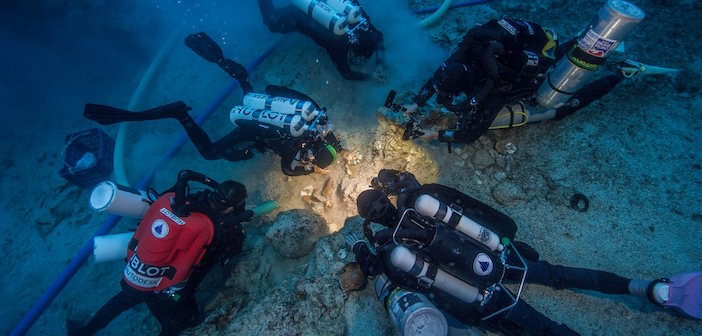
The Greek Culture Ministry announced that archaeologists revisiting one of the most famous shipwrecks of ancient times off southern Greece  near Antikythera island have discovered fragments of bronze statues and a section of the wooden hull. According to the ministry statement, divers raised a complete arm and a section of pleated clothing from statues, and compacted metal objects that have yet to be cleaned and separated. A video titled “2017 Return to Antikythera Expedition” looks at the delicate and often hazardous work marine archaeologists do in recovering ancient gems from the depth of the seas.


The 1st-century B.C. wreck of a large freighter discovered more than a century ago  between Crete and the Peloponnese has already yielded an ancient astronomical computer — known as the Antikythera Mechanism — as well as statues and thousands of other artifacts. The latest expedition, led by the Greek Ephorate of Underwater Antiquities, Lund University, and Woods Hole Oceanographic Institution, was conducted between September 4 to 20, and as per previous trips to the wreck, the team did not leave disappointed.

According to Guardian, the project team, from the Greek Ephorate of Underwater Antiquities and Lund University in Sweden, discovered the buried arm with a bespoke underwater metal detector which has revealed the presence of other large metal objects nearby under the seabed. “There should be at least seven statues,” Alexandros Sotiriou, a Greek technical diver on the team told the Guardian. The operation is overseen by Ageliki Simosi, director of the Greek Ephorate of Underwater Antiquities, which is responsible for all underwater archaeology in Greece. Brendan Foley, co-director of the excavations team at Lund University, said:

“What we’re finding is these sculptures are in among and under the boulders. We think it means a minimum of seven, and potentially nine, bronze sculptures still waiting for us down there.”

The boulders that overlie the metal objects weigh several tonnes and may have tumbled onto the wreck during a massive earthquake that shook Antikythera and surrounding islands in the 4th century AD.

The bronze arm, probably from a statue of a male, is the highlight of the team’s 2017 excavation season. Among other objects the divers recovered are a patterned slab of red marble the size of a tea tray, a silver tankard, sections of joined wood from the ship’s frame, and a human bone. Last year, the team found the skull, teeth, ribs and other bones of an individual who perished on the wreck. They have since extracted DNA from the skull and from it learned the individual’s sex and where they came from. Until those results are published, the person is known as Pamphilos after divers found the name, meaning “friend of all”, carved on a buried cup that had been decorated with an erotic scene. 

With excellent weather conditions above them, the divers managed to recover, in addition to the “orphaned” right arm, pottery shards, nails, lead sheathing fragments, and an odd metal disc, among other artifacts. Prior to this latest expedition, the Return to Antikythera project team managed to recover glassware, luxury ceramics, anchors, counterweights, tools, and even an ancient skeleton; which is currently being analyzed for DNA.
News of the Antikythera shipwreck is not an unfamiliar sight on this blog. The Antikythera mechanism and the subsequent finds on the wreck are spellbinding and have held my interest for years. So of course I am going to report on this too, because my Gods! Researchers from the Greek Ministry of Culture and the Woods Hole Oceanographic Institution in Massachusetts have found a human skeleton at the bottom of the sea floor in the wreck where the famed Antikythera Mechanism was also found.


The recently found remains were pulled from the ship on August 31st. The team first uncovered a skull complete with a jaw and teeth, followed by arms, legs, and ribs. Some parts of the skeleton still remain underwater, but they were left behind and will taken to the surface at a later time.

Now, this is not the first time divers have found skeletons at the site. In 1976, Jacques-Yves Cousteau visited the wreck with his team and uncovered more than 300 artifacts, which included a number of skeletons. The find of human remains marks the first time since the beginning of DNA studies, however, that such an ancient skeleton has been identified aboard a ship and remains preserved. This means scientists have their first real hope of sequencing DNA from a victim of an ancient shipwreck.

Brendan Foley at Woods Hole Oceanographic Institution, who is exploring the wreck site with archaeologists from the Greek Ephorate of Underwater Antiquities explained how Nikolas Giannoulakis, a team member, tapped him on the shoulder while out on a dive:

"Talking through his rebreather in muffled excitement, said: 'We found bones! We found a skeleton!' There was no doubt in any of our minds that what were were looking at were extensive human remains. This is the most exciting scientific discovery we’ve made here. We think he was trapped in the ship when it went down and he must have been buried very rapidly or the bones would have gone by now.”

Hannes Schroeder, an ancient DNA expert at the Natural History Museum of Denmark in Copenhagen, will recieve samples from the remains for full analysis after the Greek authorities give permission.

“Against all odds, the bones survived over 2,000 years at the bottom of the sea and they appear to be in fairly good condition, which is incredible.” 

If a sufficient amount of DNA is recovered from the bones, researchers could learn a lot, including about the skeleton’s geographic and ethnic origins. Though the bones have been underwater for thousands of years, the bones are largely intact. That quality, combined with recent advances in DNA, should help experts in their analysis.

DNA tests are expected to provide information on the drowned person's age and gender which, if female, would add to evidence that such ships carried passengers as well as cargo, said Ageliki G. Simosi, director of the ministry's department of Underwater Antiquities. Simosi said the latest excavation, conducted 52 metres (170 feet) below the surface by the Woods Hole Oceanographic Institution and the culture ministry, had a lot more still to reveal.

"The area is difficult to approach and the conditions are tough. This shipwreck continuously reveals treasures and I believe that this is only the beginning."
A few weeks ago, archeologists associated with the project announced the Antikythera dive was sure to pay off--and it has. In the ongoing saga of the new dive down to the Antikythera wreck, the first finds are in, and they are very promising.

Stunning news finds from Antikythera
WHOI Diving Safety Officer Edward O'Brien "spacewalks" in the Exosuit, suspended
from the Hellenic Navy vessel THETIS during the 2014 Return to Antikythera project
[Credit: Brett Seymour, Copyright: Return to Antikythera 2014]

During the first excavation season, from September 15 to October 7, 2014, the researchers have created a high-resolution, 3D map of the site using stereo cameras mounted on an autonomous underwater vehicle (AUV). Divers then recovered a series of finds which prove that much of the ship's cargo is indeed still preserved beneath the sediment.

Components of the ship, including multiple lead anchors over a metre long and a bronze rigging ring with fragments of wood still attached, prove that much of the ship survives. The finds are also scattered over a much larger area than the sponge divers realized, covering 300 meters of the seafloor. This together with the huge size of the anchors and recovered hull planks proves that the Antikythera ship was much larger than previously thought, perhaps up to 50 meters long. Brendan Foley of the Woods Hole Oceanographic Institution:

"The evidence shows this is the largest ancient shipwreck ever discovered. It's the Titanic of the ancient world."

The archaeologists also recovered a beautiful intact table jug, part of an ornate bed leg, and most impressive of all, a 2-meter-long bronze spear buried just beneath the surface of the sand. Too large and heavy to have been used as a weapon, it must have belonged to a giant statue, perhaps a warrior or the goddess Athena, says Foley. In 1901, four giant marble horses were discovered on the wreck by the sponge divers, so these could have formed part of a complex of statues involving a warrior in a chariot that was pulled by the four horses.

The archaeologists plan to return next year to excavate the site further and recover more of the ship's precious cargo. The finds, particularly the bronze spear, are very promising, according to the researchers, and they are sure there are still many secrets to uncover.
In the ongoing saga of the new dive down to the Antikythera wreck, I am here to report that things look positive in the murky water. The Archaeology News Network reports that the divers and researchers are almost certain that they will make new discoveries.


The Antikythera wreck is a shipwreck from the 2nd quarter of the 1st century BC. It was discovered by sponge divers off Point Glyphadia on the Hellenic island of Antikythera in 1900. The wreck manifested numerous statues, coins and other artefacts dating back to the 4th century BC, as well as the severely corroded remnants of a device that is called the world's oldest known analog computer, the Antikythera mechanism.

I first blogged about the new Antikythera wreck dive when I posted about the brand new exosuit that was going to be used. The cutting-edge diving suit will be worn by U.S. divers who will be able to remain deep underwater for extended periods of time, enabling them to conduct excavations and handle the fragile ancient objects with due care. The 1.5-million-dollar Exosuit was made by the Canadian robotics firm Nuytco Research and comes equipped with a number of features that will allow divers to work at the 120-metre depths for an essentially unlimited period of time, without being at risk from decompression sickness.

As for the goals of the dive: Angeliki Simosi, head of Greece's directorate of underwater antiquities is positive after exploratory dives in the area in 2012 and 2013. She is sure there are dozens of artefacts left in the original wreck, and the archaeologists also hope to confirm the presence of a second ship, some 250 metres away from the original discovery site. All in all, there is a lot left to discover, and the Exosuit will help the archaeologists do that.
I am currently swamped with work, and seeing as there are only so many hours in the day, I wanted to quickly share some news with you guys before I rush off. Remember me geeking out about researchers who were going to use an exosuit to search the wreck of the 2000 year old shipwreck which yielded the Antikythera mechanism? Well, it hasn't happened yet, but it's still news worthy.


That is a video of the exosuit and its diver, Dr. Brendan Foley. He is the head of the American section of the international underwater expedition which boasts members of a variety of different ethnicities and disciplines which has spent the last two years preparing for the challenges ahead. The biggest of these, he says, is whether they will be able to get below the wreck and dig underneath, adding to previous searches of the surface of the shipwreck conducted by the sponge divers who discovered it in 1900 and Jacques-Yves Cousteau in 1976.

"The ship was used for commercial purposes and we can speculate that there are more items to be found from its valuable cargo, which will most likely be very well preserved. We are also certain of the existence of a second wreck near the one where sculpture, amphorae and the mechanism were discovered. It is 250 meters away and was carrying similar ceramic objects. We discovered it about two years ago. It was obviously following the same route and may have been traveling with the ship carrying the [Antikythera] mechanism."

The exhibition in Athens on the finds of the wreck that went down in the second quarter of the 1st century BC--'The Shipwreck of Antikythera: The Ship – the Treasures – the Mechanism'--has recently ended, and is now on its way to Switzerland, where it will go on display in 2015. The dive for more treasure is scheduled to take place in September 2014, and will last a month.
I am not sure if you all know this about me, but I am a total geek. I play tabletop roleplaying games, I studied IT, I can take apart and put back together a computer, and yes, when I hear researchers are going to use an exosuit to search the wreck of the 2000 year old shipwreck which yielded the Antikythera mechanism, I get very, very, excited.


The Antikythera wreck is a shipwreck from the 2nd quarter of the 1st century BC. It was discovered by sponge divers off Point Glyphadia on the Hellenic island of Antikythera in 1900. The wreck manifested numerous statues, coins and other artefacts dating back to the 4th century BC, as well as the severely corroded remnants of a device that is called the world's oldest known analog computer, the Antikythera mechanism.

The Antikythera mechanism is an ancient analog computer designed to predict astronomical positions and eclipses. The computer's construction has been attributed to the Hellenes and was dated to the early 1st century BC. Technological artefacts approaching its complexity and workmanship did not appear again until the 14th century, when mechanical astronomical clocks began to be built in Western Europe.

The mechanism was housed in a wooden box and is made up of bronze gears (that we know of). The mechanism's remains were found as eighty-two separate fragments of which only seven contain any gears or significant inscriptions. Today, the fragments of the Antikythera mechanism are kept at the National Archaeological Museum of Athens.

It was reported that--using the latest advances in technology and robotics--researchers will now strive to extract more secrets from the ancient shipwreck, and their main tool will be a robotic 'exoskeleton' dubbed "Exosuit". The Archaeology News Network reports that:

"...the cutting-edge diving suit, essentially still in an experimental stage, will be worn by U.S. divers who will be able to remain deep underwater for extended periods of time, enabling them to conduct excavations and handle the fragile ancient objects with due care. The 1.5-million-dollar Exosuit was made by the Canadian robotics firm Nuytco Research and comes equipped with a number of features that will allow divers to work at the 120-metre depths for an essentially unlimited period of time, without being at risk from decompression sickness."

Scientists are optimistic that the site will yield a second device like the Antikythera Mechanism, as a preliminary survey conducted last year showed a wealth of artefacts scattered over the crash site, as well as a second unknown shipwreck next to the one already found.

The first real test of the suit will take place in July, during underwater surveys off the northeast coast of the United States and the Antikythera mission will take place immediately afterward. It will also be worn by U.S. divers during the Antikythera mission.