Showing posts with label galen. Show all posts

During his childhood (or so goes one legend), the future Olympian wrestler Milo of Croton owned a young calf he used to lift onto his shoulders and carry around for a spell. Milo is said to have done this every single day: as it got bigger, he grew stronger. Four years later, Milo could be seen wandering around with this fully grown pet bull resting on his manly shoulders.
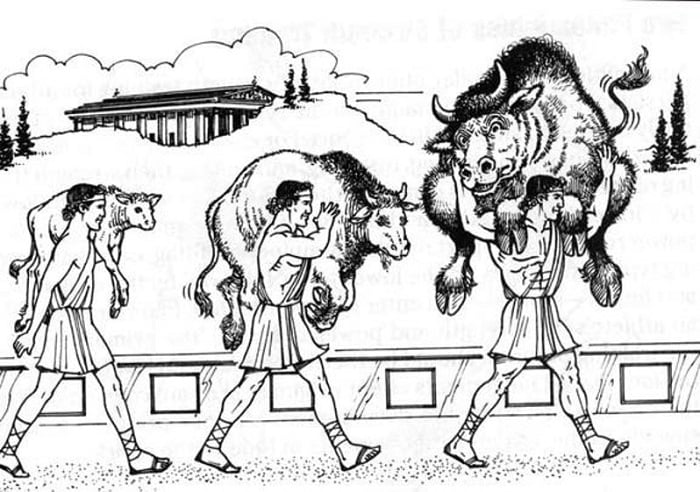

Nearly 2,500 years ago, Milo of Croton was regarded as the strongest person who had ever lived in the known world. A man of incredible strength and athleticism, he taught us the three basic principles of building muscle: Start very light, don’t miss workouts, and increase training in very small increments.

Milo, from Croton in Magna Graecia, today’s southern Italy, was almost certainly the most successful wrestler of his day, becoming six-time wrestling champion at the Ancient Olympic Games. In 540 BC, he won the boys’ wrestling category and then proceeded to win the men’s competition at the next five Olympic Games in a row. He also dominated the Pythian Games (7-time winner), Isthmian Games (10-time winner), and Nemean Games (9-time winner).

Other legends say he carried his own bronze statue to its place at Olympia. One report says the wrestler was able to hold a pomegranate without damaging it while challengers tried to pry his fingers from it, and another report says he could burst a band fastened around his brow by inhaling air and causing his temple veins to swell.

The Ancient Hellenes typically attributed remarkable deaths to famous persons — in keeping with their characters throughout life. The date of Milo’s death is unknown, but according ancient historians, Milo was walking in a forest when he came upon a tree-trunk split with wedges. In what was probably intended as a display of strength, Milo inserted his hands into the cleft to rend the tree. The wedges fell from the cleft, and the tree closed upon his hands, trapping him. Unable to free himself, the wrestler was devoured by wolves.

If you want to be as strong as Milo, here are some anchient work-out tips and tricks. Be on the look-out for wolves, though!

1. Drunk Athletes Still Have to Exercise (Just Not as Strenuously)

Intoxication wouldn’t excuse you from fitness lessons. The Greco-Roman gymnastics guru Philostratus realized that people couldn’t train as effectively while under the influence. Nevertheless, he maintained that tipsy pupils should still complete their regularly scheduled workouts, just with a bit less intensity than usual.

2. Ease Up on the Barley
Denouncing high-carb diets is nothing new; many Roman gladiators bulked up by consuming a dense barley porridge loaded with beans. Claudius Galen—a celebrated Roman physician—believed this made them too flabby for serious combat and criticized the practice.

3. Your Pre-Workout Routine Should Include Lots of Body Oil
Ancient Hellenic sportsmen were known to lather themselves in natural oils before exercising, which gave their bods a distinctive glisten. At the time, scholars claimed that doing so kept athletes from getting cold while toughening their skin.

4. Run Through Sand For Extra Stamina
Anacharsis, a Mediterranean philosopher who spent much of his time traveling through Athens during the 6th century BCE, once wrote a detailed description of how the Hellenes trained their sprinters. “The [practice] running is not done on hard, resistant ground,” he noted, “but in deep sand where it is not easy to plant a foot solidly or get a grip with it since it slips away from underneath the foot.” As an added bonus, these young men were also instructed “to jump over a ditch, if necessary, or some other obstacle carrying lead weights that are as large as they can hold.”

5. Wanna Get Toned? Try Digging.
If your goal is to build chiseled, well-defined muscles without using techniques that involve “violent movement,” the aforementioned Galen recommends digging, rope-climbing, and extending the arms while a workout buddy tries pulling them downwards.

6. Pick Short and Simple Exercises.
Seneca the Younger would’ve been a terrible Phys Ed teacher. The Roman philosopher believed that strenuous exercise was, ultimately, pointless. However, if somebody absolutely had to work out, Seneca favored keeping it quick. “There are short and simple exercises which will tire the body without undue delay,” he conceded, “[such as] running, swinging weights about, and jumping—either high jumping or low jumping… But whatever you do, return from body to mind very soon.”

7. Nobody Likes a Noisy Weightlifter
Say what you will about Seneca, but at least one of his fitness observations was spot-on. The following rant—inspired by an especially obnoxious breed of bodybuilder which frequented Rome’s urban bath-houses—might as well have been written about a present-day gym:

"Conjure up in your imagination all the sounds that make one hate one’s ears. I hear the grunts of musclemen exercising and jerking those heavy weights around; they are working hard, or pretending to. I hear the sharp hissing when they release their pent breath."And the bellyaching didn’t stop there. “Add to this,” Seneca moaned, “the racket of a cocky bastard, a thief caught in the act, and a fellow who likes the sound of his own voice … plus those who plunge into the pool with a huge splash of water.”
Sententiae Antique put up a lovely translation of Galen recently that I would like to share with you. Galen was a doctor and medical researcher who lived from 129 to around 216 CE. He studied medicine by dissecting apes and made some important discoveries, among them that arteries do not carry air, but blood. His work remained influential into the Middle Ages. Of course, like most ancient Hellenes who wrote things down, he was also a bit of a philosopher, including this beautiful bit on keeping the door open (but, you know, mentally and emotionally).


“Always be on guard against the matter which is greatest in this, once you choose to honor yourself. For it is possible always to keep at hand the memory of the hideousness of the soul of those who get angry and the beauty of those who are untroubled by rage.

For whoever, thanks to being accustomed to a mistaken behavior over time, has developed a stain of emotions which cannot be washed away,  must for as great an amount of time attend to each of those beliefs by which a man might become noble and good, should he heed them. We lose sight of a thing that falls easily from our minds because they have been previously filled by these emotions.

Therefore this must be pursued by each of those who want to be saved as if there were no proper season for taking it easy; and all of us must turn toward accusing ourselves, and we must listen to [others] gently, not for the sake of castigating them but for shaping them in turn.

Keep the door of your home open all the time and permit those who understand to enter at every opportune moment. If you are prepared in this way, be bold enough to be discovered as overcome by any of the major mistakes by none of those who enter. Just as it is possible to banish a bad feeling for one who is unwilling, it is easy to banish great ones for one who has made this decision.

When your door is open all the time, as I said, then let there be plenty of time for people who understand to enter. As all the other people who enter a public space attempt to act properly, so too act in the same way in your private home. But those who are ashamed before others only because they might be caught, do not feel shame before themselves alone: but you, feel shame before yourself especially, if you follow this precept.”

[Affections 5.25–26]
File this one under the heading of  "the more you know": ancient Hellenic aphrodisiacs! An aphrodisiac is a substance that increases libido when consumed. The name comes from the Greek ἀφροδισιακόν, aphrodisiakon, "sexual, aphrodisiac", from aphrodisios, "pertaining to Aphrodite." Throughout human history, food, drinks, and behaviors have had a reputation for making sex more attainable and/or pleasurable, but these ones, the ancient Hellenes knew (and used!) already.


1. Pomegranates
Even back in ancient Hellas, the pomegranate fruit was considered nutritious and it was also believed, in both ancient times and today, that the juice has aphrodisiac properties. Pomegrante is a noted source for three different antioxidants and it's rich in vitamin C. It has been used for generations to treat depression, settle sore stomachs and neutralize internal parasites. From an aphrodisiac standpoint, the juice may be the most powerful part of this plant. According to the International Journal of Impotence Research, in a double-blind study, men with mild to moderate erectile dysfunction served a daily dose of pomegranate juice showed marked improvement in their condition. Another study, conducted at Queen Margaret University, demonstrated that pomegranate juice has the power to raise testosterone levels in both men and women.

2. Truffles
Dating as far back as the 1st century AD, this fungi found its way into the limelight as an aphrodisiac as it is believed that it came into existence as a result of the combined action of water, heat, and thunderbolts as Zeus hurled a thunderbolt to Earth which landed close to an oak tree! The ancient physician Galen said that “the truffle is very nourishing and can direct voluptuousness.” Although it is clearly the aroma of truffles that moves men (and women), scent is not the only attribute of the truffle that contributes to an aphrodisiac reputation. Their rarity and short season make them among the most elusive, luxury goods of the culinary world. And it might be surprising to learn that truffles are high in protein.

3. Leeks
In ancient times, leeks were eaten raw and whole or cooked and were probably considered an aphrodisiac because of their phallic shape. Nowadays, people still believe that leeks are an aphrodisiac. Whether they work or not, you be the judge. The zinc in leek has been named as the source of the boost to the libido, but it's as high as in spinach and no one calls that an aphrodisiac, so this one remains unproven.

4. Garlic
At some point and time, people stopped believing that garlic was toxic and started eating it to prevent illness and congestion. In addition, people started believing that it possessed magical properties and that it is a natural aphrodisiac. It improves blood circulation and shows antibiotic properties, it has been generally accepted to be a potent aphrodisiac; but now it appears that an enzyme called nitric oxide synthase (NOS) is primarily responsible for the mechanism of erection. Studies have recently shown that garlic in certain forms can stimulate the production of NOS particularly in individuals who have low levels of this enzyme.

5. Legumes
Dating back as far as Hippocrates, legumes have been an essential part of the menu for men wishing to keep up their libido as they get older. Hippocrates prescribed a variety of legumes to eat by the bowl-full; while the Aristotle was a believer in lentil beans with the addition of saffron to keep a man’s libido active and in top shape. Legumes contain phytoestrogens, plant compounds with estrogen-like effects. Estrogen affects sex drive and helps increase sensation. This is most likely where the reputation comes from.
High-powered X-rays have helped researchers reveal a text by ancient Greek doctor Galen hidden under 6th century writing.


An international multidisciplinary team in California has made an exciting discovery, unveiling a translation of an ancient Greek medical text that until now had been covered with religious writing.
Uncovered at the Department of Energy’s SLAC National Accelerator Laboratory, scientists used high-powered X-rays to analyze the text from St Catherine’s Monastery on the Sinai Peninsula. On the surface were 10th-century psalms, which were found to be covering writings by ancient Greek doctor Galen that had been translated a few hundred years after his death into the ancient Syriac language.

Galen, who lived from 129 to around 216 CE, studied medicine by dissecting apes and made some important discoveries, among them that arteries do not carry air, but blood. His work remained influential into the Middle Ages.

The Stanford Synchrotron Radiation Lightsource (SSRL) used to make the discovery, is a common particle accelerator. It works by accelerating electrons to nearly the speed of light and keeps them traveling around a many-sided polygon. Magnets change the electrons’ directions, producing a beam of high-energy X-rays, which successfully revealed the ink that had been scraped off on the parchment.The team at SLAC stated:

“The process we’re using is x-ray fluorescence imaging. We’re going to hit the sample with x-ray energies and it’s going to make the elements that are in the sample fluoresce. One thing people use this sort of technique for is spotting forgeries because by picking up the elements that make up the ink, which you can do from the spectral lines that you’ve got, you can identify if this is modern or ancient."

Researchers now have plans to scan the 26 pages to produce high-resolution files that will be uploaded and made available online.