Showing posts with label Bellerophon. Show all posts

Welcome to another constellation post; this one is one of my favourites. Who doesn't love a winged horse? The constellation is called 'Hippos' (the Horse) in Greek and has some badass mythology attached to it.
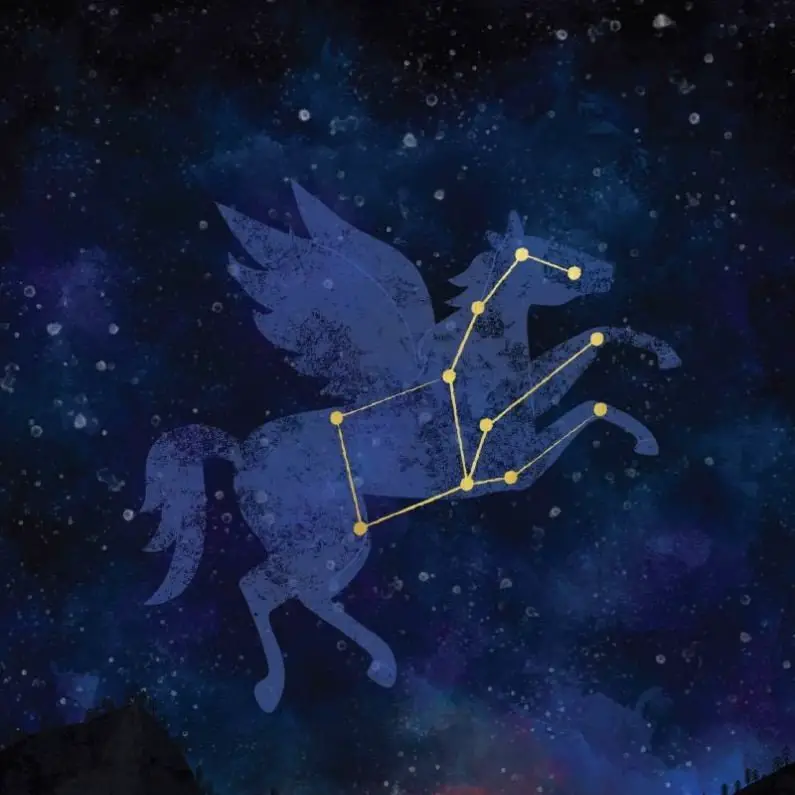

Pegasos was originally only one winged horse, born from the neck of Médousa when she was beheaded by the hero Perseus. Poseidon, Tamer of Horses, is his father. Hesiod describes in his 'Theogony' the curious circumstances of his birth:


"...Medusa who suffered a woeful fate: she was mortal, but the two [of her Gorgon sisters] were undying and grew not old. With her lay the Dark-haired One [Poseidon] in a soft meadow amid spring flowers. And when Perseus cut off her head, there sprang forth great Chrysaor and the horse Pegasus who is so called because he was born near the springs [pegae] of Ocean [Okeanos]; and that other, because he held a golden blade [aor] in his hands. Now Pegasus flew away and left the earth, the mother of flocks, and came to the deathless gods: and he dwells in the house of Zeus and brings to wise Zeus the thunder and lightning." [ll 270-294]

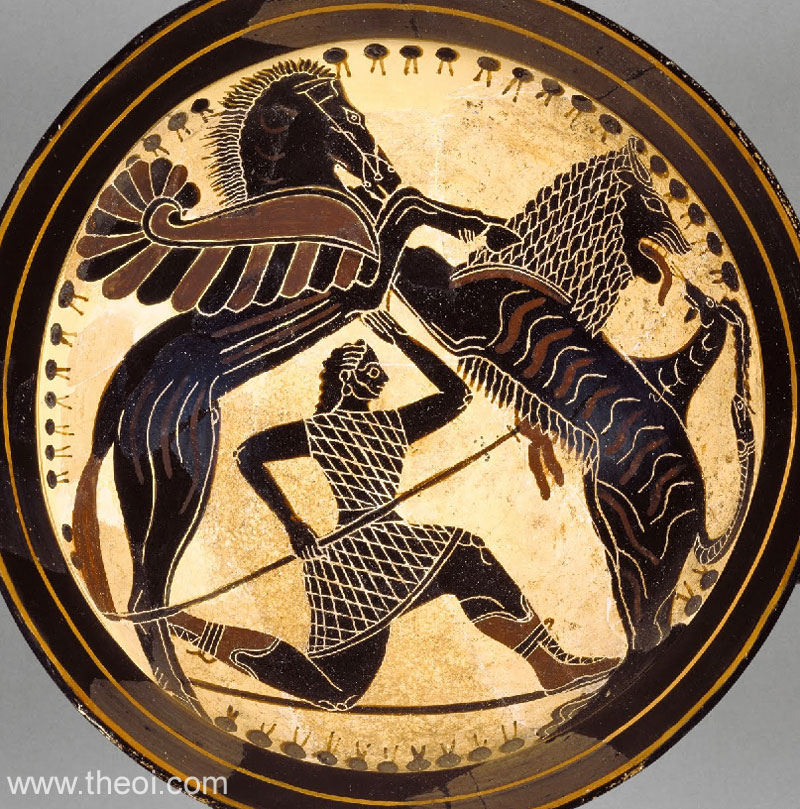
Pegasos was tamed by Bellerophon, a Korinthian hero, who rode him into battle against the fire-breathing Khimaira. Pindar, in his beautiful Olympian Odes describes this cooperation wonderfully:

"Bellerophon, who once suffered greatly when beside the spring he wanted to harness Pegasus, the son of the snake-entwined Gorgon; until the maiden Pallas brought to him a bridle with golden cheek-pieces. The dream suddenly became waking reality, and she spoke: “Are you sleeping, king, son of Aeolus? Come, take this charm for the horse; and, sacrificing a white bull, show it to your ancestor, Poseidon the Horse-Tamer.” The goddess of the dark aegis seemed to say such words to him as he slumbered in the darkness, and he leapt straight up to his feet. He seized the marvellous thing that lay beside him, and gladly went to the seer of the land,  and he told the son of Coeranus the whole story: how, at the seer's bidding, he had gone to sleep for the night on the altar of the goddess, and how the daughter herself of Zeus whose spear is the thunderbolt had given him the spirit-subduing gold. The seer told him to obey the dream with all speed; and, when he sacrificed a strong-footed bull to the widely powerful holder of the earth, straightaway to dedicate an altar to Athena, goddess of horses. The power of the gods accomplishes as a light achievement what is contrary to oaths and expectations. And so mighty Bellerophon eagerly stretched the gentle charmed bridle around its jaws and caught the winged horse. Mounted on its back and armored in bronze, at once he began to play with weapons. And with Pegasus, from the chilly bosom of the lonely air,7 he once attacked the Amazons, the female army of archers, [90] and he killed the fire-breathing Chimaera, and the Solymi. I shall pass over his death in silence; but Pegasus has found his shelter in the ancient stables of Zeus in Olympus." [13. 63]

As a constellation, it's arrival in the sky notes the arrival of the warmer weather of spring and seasonal rainstorms, which is also why it got the job and title of thunderbolt-bearer of Zeus. Hyginus in his 'Astronomica' speaks of the events that led up to Pegasos' immortalization in the sky:

"Others say that at the time Bellerophon came to visit Proetus, son of Abas and king of the Argives, Antia, the king’s wife, smitten with love for the guest, begged to visit him, promising him her husband’s kingdom. When she couldn’t obtain this request, out of fear that he would accuse her to the king, she anticipated him by telling Proetus that he had offered violence to her. Proetus, who had been fond of Bellerophon, was reluctant to inflict punishment himself, but knowing that he had the horse Pegasus, sent him to the father of Antia (some call her Sthenoboea), for him to defend his daughter’s chastity and send the youth against the Chimera, which at that time was laying waste with flames the country of the Lycians.

Bellerophon was victor, and escaped, but after the creation of the spring, as he was attempting to fly to heaven, and had almost reached it, he became terrified looking down at the earth, and fell off and was killed. But the horse is said to have flown up and to have been put among the constellations by Jove [Zeus]. Others have said that Bellerophon fled from Argos not because of Antia’s accusations, but so as not to hear any more proposals which were distasteful to him, or to be distressed by her entreaties." [II.18]

Although most would agree that it is Pegasos whom the constellation denotes, there is one other explanation, there because her mythology is usually tied to the constellation Equuleus: the little horse. Her name is Melanippe (Εὐίππη), daughter of the kéntauros Kheiron. She became pregnant and could not let her father know. As such, she begged the Gods to be transformed into a mare. Also from Hyginus's Astronomica:
 
"Euripides in his Melanippe, says that Melanippe, daughter of Chiron the Centaur, was once called Thetis. Brought up on Mount Helicon, a girl especially fond of hunting, she was wooed by Aeolus, son of Hellen, and grandson of Jove, and conceived a child be him. When her time drew near, she fled into the forest, so that her father, who supposed her a virgin, might not see that she had given birth to a grandchild. And so when her father was looking for her, she is said to have begged the power of the gods not to let her father see her in childbirth. After the child was born, by the will of the gods she was changed into a mare which was placed among the stars."

He also gives another reason for her change:

"Some say that she was a prophetess, and because she used to reveal the plans of the gods to men, she was changed into a mare. Callimachus says that because she ceased hunting and worshipping Diana [Artemis], Diana changed her into the shape we have mentioned. For the reason above, too, she is said to be out of sight of the Centaur, who some say is Chiron, and to show only half her body, since she didn’t want her sex to be known."

The constellation is visible at latitudes between +90° and −60°, and best visible at 21:00 (9 p.m.) during the month of October.

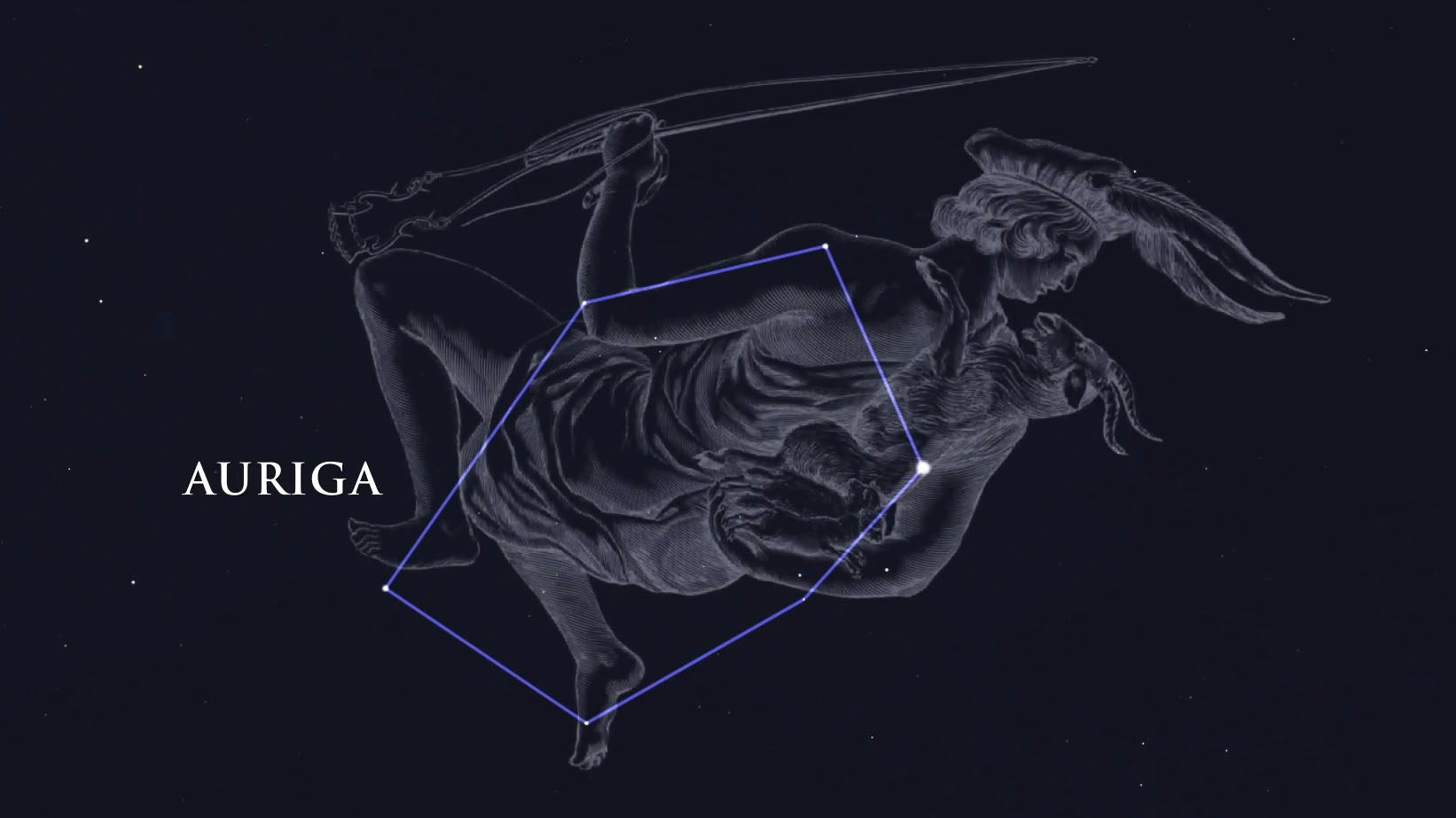
There are many well known chariots and charioteers in ancient Hellenic mythology. All of the Theoi have one, and Helios and Apollon use one to bring light to the world. Hades kidnapped Persephone with His. Kastor and Polideukes were very skilled at driving the fast, light, open, two-wheeled conveyance drawn by two or more horses. Helios lost a son when he let his son Phaethon (Φαέθων) drive his chariot for its morning track through the sky. Phaethon flew too close to the earth and scorched it all; Zeus then cast him down with a lightning-bolt. Yet, these are not the charioteers the constellation is associated with. In this next installment of the constellation series, we will look at the Divine child the constellation refers to... and a few others, because the constellation Auriga has had many interpretations over the years.


For a very long time, war chariots were pulled by two horses only. The charioteer of the constellation is therefor most likely Erichthonios (Ἐριχθόνιος), child of Hēphaistos and Athena, through Gaea, as he invented a chariot pulled by four horses. 

As the myth of his birth goes; Athena went to Hēphaistos' workshop for weaponry, but Hēphaistos--overcome with lust--tried to rape Her instead. Athena fled, but could not flee fast enough. Hēphaistos caught up to Her. Athena fought off Her attacker, but could not prevent Hēphaistos from ejaculating on Her thigh. She wiped Hēphaistos' semen away with a scrap of wool (ἔριον, erion) and flung it to the earth (χθών, chthôn). From it was born Erichthonios, who was part man, and part snake.

In my post about the many legends of Médousa, I posed the following about Athena and the source of Erichthonius' myth and birth as part-snake:

"Athena's role as a snake and fertility Goddess is still visible in the myth about the child she had with Hephaestus; Erichthonios (Ἐριχθόνιος), who was half man, half snake. It's even posed that in the early days, Athena was married to Hephaestus and had His child willingly. As Athena was stripped of Her roles as a fertility and snake Goddess, Médousa's myth came into being, where Athena distances Herself from sex and snakes, by punishing an epithet of herself (Athena Tritogeneia, perhaps: 'born of Trito', a lake which was supposedly located in Libya), or the Libyan snake Goddess Médousa, who may have still been attached to Her worship. By placing Médousa's head on Her breastplate or shield, Athena's mythology is continuously linked to Her Libyan heritage, but harmlessly so, to Her new image of a virginal warrior."

No matter the source, Erichthonios was born, and placed in a box by Athena. She placed the box in the care of three of Her attendants at the Acropolis, with clear instructions not to open the box. They did, of course, and were scared so by the sight of either a snake in the box, or Erichthonios' deformities, they cast themselves off of the Acropolis in terror. Yet, despite his deformities, Erichthonios became king of Athens and ruled it long and well.

He married Praxithea (Πραξιθέα), a naiad, and had a son, Pandion I. He founded the Panathenaiac Festival in the honor of Athena, and set up a wooden statue of her on the Acropolis. He taught his people to yoke horses and use them to pull chariots, to smelt silver, and to till the earth with a plough. His deformities and lameness inspired him to invent the quadriga--or four-horse chariot--to get around easier. He was very skilled as a charioteer, and won many games. Zeus was said to have been so impressed with his skill that he raised him to the heavens to become the constellation Auriga after his death.

There are also other charioteers to whom the constellation could refer; Myrtilus (Μυρτίλος), for example, who was Hermes's son and the charioteer of Oenomaus. Myrtilus's chariot was destroyed in a race intended for suitors to win the heart of Oenomaus's daughter Hippodamia. Myrtilus earned his position in the sky when Hippodamia's successful suitor, Pelops (Πέλοψ), killed him, although he helped him win the woman's hand. After his death, Myrtilus's father Hermes placed him in the sky. 

The constellation could also represent Theseus's son Hippolytos who was rejected from Athens after he refused the romantic advances of his stepmother Phaedra, who committed suicide as a result. He was killed when his chariot was wrecked, but revived by Asklepios. Another possibility is that the constellation does not represent a whole person at all, but is a limb of Mēdeia's brother after she killed and dismembered him.

Occasionally, Auriga is also seen as the Charioteer but as Bellerophon (Βελλεροφῶν), the mortal rider of Pegasus who dared to approach Mount Olympus. In this version of the tale, Zeus pitied Bellerophon for his foolishness and placed him in the stars.

Whomever--or whatever--it represents, Auriga reminds us that the chariot had an important place in ancient Hellenic society. As for the constellation, it is visible at latitudes between +90° and −40°, and best visible at 21:00 (9 p.m.) during the month of late February to early March.
Mythologically speaking, Pegasos was originally only one winged horse, born from the neck of Médousa when she was beheaded by the hero Perseus. Poseidon, Tamer of Horses, is his father. Hesiod describes in his ‘Theogony’ the curious circumstances of his birth:

"…Medusa who suffered a woeful fate: she was mortal, but the two [of her Gorgon sisters] were undying and grew not old. With her lay the Dark-haired One [Poseidon] in a soft meadow amid spring flowers. And when Perseus cut off her head, there sprang forth great Chrysaor and the horse Pegasus who is so called because he was born near the springs [pegae] of Ocean [Okeanos]; and that other, because he held a golden blade [aor] in his hands. Now Pegasus flew away and left the earth, the mother of flocks, and came to the deathless gods: and he dwells in the house of Zeus and brings to wise Zeus the thunder and lightning." [ll 270-294]

Pegasos was tamed by Bellerophon, a Korinthian hero, who rode him into battle against the fire-breathing Khimaira. Pindar, in his beautiful Olympian Odes describes this cooperation wonderfully:

"Bellerophon, who once suffered greatly when beside the spring he wanted to harness Pegasus, the son of the snake-entwined Gorgon; until the maiden Pallas brought to him a bridle with golden cheek-pieces. The dream suddenly became waking reality, and she spoke: “Are you sleeping, king, son of Aeolus? Come, take this charm for the horse; and, sacrificing a white bull, show it to your ancestor, Poseidon the Horse-Tamer.” The goddess of the dark aegis seemed to say such words to him as he slumbered in the darkness, and he leapt straight up to his feet.

He seized the marvellous thing that lay beside him, and gladly went to the seer of the land,  and he told the son of Coeranus the whole story: how, at the seer’s bidding, he had gone to sleep for the night on the altar of the goddess, and how the daughter herself of Zeus whose spear is the thunderbolt had given him the spirit-subduing gold. The seer told him to obey the dream with all speed; and, when he sacrificed a strong-footed bull to the widely powerful holder of the earth, straightaway to dedicate an altar to Athena, goddess of horses.

The power of the gods accomplishes as a light achievement what is contrary to oaths and expectations. And so mighty Bellerophon eagerly stretched the gentle charmed bridle around its jaws and caught the winged horse. Mounted on its back and armored in bronze, at once he began to play with weapons. And with Pegasus, from the chilly bosom of the lonely air,7 he once attacked the Amazons, the female army of archers, [90] and he killed the fire-breathing Chimaera, and the Solymi. I shall pass over his death in silence; but Pegasus has found his shelter in the ancient stables of Zeus in Olympus." [13. 63]

Pegasos was not worshipped with ritual and sacrifices like the Theoi—the Hellenic Gods—were; only the Theoi were worshipped in that manner, and even then there were huge differences in Ouranic, Khthonic, and hero worship. He/they were featured in art, though, and was/were a beloved part of the Hellenic mythology; especially the Pegasos Bellerophon rode on, as he was featured on many coins throughout the years.
The dragons of ancient Hellas had very little--if anything--to do with the fantasy dragons we are so accustomed to now. The ancient Hellenes knew four types of dragon: the Drakones, the Ketea, the Khimaira and the Drakaenae.

The Drakones were named after the Greek 'drakein' and 'derkomai, meaning 'to see clearly' or 'gaze sharply'. These were guardians, usually of wells and springs, groves, Gods, or treasure. As guardians, they were usually equipped with sharp fangs, deadly poison and/or multiple heads. In essence, they were seen as giant snakes which--and this is wholly a personal observation--makes sense when most protective and purifying Theoi were depicted as snakes.

Yet, some drakones caused mayhem and were slain. These are some of the dragon slayers of ancient Hellenci mythology:

"According to the mythology, a spring nearby the location of the temple [of Delphi] was guarded by the large Python or she-dragon, which Apollo slayed upon arrival, thus freeing the people from their fear of the earth and its power." 

When the Olympians rose to power, they first fought the Titans during the Titanomachy. Vanquishing them, the Theoi thought They had won. Yet, there was one who sought revenge for the defeat of his father: Typhôeus, the most-feared son of Tartaros and Gaea. Some versions of the myth say that Typhôeus was actually the Drakon Gigantomakhios, or one of his offspring. Hyginus shares what happened to the dragon:

"Some also say this dragon was thrown at Minerva [Athena] by the Giants, when she fought them. Minerva, however, snatched its twisted form and threw it to the stars, and fixed it at the very pole of heaven. And so to this day it appears with twisted body, as if recently transported to the stars."


The hero Bellerophon was commanded by King Iobates to slay the Khimaira, a fire-breathing mythical beast whose form was a hybrid of lion, serpent and goat. Bellerophon rode into battle against the beast on the back of the winged horse Pegasos and, driving a lead-tipped lance down the Khimaira's flaming throat, suffocated it. From Hómēros' Iliad:

 "On first deciphering the fatal message, he ordered Bellerephon to kill the monstrous Chimaera, spawned by gods and not men, that had a lion’s head, goat’s body and serpent’s tail, and breathed out deadly blasts of scorching fire. But Bellerephon slew her, guided by the gods." [VI:119-211]

Cadmus (Kadmos)
"On a quest to find his sister, Europa, he stopped at the Delphic temple to consult Apollo’s oracle, which led him to found the city of Thebes. While building the Theban temple, Cadmus’ assistants were slain by a dragon as they attempted to collect water from a nearby spring. Athena instructed Cadmus to slay the dragon and then sow its teeth into the ground like seeds." 

Damasen
Damasen was a giant, a son of Gaia. He assisted the nymph Moria after her brother Tylus accidentally touched a serpent, which then attacked him. It coiled round his body and suffocated him. Moria implored Damasen to help and he killed the serpent, hitting it with the trunk of a tree he tore out of the ground. Then a female serpent, the slain monster's mate, appeared and used a magical herb, referred to as 'Zeus' flower', to bring the dead serpent back to life. Moria then used the same herb to revive her brother. The myth is only mentioned in Nonnus' 'Dionysiaca', although it may the foundation of  Hēraklēs' second labour.

"This was he whom the Nymphe beheld on the fertile slope of the woodland. She bowed weeping before him in prayer, and pointed to the horrible reptile, her brother’s murderer, and Tylos newly mangled and still breathing in the dust. The Gigas (Giant) did not reject her prayer, that monstrous champion; but he seized a tree and tore it up from tits roots in mother earth, then stood and came sidelong upon the ravening Drakon." [25.452]


Heracles (Hēraklēs)
"Heracles, strangled his first snake when he was still just a baby in the cradle. [...] Throughout his twelve labors he conquered two multi-headed snakes, including the Hydra and the Ladon."

Iason
Iason was sent by Poseidon’s son, Pelias, to fetch the Golden Fleece. Along the way, he acquired additional tasks: to plow a field with fire-breathing oxen, to steal a tooth from a dragon, and to slay the dragon that guarded the fleece. Luckily for Iason, his lover Medea was trained in Hecate’s dark arts and gave him an ointment that would keep him from being burned by the oxen, in addition to a herbal potion with which he could put the dragon to sleep."

"Of his conquests, one of the most memorable is the beheading of Medusa, the snake haired gorgon, with the aid of Athena’s polished shield. Afterwards, Perseus went on to slay another monster, the sea serpent Cetus sent by Poseidon."

Phorbas was the son of Triopas and Hiscilla (daughter of Myrmidon), a hero of the island of Rhodes. When the people of the island of Rhodes fell victim to a plague of masses of serpents (may have been dragons or simply snakes), an oracle directed them to call on a man named Phorbas. Phorbas cleansed the island of the snakes and in gratitude the Rhodians venerated him as a hero. For his achievement he won a place among the stars as the constellation Serpentarius or Ophiuchus. Hyginus, in his 'Astronomica' writes:

"Polyzelus the Rhodian, however, points out that this is Phorbas, who was of great assistance to the Rhodians. The citizens called their island, overrun by a great number of snakes, Ophiussa. In this multitude of beasts was a snake of immense size, which had killed many of them; and when the deserted land began finally to lack men, Phorbas, son of Triopas by Hiscilla, Myrmidon’s daughter, when carried there by a storm, killed all the beasts, as well as that huge snake. Since he was especially favored by Apollo, he was put among the constellations, shown killing the snake for the sake of praise and commemoration. And so the Rhodians, as often as they go with their fleet rather far from their shores, make offerings first for the coming of Phorbas, that such a happening of unexpected valor should befall the citizens as the opportunity for glory which brought Phorbas, unconscious of future praise, to the stars." [II.14]


Zeus
During the Titanomachy, Zeus needed the giants to win his war. Trouble was, they were locked away in Tartaros by Kronos where they were guarded by Kampê (Καμπη), a she-dragon who, from the waist up, had the body of a serpentine-haired woman. Below that she had the body of a scaly drakon with a thousand vipers for feet and sprouting from her waist the heads of fifty fearsome beasts--lions, boars and other wild animals. Dark wings rose from her shoulders and above her head she lifted a furious scorpion's tail. Zeus slew her and freed His future allies. Apollodorus, in his 'Bibliotheca' writes:

"After ten years of fighting Ge [Gaia] prophesied a victory for Zeus if he were to secure the prisoners down in Tartaros as his allies. He thereupon slew their jail-keeper Kampe, and freed them from their bonds." [1.6]
Mythologically speaking, Pegasos was originally only one winged horse, born from the neck of Médousa when she was beheaded by the hero Perseus. Poseidon, Tamer of Horses, is his father. Hesiod describes in his ‘Theogony’ the curious circumstances of his birth:

"…Medusa who suffered a woeful fate: she was mortal, but the two [of her Gorgon sisters] were undying and grew not old. With her lay the Dark-haired One [Poseidon] in a soft meadow amid spring flowers. And when Perseus cut off her head, there sprang forth great Chrysaor and the horse Pegasus who is so called because he was born near the springs [pegae] of Ocean [Okeanos]; and that other, because he held a golden blade [aor] in his hands. Now Pegasus flew away and left the earth, the mother of flocks, and came to the deathless gods: and he dwells in the house of Zeus and brings to wise Zeus the thunder and lightning." [ll 270-294]

Pegasos was tamed by Bellerophon, a Korinthian hero, who rode him into battle against the fire-breathing Khimaira. Pindar, in his beautiful Olympian Odes describes this cooperation wonderfully:

"Bellerophon, who once suffered greatly when beside the spring he wanted to harness Pegasus, the son of the snake-entwined Gorgon; until the maiden Pallas brought to him a bridle with golden cheek-pieces. The dream suddenly became waking reality, and she spoke: “Are you sleeping, king, son of Aeolus? Come, take this charm for the horse; and, sacrificing a white bull, show it to your ancestor, Poseidon the Horse-Tamer.” The goddess of the dark aegis seemed to say such words to him as he slumbered in the darkness, and he leapt straight up to his feet. He seized the marvellous thing that lay beside him, and gladly went to the seer of the land,  and he told the son of Coeranus the whole story: how, at the seer’s bidding, he had gone to sleep for the night on the altar of the goddess, and how the daughter herself of Zeus whose spear is the thunderbolt had given him the spirit-subduing gold. The seer told him to obey the dream with all speed; and, when he sacrificed a strong-footed bull to the widely powerful holder of the earth, straightaway to dedicate an altar to Athena, goddess of horses. The power of the gods accomplishes as a light achievement what is contrary to oaths and expectations. And so mighty Bellerophon eagerly stretched the gentle charmed bridle around its jaws and caught the winged horse. Mounted on its back and armored in bronze, at once he began to play with weapons. And with Pegasus, from the chilly bosom of the lonely air,7 he once attacked the Amazons, the female army of archers, [90] and he killed the fire-breathing Chimaera, and the Solymi. I shall pass over his death in silence; but Pegasus has found his shelter in the ancient stables of Zeus in Olympus." [13. 63]

Pegasos was not worshipped with ritual and sacrifices like the Theoi—the Hellenic Gods—were; only the Theoi were worshipped in that manner, and even then there were huge differences in Ouranic, Khthonic, and hero worship. He/they were featured in art, though, and was/were a beloved part of the Hellenic mythology; especially the Pegasos Bellerophon rode on, as he was featured on many coins throughout the years.
A well-preserved Roman mosaic, described as the "most exciting" discovery in decades, has been uncovered in Berkshire by a local community archaeology dig. It features many scenes from Hellenic mythology.


The mosaic, dated from around the 4th century AD, features Bellerophon, a Hellenic hero, riding the winged horse Pegasus. The panel shows a scene where they attack the fire-breathing monster Chimera. As a reward for killing the beast which had a lion's head, a goat's body, and a serpent's tail, Pegasus was offered the King Iobates' daughter, Philonoe. The myth would later form the basis of the St George and the dragon legend in Christian times. Joy Appleton from the Boxford History Project told The Independent:

"I was stunned. It’s an amazing mosaic with so many figures. There is every Greek mythical figure found on a British site. The owner of the Roman villa in which the mosaic was found, wanted to display his knowledge as there are so many characters and beasts from Greek mythology."

Among the most spectacular scenes is Hercules killing a centaur, possibly Nessus, whose poisoned blood later caused the death of Hercules. Other illustrative elements on the mosaic contain scenes previously unknown on other UK sites, said archaeological experts. Anthony Beeson, a member of the Association for the Study and Preservation of Roman Mosaics, described the find as:

"[...] without question the most exciting mosaic discovery made in Britain in the last fifty years and must take a premier place amongst those Romano-British works of art that have come down to modern Britons."

Luigi Thompson, who visited the site and is known for his paintings of mosaics said:

"If I had the choice of only doing one painting in my career, it would be this one. It is the most delightful, lively and charming pavement I have ever seen. It causes me to imagine, with pleasure, the villa owner entertaining his guests with his knowledge of classical mythology."

Less than half the mosaic, a six-meter strip richly patterned with mythical characters, was uncovered in the last two weeks. It has now been buried again to protect it. The dig volunteers, some without previous experience of working on archaeological sites, are hoping to fundraise for another excavation next year.
All of you know Classical Wisdom Weekly, right? Well, they have a newsletter too, which I am subscribed to. There is a lot of Roman stuff in there, but every once in a while they have nice Hellenic mythology features--like their latest one, on the dragons slayers of the ancient Hellenic world. I love dragons--drakons--(who doesn't?), so I wanted to share their picks, and then tell you mine.

1. Apollo
"According to the mythology, a spring nearby the location of the temple [of Delphi] was guarded by the large Python or she-dragon, which Apollo slayed upon arrival, thus freeing the people from their fear of the earth and its power."

2. Cadmus (Kadmos)
"On a quest to find his sister, Europa, he stopped at the Delphic temple to consult Apollo’s oracle, which led him to found the city of Thebes. While building the Theban temple, Cadmus’ assistants were slain by a dragon as they attempted to collect water from a nearby spring. Athena instructed Cadmus to slay the dragon and then sow its teeth into the ground like seeds."

3. Jason
"Jason was sent by Poseidon’s son, Pelias, to fetch the Golden Fleece. Along the way, he acquired additional tasks: to plow a field with fire-breathing oxen, to steal a tooth from a dragon, and to slay the dragon that guarded the fleece. Luckily for Jason, his lover Medea was trained in Hecate’s dark arts and gave him an ointment that would keep him from being burned by the oxen, in addition to a herbal potion with which he could put the dragon to sleep."

4. Perseus
"Of his conquests, one of the most memorable is the beheading of Medusa, the snake haired gorgon, with the aid of Athena’s polished shield. Afterwards, Perseus went on to slay another monster, the sea serpent Cetus sent by Poseidon."

5. Heracles (Hēraklēs)
"Heracles, strangled his first snake when he was still just a baby in the cradle. [...] Throughout his twelve labors he conquered two multi-headed snakes, including the Hydra and the Ladon."


I like these picks, and I agree with most of them. Especially the top three would be mine as well. I'm going to add a few others to the list as well, though.

Athena
When the Olympians rose to power, they first fought the Titans during the Titanomachy. Vanquishing them, the Theoi thought They had won. Yet, there was one who sought revenge for the defeat of his father: Typhôeus, the most-feared son of Tartaros and Gaea. Some versions of the myth say that Typhôeus was actually the Drakon Gigantomakhios, or one of his offspring. Hyginus shares what happened to the dragon:
 
"Some also say this dragon was thrown at Minerva [Athena] by the Giants, when she fought them. Minerva, however, snatched its twisted form and threw it to the stars, and fixed it at the very pole of heaven. And so to this day it appears with twisted body, as if recently transported to the stars."

Bellerophon
The hero Bellerophon was commanded by King Iobates to slay the Khimaira, a fire-breathing mythical beast whose form was a hybrid of lion, serpent and goat. Bellerophon rode into battle against the beast on the back of the winged horse Pegasos and, driving a lead-tipped lance down the Khimaira's flaming throat, suffocated it. From Hómēros' Iliad:

 "On first deciphering the fatal message, he ordered Bellerephon to kill the monstrous Chimaera, spawned by gods and not men, that had a lion’s head, goat’s body and serpent’s tail, and breathed out deadly blasts of scorching fire. But Bellerephon slew her, guided by the gods." [VI:119-211]
 
Zeus
During the Titanomachy, Zeus needed the giants to win his war. Trouble was, they were locked away in Tartaros by Kronos where they were guarded by Kampê (Καμπη), a she-dragon who, from the waist up, had the body of a serpentine-haired woman. Below that she had the body of a scaly drakon with a thousand vipers for feet and sprouting from her waist the heads of fifty fearsome beasts--lions, boars and other wild animals. Dark wings rose from her shoulders and above her head she lifted a furious scorpion's tail. Zeus slew her and freed His future allies. Apollodorus, in his 'Bibliotheca' writes:
 
"After ten years of fighting Ge [Gaia] prophesied a victory for Zeus if he were to secure the prisoners down in Tartaros as his allies. He thereupon slew their jail-keeper Kampe, and freed them from their bonds." [1.6]
 
Phorbas was the son of Triopas and Hiscilla (daughter of Myrmidon), a hero of the island of Rhodes. When the people of the island of Rhodes fell victim to a plague of masses of serpents (may have been dragons or simply snakes), an oracle directed them to call on a man named Phorbas. Phorbas cleansed the island of the snakes and in gratitude the Rhodians venerated him as a hero. For his achievement he won a place among the stars as the constellation Serpentarius or Ophiuchus. Hyginus, in his 'Astronomica' writes:
 
"Polyzelus the Rhodian, however, points out that this is Phorbas, who was of great assistance to the Rhodians. The citizens called their island, overrun by a great number of snakes, Ophiussa. In this multitude of beasts was a snake of immense size, which had killed many of them; and when the deserted land began finally to lack men, Phorbas, son of Triopas by Hiscilla, Myrmidon’s daughter, when carried there by a storm, killed all the beasts, as well as that huge snake. Since he was especially favored by Apollo, he was put among the constellations, shown killing the snake for the sake of praise and commemoration. And so the Rhodians, as often as they go with their fleet rather far from their shores, make offerings first for the coming of Phorbas, that such a happening of unexpected valor should befall the citizens as the opportunity for glory which brought Phorbas, unconscious of future praise, to the stars." [II.14]
 
Damasen
Damasen was a giant, a son of Gaia. He assisted the nymph Moria after her brother Tylus accidentally touched a serpent, which then attacked him. It coiled round his body and suffocated him. Moria implored Damasen to help and he killed the serpent, hitting it with the trunk of a tree he tore out of the ground. Then a female serpent, the slain monster's mate, appeared and used a magical herb, referred to as 'Zeus' flower', to bring the dead serpent back to life. Moria then used the same herb to revive her brother. The myth is only mentioned in Nonnus' 'Dionysiaca', although it may the foundation of  Hēraklēs' second labour.

"This was he whom the Nymphe beheld on the fertile slope of the woodland. She bowed weeping before him in prayer, and pointed to the horrible reptile, her brother’s murderer, and Tylos newly mangled and still breathing in the dust. The Gigas (Giant) did not reject her prayer, that monstrous champion; but he seized a tree and tore it up from tits roots in mother earth, then stood and came sidelong upon the ravening Drakon." [25.452]

Are there any other dragon slayers who deserve to make the list? Let me know in the comments!
Oh my, so busy today. This post is going to be short, but I hope it will be interesting none the less. I was asked about Pegasos. They wanted to know if the ancient Hellenes worshipped Pegasos, and how he was seen in ancient times.

Mythologically speaking, Pegasos was originally only one winged horse, born from the neck of Médousa when she was beheaded by the hero Perseus. Poseidon, Tamer of Horses, is his father. Hesiod describes in his ‘Theogony’ the curious circumstances of his birth:

"…Medusa who suffered a woeful fate: she was mortal, but the two [of her Gorgon sisters] were undying and grew not old. With her lay the Dark-haired One [Poseidon] in a soft meadow amid spring flowers. And when Perseus cut off her head, there sprang forth great Chrysaor and the horse Pegasus who is so called because he was born near the springs [pegae] of Ocean [Okeanos]; and that other, because he held a golden blade [aor] in his hands. Now Pegasus flew away and left the earth, the mother of flocks, and came to the deathless gods: and he dwells in the house of Zeus and brings to wise Zeus the thunder and lightning." [ll 270-294]

Pegasos was tamed by Bellerophon, a Korinthian hero, who rode him into battle against the fire-breathing Khimaira. Pindar, in his beautiful Olympian Odes describes this cooperation wonderfully:
 
"Bellerophon, who once suffered greatly when beside the spring he wanted to harness Pegasus, the son of the snake-entwined Gorgon; until the maiden Pallas brought to him a bridle with golden cheek-pieces. The dream suddenly became waking reality, and she spoke: “Are you sleeping, king, son of Aeolus? Come, take this charm for the horse; and, sacrificing a white bull, show it to your ancestor, Poseidon the Horse-Tamer.” The goddess of the dark aegis seemed to say such words to him as he slumbered in the darkness, and he leapt straight up to his feet. He seized the marvellous thing that lay beside him, and gladly went to the seer of the land,  and he told the son of Coeranus the whole story: how, at the seer’s bidding, he had gone to sleep for the night on the altar of the goddess, and how the daughter herself of Zeus whose spear is the thunderbolt had given him the spirit-subduing gold. The seer told him to obey the dream with all speed; and, when he sacrificed a strong-footed bull to the widely powerful holder of the earth, straightaway to dedicate an altar to Athena, goddess of horses. The power of the gods accomplishes as a light achievement what is contrary to oaths and expectations. And so mighty Bellerophon eagerly stretched the gentle charmed bridle around its jaws and caught the winged horse. Mounted on its back and armored in bronze, at once he began to play with weapons. And with Pegasus, from the chilly bosom of the lonely air,7 he once attacked the Amazons, the female army of archers, [90] and he killed the fire-breathing Chimaera, and the Solymi. I shall pass over his death in silence; but Pegasus has found his shelter in the ancient stables of Zeus in Olympus." [13. 63]

Pegasos was not worshipped with ritual and sacrifices like the Theoi—the Hellenic Gods—were; only the Theoi were worshipped in that manner, and even then there were huge differences in Ouranic, Khthonic, and hero worship. He/they were featured in art, though, and was/were a beloved part of the Hellenic mythology; especially the Pegasos Bellerophon rode on, as he was featured on many coins throughout the years.
Hellenic mythology has its fair share of mythological creatures. In general, they are considered challenges for the hero to overcome, and the Chimera (Khimaira, Χιμαιρα) is one of them. It features heavily in the story of Bellerophon.


In general, monsters beget monsters. In the case of the Chimera, it was mothered by Erchidna, half Nymph, half snake. The Chimera itself is described as a composite creature, with the body and maned head of a lion, a goat's head rising from its back, a set of goat-udders, and a serpentine tail. From Hesiod's Theogony:

"And there she has a cave deep down under a hollow rock far from the deathless gods and mortal men. There, then, did the gods appoint her a glorious house to dwell in: and she keeps guard in Arima beneath the earth, grim Echidna, a nymph who dies not nor grows old all her days.

Men say that Typhaon the terrible, outrageous and lawless, was joined in love to her, the maid with glancing eyes. So she conceived and brought forth fierce offspring; first she bare Orthus the hound of Geryones, and then again she bare a second, a monster not to be overcome and that may not be described, Cerberus who eats raw flesh, the brazen-voiced hound of Hades, fifty-headed, relentless and strong. And again she bore a third, the evil-minded Hydra of Lerna, whom the goddess, white-armed Hera nourished, being angry beyond measure with the mighty Heracles. And her Heracles, the son of Zeus, of the house of Amphitryon, together with warlike Iolaus, destroyed with the unpitying sword through the plans of Athene the spoil-driver. She was the mother of Chimaera who breathed raging fire, a creature fearful, great, swift-footed and strong, who had three heads, one of a grim-eyed lion; in her hinderpart, a dragon; and in her middle, a goat, breathing forth a fearful blast of blazing fire. Her did Pegasus and noble Bellerophon slay; but Echidna was subject in love to Orthus and brought forth the deadly Sphinx which destroyed the Cadmeans, and the Nemean lion, which Hera, the good wife of Zeus, brought up and made to haunt the hills of Nemea, a plague to men." [295-332]

As said before, the Chimera's main accomplishment if being felled by Bellerophon (Βελλεροφων), a mighty hero who was a son of the Corinthian king, Glaucus and Eurymede, and a grandson of Sisyphus. Alternatively, he was a son of Poseidon and Eurymede. In punishment, Bellerophon was told to slay the Chimera. What crime he committed differs along stories; in some, he is punished for committing murders and this quest is his purification, in others, he is being set up to die, and in a others again, he is falsely accused of trying to seduce or assaulting a married woman.

Hyginus in his 'Astronomica' speaks of the latter of events that led up to the dead of the Chimera:

"Others say that at the time Bellerophon came to visit Proetus, son of Abas and king of the Argives, Antia, the king’s wife, smitten with love for the guest, begged to visit him, promising him her husband’s kingdom. When she couldn’t obtain this request, out of fear that he would accuse her to the king, she anticipated him by telling Proetus that he had offered violence to her. Proetus, who had been fond of Bellerophon, was reluctant to inflict punishment himself, but knowing that he had the horse Pegasus, sent him to the father of Antia (some call her Sthenoboea), for him to defend his daughter’s chastity and send the youth against the Chimera, which at that time was laying waste with flames the country of the Lycians." [II.18]
 
As theoi.com wisely notes:

"The Khimaira (Chimera) may have symbolised the cold of winter: her fire-breathing lion-head representing frost, her goat-head the storms of winter (aigis in Greek means both goatish and storm), and her serpentine-head winter sickness. Khimaira's name was perhaps derived from the Greek words kheima (cold, frost, winter) and aera (air). The father of Khimaira was Typhoeus the daemon of deadly, winter-storms and her mother was Ekhidna a daemon of illness and disease."
Welcome to another constellation post; this one is one of my favourites. Who doesn't love a winged horse? The constellation is called 'Hippos' (the Horse) in Greek and has some badass mythology attached to it.

http://mail.colonial.net/~hkaiter/zodiacconstellations.html

Pegasos was originally only one winged horse, born from the neck of Médousa when she was beheaded by the hero Perseus. Poseidon, Tamer of Horses, is his father. Hesiod describes in his 'Theogony' the curious circumstances of his birth:

"...Medusa who suffered a woeful fate: she was mortal, but the two [of her Gorgon sisters] were undying and grew not old. With her lay the Dark-haired One [Poseidon] in a soft meadow amid spring flowers. And when Perseus cut off her head, there sprang forth great Chrysaor and the horse Pegasus who is so called because he was born near the springs [pegae] of Ocean [Okeanos]; and that other, because he held a golden blade [aor] in his hands. Now Pegasus flew away and left the earth, the mother of flocks, and came to the deathless gods: and he dwells in the house of Zeus and brings to wise Zeus the thunder and lightning." [ll 270-294]

Pegasos was tamed by Bellerophon, a Korinthian hero, who rode him into battle against the fire-breathing Khimaira. Pindar, in his beautiful Olympian Odes describes this cooperation wonderfully:

"Bellerophon, who once suffered greatly when beside the spring he wanted to harness Pegasus, the son of the snake-entwined Gorgon; until the maiden Pallas brought to him a bridle with golden cheek-pieces. The dream suddenly became waking reality, and she spoke: “Are you sleeping, king, son of Aeolus? Come, take this charm for the horse; and, sacrificing a white bull, show it to your ancestor, Poseidon the Horse-Tamer.” The goddess of the dark aegis seemed to say such words to him as he slumbered in the darkness, and he leapt straight up to his feet. He seized the marvellous thing that lay beside him, and gladly went to the seer of the land,  and he told the son of Coeranus the whole story: how, at the seer's bidding, he had gone to sleep for the night on the altar of the goddess, and how the daughter herself of Zeus whose spear is the thunderbolt had given him the spirit-subduing gold. The seer told him to obey the dream with all speed; and, when he sacrificed a strong-footed bull to the widely powerful holder of the earth, straightaway to dedicate an altar to Athena, goddess of horses. The power of the gods accomplishes as a light achievement what is contrary to oaths and expectations. And so mighty Bellerophon eagerly stretched the gentle charmed bridle around its jaws and caught the winged horse. Mounted on its back and armored in bronze, at once he began to play with weapons. And with Pegasus, from the chilly bosom of the lonely air,7 he once attacked the Amazons, the female army of archers, [90] and he killed the fire-breathing Chimaera, and the Solymi. I shall pass over his death in silence; but Pegasus has found his shelter in the ancient stables of Zeus in Olympus." [13. 63]

As a constellation, it's arrival in the sky notes the arrival of the warmer weather of spring and seasonal rainstorms, which is also why it got the job and title of thunderbolt-bearer of Zeus. Hyginus in his 'Astronomica' speaks of the events that led up to Pegasos' immortalization in the sky:

"Others say that at the time Bellerophon came to visit Proetus, son of Abas and king of the Argives, Antia, the king’s wife, smitten with love for the guest, begged to visit him, promising him her husband’s kingdom. When she couldn’t obtain this request, out of fear that he would accuse her to the king, she anticipated him by telling Proetus that he had offered violence to her. Proetus, who had been fond of Bellerophon, was reluctant to inflict punishment himself, but knowing that he had the horse Pegasus, sent him to the father of Antia (some call her Sthenoboea), for him to defend his daughter’s chastity and send the youth against the Chimera, which at that time was laying waste with flames the country of the Lycians.

Bellerophon was victor, and escaped, but after the creation of the spring, as he was attempting to fly to heaven, and had almost reached it, he became terrified looking down at the earth, and fell off and was killed. But the horse is said to have flown up and to have been put among the constellations by Jove [Zeus]. Others have said that Bellerophon fled from Argos not because of Antia’s accusations, but so as not to hear any more proposals which were distasteful to him, or to be distressed by her entreaties." [II.18]

Although most would agree that it is Pegasos whom the constellation denotes, there is one other explanation, there because her mythology is usually tied to the constellation Equuleus: the little horse. Her name is Melanippe (Εὐίππη), daughter of the kéntauros Kheiron. She became pregnant and could not let her father know. As such, she begged the Gods to be transformed into a mare. Also from Hyginus's Astronomica:
 
"Euripides in his Melanippe, says that Melanippe, daughter of Chiron the Centaur, was once called Thetis. Brought up on Mount Helicon, a girl especially fond of hunting, she was wooed by Aeolus, son of Hellen, and grandson of Jove, and conceived a child be him. When her time drew near, she fled into the forest, so that her father, who supposed her a virgin, might not see that she had given birth to a grandchild. And so when her father was looking for her, she is said to have begged the power of the gods not to let her father see her in childbirth. After the child was born, by the will of the gods she was changed into a mare which was placed among the stars."

He also gives another reason for her change:

"Some say that she was a prophetess, and because she used to reveal the plans of the gods to men, she was changed into a mare. Callimachus says that because she ceased hunting and worshipping Diana [Artemis], Diana changed her into the shape we have mentioned. For the reason above, too, she is said to be out of sight of the Centaur, who some say is Chiron, and to show only half her body, since she didn’t want her sex to be known."

The constellation is visible at latitudes between +90° and −60°, and best visible at 21:00 (9 p.m.) during the month of October.
There are many well known chariots and charioteers in ancient Hellenic mythology. All of the Theoi have one, and Helios and Apollon use one to bring light to the world. Hades kidnapped Persephone with His. Kastor and Polideukes were very skilled at driving the fast, light, open, two-wheeled conveyance drawn by two or more horses. Helios lost a son when he let his son Phaethon (Φαέθων) drive his chariot for its morning track through the sky. Phaethon flew too close to the earth and scorched it all; Zeus then cast him down with a lightning-bolt. Yet, these are not the charioteers the constellation is associated with. In this next installment of the constellation series, we will look at the Divine child the constellation refers to... and a few others, because the constellation Auriga has had many interpretations over the years.


For a very long time, war chariots were pulled by two horses only. The charioteer of the constellation is therefor most likely Erichthonios (Ἐριχθόνιος), child of Hēphaistos and Athena, through Gaea, as he invented a chariot pulled by four horses. 

As the myth of his birth goes; Athena went to Hēphaistos' workshop for weaponry, but Hēphaistos--overcome with lust--tried to rape Her instead. Athena fled, but could not flee fast enough. Hēphaistos caught up to Her. Athena fought off Her attacker, but could not prevent Hēphaistos from ejaculating on Her thigh. She wiped Hēphaistos' semen away with a scrap of wool (ἔριον, erion) and flung it to the earth (χθών, chthôn). From it was born Erichthonios, who was part man, and part snake.

In my post about the many legends of Médousa, I posed the following about Athena and the source of Erichthonius' myth and birth as part-snake:

"Athena's role as a snake and fertility Goddess is still visible in the myth about the child she had with Hephaestus; Erichthonios (Ἐριχθόνιος), who was half man, half snake. It's even posed that in the early days, Athena was married to Hephaestus and had His child willingly. As Athena was stripped of Her roles as a fertility and snake Goddess, Médousa's myth came into being, where Athena distances Herself from sex and snakes, by punishing an epithet of herself (Athena Tritogeneia, perhaps: 'born of Trito', a lake which was supposedly located in Libya), or the Libyan snake Goddess Médousa, who may have still been attached to Her worship. By placing Médousa's head on Her breastplate or shield, Athena's mythology is continuously linked to Her Libyan heritage, but harmlessly so, to Her new image of a virginal warrior."

No matter the source, Erichthonios was born, and placed in a box by Athena. She placed the box in the care of three of Her attendants at the Acropolis, with clear instructions not to open the box. They did, of course, and were scared so by the sight of either a snake in the box, or Erichthonios' deformities, they cast themselves off of the Acropolis in terror. Yet, despite his deformities, Erichthonios became king of Athens and ruled it long and well.

He married Praxithea (Πραξιθέα), a naiad, and had a son, Pandion I. He founded the Panathenaiac Festival in the honor of Athena, and set up a wooden statue of her on the Acropolis. He taught his people to yoke horses and use them to pull chariots, to smelt silver, and to till the earth with a plough. His deformities and lameness inspired him to invent the quadriga--or four-horse chariot--to get around easier. He was very skilled as a charioteer, and won many games. Zeus was said to have been so impressed with his skill that he raised him to the heavens to become the constellation Auriga after his death.

There are also other charioteers to whom the constellation could refer; Myrtilus (Μυρτίλος), for example, who was Hermes's son and the charioteer of Oenomaus. Myrtilus's chariot was destroyed in a race intended for suitors to win the heart of Oenomaus's daughter Hippodamia. Myrtilus earned his position in the sky when Hippodamia's successful suitor, Pelops (Πέλοψ), killed him, although he helped him win the woman's hand. After his death, Myrtilus's father Hermes placed him in the sky. 

The constellation could also represent Theseus's son Hippolytos who was rejected from Athens after he refused the romantic advances of his stepmother Phaedra, who committed suicide as a result. He was killed when his chariot was wrecked, but revived by Asklepios. Another possibility is that the constellation does not represent a whole person at all, but is a limb of Mēdeia's brother after she killed and dismembered him.

Occasionally, Auriga is also seen as the Charioteer but as Bellerophon (Βελλεροφῶν), the mortal rider of Pegasus who dared to approach Mount Olympus. In this version of the tale, Zeus pitied Bellerophon for his foolishness and placed him in the stars.

Whomever--or whatever--it represents, Auriga reminds us that the chariot had an important place in ancient Hellenic society. As for the constellation, it is visible at latitudes between +90° and −40°, and best visible at 21:00 (9 p.m.) during the month of late February to early March.