Showing posts with label Money. Show all posts

Istros, also known as Histria, was an ancient Hellenic colony located on the western Dobrudja coast of the Black Sea. Situated approximately 300 miles north of Byzantium, this small city was founded by Miletian traders around 657 or 656 BCE. As the oldest Hellenic colony on the Black Sea, Istros survived for some 14 centuries before its eventual abandonment in the mid-seventh century CE. It is unsurprising, therefore, that such a long-lasting settlement would produce several interesting and important numismatic types. Perhaps the most recognizable Istrian coin is the “unique” anti-parallel Apollonian silvers.
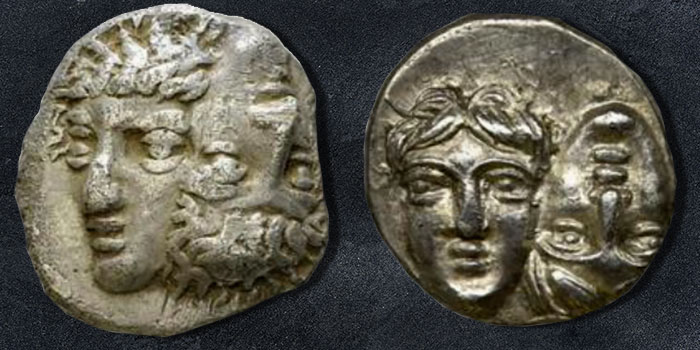
Struck in both drachmai and the associated fractional denominations, these coins portray “essentially identical” dual portraits of Apollon on their obverse. The inverted heads set these coins apart as a rarity not seen anywhere else in the ancient world. The only real design differences on the obverse come from the engravers’ skill level and artistry. Some of the obverses are finely engraved with highly realistic features, while others are rather crude, as demonstrated below. This design would not change during the entire span of this type’s production, from 434 BCE to approximately 300 BCE.

Similarly consistent, the reverse design shows an eagle in flight with wings outstretched as it clutches a dolphin in its talons. Since dolphins were, and still are found in the Black Sea, it is rather common to see them on Thracian and other Black Sea coins. Historians believe that the eagle represents Zeus and the dolphin the Black Sea. Due to the dolphin’s position as prey, it is logical to assume that the reverse image symbolizes either some unspecified military victory or Hellenic domination over the region and its vital trade routes.

But unlike the reverse imagery, the obverse has been a matter of interest and study for a long time. In all, numismatists and historians have suggested six possible meanings. The first and least likely is that the two heads represent the east-west trade routes along the River Danube and into Asia. This does not acknowledge the more important north-south trade routes into Hellas and the Mediterranean.

Another unlikely theory is that the Apollonian heads represent dual wind Gods. While possible, with their cheeks not puffed out and with their mouths open instead of closed, the obverse imagery does not match that of contemporary wind Gods.

The next theory is that the dual-headed imagery represents multiple branches of the Ister river, later to be known as the Danube. While these tributary branches no longer exist, it is possible that this interpretation is correct. Similar to the last theory, however, the iconography does not match. River Gods are usually depicted in profile, not facing forward, with beards and long flowing hair. With their short hair and beardless faces, these coins do not match this standard iconography.

A more “attractive” interpretation is that the two heads depict the rising and setting sun. Since the two Apollonian portraits are similar to those with radiate crowns from Rhodes, this is not an implausible idea. However, the “uniqueness” of the Istros imagery proves this false. The rising and setting of the sun is not a uniquely Istrian phenomenon and should therefore be seen on many coins around the ancient world, and not solely of coins from a small trading center on the periphery of the Hellenic world.

The most common theory about this interesting design is that the two heads represent Kastor and Polydeukes, the mythical Dioskuri. These identical twin brothers, sons of the princess Leda, participated in some of the most famous Hellenic mythical adventures and are known today as the Gemini twins. While this theory fits in broadly, and there are many numismatic examples of the Dioskuri being pictured on ancient coins, the Istrian type does not include many of the specific details. For example, the brothers are usually shown as full figures, and sometimes on horseback with their signature conical Dioskuri caps. More importantly, they are “seldom identical, never inverted and sometimes with stars above them.” The standard iconography is displayed on this quadrigatus from Bruttium.

We are forced to concede that while this theory is a partial fit, it cannot fully explain the enigmatic design.

In 2005, William Saslaw and Paul Murdin, noted academics at the Cambridge Institute of Astronomy, authored an influential article that argued that the double-headed Istrian coins were actually the earliest commemoration of a solar eclipse in numismatic history. Astronomers are able to predict the date and time of both future and past eclipses to within minutes. After searching for an eclipse that would have been visible from Istros between 450 and 300 BCE, Saslaw and Murdin discovered that at 6:30 am on the fourth of October, 434 BCE, there was a partial eclipse. Initially, the sun would have risen as a crescent with the two points facing up, like a bull’s horns. The sun and moon would have risen at differing speeds, thus as the sun gained altitude the horns would have “flipped” with the horns later facing down. “Clearly the Sun God was up to something astonishing.” This would have been “memorable” and “worth recording”. Since “solar eclipses are rare in both space and time,” it would not be unusual for it to be commemorated on a coin.

In fact, in the following centuries, many societies commemorated such events on their coins. The Roman emperor Vespasian included a “star” on the reverse of a denarius to commemorate the eclipse of January 5, 75 CE, and Hadrian’s mint produced the “Star and Crescent” series after the September 3, 118 CE eclipse. Hundreds of years later, the English king John included a crescent sun after there were eclipses in 1201 and 1207 CE, just to name a few.

Not only are partial eclipses “relatively rare”, a once-in-a-century phenomenon, but Istros happened to have witnessed two of them within three years. This dual occurrence should be considered “sufficient to initiate the coinage.” Since as I have discussed in past articles, coins were used to “spread news or propaganda,” it would be logical that the Istrian authorities would include “an emblem advertising Apollon’s favor” as a result of these two astronomical events. Why wouldn’t the locals take “these events as signs of good times”?

A century later on the 14th of July, 337 BCE, there was a third celestial event: a much rarer total eclipse. However, by this time, the city was beginning to decline in economic and cultural importance. Though full eclipses occur every 375 years on average at any given location, the double-headed coinage was already thought mainly to have been discontinued. There are some examples that are believed to have been struck later, but this is disputed, and they are given a date range of between 313 and 280 BCE.

One reason these dates are disputed is the general difficulty in dating this series. Unlike many other ancient coins, this Apollonian series is “never dated specifically, nor is there any datable historical reference.” Usually, there is one of these factors or the other to help numismatists date a specific example. Numismatists must therefore rely on a four-step process to date these coins.

The first step is to analyze their alloy and weights. Before the discovery of the lunar connection, this was used to date the beginning of the series to 480 to 430 BCE. The next step is to look at their production method. In the earlier issues, the mint workers employed a narrow incuse die for the reverse. This was common in Hellas during the fifth century BCE but fell out of use around 340 BCE in Istros. Another dating tool is the reverse lettering font. Between 359 and 336 BCE, it morphed to closely resemble the text on Phillip of Macedonia, the regional hegemon’s, coinage. Lastly, numismatists can use hoard membership to help date specific examples. For example, coins from the Orgamé-Argamum Necropolis Hoard were found in a ceramic pot dated to between 380 and 360 BCE. Therefore, the 39 coins inside were all struck before those dates.

Despite the difficulty in dating and the unsettled iconography, these interesting coins are fairly common and enjoyed a “relatively long run” of 150 years. They must have been intended for circulation beyond the city walls because the “variations in weight, size, and purity of the coins were small.” We can therefore infer that they were “important and reliable for commerce.”

If a collector were interested in acquiring an example of this type, they are very affordable. Examples of the full drachmai can cost as little as $80 USD and as high as $750. Fractional examples also fall within this range, with examples valued between $100 and $500.

A wonderful friend and reader of this blog sent be a box with gifts. She's a lovely friend that way! I wanted to share two of the items with you, because they are already oh so dear to my heart.


Let's start with the coins! they're replicas of ancient ones and they're heavy and absolutely splendid! I've added them to my various shrines and I can't stop playing with Athena's owl one. I love coins, period, and (replicas of) ancient Hellenic ones? Heaven!

And then there is the dodecagram! In my most viewed post to date (by a landslide) I examined some symbols of Hellenism, in the hope of figuring out one that might unify the community. My choice out of a select few was the dodecagram.


The dodecagram, or twelve pointed star, is already one of the more widespread symbols of Hellenismos. The twelve points represent the twelve Olympic Gods and thus the symbol serves its purpose as a dedicational symbol well. Another version of this symbol is the Star of Vergina, a symbol with sixteen points. The Star was used in ancient Hellas (Macedonia, mostly) and is still part of the Macedonian flag today. Because of this association, the Star does not have my preference, but I'm a great fan of the dodecagram.

In that post I also mentioned that what will decide the battle is the availability of the symbol. Back in 2012 (!) you couldn't order it anywhere, not even online. I have found versions throughout the years but they were either too small or just plain ugly. My friend had one made especially for me (!!!) and had one cast in bronze for herself (mine is silver). 

I love it. I love everything about it. It's absolutely stunning and of course, I wanted to share it with you all. Tell me, if you could and it can be an affordable option, would you like to buy one? I'm sure I can figure out if that's a possibility some way. 
A hoard of about 119 coins, together with an iron lock that may have sealed them within a container, have been found inside a collapsed building in the harbor of the ancient city of Corinth in Greece.  Corinth flourished for millennia in ancient and medieval times, and today a city named after Corinth is located not far from the ruins of the ancient site. Lechaion is the harbor area of Corinth.


The discovery leaves archaeologists with a mystery: Why didn't anyone come to retrieve the stash after the building collapsed? According to Paul Scotton, a professor of classics at California State University Long Beach who leads excavations for the Lechaion Harbor and Settlement Land Project:


"That is an excellent question and one that has been troubling us. The coins were found circa 30-40 centimeters [12 to 16 inches] below modern ground level under the collapsed tile roof. With it having been so close to the surface, why someone didn't return for it is a puzzle. Either the owner could not or did not want to retrieve it. Exactly why that would be is only conjecture."

The coins, many of which are made of bronze, were discovered in excavations carried out in 2016 and 2017; some of the coins still need to be cleaned. No human remains were found with the coins, archaeologists said. The collapsed building is located beside the remains of what may be a work yard, which has the remains of iron slag, unworked iron, cooked animal bone and a concrete basin, archaeologists found.

The earliest coin in the hoard dates to shortly after the death of Roman Emperor Constantine the Great (who reigned from A.D. 306-337), while the most recent two coins in the stash date to the reign of Byzantine Emperor Anastasius I (who reigned from A.D. 491-518), said Michael Ierardi, a professor of classics at Bridgewater State University in Massachusetts, who is studying the hoard. Based on their weight and size, the coins likely date to sometime between A.D. 491 and 498, before Anastasius I reformed the Byzantine Empire's coinage system, Ierardi said.

Research into the hoard is ongoing. The Lechaion Harbor and Settlement Land Project, co-directed by Constantinos Kissas, is a cooperative effort between the American School of Classical Studies at Athens and the Corinthian Ephorate of Antiquities. That cooperative is working with a team of scholars and students from several universities.

A group of scholars with the project presented a paper on this discovery and others from the Lechaion in January at the joint annual meeting of the Archaeological Institute of America and the Society for Classical Studies held in Boston.
Researchers at Macquarie University's Australian Centre for Ancient Numismatic Studies (ACANS) have joined forces with scientists from the Australian Nuclear Science and Technology Organisation (ANSTO), on a joint research program to solve a twenty-five century-old mystery behind the technology used to produce a special variety of ancient Hellenic coins, thus reports the Archaeology News Network.

Twenty-five century-old mystery uncovered
Silver Stater from Lucania Metapontion, 510-480 BC: Obv. Ear of corn, META reversed; 
Rev: Ear of corn incuse [Credit: Rosenblum Coins]
There are many mysteries about ancient Hellenic society, and it seems these researchers are working hard to solve one of them: how did the ancient Hellenes mint coins which shows the same image on the front and back, but with the image on the back sunk into the metal so that it appears as a negative or incuse version of the front?

These coins were first minted around 540 BC in the cities of Southern Italy (modern Basilicata and Calabria) and has attracted a good deal of discussion but it has never been satisfactorily explained. The mysterious technique of manufacture, which appears to be quite difficult to execute, was in practice for over a century. There are no surviving contemporary accounts of ancient coin manufacture, and no illustrations. Only three or four of the dies once used for striking coins in ancient Greek mints survive today. Therefore, what we know about the earliest history of coin minting is derived from a study of the coins themselves.

Dr Vladimir Luzin, Instrument Scientist at ANSTO, is at the head of the new research which makes use of neutron scattering texture measurements.

"Our aim is to explore the technology behind the production of one of the world's first coinages. In particular, our objective is to explain the very singular technology and processes for minting incuse coins."

ANSTO's Bragg Institute leads Australia in the use of neutron scattering and X-ray techniques to solve complex research and industrial problems in many important fields. Although measurements of coins using neutron texture analysis have been implemented before, a systematic and full-scale study to set a benchmark is unique to this project. According to Associate Professor Kenneth Sheedy, Director of ACANS, ANSTO's neutron scattering texture measurements will provide insight into the mechanical processes undertaken to create the coins. Numismatists from ACANS will then infer the production steps undertaken to produce these coins using knowledge of ancient materials and equipment that were available at the time. I will keep you posted when more information becomes available.
Five ancient coins were returned to the Greek government Monday, August 4, the Archaeological News Network reports. The coins were part of a case against noted Rhode Island hand surgeon and coin aficionado Dr. Arnold-Peter Weiss, who was arrested January 2012 arrest during a coin auction at the Waldorf-Astoria hotel.
US officials return ancient coins to Greece
Greek Ambassador to the U.S. Christos Panagopoulos, left, is joined by Manhattan
District Attorney Cyrus Vance Jr., center, and ICE Homeland Security Investigations
Deputy Agent in Charge Glenn Sorge, as he speaks during a repatriation ceremony
of ancient Greek coins [Credit: AP/Richard Drew]
Manhattan District Attorney Cyrus R. Vance Jr. and Greek officials held a ceremony marking the repatriation of coins dating to 500 B.C.. Ambassador Christos Panagopoulos noted:

"The coins being returned to us by the New York County district attorney are exquisite ancient artefacts that reflect Greece's culture, history and enduring strength. Back home, where they belong, they will be displayed — with the gratitude of the Greek people to the DA — for all to admire, our citizens and visitors to Greece alike."

The pieces include two types of ancient Greek currency, staters and a didracham, or two-drachma coin. All bear images of Gods and other mythological figures.


US officials return ancient coins to Greece
The five ancient Greek coins that were repatriated to Greece. They are, from left: Silver
stater of Dikaia, Thrace; silver stater of Locri Opunti; silver didrachm of Euboia;
silver stater of Thebes, Boeotia; and silver stater of Thebes, Boeotia
 [Credit: The New York County District Attorney's Office]
Weiss pleaded guilty to attempted criminal possession of stolen property. According to the criminal complaint, he was caught on tape telling a police informant that he knew the coins had been recently looted in Sicily. As part of Weiss’ plea bargain, he agreed to write an essay to raise awareness about unprovenanced coins and promote responsible collecting. those interested can find it here. Weiss was also was required to do 70 hours of community service and forfeited about 20 other coins, including the authentic pieces headed back to Greece. Two of the coins have been returned to a previous owner, and the rest are to be given to cultural and academic institutions, prosecutors said.
Friend of the blog and all-round wonderful person Terence P Ward asked me to talk a little bit more about money. Seeing as there was flattery and flattery will get you everywhere, I guess I'm writing about money today. Head's up, a lot of this is from the Oxford Companion To Classical Civilization.


"I was wondering if I could entice you to do another post on money, seeing that your research skills are heroic. Specifically, I would like to learn what the Hellenic word for money is, and how that informs our understanding of the Hellenic relationship with the stuff. I guess that would be the etymology I'm asking about. Any interest?"

As far as I am aware, the ancient Hellenic word for 'money' is 'momisma' (νόμισμα). It's derived from νομίζω (nomizō), 'to hold or own as a custom or usage, to use customarily', in turn from νόμος (nomos), 'usage, custom', ultimately from νέμω (nemō), 'I dispense, divide, assign, keep, hold'. In modern Greek, the word 'nomisma' means 'currency', and it is also a term used by numismatists--people who study or collect currency, including coins, tokens, paper money, and related objects--when referring to the pieces of money or coin. The plural is 'nomismata'.

The use of coins most likely began in western Anatolia, at the point of contact between Hellenic cities on the Aegean coast and the Lydian kingdom. The first coins were made of a natural gold and silver alloy named 'electrum', and were most likely made around 600 BC. Purely gold and silver coinds followed quickly, and they carried depictions of lions and bulls.

Nowadays, we make use of money dor any purchase, but it's highly unlikely that these early coins served the same purpose. There were differences in weight, purity, and size between coins from various city-states--even when they were close together--and thus the value of a coin was... flexible. At best. It most likely took decades for coins to become a standardized method of payment, and in the beginning, the coins were most likely only used for large-scale payments that needed to cross great distances. Gold coins are easier to transport than goods with the same value, after all.

By the second half of the sixth century BC, golden coins had all but disappeared in favor of solid silver ones. A great variety of coins emmerged--some lighter and of less value for direct barter, but most heavier than the base currency, intended solely to be transported over great distances to make a payment. From the Aegean area, the medium of coinage spread rapidly to the western Hellenics settled around the coasts of southern Italy and Sicily, France, and Spain. Early Corinthian coinage in particular influenced some of the first coinages in the west.

Alexander the Great adopted the Attic weight standard for coins and even after his death, the system he had put into place remained fairly stable. Bronze became an oft-used medium to mint coins in, and started replacing silver. Even so, the value of the coin held, and slowly, the coin developed a worth beyond the price of the material it was made from.

Terence, I hope this is what you were looking for. If not, you know where to find me, right? The Pagan Blog Project Post will be up tomorrow.
The 'Y' is one of those letters that makes me want to drop the Pagan Blog Project, just because there is simply nothing that relates completely to Hellenism. As such, I have to branch out a little and I will write a post I have been meaning to write for a while but never really found the spoons to write.

I came to Paganism through Eclectic Religious Witchcraft (in one form or another). It eventually lost its appeal in favor of something that was more truthful to me, more fitting, but I learned much in my ten+ odd years in the religion and one of them is that I really, really, cannot stand people charging exhorbitant prices for religious teachings. I feel that if there is one thing that should be 'open source', it should be religion. There is nothing wrong with asking for a donation or charging a small fee to cover costs, but as soon as you start charging $15,- for an hour long ritual that cost you nothing to put together but an hour of your time, I break out in hyves.

There is nothing wrong with selling art or books, or doing anything of the sort, especially if your prices are reasonable; this is a wonderful service to the community and something that can add to your practice once you have the funds. I'm talking more about information here, which is hard to be without if you want to practice.

Money makes the world go 'round these days, and it truly sickens me. Money should have no place in the pursuit of truth, faith, and happiness. Again, I have no issue with covering costs or even a little more than that, but I have seen a lot of fuckery (pardon the term) when it comes to money, and I have seen how some people who really want to participate and practice in the way they feel they are told to are left in the cold because they can't cough up the fee.

All of the religions under our banner are small when compared to the mainstream faiths, and as such getting quality information on it is rediculously hard. Some religions and traditions under our banner have a bit more information overturn and talented writers than other, but in general, it is very, very, hard to get your questions answers and if you are just starting out, you are far more likely to be told to do 'your own damn research' than get an answer at all from mroe experienced members of the religion.

What is this, people? Why do we do this? Why do we downlook those who come into the faith eagerly, willing to learn? Have we forgotten how badly we struggled in the beginning, how just figuring out basic ritual structures took a month? How we didn't know what to buy, what to say, how to look at the world? Why make someone else go through that when all it takes is a sentence or two to say: 'look up the word 'khernips', it's the lustral water used for purification. Come talk to me when you have and we'll get you started'.

I believe information is the greatest gift we can give our fellow human beings and fellow religionists. I don't believe in 'you get what you pay for'; I believe in 'you get what you need if you ask me nicely'. Be a decent human being to me, don't treat me like a Magic 8-Ball, and I will spent hours researching your question if I don't know the answer from the top of my head. I do this because I do remember being in your shoes; I remember being stuck with Google only and not having access to any of the books that Google ended up referring to. I remember my frustration.

As someone who gets (and answers) questions about Hellenismos quite often, I have found there are two types of questions: 'please help me because I just can't find any more information and I'm stuck', and 'please help me because I am too lazy to open Google'. In the latter case, I will always reffer you to Google with a few search terms concerning your query. In the first case, you get essays worth of material from me; free of charge, no strings attached, no questions asked (unless I need the answers to properly help you along).

I think I have pledged this before, but I will never charge you for anything. I might ask for donations or eventually put up a donate button, but the information I have, I will always share freely. I will also always be available for questions and I will never judge you for your query. Contact me through e-mail (baring.the.aegis at gmail), or Facebook, or on the Baring the Aegis Facebook page or in any of the groups I frequent. I have Google+, Twitter, and a Youtube channel. I am pretty much everywhere so if you have something to ask, just ask; free of charge, because I love our Gods, and I treasure my tradition. I would love to gift you that gift as well.
A few days ago, it was Queen's day in the Netherlands, and it's tradition to visit flea markets during that time. Naturally, I partook, and besides a statue of Hades and Persephone in need of some TLC I picked up for fifty cents, I also discovered a replica of an old Hellenic coin. As it was not a coin I was familiar with, I had to do a fair bit of searching before I found out what it was.

 
The original coins were minted between 229 - 221 BC, and named after the king of Macedonia they were created for: Antigonos III Donos (Ἀντίγονος Γ΄ Δώσων). Antigonos III Doson was a half-cousin of his predecessor, Demetrius II Aetolicus. Doson's father was Demetrius the Fair, who had briefly reign as king of Cyrene. According to Eusebius, Doson's mother was a Thessalian noblewoman, Olympias, daughter of Pauliclitus of Larissa.

When Demetrius II died in battle in 229 BC, his son and would-be successor--the later Philip V--was only nine years old. Plutarch describes that both the Macedonian army and nobility thought the political situation too volatile to wait for Philip V to mature enough to assume command. In his own words:

"Antigonos, the most powerful amongst the captains and successors of Alexander, having obtained for himself and his posterity the title of king, had a son named Demetrius, father to Antigonos, called Gonatas, and he had a son Demetrius, who, reigning some short time, died and left a young son called Philip. The chief men of Macedon, fearing great confusion might arise in his minority, called in Antigonos, cousin-german to the late king, and married him to the widow, the mother of Philip. At first they only styled him regent and general, but when they found by experience that he governed the kingdom with moderation and to general advantage, gave him the title of king. This was he that was surnamed Doson, as if he was a great promiser and a bad performer. To him succeeded Philip, who in his youth gave great hopes of equalling the best of kings, and that he one day would restore Macedon to its former state and dignity, and prove himself the one man able to check the power of the Romans, now rising and extending over the whole world."

Under Antigonos III, Macedon was reestablished as the dominant power in the region. He formed lliances with  Epirus and the Achaean League, preventing many wars and skermishes. Antigonos III helped rebuke Sparta from Peloponnese in the battle of Sellasia, where the Spartans were so outmatched by the better equipped Macedonian army what only a few horsemen manged to escape to Egypt. When his soldiers turned to plundering, however, Antigonos intervened and most famously stated that it was Kleomenes, king of Sparta, not Sparta, that was his enemy. King Antigonos III died shortly after, as he became sick during the battle against the Illyian army.

The coin was minted during his reign and depicts the wreathed head of Poseidon
on the one side, and Apollon Aktios sitting on he prow of a galley, holding a bow in His outstretched arm on the reverse. The text on the reverse reads 'ΒΑΣΙΛΕΩΣ ΑΝΤΙΓΟΝΟΥ' ('Basileus Antigonous'--'King Antigonos').

According to the 'Brill's companion to ancient Macedon', the coin was not minted by Antigonos III, but by Antigonos Antigonus I Monophthalmus (Ἀντίγονος ὁ Μονόφθαλμος) himself around 268/7 BC, who first created tetradrachms which bore the head of Pan with a Macedonian shield and Athena Alcidemus (warrior) on the reverse. Pan was the protector of Antigonos I, the God who helped him save Hellas from the Gauls. The coin I now have a replica of was most likely minted near the end of his reign around 246/7--according to the companion--and became known as 'Poseidon tetradrachms', distributed mostly in the Balkans. The iconography refers to Antigonos' naval aspirations in the Aegean, and his rivalry with the Ptolomies. The companion goes on to say that Antigonos III did not mint coins of his own during his reign. Several other sources counter these facts, but the interpretation of the design seems valid.

 
My coin comes with a small hole near the top, allowing me to wear it as a pendant, which I have been gratefully doing. It's a wonderful coin, and a great twenty cent find at the flea market.
Through a fellow blogger, I came upon an article about an author's loathing for the Pagan sellers of all the Witchcraft stuff one can buy. The post boiled down to saying that monetizing your faith takes power away from you, and simply buying your equipment will lead to hollowed out rituals. The post is here.

There is a long discussion in this from the Witchcraft perspective, but I'm not going there. I'm not going there because I left that path behind and the more I look back, I realize what a tangled--but beautiful--mess it is. Instead, I'm going to write about this from the Hellenistic point of view and take you back to Ye Olden Days when the Ancient Hellens still practiced their faith in their temples.

Religion was entwined with daily life to such an extend that you'd be hard pressed to find a pottery seller who had not depicted one or more of the Theoi on his work. Near just about every temple was a stand which sold small statues which one could sacrifice to the Theoi at said temple. Every temple complex had a treasury where the various gifts of the devoted were stored. Religion, back in the day, was big business--as it should be. It helped instill the presence of the Theoi in daily life.

I have said before that I wish more people would turn to monetizing Hellenismos. I'm still looking for that pendant, I still can't find decent statuary that I don't have to fly in from America or China, the thrift store is still my best friend in terms of finding items I can actually use in ritual, and I am still very happy for my semi-local new age bookstore annex supply shop, so I can at least find the incense I need for my daily devotionals.

I think there is absolutely nothing wrong with making money from your faith. If you're good at writing, I encourage you to write. If you're good at dry-walling, I encourage you to dry-wall. If you're good at religion, make your money that way. I'm at the point where I'm saving up so I can ask a jewelry maker to make me that dodecagram pendant I keep being nudged about wearing.

I do understand the author's frustration, though. Witchcraft is becoming a sated market where a lot of stuff has little meaning to the actual practice. I think I would prefer being on that end of the spectrum compared to the black marketing hole of nothingness where Hellenismos is located. I'd rather wade through the crap than find myself in an extremely limited religious position where the tools I feel the Theoi deserve, are none-existent, improvised or too rich for my blood.

I make no money off of either Baring the Aegis or Little Witch magazine, and I'm okay with that. Making money off of your faith, I feel, should always be for the best interest of said faith. I won't cheapen Hellenismos by letting Google randomly place advertisements on this blog. I feel this may be where the original author is absolutely right for saying that The Stuff is becoming more important than the faith: making money from your faith in a way that is in line with your faith is fine. Using your faith as a marketing strategy? Not that great.

All in all, the issue is complicated. I may not agree on flooding the market with items that make money off of faith, but, like Jason at The Wild Hunt, I believe that good work deserves good pay. So here is to hoping the Hellenistic community raises its artists to a new level. And because I'm still so partial to her work, check out Esma Designs when you get the chance. She may not be Hellenistic, but she makes incredible Hellenic jewelry.
[This post was first published in the Summer 2012 issue of Little Witch Magazine. Read the original version here.]

Pagans of all denominations seem to have a problem with money. We struggle to bring it in, don't like to give it away and, perhaps most importantly, we tend to ignore it until it becomes a problem. 

Most Pagans get by. They're not well off, but they manage. Authors, lecturers, workshop organizers, blog writers... all do what they do out of love, devotion and the crafting of skills, but very few actually pay their bills with their 'pagan job'.


There are a few difficulties in the Pagan community that make 'profitable Paganism' virtually impossible. For one, money is such a terribly mundane thing to be worried about, it takes away from the transcending nature of many (religious Witchcraft) Traditions. As Pagans, there is nothing worse than going to a retreat, fair or other religious even and coming home to debt. Yet, that is what many of us do regularly; we have our religious and spiritual awakenings somewhere else and then pay interest on it for up to several months. 


Money is a dirty word within many branches of Paganism. When you're striving to leave the toils and troubles of daily life behind and to focus, instead, on the Divine, nothing is more difficult than subjecting yourself to a job you might dislike just for the money to pay for your mortgage, your food, your utilities and still end up with nothing to spend on the things you like and a lot of time seemingly wasted. This is problem number two; most Pagans have no drive to get rich or even well off because it takes them away from the things they love to do; explore nature, participate in ritual, meet up with friends and the community, work in the garden, and so many other things.  

Issue number three comes in the form of guilt. As Pagans, those of us with a skill worth selling will have no problem charging the non-Pagan community but somewhere, somehow, it became a practice to identify with your Pagan patron's plight and knock a bit off of the price of a service of product 'because we practice the same faith and we should support each other'. It's a wonderful idea, and if everyone had money to spare, it would even work, but currently this just means that Pagan artisans, diviners, writers and healers are doing a lot of work for very little money. And they are supposed to be grateful for the little they did receive because it was a gift. Those who do charge a fair and universal rate for their work are often met with little patronage and judgment. They have broken the super secret Pagan code... because the want to stay out of debt. This code is especially prevalent in (Neo-)Wiccan circles and the majority of Witchcraft Traditions. It's rarely found amongst the Reconstructionist faiths like Asatru, Hellenismos and Kemeticism. In fact, the Reconstructionist faiths tend to be very open to a monetary reward for services rendered or items bought. That's what used to happen in the Olden Days; someone crafted a vase, another person saw the vase and liked it, so they bought it, or they traded it for something of equal value. Everyone went home better off at the end of the day. If the patron could not afford the vase, they didn't get to take it home. Priests in Ancient Greece oversaw ritual sacrifices and got to take home a share of the meat. They were paid for their services because priests, like anyone else, need to eat.

Paganism doesn't have paid clergy. This is issue number four and it's a difficult one to tackle. Research into the (American) Pagan community has discovered that the majority of questioned Neo-Pagans would like to have paid clergy available to them. Yet, they are are still not there. A major issue seems to be the fact that Neo-Pagans are scrooges when it comes to money. We don't have much of it ourselves and if we do have it, we will only spent it on things that will buy us something, be it an item or knowledge. Any money we part with needs to be met with an equal pay-off. This is in part to do with the fact that there are no Temples to tithe to. Most of us aren't raised with the request to donate money to a religious cause on a weekly or monthly basis. Those that were, often have turned away from those places and any tithing will leave them with a bad taste in their mouth. Because of this, there is no money to pay for someone to take up the role of community priest or priestess. Often, the closest we get to it is charging admission to public rituals and feeling guilty about it. But paid clergy can be so much more and there is no need to model the job the Christian way. 

Paid clergy is an ever-available listening ear to the beginning Pagan or the Pagan with (religiously fueled) marriage problems. Clergy can organize regular rituals, lectures and workshops which tighten the community and push Paganism forward. They can get certified to legally perform marriage ceremonies and can be hired to see to Pagan funeral rites, something that is becoming an issue now many of the first and second wave Pagans are reaching the age where they pass over. 

Money can buy a lot and it is not evil, or even mundane. It's part of our spiritual practice and should be seen as a blessing, not a curse. There is nothing wrong with striving for riches. These riches support your local Neo-Pagan shops, support the information sources you frequent but are charged nothing for, support rituals and fairs you can attend and, mostly, they help you invest in the future of Paganism. A future where skills and crafts are valued fairly so those who can do, get to focus on it full time and teach these skills to others so they don't get lost (again). Money helps us be better Pagans and it's time we started acknowledging that.