Showing posts with label Mesomedes. Show all posts

 Time for another bit of ancient beauty! I love little gems like this. It is not truly a hymn as such, but more an invocation: a short work that is meant to supplicate. This one is to Apollon and the muse Kalliope, the muse who presides over eloquence and epic poetry. It was written by Mesomodes.


Mesomedes of Krete (Μεσομήδης ὁ Κρής) was a Roman-era Greek lyric poet and composer of the early 2nd century AD. Two epigrams by him in the Greek Anthology are extant, and a hymn to Nemesis as well as one to Helios. The hymn is one of four which preserve the ancient musical notation written over the text. A total of 15 poems by Mesomedes are known. Prior to the discovery of the Seikilos epitaph in the late 19th century, the hymns of Mesomedes were the only surviving written music from the ancient world. The hymns to Nemesis, the muse Kalliope, and Helios can be read here and listened to here.

This version was reconstructed by Christodoulos Halaris and has been recorded on his album 'Music of Ancient Greece'. Greek composer and scholar Christodoulos Halaris is a leading expert on the study and reconstruction of ancient Greek and Byzantine music. He turned to musicology and composing after studying mathematics in Paris. Taking his cues from religious iconography and traditional popular Greek music, Halaris began reconstructing fragmentary (and sometimes nonexistent) old Greek music documents. He has published more than fifty CD's of this music and helped create the Museum of Thessalonica, devoted to Greek music. The English translations are from Ancient Greek Music by M. L. West, Oxford University Press, 1992.


Invocation to Apollon and Kalliope

Sing for me, dear Muse,
begin my tuneful strain;
a breeze blow from your groves
to stir my listless brain.
 
Skilful Calliope,
leader of the delightsome Muses,
and skilful instructor,
son of Leto, Delian Paian,
favour and be with me.
For those of you who, like me, are not blessed with the ability to write poetry beyond the level of an eight-grader, or for those who simply wish to draw they eyes of the Theoi by reciting poetry--or actually singing the hymns if your mastery of the Greek language allows it--which is familiar to Them, hymns form a wonderful addition to your practice. The oldest, and most well know, of the hymns are undoubtedly the Homeric ones, with the Orphic ones a close second, but there are many more out there.

  • Homeric Hymns - a collection of thirty-three Hellenic hexameter poems in epic style well known from Hómēros' Iliad and Odysseia. They range in length from three to five-hundred lines, and were composed in various time periods, by a variety of--now largely anonymous--authors. Hómēros might have actually written some of them, Pamphos might have penned the 'Hymn to Demeter', and Cynaethus of Chios might have penned the 'Hymn to Apollon'. Most of the poems were written between 800 and 300 BC, a few of the shorter poems are clearly from the Hellenistic (third or second century BC) period, and the Hymn to Ares was probably added to the whole in Roman times. Who actually combined the thirty-three is unclear. The first and second hymns ('To Dionysos', and 'To Demeter') were lost for a long time, until a chance discovery in Moscow in 1777 unearthed a fifteenth century manuscript with the two poems largely intact. The 'Hymn to Apollon' was noted down on the walls of Artemis' temple at Delos, and was most likely a large part of the festivals held there for Apollon. For all Homeric Hymns, go here.
  • Orphic Hymns - a collection of eighty-seven short religious poems composed in either the late Hellenistic or early Roman (first or second century AD) era. They are based on the beliefs of Orphism, a mystery cult or religious philosophy which claimed descent from the teachings of the mythical hero Orpheus. The Mysteries were mostly connected to Demeter, Persephone, life after death and reincarnation. From the Orphic Hymns also comes a list of which incenses to offer to which deity. For all Orphic Hymns, go here.
  • Hymns of Kallimachos (Καλλίμαχος) - a lesser known collection of poems, written by Kallimachos of Kyrēnē (Κυρήνη, Cyrene), who was a Hellenic poet and scholar of the Library of Alexandria. He rose to greatness around the third century BC and was the author of a large number of works. Unfortunately, only six hymns and sixty-three epigrams have survived to this day. Kallimachos despised the 'outdated' poetry type of Hómēros and wrote many testimonials against it. His hymns are, therefor, different to the eye than the Homeric and Orphic ones. For the complete hymns, go here.
  • Delphic Hymns - two musical compositions from ancient Hellas, dating back to 128 BC. They were recovered from the walls of the treasury of Apollon at Delphi, and were most likely performed in His worship at the Pythian festival. The first of the hymns was written and composed by Athenios, son of Athenios, the second by Limenios, son of Thoinos. For the first hymn, go here, for the second, go here.
  • Hymns of Proklos - Proclus (Πρόκλος) was a Greek Neoplatonist philosopher, one of the last major Classical philosophers. He was alive from 8 February 412 AD to 17 April 485 AD), and while a very late addition to this list, he wrote five beatiful hymns about the Roman Gods, which can be interpreted for the Hellenic ones as well. The surviving works consist of two hymns to Venus (Aphrodite), one to the Sun (Helios), one to the Muses, and one to Minerva (Athena). The surviving hymns can be found here, in both Greek and English.
  • Hymns of Mesomedes - Mesomedes of Krete (Μεσομήδης ὁ Κρής) was a Roman-era Hellenic lyric poet and composer of the early second century AD.  He was a freedman and court musician to the emperor Hadrian (reigned 117-138 CE), and created  three hymns and fifteen poems which have survived to this day. The hymns to Nemesis, the muse Calliope, and the Sun can be read here and listened to here. I am partial to this translation of the 'Hymn to Nemesis'.
  • Hymn to Aphrodite - This most wonderful hymn was written by Sappho (Σαπφώ) as she was struggling with love. It's unique in that it shows both petitioner and Aphrodite Herself. I am partial to this translation.
I don't know how things are where you live, but here, it's been a week of gloomy, rainy, shitty weather. Zeus Ombrios reigned strong! And then this morning, spring started. It's warm, it's sunny, and I said my prayers to Helios with pure delight! To honor Him, I am going to post a compilation of His ancient representations. Bless you, Helios, for brightening my life!

For those of you who don't know: Helios is a Titan, born from Hyperion and Theia (Hesiod, Pindar), or Hyperion and Euryphaessa (Homeric Hyms). Helios is also often confused with Apollon, mostly because of their conglomeration as a single Deity in the Roman era. In ancient Hellas, it was Phoibos (or 'Aiglêtos') Apollon who drove the chariot of the sun through the sky each morning, following the lovely Eos out of the heavenly gates. Phoibos Apollon is associated with carrying sunlight, but He is in no way the sun itself. That honor befalls Helios.


Let the heavens be silent, 
the earth, the sea, the winds.
Mountains, valleys, echoes 
and the sons of birds, keep silent!
Phoebus of the long and beauteous hair is coming.
Father of the dawn, with eye of dazzling white,
you, with the glorious golden tresses, 
lead your rosy chariot along the limitless roads of the sky, 
following the winged footprints of the steeds,
intertwining your curling rays, 
surrounding the whole earth with your resplendent light. 
Your rivers of immortal fire give life to the smiling day. 
For your, the imperturbable chorus of stars dances on Olympus
accompanying their free melody on Phoebus' lyre; 
and in front, the pale Moon leads the rhythmic times 
of the seasons by the cadenced movement of white calves. 
Your benevolent spirit rejoices in turning the myriad-robed earth.

[Mesomedes of Krete, Hymn to Helios]


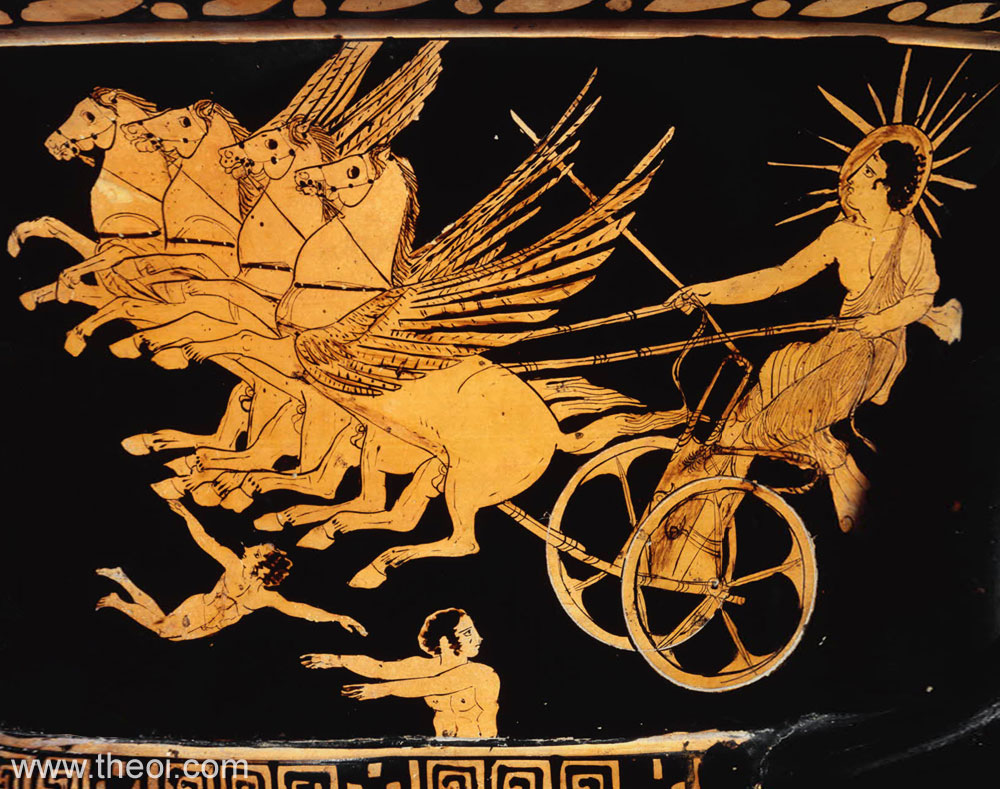
Helios, or perhaps his son Phaethon, rises into the sky at dawn. The God is crowned with the aureole of the sun and drives a four-horse chariot of winged horses. The Astra Planeta (Gods of the wandering stars) dive into the sea before Him. Selene and Eos chasing the hunter Kephalos (not shown) complete the scene. [source]

Helius & Astra Planeta | Attic red figure vase painting

The Astra Planeta dive into the sea from their heavenly perches as Helios rides into the sky. [source]

Helius, Eos & Eosphorus | Apulian red figure vase painting

The Gods Helios, Eos and Eosphoros--Sun, Dawn and Dawn-Star--form the procession of day. Eosphoros is depicted as a winged youth crowned with a shining aureole. Helios and Eos drive four-horse (quadriga) chariots and are crowned with the aureoles of sun and the light of dawn. Fish and dolphins dance beneath the chariot-wheels as the Gods emerge from the river Okeanos. [source]

Helius & Heracles | Attic black figure vase painting

Herakles, seated on the banks of the River Okeanos, shoots arrows at Helios. The God is crowned with the aureole of the sun and drives a chariot drawn by a pair of winged horses. A pair of arrows protrude from the chariot. The hero wears a lion-skin cape and holds a club and bow. [source]
Time for another bit of ancient beauty! I love little gems like this. It is not truly a hymn as such, but more an invocation: a short work that is meant to supplicate. This one is to Apollon and the muse Kalliope, the muse who presides over eloquence and epic poetry. It was written by Mesomodes.

Mesomedes of Krete (Μεσομήδης ὁ Κρής) was a Roman-era Greek lyric poet and composer of the early 2nd century AD. Two epigrams by him in the Greek Anthology are extant, and a hymn to Nemesis as well as one to Helios. The hymn is one of four which preserve the ancient musical notation written over the text. A total of 15 poems by Mesomedes are known. Prior to the discovery of the Seikilos epitaph in the late 19th century, the hymns of Mesomedes were the only surviving written music from the ancient world. The hymns to Nemesis, the muse Kalliope, and Helios can be read here and listened to here.

This version was reconstructed by Christodoulos Halaris and has been recorded on his album 'Music of Ancient Greece'. Greek composer and scholar Christodoulos Halaris is a leading expert on the study and reconstruction of ancient Greek and Byzantine music. He turned to musicology and composing after studying mathematics in Paris. Taking his cues from religious iconography and traditional popular Greek music, Halaris began reconstructing fragmentary (and sometimes nonexistent) old Greek music documents. He has published more than fifty CD's of this music and helped create the Museum of Thessalonica, devoted to Greek music. The English translations are from Ancient Greek Music by M. L. West, Oxford University Press, 1992.


Invocation to Apollon and Kalliope

Sing for me, dear Muse,
begin my tuneful strain;
a breeze blow from your groves
to stir my listless brain.
 
Skilful Calliope,
leader of the delightsome Muses,
and skilful instructor,
son of Leto, Delian Paian,
favour and be with me.
Mesomedes of Krete (Μεσομήδης ὁ Κρής) was a Roman-era Hellenic lyric poet and composer of the early second century AD. He was a freedman and court musician to the emperor Hadrian (reigned 117-138 CE), and created  three hymns and fifteen poems which have survived to this day. The hymns to Nemesis, the muse Calliope, and the Sun can be read here and listened to here. Today, I would like to leave you with his 'Hymn to Hēlios' because I'm a little sick and very busy, regardless.


Let the heavens be silent, 
the earth, the sea, the winds.
Mountains, valleys, echoes 
and the sons of birds, keep silent!
Phoebus of the long and beauteous hair is coming.
Father of the dawn, with eye of dazzling white,
you, with the glorious golden tresses, 
lead your rosy chariot along the limitless roads of the sky, 
following the winged footprints of the steeds,
intertwining your curling rays, 
surrounding the whole earth with your resplendent light. 
Your rivers of immortal fire give life to the smiling day. 
For your, the imperturbable chorus of stars dances on Olympus
accompanying their free melody on Phoebus' lyre; 
and in front, the pale Moon leads the rhythmic times 
of the seasons by the cadenced movement of white calves. 
Your benevolent spirit rejoices in turning the myriad-robed earth.
I literally have five minutes to put something up today due to bad planning on my part, so forgive me when I leave you with another poetry post. I chose this because you guys seemed to really like the not-so-well-known 'Hymn to Athena' by Proklos. Forgive me, I will actually write you something tomorrow. It is most definitely one of those weeks.

Mesomedes of Krete (Μεσομήδης ὁ Κρής) was a Roman-era Hellenic lyric poet and composer of the early second century AD. He was a freedman and court musician to the emperor Hadrian (reigned 117-138 CE), and created  three hymns and fifteen poems which have survived to this day. The hymns to Nemesis, the muse Calliope, and the Sun can be read here and listened to here. I am partial to this translation of the 'Hymn to Nemesis', copied from here, as translated by AZ Foreman.


Nemesis, winged tilter of scales and lives,
Justice-spawned Goddess with steel-blue eyes!
Thou bridlest vain men who roil in vain 
Against Thy harsh adamantine rein.
Great hater of hubris and megalomania,
Obliterator of black resentment,
By Thy trackless, churning, wracking wheel
Man's glinting fortunes turn on earth.
Thou comest in oblivion's cloak to bend
The grandeur-deluded rebel neck,
With forearm measuring out lifetimes
With brow frowning into the heart of man
And the yoke raised sovereign in Thy hand. 
Hail in the highest, O justice-queen
Nemesis, winged tilter of scales and lives,
Immortal Resenter! I sing Thy song,
Almighty Payback on proud-spread wings,
Lieutenant of fairness, Requiter of wrongs.
Despise the lordly with all Thine art
And lay them low in the Nether-dark.
For those of you who, like me, are not blessed with the ability to write poetry beyond the level of an eight-grader, or for those who simply wish to draw they eyes of the Theoi by reciting poetry--or actually singing the hymns if your mastery of the Greek language allows it--which is familiar to Them, hymns form a wonderful addition to your practice. The oldest, and most well know, of the hymns are undoubtedly the Homeric ones, with the Orphic ones a close second, but there are many more out there.

  • Homeric Hymns - a collection of thirty-three Hellenic hexameter poems in epic style well known from Hómēros' Iliad and Odysseia. They range in length from three to five-hundred lines, and were composed in various time periods, by a variety of--now largely anonymous--authors. Hómēros might have actually written some of them, Pamphos might have penned the 'Hymn to Demeter', and Cynaethus of Chios might have penned the 'Hymn to Apollon'. Most of the poems were written between 800 and 300 BC, a few of the shorter poems are clearly from the Hellenistic (third or second century BC) period, and the Hymn to Ares was probably added to the whole in Roman times. Who actually combined the thirty-three is unclear. The first and second hymns ('To Dionysos', and 'To Demeter') were lost for a long time, until a chance discovery in Moscow in 1777 unearthed a fifteenth century manuscript with the two poems largely intact. The 'Hymn to Apollon' was noted down on the walls of Artemis' temple at Delos, and was most likely a large part of the festivals held there for Apollon. For all Homeric Hymns, go here.
  • Orphic Hymns - a collection of eighty-seven short religious poems composed in either the late Hellenistic or early Roman (first or second century AD) era. They are based on the beliefs of Orphism, a mystery cult or religious philosophy which claimed descent from the teachings of the mythical hero Orpheus. The Mysteries were mostly connected to Demeter, Persephone, life after death and reincarnation. From the Orphic Hymns also comes a list of which incenses to offer to which deity. For all Orphic Hymns, go here.
  • Hymns of Kallimachos (Καλλίμαχος) - a lesser known collection of poems, written by Kallimachos of Kyrēnē (Κυρήνη, Cyrene), who was a Hellenic poet and scholar of the Library of Alexandria. He rose to greatness around the third century BC and was the author of a large number of works. Unfortunately, only six hymns and sixty-three epigrams have survived to this day. Kallimachos despised the 'outdated' poetry type of Hómēros and wrote many testimonials against it. His hymns are, therefor, different to the eye than the Homeric and Orphic ones. For the complete hymns, go here.
  • Delphic Hymns - two musical compositions from ancient Hellas, dating back to 128 BC. They were recovered from the walls of the treasury of Apollon at Delphi, and were most likely performed in His worship at the Pythian festival. The first of the hymns was written and composed by Athenios, son of Athenios, the second by Limenios, son of Thoinos. For the first hymn, go here, for the second, go here.
  • Hymns of Proklos - Proclus (Πρόκλος) was a Greek Neoplatonist philosopher, one of the last major Classical philosophers. He was alive from 8 February 412 AD to 17 April 485 AD), and while a very late addition to this list, he wrote five beatiful hymns about the Roman Gods, which can be interpreted for the Hellenic ones as well. The surviving works consist of two hymns to Venus (Aphrodite), one to the Sun (Helios), one to the Muses, and one to Minerva (Athena). The surviving hymns can be found here, in both Greek and English.
  • Hymns of Mesomedes - Mesomedes of Krete (Μεσομήδης ὁ Κρής) was a Roman-era Hellenic lyric poet and composer of the early second century AD.  He was a freedman and court musician to the emperor Hadrian (reigned 117-138 CE), and created  three hymns and fifteen poems which have survived to this day. The hymns to Nemesis, the muse Calliope, and the Sun can be read here and listened to here. I am partial to this translation of the 'Hymn to Nemesis'.
  • Hymn to Aphrodite - This most wonderful hymn was written by Sappho (Σαπφώ) as she was struggling with love. It's unique in that it shows both petitioner and Aphrodite Herself. I am partial to this translation.