Showing posts with label Aphrodite. Show all posts

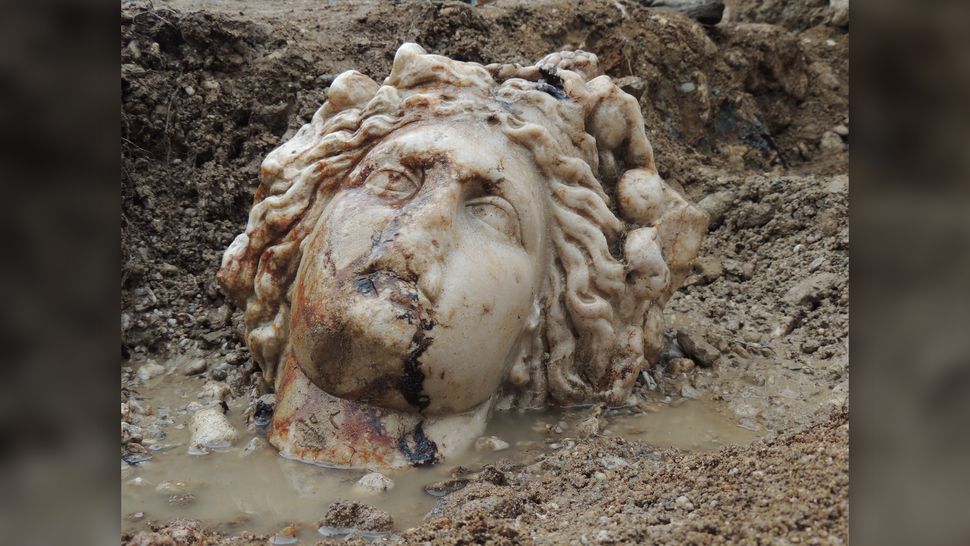
According to Hellenic mythology, the deities Aphrodite and Dionysos had a grand love affair. So, perhaps it's fitting that archaeologists found the ancient statuary heads of the Goddess of love and the reveler near each other during a dig in the ancient city of Aizanoi, in western Turkey.


The discovery of the deities' heads helps top off a previous find; on an earlier dig, archaeologists found the statues' headless bodies, Gokhan Coskun, an archaeologist at Kütahya Dumlupınar University in Turkey and the excavation coordinator, told Anadolu Agency, a Turkish state-run news organization. 

"These are important findings for us, as they show that the polytheistic culture of ancient Greece existed for a long time without losing its importance in the Roman era," Coskun said. "The findings suggest that there may have been a sculpture workshop in the region."

The ancient city of Aizanoi has a rich history filled with ancient Greek and Roman period settlements. Its earliest settlement dates to the second millennium B.C., but many of its remaining ruins date to the Roman Empire, including its Roman baths, Zeus temple and macellum, or Roman indoor market. Aizanoi is listed as a "tentative" World Heritage Site by the United Nations Educational, Scientific and Cultural Organization (UNESCO). 

Archaeologists found the Roman-era heads of Aphrodite and Dionysos buried in a creek bed in the ancient city. Each head is made of limestone, with Aphrodite's head measuring 19 inches (50 centimeters) and Dionysus' head measuring 17 inches (45 cm) tall, according to the news site GEO. It's unknown how the statues' heads became separated from their bodies.

Previously, archaeologists in Aizanoi uncovered the statue of Hygieia, Goddess of health, cleanliness and hygiene, according to GEO. 

How about a little overview today? An overview of the fertility gods of Hellenismos. I'm going to start off with a lesser known deity: Priapos (Πριαπος), protector of sheep, goats, bees, the vine and of all garden produce. He was depicted with a huge male member, and can be petitioned for aid with any issues regarding the male genitalia. He was native to the Mysian city of Lampsakos on the Hellespont but the ancient Hellenes adopted the God as the son of either Hermes or Dionysos. His mother was usually Aphrodite. Fun fact: primitive statues of Priapos were traditionally set-up in vegetable plots to promote fertility with the added benefit of functioning as a type of 'scarecrow' scaring away birds.


Rhea (Ρεα), wife of Kronos, is a female fertility Goddess--amongst other things. She also looks after mothers and children, and is one of the great mother Goddesses in the pantheon having obviously given birth to the Olympians. Anything female-related (including issues with fertility) can be put before Her. Hera, by the way, has many of the same domains as Her mother--logical as she is the new generation's mother figure.

Aphrodite is also a fertility Goddess. She along with Zeus, Hera, Eileithyia and Hymenaios were the Theoi Gamelioi (Gods of Marriage) who presided over the wedding rites. She was invoked as the Goddess of the consummation of marriage and the fertility of the bride.

Speaking of which, Eileithyia (Ειλειθυια) is the Goddess of childbirth and labour pains. According to some there were two Eileithyiai, one who furthered birth and one who protracted the labour. Her name means 'she who comes to aid'.

Demeter and Persephone were regarded as fertility Goddesses in the Eleusinian Tradition, and during Their Thesmophoria festival, women actively asked for fertility from Them. Demeter, especially, is obviously also very important for the growth of plant life.

Dionysos is mostly associated with the fertility of the soil, and especially in regards to the grape vine, but human fertility is amongst His descriptors. Pan is regarded as much the same, as are many of the Satyrs and daimons connected to Them--like Tykhon, Konisalos, and Orthannes.

Phanes (Φανης) is the Protogenos of procreation in the Orphic cosmogony. He is the primal generator of life, and was the driving force behind reproduction in the early cosmos. Phanes was hatched from the world egg when it was split into its constituent parts by the ancient gods Khronos and Ananke. Arguably, He still drives the process of reproduction, be it in plants, animals, or humans.

Pisces is a constellation of the zodiac. Its name is the Latin plural for 'fish'. It lies between Aquarius to the west and Aries to the east. The ecliptic and the celestial equator intersect within this constellation and in Virgo.


http://www.constellationsofwords.com/stars/AlPherg.html


During the Titomanchy, the Olympians were in for a rough fight when Zeus led them against the Titans. One of their toughest fights was against the storm-giant Typhôeus (Τυφωευς), a fight so tough, in fact, that the Olympians had to flee from battle. Pisces is associated with Aphrodite and Eros, the who escaped from the monster Typhôeus, the most-feared son of Tartaros and Gaea, by leaping into the sea and transforming themselves into fish. In order not to lose each other, they tied themselves together with rope. Alternatively, the fish represent the Ikhthyes (Ιχθυες), a pair of large Syrian river fish who rescued Aphrodite and Eros when they were fleeing. Thirdly, they may be solely the fishes Aphros and Bythos, the fish-tailed Ikhthyokentauroi (Sea-Centaurs) of late classical art, who pulled Aphrodite to safety after her birth in the ocean. Hyginus says of the first option in his 'Astronomica':

"Diognetus Erythraeus says that once Venus and her son Cupid came in Syria to the river Euphrates. There Typhon, of whom we have already spoken, suddenly appeared. Venus and her son threw themselves into the river and there changed their forms to fishes, and by so doing this escaped danger. So afterwards the Syrians, who are adjacent to these regions, stopped eating fish, fearing to catch them lest with like reason they seem either to oppose the protection of the gods, or to entrap the gods themselves." [II.30]

Roman poet Ovid has an adaption about the second option, noted down in 'Fasti':

"[N]ext in turn do thou, O Fish, receive the heavenly steeds. They say that thou and thy brother (for ye are constellations that sparkle side by side) did support twain gods upon your backs. Once on a time Dione,55 fleeing from the dreadful Typhon, when Jupiter bore arms in defence of heaven, came to the Euphrates, accompanied by the little Cupid, and sat down by the brink of the Palestinian water. Poplars and reeds crowned the top of the banks, and willows offered hope that the fugitives also could find covert there. While she lay hid, the grove rustled in the wind. She turned pale with fear, and thought that bands of foes were near. Holding her child in her lap, “To the rescue, nymphs!” she said, “and to two deities bring help!” Without delay she sprang forward. Twin fish received her on their backs, wherefore they now possess the stars, a guerdon meet. Hence scrupulous Syrians count it sin to serve up such fry upon the table, and will not defile their mouths with fish." [2.458]

In all cases, the fishes were accepted into the heavens for their aid lend, and Aphrodite and Eros were safe, having escaped Typhôeus.

Pisces is visible at latitudes between +90° and −65°, and best visible at 21:00 (9 p.m.) during the month of November.

Coming of age ceremonies are prevalent in most cultures and are often linked to the religious views of the people performing it. Famous examples are the bar mitswa's and bat mitswa's of the Jewish. The ancient Hellenes had coming of age rituals as well, and like almost everything else in ancient Hellenic life, these rituals were tied into deity worship. Today, I'm going to talk about these coming of age ceremonies, but because the differences are so great between girls and boys, I'm going to describe their coming of age ceremonies separately.


Girl to woman
In ancient Hellas, a girl's coming of age ceremony was linked to her wedding day. As soon as she got married, she would move out, into her new husband's oikos, and commit to the task she was born to fulfill: gift her husband legitimate offspring--boys, preferably. It won't come as a surprise that in preparation for this entirely new role in life, a girl's coming of age ceremony was focussed almost entirely on ending her own childhood, and petitioning the Theoi for help in her life as an adult. As such, fertility and womanhood were big parts of the rituals.

Young girls rarely had a role to play in household worship. The family only had them with them for thirteen to fifteen years, on average, after that, she joined her rightful place at the oikos of her husband, where she carried more (religious) responsibility. There were religious roles young girls could fulfill outside of the home, however, most notably as 'Arrephoros' (Ἀρρήφορος)--year long handmaidens of Athena Polias (Πολιάς)--in Athens, and as 'Arktos' (αρκτος), bear, a service in the following of Artemis Brauronia (Βραυρωνια) at Brauron (Βραυρών).

During the Arkteia festival, celebrated every four or five years alongside--or as a part of--the Brauronia, named and in honor of the epithet of Artemis. Every Athenian girl, as well as many other girls from all over Attika, had to take part of the festival before they could marry. The girls were brought to Brauron, a temple of Artemis with a rich history in both myth and history. Some versions of the myth of Iphigeneia have her taken from the sacrifice and dropped in Brauronia, where she established a temple to the Theia in gratitude. Otherwise, an oracle might have told the ancient Hellenes to build a temple to the Theia at Brauron after a terrible plague or famine plagued the land following the killing of a bear by two hunters.

The symbolism of the bear might refer to the bear which was slain by the hunters, or the clothes Iphigeneia might have left at her 'sacrifice'. It's also possible that the bear reference refers to Kallisto, who was transformed into a bear by the Theia.

During the festival young girls, and it seems that on occasion young boys, would gather to celebrate Artemis Brauronia with races, and dances. They would don bear masks and dance a dance known as the 'Arkteia', which was made up of slow, solemn steps meant to imitate the movements of a bear and was performed to a tune from a diaulos (double flute). They might have carried baskets of figs. Up until as far back as the 5th century, the girls might have worn actual bear skins, but bears soon became scarce, so they wore yellow dresses called 'krokoton', which they 'shed' instead of the skins to signal their coming adulthood.

The actual reason for the 'bear' ritual has been lost. It's possible that the ritual served to exorcise 'the wildness' out of little girls, but it's more likely that it was simply a way to procure kharis for the young girls who would soon call on Artemis during childbirth. In the same spirit, young women on the threshold of marriage made an offering to Artemis of their childhood toys and other paraphernalia that represented childhood, as with an offering of one drachma (roughly $ 60,-) at the temple of Aphrodite. Most likely, the bride also honored Hera Teleia and Zeus Teleios in some way.

A young woman came of age during her wedding and the subsequent wedding night, but became a woman when she gave birth for the first time. Especially during the latter, they desperately needed the support of the Theia Artemis. Aphrodite and Hera Teleia would support her through her marriage, and help her make it a success. With the help of the Theoi, a girl could become a woman.

Boy to man
Young boys had a very different life to young girls when it came to life in ancient Hellas. Because it was very important for a man to have legitimate children, the child's paternity was attested to on multiple occasions. In Athens, this was done the first time shortly after being named, and the second time when he reached sixteen years of age. Both times, the child was presented at the 'phratria' (φ(ρ)ατρία)--brotherhood--of his father. The system of brotherhoods, four in total, was the system that preceded the system of tribes. The brotherhoods largely fades, except for the registration of male offspring, and the vetting of such with testimonials and tests. The brotherhoods were overseen by Zeus Phratrios and Athena Phratria, who were honored yearly in a three-day festival called the 'Apoutouria'.

During a son's presentation to the brotherhood, Zeus Phratrios and Athena Phratria during the Apoutouria, boys sacrificed a lock of their hair to the patron Theoi and Hēraklēs, their father an animal. If one of the phratria contested that the father was, indeed, the father of this child, he could take the animal from the father before they reached the altar, and drag it away. Doing so would have been a very serious thing to do, and very shocking for a young boy to witness, not to speak of the father. The claim would then be put to a vote. When the phratria ruled in favor of the father, the animal was sacrificed and the meat distributed to the members of the brotherhood. The son became a full member.

At sixteen, a boy was considered a young man, and he entered one or two years of public service, either to mature, or to show he had matured enough to take part. This was called his 'ephebeia', which literally means 'young man'. On completion of this public service, a young man could enter the military and became a voting member of the Ekklesia. He became a citizen. Although young man were now considered adults, he only truly became an adult at age thirty, when he could serve in the boule, and get married.

Young men swore an oath upon completion of their ephebia, which has largely been preserved. It read as follows:

"I will not bring shame upon these sacred weapons nor will I abandon my comrade-in-arms wherever I stand in the ranks. I will defend both the holy and profane things. I will not hand on the fatherland smaller than I received it, but larger and better, so far as it lies in my power with the assistance of all the other citizens. I will obey the officials who govern wisely and the laws, both those which are already established and those which are wisely established in the future. If anyone attempts to destroy them, I will not allow it, so far as it lies in my power with the assistance of all the other citizens. I will hold in honor the ancestral sanctuaries. The following gods are witnesses: Aglauros, Hestia, Enyo, Enyalios, Ares and Athena Areia, Zeus, Thallo, Auxo, Hegemone, Heracles, the territory of the fatherland, the wheat, barley, vines, olive trees, and fig trees."

With this oath, the world opened up for young men; they would now be held divinely accountable for any trespassing upon the law and common sense. Political life would become important for men, as well as military service. They had roughly ten years to dedicate to these before he took a wife, so young men tended to fulfill much of their obligation to the city in these ten years. After his marriage, he became the one who presented sons to the phratria, and he got to experience the entire proceedings from the spot his father once held. This--most likely--created strong familial ties that continued through family lines for centuries.

In conclusion
There is much that remains to be said about coming of age ceremonies in ancient Hellas, more to be said about coming of age ceremonies in ancient Athens, even, but that is talk for another day. For now, I hope you have a basic idea of the youth and religious focal points of an Athenian child's life. Personally, I have a soft spot for coming of age rituals, and I strongly suggest creating or adapting ceremonies for the second (or even third) generation of Hellenists. What this would look like will be left for another post, but it would surely be beautiful.

I am fairly swamped right now. May I interest you in the words of Sophocles on Aphrodite and love? I'll give you something more tomorrow.


“Children, the Cyprian is certainly not only the Cyprian
But she is a being of many names.
She is Hades. She is immortal life.
She is mad insanity. She is desire undiluted.
She is lamentation. In her is everything
Earnest, peaceful, all that leads to violence
She seeps into the organs of everything
In which life resides. Who is ever sated by the goddess?
She enters into the fishes’ swimming race,
She is in the four-limbed tribe on the land
And guides her wing among the birds.
Among beasts, mortals, among the gods above.
Whom of the gods has she not thrown three times?
If it is right for me—if it is right to speak the truth,
She rules Zeus’ chest without a spear or iron
The Cyprian certainly cuts short
All the best plans of humans and gods.”
[fr. 941 [=Stobaeus 4, 20.6]]


Our blessed Goddess Aphrodite intrigues me. She is a Goddess of both love and war, of friendship and hate, of companionship and jealousy. She is one of the Goddesses with the widest range of domains and influence in our world and She is Goddess that touches us personally. She doesn't control the weather or the sea, She controls us directly.

Aphrodite's cult was very popular in ancient Hellas with numerous shrines and temples throughout the land. Her main cult centres within Hellas were the city of Corinth, and the island of Cytherea off the coast of Lakedaimonia. Beyond Hellas the island of Cyprus was famed for its Mystery cult of the goddess. Aphrodite was also worshipped with private rituals and prayers.

One of the aspects of Aprodite's worship that has always fascinated me is Her connection to doves. Aphrodite's jewel-encrusted, golden chariot was drawn through the sky by a team of doves. The Syrian Aphrodite Astarte was said to have been hatched from an egg nursed by doves. In Hellenic art, Aphrodite's doves symbolize the pure, spiritual aspect of love, rather than physical love.

Aphrodite's primary festival, the Aphrodesia, also had a very special place for doves. An inscription on a stele of Hymettian marble found near the Beulé Gate at the site of the aedicula on the south-west slope of the Acropolis, dated between 287 and 283 BC, records that at the time of the procession of Aphrodite Pandemos, Kallias, son of Lysimachos of the deme of Hermai, was to provide funds for the purification of the temple and the altar with the blood of a dove, for giving a coat of pitch to the roof, for the washing of the statues, and for a purple cloak for the amount of two drachmas.

Doves were probably the first birds to be domesticated, possibly as early as Neolithic times. They also return home (to their mates), making them inherently "romantic" animals. They were also
considered oracular birds; the oracle at Dodona was considered the oldest in Hellas, even if it was later replaced in importance by the oracle of Apollon at Delphi. According to Herodotos, in his Histories, the oracle was founded when two black doves flew from Thebes in Egypt; one dove settled in Libya to found the sanctuary of Zeus Ammon, and the other settled in an oak tree at Dodona, proclaiming a sanctuary to Zeus be built there. Doves also take nectar and ambrosia to the Gods on Olymos.

Doves are not unique to Aphrodite's worship, but it strikes me that they are as diverse as Her. They are also very "personal" animals--domesticated, bringing food and drink to the Gods, coming home to their mate. They fit Her, and I have no trouble picturing them as Her birds.

Because it's been a while since the last constellation, and yesterday's blog post hardly counted, I'm going to give you not one but two constellations today (also because it's much easier to describe both in one post, seeing as the mythology surrounding these two has mixed throughout the years, so I'm really just making it easier on myself).


The Corona Australis, the southern crown, is located in the southern hemisphere, next to the constellation Sagittarius. As such, it is often linked to that constellation and regarded as the wreath that fell off of the head of one of the kéntauros that particular constellation is linked to. In the same regard, it is also linked to the kéntauros 'Centaurus'.

Corona Australis is most often regarded as a wreath, but in some descriptions and depictions, the Corona Australis is a crown. There is, however, one myth in which the Corona Australis does not depict a wreath or crown: in this myth, the constellation represents Ixion, king of the Lapits, who fell in love with Hera after being invited up to Olympos by Zeus. Zeus decided to test his integrity after He discovered His guest' lust for Hera, but Ixion failed miserably. Ixion was expelled from Olympus and blasted with a thunderbolt for failing his test. Zeus then ordered Hermes to bind Ixion to a winged fiery wheel that was always spinning. Therefore, Ixion is bound to a burning solar wheel for all eternity, at first spinning across the heavens, then into Tartaros. The Corona Australis is this very wheel, with Ixion tied to it.

The most famous of myths associated with the Corona Australis is the story of the birth of Dionysos, and the death of His mother Semele. In this version of the myth, Dionysos is born from Semele and Zeus, and while Semele is pregnant with Him, Hera plants seeds of doubt in her mind about the father of the child truly being Zeus. Semele asks Zeus to reveal Himself to her in His true form, and when He is left with no other option, He does so, killing her in the process. Zeus takes pity on His child, and takes Him into either His thigh or testicle, where He is eventually born from. When Dionysos grows up, He raises Semele to Olympos and grants her eternal life. He also places a wreath into the sky to honor her. The wreath would be made of myrtle leaves, for Dionysos left a gift of myrtle in the Underworld in return for His mother, and the followers of Dionysos wore crowns of myrtle.

Interestingly enough, Roman author Hyginus ascribes this myth to the Corona Borealis, and adds that Dionysos first received this wreath--now a golden crown--from Aphrodite. He gave it to His beloved Ariadne, daughter of Minos. According to Hyginus, it was the light that reflected off of this crown, that led Theseus from the labyrinth after slaying the minotaur. Hyginus then goes on to retell the story above, and says that Dionysos did not want to take the crown into the Underworld in fear of it being contaminated with miasma. When He returned from the Underworld, he threw the golden crown into the sky as a memorial.

Hyginus also gives another account for the the northern crown, the Corona Borealis:

"It is said that when Theseus came to Crete to Minos with seven maidens and six youths, Minos, inflamed by the beauty of one of the maidens, Eriboea by name, wished to lie with her. Theseus, as was fitting for a son of Neptune[Poseidon], and one able to strive against a tyrant for a girl’s safety, refused to allow this. So when the dispute became one not about the girl but about the parentage of Theseus, whether he was the son of Neptune or not, Minos is said to have drawn a gold ring from his finger and cast it into the sea. 

He bade Theseus bring it back, if he wanted him to believe he was a son of Neptune; as for himself, he could easily show he was a son of Jove [Zeus]. So, invoking his father, he asked for some sign to prove he was his son, and straightway thunder and lightning gave token of assent. For a similar reason, Theseus, without any invoking of his father or obligation of an oath, cast himself into the sea. And at once a great swarm of dolphins, tumbling forward over the sea, led him through gently swelling waves to the Nereids. 

From them he brought back the ring of Minos and a crown, bright with many gems, from Thetis, which she had received at her wedding as a gift from Venus [Aphrodite]. Others say that the crown came from the wife of Neptune, and Theseus is said to have given it to Ariadne as a gift, when on account of his valor and courage she was given to him in marriage. After Ariadne’s death, Liber [Dionysos] placed it among the constellations."

As you can see, there are many myths surrounding the two crowns. The Hellenic poet Aratos named them 'Stephanoi' (Στεφάνοι) around 300 BC, but did not differnetiate between the two, although they are not placed close together. As such, the Stephanoi are visible and best viewed at different times throughout the year. The Corona Australis is visible at latitudes between +40° and −90°, and best visible at 21:00 (9 p.m.) during the month of August. The Corona Borealis, located near the constellations of Hēraklēs and Boötes, is visible at latitudes between +90° and −50°, and best visible at 21:00 (9 p.m.) during the month of July.

 I get a lot of questions from readers, and most of the time, the answers are fairly short. When I feel the question or the reply would be valuable to others as well, I make a post with a collection of them and post them in one go. Today is one of those posts.


"What kind of incense can I offer to Aphrodite? Thank you! :-)"

The Orphic incenses prescribe a hymn to Aphrodite, so as far as the go-to guide for incenses goes, the Orphic hymns aren't helpful. That said, there were a few staples. Frankincense (λίβανον) is one of them. Frankincense is tapped from the Boswellia sacra tree. The bark is stripped off, and the tree 'bleeds' tears of frankincense, which are allowed to harden before being cut off. There is great variety in quality--colour, purity, aroma, age, and shape--and, thus, in price. Another staple is Myrrh (σμύρναν). Myrrh is harvested in the same way frankincense is, and is commonly harvested from the species Commiphora myrrha. Myrrh gum is waxy, and coagulates quickly. It becomes rock hard very fast, and becomes glossy. The gum is yellowish, and may be either clear or opaque. It darkens deeply as it ages, and white streaks emerge.

Myrrh, especially, is connected to Aphrodite in legend. It's said that Myrrha (or Smyrna) was a young princess who refused to honour Aphrodite, and so She made her lust after her own father. Eventually, she was turned into the first Myrrh tree. Apollodorus, in his 'Bibliotheca':

"And Adonis, while still a boy, was wounded and killed in hunting by a boar through the anger of Artemis. Hesiod, however, affirms that he was a son of Phoenix and Alphesiboea; and Panyasis says that he was a son of Thias, king of Assyria, who had a daughter Smyrna. In consequence of the wrath of Aphrodite, for she did not honor the goddess, this Smyrna conceived a passion for her father, and with the complicity of her nurse she shared her father's bed without his knowledge for twelve nights. But when he was aware of it, he drew his sword and pursued her, and being overtaken she prayed to the gods that she might be invisible; so the gods in compassion turned her into the tree which they call smyrna. Ten months afterwards the tree burst and Adonis, as he is called, was born, whom for the sake of his beauty, while he was still an infant, Aphrodite hid in a chest unknown to the gods and entrusted to Persephone. But when Persephone beheld him, she would not give him back. The case being tried before Zeus, the year was divided into three parts, and the god ordained that Adonis should stay by himself for one part of the year, with Persephone for one part, and with Aphrodite for the remainder. However Adonis made over to Aphrodite his own share in addition; but afterwards in hunting he was gored and killed by a boar." [3.14.4]


"Hi, I watched your "making manna" video tutorial, and I couldn't really understand what you said was in the yellow glass bottle. What is it, and where can I get it?"

I had to watch my own video again to remember a yellow bottle, but I think I know what you mean. The yellow bottle is used to store my bio-ethanol, the burning agent I use when building a fire indoors. This is a form of biofuel (fuel derived from biological sources), and a variation of denatured alcohol. It's a clear, flammable liquid which burns without smoke and without scent. As such, it works very well for indoor use. Make sure to use a cast-iron or at least solid container to burn in!


"Is there a greek god of finding missing things?"

Not as far as I know, but in general, Gods and Goddesses whom you have built kharis with will help you when you are truly in need. From a purely personal perspective, Hermes would most likely be able to find your items, seeing as he's been known to hide (and steal) items Himself ;-)

A 2,500-year-old Aphrodite temple was recently unearthed by a team of Turkish archaeologists in the Urla-Cesme peninsula in western Turkey.

The ancient Greek temple to the Goddess of love and beauty, Aphrodite, was located just outside of the city of Izmir, or Smyrna.

The first remnants of this temple were discovered in 2016 after archaeologists began to conduct extensive searches over a large area of 1,600 square meters (17,220 square feet) in the province.

Throughout their work surveying the plot, archaeologists have found a wealth of artifacts left by the region’s ancient residents.

In total, remnants from 35 settlements from the prehistoric period, 16 of which are from the Late Neolithic period, have been unearthed in the province of western Turkey.

Professor Elif Koparal from Mimar Sinan University leader of the excavations, spoke to Andalou Agency about the remarkable finds archaeologists have discovered in the region.

“During our screening of the surface, we detected the Aphrodite temple from the sixth century B.C. Aphrodite was a commonly worshiped figure back then. It is a fascinating and impressive discovery.” 

Koparal added that archaeologists have found evidence of an extensive ancient social and economic network in the province.

As the looting of artifacts is widespread and prevalent in the country, Koparal worked to gain the trust of local residents, creating a network of people who protected the priceless finds from thieves.

A Roman age marble head depicting the goddess Venus has been found during the course of rescue excavations ahead of redevelopment of the central Piazza San Giustino in Chieti, Abruzzo.

Thought to date to the first century AD the head, carved from precious Parian marble, is likely to be a copy of the Crouching Venus by the Greek sculptor Doidalsas of Bithynia who lived in the third century BC. 

Other findings include laterite brick walls from the post-classical period, medieval masonry, a series of foundations of pillars, as well as sections of walls belonging to a cistern or large basement. A domestic-artisan space, also from the medieval period, equipped with a small silo for the storage of grains was also found.

"The preliminary investigation," reads an announcement by the Superintendence, "has resulted in photogrammetric and documentation of what was found. At the same time, the works for the redevelopment of the square, as part of a project of over one and a half million euros, will go ahead.'


"Were the women engaging in holy prostitution doing it willingly or were they forced?"

This refers to this post about sex and ritual in which I mention sacred prostitution in relation to the worship of Aphrodite. This is a hard question to answer. For one, accounts are incredibly fuzzy and there appear to be many forms of ritual prostitution, especially in relation to the worship of Aphrodite. Before we go into the question, let me reiterate a bit of what I have explained about women in ancient Hellas before: women were property. They could be bought and sold, they could be given away in marriage, and within the law, they could be raped without punishment (same goes for men, by the way). Women did not have the autonomy to plan their own life--that honour went to her father or her husband, and if those were not available, the privilege went to her son(s) or another male family member. This sounds pretty dire, but it wasn't; it was just life.

Because much of what we know of ancient Hellas was written by men who condoned and enjoyed this system of male economic and social superiority, we will most likely never know exactly how women felt about these arrangements, let alone temple prostitution. And in a system like this, where is the line between willing and forced? If the women knew there was an alternative, would they have resisted? Did they now? Did they see it as their sacred duty to Aphrodite, or did the men in their lives think so?

I can tell you a bit: many of these practices were old--far older than Hellenic civilization. Some were also imported from other parts of the surrounding world, and the Goddess that was originally worshipped with these rites was adapted to Aphrodite as well. There are accounts of a great variety of prostitution rites: women sold to men in grand sales where the men had to promise to wed the women (thus making them lawful wives, not a doûlos, a slave) and where the funds raised went to the temple of Aphrodite; women put out by the side of the road and sold to men for a coin for one night, after which she would never have to submit to a man ever again (and once more, the coins went to Aphrodite); or a ritual where women had to cut their hair and if they refused, they had to sleep with strangers for a day and all the funds went to Aphrodite. There are countless of these examples, although many grew outdated fairly early on in Hellenic history.

It's important to note that temple prostitution was not frowned upon. A woman who collected her dowry by prostituting herself was considered pure and pious, and men would wed her readily. If a woman prostituted herself and gave the proceedings to the temple, she was considered pious and worthy of great respect.

Temple prostitutes did more than offer sexual intercourse to visitors of the temple or its festivals: they entertained by way of musical instrument, by song or dance. they gave brilliance to the rites performed and enhanced the festival proceedings greatly. They were always invited, and while they weren't priestesses of Aphrodite, they were considered part of the temple and somewhat sacred to Her. The temple of Aphrodite Porne at Corinth was said to be so wealthy that it kept more than a thousand of these women.

Did these women do it willingly? I don't know. It was part of the worship of Aphrodity, as proclaimed by the men who took advantage of these sacred laws. Very rarely can these type of circular logic problems be answered with a 'yes' or a 'no'. The reasons for taking part in temple prostitution must have been numerous, and I don't know if the women could refuse. It's tempting to look at this from a modern point of view, but it's useless to do so. Times have changed, and this is an aspect of Hellenic religion, we have rightfully left in the past.


"Were there male temple prostitutes?"

The short answer is: we don't know. We know that there was (young) male prostitution that ancient Athenial lawmaker Solon regulated. These men were called 'πόρνοι pórnoi'. Some of them aimed at a female clientele but the vast majority of male prostitutes were for a male clientele. The period during which adolescents were judged as desirable extended from puberty until the appearance of a beard. Boys kept on afterwards were looked down upon, and if the matter came to the attention of the public they were deprived of citizenship rights once come to adulthood. For the relations that were built up (instead of just a quick tryst ), see pederasty, the socially acknowledged erotic relationship between an adult male and a younger male usually in his teens which was practiced mostly in the Archaic and Classical ages of Hellenic history. Due to the age difference and the societal function the practice served, this type of relationship was accepted and not considered homosexual. The younger partner was always the passive party and performed to role of 'woman' in the exchange, thus making it a heterosexual relationship between two men (as contradictory as that may sound).

As for temple prostitution: I haven't seen a single mention of it anywhere. It may have existed, but personally I doubt it for the reason listed above: the men who slept with temple prostitutes did so to honour a female deity who was--in essence--above them is standing. To raise a young boy to the same height when the rules of pederasty were so clear cut just does not fly with me. I'll let you guys know if I ever find out more.
On the 16th of Hekatombaion, the Synoikia (συνοίκια or συνοικέσια) festival was held in Athens. It was a community festival, sacred to primarily Athena, and was a festival held every year. Why the Sunoikia was celebrated, and what its origins are is not entirely clear; best I can tell is that it reaches back to the unification of twelve small towns into the metropolis of Athens, and is thus linked to the myth of Theseus. Will you celebrate with us today, on July 7th?


The Synoikia was 'somewhat' of a two-day festival; the 16th was the official sacred day, but the 15th was important as well. Parke, in 'Festivals of the Athenians' (1977), states that:

"Some light on the subject comes from a fragment of the fifth-century code of sacrificial regulations found in the Agora. It records among the festival held every second year as the earliest in the calendar sacrifices held on the 15th and 16th of Hecatombaion. This is evidently the Synoikia though the name does not appear in the inscription. Thuclydides did not mention anything about a two-yearly celebration, and one would naturally expect the commemoration of a historic even to take place annually. But the part of the code dealing with the annual festivals of Hecatombaion is lost, and it probably contained references to the annual Synoikia on the 16th, and one should picture the celebration as taking place on this one day every year, and every second year being held in a larger and more extended form over the two days of the 15th and the 16th." [p. 31]

The second day was the main event, and it contained sacrifices to Zeus Phratrios, Eirênê (Ειρηνη, Goddess of peace and spring), and most importantly: Athena. The Synoikia was believed to have been instituted by Theseus to commemorate the concentration, the Synoecism, of the government of the various towns of Attica and Athens. This unification is described by Thucydides, in his 'History of the Peloponnesian War':

"In this manner spake the Mytilenaeans. And the Lacedaemonians and their confederates, when they had heard and allowed their reasons, decreed not only a league with the Lesbians but also again to make an invasion into Attica. And to that purpose the Lacedaemonians appointed their confederates there present to make as much speed as they could with two parts of their forces into the isthmus; and they themselves being first there prepared engines in the isthmus for the drawing up of galleys, with intention to carry the navy from Corinth to the other sea that lieth towards Athens, and to set upon them both by sea and land. [2] And these things diligently did they. But the rest of the confederates assembled but slowly, being busied in the gathering in of their fruits and weary of warfare." [3. 15]

Prior to this mythical event taking place, it seems the Synoikia was solely a festival for Athena, as caretaker of Athens. All sacrifices went to Her. After the Synoecism, however, Zeus Phatrios gained importance: he oversaw the various phratries (clans) of Athens who had come together to form a unified people. The content of the Synoikia was solidified in a time of many wars, and it seemed many people were not only tired of them, but saw them as a threat to the solidity of Athens and Attica. As such, the inclusion Eirênê makes sense, as well as Elaion's additions of Aphrodite and Peitho.

Even in ancient times, the sacrifices were a bit lacklustre: a young ewe on the 15th, and two young bullocks on the 16th. Neither sacrifice included a feast and the meat--save for what was sacrificed, of course--was sold right away, indicating not many people attended and that the festival was held most for form; and antiquated festival even then. Today, reading up on the history of Athens and sacrificing to Athena, Zeus Phatrios, and Eirênê suffices to celebrate the Synoikia--and join in with our PAT ritual, of course! You can find the ritual here and the community page here.
June 26, at 10 am EDT, we will hold a rite for Aphrodite Pandamos and Peitho, as on this day, the fourth of Hekatombaion, They were traditionally honored during a festival of unification. Will you join us?


Pandêmos (Πανδημος) occurs as an epithet of Aphrodite. It identifies her as the Goddess of low sensual pleasures, and the epithet is often translated as 'common to all the people'. She united all the inhabitants of a country into one social or political body. In this respect She was worshipped at Athens along with Peitho (persuasion), and Her worship was said to have been instituted by Theseus at the time when he united the scattered townships into one great body of citizens.

According to some authorities, it was Solon who erected the sanctuary of Aphrodite Pandemos, either because her image stood in the agora, or because the hetaerae had to pay the costs of its erection. The worship of Aphrodite Pandemos also occurs at Megalopolis in Arcadia and at Thebes. 'Pandemos' also occurs as a surname of Eros.

Peithô is the personification of persuasion, seduction and charming speech. She was worshipped as a divinity at Sicyon, where she was honoured with a temple in the agora. Peitho also occurs as a surname of other divinities, such as Aphrodite, whose worship was said to have been introduced at Athens by Theseus, when he united the country communities into towns, and of Artemis.

At Athens the statues of Peitho and Aphrodite Pandemos stood closely together, and at Megara, too, the statue of Peitho stood in the temple of Aphrodite, so that the two divinities must he conceived as closely connected, or the one, perhaps, merely as an attribute of the other. For our rite, we will honour both divinities separately.

There is actually not much known about the Aphrodisia. It was most likely linked to the synoikismos, or unification, of the Attic demes into poleis, or city-states. In early Hellas, ancient society was split between the 'demos', country villages, and the 'asty', or 'polis', the seat of the aristocracy. The distinction between the 'polis' and the 'demos' was of great political importance in the ancient states. There was much antagonism between these two bodies, the country and city. In the city-states of ancient Hellas, synoecism occurred when the 'demos' combined with--usually by force--a polis to form one political union. The most notable synoikistes was the mythic or legendary Theseus, who liberated Attica from Kretan hegemony and gave independency back to Hellas under leadership of Athens. Like the Synoikia that was celebrated in a few days--which was a truly political festival and we will thus not celebrate it--the Aphrodisia seems to celebrate Theseus' efforts.

An inscription on a stele of Hymettian marble found near the Beulé Gate at the site of the aedicula on the south-west slope of the Acropolis may tell us something of the preparations for the Aphrodisia festival. Dated between 287 and 283 BC, the inscription records that at the time of the procession of Aphrodite Pandemos, Kallias, son of Lysimachos of the deme of Hermai, was to provide funds for the purification of the temple and the altar with the blood of a dove, for giving a coat of pitch to the roof, for the washing of the statues, and for a purple cloak for the amount of two drachmas.

From this and other ancient sources, we can conclude that the first ritual of the festival would be to purify the temple with the blood from a dove, which we know is the sacred bird of Aphrodite. Needless to say, we won't do this, but we do encourage you to give your altar a good scrub! Afterwards, worshippers would carry sacred images of Aphrodite and Peitho in a procession to the sea to be washed. In Cyprus, participants who were initiated into the Mysteries of Aphrodite were offered salt, a representation of Aphrodite's connection to the sea, and bread baked in the shape of a phallus (feel free to make some of those!). During the festival it was not permitted to make bloody sacrifices, since the altar could not be polluted with the blood of the sacrifice victims, which were usually white male goats. This of course excludes the blood of the sacred dove, made at the beginning of the ritual to purify the altar. In addition to live male goats, worshippers would offer flowers and incense.

As a celebration of the unification of Attica, the Aphrodisia festival may seem redundant, since the Synoikia festival also took place in the month of Hekatombaion, between the Aphrodisia and the Panathenaia. Yet, without help of Aphrodite Pandemos and Peitho, whose powers bring people together, unification would not have been possible. While the Synoikia celebrates a very specific event that is no longer current, the Aphrodisia celebrates not only Aphrodite (and Peitho) as divine, but also represents the beauty of community, solidarity, and the end of strive. In this day and age where it seems the entire world is at war, we offer sacrifice to Aphrodite and Peitho humbly in hopes that They will interfere and lay to rest this terrible animosity.

Will you be joining us on June 26? Join the community here, and download the ritual here.
Everyone knows and loves the Twelve Olympians. Heck, everyone knows and loves all Olympians. there are many Theoi, however, that often get overlooked. Today I wanted to introduce a few of the lesser known Theoi to you, if you haven't heard of Them already. I am a firm believer that all the Theoi deserve praise and knowledge of them is the first step towards that goal.


Nereus
Nereus (Νηρευς) is the old man of the sea, and the God of the sea's rich bounty of fish. He dwells in the depths of the Aegean with his wife Doris and his fifty Nereid daughters. Like many of the other sea-Gods Nereus is a master shapeshifter, and speaks with prophetic voice. He is considered a very wise and very old God and the ancient Hellenes depicted him as an old man with a wooden staff accompanied by a host of his Nereid daughters. Sometimes he was depicted with a coiling fish tail in place of legs.

Khionê
Khionê (χιών) is one of the nymphs, a daughter of Boreas, God of the north-wind, and Oreithyia, the lady of mountain gales. Khione is the Goddess of snow. Her name bears a direct link with the ancient Hellenic word for snow: khiôn.

The Astra Planeti
The Astra Planeti (Αστηρ Πλανητων) are the Gods of the five wandering stars or planets. They are named Phainon (the planet of Kronos), Phaethon (the planet of Zeus), Pyroeis (the planet of Ares), Eosphoros (the planet of Aphrodite), and Stilbon (the planet of Hermes). In Hellenic vase painting they were depicted as youths diving into the river Okeanos with the rising of Helios.

Hebe
Hebe (Ἡβη) is the Goddess of youth and the cupbearer of the Gods who served ambrosia at the heavenly feasts. She is also the patron Goddess of the young bride and an attendant of Aphrodite. Her father is Zeus and her mother is Hera. Her husband is the hero Hēraklēs.

Aniketos and Alexiares
Aniketos (Ανικητος) and Alexiares (Αλεξιαρης) are the sons of Hebe and Hēraklēs. Together, They guard the Gates of Olympos and presided over the defence of fortified towns and citadels. Their names mean respectively 'the unconquerable one' and 'he who wards off war'.

Phobos and Deimos
Phobos (Φοβος) is the God of fear, dread and terror, and his twin-brother Deimos (Δειμος) the god of panic fear, flight and battlefield rout. They are sons of Ares and Aphrodite and often accompany their father into battle, driving His chariot and spreading fear in Their wake. As sons of Aphrodite the twins also represented the fear of loss. In classical art the two were usually represented as youths. Phobos was sometimes depicted with a lion or lion-like head.

Iapetos
Iapetos (Ιαπετος) is one of the Titan Gods, sons of Ouranos and Gaia. He is one of four brothers who hold heaven and earth apart. Iapetos Himself was no doubt the pillar of the west, a position which was later and more obviously held by His son Atlas. He may have been regarded as the Titan God of the mortal life-span and His sons Prometheus and Epimetheus were represented as the creators of mankind and other mortal creatures.

Harmonia
Harmonia (Ἁρμονια) is the Goddess of harmony and concord. As a daughter of Aphrodite, she presides over marital harmony, soothing strife and discord; as a daughter of Ares, she represented harmonious action in war. Late Hellenic and Roman writers ascribe cosmic harmony to Her. Her counterpart is Eris.
For those of you who, like me, are not blessed with the ability to write poetry beyond the level of an eight-grader, or for those who simply wish to draw they eyes of the Theoi by reciting poetry--or actually singing the hymns if your mastery of the Greek language allows it--which is familiar to Them, hymns form a wonderful addition to your practice. The oldest, and most well know, of the hymns are undoubtedly the Homeric ones, with the Orphic ones a close second, but there are many more out there.

  • Homeric Hymns - a collection of thirty-three Hellenic hexameter poems in epic style well known from Hómēros' Iliad and Odysseia. They range in length from three to five-hundred lines, and were composed in various time periods, by a variety of--now largely anonymous--authors. Hómēros might have actually written some of them, Pamphos might have penned the 'Hymn to Demeter', and Cynaethus of Chios might have penned the 'Hymn to Apollon'. Most of the poems were written between 800 and 300 BC, a few of the shorter poems are clearly from the Hellenistic (third or second century BC) period, and the Hymn to Ares was probably added to the whole in Roman times. Who actually combined the thirty-three is unclear. The first and second hymns ('To Dionysos', and 'To Demeter') were lost for a long time, until a chance discovery in Moscow in 1777 unearthed a fifteenth century manuscript with the two poems largely intact. The 'Hymn to Apollon' was noted down on the walls of Artemis' temple at Delos, and was most likely a large part of the festivals held there for Apollon. For all Homeric Hymns, go here.
  • Orphic Hymns - a collection of eighty-seven short religious poems composed in either the late Hellenistic or early Roman (first or second century AD) era. They are based on the beliefs of Orphism, a mystery cult or religious philosophy which claimed descent from the teachings of the mythical hero Orpheus. The Mysteries were mostly connected to Demeter, Persephone, life after death and reincarnation. From the Orphic Hymns also comes a list of which incenses to offer to which deity. For all Orphic Hymns, go here.
  • Hymns of Kallimachos (Καλλίμαχος) - a lesser known collection of poems, written by Kallimachos of Kyrēnē (Κυρήνη, Cyrene), who was a Hellenic poet and scholar of the Library of Alexandria. He rose to greatness around the third century BC and was the author of a large number of works. Unfortunately, only six hymns and sixty-three epigrams have survived to this day. Kallimachos despised the 'outdated' poetry type of Hómēros and wrote many testimonials against it. His hymns are, therefor, different to the eye than the Homeric and Orphic ones. For the complete hymns, go here.
  • Delphic Hymns - two musical compositions from ancient Hellas, dating back to 128 BC. They were recovered from the walls of the treasury of Apollon at Delphi, and were most likely performed in His worship at the Pythian festival. The first of the hymns was written and composed by Athenios, son of Athenios, the second by Limenios, son of Thoinos. For the first hymn, go here, for the second, go here.
  • Hymns of Proklos - Proclus (Πρόκλος) was a Greek Neoplatonist philosopher, one of the last major Classical philosophers. He was alive from 8 February 412 AD to 17 April 485 AD), and while a very late addition to this list, he wrote five beatiful hymns about the Roman Gods, which can be interpreted for the Hellenic ones as well. The surviving works consist of two hymns to Venus (Aphrodite), one to the Sun (Helios), one to the Muses, and one to Minerva (Athena). The surviving hymns can be found here, in both Greek and English.
  • Hymns of Mesomedes - Mesomedes of Krete (Μεσομήδης ὁ Κρής) was a Roman-era Hellenic lyric poet and composer of the early second century AD.  He was a freedman and court musician to the emperor Hadrian (reigned 117-138 CE), and created  three hymns and fifteen poems which have survived to this day. The hymns to Nemesis, the muse Calliope, and the Sun can be read here and listened to here. I am partial to this translation of the 'Hymn to Nemesis'.
  • Hymn to Aphrodite - This most wonderful hymn was written by Sappho (Σαπφώ) as she was struggling with love. It's unique in that it shows both petitioner and Aphrodite Herself. I am partial to this translation.
On the 16th of Hekatombaion, the Synoikia (συνοίκια or συνοικέσια) festival was held in Athens. It was a community festival, sacred to primarily Athena, and was a festival held every year. Why the Sunoikia was celebrated, and what its origins are is not entirely clear; best I can tell is that it reaches back to the unification of twelve small towns into the metropolis of Athens, and is thus linked to the myth of Theseus. Will you celebrate with us on July 19th?


The Synoikia was 'somewhat' of a two-day festival; the 16th was the official sacred day, but the 15th was important as well. Parke, in 'Festivals of the Athenians' (1977), states that:

"Some light on the subject comes from a fragment of the fifth-century code of sacrificial regulations found in the Agora. It records among the festival held every second year as the earliest in the calendar sacrifices held on the 15th and 16th of Hecatombaion. This is evidently the Synoikia though the name does not appear in the inscription. Thuclydides did not mention anything about a two-yearly celebration, and one would naturally expect the commemoration of a historic even to take place annually. But the part of the code dealing with the annual festivals of Hecatombaion is lost, and it probably contained references to the annual Synoikia on the 16th, and one should picture the celebration as taking place on this one day every year, and every second year being held in a larger and more extended form over the two days of the 15th and the 16th." [p. 31]

The second day was the main event, and it contained sacrifices to Zeus Phratrios, Eirênê (Ειρηνη, Goddess of peace and spring), and most importantly: Athena. The Synoikia was believed to have been instituted by Theseus to commemorate the concentration, the Synoecism, of the government of the various towns of Attica and Athens. This unification is described by Thucydides, in his 'History of the Peloponnesian War':

"In this manner spake the Mytilenaeans. And the Lacedaemonians and their confederates, when they had heard and allowed their reasons, decreed not only a league with the Lesbians but also again to make an invasion into Attica. And to that purpose the Lacedaemonians appointed their confederates there present to make as much speed as they could with two parts of their forces into the isthmus; and they themselves being first there prepared engines in the isthmus for the drawing up of galleys, with intention to carry the navy from Corinth to the other sea that lieth towards Athens, and to set upon them both by sea and land. [2] And these things diligently did they. But the rest of the confederates assembled but slowly, being busied in the gathering in of their fruits and weary of warfare." [3. 15]

Prior to this mythical event taking place, it seems the Synoikia was solely a festival for Athena, as caretaker of Athens. All sacrifices went to Her. After the Synoecism, however, Zeus Phatrios gained importance: he oversaw the various phratries (clans) of Athens who had come together to form a unified people. The content of the Synoikia was solidified in a time of many wars, and it seemed many people were not only tired of them, but saw them as a threat to the solidity of Athens and Attica. As such, the inclusion Eirênê makes sense, as well as Elaion's additions of Aphrodite and Peitho.

Even in ancient times, the sacrifices were a bit lacklustre: a young ewe on the 15th, and two young bullocks on the 16th. Neither sacrifice included a feast and the meat--save for what was sacrificed, of course--was sold right away, indicating not many people attended and that the festival was held most for form; and antiquated festival even then. Today, reading up on the history of Athens and sacrificing to Athena, Zeus Phatrios, and Eirênê suffices to celebrate the Synoikia--and join in with our PAT ritual, of course! You can find the ritual here and the community page here.
July 7, at 10 am EDT, we will hold a rite for Aphrodite Pandamos and Peitho, as on this day, the fourth of Hekatombaion, They were traditionally honored during a festival of unification. Will you join us?


Pandêmos (Πανδημος) occurs as an epithet of Aphrodite. It identifies her as the Goddess of low sensual pleasures, and the epithet is often translated as 'common to all the people'. She united all the inhabitants of a country into one social or political body. In this respect She was worshipped at Athens along with Peitho (persuasion), and Her worship was said to have been instituted by Theseus at the time when he united the scattered townships into one great body of citizens.

According to some authorities, it was Solon who erected the sanctuary of Aphrodite Pandemos, either because her image stood in the agora, or because the hetaerae had to pay the costs of its erection. The worship of Aphrodite Pandemos also occurs at Megalopolis in Arcadia and at Thebes. 'Pandemos' also occurs as a surname of Eros.

Peithô is the personification of persuasion, seduction and charming speech. She was worshipped as a divinity at Sicyon, where she was honoured with a temple in the agora. Peitho also occurs as a surname of other divinities, such as Aphrodite, whose worship was said to have been introduced at Athens by Theseus, when he united the country communities into towns, and of Artemis.

At Athens the statues of Peitho and Aphrodite Pandemos stood closely together, and at Megara, too, the statue of Peitho stood in the temple of Aphrodite, so that the two divinities must he conceived as closely connected, or the one, perhaps, merely as an attribute of the other. For our rite, we will honour both divinities separately.

There is actually not much known about the Aphrodisia. It was most likely linked to the synoikismos, or unification, of the Attic demes into poleis, or city-states. In early Hellas, ancient society was split between the 'demos', country villages, and the 'asty', or 'polis', the seat of the aristocracy. The distinction between the 'polis' and the 'demos' was of great political importance in the ancient states. There was much antagonism between these two bodies, the country and city. In the city-states of ancient Hellas, synoecism occurred when the 'demos' combined with--usually by force--a polis to form one political union. The most notable synoikistes was the mythic or legendary Theseus, who liberated Attica from Kretan hegemony and gave independency back to Hellas under leadership of Athens. Like the Synoikia that was celebrated in a few days--which was a truly political festival and we will thus not celebrate it--the Aphrodisia seems to celebrate Theseus' efforts.

An inscription on a stele of Hymettian marble found near the Beulé Gate at the site of the aedicula on the south-west slope of the Acropolis may tell us something of the preparations for the Aphrodisia festival. Dated between 287 and 283 BC, the inscription records that at the time of the procession of Aphrodite Pandemos, Kallias, son of Lysimachos of the deme of Hermai, was to provide funds for the purification of the temple and the altar with the blood of a dove, for giving a coat of pitch to the roof, for the washing of the statues, and for a purple cloak for the amount of two drachmas.

From this and other ancient sources, we can conclude that the first ritual of the festival would be to purify the temple with the blood from a dove, which we know is the sacred bird of Aphrodite. Needless to say, we won't do this, but we do encourage you to give your altar a good scrub! Afterwards, worshippers would carry sacred images of Aphrodite and Peitho in a procession to the sea to be washed. In Cyprus, participants who were initiated into the Mysteries of Aphrodite were offered salt, a representation of Aphrodite's connection to the sea, and bread baked in the shape of a phallus (feel free to make some of those!). During the festival it was not permitted to make bloody sacrifices, since the altar could not be polluted with the blood of the sacrifice victims, which were usually white male goats. This of course excludes the blood of the sacred dove, made at the beginning of the ritual to purify the altar. In addition to live male goats, worshippers would offer flowers and incense.

As a celebration of the unification of Attica, the Aphrodisia festival may seem redundant, since the Synoikia festival also took place in the month of Hekatombaion, between the Aphrodisia and the Panathenaia. Yet, without help of Aphrodite Pandemos and Peitho, whose powers bring people together, unification would not have been possible. While the Synoikia celebrates a very specific event that is no longer current, the Aphrodisia celebrates not only Aphrodite (and Peitho) as divine, but also represents the beauty of community, solidarity, and the end of strive. In this day and age where it seems the entire world is at war, we offer sacrifice to Aphrodite and Peitho humbly in hopes that They will interfere and lay to rest this terrible animosity.

Will you be joining us on July 7? Join the community here, and download the ritual here.

How about a little overview today? An overview of the fertility gods of Hellenismos. I'm going to start off with a lesser known deity: Priapos (Πριαπος), protector of sheep, goats, bees, the vine and of all garden produce. He was depicted with a huge male member, and can be petitioned for aid with any issues regarding the male genitalia. He was native to the Mysian city of Lampsakos on the Hellespont but the ancient Hellenes adopted the God as the son of either Hermes or Dionysos. His mother was usually Aphrodite. Fun fact: primitive statues of Priapos were traditionally set-up in vegetable plots to promote fertility with the added benefit of functioning as a type of 'scarecrow' scaring away birds.

Rhea (Ρεα), wife of Kronos, is a female fertility Goddess--amongst other things. She also looks after mothers and children, and is one of the great mother Goddesses in the pantheon having obviously given birth to the Olympians. Anything female-related (including issues with fertility) can be put before Her. Hera, by the way, has many of the same domains as Her mother--logical as she is the new generation's mother figure.

Aphrodite is also a fertility Goddess. She along with Zeus, Hera, Eileithyia and Hymenaios were the Theoi Gamelioi (Gods of Marriage) who presided over the wedding rites. She was invoked as the Goddess of the consummation of marriage and the fertility of the bride.

Speaking of which, Eileithyia (Ειλειθυια) is the Goddess of childbirth and labour pains. According to some there were two Eileithyiai, one who furthered birth and one who protracted the labour. Her name means 'she who comes to aid'.

Demeter and Persephone were regarded as fertility Goddesses in the Eleusinian Tradition, and during Their Thesmophoria festival, women actively asked for fertility from Them. Demeter, especially, is obviously also very important for the growth of plant life.

Dionysos is mostly associated with the fertility of the soil, and especially in regards to the grape vine, but human fertility is amongst His descriptors. Pan is regarded as much the same, as are many of the Satyrs and daimons connected to Them--like Tykhon, Konisalos, and Orthannes.

Phanes (Φανης) is the Protogenos of procreation in the Orphic cosmogony. He is the primal generator of life, and was the driving force behind reproduction in the early cosmos. Phanes was hatched from the world egg when it was split into its constituent parts by the ancient gods Khronos and Ananke. Arguably, He still drives the process of reproduction, be it in plants, animals, or humans.