Showing posts with label Lycurgus. Show all posts

 Xenelasia (ξενηλασία). Xenelasia was 'the right possessed and exercised by the Lacedaemonian magistrates of expelling from Sparta (and Doric Krete) any stranger whose presence was injurious to the public order or morals'.

In order to explain that, I need to give a bit of history on Sparta and the way it was ran. Sparta (Σπάρτα), or Lacedæmon (Λακεδαίμων), was a prominent city-state in ancient Hellas, located on the banks of the River Eurotas in Laconia, in south-eastern Peloponnese. It emerged as a political entity around the 10th century BC, when the invading Dorians subjugated the local, non-Dorian population. Sparta was an oligarchy (oligarkhía, ὀλιγαρχία)--a form of power structure in which power effectively rests with a small number of people. The state was ruled by two hereditary kings of the Agiad and Eurypontid families, both supposedly descendants of Hēraklēs and equal in authority, so that one could not act against the power and political enactments of his colleague. The kings were in charge of religious festivals, judicial matters, as well as the military. Over time, the kings became mere figureheads except in their capacity as generals in war, but their power waned slowly, and democracy was never instituted in the polis.

From about 650 BC onwards, Sparta rose to become the dominant military land-power in ancient Hellas. Sparta was one of the city-states that never adopted a democratic political system; instead, they had the family as a model for the organization of the state; a family they protected from corruption by outside forces. Like a true family unit, Sparta had its own customes, holidays, and drunk uncles, and they were preserved as much as possible. In order to accomplish this, Lacedæmonian magistrates had the duty and authorization to expel any person who posed a threat to public order and morals

Foreigners were allowed into Sparta for religious festivals and missions of state but they were not allowed to live in the environs. Special exceptions were given to friends and allies who were called 'laconophiles'; lovers of Sparta. On the reverse side, the general populace was forbidden foreign travel. These laws were intended to preserve the native character of the Doric tribe from any taint of foreign influence. Plutarch, in 'The Lives of the Noble Grecians and Romans', wrote:

"And this was the reason why he [Lycurgus] forbade them to travel abroad, and go about acquainting themselves with foreign rules of morality, the habits of ill-educated people, and different views of government. Withal he banished from Lacedaemon all strangers who would not give a very good reason for their coming thither; not because he was afraid lest they should inform themselves of and imitate his manner of government (as Thucydides says), or learn anything to their good; but rather lest they should introduce something contrary to good manners. With strange people, strange words must be admitted; these novelties produce novelties in thought; and on these views and feelings whose discordant character destroys the harmony of the state. He was as careful to save his city from the infection of foreign bad habits, as men usually are to prevent the introduction of a pestilence."

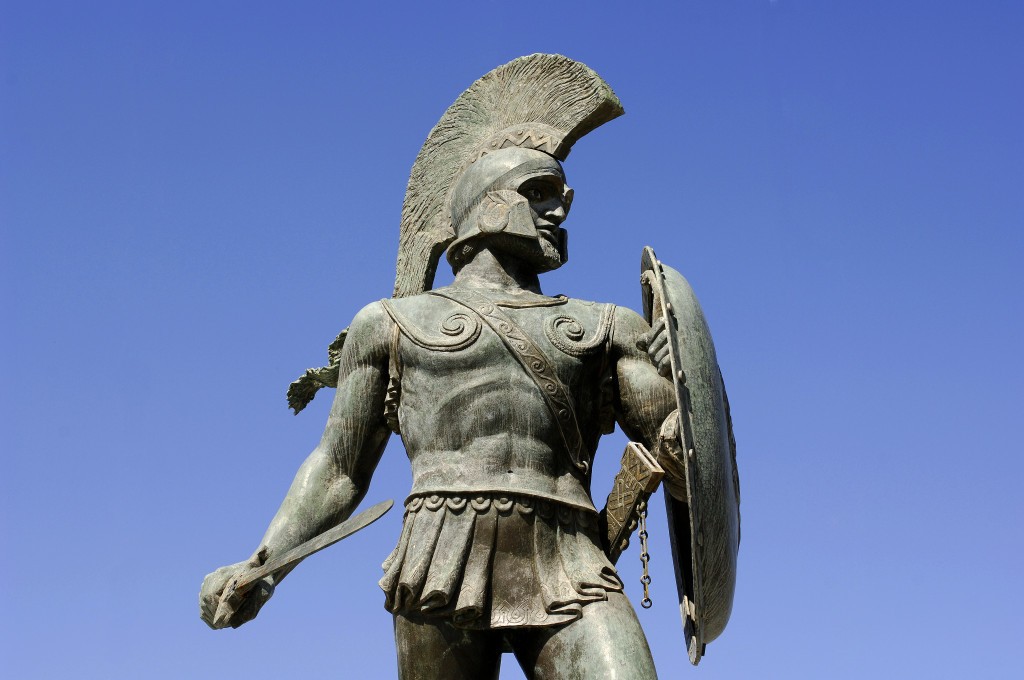
Lycurgus (Lykoûrgos, Λυκοῦργος), pictured above, was the legendary lawgiver of Sparta, who established the military-oriented reformation of Spartan society in accordance with the Oracle of Apollo at Delphi. All his reforms were directed towards the three Spartan virtues: equality (among citizens), military fitness, and austerity. It is said that after his reforms--which included the laws governing xenelasia--he left for the Oracle of Delphi to check with the Gods if they agreed. Before he left, he made every Spartan swear to uphold his laws while he was gone. Once at the Oracle, she told him that his laws were excellent, and Lycurgus prompty disappeared or starved himself so his laws would always remain in effect.

Xenelasia was part of any interaction with outsiders, be it in trade, in entertainment, during religious functions, and even applied to whom Spartans could ahve sex with and marry. While it sounds like these laws would interfere with xenia, they didn't; foreigners were welcome, but they were never considered truly Spartan. Only Spartans were Spartans. Even if you loved the polis, you would never truly be a part of it.

The laws of xenelasia were controversial in ancient Hellas, but they were a defining factor in what made Sparta great; its character caused Spartans to band together, to make their family unit proud, and it helped them accept the sacrifice of their individuality in favor of the greatness of the polis. In the end, however, it is suspected that their unwillingness to open up to the influence of others contributed to the demise of the once-great polis; there was simply no buffer to accommodate losses in battle.

Image property: Wikipedia Commons

 I don't write enough about Hellenic tragedies (or comedies, for that matter). In fact, in nearly two hundred posts, I don't think I've gone in depth on any of the plays, besides a cursory retelling of Euripides' adaption of Mēdeia's myth. I think the reason for this is that tragedies are, firstly, an extension of the ancient rites performed in honor of Dionysos... and while I worship Dionysos as a member of the Hellenic pantheon, I am not drawn to His Mysteries and cults at all. Before I begin this post, I therefor need to give the basics of tragic, Hellenic, theater before I get get to the point of this Pagan Blog Post, namely the Year-Daímōn, or Eniautos-Daímōn.


How tragic theater came to be is unknown. It's an old practice, dating back to the earliest foundations of Hellas. What we do know is that the tradition became intrinsically linked to the the Greater Dionysia, which was celebrated in the month of Elaphebolion; around March. Tragedies were plays--usually sung in their entirety by the chorus, but later also partly spoken--which were often pitted against each other in a contest, with the price for the winner being a goat. The word 'tragus día (τραγῳδία) has its roots in the ancient Hellenic words for 'goat' (tragos, τράγος) and 'sing' (á(i)dô, ᾄδω), which, combined, would be 'song for the goat'.

The name may also stem from 'bleating like a goat' or 'bleating like a child', and indicate that the name was given to the practice to indicate that the actors threw their voice to perform the parts. There are many other explanations, and the inclusion of the goat may simply refer to a goat being sacrificed at the festivals that included the performance of tragedies, or refer to satyr-like behavior as identified with Dionysos and His following.

This satyr-like behavior was most often seen in satyr plays, which are a third form of Hellenic theater, next to comedies and tragedies. Satyr plays were based on Hellenic mythology, and were chock full of mock drunkenness, sexuality, phallic props, pranks, and general merriment. After three days of tragedies, the fourth day of the Greater Dionysia was celebrated with satyr plays.

Like satyr plays, tragedies always focussed on mythology. Favorites were the myths surrounding Demeter, Persephone, and Hades; the 'death' and 'rebirth' of Dionysos; heroes like Herakles, Ajax, and Philoktētēs; and women like Mēdeia, Helèktra, Iphigeneia, and Antigone.

Tragedies often revolved around a central theme: dark versus light, good versus evil, or other variations of the duality. They were always about making ethical decisions. They also had a central structure: Contest (agon), Tearing-asunder/death/defeat (pathos), Messenger (angelos), Lamentation (threnos), Discovery (anagnorisis), Recognition (theophany), and Resurrection (apotheosis). Not all parts had to be included, although the plays were rated higher if they were.

An example: Euripides' Mēdeia starts after Iásōn tells her he will marry Kreousa, daughter of king Kreon of Korinth instead of her. There is a heated discussion, and Mēdeia flees to Athens, vowing to get her revenge (agon). She sends her children to Iásōn and Kreousa with an enchanted dress that kills both Kreousa and her father (pathos). A messenger runs to tell her of this event (angelos), and Iásōn grieves over the woman he has lost and his situation (threnos). Mēdeia returns to kill her two sons, and is discovered by Iásōn. Mēdeia explains her actions to the audience and Iásōn (theophany) and rises above the situation in Helios' chariot, which carries her off (a form of apotheosis). Mēdeia's play is straight-forward, without anagnorisis, something usually interpreted as a plot twist. In this case, Mēdeia knew the children were hers when she killed them. If she hadn't know, the play would have been completely different, and would probably have garnered Euripides more than third place.

With this introduction done, we can move on to the core of this post: the Year-Daímōn and its sacrifice. The Year-Daímōn is a title given to any Theos or hero, whose death and rebirth are tied to the turning of the seasons. These scapegoats 'die' with the old year and are 'reborn' with the new year, setting in motion a cycle of renewal for the plant life that forms the basis of the Hellenic food supply. Dionysos is the prime Eniautos-daímōn, but Theseus, Herakles, Apollon, Odysseus, and Orpheus qualify as well, as They are--in some way--linked closely to death and rebirth, either from visiting the Underworld and leaving it, or experiencing a 'second birth' of sorts.

To stay with Dionysos; for those unaware, there are about a bazillion stories on His birth, but two are of importance to this post. In one, he is born from Semele and Zeus, and while Semele is pregnant with Him, Hera plants seeds of doubt in her mind about the father of the child truly being Zeus. Semele asks Zeus to reveal Himself to her in his true form, and when he is left with no other option, He does so, killing her in the process. Zeus takes pity on His child, and takes Him into either His thigh or testicle, where He is eventually born from.

In the other version of the myth, stemming from Crete, Dionysos is the child of Zeus and Persephone (or Demeter). In this version, Dionysos is born, but ripped to pieces by Titans, under orders of a jealous Hera. Zeus smites the Titans, but is too late to save anything of Dionysos but His heart, which He gets implanted into His thigh like the first myth, or implants in Semele.

In both versions of the myth, Dionysos is twice-born, hence his epithet 'Dimêtôr' (Διμητωρ). Dionysos was considered a fertility God, but also closely related to nature's eternal cycle of birth and death. The ancient Hellens considered the moment a plant--especially the grape--began to grow for the first time after being planted its first birth, and counted its second birth when it became laden with ripened fruit. As Dionysos is so closely related to to the grape vine, it was Dionysos Himself that was considered being born once from the earth and again from the vine.

Dionysos' cult focussed heavily on this part of His mythology, and during the Dionysia, this thought pattern returned heavily, especially within the context of tragedies. From Harrison's pre-Olympic themed 'Themis: a Study of the Social Origins of Greek Religion' comes the following reflection on a procession exhibited by Ptolemy Philadelphos in honour of Dionysos:

"The procession was headed by Silenoi clad, some in purple, some in scarlet, to keep off the multitude; next followed twenty Satyrs bearing lamps; next figures of Nike with golden wings; then Satyrs again, forty of them, ivy-crowned, their bodies painted some purple, some vermilion. So far it is clear we have only the ministrants, the heralds of the god to come. After these heralds comes the first real personage of the procession, escorted by two attendants. His figure will not now surprise us.

"After the Satyrs come two Sileni, the one with petasos and caduceus as herald, the other with trumpet to make proclamation. And between them walked a man great of stature, four cubits tall in the dress and mask of a tragic actor and carrying the gold horn of Amaltheia. His name was Eniautos. A woman followed him, of great beauty and stature, decked out with much and goodly gold; in one of her hands she held a wreath of peach-blossom, in the other a palm-staff, and she was called Penteteris. She was followed by four Horai dressed in character and each carrying her own fruits."

Of note are two things: the reference to Eniautos as linked to Dionysos, and the inclusion of the Horai (the Goddesses of the Seasons). Eniautos, here, is the personification of something we now identify as 'a year' but which in ancient Hellas would have been linked to any pre-defined period of time. In this case--as can be seen with the link to the Horai--the persona identified with the cycle of the seasons we deal with on earth. This procession did not take place during the (Greater) Dionysia, but it does--once more--show the link between Dionysos and Eniautos, and affirm His worship as a Year-Daímōn.

And so, the Year-Daímōn is the personification of the yearly cycle, and is superimposed on existing mythology. To stay with Dionysos--because to include the mythology of the other Theoi and heroes who were considered linked with the Year-Daímōn would make this post even longer than it already is--Dionysos' mystery cult (which eventually grew into (or branched off into) Orphism) saw Dionysos as an Immortal Theos, who took on a Khthonic form--Dionysos Khthonios (Διονυσος Χθονιος)--during the winter months. Dionysos Khthonios took on an oracular role at Delphi while Apollon was 'visiting the Hyperboreans'. Wether this was a result of, or a reason for, His link to the Year-Daímōn is unclear. So he was not 'dead' as we may understand the term, but like the ground on which nothing grew, so Dionysos lay dormant as well. From Murray:

"The ordinary Year-Daimon arrived, grew great and was slain by his successor, who was exactly similar to him. But Dionysos did not die. He seemed to die, but really it was his enemy, in his dress and likeness, it was Pentheus or Lycurgus who died while Dionysos lived on in secret. When the world seemed to be dead and deprived of him, he was there in the ivy and pine and other evergreens; he was the secret life or fire in wine, or other intoxicants. By this train of ideas Dionysos comes to be regarded not as a mere vegetation-spirit, or Year-Daimon, but as representing some secret or mysterious life, persisting through death or after death."

King Lycurgus of Thrance, to clarify, was a mythical figure, who bitterly opposed Dionysos' new religion. After a first encounter, Dionysos retreated into the sea, only to come back and imprison Lycurgus in a rocky cave. Dionysos planned to let him reflect and learn from his mistakes, but Zeus did not care to have the Gods insulted, and blinded, then killed Lycurgus.

More telling; Pentheus was the king of Thebes, and cousin to Dionysos. Pentheus did not believe Dionysos was a new Theos, and ordered His drunken and loud following imprisoned. Dionysos freed them and He tried to explain His worship to His cousin. Yet, Pentheus would not listen, so Dionysos left him to his anger. He took His followers--including many local women, including Pentheus' mother and sister--to the hills. When Pentheus pursued Him, He drove the women mad. To them Pentheus appeared to be a moutain lion. In a berserk rage, they attacked him, and his mother--who was first to reach him--ripped his head off, while the others tore off his limbs.

This myth reach back to  much older--possibly pre-Hellenic--'primitive' tribes which worshipped Dionysos or a God similar to Him with animal and human sacrifices which were torn apart, either before they were killed, or as a means to kill them. The God worshipped this way was also a God of life and death, and these sacrifices were conducted to ensure a good harvest in the coming year. This is the very same culture mentioned in the second paragraph as having founded the basics of tragic plays. This may also explain one of the retellings of the birth of Dionysos where He was torn apart by Titans.

How involved the worship of the Eniautos-Daímōn was, or how far-spread it was, is unclear. Sacrifices for a good harvest were very common, and it's not odd to imagine that the 'first birth' would have fallen somewhere around the Greater Dionysia (as it was celebrated roughly around the Spring Equinox). If all sacrifices to the Year-Daímōn were linked to Dionysos is also unclear, although He did play a huge role in the formation of the ritual style, which often included ecstatic rites brought on by wine, dancing and other aids.

For (Neo-)Pagans reading this, the Year-Daímōn seems to be a reflection of the Horned God's yearly cycle, and there are definitely similarities. The cycle of non-death and rebirth can be found in many Gods throughout the pantheons. Immediately to mind comes Osiris, but also Shiva. The two may, indeed, be linked and as an Eclectic-turned-Recon, it would be easy for me to superimpose the mythology of the Horned God onto Dionysos (and for non-Recons to do it the other way around). But the differences are glaring--as I hope I have explained with this post--and as easy as it would be to link Christmas to the Lesser Dionysia, or the Greater Dionysia to a fertility festival like Ostara, at their base, neither is true.

The Year-Daímōn is a spirit of growth, or renewal, and of life's continuation. Different but the same, every year--year in, year out. The Eniautos-Daímōn formed the basis of life for a civilization which relied heavily on  agriculture for survival, and to see homage and sacrifice in his name during major festivals is hardly surprising.  If the cycle stopped, so did life. And so, the Year-Daímōn's worship continued on and the Hellens were rewarded. Just one more thing to think about now the Lesser Dionysia is nearly upon us and the Greater Dionysia's is coming only a few months away.
Xenelasia (ξενηλασία). Xenelasia was 'the right possessed and exercised by the Lacedaemonian magistrates of expelling from Sparta (and Doric Krete) any stranger whose presence was injurious to the public order or morals'.

In order to explain that, I need to give a bit of history on Sparta and the way it was ran. Sparta (Σπάρτα), or Lacedæmon (Λακεδαίμων), was a prominent city-state in ancient Hellas, located on the banks of the River Eurotas in Laconia, in south-eastern Peloponnese. It emerged as a political entity around the 10th century BC, when the invading Dorians subjugated the local, non-Dorian population. Sparta was an oligarchy (oligarkhía, ὀλιγαρχία)--a form of power structure in which power effectively rests with a small number of people. The state was ruled by two hereditary kings of the Agiad and Eurypontid families, both supposedly descendants of Hēraklēs and equal in authority, so that one could not act against the power and political enactments of his colleague. The kings were in charge of religious festivals, judicial matters, as well as the military. Over time, the kings became mere figureheads except in their capacity as generals in war, but their power waned slowly, and democracy was never instituted in the polis.

From about 650 BC onwards, Sparta rose to become the dominant military land-power in ancient Hellas. Sparta was one of the city-states that never adopted a democratic political system; instead, they had the family as a model for the organization of the state; a family they protected from corruption by outside forces. Like a true family unit, Sparta had its own customes, holidays, and drunk uncles, and they were preserved as much as possible. In order to accomplish this, Lacedæmonian magistrates had the duty and authorization to expel any person who posed a threat to public order and morals

Foreigners were allowed into Sparta for religious festivals and missions of state but they were not allowed to live in the environs. Special exceptions were given to friends and allies who were called 'laconophiles'; lovers of Sparta. On the reverse side, the general populace was forbidden foreign travel. These laws were intended to preserve the native character of the Doric tribe from any taint of foreign influence. Plutarch, in 'The Lives of the Noble Grecians and Romans', wrote:

"And this was the reason why he [Lycurgus] forbade them to travel abroad, and go about acquainting themselves with foreign rules of morality, the habits of ill-educated people, and different views of government. Withal he banished from Lacedaemon all strangers who would not give a very good reason for their coming thither; not because he was afraid lest they should inform themselves of and imitate his manner of government (as Thucydides says), or learn anything to their good; but rather lest they should introduce something contrary to good manners. With strange people, strange words must be admitted; these novelties produce novelties in thought; and on these views and feelings whose discordant character destroys the harmony of the state. He was as careful to save his city from the infection of foreign bad habits, as men usually are to prevent the introduction of a pestilence."

Lycurgus (Lykoûrgos, Λυκοῦργος), pictured above, was the legendary lawgiver of Sparta, who established the military-oriented reformation of Spartan society in accordance with the Oracle of Apollo at Delphi. All his reforms were directed towards the three Spartan virtues: equality (among citizens), military fitness, and austerity. It is said that after his reforms--which included the laws governing xenelasia--he left for the Oracle of Delphi to check with the Gods if they agreed. Before he left, he made every Spartan swear to uphold his laws while he was gone. Once at the Oracle, she told him that his laws were excellent, and Lycurgus prompty disappeared or starved himself so his laws would always remain in effect.

Xenelasia was part of any interaction with outsiders, be it in trade, in entertainment, during religious functions, and even applied to whom Spartans could ahve sex with and marry. While it sounds like these laws would interfere with xenia, they didn't; foreigners were welcome, but they were never considered truly Spartan. Only Spartans were Spartans. Even if you loved the polis, you would never truly be a part of it.

The laws of xenelasia were controversial in ancient Hellas, but they were a defining factor in what made Sparta great; its character caused Spartans to band together, to make their family unit proud, and it helped them accept the sacrifice of their individuality in favor of the greatness of the polis. In the end, however, it is suspected that their unwillingness to open up to the influence of others contributed to the demise of the once-great polis; there was simply no buffer to accommodate losses in battle.

Image property: Wikipedia Commons

To this day, Spartans are seen as the toughest SOB's of the ancient Hellenic world--and they were! The physical (and often intellectual) prowess of both Spartan men and Spartan women outdid that of those of any other Polis. Why? Because every minute of a young Spartan's life--right up to adulthood--was taken up with becoming the best adult they could be.


Spartan youngsters faced their first obstacle the second they were born: their father. If their father found a birth defect or otherwise rejected the child, he or she was literally left to the wolves. A child deemed worth raising was raised by its mother until it was seven years old, but boys accompanied their father to the syssitia (τὰ συσσίτια, tà sussítia, dining clubs) where he would sit on the floor and learned what it was like to be a Spartan man through watching and listening.

The laws of Sparta were developed and written by Lycurgus, a legendary lawmaker who, in the 7th century BC reorganized the political and social structure of the polis, transforming it into a strictly disciplined and collective society. He also developed the stringent military academy of the agoge (ἀγωγή, agōgē), where Spartan boys were trained from childhood to adulthood in three stages: the paídes (about ages 7–17), the paidískoi (ages 17–19), and the hēbōntes (ages 20–29).

Lycurgus instituted the practice of appointing a state officer, the paidonomos (παιδονόμος, paidonómos, boy-herder) who organized the boys into divisions of about 60 each called agelai (ἀγέλαι, agélai, herds). These were groups of peers of the same age. Most of their time was spent in this compan. The agelai were under the supervision of an eiren (εíρήν, young adult) aged about 20, at whose house the agelai ate.

Children went barefoot to encourage them to move swiftly, and they are encouraged to learn to withstand the elements by having only one outfit. They were never satiated with food or fed fancy dishes. If the boys wanted more food, they went on hunts or raids. Their stealing was not only allowed but encouraged--but if they got caght, they suffered floggings. If they made a sound during their punishment, they were flogged again. From Plutarch's Life of Lycurgus comes this little titbit:

"The boys make such a serious matter of their stealing, that one of them, as the story goes, who was carrying concealed under his cloak a young fox which he had stolen, suffered the animal to tear out his bowels with its teeth and claws, and died rather than have his theft detected." [18.1]

During the day, the boys played ball games, and learned to ride and swim. They studied dance as a kind of gymnastic training for war dances as for wrestling. This was so central that Sparta was known as a dancing place from Homeric times. It is not clear whether they learned to read; Sparta abhorred written records and laws, and prided themselves on not needing them. After dinner, the boys sang songs of war, studied history, and discussed morality with the eiren. He also quizzed them, trained their memory, logic, and ability to speak laconically. They slept on reeds.

And what of Sparta's girls? The law reforms of Lycurgus also included certain rules and allowances for them. Spartan women were seen as the vehicle by which Sparta constantly advanced. Unlike many other ancient Hellenic girls, they were afforded formal education as well, although it seems they lied at home with their mothers instead of being into room and board like the boys. They also could not use their education to have careers or earn money.

Spartan girls were forbidden from wearing any kind of makeup or enhancements. The girls would exercise outdoors, unclothed, like the Spartan boys, which was impossible in the rest of the ancient Hellenic world. They also participated in athletics, competing in events like footraces.

Giving Spartan girls a physical (and mental) education was seen as a guarantee that the strong and fit Spartan women would reproduce, and when they had babies, those babies would be strong warriors in the making. I note the mental aspect because Spartan women of all ages mingled, in public, with Spartan men. Through these meetings, they learned many of the intellectual pursuits of the men and the ancient Spartan women were infamous for their ability to trade conversation and give political commentary. They were known for their razor-sharp wit and outspoken natures.

Their methods worked: Around 650 BC, Sparta rose to become the dominant military land-power in ancient Hellas and held that position for almost 300 years.
So, yesterday, I overslept and didn't get to write this week's Pagan Blog Project post. I also managed to double post yesterday's article, so oops. It's rectified now. Right, onto today's topic and this week's PBP subject: xenelasia (ξενηλασία). Xenelasia was 'the right possessed and exercised by the Lacedaemonian magistrates of expelling from Sparta (and Doric Krete) any stranger whose presence was injurious to the public order or morals'.

In order to explain that, I need to give a bit of history on Sparta and the way it was ran. Sparta (Σπάρτα), or Lacedæmon (Λακεδαίμων), was a prominent city-state in ancient Hellas, located on the banks of the River Eurotas in Laconia, in south-eastern Peloponnese. It emerged as a political entity around the 10th century BC, when the invading Dorians subjugated the local, non-Dorian population. Sparta was an oligarchy (oligarkhía, ὀλιγαρχία)--a form of power structure in which power effectively rests with a small number of people. The state was ruled by two hereditary kings of the Agiad and Eurypontid families, both supposedly descendants of Hēraklēs and equal in authority, so that one could not act against the power and political enactments of his colleague. The kings were in charge of religious festivals, judicial matters, as well as the military. Over time, the kings became mere figureheads except in their capacity as generals in war, but their power waned slowly, and democracy was never instituted in the polis.

From about 650 BC onwards, Sparta rose to become the dominant military land-power in ancient Hellas. Sparta was one of the city-states that never adopted a democratic political system; instead, they had the family as a model for the organization of the state; a family they protected from corruption by outside forces. Like a true family unit, Sparta had its own customes, holidays, and drunk uncles, and they were preserved as much as possible. In order to accomplish this, Lacedæmonian magistrates had the duty and authorization to expel any person who posed a threat to public order and morals

Foreigners were allowed into Sparta for religious festivals and missions of state but they were not allowed to live in the environs. Special exceptions were given to friends and allies who were called 'laconophiles'; lovers of Sparta. On the reverse side, the general populace was forbidden foreign travel. These laws were intended to preserve the native character of the Doric tribe from any taint of foreign influence. Plutarch, in 'The Lives of the Noble Grecians and Romans', wrote:

"And this was the reason why he [Lycurgus] forbade them to travel abroad, and go about acquainting themselves with foreign rules of morality, the habits of ill-educated people, and different views of government. Withal he banished from Lacedaemon all strangers who would not give a very good reason for their coming thither; not because he was afraid lest they should inform themselves of and imitate his manner of government (as Thucydides says), or learn anything to their good; but rather lest they should introduce something contrary to good manners. With strange people, strange words must be admitted; these novelties produce novelties in thought; and on these views and feelings whose discordant character destroys the harmony of the state. He was as careful to save his city from the infection of foreign bad habits, as men usually are to prevent the introduction of a pestilence."

Lycurgus (Lykoûrgos, Λυκοῦργος), pictured above, was the legendary lawgiver of Sparta, who established the military-oriented reformation of Spartan society in accordance with the Oracle of Apollo at Delphi. All his reforms were directed towards the three Spartan virtues: equality (among citizens), military fitness, and austerity. It is said that after his reforms--which included the laws governing xenelasia--he left for the Oracle of Delphi to check with the Gods if they agreed. Before he left, he made every Spartan swear to uphold his laws while he was gone. Once at the Oracle, she told him that his laws were excellent, and Lycurgus prompty disappeared or starved himself so his laws would always remain in effect.

Xenelasia was part of any interaction with outsiders, be it in trade, in entertainment, during religious functions, and even applied to whom Spartans could ahve sex with and marry. While it sounds like these laws would interfere with xenia, they didn't; foreigners were welcome, but they were never considered truly Spartan. Only Spartans were Spartans. Even if you loved the polis, you would never truly be a part of it.

The laws of xenelasia were controversial in ancient Hellas, but they were a defining factor in what made Sparta great; its character caused Spartans to band together, to make their family unit proud, and it helped them accept the sacrifice of their individuality in favor of the greatness of the polis. In the end, however, it is suspected that their unwillingness to open up to the influence of others contributed to the demise of the once-great polis; there was simply no buffer to accommodate losses in battle.

Image property: Wikipedia Commons
I don't write enough about Hellenic tragedies (or comedies, for that matter). In fact, in nearly two hundred posts, I don't think I've gone in depth on any of the plays, besides a cursory retelling of Euripides' adaption of Mēdeia's myth. I think the reason for this is that tragedies are, firstly, an extension of the ancient rites performed in honor of Dionysos... and while I worship Dionysos as a member of the Hellenic pantheon, I am not drawn to His Mysteries and cults at all. Before I begin this post, I therefor need to give the basics of tragic, Hellenic, theater before I get get to the point of this Pagan Blog Post, namely the Year-Daímōn, or Eniautos-Daímōn.

How tragic theater came to be is unknown. It's an old practice, dating back to the earliest foundations of Hellas. What we do know is that the tradition became intrinsically linked to the the Greater Dionysia, which was celebrated in the month of Elaphebolion; around March. Tragedies were plays--usually sung in their entirety by the chorus, but later also partly spoken--which were often pitted against each other in a contest, with the price for the winner being a goat. The word 'tragus día (τραγῳδία) has its roots in the ancient Hellenic words for 'goat' (tragos, τράγος) and 'sing' (á(i)dô, ᾄδω), which, combined, would be 'song for the goat'.

The name may also stem from 'bleating like a goat' or 'bleating like a child', and indicate that the name was given to the practice to indicate that the actors threw their voice to perform the parts. There are many other explanations, and the inclusion of the goat may simply refer to a goat being sacrificed at the festivals that included the performance of tragedies, or refer to satyr-like behavior as identified with Dionysos and His following.

This satyr-like behavior was most often seen in satyr plays, which are a third form of Hellenic theater, next to comedies and tragedies. Satyr plays were based on Hellenic mythology, and were chock full of mock drunkenness, sexuality, phallic props, pranks, and general merriment. After three days of tragedies, the fourth day of the Greater Dionysia was celebrated with satyr plays.

Like satyr plays, tragedies always focussed on mythology. Favorites were the myths surrounding Demeter, Persephone, and Hades; the 'death' and 'rebirth' of Dionysos; heroes like Herakles, Ajax, and Philoktētēs; and women like Mēdeia, Helèktra, Iphigeneia, and Antigone.

Tragedies often revolved around a central theme: dark versus light, good versus evil, or other variations of the duality. They were always about making ethical decisions. They also had a central structure: Contest (agon), Tearing-asunder/death/defeat (pathos), Messenger (angelos), Lamentation (threnos), Discovery (anagnorisis), Recognition (theophany), and Resurrection (apotheosis). Not all parts had to be included, although the plays were rated higher if they were.

An example: Euripides' Mēdeia starts after Iásōn tells her he will marry Kreousa, daughter of king Kreon of Korinth instead of her. There is a heated discussion, and Mēdeia flees to Athens, vowing to get her revenge (agon). She sends her children to Iásōn and Kreousa with an enchanted dress that kills both Kreousa and her father (pathos). A messenger runs to tell her of this event (angelos), and Iásōn grieves over the woman he has lost and his situation (threnos). Mēdeia returns to kill her two sons, and is discovered by Iásōn. Mēdeia explains her actions to the audience and Iásōn (theophany) and rises above the situation in Helios' chariot, which carries her off (a form of apotheosis). Mēdeia's play is straight-forward, without anagnorisis, something usually interpreted as a plot twist. In this case, Mēdeia knew the children were hers when she killed them. If she hadn't know, the play would have been completely different, and would probably have garnered Euripides more than third place.

With this introduction done, we can move on to the core of this post: the Year-Daímōn and its sacrifice. The Year-Daímōn is a title given to any Theos or hero, whose death and rebirth are tied to the turning of the seasons. These scapegoats 'die' with the old year and are 'reborn' with the new year, setting in motion a cycle of renewal for the plant life that forms the basis of the Hellenic food supply. Dionysos is the prime Eniautos-daímōn, but Theseus, Herakles, Apollon, Odysseus, and Orpheus qualify as well, as They are--in some way--linked closely to death and rebirth, either from visiting the Underworld and leaving it, or experiencing a 'second birth' of sorts.

To stay with Dionysos; for those unaware, there are about a bazillion stories on His birth, but two are of importance to this post. In one, he is born from Semele and Zeus, and while Semele is pregnant with Him, Hera plants seeds of doubt in her mind about the father of the child truly being Zeus. Semele asks Zeus to reveal Himself to her in his true form, and when he is left with no other option, He does so, killing her in the process. Zeus takes pity on His child, and takes Him into either His thigh or testicle, where He is eventually born from.

In the other version of the myth, stemming from Crete, Dionysos is the child of Zeus and Persephone (or Demeter). In this version, Dionysos is born, but ripped to pieces by Titans, under orders of a jealous Hera. Zeus smites the Titans, but is too late to save anything of Dionysos but His heart, which He gets implanted into His thigh like the first myth, or implants in Semele.

In both versions of the myth, Dionysos is twice-born, hence his epithet 'Dimêtôr' (Διμητωρ). Dionysos was considered a fertility God, but also closely related to nature's eternal cycle of birth and death. The ancient Hellens considered the moment a plant--especially the grape--began to grow for the first time after being planted its first birth, and counted its second birth when it became laden with ripened fruit. As Dionysos is so closely related to to the grape vine, it was Dionysos Himself that was considered being born once from the earth and again from the vine.

Dionysos' cult focussed heavily on this part of His mythology, and during the Dionysia, this thought pattern returned heavily, especially within the context of tragedies. From Harrison's pre-Olympic themed 'Themis: a Study of the Social Origins of Greek Religion' comes the following reflection on a procession exhibited by Ptolemy Philadelphos in honour of Dionysos:

"The procession was headed by Silenoi clad, some in purple, some in scarlet, to keep off the multitude; next followed twenty Satyrs bearing lamps; next figures of Nike with golden wings; then Satyrs again, forty of them, ivy-crowned, their bodies painted some purple, some vermilion. So far it is clear we have only the ministrants, the heralds of the god to come. After these heralds comes the first real personage of the procession, escorted by two attendants. His figure will not now surprise us.

"After the Satyrs come two Sileni, the one with petasos and caduceus as herald, the other with trumpet to make proclamation. And between them walked a man great of stature, four cubits tall in the dress and mask of a tragic actor and carrying the gold horn of Amaltheia. His name was Eniautos. A woman followed him, of great beauty and stature, decked out with much and goodly gold; in one of her hands she held a wreath of peach-blossom, in the other a palm-staff, and she was called Penteteris. She was followed by four Horai dressed in character and each carrying her own fruits."

Of note are two things: the reference to Eniautos as linked to Dionysos, and the inclusion of the Horai (the Goddesses of the Seasons). Eniautos, here, is the personification of something we now identify as 'a year' but which in ancient Hellas would have been linked to any pre-defined period of time. In this case--as can be seen with the link to the Horai--the persona identified with the cycle of the seasons we deal with on earth. This procession did not take place during the (Greater) Dionysia, but it does--once more--show the link between Dionysos and Eniautos, and affirm His worship as a Year-Daímōn.

And so, the Year-Daímōn is the personification of the yearly cycle, and is superimposed on existing mythology. To stay with Dionysos--because to include the mythology of the other Theoi and heroes who were considered linked with the Year-Daímōn would make this post even longer than it already is--Dionysos' mystery cult (which eventually grew into (or branched off into) Orphism) saw Dionysos as an Immortal Theos, who took on a Khthonic form--Dionysos Khthonios (Διονυσος Χθονιος)--during the winter months. Dionysos Khthonios took on an oracular role at Delphi while Apollon was 'visiting the Hyperboreans'. Wether this was a result of, or a reason for, His link to the Year-Daímōn is unclear. So he was not 'dead' as we may understand the term, but like the ground on which nothing grew, so Dionysos lay dormant as well. From Murray:

"The ordinary Year-Daimon arrived, grew great and was slain by his successor, who was exactly similar to him. But Dionysos did not die. He seemed to die, but really it was his enemy, in his dress and likeness, it was Pentheus or Lycurgus who died while Dionysos lived on in secret. When the world seemed to be dead and deprived of him, he was there in the ivy and pine and other evergreens; he was the secret life or fire in wine, or other intoxicants. By this train of ideas Dionysos comes to be regarded not as a mere vegetation-spirit, or Year-Daimon, but as representing some secret or mysterious life, persisting through death or after death."

King Lycurgus of Thrance, to clarify, was a mythical figure, who bitterly opposed Dionysos' new religion. After a first encounter, Dionysos retreated into the sea, only to come back and imprison Lycurgus in a rocky cave. Dionysos planned to let him reflect and learn from his mistakes, but Zeus did not care to have the Gods insulted, and blinded, then killed Lycurgus.

More telling; Pentheus was the king of Thebes, and cousin to Dionysos. Pentheus did not believe Dionysos was a new Theos, and ordered His drunken and loud following imprisoned. Dionysos freed them and He tried to explain His worship to His cousin. Yet, Pentheus would not listen, so Dionysos left him to his anger. He took His followers--including many local women, including Pentheus' mother and sister--to the hills. When Pentheus pursued Him, He drove the women mad. To them Pentheus appeared to be a moutain lion. In a berserk rage, they attacked him, and his mother--who was first to reach him--ripped his head off, while the others tore off his limbs.

This myth reach back to  much older--possibly pre-Hellenic--'primitive' tribes which worshipped Dionysos or a God similar to Him with animal and human sacrifices which were torn apart, either before they were killed, or as a means to kill them. The God worshipped this way was also a God of life and death, and these sacrifices were conducted to ensure a good harvest in the coming year. This is the very same culture mentioned in the second paragraph as having founded the basics of tragic plays. This may also explain one of the retellings of the birth of Dionysos where He was torn apart by Titans.

How involved the worship of the Eniautos-Daímōn was, or how far-spread it was, is unclear. Sacrifices for a good harvest were very common, and it's not odd to imagine that the 'first birth' would have fallen somewhere around the Greater Dionysia (as it was celebrated roughly around the Spring Equinox). If all sacrifices to the Year-Daímōn were linked to Dionysos is also unclear, although He did play a huge role in the formation of the ritual style, which often included ecstatic rites brought on by wine, dancing and other aids.

For (Neo-)Pagans reading this, the Year-Daímōn seems to be a reflection of the Horned God's yearly cycle, and there are definitely similarities. The cycle of non-death and rebirth can be found in many Gods throughout the pantheons. Immediately to mind comes Osiris, but also Shiva. The two may, indeed, be linked and as an Eclectic-turned-Recon, it would be easy for me to superimpose the mythology of the Horned God onto Dionysos (and for non-Recons to do it the other way around). But the differences are glaring--as I hope I have explained with this post--and as easy as it would be to link Christmas to the Lesser Dionysia, or the Greater Dionysia to a fertility festival like Ostara, at their base, neither is true.

The Year-Daímōn is a spirit of growth, or renewal, and of life's continuation. Different but the same, every year--year in, year out. The Eniautos-Daímōn formed the basis of life for a civilization which relied heavily on  agriculture for survival, and to see homage and sacrifice in his name during major festivals is hardly surprising.  If the cycle stopped, so did life. And so, the Year-Daímōn's worship continued on and the Hellens were rewarded. Just one more thing to think about now the Lesser Dionysia is nearly upon us and the Greater Dionysia's is coming only a few months away.