Showing posts with label Centauromachy. Show all posts

Like Andromeda and her family, crater belongs to a group of constellations linked together by a single myth. The first part of this series, on the constellation Corvus, introduced the basics of the myth:


"Corvus represents a raven or crow in service to Apollon, who was sent out on an errant for the Theos. He was asked to bring water to Him, but instead, he paused in his quest, most commonly assumed is that he stopped for a meal of figs. When the raven returned without water, Apollon questioned him. Instead of giving a straight answer, the raven lied, and said he had been kept from the water by a snake. In some accounts, he actually had a snake in his talons as he said this. Apollon, however, saw that the raven was lying, and flung the raven, the krater with which the raven was supposed to collect water, as well as the snake into the sky, where they remain to this day. To punish the bird further, Apollon made sure the krater would forever be just out of reach of the bird."


The Hellenic spelling of the word 'crater' is with a 'k'--'krater' (κρατήρ). All 'kraters' are mixing bowls. The name comes from the word 'kerannmi': 'to mix'. The krater is named after the shape of the handles. There are four types, the 'volute', the 'calyx', the 'column', and the 'bell' krater. The handles of the volute are in the form of a spiral with flanged sides rising from loops on the shoulder to above to the rim. A calyx krater differs from the basic krater shape, but not in its purpose. It has a deep body, with the lower part convex, and the upper part slightly concave. It rests on a heavy stand and has handles which are set at the top of the lower part, which curve upward. It's the only basic krater shape where the handles don't reach, or top, the rim.  The column krater has a round body, a offset neck with a thick lip and a heavy stand. Each handle consists of a pair of cylindrical stems ending in a horizontal block joined to the rim. In short, the handles look like the tops of the columns holding up ancient Hellenic temples. Bell kraters, obviously, have a bell shaped body. They have loop handles placed high on the body, which curve slightly upward. The krater rests on a heavy stand. Which type of krater was used in the myth is unclear.

I promised last week to go deeper into the myth. The original version of it is as follows, in the words of Roman author Gaius Julius Hyginus (64 BC - 17 AD) (Astronomica 2, 2.40):

"This is the sign on which the Crow sits and over which the Bowl is placed. The following reason has been handed down: When Apollo was sacrificing, the crow, who was under his guardianship, was sent to a spring to get some pure water. Seeing several trees with their figs not yet ripe, he perched on one of them waiting for them to ripen. After some days when the figs had ripened and the crow had eaten some, Apollo, who was waiting, saw him come flying in haste with the bowl full of water. For this fault of tardiness Apollo, who had had to use other water because of the crow’s delay, punished him in this way. As long as the figs are ripening, the crow cannot drink, because on those days he has a sore throat, so when the god wished to illustrate the thirst of the crow, he put the bowl among the constellations, and placed the water-snake underneath to delay the thirsty crow. For the crow seems to peck at the end of its tail to be allowed to go over to the bowl."

There is, however, another myth linked tot he constellation, also given to us by Hyginus:

"About the Bowl Phylarchus writes this tale: In the Cheronnese near Troy where many have said the tomb of Protesilaus is located, there is a city, Elaeusa by name. When a certain Demophon was ruling there, a sudden plague fell on the land with a strange death-rate among the citizens. Demophon, greatly disturbed by this, sent to the oracle of Apollo seeking a remedy, and was told that every year one girl of noble rank should be sacrificed to their household gods. Demophon, passing over his own daughters, would choose by lot one of the daughters of the nobles, and kept doing this until his scheme offended a certain man of highest rank. He said he wouldn’t allow his daughter to be entered in the drawing unless the daughters of the king were included. The king, angered by this, killed the noble’s daughter without drawing of lots. This deed Mastusius, father of the girl, for a time out of patriotism pretended he did not resent, for the girl might have perished if the lots had been taken. Little by little, time led the king to forget. When the girl’s father had shown himself to be on most friendly terms with the king, he said he was going to make a solemn sacrifice and invited the king and his daughters to join the celebration. The king, suspecting nothing, sent his daughters ahead; since he was busy with a state affair, he would come later. When this happened as Mastusius wished, he killed the king’s daughters, and mixing their blood with wine in a bowl, bade it be given as a drink to the king on his arrival. The king asked for his daughters, and when he learned what had happened, he ordered Mastusius and the bowl to be thrown into the sea. The where he was thrown, to memorialize him is called Mastusian; the harbour still is called the Bowl. Astronomers of old pictured it in the stars, so that men might remember that no one can profit from an evil deed with impunity, nor can hostilities often be forgotten."

The third interpretation of the constellation comes from a link to the constellation Centaurus. It centers around Phôlos, a civilized kéntauros who aided Hēraklēs when the smell of the wine from Phôlos' own wineskin drove them into a frenzy. Phôlos had only meant to be a good host, but ended up giving Hēraklēs one of the biggest fights of his life. Phôlos died in the struggle, as he accidentally dropped a poisoned arrow into his foot. The Theoi took mercy on Phôlos and took the cup he had meant to serve Hēraklēs his wine in, and placed it into the sky as a reminder of Phôlos' good character and generosity.

There are some smaller, more local, myths connected to the constellation, but these are the most well know. Whatever its origin, the constellation Crater is visible at latitudes between +65° and −90°, and best visible at 21:00 (9 p.m.) during the month of April.
Many people--myself included--sometimes forget how extensive the ancient Hellenic empire was. It wasn't just what is now modern Greece. It extended all the way down to, for example, Russia, Italy, Spain and the Ukraine. But, of course, there were ancient Hellenic cities in modern day Greece too that no longer exist today. One of these is Mieza.

[Can't find it? Little left and below of center,
under "Bottia"]

At the foot of mount Vermio in Central Macedonia, Greece, excavations brought to light and continue to reveal the remains of an ancient city, which is identified with Mieza, one of the major cities of the Macedonian kingdom the period of its prosperity (4th to 2nd century BC). There are numerous references for Mieza at ancient literary sources, most notably Plutarch's information that near the ancient city lay Nymphaion, in the shady paths of which Aristotle taught the young Alexander the Great.

[Excavations of the "Aristotle School" near Naousa]

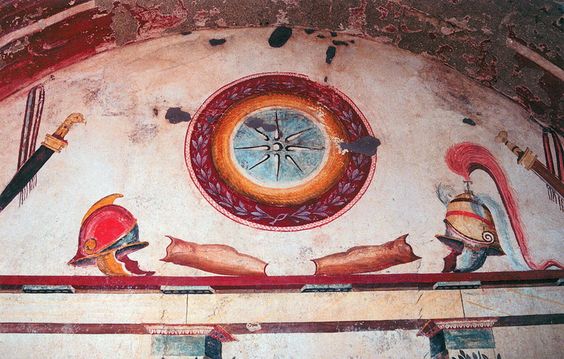
Mieza was a rural community that transformed into an urban center, then into a prosperous and wealthy city of the Hellenistic period. The most valuable archaeological evidence derives from the cemeteries and burial monuments of the area, which preserved the second most significant complex of Macedonian tombs after the royal tombs of Vergina. A total of six Macedonian tombs were found along the course of the road that in antiquity led from Pella to Mieza. They bear all the typical features of the monumental Macedonian tombs, they namely are subterranean vaulted structures with a temple-like façade and one or two burial chambers. Most often the internal surfaces, as well as the façade bear painted decoration and it is noteworthy that the murals of the Macedonian tombs are so far the only preserved examples of the large-scale ancient Greek painting. The tombs used to be covered with soil to form a hill and formed the resting places of the royal dynasty.

[Facade of the "Tomb of Judgment"]

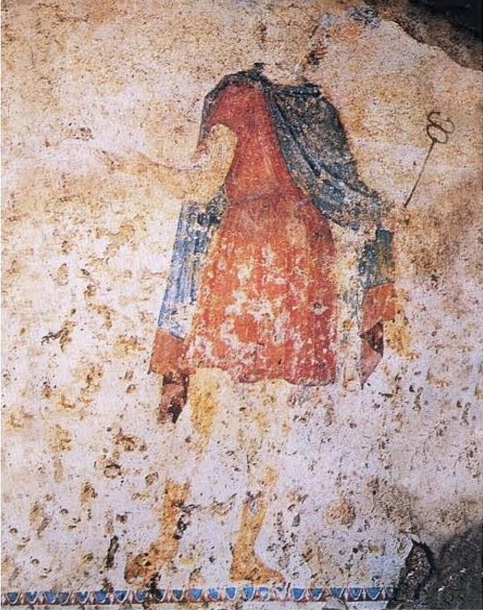
Perhaps the most important amongst all known Macedonian tombs is the Tomb of Judgement (late 4th - early 3rd century BC), one of the largest and most imposing monuments of its kind. Unique is the exterior of the tomb articulated by a two-storey façade which combines the Doric order in the lower half and the Ionic in the upper half respectively. Among the Doric half-columns flanking the door of the tomb are four paintings, depicting Hermes Psychopompos leading the dead to the Judges of the Underworld. The Doric metopes depict scenes of the Kentauromakhy while the war scene of the Ionic frieze with its relief figures represents one of the historic battles of Greeks and Persians.

[Fresco from the Tomb of Judgment showing Hermes Psychopompos]

Outside the perimeter of the ancient city, along the contemporary rural road that leads from Kopanos to Naoussa, lies the idyllic site of Isvoria. The lush landscape with the plenty waters and natural caves on the rocks was an ideal place for worshipping the Nymphs in antiquity. The scattered architectural parts of a rock-hewn Ionic stoa, dated after the mid-4rth century BC, were associated with the ancient descriptions and led to the identification of a significant site: the very school of Aristotles, where the young prince Alexander studied under the great philosopher.

[Painting from the Tomb of Lyson and Kallikles (2nd BC)]

The ancient city itself consists of disperse building complexes, though its boundaries cannot yet be delineated with precision. The architectural remains belong mainly to buildings of a public character and it’s most likely that the nucleus of the ancient city, namely its agora, lay at the present rural site of Belovina at Kopanos, where the theatre also came to light. The theatre dates to the Late Hellenistic period, though the form in which it is preserved today belongs to the Roman times. It was built on a hillside with a panoramic view over the valley and its capacity is estimated at 1500 spectators. The prosperity of Mieza is also reflected in the luxurious villas of the Hellenistic and Roman times. Among the best preserved examples are the two Roman villas at Tsifliki of Lefkadia and Baltaneto of Naoussa respectively, with splendid mosaic floors dated to the 2nd century AD.
A little over a week ago, I introduced part one of this new series-within-a-series. Like Andromeda and her family, crater belongs to a group of constellations linked together by a single myth. The first part of this series, on the constellation Corvus, introduced the basics of the myth:

"Corvus represents a raven or crow in service to Apollon, who was sent out on an errant for the Theos. He was asked to bring water to Him, but instead, he paused in his quest, most commonly assumed is that he stopped for a meal of figs. When the raven returned without water, Apollon questioned him. Instead of giving a straight answer, the raven lied, and said he had been kept from the water by a snake. In some accounts, he actually had a snake in his talons as he said this. Apollon, however, saw that the raven was lying, and flung the raven, the krater with which the raven was supposed to collect water, as well as the snake into the sky, where they remain to this day. To punish the bird further, Apollon made sure the krater would forever be just out of reach of the bird."


The Hellenic spelling of the word 'crater' is with a 'k'--'krater' (κρατήρ). All 'kraters' are mixing bowls. The name comes from the word 'kerannmi': 'to mix'. The krater is named after the shape of the handles. There are four types, the 'volute', the 'calyx', the 'column', and the 'bell' krater. The handles of the volute are in the form of a spiral with flanged sides rising from loops on the shoulder to above to the rim. A calyx krater differs from the basic krater shape, but not in its purpose. It has a deep body, with the lower part convex, and the upper part slightly concave. It rests on a heavy stand and has handles which are set at the top of the lower part, which curve upward. It's the only basic krater shape where the handles don't reach, or top, the rim.  The column krater has a round body, a offset neck with a thick lip and a heavy stand. Each handle consists of a pair of cylindrical stems ending in a horizontal block joined to the rim. In short, the handles look like the tops of the columns holding up ancient Hellenic temples. Bell kraters, obviously, have a bell shaped body. They have loop handles placed high on the body, which curve slightly upward. The krater rests on a heavy stand. Which type of krater was used in the myth is unclear.

I promised last week to go deeper into the myth. The original version of it is as follows, in the words of Roman author Gaius Julius Hyginus (64 BC - 17 AD) (Astronomica 2, 2.40):

"This is the sign on which the Crow sits and over which the Bowl is placed. The following reason has been handed down: When Apollo was sacrificing, the crow, who was under his guardianship, was sent to a spring to get some pure water. Seeing several trees with their figs not yet ripe, he perched on one of them waiting for them to ripen. After some days when the figs had ripened and the crow had eaten some, Apollo, who was waiting, saw him come flying in haste with the bowl full of water. For this fault of tardiness Apollo, who had had to use other water because of the crow’s delay, punished him in this way. As long as the figs are ripening, the crow cannot drink, because on those days he has a sore throat, so when the god wished to illustrate the thirst of the crow, he put the bowl among the constellations, and placed the water-snake underneath to delay the thirsty crow. For the crow seems to peck at the end of its tail to be allowed to go over to the bowl."

There is, however, another myth linked tot he constellation, also given to us by Hyginus:

"About the Bowl Phylarchus writes this tale: In the Cheronnese near Troy where many have said the tomb of Protesilaus is located, there is a city, Elaeusa by name. When a certain Demophon was ruling there, a sudden plague fell on the land with a strange death-rate among the citizens. Demophon, greatly disturbed by this, sent to the oracle of Apollo seeking a remedy, and was told that every year one girl of noble rank should be sacrificed to their household gods. Demophon, passing over his own daughters, would choose by lot one of the daughters of the nobles, and kept doing this until his scheme offended a certain man of highest rank. He said he wouldn’t allow his daughter to be entered in the drawing unless the daughters of the king were included. The king, angered by this, killed the noble’s daughter without drawing of lots. This deed Mastusius, father of the girl, for a time out of patriotism pretended he did not resent, for the girl might have perished if the lots had been taken. Little by little, time led the king to forget. When the girl’s father had shown himself to be on most friendly terms with the king, he said he was going to make a solemn sacrifice and invited the king and his daughters to join the celebration. The king, suspecting nothing, sent his daughters ahead; since he was busy with a state affair, he would come later. When this happened as Mastusius wished, he killed the king’s daughters, and mixing their blood with wine in a bowl, bade it be given as a drink to the king on his arrival. The king asked for his daughters, and when he learned what had happened, he ordered Mastusius and the bowl to be thrown into the sea. The where he was thrown, to memorialize him is called Mastusian; the harbour still is called the Bowl. Astronomers of old pictured it in the stars, so that men might remember that no one can profit from an evil deed with impunity, nor can hostilities often be forgotten."

The third interpretation of the constellation comes from a link to the constellation Centaurus. It centers around Phôlos, a civilized kéntauros who aided Hēraklēs when the smell of the wine from Phôlos' own wineskin drove them into a frenzy. Phôlos had only meant to be a good host, but ended up giving Hēraklēs one of the biggest fights of his life. Phôlos died in the struggle, as he accidentally dropped a poisoned arrow into his foot. The Theoi took mercy on Phôlos and took the cup he had meant to serve Hēraklēs his wine in, and placed it into the sky as a reminder of Phôlos' good character and generosity.

There are some smaller, more local, myths connected to the constellation, but these are the most well know. Whatever its origin, the constellation Crater is visible at latitudes between +65° and −90°, and best visible at 21:00 (9 p.m.) during the month of April.
I'm doing a combination post today: I'm combining a Pagan Blog Post, and a constellation series post. As such, I'll be talking about the mythical creatures as well as the constellation named after a few very famous examples of the species. Centaurs (kéntauros, kένταυρος) are depicted as half man, half horse; having the torso of a man extending where the neck of a horse should be. They were said to be wild, savage, and lustful, and in very old Hellenic artwork, they were often depicted as fully human, with a horse's end added to them. This shape for Centaurs remained in art for civilized Centaurs like Kheiron and Phôlus.


There are two stories of the birth of the centaur race: in the first, Ixion (Ἰξίων), king of the Lapiths (Λαπίθαι), and Nephele (Νεφέλη), a cloud nymph Zeus created in the image of Hera to trick Ixion to test his integrity after displaying his lust for Hera during a feast as a guest of Zeus, fathered the Centaurs with the nymph after failing said test. The Lapiths were a mythical, pre-Hellenic tribe whose home was in Thessaly, in the valley of the Peneus and on the mountain Pelion.

Because of the antiquity of the tribe, Ixion's parents are a little hard to determine; sources attest to Ares, Apollon, or Leonteus, or Antion and Perimele. In another version of the myth, Ixion and Nephele had only one son, Centaurus, who was deformed and hunched over. He took to the wilds his father loved, and eventually mated with the mares of a race of horses that lived in Magnesian. From this union came the Centaurs. In all versions of the myth, Ixion was expelled from Olympus and blasted with a thunderbolt for failing his test. Zeus then ordered Hermes to bind Ixion to a winged fiery wheel that was always spinning. Therefore, Ixion is bound to a burning solar wheel for all eternity, at first spinning across the heavens, then into Tartaros. From Pindar's Second Pythian Ode:

"To your benefactor return ever with kind dealing rendered. He learned that lesson well. By favor of the sons of Kronos, he was given a life of delight but could not abide blessedness long; in his delirious heart he loved Hera, dedicated to the high couch of Zeus. That outrage hurled him into conspicuous ruin. He was a man and endured beyond all others distress full merited. Two sins flowered to pain in his life: a hero, he first infected the mortal breed with kindred bloodshed, not with-out treachery; also, in the great secret chambers of Zeus he strove to ravish the Queen. A man should look at himself and learn well his own stature. 

The coupling unnatural brought accumulation of evil on him, even in success; it was a cloud he lay with, and he in his delusion was given the false loveliness. A phantom went in the guise of that highest daughter of Uranian Kronos; a deceit visited upon him by the hands of Zeus, a fair evil thing. Zeus likewise wrought the crucifixion on the wheel, Ixion's bane; and, spinning there, limbs fast to the ineluctable circle, he makes the message a thing that all may know. 

But she, graceless, spawned a child of violence. There was none like her, nor her son; no honor was his portion in the usage of god or man. Nursing him, she named him Kentauros, and he coupled with the Magnesian mares on the spurs of Pelion; and a weird breed was engendered in the favor of either parent: the mare's likeness in the parts below, and the manlike father above. "

The most famous myth concerning the Centaur race is focussed on the tribe of Centaurs, as well as the Lapiths. We call this event the Centauromachy. Scholars say that, like the Titanomancy, the Centauromancy represents a shift from barbarism to civility. The story is as follow, best--and most lengthy--described, I feel, by the Roman poet Ovid, but summarized as follows by Plutarch:

"After this, when Peirithous was about to marry Deidameia, he asked Theseus to come to the wedding, and see the country, and become acquainted with the Iapithae. Now he had invited the Centaurs also to the wedding feast. And when these were flown with insolence and wine, and laid hands upon the women, the Lapithae took vengeance upon them. Some of them they slew upon the spot, the rest they afterwards overcame in war and expelled from the country, Theseus fighting with them at the banquet and in the war. Herodorus, however, says that this was not how it happened, but that the war was already in progress when Theseus came to the aid of the Lapithae and that on his way thither he had his first sight of Heracles, having made it his business to seek him out at Trachis, where the hero was already resting from his wandering and labours; and he says the interview passed with mutual expressions of honor, friendliness, and generous praise."


Note that all Centaurs in the old writings were male. Female Centaurs entered Hellenic writings only as late as (roughly) 190 AD, through the writings of Philostratus of Lemnos. Kentaurides (or Centaurides), the female members of the Kentauroi, were depicted in Hellenic art before that time, though. From Philostratus' Imagine (2.3.):

"You used to think that the race of centaurs sprang from trees and rocks or, by Zeus, just from mares – the mares which, men say, the son of Ixion covered, the man by whom the centaurs though single creatures came to have their double nature. But after all they had, as we see, mothers of the same stock and wives next and colts as their offspring and a most delightful home; for I think you would not grow weary of Pelion and the life there and its wind-nurtured growth of ash which furnishes spear-shafts that are straight and at the same time do not break at the spearhead. And its caves are most beautiful and the springs and the female centaurs beside them, like Naïads if we overlook the horse part of them, or like Amazons if we consider them along with their horse bodies; for the delicacy of their female form gains in strength when the horse is seen in union with it. Of the baby centaurs here some lie wrapped in swaddling clothes, some have discarded their swaddling clothes, some seem to be crying, some are happy and smile as they suck flowing breasts, some gambol beneath their mothers while others embrace them when they kneel down, and one is throwing a stone at his mother, for already he grows wanton. The bodies of the infants have not yet taken on their definite shape, seeing that abundant milk is still their nourishment, but some that already are leaping about show a little shagginess, and have sprouted mane and hoofs, though these are still tender.

How beautiful the female centaurs are, even where they are horses; for some grow out of white mares, others are attached to chestnut mares, and the coat’s of others are dappled, but they glisten like those of horses that are well cared for. There is also a white female centaur that grows out of a black mare, and the very opposition of the colours helps to produce the united beauty of the whole."

It is said that the constellation Centaurus represents Centaurus himself; not because he did something heroic, but because Centaurus was the first person to group stars into constellations and taught others how to read them. The constellation might simply have been Centaurus putting a picture of his children (or, in some versions of the myth--where he is a Centaur--himself) in the sky, possibly to guide the Argonauts on their mission to secure the golden fleece.

There were many famous centaurs in Hellenic mythology, all of whom could be linked to the constellation Centaurus: Kheiron (Chiron, Χείρων), the wise and educated Centaur who taught heroes like Achilles, Theseus, Iásōn, and Hēraklēs, who--although looked like the Centaurs of mount Pelion--was sired much earlier, by Kronos; Pholus, a friend of Hēraklēs, who died of the same poison that led Kheiron to give up his immortality; or Nessus (Νέσσος), the Centaur who carried Hēraklēs' third wife Deïaneira (Δῃάνειρα) over the river Evinos (Εύηνος), and was killed by Hēraklēs for attempting to abduct and rape her. Many of these, however, are linked to the constellation Sagittarius, not Centaurus, and as such, I'll get back to these when I reach this constellation. It seems only Centaurus may rightfully be linked to Centaurus.

The constellation of Centaurus is visible at latitudes between +25° and −90°, and best visible at 21:00 (9 p.m.) during the month of May.