Showing posts with label Philostratus. Show all posts

 I get a lot of questions from readers, and most of the time, the answers are fairly short. When I feel the question or the reply would be valuable to others as well, I make a post with a collection of them and post them in one go. Today is one of those posts.


"Do you know anyone with UPG into the personality of the river god Achelous or even who works with Greek river gods in general? Also, a popular source on Achelous says his worship was once widespread. I can't anymore detail on this though. I also can't find the source which speaks of the numerous wives and descents of this god. "

I don't think I do, but here is a shout-out to anyone reading this who does! Please get in contact with me so I can link you two...? Thanks! As for His children, Apollonius Rhodius, in the 'Argonautica', ascribes the sirens to Him as offspring:

"And soon they saw a fair island, Anthemoessa, where the clear- voiced Sirens, daughters of Achelous, used to beguile with their sweet songs whoever cast anchor there, and then destroy him. Them lovely Terpsichore, one of the Muses, bare, united with Achelous; and once they tended Demeter's noble daughter [Persephone]still unwed, and sang to her in chorus; and at that time they were fashioned in part like birds and in part like maidens to behold. And ever on the watch from their place of prospect with its fair haven, often from many had they taken away their sweet return, consuming them with wasting desire; and suddenly to the heroes, too, they sent forth from their lips a lily-like voice." [4.885]

Naiad nymphs of springs along the Gulf coast, such as Kastalia at Delphoi, and Peirene in Korinthos, were described as his daughters, as described by Pausanias in his 'Description of Greece':

"You reach, on the right of the way [to the sanctuary of Delphoi, Phokis] the water of Kastalia, which is sweet to drink and pleasant to bathe in . . . Panyassis [epic poet C5th B.C.] who composed an epic poem on Herakles, says that Kastalia was a daughter of Akheloios. For about Herakles he says:--`Crossing with swift feet snowy Parnassos he reached the immortal water of Kastalia, daughter of Akheloios.'" [10.8.9.]

As the largest of the rivers of southern Hellas Achelous was worshipped in many of the countries bordering the Gulf as the God of fresh-water springs. His largest cults were in Athens, Oropos, and Thespia:

Plato, in 'Phaedrus':
"Here, a fair resting-place, full of summer sounds and scents. Here is this lofty and spreading plane-tree [on the banks of the Ilissos river in Attica], and the agnus cast us high and clustering, in the fullest blossom and the greatest fragrance; and the stream which flows beneath the plane-tree is deliciously cold to the feet. Judging from the ornaments and images, this must be a spot sacred to Akheloios and the Nymphai. How delightful is the breeze:--so very sweet; and there is a sound in the air shrill and summerlike which makes answer to the chorus of the cicadae. But the greatest charm of all is the grass, like a pillow gently sloping to the head."

Pausanias, in his 'Description of Greece':
"[In the sanctuary of Amphiaraus in Oropos, Attika :] The altar shows parts . . . the third is to Hestia and Hermes and [the hero] Amphiaraus and the children of Amphilokhos . . . The fifth is dedicated to the Nymphai and Pan, and to the rivers Akheloos and Kephisos." [1.34.3.]

Philostratus the Elder, in 'Imagines':
"A youth [Narkissos] just returned from the hunt stands over a pool . . . The cave is sacred to Akheloos and the Nymphai, and the scene is painted realistically. For the statues are of a crude art and made from a local stone; some of them are worn away by time, others have been mutilated by children of cowherds or shepherds while still young and unaware of the presence of the god [i.e. Dionysos]." [1.23]

I would also like to point you to this page on Theoi.com about the cult of the Potamoi, the river Gods.


"I read your blog and found a blog post containing a video and information about ancient hellenic clothing. I would like to make a new himation as I am unhappy with my short one I made. I would like to wrap it around my body and, if I like to, even be able to cover my head with a piece of it, so I want to ask how large and how broad the piece of cloth should be to do this."

Let me give you the base measurements of all clothing items: the cloth for the chiton has to be your own height. For a peplos, the cloth has to be your height plus at least 18" (this will be the part you fold over). Both clothing items need to be twice your 'wingspan' in width. The himation was a rectangle of various sizes--in essence, if it's long or short enough for you to do with what you want, it is correct. For me, I try to choose a piece of cloth that reaches below my ass once I have pulled it up over my head. Again, this depends on your height.


"Have you heard about the great Hellenic mystic, Neopythagorean and possibly the prototype of Jesus Christ, Apollonius of Tyana?"

As far as I am aware, Neo-Pythagoreanism was a school of Hellenistic philosophy which revived Pythagorean doctrines. Ancient Hellenic philosophy is not my strongest knowledge base, but if I remember well, it focussed on spiritual purity and 'mind over matter'-type of behaviour in order to reach it. Religiously, I think its biggest influence/difference with mainstream thought was that prayer was more important than outward actions like sacrifice in worshipping the Theoi.
 
Apollonius of Tyana was a Roman philosopher and a Neo-Pythagorean. As he lived at the time of Christ and his teachings were partly similar, the two were compared by (Christian) writers from about the 4th century AD on. Both figures fit the mythic hero archetype, after all, and that archetype, specifically, is found in much of (Hellenic) mythology. Other examples include Theseus, Perseus, and Zeus himself. Outside of Hellenic mythology, Robin Hood comes to mind.
 
So yet, I have heard of both, but both are just a little outside of my usual time period of interest :)
 
 
"Could people like Hypatia (a wondorous Alexandrian female philosopher, mathematician and astronomer) or emperor Julian be considered the defenders of our faith or even martyrs, as some, like Hypatia, died in the name of ancient wisdom, culture and the gods from the hands of the Christians?"
 
I have trouble answering this question, and I will tell you why. Hypatia was definitely murdered by Christians, but she was murdered for her social associations, not for trying to re-institute Hellenic worship or life. In a feud between Orestes, the prefect of Alexandria and Cyril, the Bishop of Alexandria over the regulation of Jewish dancing exhibitions in Alexandria, she was blamed for influencing Orestes not to reconcile with Cyril after one of 500 monks who resided in the mountains of Nitria, and who sided with Cyril,  struck Orestes in the head with a rock. Whether she had was besides the point. The backlash was on the Christians, as the actions by the Christian mob that killed her was widely criticized.
 
Emperor Julian did try to reconcile Christianity and Paganism. It's important to realize though that in the Roman empire during his two years of ruling (361-363 AD), there was no consensus about a state religion. Followers of many religious traditions lived together, creating a religious melting pot. Julian was a follower of the ancient ways and he tried to push for a broader adoption of those. During his lifetime, neither pagan nor Christian ideology won out, and the merits of all were greatly debated. What Julian did accomplish--and that was a major shift--was that he made Paganism a religion, where previously it had been a collection of traditions. As such, it could be 'pitted' against Christianity. Emperor Julian was committed to fostering religions other than Christianity, and that included Judaism. Because of this, the Jews came to call him 'Julian the Hellene', as in that time the term 'Hellene' was given the meaning of 'pagan' by the early Christian church. Julian died during the war with the Persians in an effort to further the rule of the Roman empire.
 
Yes, these people were heavily influenced by either Hellenic thought or Hellenic tradition (logical for the time they lived in). They were also some of the later people we know of who did so. That said there are probably many people we haven't heard of who believed the same. These people were not people who spent 24 hours a day, seven days a week promoting Hellenic thought. They promoted Hellenic thought, but it was just the way they lived their lives. I think anyone can be a personal hero, or even one of a tradition, if their actions are inspiring to people who hear their story or live it up close. As such, yes, I think Hypatia and Julian can be heroes. Are they martyrs...? Per definition, a martyr is somebody who suffers persecution and/or death for advocating, renouncing, refusing to renounce, and/or refusing to advocate a belief or cause of either a religious or secular nature. Neither qualifies per definition, but if you want to view them as symbols of exceptional leadership and heroism, then you are free to do so. They did live with the principle teachings of ancient Hellenic thought and religion, so in that way, they can definitely be seen as inspirational. All I would ask is to not forget about all the regular people no one wrote about but who lived their life in the same way.

It's time for another constellation, and we are moving on to one of the larger ones: the sixth largest of Ptolemy's constellations, in fact. This one represents something that definitely exists: the Po river in northern Italy, or the Istros of Hungry, which was located in the mythical northern land of Hyperborea. The ancient Hellenes called the river 'Eridanos', and that's the name of the constellation as well.


Eridanos (Ηριδανος) is a river God, and one mostly identified with the story of Hēlios and His son Phaëton, which I will come to in a bit. This association comes from a possible translation of the name: 'early burnt'. Phaëton's myth, in fact, is the only myth this river s identified with, but not even in a big way. Lets look at the myth first:


The most famous piece of mythology concerning Hēlios regards His son Phaëthon (Φαέθων), by Klymene (Κλυμένη). The story is told to us by Ovid, a roman poet. In it, Klymene boasts to Phaëthon that his father is the sun God Himself, and so, Phaëthon goes up to Olympus to confirm. To prove His paternity, Hēlios swears of the river Styx to give Phaëthon anything he desires. Phaëthon grabs this opportunity to demand of his father to let him drive his golden chariot the next time the sun rises.

Hēlios tries to talk His son out of it, claiming that not even Zeus would attempt to drive the chariot, as it is hot with fire and the horses wild and fire breathing. Phaëthon will hear none of it, and so Hēlios must let him get on. He rubs his son's body with magical oil that will protect him from the heat and as Eos and Apollon leave the gates, so does Phaëthon.

The four horses of the chariot--Pyrois, Aeos, Aethon, and Phlegon--sensed Phaëthon's weaker hand and became virtually unsteerable. First, Phaëthon drove them too high, and the Earth below cooled and the people suffered. Then, he flew too low and entire cities burned, lakes and rivers dried up, and even the seas were affected. Mighty Poseidon tried to stop Phaëthon, but had to flee from the heat. It was Zeus who threw His lightning bolt and killed Phaëthon. In some versions of the myth, Phaëthon's burning body landed in the Eridanos river. The following example is from Philostratus the Elder's 'Imagines', a Greek writer who lived in the third century AD:

"Now the youth is thrown from the chariot and is falling headlong – for his hair is on fire and his breast smouldering with the heat; his fall will end in the river Eridanus and will furnish this stream with a mythical tale." [1.11]

Hygenius identifies Eridanos with another river: the Nile. From his 'Astonomica':

"Some call this the Nile, though many call it Ocean. Those who advocate the Nile point out that it is correctly so called on account of the great length and usefulness of that River, and especially because below the sign is a certain star, shining more brightly than the rest, called Canopus. Canopus is an island washed by the river Nile." [II.32]

Eridanos is visible at latitudes between +32° and −90°, and best visible at 21:00 (9 p.m.) during the month of December.

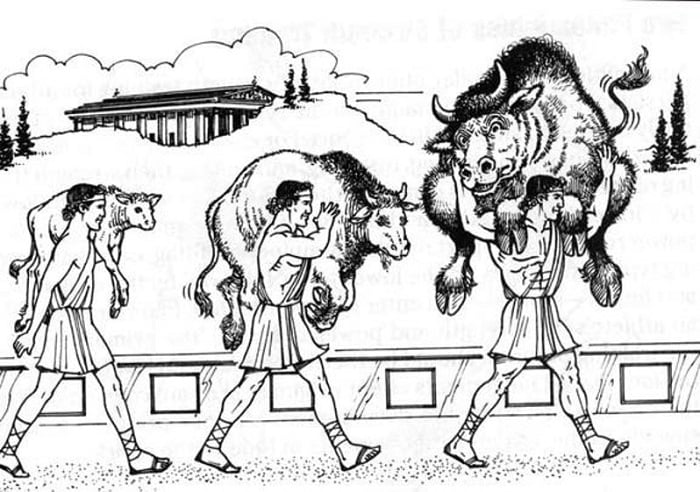
During his childhood (or so goes one legend), the future Olympian wrestler Milo of Croton owned a young calf he used to lift onto his shoulders and carry around for a spell. Milo is said to have done this every single day: as it got bigger, he grew stronger. Four years later, Milo could be seen wandering around with this fully grown pet bull resting on his manly shoulders.


Nearly 2,500 years ago, Milo of Croton was regarded as the strongest person who had ever lived in the known world. A man of incredible strength and athleticism, he taught us the three basic principles of building muscle: Start very light, don’t miss workouts, and increase training in very small increments.

Milo, from Croton in Magna Graecia, today’s southern Italy, was almost certainly the most successful wrestler of his day, becoming six-time wrestling champion at the Ancient Olympic Games. In 540 BC, he won the boys’ wrestling category and then proceeded to win the men’s competition at the next five Olympic Games in a row. He also dominated the Pythian Games (7-time winner), Isthmian Games (10-time winner), and Nemean Games (9-time winner).

Other legends say he carried his own bronze statue to its place at Olympia. One report says the wrestler was able to hold a pomegranate without damaging it while challengers tried to pry his fingers from it, and another report says he could burst a band fastened around his brow by inhaling air and causing his temple veins to swell.

The Ancient Hellenes typically attributed remarkable deaths to famous persons — in keeping with their characters throughout life. The date of Milo’s death is unknown, but according ancient historians, Milo was walking in a forest when he came upon a tree-trunk split with wedges. In what was probably intended as a display of strength, Milo inserted his hands into the cleft to rend the tree. The wedges fell from the cleft, and the tree closed upon his hands, trapping him. Unable to free himself, the wrestler was devoured by wolves.

If you want to be as strong as Milo, here are some anchient work-out tips and tricks. Be on the look-out for wolves, though!

1. Drunk Athletes Still Have to Exercise (Just Not as Strenuously)

Intoxication wouldn’t excuse you from fitness lessons. The Greco-Roman gymnastics guru Philostratus realized that people couldn’t train as effectively while under the influence. Nevertheless, he maintained that tipsy pupils should still complete their regularly scheduled workouts, just with a bit less intensity than usual.

2. Ease Up on the Barley
Denouncing high-carb diets is nothing new; many Roman gladiators bulked up by consuming a dense barley porridge loaded with beans. Claudius Galen—a celebrated Roman physician—believed this made them too flabby for serious combat and criticized the practice.

3. Your Pre-Workout Routine Should Include Lots of Body Oil
Ancient Hellenic sportsmen were known to lather themselves in natural oils before exercising, which gave their bods a distinctive glisten. At the time, scholars claimed that doing so kept athletes from getting cold while toughening their skin.

4. Run Through Sand For Extra Stamina
Anacharsis, a Mediterranean philosopher who spent much of his time traveling through Athens during the 6th century BCE, once wrote a detailed description of how the Hellenes trained their sprinters. “The [practice] running is not done on hard, resistant ground,” he noted, “but in deep sand where it is not easy to plant a foot solidly or get a grip with it since it slips away from underneath the foot.” As an added bonus, these young men were also instructed “to jump over a ditch, if necessary, or some other obstacle carrying lead weights that are as large as they can hold.”

5. Wanna Get Toned? Try Digging.
If your goal is to build chiseled, well-defined muscles without using techniques that involve “violent movement,” the aforementioned Galen recommends digging, rope-climbing, and extending the arms while a workout buddy tries pulling them downwards.

6. Pick Short and Simple Exercises.
Seneca the Younger would’ve been a terrible Phys Ed teacher. The Roman philosopher believed that strenuous exercise was, ultimately, pointless. However, if somebody absolutely had to work out, Seneca favored keeping it quick. “There are short and simple exercises which will tire the body without undue delay,” he conceded, “[such as] running, swinging weights about, and jumping—either high jumping or low jumping… But whatever you do, return from body to mind very soon.”

7. Nobody Likes a Noisy Weightlifter
Say what you will about Seneca, but at least one of his fitness observations was spot-on. The following rant—inspired by an especially obnoxious breed of bodybuilder which frequented Rome’s urban bath-houses—might as well have been written about a present-day gym:

"Conjure up in your imagination all the sounds that make one hate one’s ears. I hear the grunts of musclemen exercising and jerking those heavy weights around; they are working hard, or pretending to. I hear the sharp hissing when they release their pent breath."And the bellyaching didn’t stop there. “Add to this,” Seneca moaned, “the racket of a cocky bastard, a thief caught in the act, and a fellow who likes the sound of his own voice … plus those who plunge into the pool with a huge splash of water.”
I get a lot of questions from readers, and most of the time, the answers are fairly short. When I feel the question or the reply would be valuable to others as well, I make a post with a collection of them and post them in one go. Today is one of those posts.


"Do you know anyone with UPG into the personality of the river god Achelous or even who works with Greek river gods in general? Also, a popular source on Achelous says his worship was once widespread. I can't anymore detail on this though. I also can't find the source which speaks of the numerous wives and descents of this god. "

I don't think I do, but here is a shout-out to anyone reading this who does! Please get in contact with me so I can link you two...? Thanks! As for His children, Apollonius Rhodius, in the 'Argonautica', ascribes the sirens to Him as offspring:

"And soon they saw a fair island, Anthemoessa, where the clear- voiced Sirens, daughters of Achelous, used to beguile with their sweet songs whoever cast anchor there, and then destroy him. Them lovely Terpsichore, one of the Muses, bare, united with Achelous; and once they tended Demeter's noble daughter [Persephone]still unwed, and sang to her in chorus; and at that time they were fashioned in part like birds and in part like maidens to behold. And ever on the watch from their place of prospect with its fair haven, often from many had they taken away their sweet return, consuming them with wasting desire; and suddenly to the heroes, too, they sent forth from their lips a lily-like voice." [4.885]

Naiad nymphs of springs along the Gulf coast, such as Kastalia at Delphoi, and Peirene in Korinthos, were described as his daughters, as described by Pausanias in his 'Description of Greece':

"You reach, on the right of the way [to the sanctuary of Delphoi, Phokis] the water of Kastalia, which is sweet to drink and pleasant to bathe in . . . Panyassis [epic poet C5th B.C.] who composed an epic poem on Herakles, says that Kastalia was a daughter of Akheloios. For about Herakles he says:--`Crossing with swift feet snowy Parnassos he reached the immortal water of Kastalia, daughter of Akheloios.'" [10.8.9.]

As the largest of the rivers of southern Hellas Achelous was worshipped in many of the countries bordering the Gulf as the God of fresh-water springs. His largest cults were in Athens, Oropos, and Thespia:

Plato, in 'Phaedrus':
"Here, a fair resting-place, full of summer sounds and scents. Here is this lofty and spreading plane-tree [on the banks of the Ilissos river in Attica], and the agnus cast us high and clustering, in the fullest blossom and the greatest fragrance; and the stream which flows beneath the plane-tree is deliciously cold to the feet. Judging from the ornaments and images, this must be a spot sacred to Akheloios and the Nymphai. How delightful is the breeze:--so very sweet; and there is a sound in the air shrill and summerlike which makes answer to the chorus of the cicadae. But the greatest charm of all is the grass, like a pillow gently sloping to the head."

Pausanias, in his 'Description of Greece':
"[In the sanctuary of Amphiaraus in Oropos, Attika :] The altar shows parts . . . the third is to Hestia and Hermes and [the hero] Amphiaraus and the children of Amphilokhos . . . The fifth is dedicated to the Nymphai and Pan, and to the rivers Akheloos and Kephisos." [1.34.3.]

Philostratus the Elder, in 'Imagines':
"A youth [Narkissos] just returned from the hunt stands over a pool . . . The cave is sacred to Akheloos and the Nymphai, and the scene is painted realistically. For the statues are of a crude art and made from a local stone; some of them are worn away by time, others have been mutilated by children of cowherds or shepherds while still young and unaware of the presence of the god [i.e. Dionysos]." [1.23]

I would also like to point you to this page on Theoi.com about the cult of the Potamoi, the river Gods.


"I read your blog and found a blog post containing a video and information about ancient hellenic clothing. I would like to make a new himation as I am unhappy with my short one I made. I would like to wrap it around my body and, if I like to, even be able to cover my head with a piece of it, so I want to ask how large and how broad the piece of cloth should be to do this."

Let me give you the base measurements of all clothing items: the cloth for the chiton has to be your own height. For a peplos, the cloth has to be your height plus at least 18" (this will be the part you fold over). Both clothing items need to be twice your 'wingspan' in width. The himation was a rectangle of various sizes--in essence, if it's long or short enough for you to do with what you want, it is correct. For me, I try to choose a piece of cloth that reaches below my ass once I have pulled it up over my head. Again, this depends on your height.


"Have you heard about the great Hellenic mystic, Neopythagorean and possibly the prototype of Jesus Christ, Apollonius of Tyana?"

As far as I am aware, Neo-Pythagoreanism was a school of Hellenistic philosophy which revived Pythagorean doctrines. Ancient Hellenic philosophy is not my strongest knowledge base, but if I remember well, it focussed on spiritual purity and 'mind over matter'-type of behaviour in order to reach it. Religiously, I think its biggest influence/difference with mainstream thought was that prayer was more important than outward actions like sacrifice in worshipping the Theoi.
 
Apollonius of Tyana was a Roman philosopher and a Neo-Pythagorean. As he lived at the time of Christ and his teachings were partly similar, the two were compared by (Christian) writers from about the 4th century AD on. Both figures fit the mythic hero archetype, after all, and that archetype, specifically, is found in much of (Hellenic) mythology. Other examples include Theseus, Perseus, and Zeus himself. Outside of Hellenic mythology, Robin Hood comes to mind.
 
So yet, I have heard of both, but both are just a little outside of my usual time period of interest :)
 
 
"Could people like Hypatia (a wondorous Alexandrian female philosopher, mathematician and astronomer) or emperor Julian be considered the defenders of our faith or even martyrs, as some, like Hypatia, died in the name of ancient wisdom, culture and the gods from the hands of the Christians?"
 
I have trouble answering this question, and I will tell you why. Hypatia was definitely murdered by Christians, but she was murdered for her social associations, not for trying to re-institute Hellenic worship or life. In a feud between Orestes, the prefect of Alexandria and Cyril, the Bishop of Alexandria over the regulation of Jewish dancing exhibitions in Alexandria, she was blamed for influencing Orestes not to reconcile with Cyril after one of 500 monks who resided in the mountains of Nitria, and who sided with Cyril,  struck Orestes in the head with a rock. Whether she had was besides the point. The backlash was on the Christians, as the actions by the Christian mob that killed her was widely criticized.
 
Emperor Julian did try to reconcile Christianity and Paganism. It's important to realize though that in the Roman empire during his two years of ruling (361-363 AD), there was no consensus about a state religion. Followers of many religious traditions lived together, creating a religious melting pot. Julian was a follower of the ancient ways and he tried to push for a broader adoption of those. During his lifetime, neither pagan nor Christian ideology won out, and the merits of all were greatly debated. What Julian did accomplish--and that was a major shift--was that he made Paganism a religion, where previously it had been a collection of traditions. As such, it could be 'pitted' against Christianity. Emperor Julian was committed to fostering religions other than Christianity, and that included Judaism. Because of this, the Jews came to call him 'Julian the Hellene', as in that time the term 'Hellene' was given the meaning of 'pagan' by the early Christian church. Julian died during the war with the Persians in an effort to further the rule of the Roman empire.
 
Yes, these people were heavily influenced by either Hellenic thought or Hellenic tradition (logical for the time they lived in). They were also some of the later people we know of who did so. That said there are probably many people we haven't heard of who believed the same. These people were not people who spent 24 hours a day, seven days a week promoting Hellenic thought. They promoted Hellenic thought, but it was just the way they lived their lives. I think anyone can be a personal hero, or even one of a tradition, if their actions are inspiring to people who hear their story or live it up close. As such, yes, I think Hypatia and Julian can be heroes. Are they martyrs...? Per definition, a martyr is somebody who suffers persecution and/or death for advocating, renouncing, refusing to renounce, and/or refusing to advocate a belief or cause of either a religious or secular nature. Neither qualifies per definition, but if you want to view them as symbols of exceptional leadership and heroism, then you are free to do so. They did live with the principle teachings of ancient Hellenic thought and religion, so in that way, they can definitely be seen as inspirational. All I would ask is to not forget about all the regular people no one wrote about but who lived their life in the same way.
It's been a little while since we last met Hēraklēs for a labour. Last time, he managed to fashuion a rattle to scare off the blood thirsty Stymphalian Birds, completing that labour rather effortlessly thanks to the Gods. Now, Hēraklēs is sent on a mission which--in theory--is far tougher: to capture the Cretan Bull.

To many, the Cretan Bull will be familiar, either because of it's own part in the tale or the fallout, namely the Minotaur. The classic myth goes as follows: Minos, king of Krete, requested Poseidon raise a bull from the sea, which the King promised to sacrifice; but when Minos refused to do so, Poseidon caused his wife Pasiphaê to fall in love with the bull. The child that came from this union was deformed in such a way that he had the head of a bull and the body of a man. In the labours of Hēraklēs, the story changes a little depending on the source. Diodorus agrees with the myth, saying in his 'Library of History':

"The next Labour which Heracles undertook was to bring back from Crete the bull of which, they say, Pasiphaê had been enamoured." [4.13.4]

Apollodorus, for example, has a different story to tell, not just about the Cretan Bull, but also about the story of King Minos. It seems the Bull had become feral, terrorizing the land and scaring the inhabitants of the island. From his 'Library':

"The seventh labour he enjoined on him was to bring the Cretan bull. Acusilaus says that this was the bull that ferried across Europa for Zeus; but some say it was the bull that Poseidon sent up from the sea when Minos promised to sacrifice to Poseidon what should appear out of the sea. And they say that when he saw the beauty of the bull he sent it away to the herds and sacrificed another to Poseidon; at which the god was angry and made the bull savage." [2.5.7]

From Philostratus the Elder we get a description of the bull, based off of the description of his second Image Book:

"Pasiphaë outside the workshop in the cattlefold gazes on the bull, thinking to draw him to her by her beauty and by her robe, which is divinely resplendent and more beautiful than any rainbow. She has a helpless look – for she knows what the creature is that she loves – and she is eager to embrace it, but takes no notice of her and gazes at its own cow. The bull is depicting with proud mien, the leader of the herd, with splendid horns, white, already experienced in love, its dewlap low and its neck massive, and it gazes fondly at the cow; but the cow in the herd, ranging free and all white but for a black head, disdains the bull. For its purpose suggests a leap, as of a girl who avoids the importunity of a lover." [1.16]

Contrary to the other labours, there is actually not alot known about how Hēraklēs managed to wrangle in the bull and take him back to the main land. Both versions, however, agree that Minos helped him do it, or at least offered Hēraklēs assistance. If I was Minos, I would want that bull away from my wife and people too! Diodorus literally suffices with a single line on the capture of the Bull:

"[A]nd sailing to the island he secured the aid of Minos the king and brought it back to the Peloponnesus, having voyaged upon its back over so wide an expanse of sea." [4.13.4]

Apollodorus is a little bit more forthcoming:

"To attack this bull Hercules came to Crete, and when, in reply to his request for aid, Minos told him to fight and catch the bull for himself, he caught it and brought it to Eurystheus, and having shown it to him he let it afterwards go free. But the bull roamed to Sparta and all Arcadia, and traversing the Isthmus arrived at Marathon in Attica and harried the inhabitants." [2.5.7]

How Hēraklēs captured the Bull will most likely always remain a mystery. I like to envision him wrestling it down and tying it like the bull capturers; risking life and limb in a heroic effort to make better the lives of the citizens of Krete. And so another labour is completed. Next time we will cover the little break that follows the seventh labour in which Hēraklēs establishes the Olympic Games and frees the Titan Prometheus--amongst other things.

Image Source: Wikipedia Commons.
It's time for another constellation, and we are moving on to one of the larger ones: the sixth largest of Ptolemy's constellations, in fact. This one represents something that definitely exists: the Po river in northern Italy, or the Istros of Hungry, which was located in the mythical northern land of Hyperborea. The ancient Hellenes called the river 'Eridanos', and that's the name of the constellation as well.
Eridanos (Ηριδανος) is a river God, and one mostly identified with the story of Hēlios and His son Phaëton, which I will come to in a bit. This association comes from a possible translation of the name: 'early burnt'. Phaëton's myth, in fact, is the only myth this river s identified with, but not even in a big way. Lets look at the myth first:

The most famous piece of mythology concerning Hēlios regards His son Phaëthon (Φαέθων), by Klymene (Κλυμένη). The story is told to us by Ovid, a roman poet. In it, Klymene boasts to Phaëthon that his father is the sun God Himself, and so, Phaëthon goes up to Olympus to confirm. To prove His paternity, Hēlios swears of the river Styx to give Phaëthon anything he desires. Phaëthon grabs this opportunity to demand of his father to let him drive his golden chariot the next time the sun rises.

Hēlios tries to talk His son out of it, claiming that not even Zeus would attempt to drive the chariot, as it is hot with fire and the horses wild and fire breathing. Phaëthon will hear none of it, and so Hēlios must let him get on. He rubs his son's body with magical oil that will protect him from the heat and as Eos and Apollon leave the gates, so does Phaëthon.

The four horses of the chariot--Pyrois, Aeos, Aethon, and Phlegon--sensed Phaëthon's weaker hand and became virtually unsteerable. First, Phaëthon drove them too high, and the Earth below cooled and the people suffered. Then, he flew too low and entire cities burned, lakes and rivers dried up, and even the seas were affected. Mighty Poseidon tried to stop Phaëthon, but had to flee from the heat. It was Zeus who threw His lightning bolt and killed Phaëthon. In some versions of the myth, Phaëthon's burning body landed in the Eridanos river. The following example is from Philostratus the Elder's 'Imagines', a Greek writer who lived in the third century AD:

"Now the youth is thrown from the chariot and is falling headlong – for his hair is on fire and his breast smouldering with the heat; his fall will end in the river Eridanus and will furnish this stream with a mythical tale." [1.11]

Hygenius identifies Eridanos with another river: the Nile. From his 'Astonomica':

"Some call this the Nile, though many call it Ocean. Those who advocate the Nile point out that it is correctly so called on account of the great length and usefulness of that River, and especially because below the sign is a certain star, shining more brightly than the rest, called Canopus. Canopus is an island washed by the river Nile." [II.32]

Eridanos is visible at latitudes between +32° and −90°, and best visible at 21:00 (9 p.m.) during the month of December.