Showing posts with label ancient Hellenic culture. Show all posts


The Minoan civilization was an Aegean Bronze Age civilization that arose on the island of Crete and other Aegean islands and flourished from approximately 3650 to 1400 BC. It was rediscovered at the beginning of the 20th century through the work of British archaeologist Arthur Evans. Historian Will Durant referred to it as "the first link in the European chain."

It was not until roughly 5000 BC in the late Neolithic period, that the first signs of advanced agriculture appeared in the Aegean, marking the first signs of civilization. The term "Minoan" refers to the mythic King Minos. Minos was associated in Greek myth with the labyrinth and the minotaur, which Evans identified with the site at Knossos, the largest Bronze Age Minoan site. The poet Homer recorded a tradition that Crete once had 90 cities.

The Minoans were primarily a mercantile people engaged in overseas trade. Their pottery provides the best means of dating. As traders and artists, their cultural influence reached far beyond the island of Crete — throughout the Cyclades, to Egypt's Old Kingdom, to copper-bearing Cyprus, Canaan, and the Levantine coasts beyond, and to Anatolia. Some of its best art is preserved in the city of Akrotiri, on the island of Santorini, very near the Thera eruption.

Though we cannot read their language (Linear A), and there is much dispute, it is generally assumed there was little internal armed conflict in Minoan Crete itself, until the following Mycenaean period. The armed Mycenaeans or the eruption at Thera are two popular theories for the eventual demise of Minoan civilization around 1,400 BC.

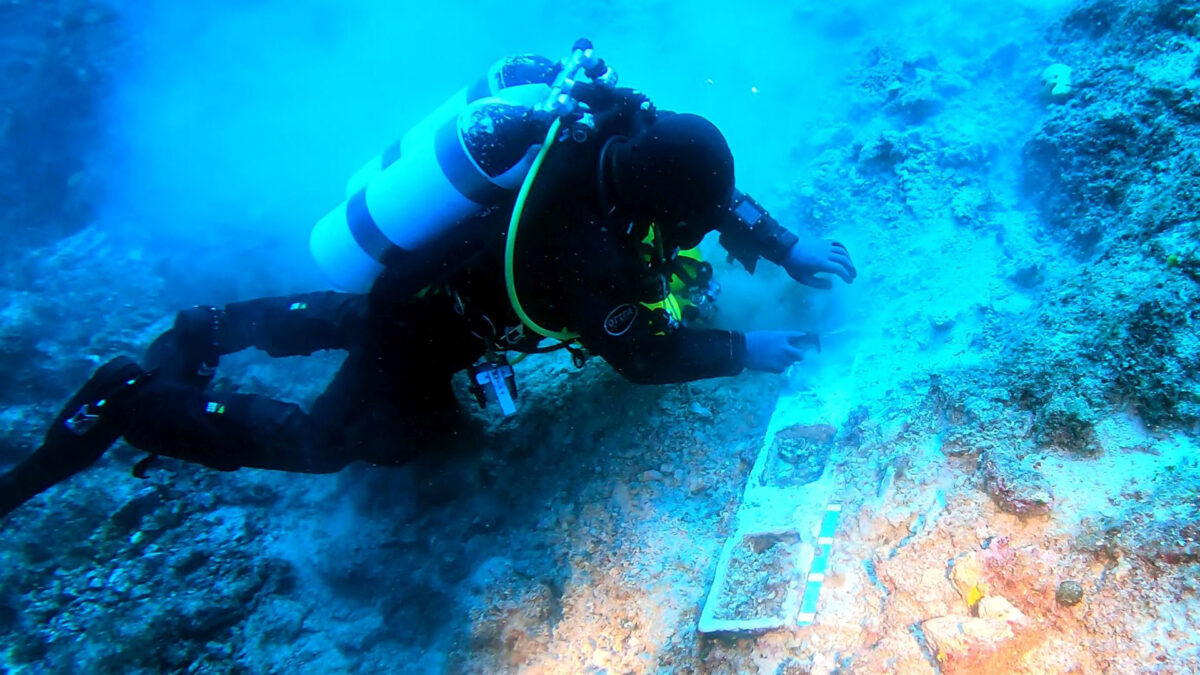
The Ministry of Culture and Sports announced the completion of the preliminary and exploratory works for the year 2021 on the Shipwreck of Antikythera. The new five-year underwater research programme is being conducted by the Swiss School of Archaeology under Dr. Angeliki G. Simosi, Head of the Euboea Ephorate of Antiquities and Lorenz E. Baumer, Professor of Classical Archaeology at the University of Geneva. Based on the results of this year’s research, a detailed programme will be prepared for the following years (2022-2025), in collaboration with all competent bodies involved. As noted in the announcement, maximum results were achieved in this year’s short expedition despite quite difficult weather conditions.

The first expedition of the second five-year programme took place between October 1-10 and focused on a detailed mapping of the site of the Antikythera wreck and the creation of its complete photogrammetric three-dimensional model in high resolution. On the one hand the mapping allows a much more accurate analysis of the distribution of the findings on the sea floor, fundamental to the accurate representation of the sinking of the ship in the 1st century BC. On the other hand it offers a new cutting-edge tool for an accurate planning of further research.

The successive integration of new and older findings in the model will result in the shipwreck’s complete documentation. It also makes it possible to access the space virtually through the internet. Moreover, this year’s expedition recorded most of the wreck’s surroundings, providing new and important information that will be investigated in future expeditions .

Despite the plethora of findings salvaged from the shipwreck from 1900 to the present, recent research between 2014 and 2019 shows that the scientific community is on the verge of discovering more important archaeological evidence that will help to better understand the site, answering key questions that have remained unanswered for more than 100 years.

The purpose of the investigation is to complete the collection of data necessary to draw conclusions regarding the following : the existence of other remnants of the Antikythera Mechanism at the site of the shipwreck, the ship and its cargo that remain covered as a result of a landslide, the possible connection between wrecks A and B, as well as the number of people aboard ship wreck A. An equally important goal is the discovery and collection of findings which include human skeletal remains, parts of the Antikythera ship and cargo which are exposed and vulnerable to possible human interventions and the adverse effects of the environment.

The most important find is part of a marble statue trapped under a heavy boulder. The initial analysis and documentation of the artefact was carried out by in situ photogrammetry and in due course will be further investigated. During the research, some smaller wooden and bronze structural elements of the ship were retrieved, as well as fragments of ceramics that give valuable information on the cargo’s dating and composition.This and other findings yielded by the future excavation will contribute to a more complete understanding of the valuable cargo on board the ship.

The field teams were coordinated by commodore Alexandros Palatianos and the director of underwater research was Alexandros Sotiriou, a collaborating archaeologist at the University of Geneva, with the participation of members of the Special Diving Team of the Submarine Missions Unit of the Coast Guard, underwater archaeologist Orestis Manousos and Italian researcher Dr. Elisa Costa of Ca ‘Foscari University in Venice.

The research is being conducted by the Swiss School of Archaeology under the supervision of the Ephorate of Underwater Antiquities and with the funding of the Ekaterini Laskaridis Foundation and Swiss Watch Manufacturer Hublot. The Athanasios K. Laskaridis Public Benefit Foundation has provided the Norwegian ship Typhoon, while Cosmote supports the project’s telecommunications.

The project is under the auspices of President of the Hellenic Republic Katerina Sakellaropoulou and actively supported by the Municipality of Kythera and the people of Antikythera.

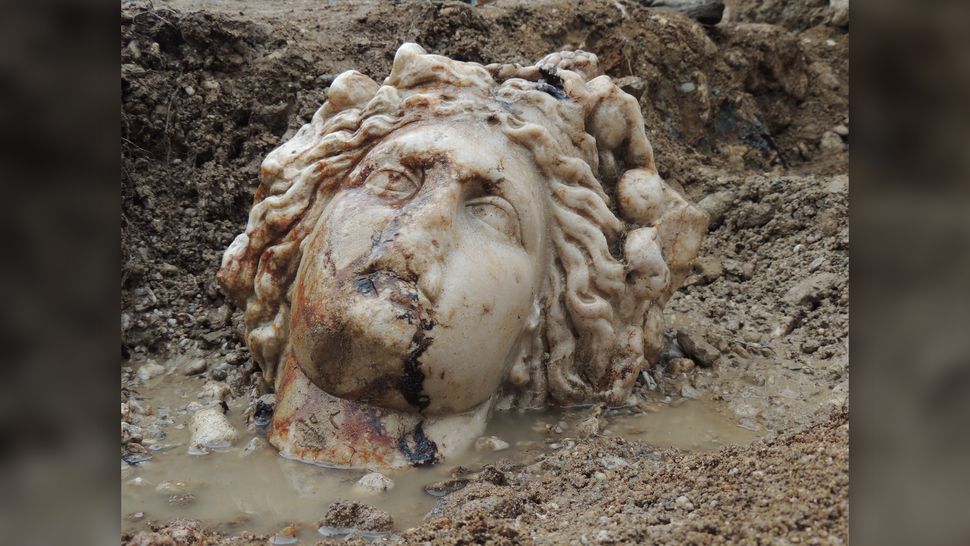
According to Hellenic mythology, the deities Aphrodite and Dionysos had a grand love affair. So, perhaps it's fitting that archaeologists found the ancient statuary heads of the Goddess of love and the reveler near each other during a dig in the ancient city of Aizanoi, in western Turkey.


The discovery of the deities' heads helps top off a previous find; on an earlier dig, archaeologists found the statues' headless bodies, Gokhan Coskun, an archaeologist at Kütahya Dumlupınar University in Turkey and the excavation coordinator, told Anadolu Agency, a Turkish state-run news organization. 

"These are important findings for us, as they show that the polytheistic culture of ancient Greece existed for a long time without losing its importance in the Roman era," Coskun said. "The findings suggest that there may have been a sculpture workshop in the region."

The ancient city of Aizanoi has a rich history filled with ancient Greek and Roman period settlements. Its earliest settlement dates to the second millennium B.C., but many of its remaining ruins date to the Roman Empire, including its Roman baths, Zeus temple and macellum, or Roman indoor market. Aizanoi is listed as a "tentative" World Heritage Site by the United Nations Educational, Scientific and Cultural Organization (UNESCO). 

Archaeologists found the Roman-era heads of Aphrodite and Dionysos buried in a creek bed in the ancient city. Each head is made of limestone, with Aphrodite's head measuring 19 inches (50 centimeters) and Dionysus' head measuring 17 inches (45 cm) tall, according to the news site GEO. It's unknown how the statues' heads became separated from their bodies.

Previously, archaeologists in Aizanoi uncovered the statue of Hygieia, Goddess of health, cleanliness and hygiene, according to GEO. 

 Poseideon is the sixth month of the Hellenic calendar and we are slowly moving towards it. Poseideon is a special month; it was the month that would have been repeated (in a minor way) should the ancient calendar not line up with the phases of the moon (which it didn't, after a while). You can read more about that here as it is beyond the scope of this post. What I would like to talk to you about today is the divine triad that oversaw Poseideon (the quartet, actually, but we'll get to that) and its significance.

Poseideon was ruled by Poseidon (honoured during the Poseideia), Zeus (during the Plerosia and a seperate sacrifice to Zeus Horios) and Dionysos (during the Lesser Dionysia and secondarily during the Haloa). Poseideon is the first true winter month; the first harvest was over, seafaring had ceased and thus war had come to an end. The focus was on the home and preparation for true, deep winter: the weather turned and the crops needed protecting. Because of this, it was also a month of threat; if the crops failed, if the seas became too rough when a daring fisherman was out on it, or if a river went out of bounds and flooded a well populated area there would be death.

I get on my soapbox a lot on my blog. One of my main points is that everything is connected in the ancient Hellenic religion. That everything was constructed the way it was for a reason; the pantheon, the calendar, the festivals, the way festivals were celebrated--if you spend time to sort out the why, you will discover it's all part of an intricate web that formed an entire civilization. Nothing--absolutely nothing--in our religion and in the ancient civilization it was formed in ended up in it by accident. We have lost a lot of knowledge and understanding of this society but we can try to piece things together if we put in the effort. So today I will put in a little effort to explain why Poseideon was ruled by Poseidon, Zeus and Dionysos. And why it mattered that it were Them.

During the Poseideia, Poseidon as savior of ships, protector of those who voyage in ships, and God of the lapping waters both salt and fresh important for agriculture, is thanked for the many gifts that came from faraway places that were likely given at that time. The immense trade and distribution was nearly all through shipping, relatively little overland, whether it be perfume from Cyprus or pottery from Corinth. One of Poseidon’s epithets is prosklystios, 'of the lapping water'. He is also invoked as Poseidon phytalmios which implies natural fertility and human procreation.

The Plerosia is a harvest festival of sorts. It was held to honour Zeus but presumably als Demeter. Poseideon marks the time to return home, take stock, and stay warm. It's a time to thank the Theoi for all that has been recieved and all that will get us through the winter. The word ‘plerosis’ means fulfillment, satiated, filled. Important note: the Plerosia seems to have been a women-only festival, perhaps because now that winter is upon us, we turn to the domain of the women: the house(hold). As such, it is her prerogative to thank the Gods for the food she can feed her family with.

The lesser Dionysia, a vintage festival, was celebrated in the various demes of Attica in the month of Poseideon. It was probably a very ancient festival, perhaps not originally associated with Dionysos. The Dionysia was a time when classes came together in order to celebrate their shared origins in the natural world; it was a vintage festifal for all.

The Haloa was held in honor of Demeter, Dionysos and a little bit in honor of Persephone. Like all festivals of Demeter and Persephone's 'Kore' persona, women were the only ones who were allowed to handle the religious and sacrificial side of it. The Haloa is assumed to be a celebration of the pruning of the vines and the tasting of the wine after its first fermentation, or it may be to encourage the growth of corn from the seed.

A few links between Poseidon, Zeus and Dionysos are clear instantly from the descriptions of these festivals. Poseidon and Dionysos are linked through water--moisture, actually. Plutarch already noted that Dionysos was a God of moisture--in particular the moisture associated with life and vigour as can be seen in plants and trees and most telling in the wine produced from the fruits of the vine. Poseidon is all but the personification of water of all kinds. Furthermore, one of the epithets of Dionysos is Dendrites, ‘of the trees’, connects him to branching life. The tree was similarly a metaphor for rivers whose branching nature was morphologically similar. This links Dionysos to Poseidon even more.

And what of Poseidon and Zeus? Poseidon is the brother of Zeus and Hades, and together they form a triumvirate who represents the dominion of the sea, the sky and the underworld respectively. In Hellenic mythology, the underworld is seen as an exact mirror and equally valid version of the ‘celestial’ world. In other words: Zeus is Hades inverted and Poseidon is the synthesis of both. Dionysos therefore unifieds these god-themes and manifested them in the mundane world.

This brings us to Hades, the fourth member of this triad. He is worshipped too, just not directly--never directly. the ancient Hellenes very rarely honoured Hades, not even Plouton, His ouranic epithet. But Hades' influence was most definitely felt; he's the third of the triumvirate, He is prevalent in the threat of death that hangs over the month and He is appeased though a medium who is perhaps unlikely: Demeter.

Mythological and epithological links exist between Demeter and Hades. Hades was celebrated as an important divine figure in the Eleusinian Mysteries. The seasonal drama of nature was said to depend on her annual passage into the underworld in the depths of winter when fruitfulness and vegetation dies back. Through Kore (Persephone) Hades and Demeter rule over the harvest. Hades takes and Demeter gives--or more accurately: Hades causes Demeter to take instead of give. In praying for fruitfulness of the earth to Demeter, it is also Hades who is spoen to and appeased, which makes Him an unofficial member of the triad (this is likewise true for Demeter and even Kore/Persephone).

To compelete the circle, Dionysos and Demeter are worshipped together during the Haloa, which drives home the agricultural ties all these five deities have  and the way they link to the mundane issues of this time of year; Demeter and Hades (Plouton) through the fruitful earth (underworld), Zeus through mild weather (sky) and Poseidon and Dionysos through sweet water (the intermediate). Because of Their links and domains, it can be only these deities that govern Poseideon.

Epictetus (Ἐπίκτητος) was a Greek-speaking Stoic philosopher who lived from 55 – 135 AD. He was born a slave at Hierapolis, Phrygia (present day Pamukkale, Turkey), and lived in Rome until his banishment, when he went to Nicopolis in north-western Greece for the rest of his life. His teachings were written down and published by his pupil Arrian in his Discourses and Enchiridion.


Epictetus' primary philosophical lesson was that philosophy is a way of life and not just a theoretical discipline. To Epictetus, all external events are beyond our control; we should accept whatever happens calmly and dispassionately. However, individuals are responsible for their own actions, which they can examine and control through rigorous self-discipline. In short: a true Stoic. In 'Discourses' Epictetus' views come to light best, and I would like to share some of his wise words today, because my life has been a little rough and I have been using some of these as a mantra.


"The gods then, as was but right, put in our hands the one blessing that is best of all and master of all, that and nothing else, the power to deal rightly with our impressions, but everything else they did not put in our hands." [Bk.1, Ch. 1]

"If it were possible I [Zeus] would have made your body and your possessions (those trifles that you prize) free and untrammelled. But as things are—never forget this—this body is not yours, it is but a clever mixture of clay. But since I could not make it free, I gave you a portion in our divinity, this faculty of impulse to act and not to act, of will to get and will to avoid, in a word the faculty which can turn impressions to right use." [Bk.1, Ch. 1]

"If a man could only take to heart this judgement, as he ought, that we are all, before anything else, children of God." [Bk.1, Ch. 3]

"Miserable man, there is only one place to seek it [virtue]—where your work lies. Where does it lie? It lies in the region of will; that you may not fail to get what you will to get, nor fall into what you will to avoid; it lies in avoiding error in the region of impulse, impulse to act and impulse not to act: it lies in assent and the withholding of assent, that in these you may never be deceived." [Bk.1, Ch. 4]

"O great good fortune! O great benefactor, who shows us the way! And yet—though all men have raised temples and altars to Triptolemus, for teaching us the cultivation of the crops, yet what man of you ever set up an altar in honour of him who found the truth and brought it to light and published it among all men—not the truth of mere living, but the truth that leads to right living? Who ever dedicated a shrine or an image for this gift, or worships God for it? I say shall we, who offer sacrifices because the gods gave us wheat or the vine, never give thanks to God that they produced this manner of fruit in the mind of men, whereby they were to show us the true way of happiness?" [Bk.1, Ch. 4]

"Zeus, send me what trial Thou wilt; for I have endowments and resources, given me by Thee, to bring myself honor through what befalls." [Bk.1, Ch. 6]

Oedipus Rex, also known by its Greek title, Oedipus Tyrannus (Οἰδίπους Τύραννος), or Oedipus the King, is an Athenian tragedy by Sophocles that was first performed around 429 BC. Originally, to the ancient Hellenes, the title was simply Oedipus (Οἰδίπους), as it is referred to by Aristotle in the Poetics. It is thought to have been renamed Oedipus Tyrannus to distinguish it from another of Sophocles' plays, Oedipus at Colonus. In antiquity, the term “tyrant” referred to a ruler with no legitimate claim to rule, but it did not necessarily have a negative connotation.

Of Sophocles' three Theban plays that have survived, and that deal with the story of Oedipus, Oedipus Rex was the second to be written. However, in terms of the chronology of events that the plays describe, it comes first, followed by Oedipus at Colonus and then Antigone. Prior to the start of Oedipus Rex, Oedipus has become the king of Thebes while unwittingly fulfilling a prophecy that he would kill his father, Laius (the previous king), and marry his mother, Jocasta (whom Oedipus took as his queen after solving the riddle of the Sphinx). The action of Sophocles' play concerns Oedipus' search for the murderer of Laius in order to end a plague ravaging Thebes, unaware that the killer he is looking for is none other than himself. At the end of the play, after the truth finally comes to light, Jocasta hangs herself while Oedipus, horrified at his patricide and incest, proceeds to gouge out his own eyes in despair.

Oedipus Rex is regarded by many scholars as the masterpiece of ancient Hellenic tragedy. In his Poetics, Aristotle refers several times to the play in order to exemplify aspects of the genre.

Disney's "Hercules" (1997) is a beloved animated retelling of the classic Hellenic myth, but even die-hard fans may not have caught all these hidden gems. The film is full of references to Hellenic mythology, including the tale of the Titans and the divine guests at Zeus and Hera's party. There are also jokes related to more recent cultural phenomena, like "Buns of Bronze" and the Marilyn Monroe constellation. Did you catch them all? Insider did!


One of the Muses is attracted to Hercules.

The Muses are the musical goddesses who narrate the movie. All of them are fans of Hercules, and throughout the movie they praise him for his heroic feats. However, one of the Muses in particular — Thalia, the muse of comedy — focuses on Hercules' attractiveness and calls him "Hunk-ules." She also says that she'd "like to make some sweet music with him" while lying next to his image before another Muse interrupts her.

Though this movie only shows Megara as Hercules' love interest, in Greek mythology, the demigod had several wives throughout the course of his life. So, this blatant showing of other women's attraction to him could be a subtle acknowledgment of that.

The Muses explain some pretty accurate Titan mythology.

The story of the Titans that the Muses sing about at the beginning of the film is mostly accurate to Greek mythology. They explain that the Titans wreaked havoc until Zeus overthrew them, which follows the Greek myth where Zeus imprisons the Titans and ends their rule over Earth. However, "Hercules" only shows four Titans, and there are actually 12 in the classic myth. 

There's an alcohol reference that kids likely don't understand.

The Muses describe life on Mountain Olympus as "neat and smooth as sweet vermouth." Vermouth is a wine that is used in a variety of mixed drinks. Although the alcohol can be "neat and smooth," so it makes sense in the Muses' metaphor, this reference would presumably go over the heads of the young audience that the movie is aimed at. 

Several recognizable gods and goddesses are shown at Zeus and Hera's party.

There are many gods and goddesses in attendance at the party that  Zeus and Hera throw on Mount Olympus when Hercules is born. Hermes delivers a gift to Zeus, a fitting act for the messenger of Mount Olympus, and he's shown wearing his famous winged cap and sandals. In another brief scene, Narcissus, famous for his self-love, is seen looking at himself in a mirror. There are also several non-speaking gods and goddesses scattered in the background with distinct physical characteristics that make it clear who they're supposed to represent.

A goddess with long, heart-shaped hair and a heart clip on her toga appears to be Aphrodite, the goddess of love. A god with a massive helmet and sword is identified as Ares, the god of war. One god with a fin on his head and a trident in his hand is recognizably Poseidon, the god of the sea. And another goddess in the background of the scene is shown holding an owl, the symbol of Athena, the goddess of wisdom and war. 

Zeus uses the major cloud types when making Pegasus.

Zeus makes Hercules' winged-horse companion, Pegasus, out of clouds, and as he does this, he mentions each cloud type he's using by name. The god of the sky makes Pegasus out of three of the main cloud types: cirrus (high-level ice clouds), nimbostratus (mid-level rain clouds), and cumulus (low-level fair-weather clouds).

Zeus and Hercules have matching medallions.

During Hercules' party scene, viewers can see that Zeus and Hercules are both wearing medallions with the same symbol. Zeus has his pinned to the shoulder of his toga, and Hercules wears his as a necklace. Both medallions show a cloud with a lightning bolt, and this symbol is later described by Hercules' adoptive mother as "the symbol of the gods."

Hades travels across a river of dead souls.

Viewers first see the Underworld when Hades returns after visiting Mount Olympus for the party. He travels across a river, but instead of water, there are floating ghost-like people under his boat — which may have been a little jarring for any child who noticed.

This is reflected in Greek mythology, which depicts the Underworld as having five different rivers that Hades and other gods can travel on by boat. Later, when Hercules rescues Meg from the Underworld, it's clear that the transparent people in the river represent the souls of people who have died. 

The movie makes some odd word choices, such as "lugubriousness" and "furshlugginer."

This movie includes not only references but also words that children aren't likely to know. Two examples of this that particularly stand out are "lugubriousness" and "furshlugginer." Pain, one of Hades' henchmen, calls Hades "your most lugubriousness" the first time he is on screen. Lugubrious means exaggeratedly mournful or brooding, which is certainly fitting for Hades, but it's odd that the word is included offhandedly as though children will understand it.

Later in the film, Phil refers to Achilles' famed weakness as "that furshlugginer heel of his." Furshlugginer, which is a slang word with Yiddish origins that means foolish, is also somewhat out of place in a film geared toward kids.

The Fates kill a woman during their first scene.

The Fates, magical women who can see into the past, present, and future, only have one eye between the three of them. They're typically remembered for the humorous scenes in which they take turns using this eye, but if you pay attention, they have a pretty dark introduction. When viewers are first introduced to the Fates, they are holding and cutting a thread — a symbol traditionally included in the Fates mythology — that they say is connected to a mortal's life. Immediately after they cut this thread, a woman screams and appears in the Underworld, showing that they did indeed kill her.

There are only six planets shown during the prophecy scenes.

The Fates tell Hades that in 18 years, if he releases the Titans while the planets are aligned (and Hercules does not interfere), he will have the chance to usurp Zeus. However, the image that's shown alongside this prophecy only depicts six planets. Later, when the prophecy comes true, six planets are again shown instead of eight. 

The decision to leave out a few of the planets from our modern knowledge of the solar system may have been done to accurately reflect Ancient Greece's understanding of the planets. At that time, Mercury, Earth, Mars, Venus, Jupiter, and Saturn had been identified, but Uranus and Neptune had not. 

Hercules' human parents are accurately named after their mythological counterparts.

In the film, Hercules' adopted mortal parents are his mother, Alcmene, and his father, Amphitryon. Alcmene and Amphitryon are accurate names from the Hercules myth, but their roles are depicted a little differently in the Disney film. In Greek mythology, Zeus cheats on his wife and has Hercules with the human Alcmene — which explains Hercules' demigod status. This differs from the movie, which shows Hercules being born to Zeus and Hera before becoming a demigod when Hades arranges for him to drink a poisonous potion. 

Philoctetes' interaction with the wood nymphs shows classic satyr behavior.

Hercules first finds Philoctetes in a forest where he is watching a group of wood nymphs. Phil runs after the nymphs, trying to catch them, but they turn into flowers and trees before he can reach them. Phil, who appears to be half-goat, half-man, tells Hercules that he is a satyr. In Greek mythology, satyrs are fertility spirits known to engage in sensual acts with nymphs, making Phil's chase scene accurate — but perhaps a bit inappropriate for a kid's movie.

Phil brags about training some major mythological figures.

Phil's home is full of objects related to some of the heroes he used to train. Hercules hits his head on what Phil says is the mast of the Argo — a ship that belonged to Jason, the mortal hero of the Argonauts, in Greek mythology. This head bump is also ironic because Jason died after a rotting beam of the Argo fell on him. Phil then mentions that he trained the Greek legends Odysseus, Perseus, Theseus, and he shows off a giant statue of Achilles, his most promising hero-in-training. 

There's a visual pun to go along with the term "greenhorn."

When Hercules first starts training with Phil, he struggles to complete the practice drills the satyr arranges for him. As part of his big song "One Last Hope," Phil complains about having to work with a "greenhorn," which roughly translates to mean an amateur. As Phil sings the line, "I get the greenhorn," there's a clever visual pun to go along with it. Green olives get stuck on his horns, making him look as though he actually has green horns.

There's also a visual reference to "The Karate Kid" in the training montage.

In the same training montage that takes place during "One Last Hope," Phil, Hercules, and Pegasus stand on wooden posts and strike fighting poses in front of a setting sun, which resembles one of Daniel LaRusso's famed training sequences in "The Karate Kid" (1984). 

The centaur Hercules fights plays into a traditional Greek myth.

Hercules first meets Meg when he saves her from a centaur, and when Meg and Hades are talking afterward, they mention that the centaur's name is Nessus. Nessus the centaur is a creature from Greek mythology who Hercules fights to save one of his wives. But in contrast to the movie, it wasn't Megara, it was his second wife, Deianeira. 

Thebes is compared to New York City multiple times.

Hercules and Phil journey to the city of Thebes, where Hercules can accomplish his heroic feats. As they travel there, Phil calls the city "the Big Olive," a pun that seems to be a take on New York City's nickname, "the Big Apple." In the same scene, Phil tells Hercules, "If you can make it there, you can make it anywhere," a phrase from the popular Frank Sinatra song "New York, New York." Later on in the film, Meg also uses the phrase "in a Peloponnesian minute," which, with all the other references to New York, seems like a play on the phrase "New York minute."

There's a not-so-subtle Roman numeral joke.

While pretending to be trapped under a boulder, Hades henchmen Pain and Panic appear as young boys crying for help, and one of them shouts, "Somebody call IX-I-I!" That's the Roman-numeral equivalent of 9-1-1, which seems like a clever way to include a modern American cry for help in an era-appropriate numerical style. However, the film takes place in ancient Greece, not ancient Rome, so Greek numerals would've been the norm in Thebes.

Modern references are made while describing Hercules' new popularity.

Throughout the film, there are a few allusions to modern culture. While singing about Hercules' popularity, the Muses remark that he can make an arena "SRO," which is usually used as a concert term that stands for "standing room only." Phil also advertises Hercules-themed merchandise, including a "Buns of Bronze" workout scroll, which is likely a reference to the "Buns of Steel" workout videos that were popular in the 1990s when the film was made. Another merch item featured in the film, "Air Hercs," seem to be a take on Nike's famous Air Jordan sneakers. But the reference is even more meaningful when you remember that Nike is the Greek goddess of victory. 

Hercules passes a constellation that imitates a famous Marilyn Monroe scene.

During "Zero to Hero," Hercules rides Pegasus through the sky and we see a constellation in the shape of a woman with short hair wearing a halter-neck dress. When Hercules rides past this group of stars, the woman's dress flies up and she uses her hands to push it back down. This, along with her appearance, makes it clear that the constellation is a recreation of Marilyn Monroe's most famous movie moment from "The Seven Year Itch" (1955).

There's also a reference to Grauman's Chinese Theatre in "Zero to Hero."

After the Marilyn Monroe reference, Hercules and Pegasus are shown leaving their handprints (or hoof prints) in wet cement, much like celebrities do in front of LA's famed TCL Chinese Theatre (also known as Grauman's Chinese Theatre). If you look closely, Hercules' signature is addressed "To Sid," which is likely a reference to the original owner of the Chinese Theatre, Sid Grauman. 

Scar from "The Lion King" makes an unfortunate appearance.

Three years before Hercules hit US theaters, "The Lion King" (1994)introduced the Disney fandom to one of the studio's most despicable villains, Scar. However, the brother-murdering lion seems to have gotten what was coming for him seeing as he makes a brief appearance in the 1997 film as a dead lion's mane that the Hercules wears while he's getting his portrait painted. We get a clear view when Phil uses the thwarted villain as a wipe to remove paint from his face, and it's a little creepy that his pricing green and yellow eyes are still intact. 

Hercules and Meg see a play about Oedipus.

When Hercules and Meg return from spending the day together, they talk about having gone to a restaurant and seeing a play about "that Oedipus thing." This is most likely a reference to the Ancient Greek play "Oedipus Rex." In the play, and classic Greek mythology, Oedipus was the ruler of Thebes, so it makes sense that they would be performing it there. However, the real joke comes with Hercules' next line, "Man, I thought I had problems," which is probably a reference to Oedipus' romantic relationship with his mother. 

The film tries to answer the age-old question of how a famous statue lost its arms.

At the end of his date with Meg, Hercules skips a stone in a fountain and accidentally breaks the arms off of a statue of a woman. The result resembles the famous Venus de Milo statue by Greek sculptor Alexandros of Antioch that is well known for its mysterious lack of arms. As the statue's name refers to the Greek goddess, its appearance in the movie adds another reference to mythology while also providing a fun explanation for why the real statue is armless.

The Muses recreate a scene from Disney's popular Haunted Mansion ride.

During "I Won't Say I'm in Love," the Muses transform themselves into stone busts that are arranged in an eerily similar way to the singing busts on Disney's famed Haunted Mansion attraction. Six years after "Hercules," the busts also made an appearance in Disney's live-action movie, "The Haunted Mansion" (2003). 

Hades uses legal terminology when describing his contract with Hercules that ends up thwarting him in the end.

Hades makes a deal with Hercules in which the demigod agrees to give up his strength for a day as long as Meg is safe. While explaining the contract to Hercules, Hades describes the deal as "boilerplate," which is a legal term that refers to a standard contract format. Interestingly, boilerplate provisions call for rules for how the contract will be interpreted, which in this case should have included a definition of what Meg's safety entailed. Since Meg's injury is what breaks the contract and returns Hercules' strength, Hades probably should have been a bit more careful with the wording of the deal he drew up.

The different monsters Hercules fights at the end of the film include some of his most famous mythological enemies.

Some of Hercules' most famous accomplishments in mythology were part of his 12 Labours. The 12 Labours of Hercules was a series of tasks he completed as part of a punishment. Fighting a Hydra and the three-headed dog Cerberus were two such tasks, both of which are included at the end of the movie. The "Zero to Hero" montage also shows Hercules fighting a boar, a lion, a bird, and a bull — all creatures that were part of his 12 Labours. 

For image proof, visit Insider!

 I get a lot of questions from readers, and most of the time, the answers are fairly short. When I feel the question or the reply would be valuable to others as well, I make a post with a collection of them and post them in one go. Today is one of those posts.


"I really want to start doing daily rituals but I just don't know how to start or who to worship. Can you help me?"

Daily worship can be a very rewarding practice, but it is hard to get into. In ancient Hellas, the courtyard of the home often held a bômos, a free standing, raised, altar where the majority of household worship took place. Some houses also had a wall niche, an indoor worship area, either in a room especially designated for worship, or in the main family room. These altars were used to worship the Ephestioi (Εφεστιοι), the most personal of the household Theoi. These almost always included: Hestia, Zeus Ephestios (Overseer of the Hearth), Zeus Kthesios, and Agathós Daímōn. Worship of these deities was highly personal and many other Theoi could be added to this worship list.
 
If you wish to get into the routine of daily worship, these Theoi can be used as a base for ritual. Add to this short list any Theoi you feel drawn to or whose influence you feel you need in your life. My list can be found here. Pro tip: start with a short list and build up once you feel comfortable and you have found your rhythm.
 
~~~
 
"How should I celebrate the Noumenia?"

The goal of the Noumenia is to start fresh and to honor the household deities. It is a day of family, family meals, and the celebration of the new month. Part of that celebration can be to prepare for the new month by planning out important events--religious or secular--and writing them down, preferably with the whole family present. Offer sacrifices of honey cakes to Apollon Noumenios, Hestia,Hermes and Zeus Kthesios and refill your kathiskos.
 
~~~
 
"Some tragic events occurred and ever since I have felt odd working with Hermes or any gods. What would be a way I could find out if Hermes still wants to work with me, and if so what things would you suggest doing to work with him (altar suggestions, etc)? Thank you."

One thing that is generally hard for people to understand is that the attention the Theoi pay us does not waver and They do not pick favourites. They accept any and all worship and They are always there. What wavers is the level of attention we pay Them or the amount of time and brainpower we have to spare for Their worship. This is miasma, this is the disconnect between the Theoi and us. Think of it as a radio signal where the Theoi are the broadcasting party: They are always on but depending on the amount of interference and obstacles on our receiving end, the reception is clear or muddled. The ancient Hellenes understood this and that is why they were adamant about a daily practice and regular, state funded, festivals. Hermes is there. He is always there. I dislike the term ‘work with’ but if you wish to honour Him, then do so by any way you have already done. Give libations and sacrifices at your household shrine, read His mythology, meditate. He will be receptive.

~~~
 
"Were Elves or Faeries worshiped by the Ancient Hellenes? We know that there was influence from the Celts and maybe even the Nordics in ancient Hellas. Hence the Hyperboreas."

That's a complicated question to answer. And an easy one. No, Tolkien's Elves are not found in Hellenic mythology and neither was Tinkerbell. So, the question is: how do you define 'Elves' and how do you define 'Faeries'?

An elf, mythologically speaking, is a type of supernatural being in Germanic mythology and folklore. Back then mention of them was very uncommon and served as a race to offset the Giants. An elf in classical Eddaic poetry was male and prominently associated with sexual threats, seducing people and causing them harm. Needless to say, the image has changed since then.

The concept of 'fairy' in the narrow sense is unique to English folklore, conflating Germanic elves with influences from Celtic and Romance (French) folklores, and later made 'diminutive' according to the tastes of Victorian era fairy tales for children. These Celtic roots stem mostly from the The Tuatha Dé Danann, a race of supernaturally-gifted people in Irish mythology. They are thought to represent the main deities of pre-Christian Gaelic Ireland. Many of the Irish tales of the Tuatha Dé Danann refer to these beings as fairies, though in more ancient times they were regarded as Goddesses and Gods.

The ancient Hellenic empire was pretty large but Gaul (France and Belgium), Hispania (Spain) and Britannia (Britain) were reached mostly during the Roman occupation of these regions or provinces. Their influence did not carry over to ancient Hellas. That said, ancient Hellenic mythology does have its Dryads and Nymphs, so there are nature spirits that received worship, but no, no elves and no fairies.

~~~
 
"Do you use the Orphic Hymns in your practice?"

I do! I use as many ancient sources as I can, so that includes the Orphic hymns, the Homeric ones and any ohers I can find. I borrow from plays and philosophical texts as well. If it's ancient and about the Theoi, I'll use it in my rites.

 Poseidon is the God of the Mediterranean seas, who can strike down His trident and create fresh water springs, or disastrous earthquakes. He is also the Lord of horses, presumably because of the foamy waves rising up like a herd of horses before crashing on the shore. He has made His home underwater, with his wife Amphitrite and other water creatures, many of which immortal. He's a powerful God, one of three brothers who rule the sky, the sea and the underworld.


Claudius Aelianus (Κλαύδιος Αἰλιανός), commonly called Aelian, was born at Praeneste around 175 AD. He was a Roman author and teacher of rhetoric who spoke Greek so perfectly that he was called "honey-tongued" (meliglossos). He preferred Greek authors, and wrote in a slightly archaizing Greek himself. "On the Nature of Animals" (Περὶ Ζῴων Ἰδιότητος) is a collection of seventeen books. All contain brief stories of natural history, sometimes selected with an eye to conveying allegorical moral lessons, sometimes because they are just so astonishing. He also quotes other authors and in the collection, he quotes a hymn to Poseidon I'd like to share with you today. It was originally written by Arion, son of Cycleus, it seems. He wrote the poem in thanks to Poseidon for saving his life. He focusses on dolphins. It goes as follows and probably stems from the fifth century BC:


"Highest of the Gods, Lord of the sea, Poseidon of the golden trident, earth-shaker in the swelling brine, around thee the finny monsters in a ring swim and dance, with nimble flingings of their feet leaping lightly, snub-nosed hounds with bristling neck, swift runners, music-loving dolphins, sea-nurslings of the Nereid maids divine, whom Amphitrite bore, even they that carried me, a wanderer on the Sicilian mean, to the headland of Taenarum in Pelops' land, mounting meupon their humped backs as they clove the furrow of Nereus' plain, a path untrodden, when deceitful men had cast me from their sea-faring hollow ship into the purple swell of ocean."

 I'm a little short on time, so it's time for a video! This one is called "The Minotaur Island" and it's pretty cool!


"The mysterious island of Crete has always loomed large in imagination, as the home of the Minotaur -- that monstrous creature, half-man half-bull -- imprisoned in Daedalus' labyrinth. Before Crete collapsed in fire and violence, it gave birth to Europe's first civilization nearly 5,000 years ago, and boasted an advanced, prosperous Mediterranean civilization with hinged doors, flush toilets, and magnificent palaces."

The first season of this year’s excavation on the Trapeza plateau, eight kilometers southeast of Aegion (Northwest Peloponnese), has been completed, bringing to light, among other things, valuable assemblages of grave gifts and bronze swords. The site has been identified as Rhypes, a city that flourished in early historical times and participated in colonization, founding Croton in Magna Graecia.

The excavation focused on investigating the Mycenaean necropolis which extends across the plateau’s southwestern slope and is located on the ancient road that led to the acropolis of historical times. The tombs are chambered, carved into the soft sandy subsoil. Already during the Early Palace period of the Mycenaean world, their use was long and intensive, in parallel with the prosperity of the great centers of Mycenae, Tiryns and Pylos. Significant reuse of the tombs dates back to the 12th century B.C. when they were repeatedly reopened, being at once a place for conducting burials and complex ritual practices until the end of the Bronze Age in the 11th century BC.

The excavation of the necropolis has yielded valuable assemblages of grave gifts consisting of vases, a number of seal stones and all kinds of beads and tesserae of various materials – glass, faience, gold, carnelian and rock crystal – for the making of necklaces and ornaments such as the gold talismans shaped like bulls’ heads, suggesting trade relations with the eastern Aegean and Cyprus.

The rectangular shaped chamber of tomb 8, investigated this year, presented a complex stratigraphy. In the first layer of tombs of the 12th c. BC, three burials containing stirrup jars (amphorae) were investigated in situ. The bones inside the older tombs had been removed and placed reverently and very carefully in two successive piles at the back of the chamber, in contact with the walls of the tomb. Three decorated clay alabastron flasks and an amphora found on top of these bone collections, date these first burials to the Early Palace period (14th century BC).

An exceptionally well preserved bronze sword had also been placed among the bones and offerings such as carnelian and glass beads and a clay horse figurine that accompanied these earlier burials. At the base of the pile of bones two more intact bronze swords were also found with part of their wooden grips/handles. The three swords belong to different types, namely Sandars D and E, and date back to the heyday of the Mycenaean Palace period. The presence of these weapons as well as the long spears of the same time period found during the excavation in neighbouring tombs in the Trapeza necropolis is particularly important. It is distinguished from the other necropoleis of Achaia, emphasizing the direct dependence of the local community on the powerful palace centers. The weapons are products of the palace workshops, perhaps of Mycenae, thus consistent with the genre of the homeric epos and the mythological tradition handed down to us. According to the latter, Achaia belonged to the kingdom of Agamemnon who as ruler of Mycenae gathered the men of most value in neighbouring Aegion to discuss how the campaign against the state of Priam should take place.

The location of the Mycenaean settlement of Trapeza is still not entirely clear. Probably, during the early cycle of use of the necropolis, the settlement was situated on a hill about 100 meters south of Trapeza. This year, at the same time as researching the Mycenaean necropolis, the excavation of an area of the settlement revealed part of a building, perhaps a mansion. It is a wide rectangular chamber with a hearth in the center and typical pottery that dates it to the 17th century BC.

The excavation at Trapeza, Aigion (ancient Rhypes) is led by Dr. Andreas G. Vordos, archaeologist of the Achaia Ephorate of Antiquities. Participating in the interdisciplinary research programme of the Mycenaean necropolis and the prehistoric settlement is Elisabetta Borgna, Professor of Aegean Archaeology at the University of Udine with a group of students from the Universities of Udine, Trieste and Venice, as well as postgraduate students from Greek Universities. The main sponsor of the excavation at Trapeza Aigialeias (ancient Rhypes) is the A.G Leventis Foundation. The excavation work is also supported by Olympia Odos SA.

I get a lot of questions from readers, and most of the time, the answers are fairly short. When I feel the question or the reply would be valuable to others as well, I make a post with a collection of them and post them in one go. Today is one of those posts.


"The only real question I have is the meaning behind 'khaire'. I looked everywhere for a solid definition but no one can seem to agree."

'Khaire' and its plural cousin 'Khairete' are greetings. They were used by the likes of Homeros in their writings. They both have the literal meaning 'rejoice,' 'fare well,' and 'hail.' As such they can be used both as a greeting or as a goodbye. This is some interesting reading on the words and their use.
~~~

"Should I construct an Altar to the Gods I want to worship?"

Some definitions you will need: an altar is one of those basic necessities within Hellenismos, and it differs from a shrine. Where an altar is a 'work space', dedicated not so much to a specific deity, but used to do the bulk of the (daily) rituals, a shrine is a devotional area where an altar might be located. In ancient Hellas, the shrine was usually a temple, the altar an actual altar, standing outside of it. Household worship took place at a multitude of shrines. You need an altar for Hellenic sacrifice, and you could build a shrine to the Gods you wish to honour, if you so desire.

~~~

"I want to celebrate the Galaxia, but would Kronos not be offended if I offer to another God?"

The ancient Hellenes (and modern Hellenisist with them) felt strongly all the Gods are connected in some way. Thus you will only very rarely--if ever--sacrifice to just one God. Sacrificing to the Gods in the periphery of the main God you wish to worship establishes kharis and is simply good form. The Gods care about Their family just as we do, so honouring Their mothers, daughters, sons and brothers is very important.

~~~
 
"I would like to adopt the custom of having a kathiskos, but I'm really worried about all of that decomposition and decay that is tied into it all. Would you have any advice for me?"

A kathiskos is an offer jar of foodstuffs used to protect the household's food storage. Typically, it has olive oil and water. The rest is up to the household. The Kathiskos is dedicated to Zeus Ktesios, guardian of the household. The jar is typically emptied into the compost bin or garden and refilled with fresh foodstuffs every month. In generl, kathiskoi have a lid--a lid that tightly screws on. If you have that, then you really need to worry about anything like decomposition and decay.

Below is a picture of an example kathiskos that has not been changed for a little over a year (!) now. It still looks pretty fresh, doesn't it? And this one has fruit! Of course, if I were to open this one know, it would smell foul. My kathiskos always smells foul. That's the point. Think of it like this: all the rotting and fermentation that took place in your kathiskos did not happen to your other foodstuffs. The worse the smell and the worse the status of your content, the better.


~~~

"My sister recently gave birth to a baby girl and I said a prayer of thanks to Hera and Artemis. Now she has two other children, 2 boys, and I was wondering, should I say prayers on their behalf to Artemis as well, or to some other deity?"

Congratulations on your niece (and nephews, of course). Artemis is the protectress of all children, as a Kourotrophos The Kourotrophos are (mostly) female deities who watched over growing children--Gaea, Artemis, Hekate, Eirênê, Aglauros and Pandrosos, especially. They also watched over young boys and were offered to to keep them safe. Zeus, Athena and Hēraklēs were also prayed to by young boys in order to grow big and strong, and these Theoi were also prayed to to guide and protect the boy.

Those who visit this blog on a regular basis know that I'm a fan of Solon and his reformations of the political landscape of Athens in the sixth century BC. Solon (Σόλων) was an Athenian statesman and lawmaker who lived from 638 BC to 558 BC. He spent most of his adult life trying to legislate against political, economic, and moral decline in archaic Athens. His ideologies are often credited with having laid the foundations for Athenian democracy. Solon's reforms created a system where the power was in the hands of the people, because instead of leaving justice to be administered by the aristocracy. He was also a poet and some of his work has miraculously survived. Today, I would like to share one of the fragments of his work that have survived.


"Glorious children of Olympian Zeus and Memory
Pierian Muses, hear me as I pray.
Grant me happiness from the blessed Gods and possession
Of a good reputation among all people forever.
In this may I be sweet to my friends and bitter to my enemies,
Revered by the former and terrible for the latter to see.
I long to have money, but I do not want to obtain it

Unjustly—punishment inevitably comes later."

[Fr. 13. 1–8
Translation here.]

 Greece has seen much turbulent summer weather with storms, rains and floods lashing different parts of the country.While tourists dash for shelter from the rain, and lightning bolts light up the Acropolis, it is worth considering how the ancient Hellenes explained the weather.


Although Zeus is well known for his thunderbolts, it is the Anemoi which seem to correspond more specifically with the winds and the weather they brought to Greece. Each such God was ascribed a cardinal direction from where they would bring the wind and other weather phenomena.

Boreas is the north wind and bringer of cold winter air. Zephyrus is the west wind and bringer of light spring and early-summer breezes, and Notus is the south wind and bringer of the storms of late summer and autumn. Eurus is another weather God but was not associated with any of the specific ancient Hellenic seasons, of which they had only three.

There were a host of other, more minor, Hellenic deities whose names were gives to the particular winds which would blow at different times of the year. The Romans adopted some of these Gods, giving them new names, but still ascribing to them the power to bring different types of weather.

The Winds were portrayed as either man-shaped, winged Gods who lived together in a cavern on Mount Haimos (Haemus) in Thrake (Thrace), or as horse-shaped divinities stabled by Aiolos Hippotades, "the Reiner of Horses", on the island of Aiolia and set out to graze on the shores of the earth-encircling River Okeanos.

Early poets, such as Homer and Hesiod, drew a clear distinction between the four, relatively benign, seasonal Winds (Anemoi) and the destructive Storm-Winds (Anemoi Thuellai). The latter, spawned by the monster Typhoeus, were either housed in the caverns of Aiolos or guarded by the Hekatonkheires in the pits of Tartaros. Later authors blurred the distinction between the two.

The female counterparts of the Anemoi were the Aellai Harpyiai (Harpies). Mated with the Winds they produced many swift, immortal horses.

Oh, this is fun! Podcaster Dan has created a historic tour of Ancient Hellas using Assassin’s Creed The Odyssey to create a magnificent view of the Acropolis back in its glorious days. Learn about the history of ancient Hellas both in audio and video and check your understanding at the end of the episode. 


Ephesus, an ancient Hellenic city on the coast of Ionia, is one of the greatest archaeological treasures on Earth, with the entire city listed as a UNESCO World Heritage site. The great city, which went through endless transformations over the years as a result of earthquakes, wars and conquests, was founded in the 10th century BC on the site of the former Arzawan capital by Attic and Ionian Greek colonists.


The city was famous in its day for the nearby Temple of Artemis (completed around 550 BC), which was considered one of the Seven Wonders of the Ancient World. Its many monumental buildings included the Library of Celsus and a theater capable of holding no less than 24,000 spectators. Archaeologists estimate that the population of any ancient city was ten times that of the capacity of its largest theater; therefore, they believe the population of Ephesus was approximately 250,000.

Ephesus also had one of the “seven churches of Asia” referred to in the Book of Revelation. The Gospel of John may also have been written there, and it was the site of several 5th-century Christian Councils, including the Councils of Ephesus that took place in 431, 449 and 475 AD.

The city was destroyed by the Goths in their invasion in the year 263; although it was rebuilt, its great importance as a commercial center declined as its harbor was slowly silted up by the Meander River. In the year 614, it was partially destroyed by an earthquake. Eventually abandoned, this might have been a blessing in disguise for Ephesus, as its ancient ruins lie in plain sight, rather than being buried under centuries of buildings.

Today, the ancient city of Ephesus is a huge draw for international tourists and scholars because of its ancient provenance and its many historical treasures.

The areas around Ephesus were settled as far back as the Neolithic Age (about 6000 BC), as shown by evidence from excavations at the nearby artificial mounds known as “tells” in Arvalya and Cukurici. After being founded as an Attic-Ionian colony in the 10th century BC, the ruler Androklos drove away most of the native Carian and Lelegian inhabitants of the city and united his people with the remainder. He was a successful warrior, and as a king he was able to join the twelve cities of Ionia together into the Ionian League. During his reign the city began to prosper. Androklos and his dog are depicted on the Hadrian temple frieze, dating from the 2nd century.

A temple dedicated to the Egyptian god Serapis, which was also rediscovered in the ancient Greek city, was built in the 2nd century A.D. as a symbol of devotion to the Egyptian god; it is considered the best preserved and largest temple in all of Anatolia. It was constructed in an area measuring an astounding 7,700 square meters (194,520,997 square feet) while  the building alone measures over 1,000 square meters (10,764 square feet).

Although it was shaken by the earthquake, almost all of the temple’s pieces are still intact. The Ephesus Foundation has undertaken the restoration project, following the restoration of the city’s illustrious Celsius Library.

The Goddess Artemis and the great Anatolian Goddess Kybele were identified and worshipped together as “Artemis of Ephesus.” The many-breasted “Lady of Ephesus”, identified with Artemis, was venerated in the Temple of Artemis, which was the largest building in the ancient world, according to Pausanias.

The Temple of Artemis, one of the Seven Wonders of the Ancient World, once stood 418 feet by 239 feet with over 100 marble pillars each 56 feet high. The temple earned the city the title “Servant of the Goddess”.

Pliny tells us that the magnificent structure took 120 years to build but is now represented only by one lonely column, revealed during an archaeological excavation by the British Museum in the 1870s and still standing alone in the center of the ruins in a grassy field.

About 560 BC, Ephesus was conquered by the Lydians under King Croesus, who treated the inhabitants with respect and even became the main contributor to the reconstruction of the temple of Artemis. His signature has been found on the base of one of the columns of the temple (now on display in the British Museum). The city later fell to the Persian army commander Harpagos in 547 BC. The Persians then incorporated the Greek cities of Asia Minor into their Achaemenid Empire.

Ephesians participated in the Ionian Revolt against Persian rule in the Battle of Ephesus in 498 BC, which instigated the Greco-Persian wars. In 479 BC, the Ionians, together with Athens, were able to oust the Persians from the shores of Asia Minor. In 478 BC, the Ionian cities with Athens entered into the Delian League against the Persians.

During the Classical Roman period, which lasted from 129 BC to 395 AD, Ephesus, as part of the kingdom of Pergamon, became a subject of the Roman Republic, coming under its yoke in 129 BC after the revolt of Eumenes III was suppressed. Mark Antony was welcomed by Ephesus when he was proconsul of Rome; and again in 33 BC with Cleopatra ,when he gathered his fleet of 800 ships before the decisive Battle of Actium with Octavius. When Augustus became emperor in 27 BC, he made Ephesus the capital of proconsular Asia. According to the geographer Strabo, it was second in importance and size only to Rome.

Ephesus also served as an important center for early Christianity beginning as early as the AD 50s. From 52–54, the apostle Paul lived in Ephesus, working with the congregation and apparently organizing missionary activity into the hinterlands of Asia Minor. Initially, according to the Acts of the Apostles, Paul attended the Jewish synagogue in Ephesus, but after three months he became frustrated with the stubbornness of some of the Jews, and moved his base to the school of Tyrannus. Later a silversmith named Demetrios stirred up a mob against Paul, saying that he was endangering the livelihood of those making silver Artemis shrines.

Between 53 and 57 AD Paul wrote the letter known as 1 Corinthians from Ephesus — possibly from the “Paul tower” near the harbor, where he was imprisoned for a short time. Later, he wrote his Epistle to the Ephesians while he was in prison in Rome, around 62 AD. The Gospel of John might have been written in Ephesus a bit later, c. 90–100. Ephesus was one of the seven cities addressed in the Book of Revelation, indicating that the church of the city was already a major presence.

According to Eusebius of Caesarea, Saint Timothy was the first bishop of Ephesus. A legend, which was first mentioned by Epiphanius of Salamis in the 4th century, purported that the Virgin Mary may have spent the last years of her life in Ephesus. The Ephesians derived the argument from the apostle John’s presence in the city, and Jesus’ instructions to John to take care of his mother, Mary, after his death. Epiphanius, however, pointed out that while the Bible says John was leaving for Asia, it does not say specifically that Mary went with him. He later stated that she was buried in Jerusalem.

Since the 19th century, The House of the Virgin Mary, about 7 km (4 miles) from Selçuk, has been considered to have been the last home of Mary. It is still a popular place of Catholic pilgrimage. The city and temple were destroyed by the Goths in 263. This marked the first precipitous decline of the city’s ages of splendor. However, the emperor Constantine the Great rebuilt much of the city and even constructed new public baths. The Church of Mary near the harbor of Ephesus was the setting for the Third Ecumenical Council in 431, which resulted in the condemnation of Nestorius. A Second Council of Ephesus was held in 449.

Ephesus remained the most important city of the Byzantine Empire in Asia, however, after Constantinople, in the 5th and 6th centuries.The basilica of St. John was built during the reign of emperor Justinian I in the 6th century.

The importance of the city as a commercial center declined as the harbor was slowly silted up by the river despite repeated dredging during the city’s history. The loss of its harbour caused Ephesus to lose its access to the Aegean Sea, which was important for trade. People started leaving the city for the surrounding hills.

Eventually, the ruins of its great temples were tragically used as building blocks for new homes. Precious marble sculptures from antiquity were ground to powder to make lime for plaster. Sackings by the Arabs, first in the year 654–655 and later in 700 and 716, hastened the decline of the great city of Ephesus even further. By the time the Seljuk Turks conquered Ephesus in 1090, it was just a small village.

The Byzantines resumed control in 1097 and changed the name of the town to Hagios Theologos. They kept control of the region until 1308 — but by that time, the exquisite Temple of Artemis had been completely forgotten by the local population. It would have been lost to human memory completely if it were not for the excavation and restoration efforts of modern archaeologists.

The town surrendered, on October 24, 1304, to a Turkish warlord. Nevertheless, contrary to the terms of the surrender the Turks pillaged the church of Saint John and deported most of the local population to Thyrea, Greece. During these events many of the remaining inhabitants were cruelly massacred. The once-shining city of Ephesus, with its sweeping public spaces, temples and library, was completely abandoned by the 15th century.

But the city is still beloved by those who walk its broad, stone-paved central street and take in the breathtaking ruins of days gone by. Moreover, the ancient Greek city is set to once again have a harbor on the Aegean coast, as the result of an ambitious new project.

In the ancient era Ephesus, which is today one of Turkey’s top tourist attractions, was connected to a harbor on the Aegean Sea with a spacious canal, but the port and the canal became silted up by the river in the years since.

An ambitious canal project proposed by Turkey in 2018 pledged to uncover the canal and eventually link the ancient harbor city to the sea once again after a 6,130-meter length of the canal became covered with alluvial deposits over the centuries. So far, however, nothing has been done to make this project a reality.

The ruins of the once-glorious city still stand, however, and welcome visitors today from all over the world, continuing to tell the stories of its many illustrious inhabitants over the millennia.

Ethics are at the very core of Hellenismos, and they support the heart of human life: arête, the act of living up to one's full potential. When one lives the way of arête, they live their life ethically, consciously, and in happiness. That is the true potential of arête: a life of happiness.


Living up to arête is not easy: it challenges up to be our best mentally, physically, and spiritually. It means taking control of our life, to become an active participant in it. To place blame only on yourself when things go wrong, and to keep trying to reach your goals, no matter what setbacks you suffer. Arête should become a way of life, and in that way of life, an ethical framework is essential. Ethics give you the tools to create internal order and consistent action. Both are necessary for happiness. Ethics will remove doubt, fears and regrets from your life, as you know exactly what you should and should not do to become the best you can be. 

The ancient Hellenes had many guidelines for this ethical framework. As such, Hellenismos is known for its highly developed ethical system, derived from ancient scripture like the Delphic Maxims I keep going on about as well as scholarly works like the Homeric Hymns, the Tenets of Solon, the Ethics of Aristotle (1,2), the Golden Verses of Pythagoras, the Philosophy of Epicurus, the Stoics, Works and Days by Hesiod and many, many others.

Today, I want to look into Solon and his tenets. Solon (Σόλων) was an Athenian statesman, lawmaker, and poet, who lived from 638 BC to 558 BC. He spend most of his adult life trying to legislate against political, economic, and moral decline in archaic Athens. His ideologies are often credited with having laid the foundations for Athenian democracy.

As a statesman, Solon put principles before expediency. In a time when Athens was struggling under the burden of civil war, his reforms strove to bridge the gap between the rich an the poor. He cancelled all debts, and purchased the freedom of all slaves, allowing everyone to start with a clean slate. This caused a massive financial crisis, for which new reforms were necessary, including new trade ties, and an halt in the export of all foodstuffs but olive oil, of which there was plenty. Solon did not stop there, however. Once he was given full legislative powers, he abolished political distinctions of birth in politics. Instead, he created four new groups:
  • Thetes, the lowest group, who paid no taxes, provided no equipment city state or its army, and who were not eligible to hold an office of any kind.
  • Zeugitae, the second lowest group, who paid tax at the lowest rate, provided body armor to the Athenian army, and who were eligible to hold office.
  • Hippeus, the second highest group, who paid higher taxes at the middle rate, provided their own war horse when they served in the army, and they were eligible for higher offices.
  • Pentacosiomedimni, the top class of citizens, who paid the highest amount of taxes, and were eligible for all top positions of government in Athens. Archons were chosen from this class.
Further political reforms brought stability to the political landscape, and eventually to the economic climate as well. From Diogénes Laértios (Διογένης Λαέρτιος), a Hellenic biographer, in his 'Lives of Eminent Philosophers':

"He was the first person also who assembled the nine archons together to deliver their opinions, as Apollodorus tells us in the second book of his Treatise on Lawgivers. And once, when there was a sedition in the city, he took part neither with the citizens, nor with the inhabitants of the plain, nor with the men of the sea-coast."

He gave the following advice, as is recorded by Apollodorus in his Treatise on the Sects of Philosophers (as written down by Laértios):
(1) Consider your honour, as a gentleman, of more weight than an oath.
(2) Never speak falsely.
(3) Pay attention to matters of importance.
(4) Be not hasty in making friends; and do not cast off those whom you have made.
(5) Rule, after you have first learnt to submit to rule.
(6) Advise not what is most agreeable, but what is best.
(7) Make reason your guide.
(8) Do not associate with the wicked.
(9) Honour the gods;
(10) respect your parents. 

Pausanias, in his 'Description of Greece', lists Solon as one of the seven sages whose aphorisms adorned Apollo's temple in Delphi (XXIV), and so it is not odd that many of Solon's tenets have a Delphinian counterpart in the maxims. These are common themes, reflected in most of the ethical teachings listed above. Common themes are honor, honesty, intelligent decision making, and family. Coincidentally--or perhaps not so much--these are also at the base of arête. 

The ancient Hellenic cremation burial site known as the “Tomb of Nestor’s Cup” found in 1954 on the island of Ischia in Italy has revealed some of its secrets, according to researchers, Live Science (LS) reported on October 6. Previously thought to contain the remains of a child, new analysis found that the nearly 3,000-year-old tomb “instead held the remains of at least three adults,” LS reported.

“This could help to explain a longstanding mystery: the presence in the tomb of a cup with a racy inscription that seemed out of place in a child's grave,” LS reported, adding that “the clay vessel, known as Nestor's Cup, bears a three-line boast ending with a promise that whoever drank from the cup would be smitten with desire for Aphrodite, goddess of beauty and love” and “experts have long puzzled over why such a message would be preserved in the burial of a child, and the recent findings may help to explain it, scientists reported in a new study.

“We can say that we re-opened a cold case,” lead study author Melania Gigante, a postdoctoral researcher in the Department of Cultural Heritage at the University of Padua in Italy, told LS in an email.

The burial is part of an ancient site called Pithekoussai, an ancient Greek city and necropolis on the island of Ischia in Italy,” LS reported, noting that “it dates to the eighth century BC, and archaeologists excavated approximatel LS reported, noting that “it dates to the eighth century BC, and archaeologists excavated approximately 1,300 tombs there between 1952 and 1982.”

"One of the tombs, identified as ‘Cremation 168,’ is more widely known as the ‘Tomb of Nestor's Cup’ after an inscribed vessel for drinking wine, known as a kotyle, that was discovered there,” LS reported, adding that “the cup bears one of the oldest surviving examples of Greek writing, the study authors reported Oct. 6 in the journal PLOS One.

In the epic Greek poem The Iliad, Homer described a beautiful golden cup that only its owner, the hero Nestor, could lift,” LS reported, noting that “according to legends of the time, adventurers would drink a fortifying beverage from its depths.

“By comparison, the clay vessel found in Tomb 168 is a simple cup,” LS reported, pointing out that “its inscription claims otherwise in a nod to Nestor's mythical goblet, according to the Joukowsky Institute for Archaeology and the Ancient World at Brown University in Providence, RI.

Three lines of text in the Greek alphabet are written on the clay cup in hexameter (a line of verse with six accents), thought to be an allusion to Homer's poetry,” LS reported, adding that “the text reads: ‘I am Nestor's cup, good to drink from. Whoever drinks this cup empty, straightaway Desire for beautiful-crowned Aphrodite will seize him,’ according to the institute.

“The burial held 195 bone fragments, and the researchers used microscopy to examine details in the surfaces and internal tissues, with some conclusive results on 175 fragments,” LS reported, noting that “to their surprise, they found that only 130 of the bones were human; 45 bone fragments came from animals. Some of those bones likely belonged to sheep, and other bones may have belonged to dogs and birds, but the pieces were so broken that the scientists were unable to identify most of the fragments with certainty, according to the study.

“When the scientists looked at the human bones — mostly bits of large bones from the arms and legs — they examined formations that emerge as bone tissue renews itself over time,” LS reported, adding that “by comparing the density of these formations across specimens, they saw that the fragments belonged to three individuals” and “the bones also indicated that the people were adults that were no longer growing; while it wasn't possible to determine how old they were or if they were related, the findings ruled out the possibility that the tomb held a child, the researchers wrote.

“Unfortunately, given the high fragmentation of the samples and the fire action, we are unable to say more. Human and animal remains showed similar burn patterns, hinting that they were burned together or using the same methods, and the animals in the grave may represent food offerings for the dead ‘or companions in the journey to the afterlife,’ according to the study.

I am not surprised to have received yet another confirmation of how much there is still to be discovered about Pithekoussai,” Gigante told LS. “This study is only the first step towards a more complete interpretation not only of the Tomb of Nestor's Cup, but also of the customs and funerary uses at the dawn of Magna Graecia [Greater Greece].” y 1,300 tombs there between 1952 and 1982.”

One of the tombs, identified as ‘Cremation 168,’ is more widely known as the ‘Tomb of Nestor's Cup’ after an inscribed vessel for drinking wine, known as a kotyle, that was discovered there,” LS reported, adding that “the cup bears one of the oldest surviving examples of Greek writing, the study authors reported Oct. 6 in the journal PLOS One.

In the epic Greek poem The Iliad, Homer described a beautiful golden cup that only its owner, the hero Nestor, could lift,” LS reported, noting that “according to legends of the time, adventurers would drink a fortifying beverage from its depths.

By comparison, the clay vessel found in Tomb 168 is a simple cup,” LS reported, pointing out that “its inscription claims otherwise in a nod to Nestor's mythical goblet, according to the Joukowsky Institute for Archaeology and the Ancient World at Brown University in Providence, RI.

Three lines of text in the Greek alphabet are written on the clay cup in hexameter (a line of verse with six accents), thought to be an allusion to Homer's poetry,” LS reported, adding that “the text reads: ‘I am Nestor's cup, good to drink from. Whoever drinks this cup empty, straightaway Desire for beautiful-crowned Aphrodite will seize him,’ according to the institute.

The burial held 195 bone fragments, and the researchers used microscopy to examine details in the surfaces and internal tissues, with some conclusive results on 175 fragments,” LS reported, noting that “to their surprise, they found that only 130 of the bones were human; 45 bone fragments came from animals. Some of those bones likely belonged to sheep, and other bones may have belonged to dogs and birds, but the pieces were so broken that the scientists were unable to identify most of the fragments with certainty, according to the study.

When the scientists looked at the human bones — mostly bits of large bones from the arms and legs — they examined formations that emerge as bone tissue renews itself over time,” LS reported, adding that “by comparing the density of these formations across specimens, they saw that the fragments belonged to three individuals” and “the bones also indicated that the people were adults that were no longer growing; while it wasn't possible to determine how old they were or if they were related, the findings ruled out the possibility that the tomb held a child, the researchers wrote.

Unfortunately, given the high fragmentation of the samples and the fire action, we are unable to say more. Human and animal remains showed similar burn patterns, hinting that they were burned together or using the same methods, and the animals in the grave may represent food offerings for the dead ‘or companions in the journey to the afterlife,’ according to the study.

I am not surprised to have received yet another confirmation of how much there is still to be discovered about Pithekoussai,” Gigante told LS. “This study is only the first step towards a more complete interpretation not only of the Tomb of Nestor's Cup, but also of the customs and funerary uses at the dawn of Magna Graecia [Greater Greece].”