Showing posts with label Hēraklēs. Show all posts

Taurus is a large and prominent constellation in the northern hemisphere's winter sky. It is one of the oldest constellations, dating back to at least the Early Bronze Age when it marked the location of the Sun during the spring equinox. It's located in the northern hemisphere's winter sky, between Aries to the west and Gemini to the east; to the north lie Perseus and Auriga, to the southeast Orion, to the south Eridanos, and to the southwest Cetus. This constellation forms part of the zodiac, and hence is intersected by the ecliptic. This circle across the celestial sphere forms the apparent path of the Sun as the Earth completes its annual orbit. As the orbital plane of the Moon and the planets lie near the ecliptic, they can usually be found in the constellation Taurus during some part of each year.


In Hellenic mythology, Taurus was identified with Zeus, who assumed the form of a magnificent white bull to abduct Europa, a legendary Phoenician princess. In illustrations of Hellenic mythology, only the front portion of this constellation are depicted; this was sometimes explained as Taurus being partly submerged as he carried Europa out to sea. From Apollodorus' 'Library':

"...But some say that Europa was a daughter not of Agenor but of Phoenix. Zeus loved her, and turning himself into a tame bull, he mounted her on his back and conveyed her through the sea to Crete. There Zeus bedded with her, and she bore Minos, Sarpedon, and Rhadamanthys; but according to Homer, Sarpedon was a son of Zeus by Laodamia, daughter of Bellerophon. On the disappearance of Europa her father Agenor sent out his sons in search of her, telling them not to return until they had found Europa. With them her mother, Telephassa, and Thasus, son of Poseidon, or according to Pherecydes, of Cilix, went forth in search of her. But when, after diligent search, they could not find Europa, they gave up the thought of returning home, and took up their abode in divers places..." [3.1.1]

A second Hellenic myth portrays Taurus as Io, a mistress of Zeus. To hide his lover from his wife Hera, Zeus changed Io into the form of a heifer. From Hyginus' 'Fabulae':

"Jupiter [Zeus] loved and embraced Io, and changed her to heifer form so that Juno [Hera] would not recognize her. When Juno found out, she sent Argus, who had gleaming eyes all around to guard her. Mercury, at Jove’s command, killed him. But Juno sent a fearful shape to plague her, and out of terror of it she was driven wildly and compelled to cast herself into the sea, which is called Ionian. Thence she swam to Scythia, and the Bosporus is named from that; thence she went to Egypt where she bore Epaphus. When Jove realized that for his sake she had borne such suffering, he restored her to her own form, and made her a goddess of the Egyptians, called Isis." [145]

Greek mythographer Acusilaus marks the bull Taurus as the same that formed the myth of the Cretan Bull, one of The Twelve Labours of Hēraklēs.

There are two more myths linked to this constellation, one that relates to the Hyades, and one to the Pleiades. The Hyades were daughters of Atlas (by either Pleione or Aethra, one of the Oceanides) and sisters of Hyas in most tellings, although one version gives their parents as Hyas and Boeotia. The Hyades are sisters to the Pleiades and the Hesperides. They are a sisterhood of nymphs that bring rain. These five nymphs whose stars outline the face of the bull Taurus. They were nurses of the god Dionysus who were awarded for their service with a place amongst the stars of heaven. Their rising heralded the onset of the rainy season in Greece. Some say they were teary nymphs placed in the heavens following the death of their brother Hyas, who was killed by a lion. Presumably this Hyas and the lion were represented by the constellations Aquarius and Leo. According to Hyginus in his 'Astronomica':
"It faces towards the East, and the stars which outline the face are called Hyades. These, Pherecydes the Athenian says, are the nurses of Liber [Dionysos], seven in number, who earlier were nymphae called Dodonidae. Their names are as follows: Ambrosia, Eudora, Pedile, Coronis, Polyxo, Phyto, and Thyone. They are said to have been put to flight by Lycurgus and all except Ambrosia took refuge with Theits, as Asclepiades says. But according to Pherecydes, they brought Liber to Thebes and delivered him to Ino, and for this reason Jove expressed his thanks to them by putting them among the constellations." [II.21]

The seven nymphs whose stars form the 'tail' of the bull Taurus are called the Pleiades. The sisters were placed amongst the stars by the Zeus, after the lustful giant Orion had pursued them across the earth for seven years. Orion was also set in heaven, but doomed to continue a futile chase for all eternity. Again from Hyginus:

"The Pleiades were so named, according to Musaeaus, because fifteen daughters were born to Atlas and Aethra, daughter of Ocean. Five of them are called Hyades, he shows, because their brother was Hyas, a youth dearly beloved by his sisters. When he was killed in a lion hunt, the five we have mentioned, given over to continual lamentation, are said to have perished. Because they grieved exceedingly at his death, they are called Hyades. The remaining ten brooded over the death of their sisters, and brought death on themselves; because so may experienced the same grief, they were called Pleiades. Alexander says they were called Hyades because they were daughters of Hyas and Boeotia, Pleiades, because born of Pleio, daughter of Ocean, and Atlas.
 
The Pleiades are called seven in number, but only six can be seen. This reason has been advanced, that of the seven, six mated with immortals (three with Jove, two with Neptune, and one with Mars); the seventh was said to have been the wife of Sisyphus. From Electra and Jove, Dardanus was born; from Maia and Jove, Mercury; from Taygete and Jove, Ladedaemon; from Alcyone and Neptune, Hyrieus; from Celaeno and Neptune, Lycus and Nycteus. Mars by Sterope begat Oenomaus, but others call her the wife of Oenomaus. Merope, wed to Sisyphus, bore Glaucus, who, as many say, was the father of Bellerophon. On account of her other sisters she was placed among the constellations, but because she married a mortal, her star is dim. Others say Electra does not appear because the Pleiades are thought to lead the circling dance for the stars, but after Troy was captured and her descendants through Dardanus overthrown, moved by grief she left them and took her place in the circle called Arctic. From this she appears, in grief for such a long time, with her hair unbound, that, because of this, she is called a comet.
 
But ancient astronomers placed these Pleiades, daughters of Pleione and Atlas, as we have said, apart from the Bull. When Pleione once was travelling through Boeotia with her daughters, Orion, who was accompanying her, tried to attack her. She escaped, but Orion sought her for seven years and couldn’t find her. Jove, pitying the girls, appointed a way to the stars, and later, by some astronomers, they were called the Bull’s tail. And so up to this time Orion seems to be following them as they flee towards the west. Our writers call these stars Vergiliae, because they rise after spring. They have still greater honour than the others, too, because their rising is a sign of summer, their setting of winter - a thing is not true of the other constellations." [II.21]
 
The constellation Taurus is visible at latitudes between +90° and −65°, and best visible at 21:00 (9 p.m.) during the month of January.

It's been a while since we have tackled a constellation, so let's look at the next one today: Sagittarius, the archer. It was named 'Toxotes' (Τοξότης) in Greek, and is one of the 48 constellations listed by the 2nd-century astronomer Ptolemy and remains one of the 88 modern constellations. It lies between Scorpius and Ophiuchus to the west and Capricornus to the east.


http://www.constellationsofwords.com/stars/Facies.html

In Hellenic mythology, Sagittarius is usually identified as a centaur: half human, half horse. Who, exactly, Sagittarius is, exactly, is unclear. Kheiron (Chiron, Χείρων), the wise and educated Centaur who taught heroes like Achilles, Theseus, Iásōn, and Hēraklēs, is a very good candidate, mostly because he died a very tragic death.

Hēraklēs' fourth labour is to capture the Erymanthian Boar, which got his name from the mountainside and swamp it roamed on. It is a difficult task; a boar is a ferocious animal, and even modern day hunters take care when hunting boar. This labour became even harder to complete for Hēraklēs when he met the centaurs on his way to the boar. Our hero went the long way to visit Phontus, a kéntaur who dwelt in a cave on Mount Pholoe, who was the son of Seilenus and the nymph Melia.

Having heard of Hēraklēs, Phontus entertained him in his cave, and provided him with food. Hēraklēs, thirsty from the savory meat dish, asked for wine, but Phontus said he only had the wine that was communal to all the kéntauroi, and he did not dare touch it. Hēraklēs convinced him to do so, regardless, and the kéntauroi came galloping to the cave. Hēraklēs fought them, and many died. Phontus, inspecting one of Hēraklēs' arrows dipped in hydra poison, which the hero had used to kill one of the kéntauros, dropped it onto his foot and he died of the poison as well. Hēraklēs, grieving for the death of Phontus, buried him near his cave. Hyginus, in his 'Astronomica' writes:

"He is said to be Chiron, son of Saturn and Philyra, who surpassed not only the other Centauris but also men in justice, and is thought to have reared Aesculapius and Achilles. By his conscientiousness and diligence, therefore, he won inclusion among the stars. When Hercules was once visiting Chiron, and while sitting with him was examining his arrows, one of them is said to have fallen on the foot of Chiron, and thus brought about his death. Others say that when the Centaur wondered at his being able to kill such huge creatures as Centauri with such slight arrows, he himself tried to draw the bow, and the arrow, slipping from his hand, fell on his foot. For this reason Jupiter, pitying him, put him among the constellations with a victim which he seems to hold above the altar for sacrifice. Others have said that he is Pholus the Centaurus, who was more skilled in augury that the rest. Consequently, by the will of Jove, he was represented coming to the altar with a victim." [II.38]

It is important to note, though, that this could also relate to the constellation Centaurus--Hyginus seems to think so, although he also wonders if it's a Centaur at all...

"Many have called this sign the Centaurus; others deny the name, for the reason that no Centaurus makes use of arrows. The question is raised, too why he is formed with horse flanks but a Satyr’s tail." [II.27]

A competing mythological tradition, as espoused by Eratosthenes, identified the Archer not as a centaur but as the satyr Krotos (Κροτος), son of Pan, who the ancient Hellenes credited with the invention of archery. According to myth, Krotos often went hunting on horseback and lived among the Muses, who requested that Zeus place him in the sky, where he is seen demonstrating archery. Hyginus again, in his 'Fabulae' on mortals who were made immortal mentions Krotos:

"Crotos, son of Pan and Eupheme, foster-brother of the Muses, put into the constellation Sagittarius" [224]

The arrow of this constellation points towards the star Antares, the 'heart of the scorpion', and Sagittarius stands poised to attack should Scorpius ever attack the nearby Hēraklēs, or to avenge Scorpius' slaying of Orion. The constellation Sagittarius is visible at latitudes between +55° and −90°, and best visible at 21:00 (9 p.m.) during the month of August.

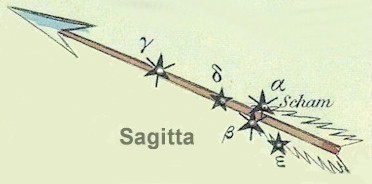
 Today we'll examine a constellation not many people will have heard about. It is called 'Sagitta' and is located beyond the north border of Aquila, the eagle, east of Delphinus, the Dolphin, and north of the constellation of Hercules. The ancient Hellenes called the constellation 'Oistos', and even though it is the third-smallest area of all constellations, it was included among the 48 constellations listed by  Ptolemy. It remains one of the 88 modern constellations defined by the International Astronomical Union. Located to the north of the equator, Sagitta can be seen from every location on Earth except within the Antarctic circle.


Sagitta looks like an arrow, and obviously, it is identified with pretty much every archer in ancient Hellenic mythology. For such a tiny constellation is has a lot written about it, mostly by Hyginus in his 'Astronomica'. Above all, he attributes the flying arrow to Hēraklēs, shot to kill the eagle that ate the liver of Prometheus night after night.

"This arrow, they say, is one of the weapons of Hercules, with which he is said to have killed the eagle which ate the liver of Prometheus. The following reason for the release of Prometheus has been handed down. When Jupiter, moved by the beauty of Thetis, sought her in marriage, he couldn’t win the consent of the timid maiden, but none the less kept planning to bring it about. At that time the Parcae were said to have prophesied what the natural order of events should be. They said that the son of Thetis’ husband, whoever he might be, would be more famous than his father. Prometheus heard this as he kept watch, not from inclination but from necessity, and reported it to Jove. He, fearing that what he had done to his father Saturn in a similar situation, would happened to him, namely, that he would be robbed of his power, gave up by necessity his desire to wed Thetis, and out of gratitude to Prometheus thanked him and freed him from his chains. But he didn’t go so far as to free him from all binding, since he had sworn to that, but for commemoration bade him bind his finger with the two things, namely, with stone and with iron. Following this practice men have rings fashioned of stone and iron, that they may seem to be appeasing Prometheus. Some also have said that he wore a wreath, as if to claim that he as victor had sinned without punishment. And so men began the practice of wearing wreaths at times of great rejoicing and victory. You may observe this in sports and banquets.

But to come back to the beginning of the inquiry and the death of the eagle. Hercules, when sent by Eurystheus for the apples of the Hesperides, out of ignorance of the way came to Prometheus, who was bound on Mount Caucasus, as we have shown above. When victor, he returned to Prometheus to tell him that that dragon we have mentioned was slain, and to thank him for his kindness since he had pointed out the way. Straightway he gave what honour he could to the one that deserved it, for [he killed the eagle?] and since it was slain, men began, when victims were sacrificed, to offer livers on the altars of the gods to satisfy them in place of the liver of Prometheus."

Another explanation Hyginus gives--along with Hesiod, Apollodorus, and Diodorus, amongst others--is that the arrow belongs to Apollon. It was the arrow with which He avenged the death ofHhis son Asklepios, who had been killed by a lightning bolt design by the Kyclopses. Obviously, Apollon could not attack Zeus, so he attacked the Kyklopses instead, and murdered them. To quote Hyginus

"Eratosthenes says about the Arrow, that with this Apollo killed the Cyclopes who forged the thunderbolt by which Aesculapius died. Apollo had buried this arrow in the Hyperborean mountain, but when Jupiter pardoned his son, it was borne by the wind and brought to Apollo along with the grain which at that time was growing. Many point out that for this reason it is among the constellations."

Sagitta is visible at latitudes between +90° and −70°, and best visible at 21:00 (9 p.m.) during the month of August.

 The story of Oedipus (Οἰδίπους, Oidípous) was written by playwright Sophocles. The playwright wrote three plays about him: Oedipus the King, Oedipus at Colonus, and Antigone. Together, these are called the Theban plays. Sophocles was not the only one to write about him, though: fragments of his story exist in the works of Hómēros, Hesiod, Pindar, Aeschylus and Euripides. Sophocles was simple one of the latest authors to write about him, and the version that was preserved best was his. He has Oedipus wander to Thebes after killing his father. Here, he finds the Sphinx at the gates to the city--a city that is starving and slowly emptying out, as the Sphinx will not allow anyone to pass without answering her riddle. Those who answer the riddle incorrectly, get killed or eaten (depending on the author).


The Sphinx is not mentioned by every author. Some, like Hómēros, only mention the oracle that Oedipus' father got, and Oedipus' murder of his father, and marriage to his mother. Hesiod mentions the Sphinx, but does not mention Oedipus. The Sphinx in Sophocles' Oedipus the King never speaks, and the words of the riddle are never conveyed. The sole mention of the riddle is as follows:

"See, for this crown the State conferred on me.
A gift, a thing I sought not, for this crown
The trusty Creon, my familiar friend,
Hath lain in wait to oust me and suborned
This mountebank, this juggling charlatan,
This tricksy beggar-priest, for gain alone
Keen-eyed, but in his proper art stone-blind.
Say, sirrah, hast thou ever proved thyself
A prophet? When the riddling Sphinx was here
Why hadst thou no deliverance for this folk?
And yet the riddle was not to be solved
By guess-work but required the prophet's art;
Wherein thou wast found lacking; neither birds
Nor sign from heaven helped thee, but I came,
The simple Oedipus; I stopped her mouth
By mother wit, untaught of auguries."

Apollodorus is one of the first to mention the very words of the riddle and has them as follows, including the tale of Oedipus' involvement:

"For Hera sent the Sphinx, whose mother was Echidna and her father Typhon; and she had the face of a woman, the breast and feet and tail of a lion, and the wings of a bird. And having learned a riddle from the Muses, she sat on Mount Phicium, and propounded it to the Thebans. And the riddle was this:— What is that which has one voice and yet becomes four-footed and two-footed and three-footed? Now the Thebans were in possession of an oracle which declared that they should be rid of the Sphinx whenever they had read her riddle; so they often met and discussed the answer, and when they could not find it the Sphinx used to snatch away one of them and gobble him up. When many had perished, and last of all Creon's son Haemon, Creon made proclamation that to him who should read the riddle he would give both the kingdom and the wife of Laius. On hearing that, Oedipus found the solution, declaring that the riddle of the Sphinx referred to man; for as a babe he is four-footed, going on four limbs, as an adult he is two-footed, and as an old man he gets besides a third support in a staff. So the Sphinx threw herself from the citadel, and Oedipus both succeeded to the kingdom and unwittingly married his mother, and begat sons by her, Polynices and Eteocles, and daughters, Ismene and Antigone. But some say the children were borne to him by Eurygania, daughter of Hyperphas."

There are other versions of the riddle, but this is the one best known. Note that in older versions of the tale, Oedipus was not such a smart man at all. In fact, he was more of a warrior-hero like Hēraklēs. With the popularity of Odysseus, it was convenient to transform Oedipus into a cunning man, instead of a brawler. In the older art depicting the encounter between Oedipus and the Sphinx, he outright kills her. There is no riddle, and no suicide. She is a monster, who is vanquished by the hero, who collects his reward in the form of a wife.

Personally, I like the inclusion of the Riddle of the Sphinx. In general, I prefer the clever heroes over the brawling ones. I'm also a big fan of these types of riddles, although I'm terrible at solving them. 

Very few heroes in ancient Hellas had quite the impact of Herakles. Both mythologically speaking and as a practical part of the religion, Herakles has a special place and he is honored during the Herakleia. Will you honor him with us tomorrow, on August 11 at the usual 10 am EDT?


Herakles was conceived by Zeus upon Alkmene, as He disguised Himself as her husband, returning early from war. Alkmene accepted Him in her bed gladly, as she was happy to see her husband again. When the real Amphitryon did return later that night, Alkmene realized what had happened, and told her husband. Amphitryon accepted her in his bed, regardless, and so she became pregnant with twins, one fathered by Zeus, and one by her mortal husband.

Hera, hearing of the affair, took an instant disliking to the unborn child. When it became time for Alkmene to give birth, Hera made Zeus swear a vow that a child born in the line of Perseus on this day would become King. Zeus agreed, and Hera hurried off to delay the birth of Herakles and Iphikles, and hurry along the birth of Eurystheus (Εὐρυσθεύς), grandson of Perseus. The two had unknowingly become part of a contest of wills between Zeus and Hera, to decide who would be the hero to drive off the last of the great monsters and pave the way for the Olympians.

Eventually, Hera was tricked into allowing the children born, as She would have postponed their delivery indefinitely. Alkmene, aware of the divine spark in one of her sons, took her distance from him, but the young Herakles was taken up by Athena and taken to Hera, who did no recognize the newborn nemesis of Her candidate, and took pity on him. She fed him from Her breast, but when he suckled so hard that he caused Her pain, She realized who he was, and cast him off. Athena rescued the infant and took him back to his mortal parents. Alkmene took him back and raised him with her husband.

Herakles was a strong child, so strong, in fact, that he inadvertently killed his music teacher Linos (Λῖνος) with a lyre, for which he was tried and found not guilty. He was still made to leave the city, however. Herakles set out to perform feats of strength, starting by defeating the lion of Kithairon, which had been a bane to his stepfather for far too long. Thespios, King of Thespiae, housed Herakles for fifty days as he hunted for the lion, and every night Thespios placed one of his fifty daughters in his bed, although Herakles thought he was only sleeping with one. Herakles eventually vanquished the lion. He dressed himself in the skin, and wore the scalp as a helmet. The Gods lavished him with gifts: a sword from Hermes, bow and arrows from Apollon, a golden breastplate from Hephaistos, and a robe from Athena. His famous club he made himself at Nemea.

Next, Herakles was drawn into a war between the Thebans and the Minyans. He happened upon heralds from King Klymenos, who had won a previous battle with Thebes and now demanded tribute from them. Herakles, who had been living in Thebes, cut the ears, noses and hands off of all but one of the heralds and told the last remaining one to take them back to his king as tribute. In the battle that followed, Herakles fought bravely with the king's army, and his side eventually won, earning him his wife Megara, eldest daughter of King Kreon of Thebes.

Due to Hera's jealousy, he was stricken mad and killed the five sons he had by his wife. When he was released from his madness by a hellebore potion--provided by Antikyreus--and realized what he had done, he cried out in anguish, and went on a long journey to cleanse himself of the miasma caused by these killings. First, he visited the oracle at Delphi, who, unbeknownst to him, was whispered to by Hera. The Oracle told Herakles to serve the king of Tiryns, Eurystheus, for ten years and do everything Eurystheus told him to do. Eurystheus gladly provided Herakles with these labors--ten of them, one for each year--and eventually ended up adding two more, resulting in the Twelve Labors of Herakles.

The Herakleia (Ἡράκλεια ἐν Κυνοσάργει, Herakleia en Kynosargei) were ancient festivals commemorating the death of Herakles. In Athens, the celebration was held just outside the city walls, in a sanctuary dedicated to Herakles. His priests were drawn from the list of boys who were not full Athenian citizens (nothoi, illegitimate children, like him) and were named 'parasitoi'. The Attic cults of Herakles were often closely connected with youth: at several of his cult sites there was a gymnasion attached, and there was a mythological tradition (perhaps originating in Boeotia) that after Herakles died he was taken up to Olympus, where he married Hebe, the personification of youth. Because of this, Herakles is sometimes worshipped as a God and sometimes as a dead hero.

In Thebes, the center of the cult of Herakles, the festivities lasted a number of days and consisted of various athletic and musical contests (agones), as well as sacrifices. They were celebrated in the gymnasium of Iolaus, the nephew and eromenos of Herakles, and were known as the Iolaeia. The winners were awarded brass tripods.

Will you join us in honoring Herakles on this day? You can join the community here and find the ritual here.

According to Hellenic mythology, the Olympic Games were founded by Herakles. It happened after he captured the Cretan Bull, the very same bull that got Pasiphaê, wife of Minos, pregnant with the Minotaur. There is an extended break between the completion of this labour and the start of the next, during which the Olympics came to be.

After capturing the bull, Herakles took some time to unwind, feast, and thank the Gods for all he had achieved so far. Chief amongst his accomplishments in his time off time period is the founding of the Olympic Games, which even Pausanias attributed to Herakles in the mythological retelling of the practice. He writes in his 'Description of Greece':

"Heracles of Ida, therefore, has the reputation of being the first to have held, on the occasion I mentioned, the games, and to have called them Olympic. So he established the custom of holding them every fifth year, because he and his brothers were five in number." [5.7.9]

Corroborating accounts come from, for example, Diodorus Siculus who writes:

"After the performance of this Labour Heracles established the Olympic Games, having selected for so great a festival the most beautiful of places, which was the plain lying along the banks of the Alpheius river, where he dedicated these Games to Zeus the Father. And he stipulated that he prize in them should be only a crown, since he himself had conferred benefits upon the race of men without receiving any monetary reward.

All the contests were won by himself without opposition by anyone else, since no one was bold enough to contend with him because of his exceeding prowess. And yet the contests are very different one from another, since it is hard for a boxer or one who enters for the “Pankration” to defeat a man who runs the “stadion,” and equally difficult for the man who wins first place in the light contests to wear down those who excel in the heavy. Consequently it was fitting that of all Games the Olympic should be the one most honoured, since they were instituted by a noble man." [4.14.1 - 4.14.2]

That said, of course there are a great many non-mythological accounts of how the Olympics came to be. My favorite, perhaps, is from Diodorus Siculus again, who writes a beautiful line between myth and his reality, speaking of the five Daktyloi, daimones who were appointed by Rhea to guard the infant God Zeus in a cave on Mount Ida in Krete and eventually established the Olympic Games in the age of Kronos. One of them was called Hēraklēs as well:

"Also the greater number of the gods who, because of their benefactions to all men alike, have been accorded immortal honours, had their origin, so their myths relate, in their land; and of the tradition regarding these gods we shall now give a summary account, following the most reputable writers who have recorded the affairs of Crete.

The first of these gods of whom tradition has left a record made their home in Crete about Mt. Idê and were called Idaean Dactyli. These, according to one tradition, were one hundred in number, but others say that there were only ten to receive this name, corresponding in number to the fingers (dactyli) of the hands.

But some historians, and Ephorus is one of them, record that the Idaean Dactyli were in fact born on the Mt. Idê which is in Phrygia and passed over to Europe together with Mygdon; and since they were wizards, they practised charms and initiatory rites and mysteries, and in the course of a sojourn in Samothrace they amazed the natives of that island not a little by their skill in such matters. And it was at this time, we are further told, that Orpheus, who was endowed with an exceptional gift of poesy and song, also became a pupil of theirs, and he was subsequently the first to introduce initiatory rites and mysteries to the Greeks.

However this may be, the Idaean Dactyli of Crete, so tradition tells us, discovered both the use of fire and what the metals copper and iron are, as well as the means of working them, this being done in the territory of the city of Aptera at Berecynthus, as it is called; and since they were looked upon as the originators of great blessings for the race of men, they were accorded immortal honours. And writers tell us that one of them was named Heracles, and excelling as he did in fame, he established the Olympic Games, and that the men of a later period thought, because the name was the same, that it was the son of Alcmenê who had founded the institution of the Olympic Games." [5.64.2 - 5.64.6]

No one knows who actually founded the first Olympics, so I'll take the mythical explanation of a hero named Herakles, who founded the Games to honor the Gods and receive blessings upon himself so he would be able to complete the coming labors.

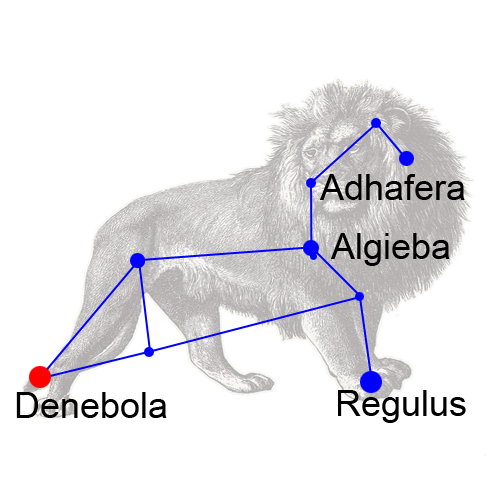
It's been a while since the last constellation! The constellation Leo is one of the most recognizable in the sky, and is obviously one of the constellations tied to the zodiac. Not surprisingly, it is therefor also tied to Hēraklēs.

The lion was considered the King of Beasts by the ancient Hellenic writers. For this reason, Hyginus--our primary source of ancient information on constellations--describes the constellation almost entirely as such, mentioning Hēraklēs in passing only:

"He is said to have been put among the stars because he is considered the king of beasts. Some writers add that Hercules’ first Labor was with him and that he killed him, unarmed. Pisandrus and many others have written about this. " [II.24]

The firs labour of Hēraklēs is, of course, to slay the Nemean lion. You can read about the start of Hēraklēs' life here, but for this constellation, all you need to know is that he was stricken mad by Hera, and killed his wife and children while he was out. As a result, he went on a long journey to cleanse himself of the miasma caused by these killings. First, he visited the oracle at Delphi, who, unbeknownst to him, was whispered to by Hera. The Oracle told Hēraklēs to serve the king of Tiryns, Eurystheus, for ten years and do everything Eurystheus told him to do. Eurystheus gladly provided Hēraklēs with these labors--ten of them, one for each year--and eventually ended up adding two more, resulting in the Twelve Labors of Hēraklēs.

The first of the twelve labours was to slay the Nemean lion. As the lion was terrorizing the area surrounding the mountain, Eurystheus must have seen in the lion a worthy opponent of Hēraklēs, whose tales of bravery and brute strength has proceeded him. He ordered the hero to return with its skin. And so, Hēraklēs went to the cave of the lion after picking up a bow and quiver of arrows, because he was unaware he would not be able to harm the creature with mortal weapons. After a long fight, Hēraklēs eventually chokes the lion, and hails victorious.

The Latin writer Seneca had a beautiful description of the constellation Leo, in the words of our great hero:

"See where the lion, my first toil, glows in no small part of heaven, is all hot with rage, and makes ready his fangs. Forthwith he will seize some star; threatening he stands with gaping jaws, and breathes forth fires, and shakes the mane upon his flaming neck; whatever stars sickly autumn and cold winter with its frozen tracts bring back, with one bound will he o’erleap, and attack and crush the neck of the vernal Bull." [II.942]

I want to add one more thing to he description of this constellation: Hyginus tells another tale about the constellation Leo: the story of Berenikē (Βερενίκη). The name translates to 'bearer of victory', and this version of the story refers to Berenikē II, who lived from about 267 - 221 BC. She was the daughter of Magas of Cyrene and Queen Apama II, and the wife of Ptolemy III, the third ruler of the Ptolemaic dynasty of Egypt. Prior to her marriage to Ptolemy III, she was married to Demetrius the Fair, a Macedonian prince, whom she had killed after he chose to become the lover of her mother Apama. Berenikē was quite the woman, and participated in the Nemean Games even the ancient Olympics. Her own son, Ptolemy IV eventually had her killed, but she was deified and to be honored from that moment on. The following story concerns her, her husband Ptolemy III, and Aphrodite.

"Above his likeness in the sky nearest the Virgin are seven other stars near his tail, arranged in a triangle, which Conon, the mathematician, and Callimachus call the Lock of Berenice. When Ptolemy had married his sister Berenice, daughter of Ptolemy and Arsinoe, and after a few days had set out to attack Asia, Berenice vowed that if Ptolemy returned as victor she would clip off her hair. She placed the lock, consecrated by this vow, in the temple of Venus Arsinoe Zephyritis, but on the following day it couldn’t be seen there. When the king was distressed by this, Conon the mathematician, whom we mentioned above, desiring to win the favor of the king, said that he had seen the lock among the constellations, and pointed out seven stars without definite configuration which he imagined were the lock.

Some authors along with Callimachus have said that this Berenice raised horses, and used to send them to Olympia. Others add that once Ptolemy, Berenice’s father, in panic at the number of the enemy, had sought safety in flight, but his daughter, an accomplished horse woman, leaped on a horse, organized the remaining troops, killed many of the enemy, and put the rest to flight. For this even Callimachus calls her high-souled. Eratosthenes says that she ordered returned to the girls of Lesbos the dowry left to them by their parents, which on one had released, and she established among them right to bring action of recovery."

The constellation Leo is visible at latitudes between +90° and −65°, and best visible at 21:00 (9 p.m.) during the month of April.

Coming of age ceremonies are prevalent in most cultures and are often linked to the religious views of the people performing it. Famous examples are the bar mitswa's and bat mitswa's of the Jewish. The ancient Hellenes had coming of age rituals as well, and like almost everything else in ancient Hellenic life, these rituals were tied into deity worship. Today, I'm going to talk about these coming of age ceremonies, but because the differences are so great between girls and boys, I'm going to describe their coming of age ceremonies separately.


Girl to woman
In ancient Hellas, a girl's coming of age ceremony was linked to her wedding day. As soon as she got married, she would move out, into her new husband's oikos, and commit to the task she was born to fulfill: gift her husband legitimate offspring--boys, preferably. It won't come as a surprise that in preparation for this entirely new role in life, a girl's coming of age ceremony was focussed almost entirely on ending her own childhood, and petitioning the Theoi for help in her life as an adult. As such, fertility and womanhood were big parts of the rituals.

Young girls rarely had a role to play in household worship. The family only had them with them for thirteen to fifteen years, on average, after that, she joined her rightful place at the oikos of her husband, where she carried more (religious) responsibility. There were religious roles young girls could fulfill outside of the home, however, most notably as 'Arrephoros' (Ἀρρήφορος)--year long handmaidens of Athena Polias (Πολιάς)--in Athens, and as 'Arktos' (αρκτος), bear, a service in the following of Artemis Brauronia (Βραυρωνια) at Brauron (Βραυρών).

During the Arkteia festival, celebrated every four or five years alongside--or as a part of--the Brauronia, named and in honor of the epithet of Artemis. Every Athenian girl, as well as many other girls from all over Attika, had to take part of the festival before they could marry. The girls were brought to Brauron, a temple of Artemis with a rich history in both myth and history. Some versions of the myth of Iphigeneia have her taken from the sacrifice and dropped in Brauronia, where she established a temple to the Theia in gratitude. Otherwise, an oracle might have told the ancient Hellenes to build a temple to the Theia at Brauron after a terrible plague or famine plagued the land following the killing of a bear by two hunters.

The symbolism of the bear might refer to the bear which was slain by the hunters, or the clothes Iphigeneia might have left at her 'sacrifice'. It's also possible that the bear reference refers to Kallisto, who was transformed into a bear by the Theia.

During the festival young girls, and it seems that on occasion young boys, would gather to celebrate Artemis Brauronia with races, and dances. They would don bear masks and dance a dance known as the 'Arkteia', which was made up of slow, solemn steps meant to imitate the movements of a bear and was performed to a tune from a diaulos (double flute). They might have carried baskets of figs. Up until as far back as the 5th century, the girls might have worn actual bear skins, but bears soon became scarce, so they wore yellow dresses called 'krokoton', which they 'shed' instead of the skins to signal their coming adulthood.

The actual reason for the 'bear' ritual has been lost. It's possible that the ritual served to exorcise 'the wildness' out of little girls, but it's more likely that it was simply a way to procure kharis for the young girls who would soon call on Artemis during childbirth. In the same spirit, young women on the threshold of marriage made an offering to Artemis of their childhood toys and other paraphernalia that represented childhood, as with an offering of one drachma (roughly $ 60,-) at the temple of Aphrodite. Most likely, the bride also honored Hera Teleia and Zeus Teleios in some way.

A young woman came of age during her wedding and the subsequent wedding night, but became a woman when she gave birth for the first time. Especially during the latter, they desperately needed the support of the Theia Artemis. Aphrodite and Hera Teleia would support her through her marriage, and help her make it a success. With the help of the Theoi, a girl could become a woman.

Boy to man
Young boys had a very different life to young girls when it came to life in ancient Hellas. Because it was very important for a man to have legitimate children, the child's paternity was attested to on multiple occasions. In Athens, this was done the first time shortly after being named, and the second time when he reached sixteen years of age. Both times, the child was presented at the 'phratria' (φ(ρ)ατρία)--brotherhood--of his father. The system of brotherhoods, four in total, was the system that preceded the system of tribes. The brotherhoods largely fades, except for the registration of male offspring, and the vetting of such with testimonials and tests. The brotherhoods were overseen by Zeus Phratrios and Athena Phratria, who were honored yearly in a three-day festival called the 'Apoutouria'.

During a son's presentation to the brotherhood, Zeus Phratrios and Athena Phratria during the Apoutouria, boys sacrificed a lock of their hair to the patron Theoi and Hēraklēs, their father an animal. If one of the phratria contested that the father was, indeed, the father of this child, he could take the animal from the father before they reached the altar, and drag it away. Doing so would have been a very serious thing to do, and very shocking for a young boy to witness, not to speak of the father. The claim would then be put to a vote. When the phratria ruled in favor of the father, the animal was sacrificed and the meat distributed to the members of the brotherhood. The son became a full member.

At sixteen, a boy was considered a young man, and he entered one or two years of public service, either to mature, or to show he had matured enough to take part. This was called his 'ephebeia', which literally means 'young man'. On completion of this public service, a young man could enter the military and became a voting member of the Ekklesia. He became a citizen. Although young man were now considered adults, he only truly became an adult at age thirty, when he could serve in the boule, and get married.

Young men swore an oath upon completion of their ephebia, which has largely been preserved. It read as follows:

"I will not bring shame upon these sacred weapons nor will I abandon my comrade-in-arms wherever I stand in the ranks. I will defend both the holy and profane things. I will not hand on the fatherland smaller than I received it, but larger and better, so far as it lies in my power with the assistance of all the other citizens. I will obey the officials who govern wisely and the laws, both those which are already established and those which are wisely established in the future. If anyone attempts to destroy them, I will not allow it, so far as it lies in my power with the assistance of all the other citizens. I will hold in honor the ancestral sanctuaries. The following gods are witnesses: Aglauros, Hestia, Enyo, Enyalios, Ares and Athena Areia, Zeus, Thallo, Auxo, Hegemone, Heracles, the territory of the fatherland, the wheat, barley, vines, olive trees, and fig trees."

With this oath, the world opened up for young men; they would now be held divinely accountable for any trespassing upon the law and common sense. Political life would become important for men, as well as military service. They had roughly ten years to dedicate to these before he took a wife, so young men tended to fulfill much of their obligation to the city in these ten years. After his marriage, he became the one who presented sons to the phratria, and he got to experience the entire proceedings from the spot his father once held. This--most likely--created strong familial ties that continued through family lines for centuries.

In conclusion
There is much that remains to be said about coming of age ceremonies in ancient Hellas, more to be said about coming of age ceremonies in ancient Athens, even, but that is talk for another day. For now, I hope you have a basic idea of the youth and religious focal points of an Athenian child's life. Personally, I have a soft spot for coming of age rituals, and I strongly suggest creating or adapting ceremonies for the second (or even third) generation of Hellenists. What this would look like will be left for another post, but it would surely be beautiful.

It's time for part three of the series-within-a-series featuring the myth of Apollon and the raven. The previous parts were the constellation Corvus: the Raven, and the Constellation Crater: the Cup. This third installment is about the longest constellation we still recognize as a constellation today: Hydra, or the sea-serpent.


To recap the story of Apollon and the raven: the raven (or crow) was in service to Apollon, and was sent out on an errant for the Theos. He was asked to bring water to Him, but instead, he paused in his quest. Most commonly it is assumed is that he stopped for a meal of figs. When the raven returned without water, Apollon questioned him. Instead of giving a straight answer, the raven lied, and said he had been kept from the water by a snake. In some accounts, he actually had a snake in his talons as he said this. Apollon, however, saw that the raven was lying, and flung the raven, the krater with which the raven was supposed to collect water, as well as the snake into the sky, where they remain to this day.

Roman author Gaius Julius Hyginus (64 BC - 17 AD) talks about the serpent's continued function in his Astronomica:

"This is the sign on which the Crow sits and over which the Bowl is placed. [...] As long as the figs are ripening, the crow cannot drink, because on those days he has a sore throat. So when the god wished to illustrate the thirst of the crow, he put the bowl among the constellations, and placed the water-snake underneath to delay the thirsty crow. For the crow seems to peck at the end of its tail to be allowed to go over to the bowl." [2.40]


Another hydra the constellation is associated with is the Hydra vanquished by Hēraklēs as his second labour. After his victory over the Nemean lion, Hēraklēs is send off to handle another sticky problem: the Lernaean Hydra, who was raised from the earth by Hera just to end the life of Hēraklēs. The Lernaean Hydra (Λερναία Ὕδρα) was the offspring of Typhon, and layered in the swampy lake of Lerna. He realized he would need help for this labour, and asked it of his nephew Iolaus (Ἰόλαος). Together they devised a plan: Hēraklēs would cut off the heads, and Iolaus would sear the stumps shut, in this way, the heads could not regenerate. When Hēraklēs returns to Eurystheus after completing the labour, the king decrees that, because Hēraklēs could not have completed the labour without the help of Iolaus, the labour will not count against his total, and he will have to do an extra one to fulfill his debt.

On the hydra, Pausanias writes in his 'History of Greece'. He speaks of the birth place of the hydra, and of his alleged number of heads:

"At the source of the Amymone grows a plane tree, beneath which, they say, the hydra (water-snake) grew. I am ready to believe that this beast was superior in size to other water-snakes, and that its poison had something in it so deadly that Heracles treated the points of his arrows with its gall. It had, however, in my opinion, one head, and not several. It was Peisander76 of Camirus who, in order that the beast might appear more frightful and his poetry might be more remarkable, represented the hydra with its many heads." [2.37.4]


Constellations are often associated with the constellations they are surrounded with, and with no constellation this is clearer than with Hydra. Aratos, a Hellenic poet who flourished in Macedonia in the early third century BC, speaks best of Hydra in regards to his surrounding constellations in his 'Phaenomena':

"Another constellation trails beyond, which men call the Hydra. Like a living creature it winds afar its coiling form. Its head comes beneath the middle of the Crab, its coil beneath the body of the Lion, and its tail hangs above the Centaur himself. Midway on its coiling form is set the Crater, and at the tip the figure of a Raven that seems to peck at the coil." [443]


The constellation Hydra is visible at latitudes between +54° and −83°, and best visible at 21:00 (9 p.m.) during the month of April.

 I have already written quite a lot about the Hellenic hero Hēraklēs, whose name was later Romanized as 'Hercules'. In fact, I am writing a continuing series about his labours. That said, this post will not be just about him, because there were others associated with the myth, despite the name.


The name of the constellation in ancient Hellas was Ἐγγόνασιν, The Kneeler, or On His Knees. That said, the ancient Hllenes already associated the myth with the hero Hēraklēs. Hyginus, for example, in his 'Atronomica' describes:

"Eratosthenes says he is Hercules, placed above the dragon we have already mentioned, and prepared to fight, with his left hand holding his lion skin, and his right the club. He is trying to kill the dragon of the Hesperides, which, it is thought, never was overcome by sleep or closed its eyes, thus offering more proof it was placed there as a guard. Panyassis in the Heraclea says of the sign that Jupiter, in admiration of their struggle, placed it among the stars; for the dragon has its head erect, and Hercules, resting on his right knee, tires to crush the right side of its head with his left foot. His right hand is up and striking, his left extended with the lion skin, and he appears to be fighting with all his strength.

Aeschylus, in the play entitled Prometheus lyomenos, says that he is Hercules, fighting not with the dragon, but with the Ligurians. For he says that at the time Hercules was driving away the cattle of Geryon, he journeyed through the territory of the Ligurians. They joined forces in trying to take the herd from him, and pierced many of the beasts with arrows. But after Hercules’ weapons failed, worn out by the number of the barbarians and lack of arms, he fell to his knees, already suffering from many wounds. Jove, however, out of pity for his son, provided that there should be a great supply of stones around him. With these Hercules defended himself and put the enemy to flight. And so Jove [Zeus] put [t]he image of his fighting form among the constellations." [II.6]

Yet, Hyginus also mentions other possibilities and other noteworthy people who have an opinion on the matter; Araethus, for example, who calls this figure Ceteus, son of Lycaon, and father of Megisto:

"He seems to be lamenting the change of his daughter to bear form, kneeling on one knee, and holding up outstretched hands to heaven, asking for the gods to restore her to him." [II.2]

For those who these names are unfamiliar, Megisto is in some writers another form for Kallistô, the mother of Arcas, who is also called Themisto. I have discussed the happenings with this family before, for the constellation Boötes, but will recap for the unity of this post. Arcas (Ἀρκάς), son of Zeus and Kallistô (Καλλιστω). After Arcas was born, Hera caught wind of the affair and turned Kallistô into a bear. Alternatively, Kallistô was a priestess of Artemis, and Artemis punished her for losing her virginity by turning her into a bear. Because of the metamorphosis, the boy was raised by his maternal grandfather Lycaon, who would later kill and serve up his grandson to the Theoi as dinner, for which he was turned into a (were)wolf. When Arcas grew up, he went out to hunt and found a beautiful bear. He chased her through the woods. The bear--his transformed mother Kallistô--ran towards him as soon as she recognized her son. Arcas was terrified and raised his bow to shoot her. Zeus intervened swiftly and placed Kallistô and her son in the sky. Kallistô became Ursa Major and Arcas either Ursa Minor or Boötes.

Hyginus goes on to quote Hegesianax, who says that:

"...he is Theseus, who seems to be lifting the stone at Troezene. Aegeus is thought to have put [corrupt] and a sword under it, and warned Aethra, the mother, not to send him to Athens until he could lift the stone by his own strength and bring the sword to his father. And so he seems to try to lift the stone as high as he can. In this connection, too, some have said that the Lyre, placed nearest this sign, is the lyre of Theseus, for he was skillful in all the arts and seems to have learned the lyre as well. This, too, Anacreon says: Near Theseus, son of Aegeus, is the Lyre." [II.6]

Theseus was fathered by Aegeus and Poseidon, whom had both slept with his mother Aethra, and was thus destined to become a hero. In order to claim his rightful place as ruler over Athens, he had to uncover his father's sandals and sword from under a stone in his mother's birth land where Theseus grew up, and bring it to his mortal father. Theseus lifting the stone at Troezene would have been his first heroic act, and thus worthy of immortalization in the stars.

Hyginus offers a few more options:

"Others call him Thamyris, blinded by the Muses, kneeling as a suppliant; others, Orpheus, killed by the Thacian women because he looked on the rites of Father Liber. Again, some have said that he is Ixion with his arms bound, because he tried to attack Juno. Others say he is Prometheus, bound on Mt. Caucasus." [II.6]
 
I have written about the affairs with Ixion and Prometheus, so for reference, please visit those posts. I have also written about Orpheus, but with a different constellation: Cygnus: the swan. In it I describe how Orpheus wanders the world after loosing his wife for good, and stumbles upon revelers who rip him apart. His lyre is placed into the sky and Plato describes that Orpheus is turned into the constellation Cygnus because he does not want to be reincarnated as a woman, a risk he would run if he stayed in human form. It seems others thought he was put into the sky as a man regardless, and near his lyre at that.

Thamyris  (Θάμυρις) is new to this blog. He was the son of Philammon and the nymph Argiope, and a Thracian singer who was so proud of his skill that he boasted he could outsing the Muses. He competed against them and lost. As punishment for his presumption they blinded him, and took away his ability to make poetry and to play the lyre. Hómēros outlines the tale in the Iliad:

"From Pylos, and lovely Arene; from the ford of the Alpheius at Thryum, from well-built Aepy, from Cyparisseis, and Amphigeneia, Pteleos, Helos, and Dorium, where Thamyris the Thracian met the Muses, as he came from Eurytus’ house in Oechalia, and they put an end to all his singing: he who had boasted he would win his contest with those aegis-bearing daughters of Zeus, they blinding him in anger, robbing him of his sweet gift of song, so he forgot the cunning of his harp; in their fleet of ninety hollow ships the warriors came, led by Nestor the Gerenian charioteer." [II: 581-644]

It seems there is great variety in the interpretation of the person the constellation depicts, but whomever it is, they are visible at latitudes between +90° and −50°, and best visible at 21:00 (9 p.m.) during the month of July.

It's time for a new constellation, and this one is entirely dedicated to two brothers. While there are many twins in Hellenic mythology--Artemis/Apollon, Iphikles/Hēraklēs, Amphion/Zethos, etc., this constellation is almost solely connected to one set of them: Kastor and Polideukes. In fact, the main stars of the constellation are named after them.


Hyginus briefly describes the constellation in his Astronomica, and focusses almost solely on the Dioscuri:

"These stars many astronomers have called Castor and Pollux. They say that of all brothers they were the most affectionate, not striving in rivalry for the leadership, nor acting without previous consultation. As a reward for their services of friendship, Jupiter [Zeus] is thought to have put them in the sky as well-known stars. Neptune [Poseidon], with like intention, has rewarded them for he gave them horses to ride, and power to aid shipwrecked men.
 
Those who speak of Castor and Pollux add this information, that Castor was slain in the town of Aphidnae, at the time when the Lacedaemonians were fighting the Athenians. Others say that when Lynceus and Idas were attacking Sparta, he perished there. Homer states that Pollux granted to his brother one half of his life, so that they shine on alternate days." [2.22]


The twins were born from Leda, Zeus, and mortal king Tyndareus. One of the twins was mortal, the other immortal, and both hatch from an egg. Accounts vary about who was the mortal one, and who was the immortal one; in some accounts they were even both mortal or immortal. During their lifetimes, the Dioscuri became great heroes, joining Iásōn in securing the Golden Fleece, and they both fought the Calydonian Boar.

I will discuss their mythology better another time, but for now, let me suffice in saying that eventually, they aspired to marry Phoebe and Hilaeira, who were already betrothed to cousins of the Dioscuri, a second set of twin brothers named Lynceus and Idas of Thebes, sons of Tyndareus's brother Aphareus. This sparked a feud between the cousins that left Polideukes the only one standing. He was given the choice by Zeus of spending all his time on Mount Olympus or giving half his immortality to his mortal brother. He opted for the latter, and thus the two divided their time between Olympos and the Underworld.

The Dioscuri were regarded as helpers of mankind and held to be patrons of travelers and sailors. Because they excelled in horseback riding and boxing, they were regarded as the patrons of athletes and athletic contests, and in all capacities, they had shrines throughout Hellas, and were worshipped well into the Roman era. As the twins lived on after death, they became emblems of the Eleusinian Mysteries, and were said to have been initiated into it during their lifetimes.

Hyginus also mentions a few other duos connected to the constellation:

"Others have called them Hercules and Apollo; some, even Triptolemus, whom we mentioned before, and Iasion, beloved of Ceres [Demeter] - both carried to the stars." [2.22]


Hēraklēs and Apollon earned this honor because, when Apollon commanded that Hēraklēs be sold into slavery to atone for the murder of his family, Hēraklēs became enraged and wrestled the Theos for the Delphic tripod. Their match was memorialized amongst the stars as the constellation Gemini.

Triptolemos and Iasion are the last candidates. The two were favorites of the Goddess Demeter. Triptolemos was a hero who first instructed mankind in the art of agriculture, while Iasion was said to be Her lover on the island of Samothrace. Demeter must have immortalized them out of love.

Gemini is visible at latitudes between +90° and −60°, and best visible at 21:00 (9 p.m.) during the month of February.

The constellation Draco (from the Greek Drakon, meaning dragon) is identified--funnily enough--with some dragons in Hellenic myth but not others. There are quite a few creatures, after all, who would qualify as a dragon in Hellenic myth. For a dragon or hydra not connected to the constellation, think of the one Kadmos vanquished, for example, or the one Apollon vanquished at Delphi, or even the dragon who guarded the Golden Fleece and was slain by Iásōn. In truth, only two dragons were associated with the myth in ancient times, most notably by Hyginus in his Astronomica: Drakon Hesperios, the Hesperian Dragon, and Drakon Gigantomakhios, the Gigantomachian Dragon.


The first of the myths associated with the constellation is the legend of the Drakon Hesperios (Δρακων Ἑσπεριος), who was slain by Hēraklēs during one of his Labours. I will tell the whole myth of the labour soon enough, but I will share what Hyginus wrote about this labour, and Hēraklēs' encounter with Ladôn (Λαδων), as the dragon was often called.

"This huge serpent is pointed out as lying between the two Bears. He is said to have guarded the golden apples of the Hesperides, and after Hercules killed him, to have been put by Juno [Hera] among the stars, because at her instigation Hercules set out for him. He is considered the usual watchman of the Gardens of Juno. Pherecydes says that when Jupiter [Zeus] wed Juno, Terra [Gaea] came, bearing branches with golden applies, and Juno, in admiration, asked Terra to plant them in her gardens near distant Mount Atlas. When Atlas’ daughters kept picking the apples from the trees, Juno is said to have placed this guardian there. Proof of this will be the form of Hercules above the dragon, as Eratosthenes shows, so that anyone may know that for this reason in particular it is called the dragon." [II.3]

The sole other dragon this myth is linked to is Drakon Gigantomakhios (Δρακων Γιγαντομαχιος), who rose up during the Gigantomachy. When the Olympians rose to power, they first fought the Titans during the Titanomachy. Vanquishing them, the Theoi thought They had won. Yet, there was one who sought revenge for the defeat of his father: Typhôeus, the most-feared son of Tartaros and Gaea. Some versions of the myth say that Typhôeus was actually the Drakon Gigantomakhios, or one of his offspring. Hyginus shares what happened to the dragon:

"Some also say this dragon was thrown at Minerva [Athena] by the Giants, when she fought them. Minerva, however, snatched its twisted form and threw it to the stars, and fixed it at the very pole of heaven. And so to this day it appears with twisted body, as if recently transported to the stars."

The constellation Draco is visible at latitudes between +90° and −15°, and best visible at 21:00 (9 p.m.) during the month of July. Tomorrow, we will talk a little more about the types of dragons in Hellenic myth, because I suddenly realized the association with medieval dragons is very easily made when reading 'dragon', but I assure you, the ancient Hellenes were unaccustomed to giant, fire breathing, lizards.

Some constellations have barely any mythology connected to them, or are so entrenched in a major epic that writing about them is very straight forward. Others, not so much. Cygnus is one of them. This particular swan can be any of six mortal or immortal men.


One can not mention a swan in connection to Hellenic mythology and not think of the love affair between Zeus and Leda, the affair that led to the birth of some very influential people in Hellenic mythology. Leda (Λήδα) was the daughter of the Aetolian king Thestius (Θέστιος), and wife of the king Tyndareus (Τυνδάρεως), of Sparta. Zeus looked upon the beautiful Leda and fell for her instantly. In the guise of a swan, He came to her, seeking refuge in her arms from an eagle. Leda sheltered Him, and lay with Him--either after He transformed into a man, or while He was still a swan. That night, she also slept with her husband. She became pregnant and gave birth to two eggs, one housing Helene (Ἑλένη) and Klytaemnestra (Κλυταιμνήστρα), and the other Kastor and Polideukes (Κάστωρ καὶ Πολυδεύκης). Its also said that Zeus laid with Nemesis and She gave birth to an egg that housed either Helene alone, or her sister as well. A shepherd found the egg and took it to Leda, who hatched it, and adopted the child or children. In the first case, the swan is Zeus, in the latter, the swan was placed in the sky to celebrate the birth of Helene.

The second male the constellation is identified with is Orpheus. After being forced to leave Euridice in the Underworld, he travels the world with his lyre. He renounces both women, and many of the Theoi, pained as he is by the loss of his beloved wife. One day, he either sacrifices to Apollon--one of the few, or even the only Theoi he still offers to--at a shrine to Dionysos, and is discovered by the female revelers. Alternatively, the revelers stumble upon him as he plays, and they can't appreciate his divine music, or a group of women falls upon him for denouncing women. Whatever the case, Orpheus is ripped apart. His lyre is placed into the sky, and he is placed in the sky near the lyre by Zeus in the form of a swan. Plato explains this odd choice in his 'Republic', when he speaks of reincarnation:

"He said it was a strange, pitiful, and ridiculous spectacle, as the choice was determined for the most part by the habits of their former lives. He saw the soul that had been Orpheus’, he said, selecting the life of a swan, because from hatred of the tribe of women, owing to his death at their hands, it was unwilling to be conceived and born of a woman." (X, 620a)

I'm going to conflate the last four. All of them were named 'Kyknos' (Κύκνος). The first was a bloodthirsty son of Ares, who slaughtered all his guests when they came to his door. Hēraklēs killed him, either in self-defense, or in honorable battle. In one version of the story, Ares transforms His son into a swan before Hēraklēs can deliver his deathly blow, preferring this solution over his son's death. The second Kyknos was the son of Poseidon, and King of Kolonai. As the son of Poseidon, he was impervious to both spear and sword attacks, as such, he was suffocated by Achilles during the battle for Troy. After his death, this Kyknos, too, was turned into a swan.

The third Kyknos was a human King of Ligûria, and friend--or lover--of Phaëthon, son of Hēlios. When Phaëthon was killed by Zeus after scorching the earth, Kyknos was inconsolable. He spent the rest of his life mourning Phaëthon. To relief his suffering, Zeus transformed him in a swan, and was later put into the sky by Apollon. The last of the Kyknos' associated with this myth was a son of Apollon. This Kyknos was a handsome but arrogant man. Many young boys fell for his looks, but his personality drove them off again. One of the young men, Phylios, loved Kyknos unconditionally, but Kyknos felt the need to test Phylios' resolve, trying to scare him off. The first task was to kill a lion that was threatening the neighborhood without use of any weapons. The second task was to catch two man-eating vultures of enormous size that were posing an equal threat to the neighborhood, again without use of any devices. Finally, Phylios had to bring a bull to the altar of Zeus with his own bare hands. With divine help, Phylios managed to complete all three tasks, but Hēraklēs cured the boy of his love for Kyknos. Kyknos, enraged and humiliated, took his own life by drowning. His mother did the same. Out of love for the both of them, Apollon turned them both into swans. In the words of Roman poet Ovid, in his Metamorphoses:

"Whilst here, within the dismal gloom, alone, 
The melancholy monarch made his moan, 
His voice was lessen'd, as he try'd to speak, 
And issu'd through a long-extended neck; 
His hair transforms to down, his fingers meet 
In skinny films, and shape his oary feet; 
From both his sides the wings and feathers break; 
And from his mouth proceeds a blunted beak: 
All Cycnus now into a Swan was turn'd, 
Who, still remembering how his kinsman burn'd, 
To solitary pools and lakes retires, 
And loves the waters as oppos'd to fires."
(II 374-382)

The next time you look to the heavens and see constellation Cygnus, you'll have quite the stories to tell. The constellation is visible at latitudes between +90° and −40°, and best visible at 21:00 (9 p.m.) during the month of September.

The Herakleidai (Ἡρακλεῖδαι) are the descendants of Herakles. After the death of Herakles, his sons were pursued by Eurystheus. They claimed protection in Athens. The Athenians refused to surrender them and in the war that ensued Eurystheus' sons were killed. Eurystheus himself, who had fled in a chariot, was pursued and had his head cut off by Hyllos, son of Heracles. After the death of Eurystheus, the Herakleidai attacked the Peloponnesos and captured all the cities. When a plague ravaged the country the oracle of Delphi declared that this happened because the Herakleidai had returned before the proper time. So they retired and, after some unfortunate attempts to return, they made themselves masters of the Peloponnesus three generations later. In Erkhia, a yearly sacrifice was made to the sons (and hopefully the daughters) of Herakles and we will do the same on 16 April at the usual 10 am EDT.


The Herakleidai claimed power in the Peloponnesos because they were descended, through Herakles, from Perseus, the founder of Mycenae. The current ruler op the Peloponnesos, Tisamenus, was a Pelopid, a descendant of Pelops. They also claimed that Tyndareus, ruler of Sparta, had been expelled by Hippokoon and argued that Herakles, having killed Hippokoon and his sons, had given the land in trust to Tyndareus. As such, they were the true rulers of both.

Hyllos, son of Herakles, sought to effect the return to power of the Herakleidai, so he went to Delphi and inquired how to go about this. The oracle declared that 'they should await the third crop before returning'. Hyllos supposed that the third crop signified a three year wait. He did, then returned with his army to Peloponnesos. He failed and was killed by Ekhemos. 

Aristomakhos, son of Kleodaeos, son of Hyllos, had been also killed in battle. His son Temenos blamed the oracle for the death of his father. He said that they had obeyed the oracle but the Oracle answered that they were themselves to blame, for they did not understand the prophecies, seeing that by 'the third crop' it was meant, not a crop of the earth, but a crop of a generation. 

So Temenos waited. He readied the army and built ships at Naupaktos. While the army was there, a soothsayer appeared. Karnos recited oracles but the Herakleidai took him for a magician sent by the Peloponnesians to be the ruin of the army. So Hippotes (son of Phylas, son of Antiochos, son of Herakles) threw a javelin at him and killed him. But Karnos was, indeed, a seer of Apollon and the one who established the cult of Apollo Karneos among the Dorians. Appollon destroyed the naval force and made the army suffer from famine. Eventually it had to disband.

After these two failed attempts, Temenos went back to the Oracle of Delphi to ask how he could stop the misfortune that had befallen them. The Oracle advised him to banish the Hippotes for ten years and to take for his guide 'the Three-Eyed One'. So the Herakleidai banished Hippotes and started searching for the Three-Eyed One.

One day they met Oxylos who was sitting on a one-eyed horse. So, guessing he was the man described by the Oracle, they made him their guide. Oxylos had fled from Aetolia to Elis on account of the accidental murder of Thermios (or Alcidokos, depending on the account). So, with Oxylos as a guide, the Herakleidai invaded the Peloponnesos again and finally defeated them. They slew Tisamenos, the last of the Pelopides to rule the Peloponnesos, and claimed it in its entirety. 

The return of the Herakleidai took place three generations after the end of the Trojan War and the death of Nestor after his return home. When the Herakleidai conquered the Peloponnesos, they cast lots for the cities. Argos was allotted to Temenos. The twin sons of Aristodemos, Prokles and Eurysthenes, got Lacedaemon and Sparta. Messenia was allotted to Kresphontes, who drove the descendants of Nestor from Messenia. Oxylos, for his help, became king of Elis after the victory of the Herakleidai.

What follows is a (probably incomplete) list of those who were called 'Herakleidai' at the time described.

The first generation:
Alcaeos, son of Herakles and Omphale. Father of Belos.
Antiochos, son of Herakles and Meda. Father of Phylas.
Hyllos, son of Herakles and Deianira or Melite. Father of Iole of Kleodaeos and Evaekhme.
Ktesippos, son of Herakles and Astydamia or Deianira. Father of Thrasyanor.
Phaestos, son of Herakles and an unknown mother. Father of Rhopalos.

The second generation:
Belos, son of Alcaeos.
Kleodaeos, son of Hyllos. Father of Aristomachos and Lanassa.
Phylas, son of Antiochos. Father of Hippotes and Thero.
Rhopalos, son of Phaestos. Father of Hippolytos.
Thrasyanor, son of Ktessipos. Father of Agamedidas and Antimachos.

The third generation:
Agamedidas, son of Thrasyanor. Father of Thersander.
Anaxandra, daughter of Thersander. Mother by Eurysthenes of King Agis of Sparta.
Antimakhos, son of Thrasyanor. Father of Deiphontes.
Aristomachos, son of Kleodaeus. Father of Temenos, Kresphontes and Aristodemos.
Eurysthenes, son of Aristodemos. Father of King Agis.
Hippotes, son of Phylas. Father of Aletes.
Hippolytos, son of Rhopalos. Father of Lacestades.
Lathria, daughter of Thersander. Mother by Prokles of King Sous of Sparta.
Prokles, son of Aristodemos. Father by Lathria of Sous and Eurypon.

The fourth generation:
Aristodemos, son of Aristomachos. Father of Eurysthenes and Prokles.
Aletes, son of Hippotes.
Deiphontes, son of Antimakhos. Father of Antimenes, Xanthippos, Argeos, and Orsobia.
Kresphontes, son of Aristomachos. Father of Aepytos.
Lakestades, son of Hippolytos.
Temenos, son of Aristomachos. Father of Agelaos, Eurypylos, Kallias and Hyrnetho (or Kisos, Kerynes, Phalkes, Agraeos, Isthmios and Hyrnetho).
Thersander, son of Agamedidas. Father of Lathria and Anaxandra.

The fifth generation:
Agelaus, son of Temenos.
Agraeus, son of Temenos.
Aepytos, son of Kresphontes.
Eurypylus, son of Temenos.
Hyrnetho, daughter of Temenos.
Isthmios. Son of Temenos.
Kallias, son of Temenos.
Kerynes, son of Temenos.
Kisos, son of Temenos. Father of Phlias and Medon.
Phalkes, son of Temenos.

The ritual for the event can be found here and you can join the community page here.