Showing posts with label Paganism. Show all posts

 I get a lot of questions from readers, and most of the time, the answers are fairly short. When I feel the question or the reply would be valuable to others as well, I make a post with a collection of them and post them in one go. Today is one of those posts.


"What do you think of offering beer to the Theoi?"

Beer has been around for a very long time, at least six thousand years, although the art of beer-making could date back as far as fifteen thousand years ago. The ancient Hellenes certainly were not the ones who invented it. Most likely, it travelled to them by way of the Egypt, but the Egyptians could probably trace the art back to Mesopotamia. A four thousand year old seal to the Goddess Ninkasi--the Goddess of beer--has been found, which is as well a hymn to Her as a recipe for beer.

The beer that was drunk by the ancient Mesopotamians, Egyptians, Greeks--or anyone else, really--had very little to do with the beer we pick up at the grocery store today. They share the same base component--fermented barley--but that's about it. Ancient records ascribed to the following method of creating beer, which is somewhat similar to modern day practices, but vary greatly in execution:

According to Athenaeus Naucratis, a Hellenic rhetorician and grammarian, a grain, typically barley but also millet, rye and wheat, was malted. The grain was dampened with water and allowed to germinate. Nature took its course to converted some of the starches into fermentable sugars and the resulting malt was heated to dry it. The dried malt was often shaped into loafs which were then backed for a small amount of time. These loaves were crumbled, mixed with cereals, and then soaked overnight. To add flavor, spices, honey, dates or other types of sweeteners were used. After the mash had fermented, the liquid contained roughly six to twelve percent alcohol and was sucked out of large bowls with straws, because the gruel-like mash was left in.

Depending on the country or region of origin, the ancient Hellenes knew a wide variety of beers, all mixed slightly differently. Zythos (ζῦθος) came from Egypt. The beer or barley-wine of Crete was known as 'korma' (κόρμα) or 'kourmi' (κοῦρμι). A similar beverage was known in the north of Hellas and in Asia Minor under the name of 'βρῦτον', which simply means 'fermented' or 'something brewed', being made of barley by the Phrygians and Paeonians, of barley or of roots by the Thracians, while the Paeonians also made another mixture which they called 'παραβίας' or 'παραβίη' from millet and fleabane for which I have no translation.

The Roman Plinius reported of the popularity of beer in the Mediterranean area before wine took hold, but the Hellenes were much bigger fans of the fermented grape than fermented barley. Still, the ancient Hellenes associated beer with the Theoi. Dionysos was lauded for the drink, but the prime Theos of beer was (and is) Seilenos (Σειληνός), foster-father of Dionysos and son of Hermes. Please note that the preferred drink of Demeter, Kykeon, which is also made with barley, was not fermented and does not contain alcohol.

Within modern Hellenistic practice, beer is most likely not a suitable offering for the Theoi, and should not replace wine offerings. Even in ancient Hellas, beer was viewed as inferior and barbaric. Peasants drank it, as it was a lot cheaper than wine, but that's about it. On principle, I'm against offering anything sub-par to the Theoi, even if the modern process has made the drink a lot more palatable. Still, it's good to know the ancient Hellenes had options, although getting drunk was frowned upon even if you drank beer.

~~~

"Read on your blog that your Hellenistic has, in a way, freed you from certain aspects of witchcraft. I’m intrigued, can you explain? Of course its personal to you and wont apply to all, but I feel like you probably have interesting points to raise."

In my twenty-three years of practice, I have progressed at least four times; from Neo-Wicca to Technopaganism, from Technopaganism to Hedgewitchery, from Hedgewitchery to Eclectic Religious Witchcraft and from Eclectic Religious Witchcraft on to Hellenismos. Some were easy, some a good lot harder to reconcile with my heart and mind.
 
Progression is never easy as you do step away from a practice you have spent many years building. It takes a lot of guts to finally admit your current practice is not for you anymore. It’s a process. It’s generally not a sudden thing that happens (although for some, it might be).

All the times I’ve progressed, it has been a relief. I took all I had learned with me into my next step of religious evolution. I never looked for a new home, but every time I progressed, it was a new homecoming.

Religion is the process of finding personal truth. For me, it’s also a way to reconcile my many thoughts about Divinity with the experiences I have had with it. Which practices I use gives me a framework to do what I feel that needs to be done. I can still do Neo-Wiccan and Eclectic ritual; I have the tools, the knowledge and the faith in the God and Goddess but the Theoi are the Gods that bring me closer to myself and the world around me. That particular framework gives me everything I have ever wished my pervious practices were–and that is why it was natural for me to progress into it.

I practiced Eclectic Religious Witchcraft for about seven years. I was initiated into a coven and initiated others. I was a priestess with a specialization in the ancient Hellenic pantheon. I summoned the Theoi into circles, bastardized Their festivals to suite the Pagan way of practice and circle of the year, and did a lot of research. I have always liked research.

The last year or so of my practice, I behun to feel uneasy as I summoned the Theoi. I had begun to understand the ways of the ancient Hellenes and realized that I was not worhipping the Theoi, I was abusing them. This became my personal truth. I felt it down to my bones. Then I had a UPG experience–two actually. Both shook me to my very foundation. One was during a ritual to Dionysos, and He tapped me upside the head so hard that I was out of sorts for days. Dionysos takes no shit from anyone, and most certainly not a snot nosed kid like me who tried to summon Him into a circle. Then, two days after, I had a UPG experience with Hecate, during the new moon. I’m not going to go into details but let me suffice by saying she was kinder about it and gave me a mission: to build a temple. I thought she meant an actual temple, now, years later, I know she meant my personal practice in combination with the blog and the work I do for Elaion.

Progressing into Hellenismos at break-neck speed (I started Baring the Aegis about two or three days before actually progressing) has been the wildest ride of my life. The break with Eclectic Religious Witchcraft was painful. It meant leaving so much of myself behind. And yet, I am better for it, because the more I learned, the more I came to realize that Hellenismos was what I had been searching for my entire life. A religion with a set fromawerk that was not a modern invention but founded upon religious truths that carried across most ancient religion; an intricate web of trust and love between mortal and the divine.

Has progression freed me from anything? Yes, I suppose. My guilt and shame over the way I treated the Theoi, for one. It has given me a religious home and through it, I have met so many beautiful people, amongst which my best friend and spiritual and religious partner Robert Clark, co-founder of Elaion. I have been fortunate enough to fulfill much of the mission Hekate has put me on eleven years ago and I am proud and happy about that. But mostly… mostly progressing into Hellenismos was inevitable. It’s where I belong. It’s my home, and I doubt that will ever change.

 Growing up, my mother taught me a good few valuable lessons, but the one that has undoubtedly kept me out of trouble most was leaning to keep my mouth shut if I didn't have anything positive to contribute to the discussion. If all you're doing is pushing air and adding venom, then it's best to just remain silent. So, now I sit unraveling discussions out, I try not to take things personal, and when I contribute to any discussion, it is with respect to the other person, their opinion, and myself.


What I like most about our commandment-like scriptures--most notably the Delphic Maxims and the Tenets of Solon--is that they make sense. Following them helps you be a better person; to practice Arête, and you don't really need to study them at all to follow them. Most--if not all--made complete sense in the ancient Hellenic culture, and as our modern culture is inspired hugely by ancient Hellas, they are often still engrained within our own; if you're lucky, you are taught them at home, or in school, like to keep your mouth shut if you don't have something positive to add.

Almost all of the Delphic Maxims fit into the Tenets of Solon in some way. Take my example of keeping your mouth shut; it's the modern stating of the ancient maxim 'Restrain the tongue' (Γλωτταν ισχε). This maxim, along with  few other (most notably 'Control yourself' (Αρχε σεαυτου), 'Control anger' (Θυμου κρατει), 'Pursue honor' (Δοξαν διωκε), 'Long for wisdom' (Σοφιαν ζηλου), 'Exercise nobility of character' (Ευγενειαν ασκει), and 'Make just judgements' (Κρινε δικαια)) make up Solon's tenet of 'Make reason your guide'--or what I like to remember as the modern 'Think before you act'.

I am not an authority on ancient Hellenic philosophy, by far, but I do want to mention Plato and his student Aristotle for a moment, as we are discussing common sense. I love the English term 'common sense'. The Dutch equivalent means 'logical thought', and does not quite pack the same punch. Common sense implies that what is morally and ethically right or wrong is understood by the community which the individual is a part of; as such, actions are culturally understood to be either right or wrong. Plato believed in a Good that did not chance according to circumstances and individual folly (paraphrasing here, there is far more nuance in his actual writings). As such, the Platonic ideal is autarkia (αὐτάρκεια)--self-control and self-sufficiency--which would only be possible if we assume that our lives are under the sway of the idea of the Good that would be universal and therefore unchanged by any external circumstance.

Aristotle disagreed, saying that ethical deliberations and choices are always determined by the particular situation that we are in, where the right course of action can never be determined in advance. If human action were governed by rules--laws, maxims, tenets--then we would never have to deliberate about our actions, because it would always be clear and transparent what the correct action is. We would simply have to learn these rules in advance to be sure that we would not make the incorrect and unethical decision.

Taking an example from my more eclectic Pagan days: are you allowed to defend yourself against the burglar who enters your home and threatens to kill your family, even if it means killing him? This is why we have addendums to our laws; murder is forbidden, but if self-defense can be argued, you might walk away without (external) punishment.

The maxims and tents are guidelines, and if regarded as such, Plato's ideals of Good and autarkia are valuable, because just looking at the list of Delphic maxims, it is easy to envision these ideals were shared throughout the whole of Hellas. They even resonate well with modern society. Yet, as Aristotle points out, using maxims and tenets as laws is futile; there will always be situations where any of these guidelines will lead to an evil action, or one with great cost to the individual and those around him. Moderation is in order, therefore, and it so happens to be that that is one of the most important and well known Delphic Maxims: Nothing to excess (Μηδεν αγαν)
I've never heard the voices of the Gods and Goddesses I worship, but I have been in contact with them on numerous occasions. I know people whom the Gods actually, literally, speak to. I have never been that girl, and that is just fine by me. That way, I'm sure it's not just the inner sock puppets--a term gratefully borrowed--I'm dealing with. See, I talk to myself all the time. I talk out loud--to my dinner, my computer, my cat, my books, anything--but I also talk to myself a lot in my head. I have entire internal dialogues, especially when I'm in bed. Adding a Divine voice to that would freak me out.

This, however, does not mean that I'm never in contact with the Gods. I have come to rely on a certain gut feeling that is impossible to describe. It feels a little like someone puts a hand on your neck and lower back at the same time and pinches. I spoke about the feeling in my post about synchronicity, and those times, I definitely feel that presence. Due to that feeling, I also know exactly which of my divinations and meditations are Divinely inspired. Then there is another thing by which I know I'm on the right path in life: déjà vu's.

I haven't figured out exactly how it works, but I am absolute rubbish at remembering my dreams. I just can not remember them. I tried training my memory to remember them for a while, trying to keep a dream diary, but as soon as I wake up, the dreams fade into my subconscious. Unlike my girlfriend, they also don't come back to me when I go to bed at night. Yet, when I get one of those Divinely inspired déjà vu's, I simply know that the situation was already shown to me in a dream.

Sometimes, these situations are situations in which I could use some help. The déjà vu shows me what to do, say or where to go. Sometimes, I get a feeling that I need to go somewhere and I get rewarded with a déjà vu on the way there, letting me know I'll experience or find something that will aid me. And I always do. Sometimes, I do, buy or try something and I get rewarded very shortly after with a déjà vu. These déjà vu's usually don't have anything to do with the situation at hand; they are simply scenes to show me that I took the right fork in the road and ended up in the right place at the right time for the Divine plan to come to fruition.

I realize this may sound very New-Agey. In fact, I don't really like talking about these things. I'm better at talking about my practice. But this is part of the kharis between me and the Theoi, and that is important to me. It's all UPG, of course, but it has been--and still is--one of the foundations of my daily religious life.

Do you interact with the Gods you worship? If so, how? If you don't, is this something that bothers you? I look forward to hearing your stories.
Where does Hellenismos fit in? Are we part of the Pagan banner? Is there a 'we'? I tend to believe in the awesomeness that is a unified Hellenismos; I tend to believe that we all believe the same thing. But we don't, do we? There are so many labels, so many terms, just to figure out a way to tell someone else what you believe in, in a way they might just possibly relate to.

I tend to generalize a lot; I assume everyone thinks about Hellenismos the same way I do, even though I know that's rubbish. Being aware of this flaw, I go out of my way not to impose my views on others. It's a bit of mental gymnastics I don't expect you to even try to follow, so let me suffice with saying that I respect everyone's views on Hellenismos--or anything else--equally, and would never force my opinion of it onto anyone. Then again, this is my blog, so I will share with you the labels I associate with Hellenismos.

Supernatural: supernaturalism is the belief that events and values require supernatural powers or authority for their explanation. It is opposed by naturalism, which is the belief that all objects, events, and even values can be fully explained in terms of factual and/or causal claims about the natural world. Naturalism is on the rise in Paganism and I have no problem with it. I just do not think it has any place at all in Hellenismos. As a religion, I feel it is required to believe in the Theoi as actual being who have actual influence on your life. Else, you are just going through the motions. To put it bluntly: the ancient Hellens believed, thus so should the modern reconstructionist practitioner. Starting out with a shaky faith is fine; you can grow into faith. Going into it with a set mind that the supernatural does not exist? Not so useful, in my opinion.

Hard polytheistic: I'm not sure how, exactly, a soft polytheistic or even monoistic/monotheistic vision on Hellenismos would work, but it doesn't for me. To me, being a hard polytheist is pretty much the only way to believe if you're Hellenistic. A belief that the Theoi are all fragments of a single divine source (monotheistic), or that They can be conglomerated into a set of archetypical deities that span the entirety of the divine world (soft polytheism) is a wonderful thought process and belief system, but I don't see it working in Hellenismos, where worship is based on ancient sources who clearly show that's not how it works.

"Verily at the first Chaos came to be, but next wide-bosomed Earth, the ever-sure foundations of all the deathless ones who hold the peaks of snowy Olympus, and dim Tartarus in the depth of the wide-pathed Earth, and Eros (Love), fairest among the deathless gods, who unnerves the limbs and overcomes the mind and wise counsels of all gods and all men within them."

Pantheism would be another option, were it not for the fact that the Theoi are just as much a part of the world as we are--as Hesiod shows above--not the world itself. They, too, exist within a world frame; They were born into it, and are not part of it. They are a part of everything else that exists within the world frame. I can see, however, that this is a matter of interpretation of the term, and I could be able to understand a pantheistic view of Hellenic Divinity.

Immanence: the Theoi are immanence; partakers of the same world as we reside in. Like us, They make changes to it, steer the course of its development and interact with it constantly. They are a part of it, like us, just on a far larger scale. Some of the Divine are more involved with it than others--those who represent abstracts like Chaos, versus Theoi like Zeus, for example--but all of Them are as much part of the world as we are. Does this mean that the top(s) of Mount Olympus house the Theoi? Yes, in my opinion, it/they do. We just don't have the ability to perceive the world as the Theoi do, and so we can not see it.

Literal: this one is related to the previous three and is probably the most controversial one; Hellenists are called to see the myths of the Theoi as a literal interpretation of the nature of the Divine, as well as history as a whole. What happened in the myths, literally happened. It's called living with the Theoi on a daily basis. It means seeing the divine in everything. Lightning is just as much a scientific phenomenon as Zeus' mighty weapon cast down upon the earth. The little girl who guided Odysseus to the palace of Alcinous was just as much a little girl as the personification of Athena. The two overlap and co-exist. And as such, Hēraklēs' madness was brought on by Hera, and--at an even more basic level--Hēraklēs existed. He may have existed in multiple men, but there was once a man so powerful that he could only be the child of Zeus, and the many extraordinary things he did could only be attributed to a man aided by the Theoi. Literalism is tied to supernaturalism in a way that can not be untied, and as such, I feel it is part of Hellenismos. To chalk the myths up to metaphor is to deny the Theoi.

Orthopraxic: Hellenismos is a religion focussed on orthopraxia; the correct performance of the rituals associated with the religion. Yet, you can not have orthopraxia without orthodoxia; the correct thoughts behind said rituals. And so, it is both, but it is true that great focus is placed upon the proper performance of rituals, devotionals and other practices related to the Theoi. This is why I have portable shrines, so I can do my daily rituals, and it is why I honor the festivals in a way that the Theoi can relate to. What we do, matters, and I still feel very strongly for a standardized Hellenismos. This is also why I don't celebrate modern Hellenistic festivals, but more on that soon.

Reconstructionistic: If you're not doing it like the ancients did it, you're not practicing Hellenismos. Although we're still trying to draw a line where--exactly--the practice loses its reconstructionistic status, a good indication would be the pillars of Hellenismos, and all the above. Just worshipping the Theoi is not enough to adopt the label. I used to 'work' only with the Theoi, but as long as I was still drawing circles and calling quarters, I simply had no business calling myself Hellenistic. And I did not. Again, I call for standardization, in the knowledge it will not happen.

There are so many more terms and thoughts to get into, but they mostly serve to differentiate between the many varieties of Pagan out there. A few examples: I believe that within Hellenismos, humans should not be seen as divine, or holding a spark of the divine. We should not consider ourselves priests and priestesses of our religion, we are simple worshippers. Our lives should be dedicated and ruled by the Theoi, because we believe in Their divinity and feel They deserve our worship simply for being what They are. The list goes on.

Not agreeing with this interpretation of Hellenismos is perfectly alright. It was written to convey my firm belief of the religion, but--again--as we lack standardization, there is no 'right' or 'wrong', nor do I feel my way is the only 'right' way. If Hellenismos was standardized tomorrow and changes were made to any of the above, I would adjust my viewpoint(s) to fall in line, for the greater good of the religion. Until that happens, though, I stay with the terminology that makes the most sense to me. I wonder if it does to you as well.
Sin is a 'transgression of a religious or moral law, especially when deliberate', often regarded as either 'deliberate disobedience to the known will of [the Abrahamic] God, or 'a condition of estrangement from [the Abrahamic] God resulting from such disobedience'. I am not a Christian, nor was I raised as one, but in my opinion, sinful acts are acts which turn the actor away from the goal of Heaven; food, for example, if not a part of heaven, so to gutonously eat while here on earth shows you don't really want to get into heaven after all.

Once sinned, a devotee is barred from Heaven--the supreme goal--until he or she repents. Repenting is 'to feel remorse, contrition, or self-reproach for what one has done or failed to do', and includes 'an admission of guilt for committing a wrong or for omission of doing the right thing; a promise or resolve not to repeat the offense; an attempt to make restitution for the wrong, or in some way to reverse the harmful effects of the wrong or the omission where possible'. As Frank Stagg says:

"It is a call to conversion from self-love, self-trust, and self-assertion to obedient trust and self-commitment to God. It is a change of mind that involves a conscious turning away from wrong actions, attitudes and thoughts that conflict with a Godly lifestyle and biblical commands, and an intentional turning toward doing that which the Bible says pleases God."

 Naturally, sin has no place in Hellenismos, as well as modern Pagan religions, and yet, the concept lives on in its practicioners. I happened across another example a little while ago where guilt and fear over wrongdoing (in this case concerning a lack of daily--or at least consistant--ritual). Sin was never brought up, and this is my interpretation, but I still see it a lot around the Pagan internet hangouts: a fear to 'do wrong' that is beyond the scope of Hellenismos.

There are things you can 'do wrong' in Hellenism, but because of the way the concept of sin works, it can never be applied to the Hellenic religion: we are not working towards the goal of an afterlife. We know that we will inevertably end up in the realm of Hades, and it is nothing to look forward to. Only if you have done something incredibly inexcusable (kill, chop up and serve your son to the Theoi, for example, as Tantalos did), you might be punished in Tartaros. In general, we will walk the dreary Fields forever, while some of us--those who have done extraordinary deeds in life--will end up in Elysium, but that is a rare honor indeed.

Within Hellenismos, we try not to do wrong--or better, we always try to do right--by the Gods. They are the major influence over our lives, and we live largely by Their will. As such, fear of the Gods is a cornerstone of the faith, but it is not meant in the Christian sense where any sin committed is seen by God, and jeopardizes you place in heaven; here it is meant as a reminder of kharis: that the Gods look favorably upon those who honor Them properly. The implication here is, of course, that they do not look favorably upon those who do not honor Them properly, and this is correct, yet, committing hubris does not automatically mean that you will be punished by the Theoi; it simply means a drop in kharis.

Within Hellenic practice, miasma describes the lingering aura of uncleanliness in regards to a person or space through which contact is made with the Gods. Next to piety, being ritually clean is one of the most important things to adhere to within Hellenismos. We all incur miasma, every single day of our lives. It is a consequence of living. We breath, make decisions, come in contact with others, and along the way, we become too human--for lack of a better term--to petition the Gods. The divide between the purity and cleanliness of the Theoi and our human mortality and imperfection, keeps us away from Them.

There are striking similarities between the previous paragraph and the first I posted: a divide of 'human-ness' between humanity and divinity, a transgression against the Gods, a typically human act... but the differences that are telling: miasma and hubris do not require guilt to absolve. There is no need to repent and beg the Gods for forgiveness: Hellenismos blows by that part of repentance and goes straight to a change in behavior. Acknowledging your error is important, and sacrifices are often given, but miasma is 'absolved' often by washing and cleaning alone, and a drop in kharis is restored by fostering more kharis.

Sin is an important concept, but it is unrelated to Hellenismos. One should never feel guilt for doing wrong by the Gods--only, perhaps, sadness for not doing right. Sin and guilt have no place in our religion, although they have a place in many of us as our Western societies are often drenched with Christian values and morals. It's important to untangle yourself from these subconcious influences to live an authentic Hellenistic life, which is not better than an Abrahamic one, only different. And the differences count.
"There is this video on youtube about a woman named Elizabeth Vandiver, who is a professor in mythology and she says, that the gods could care less about us humans, and what they truly want from us is sacrifices. Now, I wanted to know what you thought about this lecture (if you have the time to see it, it's about half an hour long and covers subjects such as Pandora and Prometheus) because I feel like, whenever I pray my prayers goes unheard, and this professor may have a point, even if it's moot. She's really convincing, because she knows her stuff, and that's why I'm pondering whether she's right or if this is just the view of someone outside Hellenismos. So if you have the time to see this, I would love to hear your response because you are a strong believer and you might just convince me otherwise."


In Hellenic mythology, when our pre-human ancestors no longer gave the Gods sacrifice, Zeus wiped them all off the face of the planet with a huge flood and started over. In the myth of Baukis and Philemon, every villager who had turned the disguised Gods Zeus and Hermes away were drowned by another flood. This, however, has to do with respect and the just order of things--which is wholly Zeus's domain.

I agree with Vandiver when she says that humans are useful to the Gods and that's basically the only reason They keep us around, but she doesn't go into the very important concept of kharis. Hellenic animal sacrifice was done for a multitude of reasons. It was an act of devotion, an act to establish hierarchy--the Theoi are higher than mankind, but mankind is higher than animals, who are equal to each other--a social bonding affair, a nutritious necessity and tradition. First and foremost, sacrifice of any kind was given out of piety, out of a desire to please or appease the Theoi. Any sacrifice establishes kharis.

When we, in Hellenismos, petition the Gods for aid, we always do so with an offering. This offering can be incense, a libation, a food offering or anything else. It must be something tangible. Good thoughts and intentions don't count. This offering is given freely, joyfully, with pleasure, out of respect and love for the Gods. We ask what we feel we need--sometimes that's a new job, sometimes just a vague sentiment like honor and prosperity to the household--and never expect to be granted this request. Petitions aren't bribery. We give to the Gods and should They feel inclined to grand us our request, we thank Them by offering to them again, to which the Gods might respond, to which we will sacrifice, and so on. This circular practice of voluntary giving is called kharis. As long as we show respect and establish kharis, we are useful to the Gods. Disrespect the Gods and you become expendable.

We tend to resist this view in modern times. I consider that an especially Christian influence: God should be/is a benevolent entity (Islam and Judaism are less firm on a benevolent God), as well as a sign of the times. The ancient Hellenes, nor any of their contemporaries, believed the Gods to be anything but feared, appeased, and respected. The reason for this is logical: they were hard times to live in. The ancient Hellenes were subject to natural influence much more than we are. When a harvest fails, it doesn't automatically mean famine anymore. When we travel by ship, the odds of dying on it are slim. Not so in ancient Hellas. It were exactly these natural influences that the Gods had (and have) domain over, ergo: the Gods became beings to fear. They still are.

In essence: regular and grandiose worship through sacrifice raises your status with the Gods from an easily squashed nobody to someone who is useful and perhaps worthy of some protection and aid.

Having an almost personal, loving, and safe relationship with the Gods is a modern invention. It came to a rise with the revival of Paganism in the form of Wicca and Witchcraft. It makes absolutely no sense in an Hellenistic context because it goes against the hierarchy: Gods, then humans, then animals. As humans, we tend to reason from ourselves outwards, which basically would make the hierarchy: humans, Gods/animals. That's hubris. That's the opposite of piety. Piety, in large part, is accepting that we, as humans, are not at the top of this chain and that the Gods look at us like we look at animals: cute, but expendable once their purpose is served. It's a hard truth to face, and I get a lot of backlash for putting it out there, but that's the way the ancient Hellenes viewed their Gods, and it's how I view Them as well.
You know, sometimes I miss Witchcraft. Not so much the actual practice of it but the emotion of it. Let me be very clear in saying that Hellenismos is where I belong and it's not even a contest if I will remain in it. It's a religion in which I can put plenty of emotion, even in its repetitiveness. To follow the same cycle every day and every year brings with it a stability, a depth of understanding and a connectiveness I have never experienced in Witchcraft. But it's not 'sexy'; it's not exciting. It's not full of midnight rites with too many candles and too much incense and that one smoke detector you forgot to turn off. It's not putting together rituals that are full of flair and creating circles that you just have to take a picture of and show all your witch friends because it was just so darn pretty.

Every now and again, I really, really miss Witchcraft. It usually happens when I am thinking of stories (I write, trying to become a writer at least part-time if not full time). A lot of them have supernatural elements in them and they rely heavily on my knowledge of ancient mythical systems and occult history. History was always my speciality--history and reasearching it. When I write is when I break out my old books on Witchcraft--the ones I kept, anyway. The ones that either inspire me (even if they are super bad and inaccurate) or the ones that are simply so good that you can find anything in them you need (written by the Parker's of Witchcraft and Wicca). Reading all this faux-history, fanciful origin stories and in-depth knowledge always gives me a thrill. It did that when I was twelve years old and it still does that now I am about to turn thirty-one.

I think it, in part, has to do with how long I practiced it and when. I became a Witch in my teens, at the height of needing something to hold on to and identify with. Witchcraft was my perfect rebellion but even more so, my perfect getaway. It gave me a sense of control over my life that I had to give up once I realized you can't rule over and force the Gods. When I submitted myself to Their counsel, I gave up that power. When times get busy as they are now, and the world becomes a bit too scary a place, I long to have that sense of power back and the escape Witchcraft offered me. The safety of believing you could directly influence your fate--and I still think you can, I just choose to submit instead.

Funnily enough, I find safety in submitting, too. I control my part of my relationship with the Theoi through my practice and establishing kharis. In return, I trust Them to know what I could not possibly have known as a Witch and let Them set my course instead of forcing it. And my life has become so much better and more stable since. Even funnier: I have found I can find that same sense of escapism I found in Witchcraft in any hobby. I can go out and play Pokemon Go for an hour to forget about another bombing. I can go for a run to get out work stress. I can read the night away and feel filled with the bewonderment of the world created by another.

I was a Witch through many of my formative years and it has most certainly shaped me. It's a beautiful Tradition and one can put into and get out of it anything one might desire. It's unique in that perspective. It is completely free and completely fluid. I both loved that about it and hated it for it. It's exactly why I got out of it and it's also exactly why I still long for it sometimes. But it is a fleeting desire because this depth of religious experience I experience in Hellenismos, the purpose it gives me and the stability are far more valuable to me.

I could never live without the Theoi and honouring Them traditionally, but I gave up Witchcraft within only a few days time. This is my religious home. And when I long for Witchcraft, I read, or write a post about it like now and it'll leave my system. Because at the end of the day, I belong to the Theoi, solely. As it should be.
I, technically, identify as 'Pagan'. I consider Hellenism a branch of Paganism. Mostly, I consider myself someone who is concious of the miriad of ways we, as humans, negatively impact the earth. A year ago today, on Earth Day (April 22), 2015, a large group of diverse Pagans, including Pagan leaders, authors, artists, and bloggers from around the world officially released the Pagan Community Statement on the Environment.


I came across the Statement back in 2015, read it, and realized that I, although Pagan, am not that type of Pagan. The language used put me off so much that I turned tail, ran, and never looked back. That was still my first reaction when I came across the Statement again recently but I suffered through the text and tried to discover what it would actually mean to sign the petition. What it means is signing a personal statement of intent:

"As signatories, we commit to use our abilities and resources to promote policies and practices that foster the changes that our world so urgently needs. We will continue to educate members of our community to foster intelligent and focused sustainable living, and help the world recognize that everyone, whether Pagan or not, is part of our precious Earth. We hold that living a fulfilling and meaningful life, and allowing the same for future generations, is only possible if the entire Earth is healthy. We will therefore strive as individuals, as groups, and as members of a global society to promote the current and future health of our entire Earth, including the water, air, land, and the web of life."

That statement is mercifully void of the woolly language that so greatly puts me off and it's something I can get behind 100 percent. So I signed. And now, I am putting it to you to do the same, because we need our earth. We need it to worship on, to live on, to raise our children on. And we need it intact.

In just a few short weeks the petition will be celebrating its one year anniversary. The goal is to get to 10.0000 signatures by then. I think we, as Hellenist, can help with that. So if the flowery language of the Statement put you off in the past or threathens to do so now, read only the text above. If that applies to you, you can sign the Statement here. Thank you.
I get a lot of questions about practicing modern Witchcraft and Hellenismos at the same time. I, well, I'm not for that. In that link, you will find my generalized reasons why, based on the ancient ways, but I want to show you why it doesn't work (in my opinion, of course) from a modern standpoint.

Here is a disclaimer first: I am not an authority on anything but I have been a practicioner and teacher of Hellenismos for nearly five years now and before that, I practiced and taught as an Eclectic Religious Witch. I was initiated in a long running line here in The Netherlands and practiced in a coven. I taught 'meditation' and 'history of witchcraft' classes and was quite active both online and in my local community, organising rituals for the eight yearly feasts. The point is: I know both sides of the coin.

I came across a Tumblr post a while ago. It read the following and shows exactly where the rub is with combining the two, because this is actually very accurate in terms of modern Witchcraft:

"Tips for writing spells:

If you want to keep something close, bury it in your back yard.
 If you want to attract something, bury it under the front door step
 If you want to destroy its influence, burn it.
 If you want it to move away and sink, throw it in running water
 If you want to disperse it to a distance, throw it into a crossroads
 If you want to fix its influence, inter it in a five-spot pattern
 If you want it to work by means of spirits, bury it in a graveyard
 If you want to hide its point of origin, conceal it in a tree
 If you want it to work in secret, give it in food or drink
 If you want it to work by stealth, hide it in clothing or on objects
 If you want its influence to begin or strengthen, throw it East
 If you want its influence to end or weaken, throw it West
 If you want its influence to rise and fall cyclicly, float it in a tidal estuary"

Now let me make the Hellenic version for you, which won't get you spells but the religious and mythological 'rules' of our religion:

"If you want remove something from your life and household, bury it in your back yard.
 Don't ever bury anything under the front door step, it'll keep miasma trapped
 If you want to sacrifice something to the Theoi, burn it.
 Don't polute any body of water, this is where the Naiad house
Sacrifice to Hekate at a crossroads for fortune and purification for your family
 A five-spot pattern means nothing in Hellenismos
 Graveyards are miasmic. Spirits need to be appeased but never 'worked with' to prevent miasma
 Don't polute any tree or woodland, this is where the Dryads house
 Giving anything in food or drink might give you a belly ache if it's not to be consumed
 Hiding anything in clothing or on objects will do absolutely nothing
 East is the territory of Euros and considered unlucky
 West is the territory of Zephyros, the gentlest of the winds, the fructifying wind and the messenger of spring
 The ancient Hellenes were sailors and knew that if it ended up in the sea, it stayed in the sea. If it was alive before, it died"

So, literally every single point of truth in modern Witchcraft has the reverse truth in Hellenismos. This is why, in my opinion, it simply does not work to practice the two simultaniously. It can't be done in good concience. Even if you practice the two without overlap, it would two entirely different mindsets that you would have to switch between any time you practice one of the two. I believe--I practice--Hellenismos as a way of life. It's soaked into everything. Because of that, I had to get out of Witchcraft once I progressed into Hellenismos. I hope this clarifies my views some.
I get a lot of questions from readers, and most of the time, the answers are fairly short. When I feel the question or the reply would be valuable to others as well, I make a post with a collection of them and post them in one go. Today is one of those posts.


"What do you think of offering beer to the Theoi?"

Beer has been around for a very long time, at least six thousand years, although the art of beer-making could date back as far as fifteen thousand years ago. The ancient Hellenes certainly were not the ones who invented it. Most likely, it travelled to them by way of the Egypt, but the Egyptians could probably trace the art back to Mesopotamia. A four thousand year old seal to the Goddess Ninkasi--the Goddess of beer--has been found, which is as well a hymn to Her as a recipe for beer.

The beer that was drunk by the ancient Mesopotamians, Egyptians, Greeks--or anyone else, really--had very little to do with the beer we pick up at the grocery store today. They share the same base component--fermented barley--but that's about it. Ancient records ascribed to the following method of creating beer, which is somewhat similar to modern day practices, but vary greatly in execution:

According to Athenaeus Naucratis, a Hellenic rhetorician and grammarian, a grain, typically barley but also millet, rye and wheat, was malted. The grain was dampened with water and allowed to germinate. Nature took its course to converted some of the starches into fermentable sugars and the resulting malt was heated to dry it. The dried malt was often shaped into loafs which were then backed for a small amount of time. These loaves were crumbled, mixed with cereals, and then soaked overnight. To add flavor, spices, honey, dates or other types of sweeteners were used. After the mash had fermented, the liquid contained roughly six to twelve percent alcohol and was sucked out of large bowls with straws, because the gruel-like mash was left in.

Depending on the country or region of origin, the ancient Hellenes knew a wide variety of beers, all mixed slightly differently. Zythos (ζῦθος) came from Egypt. The beer or barley-wine of Crete was known as 'korma' (κόρμα) or 'kourmi' (κοῦρμι). A similar beverage was known in the north of Hellas and in Asia Minor under the name of 'βρῦτον', which simply means 'fermented' or 'something brewed', being made of barley by the Phrygians and Paeonians, of barley or of roots by the Thracians, while the Paeonians also made another mixture which they called 'παραβίας' or 'παραβίη' from millet and fleabane for which I have no translation.

The Roman Plinius reported of the popularity of beer in the Mediterranean area before wine took hold, but the Hellenes were much bigger fans of the fermented grape than fermented barley. Still, the ancient Hellenes associated beer with the Theoi. Dionysos was lauded for the drink, but the prime Theos of beer was (and is) Seilenos (Σειληνός), foster-father of Dionysos and son of Hermes. Please note that the preferred drink of Demeter, Kykeon, which is also made with barley, was not fermented and does not contain alcohol.

Within modern Hellenistic practice, beer is most likely not a suitable offering for the Theoi, and should not replace wine offerings. Even in ancient Hellas, beer was viewed as inferior and barbaric. Peasants drank it, as it was a lot cheaper than wine, but that's about it. On principle, I'm against offering anything sub-par to the Theoi, even if the modern process has made the drink a lot more palatable. Still, it's good to know the ancient Hellenes had options, although getting drunk was frowned upon even if you drank beer.

~~~

"Read on your blog that your Hellenistic has, in a way, freed you from certain aspects of witchcraft. I’m intrigued, can you explain? Of course its personal to you and wont apply to all, but I feel like you probably have interesting points to raise."

In my seventeen years of practice, I have progressed at least four times; from Neo-Wicca to Technopaganism, from Technopaganism to Hedgewitchery, from Hedgewitchery to Eclectic Religious Witchcraft and from Eclectic Religious Witchcraft on to Hellenismos. Some were easy, some a good lot harder to reconcile with my heart and mind.
 
Progression is never easy as you do step away from a practice you have spent many years building. It takes a lot of guts to finally admit your current practice is not for you anymore. It’s a process. It’s generally not a sudden thing that happens (although for some, it might be).

All the times I’ve progressed, it has been a relief. I took all I had learned with me into my next step of religious evolution. I never looked for a new home, but every time I progressed, it was a new homecoming.

Religion is the process of finding personal truth. For me, it’s also a way to reconcile my many thoughts about Divinity with the experiences I have had with it. Which practices I use gives me a framework to do what I feel that needs to be done. I can still do Neo-Wiccan and Eclectic ritual; I have the tools, the knowledge and the faith in the God and Goddess but the Theoi are the Gods that bring me closer to myself and the world around me. That particular framework gives me everything I have ever wished my pervious practices were–and that is why it was natural for me to progress into it.

I practiced Eclectic Religious Witchcraft for about seven years, longer than anything else in my life. I was initiated into a coven and initiated others. I was a priestess with a specialization in the ancient Hellenic pantheon. I summoned the Theoi into circles, bastardized Their festivals to suite the Pagan way of practice and circle of the year, and did a lot of research. I have always liked research.

The last year or so of my practice, I behun to feel uneasy as I summoned the Theoi. I had begun to understand the ways of the ancient Hellenes and realized that I was not worhipping the Theoi, I was abusing them. This became my personal truth. I felt it down to my bones. Then I had a UPG experience–two actually. Both shook me to my very foundation. One was during a ritual to Dionysos, and He tapped me upside the head so hard that I was out of sorts for days. Dionysos takes no shit from anyone, and most certainly not a snot nosed kid like me who tried to summon Him into a circle. Then, two days after, I had a UPG experience with Hecate, during the new moon. I’m not going to go into details but let me suffice by saying she was kinder about it and gave me a mission: to build a temple. I thought she meant an actual temple, now, years later, I know she meant my personal practice in combination with the blog and the work I do for Elaion.

Progressing into Hellenismos at break-neck speed (I started Baring the Aegis about tow or three days before actually progressing) has been the wildest ride of my life. The break with Eclectic Religious Witchcraft was painful. It meant leaving so much of myself behind. And yet, I am better for it, because the more I learned, the more I came to realize that Hellenismos was what I had been searching for my entire life. A religion with a set fromawerk that was not a modern invention but founded upon religious truths that carried across most ancient religion; an intricate web of trust and love between mortal and the divine.

Has progression freed me from anything? Yes, I suppose. My guilt and shame over the way I treated the Theoi, for one. It has given me a religious home and through it, I have met so many beautiful people, amongst which my best friend and spiritual and religious partner Robert Clark, co-founder of Elaion. I have been fortunate enough to fulfill much of the mission Hekate has put me on five years ago and I am proud and happy about that. But mostly… mostly progressing into Hellenismos was inevitable. It’s where I belong. It’s my home, and I doubt that will ever change.
Bibliotheca Alexandrina is seeking submissions for a devotional anthology to honor the least and greatest of Olympians, in a volume entitled 'First and Last: A Devotional for Hestia'. Firstborn of Her mother Rhea, and last to be disgorged from the gullet of Her father Kronos, Hestia receives first and last offerings from many Hellenic polytheists, but does not play the kind of public role associated with Her siblings. In antiquity, Her cult was mostly of the household rather than of festivals and temples, and She was not as prominent in the myths of the day. Nevertheless, as accepter of sacrifices Hestia receives Her due, what is sometimes called the least and greatest of offerings. She is the hearth of the Hellenic home, the keeper of the sacred flame of the Gods, guardian of hospitality, and keeper of oaths.

Appropriate submissions will discuss aspects of Hestia in antiquity and/or modern practice, including but not limited to:
- Her role as a virgin Goddess, and the significance of her rejecting two divine offers of marriage from Apollon and Poseidon;
- Her connection with other deities, including
- Hellenic Theoi, especially Hephaestus, Hermes and Hekate; and
- relationships with and syncretic forms with non-Hellenic Gods, such as Taweret, Bes, Frigg, and Brighid;
- and comparisons/contrasts with the Roman Goddess Vesta, and Vesta’s links with the lares and penates;
- explorations and reimaginings of the tales and myths Hestia features in;
- accounts of personal devotional practices such as veiling, maintaining a hearth/flame, offerings, et cetera;
- research into Her cult and sacred sites in antiquity;
- ancient and modern rituals;
- ancient and modern hymns;
- artwork; and
- recipes inspired by or used as offerings to Hestia.

Academic and artistic submissions will also be considered, be it poetry or prose.

All works must be original. Please submit no plagiarized or public domain material. Scholarly articles must provide proper citation for all sources in the form of a bibliography and in-text citations. Previously published submissions are acceptable, as long as the author retains all rights. After publication, the author will continue to retain all rights to any submissions accepted for this anthology. Upon acceptance, the author must complete a permission to publish form, and include a brief author biography to be included in the anthology.

Please send any and all submissions and queries either in the body of the email or as .txt/.doc/.rtf attachments to Terence P Ward at tpw@protonmail.ch.

The editor reserves the right to make minor changes to formatting, spelling, and grammar, if necessary; he also reserves the right to request modifications, or to reject submissions entirely.
No monetary compensation will be provided. Instead, each contributor will be provided with a coupon code which will allow them to purchase three copies at cost. Each contributor will also receive a .pdf copy of the devotional for personal use. Proceeds from all sales will be divided between charitable donations in honour of Hestia and production costs for future publications from Bibliotheca Alexandria.

Acceptable length is anywhere from 100-10,000 words, with the exception of poetry. Any artwork submitted should be scanned in or created at 300 dpi and sent as a .jpg or .tif file.

Submissions open 1 January 2016 and close 1 June 2016, with a projected release date of Summer 2016.
A.L. Eleutherios over at Under Two Trees recently posted a very thought provoking article on absolute anti-theism. This opinion piece argues that many celebrated atheists thoughts, sayings, and actions are actually anti-theist, and that this anti-theist movement is hurtful to followers of minority religions, as they are conflated with the oft-meant majority religious groups that fueled aforementioned thoughts, sayings, and actions.

The major example given was the 'God graveyard' (part two) stunt that took place in 2013 by the Atheists, Humanists, and Agnostics at the University of Wisconsin. The group had created a graveyard filled with (paper) tombstones with names, images, year of birth, year of death, and a short description of many popular Pagan and Non-Pagan Gods. The group never released their reason for putting up this specific display, but did comment on Facebook to criticism saying:

"Our sign said "Once worshipped by entire civilizations, now only myths." Perhaps we should have said "now considered myths". The fact is that every god that we included was once worshipped by an entire civilization, but those civilizations have since died, and their gods are now no longer worshipped at all, or by nowhere near as many people as before. 

As atheists, we believe ALL gods are myths, but we chose to only include the gods that are now considered myths by the majority of human beings. The Judeo-Christian, Hindu, Islamic, etc gods are undoubtedly at the height of their worship, and thus can be considered "the gods of today". We then posed a simple question: looking at all these gods that were once worshiped widely, but have since ceased being worshiped altogether or at least lost a significant amount of followers, how much longer will the current gods 'live' or remain in the mainstream?"

Eleutherios recounts these events and puts them into another --much darker--light:

"It’s not that it bothers me what these kids believe about the old gods. It’s because the graveyard, essentially, is an endorsement of cultural genocide, no different from building a monument to Christopher Columbus. Basically, how this sounds like is, “These cultures are dead and you’re next”. But since these cultures didn’t die of “natural causes” or “old age”, this isn’t a reminder of mortality — it’s a threat. We know from history that most of those religions “died” and their gods “forgotten” because of coercion, not for simply falling out of favour.

Now, I understand how they want to “help” monotheists see how ridiculous it is to question other religions but not theirs. I think that’s important. However, this graveyard stunt (and others like it) comes off as historically and culturally uninformed. There are countless accounts of pagan peoples fighting for their right to exist in an increasingly pagan-hostile society, ultimately losing because the enemy had more money for a bigger army. In some places, it still happens."

These types of actions, and condoning them, is not atheism, it's anti-theism, and it paints--in Eleutherios' words 'religious people [as] a monolith; a cohesive group of delusional, backward bigots holding the world back from science, reason, and progress'.

Now, I do not condone the stunt pulled, nor do I support or appreciate anyone speaking highly of it. But as I said then, I do not feel personally offended. This was a thought exercise--or threat, if that is how you want to view it--not to the Pagan and/or ancient religions (as a conglomerated whole), but to those religions currently in major practice. Does this equate cultural genocide? I don't know. I doubt that was the goal of the graveyard, and few atheists I know are actively looking forward to, or working towards, a day where all religions have disappeared (with or without its previous believers).

Now, 'anti-theism', as described in the blog post is very real. To a very, very, very small group of people, all people who believe in some form of divinity are pretty much basket cases. Some people in the world extend their hate towards believers of a particular faith to all people of faith. And a larger group of people with receive information about being a follower of a minority religion with skepticism or ridicule. Yes, this is all true. I do think, however, that the distinction between theism and anti-theism is a lot more nuanced than proclaimed in the blog and that the graveyard is a form of atheism (as badly thought out as it was), not anti-theism. You will recognize anti-theism instantly, I feel: if you doubt it’s anti-theistic, it probably is not.

For me, anti-theism is the Chapel Hill shooting, or the 2015 Oregon shooting. It's outright violence and/or the spreading of hatein the name of atheism. It's getting others to share your views in a way that is clearly meant to incite, not provoke objective thought. Anti-theism is the radicalized version of atheism, and radicalization no matter the form is scary, deadly, and very hard to root out. But just like Muslims cannot and should not be judged by the actions of a very small few who kill in the name of their religion, we cannot judge atheists in the same way. Some people simply do not believe. Some people talk about not believing like I talk about believing. And there is enough room in the world for both. There is not, however, room in the world for extremism of any kind and while atheist thought, in my opinion, falls under freedom of speech, true anti-theism never, ever does.
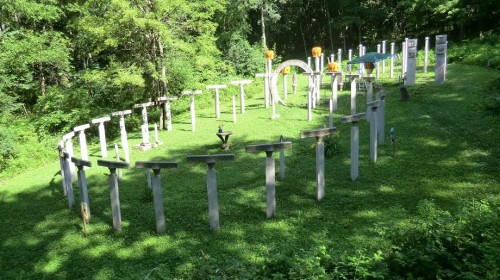
Just over 10 years ago work started on a new Egyptian temple dedicated to the Goddess Hathor. The design for the temple was revealed by the Goddess herself to Tim, a solitary Kemetic Wiccan living in rural Wisconsin. Over the years, Tim worked almost daily to recreate the temple that he saw during his trance. The Wild Hunt talked to him about why he built this temple and how it has affected his worship.


Now nearing completion, the temple consists of an eleven foot entry gate and two circles of cement pillars 11 feet high and weighing two tons each. The inner circle of columns is 33 feet across and consists of 4 pedestal quarter markers with a pair of obelisks equally spaced between the quarters. The obelisks make this a strictly solar temple. The main circle entry is also on the north end, as we enter as earthly beings.The center point of the central table is the point of origin for all measurements used to build the temple. In the west, there will be a Naos shrine with sacred image of Hathor in it. 

The outer circle of pillars are the outer boundary of the temple. The entry ring, the stargate looking structure, is a molded concrete ring 9 feet across on the inside and 11 feet across on the outside. At the end of the semicircular transitional pathway are the massive entry pillars. These pillars are 10 feet tall and over 2 tons each. They are spaced closely so you can stand between them with hands on both to completely ground yourself whether entering or leaving the temple. All structures in the temple have integrally molded foundation posts extending into the ground between 4 and almost 6 feet.

For now, the temple is for private use only, and Tim is still working to finish painting the pillars, images of Hathor, and the capstones, but the goal is to open the temple to the public. For me, this raises the question: if Tim can do it, can we? The temple itself has cost about five thousand dollars total in materials and was built on ground Tim already owned. He's done most of the work himself, it seems, and to great effect! Five thousand dollars is not a lot. Nine years of construction is, though, so in order to cut down on that, more money is most likely required--and ground.

There is a modern Hellenistic temple in Thessaloniki. It can be done. So why haven't more of us done it? Years ago, I had a dream like Tim's, where I saw a temple so clearly. It's still in my mind. I still want to construct it. But I have not found the drive like Tim has. I have invested my energy elsewhere--Elaion, Baring the Aegis--and in my own way I have built my temple. But it's not a structure, and I wouldn't know where to start. So have you ever had a dream like that? Have you ever wondered about if it's possible and how to do it? Have you actually done it? I want to know because our Gods most certainly deserve temples as magnificent as Tim's temple/circle to Hathor!
I'm not very active on Facebook (although I do maintain a page for this blog and moderate for the Elaion Facebook group). For those of you who are, there are great groups available to join, either for all the Hellenic Gods or for a singular one. I would like to share a few of those today. This post is not meant as an exhaustive list; please feel welcome to post other shrines and groups in the comments so I can add them!

Shrines:
The Kantharos [Dionysos] - "This group has been set up to enable and easen communication for those who have tasted the sweet and crimson wine of the god Dionysus himself or are interested in tasting the ecstasy brought to us by him."
Libations for Apollon - "Libations for Apollon is a Hellenic group designed for regular worship practices and theological... discussion of the impact of Apollon in our lives and spiritual experience of the god. This can range anywhere from regular rituals for Apollon Agyeius and Apollon Noumenios that are the core roles of Apollon in the domestic religious life, to greater epithets and roles the god takes."
Shrine of Ares - "This Shrine is dedicated to the Olympian Ares God of War only. Here you can share your Ares Altars, talk about your altars, share photos, prayers, poems, book recommendations etc."
Shrine of Hephaestus - "This Shrine is dedicated to the Olympian Blacksmith Hephaestus only. Here you can share your Hephaestus Altars, talk about your altars, share photos, prayers, poems, book recommendations etc."
Shrine of Poseidon - "This Shrine is dedicated to the Olympian Lord of the Sea, Oceans and Rivers and his Queen Amphitrite and their children. Here you can share your Poseidon Altars, prayers, poems, creative ideas, offering suggestions, book recommendations etc."
Temple of Persephone - "Welcome to the Temple of Persephone, an online community dedicated to the worship and research o...f the Goddess Persephone however you see Her. From the archetypal Daughter at Eleusis, to the great Savior Queen of the Orphics, to the domestic Marriage Goddess of the Locrians, She has many beautiful forms to celebrate."

Groups:
Ancient Greek gods' new believers - The Hellenes still mourn the end of their civilisation in the 4th Century AD, when Christians representing the new official religion of the Roman Empire began destroying their temples, statues and libraries. "We are a legitimate religion and yet they call us pagans".

Elaion - "Elaion is a religious organization committed to re-establishing the ancient Hellenic religion (known as Dodekatheism, Hellenic Reconstructionism, Hellenismos) to its rightful place in society."
Hellenic Pagan - "This is a group for discussion of the religious practices of the ancient Hellenic world as well as modern religious practices that are in some way based on those. We welcome Reconstructionists, Wiccans, and any other pagans who worship the Greek gods in some way, as well as people who are interested in talking about such worship. This list is for polytheists with explorations into the myths, gods, and ancient practices as well as personal experiences. Do you need to be Greek to join us? Not at all: We represent many backgrounds, nationalities, cultures, and ethnicities. We believe that our diversity is one of our strengths, and we welcome you into our mix."

Hellenic Polytheistic Community - "The topic of this group is the Hellenic ethnic religion, its associated history, culture, customs, language, etc. This also encompasses historical syncretisms of the Hellenic ethnic religion and other ethnic religions, as well as "modern" ones, as long as there is a clearly recognizable Hellenic component to it."
"I want to make an offering to Ares but I'm at a loss on what to give Him.... Any ideas on what He might like to be offered?"

I get quite a few questions on how to best honour a certain deity or what to offer Them. I have answered this question before, actually, in relation to Athena and Poseidon. As I said then, the major difference between reconstructive religions and modern ones—especially Pagan ones—is the way worship is conducted. Individual worship of Gods as well as patronage is perfectly acceptable in modern religions, but in Recon religions and the ancient Traditions they were based upon, worship tends to be of the pantheon, not so much the one God or Goddess. Worship was generalized in such a way that multiple Gods and Goddesses were worshipped in one rite—and usually in the same way.

The traditional offerings for the ancient Gods were wine, meat and skins from sacrificed animals, and incense. Pretty much anything else is a modern invention; coins, feathers, statues, etc. etc, are all modern. Yes, there were statues in temples, but they were there to house the presence of the God and to give a focal point to worship. Yes, gifts were given to temples, but as payment for the aid of the priests. Basic, Hellenic worship means pouring wine into a fire, means tossing barley groats and incense into the flames, and depending on how hard-core you go at it, to sacrifice animals or give bought meat to the Gods through flames.

Those of us in Hellenismos who came there from the Pagan community often feel the need to give specified gifts; for Ares, I could imagine decorating shrines with weapons and shields, with the colour red (for blood and war but also love), and other symbolic gifts. This is perfectly fine, of course, but please be aware that this is a modern thought pattern. Even ancient shrines were basic places of worship, decorated mostly with practical tools. Temples were places where riches were collected and stored--usually not even displayed prominently.

To answer this question, the best I can come up with is red, grass-fed meat, frankincense incense and some hymns in His honour. I hope that helps.
I try to keep the blog pretty Hellenic-only, but hey, there are plenty of Pagan and multi-faith initiatives worth the attention of my readers. I'd like to present you with one today: the New Alexandrian Library project is holding a fundraiser for the Gala held at the Between The Worlds Conference on March 7, 2015.


For those unaware, the New Alexandrian Library project aims to serve as a research library, a lending library, a museum, an archive, and as a hub for the preservation and the evolution of pagan culture. Books, periodicals, newsletters, music, media, art works, artifacts, photographs, digital media, etc., are all carefully being cataloged and cross-referenced to ease the work of research and study. The Library--which was completed December 2, 2014--will also work to restore and to preserve rare and damaged documents. They hold periodic fundraisers to finance the project.

Once, the Great Library of Alexandria in Egypt served as the focal point for esoteric knowledge. This project is working to create a library worthy of its namesake. The New Alexandrian Library--once fully up and running--will be a modern, state of the art facility, comparable to the quality of a university library. The New Alexandrian Library will be collecting materials from all religious traditions focusing on their mystical and the spiritual writings. Like the original Alexandrian Library in ancient Egypt, it will be an interfaith crossroads.

Many of the perks of the fundraiser include tickets for the concert, but even if you aren't part of the NAL's Pagan community, supporting this cause is well-worth the effort and money. The NAL is located on 100 acres of Sacred Land at Seelie Court in Georgetown, DE. The facility will be accessible to visiting scholars and is serviced by Philadelphia and Washington, D.C. airports while maintaining a wonderfully secluded atmosphere for serious study.

Should you want to help the project, check out the fundraiser website.
After raising $171,- for the Pagan temple and convent 'Maetreum of Cybele', Pandora's Kharis has elected another Pagan initiative to raise money for. The Pyanepsion 2014 cause for Pandora's Kharis is Pagan news outlet The Wild Hunt.


The Wild Hunt is primary destination for those interested in following news relating and of interest to modern Pagan religions and other minority faiths. Founded by Jason Pitzl-Waters in 2004, The Wild Hunt has grown to become one of the most-visited and popular destinations exploring these topics. Recruited to Patheos.com in the Summer of 2011, The Wild Hunt decided to exist as an independent entity once more in the Summer of 2012. In addition, The Wild Hunt has now expanded into a media outlet with paid contributors and three paid staff members.

Every year, The Wild Hunt organises a Fall Funding Drive, and this year, they are asking for a base budget of $12,500 dollars to run for another year, and are hoping that supporters will help them not only meet this goal, but surpass it and allow them to do even more. $12,500 dollars will allow The Wild hunt to pay their hosting bills for another year, pay their staff, and cover other expenses related to running the website.

The Wild Hunt has a proven track record that stretches over nearly ten years, and over those years they've become an essential news source and inspired many to create their own media. They've interviewed big-name Pagans like Margot Adler and Starhawk, reported on controversies and inspirational moments that have affected our community deeply, and acted as a watchdog when the mainstream media reports on modern Pagans and other minority faith traditions. However, the commitment, time, and energy needed to make this sustainable can only happen if others in the community are willing to step forward and help them fund it.

You can now donate to Pandora's Kharis at baring.the.aegis@gmail.com or by clicking the 'donate' button to the side of the Pandora's Kharis website. Thank you in advance for any amount you can spare. It will matter. The deadline to donate is 24 October, 2014.