Showing posts with label Seneca. Show all posts

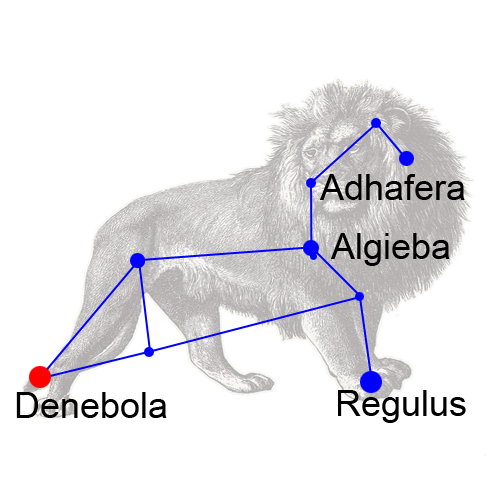
It's been a while since the last constellation! The constellation Leo is one of the most recognizable in the sky, and is obviously one of the constellations tied to the zodiac. Not surprisingly, it is therefor also tied to Hēraklēs.

The lion was considered the King of Beasts by the ancient Hellenic writers. For this reason, Hyginus--our primary source of ancient information on constellations--describes the constellation almost entirely as such, mentioning Hēraklēs in passing only:

"He is said to have been put among the stars because he is considered the king of beasts. Some writers add that Hercules’ first Labor was with him and that he killed him, unarmed. Pisandrus and many others have written about this. " [II.24]

The firs labour of Hēraklēs is, of course, to slay the Nemean lion. You can read about the start of Hēraklēs' life here, but for this constellation, all you need to know is that he was stricken mad by Hera, and killed his wife and children while he was out. As a result, he went on a long journey to cleanse himself of the miasma caused by these killings. First, he visited the oracle at Delphi, who, unbeknownst to him, was whispered to by Hera. The Oracle told Hēraklēs to serve the king of Tiryns, Eurystheus, for ten years and do everything Eurystheus told him to do. Eurystheus gladly provided Hēraklēs with these labors--ten of them, one for each year--and eventually ended up adding two more, resulting in the Twelve Labors of Hēraklēs.

The first of the twelve labours was to slay the Nemean lion. As the lion was terrorizing the area surrounding the mountain, Eurystheus must have seen in the lion a worthy opponent of Hēraklēs, whose tales of bravery and brute strength has proceeded him. He ordered the hero to return with its skin. And so, Hēraklēs went to the cave of the lion after picking up a bow and quiver of arrows, because he was unaware he would not be able to harm the creature with mortal weapons. After a long fight, Hēraklēs eventually chokes the lion, and hails victorious.

The Latin writer Seneca had a beautiful description of the constellation Leo, in the words of our great hero:

"See where the lion, my first toil, glows in no small part of heaven, is all hot with rage, and makes ready his fangs. Forthwith he will seize some star; threatening he stands with gaping jaws, and breathes forth fires, and shakes the mane upon his flaming neck; whatever stars sickly autumn and cold winter with its frozen tracts bring back, with one bound will he o’erleap, and attack and crush the neck of the vernal Bull." [II.942]

I want to add one more thing to he description of this constellation: Hyginus tells another tale about the constellation Leo: the story of Berenikē (Βερενίκη). The name translates to 'bearer of victory', and this version of the story refers to Berenikē II, who lived from about 267 - 221 BC. She was the daughter of Magas of Cyrene and Queen Apama II, and the wife of Ptolemy III, the third ruler of the Ptolemaic dynasty of Egypt. Prior to her marriage to Ptolemy III, she was married to Demetrius the Fair, a Macedonian prince, whom she had killed after he chose to become the lover of her mother Apama. Berenikē was quite the woman, and participated in the Nemean Games even the ancient Olympics. Her own son, Ptolemy IV eventually had her killed, but she was deified and to be honored from that moment on. The following story concerns her, her husband Ptolemy III, and Aphrodite.

"Above his likeness in the sky nearest the Virgin are seven other stars near his tail, arranged in a triangle, which Conon, the mathematician, and Callimachus call the Lock of Berenice. When Ptolemy had married his sister Berenice, daughter of Ptolemy and Arsinoe, and after a few days had set out to attack Asia, Berenice vowed that if Ptolemy returned as victor she would clip off her hair. She placed the lock, consecrated by this vow, in the temple of Venus Arsinoe Zephyritis, but on the following day it couldn’t be seen there. When the king was distressed by this, Conon the mathematician, whom we mentioned above, desiring to win the favor of the king, said that he had seen the lock among the constellations, and pointed out seven stars without definite configuration which he imagined were the lock.

Some authors along with Callimachus have said that this Berenice raised horses, and used to send them to Olympia. Others add that once Ptolemy, Berenice’s father, in panic at the number of the enemy, had sought safety in flight, but his daughter, an accomplished horse woman, leaped on a horse, organized the remaining troops, killed many of the enemy, and put the rest to flight. For this even Callimachus calls her high-souled. Eratosthenes says that she ordered returned to the girls of Lesbos the dowry left to them by their parents, which on one had released, and she established among them right to bring action of recovery."

The constellation Leo is visible at latitudes between +90° and −65°, and best visible at 21:00 (9 p.m.) during the month of April.

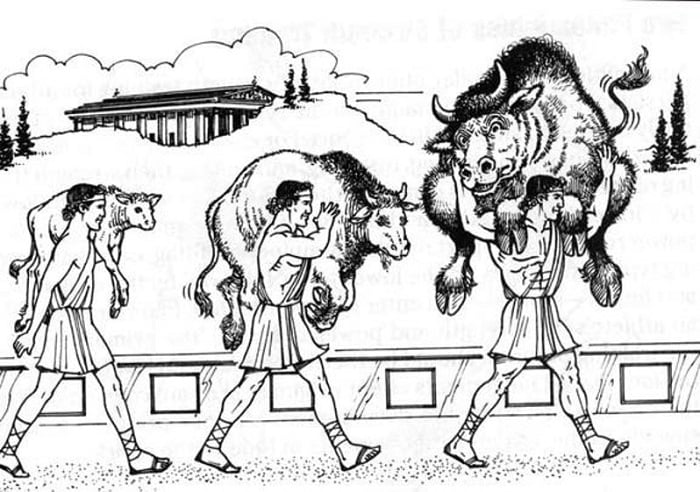
During his childhood (or so goes one legend), the future Olympian wrestler Milo of Croton owned a young calf he used to lift onto his shoulders and carry around for a spell. Milo is said to have done this every single day: as it got bigger, he grew stronger. Four years later, Milo could be seen wandering around with this fully grown pet bull resting on his manly shoulders.


Nearly 2,500 years ago, Milo of Croton was regarded as the strongest person who had ever lived in the known world. A man of incredible strength and athleticism, he taught us the three basic principles of building muscle: Start very light, don’t miss workouts, and increase training in very small increments.

Milo, from Croton in Magna Graecia, today’s southern Italy, was almost certainly the most successful wrestler of his day, becoming six-time wrestling champion at the Ancient Olympic Games. In 540 BC, he won the boys’ wrestling category and then proceeded to win the men’s competition at the next five Olympic Games in a row. He also dominated the Pythian Games (7-time winner), Isthmian Games (10-time winner), and Nemean Games (9-time winner).

Other legends say he carried his own bronze statue to its place at Olympia. One report says the wrestler was able to hold a pomegranate without damaging it while challengers tried to pry his fingers from it, and another report says he could burst a band fastened around his brow by inhaling air and causing his temple veins to swell.

The Ancient Hellenes typically attributed remarkable deaths to famous persons — in keeping with their characters throughout life. The date of Milo’s death is unknown, but according ancient historians, Milo was walking in a forest when he came upon a tree-trunk split with wedges. In what was probably intended as a display of strength, Milo inserted his hands into the cleft to rend the tree. The wedges fell from the cleft, and the tree closed upon his hands, trapping him. Unable to free himself, the wrestler was devoured by wolves.

If you want to be as strong as Milo, here are some anchient work-out tips and tricks. Be on the look-out for wolves, though!

1. Drunk Athletes Still Have to Exercise (Just Not as Strenuously)

Intoxication wouldn’t excuse you from fitness lessons. The Greco-Roman gymnastics guru Philostratus realized that people couldn’t train as effectively while under the influence. Nevertheless, he maintained that tipsy pupils should still complete their regularly scheduled workouts, just with a bit less intensity than usual.

2. Ease Up on the Barley
Denouncing high-carb diets is nothing new; many Roman gladiators bulked up by consuming a dense barley porridge loaded with beans. Claudius Galen—a celebrated Roman physician—believed this made them too flabby for serious combat and criticized the practice.

3. Your Pre-Workout Routine Should Include Lots of Body Oil
Ancient Hellenic sportsmen were known to lather themselves in natural oils before exercising, which gave their bods a distinctive glisten. At the time, scholars claimed that doing so kept athletes from getting cold while toughening their skin.

4. Run Through Sand For Extra Stamina
Anacharsis, a Mediterranean philosopher who spent much of his time traveling through Athens during the 6th century BCE, once wrote a detailed description of how the Hellenes trained their sprinters. “The [practice] running is not done on hard, resistant ground,” he noted, “but in deep sand where it is not easy to plant a foot solidly or get a grip with it since it slips away from underneath the foot.” As an added bonus, these young men were also instructed “to jump over a ditch, if necessary, or some other obstacle carrying lead weights that are as large as they can hold.”

5. Wanna Get Toned? Try Digging.
If your goal is to build chiseled, well-defined muscles without using techniques that involve “violent movement,” the aforementioned Galen recommends digging, rope-climbing, and extending the arms while a workout buddy tries pulling them downwards.

6. Pick Short and Simple Exercises.
Seneca the Younger would’ve been a terrible Phys Ed teacher. The Roman philosopher believed that strenuous exercise was, ultimately, pointless. However, if somebody absolutely had to work out, Seneca favored keeping it quick. “There are short and simple exercises which will tire the body without undue delay,” he conceded, “[such as] running, swinging weights about, and jumping—either high jumping or low jumping… But whatever you do, return from body to mind very soon.”

7. Nobody Likes a Noisy Weightlifter
Say what you will about Seneca, but at least one of his fitness observations was spot-on. The following rant—inspired by an especially obnoxious breed of bodybuilder which frequented Rome’s urban bath-houses—might as well have been written about a present-day gym:

"Conjure up in your imagination all the sounds that make one hate one’s ears. I hear the grunts of musclemen exercising and jerking those heavy weights around; they are working hard, or pretending to. I hear the sharp hissing when they release their pent breath."And the bellyaching didn’t stop there. “Add to this,” Seneca moaned, “the racket of a cocky bastard, a thief caught in the act, and a fellow who likes the sound of his own voice … plus those who plunge into the pool with a huge splash of water.”
The papyrus fragments which are now attributed to Seneca the Elder had been kept for some time among the Herculaneum Papyri in the National Library of Naples. The fragments of the papyrus have survived because the fire that engulfed them during the eruption prevented them from deteriorating. The text belongs to "Historiae ab initio bellorum civilium" by Lucio Anneo Seneca, a work also known as "Oratio in Senatu habita ante principem".


Lucius Annaeus, also known as the Orator, lived between 54 BC and 39 AD, was the father of the famous philosopher Seneca the Younger. Originally from Corduba (Spain), he lived his entire life in Rome until his death in 39 AD.

In the 1700s, 125 Latin papyri were recovered from the excavations of Herculaneum. The papyrus fragment PHerc 1067 was studied by the philologist Valeria Piano, who managed to identify the author of the text.

Preliminary studies had indicated that this was a work of a high standard for the elegance of its writing and form. The first hypothesis, soon after discarded, saw Lucio Manlio Torquato (a politician belonging to Gens Manlia) as the author of the papyrus.

The papyrus is made up of 16 fragments from the same 13-metre-long scroll, which deals with the historical and political subjects of the early years of the principates of Augustus and Tiberius (27 B.C. - 37 A.D.). It was to contain a political speech composed of Lucius Manlius Torquato and delivered in the Senate before the emperor (hence the initial error as to its authorship).

The meticulous study of the philologist was accompanied by the latest technology, in fact, thanks to the help of elaborate microscopes and multispectral images, it was possible to reconstruct the Roman text on computer.

Papyrus PHerc 1067 bears witness to the only direct work by Seneca the Elder, eliminating the long held view that nothing was written by the father of the famous Latin philosopher.
It's been a while since the last constellation! The constellation Leo is one of the most recognizable in the sky, and is obviously one of the constellations tied to the zodiac. Not surprisingly, it is therefor also tied to Hēraklēs.
The lion was considered the King of Beasts by the ancient Hellenic writers. For this reason, Hyginus--our primary source of ancient information on constellations--describes the constellation almost entirely as such, mentioning Hēraklēs in passing only:

"He is said to have been put among the stars because he is considered the king of beasts. Some writers add that Hercules’ first Labor was with him and that he killed him, unarmed. Pisandrus and many others have written about this. " [II.24]

The firs labour of Hēraklēs is, of course, to slay the Nemean lion. You can read about the start of Hēraklēs' life here, but for this constellation, all you need to know is that he was stricken mad by Hera, and killed his wife and children while he was out. As a result, he went on a long journey to cleanse himself of the miasma caused by these killings. First, he visited the oracle at Delphi, who, unbeknownst to him, was whispered to by Hera. The Oracle told Hēraklēs to serve the king of Tiryns, Eurystheus, for ten years and do everything Eurystheus told him to do. Eurystheus gladly provided Hēraklēs with these labors--ten of them, one for each year--and eventually ended up adding two more, resulting in the Twelve Labors of Hēraklēs.

The first of the twelve labours was to slay the Nemean lion. As the lion was terrorizing the area surrounding the mountain, Eurystheus must have seen in the lion a worthy opponent of Hēraklēs, whose tales of bravery and brute strength has proceeded him. He ordered the hero to return with its skin. And so, Hēraklēs went to the cave of the lion after picking up a bow and quiver of arrows, because he was unaware he would not be able to harm the creature with mortal weapons. After a long fight, Hēraklēs eventually chokes the lion, and hails victorious.

The Latin writer Seneca had a beautiful description of the constellation Leo, in the words of our great hero:

"See where the lion, my first toil, glows in no small part of heaven, is all hot with rage, and makes ready his fangs. Forthwith he will seize some star; threatening he stands with gaping jaws, and breathes forth fires, and shakes the mane upon his flaming neck; whatever stars sickly autumn and cold winter with its frozen tracts bring back, with one bound will he o’erleap, and attack and crush the neck of the vernal Bull." [II.942]

I want to add one more thing to he description of this constellation: Hyginus tells another tale about the constellation Leo: the story of Berenikē (Βερενίκη). The name translates to 'bearer of victory', and this version of the story refers to Berenikē II, who lived from about 267 - 221 BC. She was the daughter of Magas of Cyrene and Queen Apama II, and the wife of Ptolemy III, the third ruler of the Ptolemaic dynasty of Egypt. Prior to her marriage to Ptolemy III, she was married to Demetrius the Fair, a Macedonian prince, whom she had killed after he chose to become the lover of her mother Apama. Berenikē was quite the woman, and participated in the Nemean Games even the ancient Olympics. Her own son, Ptolemy IV eventually had her killed, but she was deified and to be honored from that moment on. The following story concerns her, her husband Ptolemy III, and Aphrodite.

"Above his likeness in the sky nearest the Virgin are seven other stars near his tail, arranged in a triangle, which Conon, the mathematician, and Callimachus call the Lock of Berenice. When Ptolemy had married his sister Berenice, daughter of Ptolemy and Arsinoe, and after a few days had set out to attack Asia, Berenice vowed that if Ptolemy returned as victor she would clip off her hair. She placed the lock, consecrated by this vow, in the temple of Venus Arsinoe Zephyritis, but on the following day it couldn’t be seen there. When the king was distressed by this, Conon the mathematician, whom we mentioned above, desiring to win the favor of the king, said that he had seen the lock among the constellations, and pointed out seven stars without definite configuration which he imagined were the lock.

Some authors along with Callimachus have said that this Berenice raised horses, and used to send them to Olympia. Others add that once Ptolemy, Berenice’s father, in panic at the number of the enemy, had sought safety in flight, but his daughter, an accomplished horse woman, leaped on a horse, organized the remaining troops, killed many of the enemy, and put the rest to flight. For this even Callimachus calls her high-souled. Eratosthenes says that she ordered returned to the girls of Lesbos the dowry left to them by their parents, which on one had released, and she established among them right to bring action of recovery."

The constellation Leo is visible at latitudes between +90° and −65°, and best visible at 21:00 (9 p.m.) during the month of April.
Yesterday, I received an e-mail from a frequent reader of Baring the Aegis who had seen my post on the small packages of the ancient statues and the post about taboos where nudity also plays an important role, and had begun to wonder about nudity at large in ancient Hellas, and specifically in a religious setting. They also wondered how I feel about nudity in modern Hellenismos. I would like to share my--slightly edited--reply with the readers of this blog, because others might be wondering about the ancient Hellenic attitude towards nakedness as well.
 
‘Naked’, gymnos, in the ancient Hellenic language has a double meaning: it means both nudity and ‘to go without chiton’, which complicates drawing conclusions from the written word. As such, most of the information gathered on this topic is based upon artwork, with a few exceptions. The ancient Hellenes had a very complicated view of nudity, and I don’t think I did that view justice back in 2012.
 
Before I get to the religious part, I feel I must look at every day life first. I want to start with ancient Hellenic clothing, which varied for males and females, although both only wore one or two rectangular pieces of cloth. Undergarments of any kind were unknown to the ancient Hellenes, and they were thus naked under them. Men throughout the whole of the ancient Hellenic time period wore either a chiton and himation, only a chiton, or only the himation. Socrates is famous for wearing only the latter, and so is Agesilaus, King of Sparta, and Phocion, who Plutarch joked about in ‘Phocion’, saying: 
 
“His countenance was so composed that scarcely was he ever seen by any Athenian either laughing or in tears. He was rarely known, so Duris has recorded, to appear in the public baths, or was observed with his hand exposed outside his cloak, when he wore one. Abroad, and in the camp, he was so hardy in going always thin clad and barefoot, except in a time of excessive and intolerable cold, that the soldiers used to say in merriment, that it was like to be a hard winter when Phocion wore his coat.“
 
There were very strict social rules about what was considered proper and improper for men when wearing only one of the two layers of clothing, and even when wearing both. Under no circumstances was the clothing to slide up above the knee during social affairs. It seems that any setting where nudity was not required--something we will come to below--nudity was forbidden quite strictly. Partial exposure like that was considered not only improper but irreverent, again, something I must explain later.
 
Women, whose style of clothing varied greatly throughout the ancient Hellenic time period, had to hold fast to different social rules concerning nudity. Statues and frescos show that in very archaic Knossos, for example, highly placed women wore garments which proudly exposed their breasts. When this style faded, others took its place. For their clothing, women in ancient Hellas often wore translucent materials, which left very little to the imagination. Many ancient writers, including Lucian, Petronius, and Seneca write about this, Seneca most tellingly:
 
“I see silk clothes, if they can be called clothes, which can protect neither the body nor the modesty.” [De Beneficiis, 7.9.5.]
 
It seems that women, while not nude, displayed a nakedness in the streets that was completely accepted. The social rules concerning these displays of the body depended on the intent of the nudity: either natural or erotic. Erotic nudity had no function in public, and was heavily frowned upon. Natural nakedness went accepted. For ancient Hellenic men, a woman’s girdle holding in place her dress was much more erotic than seeing her breasts through the thin fabric of her clothing.
 
Public nudity was not originally an Hellenic custom, but became one. From Thucydides’ ‘History of the Peloponnesian War’: 
 
“The Athenians were the first to lay aside their weapons, and to adopt an easier and more luxurious mode of life; indeed, it is only lately that their rich old men left off the luxury of wearing undergarments of linen, and fastening a knot of their hair with a tie of golden grasshoppers, a fashion which spread to their Ionian kindred and long prevailed among the old men there. On the contrary, a modest style of dressing, more in conformity with modern ideas, was first adopted by the Lacedaemonians, the rich doing their best to assimilate their way of life to that of the common people. They also set the example of contending naked, publicly stripping and anointing themselves with oil in their gymnastic exercises. Formerly, even in the Olympic contests, the athletes who contended wore belts across their middles; and it is but a few years since that the practice ceased. To this day among some of the barbarians, especially in Asia, when prizes for boxing and wrestling are offered, belts are worn by the combatants. And there are many other points in which a likeness might be shown between the life of the Hellenic world of old and the barbarian of to-day.“ [1.6]
 
Sports were a frequent platform of nudity: not only did males (and in Sparta and a few other choice city-states, females) who studied at the gymnasium practice sports and even their classes in the nude, there is evidence to support that the two genders did not hide their bodies from each other when women were permitted, and even that they wrestled each other while naked, showing that this type of nakedness was considered completely natural and accepted. Athenaeus records a Spartan custom of this, saying
 
“The fashion, too, of Sparta is much praised, I mean that of displaying their maidens naked to their guests; and in the island of Chios it is a beautiful sight to go to the gymnasia and the race-courses, and to see the young men wrestling naked with the maidens, who are also naked.” [13, 566e]

Sporting competitions were always in the nude. It seems that in antiquity, the athletes did wear something to hide their nether regions, but when this covering slipped off of a sprinter, and he tripped and fell to his death, any type of covering was forbidden. Married women, in most city states, (interestingly enough) were not allowed to watch sporting events, not even the major ones like to Olympics, although testimony Pindar (in Pythia) hints at the possibility that the Hellenic city-state of Cyrene allowed married women to watch. Maidens were more often allowed to view the games. Scholars pose that the distinction between maiden and married is made purely aesthetically: the ancient Hellenes valued beauty very much, and maidens were considered beautiful. They were virtuous and thus desirable. Married women were not to be seen as desirous; they were married.
 
Before I come to the religious part of this longwinded tale, I must address two more points: bathing and the ancient Hellenic practice to either be completely dressed, or completely naked. Bathing, in ancient Hellas, had quite an interesting set of social rules attached to it, especially before the Peloponnesian war. ’Baths’, when referred to in ancient texts, unless otherwise specified, nearly always alluded to bathing in hot or warm water, as many bathing house offered. at least until the previously mentioned war, bathing in warm water was  considered taboo for men. Warm water was for women; men were supposed to be a heartier breed and thus bathed in cold water. Aristophanes, in Clouds, forbids men from entering the baths, because they are baneful and effeminizing. From the writings of Plato, Demothenes, and Plutarch, we can see that this view was quite widespread (see Plutarch on Phocion above).
 
For my last point before I get to religion, it must be said that the ancient Hellenes felt no shame about their body, quite the opposite, in fact. The ancient Hellenes took great pride in beauty, and displayed their bodies proudly. Especially young males were considered pleasing, as described in my post about the small packages of statues. Sexual organs of both sexes were considered not only natural, but sacred. Aidos (Αἰδώς) is a term (and Goddess) interpreted often as ‘shame’ or ‘modesty’, and linked to he displaying of a person’s genitals, but the term can also mean ‘awe’ and ‘reverence’. The ancient Hellenes were well aware that their sexual organs--when brought together in an intimate setting--produced children. As such, these body parts were treated with an almost religious reverence as the mystical tools of propagation. These instruments produced life, something definitely awe inspiring. This is also how the phallus became a religious symbol; it represents the inexhaustible fruitfulness of human nature and the gratitude that came with this understanding.
 
Because sexual organs were considered somewhat sacred, covering them up--especially when otherwise naked--was considered impious, and so any socially acceptable situation where clothes were deemed cumbersome, unnecessary or impossible led to a state of complete nakedness. The ancient Hellenes took great pride in this fact, and to cover up one’s groin was considered barbaric. As Herodotos puts it so beautifully in his ‘Histories’:
 
“For among the Lydians, and indeed among the barbarians generally, it is reckoned a deep disgrace, even to a man, to be seen naked. ” [1, 7-11]
 
To conclude, nudity was generally accepted by the ancient Hellenes, although social rules had to be observed. Women rarely went completely uncovered in every day life, but displayed their bodies through their clothing. Men could cast off their clothing more readily. If either gender undressed, it was seen as irreverent to do so partly, and thus they appeared either fully clothed or naked. Partial nudity was frowned upon in almost all social settings, while full nudity was often accepted.
 
Now, as for religious worship: there are definitely some instances where complete nudity became required. In other festivals, I would assume--based on the above--that nudity was allowed, if the person went completely uncovered. A few examples of rituals where we know nudity was included:
 
  • The young maidens who ‘played the bear’ to Artemis at the Brauronia are depicted naked at various stages of the ritual
  • Athenaeus describes a 'naked-boy dance' in relation to the cult of Dionysos:  “The naked-boy-dance is like what is called the anapale among the ancients. For all the boys who dance it are naked, performing certain rhythmical movements and describing certain positions with the arms gently, so as to represent certain scenes in the wrestling-school during a wrestling-and-boxing match, but moving the feet in time to the music. Variations of it are the Oschophoric and the Bacchic, so that this dance also is traceable to the worship of Dionysus. Aristoxenus says that the ancients, practicing first the naked-boy-dance, proceeded into the pyrriche before entering the theatre.”
  • Arisophanes in ‘Clouds’ hints at this type of dance being performed during the Panathenaea as well: “But you, you teach the children of to-day to bundle themselves quickly into their clothes, and I am enraged when I see them at the Panathenaea forgetting Athene while they dance, and covering their tools with their bucklers.”
  • Stabo recorded the following example of public nudity at Acharaca in ancient Hellas:  “On the road between Tralles and Nysa is a village of the Nysaeans, not far from the city Acharaca, in which is the Plutonium, to which is attached a large grove, a temple of Pluto and Proserpine, and the Charonium, a cave which overhangs the grove, and possesses some singular physical properties. The sick, it is said, who have confidence in the cures performed by these deities, resort thither, and live in the village near the cave, among experienced priests, who sleep at night in the open air, on behoof of the sick, and direct the modes of cure by their dreams. The priests invoke the gods to cure the sick, and frequently take them into the cave, where, as in a den, they are placed to remain in quiet without food for several days. Sometimes the sick themselves observe their own dreams, but apply to these persons, in their character of priests and guardians of the mysteries, to interpret them, and to counsel what is to be done. To others the place is interdicted and fatal.
    An annual festival, to which there is a general resort, is celebrated at Acharaca, and at that time particularly are to be seen and heard those who frequent it, conversing about cures performed there. During this feast the young men of the gymnasium, and the ephebi, naked and anointed with oil, carry off a bull by stealth at midnight, and hurry it away into the cave. It is then let loose, and after proceeding a short distance falls down and expires.”
  • Vase paintings and frescos of Dionysios’ festivals often have men and women dancing naked.
  • I’m sure I have read somewhere that Aphrodite’s worship was also sometimes conducted naked, but I simply can not find the reference again.
 
Nudity was a part of ancient Hellenic religion, but not often a requirement. In most cases, clothes were cot considered a burden, so they remained on. In the case of Dionysian worship, clothes would hinder the ecstatic dances usually tied to them, so clothes were discarded. Functional nudity. That said, I have not found any references to festivals where public nudity was expressly forbidden.
 
I come from a Neo-Pagan background and was quite accustomed to performing rituals in the nude. It was a big shift to go to clothed ritual for me, but it does seem fitting somehow. The ancient Hellenic viewpoint of functional nudity seems practical and a good standard to uphold. That said, I am not against nudity in Hellenic ritual at all, if agreed upon by all participants and the occasion warrants it.
 
If you have a question for me, please, do not hesitate to contact me at the gmail address 'baring.the.aegis'.
At the end of last year, I wrote a long and detailed post about the Hellenic Underworld. In it, I mentioned the judges of the dead: Minos, Rhadamanthys and Aiakos. All three of the judges were human once, and all three were selected for certain unique qualities. As these three are some of the most powerful demi-Gods who will ever touch our lives, I want to discuss them further today.


Thanks to the ancient writers, we know quite well who the judges are and why they were appointed to the position. From Plato's Gorgias comes this long but very clear description:
 
"Now in the time of Kronos there was a law concerning mankind, and it holds to this very day amongst the gods, that every man who has passed a just and holy life departs after his decease to the Isles of the Blest, and dwells in all happiness apart from ill; but whoever has lived unjustly and impiously goes to the dungeon of requital and penance which, you know, they call Tartaros. Of these men there were judges in Kronos' time, and still of late in the reign of Zeus--living men to judge the living upon the day when each was to breathe his last; and thus the cases were being decided amiss.
So Plouton [Haides] and the overseers from the Isles of the Blest came before Zeus with the report that they found men passing over to either abode undeserving.
 
Then spake Zeus: 'Nay,' said he, 'I will put a stop to these proceedings. The cases are now indeed judged ill and it is because they who are on trial are tried in their clothing, for they are tried alive. Now many,' said he, `who have wicked souls are clad in fair bodies and ancestry and wealth, and at their judgment appear many witnesses to testify that their lives have been just. Now, the judges are confounded not only by their evidence but at the same time by being clothed themselves while they sit in judgment, having their own soul muffled in the veil of eyes and ears and the whole body. Thus all these are a hindrance to them, their own habiliments no less than those of the judged.
 
Well, first of all,' he said, 'we must put a stop to their foreknowledge of their death; for this they at present foreknow. However, Prometheus has already been given the word to stop this in them. Next they must be stripped bare of all those things before they are tried; for they must stand their trial dead. Their judge also must be naked, dead, beholding with very soul the very soul of each immediately upon his death, bereft of all his kin and having left behind on earth all that fine array, to the end that the judgment may be just.
 
Now I, knowing all this before you, have appointed sons of my own to be judges; two from Asia, Minos and Rhadamanthus, and one from Europe, Aiakos. These, when their life is ended, shall give judgment in the meadow at the dividing of the road, whence are the two ways leading, one to the Isles of the Blest, and the other to Tartaros. And those who come from Asia shall Rhadamanthys try, and those from Europe, Aiakos; and to Minos I will give the privilege of the final decision, if the other two be in any doubt; that the judgment upon this journey of mankind may be supremely just." 

And so we have three judges, Rhadamanthys for those from Asia Minor, Aiakos for those from Europe, and Minos to make the final decision. And so the question remains, who are these three, and why were they worthy enough to become a judge of the dead?

Minos (Μίνως) was a king of Krete, son of Zeus and Europa. He is most famous for the labyrinth of the Minotaur under his fantastic palace where Daidalos and Íkaros were kept until their escape. He died in pursued of them, killed while taking a bath--either by Daidalos, or by the daughters of King Kokalus with whom Minos was staying. How can a man as cruel as Minos become a fair judge of the dead? Plutarch, in Perseus, says the following about it:

"Hesiod called him [Minos] 'most royal,' or that Homer styled him 'a confidant of Zeus,' but the tragic poets prevailed, and from platform and stage showered obloquy down upon him, as a man of cruelty and violence. And yet they say that Minos was a king and lawgiver, and that Rhadamanthys was a judge under him, and a guardian of the principles of justice defined by him."

Rhadamanthys (Ραδαμανθυς) was Minos' brother in most versions of mythology, although he could also have been the son of Hēphaistos. During his life, he was a lawmaker, judge and ruler in the court of Minos. In some versions of the myth, he was Ariadne's husband, instead of Dionysos. It seems Minos may have been jealous of Rhadamanthys' popularity, and Rhadamanthys was forced to flee the island of Krete. During his exile, he met and married Alkmene, mother of Hēraklēs, who had been left without a husband after Amhitryon passed. After his death, he went to Elysium, and became a judge, as a reward for living a just and lawful life. From Pindar's Olympian Ode comes the following praise:

"Those [of the dead] who had good courage, three times on either side of death, to keep their hearts untarnished of all wrong, these travel along the road of Zeus to Kronos’ tower. There round the Islands of the Blest, the winds of Okeanos play, and golden blossoms burn, some nursed upon the waters, others on land on glorious trees; and woven on their hands are wreaths enchained and flowering crowns, under the just decrees of Rhadamanthys, who has his seat at the right hand of the great father [Kronos], Rhea’s husband, goddess who holds the throne highest of all." [2.63]

Aiakos (Αἰακός) was the son of Zeus and Aegina, a daughter of the river-god Asopus. He was born on the island of Oenopia--later renamed Aegina--to which Aegina had been carried by Zeus to secure her from the anger of her parents. Aiakos is also sometimes mentioned as a son of Europa. While he reigned in Aegina, he was renowned in all of Hellas for his justice and piety, and was frequently called upon to settle disputes not only among men, but even among the gods themselves. After his death, Aiakos became one of the three judges in Hades, and according to Plato especially for the shades of Europeans. Apollodorus in his Bibliotheca describes Aiakos:

"Aiakos was the most religious of all men . . . and Aiakos, even after death, is honoured in the company of Plouton [Haides], and has charge of the keys of Haides’ realm."

And so, these are the three judges who rule over us in death. Let me end this with a little Hellenic advice, noted down by Seneca, Roman Stoic philosopher and playwright, from his tragedy 'Hercules Furens':

"Is the report true that in the underworld justice, though tardy, is meted out, and that guilty souls who have forgot their crimes suffer due punishment? Who is that lord of truth, that arbiter of justice? Not one inquisitor alone sits on the high judgment-seat and allots his tardy sentences to trembling culprits. In yonder court they pass to Cretan Minos’ presence, in that to Rhadamanthus’, here [Aiakos] the father of Thetis’ spouse gives audience. What each has done, he suffers; upon its author the crime comes back, and the guilty soul is crushed by its own form of guilt. I have seen bloody chiefs immured in prison; the insolent tyrant’s back torn by plebeian hands. He who reigns mildly and, though lord of life, keeps guiltless hands, who mercifully and without bloodshed rules his realm, checking his own spirit, he shall traverse long stretches of happy life and at last gain the skies, or else in bliss reach Elysium’s joyful land and sit in judgment there. Abstain from human blood, all ye who rule: with heavier punishment your sins are judged." [2.731]