Showing posts with label Odysseia. Show all posts

An invocation is a request for the spiritual presence and blessing of a deity during a rite. To invoke is to call upon earnestly, so an “invocation” in the context of prayer is a serious, intentional calling upon a God or Goddess. In Hellenic ritual, it's common for prayers of invocation to be offered every time a new deity is invoked, so we can be sure They will the hymns and prayers of petition offered to Them. Invocations fit into the rite like so:


- Lighting of the incense burner with frankincense
- Invocation to Demeter: Khaire Demeter, you who taught us to work the earth and provides for us so bountifully…
- Libation of a kykeon and sacrifices
- Orphic Hymn 40 To Eleusinian Demeter
- Prayers

A few days ago, I put up a list of invocations from the Iliad. People seemed to like it, so let's do another one today: from the Odysseia, because that is the logical step! The Odyssey (Ὀδύσσεια) is, in part, a sequel to the Iliad, the other work ascribed to Homeros. The Odyssey was composed near the end of the 8th century BC and focuses mainly on the hero Odysseus, king of Ithaca, and his journey home after the fall of Troy. It takes Odysseus ten years to reach Ithaca. In his absence, it is assumed Odysseus has died, and his wife Penelope and son Telemachus must deal with a group of unruly suitors, who compete for Penelope's hand in marriage. Needless to say, Odysseus keeps his lady love! There aren't as many invocation in this story as most of the characters tell their story themselves, but there are a few.

Artemis:
"Great Goddess Artemis, daughter of Zeus..."

Athena:
"Hear me, daughter of Aegis-bearing Zeus, unweariable..."

Eos:
"Rosy-fingered Eos, child of morning..."

Poseidon:
"O thou that encirclest the earth, vouchsafe to grant the prayers of thy servants that call upon thee..."

Themis:
"I pray you by Themis, who is the beginning and the end of councils..."

Zeus:
"Hear me, O King..."
"Father Zeus, and all you other gods who live in everlasting bliss..."
"Father Zeus, you who rule over heaven and earth, you have thundered from a clear sky without so much as a cloud in it, and this means something for somebody; grant the prayer, then, of me your poor servant who calls upon you..."

 The beautiful thing about our religion is that not only do we have a clear way to honor the Theoi, and incentive to do so, we also get to live in a world governed completely by the Theoi. Hellenismos is special in that regards because it also largely matches up with science. To me--and many others with me--that is something very comforting. Now, as you are probably all aware, I live in a world full of Gods and Nymphs; for example, I take great strength in greeting Eos each morning as she paves the way for Helios, but there are many Gods who are, or who control, the cycle of day and night, and I would like to write out this cycle, if I may.


For all things geneological, I will always turn to Hesiod first. In his 'Theogony', he speaks of the birth of the Dawn, Sun and Moon:

"And Theia was subject in love to Hyperion and bare great Helios, and clear Selene, and Eos." [177]

Diodorus Siculus, in his 'Library of History' shares this world vieuw and moves a (pseudo-scientific) step beyond it:

"Of Hyperion we are told that he was the first to understand, by diligent attention and observation, the movement of both the sun and the moon and the other stars, and the seasons as well, in that they are caused by these bodies, and to make these facts known to others; and that for this reason he was called the father of these bodies, since he had begotten, so to speak, the speculation about them and their nature." [5.67.1]

Hyperion (Ὑπερίων), meaning 'The High-One', was a Titanes God born from Gaea and Ouranos. Theia and Euryphaessa (as mentioned in, for example, the Homeric Hymns) are generally regarded as the same Deathless woman: 'Theia' is the Hellenic word for 'Goddess', so it was likely 'Theia Euryphaessa' translated to 'Goddess Euryphaessa'. This means that the family tree is as follows:

     Khaos ------------ Gaea
         |         |
   Ouranos --- |
                       Hyperion --- Euryphaessa
                   |
                  Eos - Helios - Selene

The three of them--put into motion by Hyperion--form the basic cycle of these planets associated with specific times of day. Yet, the ancient Hellenes saw Night and Day as quite seperate from the heavenly bodies that are associated with them today. I have spoken before of the Protogenoi, and how They--contrary to the Olympians--are actually of the world; They, together, form the tapistry of earth and life. They literally make up our universe. As such, the further towards the Big Bang you go, the more abstract the Theoi become; They take on large, mostly unformed, chunks of the material that makes up our world and the further away you go from Khaos, the more specialized the Gods become--as well as numerous.

As such, starting this explination with Hyperion is actually incorrect--I should have started with Khaos itself, but if not there, than at least with Nyx, who is the deep Night, and Her daughter Hêmera (Ἡμερα), who is the Protogenos of the Day and the sister-wife of Aither (Light). In Hellenic mythology, Nyx draws a veil of darkness between the shining atmosphere of the aither and the lower air of earth (aer) at set times in the day, bringing night to man. In the morning, Hêmera removes this veil, and exposed the Earth once more to Light. As Hesiod writes in the Theogony:

"[At the ends of the earth, where lie the roots of earth, sea, Tartaros :] There stands the awful home of murky Nyx wrapped in dark clouds. In front of it [Atlas] the son of Iapetos stands immovably upholding the wide heaven upon his head and unwearying hands, where Nyx and Hemera draw near and greet one another as they pass the great threshold of bronze: and while the one is about to go down into the house, the other comes out at the door. And the house never holds them both within; but always one is without the house passing over the earth, while the other stays at home and waits until the time for her journeying come; and the one holds all-seeing light (phaos) for them on earth." [744]

Once we reach AD times, Hêmera is often identified with Eos, but in centuries prior, she was very much Her own Goddess, and Hêmera was as well. Hómēros, for example, in the 'Odysseia' writes: 

"The ship [of Odysseus] in due course left the waters of the river Okeanos and reached the waves of the spacious sea and the island of Aiaia; it is there [Okeanos] that Eos the early-comer (Erigeneia) has her dwelling place and her dancing grounds, and the sun himself has his risings. We came came in; we beached our vessel upon the sands and disembarked upon the sea-shore; there we fell fast asleep, awaiting ethereal Dawn." [12.1]

So, to recapitulate: Nyx and Hêmera continually work to both create and dissolve darkness on Earth; Selene moves with Nyx, and Helios with Hêmera, as heralded by Eos. In this recap, it is quite obvious we are yet missing a speciffic time of the day: dusk, or the evening. This was in the domain of the Nymphs, in this case the Hesperides (Ἑσπεριδες), who--depending of source--are either the daughters of Nyx or Atlas. Diodorus Siculus, in the 1st Century BC., wrote in his 'Library of History': 

"Now Hesperos (Evening) begat a daughter named Hesperis (Evening), who he gave in marriage to his brother [Atlas] and after whom the land was given the name Hesperitis; and Atlas begat by her seven daughters, who were named after their father Atlantides, and after their mother Hesperides." [4. 26. 2]

Yet, older sources agree that the Hesperides were born from Nyx; Hesiod, for example:

"And Nyx (Night) bare hateful Moros (Doom) and black Ker (Violent Death) and Thanatos (Death), and she bare Hypnos (Sleep) and the tribe of Oneiroi (Dreams). And again the goddess murky Nyx, though she lay with none, bare Momos (Blame) and painful Oizys (Misery), and the Hesperides who guard the rich, golden apples and the trees bearing fruit beyond glorious Okeanos."

Of course, there are more Gods--motly Titans--who are in some way connected to the cycle of night and day, but these are the most important ones and it's quite a hand full already. So perhaps next time when you awake, you will think of Hêmera, and rosy Eos, and when the sun is high in the sky, you will think of Him as well, and when you look upon the Moon before going to bed, you will give honors to Selene and Nyx, who holds Her and Gaea in Her embrace. Our Gods are everywhere; you only have to be aware of Them to notice.

 I get a lot of questions from readers, and most of the time, the answers are fairly short. When I feel the question or the reply would be valuable to others as well, I make a post with a collection of them and post them in one go. Today is one of those posts.


"Regarding the overhaul to the setup of the blog: I only have one item that I'm concerned about, and that's the fact that all posts appear to be undated now. I liked having dates, as it makes it easier to cite entries on this blog as sources for academic purposes. Can we have the dates back, please? :)"

So, I hadn't even noticed that! Thank you for pointing it out! It's back now, in the bottom beam, next to the share buttons, above the labels. I'm still tweaking things, by the way, on the new lay-out. Nothing major but still. If you notice something amiss or missing, let me know!


***

"I was curious if there was a specific reason that milk wasn't drunk by the Ancient Greeks?"

Mostly, the ancient Hellenes considered anything their non-Greek speaking neigbours did 'barbaric'--and their neighboors drank milk. Peasants drank milk--because hey, precious food--but most likely they used most of the milk they got from their sheep, cows, and goats to make cheese. It's an old custom to link milk to barbarism, by the way. It's already in Hómēros' 'Odysseia' in which the cyclops that tried to eat Odysseus and his crew drank milk:

"He curdled half the milk and set it aside in wicker strainers, but the other half he poured into bowls that he might drink it for his supper." [IX]

This observation follows after it's minutely detailed how the crew ate only cheese and sacrificed only cheese as well. Speaking of sacrifice: milk was also an oft-given gift to the dead. We, generally speaking, avoid eating things we associate with the dead to avoid miasma. So cheese is fine, yoghurt is fine, but milk is not.


***

"Can I be a Hellenic Polytheist if I worship just a few Olympian gods, and two of them aren't Zeus and Hera? I mean... I don't want to be disrespectful to any of the Theoi, is just that I don't feel a connection with the 12 (and Poseidon kind of scares me) but if worship all the Olympians is the 'right' thing to do, I will do it the best I could. Sorry if my doubts are dumb, i'm new in this."

There are no dumb questions, I promise. Okay, so, short answer: yes, technically, you can be an Hellenic Polytheist as long as you worship more than one Hellenic God. 'Recon' is out but 'Polytheist' would still work. This is technically. Personally, I feel anyone who wishes to call themselves an Hellenic Polytheist needs to understand that the Theoi come as a package deal, a family, a world ecompassing whole that cannot function if a piece is missing.

Roughly divided, all our Gods and heroes (who were often raised up to become Gods in their own right) fit into five generational categories. These are the:
  • Protogenoi
  • Uranides
  • Titanes
  • Olympic Gods
  • Heroes/deified mortals
The Protogenoi are the Gods from which the universe is made. They are Gods like Khaos, Gaia, Ouranos, and Nyx. In general, these Theoi are more abstract and less defined than, say, the Olympians. They are cruder, more powerful Gods who, together, form the tapistry of earth and life. We simply could not live without Them as They are the air we breath, the earth we walk on, the water we drink and the death that eventually lays us to rest. and yet, neither we, nor the ancient Hellenes revered them often. They are distant and hav very little to do with the individual's lifecycle.

The Uranides formed the world created by the Protogenoi into the world we know now. They are the children of the Protogenoi and They are in charge of  more specific domains. They give us the constellations, intellect, light, memory, navigation, and many other things without which we simply would not be able to live the life we live. Like the Protogenoi, these Gods make up the tapestry of the universe and did not recieve much direct worship in state festivals.

The Titanes are Gods with whom we are more familiar. They are Helios, Hekate, Lêtô, Selênê and many others. This is the first generation of Gods we are more familiar with by name than function--and also the first generation whose names don't always directly relate to the domains they are familiar with, although we know them through mythology. Lêtô, for example, is identified as the Goddess of motherhood and protectress of the young while we mostly know her as mother of Apollon and Artemis. These Gods often times--but not always--recieved individual worship and were sometimes included in state festivals. They feature in mythology and possess well-rounded personalities that we know (unlike, say, the Protogenoi).

We all know the Olympic Gods. They are the Gods we worship most. They are also the sole 'generation' of Gods who span two generations: they are the children of the Uranides (like the Titanes), and the children of the Olympians. Zeus and His brothers and sisters for example, were born from Rhea and Kronos (both Uranides), but Their children (Hēphaistos, Artemis, Apollon, etc.) are also counted amongst the Olympians. In general, if a Gods is said to reside on Mount Olympos, They are known as an Olympic God. Alternatively--or perhaps erroneously--the Olpmpic Gods are interpreted to be solely the Dodekatheon, the Twelve Olympians who ruled over humanity and the Gods from the top of the mountain. The most canonical version of the Dodekatheon is: Aphrodite, Apollon, Ares, Artemis, Athena, Demeter, Hēphaistos, Hera, Hermes, Hestia, Poseidon, and Zeus. Theoi who were held in high regard in a certain city-state would have held the thrones, according to the people who lived in that city-state, and many different Gods have been counted amongst the Dodekatheon over the centuries. Needless to say, most (state) worship in ancient times focussed on the Olympians.

The heroes of Hellenismos recieve(d) quite a bit of worship. Many heroes were local ones, but we have all heard of Hēraklēs, of Perseus and Theseus, of Atalanta and Odysseus. These heroes represent the most powerful, most virtuoes of all humans and teach us the qualities the Theoi enjoy seeing in us. Many of these heroes were fathered (and sometimes mothered) by the divine and they are thus part of the divine line. In fact, the heroes can be counted amongst the Olympians.

While the main body of our worship focusses on the Olympians, the Olympians did not come to power in a vacuum. The Old Gods presided over the building blocks of the previous generation, like the Olypmians preside over the building blocks of all three. Looking over the list, it's easy to trace the domains of the Olympians back to their predecessors--or even the God or Goddess They hold sway over directly. While the Olympian generation of Gods rule our daily lives, They operate in the framework of the Titans, the Uranides and the Protogenoi. These intricate lines built a web that is of vital importance to see in order to understand not only Hellenic mythology but also the Gods themselves.
Hellenic Recons (and a portion of Hellenic Polytheists) are aware of these generations and they can trace familial lines of influence down through the generations of the Gods. They understand that all Gods play a vital role in the tapestry of the world and that they need to be revered alongside Their brothers, sisters, parents, and sometimes even Their children.

Seeing the Gods as separate from each other like we often do in modern Paganism would not even have occurred to the ancient Hellenes. They did not see themselves separate from their spouse, their children, their parents, their cousins, etc., so why would they think of the Gods that way?

That said, not every God needs to be worshipped daily. The cycle of festivals provided enough moments to honour all major Gods throughout the year, after all. every household focussed on those Gods that were inportant to their family, either through (percieved) geneology, experience, or practical matters like making a living. A soldier would pay regular homage to Ares and Athena, a blacksmith to Hephaistos, and so on. But even if they only paid homage to Asklepios during His festivals, they would go to His temple to pray in case someone fell ill. If a sea voyage was in the cards, the family would pay tribute to Poseidoneven if they never sacrificed to Him during household worship.

I don't know if the ancient Hellenes thought any Ouranic God was frightening. I doubt it. All of the Gods were revered with respect and proper etiuette so as not to upset Them. That's simply good form when drawing the attention of someone a lot more powerful than you onto yourself.

So, that's the long answer: yes, you can, but I can't think of a reason why you would want to if you truly wish to commit to the ancient Hellenic Gods.


Polyphemus (Πολύφημος Polyphēmos) is the giant son of Poseidon and Thoosa in Hellenic mythology, one of the Cyclopes described in Homeros's Odyssey. His name means "abounding in songs and legends".

In Homeros's epic, Odysseus lands on the island of the Cyclops during his journey home from the Trojan War and, together with some of his men, enters a cave filled with provisions. When the giant Polyphemus returns home with his flocks, he blocks the entrance with a great stone and, scoffing at the usual custom of hospitality, eats two of the men. Next morning, the giant kills and eats two more and leaves the cave to graze his sheep.

After the giant returns in the evening and eats two more of the men, Odysseus offers Polyphemus some strong and undiluted wine given to him earlier on his journey. Drunk and unwary, the giant asks Odysseus his name, promising him a guest-gift if he answers. Odysseus tells him "Οὖτις", which means "nobody" and Polyphemus promises to eat this "Nobody" last of all. With that, he falls into a drunken sleep. Odysseus had meanwhile hardened a wooden stake in the fire and drives it into Polyphemus' eye. When Polyphemus shouts for help from his fellow giants, saying that "Nobody" has hurt him, they think Polyphemus is being afflicted by divine power and recommend prayer as the answer.

In the morning, the blind Cyclops lets the sheep out to graze, feeling their backs to ensure that the men are not escaping. However, Odysseus and his men have tied themselves to the undersides of the animals and so get away. As he sails off with his men, Odysseus boastfully reveals his real name, an act of hubris that was to cause problems for him later. Polyphemus prays to his father, Poseidon, for revenge and casts huge rocks towards the ship, which Odysseus barely escapes.

I came across the above artwork yesterday and it broke my heart to see the gentleness of the giant knowing his fate. So, today's post is in honor of Polyphemus. Your life would have been much better if a certain stray hero hadn't set foot on your island.

“Oh gentle ram, why do you come from the cave behind the rest of the flock? You never before tarried behind the other skeep, but striding far before the others you snatched the mild blossoms, you came first to the banks of the rivers, and you ever desired first to return home in the evening. But now you are last by far. Are you worried about my eye, which that rotten bastard Noone and his awful friends took from me after wrecking my mind with wine – I do not say that he has escaped death. Would that you could be of one mind with me, and could tell me where that man has fled from my wrath. Once slain, his brain would drip through my cave here and there to the ground, and it would ease my heart from those troubles which that worthless bastard Noone gave me.”
(Odyssey 9.446-460)

Post settings Labels Polyphemus,Mythology 101,Odysseia,ancient Hellenic culture,Hómēros,Odysseus, No matching suggestions Published on 21/05/2018 09:00 Permalink Location Options

 It had been a long journey. Hermes had kept him safe through most of it, so he was not mugged, nor killed. His feet hurt from his blisters as he walked the final steps into the temple. He had arrived four days ago and was housed in one of the guesthouses by the priests of Delphi. He was asked to wait with the other petitioners until the Oracle was ready to receive him. He was lucky; he had only had to wait four days. Others had been here for weeks. 


He had been relieved of his gifts and offerings to the Oracle as soon as he walked through the gates. Four long days had passed and now he entered the dark temple, lit only by a couple of torches lining the wall. He was led deeper into the complex by a silent priest and he wondered if it was the same one who had greeted him at the gate. His thoughts halted as he laid eyes on Pythia; the Oracle.

She was younger than he had expected, in her early thirties, perhaps, and seated on a three legged stool, flanked by two priests. She swayed slightly, inhaling the fumes of laurel and barley, which hung heavily in the air. He held back a cough and waited when the priest who had led him here motioned for him to do so. The priest walked on and ascended the few steps to reach the Oracle. He tried to keep his eyes off of the woman on the stool. She unnerved him. As he heard a light whisper, he did look up, in time to see the priest whisper his question in the Oracle's ear. Should his brother leave the farm to his eldest or youngest son, or perhaps split it? It was a question which was tearing his family apart and so he had come here to hear the will of the Theos Apollon. 

The priest stepped away and the Oracle sunk deeper into herself. The swaying became a shaking that rocked her body and he could barely hold back a gasp when she threw her head back and inhaled sharply. The two priests stepped closer to hold her lightly as she begun to mutter, the words too soft for him to hear. The words swelled rapidly and soon her words carried through the entire hall but he was barely able to register them, enthralled as he was by the Oracle. His guide begun to scribe down the words, sitting at the feet of the Oracle. He remained silent, unsure what to do with himself now the Gods were so close to him. Then the Oracle's head fell forward and his guide stood. He silently motioned for him to follow him out and he did, not chancing a look at the Oracle, who was being supported by the two priests as she left the room through a doorway he had not seen.

When he stepped outside, the sunlight was painful to his eyes. the sounds were too harsh on his senses. Something had shifted in him, the universe redone through the words of the God. The priest halted him and spoke a few words. His interpretation of the words of the Oracle. His brother should offer libations of wine to Apollon and look to the birds on the dawn of the second day after the new moon. The son who commented on them should inherit the farm. He thanked the priest and, after gathering his belongings, he took to the road with relief in his heart. His family would be saved by a sign from the Gods.

This is how archeologists think a petition at the Oracle of Delphi could have gone, combined with some dramatization on my part. The Oracles of Delphi are, by far, the best known oracles but there were many, many more. Some were stationary, holding office in their hometown. Amphiaraus in Oropus, for example. Others traveled the country, providing the voice of the Gods in family disputes, fights over land and cattle ownership, and any other number of disputed that they could help with. They often walked a very thin line, as  they often had to pick a side in disputes and the losing party often did not appreciate it.

Oracles given directly, like at Delphi, were rare and called chesmomancy. All other forms of divination practiced in ancient Hellas were performed by seers, not oracles. Seer staples were divination through the spotting of birds (ornithomancy and augury), dream interpretation (oneiromancy) and animal sacrifice (hieromancy, haruspicy, empyromancy and extispicy) but other forms of divination were definitely used, including cledonomancy (listening to words spoken by a crowd), oneiromancy (divination through the reading of birthmarks) and Phyllorhodomancy, the reading of the sound rose petals make when slapping them together with your hands. The biggest difference between oracles and seers was that oracles gave long answers which usually needed some for of interpretation while seers usually answered yes-or-no questions.

Divination of any kind was rarely turned to, to predict the future. To desire knowledge of the future was considered hubris. Instead, oracles and seers were petitioned to help answer questions about the present or to advice on a decision which had to be made in the very near future. 'Shall I go to war?', ' Shall I put my sheep out on the high pasture?'. Most often, oracular questions were posed in a way which made it easy for the God(dess)--and the seer--to answer; they did not ask 'Shall I go to war?', they asked 'Don't you think I ought to go to war?'. Most likely, the answer of seers (and perhaps even oracles) depended on the offertory; if it was large enough, the answer was 'yes', if the offertory was dissatisfactory, the answer would be 'no'.

Divination played a fairly large role in Hellenic every day life, but it played an even greater role in mythology. many of the epic stories, like those written by Hómēros, feature signs given by the Gods and interpreted by humans. The eagles, sent by Zeus, in the Odysseia, for example:

"So Telemachus spoke, and Far-Seeing Zeus sent out two eagles from a high mountain peak. They flew for a while with outspread wings, side by side in the currents of air, but when they were above the voice-filled assembly they swiftly slanted their wings, circling round, gazing down on the heads below, and death was in their gaze. Then they clawed at each other’s head and neck with their talons, and soared away eastward over the roofs of the town. The people saw them and wondered, and considered what this might foreshadow. Then the old hero Halitherses, Mastor’s son, spoke out, for he was the wisest man of his day in bird-lore and prophecy. With goodwill in his heart he addressed the assembly:

‘Men of Ithaca, listen to me: and I say these words to the Suitors especially, since disaster approaches them. Odysseus will not be far from his friends much longer, and I believe even now he is near, sowing the seeds of dark death for all these men. Yes, and he will bring trouble to many another of us, who live in clear-skied Ithaca. Let us think in advance how we might prevent all this, or let them prevent it of their own accord, easily their best option. I am not unskilled in prophecy, but have true knowledge. I say that all things for that man will be fulfilled, just as I told him when the Argives sailed for Troy, he among them, resourceful Odysseus. I declared that, suffering many troubles, losing all comrades, he would return in the twentieth year, unknown to all: and now it is coming to pass.’ "

Many divinatory practices remain today but most modern Hellenics divine differently than the Hellens of old. Tarot has become a staple in divination. I have my Olympus Tarot deck for readings. Yet, I also practice cledonomancy when I have access to a crowd and no access to my tarot cards, and I absolutely believe in the prophetic powers of dreams.

In this part of the constellation series, we'll talk about the unclear constellation of Boötes (Boōtēs, Βοώτης), the herdsman. The ö (or ō) serves as a diaeresis, not an umlaut, meaning that each 'o' is to be pronounced separately. Who the constellation represents is about as clear as who the constellation Auriga represents: not clear at all. The options: Arcas, Ikários, and a random ploughman who drove the oxen in the constellation Ursa Major, are the most likely contestants.


The constellation's name means 'oxen-driver'; the ancient Hellens saw the constellation we now call the 'Big Dipper' as a cart with oxen. Logically, this view influenced the meaning given to the constellation by Ptolomy. Who this ox-driver was, is unclear, though. It may have been Boötes himself, but in a society where agriculture was a way of life, the ox-driver stands for every ox-driver of ancient Hellas; the base workman of society. Boötes may also have been the man who invented the plow and was placed in the sky for his contribution to ancient Hellenic society.

A second interpretation for the source of Boötes is given to us by Latin author, Gaius Julius Hyginus (64 BC – AD 17) is that of Ikários (Ἰκάριος), a grape farmer from Athens who was trained by Dionysos. Ikários is not to be confused with Íkaros from mythology, the son of Daidalos. This Ikários was such a fine winemaker that he could produce wine so strong, those who drank it appeared to be poisoned. His skill turned out to be his undoing; Íkaros was killed by those who drank his wine, thinking the wine maker was out to kill them. His daughter Erigone was taken to his body by the family hound, Maera, whereupon both she and the dog committed suicide by hanging. It may have been that Dionysos was so angry over the murder and the following suicides, He punished Athens by making all of the city's maidens commit suicide in the same way. Zeus, stricken by the events, placed all of them in the sky; Ikários as Boötes, Erigone as Virgo, and Maera as Canis Major, Canis Minor or the star, Procyon.

The third explanation on the story behind the constellation, is that the constellation represents Arcas (Ἀρκάς), son of Zeus and Kallistô (Καλλιστω). After Arcas was born, Hera caught wind of the affair and turned Kallistô into a bear. Alternatively, Kallistô was a priestess of Artemis, and Artemis punished her for losing her virginity by turning her into a bear. Because of the metamorphosis, the boy was raised by his maternal grandfather Lycaon. Due to his close relation with the Theos Zeus, it came to be that Zeus ate at his table one night. Lycaon decided to test the King of the Theoi, to see if He was worth the title. To accomplish this, Lycaon killed his grandson and prepared a meal with his remains. Zeus realized what had happened as soon as he was served the meal and was beyond angry. Lycaon was transformed into a (were-)wolf and Zeus restored His son's body and life. When Arcas grew up, he went out to hunt and found a beautiful bear. He chased her through the woods. The bear--his transformed mother Kallistô--ran towards him as soon as she recognized her son. Arcas was terrified and raised his bow to shoot her. Zeus intervened swiftly and placed Kallistô and her son in the sky. Kallistô became Ursa Major and Arcas either Ursa Minor or Boötes. A furious Hera asked Tethys to chain the two to the night's sky, so that the constellations would never sink below the horizon and receive water. The Hellenic name for Boötes, 'Arctophylax', can also mean 'Bear Watcher'.

Boötes is visible at latitudes between +90° and −50°. It is best visible at 21:00 (9 p.m.) during the month of June.

Welcome to another installment of the constellation series. As the fourth constellation, I have for you Argos Navis, a collection of constellations which together form the ship Argo, on which the Argonauts (Argonautai, Ἀργοναῦται) sailed to find the Golden Fleece.


The Argo Navis was an ancient constellation which has since been disband. It was a huge constellation, the largest in existence.  In 1752, the French astronomer Nicolas Louis de Lacaille subdivided it into Carina (the keel of the ship), Puppis (the stern), and Vela (the sails). Back in ancient Hellas, it was still one, large, constellation and it represented the ship on which one of Hellas' greatest heroic journeys was undertaken: Iásōn's (Ἰάσων, Jason) quest for the Golden Fleece.

The Argo (Ἀργώ), meaning 'swift', was built by the shipwright Argus. He was a member of the Argive royal house, and his fmily was favored by Hera. Becasue of this, anyone who sailed on the Argo, would have Her aid. Argus was aided in the planning and construction of the Argo by Athena, and possessed in its prow, a magical piece of wood from the sacred forest of Dodona, which could speak and render prophecies.

The tale of the Argonautai is long, and complicated. As so many kings in ancient Hellas, Pelias (Πελίας) unrightfully laid claim to his half-brother's throne. He became the king of Iolkos in Thessaly, and fell in disfavor of the Theoi because of his actions. It was prophesied that a member of the rightfully royal bloodline would one day punish him, and he was likewise warned to watch out for a man with only one sandal.

Pelias didn't believe in half measures and murdered every prominent descendant of Aeolus he could, but spared his mother Tyro's youngest son, Aeson. Instead, he imprisoned him and forced him to renounce his claim to the throne. Aeson complied, and eventually was set free. He married  Alcimede, who bore him a son named Diomedes. Alcimede successfully saved her son from certain death by having her nursemaids keen as if the boy had been stillborn. She secretly packed him off to Mount Pelion, where he was raised by the kéntauros Kheiron (Χείρων), who changed the boy's name to Iásōn.

From Kheiron, Iásōn learned the arts of combat, sports, medicine and music. When he reached adulthood, he was send back to Iolkos with proof of his royal birth. On the way there, he had to cross a river and found an old woman on the bank of it, who begged everyone who passed by to carry her through the water. All but Iásōn ignored her. He took her onto his back and he helped her across, although he found the journey tougher than he had ever thought possible. He also lost one of his sandals in the mud. As he put down the old woman, she turned into the magnificent Hera, of whom he would continue to receive support now he had passed her test.

As soon as Pelias laid eyes on the youth with one sandal, he knew what would happen now. And thus, he devised a plot to get rid of Iásōn. As Iásōn presented him with an offer to keep some farms and cattle, while Iásōn claimed his rightful place on the throne, Pelias happily accepted, but warned Iásōn that one task had to be completed first: the proper burial of king Phrixos.

Phrixos, thus told Pelias, Iásōn, had been saved from being sacrificed to the Theoi by a ram with golden wool. The Theoi had not demanded this sacrifice, but his step-mother Ino had paid off messengers from the oracle of Delphi to demand so of her husband out of hatred for the boy. The ram had carried him off to Helios' palace, where he was accepted into the household. The ram was sacrificed to Zeus, and the fleece was hung from a tree in a sacred grove of Ares, guarded night and day by a dragon that never slept. Pelias was haunted by Phrixos, and swore to Iásōn Phrixos would not rest until his ghost was taken back to Iokos, along with the Golden Fleece. If Iásōn did this, he swore by Zeus, to relinquish his throne to him.

Iásōn jumped at the chance. Kheiron had taught him well, and a chance to prove himself was all he desired. And so, he hired Argus to build him a ship, and send out messages to the various royal families to send them their young heroes for this voyage. Many jumped at the chance, although it's unclear how many, exactly. Argus may have undertaken the journey himself, as did Atalanta, Bellerophon, Kastor and Polideukes, Hēraklēs, Nestor, Orpheus, Perseus and Theseus. The number of Argonautai lay somewhere between forty and fifty.

The journey would take the brave Argonautai to many dangerous places. The first was Lemnos, where the women had been struck with madness by Aphrodite for failing to properly honor her. they had killed all men on the island, and all slave women as well. When the Argonautai reached the island, Aphrodite enchanted the women to seduce them, and thus halt their journey. Hēraklēs was the only one who did not go off of the ship, so he was able to convince the others to ship out after a long, long wait.

The next challenge came in the form of the Gegeines; Earthborn giants with six arms. The Argo sailed to Doliones where king Cyzicus ruled. In search of supplies, he allowed then to look for supplies on Bear Mountain, but failed to warn the crew of its inhabitants. When most of the crew left for the mountains, the Gegeines attempted to raid the ship, but Hēraklēs, along with a few others, held them off long enough for Iásōn and his men to return. They set sail int he dead of night but got turned about. They ended up on the same shore where the Argonautai and the people of king Cyzicus failed to recognize each other and many of them were killed, the king amongst them. When morning came, the Argonautai were shocked and ashamed, and organized a burial for the dead king. Hēraklēs took his leave here, as his tasks were not yet completed.

For twelve, long, days, the weather was so bad that the Argo could not set sail. The crew waited and grew hungry and thirsty. Mopsos, a bird auger, eventually deduced that the men should sacrifice to Rhea, mother of the Theoi. They did, and food and drink came to them by way of animals and low hanging fruit. The wind also died down, and the expedition was saved.

Next, they reached Bebryken, where they were challenged to a fist fight by king Amykos. He was so strong, he killed every opponent with one hit, and tossed those who refused to fight into the sea to die there. It was Pollux, son of Zeus, who accepted the challenge. He managed to win his fight gloriously, but the followers of the king were furious and wanted revenge. They fought the Argonautai, but were no match.

Soon they reached the court of Phineus of Salmydessus in Thrace. The king had been blessed with the gift of prophecy, but had shared too much of Zeus' secrets. For that, Zeus send Harpies to his door every day to take his food. The starving king begged the Argonautai for help, and received it. The Harpies were killed (or, in some versions of the myth, chased off) and the expedition continued.

The only way to reach their destination was to sail through the Symplegades, or Clashing Rocks. These huge rock cliffs came together and crushed anything that traveled between them. Phineas told the crew to release a dove when they approached these islands, and if the dove made it through, to row with all their might. If the dove was crushed, he was doomed to fail. Iásōn released the dove as advised, which made it through, losing only a few tail feathers. They went for it and, with the aid of Athena, made it through with only minor damage to the stern of the Argo. The clashing rocks were forever joined, leaving the way free for others to travel.

Before reaching Kolchis, their destination, the Argonautai would halt twice more. Once in the land of the Mariandyn, where they lost their navigator to illness, and Hera just barely saved the expedition by making Ankaios speak winged words of confidence that he could steer the ship. And he did. The second wait came in the form of a terrible storm for which the Argo needed to be protected. When the storm died down, they found the shipwrecked nephews of Iásōn, who had been on their way back from Kolchis, and were accepted into the Argonautai right away.

Once the Argonautai reached Kolchis, their struggle wasn't over. King Aeetes was unwilling to part with the Fleece, as it had brought great prosperity to his lands. He devised three tasks for Iásōn: to plow a field with fire-breathing oxen, to sow the teeth of a dragon into the field, and to overcome the sleepless dragon guarding the Fleece. Aided by Mēdeia (Μήδεια)--who was made to fall in love with Iásōn by Athena and Hera, who convinced Aphrodite to convince Eros to shoot his arrow--Iásōn completed his tasks and fled with Mēdeia and her younger brother Absyrtus, aboard the Argus.

As king Aeetes' war fleet hunted them down, Mēdeia did the unthinkable: she killed her brother and, in some versions of the myth, dismembered him, throwing his body parts into the sea one by one. His father made sure all parts were recovered and the Argo was able to get away. In all versions of the myth, Iásōn is shocked by this act, as well as the magick she implored to aide him in his other quests, but in some, he takes Mēdeia onto dry land to allowed her to cleanse herself of the miasma incurred by the murder she had committed.

After this, the Argo makes it home safely, after first passing by the Sirens who are so well known from the Odysseia--harmless because of Orpheus' louder and more beautiful music--and the boulder throwing Taltos, a bronze man with one blood vessel which ran from his neck to his toe. The blood vessel was held closed by a single nail. Mēdeia practiced her magick again, and put the giant to sleep. Then, she removed the nail, and Taltos bled to death.

Again, it was Mēdeia who saved the expedition, as Pelias refused to give in. Yet, he had become an old man in the time Jason had been gone, and when Mēdeia offered to make him young again, his daughters jumped at the chance. Mēdeia told the women that they should kill and cut up their father and put them in her cooking pot. This way, she would be able to perform her magick and the king would be reborn in his prime. The girls did as told but Mēdeia did not add the magickal herbs needed to complete the spell, and Pelias remained quite dead. Iásōn and Mēdeia were exiled for their crime by Pelias' son.

Yet the story of the Argo is not quite over. According to playwright Euripides, Iásōn betrayed Mēdeia, and wedded Kreousa (Κρέουσα), daughter of king Kreon of Korinth, instead of her. Mēdeia recounted all the help she had given him, and reminded him of his vow to marry her, but he told her that she should not be angry at him, but at Aphrodite, who had made her fall in love with him. Angered and ashamed, Mēdeia enchanted the dress Kreousa would wear for her wedding, and it caught fire as soon as she put it on. The fire killed both her and her father. Out of fear for retaliation, or out of a desire to hurt Iásōn even further, Mēdeia killed the two sons she had with Iásōn and fled.

Iásōn was punished for his treachery: Hera abandoned him and the mast of the Argo squashed him as he lay sleeping on the Argo one night late into his lonely and tortured life. The Argo was consecrated to Poseidon in the Isthmus, and was later placed into the sky and turned into the constellation of Argo Navis. The constellation has fallen apart over the years. Carina is visible at latitudes between +20° and −90°. It is best visible at 21:00 (9 p.m.) during the month of March. Puppis is visible at latitudes between +40° and −90°, and is best visible at 21:00 (9 p.m.) during the month of February. Vela is visible at latitudes between +30° and −90° and is best visible at 21:00 (9 p.m.) during the month of March.

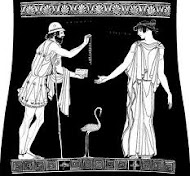
It's the season of gift-giving! Even while socially distanced, this is possible, and of course encouraged. Who doesn't like gifts? And spreading some joy? Order online and have it delivered, or drop gifts off at the door. Why not buy someone a subscription to a service they might enjoy? Options galore! But where does the practice come from and is it important in Hellenism?

Giving gifts to friends, family members, or even acquaintances and complete strangers is a long standing tradition. It existed long before ancient Hellas, but was, indeed, a vital part of its culture. It was tied to both kharis and xenia. Gifts were exchanged between monarchs of city-states to create good will, and were thus an important part of diplomacy. All votives, thank-offerings, and pinakes were gifts from mortals to Theoi. Athletic competitions always concluded with a price--a gift--awarded to the winner. Gifts were given to the submissive partner in a pederastic relationship, and to favored prostitutes and serfs. Gifts played a much more significant role in ancient Hellenic society as a whole than they do in ours today. The giving of gifts in ancient Hellas was not just a social event, however. There was far more to the practice than one might assume, and today, we will look at the tradition of gift giving in greater detail.


I have spoken of the importance of gifts in xenia before. A gift given as part of ritual hospitality was called a xenion (ξεινήιον). This xenion was expected to be expensive, and was presented to the guest upon departure. Needless to say, this practice was mostly executed by nobility, or at least the elite, and happened mostly when a man of equal social standing from another nation or city-state came to visit. In the Odysseia, Telemachos, son of Odysseus, receives from Menelaus a cup made by Hēphaistos Himself:

"But stay here in the palace, till the eleventh or the twelfth day, and I will send you off with honours, and fine gifts, a shining chariot with a trio of horses, and a glorious cup with which to pour libations to the deathless gods, while remembering me all your days."

The practice of gift giving to someone of another nation whom you might never see again, might seem counter-intuitive, but it's actually quite the opposite. By presenting a foreign equal with a great gift, not only do you establish kharis between the two of you, you also indebt the other person to you: they can not repay your kindness at this time, but they will compensate you for it when you visit, or when you are in need. On top of that, the recieving party will go home with tales of your hospitality, and your wealth, providing a boost in stature to the family and the land. It increases the honor of both, something very important to the ancient Hellenes. Gifts, in this context, functioned as a means of communication, legitimization, and mediation between benefactors and cities.

Beyond the elite, gift-giving was still very important, especially between men. The practice was a feature of the symposion, where it was displayed between men in a pederastic relationship, as well as between men of equal standing. Pederasty was where a mature male would take a young boy as his pupil and lover. The relationship was not about love: it was a social construct that allowed to boy time to get to know influential men, and to work himself up into their ranks. Because of this, there were many ritual acts connected to the practice, amongst which the giving of gifts, from mentor to pupil. Three gifts were traditional: military attire, an ox, and a drinking cup, but the youth most certainly received more expensive gifts.

One of the places the young lover would have been taken was the symposion. By allowing the young boy into the symposion it enabled the adults to prepare them for adult life and war in particular. Once the boys grew up, they became one of the men, taking young boys as lovers themselves, and teaching them the ropes of adult malehood. Gift giving in this context allows for a community to become closer, and for a young boy to prepare for his life as a man. Giving gifts--to their young lovers, as well as to those of equal age and standing--allowed men to teach the importance of equal distribution and redistribution of wealth, which was a founding factor of (mostly Athenian) society. It was also a status symbol: if one had time to visit the symposia, and give expensive gifts, they were not only citizens, but wealthy citizens, a clear mark that they were fit for greater responsibility within the political landscape of the city.

Most of these examples are from wealthy city-states like Athens, but there is evidence of gift-giving in other city-states as well. Sparta, for example, greatly frowned upon the flaunting of wealth, but they, too, gave gifts. These, however, were mostly practical in nature between the citizens themselves--fresh game, honey, perhaps a hunting dog--and were honors bestowed upon the person in the case of big events, or an a-symmetrical relationship. A Spartan winner of important sporting events, for example, would be allowed a place in the royal guard of the King, where Athenian winners would be set up for life, including food, housing, and status.

Another form of gift-giving was from a wealthy citizen to the community. This practice was dubbed 'Euergetism', from the Hellenic 'εὐεργετέω': 'I do good things'. While the money spent this way was, indeed a voluntary action on the part of the citizen, he was socially obligated to participate in the practice. Many roads and public buildings were funded this way, and thus bore the name of the citizen that had donated the funds--something we find archeological evidence for to this day.

Gift giving was of vital importance in the Archaic and Early Classical times, most notably in a social, ethical, economic, and political context. In the Classical period--which witnessed the development of elaborate monetary and law systems--the giving of gifts, and the associated benefits, became less prominent in economic and political contexts, though it did remain central in social and religious systems. Gift-giving and reciprocity did return to the Athenian stage, however, in the Hellenistic age, when much of the previously described took place.

Gift giving was of unparalleled important to the ancient Hellenes, but has lost much of its standing today. For those who reconstruct the ancient Hellenic religion, it might be a good exercise to examine these practices, and implement a symbolic exchange. Lavish gifts would not be necessary, but a parting gift by the host on days then the group comes together might make a nice, ritualistic, reminder that the contributions of the group were welcomed, and the effort to travel to the meeting place recognized--after the pandemic, of course!

This Christmas, we'll do door drop-offs with the family and then we're all meeting on Zoom from the safety of our own homes to unwrap the gifts we've gotten and read the poems we write along with them out loud to one another. You make do in a pandemic! 

Stay safe this season and stay smart. It's just one Christmas, the risks are not worth it.

Image taken from: Sparta Reconsidered

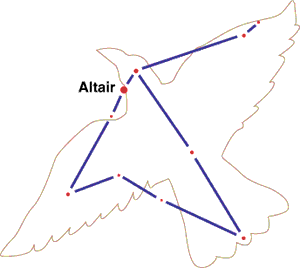
It's time for part three of the constellation series, and this time I'm tackling a constellation I had never heard of before: Aquila. It's one of the medium sized constellations, located a little 'above' Sagittarius.


Aquila is aptly named 'the eagle'. The shape it was given, as well as the mythology attached to it all relate to the bird. Aquila is the Latin for 'eagle', and from mythology, we are well aware that Zeus's favorite animal is this very bird.

This constellation is heavily linked to the constellation of Aquarius: the water carrier. This constellation is often said to represent Ganymēdēs, who was carried to Olympus by an eagle; this very eagle, in fact. It is also said that Zeus's thunderbolts are carried down by the eagle. In the Odysseia, Odysseus' son Telemachos receives oracular message from Zeus by way of the eagle:

"So Telemachus spoke, and Far-Seeing Zeus sent out two eagles from a high mountain peak. They flew for a while with outspread wings, side by side in the currents of air, but when they were above the voice-filled assembly they swiftly slanted their wings, circling round, gazing down on the heads below, and death was in their gaze. Then they clawed at each other’s head and neck with their talons, and soared away eastward over the roofs of the town. The people saw them and wondered, and considered what this might foreshadow. Then the old hero Halitherses, Mastor’s son, spoke out, for he was the wisest man of his day in bird-lore and prophecy. With goodwill in his heart he addressed the assembly:

‘Men of Ithaca, listen to me: and I say these words to the Suitors especially, since disaster approaches them. Odysseus will not be far from his friends much longer, and I believe even now he is near, sowing the seeds of dark death for all these men. Yes, and he will bring trouble to many another of us, who live in clear-skied Ithaca. Let us think in advance how we might prevent all this, or let them prevent it of their own accord, easily their best option. I am not unskilled in prophecy, but have true knowledge. I say that all things for that man will be fulfilled, just as I told him when the Argives sailed for Troy, he among them, resourceful Odysseus. I declared that, suffering many troubles, losing all comrades, he would return in the twentieth year, unknown to all: and now it is coming to pass.’"

Another prominent myth in which the eagle of Zeus features is the myth of Prometheus, who stole fire from the Gods and gave it to humanity. For his efforts, he was tied to a rock by Hermes who was under orders from Zeus. Zeus then tormented him every day for the longest time, by sending an eagle to peck out his liver again and again, because as an immortal, Prometheus' liver grew back every night. In some stories, Prometheus is eventually freed by the hero Hēraklēs, after Zeus takes mercy on him.  

For all his hard work, the eagle was placed into the sky by Zeus, so it could soar through the skies for eternity. The constellation Aguila is visible at latitudes between +90° and −75°. It is best visible at 21:00 (9 p.m.) during the month of August.

The ancient Hellenes viewed the Earth as a round disk divided into equal parts by the Mediterranean Sea and the (Black) Sea (first called the Inhospitable Sea by Pindar, then the Hospitable Sea once the shores became inhabited). Okeanos, a mystical river, flowed around the entire disk, and mysterious peoples—the Hyperboreans in the north, the Ethiopians in the far south and the Kimmerians in parts unknown—lived outside Okeanos' perimeter. 

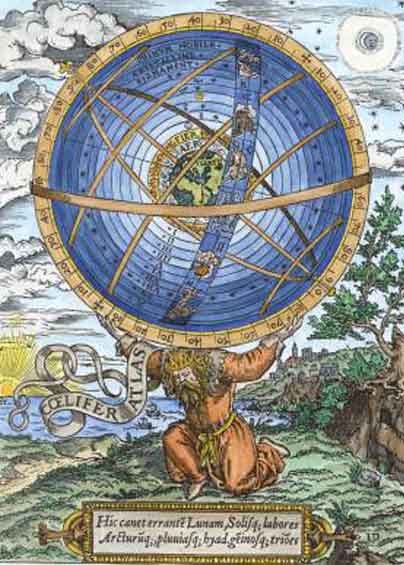
The ancient Hellenes also believed that the heaven was made up of celestial spheres. The celestial spheres, or celestial orbs, were the fundamental entities of the cosmological models developed by great philosophers and astronomers like Plato, Aristotle, and Ptolemy. It was believed that the stars were fixed and did not change their positions relative to one another. As such, it was argued that they must be on the surface of a single starry sphere. The apparent motions of the fixed stars and the planets are accounted for by treating them as embedded in rotating spheres made of an aetherial, transparent fifth element (quintessence).

According to the Homeric hymns, the ancient Hellenes also believed that there are columns that keep apart earth and heaven. It's most likely these columns or pillars were mountains in the centre of the disk, or at the edge of the disk. It were these pillars that Atlas guarded, or he was the actual pillar who held up the spheres--and thus the actual mountain. As Hesiod writes in the Theogony: 

"[At the ends of the earth, where lie the roots of earth, sea, Tartaros :] There stands the awful home of murky Nyx wrapped in dark clouds. In front of it [Atlas] the son of Iapetos stands immovably upholding the wide heaven upon his head and unwearying hands." [744]

Now we are on the topic, it also depends upon tradition if Atlas held up the celestial orbs as punishment, or if he was chosen to do it as an honour to him. The punishment part is perhaps best described by Hyginus in his Fabulae:

"After Juno [Hera] saw that Epaphus, born of a concubine, ruled such a great kingdom, she saw to it that he should be killed while hunting, and encouraged the Titanes to drive Jove [Zeus] from the kingdom and restore it to Saturn [Kronos]. When they tried to mount to heaven, Jove with the help of Minerva [Athene], Apollo, and Diana [Artemis], cast them headlong into Tartarus. On Atlas, who had been their leader, he put the vault of the sky; even now he is said to hold up the sky on his shoulders." [150]

Hómēros, in his Odysseia, takes an opposite--or at least milder--view, implying the honour in Atlas' position:

"Atlas the baleful; he knows the depths of all the seas, and he, no other, guards the tall pillars that keep the sky and earth apart." [1.52]

It makes sense, in fact, to have holding up the heavens be an honour: if Atlas slacks even a moment, the celestial spheres would crash down onto Earth and destroy it, killing everyone. It's a huge responsibility, and to give that to someone pissed off for losing a war seems foolish. 

Like many of the myths concerning the ancient Titans, there are versions of mythology where Atlas no longer bears the heaven. In this case: Pindar describes it as such in the Pythian Odes:

"Does not even now great [Titan] Atlas struggle to bear up the weight of heaven, far from his fathers’ land and his possessions? But almighty Zeus set free the Titanes, for as time passes and the breeze abates, the sails are set anew." [4]

The Farnese Atlas is a 2nd-century Roman marble copy of a Hellenistic sculpture of Atlas kneeling with the celestial spheres, not a globe, weighing heavily on his shoulders. It is the oldest extant statue of Atlas, as well as the oldest known representation of the celestial sphere. The globe shows a depiction of the night sky as seen from outside the outermost celestial sphere, with low reliefs depicting 41 (some sources say 42) of the 48 classical Hellenic constellations distinguished by Ptolemy. The sphere is made up of solid marble, and contains no actual stars. This may have aided the formation of the common misconception that Atlas was forced to hold the Earth on his shoulders. I hope this post clears up a bit of the confusion.


Polyphemus (Πολύφημος Polyphēmos) is the giant son of Poseidon and Thoosa in Hellenic mythology, one of the Cyclopes described in Homeros's Odyssey. His name means "abounding in songs and legends". 

In Homeros's epic, Odysseus lands on the island of the Cyclops during his journey home from the Trojan War and, together with some of his men, enters a cave filled with provisions. When the giant Polyphemus returns home with his flocks, he blocks the entrance with a great stone and, scoffing at the usual custom of hospitality, eats two of the men. Next morning, the giant kills and eats two more and leaves the cave to graze his sheep.

After the giant returns in the evening and eats two more of the men, Odysseus offers Polyphemus some strong and undiluted wine given to him earlier on his journey. Drunk and unwary, the giant asks Odysseus his name, promising him a guest-gift if he answers. Odysseus tells him "Οὖτις", which means "nobody" and Polyphemus promises to eat this "Nobody" last of all. With that, he falls into a drunken sleep. Odysseus had meanwhile hardened a wooden stake in the fire and drives it into Polyphemus' eye. When Polyphemus shouts for help from his fellow giants, saying that "Nobody" has hurt him, they think Polyphemus is being afflicted by divine power and recommend prayer as the answer.

In the morning, the blind Cyclops lets the sheep out to graze, feeling their backs to ensure that the men are not escaping. However, Odysseus and his men have tied themselves to the undersides of the animals and so get away. As he sails off with his men, Odysseus boastfully reveals his real name, an act of hubris that was to cause problems for him later. Polyphemus prays to his father, Poseidon, for revenge and casts huge rocks towards the ship, which Odysseus barely escapes.

The above artwork breaks my heart, seeing the gentleness of the giant knowing his fate. So, today's post is in honor of Polyphemus. Your life would have been much better if a certain stray hero hadn't set foot on your island.

“Oh gentle ram, why do you come from the cave behind the rest of the flock? You never before tarried behind the other skeep, but striding far before the others you snatched the mild blossoms, you came first to the banks of the rivers, and you ever desired first to return home in the evening. But now you are last by far. Are you worried about my eye, which that rotten bastard Noone and his awful friends took from me after wrecking my mind with wine – I do not say that he has escaped death. Would that you could be of one mind with me, and could tell me where that man has fled from my wrath. Once slain, his brain would drip through my cave here and there to the ground, and it would ease my heart from those troubles which that worthless bastard Noone gave me.”
(Odyssey 9.446-460)

I have talked about slavery in ancient Hellas quite a bit on my blog. You an read the masterpost, if you will, here. The word 'slave' wasn't known in ancient Hellas, in fact, the first mention of the word dates back to the seventh century C.E.. A Hellenic slave was called a doûlos (δούλος), which would translate best as a 'servant' or 'serf'.  In ancient Hellas, doûlos were the working class. They were teachers, farmers, shop owners, herders, doctors, city militia, cleaners, etc. 

In democratic city states, the doûlos were protected by law and their masters were urged to care for them and treat them as fellow human beings. If a serf felt they were being mistreated by their master, they could seek asylum in a temple and request a new master. Murdering a doûlos was an equally severe crime as the murder of a free man. No servant could be executed on a whim; a court ruling was required. For a serf to be executed there should be a special reason imposed to the court. Any slave could buy his freedom for a certain amount of money and the state itself sometimes freed its serfs on their own accord. 

Of course, this all sounds a bit too positive. These conditions were prevalent in democratic city states but outside of those, life was hard for serfs. In Sparta, for example, serfs could be executed at will and were worked hard. Revolts happened on occasion. Punishment was prevalent, even in the democratic city states, and lashings were common place. Even if that wasn't the case, a huge portion of serfs were 'barbarian' men, women and children who had been kidnapped from their homes in non-Hellenic territories or who had lived for centuries on the land that the Hellens overtook.

Still, slavery was an ideal condition for some people in ancient Hellas. Poverty and diseases were so prevalent in those days that people preferred to be slaves to wealthy people so that they could survive those hardships. This gave them a level of economic security in that poverty-stricken world. Were all the slaves treated in the same manner? Here are three classifications of slaves.


Domestic Slaves

Domestic slaves in ancient Hellas would do everything around the house, including cooking, gardening, cleaning, washing, reading, writing, taking care of babies, and the sick. They also escorted their masters, carried and delivered messages, acted as travel companions, and did pretty much anything that has to be done at home. Since the slaves were regarded as a breathing piece of property, the quality of their lives just depended on their luck. If they were lucky enough to be acquired by a kind and humane master or mistress, they would perhaps be treated as a family member, of course, with strict limits. The slave would be incorporated into the family through a special ceremony. It was similar to the ceremony for a newborn baby to be incorporated into the family. These domestic slaves were likely to strengthen their ties with their masters or mistresses. If the slave took care of the children as a female nurse or a male paidagôgos, they were more likely to develop such ties. Interestingly, the words pedagogue and pedagogy come from the Greek word paidagôgos, which means a slave working as a tutor.

One such close relationship is portrayed in the Odyssey. We see this in the relationship between Odysseus and his nurse, Eurycleia. They were so close that when Odysseus returned from Ithaca disguised as a beggar, she notices the scar on his thigh. She is particularly trusted by Odysseus and his family because she was a freeborn, and was captured and sold by pirates.

Although there were many cases in which the masters were not totally satisfied with the services of their slaves, they were likely to win the hearts of their masters or mistresses. This was especially true if they had been with them from childhood as their nurses or tutors. Another sign that indicated the slaves were parts of the family was that they were buried in the family plots.

Despite all these close relationships, the owner was free to abuse his slave physically or sexually. Also, if the slave was too old or weak to fulfill their duties, the owner was at liberty to throw them out. At the time of economic crisis or famine, slaves would lose their rations, but otherwise, domestic servants were mostly paid well and their livelihood was secured.


Agricultural Slaves

The size of this slave workforce is much disputed. In Athens, the number depended on the number of peasant proprietors and large landowners. Peasant farmers were more likely to hire seasonal workers than having slaves for the job because the former were considerably cheaper.

The status, comfort, and security of the agricultural slaves were not the same as that of the domestic slaves. That’s because the agricultural slaves had limited contact with their master and couldn’t develop personal relationships with them. If they fell sick, they could be killed because they were not worthy anymore. Although there are no clear clues, it is speculated that the agricultural slaves were restrained in leg irons at night, like those who worked for the Romans.


Other Types of Slaves

In addition to domestic and agricultural slaves, there was a class of slaves called chôris oikountes, or those living separately. They did not live with their masters and worked as managers of shops and factories, bankers, captains of trading ships, bailiffs, artisans, and so on. This class of slaves existed because the Greeks did not like to work for other people. These slaves were considerably free and independent and worked on behalf of their masters on commission.

The dêmosioi, or the public ones, was another class of slaves in ancient Hellas. These slaves were owned by the state. Notaries, coin testers, jury clerks, and public executioners belonged to this class of slaves. Their jobs were generally considered demeaning. Road menders or masons also belonged to this group.

The industrial workers in ancient Hellas were also slaves. Their condition was the worst of the lot. They worked in mines or quarries, like Egyptian slaves. The working conditions were so adverse that some of them died because they had to work 24/7 non-stop.

The beautiful thing about our religion is that not only do we have a clear way to honor the Theoi, and incentive to do so, we also get to live in a world governed completely by the Theoi. Hellenismos is special in that regards because it also largely matches up with science. To me--and many others with me--that is something very comforting. Now, as you are probably all aware, I live in a world full of Gods and Nymphs; for example, I take great strength in greeting Eos each morning as she paves the way for Helios, but there are many Gods who are, or who control, the cycle of day and night, and I would like to write out this cycle, if I may.

For all things geneological, I will always turn to Hesiod first. In his 'Theogony', he speaks of the birth of the Dawn, Sun and Moon:

"And Theia was subject in love to Hyperion and bare great Helios, and clear Selene, and Eos." [177]

Diodorus Siculus, in his 'Library of History' shares this world vieuw and moves a (pseudo-scientific) step beyond it:

"Of Hyperion we are told that he was the first to understand, by diligent attention and observation, the movement of both the sun and the moon and the other stars, and the seasons as well, in that they are caused by these bodies, and to make these facts known to others; and that for this reason he was called the father of these bodies, since he had begotten, so to speak, the speculation about them and their nature." [5.67.1]

Hyperion (Ὑπερίων), meaning 'The High-One', was a Titanes God born from Gaea and Ouranos. Theia and Euryphaessa (as mentioned in, for example, the Homeric Hymns) are generally regarded as the same Deathless woman: 'Theia' is the Hellenic word for 'Goddess', so it was likely 'Theia Euryphaessa' translated to 'Goddess Euryphaessa'. This means that the family tree is as follows:

     Khaos ------------ Gaea
         |         |
   Ouranos --- |
                       Hyperion --- Euryphaessa
                   |
                  Eos - Helios - Selene

The three of them--put into motion by Hyperion--form the basic cycle of these planets associated with specific times of day. Yet, the ancient Hellenes saw Night and Day as quite seperate from the heavenly bodies that are associated with them today. I have spoken before of the Protogenoi, and how They--contrary to the Olympians--are actually of the world; They, together, form the tapistry of earth and life. They literally make up our universe. As such, the further towards the Big Bang you go, the more abstract the Theoi become; They take on large, mostly unformed, chunks of the material that makes up our world and the further away you go from Khaos, the more specialized the Gods become--as well as numerous.

As such, starting this explination with Hyperion is actually incorrect--I should have started with Khaos itself, but if not there, than at least with Nyx, who is the deep Night, and Her daughter Hêmera (Ἡμερα), who is the Protogenos of the Day and the sister-wife of Aither (Light). In Hellenic mythology, Nyx draws a veil of darkness between the shining atmosphere of the aither and the lower air of earth (aer) at set times in the day, bringing night to man. In the morning, Hêmera removes this veil, and exposed the Earth once more to Light. As Hesiod writes in the Theogony:

"[At the ends of the earth, where lie the roots of earth, sea, Tartaros :] There stands the awful home of murky Nyx wrapped in dark clouds. In front of it [Atlas] the son of Iapetos stands immovably upholding the wide heaven upon his head and unwearying hands, where Nyx and Hemera draw near and greet one another as they pass the great threshold of bronze: and while the one is about to go down into the house, the other comes out at the door. And the house never holds them both within; but always one is without the house passing over the earth, while the other stays at home and waits until the time for her journeying come; and the one holds all-seeing light (phaos) for them on earth." [744]

Once we reach AD times, Hêmera is often identified with Eos, but in centuries prior, she was very much Her own Goddess, and Hêmera was as well. Hómēros, for example, in the 'Odysseia' writes: 

"The ship [of Odysseus] in due course left the waters of the river Okeanos and reached the waves of the spacious sea and the island of Aiaia; it is there [Okeanos] that Eos the early-comer (Erigeneia) has her dwelling place and her dancing grounds, and the sun himself has his risings. We came came in; we beached our vessel upon the sands and disembarked upon the sea-shore; there we fell fast asleep, awaiting ethereal Dawn." [12.1]

So, to recapitulate: Nyx and Hêmera continually work to both create and dissolve darkness on Earth; Selene moves with Nyx, and Helios with Hêmera, as heralded by Eos. In this recap, it is quite obvious we are yet missing a speciffic time of the day: dusk, or the evening. This was in the domain of the Nymphs, in this case the Hesperides (Ἑσπεριδες), who--depending of source--are either the daughters of Nyx or Atlas. Diodorus Siculus, in the 1st Century BC., wrote in his 'Library of History': 

"Now Hesperos (Evening) begat a daughter named Hesperis (Evening), who he gave in marriage to his brother [Atlas] and after whom the land was given the name Hesperitis; and Atlas begat by her seven daughters, who were named after their father Atlantides, and after their mother Hesperides." [4. 26. 2]

Yet, older sources agree that the Hesperides were born from Nyx; Hesiod, for example:

"And Nyx (Night) bare hateful Moros (Doom) and black Ker (Violent Death) and Thanatos (Death), and she bare Hypnos (Sleep) and the tribe of Oneiroi (Dreams). And again the goddess murky Nyx, though she lay with none, bare Momos (Blame) and painful Oizys (Misery), and the Hesperides who guard the rich, golden apples and the trees bearing fruit beyond glorious Okeanos."

Of course, there are more Gods--motly Titans--who are in some way connected to the cycle of night and day, but these are the most important ones and it's quite a hand full already. So perhaps next time when you awake, you will think of Hêmera, and rosy Eos, and when the sun is high in the sky, you will think of Him as well, and when you look upon the Moon before going to bed, you will give honors to Selene and Nyx, who holds Her and Gaea in Her embrace. Our Gods are everywhere; you only have to be aware of Them to notice.
"The Argonauts sailed on in gloom. The Seirenes  were behind them, but worse perils lay ahead, at a place where two seas met and shipping came to grief. On one side the sheer cliff of Skylla  hove in sight; on the other Kharybdis  seethed and roared incessantly; while beyond, great seas were booming on the Wandering Rocks."
-- Apollonius Rhodius, Argonautica 4. 921

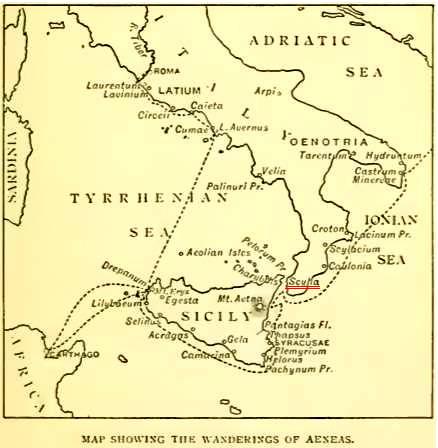
A map of the wanderings of Aeneas, showing the positions of Charybdis and Scylla (underlined in red), from an edition of The Aeneid of Virgil, Book III, edited by Philip Sandford, London: Blackie & Son. 1900


Some of the greatest heroes encountered the terrifying and destructive force of Skylla and Kharybdis on their travels: Odysseus had to pass them twice, and the Argonauts came upon them as well. We will discuss Skylla at a later date, but for now, we will discuss Kharybdis--monster and Goddess--who controls the tide.

The ancient hellenes in the time the Odysseia was written seem to have been largely unaware that the rise and fall of sea levels are caused by the combined effects of the gravitational forces exerted by the Moon and the Sun and the rotation of the Earth. Instead, they held a single entity responsible: a monster or a Goddess controlling a whirlpool, as described by Hómēros:

"Odysseus, you will notice the other cliff is lower, only a bow-shot away, and a great fig-tree with dense leaves grows there. Under it divine Charybdis swallows the black waters. Three times a day, she spews them out, and three times darkly sucks them back again. No one, not even Poseidon, could save you from destruction if you are there when she swallows." [Bk XII:36-110]

For those of you who grew up with huge differences between high and low tides, it might be hard to grasp how the ancient Hellenes attributed such a difference to a single whirlpool entity. Well, they didn't; Even modern Hellas hardly has a difference between high and low tide; a foot or two at max. As such, it becomes a lot more feasable for that amount of water to be swallowed and regurgitated.

The development of tidal science began in antiquity with the cosmology of Aristotle (384 BC – 322 BC), a Hellenic philosopher and polymath, a student of Plato and teacher of Alexander the Great. In researching this subject, I keep happening upon a quote by him that I can't place in any of his works, but would love to have someone source for me. It goes:

"It is even said that many ebbings and risings of the sea always come round with the Moon and upon certain fixed times."

The closest I have gotten is from the 'Meteorology':

"Again, most earthquakes and the severest occur at night or, if by day, about noon, that being generally the calmest part of the day. For when the sun exerts its full power (as it does about noon) it shuts the evaporation into the earth. Night, too, is calmer than day. The absence of the sun makes the evaporation return into the earth like a sort of ebb tide, corresponding to the outward flow; especially towards dawn, for the winds, as a rule, begin to blow then, and if their source changes about like the Euripus and flows inwards the quantity of wind in the earth is greater and a more violent earthquake
results." [Bk 2, Pt 8]
And:

"Every one admits this, that if the whole world originated the sea did too; for they make them come into being at the same time. It follows that if the universe is eternal the same must be true of the sea. Any one who thinks like Democritus that the sea is diminishing and will disappear in the end reminds us of Aesop's tales. His story was that Charybdis had twice sucked in the sea: the first time she made the mountains visible; the second time the islands; and when she sucks it in for the last time she will dry it up entirely. Such a tale is appropriate enough to Aesop in a rage with the ferryman, but not to serious inquirers. Whatever made the sea remain at first, whether it was its weight, as some even of those who hold these views say (for it is easy to see the cause here), or some other reason-clearly the same thing must make it persist for ever. They must either deny that the water raised by the sun will return at all, or, if it does, they must admit that the sea persists for ever or as long as this process goes on, and again, that for the same period of time that sweet water must have been carried up beforehand. So the sea will never dry up: for before that can happen the water that has gone up beforehand will return to it: for if you say that this happens once you must admit its recurrence. If you stop the sun's course there is no drying agency. If you let it go on it will draw up the sweet water as we have said whenever it approaches, and let it descend again when it recedes. This notion about the sea is derived from the fact that many places are found to be drier now than they once were. Why this is so we have explained. The phenomenon is due to temporary excess of rain and not to any process of becoming in which the universe or its parts are involved. Some day the opposite will take place and after that the earth will grow dry once again. We must recognize that this process always goes on thus in a cycle, for that is more satisfactory than to suppose a change in the whole world in order to explain these facts. But we have dwelt longer on this point than it deserves." [Bk 2, Pt 3]

In general, I would say the ancient Hellenes were aware of the connection between the Moon (and Sun) and the tides, but neglected to make a causal connection. For a long time Kharybdis was the most logical of options. Another name of hers is 'Trienos' (Τριενος), 'Three Times a Day', alluding to the earlier stated behavior of the whirlpool. Suidas, by the tenth century AD, had placed the actual whirlpool with accuracy. This location is portrayed on the map above:

"Kharybdis (Charybdis): It sucks up the sea around Gadeira and furiously spirals around again. It is said that it all leads down to chaos and destruction. Priskos (Priscus) says about Kharybdis: ‘They sail by Sikelia (Sicily) in front of Messene and by the strait of Italy where Kharybdis [is], taking in stormy winds, and sucking those men in. Kharybdis and Skylla (Scylla), lying in a narrow place, are subject to the currents of the oceans and sink those sailing past. There Odysseus lost all his companions with the ships; he himself was carried away hanging on to a board in the currents of the sea.’"
It is easy to link our modern understanding of tidal physics to the minds of the ancient Hellenes, but I am in no way certain they actually linked the tides to the Moon and Sun. As such, neither Selene, nor Artemis, nor even the Oceanic Gods like Poseidon would have had any influence on the tides: they were in the domain of either another divinity, or a monster, and both were out of reach.
The ancient Hellenes were very keen people, interested in all things nature, science and philosophy. They searched for answers to questions about their life, as well as the Theoi, and they theorized structurally about any discoveries they made, be it in health care, science or paleontology. Especially in the latter department, there are a few discoveries that might have shaped a large part of ancient Hellenic mythology and religion in general. Today, we'll be discussing some of those.

Giants:

Nichoria (Νιχώρια) is a site in Messenia, a regional unit in the southwestern part of the Peloponnese, Greece, on a ridgetop near modern Rizomylos, at the northwestern corner of the Messenian Gulf. It was the home of an Acropolis where many--what we now call--fossils were stored. The Nichoria bone was discovered by the ancient Hellenes roughly around 1000 BC. It is the blackened and petrified thigh bone of an extinct mega mammal--likely a woolly rhinoceros, or a mammoth--that roamed southern Hellas around one million years ago. The rusty-black color of the fossil bone indicates that it was most likely collected from the lignite deposits near the ancient town of Megalopolis, some 55 kilometers (35 miles) away from Nichoria. The Megalopolis basin was known in antiquity as the 'battleground of the Giants', where first the Titanomachy and then the Gigantomachy was believed to have taken place. The dense concentration of large fossil bones found at the basin inspired the belief that entire armies of giants were blasted by Zeus' thunderbolts, and the Nichoria bone--the distal end of a right femur, 15 cm (5-6 inches) wide, about twice the size of a regular human thigh bone--was most likely believed to have belonged to one of these giants. If the myth or the bone came first is unknown.

Cyclopses:
The one-eyed giants might have their origins in the recovered skulls of Deinotherium giganteum, which, loosely translated means 'really huge terrible beast'. Skulls and even tusks have been discovered in temples of the island of Krete, placed their by the ancient inhabitants. The Deinotherium is a distant relative to today's elephants. It stood about four and a half meters (15 feet) tall at the shoulder, and had tusks that extended over a meter (4.5 feet). It roamed Europe, Asia, and Africa during the Miocene (23 to 5 million years ago) and Pliocene (5 to 1.8 million years ago) eras before becoming extinct. As the image to the right shows, the large hole in the front of the skull was the anchor point for the trunk, not the eyes, but the skill of a young Deinotherium combined with the fearsome reputation of the cyclopses, makes it easy to see why the anciente Hellenes might have identified these skulls as belonging to Odysseus' captor.

Griffin's
The grýphōn (γρύφων) is a mythical creature with the body, tail, and back legs of a lion; the head and wings of an eagle; and an eagle's talons as its front feet. They feature in much Hellenic artwork, and Adrienne Mayor, a classical folklorist, proposes that the griffin was an ancient misconception derived from the fossilized remains of the Protoceratops found in gold mines in the Altai mountains of Scythia, in present day southeastern Kazakhstan, or in Mongolia. Looking at the skull of one of these dinosaurs, it really isn't a big leap; Protoceratops is about the size of a sheep or large dog, and they have a powerful jaw, and protruding bird-like beak. As a dinosaur, the rest of the skeleton would also have resembled a densely packed lion, one capable of carrying the weight of a man. The wings could simply have been assumed lost in time, or perhaps small bones found in the area would have indicated that the 'griffin' once took flight.

There are many more examples, and for anyone interested in this topic, Adrienne Mayor's book 'The First Fossil Hunters: Dinosaurs, Mammoths, and Myth in Greek and Roman Times' is an absolute must-read. From a review of the book:

"Above all, in The First Fossil Hunters Mayor proves two basic points: that many of the classic Greek and Roman myths did have a basis in fact, and that the basis for these facts were fossils. Using evidence collected from personal interviews, trips to Greek and Italian museums, and careful studies of classical myths and geology, Mayor continues to prove the two above points throughout her 360-page book. 

[...] Throughout her book Mayor continually proves the two basic points that she originally set out in the introduction: that many Greek and Roman myths had a basis in fact, and that these facts were often fossils. However, she goes beyond this basis thesis, and proves that Greeks and Romans frequently encountered the fossilized remains of mammals and dinosaurs, and that they developed very sophisticated concepts and myths to explain this bewildering and often confusing fossil evidence. Like their modern counterparts, Mayor writes, the ancient fossil hunters collected and measured impressive petrified remains and even displayed them in temples and museums. They attempted to reconstruct the appearance of these creatures through art and sculpture, and went even further in attempting to explain their creation and extinction."


Mammoth bone image source here; Cyclops image source here; Protoceratops skull image source here.