Showing posts with label Kadmos. Show all posts
The dragons of ancient Hellas had very little--if anything--to do with the fantasy dragons we are so accustomed to now. The ancient Hellenes knew four types of dragon: the Drakones, the Ketea, the Khimaira and the Drakaenae.

The Drakones were named after the Greek 'drakein' and 'derkomai, meaning 'to see clearly' or 'gaze sharply'. These were guardians, usually of wells and springs, groves, Gods, or treasure. As guardians, they were usually equipped with sharp fangs, deadly poison and/or multiple heads. In essence, they were seen as giant snakes which--and this is wholly a personal observation--makes sense when most protective and purifying Theoi were depicted as snakes.

Yet, some drakones caused mayhem and were slain. These are some of the dragon slayers of ancient Hellenci mythology:

"According to the mythology, a spring nearby the location of the temple [of Delphi] was guarded by the large Python or she-dragon, which Apollo slayed upon arrival, thus freeing the people from their fear of the earth and its power." 

When the Olympians rose to power, they first fought the Titans during the Titanomachy. Vanquishing them, the Theoi thought They had won. Yet, there was one who sought revenge for the defeat of his father: Typhôeus, the most-feared son of Tartaros and Gaea. Some versions of the myth say that Typhôeus was actually the Drakon Gigantomakhios, or one of his offspring. Hyginus shares what happened to the dragon:

"Some also say this dragon was thrown at Minerva [Athena] by the Giants, when she fought them. Minerva, however, snatched its twisted form and threw it to the stars, and fixed it at the very pole of heaven. And so to this day it appears with twisted body, as if recently transported to the stars."


The hero Bellerophon was commanded by King Iobates to slay the Khimaira, a fire-breathing mythical beast whose form was a hybrid of lion, serpent and goat. Bellerophon rode into battle against the beast on the back of the winged horse Pegasos and, driving a lead-tipped lance down the Khimaira's flaming throat, suffocated it. From Hómēros' Iliad:

 "On first deciphering the fatal message, he ordered Bellerephon to kill the monstrous Chimaera, spawned by gods and not men, that had a lion’s head, goat’s body and serpent’s tail, and breathed out deadly blasts of scorching fire. But Bellerephon slew her, guided by the gods." [VI:119-211]

Cadmus (Kadmos)
"On a quest to find his sister, Europa, he stopped at the Delphic temple to consult Apollo’s oracle, which led him to found the city of Thebes. While building the Theban temple, Cadmus’ assistants were slain by a dragon as they attempted to collect water from a nearby spring. Athena instructed Cadmus to slay the dragon and then sow its teeth into the ground like seeds." 

Damasen
Damasen was a giant, a son of Gaia. He assisted the nymph Moria after her brother Tylus accidentally touched a serpent, which then attacked him. It coiled round his body and suffocated him. Moria implored Damasen to help and he killed the serpent, hitting it with the trunk of a tree he tore out of the ground. Then a female serpent, the slain monster's mate, appeared and used a magical herb, referred to as 'Zeus' flower', to bring the dead serpent back to life. Moria then used the same herb to revive her brother. The myth is only mentioned in Nonnus' 'Dionysiaca', although it may the foundation of  Hēraklēs' second labour.

"This was he whom the Nymphe beheld on the fertile slope of the woodland. She bowed weeping before him in prayer, and pointed to the horrible reptile, her brother’s murderer, and Tylos newly mangled and still breathing in the dust. The Gigas (Giant) did not reject her prayer, that monstrous champion; but he seized a tree and tore it up from tits roots in mother earth, then stood and came sidelong upon the ravening Drakon." [25.452]


Heracles (Hēraklēs)
"Heracles, strangled his first snake when he was still just a baby in the cradle. [...] Throughout his twelve labors he conquered two multi-headed snakes, including the Hydra and the Ladon."

Iason
Iason was sent by Poseidon’s son, Pelias, to fetch the Golden Fleece. Along the way, he acquired additional tasks: to plow a field with fire-breathing oxen, to steal a tooth from a dragon, and to slay the dragon that guarded the fleece. Luckily for Iason, his lover Medea was trained in Hecate’s dark arts and gave him an ointment that would keep him from being burned by the oxen, in addition to a herbal potion with which he could put the dragon to sleep."

"Of his conquests, one of the most memorable is the beheading of Medusa, the snake haired gorgon, with the aid of Athena’s polished shield. Afterwards, Perseus went on to slay another monster, the sea serpent Cetus sent by Poseidon."

Phorbas was the son of Triopas and Hiscilla (daughter of Myrmidon), a hero of the island of Rhodes. When the people of the island of Rhodes fell victim to a plague of masses of serpents (may have been dragons or simply snakes), an oracle directed them to call on a man named Phorbas. Phorbas cleansed the island of the snakes and in gratitude the Rhodians venerated him as a hero. For his achievement he won a place among the stars as the constellation Serpentarius or Ophiuchus. Hyginus, in his 'Astronomica' writes:

"Polyzelus the Rhodian, however, points out that this is Phorbas, who was of great assistance to the Rhodians. The citizens called their island, overrun by a great number of snakes, Ophiussa. In this multitude of beasts was a snake of immense size, which had killed many of them; and when the deserted land began finally to lack men, Phorbas, son of Triopas by Hiscilla, Myrmidon’s daughter, when carried there by a storm, killed all the beasts, as well as that huge snake. Since he was especially favored by Apollo, he was put among the constellations, shown killing the snake for the sake of praise and commemoration. And so the Rhodians, as often as they go with their fleet rather far from their shores, make offerings first for the coming of Phorbas, that such a happening of unexpected valor should befall the citizens as the opportunity for glory which brought Phorbas, unconscious of future praise, to the stars." [II.14]


Zeus
During the Titanomachy, Zeus needed the giants to win his war. Trouble was, they were locked away in Tartaros by Kronos where they were guarded by Kampê (Καμπη), a she-dragon who, from the waist up, had the body of a serpentine-haired woman. Below that she had the body of a scaly drakon with a thousand vipers for feet and sprouting from her waist the heads of fifty fearsome beasts--lions, boars and other wild animals. Dark wings rose from her shoulders and above her head she lifted a furious scorpion's tail. Zeus slew her and freed His future allies. Apollodorus, in his 'Bibliotheca' writes:

"After ten years of fighting Ge [Gaia] prophesied a victory for Zeus if he were to secure the prisoners down in Tartaros as his allies. He thereupon slew their jail-keeper Kampe, and freed them from their bonds." [1.6]
About a week ago, I posted about the dragon slayers on ancient Hellenic mythology. My wonderful friend Robert Clark, Co-founder of Elaion, the Hellenic organisation this blog is associated, read the post and emailed me some of his thoughts on drakons (serpents) and the meaning behind them in mythology. I found them so inspiring that I would like to share them with you today.

"Well into the third century, the human soul was understood to take the form of a serpent (snake) on leaving the deceased body.  Apollon kills the Python as He is the 'new Python' in a sense, a protector and averter of evil par excellence. The Pythia gave her oracles from the spring that was under the Temple of Apollon. The Kastalia spring was used for cleansing before entering the precinct of Delphi. There is the healing serpent of Asklepios and the two serpents of the kerykeion, the Agathos Daimon and Agatha Tyche, the crescent moon and full moon and perhaps the disk of the sun, the likeness to the horns of consecration, etc. that permeates our religion. 

Cadmos as instructed by Athena in Ovid's Metamorphoses: 

"She commanded him to sow the dragon's teeth in mellowed soil, from which might spring another race of men. And he obeyed: and as he plowed the land, took care to scatter in the furrowed soil the dragon's teeth; a seed to raise up man." 

In the end, Cadmus and Harmonia are turned into serpents:

"Weighted with woe, bowed down with years, their minds recalled the time when first disaster fell upon their House:—relating their misfortunes, Cadmus spoke “Was that a sacred dragon that my spear impaled, when on the way from Sidon's gates I planted in the earth those dragon-teeth, unthought-of seed? If haply 'tis the Gods, (whose rage unerring, gives me to revenge) I only pray that I may lengthen out, as any serpent.” Even as he spoke, he saw and felt himself increase in length."

Harmonia is also changed into a serpent:

"Oh, why not, ye celestial Gods, me likewise, to a serpent-shape transform!”— So ended her complaint. Cadmus caressed her gently with his tongue; and slid to her dear bosom, just as if he knew his wife; and he embraced her, and he touched her neck. All their attendants, who had seen the change, were filled with fear; but when as crested snakes the twain appeared in brightly glistening mail, their grief was lightened: and the pair, enwreathed in twisting coils, departed from that place, and sought a covert in the nearest grove.— There, then, these gentle serpents never shun mankind, nor wound, nor strike with poisoned fangs; for they are always conscious of the past."

Thank you, Robert, for your words of wisdom.
All of you know Classical Wisdom Weekly, right? Well, they have a newsletter too, which I am subscribed to. There is a lot of Roman stuff in there, but every once in a while they have nice Hellenic mythology features--like their latest one, on the dragons slayers of the ancient Hellenic world. I love dragons--drakons--(who doesn't?), so I wanted to share their picks, and then tell you mine.

1. Apollo
"According to the mythology, a spring nearby the location of the temple [of Delphi] was guarded by the large Python or she-dragon, which Apollo slayed upon arrival, thus freeing the people from their fear of the earth and its power."

2. Cadmus (Kadmos)
"On a quest to find his sister, Europa, he stopped at the Delphic temple to consult Apollo’s oracle, which led him to found the city of Thebes. While building the Theban temple, Cadmus’ assistants were slain by a dragon as they attempted to collect water from a nearby spring. Athena instructed Cadmus to slay the dragon and then sow its teeth into the ground like seeds."

3. Jason
"Jason was sent by Poseidon’s son, Pelias, to fetch the Golden Fleece. Along the way, he acquired additional tasks: to plow a field with fire-breathing oxen, to steal a tooth from a dragon, and to slay the dragon that guarded the fleece. Luckily for Jason, his lover Medea was trained in Hecate’s dark arts and gave him an ointment that would keep him from being burned by the oxen, in addition to a herbal potion with which he could put the dragon to sleep."

4. Perseus
"Of his conquests, one of the most memorable is the beheading of Medusa, the snake haired gorgon, with the aid of Athena’s polished shield. Afterwards, Perseus went on to slay another monster, the sea serpent Cetus sent by Poseidon."

5. Heracles (Hēraklēs)
"Heracles, strangled his first snake when he was still just a baby in the cradle. [...] Throughout his twelve labors he conquered two multi-headed snakes, including the Hydra and the Ladon."


I like these picks, and I agree with most of them. Especially the top three would be mine as well. I'm going to add a few others to the list as well, though.

Athena
When the Olympians rose to power, they first fought the Titans during the Titanomachy. Vanquishing them, the Theoi thought They had won. Yet, there was one who sought revenge for the defeat of his father: Typhôeus, the most-feared son of Tartaros and Gaea. Some versions of the myth say that Typhôeus was actually the Drakon Gigantomakhios, or one of his offspring. Hyginus shares what happened to the dragon:
 
"Some also say this dragon was thrown at Minerva [Athena] by the Giants, when she fought them. Minerva, however, snatched its twisted form and threw it to the stars, and fixed it at the very pole of heaven. And so to this day it appears with twisted body, as if recently transported to the stars."

Bellerophon
The hero Bellerophon was commanded by King Iobates to slay the Khimaira, a fire-breathing mythical beast whose form was a hybrid of lion, serpent and goat. Bellerophon rode into battle against the beast on the back of the winged horse Pegasos and, driving a lead-tipped lance down the Khimaira's flaming throat, suffocated it. From Hómēros' Iliad:

 "On first deciphering the fatal message, he ordered Bellerephon to kill the monstrous Chimaera, spawned by gods and not men, that had a lion’s head, goat’s body and serpent’s tail, and breathed out deadly blasts of scorching fire. But Bellerephon slew her, guided by the gods." [VI:119-211]
 
Zeus
During the Titanomachy, Zeus needed the giants to win his war. Trouble was, they were locked away in Tartaros by Kronos where they were guarded by Kampê (Καμπη), a she-dragon who, from the waist up, had the body of a serpentine-haired woman. Below that she had the body of a scaly drakon with a thousand vipers for feet and sprouting from her waist the heads of fifty fearsome beasts--lions, boars and other wild animals. Dark wings rose from her shoulders and above her head she lifted a furious scorpion's tail. Zeus slew her and freed His future allies. Apollodorus, in his 'Bibliotheca' writes:
 
"After ten years of fighting Ge [Gaia] prophesied a victory for Zeus if he were to secure the prisoners down in Tartaros as his allies. He thereupon slew their jail-keeper Kampe, and freed them from their bonds." [1.6]
 
Phorbas was the son of Triopas and Hiscilla (daughter of Myrmidon), a hero of the island of Rhodes. When the people of the island of Rhodes fell victim to a plague of masses of serpents (may have been dragons or simply snakes), an oracle directed them to call on a man named Phorbas. Phorbas cleansed the island of the snakes and in gratitude the Rhodians venerated him as a hero. For his achievement he won a place among the stars as the constellation Serpentarius or Ophiuchus. Hyginus, in his 'Astronomica' writes:
 
"Polyzelus the Rhodian, however, points out that this is Phorbas, who was of great assistance to the Rhodians. The citizens called their island, overrun by a great number of snakes, Ophiussa. In this multitude of beasts was a snake of immense size, which had killed many of them; and when the deserted land began finally to lack men, Phorbas, son of Triopas by Hiscilla, Myrmidon’s daughter, when carried there by a storm, killed all the beasts, as well as that huge snake. Since he was especially favored by Apollo, he was put among the constellations, shown killing the snake for the sake of praise and commemoration. And so the Rhodians, as often as they go with their fleet rather far from their shores, make offerings first for the coming of Phorbas, that such a happening of unexpected valor should befall the citizens as the opportunity for glory which brought Phorbas, unconscious of future praise, to the stars." [II.14]
 
Damasen
Damasen was a giant, a son of Gaia. He assisted the nymph Moria after her brother Tylus accidentally touched a serpent, which then attacked him. It coiled round his body and suffocated him. Moria implored Damasen to help and he killed the serpent, hitting it with the trunk of a tree he tore out of the ground. Then a female serpent, the slain monster's mate, appeared and used a magical herb, referred to as 'Zeus' flower', to bring the dead serpent back to life. Moria then used the same herb to revive her brother. The myth is only mentioned in Nonnus' 'Dionysiaca', although it may the foundation of  Hēraklēs' second labour.

"This was he whom the Nymphe beheld on the fertile slope of the woodland. She bowed weeping before him in prayer, and pointed to the horrible reptile, her brother’s murderer, and Tylos newly mangled and still breathing in the dust. The Gigas (Giant) did not reject her prayer, that monstrous champion; but he seized a tree and tore it up from tits roots in mother earth, then stood and came sidelong upon the ravening Drakon." [25.452]

Are there any other dragon slayers who deserve to make the list? Let me know in the comments!
The Spartoi (Σπαρτοι, or Sparti (Σπαρτος)), were a mythological race of fighters, born from the earth out of the teeth of a Drakon who was sacred to Ares. They were grown twice; first by Kadmos, then by Iásōn. While there are more stories of earth-born people in Hellenic mythology, the Spartoi are quite unique, and that is why we discuss them today.

The name 'Spartoi' literally means 'the sown men'. Starting with the myth of Kadmos, the Spartoi were involved in the founding of the city of Thebes. In short, Kadmos was the brother of Europe, who got taken by Zeus. During his quest to recover her, he was ordered, by the oracle in Delphi, to follow a cow with a half moon on her flank and to built a town on the spot where the cow laid down. The animal led him to Boeotia, where he founded the city of Thebes. Hygenus has written a nice summary of the myth in his Fabulae:

"Cadmus in his wanderings came to Delphi. There the oracle told him to buy from farmers an ox which had a moon-shaped mark on its side, and to drive it before him. Where it lay down it was fated that he found a town and rule. When Cadmus heard the oracle, he did as he was told. While seeking water he came to the fountain of Castalia [N.B. Hyginus' error, it was actually the Ismenian spring], which a Dracon, the offspring of Mars [Ares], was guarding. It killed the comrades of Cadmus, but was killed by Cadmus with a stone. Under Minerva's [Athena's] instructions he sowed the teeth and ploughed them under. From them sprang the Sparti. These fought themselves, but from them five survived, namely, Chthonius, Udaeus, Hyperenor, Pelorus, and Echion. Moreover, Boeotia was named from the ox Cadmus followed." [179]

Apollonius Rhodius, in his 'Argonautica', however, says that Kadmos only got half of the teeth from Athena:

"But the teeth the Tritonian goddess tore away from the dragon's jaws and bestowed as a gift upon Aeetes and the slayer. And Agenor's son, Cadmus, sowed them on the Aonian plains and founded an earthborn people of all who were left from the spear when Ares did the reaping; and the teeth Aeetes then readily gave to be borne to the ship, for he deemed not that Jason [Iásōn] would bring the contest to an end, even though he should cast the yoke upon the oxen." [1188 - 1190]

The second portion of the teeth came into the posession of Iásōn in his quest for the Golden Fleece, which I have described before. As so many kings in ancient Hellas, Pelias unrightfully laid claim to his half-brother's throne. He became the king of Iolkos in Thessaly, and fell in disfavor of the Theoi because of his actions. It was prophesied that a member of the rightfully royal bloodline would one day punish him, and he was likewise warned to watch out for a man with only one sandal.

Pelias didn't believe in half measures and murdered every prominent descendant of Aeolus he could, but spared his mother Tyro's youngest son, Aeson. Instead, he imprisoned him and forced him to renounce his claim to the throne. Aeson complied, and eventually was set free. He married  Alcimede, who bore him a son named Diomedes. Alcimede successfully saved her son from certain death by having her nursemaids keen as if the boy had been stillborn. She secretly packed him off to Mount Pelion, where he was raised by the kéntauros Kheiron, who changed the boy's name to Iásōn.

From Kheiron, Iásōn learned the arts of combat, sports, medicine and music. When he reached adulthood, he was send back to Iolkos with proof of his royal birth. On the way there, he had to cross a river and found an old woman on the bank of it, who begged everyone who passed by to carry her through the water. All but Iásōn ignored her. He took her onto his back and he helped her across, although he found the journey tougher than he had ever thought possible. He also lost one of his sandals in the mud. As he put down the old woman, she turned into the magnificent Hera, of whom he would continue to receive support now he had passed her test.

As soon as Pelias laid eyes on the youth with one sandal, he knew what would happen now. And thus, he devised a plot to get rid of Iásōn. As Iásōn presented him with an offer to keep some farms and cattle, while Iásōn claimed his rightful place on the throne, Pelias happily accepted, but gave Iásōn a tasks to complete first, of which one was the retrieval of the Golden Fleece, which Iásōn set out to do with the Argonautai.

The journey to the lands where the Fleece was kept--Kolchis--was long and hard, and once the Argonautai reached Kolchis, their struggle wasn't over. King Aeetes was unwilling to part with the Fleece, as it had brought great prosperity to his lands. He devised three tasks for Iásōn: to plow a field with fire-breathing oxen, to sow the teeth of a dragon into the field, and to overcome the sleepless dragon guarding the Fleece.

Iásōn managed the first of the quests, and yoked the oxen. From Apollonius Rhodius' 'Argonautica' comes the following account of the planting and rising of the Spartoi:

"The bulls meantime raged exceedingly, breathing forth furious flame of fire; and their breath rose up like the roar of blustering winds, in fear of which above all seafaring men furl their large sail. But not long after that they moved on at the bidding of the spear; and behind them the rugged fallow was broken up, cloven by the might of the bulls and the sturdy ploughman. Then terribly groaned the clods withal along the furrows of the plough as they were rent, each a man's burden; and Jason followed, pressing down the cornfield with firm foot; and far from him he ever sowed the teeth along the clods as each was ploughed, turning his head back for fear lest the deadly crop of earthborn men should rise against him first; and the bulls toiled onwards treading with their hoofs of bronze.

But when the third part of the day was still left as it wanes from dawn, and wearied labourers call for the sweet hour of unyoking to come to them straightway, then the fallow was ploughed by the tireless ploughman, four plough-gates though it was; and he loosed the plough from the oxen. Them he scared in flight towards the plain; but he went back again to the ship, while he still saw the furrows free of the earthborn men. And all round his comrades heartened him with their shouts. And in the helmet he drew from the river's stream and quenched his thirst with the water. Then he bent his knees till they grew supple, and filled his mighty heart with courage, raging like a boar, when it sharpens its teeth against the hunters, while from its wrathful mouth plenteous foam drips to the ground. By now the earthborn men were springing up over all the field; and the plot of Ares, the death-dealer, bristled with sturdy shields and double-pointed spears and shining helmets; and the gleam reached Olympus from beneath, flashing through the air. And as when abundant snow has fallen on the earth and the storm blasts have dispersed the wintry clouds under the murky night, and all the hosts of the stars appear shining through the gloom; so did those warriors shine springing up above the earth.

But Jason bethought him of the counsels of Medea full of craft, and seized from the plain a huge round boulder, a terrible quoit of Ares Enyalius; four stalwart youths could not have raised it from the ground even a little. Taking it in his hands he threw it with a rush far away into their midst; and himself crouched unseen behind his shield, with full confidence. And the Colchians gave a loud cry, like the roar of the sea when it beats upon sharp crags; and speechless amazement seized Aeetes at the rush of the sturdy quoit. And the Earthborn, like fleet-footed hounds, leaped upon one another and slew with loud yells; and on earth their mother they fell beneath their own spears, likes pines or oaks, which storms of wind beat down.

And even as a fiery star leaps from heaven, trailing a furrow of light, a portent to men, whoever see it darting with a gleam through the dusky sky; in such wise did Aeson's son rush upon the earthborn men, and he drew from the sheath his bare sword, and smote here and there, mowing them down, many on the belly and side, half risen to the air -- and some that had risen as far as the shoulders -- and some just standing upright, and others even now rushing to battle. And as when a fight is stirred up concerning boundaries, and a husbandman, in fear lest they should ravage his fields, seizes in his hand a curved sickle, newly sharpened, and hastily cuts the unripe crop, and waits not for it to be parched in due season by the beams of the sun; so at that time did Jason cut down the crop of the Earthborn; and the furrows were filled with blood, as the channels of a spring with water. And they fell, some on their faces biting the rough clod of earth with their teeth, some on their backs, and others on their hands and sides, like to sea- monsters to behold.

And many, smitten before raising their feet from the earth, bowed down as far to the ground as they had risen to the air, and rested there with the damp of death on their brows. Even so, I ween, when Zeus has sent a measureless rain, new planted orchard-shoots droop to the ground, cut off by the root the toil of gardening men; but heaviness of heart and deadly anguish come to the owner of the farm, who planted them; so at that time did bitter grief come upon the heart of King Aeetes. And he went back to the city among the Colchians, pondering how he might most quickly oppose the heroes. And the day died, and Jason's contest was ended." [1326 - 1404]

The Spartoi who remained for Kadmos assisted him in founding Thebes, and one of them--Ekhiôn--even married Kadmos' daughter Agave. I suspect the Spartoi--especially in the case of Kadmos--were a form of the 'God-born King' line of thinking which Athens was also famous for. This way, the five most powerful and most ancient family lines in Thebes could trace their line back to extraordinary men. Through the myth of the Spartoi, not only Apollon (through the oracle at Delphi), but also Athena was tied to the wellbeing of the city of Thebes and the powerful family lines. Kadmos ended up paying a hefty prize for sowing slaying the Drakon, but that is a tale for another time. For now, I leave you to ponder the Spartoi who were the offspring of Ares, and helped found one of the most powerful cities in ancient Hellas, and made life miserable for Iásōn.
Yesterday we spoke about the constellation Draco, or Drakon, which was said to represent two on ancient Hellas' dragons. I mentioned in that post that I would speak more of dragons tomorrow, so here we are. The dragons of ancient Hellas had very little--if anything--to do with the fantasy dragons we are so accustomed to now. The ancient Hellenes knew four types of dragon: the Drakones, the Ketea, the Khimaira and the Drakaenae.

The Drakones were named after the Greek 'drakein' and 'derkomai, meaning 'to see clearly' or 'gaze sharply'. These were guardians, usually of wells and springs, groves, Gods, or treasure. As guardians, they were usually equipped with sharp fangs, deadly poison and/or multiple heads. In essence, they were however seen as giant snakes which--and this is wholly a personal observation--makes sense when most protective and purifying Theoi were depicted as snakes.

Some examples of the Drakones are the Drakon Hesperios (Hesperian Drakon), who guarded the golden apples in the grove of the Hesperides; the Hydra, most famous of all mythological drakons, who had nine, regenerating, heads which grew back in pairs when cut off; and the Drakon Ismenios, who guarded the sacred spring of Ares near Thebes and was slain by Kadmos. The ancient Hellenes also believed that remote, unexplored corners of the earth housed a variety of Drakones, which could be found in Aethiopia, the hills and mountains of India, and in central Anatolia.

The second type were the Ketea, sea-monsters. These resembled snakes, again, but did no guard anything. These were destroyers, usually sent by the Gods in punishment. Cetus, the sea monster sent to ravage the coasts of Aethiopia after a prideful boast by Queen Cassiopeia. Cetus could only be appeased by sacrificing Androméda to it. According to the ancient Hellenes, the Ketea had real-life counterparts as well, in the deep Indian oceans, and in the form of the Scolopendra. Aelian, Hellenic natural historian from the second century AD describes them as follows in his 'On Animals':

"Now in the course of examining and investigating these subjects and what bears upon them, to the utmost limit, with all the zeal that I could command, I have ascertained that the Skolopendra is a Ketos (Sea-Monster), and of Sea-Monsters it is the biggest, and if cast up on the shore no one would have the courage to look at it. And those who are expert in marine matters say that they have seen them floating and that they extend the whole of their head above the sea, exposing hairs of immense length protruding from their nostrils, and the tail is flat and resembles that of a crayfish. And at times the rest of their body is to be seen floating on the surface, and its bulk is comparable to a full-sized trireme. And they swim with numerous feet in line on either side as though they were rowing themselves (though the expression is somewhat harsh) with tholepins hung alongside. So those who have experience in these matters say that the surge corresponds with a gentle murmur, and their statement convinces me." [13.23]

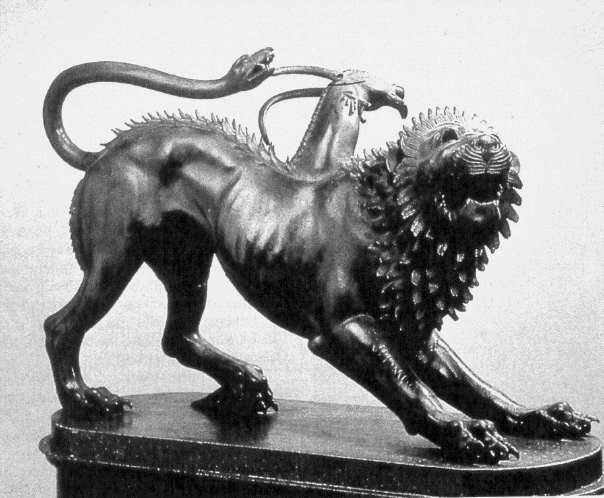
The third type of drakon was the Khimaira, a fire-breathing mythical beast whose form was a hybrid of lion, serpent and goat. Medieval artists used this creature as the template for the Dragon of Saint George, and this form became the link from ancient Hellas to modern D&D creature. The hero Bellerophon was commanded to slay it by King Iobates. He rode into battle against the beast on the back of the winged horse Pegasos and, driving a lead-tipped lance down the Khimaira's flaming throat, suffocated it. From Hómēros' Iliad:

 "On first deciphering the fatal message, he ordered Bellerephon to kill the monstrous Chimaera, spawned by gods and not men, that had a lion’s head, goat’s body and serpent’s tail, and breathed out deadly blasts of scorching fire. But Bellerephon slew her, guided by the gods." [VI:119-211]

The Drakaena were hybrids as well, usually with the upper body of a beautiful nymph, and the lower body of a drakon or sea-monster. Most often, these were parents to the above--a necessary evolutionary step. Famous examples include the Goddess Keto, who spawned the Hesperian Drakon, Ekhidna, who was married to the serpent-giant Typhôeus and spawned most of the dragons and monsters of myth, and Skilla, who did not spawn anyone, but was the she-dragon who haunted the Straits of Messina, snapping up sailors from ships--as Odysseus discovered.

These are the four types of drakones the ancient Hellenes identified, some mythological, some actually living in those days. Hopefully this will clear up the confusion of dragons in ancient Hellas and Hellenic myth once and for all.

Image source: Hydra, Cetus, Khimaira, Skilla.

This morning, I got to pick up the complete series of twelve volumes of George Grote's classic standard work 'History of Greece'. It's the 1858-1862 edition. The original came out from 1846-1856. It's one of those series of books I doubted I would ever own, but I do now and I'm beyond excited. Archeology has come a long way since Grote, that's for sure. For one, in the time of Grote, the remains of Troy had not been identified yet, so Grote highly doubted the Trojan war had been real. Because of this, Grote is definitely not the only author to read on the history of Greece, but he's an excellent writer in general, and what he writes, you'll remember. If you even manage to get your hands on a copy of his books, either the pre-1900 editions or the new volumes (which come in various price ranges, formats and quality), and you an interest in the history of Greece: read it. It'll be worth it.

The other item on that picture is a kylix, an ancient Hellenic drinking cup. This is a replica of course, made in Krete, and gifted to me by the same friend who tipped me about the Grote books. If you've never heard of a kylix, tomorrow's post will surely be of interest to you, because for the Pagan Blog Project, I'm writing about  ancient Hellenic pottery shapes. The image is a simplified version of this image: Kadmos (Κάδμος), defeating the guardian of the spring. 
As the myth goes, as written down by Ovid in his Metamorphoses:

"Kadmos was the brother of Europe, who got taken by Zeus. During his quest to recover her, he was ordered, by the oracle in Delphi, to follow a cow with a half moon on her flank and to built a town on the spot where the cow laid down. The animal led him to Boeotia, where he founded the city of Thebes.

Kadmos wanted to sacrifice the cow to the goddess Athena and send some of his companions to the nearby Spring of Ismenos to fetch water. However, they were slain by the gold-crested dragon of Ares, who guarded the spring. Kadmos, in turn, confronted and destroyed the hydra and followed the instructions of Athena to sow the dragon’s teeth in the ground. Fierce armed men sprang up called Sparti, but they started fighting amongst themselves until only five remained. They assisted Kadmos to built the Cadmeia or acropolis of Thebes."

As you can see, this week was a great week for my Hellenic collection, and because I'm so excited about it, you guys get an extra post today.