Showing posts with label Minoan. Show all posts


The Minoan civilization was an Aegean Bronze Age civilization that arose on the island of Crete and other Aegean islands and flourished from approximately 3650 to 1400 BC. It was rediscovered at the beginning of the 20th century through the work of British archaeologist Arthur Evans. Historian Will Durant referred to it as "the first link in the European chain."

It was not until roughly 5000 BC in the late Neolithic period, that the first signs of advanced agriculture appeared in the Aegean, marking the first signs of civilization. The term "Minoan" refers to the mythic King Minos. Minos was associated in Greek myth with the labyrinth and the minotaur, which Evans identified with the site at Knossos, the largest Bronze Age Minoan site. The poet Homer recorded a tradition that Crete once had 90 cities.

The Minoans were primarily a mercantile people engaged in overseas trade. Their pottery provides the best means of dating. As traders and artists, their cultural influence reached far beyond the island of Crete — throughout the Cyclades, to Egypt's Old Kingdom, to copper-bearing Cyprus, Canaan, and the Levantine coasts beyond, and to Anatolia. Some of its best art is preserved in the city of Akrotiri, on the island of Santorini, very near the Thera eruption.

Though we cannot read their language (Linear A), and there is much dispute, it is generally assumed there was little internal armed conflict in Minoan Crete itself, until the following Mycenaean period. The armed Mycenaeans or the eruption at Thera are two popular theories for the eventual demise of Minoan civilization around 1,400 BC.

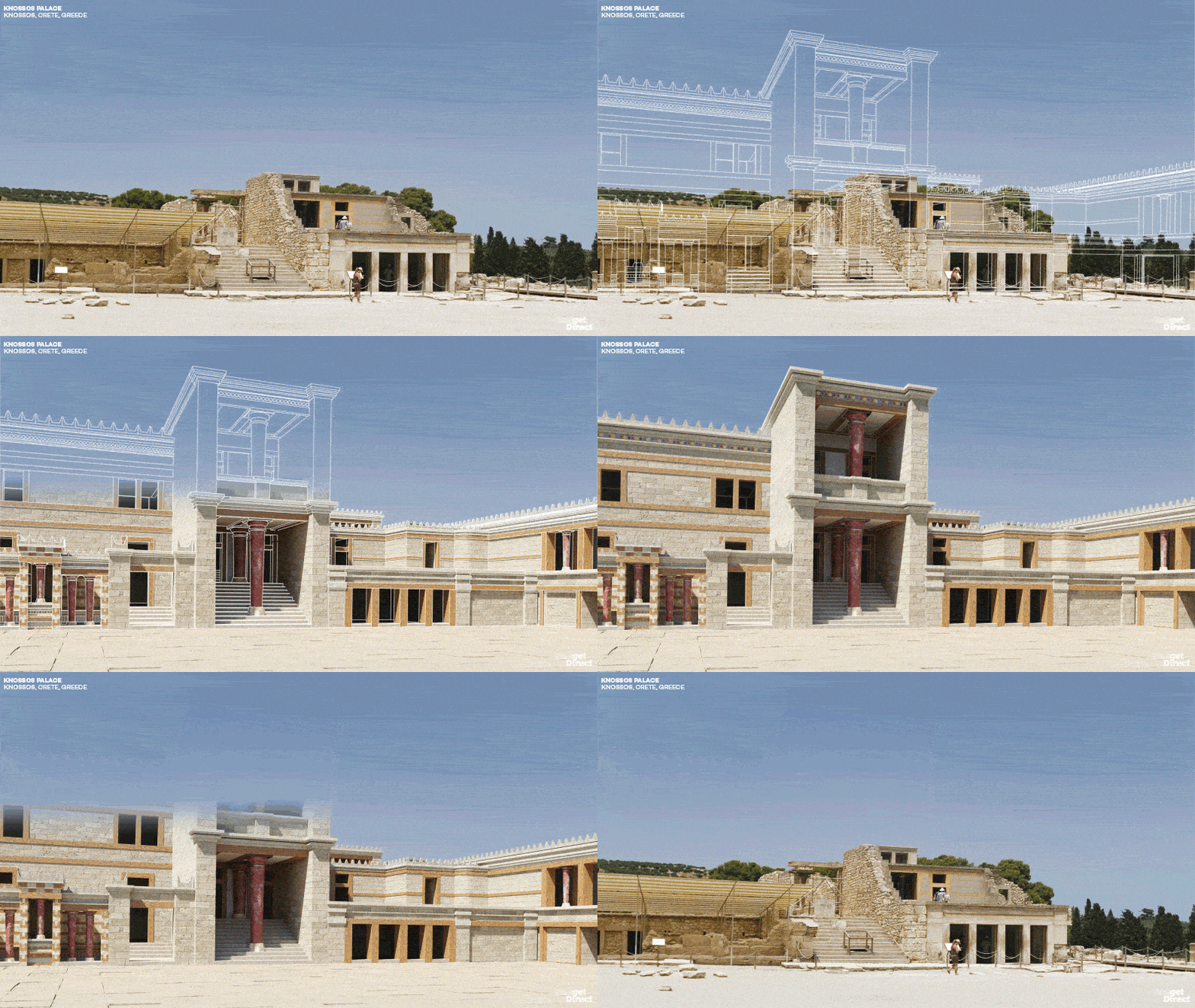
Following on from the popularity of their reconstruction of European Castles and Ancient Wonders  award winning Australian insurance company Budget Direct decided to restore a selection of palaces from across the globe, one of these being Greece’s Ancient Knossos Palace. For this project, with the help of a team of architects and a lot of desk research, Budget Direct virtually reconstructed seven ruined palaces around the world including the Knossos Palace.

The town of Knossos, which surrounds Knossos Palace, is considered to be Europe’s oldest city. It was settled as early as the Neolithic period around 700BC and by 1500BC had a population of 100,000 people. The largest Bronze Age archaeological site on Crete, the Palace of Knossos is located just south of modern-day Heraklion near the north coast of Crete.

Constructed around 1700BC, Knossos Palace is the most complex in Greece and thought to be the first palace built in the Middle Minoan IO period.The palace was abandoned sometime in Late Minoan IIIC, 1380 – 1100BC, for reasons which are largely unknown.

During the Bronze Age, Knossos Palace was the ceremonial, religious, economic and political centre of the Minoan Civilization. The archaeological site of Knossos Palace covers about 20,000 square metres, spread over three acres of land and comprises over 1,500 rooms. Excavation of the site has provided historians with a wealth of insight into the Minoan Civilization. Tools such as clay and stone incised spools and whorls are indicative of a cloth-making industry in existence.

Artefacts as well as the many vibrant frescoes on the wall of the ruins provide a further understanding of the Minoan culture. Painted in a style emphasising movement and grace, these frescoes illustrate scenes of lithe young athletes, ladies gossiping and dancing, and dolphins and other animals in magical gardens. One frescoe depicts the ancient sport of bull-leaping, a sport which may have given rise to the legend of the mythical Minotaur, a creature of later Hellenic mythology that was half- man and half bull.

The possibility that there existed a Minotaur became more acceptable once it was understood that, in the Minoan sport of bull-jumping, the male athlete ‘became one with the bull’ as he vaulted over the bull’s horns. It could therefore make sense that this sport may have evoked in ancient consciousness the ‘myth’ of the Minotaur through the impression that these athletes were half men and half bulls.

The ruins of the palace foundations reveal a vast interconnected maze of small corridors, staircases and private rooms containing residential dwellings, workshops, administrative areas. Since the intricate interior of Knossos Palace has been uncovered it has been speculated that this complex structure, combined with bull symbolism ever-present throughout the ruins, has provided the distant inspiration behind the labyrinth in the Greek myth of Theseus and the Minotaur. Timber stairways led to large upper rooms have not survived the ages, but probably once rose five stories in height.

An elaborate and advanced system of drains, conduits, and terra-cotta pipes provided water and sanitation. Vertical shafts in the structure known as light-wells were designed to bring natural light to the lower levels, created an airy and comfortable atmosphere.

Despite the fact that Knossos Palace was first excavated a century ago, it is still somewhat shrouded in mystery and researched have many questions about the palace and the people who inhabited it. The controversial restoration of parts of the palace over the years has remained the centre of historical debate, with many saying that the rebuilding has been based on “historically incorrect creative licence.”

he 'highest' palace of Crete, Zominthos continues to be excavated by the Archaeological Society under Honorary Director of Antiquities, Dr. Efi Sapouna-Sakellaraki. Despite the difficult conditions (COVID-19), the excavation was carried out with all the mandatory protection measures.


The purpose of the excavation was to clarify how to access the north entrance of the Central Building, one of the central entrances, and to verify the biomagnetic research carried out by the team of A. Sarris north of the Central Building.

This year’s excavation proved that the existing, two-storey or even three-storey, Central Building had an earlier use, at least from 2000 BC and that from 1700 BC it began to expand to the surrounding area; a fact that has already been acknowledged in previous excavation periods and culminated this year with the unearthing of two new complexes. Ultimately it turns out that the excavation on the northern slope of the hill, where the palace is located, has not been exhausted by excavations and that further investigation is needed.

Once again, it turns out that the palace of Zominthos had a political, economic and religious character throughout its existence, because of its proximity to the large religious centre of the Ideon Andron whose fame spread to the Eastern Mediterranean, the Near East and Egypt.

This year’s excavation showed that access to the northern entrance had already been made as early as the Protopalatial era (around 1900 BC) by a ramp, which ended in a strong retaining wall and was subsequently twice paved with slabs during the Neopalatial period (1700-1600 BC). 

A slanting, ritual corridor was built in the strong retaining wall, which reached the northern entrance. Its use from the period of the first palaces is confirmed by ceramics and especially by cups of the type found in the Middle Minoan period (around 1800 BC), typical of the pottery of Knossos.

On the level of the Late Minoan IA period (around 1650 BC) three stone openings (drainage pipes) were unearthed belonging to areas of the Central Building and the western apartments attached to it immediately after its destruction, around 1650 BC (Complex I).

Standing out from Complex I is what is now called the “north sanctuary” from the Neopalatial period, an important sanctuary outside the Central Building. Part of it was excavated in 2019 and specifically an altar laid out with stones, between and on top of which a number of ritual and other vessels,came to light; mainly rhyta.

The discovery of a small sheet of gold unearthed after rain, led to a search under the altar’s stone layer, where a surprise awaited the excavators. Found in the center of the underlying layer was a piece of burnt wood on which about 90 small sheets of gold were either attached or scattered round it. The finding of this set can only point to the existence of a wooden idol clad in thin gold leaf. Corresponding gold-clad idols are known from ivory figurines of Archanes and Palaiokastro.

On the same level a stone was found, a ritual vat for receiving liquids and a seal with an animal representation on its sealing surface. Obviously, after the first destruction of the new palaces, the occupants of the building preserved the remains of the ruined idol, over which the stone altar was built with the ritual vessels mentioned above.

The timeless sanctity of the place is apparent by the existence on the same spot, on a lower level and north of the altar, of an earlier sanctuary of the Protopalatial period (around 1900 BC), in which fragmentary figurines of people and animals were unearthed. Among them is a beautiful, female figurine, named “the Lady of Zominthos”.

North of Complex I, a second complex of rooms (Complex II) was unearthed, separated from the first by a narrow corridor The rooms are paved and equipped with an important sewerage system, with pipes starting from Complex I and continuing further north. In one of these rooms and among the ceramic finds an important flower-shaped seal came to light, dating from the time of the first palaces.

Both the drainage and sewerage systems prove the advanced expertise that existed in Zominthos. The use over time of the section excavated this year is also proved by a coin of the Doge of Venice Pietro Gradenigo (1289-1311), which coincides with the 4th Crusade and the period of Venetian rule in Crete.

For more images, go here.

Petras, the elite cemetery of house tombs (c. 2900-1800 BC), is part of a very rare monumental topography consisting of a Minoan palace and several settlements (3400-1100 BC), at the east end of Sitia.


The archaeological sites of Petras have been excavated since 1985 as part of a long-term systematic research programme of the Ministry of Culture, headed by Dr. Metaxia Tsipopoulou, executive member  and Honorary Director, since 2012,  of the Ministry of Culture.

The palace and part of the main settlement have been open to the public since 2006. The Petras excavations are among the largest research projects to have been conducted by members of the Greek Archaeological Service. Significant findings have contributed to a better understanding of Minoan society and its contacts at home and abroad especially in the Pre- and Proto-palatial periods.

The ongoing study of the excavation results, such as the excavation itself, is carried out by an interdisciplinary team of experts. There are now 100 publications including articles, monographs and the proceedings of two conferences. In addition, guided tours are organized annually during excavations for the people of Sitia and its visitors, educational programmes for children and students, as well as photographic exhibitions. It should be noted that all funding for the excavation, conservation of the material, stabilizing work and research come from an Institution abroad and that the excavation conducted by approximately 40 people for six weeks a year, is, from an economic point of view, a development project for the town of Sitia.

The excavation of the cemetery is nearing completion, based on the second five-year programme 2017-2021), approved by Ministerial Decree and renewed annually. This year the license was not renewed and no explanation was given by the Ministry’s Central Services of the Ministry for this (silent) cessation of the project.

The cemetery site is threatened by winter weather and unlawful human activity. Excavating the funerary buildings and stabilizing the walls must be completed in the next two excavation periods, according to the detailed schedule submitted to the Ministry for the annual renewal of the permit.

To persuade Minister of Culture and Sports, Dr. Lina Mendoni to reconsider the decision (silent ,not written) to stop the excavation, for the planned six week field work to go ahead in the autumn, a gathering of signatures has begun online. You can sign here.
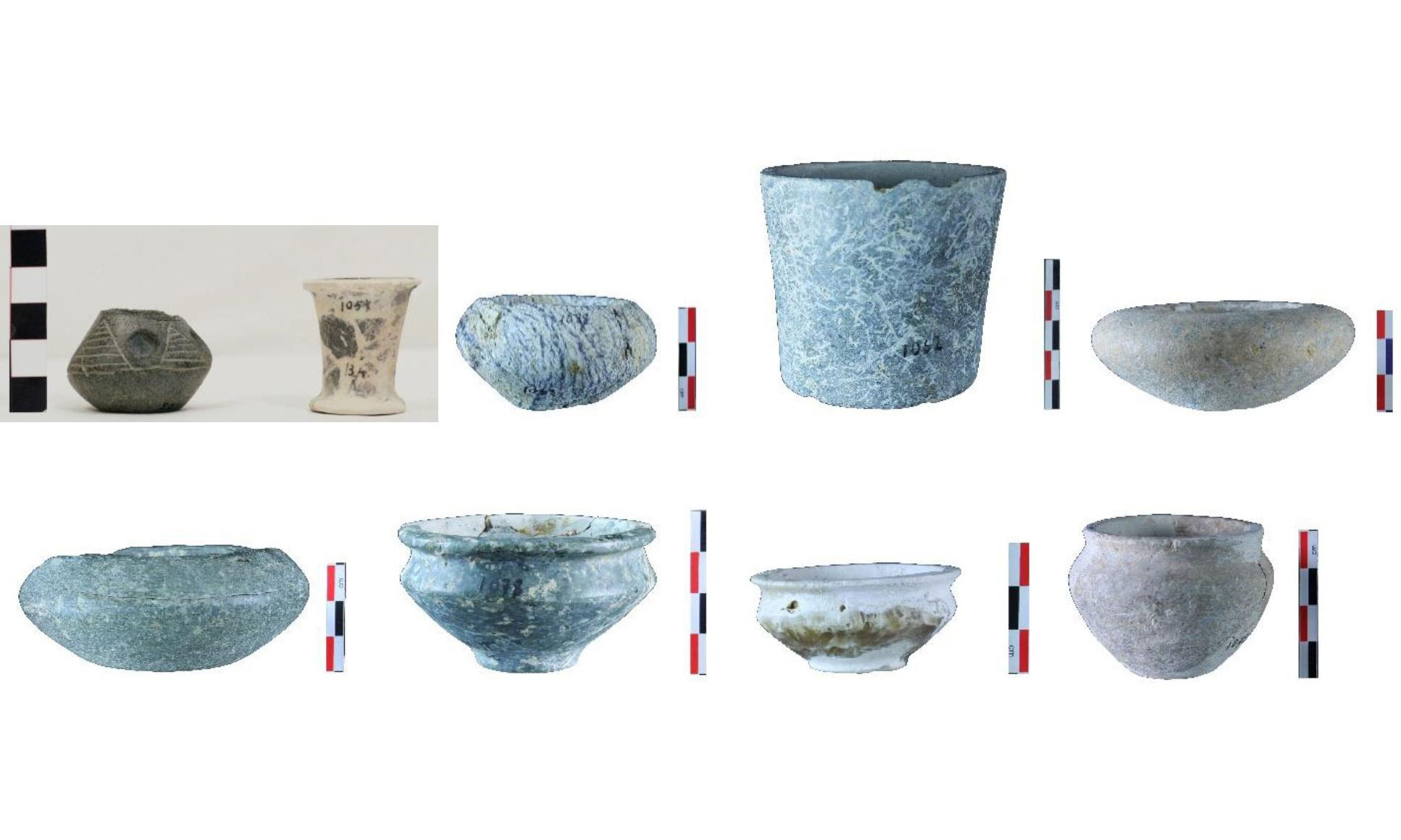
An in-depth analysis of stone objects has yielded new evidence on Minoan stoneworking, with regard to the geological outcrops exploited for the production of certain objects as well as the specific stone materials used for the making of particular shapes.


A team of experts led by archaeologist Dr. Georgia Flouda (Heraklion Archaeological Museum) and consisting of researchers from the Foundation for Research and Technology (IESL-FORTH), performed a series of tests on stone objects from the Minoan Tholos Tomb B at Porti in Crete’s Mesara Plain. The results have just been published through the Journal of Archaeological Science (Vol. 32, August 2020); the article is accessible to view and download here.

Cretan Tholos tombs are much earlier than the more well-known Mycenaean Tholos tombs, do not relate to them, and reflect completely different socio-cultural procedures.  Found in the plain of Mesara, in south-central Crete, the Tholos tomb P at Porti dates to the Early (EBA) to Middle Bronze Age (MBA) (3rd and early 2nd millennium B.C.), (ca. 2700–1700 BCE). According to the researchers, this tomb’s material represents “one of the richest burial assemblages in south-central Crete”, reflecting in many ways the technological and ideological innovations as well as wealth characterizing what is known as Crete’s Prepalatial and Protopalatial periods.

In particular, the mortuary assemblage where the team performed its archaeometry project consists of a group of 59 stone artifacts (vessels, implements, and figurines).

As mentioned in the paper’s abstract, the analysis was based on mobile Raman microspectroscopy, a quick, non-invasive deep scanning archaeometrical method. Mineral identification was possible for over half of the objects examined and the results expand our understanding, originally obtained on the basis of visual and microscopic characterization of the objects. During the project, patterns of variability in the stones investigated are correlated with the typological repertoire of the final products and compared with data from the neighboring site of Apesokari; further inferences on craft specialization issues are finally drawn.

In all, the data obtained lead researchers to suggest that stone vessel manufacture at Porti was predominantly focused on the exploitation of local soft stone outcrops. This hypothesis agrees with the current knowledge concerning the geological formation of the Asterousia area, on the northern fringes of which the site of Porti is located.

In parallel, this research gave the opportunity to the team to assess and discuss the capacity of mobile Raman microspectrometry to contribute to stone object characterization as regards their mineral composition, along with the advantages and limitations of the methodology followed. Raman analysis is performed quickly, non-invasively, directly on the object and over several spots across its surface for probing heterogeneous mineral distributions. The mobile spectrometer permits measurements to be conducted on location, namely within the museum study facilities. A major limitation with respect to obtaining clean analytical information resulted from strong fluorescence emission observed in some of the measurements, which interfered with the Raman scattering signal. These emissions were attributed to organic materials present on the stone surface either as environmental contamination or as a result of previous, often undocumented, conservation treatments.

Finally, experts stressed the need to collect and thoroughly characterize local stone outcrops as well as archaeological stone objects; in so, it is stated that building a representative Raman spectral database will certainly facilitate future studies.
The monkeys featured in several frescos in Minoan Greece suggests the civilisation was familiar with multiple monkey species, none of which were indigenous to the region. Researchers studying the ‘blue’ monkeys in Bronze Age frescos from Minoan Greece have found they’re incredibly accurate, to the point that researchers can even identify the genus of monkey.


At the 3,600-year-old settlement of Akrotiri, Thera, vervet monkeys are commonly depicted. Their rounded greyish/black muzzle, white band on the forehead, long arms and legs, and extended tail are all key indicators.

Meanwhile, at Knossos, Crete, baboons appear to be depicted. The narrow waist but thick chest, projecting face and hairless nose are a good match for the primates.

Crucially, the behaviours of both monkeys match up to their real-life counterparts. The vervet monkeys are depicted climbing, whilst baboons are seen on the ground. This would suggest that the artists had seen, or had contact with people who had encountered these animals.

Such contact is notable as neither species of monkey is native to the Minoan region, both being found in North-eastern Africa. There is alleged evidence of Minoan contact with the continent, but these monkeys provide some of the strongest proof to support such a theory.

There is one contradiction, monkeys aren’t blue, however, cultural particularities and trends often influence how colours are categorised. In some cultures this results as blue being viewed as part of the grey-green spectrum.

Perhaps this happed among the Minoans, explaining why the coloured grey/green monkeys are depicted blue. Alternatively, they could be borrowing the colouration from the Ancient Egyptians who used blue in scared contexts.

Either way, this case of ‘archaeoprimatology’ sheds new light on Minoan frescoes and provides insight into the surprisingly interconnected world of Ancient Greece.
Archaeologists have found thousands of handleless clay cups at sites on the island of Crete and at the palace Knossos. One 3,500-year-old vessel, designed to be hurled out with the rubbish, is going on display at the British Museum this month. The single-use cup was made by the Minoans, one of the first advanced civilisations in Europe.


The cup will go on show at the display "Rubbish And Us" at the British Museum, which has been under pressure over environment-related issues with its sponsorship deal with oil giant BP. Julia Farley, who is a curator at the British Museum, said:

"People may be very surprised to know that disposable, single-use cups are not the invention of our modern consumerist society, but in fact can be traced back thousands of years. Minoans gathered at the palace for parties, feasts and gatherings such as bull-leaping festivals - a "more risky" version of "hurdles". The elite were showing off their wealth and status by throwing these great big parties, feasts and festivals. People were getting together in large groups and much like today, nobody wants to do the washing up."

As well as being convenient, the cup was a means of showing off wealth because of all the resources "poured into making it". Farley said she hoped the display would make visitors think creatively about reducing waste, instead of just feeling guilty.

"Human beings have always produced rubbish. Making some rubbish is an unavoidable by-product of being human. We are tool-using animals. We wear clothes. Nothing lasts forever. It's in the very nature of our existence that we make rubbish. This is a sobering message about scale and consumption and I think we need to find that balance, which humans have never been very good at finding."

The ancient object will be shown alongside a waxed paper cup from the early 1990s - made at around the same time modern disposable cups were taking off, in The Asahi Shimbun Displays Disposable? Rubbish And Us. Other objects will include a yellow fishing basket made from plastic wrapping and photographs from across the Pacific, showing the extent of the plastic problem. Farley said:

"We have thousands of these Minoan, disposable cups and that's a lot. But today we are making over 300 billion papers cups globally every year. The Minoan civilisation is tiny compared to the global consumerist economy that we have now. Now we are doing what human beings have always done but we are doing it on an unprecedented scale with materials that are going to take hundreds, if not thousands of years, to biodegrade. We think of ancient people being in touch with their environment but if you cut down trees to make charcoal and burn it to fire clay that's releasing a lot of carbon dioxide."

The Museum said it is "striving to lessen its environmental impact", with all waste being either recycled or burned and converted to electricity. British Museum director Hartwig Fischer said: 


"We hope that this display will make people think about their relationship with rubbish, then, now and in the future."
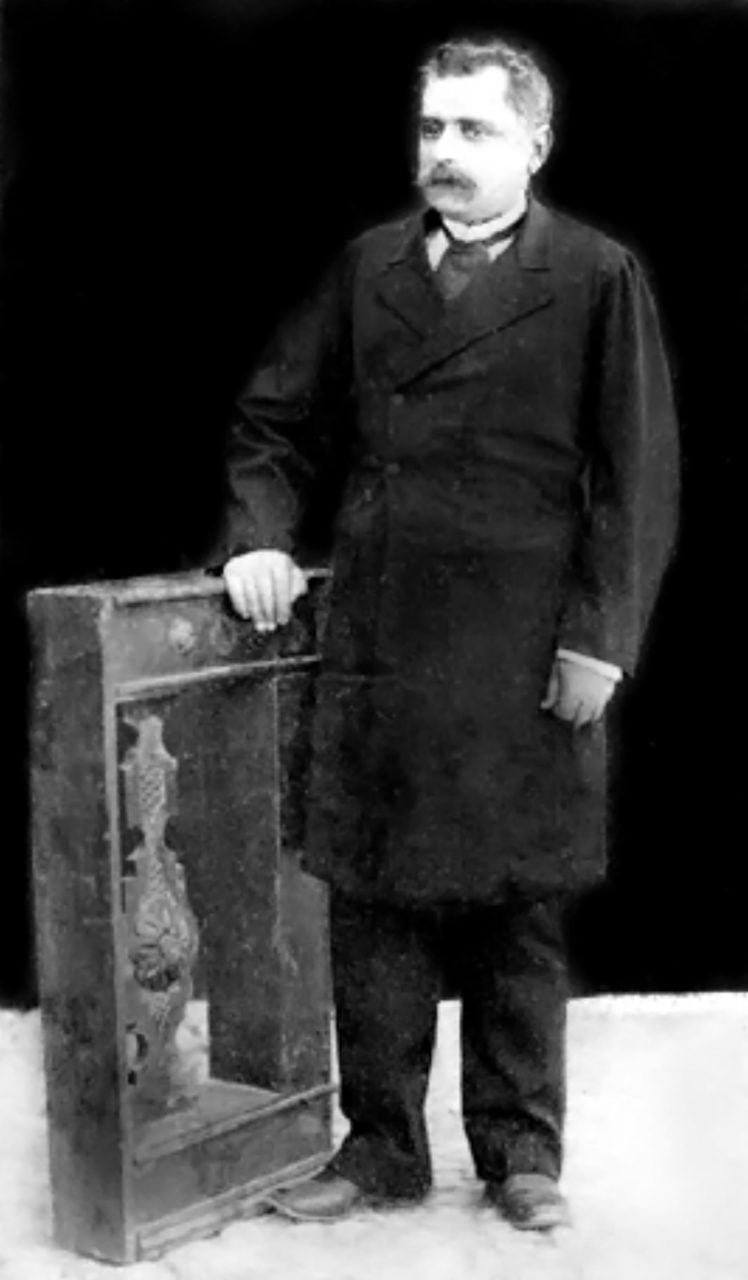
Knossos is the site of the most important and better known palace of Minoan civilisation. It is located in a prominent position on Kefala Hill, 6 km. southeast of Herakleion, surrounded by olive groves, vineyards and cypress trees. According to tradition, it was the seat of the legendary King Minos. The Palace is also connected with thrilling legends, such as the myth of the Labyrinth with the Minotaur, and the story of Daidalos and Icaros. The site was continuously inhabited from the Neolithic period (7000-3000 B.C.) until Roman times. Most people believe that Knossos was discovered by Sir Arthur Evans in 1900. In fact, the first excavation took place in 1878, by the Cretan merchant and antiquarian Minos Kalokairinos, but his contribution has been largely overshadowed by that of Evans.

Minos Kalokairinos was born in 1843. His father was a rich landowner, who owned the site of the palace of Knossos. As Dr Katerina Kopaka notes, “Kalokairinos tried to combine his responsibilities as an homme d’ affaires with his vision of a man of letters”. He obtained secondary education on the isle of Syros, then enrolled at the law faculty of the University of Athens where he only studied a year, as he was forced to abandon his studies after his father fell seriously ill and died. He then took over, together with his brother Lysimachus, the family-owned business until 1871.

Kalokairinos later went into soap manufacturing, winning awards at world exhibitions. Unfortunately, however, his business enterprises were not destined to be successful to the end; in 1895, he was forced to declare bankruptcy and was thus deprived of the right to engage in commerce. In 1903 he decided to resume his legal studies at the university, and was later awarded a degree. In 1878 his passion for archaeology and classical studies led him to attempt the first systematic excavations at Knossos. He bought the site where he wanted to conduct excavations from Zekiris Bey, Ibrahim Efentakis and according to Turkish archaeological law he would be entitled to 1/3 of the findings. The main excavation lasted three weeks and covered different parts of the Royal Palace complex, focusing on its west and south wings.

In 1879, the Christian General Commander of Crete, Fotiadis Pasha, visited Knossos to see the progress of the excavations. With the agreement of the city’s scholars, he decided to stop the excavations in order to protect the findings, because he was afraid that they would be transferred to Istanbul, as Crete was still under Turkish occupation.

Kalokairinos, who wanted to make Knossos broadly known, escorted archaeologists, diplomats, newspaper correspondents and other VIPs at the site and showed them his private collection.

In 1886 he was visited by the German archaeologist Heinrich Schliemann, who was famous for the discovery of Troy. Kalokairinos showed him his findings, but he also failed to obtain permission to continue the excavations.

In 1894 it was Evans’ turn to visit Crete and to be informed about the excavations. Sir Arthur Evans was impressed and bought ¼ of the Kephala Hill for 6,000 drachmas. On 23 March, 1900, excavations began. Evans’ most important colleagues were the archaeologist D. Mackenzie, known for his excavation in Melos, who undertook to keep the excavation journal, and the architects C. Doll, F.G. Newton and Piet de Jong.

First came to light the “throne room” and within two years Evans and his team managed to dig Knossos out of the ashes and lava. Kalokairinos had already retired, on account of the dramatic events he’d experienced: during the slaughter of civilians by the Turks on August 25th 1898, his brother Lysimachus was beheaded, his niece had disappeared and his son was murdered. His home was set on fire and the collection of findings from Knossos, destined for the Archaeological Museum of Athens, was destroyed.

In 1903, a new mansion was built by Kalokairinos’ nephew, son of Lysimachus. Today this mansion houses the Historical Museum of Herakleion. Shortly before Minos Kalokairinos’ death, he published the journal “Cretan Archaeological Ephemeris”, much of which was devoted to Knossos.

Kalokairinos had a strong disposition towards ancient Hellenic literature, especially Homer, Plato, Strabo, Pausanias and their accounts of Cretan antiquity. As he confesses in his book Prolegomena 1893, his strong desire to draw upon these works in order to elucidate the ancient history of Crete, led him to the undertaking of the excavations.

Minos Kalokairinos had found a large collection of objects during his excavations. The findings that survived after the violent events of 25 August, 1898, mostly amphorae found in the western wing of the palace, were donated to museums of Greece, Paris and London in order to promote public interest in Knossos.

Cretan archeology owes a great debt to Kalokairinos for this early exploration of Knossos which highlighted the islands prehistoric past and opened the path for discoveries that surpassed all expectations.

Source: Greek News Agenda
Linear A is the yet-undeciphered language of the ancient Minoan civilization of Crete that flourished from roughly 1700 BCE to 1490 BCE. Linguist and archaeologist Brent Davis, a lecturer at the University of Melbourne, is one of only a handful of people around the world to have made any significant headway on solving Linear A in the last 50 years.


The Minoans live on in myth as people of the land of King Minos who kept the half-bull, half-man Minotaur in a labyrinth below his palace at Knossos. They are also possibly the oldest civilization of Western Europe, and their language could reveal more about a people and culture that was the foundation on which Ancient Greek and (ultimately) Roman culture were built.

The eccentric English architect Michael Ventris famously cracked Linear B, a slightly later but closely related script found in Crete and mainland Greece, in 1952. He discovered that Linear B was actually a very early form of ancient Greek—Mycenaean—and his finding extended the origin of ancient Greek civilization back a further 500 years earlier than first thought.

The Linear B tablets were preserved by chance when the dried clay that had been written on was fired as a result of palaces and other buildings burning down during natural and human-made calamities.
The information they revealed proved to be largely inventories of people, produce, accounts, offerings, and other goods, giving us glimpses of people and their occupations.

Linear A is likely to reveal similar information, but Davis says much Linear A occurs as religious script. “If we can decipher these inscriptions, we will have the personal prayers of Minoan people,” he says.

At the time he cracked Linear B, Ventris told the BBC it was like having to solve a crossword puzzle without knowing which spaces are blacked-out. In fact, Ventris’ achievement was built on the crucial work of little-acknowledged US classicist Alice Kober, who died in 1950. It was Kober who identified similar word endings in Linear B, allowing her to find some root words she thought were place names and which Ventris would later realize were akin to Greek. She also devised a method for tabulating the relationships between signs that Ventris would build on—leaving behind more than 180,000 index cards.

Deciphering Linear B was a monumental achievement, but the challenge of Linear A is even more difficult. That’s partly because the language behind the script doesn’t appear to be like any other language. Davis says:

"It seems to be a wholly unknown indigenous language. Linear B took most of its signs from Linear A, and because we can read Linear B, we can actually pronounce Linear A inscriptions, but if you do pronounce them, it just sounds like complete gobbledygook."

Like Ventris, Davis became fascinated with deciphering ancient languages as a boy, particularly the story of how Egyptian hieroglyphs were deciphered using the Rosetta Stone that Napoleon’s soldiers found in Egypt. But he’s always known that solving Linear A was a tough task.

"Ventris vowed, when he was just 14, that one day he’d solve Linear B. At the same age I was saying I’d love to solve Linear A, but I’m not promising anything."

By establishing the word order of the language, linguists can identify the function of a word in a sentence just from its position. It’s like finding a key word in a massive crossword puzzle.

"The definite word order in English is subject (S)-verb (V)-object (O), as in the phrase John likes cats. And we know that about 97% of human languages are either in this form or S-O-V (John cats likes) or V-S-O (Likes John cats). What we really need to find is a palace archive, which is where we are likely to find enough Linear A to finally decipher it."

But when Davis looked at other Bronze Age languages of this period in the region, none were like English. They were either S-O-V (like early Greek and Sumerian), or V-S-O (like ancient Egyptian). He guessed Linear A was likely to have one of these two word orders. He then applied this framework to a series of inscriptions that appear on Minoan offering bowls. To put it simply, he found that the words on the bowls tended to recur in what was obviously a formula, except for the second word in the inscription, which was always different from bowl to bowl. His guess was that this word was probably the name of the person (the subject) making the offering. If correct then Linear A was likely a V-S-O language.

That was confirmed when he found the Linear B sign for “olives” (which it borrowed borrowed from Linear A), occurring after the name as the object of the phrase. The repeated start of the phrase was therefore a verb, like “gives”, yielding the phrase “gives Yasumatu olives,” or in English, “Yasumatu gives olives.” Just such an offering of olives in a goblet has been found, preserved at the bottom of a sacred Minoan well. “It was a huge feeling of discovery, completely thrilling,” says Davis.

But he cautions that understanding the word order alone won’t be enough to solve Linear A.

"Examining the word order provides something of a magic key, but we if we are to crack it what we need most is simply more material."

Material was another advantage that Ventris had in deciphering Linear B. There were 20,000 examples of Linear B signs occurring in inscriptions, compared to just 7,000 examples of Linear A signs.

"That is about three-to-four A4 pages worth. Mathematicians tells us that if we are to crack Linear A, we’ll need something like 10,000 to 12,000 examples of signs, which means we aren’t that far away—but it all depends on archaeology. Discoveries are still being made, so I’m optimistic, but what we really need to find is a palace archive, which is where we are likely to find enough Linear A to finally decipher it."

Davis is the 2019 winner of the Michael Ventris Award at the University of London, which the Michael Ventris Memorial Fund supports.

Source: University of Melbourne.
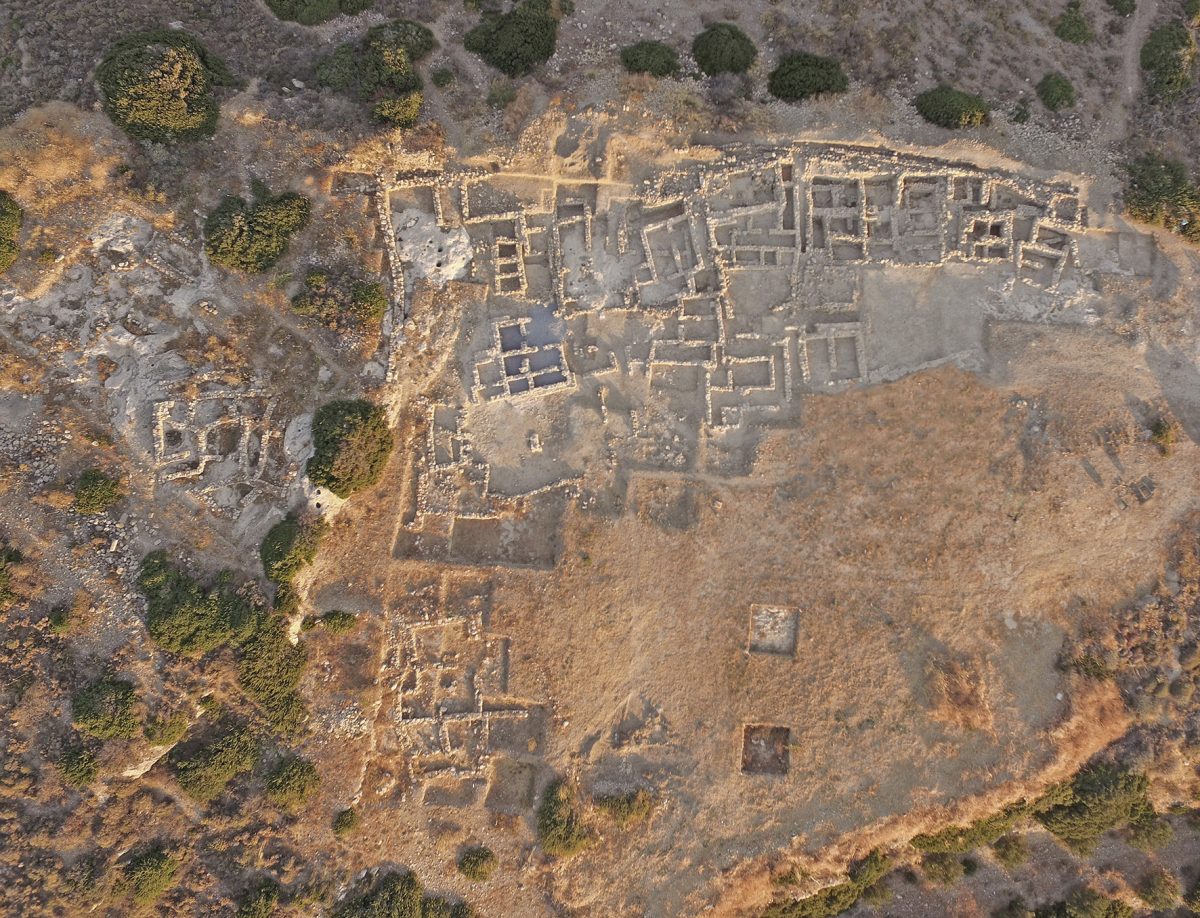
Great quantities of porfyra (murex shells) and buildings of a Minoan settlement were located in excavations by the Lasithi Ephorate of Antiquities west of the islet of Chrysi where ancient carved fish ponds have survived on the coast. The numerous broken porfyra shells found in the rooms of the houses are evidence of a very early cottage industry of porfyra dye established during Crete’s first palaces. The settlement had a flourishing economy not apparent from the architectural remains but from the fine quality artefacts found in the houses.


Chrysi islet is situated in the south of Crete in the administrative Region of Lasithi and belongs to the Ierapetra Municipality. The surface survey conducted between 2008-2011 provided evidence of human activity and habitation since the Bronze Age.

In 2018 and 2019 the by now systematic excavation on Chrysi under the Lasithi Antiquities Ephorate’s Head Chrysa Sophianou, brought to light a large building with many rooms, known as B2, which was inhabited without interruptions during the Protopalatial and Neopalatial period, from the Middle Minoan IIB to the Late Minoan IB period (ca 1800-1500 BC).

The rooms had simple architectural elements, such as built in vats, stone benches, work surfaces, hearths and a staircase with stone slabs. Pottery is a typical mixture of vessels for drinking, eating, cooking and storage, while many stone tools were recovered. It was a surprise to discover no evidence in this entire building of a cottage industry for the production of porfyra, unlike the other excavated houses of the settlement.

Despite their simple architecture, two rooms contained “treasures/hoards” of metal, glass and semiprecious stones. The first treasure was found in 2018 in a room which most probably was used as a storage area. The deposit contained two parts of copper talents, a mass of slag and jewellery: a gold ring, a gold bracelet, 26 gold beads (disc shaped, round and shaped like a papyrus), one bead of silver, 5 of bronze and the band of a bronze ring. There was also a large number of different shaped glass beads (39 round and 25 papyrus-shaped), 4 of so called Egyptian blue, 20 of corneal stone, 1 of amethyst, 10 of lapis, one agate seal depicting a ship whose prow has the shape of an animal’s head and a stone amulet shaped like a monkey.

While continuing the excavation in 2019, another treasure of talents was discovered in the corner of a room in the same building, along with a large saw and three vessels, one made of copper. Their overall weight is 68 kilos and together with the parts of the other treasure they are in all over two talents. It is the largest treasure of metals found to date on Crete. Moreover, stored inside a vessel were pieces of a tin talent. The latter is considered a rare find being the second from the Late Minoan period found on Crete. The first was discovered in a settlement on the islet of Mochlos.

The above data leads to the hypothesis that the inhabitants of building B2 in the Late Minoan period (ca 1500 BC) belonged to a higher social class and played a different part in the society of Chrysi; probably one of administration. They managed production, the promotion of products, the trading of porfyra dye and the import or distribution of metals.

Many more images here.
Archaeologists in Greece have located a "major treasure" of Minoan origin in a Bronze Age settlement on a small island in the Libyan Sea, the culture ministry said Friday.


A team excavating on the tiny island of Chrysi south of Crete for over a decade have unearthed a 3,800-year-old Bronze Age compound containing gold jewels, glass beads and the remains of bronze talents, the common unit of value of ancient Greece.

Some of the beads are of Egyptian origin, the culture ministry said in a statement.

The archaeologists also found ancient fish tanks and large amounts of porphyry -- a prized purple pigment of the ancient world derived from sea snails, and later the colour exclusively reserved for Roman emperors.

"The amount of broken shells found...show a very early Mediterranean production of porphyry dye. The cache constitutes one of the most important (Minoan treasures) ever found in Crete until now."

The Minoan civilisation, a naval superpower of the Bronze Age era, flourished on Crete and other Aegean islands until about 1500 BCE.
Important remains from the Early Minoan era (circa 2,600 BC), including an intact skeleton of a woman, were revealed recently near the complex of monuments currently being excavated by archaeologists in Sisi, in the Lasithi region on Crete.


The Greek Ministry of Culture noted in its announcement on Thursday:

"After the abandonment of the settlement by its people, who left almost the entirety of their material culture in loco, a monumental structure was constructed to the east of the village. This building became the heart of the later west wing. Even though it was destroyed by a fire in 2,500 BC, its remains were almost fully incorporated into the construction of a complex of monumental buildings with a courtyard, which was constructed around 1,700 BC."

Further excavations have revealed a decorated floor, constructed with a high-quality mortar, and a well-made 33-meter (109-foot) long clay drainage pipe, the ministry said.

Significant finds from lesser-known eras have also been unearthed in other parts of the hill, among them a residence that was destroyed in the Mid-Minoan Era, most likely by an earthquake.
The woman’s skeleton found in Sisi

A box-shaped grave belonging to the Post-Minoan era containing an almost intact skeleton of a woman was also found.

A copper mirror with an ivory handle, dress pins made of copper and a necklace with 15 olive-shaped golden beads and fifteen smaller golden beads were also found inside the woman’s grave. These types of graves are rare on Crete and are usually only found in Knossos and Chania.

The Culture Ministry said that over a hundred archaeologists from different nations participated in the 10th excavation period conducted by the Belgian School of Athens in Sisi, in collaboration with the Lasithi Antiquities Ephorate.

The dig near Sisi was under the guidance of Professor Jan Driessen.
I would like to share with you the The Palaikastro Hymn to Cretan Zeus. At the end of May in 1904 a fragmentary inscription bearing a Hymn to Zeus was discovered at Palaikastro in East Crete, during the excavation of the sanctuary of Dictaean Zeus, on top of the ruins of a Minoan harbour town which contained this hymn. From the very informative, and very well researched paper by Mark Alonge on the subject:

"The Palaikastro Hymn—better known as the Hymn of the Kouretes—does not celebrate a god of pre-Hellenic pedigree, who is Zeus in name only, as scholars have believed with virtual unanimity. Rather, an understanding of the conventions of Greek hymnic performance in its ritual context goes far to elucidating many of the ostensibly peculiar features of the Hymn. Moving out from Palaikastro, in eastern Crete, to survey the island as a whole, I show that the Cretan iconographic and epigraphic records contradict the widely accepted theory of a special, Minoan 'Cretan Zeus.' "

 The hymn goes as follows:

"O supreme son of Kronos, salutations! All-powerful over refreshment, you stand at the head of the gods. Come to Dicte at the turn of the year and take pleasure in our song. We weave it for you with lyres, having blended it with pipes, and we sing having taken our places around your well-walled altar.

O supreme son of Kronos, salutations! All-powerful over refreshment, you stand at the head of the gods. Come to Dicte at the turn of the year and take pleasure in our song. For on this very spot, your shield-bearing guardians received you, an immortal child, from Rhea and beating their foot, kept you hidden.

O supreme son of Kronos, salutations! All-powerful over refreshment, you stand at the head of the gods. Come to Dicte at the turn of the year and take pleasure in our song. [two verses missing]…of the beautiful dawn.

O supreme son of Kronos, salutations! All-powerful over refreshment, you stand at the head of the gods. Come to Dicte at the turn of the year and take pleasure in our song. The Seasons teemed year by year and Justice held mortals in her power, and Peace, who loves prosperity, governed all creatures.

O supreme son of Kronos, salutations! All-powerful over refreshment, you stand at the head of the gods. Come to Dicte at the turn of the year and take pleasure in our song. But, lord, leap to our wine jars, and leap to our fleecy flocks, and to our fields of fruit leap, and to our homes made thereby productive.

O supreme son of Kronos, salutations! All-powerful over refreshment, you stand at the head of the gods. Come to Dicte at the turn of the year and take pleasure in our song. And leap to our cities and leap to our seafaring ships, and leap to our new citizens and leap to fair Themis.

O supreme son of Kronos, salutations! All-powerful over refreshment, you stand at the head of the gods. Come to Dicte at the turn of the year and take pleasure in our song."
The mystery of what happened to the Minoan civilization has tormented archaeologists for over a century, and the tale has now taken a new twist. Nothing happened to them, say archaeologists who have been excavating the island of Crete for over thirty years.


This extraordinary people, who produced palatial architecture unparalleled in the Aegean region at the time, were not immolated by the volcanic eruption of Thera as once thought, crushed by earthquake, or squashed by Mycenean Greece as more recently supposed. Rather, the Minoans,- who had for centuries wielded influence throughout the Aegean, did experience earthquakes that rattled them, were indeed badly weakened by the volcanic blast from Thera on the nearby island of Santorini, and did experience the unamiable attentions of the mainland Hellenes.

But although the two cultures appear to have struggled, over time the elite elements of both became virtually indistinguishable, after 1450 B.C.E., if not earlier. Minoan influence as such would recede and the by-then-Mycenaeanised islanders would soldier on until the great collapse of civilization around the Mediterranean Basin, around 1,200 B.C.E.

It bears adding that archaeologists had once thought the Minoans must have "come from somewhere else" because of their advancement compared with the surroundings. But genetic analyses in 2017 concluded that both the Minoans and Mycenaeans descended from the stone-age farmers of western Anatolia and the Aegean, plus smidgens of heritage from the Caucasus and Iran. The two were very closely related.

Yet the destruction layers found in the main Minoan city of Knossos weren’t the result of Theran ash raining down 3,600 years ago but may be debris from Minoan resistance to Mycenaean incursions, or possibly from local rebellions between 1470 to 1450 B.C.E., sums up Colin Macdonald, an archaeologist with the British School in Athens.

The island of Santorini was evacuated and buried under meters of pumice. The shores of Crete would have been hit by tsunamis, which also wrecked the Knossos port on that island. Though much of the ash-fall blew in other directions, the eruption apparently did trigger decline on the island, the east part of which became quite depopulated. However: “Thera’s eruption did not directly affect Knossos – no volcanic-induced earthquake or tsunami struck the palace which, in any case, is 100 meters above sea level,” Macdonald points out. Archaeologists have found evidence of widespread destruction in the settlements of ancient Crete a generation or two after Thera’s eruption. How the devastation was caused has yet to be demonstrated.

Absent specific indicators, the cause could have been earthquake, famine, attacks from mainland centers of ancient Greece, like Mycenae, or some combination of the above, though a wholescale invasion of marauding Mycenaean mainlanders as the central factor seems less likely.

It is also theoretically possible that Knossos, not having been much physically affected by the eruption, tried to flex its muscle and attacked other centers of civilization on its own home island, Crete. Or, there could have been local unrest: class struggles, with the country people rising up against the elites.

What can be said is that some decades after the destruction in Crete in about 1450 B,C.E., a different style of burial custom appeared at Knossos and the administration adopted a new language and writing system.

It is the change in writing system that indicates top-down change at Knossos. The earliest writing in Crete dates to the early Bronze Age and was hieroglyphic. That was followed by a syllabic writing system called Linear A, one of the oldest known in the world, which remains undeciphered to this day. But starting around 1450 B.C.E., the very time of the destruction layers in Crete, the tablets archaeologists find in Knossos were written in Linear B, which was the Greek and Mycenaean writing system at the time. Possibly, the Minoan administrative apparatus at Knossos was taken over by Greeks from the mainland; or Knossos came under outright control of Greek mainland centers, perhaps even Mycenae.

Another change after 1450 B.C.E. is that the practice by stonemasons of leaving marks on their work, disappeared from Knossos. (This was a practice throughout the region, not a local invention.)
The bottom line is that by the 14th century B.C.E., the Mycenaeans seem to have overrun Minoan interests in the eastern Mediterranean. Mycenaean material culture became ubiquitous in the south Aegean Sea, where once Minoan influence had been strong.

It was quite the reversal of fate.In the centuries before the eruption, Cretan culture had exercised notable influence on the Greek mainland. But even though the blast didn’t necessarily affect Knossos too much directly, it plausibly weakened Cretan civilizations, opening the door to Mycenaean influences, as reflected in changes in administration and burial practices.

With the administration, perhaps even religious authority collapsed. “This could well have manifested itself in local uprisings and the burning of administrative and elite buildings,” Macdonald speculates. If the eruption did not break the backbone of Minoan civilization, it may have fractured its economy, and Mycenae - the powerhouse of mainland Greece – exploited that.

This theory is supported by the fact that the eruption destroyed the Theran port that had been aligned with Crete and Knossos, plausibly enabling the Mycenaeans to develop their own trading hubs, such as the other largest site in the Cyclades, namely Phylakopi, on Milos. There is no doubt that Phylakopi was instrumental in promoting the Mycenaean Greek language and writing, Linear B, as the lingua franca of Aegean economy after the eruption.

According to historians, Knossos was Europe’s oldest proper city, established between 2000 to 1900 B.C.E.. Its palace had features considered very advanced for the time, for instance monumental architecture, stone-built storm drains and sewers, and lavatories. And although the Minoans did suffer from earthquakes, studies of the architectural remains at the palace of Knossos have shown that the basic plan remained the same over 500 years, with some major renovations, repairs and additional buildings that added to the palace’s grandeur.

“Earthquakes were not ‘game changers’, but often spurred the authorities to try something new,” says Macdonald adding, “The earthquakes were important in terms of architectural change but not of cultural discontinuity.”

The palace storerooms and advanced drainage systems, built around 2000 B.C.E., remained in use until the final destruction of the palace in the 14th century B.C.E.  The palace was destroyed sometime in the 14th century B.C.E., perhaps towards its end, by a conflagration that baked the Linear B clay tablets and seal impressions. In the 13th century B.C.E., there are scattered signs of reoccupation in the badly damaged palace buildings. But by this time the Minoans, with or without the “Mycenaean veneer”, had largely disappeared from the world stage of history.

The Minoan civilization was an Aegean Bronze Age civilization that arose on the island of Crete and other Aegean islands and flourished from approximately 3650 to 1400 BC. It was rediscovered at the beginning of the 20th century through the work of British archaeologist Arthur Evans. Historian Will Durant referred to it as "the first link in the European chain."

It was not until roughly 5000 BC in the late Neolithic period, that the first signs of advanced agriculture appeared in the Aegean, marking the first signs of civilization. The term "Minoan" refers to the mythic King Minos. Minos was associated in Greek myth with the labyrinth and the minotaur, which Evans identified with the site at Knossos, the largest Bronze Age Minoan site. The poet Homer recorded a tradition that Crete once had 90 cities.

The Minoans were primarily a mercantile people engaged in overseas trade. Their pottery provides the best means of dating. As traders and artists, their cultural influence reached far beyond the island of Crete — throughout the Cyclades, to Egypt's Old Kingdom, to copper-bearing Cyprus, Canaan, and the Levantine coasts beyond, and to Anatolia. Some of its best art is preserved in the city of Akrotiri, on the island of Santorini, very near the Thera eruption.

Though we cannot read their language (Linear A), and there is much dispute, it is generally assumed there was little internal armed conflict in Minoan Crete itself, until the following Mycenaean period. The armed Mycenaeans or the eruption at Thera are two popular theories for the eventual demise of Minoan civilization around 1,400 BC.
Just how peace loving were the Minoans? Why did they not leave behind images of wars, battles and walls despite their contacts with other eastern peoples who were their contemporaries and who used such representations? Were the inhabitants of Minoan Crete perhaps ‟flower children” living among the lilies and passing their time with bullfights and festivities in meadows and olive groves? This is the subject of a talk by Dr M. Tsipopoulou at the Heraklidon Museum.


Ms. Tsipopoulou is honorary director of the Ministry of Culture and Sports, a specialist in the Bronze Age and Early Iron Age in the Aegean, and specifically in Crete, where she has conducted many important excavations. For the last 15 years she has been head of archaeological research at Petras in Sitia; a cemetery of the early and middle Minoan period (continuous use from 2800 to 1700 BC).

So how can the absence of martial themes in the art of the Minoans be interpreted? In two ways, the speaker explained.

"First of all, that in over 2,000 years of Minoan civilization there were no wars or other conflicts, or secondly that the Minoans believed for some reason that they should not depict battles and warfare … Obviously common sense is in favour of the view that the Minoans chose not to portray war. Single city political entities evolved in Crete and at some point, Knossos seems to have dominated the whole island. States are not founded without violence, they are not established without struggles and upheavals, whether internal, within the community or external with their neighbours."

It is hard to explain why such a thing happened. As well as why in Minoan culture there is no representation of or reference to a lord.

"In Minoan culture we have no representation of a lord, neither has any name come down to us except for that of Minos and perhaps Radamanthes, about whom we do not have much information. Moreover, Homeric Idomeneas was a Mycenaean king of Crete. For those who wonder about the famous Prince with the lilies from Knossos, I am afraid I shall have to disappoint them, because this fresco has been made up of two or three different images; the body belongs to a boxer while the head is that of a sphinx, according to a study of the fragments published by Wolf Dietrich Niemeyer."

Nevertheless, walls  did exist in Minoan Crete, like those discovered during systematic excavations conducted by Mrs Tsipopoulou in the 1980s in the Bay of Siteia, specifically in Aghia Fotia and mainly in Petras. A Minoan palace was discovered there, part of an urban settlement as well as a un plundered elite cemetery which was in use for approximately 1.000 years. In Aghia Fotia , the wall that surrounds the, so far, only rectangular building, dates with the latter from around 2100-2000 B.C. ‟Was there perhaps danger from the sea ?or did the people who constructed it want to protect their space and activities from the neighbours?” are some of the questions that arise, according to the honorary director of the Ministry of Culture and Sports.

Likewise in adjacent Petras, at the site of Minoan Siteia, what part could be played by two more walls, almost cyclopean in structure and with rectangular towers , the second of which surrounds the palace’s plateau on the hill top? According to its excavator, these two walls are part of extensive configuration works of the greater area which are related to the founding of the palace. So what does she believe? ‟Around 1900 B.C. the founding of the Early Minoan palaces was predated by social upheavals, the scale of which we cannot know, until one of the elites of each place prevailed or ,most likely, a compromise was reached between a few distinguished lines of rulers, who then undertook the palaces’ administration. The walls were built immediately afterwards, so they were probably a declaration of power and propaganda by the new authorities in the face of those considering to undermine it, whether local or from across the sea”. Consequently the walls ‟are not associated with any type of warfare, but were built immediately after whatever upheavals, precisely to avoid similar ones in the future, against the new ruling class”, explained the speaker, adding that there are walls belonging to the same period from two other important palatial sites in eastern Crete, those of Malia and Zakros.

What about weapons? In the Early Minoan period (circa 3000-2100), most of them were daggers, i.e. small swords either silver or bronze which according to scholars were either used for display (the silver ones) or as knives(he bronze ones) for various daily uses, while on rare occasions they could have been used as weapons in duels. ‟Roughly about that time, as well as slightly later, we also encounter male figurines that wear similar daggers in their belts, as in the very well known one from the peak sanctuary of Petsofas, near Palaikastron, east of Petras. Such weapons could kill if necessary, but those who carried them probably aimed to impress, displaying their high social position which allowed them to access expensive imported raw materials such as copper and ivory”, Mrs Tsipopoulou pointed out.

After the destruction of the palaces of Crete around 1900 B.C.-probably by an earthquake- new palaces were erected with Knossos being the most important. The policy of expansion in the Aegean begins in that same period. How peaceful was it? ‟ Minoan settlements in Thera, Rhodes, Kea, Samos but also in Miletos and Iasos in Asia Minor were probably colonies established for trading purposes. It is certain that a number of Minoans lived there, not just for trading reasons; they transferred their culture, their seals, in some cases tablets of Linear B script, their vases, cooking, weaving and so on.

Minoan, or rather Knossian, dominance in the Aegean was called ‟Minoan peace” corresponding to the much later ‟Roman peace” that prevailed throughout the Mediterranean after the Roman conquests of all Hellenistic kingdoms. Was there perhaps a Minoan army on the islands to protect their sovereignty or was it just an initially peaceful, commercial and cultural expansion? Did some war precede the ‟Minoan peace”? We do not know. Apart from the Minoan expansion in the Aegean, there are two other interesting changes during this Neopalatial period; the first in weaponry and the second in imagery”, Ms Tsipopoulou remarked.

She explains that at that time in Crete, large swords began to appear that were certainly more functional than the earlier daggers. Moreover, for the first time we have depictions of duals on signet rings. What do these examples signify? ‟They are probably linked with the so called Minoan maritime empire, but they definitely indicate the rise of new elites within Minoan society in the Neopalatial period, who felt the need to distinguish themselves as warriors.  They obviously had the time to also train in arms so as to promote their ideology to a symbolic level”noted Ms Tsipopoulou, adding that it is very strange these depictions of duals should be restricted to microsculpture, when they would work better as frescoes, as was the case later on in Mycenaean Greece. ‟As we have said however, in Minoan wall paintings we have no scenes of violence or war”.

After 1450, Crete came under Mycenaean rule and many changes occurred within the society and the administration. New elites appeared. The Mycenaeans were warriors and many of them had been buried with their long swords but also with their helmets made of boar’s tusks. Following the fall of the Mycenaean palaces in Mainland Greece, new waves of Mycenaeans arrived on Crete and were assimilated into the local population. Among them were also groups of warriors who, in the 12th century B.C. were buried in small tholos/beehive tombs along with their powerful weapons.

The complete talk will shortly be uploaded to the site www.blod.gr.
A new dimension to the cult at the palace of Zominthos and its beginnings in the Paleopalatial period (1900-1700 BC) was discovered this year during the annual excavation of the Archaeological Society conducted on Psiloritis by the Honorary Head of Antiquities, Dr Efi Sapouna-Sakellarakis.

As shown by the archaeological research, the rock on which the building complex has its foundations had been functioning since approximately 2000 BC as an open-air site of worship with small constructions.

This year, vessels of worship and other offerings placed in hollows of the rock came to light: egg cups (simple vases in the shape of a cup with a disc-like base), either plain or painted black (sometimes with white stripes on black or painted red). As argued by Efi Sapouna-Sakellaraki, this is a cult practice known to date from the Minoan peak sanctuaries.

The building complex had been founded on the rock as shown by scattered remains over all the area. In the southwest part whose final form was revealed in this year’s excavation, there are two- and three-storey rooms with paved or wooden floors on the rock. Valuable artefacts and utensils came to light in this section both this year and the previous one; bronze daggers, a seal, stone vessels etc.

In the same area, part of a chalice was unearthed and a small bronze spoon predating 1750 BC, i.e. before the destruction of the first palaces. In excavation terms, it is the first time a combination of a rock with a multistory building is encountered in a centre of habitation.

It has only been found depicted on a stone vessel in relief from the Gypsades region in Knossos, where a kneeling worshipper is depicted offering up an object to an altar between some rocks and above which a building can be seen.

The finds mentioned above confirm the picture of a cult during whose practice, as believed by the archaeologist, ritual meals would take place as made evident by numerous cauldrons, conical cups and grinders, probably used for the preparation of dishes.

This year’s excavation work increased the overall excavated surface by 100 sq. m. and revealed more interesting architectural elements. One in particular is an entrance from north to south with a double door which led to a paved area built on a suitably shaped part of the rock. In Minoan times this paved area might have been used as an open-air space for games or ceremonies.

The same area moreover was used later on in Roman times as a paved courtyard of the building, constructed by the Romans over the ruins of the Minoan one. The Roman presence is confirmed by a coin found on this spot in 2017 of the emperor Hadrian along with one of Marcus Aurelius.

Another impressive paved entrance was revealed on the building’s northeast side with many openings leading to an antechamber with a bench. Numerous movable finds were found over the entire excavation site, as e.g. on the ground floor of the so-called “metal crafting furnace” where the paved ground floor space was excavated as well as a section of the earlier layer in which the latter’s central pillar had is foundations.

The pieces of rock crystal are of interest found in great numbers in all the building’s rooms, along with pieces of obsidian. The rock crystal workshop had first been excavated by Yannis Sakellarakis. Like other researchers, Efi Sapouna-Sakellaraki believes that they are perhaps associated with some “magic” qualities attributed to them by the inhabitants. A special find, however, are parts of a large, 30cm-high rhyton (ritual vase) in the shape of a bull’s head, located in one of the rooms on the west side of the building.

Lastly, the answer was found to the origin of the stone used to pave the building’s floor, slabs as large as 3x1m, after exploring the topography of the region, about 20km from Zominthos, in the Tallaia Mountains near the village of Doxaro. A quarry can be found there which produces large limestone slabs resembling marble.

In conclusion, despite both its long period of habitation from Minoan times to the period of Venetian rule and its many modifications and successive looting, the palace of Zominthos preserves many elements that are proof of its great significance.

Besides, it is a unique religious, economic and productive Minoan centre, at an altitude of 1,200m, perfectly organized, with many sites of worship, workshops for the treatment of raw materials and crafting of artefacts.

These include the ceramics workshop with a kiln next to it and the furnace for coppersmiths, as well as great storage facilities such as jars for storage of products from the mountains counting among them the famous Psiloritis herbs and wool.

Above all, however, both the labyrinthine building and the ceremonial artefacts that have come to light are proof of the site’s importance and its centuries-long religious role in the cult of Zeus.
Established about halfway between Knossos and the Ideon Andron, Zominthos was for the Minoans the site that could replace the sacred cave in the winter months of the year, when access to it became difficult.

After twenty years of systematic excavation begun by the late Yannis Sakellarakis and carried on by Efi Sapouna-Sakellaraki, the palace of Zominthos has at last revealed many of its secrets.
Since the late nineteenth century, archaeologists, documentary-makers and novelists have asserted that the Cretan Labyrinth – the lair of the terrifying Minotaur – was a real place. But now a major paper suggests that the legendary maze was just that – legend, a figment of collective imagination.


The labyrinth is popularly held to have been in the Palace of Knossos, built around 1950 BCE, the ruins of which stand near the city of Heraklion on the north coast of Crete. This is wrong, according to Antonis Kotsonas, a classical archaeologist from the University of Cincinnati, US. In a paper published in the American Journal of Archaeology, the researcher, using a cross-disciplinary study, points to the absence of any actual evidence that Iron Age Cretans built any form of monumental labyrinth in Knossos. Kotsonas suggests the Cretan Labyrinth is a monument only in memory, regardless of it being “considered a monument that once actually existed”. Yet the search for a maze under or the near the very real Bronze Age Knossos site has taken on legendary proportions.

As myth has it, Daedalus, the head architect of the tyrannical King Minos of Crete, built a complex maze under his palace. The maze housed the Minotaur, the monstrous half-man-half-bull that fed on seven virgin men and seven virgin girls from Athens every three years. Theseus kills the Minotaur and ends the tradition.

Kotsonas notes that the earliest surviving versions of the story – from Homer, Herodotus and Pherecydes – make no mention of a Cretan Labyrinth. For Plato and beyond, the term labyrinth is used only to describe “structures and metaphorically situations that are hard to escape”. Kallimachos, a third century BCE writer from Alexandria in Ptolemaic Egypt, is the first source Kotsonas cites that specifically links the Minotaur with the Cretan Labyrinth. He suggests that Kallimachos kne of the Egyptian labyrinth – an undoubtedly real structure built by King Amenemhet III sometime before his death in 1770 BCE – and simply “spread … the term in Cretan mythology”.

Two later Hellenistic references to the Cretan Labyrinth also come from scholars in Ptolemaic Egypt.
The real currency of the Cretan Labyrinth rose after the Roman annexation of Crete around 66 BCE. The Romans treated its existence as real, and placed its location explicitly in Knossos. It was essentially a political decision. Romans anchored their imperial power on their own re-imagined vision of themselves as inheritors of Classical Greece.

However, there are real labyrinthine cave structures carved out of limestone near the ancient Roman city of Gortyn, in the heartland of Crete, which also add to speculation. Possibly pre-Hellenic mines, the caves were used as hiding places for Christians during various Ottoman Turkish massacres – a fact frequently ignored by classicists and antiquarians determined to place the labyrinth in Knossos.

In the end, though, there is no conclusive evidence that a labyrinth, much less the fearsome bull-hybrid, ever existed in Knossos. Kotsonas weaves a detailed account of how Western anxieties, values, and politics, melded with a newly created Greek national identity in the battle against Ottoman imperialism, may have given birth to a monument that lives only in memory.
However, despite the fact that it never existed, the Cretan Labyrinth will no doubt maintain its role as a place of fear and dread, wonder and enlightenment – as a reference in popular culture from Disney to Coke, featuring the Minotaur and his lair.

For the full article, please visit Cosmos Magazine.
This post was not sponsored by Coca-Cola, and to be honest, I prefer Pepsi, but I came across this and I just had to share. Coca-Cola Greece has launched a bottle design celebrating the Greek island of Crete’s rich culture and history. Yes, really.


The limited-edition bottle was inspired by Cretan legends like the myths of the Minotaur and Theseus, with the labyrinth and Ariadne’s thread, the murals of Knossos Palace, and the ancient ritual sport of bull-leaping in Crete, taurokathapsia. The aim of the campaign is to both celebrate the island’s rich history and Minoan civilization, but also to promote Crete as an international tourist destination. The new, limited-edition Coca-Cola Crete bottles and ads were printed by Lyhnia.

"We were inspired by Cretan values, tradition, and history,” said Diana Birba, marketing manager for Coca-Cola Greece, Cyprus, and Malta. “By depicting them in our first collectible Coca-Cola bottle for a specific region in Greece, we aim to promote Crete as a tourist destination, offer visitors the opportunity to take a unique piece of modern art memorabilia home with them, and celebrate 10 years of making our products here in Crete."

Limited-edition bottles are already available in stores and retail outlets in Crete and Greece as well as in select retail outlets and the traveling Coca-Cola Pop-Up store. The campaign also included collectible items and memorabilia, sold this summer during a two-week tour, from July 24th until August 10th. Coca-Cola has also planned an international summer promotion that aims to bring tourists to Crete by giving 50 lucky competition winners from 10 countries the chance to enjoy a unique vacation experience in Crete, with exciting experiences and entertainment. The design of the limited-edition Coca-Cola Crete packaging was realized by Asterias Creative Design, a communication and design agency based in Athens. Coca-Cola Greece has a production and bottling plant in Heraklion. The plant celebrates 10 years of activity in 2018.

"The operation of our unit in Heraklion for 10 years has boosted our multiannual presence on the island and is a very important part of our business,” said Angelica Patruba, Communications Manager, Coca-Cola Hellenic. “By designing the future, we feel great joy and honor that we are an active part of this place, contributing to trade, the economy, and society."