Showing posts with label Epicurus. Show all posts

 Hellenismos believes in free will of humanity; not even the Gods can end the will of a human being, but they can certainly influence the lives we live and instil in us through our environment a need to serve, a need to find Them, a need to honour Them. They might have been doing that since the reign of the ancient Hellenes, but we have only restored the ancient practices a few decades ago, and before that, I doubt anyone really knew what to do with that wiring and just channelled it into Christianity, or in beautiful poetry like from those who were later remarked on as being 'pagan' because they related so well to the societies of years past.


The concept of free will was a grateful one to the ancient Hellenic philosophers. After all, free will in a religious world poses a problem: if you believe in the Gods, and that the Gods have powers beyond ours--foresight, mostly, and a claim to the end of our lives--how can you make the case for free will? If I believe my fate has been foretold at birth by the Moirae, then how can I claim to have full control over my own actions?

In the early days, a form of compatibilism was found where the idea that causal determinism and logical necessity are compatible with free will. Yes, the Moirae predict our deaths, but we are free to do whatever we want in between, and the way we die is of our choosing as well, it has simply been foretold when/what will happen. Because we are not privy to that information, we are not influenced by it.

As time and philosophy progressed, great thinkers like Anaximander and Heraclitus around the sixth century BC--who collectively came to be known as 'physiologoi' or 'cosmologists'--came up with theories to grapple with the supernatural as it ruled over the natural while leaving free will intact. Their resolution was to assign earthy causes to physical events like floods, taking them out of the realm of the supernatural and into the realm of the natural. Their thinking lead to a dualism: it separated the mind from the body and left both open to be influenced by different forces.

In a quest to give humanity back a sense of responsibility for their own actions, materialist philosophers Democritus and Leucippus posed a new theory: that everything--including humans--existed from atoms from the same source. The way these atoms moved and reacted to each other controlled causal laws. This is an incredibly simple explanation of a mechanism I might devote an entire blog post on soon, so just take it as is: we are all made of the same stuff, and the way all that stuff reacts together causes us to experience certain things.

Interestingly enough, this way of thinking led Leucippus to create two dogmas of determinism that go entirely against the concept of free will: the dogma of physical determinism and the dogma of logical necessity. Especially the latter is interesting. It reads:

"Nothing occurs at random, but everything for a reason and by necessity." 
οὐδὲν χρῆμα μάτην γίνεται, ἀλλὰ πάντα ἐκ λόγου τε καὶ ὑπ’ ἀνάγκης

In light of Democritus theory of the atoms and their causal connection, the dogma makes sense: everything has a cause, which means there is a single source where all action originated from. This way of thinking also paved the way for later idea of a single God who put into motion the universe.

It were great thinkers like the Pythagoreans, Socrates,  Plato, and Aristotle who attempted to reconcile an element of human freedom with material determinism and causal law, in order to hold man responsible for his actions. Aristotle, especially, introduced the notion of 'accidents' into Leucippus' thinking, paving the way for an element of chance to be introduced into the theory. He was aware of the human need for repetition and predictability, but also felt that some things just happened, without anyone having a hand in it. It was still a causal connection, but it was an unintended one; an accident. In his Physics and Metaphysics he states the following:

"It is obvious that there are principles and causes which are generable and destructible apart from the actual processes of generation and destruction; for if this is not true, everything will be of necessity: that is, if there must necessarily be some cause, other than accidental, of that which is generated and destroyed. Will this be, or not? Yes, if this happens; otherwise not." (Book VI, 1027a29)

Aristotle's views were the foundation for a slew of new theories that built upon his, the most famous, perhaps, being Epicurus, who thought human agents had the ability to transcend necessity and chance. He argued that as atoms moved through the void, there were occasions when they would 'swerve' from their otherwise determined paths, thus initiating new causal chains. We now know that atoms do now swerve, but they do move unpredictably whenever they are in close contact with other atoms. Only very large objects are not bound by this unpredictable behaviour because their momentum is too great to veer them off course before collision. Epicurus' intuition of a fundamental randomness was thus correct, and paved the way for Lucretius, who saw the randomness as enabling free will.

"If all motion is always one long chain, and new motion arises out of the old in order invariable, and if first-beginnings do not make by swerving a beginning of motion so as to break the decrees of fate, whence comes this free will?"

It was the Stoic school of philosophy that solidified the idea of natural laws controlling all things, including the mind. Their influence persists to this day, in philosophy and religion, even though most of their work on free will has been lost--most likely to the Christian church, who preached a dogma of determinism by way of an omnipotent God.

There is much more to say about the concept of free will--especially in view of philosophy--but perhaps it's interesting to look at the practical side a moment. Mythology dictates that our fate is pre-destined, although we can fail to live up to it. Fate, here, is often a promise of greatness; heroes are told they will be heroes but must work for it, requiring the help of the Gods to rise above their own potential. Others have been granted potential by becoming kings and queens, but squander it by petty human behaviour. Often, these mythological figures end up punished by the Gods. We don't know if this was pre-determined, but the Gods never give us the idea they were aware of the coming failures of these men and women.

Free will is powerful: it gives us the agency we need to aspire to greatness. It gives us a sense of control over our lives. We choose to become servants to the Gods--we are not forced to do so, even though it might be destined we become servants; this makes all the difference in our joy of the execution of the Divine will. If we felt pressured and ordered into it, we would not find the same joy in it as we do now we are free to choice our path--or believe we are free to choose our path. Personally, I believe in accidents, and I think that sometimes, the universe drops the ball on us. Sometimes, things go wrong. We are then put at the mercy of the Gods to fix the ramifications of whatever pothole our lives hit, and this is why we built kharis with Them. My life may have been mapped out in advance, but I need help along the way to get to the destination the Gods have in store for me. This is a large reason why I serve, and while this way of thinking is not for everyone, it's my (free) will to do so--and I do so gladly.

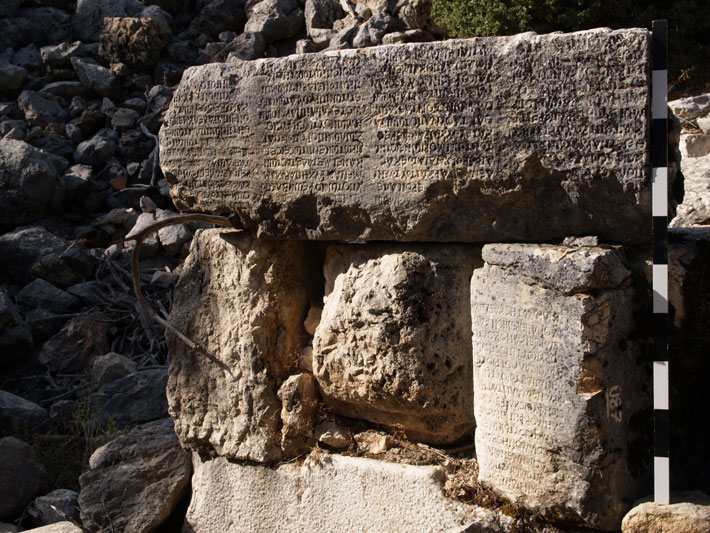
At a remote site in Turkey, archaeologists recently discovered fragments of the ancient world’s most massive inscription — and of course, it was in Greek — touting the benefits of the philosophy of Epicureanism.

The inscription, a quote from the Second century AD philosopher Diogenes, exhorts readers to follow Epicureanism, the way of life that encourages its adherents to seek modest, sustainable pleasure in the form of a state of ataraxia (tranquility and freedom from fear) through knowledge of the workings of the world, and limiting their desires.

One of ancient Hellas’s most notable schools of philosophy, it was created by Epicurus, who lived in the fourth century BC. Originally meant as a challenge to Platonism, it propounded the avoidance of all things that would cause pain in life along with the seeking of all that was just and desirable. Later opposed by the Stoics, it has at times been equated with the inordinate love of food and all things sensual, but this was far from the ideal as espoused by Epicurus.

One of the many schools of the ancient Hellenic philosophers, Epicureanism had one of its most zealous believers in Diogenes of Oenoanda, a wealthy disciple, who had a portico wall inscribed with tenets of the philosophy erected in the ancient Hellenic city of Oenoanda, Lycia.

Epicurus was an atomic materialist, leading him to assail the evils of superstition and divine intervention in every single event — such as weather — that occurred on the Earth.

Although Epicureanism is a form of hedonism insofar as it declares pleasure to be its sole intrinsic goal, its concept that the absence of pain and fear constitutes the greatest pleasure, and its advocacy of a simple life, make it very different from hedonism, or the unbridled pursuit of bodily pleasures.

Epicureanism flourished in the Late Hellenistic era and during the Roman era, and its followers established their own communities, such as those in Antiochia, Alexandria, Rhodes, and Herculaneum.

By the late 3rd century AD Epicureanism all but died out, however, being opposed by other philosophies (mainly Neoplatonism) that were now in the ascendant, as well as early Christianity. But interest in Epicureanism was resurrected in the Age of Enlightenment and it continues today in the modern era.

In Oinoanda, we can see just how much the philosophy meant to Diogenes, who inscribed his words in support of Epicureanism on the wall of a stoa, or portico, in a public square. Later dismantled and reused as building material by the Ottomans, the monumental rock with its inscription has at least survived to this day, a testament to a bygone world.

In the winter of 1884, two young French epigraphers who were exploring the ruins of the ancient city, located in what is now southwestern Turkey, discovered five stone fragments inscribed with the writings of the long-forgotten philosopher now known as Diogenes of Oinoanda.

Scattered in ruins on a hilltop that was by then covered in cedar trees, they found the massive stone with its inscription, in which Diogenes explains why he committed his thoughts to posterity.

“The majority of people suffer from a common disease, as in a plague, with their false notions about things, and their number is increasing. …I wished to use this stoa to advertise publicly the (medicines) that bring salvation.”

His words, now made immortal by having them carved into stone, make clear that he hoped Oinoandans and others who gazed at the stone would consider his words and be converted to the Epicurean school of thought.

After the discovery of the five fragments was published and their significance understood, French and Austrian archaeological teams visited the area between 1885 and 1895, recovering another 83 fragments of the inscription.

Today, it remains the only ancient philosophical text from the Hellenic and Roman world to have survived in its original form, according to Archaeology Magazine. A translation of the entire stone reads, in part: 

“As for the first bodies, also called elements, which on the one hand have subsisted from the beginning and are indestructible, and on the other hand generate things, we shall explain what they are after we have demolished the theories of others.”

Epicureanism argued that pleasure was the chief good in life, advocating living in such a way as to derive the greatest amount of pleasure possible during one’s lifetime, yet doing so moderately in order to avoid the suffering incurred by overindulgence in such pleasure.

The philosophy is often misunderstood, with an emphasis actually placed on pleasures of the mind rather than on physical pleasures. Unnecessary desires were to be suppressed, according to Epicurus.

The philosopher also sought to eliminate the irrational fear of the Gods and of death, seeing those two fears as chief causes of strife in life. He also actively recommended against passionate love, as an unnecessary desire that should be avoided.

“I learn that your bodily inclination leans most keenly towards sexual intercourse. If you neither violate the laws nor disturb well established morals nor sadden someone close to you, nor strain your body, nor spend what is needed for necessities, use your own choice as you wish. It is sure difficult to imagine, however, that none of these would be a part of sex because sex never benefitted anyone.”

Epicurus taught and gained followers in Mytilene, the capital of the island Lesbos, and then in Lampsacus and Athens, Epicurus bought a property in Athens for his school, which he called the “Garden.” Emphasizing friendship as an important ingredient of happiness, the Epicurean schools were very open to new adherents and fairly cosmopolitan by Athenian standards of the day — even including women and slaves among their ranks.

Epicurus laid such emphasis upon developing friendships as the basis of a satisfying life that he said, as quoted by Cicero:

“Of all the things which wisdom has contrived which contribute to a blessed life, none is more important, more fruitful, than friendship.”

The philosophy’s popularity grew and it became, along with Stoicism, Platonism, Peripateticism, and Pyrrhonism, one of the dominant schools of Hellenistic philosophy, lasting through the later Roman Empire.

Deciphered carbonized scrolls obtained from the library at the Villa of the Papyri in Herculaneum contain a large number of works by Philodemus, a late Hellenistic Epicurean, and even Epicurus himself, attesting to the school’s enduring popularity.

While the pursuit of pleasure formed the focal point of the philosophy, this was largely directed to minimizing pain, anxiety and suffering. In fact, Epicurus referred to life as a “bitter gift” in his “Letter to Menoeceus”.

“When we say … that pleasure is the end and aim, we do not mean the pleasures of the prodigal or the pleasures of sensuality, as we are understood to do by some through ignorance, prejudice or wilful misrepresentation. By pleasure we mean the absence of pain in the body and of trouble in the soul. It is not by an unbroken succession of drinking bouts and of revelry, not by sexual lust, nor the enjoyment of fish and other delicacies of a luxurious table, which produce a pleasant life; it is sober reasoning, searching out the grounds of every choice and avoidance, and banishing those beliefs through which the greatest tumults take possession of the soul.”

The Epicurean understanding of justice was inherently self-interested; it was deemed good because it was seen as mutually beneficial.

Epicureanism rejects immortality. From this doctrine arose the Epicurean Epitaph, “Non fui, fui, non sum, non curo (“I was not; I have been; I am not; I do not mind.”), which is inscribed on the gravestones of his followers and seen on many ancient gravestones of the Roman Empire.

Regarding ataraxia (tranquility, freedom from fear) and aponia (absence of pain) as the height of happiness, Epicurus considered prudence an important virtue, and perceived excess and overindulgence to be contrary to the attainment of ataraxia and aponia.

Epicurus preferred “the good”, and “even wisdom and culture”, to the “pleasure of the stomach,” dividing pleasure into two broad categories: the pleasures of the body and the pleasures of the mind.

One can only experience pleasures of the body in the moment, meaning they only exist as a person is experiencing them, while pleasures of the mind involve mental processes and states; feelings of joy, the lack of fear, and pleasant memories.

These pleasures of the mind do not only exist in the present, but also in the past and future, since memory of a past pleasant experience or the expectation of some potentially pleasing future can both be pleasurable experiences. Because of this, the pleasures of the mind are considered to be greater than those of the body.

“Vain and empty” desires, according to Epicurus, are neither innate to humans nor required for happiness or health; indeed, they are also limitless and can never be fulfilled. Desires of wealth or fame would fall in this class, and such desires are to be avoided because they will ultimately only bring about discomfort.

Epicurus was also one of the first Western thinkers to develop the notion of justice as a social contract. The point of living in a society with laws and punishments is to be protected from harm so that one is free to pursue happiness, he believed. Because of this, laws that do not contribute to promoting human happiness are not just.

“It is impossible to live a pleasant life without living wisely and well and justly, and it is impossible to live wisely and well and justly without living a pleasant life.”

Epicureanism, which incorporated much of social contract theory, attempts to address issues with the society described in “Plato’s Republic.” The Epicurean way of life also resembles Buddhism in its temperateness, including the belief that great excess leads to great dissatisfaction.

The Epicureans believed that all sense perceptions were true, and that errors arise in how we judge those perceptions. For example, if someone sees a tower from far away that appears to be round, and upon approaching the tower they see that it is actually square, they would come to realize that their original judgement was wrong and correct their wrong opinion.

Since Epicureans thought that sensations could not deceive, sensations are the first and main criterion of truth for Epicureans. Even in cases where sensory input seems to mislead, the input itself is true and the error arises from our judgments about the input.

For example, when one places a straight oar in the water, it appears bent. The observer makes the error in assuming that the image he or she receives correctly represents the oar and has not been distorted in some way.

In order to not make erroneous judgments about perceivable things and instead verify one’s judgment, Epicureans believed that one needed to obtain “clear vision” (enargeia) of the perceivable thing by closer examination.

One adherent to the teachings of Epicurus included the poet Horace, whose famous statement Carpe Diem (“Seize the Day”) illustrates the philosophy.

“If I had time I would add to my little book the Greek, Latin and French texts, in columns side by side. And I wish I could subjoin a translation of Gassendi’s Syntagma of the doctrines of Epicurus, which, notwithstanding the calumnies of the Stoics and caricatures of Cicero, is the most rational system remaining of the philosophy of the ancients, as frugal of vicious indulgence, and fruitful of virtue as the hyperbolical extravagances of his rival sects.”

Ataraxia (ἀταραξία) is a Greek term used by--amongst others--Pyrrho and Epicurus. Ataraxia is the Greek word for equanimity, sometimes translated as imperturbability.  It generally translates as tranquility, serenity, or peace, and it’s the telos or goal of all wholesome ethical philosophy. In Epicureanism, ataraxia was synonymous with the only true happiness possible for a person. It signifies the state of robust tranquillity that derives from eschewing faith in an afterlife, not fearing the Gods because They are distant and unconcerned with us, avoiding politics and vexatious people, surrounding oneself with trustworthy and affectionate friends and, most importantly, being an affectionate, virtuous person, worthy of trust.

Ataraxia is satisfaction with life as it is here and now, not seeking its perfection but accepting its limitations and never minding them. It’s the mental aboveness of one who’s learned to be happy and to live in a pleasant state always, regardless of conditions. Ataraxia is unconditional pleasure in living.

Note that ataraxia is not about eliminating doubt, but about eliminating the cause of the mental distress people experience when doubts assail their minds. This cause contains a desire for the certainty of knowledge coupled with a belief that such knowledge is possible; and when we desire something, we always desire more of it. The practice of ataraxia requires the acceptance of the inherent uncertainty of most of our opinions and calls us to stop searching for answers that do not exist in our world and can never be attained.

Epicurus insisted that ataraxia is a mindful, positive state of peaceful abiding which can be cultivated through certain disciplines, including the cultivation of deep gratitude to life, to nature, to one’s teachers and ancestors. Sextus Empiricus supplies an example of ataraxia:

"The Sceptic, in fact, had the same experience which is said to have befallen the painter Apelles. Once, they say, when he was painting a horse and wished to represent in the painting the horse's foam, he was so unsuccessful that he gave up the attempt and flung at the picture the sponge on which he used to wipe the paints off his brush, and the mark of the sponge produced the effect of a horse's foam. So, too, the Sceptics were in hopes of gaining quietude [ataraxia] by means of a decision regarding the disparity of the objects of sense and of thought, and being unable to effect this they suspended judgment; and they found that quietude, as if by chance, followed upon their suspense. [Outlines of Pyrrhonism 1.28—29]

How do we benefit by accepting a basic human ignorance? The reason is pragmatic. We benefit by releasing debilitating mental agitation. Where knowledge is unavailable, we can only make a choice. The those who practice ataraxia choose not to choose in cases where there are no clear conclusions and opposing positions continue to be asserted even while everyone knows they cannot all be true. The benefit is in letting go of any and all doubt an fear of that which will always remain uncertain.

Stoicism often made use of the term, as they too sought mental tranquillity and saw ataraxia as highly valuable. In Stoicism, however, ataraxia is not an end to be pursued for its own sake as it is in many other philosophical schools. Rather, it is a natural consequence that occurs in a person who pursues virtue.

Ataraxia is very important in Hellenic philosophy and in Hellenismos today. Christianity clings to many religious terms we use today--including the word ' religion', which is often seen as synonymous to Christianity. It's concepts of fear of Deity and death live on in many of our minds, even in those minds that were not formed by Christian ideology. In modern times, practicing ataraxia includes becoming aware of this influence and letting it go in favour of more ancient ways of philosophical thinking. In modern Hellenismos, ataraxia is an almost necessary practice to apply in order to get ethically and philosophically closer to the ancient Hellenes and through their way of thinking, the Theoi.
Hellenismos believes in free will of humanity; not even the Gods can end the will of a human being, but they can certainly influence the lives we live and instil in us through our environment a need to serve, a need to find Them, a need to honour Them. They might have been doing that since the reign of the ancient Hellenes, but we have only restored the ancient practices a few decades ago, and before that, I doubt anyone really knew what to do with that wiring and just channelled it into Christianity, or in beautiful poetry like from those who were later remarked on as being 'pagan' because they related so well to the societies of years past.

The concept of free will was a grateful one to the ancient Hellenic philosophers. After all, free will in a religious world poses a problem: if you believe in the Gods, and that the Gods have powers beyond ours--foresight, mostly, and a claim to the end of our lives--how can you make the case for free will? If I believe my fate has been foretold at birth by the Moirae, then how can I claim to have full control over my own actions?

In the early days, a form of compatibilism was found where the idea that causal determinism and logical necessity are compatible with free will. Yes, the Moirae predict our deaths, but we are free to do whatever we want in between, and the way we die is of our choosing as well, it has simply been foretold when/what will happen. Because we are not privy to that information, we are not influenced by it.

As time and philosophy progressed, great thinkers like Anaximander and Heraclitus around the sixth century BC--who collectively came to be known as 'physiologoi' or 'cosmologists'--came up with theories to grapple with the supernatural as it ruled over the natural while leaving free will intact. Their resolution was to assign earthy causes to physical events like floods, taking them out of the realm of the supernatural and into the realm of the natural. Their thinking lead to a dualism: it separated the mind from the body and left both open to be influenced by different forces.

In a quest to give humanity back a sense of responsibility for their own actions, materialist philosophers Democritus and Leucippus posed a new theory: that everything--including humans--existed from atoms from the same source. The way these atoms moved and reacted to each other controlled causal laws. This is an incredibly simple explanation of a mechanism I might devote an entire blog post on soon, so just take it as is: we are all made of the same stuff, and the way all that stuff reacts together causes us to experience certain things.

Interestingly enough, this way of thinking led Leucippus to create two dogmas of determinism that go entirely against the concept of free will: the dogma of physical determinism and the dogma of logical necessity. Especially the latter is interesting. It reads:

"Nothing occurs at random, but everything for a reason and by necessity." 
οὐδὲν χρῆμα μάτην γίνεται, ἀλλὰ πάντα ἐκ λόγου τε καὶ ὑπ’ ἀνάγκης

In light of Democritus theory of the atoms and their causal connection, the dogma makes sense: everything has a cause, which means there is a single source where all action originated from. This way of thinking also paved the way for later idea of a single God who put into motion the universe.

It were great thinkers like the Pythagoreans, Socrates,  Plato, and Aristotle who attempted to reconcile an element of human freedom with material determinism and causal law, in order to hold man responsible for his actions. Aristotle, especially, introduced the notion of 'accidents' into Leucippus' thinking, paving the way for an element of chance to be introduced into the theory. He was aware of the human need for repetition and predictability, but also felt that some things just happened, without anyone having a hand in it. It was still a causal connection, but it was an unintended one; an accident. In his Physics and Metaphysics he states the following:

"It is obvious that there are principles and causes which are generable and destructible apart from the actual processes of generation and destruction; for if this is not true, everything will be of necessity: that is, if there must necessarily be some cause, other than accidental, of that which is generated and destroyed. Will this be, or not? Yes, if this happens; otherwise not." (Book VI, 1027a29)

Aristotle's views were the foundation for a slew of new theories that built upon his, the most famous, perhaps, being Epicurus, who thought human agents had the ability to transcend necessity and chance. He argued that as atoms moved through the void, there were occasions when they would 'swerve' from their otherwise determined paths, thus initiating new causal chains. We now know that atoms do now swerve, but they do move unpredictably whenever they are in close contact with other atoms. Only very large objects are not bound by this unpredictable behaviour because their momentum is too great to veer them off course before collision. Epicurus' intuition of a fundamental randomness was thus correct, and paved the way for Lucretius, who saw the randomness as enabling free will.

"If all motion is always one long chain, and new motion arises out of the old in order invariable, and if first-beginnings do not make by swerving a beginning of motion so as to break the decrees of fate, whence comes this free will?"

It was the Stoic school of philosophy that solidified the idea of natural laws controlling all things, including the mind. Their influence persists to this day, in philosophy and religion, even though most of their work on free will has been lost--most likely to the Christian church, who preached a dogma of determinism by way of an omnipotent God.

There is much more to say about the concept of free will--especially in view of philosophy--but perhaps it's interesting to look at the practical side a moment. Mythology dictates that our fate is pre-destined, although we can fail to live up to it. Fate, here, is often a promise of greatness; heroes are told they will be heroes but must work for it, requiring the help of the Gods to rise above their own potential. Others have been granted potential by becoming kings and queens, but squander it by petty human behaviour. Often, these mythological figures end up punished by the Gods. We don't know if this was pre-determined, but the Gods never give us the idea they were aware of the coming failures of these men and women.

Free will is powerful: it gives us the agency we need to aspire to greatness. It gives us a sense of control over our lives. We choose to become servants to the Gods--we are not forced to do so, even though it might be destined we become servants; this makes all the difference in our joy of the execution of the Divine will. If we felt pressured and ordered into it, we would not find the same joy in it as we do now we are free to choice our path--or believe we are free to choose our path. Personally, I believe in accidents, and I think that sometimes, the universe drops the ball on us. Sometimes, things go wrong. We are then put at the mercy of the Gods to fix the ramifications of whatever pothole our lives hit, and this is why we built kharis with Them. My life may have been mapped out in advance, but I need help along the way to get to the destination the Gods have in store for me. This is a large reason why I serve, and while this way of thinking is not for everyone, it's my (free) will to do so--and I do so gladly.
I'm not always active in the online Hellenistic community but I get tagged in a lot and I do read that. I also get and answer a lot of questions from you. What I sense in many of your posts is a kind of fear about faith. Fear of the judgement of the Gods; a sense that the Theoi are always watching and ready to strike. Fear of the afterlife (or, perhaps, lack of same). The ancient Hellenes struggled with this as well. How do I know? Because there is a word to define the opposite of that fear: that word is ataraxia.

Ataraxia (ἀταραξία) is a Greek term used by--amongst others--Pyrrho and Epicurus. Ataraxia is the Greek word for equanimity, sometimes translated as imperturbability.  It generally translates as tranquility, serenity, or peace, and it’s the telos or goal of all wholesome ethical philosophy. In Epicureanism, ataraxia was synonymous with the only true happiness possible for a person. It signifies the state of robust tranquillity that derives from eschewing faith in an afterlife, not fearing the Gods because They are distant and unconcerned with us, avoiding politics and vexatious people, surrounding oneself with trustworthy and affectionate friends and, most importantly, being an affectionate, virtuous person, worthy of trust.

Ataraxia is satisfaction with life as it is here and now, not seeking its perfection but accepting its limitations and never minding them. It’s the mental aboveness of one who’s learned to be happy and to live in a pleasant state always, regardless of conditions. Ataraxia is unconditional pleasure in living.

Note that ataraxia is not about eliminating doubt, but about eliminating the cause of the mental distress people experience when doubts assail their minds. This cause contains a desire for the certainty of knowledge coupled with a belief that such knowledge is possible; and when we desire something, we always desire more of it. The practice of ataraxia requires the acceptance of the inherent uncertainty of most of our opinions and calls us to stop searching for answers that do not exist in our world and can never be attained.

Epicurus insisted that ataraxia is a mindful, positive state of peaceful abiding which can be cultivated through certain disciplines, including the cultivation of deep gratitude to life, to nature, to one’s teachers and ancestors. Sextus Empiricus supplies an example of ataraxia:

"The Sceptic, in fact, had the same experience which is said to have befallen the painter Apelles. Once, they say, when he was painting a horse and wished to represent in the painting the horse's foam, he was so unsuccessful that he gave up the attempt and flung at the picture the sponge on which he used to wipe the paints off his brush, and the mark of the sponge produced the effect of a horse's foam. So, too, the Sceptics were in hopes of gaining quietude [ataraxia] by means of a decision regarding the disparity of the objects of sense and of thought, and being unable to effect this they suspended judgment; and they found that quietude, as if by chance, followed upon their suspense. [Outlines of Pyrrhonism 1.28—29]

How do we benefit by accepting a basic human ignorance? The reason is pragmatic. We benefit by releasing debilitating mental agitation. Where knowledge is unavailable, we can only make a choice. The those who practice ataraxia choose not to choose in cases where there are no clear conclusions and opposing positions continue to be asserted even while everyone knows they cannot all be true. The benefit is in letting go of any and all doubt an fear of that which will always remain uncertain.

Stoicism often made use of the term, as they too sought mental tranquillity and saw ataraxia as highly valuable. In Stoicism, however, ataraxia is not an end to be pursued for its own sake as it is in many other philosophical schools. Rather, it is a natural consequence that occurs in a person who pursues virtue.

Ataraxia is very important in Hellenic philosophy and in Hellenismos today. Christianity clings to many religious terms we use today--including the word ' religion', which is often seen as synonymous to Christianity. It's concepts of fear of Deity and death live on in many of our minds, even in those minds that were not formed by Christian ideology. In modern times, practicing ataraxia includes becoming aware of this influence and letting it go in favour of more ancient ways of philosophical thinking. In modern Hellenismos, ataraxia is an almost necessary practice to apply in order to get ethically and philosophically closer to the ancient Hellenes and through their way of thinking, the Theoi.
A group of British, American and French scholars is calling for the immediate resumption of excavations at the Villa of the Papyri at Herculaneum, reports The Art Newspaper. The Herculaneum was buried by the eruption of Vesuvius in 79 AD. The villa, which is near Pompeii, was first explored in the 1750's when archaeologists discovered the only intact library of texts from the Classical era. The papyri found so far are Greek works of philosophy; the hope is that other Greek texts as well as Latin ones by some of the greatest writers of Antiquity may still be underground. The Art Newspaper invited the lead signatory to the Times letter, Robert Fowler, to make the case for excavation while Andrew Wallace-Hadrill, the scientific director of the Herculaneum Conservation Project, sounds a note of caution.


Some background first: in a letter to the Times newspaper in late March, academics lamented the fact that 'there has been no new [excavation] work since 2009'. 'The excavation must be finished', they wrote.  In their letter to the Times in London calling for further excavation of the Villa of the Papyri at Herculaneum, the academics warned that 'another eruption of Vesuvius may put the villa beyond reach forever'. Vesuvius is closely monitored and an updated plan for the evacuation of the population in the 'red zone' (increased from 18 communities to the 25 in the red ring above) was issued in 2014 and has been revised again this year.

Scientists expect that there will be a period of increased seismic activity before any major eruption, giving enough warning to evacuate the population of more than 600,000. However, there is a 95% certainty that, in the event of a major eruption, the red zone would have a radius of 10 km to 12 km around the central crater, encompassing Herculaneum and Pompeii. This whole area would be covered in deadly pyroclastic flows of molten rock and gas, which can reach temperatures of 1,000°C and advance at speeds of up to 450 miles per hour.

 Robert Fowler, professor of Greek at the University of Bristol is in favour of further excavations. He explains his standpoint as follows:

"The Villa of the Papyri at Herculaneum contains the only library to have survived intact from the ancient Greco-Roman world. In the eruption of Vesuvius in AD79, the scrolls were first carbonised, then miraculously preserved in a flood of airless volcanic mud. Some 1,800 fragments representing perhaps 800 original books were recovered in the 18th century. The hundreds so far identified present a lopsided profile: overwhelmingly, they are books of Epicurean Greek philosophy.
 
This appears to be the personal library of Philodemus, the leading Epicurean of the first century BC, whose patron was Lucius Calpurnius Piso Caesoninus, the father-in-law of Julius Caesar and owner, in all probability, of this villa. Cultivated Romans kept sumptuous libraries in their country homes, where philosophers and artists gathered to discuss literature and ideas. Virgil and Horace were members of Piso’s circle. Philodemus too was a poet. The library would have contained many other books both Greek and Latin. The rest of it is most probably in the southeast corner of the villa, which the early tunnelers failed to reach. The lost works waiting to be found there stagger the imagination.
 
The villa was rediscovered and partially excavated in the 1990s. The excavation must be finished. Counter-arguments are familiar. Resources are desperately scarce, people say, and should be used for pressing emergencies (Pompeii is falling down), not for digging up new things that only add to the burden of conservation. The trouble is, this argument will always be advanced. It amounts to an argument for never excavating.
 
Meanwhile, the volcano may erupt again and put the villa effectively beyond reach. It has erupted on average every 20 years since 1631. The last eruption was in 1944.
 
People say archaeology is not about treasure hunting (highly disputable: define “treasure”). Of course it must be a responsible excavation, not a grab and run. One need not exhume the whole building. The long peristyle can be left to sleep, minimising the disruption to the town above.
 
The 1990s revealed previously unknown lower levels, offering good reason in themselves for further exploration. But the library makes this building unique. We shall soon have the technology to scan and read the rolls without even touching them. They will not lie around neglected and deteriorating, as has sometimes been charged.
 
 Posterity will not forgive us if we squander this chance. The excavation must proceed."


Andrew Wallace-Hadrill, director of research, faculty of Classics, Cambridge University; scientific director of the Herculaneum Conservation Project, is against further excavation and explains his standpoints as follows:

"It is hard not to share the enthusiasm of the group of specialists who have renewed their pleas to resume excavation of the Villa of the Papyri at Herculaneum. An initial attempt at full excavation was made in the 1990s, though this only reached one corner of the building and demonstrated not only how fraught with difficulties such an excavation is, but how easy it is to cause damage in the process, and how difficult to conserve what is exposed.

Fourteen years ago, I argued in this newspaper that continued excavation was not a priority compared with conservation. Is the time right now? A decade’s heroic work by the Packard Humanities Institute has addressed many of the existing problems of conservation on the main site at Herculaneum, but the villa may be regarded as a case apart.

Is there an imminent threat to the site of the villa? Volcanic eruption can scarcely do more damage to what lies buried: it is the parts exposed that are most at risk. And the problem is precisely that by exposing them in part, the risks have been greatly increased. The steep embankment around the trench is not stable: the edges constantly crumble and do damage to the protective shelter. This can be addressed by stepping the embankment back, but simply increasing the size of the excavation only moves the problem on.

The gravest risk is from water. The consequence of creating a trench 30m below the ground level of the present city is to release a flow of water. This cascades out of the edge of the excavated area, passing through the lower floors of the villa, precisely those which were not explored by Karl Weber [in the 1750s] and have the most potential interest. One room of this lower floor has been partially excavated, and its rich decoration only underlines the potential interest of this area.

There is a strong case for urgent work to stop the embankment crumbling and the flow of water further damaging the lower floors. This might reveal further papyri. It would certainly reveal finds of great interest. But the logic that drives any modern excavation must be preservation, not the pursuit of a dream."

Personally, I think we have time to work up to a new excavation and do it right, but I do wish for another dig. Herculaneum has yeilded some of the greatest Hellenic finds there are and simply the thought of there being more in the ground is tantalising.

The Herculaneum papyri are a treasure. The official list amounts to 1,814 rolls and fragments, of which 1,756 had been discovered by 1855. The inventory now comprises 1826 papyri. More than 340 are almost complete, about 970 are partly decayed and partly decipherable, and more than 500 are merely charred fragments.

Among the recovered scrolls are large parts of Books XIV, XV, XXV, and XXVIII of the magnum opus of Epicurus, 'On Nature'. Works by early followers of Epicurus are also represented among the papyri. 44 of the rolls have been identified as the work of Philodemus of Gadara, an Epicurean philosopher and poet. The manuscript 'PHerc.Paris.2' contains part of Philodemus' On Vices and Virtues. The Stoic philosopher Chrysippus is attested to have written over 700 works, all of them lost, with the exception of a few fragments quoted by other authors. Segments of his works 'On Providence' and 'Logical Questions' were found among the papyri; a third work of his may have been recovered from the charred rolls.

Who knows what more is to be found? I am in favour of at least trying--or at the bare minimum preserving the site as best we can until funds can be found for another dig. Prosterity should have the option and possibility to dig, I feel.
Hellenismos believes in free will of humanity; not even the Gods can end the will of a human being, but they can certainly influence the lives we live and instil in us through our environment a need to serve, a need to find Them, a need to honour Them. They might have been doing that since the reign of the ancient Hellenes, but we have only restored the ancient practices a few decades ago, and before that, I doubt anyone really knew what to do with that wiring and just channelled it into Christianity, or in beautiful poetry like from those who were later remarked on as being 'pagan' because they related so well to the societies of years past.

The concept of free will was a grateful one to the ancient Hellenic philosophers. After all, free will in a religious world poses a problem: if you believe in the Gods, and that the Gods have powers beyond ours--foresight, mostly, and a claim to the end of our lives--how can you make the case for free will? If I believe my fate has been foretold at birth by the Moirae, then how can I claim to have full control over my own actions?

In the early days, a form of compatibilism was found where the idea that causal determinism and logical necessity are compatible with free will. Yes, the Moirae predict our deaths, but we are free to do whatever we want in between, and the way we die is of our choosing as well, it has simply been foretold when/what will happen. Because we are not privy to that information, we are not influenced by it.

As time and philosophy progressed, great thinkers like Anaximander and Heraclitus around the sixth century BC--who collectively came to be known as 'physiologoi' or 'cosmologists'--came up with theories to grapple with the supernatural as it ruled over the natural while leaving free will intact. Their resolution was to assign earthy causes to physical events like floods, taking them out of the realm of the supernatural and into the realm of the natural. Their thinking lead to a dualism: it separated the mind from the body and left both open to be influenced by different forces.

In a quest to give humanity back a sense of responsibility for their own actions, materialist philosophers Democritus and Leucippus posed a new theory: that everything--including humans--existed from atoms from the same source. The way these atoms moved and reacted to each other controlled causal laws. This is an incredibly simple explanation of a mechanism I might devote an entire blog post on soon, so just take it as is: we are all made of the same stuff, and the way all that stuff reacts together causes us to experience certain things.

Interestingly enough, this way of thinking led Leucippus to create two dogmas of determinism that go entirely against the concept of free will: the dogma of physical determinism and the dogma of logical necessity. Especially the latter is interesting. It reads:

"Nothing occurs at random, but everything for a reason and by necessity." 
οὐδὲν χρῆμα μάτην γίνεται, ἀλλὰ πάντα ἐκ λόγου τε καὶ ὑπ’ ἀνάγκης

In light of Democritus theory of the atoms and their causal connection, the dogma makes sense: everything has a cause, which means there is a single source where all action originated from. This way of thinking also paved the way for later idea of a single God who put into motion the universe.

It were great thinkers like the Pythagoreans, Socrates,  Plato, and Aristotle who attempted to reconcile an element of human freedom with material determinism and causal law, in order to hold man responsible for his actions. Aristotle, especially, introduced the notion of 'accidents' into Leucippus' thinking, paving the way for an element of chance to be introduced into the theory. He was aware of the human need for repetition and predictability, but also felt that some things just happened, without anyone having a hand in it. It was still a causal connection, but it was an unintended one; an accident. In his Physics and Metaphysics he states the following:

"It is obvious that there are principles and causes which are generable and destructible apart from the actual processes of generation and destruction; for if this is not true, everything will be of necessity: that is, if there must necessarily be some cause, other than accidental, of that which is generated and destroyed. Will this be, or not? Yes, if this happens; otherwise not." (Book VI, 1027a29)

Aristotle's views were the foundation for a slew of new theories that built upon his, the most famous, perhaps, being Epicurus, who thought human agents had the ability to transcend necessity and chance. He argued that as atoms moved through the void, there were occasions when they would 'swerve' from their otherwise determined paths, thus initiating new causal chains. We now know that atoms do now swerve, but they do move unpredictably whenever they are in close contact with other atoms. Only very large objects are not bound by this unpredictable behaviour because their momentum is too great to veer them off course before collision. Epicurus' intuition of a fundamental randomness was thus correct, and paved the way for Lucretius, who saw the randomness as enabling free will.

"If all motion is always one long chain, and new motion arises out of the old in order invariable, and if first-beginnings do not make by swerving a beginning of motion so as to break the decrees of fate, whence comes this free will?"

It was the Stoic school of philosophy that solidified the idea of natural laws controlling all things, including the mind. Their influence persists to this day, in philosophy and religion, even though most of their work on free will has been lost--most likely to the Christian church, who preached a dogma of determinism by way of an omnipotent God.

There is much more to say about the concept of free will--especially in view of philosophy--but perhaps it's interesting to look at the practical side a moment. Mythology dictates that our fate is pre-destined, although we can fail to live up to it. Fate, here, is often a promise of greatness; heroes are told they will be heroes but must work for it, requiring the help of the Gods to rise above their own potential. Others have been granted potential by becoming kings and queens, but squander it by petty human behaviour. Often, these mythological figures end up punished by the Gods. We don't know if this was pre-determined, but the Gods never give us the idea they were aware of the coming failures of these men and women.

Free will is powerful: it gives us the agency we need to aspire to greatness. It gives us a sense of control over our lives. We choose to become servants to the Gods--we are not forced to do so, even though it might be destined we become servants; this makes all the difference in our joy of the execution of the Divine will. If we felt pressured and ordered into it, we would not find the same joy in it as we do now we are free to choice our path--or believe we are free to choose our path. Personally, I believe in accidents, and I think that sometimes, the universe drops the ball on us. Sometimes, things go wrong. We are then put at the mercy of the Gods to fix the ramifications of whatever pothole our lives hit, and this is why we built kharis with Them. My life may have been mapped out in advance, but I need help along the way to get to the destination the Gods have in store for me. This is a large reason why I serve, and while this way of thinking is not for everyone, it's my (free) will to do so--and I do so gladly.