Showing posts with label Aristotle. Show all posts

 Hellenismos believes in free will of humanity; not even the Gods can end the will of a human being, but they can certainly influence the lives we live and instil in us through our environment a need to serve, a need to find Them, a need to honour Them. They might have been doing that since the reign of the ancient Hellenes, but we have only restored the ancient practices a few decades ago, and before that, I doubt anyone really knew what to do with that wiring and just channelled it into Christianity, or in beautiful poetry like from those who were later remarked on as being 'pagan' because they related so well to the societies of years past.


The concept of free will was a grateful one to the ancient Hellenic philosophers. After all, free will in a religious world poses a problem: if you believe in the Gods, and that the Gods have powers beyond ours--foresight, mostly, and a claim to the end of our lives--how can you make the case for free will? If I believe my fate has been foretold at birth by the Moirae, then how can I claim to have full control over my own actions?

In the early days, a form of compatibilism was found where the idea that causal determinism and logical necessity are compatible with free will. Yes, the Moirae predict our deaths, but we are free to do whatever we want in between, and the way we die is of our choosing as well, it has simply been foretold when/what will happen. Because we are not privy to that information, we are not influenced by it.

As time and philosophy progressed, great thinkers like Anaximander and Heraclitus around the sixth century BC--who collectively came to be known as 'physiologoi' or 'cosmologists'--came up with theories to grapple with the supernatural as it ruled over the natural while leaving free will intact. Their resolution was to assign earthy causes to physical events like floods, taking them out of the realm of the supernatural and into the realm of the natural. Their thinking lead to a dualism: it separated the mind from the body and left both open to be influenced by different forces.

In a quest to give humanity back a sense of responsibility for their own actions, materialist philosophers Democritus and Leucippus posed a new theory: that everything--including humans--existed from atoms from the same source. The way these atoms moved and reacted to each other controlled causal laws. This is an incredibly simple explanation of a mechanism I might devote an entire blog post on soon, so just take it as is: we are all made of the same stuff, and the way all that stuff reacts together causes us to experience certain things.

Interestingly enough, this way of thinking led Leucippus to create two dogmas of determinism that go entirely against the concept of free will: the dogma of physical determinism and the dogma of logical necessity. Especially the latter is interesting. It reads:

"Nothing occurs at random, but everything for a reason and by necessity." 
οὐδὲν χρῆμα μάτην γίνεται, ἀλλὰ πάντα ἐκ λόγου τε καὶ ὑπ’ ἀνάγκης

In light of Democritus theory of the atoms and their causal connection, the dogma makes sense: everything has a cause, which means there is a single source where all action originated from. This way of thinking also paved the way for later idea of a single God who put into motion the universe.

It were great thinkers like the Pythagoreans, Socrates,  Plato, and Aristotle who attempted to reconcile an element of human freedom with material determinism and causal law, in order to hold man responsible for his actions. Aristotle, especially, introduced the notion of 'accidents' into Leucippus' thinking, paving the way for an element of chance to be introduced into the theory. He was aware of the human need for repetition and predictability, but also felt that some things just happened, without anyone having a hand in it. It was still a causal connection, but it was an unintended one; an accident. In his Physics and Metaphysics he states the following:

"It is obvious that there are principles and causes which are generable and destructible apart from the actual processes of generation and destruction; for if this is not true, everything will be of necessity: that is, if there must necessarily be some cause, other than accidental, of that which is generated and destroyed. Will this be, or not? Yes, if this happens; otherwise not." (Book VI, 1027a29)

Aristotle's views were the foundation for a slew of new theories that built upon his, the most famous, perhaps, being Epicurus, who thought human agents had the ability to transcend necessity and chance. He argued that as atoms moved through the void, there were occasions when they would 'swerve' from their otherwise determined paths, thus initiating new causal chains. We now know that atoms do now swerve, but they do move unpredictably whenever they are in close contact with other atoms. Only very large objects are not bound by this unpredictable behaviour because their momentum is too great to veer them off course before collision. Epicurus' intuition of a fundamental randomness was thus correct, and paved the way for Lucretius, who saw the randomness as enabling free will.

"If all motion is always one long chain, and new motion arises out of the old in order invariable, and if first-beginnings do not make by swerving a beginning of motion so as to break the decrees of fate, whence comes this free will?"

It was the Stoic school of philosophy that solidified the idea of natural laws controlling all things, including the mind. Their influence persists to this day, in philosophy and religion, even though most of their work on free will has been lost--most likely to the Christian church, who preached a dogma of determinism by way of an omnipotent God.

There is much more to say about the concept of free will--especially in view of philosophy--but perhaps it's interesting to look at the practical side a moment. Mythology dictates that our fate is pre-destined, although we can fail to live up to it. Fate, here, is often a promise of greatness; heroes are told they will be heroes but must work for it, requiring the help of the Gods to rise above their own potential. Others have been granted potential by becoming kings and queens, but squander it by petty human behaviour. Often, these mythological figures end up punished by the Gods. We don't know if this was pre-determined, but the Gods never give us the idea they were aware of the coming failures of these men and women.

Free will is powerful: it gives us the agency we need to aspire to greatness. It gives us a sense of control over our lives. We choose to become servants to the Gods--we are not forced to do so, even though it might be destined we become servants; this makes all the difference in our joy of the execution of the Divine will. If we felt pressured and ordered into it, we would not find the same joy in it as we do now we are free to choice our path--or believe we are free to choose our path. Personally, I believe in accidents, and I think that sometimes, the universe drops the ball on us. Sometimes, things go wrong. We are then put at the mercy of the Gods to fix the ramifications of whatever pothole our lives hit, and this is why we built kharis with Them. My life may have been mapped out in advance, but I need help along the way to get to the destination the Gods have in store for me. This is a large reason why I serve, and while this way of thinking is not for everyone, it's my (free) will to do so--and I do so gladly.

 Growing up, my mother taught me a good few valuable lessons, but the one that has undoubtedly kept me out of trouble most was leaning to keep my mouth shut if I didn't have anything positive to contribute to the discussion. If all you're doing is pushing air and adding venom, then it's best to just remain silent. So, now I sit unraveling discussions out, I try not to take things personal, and when I contribute to any discussion, it is with respect to the other person, their opinion, and myself.


What I like most about our commandment-like scriptures--most notably the Delphic Maxims and the Tenets of Solon--is that they make sense. Following them helps you be a better person; to practice Arête, and you don't really need to study them at all to follow them. Most--if not all--made complete sense in the ancient Hellenic culture, and as our modern culture is inspired hugely by ancient Hellas, they are often still engrained within our own; if you're lucky, you are taught them at home, or in school, like to keep your mouth shut if you don't have something positive to add.

Almost all of the Delphic Maxims fit into the Tenets of Solon in some way. Take my example of keeping your mouth shut; it's the modern stating of the ancient maxim 'Restrain the tongue' (Γλωτταν ισχε). This maxim, along with  few other (most notably 'Control yourself' (Αρχε σεαυτου), 'Control anger' (Θυμου κρατει), 'Pursue honor' (Δοξαν διωκε), 'Long for wisdom' (Σοφιαν ζηλου), 'Exercise nobility of character' (Ευγενειαν ασκει), and 'Make just judgements' (Κρινε δικαια)) make up Solon's tenet of 'Make reason your guide'--or what I like to remember as the modern 'Think before you act'.

I am not an authority on ancient Hellenic philosophy, by far, but I do want to mention Plato and his student Aristotle for a moment, as we are discussing common sense. I love the English term 'common sense'. The Dutch equivalent means 'logical thought', and does not quite pack the same punch. Common sense implies that what is morally and ethically right or wrong is understood by the community which the individual is a part of; as such, actions are culturally understood to be either right or wrong. Plato believed in a Good that did not chance according to circumstances and individual folly (paraphrasing here, there is far more nuance in his actual writings). As such, the Platonic ideal is autarkia (αὐτάρκεια)--self-control and self-sufficiency--which would only be possible if we assume that our lives are under the sway of the idea of the Good that would be universal and therefore unchanged by any external circumstance.

Aristotle disagreed, saying that ethical deliberations and choices are always determined by the particular situation that we are in, where the right course of action can never be determined in advance. If human action were governed by rules--laws, maxims, tenets--then we would never have to deliberate about our actions, because it would always be clear and transparent what the correct action is. We would simply have to learn these rules in advance to be sure that we would not make the incorrect and unethical decision.

Taking an example from my more eclectic Pagan days: are you allowed to defend yourself against the burglar who enters your home and threatens to kill your family, even if it means killing him? This is why we have addendums to our laws; murder is forbidden, but if self-defense can be argued, you might walk away without (external) punishment.

The maxims and tents are guidelines, and if regarded as such, Plato's ideals of Good and autarkia are valuable, because just looking at the list of Delphic maxims, it is easy to envision these ideals were shared throughout the whole of Hellas. They even resonate well with modern society. Yet, as Aristotle points out, using maxims and tenets as laws is futile; there will always be situations where any of these guidelines will lead to an evil action, or one with great cost to the individual and those around him. Moderation is in order, therefore, and it so happens to be that that is one of the most important and well known Delphic Maxims: Nothing to excess (Μηδεν αγαν)

Italian artist Alessandro Tomasi has reconstructed the faces of ancient Greek and Roman philosophers and statesmen using as reference statues and busts kept in various museums around the world.

Tomasi, who is based in Florence, has gained thousands of followers on social media around the globe for his painstaking work of bringing the past back to life.


Listverse released a list of ten ancient Hellenic writers you should know. It's a good list, and the reasoning why these were chosen is a great read in and of itself. The ten who made the cut are:

10. Hómēros -- writer of the Iliad and the Odysseia
9. Sophocles -- the tragedian who wrote (amongst others) Antigone, Oedipus the King and Electra
8. Herodotos -- whose book The Histories is considered the first work of history in Western literature
7. Euripides -- the tragedian who wrote (amongst others) Alcestis, Medea and The Bacchus
6. Hippokrátēs -- who fathered modern medicine, mostly with his Hippocratic Corpus
5. Aristophanes -- the comic playwright who wrote (amongst others) The Clouds, The Wasps and Lysistrata
4. Plato -- one of the fathers of Western philosophy
3. Aristotle -- the last of the great Hellenic philosophers 
2. Euclid -- a mathematician and the father of geometry, whose main work--The Elements--is still used as a textbook in mathematics 
1. Archimedes -- a mathematician, engineer, inventor, physicist and astronomer whose ideas are as the basics of all these disciplines

I most certainly concur that this list lists some of ancient Hellas' most influential writers, but the list is far from complete. Today, I want to add five more to it, and most of my picks will no surprise you.

5. Sappho
Sappho (Σαπφώ) was a Hellenic lyric poet, born on the island of Lesbos (Λέσβος) around 620 BC, although the exact date is unknown. She wrote beautiful and highly romantic poetry that comes and goes straight to the heart. One of the most famous of her works is her Hymn to Aphrodite.

4. Aeschylos
As the original list includes both Sophocles and Euripides, it seems only fair to include Aeschylos. Aeschylos (Aiskhulos, Αἰσχύλος) was the first of the three Hellenic tragedians whose plays can still be read or performed. According to Aristotle, he expanded the number of characters in plays to allow for conflict amongst them, whereas previously characters had interacted only with the chorus. Aescholos' most famous works are undoubtedly the Seven against Thebes, the Supplicants and the Orestia. 

3. Pythagoras
Pythagoras of Samos ( Πυθαγόρας ὁ Σάμιος) was an Ionian Hellenic philosopher, mathematician, and the father of the religious movement called Pythagoreanism. He lived from about 570 BC to about 495 BC, and made influential contributions to philosophy, religious teaching, math, ethics, and science. His most famous work is, undoubtedly, the Pythagorean theorem (a^2 + b^2 = c^2), that's standard in every math textbook. Interestingly enough, not a single bit of writing has been preserved--if he ever wrote anything down to begin with. His works are mostly quoted by his students, or known through critiques by Aristotle.

2. Plutarch
Plutach (Ploútarkhos, Πλούταρχος) was an ancient Hellenic historian, biographer, and essayist who lived between 46 and 120 AD. He is known primarily for his Parallel Lives and Moralia, but much of his work is lost to us. Plutarch's writings are full of details about people and places, and are therefor a true treasure trove.

1. Hesiod
Hesiod (Hesiodos, Ἡσίοδος) was a Hellenic oral poet who lived between 750 and 650 BC, around the same time as Hómēros. I would dare say that his work--especially 'Works and Days' and the 'Theogony'--has shaped the way scholars and practitioners of Hellenismos view ancient Hellenic society, religion and way of life. This is why I strongly feel that anyone who feels drawn to the Theoi, might benefit from investing some time in reading his words.

 “Excellence, very-hard-work for mortal races,

The finest catch in life
For your beautiful form, Maiden,
it is an enviable fate to die in Greece
and to suffer hard, relentless toils.a
This is the kind of bravery you
Toss in the heart, an immortal thing better than gold,
Or parents, or soft-glancing sleep.
Isn’t it for you that Zeus’ Herakles and the sons of Leda
Labored in their deeds,
Trying to gather up your power?
Because of longing for you, Achilles
And Ajax came to Hades’ home.
For your love and beauty too,
The child of Atarneous lost the light of the sun.
For this reason the deeds get a song and the Muses,
Memory’s daughters, will make it immortal,
Shouting out the glory of Zeus the god of hospitality
And the gift of trustworthy friendship.”

Ὁ δὲ ὕμνος ἔχει τοῦτον τὸν τρόπον·
ἀρετά, πολύμοχθε γένει βροτείῳ,
θήραμα κάλλιστον βίῳ,
σᾶς πέρι, παρθένε, μορφᾶς
καὶ θανεῖν ζαλωτὸς ἐν Ἑλλάδι πότμος
καὶ πόνους τλῆναι μαλεροὺς ἀκάμαντας·
τοῖον ἐπὶ φρένα βάλλεις
κάρτος ἀθάνατον χρυσοῦ τε κρεῖσσον
καὶ γονέων μαλακαυγήτοιό θ᾿ ὕπνου.
σεῦ δ᾿ ἕνεχ᾿ οὑκ Διὸς Ἡρακλέης Λήδας τε κοῦροι
πόλλ᾿ ἀνέτλασαν ἔργοις
σὰν ἀγρεύοντες δύναμιν.
σοῖς δὲ πόθοις Ἀχιλεὺς
Αἴας τ᾿ Ἀΐδαο δόμους ἦλθον·
σᾶς δ᾿ ἕνεκεν φιλίου μορφᾶς καὶ Ἀταρνέος
ἔντροφος ἀελίου χήρωσεν αὐγάς.
τοιγὰρ ἀοίδιμος ἔργοις, ἀθάνατόν τε μιν αὐξήσουσι
Μοῦσαι
Μναμοσύνας θύγατρες, Διὸς ξενίου σέβας αὔξουσαι
φιλίας τε γέρας βεβαίου.

Ethos is one of three modes of persuasion explained by Aristotle. It’s means “character” and serves as a measure of how credible one is when persuading an audience on the topic you are discussing--very important in rhetoric! According to Aristotle, there are three types of ethos: arête, phronesis, and eunoia. 

I have spoken about arête before. It's the Greek word for "virtue," and in an ethical sense, it measn being the best version of yourself you can be. Aristotle believed that the ultimate goal in life for a human is happiness. In order to be fully happy in life, one would have to be virtuous. He describes the necessary steps to achieve this happiness in Nicomachean Ethics:

"[...] the man who is to be good must be well trained and habituated, and go on to spend his time in worthy occupations and neither willingly nor unwillingly do bad actions, and if this can be brought about if men live in accordance with a sort of reason and right order [...]" [Book x]

Phronesis is a Greek word for wisdom or intelligence. Aristotle didn't just mean to use it as an indication of IQ but also how well knowledge and skill are implemented in every day life. Someone with a low intelligence level can still be made wise by experience, for example. Aristotle believed that gaining phronesis required experience and there was no other wait to gain it. 
            
Eunoia is Greek for “goodwill.” In rhetoric it is the relationship the reader cultivates with the audience to gain their trust. As a speaker, that trust is required to appear credible. Without it, you can't persuade an audience.

All three values--arête, phronesis, and eunoia--add up to create the meaning of ethos. According to Aristotle, ethos starts with good parenting, with teaching a child ethical behavior. Other teachers throughout life will add to this ethical framework. By learning skills we develop ourselves more, and also by exposing ourselves to many different experiences. By creating good habits and sticking with them until they become automatic, we develop each other even more. As a result, we will be happier, more productive people.
"The Argonauts sailed on in gloom. The Seirenes  were behind them, but worse perils lay ahead, at a place where two seas met and shipping came to grief. On one side the sheer cliff of Skylla  hove in sight; on the other Kharybdis  seethed and roared incessantly; while beyond, great seas were booming on the Wandering Rocks."
-- Apollonius Rhodius, Argonautica 4. 921

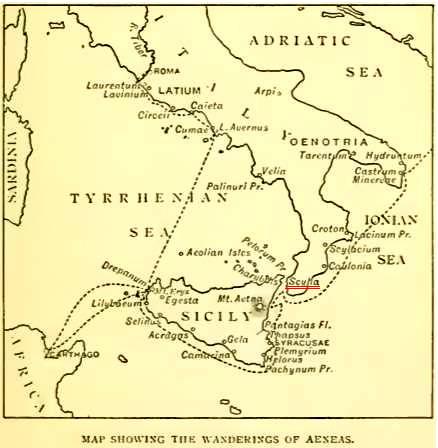
A map of the wanderings of Aeneas, showing the positions of Charybdis and Scylla (underlined in red), from an edition of The Aeneid of Virgil, Book III, edited by Philip Sandford, London: Blackie & Son. 1900


Some of the greatest heroes encountered the terrifying and destructive force of Skylla and Kharybdis on their travels: Odysseus had to pass them twice, and the Argonauts came upon them as well. We will discuss Skylla at a later date, but for now, we will discuss Kharybdis--monster and Goddess--who controls the tide.

The ancient hellenes in the time the Odysseia was written seem to have been largely unaware that the rise and fall of sea levels are caused by the combined effects of the gravitational forces exerted by the Moon and the Sun and the rotation of the Earth. Instead, they held a single entity responsible: a monster or a Goddess controlling a whirlpool, as described by Hómēros:

"Odysseus, you will notice the other cliff is lower, only a bow-shot away, and a great fig-tree with dense leaves grows there. Under it divine Charybdis swallows the black waters. Three times a day, she spews them out, and three times darkly sucks them back again. No one, not even Poseidon, could save you from destruction if you are there when she swallows." [Bk XII:36-110]

For those of you who grew up with huge differences between high and low tides, it might be hard to grasp how the ancient Hellenes attributed such a difference to a single whirlpool entity. Well, they didn't; Even modern Hellas hardly has a difference between high and low tide; a foot or two at max. As such, it becomes a lot more feasable for that amount of water to be swallowed and regurgitated.

The development of tidal science began in antiquity with the cosmology of Aristotle (384 BC – 322 BC), a Hellenic philosopher and polymath, a student of Plato and teacher of Alexander the Great. In researching this subject, I keep happening upon a quote by him that I can't place in any of his works, but would love to have someone source for me. It goes:

"It is even said that many ebbings and risings of the sea always come round with the Moon and upon certain fixed times."

The closest I have gotten is from the 'Meteorology':

"Again, most earthquakes and the severest occur at night or, if by day, about noon, that being generally the calmest part of the day. For when the sun exerts its full power (as it does about noon) it shuts the evaporation into the earth. Night, too, is calmer than day. The absence of the sun makes the evaporation return into the earth like a sort of ebb tide, corresponding to the outward flow; especially towards dawn, for the winds, as a rule, begin to blow then, and if their source changes about like the Euripus and flows inwards the quantity of wind in the earth is greater and a more violent earthquake
results." [Bk 2, Pt 8]
And:

"Every one admits this, that if the whole world originated the sea did too; for they make them come into being at the same time. It follows that if the universe is eternal the same must be true of the sea. Any one who thinks like Democritus that the sea is diminishing and will disappear in the end reminds us of Aesop's tales. His story was that Charybdis had twice sucked in the sea: the first time she made the mountains visible; the second time the islands; and when she sucks it in for the last time she will dry it up entirely. Such a tale is appropriate enough to Aesop in a rage with the ferryman, but not to serious inquirers. Whatever made the sea remain at first, whether it was its weight, as some even of those who hold these views say (for it is easy to see the cause here), or some other reason-clearly the same thing must make it persist for ever. They must either deny that the water raised by the sun will return at all, or, if it does, they must admit that the sea persists for ever or as long as this process goes on, and again, that for the same period of time that sweet water must have been carried up beforehand. So the sea will never dry up: for before that can happen the water that has gone up beforehand will return to it: for if you say that this happens once you must admit its recurrence. If you stop the sun's course there is no drying agency. If you let it go on it will draw up the sweet water as we have said whenever it approaches, and let it descend again when it recedes. This notion about the sea is derived from the fact that many places are found to be drier now than they once were. Why this is so we have explained. The phenomenon is due to temporary excess of rain and not to any process of becoming in which the universe or its parts are involved. Some day the opposite will take place and after that the earth will grow dry once again. We must recognize that this process always goes on thus in a cycle, for that is more satisfactory than to suppose a change in the whole world in order to explain these facts. But we have dwelt longer on this point than it deserves." [Bk 2, Pt 3]

In general, I would say the ancient Hellenes were aware of the connection between the Moon (and Sun) and the tides, but neglected to make a causal connection. For a long time Kharybdis was the most logical of options. Another name of hers is 'Trienos' (Τριενος), 'Three Times a Day', alluding to the earlier stated behavior of the whirlpool. Suidas, by the tenth century AD, had placed the actual whirlpool with accuracy. This location is portrayed on the map above:

"Kharybdis (Charybdis): It sucks up the sea around Gadeira and furiously spirals around again. It is said that it all leads down to chaos and destruction. Priskos (Priscus) says about Kharybdis: ‘They sail by Sikelia (Sicily) in front of Messene and by the strait of Italy where Kharybdis [is], taking in stormy winds, and sucking those men in. Kharybdis and Skylla (Scylla), lying in a narrow place, are subject to the currents of the oceans and sink those sailing past. There Odysseus lost all his companions with the ships; he himself was carried away hanging on to a board in the currents of the sea.’"
It is easy to link our modern understanding of tidal physics to the minds of the ancient Hellenes, but I am in no way certain they actually linked the tides to the Moon and Sun. As such, neither Selene, nor Artemis, nor even the Oceanic Gods like Poseidon would have had any influence on the tides: they were in the domain of either another divinity, or a monster, and both were out of reach.
A golden age captures the best and greatest virtues of human achievements. These accomplishments, however, must have the potential of uplifting humanity to a higher plane of living and be sufficiently moral for building civilization. Greece had two golden ages. Their legacies, especially in science, made Western civilization.


The first Hellenic golden age took place after the Greeks defeated the Persians in early fifth century BCE. During the fifty years between the Persian Wars and the Peloponnesian War, Athens in particular shone with a flourishing and confident Greek culture: democracy, building of the Parthenon, philosophy, science, classical architecture, theater, athletic games, and military strength.

The second golden age was the result of another Greek military victory over the Persians. This happened in the second half of the fourth century BC when Alexander the Great conquered the Persian Empire and spread Hellenic culture throughout the world.

This is a summary of an article by vaggelos Vallianatos, a historian and environmental theorist. He worked on Capitol Hill and the US Environmental Protection Agency for several years. He is the author of hundreds of articles and 6 books. The author’s blog: https://vallianatos.blogspot.com. You can find the full article here.

Alexander and Aristotle
Alexander, 356 – 323 BC, was the son of King Philip II of Macedonia. Philip hired Aristotle to tutor his thirteen-year old son. For about seven years Aristotle taught Alexander Greek history, philosophy, politics, ethics, science and international relations, focusing on the Persian threat and the need for a united Greece to revenge the Persian invasion of Greece in the early fifth century BC. His message to Alexander was this: knowledge about the workings of the world matters, but so does knowing oneself.

Alexandria
In 336 BC, a soldier assassinated King Philip II. Immediately, the twenty-year old Alexander became a king and launched his invasion and conquest of Persia. With Aristotle in mind, Alexander founded Alexandria in Egypt, making clear to his generals Alexandria was to be the Greek Aristotelian capital of his empire. Alexander appointed one of his generals and close friends, Ptolemy, son of Lagos, 367 – 282 BC, to be the governor of Egypt. When Alexander died in 323 BC in Babylon, Ptolemy consolidated his power in Egypt. In 305 BC, he made himself king of Egypt and took the name Ptolemy I Soter (Savor). He started translating Alexander’s Aristotelian dream into reality.

Ptolemy was fortunate to have the assistance of Demetrios of Phaleron, a student of Aristotle who was also author of philosophical works. Demetrios convinced him to replicate Aristotle’s school in Athens in Alexandria, first of all, by building a Library and a Mouseion, Shrine of the Muses (university-institute for advanced studies). Ptolemy was also a student of Aristotle. He encouraged Demetrios to implement the Aristotelian proposal.

Ptolemy I died in 283 BC. His successor, Ptolemy II Philadelphos (of Brotherly Love), 308 – 246, continued his father’s tradition and lavished money and political support to the Mouseion and its staff, famous scientists, poets, and scholars recruited from all over the Greek world.

The Ptolemies also established a Library of about 500,000 volumes in the Broucheion section of the palace and a sister Library of probably 42,000 volumes in the temple of Zeus Serapis or Serapeion / Serapeum.

Alexandria surpassed Athens in scientific and technological achievements. It became the center of knowledge and civilization for Greece and the world.

Science and scholarship
The Greek kings of Alexander’s empire, especially the Ptolemies of Egypt, created the foundations for a rational commonwealth characterized by scientific exploration, state-funded research, the scholarly study of earlier Greek culture and the editing of Homer, Hesiod and the Greek classics. The scholars of Alexandria pioneered the techniques of scholarly research and painstaking study, which spread all over the civilized world. They continue to be the model for classical and scientific studies.

In late fourth century BC, Euclid codified Greek mathematics in his masterpiece, The Elements. Archimedes of Syracuse was such a great third century BC genius in mathematics and mechanics-engineering that, in a real sense, he set the foundations of modern science. Galileo and Newton relied on him.

In the second century BC, Hipparchos, the greatest Greek astronomer, set shop in Rhodes where he invented mathematical astronomy and left his fingertips on the Greek computer.

Antikythera Mechanism
This computer, which archaeologists of the National Archaeological Museum in Athens dubbed Antikythera Mechanism, is a marvel of heavens and Earth. For about half a century, scientists, Greek and foreign, were shocked with an ancient Greek astronomical machine that worked with gears, the first gears that made it from antiquity to modern times. So, not knowing what to make of it, they described it as astrolabe, also ancient Greek invention, but of limited astronomical capabilities. It could identify planets and stars and measure the altitude of a celestial body above the horizon. The Antikythera computer could accurately predict the eclipses of the Sun and the Moon as well as track the movements and position of the planets.

The Antikythera computer was a reliable religious, athletic, and agricultural calendar. It connected celestial phenomena to a calendar of the seasons, sowing and harvest, sacrifices to the gods, and the two and four-year cycles of religious and athletic celebrations in the Greek world. Because of its predictive function, it served astronomers, farmers, priests, and athletes. It revealed the secrets of the stars by exhibiting the order of the whole heavens: it predicted the will of the gods.

A Greek ecumene
Alexander’s successors spread Hellenic, not Hellenic-like or Hellenistic, civilization throughout Asia and the Middle East while uniting Greece for the first time.

Strabo, a Greek geographer whose life covered the violent transformation of the Roman Republic to the Roman Empire, 63 BC to 23 AD, visited Alexandria. He was impressed by its wide streets crossing each other at right angles and suitable for horses and carriages.


Greek education was the badge of civilization. Reading Homer, Plato, and Sophocles and enjoying the comedies of Menander was essential to being a citizen of the Alexandrian Age. Failure in this Greek education was the equivalent to being a barbarian.
I love to stumble upon random college bits. And with corona measures in place, it's a lot easier this days to learn a little something extra. I'd like to share a course with you today as taught by Philippe-Antoine Hoyeck who teaches at Carleton College in Canada.

COURSE DESCRIPTION
Love is sometimes described as a form of madness, a formidable irrational force that overpowers our will, a condition that we fall into and that can bring either bliss or destruction. In this course, we will challenge this view by adopting a different starting point. Through a survey of the Western philosophical tradition, we will explore the possibility that, far from being beyond intelligibility, love (and sex) can be understood and that an ‘art of love’ can be cultivated.

Our investigation will lead us to question many aspects of our experience of love by considering its socially constructed nature, its possible objects, and its effects –a process that will help us to better appreciate the role of love and sex in a flourishing human life. We will pursue our inquiry in a diversity of contexts such as friendship, romantic love, family love, and self-love. Exploring ancient and contemporary texts that defend diverging views on love will help us cultivate precious philosophical abilities such as intellectual flexibility, definitional clarity and critical awareness.

The first lecture can be viewed here, in two parts:


It's the holiday season, and that means vacationing! For those who are visiting Greece this year--or who are planning to visit it in the future--I would like to give you my top fifteen of sites to visit, things to do, and thing to see as a Hellenist visiting this beautiful country. Let's start the countdown and happy holidays!

15. Klaros
This was an ancient Hellenic sanctuary on the coast of Ionia, an ancient region of central coastal Anatolia in present-day Turkey. It contained a temple and oracle of Apollon, honoured here as Apollo Klarios, and was considered a very important centre of prophecy as in Delphi and Didyma. It may have dated back to the sixth or seventh century BC, and is perhaps even older. It was also the site of ancient games, held every five years.

Aristotle is one of the most famous Greek philosophers and scientists. He was born in Northern Greece in a town called Stagira, in 384 BC. He founded the Peripatetic School (Wandering School), an informal institution where members tried to answer difficult scientific and mostly philosophical questions. After Aristotle’s death, a legend travelled around Greece that he used to walk while teaching, mainly around Stagira. There are various paths for visitors to choose from, depending on difficulty and length, and there are paths for mountain biking also. In addition to the trail, the local community recently opened an Aristotle theme park.

The Athens Festival institution, in collaboration with the Diazoma association, have taken the initiative of opening 25 ancient Greek theatres and archaeological sites to the public in order to promote the country’s cultural heritage. Most are ancient Hellenic theatres will host various theatrical productions during the summer. For an overview of the sites, go here.

12. Samothrake
Samothrake is a Greek island in the northern Aegean Sea. It was the home of the Sanctuary of the Great Gods, site of important Hellenic and pre-Hellenic religious ceremonies. In ancient times, the site served as a worship area to Axieros, a deity related to Cybele and Demeter, Kadmilos, an ithyfallic deity identified with Hermes, and the Cabeiri, ithyfallic demons identified with the Dioskouroi. It was also the site of a Mystery Cult. Currently, the site houses some fo the treasures found at the site, in both a storehouses and a museum.

11. Naxos
Naxos is a Greek island, the largest island in the Cyclades island group in the Aegean. It was the centre of archaic Cycladic culture. According to Hellenic mythology, young Zeus was raised in a cave on Mount Zas ('Zas' meaning 'Zeus'). It boasts ruins of a temple of Apollon, as well as one of Demeter, and it also has many beaches that draw heaps of tourists.

Built c. 330 BC over the remains of an earlier temple, the Temple of Zeus lies in the centre of the Sanctuary of Zeus at Nemea. The 9,240 square foot Temple played a significant role in the Nemea Games, one of the original Pan-Hellenic Games of Ancient Greece. It was before this Temple that, prior to the Nemea Games, the athletes would pay homage to the father of their gods, Zeus. The Temple’s construction included three Greek architectural forms, the Doric, the Corinthian, and the Ionic. 32 limestone columns each standing 42 feet tall, and composed of 13 cylindrical stones, called “drums”, each weighing approximately, 2.5 tons, surrounded the Temple of Zeus.

This is a local community within the regional unit of Messenia, and is located in the far south of modern Greece. Most of the area of Ancient Messene contains the ruins of the large classical city-state of Messene refounded by Epaminondas in 369 BC, after the battle of Leuctra and the first Theban invasion of the Peloponnese. The ancient city can be visited and is a major tourist attraction. In ancient times, it was founded by helots (Spartan slaves) running from Sparta. The defensive wall they built around the city to keep them out still exists in some places. The most important monuments of the archaeological site are the Asklepieion (see 7), the Temple of Poseidon, the Sanctuary of Demeter and the Dioskouroi, the stadium and gymnasium of Heroon where sons of noble families were trained, as well as the Theatre of Messeni, which has recently been cleared for a make-over.

8. The palace of Knossos
The palace of king Minos at Knossos is legendary because it was home to the minotaur who roamed the maze beneath it. In the myth, Theseus--a young, brave, hero--lets himself be amongst those who will be sacrificed to it, and with the help of Ariadne's string, is able to kill the minotaur and leave the maze again, unharmed. It's one of the myths that everyone knows. The palace in which the myth takes place, however, is less well known but equally impressive. It is an architectural marvel, which was incredibly ahead of its time. Even the ruins are impressive. Knossos was undeniably the capital of Minoan Crete. The ruins of the palace are located about twenty minutes south of the modern port town of Iraklio.

7. Epidaurus
Worship places of Asklēpiós were called 'asklepieia'. An asklepieion served as a temple, a hospital, and as a training-institute of the healing arts. The most famous of all the asklepieia was located at Epidaurus, and large parts of it are preserved. The site is open to visitors. In ancient Hellas, the sick would come to an asklepieion and offer a sacrifice to Asklēpiós--amongst the recorded sacrifices are black goats or sheep, gold, silver, or marble sculptures of the body part that required healing, and coins--in hopes of healing. They would then settle into the abaton or enkoimeterion, a restricted sleeping hall, which was occupied by the sick alone, or sometimes by a group of them, as well as a good few snakes.

Epidaurus also boasts a famous theatre. It's was--and is--a huge theatre, seating 15.000 people. The theatre was designed by Polykleitos the Younger in the 4th century BC. In the time of the Hellens, the theatre had thirty-four rows. Another twenty-two were added in the time of the Romans. While there were many theatres in ancient Hellas, the theatre of Epidaurus is famous for its perfect acoustics. Even today, you can hear a match being struck on the stage from any point in the theatre. For a limestone construction that's 2400 years old, that's pretty impressive.

6. Olympia
A sanctuary located in Elis, known for having been the site of the Olympic Games in classical times. The sanctuary consists of an unordered arrangement of various buildings including the Temple of Hera, the Temple of Zeus, the Pelopion (the alleged tomb of Pelops) and the area of the altar where the sacrifices were made. The hippodrome (a stadium for horse racing and chariot racing) and later stadium were also nearby. The Prytaneion (the building where the officials and winners of the Olympic games mets) and the Philippeion (an Ionic circular memorial) are located to the north of the sanctuary, as well as the array of treasuries representing the various city states. In Ancient Hellas, Olympia was sacred ground to the Greeks.

5. Kórinthos
Kórinthos, or Corinth, is a city and former municipality in Corinthia, Peloponnese, Greece. It is located about 78 kilometres (48 miles) southwest of Athens. Ancient Kórinthos was a city-state (polis) on the Isthmus of Corinth, the narrow stretch of land that joins the Peloponnesus to the mainland of Greece, roughly halfway between Athens and Sparta. The modern town of Corinth is located approximately 5 kilometres (3.1 miles) northeast of the ancient ruins. Ancient Corinth was one of the largest and most important cities of Greece, with a population of 90,000 in 400 BC. After the Romans built a new city in its place and made it the provincial capital of Greece in 44 BC, the city population was between 100,000 to 700,000 according to different sources. It boasts many museums filled to the brim with findings from various ancient sites, and boasts the 'Acrocorinthis', the acropolis of ancient Corinth, two ports, a converted a temple to Aphrodite, a temple of Apollon, and many, many, other site to visit.

4. Delos
The island of Delos near Mykonos, near the centre of the Cyclades archipelago, is one of the most important mythological, historical and archaeological sites in Greece. Investigation of ancient stone huts found on the island indicate that it has been inhabited since the 3rd century BC. By the time of the Odyssey the island was already famous as the birthplace of the twin gods Apollo and Artemis. Between 900 BC and AD 100, sacred Delos was a major cult centre where Dionysus is also in evidence as well as the Titaness Leto, mother of the divine twins. Eventually acquiring Panhellenic religious significance, Delos was initially a religious pilgrimage for the Ionians. The island houses the Temple of the Delians (Apollon and Artemis), the famous Terrace of the Lions, several market squares, the Temple of Hera, the House of Dionysus', and much, much, more.

The temple complex at Eleusis was one of the most elaborate and widely used sanctuaries around in ancient Hellas. It was the home of the Eleusinian Mysteries, and thus served as the cult's sanctuary. The Mysteries had festivals throughout the year, which were tied to agriculture through Demeter'srefusal to perform her duties as an agricultural Theia while her daughter Persephone is with Hades, and to the afterlife and Underworld through Persephone's return to the surface of the earth after Her mandatory stay with Hades has ended. Initiation ceremonies were held every year at Eleusis. Of all the mysteries celebrated in ancient times, the mysteries at Eleusis are assumed to be of great importance to a large portion of the ancient Hellens. The cult itself likely has origins dating back to the Mycenean period of around 1600 to 1100 BC, and it is believed that the cult of Demeter Herself was established in 1500 BC.

2. Athens
Athens is a sprawling city established among seven historic hills and surrounded by remarkable mountains. Inhabited for more than 3,000 years, Athens is widely known as the cradle of Western civilization and the birthplace of democracy. As the largest and capital city of Greece, Athens is also the political, commercial, financial and cultural centre of Greece. It boasts a great variety of sites for the Hellenistic tourist to visit, from the Acropolis, to the New Acropolis Museum, to the National Archaeological Museum, to the temple of Olympian Zeus, to Aristotle’s lyceum,and much, much, more. The Acropolis boasts the Parthenon, the Propylaia, the Erechtheion and the Temple of Athena Nike, and the The 'Lyceum' was a gymnasium and before that a public meeting place in a grove of trees in Classical Athens. It was named in honour of Apollo Lyceus. Though best known for its connection with Aristotle, the Lyceum was in existence long before his founding the school there in 334 / 335 BCE, providing a teaching ground for long list of philosophers and sophists, including Prodicus of Ceos, Protagoras, Isocrates, Plato, and Socrates.

1. Delphi
The number one always had to be Delphi. The Delphi complex held the temple of Apollon, the Amphictyonic Council (a council of representatives from six Greek tribes that controlled Delphi and also the sports events), various treasuries where the votive offerings to Apollon and/or the oracle were stored, the altar of the Chians (the main altar, located in front of the temple of Apollon, funded by the people of Chios, the stoa of the Athenians (A series of seven futed columns, used to house Athenian war trophies and collect the stories of freed slaves), Sibyl rock (the rock where the prophet Sibyl sat to deliver her prophecies), a theatre, the Tholos (the sanctuary of Athena Pronaia), a gymnasium, a stadium, the Hippodrome (where the running events took place), the Polygonal wall, the Castalian spring, and a large variety of athletic statues. The complex was also the site of one of the Panhellenic Games.

The site was at the epicenter of important travel routes; the road leading from northeastern and eastern Hellas to the plain of Amfissa--where it met the road joining northern Hellas with Naupactus--passed through Delphi. From the beach of Itea, it was easy to pass to nearby Peloponnesus. This not only made Delphi an important religious site, but a commercial one, and it was one of the major keys to its success.
“Excellence, very-hard-work for mortal races,
The finest catch in life
For your beautiful form, Maiden,
it is an enviable fate to die in Greece
and to suffer hard, relentless toils.
This is the kind of bravery you
Toss in the heart, an immortal thing better than gold,
Or parents, or soft-glancing sleep.
Isn’t it for you that Zeus’ Herakles and the sons of Leda
Labored in their deeds,
Trying to gather up your power?
Because of longing for you, Achilles
And Ajax came to Hades’ home.
For your love and beauty too,
The child of Atarneous lost the light of the sun.
For this reason the deeds get a song and the Muses,
Memory’s daughters, will make it immortal,
Shouting out the glory of Zeus the god of hospitality
And the gift of trustworthy friendship.”

Ὁ δὲ ὕμνος ἔχει τοῦτον τὸν τρόπον·
ἀρετά, πολύμοχθε γένει βροτείῳ,
θήραμα κάλλιστον βίῳ,
σᾶς πέρι, παρθένε, μορφᾶς
καὶ θανεῖν ζαλωτὸς ἐν Ἑλλάδι πότμος
καὶ πόνους τλῆναι μαλεροὺς ἀκάμαντας·
τοῖον ἐπὶ φρένα βάλλεις
κάρτος ἀθάνατον χρυσοῦ τε κρεῖσσον
καὶ γονέων μαλακαυγήτοιό θ᾿ ὕπνου.
σεῦ δ᾿ ἕνεχ᾿ οὑκ Διὸς Ἡρακλέης Λήδας τε κοῦροι
πόλλ᾿ ἀνέτλασαν ἔργοις
σὰν ἀγρεύοντες δύναμιν.
σοῖς δὲ πόθοις Ἀχιλεὺς
Αἴας τ᾿ Ἀΐδαο δόμους ἦλθον·
σᾶς δ᾿ ἕνεκεν φιλίου μορφᾶς καὶ Ἀταρνέος
ἔντροφος ἀελίου χήρωσεν αὐγάς.
τοιγὰρ ἀοίδιμος ἔργοις, ἀθάνατόν τε μιν αὐξήσουσι
Μοῦσαι
Μναμοσύνας θύγατρες, Διὸς ξενίου σέβας αὔξουσαι
φιλίας τε γέρας βεβαίου.

Hellenismos believes in free will of humanity; not even the Gods can end the will of a human being, but they can certainly influence the lives we live and instil in us through our environment a need to serve, a need to find Them, a need to honour Them. They might have been doing that since the reign of the ancient Hellenes, but we have only restored the ancient practices a few decades ago, and before that, I doubt anyone really knew what to do with that wiring and just channelled it into Christianity, or in beautiful poetry like from those who were later remarked on as being 'pagan' because they related so well to the societies of years past.

The concept of free will was a grateful one to the ancient Hellenic philosophers. After all, free will in a religious world poses a problem: if you believe in the Gods, and that the Gods have powers beyond ours--foresight, mostly, and a claim to the end of our lives--how can you make the case for free will? If I believe my fate has been foretold at birth by the Moirae, then how can I claim to have full control over my own actions?

In the early days, a form of compatibilism was found where the idea that causal determinism and logical necessity are compatible with free will. Yes, the Moirae predict our deaths, but we are free to do whatever we want in between, and the way we die is of our choosing as well, it has simply been foretold when/what will happen. Because we are not privy to that information, we are not influenced by it.

As time and philosophy progressed, great thinkers like Anaximander and Heraclitus around the sixth century BC--who collectively came to be known as 'physiologoi' or 'cosmologists'--came up with theories to grapple with the supernatural as it ruled over the natural while leaving free will intact. Their resolution was to assign earthy causes to physical events like floods, taking them out of the realm of the supernatural and into the realm of the natural. Their thinking lead to a dualism: it separated the mind from the body and left both open to be influenced by different forces.

In a quest to give humanity back a sense of responsibility for their own actions, materialist philosophers Democritus and Leucippus posed a new theory: that everything--including humans--existed from atoms from the same source. The way these atoms moved and reacted to each other controlled causal laws. This is an incredibly simple explanation of a mechanism I might devote an entire blog post on soon, so just take it as is: we are all made of the same stuff, and the way all that stuff reacts together causes us to experience certain things.

Interestingly enough, this way of thinking led Leucippus to create two dogmas of determinism that go entirely against the concept of free will: the dogma of physical determinism and the dogma of logical necessity. Especially the latter is interesting. It reads:

"Nothing occurs at random, but everything for a reason and by necessity." 
οὐδὲν χρῆμα μάτην γίνεται, ἀλλὰ πάντα ἐκ λόγου τε καὶ ὑπ’ ἀνάγκης

In light of Democritus theory of the atoms and their causal connection, the dogma makes sense: everything has a cause, which means there is a single source where all action originated from. This way of thinking also paved the way for later idea of a single God who put into motion the universe.

It were great thinkers like the Pythagoreans, Socrates,  Plato, and Aristotle who attempted to reconcile an element of human freedom with material determinism and causal law, in order to hold man responsible for his actions. Aristotle, especially, introduced the notion of 'accidents' into Leucippus' thinking, paving the way for an element of chance to be introduced into the theory. He was aware of the human need for repetition and predictability, but also felt that some things just happened, without anyone having a hand in it. It was still a causal connection, but it was an unintended one; an accident. In his Physics and Metaphysics he states the following:

"It is obvious that there are principles and causes which are generable and destructible apart from the actual processes of generation and destruction; for if this is not true, everything will be of necessity: that is, if there must necessarily be some cause, other than accidental, of that which is generated and destroyed. Will this be, or not? Yes, if this happens; otherwise not." (Book VI, 1027a29)

Aristotle's views were the foundation for a slew of new theories that built upon his, the most famous, perhaps, being Epicurus, who thought human agents had the ability to transcend necessity and chance. He argued that as atoms moved through the void, there were occasions when they would 'swerve' from their otherwise determined paths, thus initiating new causal chains. We now know that atoms do now swerve, but they do move unpredictably whenever they are in close contact with other atoms. Only very large objects are not bound by this unpredictable behaviour because their momentum is too great to veer them off course before collision. Epicurus' intuition of a fundamental randomness was thus correct, and paved the way for Lucretius, who saw the randomness as enabling free will.

"If all motion is always one long chain, and new motion arises out of the old in order invariable, and if first-beginnings do not make by swerving a beginning of motion so as to break the decrees of fate, whence comes this free will?"

It was the Stoic school of philosophy that solidified the idea of natural laws controlling all things, including the mind. Their influence persists to this day, in philosophy and religion, even though most of their work on free will has been lost--most likely to the Christian church, who preached a dogma of determinism by way of an omnipotent God.

There is much more to say about the concept of free will--especially in view of philosophy--but perhaps it's interesting to look at the practical side a moment. Mythology dictates that our fate is pre-destined, although we can fail to live up to it. Fate, here, is often a promise of greatness; heroes are told they will be heroes but must work for it, requiring the help of the Gods to rise above their own potential. Others have been granted potential by becoming kings and queens, but squander it by petty human behaviour. Often, these mythological figures end up punished by the Gods. We don't know if this was pre-determined, but the Gods never give us the idea they were aware of the coming failures of these men and women.

Free will is powerful: it gives us the agency we need to aspire to greatness. It gives us a sense of control over our lives. We choose to become servants to the Gods--we are not forced to do so, even though it might be destined we become servants; this makes all the difference in our joy of the execution of the Divine will. If we felt pressured and ordered into it, we would not find the same joy in it as we do now we are free to choice our path--or believe we are free to choose our path. Personally, I believe in accidents, and I think that sometimes, the universe drops the ball on us. Sometimes, things go wrong. We are then put at the mercy of the Gods to fix the ramifications of whatever pothole our lives hit, and this is why we built kharis with Them. My life may have been mapped out in advance, but I need help along the way to get to the destination the Gods have in store for me. This is a large reason why I serve, and while this way of thinking is not for everyone, it's my (free) will to do so--and I do so gladly.