Showing posts with label Mycenae. Show all posts

Monuments at Greece's archaeological site of Mycenae have not been damaged by a wildfire that swept through the area, despite the blackening from smoke on the iconic entrance to the ancient citadel, Greece's culture minister said Monday. Four water-dropping planes and two helicopters helped dozens of firefighters contain the blaze Sunday after it reached the fringes of one of Greece's most important archaeological sites, 120 kilometers (75 miles) southwest of Athens.


The Bronze Age fortified city, whose rulers were key figures in ancient Greek legend, including the Trojan War, flourished centuries before the major Acropolis temples were built in Athens and was a major center of Mediterranean civilization.

Smoke from the flames blackened the 3,250-year-old Lion Gate, named after the monumental relief sculpture of two heraldic lions flanking a pillar that crowns the entrance to the ancient citadel.

"The damage caused by yesterday's fire was the least possible," Culture Minister Lina Mendoni said during a visit to the site Monday, adding that none of the site's monuments or the Mycenae museum had suffered any damage. 

"Smoke blackened some walls. The problem is (only) aesthetic. The Fire Service acted swiftly ... and prevention measures worked: Dry vegetation had all been cleared away. That's what saved the monuments."

A spokesman for Greece's main political opposition, the left-wing Syriza party, questioned the speed of the response by the Fire Service, noting that the fire had entered the site. The party said it was carrying out a separate inspection Monday and called on the minister to apologize for downplaying the damage.

Mycenae has been closed to visitors but the Culture Ministry said it will reopen Tuesday.

The Dark Ages of Greece, spanning roughly from 1200- 750 BCE, is a period defined by dramatic societal and cultural shifts. In fact, it was one of its most famous periods. Here is a top ten of things that happened at that time.


#10 Collapse of Mycenaean Civilization 
The start of the Greek Dark Ages is marked by the fall of the Mycenaean civilization around 1200 BCE. The exact cause of this collapse is not known, though evidence of widespread destruction between 1250-1200 BCE led to the theory of a catastrophic invasion of outsiders, the “Doric Invasion”. More recent evidence has generated arguments that instead climate change or an economic crisis triggered the collapse. Whatever the cause, the collapse of the Mycenaean civilization marked the start of a dramatic societal shift in Greece that led scholars to name the following period as the “Dark Age”.

#9 Settlements Abandoned - Migration and Decentralization
The Mycenaeans had established a thriving, highly centralized early Greek society, with palatial centers across Greece. Following their collapse, centers of power were abandoned and political states vanished. The period was defined by the redistributed of the population to small scattered settlements, and a lack of centralized power. Subsistence farming and sheep herding became the primary modes of life. Beginning around 1050 mainland Greeks moved in large numbers to Athens, perhaps fleeing a northern Dorian invasion, and settled on the Anatolian coast. With no central rule villages became fiercely independent, laying the foundations for the Greek city-states that would define Greece in the following centuries.

#8 A Silent Period – Writing Lost  
It may come as no surprise that one feature of the Dark Age is the loss of writing, which vanished with the Mycenaean civilization. There are no written records to illuminate the period, leaving scholars in the dark, left with the archaeological records alone to piece together the events of the period. The complete lack of written sources from this period has contributed to the sense that there was a dramatic loss of culture following the collapse of the Mycenaean Civilization.

#7 An Impoverished Age?  
Along with the loss of writing, the Dark Age is defined by the disappearance of specialized crafts, luxury goods, and monumental buildings, creating the impression of an “impoverished culture”. In addition, the period saw a marked decrease in population, along with a decline in agricultural production and an apparent loss of trade networks with the outside world.

#6 Protogeometric Art
Thoughts of Ancient Greek pottery typically conjure up images of black vases with painted images depicting gods, heroes, or mystical beasts from Greek mythology. These images disappear from Greek pottery after 1200 BCE, replaced by protogeometric motifs, with zigzags, triangles, and cross-hatching covering the surfaces. Not until the eighth century BCE do motifs of living creatures start to reappear. The Lefkandi centaur (thought to date around 950 BCE) is a fine example of this, and is seen as an indication of the Dark Age in Greece coming to an end, signaling the “rebirth” of Greek culture. 

#5 An Age of Iron  
The Dark Age saw the transition from bronze to iron in Greece, and some prefer to refer to the period as the “Early Iron Age”. While iron ore was plentiful throughout the Mediterranean, and archaeologists have identified iron artifacts dating back as early as 2000 BCE, iron was a rare commodity until the late eleventh and tenth centuries BCE. The techniques for smelting and working iron, which required far higher temperatures than bronze but produced far stronger tools and weapons, were not mastered until the late eleventh century BCE. By 950 BCE, iron objects were no longer a commodity; iron had become the metal of choice.

#4 Diversity
The lack of centralization led to greater cultural diversity. While generalizations are made about the material culture, settlement structures, and burial practices of the time, regions developed their own unique styles and identities. Lefkandi is the best example of this, as it appears to have prospered during the Dark Age, contradicting many of the common conceptions of the period. The unique “Heroon of Eritrea” burial indicates a rich hierarchical society, and alphabetic graffiti suggests that some semblance of literacy remained. There is also evidence that Lefkandi never lost contact with the outside world.

#3 Homer
The famous blind poet Homer, credited as the author of the Iliad and the Odyssey, Greek epic poems which tell of the Trojan War and Odysseus’ tumultuous voyage home in the aftermath, has shaped what many know of the Ancient Greek world. He is thought to have lived around 800-700 BCE. Often described as a travelling bard, it is widely believed that his poems represent a tradition of oral composition; that he was one of many poets who travelled reciting poems composed and passed down without writing. (The composition of the Illiad and the Odyssey is dated to the mid-eighth century BCE, but they were not written down until the sixth or seventh centuries). These travelling bards are thought to have contributed to the spread of Greek language throughout the Mediterranean.

#2 The Trojan War 
Homer’s epic tales of the Trojan War are thought to have some grounding in actual historical events. Scholars point the period of apparent destruction around 1200-1185 BCE, the beginning of the Dark Age, as the source of the legends which bards retold and embellished over the following centuries. Typically associated with the earlier, “heroic” Bronze Age, the “Trojan War” defined the age that followed it.

#1 Nostalgia 
A feature prevalent in the art and culture of the Dark Age, exemplified in Homer’s poems, is a sense of nostalgia, a yearning for an earlier “heroic” past. This is also evident in the continuation of “hero cults” and the emergence of cremation burials in the style of Homeric epics. Surrounded by the massive palatial ruins of their predecessors, the Greeks of this period imagined the lives of larger than life figures and worshipped them.
The Bronze Age civilization of the Mycenaeans collapsed due to an extended drought in the western Peloponnese, according to a study conducted by researchers Martin Finne and Karin Holmgren of the Navarino Environmental Observatory in collaboration with archaeologist Shari Stocker. The researchers drew their conclusions after examining a stalactite from a cave on the uninhabited the islet of Schiza off the southwestern coast of the Peloponnese which yielded precise information on the weather conditions that prevailed in the region from around 1200 to 1180 BC.


These researches are not the first to come to this conclusion. Back in 2013, a study of fossilized pollen particles taken from sediments at the bottom of the Sea of Galilee brought researchers to the same conclusionBy studying pollen samples taken at 40-year intervals, the scientists were able to monitor changes in the vegetation. Israel Finkelstein, an archaeologist at the Institute of Archaeology at Tel Aviv University, who was one of the lead scientists in this earlier study notes:

"In a short period of time, the entire world of the Bronze Age crumbled. The Hittite Empire, Egypt of the pharaohs, the Mycenaean culture in Greece, the copper-producing kingdom located on the island of Cyprus, the great trade emporium of Ugarit on the Syrian coast, and the Canaanite city—states under Egyptian hegemony—all disappeared and only after a while were replaced by the territorial kingdoms of the Iron Age, including Israel and Judah."

Wars, pestilence, and sudden natural disasters have all been postulated as possible causes, but thanks to sophisticated pollen-sampling techniques and advances in radiocarbon dating, Finkelstein and his colleagues believe they know the primary culprit: drought, or rather a succession of severe droughts over a 150-year period from 1250 BCE to about 1100 BCE. These fairly precise dates come from core samples drilled into the sediments at the bottom of the Sea of Galilee. The drill cores extended 18 meters into the seabed and cut across a range of sediments deposited over the past 9,000 years. Dafna Langgut, a University of Tel Aviv palynologist (one who studies ancient pollens) states:

"We focused our study on the time interval between 3200 BCE and 500 BCE. Pollen grains are the 'fingerprints' of plants. They are extremely helpful in the reconstruction of ancient natural vegetation and past climate conditions."

The scientists noticed a sharp decline around 1250 BCE in oaks, pines, and carob trees—the traditional flora of the Mediterranean in the Late Bronze Age—and an increase in the types of  plants usually found in semiarid desert regions. There was also a big drop in the number of olive trees, an indication that horticulture was on the wane. All are signs, say the researchers, that the region was in the grip of regular and sustained droughts. The most crucial years of the collapse were probably between 1185 and 1130 BCE, says Finkelstein, but the entire process extended over a longer period of time. Finkelstein:

"I think that climate change can be seen as a sort of a 'prime mover' that initiated other processes. For example, groups of people in the northern regions were uprooted from their homes because of destruction of the agricultural output, and [they] started moving in search of food. They could have pushed other groups to move by land and sea. And this in turn caused destructions and disruption of the delicate trade system of the eastern Mediterranean."

The dates the researchers came up with via pollen analysis correspond nicely to the few remaining historical records of the period, which mention shortages of grain, disruption of trade routes, civil unrest, and pillaging of cities as people began to fight over diminishing resources. The Late Bronze Age was also a period when marauding bands known as the Sea Peoples raided coastal areas in the eastern Mediterranean.

The tumultuous period ended only when rains returned and uprooted groups began to settle down again.
Just something pretty today: aerial footage of the ancient site of ancient Mycenae.


Mycenae, located about 90 kilometers (56 miles) southwest of Athens, in the north-eastern Peloponnese, is regarded as the most important and richest palatial center of the Late Bronze Age in Greece.

The UNESCO World Heritage Site is renowned for its technical and artistic achievements but also its spiritual wealth, which spread around the Mediterranean world between 1600 and 1100 BC and played a vital role in the development of classical Hellenic culture.

The palatial administrative system, the monumental architecture, the impressive artifacts and the first testimonies of Greek language, preserved on Linear B tablets, are unique elements of the Mycenaean culture; a culture that inspired the great poet Homer to compose his famous epics. At its peak in 1350 BC, the citadel and lower town had a population of 30,000 and an area of 32 hectares.

UNESCO says that the monuments of Mycenae maintain their authenticity since the various restoration works carried out in the past were based on the international standards for the intervention on monuments, on archaeological evidence and on architectural remains of the Mycenaean period.
A new tomb type with distinctive features, containing the remains of about 20 people, three of them children, was recently revealed in the Mycenaean settlement of Dimini. The finds were announced by Mrs. Stamatia Alexandrou, the archaeologist of the Ephorate of Antiquities of Magnesia who is responsible for the archaeological site in Dimini, during the proceedings of the Sixth Archaeological Conference of Thessaly and Central Greece.


In the framework of the NSRF Project for the protection and promotion of Megara A and B of the Mycenaean settlement with the installation of metal shelters, it was necessary to construct a rainwater catchment tank. During the excavation, a section of a stone enclosure was uncovered and which was found to be part of a large tomb. The enclosure, of which only a small part has been investigated, is ellipsoidal in shape and has a diametre of about 7m. It consists of a stone circle, 0,50m wide and 1,70m tall, and on its outer face are mounted monolithic vertical slabs 1.30m in height. The investigation of the enclosure is continuing and archaeologists expect to find new elements which will help complete the picture of this impressive and unique structure.

A large L-type chamber tomb was found in the centre of the enclosure. Its external dimensions were 3.80m x 3.30m (max) -2.70m (min). Inside, the long sides are lined with vertical elongated slabs, similar to those of the enclosure, with a height of 1,00m to 1,10m, width 0,40m to 0,64m and a thickness of 0.008m. The narrow sides are covered with monolithic slabs at the bottom, while on top there are worked stones placed horizontally. At the end of the NE side is a narrow opening, sealed with a vertical slab, and a stone threshold broken into two sections.

On the NW side, there are remains of older burials, heaped in a pile on one side without special attention, and on the NE side an adult skeleton was found in a contracted position with the skull resting on a tall stone. A preliminary examination of the osteological material revealed that a total of 17 adults and 3-4 children were buried in the tomb. 16 vessels, including drinking cups, storage vases and cooking pots, were collected from among the remains. Other finds include 5 clay spindle whorls, one bronze needle and 3 bronze pins (two with rock crystal heads), gold and silver clasps, bronze rings, as well as beads made from amethyst and sardonyx.

The tomb was constructed between 1750/1720 and 1680 BC and was used from 1700/1665 to 1635/1600 BC making it the earliest example of a built chamber tomb in Thessaly. It therefore forms a connecting link between the earlier burial mounds and the later vaulted or beehive tombs, and belongs to a pre-Mycenaean cultural tradition that appeared in areas close to the eastern and southern shores which had contacts with the Aegean Islands via Dimini, which controlled the port of the Pagasitic Gulf and was thus a gateway to the Aegean.

The architecture, the rich funeral gifts and the fact that it was used for multiple burials suggests that the tomb is not a simple burial site, but belongs to a privileged 'elite' class that developed through complex processes taking place from the Middle to the Late Bronze Age, particularly in the Peloponnese and Athens, but also in Thessaly, as shown by recent investigations. The evidence from the settlement in Dimini clearly shows that by the end of the Middle Bronze Age a new wealthier class had emerged from the local population who clearly wanted to differentiate their position from other social groups by adopting a more complex funerary type, while the offerings indicate some wealth and access to resources, perhaps through the development maritime trade.
A little news round-up today as my holidays have started and when this is posted, I will be in a car heading to Germany.


Mycenaean ‘Battle Krater’ on public display for the first time
The largest bronze artefact of the Mycenaean era known as the ‘Battle krater’ will be on public display for the first time in 140 years at Athens National Archaeological Museum in the framework of the ‘Unseen Museum’ programme. This reports Protothema.

kra1

The large silver vessel was discovered in the tomb of a prince during excavations carried out by Heinrich and Sophie Schliemann in Mycenae, in 1876. The find was made in the royal tombs within Grave Circle A, where both objects and funeral rites dating back to the 16th century B.C. and previously entirely unknown to archaeologists were discovered.

The largest surviving bronze artefact was eventually reconstructed and the battle depicting two rival hoplite groups fighting over a fallen warrior was restored.

The krater will be on display at the Hall of the Altar until September 25. Culture and Sports Minister Aristidis Baltas, who was shown around the storerooms, was present during the transfer of the find o the museum. On August 7 and 28 and on September 16 and 25, museum archaeologists will be greet visitors and talk about the artefact itself, as well as the rich variety of other grave goods interred alongside it, with that same early Mycenaean-era prince.


Athenian visitors ‘travel’ back to 5th century BC in a trireme
Also from Protothema: The Greek Navy invited some lucky visitors to journey back in time, as they took the oars of the Olympias trireme, a replica of the original vessel, at the Faliron gulf.


The trireme was a fast attack, light displacement vessel. It was rowed by 170 oarsmen, three rows per side, who were either poor citizens or dolos--slaves. A trireme would try to sink an enemy ship by ramming it from the side with its bronze nose. Alternative, they would sail past and allow the soldiers to throw spears at their enemy. Sometimes, however, they threw pots filled with burning liquids, or even poisonous snakes.

In 1985–1987 a shipbuilder in Piraeus, financed by Frank Welsh (an author, Suffolk banker, writer and trireme enthusiast), advised by historian J. S. Morrison and naval architect John F. Coates (who with Welsh founded the Trireme Trust that initiated and managed the project), and informed by evidence from underwater archaeology, built a reconstructed Athenian trireme, 'Olympias'. Crewed by 170 volunteer oarsmen, Olympias in 1988 achieved 9 knots (17 km/h or 10.5 mph). Additional sea trials took place in 1987, 1990, 1992 and 1994. In 2004 Olympias was used ceremonially to transport the Olympic Flame from the port of Keratsini to the main port of Piraeus as the 2004 Olympic Torch Relay entered its final stages in the run-up to the 2004 Summer Olympics opening ceremony. Due to high maintenance costs, was subsequently put in dry dock at the Naval Tradition Park in Faliro, Athens, on November 25, 2005, where it has remained ever since.

The next voyage is planned by the Greek navy for August 28.
It seems that, for archeologists, it is the month of claiming you have discovered things that belong to ancient Hellenes. First the discovery of Aristotle's tomb and now Agamemnon's throne! Christofilis Maggidis, who heads excavations at the site in southern Greece, said Tuesday that the chunk of worked limestone was found two years ago, in a streambed under the imposing Mycean citadel. He told a press conference in Athens that the royal throne was among sections of the hilltop palace that collapsed during an earthquake around 1200 BC.


Maggidis makes a bit of a leap in judgement: Mycenae flourished from the mid-14th to the 12th century BC. and was one of Greece's most significant late bronze age centers. The most famous of all, Agamemnon, led the Greek army that besieged and sacked Troy, according to Homer's epics. It is not clear to what extent the myths were inspired by memories of historic events. No other thrones have been found in mainland Greece's Mycenaean palaces. An older, smaller example was found in the Minoan palace of Knossos, on the island of Krete. As such, this throne--=if it is in fact a throne--could have seated Agamamnon himself.

Greek Culture Ministry officials have distanced themselves from the identification, citing a separate study that ruled the chunk to be part of a stone basin. But Maggidis said the find was unmistakably made for sitting on, and would have been no use for holding liquids as it is made of porous stone. The precise type of stone used has not been found anywhere else in the palace of Mycenae, although a similar material was used extensively in the citadel's massive defensive walls and in the magnificent beehive tombs where its rulers were buried.

Maggidis said other parts of the throne may lie beneath Mycenae, and hopes to secure a permit to fully excavate the streambed.

 
I am not sure I should specify this or not, but researchers have found no evidence at all that Agamamnon, as the king described in the Odysseia by Homeros, actually ever existed. There might be possible evidence of a 14th century BC king named 'Akagamunas' whom Agamemnon might have been modelled on, but that is as far as the evidence goes. So, needless to say at least, I am just a touch sceptical. I would, however, be interested in discovering if Maggidis was right about the stone being part fo a throne, however.
The ancient Hellenic writers were dedicated historians, but they often neglected to mention the achievements of ancient Hellenic women. Now it so happens that I am a woman and I quite like having a few female heroes to look up to, so I want to introduce you to them. Today: Eritha of Pylos

Eritha was a Mycenaean Hellenic priestess in the 13th or 12th century BC. She was one of the most significant priestesses in the Mycenaean state of Pylos, in southwestern Peloponnese. Eritha was in charge of a sanctuary dedicated to the Goddess Potnia, meaning 'Mistress'or 'Lady'. The name was inherited by Classical Greek from Mycenean Greek with the same meaning and it was applied to several Goddesses. Usually the title is Khthonic and refers to Goddesses linked to nature, birth and death. In ancient Hellas the title potnia was usually given to the Goddesses Demeter, Artemis, Athena, and Persephone along with Gaia.

In the Mycenaean era, priestesses from Pylos were known controlled land, textiles, as well as a male and female serf--Tetreus and Eratara. According to the circa 1200 BC records found in the palace of Pylos, Eritha appears to have been one of the most significant priestesses in the region. Together with another local priestess, Karpathia, she appears to be of high status in Mycenaean society, probably the same status female clergy enjoyed in Minoan Krete. Eritha, as a representative of this religious institution also appears to be responsible for the economic resources of the sanctuary.

Eritha was involved in a dispute with the local communal authorities of Pylos due to the legal status of her religious holdings. She claimed that the land of the sanctuary should be exempted from paying taxes. Eritha probably asserted her claim on behalf of the Goddess Potnia. Thus, according to her, the land of the sanctuary should have been classified as a privileged one, presumably free of obligations, rather than a regular leasehold subject to taxes. The preserved records in Pylos don't mention the outcome of this dispute. It appears that Eritha's case remained unresolved by the local authorities due to the fact that Pylos and its palace was burnt to the ground by unidentified invaders in the early 12th century BC.

We don't know much about Eritha as a person. We know that she, as a priestess, was important. She had political, social and economic power. She had serfs in her name as well as large plots of land. even her serfs were important enough to own land in their own name, not Eritha's. This is a definite symbol of Eritha status, making her one of the most powerful women of her time.
Straight from the Archaeological News Network: the John S. Latsis Public Benefit Foundation has presented the volume 'Mycenae', which is the 17th consecutive addition to publishing programme 'The Museums’ Cycle' launched in 1997 and aiming to highlight the cultural heritage of Greece. Author is Mrs. Alcestis Papadimitriou, archaeologist, Head of the Ephorate of Antiquities of Argolida. The e-book, and other volumes from 'The Museums Cycles', is available here, free to read. I haven't had much tim to invest in it but it sure looks incredibly impressive!

The volume offers a comprehensive narrative of the history for the place that gave birth to a great civilization. It provides information about the first signs of inhabitation, the era of growth and prosperity, but also the difficult centuries that followed. In the book one can admire the particularly known findings hosted in the National Archaeological Museum. However, the largest part offers to the reader a tour to the unknown exhibits of the Museum in Mycenae, unfolding alongside a presentation of everyday life of the people (customs, worship of Gods, architecture, burials of the dead, regimes etc.).

Mrs. Marianna Latsis, in her foreword, notes:

“We are aware that the endeavour of promoting Greek culture acquires particular significance within the current state of affairs in our country. Alongside our programs which support social welfare networks, improve public healthcare institutions, strengthen quality of education and bolster scientific initiatives, we consider it our duty to showcase the vast cultural heritage of Greece, with the quality it demands.”
 
In his forward, Minister of Culture and Sports Mr Aristides Baltas, mentions:
 
“Through continuous support of excavations and the Archaeological Service throughout the 20th century, the Acropolis of Mycenae, which was inscribed in 1991 in UNESCO’s list of World Heritage Monuments, still stands proudly at the edge of the plain of Argos, welcoming a host of visitors in search of the dawn of Greek civilization and the glory of classical mythology. Over the course of many years, the Ministry of Culture has implemented a continuous, long-term program for the protection, conservation, restoration and enhancement of the Acropolis and the monuments surrounding it, together with a modern archaeological museum which forms a significant attraction for visitors.”

The General Secretary of Culture, Mrs Maria Andreadaki-Vlazaki, stressed:
 
“The Museums’ Cycle series is a valuable publications programme that has been established and maintained by the John S. Latsis Public Benefit Foundation. The volumes provide not only specialized scientific knowledge enriched with the necessary material, tables, pictures and drawings. It also offers to the ordinary reader and visitor, who has no special scientific interests, an attractive visualisation of antiquity, both for the known and for the unseen dimensions of the monuments of our cultural heritage, with an unrivaled aesthetic. Moreover, the same publishing effort has given to a number of fellow archaeologists the opportunity to present and document their work, through which they can promote their own contribution to science. In periods during which specialized knowledge hardly finds ways to approach the broad audience, these volumes open communication channels between scientists and the society”.
 
During his speech, Mr Vaggelis Chronis, member of the Executive Board mentioned:
 
“The Museums’ Cycle books are printed in a limited number of copies, in Greek and English, and are distributed to selected recipients, such as departments of the Ministry of Culture, universities, libraries and educational institutions in Greece and abroad. At the same time, the e-books are accessible to the public, in order for anyone interested to read the books or utilize them as an educational tool in school classes or university amphitheaters. At the same time, each book’s valuable photographic material is offered complete, up-to-date and in high resolution to the respective Ephorates of Antiquities as well as the National Monuments Archive, offering the opportunity to further promote our cultural heritage in Greece and abroad”.
 
The author, Alcestis Papadimitriou, mentioned:
 
“In the wake of Heinrich Schliemann’s impressive discoveries, many generations of scholars have shouldered the heavy burden of legitimate archaeological research, the publication of excavation results, and the conservation and protection of the monumental remains of the place that gave its name to one of the most important civilizations in Greek prehistory. As the culmination of this process of reconstituting historical truth and making it known, a new local museum was inaugurated in 2003 near the archaeological site. In accepting the proposal by the John S. Latsis Public Benefit Foundation to present Mycenae in the foundation’s popular series of distinguished editions “The Museums’ Cycle”, I felt that once again it had fallen to me to highlight the achievements of my forebears and honor the Herculean work accomplished by great archaeologists and scholars of antiquity.”

The book is published in Greek and English and, due to its non-commercial purpose, it is distributed gratis to the services of the Ministry of Culture, to all the universities of the country, to libraries, museums, research centers and institutions of science and culture in Greece. Furthermore, in order to promote Greece abroad, an extensive distribution programme is implemented gratis to the largest museums of the world, universities and research centers, international organizations and institutions for the arts.
We are currently in the middle of a heat wave and I am hot, I haven't slept too great, and I'm a little miserable because I'm not exactly made for heat so I'm going to keep this short, take a shower and find a way to get through another day of hot weather. Sorry.

The Archaeology News Network reports that a team of archaeologists is excavating the remains of a vast ancient Mycenaean citadel, known as Glas or Kastro (castle). Under the leadership of Associate Professor Christofilis Maggidis of Dickinson College and the auspices of the Athens Archaeological Society, teams of specialists have been systematically surveying the imposing, island-like, flat-topped bedrock outcrop that rises 20-40 meters above a surrounding plain with a summit area stretching 49.5 acres at the northeastern edge of the Kopais basin in southeastern Greece. The area is estimated to measure ten times the size of the ancient citadel of Mycenaean Tiryns and seven times that of Mycenae.
Extensive remains of vast Mycenaean citadel revealed
Aerial view of Glas showing the massive cyclopean walls enclosing and defining
the site of the ancient remains [Credit: C. Maggidis]

 Glas was apparently the regional storage center of production and fortified administrative seat and residence of two local rulers who were probably appointed by the palaces of Thebes and Orchomenos to supervise and maintain the complex draining system, organize and regulate the agricultural production, manage taxation, central storage and redistribution of products (crops and wine), control and defend the satellite peripheral settlements and populations.

Beginning in 2010, Maggidis and his colleagues conducted a systematic geophysical survey of the citadel using ground penetrating radar (GPR), a Fluxgate gradiometer, electrical resistivity, and satellite imagery. The team focused primarily on unexplored areas and some already excavated sectors.

The results were illuminating; the citadel of Glas was not left void of structures outside the central enclosures after all, but was apparently covered with many buildings of various uses, including at least five large and well-built complexes, extensive residential quarters and clusters of buildings stretching between these complexes, (semi)circular structures (silos?), a cistern, staircases, retaining walls and terraces. The systematic investigation of the Mycenaean citadel of Glas will continue and intensify in the next decade

Please read the entire article, because it is incredibly illuminating, and well worth the time.
Do you ever come across research that has some very interesting results but then draws conclusions that seen either so far-fetched or non-causal that you have trouble determining the value of the research? When I first read about the research done on Mycenaean grills by Julie Hruby of Dartmouth College, that was my exact reaction.


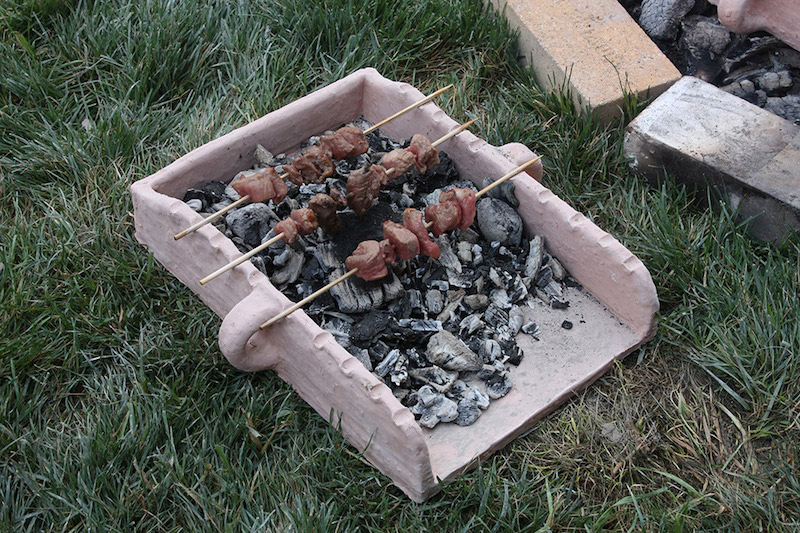
Hruby has conducted an interesting experiment to find out the use of various clay griddles and trays found amongst the ruins of Mycenaean palatial settlements. The equipment had been determined to be used for cooking, but the details of how food was prepared with them was never determined. No one knew if the rectangular ceramic pans that sat underneath skewers of meat would have been placed directly over a fire, catching fat drippings from the meat, or if the pans would have held hot coals like a portable barbeque pit. The round griddles had tiny holes on their one side, while the other was smooth... how were these griddles used?

Hruby took it upon herself to discover these ancient cooking techniques and teamed up with ceramicist Connie Podleski, of the Oregon College of Art and Craft. the artist mixed American clays to mimic Mycenaean clay and created two griddles and two souvlaki trays in the ancient style. With their replica cookware, they tried to cook meat and bread.

So far, so good. On the trays, they found that meat only cooked properly when coals were shuffled into it to roast the meat from up-close, and bread was most likely baked on the side with the holes so it did not stick too badly if oil was used lavishly. I find these results very interesting, and long for more and better pictures than the article provides.

Now on to the conclusions:
  • "We should probably envision these as portable cooking devices — perhaps used during Mycenaean picnics."
  • "As for the griddles, bread was more likely to stick when it was cooked on the smooth side of the pan. The holes, however, seemed to be an ancient non-sticking technology, ensuring that oil spread quite evenly over the griddle."
  • "They're coming from elite structures, but I doubt very much that the elites were doing their own cooking," Hruby told LiveScience. "There are cooks mentioned in the Linear B [a Mycenaean syllabic script] record who have that as a profession — that's their job — so we should envision professional cooks using these."
 I... do not fully agree, but most of all I resist modern terminology like 'picnic' and 'non-sticking technology'. When interpreting anything left behind by ancient civilizations, it is easy to taint the interpretations with your modern way of thinking. Unfortunately, this not only hampers your ability to draw the right conclusions, but also the ability to do good research.
 
I haven't read the report, so perhaps Hruby has done far more extensive research than we are led to believe, but I for one find myself wondering how hot the bottom of these trays become, because I severely doubt that they were used (only?) for 'picnics'. It would seem far more logical to use these in-doors as regular cooking appliances so the meat burns over an easily manageable bed of coals from the hearth instead of over the hearth itself--which would then be soiled with fat and would need a lot of maintenance to be restored. If the bottom remains relatively cool, these could just have been placed on a table or other surface to make cooking far easier. It would also explain why they are portable; it is much easier to bring the tray to the fire, shuffle coals in, and then carrying it to your cooking area than to transport coals to a fixed tray. I don't understand why these appliances are negeted to a fringe 'picnic'-status? Were they only found in meadows?
 
I find myself equally wondering about the grills--of which I have yet to find a good picture... anyone?--because it seems odd to solely consider this as an 'or'-situation. Bread was either baked on the smooth side or the side with holes. No, why? Why not consider they baked one type of bread on the one side and another type of bread on the other? Maybe they made honey cakes on the flat side, or baked eggs on it, I don't know, but I doubt they made a smooth surface just to disregard it during cooking.
 
As for the last mentioned conclusion... I am sure some of the Mycenaean elite had cooks, and these ceramic tools were used by them, and yes, there were probably many people who did not own these, but I somehow doubt that tools like these were used only by professional cooks. It's not rocket science, and it seems to make life a lot easier. As far as I know, we have no evidence to support either theory, so why even limit your conclusion to 'professional cooks for the elite'?
 
All in all, I would love to read Hruby's paper on the subject and see better pictures of the cooking process. I think the subject matter is very interesting and while it may not be the most glamorous of studies, I am far more concerned with items like these--items that belonged to the household--than the finery that has survived from the late Bronze Age (1700 BC to roughly 1200 BC). What do you think about the research and conclusions?
Sometimes it's slow going in acheological news land, but when it rains it tends to pour. Today I am writing a round-up of archeological discoveries made in the recent past. Today on the schedule are: the restoration work at the ancient theatre of Sparta, the discovery of a Mycenaean settlement in NW Peloponnese, and a study on an erotic epigram on an ostrakon from Rhodes.


Restoration work to begin at ancient theatre of Sparta
The Archaeology News Network heads with the news that the ancient Theater of Sparta--which is now almost completely burried with only Roman and later features still visible--is getting a make-over. The Spartan theatre is unique in that it had a mobile stage, as the theatre used to host several events. The stage was kept in a special 'case' under a hangar built at the west lane. It used to be a prosperous theater, done up in local white marble. It was one of the most important theaters around in Classical times, and thus the Central Archaeological Council has recently given the green light to start restoring the structure, starting with a careful evaluation of the monument. From the article:

"The study focuses mainly on the damage that the stone elements of the theatre have suffered (those made of marble and limestone) from erosion, the loss of material and the fractures caused by the growing of plants, the engravings and graffiti, while relevant damage has also occurred at the masonry of the monument. The road is now open for the correct documentation of the situation, of the theatre parts, and also for the cleaning off of all deposits, such as vegetation and microorganisms, or those brought by human hands such as graffiti."


Mycenaean settlement found in NW Peloponnese
Dr Lena Papazoglou-Manioudaki, Honorary Curator in charge of the Prehistoric Collection National Archaeological Museum, recently discussed the excavation on Mygdalia hill, a hill in Achaea in the Patras region, Hellas' third largest urban area and the regional capital of Western Greece, in northern Peloponnese, 215 km (134 miles) west of Athens. She did this in preparation for a speech she will be giving at the Mycenaean Seminar. In her words:

"The Mycenaean settlement on Mygdalia hill covered an area of 6,500 sq.m at the top of the hill, on three successive terraces. [...] Three areas/rooms of a large rectangular building were unearthed on Τerrace 1. [...] On Terrace 2 was excavated a densely built settlement, situated on different levels, following the slope of the hill. [...] The existence of a defensive/retaining wall, preserved for a length of at least 50 m and apparently protecting the settlement from the more accessible south side, was confirmed on Terrace 3. [...] Terrace 1 houses the public sector, the ruler’s megaron and later on it is the designated place for the erection of an archaic temple, while the main settlement is located on terraces 2 and 3. The cemetery of built cists was located on the west slope of the hill. "

According to the Archaeological News Network, 'the [first] meeting of the Mycenaean Seminar will be at 19:00 on Thursday, 31st October 2013, in the British School at Athens, Upper House (52 Souedias st.) Τhe lecture will be held in Greek. The Organising Committee of the Mycenaean Seminar are Nagia Polychronakou-Sgouritsa, Iphiyenia Tournavitou, Emilia Banou, Harikleia Brekoulaki'.


An erotic epigram on an ostrakon from Rhodes
Our last bit of news comes in the form of a study done on an epigram from the second century BC, found on an ostrrakon--a pottery shard--in Rhodes. Anastasia Dreliosi-Irakleidou and Nikos Litinas (University of Crete) studied the epigram and published their finds in the current issue (10-12) of Eulimene periodical. The ostrakon was found during excavations on a plot in the central cemetery of Rhodes. From the study it has become clear that:

"Two hypotheses can be advanced: (a) The epigram consisted of (at least) four elegiac distichs. The hexameter of the third elegiac couplet and the pentameter of the fourth elegiac couplet have been omitted, either deliberately or by mistake. (b) The epigram consisted of three elegiac distichs and the scribe wrote the pentameter of the last distich before the hexameter.

The content of the epigram(s) is that Glykera, perhaps a Samian hetaira, managed to be freed from her eros by vowing to dedicate a painting of a pannychis that had taken place on some occasion. Now a deity is asked that a thiasos already offered should also function as a lysis from eros for Papylides. However, the kind of the thiasos and the way it is dedicated are not clear. Also, there are some questions concerning the corresponding elements between the two stories of Glykera and Papylides. Since there are missing verses or the verses are reversed, as said above, it is uncertain whether the text constitutes one or two different epigrams."
 
The identity of the poet is unknown.


Image credit: Theater of Sparta: Greek Reporter via the Archaeology News Network, Mycenaean settlement: Archaiologia Online via the Archaeology News Network, epigram on ostrakon: A. Dreliosi-Irakleidou, N. Litinas via the Archaeology News Network.