Showing posts with label Kronia. Show all posts

I get a lot of questions from readers, and most of the time, the answers are fairly short. When I feel the question or the reply would be valuable to others as well, I make a post with a collection of them and post them in one go. Today is one of those posts.


"What is the difference between hellenic recon, hellenic reform, and hellenic revival? I haven't really been able to find good explanations of these terms in relation to their differences."
 
In general, I consider 'Revival' and 'Reformed' the same thing. Others probably don't, but I'll explain the difference between 'Recon' (which we call 'Traditional') and 'Reformed' Hellenismos. To start, there is no hard line—not in as far as can be defined beforehand; the distinction between 'Traditional' and 'Reformed' is a matter of intent.

The ancient Hellenes worshipped their Gods in a way they did not even have to think about. They were taught by their parents how a ritual was supposed to be conducted and what a festival looked like. Kids learned how to act in temples, and they played their parts in the sacrifice. The ancient religion varied from place to place and when details of a festival or rite changed, they changed because the polis wanted them to. The ancient Hellenic religion(s) were greatly tied to the ancient Hellenic culture(s). Yet, there were overarching ideals and ritual acts that a man traveling from Athens to Kos would recognize if he walked in on a festival there. In fact, it's likely he would have recognized the festival and could share in its intent. Perhaps not its execution, and perhaps not all the time (because of local mythology and deities), but most of the time, and in most of its execution.
 
'Traditional' thus means to practice Hellenismos in the spirit of the ancients. I keep in mind that man from ancient Athens and with everything I do, we wonder if he would recognize what I am doing as the worship of the Gods he worships at home. That does not mean you need a big altar out in your garden (although I do encourage it), and this doesn't mean you need to hold daily ritual (although I do encourage it), and it doesn't mean that you always have to worship in a group or with your family (but I do encourage it) in order to be Traditional. It means that whatever you do, you keep that man in mind and wonder if he would recognize what you are doing as an adapted and modernized version of his faith.
 
'Traditional', as such, has nothing to do with practices that link back directly to ancient Hellas; no one is claiming to trace a lineage back or to in any other way have a direct line into the ancient Hellenic religion. We take what we know from scholarly and original work and make a generalized framework that can be built off of and adapt that to modern culture. Then we flesh out our practice with ancient practices and ancient ways of thought that resonate with us.
 
'Reformed', then, is the incorporation of practices that are either completely new or were derived from ancient Hellas with so many steps in-between that it's become completely unrecognizable. The incorporation of modern witchcraft, for example, or patron Gods as defined by modern Paganism. Wiccan elements are also part of Reformed Hellenismos.
 
To get back to the intent I mentioned earlier; your practice is Traditional to the typical Hellenist if you adhere to the above: ancient practices in a modern context where the bare bones are as close to the generalized ancient religion as we can make them. If you wilfully bring in modern elements from other religions or traditions, we consider those parts of your practice Reformed, and there is no value judgement in that. One is not better than the other. they both have vlue. It's a personal choice.
  
I hope this makes the distinction between the two clearer, and that it gives substance and context to the terms. For me, the value in using these terms lies in more easily finding likeminded people to share worship with. Using these terms prevents a lot of hassle and aggravation, but in the end, they are just words. It's your practice that matters and in the end, we all worship the Theoi.

~~~

"I read your articles on the Kronia. Can you please tell me, what day it falls this year. Has anything been discovered that would need me to worship differently from your article. And how should I pay homage to the Kronos this year?"

As far as I am aware, the article is still accurate. The Kronia will be held from dusk on July 27 to dusk on July 28 in 2016. you can find last year's ritual for the event here.

If you are interested in honouring Kronos, next month, from dusk on March 23 to March 24, the Galaxia takes place. This rather obscure festival was held in many places in ancient Hellas, but most notably at Olympia. It was closely linked to the vernal equinox, which was used to date it. The Galaxia is a festival held in honour of the Mother (of the Gods), who in Hellenic mythology is Rhea, although the title is also strongly associated with Gaia and Kybele, who have similar functions. She was worshipped as the mother of Zeus and the Galaxia celebrated His birth just as much as Her giving birth to him. Kronos--as Her consort and His father--was most likely also sacrificed to, along with Hera, who as Zeus' wife deserved honour alongside Him. Our ritual for that can be found here.

~~~

"As I have been ordered by my doctor to lose a great deal of weight, I was wondering if you had any suggestions for which Gods or Goddesses I should pray to (I assume Heracles would be one of these) or which Hymn's of Homer I should recite. If you could get back to me, I would greatly appreciate your input."

Herakles would be a great hero to pray to, as would any Gods and Goddesses connected to battle, struggle and physical health. Ares and Athena come to mind, along with Asklepios and even Niké. Especially Ares is a God I pray a lot to when it comes to working out and getting in shape, Demeter might also be a good option to help make healthy food choices.

~~~

"I see that you have ideas about honoring certain gods, which can include their families..ie, Apollo, Artemis, Leto, and zeus , etc. Do you have any ideas of honoring Hera, daily and just to do something special for her, offerings or a devotional."

Do you do daily ritual now? Hera is included in mine. If you only wish to honour Hera, however, you can with a simple ritual.

- Set out a bowl of water
- Set out a bowl of wine and dilute it with water
 - Light a candle to Hestia with a match
- Drop the match into the bowl of water and use it as khernips to cleanse
- Wash your hands and face and flick the access water off over your shrine to cleanse it.
-  Recite the Homeric Hymn 24 to Hestia:
 
"Blessed Goddess Hestia, you who tend the holy house of the lord Apollo, the Far-shooter at goodly Pytho, with soft oil dripping ever from your locks, come now into this house, come, having one mind with Zeus the all-wise—draw near, and withal bestow grace upon my song."
 
- Pour some wine out to Hestia
- Light an incense burner with aromatic herbs like bay-leaf, chamomile, chrysanthemum, jasmine flowers, laurel, lavender, myrtle,  rose, sandalwood, verbana, etc. or add it to a sacrificial fire
- Recite a hymn to Hera, like Homeric Hymn 12 to Hera:
 
"I sing of golden-throned Hera whom Rhea bare. Queen of the Immortals is she, surpassing all in beauty: she is the sister and wife of loud-thundering Zeus,--the glorious one whom all the blessed throughout high Olympos reverence and honour even as Zeus who delights in thunder."
 
- Pour some wine out to Hera
- Say your prayers
- Blow out the candle and clean up

 ~~~

"Do you know any artist that does drawing or paintings or even statuary. Commissioned pieces. I have been looking for a long time now and figured to ask because I have been meaning to commission some pieces of Hera or other gods as I become more financially able."

About commissioning pieces... I only know of Lykeia. Any readers interested....? Leave your contact info in the comments!
The 12th of Hekatombion marks the start of the ancient Hellenic Kronia festival. The Kronia honours Kronos, Zeus' father, not to be confused with Khronos; creator of the Gods and Lord of Time. Will you be joining us for the celebration on July 4th, at the usual 10 am EDT?


In Athens, Kronos and Rhea--His wife and sister--shared a temple. They represented an age before the Theoi took to rule; a time when societal rules did not exist yet, and there was no hierarchy. As such, on the day Kronos was worshipped, the fixed order of society was suspended, and slaves joined--and even ruled over--a banquet given by their masters; they ran through the streets screaming and hollering. On Krete, they could whip their masters. As much fun as this was, the day served as a reminder that for a society to function, societal rules were necessary, and as such, it was also necessary for Zeus to overthrow His father and assume the throne.

Besides a banquette, the Kronia must have been celebrated with an official sacrifice as well, in the temple to Him and Rhea, as the Kronia was a harvest festival of sorts. Unlike many rites to Demeter, the Kronia focused on the harvest--most likely of cereals--that was completed around this time. It was the end of a hectic period where slaves were worked hard, and their masters as well. A communal meal and a little bit of payback on the side of the serfs was most likely at the root of this festival, along with gratitude for the successful harvest; the Hellenic summers were too hot to grow much of anything, so the food eaten in this barren season ahead needed to be taken in and thrashed (where needed) prior to the swell of summer heat. The Kronia was a good mark for this.

There is a little bit of evidence that human sacrifice--in the form of 'scapegoat' rituals was performed on or around the date of the Kronia in the very distant past, but by the time Hellas--and especially Athens--became civilized in the way we speak of today, this practice was long outdated. It seems that a criminal condemned to death was taken outside of the city gates for a reason now lost to us, possibly fed copious amounts of wine, and then killed in honor (or placation) of Kronos. Needless to say, there is no reason to bring this practice back.

You can find the ritual here and the community page here.
The 12th of Hekatombion marks the start of the ancient Hellenic Kronia festival. The Kronia honours Kronos, Zeus' father, not to be confused with Khronos; creator of the Gods and Lord of Time. Will you be joining us for the celebration on July 15th (so, today!), at the usual 10 am EDT?


In Athens, Kronos and Rhea--His wife and sister--shared a temple. They represented an age before the Theoi took to rule; a time when societal rules did not exist yet, and there was no hierarchy. As such, on the day Kronos was worshipped, the fixed order of society was suspended, and slaves joined--and even ruled over--a banquet given by their masters; they ran through the streets screaming and hollering. On Krete, they could whip their masters. As much fun as this was, the day served as a reminder that for a society to function, societal rules were necessary, and as such, it was also necessary for Zeus to overthrow His father and assume the throne.

Besides a banquette, the Kronia must have been celebrated with an official sacrifice as well, in the temple to Him and Rhea, as the Kronia was a harvest festival of sorts. Unlike many rites to Demeter, the Kronia focused on the harvest--most likely of cereals--that was completed around this time. It was the end of a hectic period where slaves were worked hard, and their masters as well. A communal meal and a little bit of payback on the side of the serfs was most likely at the root of this festival, along with gratitude for the successful harvest; the Hellenic summers were too hot to grow much of anything, so the food eaten in this barren season ahead needed to be taken in and thrashed (where needed) prior to the swell of summer heat. The Kronia was a good mark for this.

There is a little bit of evidence that human sacrifice--in the form of 'scapegoat' rituals was performed on or around the date of the Kronia in the very distant past, but by the time Hellas--and especially Athens--became civilized in the way we speak of today, this practice was long outdated. It seems that a criminal condemned to death was taken outside of the city gates for a reason now lost to us, possibly fed copious amounts of wine, and then killed in honor (or placation) of Kronos. Needless to say, there is no reason to bring this practice back.

You can find the ritual here  and the community page here.
The 12th of Hekatombion marks the start of the ancient Hellenic Kronia festival. The Kronia honours Kronos, Zeus' father, not to be confused with Khronos; creator of the Gods and Lord of Time. Will you be joining us for the celebration on July 25th, at the usual 10 am EDT?


In Athens, Kronos and Rhea--His wife and sister--shared a temple. They represented an age before the Theoi took to rule; a time when societal rules did not exist yet, and there was no hierarchy. As such, on the day Kronos was worshipped, the fixed order of society was suspended, and slaves joined--and even ruled over--a banquet given by their masters; they ran through the streets screaming and hollering. On Krete, they could whip their masters. As much fun as this was, the day served as a reminder that for a society to function, societal rules were necessary, and as such, it was also necessary for Zeus to overthrow His father and assume the throne.

Besides a banquette, the Kronia must have been celebrated with an official sacrifice as well, in the temple to Him and Rhea, as the Kronia was a harvest festival of sorts. Unlike many rites to Demeter, the Kronia focused on the harvest--most likely of cereals--that was completed around this time. It was the end of a hectic period where slaves were worked hard, and their masters as well. A communal meal and a little bit of payback on the side of the serfs was most likely at the root of this festival, along with gratitude for the successful harvest; the Hellenic summers were too hot to grow much of anything, so the food eaten in this barren season ahead needed to be taken in and thrashed (where needed) prior to the swell of summer heat. The Kronia was a good mark for this.

There is a little bit of evidence that human sacrifice--in the form of 'scapegoat' rituals was performed on or around the date of the Kronia in the very distant past, but by the time Hellas--and especially Athens--became civilized in the way we speak of today, this practice was long outdated. It seems that a criminal condemned to death was taken outside of the city gates for a reason now lost to us, possibly fed copious amounts of wine, and then killed in honor (or placation) of Kronos. Needless to say, there is no reason to bring this practice back.

You can find the ritual here and the community page here.
The 12th of Hekatombion marks the start of the ancient Hellenic Kronia festival. The Kronia honours Kronos, Zeus' father, not to be confused with Khronos; creator of the Gods and Lord of Time. Will you be joining us for the celebration on July 6th, at the usual 10 am EDT?


In Athens, Kronos and Rhea--His wife and sister--shared a temple. They represented an age before the Theoi took to rule; a time when societal rules did not exist yet, and there was no hierarchy. As such, on the day Kronos was worshipped, the fixed order of society was suspended, and slaves joined--and even ruled over--a banquet given by their masters; they ran through the streets screaming and hollering. On Krete, they could whip their masters. As much fun as this was, the day served as a reminder that for a society to function, societal rules were necessary, and as such, it was also necessary for Zeus to overthrow His father and assume the throne.

Besides a banquette, the Kronia must have been celebrated with an official sacrifice as well, in the temple to Him and Rhea, as the Kronia was a harvest festival of sorts. Unlike many rites to Demeter, the Kronia focused on the harvest--most likely of cereals--that was completed around this time. It was the end of a hectic period where slaves were worked hard, and their masters as well. A communal meal and a little bit of payback on the side of the serfs was most likely at the root of this festival, along with gratitude for the successful harvest; the Hellenic summers were too hot to grow much of anything, so the food eaten in this barren season ahead needed to be taken in and thrashed (where needed) prior to the swell of summer heat. The Kronia was a good mark for this.

There is a little bit of evidence that human sacrifice--in the form of 'scapegoat' rituals was performed on or around the date of the Kronia in the very distant past, but by the time Hellas--and especially Athens--became civilized in the way we speak of today, this practice was long outdated. It seems that a criminal condemned to death was taken outside of the city gates for a reason now lost to us, possibly fed copious amounts of wine, and then killed in honor (or placation) of Kronos. Needless to say, there is no reason to bring this practice back.

You can find the ritual here and the community page here.
I get a lot of questions from readers, and most of the time, the answers are fairly short. When I feel the question or the reply would be valuable to others as well, I make a post with a collection of them and post them in one go. Today is one of those posts.


"Hi! I have a few questions about household worship... 1. In the home, does the Hestia flame need to be separate from the sacrificial fire? 2. How do you offer fruit to the Theoi in the home? Do you burn it/do all ouranic offerings need to be burnt? 3. Do prayers come last in a ritual? Which comes first, prayers or offerings? Thank you so much in advance for your time! It means a lot."

1. Back in ancient Hellas, most religious activities surrounding the household revolved around the central hearth, which was seen as the physical manifestation of Hestia. While Hestia has little mythology to Her name, Her worship was a vital part of ancient Hellenic religion. For one, Her flame connected every single Hellenic oikos to each other and the state. All the household fires were lit with a flame from the prytaneion (Πρυτανεῖον), the structure where state officials met and where the city kept a fire for Hestia burning day and night. Every single heart fire in the city or town was linked to that central one, and that central fire was linked to the city from where the settlers of the new village, town or city came. This network of fires, which were never allowed to go out, brought all Hellenes together. In modern worship, we very rarely have a fire burning at all times of the day, so many Hellenes opt to have a candle burning for Her (or a battery powered one when we leave the house). In modern worship we thus usually have a fire to Hestia burning during ritual as well as a sacrificial fire, but since the sacrificial fire is usually lit from the flame to Hestia, it is really an extension of Hestia's flame.

2. Traditionally speaking--which is what I practice, so that's the answer you're getting when you ask me things--yes, all Ouranic sacrifices should be burned. Sacrifices to heroes too, by the way, and even some Khthonic sacrifices were burned. The ancient Hellenes burned things (like sacrifices, incense, but also the firebrand to make khernips) because smoke was the only way the sacrifice reached the Ouranic Gods. That's how the sacrifice traveled to Olympos and how the sacrifice itself became sacred. Pure. Not burning sacrifices, traditionally speaking, is promising the gods sustenance and giving them an empty plate along with a message saying "just imagine it's food. I'm sure you'll feel full". Of course, I--and hopefully They--know it isn't always possible, but I do advocate burning sacrifices if at all possible.

3. Sacrifice was and is the highlight of Hellenic ritual. In ancient Hellas, communal sacrifices almost always included animal sacrifice. Worshippers processed to the ritual site, consciously leaving the mundane behind. The scent of incense would have filled the air, and hymns would have been sung. They cleansed themselves with lustral water (named khernips) and sprinkled the area and altar with it. All participants threw barley groats onto the animal, the ground and the altar to sow good fortune. The hymns would have continued until libations were made in or around the fire. This signaled the start of prayers. After the libation, the person who would kill the animal would have taken the knife and cut a lock of the animal's hair. Swiftly, the lock would be tossed into the fire as a warning of the impending sacrifice. The tension would have reached its height at this time and with a swift motion, the animal's throat would have been cut. All of its blood was collected and later dripped onto the fire or--in case of a smaller animal--dripped onto the fire directly. Women would scream, possibly to cover up the dying sounds of the animal, and then the tension would have most likely been broken and the ominous mood turned festive: while the entire animal belonged to the Gods, They saw fit to give much of it to Their followers for rare meat consumption. Then, Hestia received the last libation.

Modern worship is organized somewhat the same way as ancient sacrifice was. Perhaps needless to say: modern worship rarely includes animal sacrifice, although meat sacrifices are more common. We start with a procession (no matter how short) toward the altar, where we purify ourselves and the space around us with khernips. We also sow barley groats. This is not only a form of purification, it was the start of the process of kharis where the strewing of barley groats on and around the altar of the Theoi is like a spiritual sowing to reap the benefits of later (asked for through prayer later on in the rite). As such, the barley that we use is whole form, just like it is for actual sowing of the crop.

During the procession, songs are sung, and once purification is performed, a hymn is sung or proclaimed. Hymns are sung to please, to bring forth. It is a way to celebrate the deity in question, but also to make Him or Her more inclined to grant the following request. Prayers are next on the agenda. A prayer is carefully formulated to convey a message as persuasively as possible to the God, and was thus often spoken. The idea is not to please, but to request. They make use of the established and just now strengthened kharis to petition the Gods for aid. Where the hymn is an offering to go along with material sacrifice, the prayer is not an offering at all. To soften the request, prayers are often accompanied by the sacrifice--the main event of the rite.

~~~

"Do you think it's "reconstructionist" to honor specific Gods on the solstices and equinoxes? Like during your daily libations? Even though we don't know of any festivals that historically took place on those days, would it be "okay" just to add hymns and libations for certain Gods on those days? Maybe also do some secular seasonal decorating? What do you think?"

A solstice is an astronomical event that occurs twice each year (around 21 June and 21 December) as the Sun reaches its highest or lowest excursion relative to the celestial equator on the celestial sphere. An equinox occurs twice a year as well (around 20 March and 22 September), when the plane of the Earth's equator passes the center of the Sun. At this time the tilt of the Earth's axis is inclined neither away from nor towards the Sun. In essence, during an equinox, the period of time the sun is down (night time) and the sun is up (daytime) is roughly the same. The ancient Hellenes observed these four points in the year, and because of that, the ancient Hellenic calendar is partly solar: the solstices and equinoxes are anchor points for the otherwise lunar calendar.

Depending on the city-state, one of these four points was picked for the start of the new year. Athens and Delphi had the summer solstice, Boeotia had the winter solstice, and Milet started out with the autumnal equinox, but moved the new year to the spring equinox around the end of the 4th century BC. This anchor point was the most important; the rest were used to check the accuracy of the calculations.

Is it reconstructionistic to honor specific Gods on the solstices and equinoxes? That depends on which Gods you honor on the equinoxes and solstices. We know there were festivals celebrated on or around the time of these anchor points:

The Galaxia was closely associated with the Spring/Vernal Equinox.
The Kronia was closely associated with the Summer Solstice.
The Eleusinian Mysteries were celebrated around the autumnal Equinox.
The Poseidea was closely associated with the Winter Solstice.

If you want to associate other deities with these dates, feel free, but honestly, with a calendar of roughly 70 festivals throughout the year, I personally do not feel the need to add modern ones.

~~~

"How do you celebrate Noumenia on the night before? The night before is the dark of the moon, in all reality, so shouldn't it be Hene Kai Nea? But Hene Kai Nea is the night/day before the dark of the moon, then Noumenia starts on the night of the dark of the moon and ends the next day. How are we celebrating the first sighting of the moon if we are doing it before the moon ever appears in the sky and we say the day is over before the moon has a chance to appear? That makes no sense to me."

One of the most important and confusing of the many Hellenic festivals is the three-day transition from month to month. Although unlinked, the Deipnon, the Noumenia and Agathós Daímōn are held on consecutive days, around the new moon. Especially the placement of the days is hard to get right; at least, it was for me.

The Deipnon (Hene kai Nea)--or Hekate's Deipnon--is celebrated any time before the first sliver of the new moon is visible. In practice, this is the day after the new moon. The Noumenia is held the day after that, when the moon has become visible again, and Agathós Daímōn the day after that. It is important to note that the ancient Hellens started a new day at sundown the day before. Instead of starting a new day at midnight--or in the morning--like we do today, they started it at sundown of the previous day. This means that--when applied to modern practice--the Deipnon starts on the day of the suspected new moon, and the rest follows after, to the total of four days. Confused yet? How about a schematic. In this example, we'll assume that the sun goes down at six P.M. on all days.

Day 1:
All day - (suspected) new moon
6 P.M. - start of the Deipnon (Deipnon night)

Day 2:
All day - day after the new moon
6 P.M. day 1 to 6 P.M. day 2 - Deipnon (Deipnon day)
6 P.M. - start of the Noumenia (Noumenia night)

Day 3:
All day - second day after the new moon
6 P.M. day 2 to 6 P.M. day 3 - Noumenia (Noumenia day)
6 P.M. - start of  Agathós Daímōn (Agathós Daímōn night)

Day 4:
All day - third day after the new moon
6 P.M. day 3 to 6 P.M. day 4 - Agathós Daímōn (Agathós Daímōn day)

In general, you celebrate the Deipnon at night time on the day of the Deipnon, so after sundown on day one. Many Hellenists spent the day of the Deipnon (day two, until sundown) cleaning and taking out things like the recyclables; getting everything ready for the new month. The Noumenia starts at sundown on day two. Typically the bulk of the Noumenia rituals is done in the daylight hours, so on day three until sundown. Personally, I do a nighttime ritual on day two after sundown for Selene, as She is a moon Goddess and honoring Her when the first sliver of Her becomes visible is important to me. I also honor Her during the daytime on day three. At sundown on day three, Agathós Daímōn starts. The ritual aspects are usually held in the daylight hours, so on day four, until sundown.
I hope this makes it clearer!
The 12th of Hekatombion marks the start of the ancient Hellenic Kronia festival. The Kronia honours Kronos, Zeus' father, not to be confused with Khronos; creator of the Gods and Lord of Time. Will you be joining us for the celebration on July 17th, at the usual 10 am EDT?


In Athens, Kronos and Rhea--His wife and sister--shared a temple. They represented an age before the Theoi took to rule; a time when societal rules did not exist yet, and there was no hierarchy. As such, on the day Kronos was worshipped, the fixed order of society was suspended, and slaves joined--and even ruled over--a banquet given by their masters; they ran through the streets screaming and hollering. On Krete, they could whip their masters. As much fun as this was, the day served as a reminder that for a society to function, societal rules were necessary, and as such, it was also necessary for Zeus to overthrow His father and assume the throne.

Besides a banquette, the Kronia must have been celebrated with an official sacrifice as well, in the temple to Him and Rhea, as the Kronia was a harvest festival of sorts. Unlike many rites to Demeter, the Kronia focused on the harvest--most likely of cereals--that was completed around this time. It was the end of a hectic period where slaves were worked hard, and their masters as well. A communal meal and a little bit of payback on the side of the serfs was most likely at the root of this festival, along with gratitude for the successful harvest; the Hellenic summers were too hot to grow much of anything, so the food eaten in this barren season ahead needed to be taken in and thrashed (where needed) prior to the swell of summer heat. The Kronia was a good mark for this.

There is a little bit of evidence that human sacrifice--in the form of 'scapegoat' rituals was performed on or around the date of the Kronia in the very distant past, but by the time Hellas--and especially Athens--became civilized in the way we speak of today, this practice was long outdated. It seems that a criminal condemned to death was taken outside of the city gates for a reason now lost to us, possibly fed copious amounts of wine, and then killed in honor (or placation) of Kronos. Needless to say, there is no reason to bring this practice back.

You can find the ritual here and the community page here.
I get a lot of questions from readers, and most of the time, the answers are fairly short. When I feel the question or the reply would be valuable to others as well, I make a post with a collection of them and post them in one go. Today is one of those posts.


"What is the difference between hellenic recon, hellenic reform, and hellenic revival? I haven't really been able to find good explanations of these terms in relation to their differences."
 
In general, I consider 'Revival' and 'Reformed' the same thing. Others probably don't, but I'll explain the difference between 'Recon' (which we call 'Traditional') and 'Reformed' Hellenismos. To start, there is no hard line—not in as far as can be defined beforehand; the distinction between 'Traditional' and 'Reformed' is a matter of intent.

The ancient Hellenes worshipped their Gods in a way they did not even have to think about. They were taught by their parents how a ritual was supposed to be conducted and what a festival looked like. Kids learned how to act in temples, and they played their parts in the sacrifice. The ancient religion varied from place to place and when details of a festival or rite changed, they changed because the polis wanted them to. The ancient Hellenic religion(s) were greatly tied to the ancient Hellenic culture(s). Yet, there were overarching ideals and ritual acts that a man traveling from Athens to Kos would recognize if he walked in on a festival there. In fact, it's likely he would have recognized the festival and could share in its intent. Perhaps not its execution, and perhaps not all the time (because of local mythology and deities), but most of the time, and in most of its execution.
 
'Traditional' thus means to practice Hellenismos in the spirit of the ancients. I keep in mind that man from ancient Athens and with everything I do, we wonder if he would recognize what I am doing as the worship of the Gods he worships at home. That does not mean you need a big altar out in your garden (although I do encourage it), and this doesn't mean you need to hold daily ritual (although I do encourage it), and it doesn't mean that you always have to worship in a group or with your family (but I do encourage it) in order to be Traditional. It means that whatever you do, you keep that man in mind and wonder if he would recognize what you are doing as an adapted and modernized version of his faith.
 
'Traditional', as such, has nothing to do with practices that link back directly to ancient Hellas; no one is claiming to trace a lineage back or to in any other way have a direct line into the ancient Hellenic religion. We take what we know from scholarly and original work and make a generalized framework that can be built off of and adapt that to modern culture. Then we flesh out our practice with ancient practices and ancient ways of thought that resonate with us.
 
'Reformed', then, is the incorporation of practices that are either completely new or were derived from ancient Hellas with so many steps in-between that it's become completely unrecognizable. The incorporation of modern witchcraft, for example, or patron Gods as defined by modern Paganism. Wiccan elements are also part of Reformed Hellenismos.
 
To get back to the intent I mentioned earlier; your practice is Traditional to the typical Hellenist if you adhere to the above: ancient practices in a modern context where the bare bones are as close to the generalized ancient religion as we can make them. If you wilfully bring in modern elements from other religions or traditions, we consider those parts of your practice Reformed, and there is no value judgement in that. One is not better than the other. they both have vlue. It's a personal choice.
  
I hope this makes the distinction between the two clearer, and that it gives substance and context to the terms. For me, the value in using these terms lies in more easily finding likeminded people to share worship with. Using these terms prevents a lot of hassle and aggravation, but in the end, they are just words. It's your practice that matters and in the end, we all worship the Theoi.

~~~

"I read your articles on the Kronia. Can you please tell me, what day it falls this year. Has anything been discovered that would need me to worship differently from your article. And how should I pay homage to the Kronos this year?"

As far as I am aware, the article is still accurate. The Kronia will be held from dusk on July 27 to dusk on July 28 in 2016. you can find last year's ritual for the event here.

If you are interested in honouring Kronos, next month, from dusk on March 23 to March 24, the Galaxia takes place. This rather obscure festival was held in many places in ancient Hellas, but most notably at Olympia. It was closely linked to the vernal equinox, which was used to date it. The Galaxia is a festival held in honour of the Mother (of the Gods), who in Hellenic mythology is Rhea, although the title is also strongly associated with Gaia and Kybele, who have similar functions. She was worshipped as the mother of Zeus and the Galaxia celebrated His birth just as much as Her giving birth to him. Kronos--as Her consort and His father--was most likely also sacrificed to, along with Hera, who as Zeus' wife deserved honour alongside Him. Our ritual for that can be found here.

~~~

"As I have been ordered by my doctor to lose a great deal of weight, I was wondering if you had any suggestions for which Gods or Goddesses I should pray to (I assume Heracles would be one of these) or which Hymn's of Homer I should recite. If you could get back to me, I would greatly appreciate your input."

Herakles would be a great hero to pray to, as would any Gods and Goddesses connected to battle, struggle and physical health. Ares and Athena come to mind, along with Asklepios and even Niké. Especially Ares is a God I pray a lot to when it comes to working out and getting in shape, Demeter might also be a good option to help make healthy food choices.

~~~

"I see that you have ideas about honoring certain gods, which can include their families..ie, Apollo, Artemis, Leto, and zeus , etc. Do you have any ideas of honoring Hera, daily and just to do something special for her, offerings or a devotional."

Do you do daily ritual now? Hera is included in mine. If you only wish to honour Hera, however, you can with a simple ritual.

- Set out a bowl of water
- Set out a bowl of wine and dilute it with water
 - Light a candle to Hestia with a match
- Drop the match into the bowl of water and use it as khernips to cleanse
- Wash your hands and face and flick the access water off over your shrine to cleanse it.
-  Recite the Homeric Hymn 24 to Hestia:
 
"Blessed Goddess Hestia, you who tend the holy house of the lord Apollo, the Far-shooter at goodly Pytho, with soft oil dripping ever from your locks, come now into this house, come, having one mind with Zeus the all-wise—draw near, and withal bestow grace upon my song."
 
- Pour some wine out to Hestia
- Light an incense burner with aromatic herbs like bay-leaf, chamomile, chrysanthemum, jasmine flowers, laurel, lavender, myrtle,  rose, sandalwood, verbana, etc. or add it to a sacrificial fire
- Recite a hymn to Hera, like Homeric Hymn 12 to Hera:
 
"I sing of golden-throned Hera whom Rhea bare. Queen of the Immortals is she, surpassing all in beauty: she is the sister and wife of loud-thundering Zeus,--the glorious one whom all the blessed throughout high Olympos reverence and honour even as Zeus who delights in thunder."
 
- Pour some wine out to Hera
- Say your prayers
- Blow out the candle and clean up

 ~~~

"Do you know any artist that does drawing or paintings or even statuary. Commissioned pieces. I have been looking for a long time now and figured to ask because I have been meaning to commission some pieces of Hera or other gods as I become more financially able."

About commissioning pieces... I only know of Lykeia. Any readers interested....? Leave your contact info in the comments!

The 12th of Hekatombion marks the start of the ancient Hellenic Kronia festival. The Kronia honours Kronos, Zeus' father, not to be confused with Khronos; creator of the Gods and Lord of Time. In Athens, Kronos and Rhea--His wife and sister--shared a temple. They represented an age before the Theoi took to rule; a time when societal rules did not exist yet, and there was no hierarchy. As such, on the day Kronos was worshipped, the fixed order of society was suspended, and slaves joined--and even ruled over--a banquet given by their masters. As much fun as this was, the day served as a reminder that for a society to function, societal rules were necessary, and as such, it was also necessary for Zeus to overthrow His father and assume the throne. You can read far more about the festival here.

To honour Kronos on this day, we will hold another PAT ritual; will you be joining us? We celebrate the Kronia on Tuesday July 28, at 10:00am in EDT. For those of you who don't want to go on Facebook for the event, you can find it here.
The 12th of Hekatombion marks the start of the ancient Hellenic Kronia festival. The Kronia honours Kronos, Zeus' father, not to be confused with Khronos; creator of the Gods and Lord of Time. In Athens, Kronos and Rhea--His wife and sister--shared a temple. They represented an age before the Theoi took to rule; a time when societal rules did not exist yet, and there was no hierarchy. As such, on th...e day Kronos was worshipped, the fixed order of society was suspended, and slaves joined--and even ruled over--a banquet given by their masters. As much fun as this was, the day served as a reminder that for a society to function, societal rules were necessary, and as such, it was also necessary for Zeus to overthrow His father and assume the throne. You can read far more about the festival here.

To honour Kronos on this day, we will hold another PAT ritual; will you be joining us? We celebrate the Kronia on Thursday July 10, at 10:00am in EDT. For those of you who don't want to go on Facebook for the event, you can find it here until Friday.
Tonight, the 12th of Hekatombion marks the start of the ancient Hellenic Kronia festival. I have written about this festival last year, but didn't go into detail about how the festival was celebrated in ancient Hellas. To recap last year's post: the Kronia honors Kronos, Zeus' father, not to be confused with Khronos; creator of the Gods and Lord of Time. For more on His mythology, see last year's post.

In Athens, Kronos and Rhea--His wife and sister--shared a temple. They represented an age before the Theoi took to rule; a time when societal rules did not exist yet, and there was no hierarchy. As such, on the day Kronos was worshipped, the fixed order of society was suspended, and slaves joined--and even ruled over--a banquet given by their masters; they ran through the streets screaming and hollering. On Krete, they could whip their masters. As much fun as this was, the day served as a reminder that for a society to function, societal rules were necessary, and as such, it was also necessary for Zeus to overthrow His father and assume the throne.

Besides a banquette, the Kronia must have been celebrated with an official sacrifice as well, in the temple to Him and Rhea, as the Kronia was a harvest festival of sorts. Unlike many rites to Demeter, the Kronia focused on the harvest--most likely of cereals--that was completed around this time. It was the end of a hectic period where slaves were worked hard, and their masters as well. A communal meal and a little bit of payback on the side of the serfs was most likely at the root of this festival, along with gratitude for the successful harvest; the Hellenic summers were too hot to grow much of anything, so the food eaten in this barren season ahead needed to be taken in and thrashed (where needed) prior to the swell of summer heat. The Kronia was a good mark for this.

There is a little bit of evidence that human sacrifice--in the form of 'scapegoat' rituals was performed on or around the date of the Kronia in the very distant past, but by the time Hellas--and especially Athens--became civilized in the way we speak of today, this practice was long outdated. It seems that a criminal condemned to death was taken outside of the city gates for a reason now lost to us, possibly fed copious amounts of wine, and then killed in honor (or placation) of Kronos. Needless to say, there is no reason to bring this practice back.

What one can bring back is a sacrifice to Kronos and a communal meal. We don't have serfs any more, but a family meal is always a good Hellenistic tradition. What kind of offering Kronos received is lost to us, but I suspect it was an animal sacrifice. Of course there are many alternatives today, and libations of wine, offerings of 'first fruits' in the form of grains, or cakes come to mind. here is an Orphic hymn to Kronos, which one can recite with fumigations of Storax:

"Etherial father, mighty Titan, hear, great fire of Gods and men, whom all revere: Endu'd with various council, pure and strong, to whom perfection and decrease belong. Consum'd by thee all forms that hourly die, by thee restor'd, their former place supply; The world immense in everlasting chains, strong and ineffable thy pow'r contains. Father of vast eternity, divine, O mighty Saturn [Kronos], various speech is thine: Blossom of earth and of the starry skies, husband of Rhea, and Prometheus wife. Obstetric Nature, venerable root, from which the various forms of being shoot; No parts peculiar can thy pow'r enclose, diffus'd thro' all, from which the world arose, O, best of beings, of a subtle mind, propitious hear to holy pray'rs inclin'd; The sacred rites benevolent attend, and grant a blameless life, a blessed end." [XII]


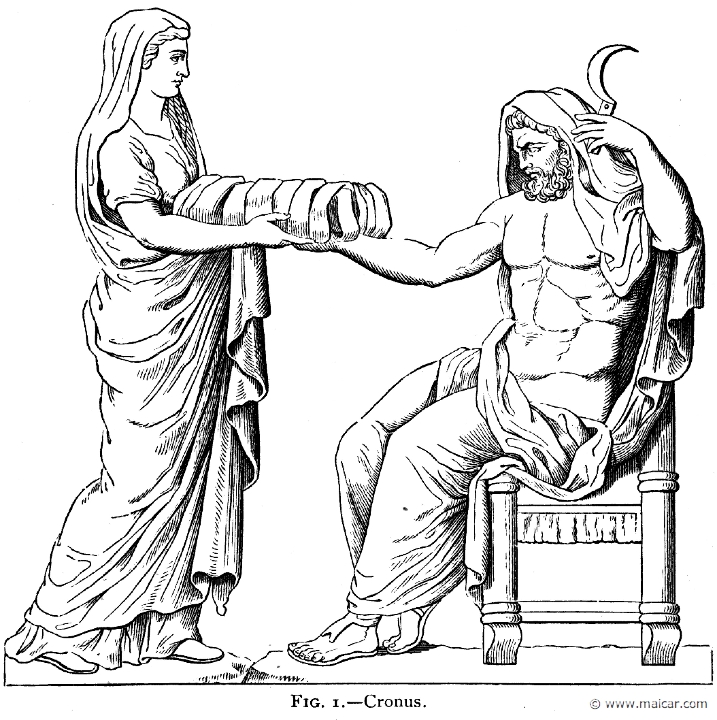
Image source: Kronos
I remember being new to Hellenic mythology. My first contact with the myths was through a study book in elementary school and focussed on the rise of Zeus over the Titans and, most importantly, his father Kronos. It was the basic story; Kronos was King of the Titans, son of Ouranos; Theos of the Sky, who was foretold one of His sons would cast Him off of the throne. To stop this from happening, Kronos ate His children whole, right after they were born. Rhea, his sister and wife, grew desperate and before giving birth to the last of Her children and ran to her mother, Gaea, for advice. Gaea told Her to hide Her child after birth and offer Kronos a rock to swallow. So done, Zeus was hidden from His father and grew up to a strong and competent young man who went on to overthrow His father, got Him to regurgitate Zeus's brothers and sisters and started the Titanomachy (Τιτανομαχία) or War of the Titans, which would last ten years and end with the victory of the Olympians and the incarceration of Kronos--and all who supported him--in Tartaros.

All I remember thinking was; 'Kronos is such a jerk! It's a good thing Zeus cast Him off of the throne!'

Now I'm a good deal older and a lot more versed in Hellenic mythology, I've come to rethink this position. I've since learned a good few things about Kronos that made me reconsider my opinion of Him. For one, Kronos, like Zeus, repeated a pattern He had learned from His parents. Ouranos did virtually the same to Kronos and the rest of His children as Kronos did, and for the same reason. Instead of eating them, Ouranos locked His many children in Tartaros. Kronos was the only one of Ouranos' children to take up the sickle His mother Gaea offered to Him and was eventually the one who cut off Ouranos' private parts and cast him down. 

Under Kronos' rule, men lived in a Golden Age. As Hesiod writes in Works and Days;

"First of all the deathless gods who dwell on Olympus made a golden race of mortal men who lived in the time of Cronos when he was reigning in heaven. And they lived like gods without sorrow of heart, remote and free from toil and grief: miserable age rested not on them; but with legs and arms never failing they made merry with feasting beyond the reach of all evils. When they died, it was as though they were overcome with sleep, and they had all good things; for the fruitful earth unforced bare them fruit abundantly and without stint. They dwelt in ease and peace upon their lands with many good things, rich in flocks and loved by the blessed gods."

After Kronos was cast down and men were ruled by Zeus, men slipped into the Silver Age, an age far worse than the Golden one;

"Then they who dwell on Olympus made a second generation which was of silver and less noble by far. It was like the golden race neither in body nor in spirit. A child was brought up at his good mother's side an hundred years, an utter simpleton, playing childishly in his own home. But when they were full grown and were come to the full measure of their prime, they lived only a little time in sorrow because of their foolishness, for they could not keep from sinning and from wronging one another, nor would they serve the immortals, nor sacrifice on the holy altars of the blessed ones as it is right for men to do wherever they dwell. Then Zeus the son of Cronos was angry and put them away, because they would not give honour to the blessed gods who live on Olympus."

When taking this under consideration, Zeus's actions against his father seem like a bad move for humanity. Although more ages followed, it never was again like it was in the Golden Age for us. It's something to think about, at least.

Kronos is often confused with Khronos; creator of the Gods and Lord of Time. Kronos--considered a harvest God for his link to the Golden Age--is outdated by Khronos by a few generations. In the Orphic cosmogony, Khronos was alone in the void. He created both Aether and Chaos who produced the Primordial Egg from with the hermaphroditic Theos Protogonos emerged. From Him, Ouranos was born, making Khronos, Kronos' great-grandfather. They are neither the same God, nor do they rule over the same domains. Most of the confusion comes from the Roman deity of Saturn, who is a harvest God, Father Time and the father of Jupiter--Zeus' equivalent--combined.

Saturn has His own festival in the Saturnalia but within Hellenismos, Kronos is honored during the Kronia. The Kronia was--and is--held on the twelfth day of the Attic month of Hekatombaion. I'll delve deeper into the Attic (Athenian) calendar in another post but this year, the Kronia was on July 2. I celebrated it today in a light but respectful manner. I followed standard practice, offered the darkest chocolate I could find (as well as Storax incense and barley) and read to Him the myths above, in which He overthrew His father and ruled over the Golden Age. 

Kronos is a a formidable Deity, a Titan of immeasurable power. Offering to Him seems only just. He's a strong ruler, a powerful harvest deity and a good example of the two sides every coin has. 

Did you celebrate Kronia? If so, how did it go? What are your experiences with Kronos? The comments section is open.