Showing posts with label current affairs. Show all posts

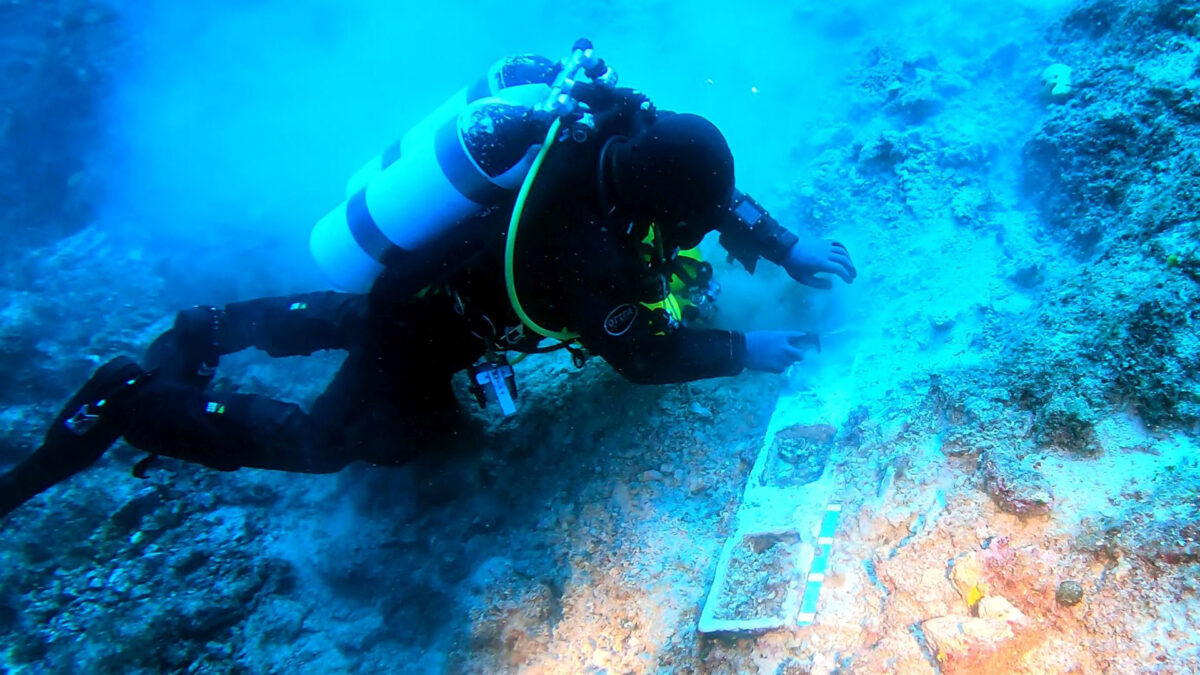
The Ministry of Culture and Sports announced the completion of the preliminary and exploratory works for the year 2021 on the Shipwreck of Antikythera. The new five-year underwater research programme is being conducted by the Swiss School of Archaeology under Dr. Angeliki G. Simosi, Head of the Euboea Ephorate of Antiquities and Lorenz E. Baumer, Professor of Classical Archaeology at the University of Geneva. Based on the results of this year’s research, a detailed programme will be prepared for the following years (2022-2025), in collaboration with all competent bodies involved. As noted in the announcement, maximum results were achieved in this year’s short expedition despite quite difficult weather conditions.

The first expedition of the second five-year programme took place between October 1-10 and focused on a detailed mapping of the site of the Antikythera wreck and the creation of its complete photogrammetric three-dimensional model in high resolution. On the one hand the mapping allows a much more accurate analysis of the distribution of the findings on the sea floor, fundamental to the accurate representation of the sinking of the ship in the 1st century BC. On the other hand it offers a new cutting-edge tool for an accurate planning of further research.

The successive integration of new and older findings in the model will result in the shipwreck’s complete documentation. It also makes it possible to access the space virtually through the internet. Moreover, this year’s expedition recorded most of the wreck’s surroundings, providing new and important information that will be investigated in future expeditions .

Despite the plethora of findings salvaged from the shipwreck from 1900 to the present, recent research between 2014 and 2019 shows that the scientific community is on the verge of discovering more important archaeological evidence that will help to better understand the site, answering key questions that have remained unanswered for more than 100 years.

The purpose of the investigation is to complete the collection of data necessary to draw conclusions regarding the following : the existence of other remnants of the Antikythera Mechanism at the site of the shipwreck, the ship and its cargo that remain covered as a result of a landslide, the possible connection between wrecks A and B, as well as the number of people aboard ship wreck A. An equally important goal is the discovery and collection of findings which include human skeletal remains, parts of the Antikythera ship and cargo which are exposed and vulnerable to possible human interventions and the adverse effects of the environment.

The most important find is part of a marble statue trapped under a heavy boulder. The initial analysis and documentation of the artefact was carried out by in situ photogrammetry and in due course will be further investigated. During the research, some smaller wooden and bronze structural elements of the ship were retrieved, as well as fragments of ceramics that give valuable information on the cargo’s dating and composition.This and other findings yielded by the future excavation will contribute to a more complete understanding of the valuable cargo on board the ship.

The field teams were coordinated by commodore Alexandros Palatianos and the director of underwater research was Alexandros Sotiriou, a collaborating archaeologist at the University of Geneva, with the participation of members of the Special Diving Team of the Submarine Missions Unit of the Coast Guard, underwater archaeologist Orestis Manousos and Italian researcher Dr. Elisa Costa of Ca ‘Foscari University in Venice.

The research is being conducted by the Swiss School of Archaeology under the supervision of the Ephorate of Underwater Antiquities and with the funding of the Ekaterini Laskaridis Foundation and Swiss Watch Manufacturer Hublot. The Athanasios K. Laskaridis Public Benefit Foundation has provided the Norwegian ship Typhoon, while Cosmote supports the project’s telecommunications.

The project is under the auspices of President of the Hellenic Republic Katerina Sakellaropoulou and actively supported by the Municipality of Kythera and the people of Antikythera.

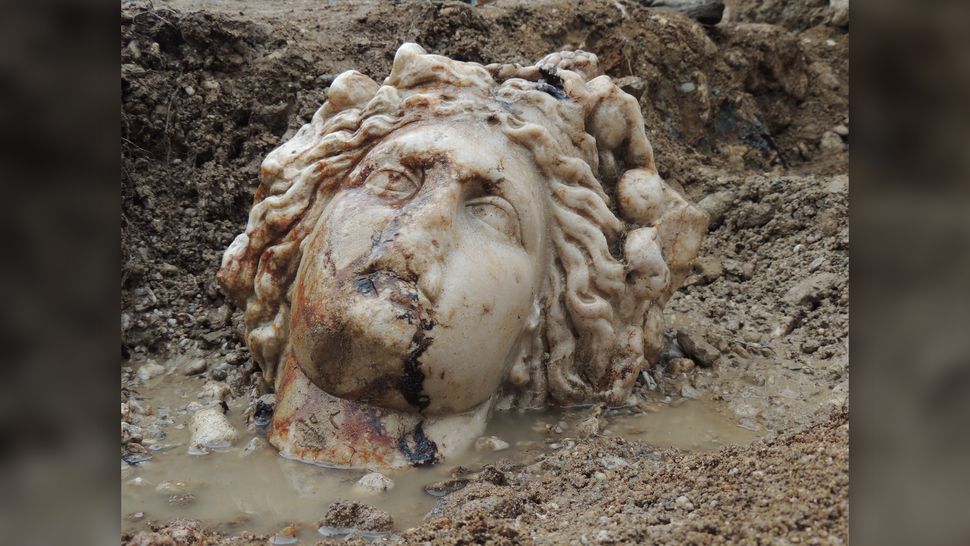
According to Hellenic mythology, the deities Aphrodite and Dionysos had a grand love affair. So, perhaps it's fitting that archaeologists found the ancient statuary heads of the Goddess of love and the reveler near each other during a dig in the ancient city of Aizanoi, in western Turkey.


The discovery of the deities' heads helps top off a previous find; on an earlier dig, archaeologists found the statues' headless bodies, Gokhan Coskun, an archaeologist at Kütahya Dumlupınar University in Turkey and the excavation coordinator, told Anadolu Agency, a Turkish state-run news organization. 

"These are important findings for us, as they show that the polytheistic culture of ancient Greece existed for a long time without losing its importance in the Roman era," Coskun said. "The findings suggest that there may have been a sculpture workshop in the region."

The ancient city of Aizanoi has a rich history filled with ancient Greek and Roman period settlements. Its earliest settlement dates to the second millennium B.C., but many of its remaining ruins date to the Roman Empire, including its Roman baths, Zeus temple and macellum, or Roman indoor market. Aizanoi is listed as a "tentative" World Heritage Site by the United Nations Educational, Scientific and Cultural Organization (UNESCO). 

Archaeologists found the Roman-era heads of Aphrodite and Dionysos buried in a creek bed in the ancient city. Each head is made of limestone, with Aphrodite's head measuring 19 inches (50 centimeters) and Dionysus' head measuring 17 inches (45 cm) tall, according to the news site GEO. It's unknown how the statues' heads became separated from their bodies.

Previously, archaeologists in Aizanoi uncovered the statue of Hygieia, Goddess of health, cleanliness and hygiene, according to GEO. 

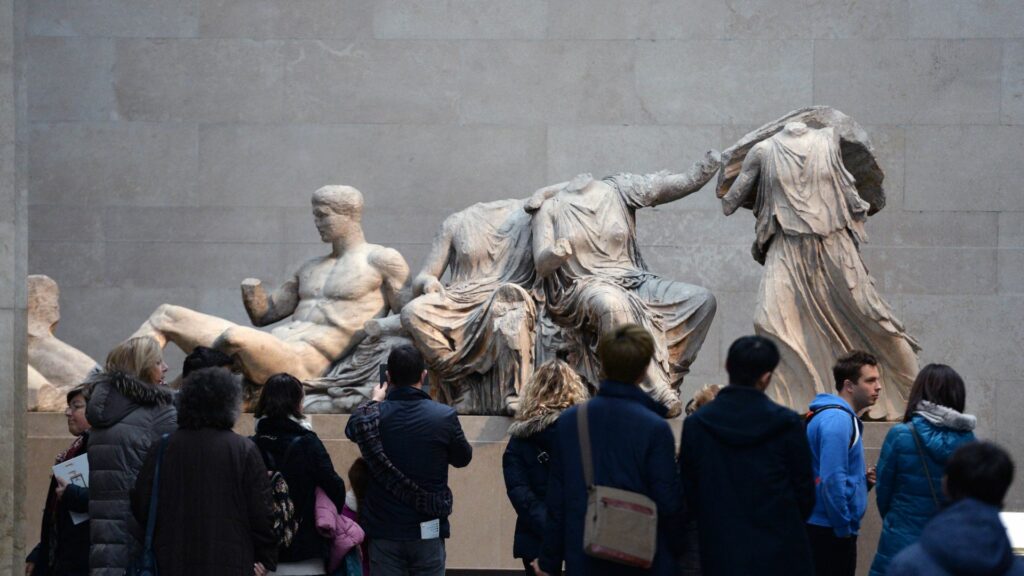
A white, hermetically sealed door, secured by an electronic lock, is what visitors to the British Museum encounter when they attempt to admire the Parthenon Sculptures. The Sculpture Room, like five other rooms with Greek exhibits, has remained inexplicably closed for ten months, heightening fears in the international lobby for the return of the Sculptures that the damage to the Museum's glass roof, which has resulted in water dripping next to (!) the Marbles, has not been repaired.

A recent inspection of the British Museum, in Bloomsbury, Central London, revealed that the Duveen Gallery, the room housing the priceless ancient Greek treasures sculpted by Pheidias, is still inaccessible to the public, unlike the other rooms that have been open since last May, when the last lockdown in Britain ended. This is despite assurances from officials at the beginning of the summer that 'the "Greek" galleries will open soon'. A spokesman for the museum was unable to give specific answers, speaking generally of a "programme of repairs and maintenance" being carried out on the halls. As for when they will reopen? Sometime "later this fall"...

In total, six rooms with ancient Greek exhibits remain closed: rooms 15, 16, 17 and 18 (ed. the last one exhibits the Sculptures), which are not open due to "repairs", and rooms 19 and 20, which do not admit visitors due to "compliance with measures for the coronavirus". Surprisingly, Museum officials, when asked, give different versions of both the reason for keeping the "Greek" halls closed, from December 2020, and when they will reopen. We asked four members of the Museum's staff who have the authority to answer questions from the public, and received four different answers! "We don't know exactly when they will open. Maybe in a month. Do you live in London? If so, come back in a while or give us a call," the first employee told us. Why are the halls closed? Because of a leak in the roof, I asked her. "Yes, and also for general maintenance." "We hope the halls will be open by the end of the year," said the second museum employee we asked, also admitting that what is keeping them closed is the water leak. "You know, it's an old building", she explained. A third employee made the same admission. "We are working to address the leak," she noted, adding that "our expectation is that the halls will reopen before the end of 2021." However, a fourth employee disagreed with the previous officials: "Renovation work is taking place. The reports of leakage are rumours and are very 'far-fetched'. I think the hall will be opened soon," he said.

Representatives of the campaign to repatriate the Marbles are alarmed, even expressing concern about the integrity of the sculptures. On August 15, the International Association for the Restoration of the Parthenon Sculptures (IARPS), which represents 21 national commissions from around the world, wrote to the museum's president Sir Richard Lambert, its director Dr. Hartwig Fischer and its commissioners on the issue. In the letter - shown here - the Union expresses its "deep concern" that the hall remains closed, stressing that the "potential moisture problem creates a dangerous situation for the sculptures". At the same time, it calls on the Museum to "reconsider its position on the ongoing division of the Sculptures", noting its "moral obligation" to reunite all the surviving Sculptures in the Acropolis Museum". "It is sad that Room 18 has remained closed since last December until further notice," IARPS president Dr. Chris Titgutt said, noting that "the inadequate air conditioning conditions in the room are a cause for concern." "I hope," he added, "that we don't have to wait another 22 years to admire the Parthenon Sculptures in London again, as happened in 1940 when the Duveen Gallery was hit by a bomb and remained closed until 1962! Then, of course, the Sculptures were kept in a safe place and remained intact."

Almost two months later, the museum has not responded to the letter, which Dr. Titgutt calls "regrettable." "That they have not responded is extremely disappointing. I wonder if this is how they are having a dialogue on such a pressing issue? It is time for the British Museum and Britain to move into the 21st century," added Paul Cartledge, a renowned Cambridge Hellenist, vice-chairman of IARPS and the British Commission on Sculpture (BCRPM).

"I would be happy if Room 18 were closed permanently, rather than temporarily as it is now, because it would mean that the magnificent sculptures snatched by the looter Lord Elgin would be reunited in the Acropolis Museum," said Janet Susman, chair of the British Committee for the Reunification of the Sculptures (BCRPM). "No one can say with certainty what kind of works are being done in the Greek halls of the British Museum and for how long," the internationally renowned Shakespearean actress added, stressing that "the poor conditions of the Sculptures' display have been pointed out by the BCRPM on many occasions: portable heaters in winter, open fire exits in summer, water leaking from the roof when it rains. We call on the British Museum to allow the Sculptures to be reunited in the iconic Acropolis Museum."

The "Greek" halls were closed to the public on 16 December 2020, when the building was locked due to the lockdown imposed by the British government. The museum reopened five months later, on 17 May 2021. However, the halls of Ancient Greece remained closed, with officials continually postponing the date of their reopening. According to reports, the heavy rainfall on 25 July in London caused, once again, water to leak into the Marble Hall, within inches of the exhibits. Advocates for the return have expressed concerns that the moisture could damage the ancient works of art. The British Museum's website states that the "Greek" rooms are "closed until further notice" due to "regular maintenance work". Museum visitors walking to Room 18 - known as the Duveen Gallery - which houses the sculptures, are forced to stop at Room 23. There, a plywood door, recently installed as part of a temporary structure, blocks the entrance to the other Greek exhibitions.

The problem of leaking water in room 18 was first highlighted in December 2018. Since then, it has remained unresolved, with many commentators calling the situation unacceptable and embarrassing for a museum of Britain's stature. The poor exhibition conditions of the sculptures were also highlighted by UNESCO ten days ago, expressing "concern that the Duveen Hall is not open to the public due to necessary repairs" and adding that it "looks forward to its reopening in due course". Almost every time it rains torrentially and the rain is lengthy, water accumulates on the roof, which sometimes drips into the Sculpture Hall. Usually, the situation is handled with buckets placed next to the Marbles and rags spread on the floor! At the same time, signs of mould have been evident on the ceiling for at least 20 years. This time, however, it appears that the problem is more serious and has kept the hall closed for almost a year. 

In an exclusive interview in January 2019, the museum's director Dr. Hartwig Fischer had claimed that it was "a small leak" that was "fixed immediately". Reality, however, contradicts him. "It is shocking that a world-class museum has to close its rooms because of water or moisture leaks. Almost three years later, it seems that this 'minor leak' has still not been fixed. Instead, it has led to the closure of the hall for several months," said Marlene Godwin, International Relations Officer of the British Commission. She added: "The fact that we are not being told when it will open shows a lack of professionalism, to say the least." The last time the issue was raised was in August. "The conditions under which the sculptures are displayed at the British Museum range from offensive to dangerous," Culture Minister Lina Mendoni had said. However, a museum source claimed that "the problem with the leaks has been fixed".

In her statement, the Museum's spokeswoman refrained from answering when exactly the Greek halls will open and what kind of work is underway.

"The British Museum is housed in a historic and listed building. Its facilities are under constant evaluation. We have a team of experts who carry out regular inspections throughout the museum to identify risks to its collection and ensure they are managed appropriately. The care of the collection and the safety of our visitors and staff are our highest priorities.

"The necessary work being carried out is part of a programme of repair and maintenance of the building, which will enable other projects to be carried out on the Museum site in the future. Alongside these essential repairs, we are developing a strategic masterplan for the transformation of the British Museum in the future. This includes refurbishing our historic buildings and grounds, improving the experience of our visitors and an ambitious presentation of our collections in a different way over the next few years.

"Temporarily, rooms 15 to 18 on the ground floor are not accessible to the public. The Museum is developing a programme of work in these rooms. However, the scheduling of the work has been delayed due to the impact of the pandemic on the Museum's schedule. Additional work and inspections were carried out over the summer. These halls are currently closed to ensure the safety of our visitors and our collection while these inspections take place. In the past there has been some water intrusion in some areas of our halls that have been closed. We have not set a date for their reopening, but the goal is to open them later this fall."

Le Monde recently devoted an extensive report to the issue of the return of the Parthenon Sculptures in response to the "urgent" appeal made by UNESCO's Intergovernmental Committee to the United Kingdom to reconsider its position. "Athens has been claiming these marble sculptures for 40 years, with a persistence that demands admiration," commented Michel Guerin, editor-in-chief of the French newspaper. He pointed to both the "ocean of support" for the Greek request and the silence of the major Western museums, which see the British position as a "floodgate": "If it collapses, it could open the floodgates of returns, and these involve tens of thousands of works acquired in questionable circumstances."

On the day of the Hene kai Nea (or sometimes, like this month, on the day after), I post a monthly update about things that happened on the blog and in projects and organizations related to it. I will also announce Elaion's coming PAT rituals.


Statistics:
PAT rituals for Maimakterion:
  • 16 Maimakterion - 21 November - 20 Maimakteria - festival for Zeus Maimaktes ('Blustering') to be gentle come winter.
  • 25 Maimakterion - 30 November - Pompaia - festival in honor of Zeus Meilikhios ('Kindly') and Hermes

Anything else?
Are you looking for an online shop to buy incenses and other Hellenistic basics from? Try The Hellenic Handmaid on Etsy.

Would you like to support me? Buy me a coffee.

Disney's "Hercules" (1997) is a beloved animated retelling of the classic Hellenic myth, but even die-hard fans may not have caught all these hidden gems. The film is full of references to Hellenic mythology, including the tale of the Titans and the divine guests at Zeus and Hera's party. There are also jokes related to more recent cultural phenomena, like "Buns of Bronze" and the Marilyn Monroe constellation. Did you catch them all? Insider did!


One of the Muses is attracted to Hercules.

The Muses are the musical goddesses who narrate the movie. All of them are fans of Hercules, and throughout the movie they praise him for his heroic feats. However, one of the Muses in particular — Thalia, the muse of comedy — focuses on Hercules' attractiveness and calls him "Hunk-ules." She also says that she'd "like to make some sweet music with him" while lying next to his image before another Muse interrupts her.

Though this movie only shows Megara as Hercules' love interest, in Greek mythology, the demigod had several wives throughout the course of his life. So, this blatant showing of other women's attraction to him could be a subtle acknowledgment of that.

The Muses explain some pretty accurate Titan mythology.

The story of the Titans that the Muses sing about at the beginning of the film is mostly accurate to Greek mythology. They explain that the Titans wreaked havoc until Zeus overthrew them, which follows the Greek myth where Zeus imprisons the Titans and ends their rule over Earth. However, "Hercules" only shows four Titans, and there are actually 12 in the classic myth. 

There's an alcohol reference that kids likely don't understand.

The Muses describe life on Mountain Olympus as "neat and smooth as sweet vermouth." Vermouth is a wine that is used in a variety of mixed drinks. Although the alcohol can be "neat and smooth," so it makes sense in the Muses' metaphor, this reference would presumably go over the heads of the young audience that the movie is aimed at. 

Several recognizable gods and goddesses are shown at Zeus and Hera's party.

There are many gods and goddesses in attendance at the party that  Zeus and Hera throw on Mount Olympus when Hercules is born. Hermes delivers a gift to Zeus, a fitting act for the messenger of Mount Olympus, and he's shown wearing his famous winged cap and sandals. In another brief scene, Narcissus, famous for his self-love, is seen looking at himself in a mirror. There are also several non-speaking gods and goddesses scattered in the background with distinct physical characteristics that make it clear who they're supposed to represent.

A goddess with long, heart-shaped hair and a heart clip on her toga appears to be Aphrodite, the goddess of love. A god with a massive helmet and sword is identified as Ares, the god of war. One god with a fin on his head and a trident in his hand is recognizably Poseidon, the god of the sea. And another goddess in the background of the scene is shown holding an owl, the symbol of Athena, the goddess of wisdom and war. 

Zeus uses the major cloud types when making Pegasus.

Zeus makes Hercules' winged-horse companion, Pegasus, out of clouds, and as he does this, he mentions each cloud type he's using by name. The god of the sky makes Pegasus out of three of the main cloud types: cirrus (high-level ice clouds), nimbostratus (mid-level rain clouds), and cumulus (low-level fair-weather clouds).

Zeus and Hercules have matching medallions.

During Hercules' party scene, viewers can see that Zeus and Hercules are both wearing medallions with the same symbol. Zeus has his pinned to the shoulder of his toga, and Hercules wears his as a necklace. Both medallions show a cloud with a lightning bolt, and this symbol is later described by Hercules' adoptive mother as "the symbol of the gods."

Hades travels across a river of dead souls.

Viewers first see the Underworld when Hades returns after visiting Mount Olympus for the party. He travels across a river, but instead of water, there are floating ghost-like people under his boat — which may have been a little jarring for any child who noticed.

This is reflected in Greek mythology, which depicts the Underworld as having five different rivers that Hades and other gods can travel on by boat. Later, when Hercules rescues Meg from the Underworld, it's clear that the transparent people in the river represent the souls of people who have died. 

The movie makes some odd word choices, such as "lugubriousness" and "furshlugginer."

This movie includes not only references but also words that children aren't likely to know. Two examples of this that particularly stand out are "lugubriousness" and "furshlugginer." Pain, one of Hades' henchmen, calls Hades "your most lugubriousness" the first time he is on screen. Lugubrious means exaggeratedly mournful or brooding, which is certainly fitting for Hades, but it's odd that the word is included offhandedly as though children will understand it.

Later in the film, Phil refers to Achilles' famed weakness as "that furshlugginer heel of his." Furshlugginer, which is a slang word with Yiddish origins that means foolish, is also somewhat out of place in a film geared toward kids.

The Fates kill a woman during their first scene.

The Fates, magical women who can see into the past, present, and future, only have one eye between the three of them. They're typically remembered for the humorous scenes in which they take turns using this eye, but if you pay attention, they have a pretty dark introduction. When viewers are first introduced to the Fates, they are holding and cutting a thread — a symbol traditionally included in the Fates mythology — that they say is connected to a mortal's life. Immediately after they cut this thread, a woman screams and appears in the Underworld, showing that they did indeed kill her.

There are only six planets shown during the prophecy scenes.

The Fates tell Hades that in 18 years, if he releases the Titans while the planets are aligned (and Hercules does not interfere), he will have the chance to usurp Zeus. However, the image that's shown alongside this prophecy only depicts six planets. Later, when the prophecy comes true, six planets are again shown instead of eight. 

The decision to leave out a few of the planets from our modern knowledge of the solar system may have been done to accurately reflect Ancient Greece's understanding of the planets. At that time, Mercury, Earth, Mars, Venus, Jupiter, and Saturn had been identified, but Uranus and Neptune had not. 

Hercules' human parents are accurately named after their mythological counterparts.

In the film, Hercules' adopted mortal parents are his mother, Alcmene, and his father, Amphitryon. Alcmene and Amphitryon are accurate names from the Hercules myth, but their roles are depicted a little differently in the Disney film. In Greek mythology, Zeus cheats on his wife and has Hercules with the human Alcmene — which explains Hercules' demigod status. This differs from the movie, which shows Hercules being born to Zeus and Hera before becoming a demigod when Hades arranges for him to drink a poisonous potion. 

Philoctetes' interaction with the wood nymphs shows classic satyr behavior.

Hercules first finds Philoctetes in a forest where he is watching a group of wood nymphs. Phil runs after the nymphs, trying to catch them, but they turn into flowers and trees before he can reach them. Phil, who appears to be half-goat, half-man, tells Hercules that he is a satyr. In Greek mythology, satyrs are fertility spirits known to engage in sensual acts with nymphs, making Phil's chase scene accurate — but perhaps a bit inappropriate for a kid's movie.

Phil brags about training some major mythological figures.

Phil's home is full of objects related to some of the heroes he used to train. Hercules hits his head on what Phil says is the mast of the Argo — a ship that belonged to Jason, the mortal hero of the Argonauts, in Greek mythology. This head bump is also ironic because Jason died after a rotting beam of the Argo fell on him. Phil then mentions that he trained the Greek legends Odysseus, Perseus, Theseus, and he shows off a giant statue of Achilles, his most promising hero-in-training. 

There's a visual pun to go along with the term "greenhorn."

When Hercules first starts training with Phil, he struggles to complete the practice drills the satyr arranges for him. As part of his big song "One Last Hope," Phil complains about having to work with a "greenhorn," which roughly translates to mean an amateur. As Phil sings the line, "I get the greenhorn," there's a clever visual pun to go along with it. Green olives get stuck on his horns, making him look as though he actually has green horns.

There's also a visual reference to "The Karate Kid" in the training montage.

In the same training montage that takes place during "One Last Hope," Phil, Hercules, and Pegasus stand on wooden posts and strike fighting poses in front of a setting sun, which resembles one of Daniel LaRusso's famed training sequences in "The Karate Kid" (1984). 

The centaur Hercules fights plays into a traditional Greek myth.

Hercules first meets Meg when he saves her from a centaur, and when Meg and Hades are talking afterward, they mention that the centaur's name is Nessus. Nessus the centaur is a creature from Greek mythology who Hercules fights to save one of his wives. But in contrast to the movie, it wasn't Megara, it was his second wife, Deianeira. 

Thebes is compared to New York City multiple times.

Hercules and Phil journey to the city of Thebes, where Hercules can accomplish his heroic feats. As they travel there, Phil calls the city "the Big Olive," a pun that seems to be a take on New York City's nickname, "the Big Apple." In the same scene, Phil tells Hercules, "If you can make it there, you can make it anywhere," a phrase from the popular Frank Sinatra song "New York, New York." Later on in the film, Meg also uses the phrase "in a Peloponnesian minute," which, with all the other references to New York, seems like a play on the phrase "New York minute."

There's a not-so-subtle Roman numeral joke.

While pretending to be trapped under a boulder, Hades henchmen Pain and Panic appear as young boys crying for help, and one of them shouts, "Somebody call IX-I-I!" That's the Roman-numeral equivalent of 9-1-1, which seems like a clever way to include a modern American cry for help in an era-appropriate numerical style. However, the film takes place in ancient Greece, not ancient Rome, so Greek numerals would've been the norm in Thebes.

Modern references are made while describing Hercules' new popularity.

Throughout the film, there are a few allusions to modern culture. While singing about Hercules' popularity, the Muses remark that he can make an arena "SRO," which is usually used as a concert term that stands for "standing room only." Phil also advertises Hercules-themed merchandise, including a "Buns of Bronze" workout scroll, which is likely a reference to the "Buns of Steel" workout videos that were popular in the 1990s when the film was made. Another merch item featured in the film, "Air Hercs," seem to be a take on Nike's famous Air Jordan sneakers. But the reference is even more meaningful when you remember that Nike is the Greek goddess of victory. 

Hercules passes a constellation that imitates a famous Marilyn Monroe scene.

During "Zero to Hero," Hercules rides Pegasus through the sky and we see a constellation in the shape of a woman with short hair wearing a halter-neck dress. When Hercules rides past this group of stars, the woman's dress flies up and she uses her hands to push it back down. This, along with her appearance, makes it clear that the constellation is a recreation of Marilyn Monroe's most famous movie moment from "The Seven Year Itch" (1955).

There's also a reference to Grauman's Chinese Theatre in "Zero to Hero."

After the Marilyn Monroe reference, Hercules and Pegasus are shown leaving their handprints (or hoof prints) in wet cement, much like celebrities do in front of LA's famed TCL Chinese Theatre (also known as Grauman's Chinese Theatre). If you look closely, Hercules' signature is addressed "To Sid," which is likely a reference to the original owner of the Chinese Theatre, Sid Grauman. 

Scar from "The Lion King" makes an unfortunate appearance.

Three years before Hercules hit US theaters, "The Lion King" (1994)introduced the Disney fandom to one of the studio's most despicable villains, Scar. However, the brother-murdering lion seems to have gotten what was coming for him seeing as he makes a brief appearance in the 1997 film as a dead lion's mane that the Hercules wears while he's getting his portrait painted. We get a clear view when Phil uses the thwarted villain as a wipe to remove paint from his face, and it's a little creepy that his pricing green and yellow eyes are still intact. 

Hercules and Meg see a play about Oedipus.

When Hercules and Meg return from spending the day together, they talk about having gone to a restaurant and seeing a play about "that Oedipus thing." This is most likely a reference to the Ancient Greek play "Oedipus Rex." In the play, and classic Greek mythology, Oedipus was the ruler of Thebes, so it makes sense that they would be performing it there. However, the real joke comes with Hercules' next line, "Man, I thought I had problems," which is probably a reference to Oedipus' romantic relationship with his mother. 

The film tries to answer the age-old question of how a famous statue lost its arms.

At the end of his date with Meg, Hercules skips a stone in a fountain and accidentally breaks the arms off of a statue of a woman. The result resembles the famous Venus de Milo statue by Greek sculptor Alexandros of Antioch that is well known for its mysterious lack of arms. As the statue's name refers to the Greek goddess, its appearance in the movie adds another reference to mythology while also providing a fun explanation for why the real statue is armless.

The Muses recreate a scene from Disney's popular Haunted Mansion ride.

During "I Won't Say I'm in Love," the Muses transform themselves into stone busts that are arranged in an eerily similar way to the singing busts on Disney's famed Haunted Mansion attraction. Six years after "Hercules," the busts also made an appearance in Disney's live-action movie, "The Haunted Mansion" (2003). 

Hades uses legal terminology when describing his contract with Hercules that ends up thwarting him in the end.

Hades makes a deal with Hercules in which the demigod agrees to give up his strength for a day as long as Meg is safe. While explaining the contract to Hercules, Hades describes the deal as "boilerplate," which is a legal term that refers to a standard contract format. Interestingly, boilerplate provisions call for rules for how the contract will be interpreted, which in this case should have included a definition of what Meg's safety entailed. Since Meg's injury is what breaks the contract and returns Hercules' strength, Hades probably should have been a bit more careful with the wording of the deal he drew up.

The different monsters Hercules fights at the end of the film include some of his most famous mythological enemies.

Some of Hercules' most famous accomplishments in mythology were part of his 12 Labours. The 12 Labours of Hercules was a series of tasks he completed as part of a punishment. Fighting a Hydra and the three-headed dog Cerberus were two such tasks, both of which are included at the end of the movie. The "Zero to Hero" montage also shows Hercules fighting a boar, a lion, a bird, and a bull — all creatures that were part of his 12 Labours. 

For image proof, visit Insider!

The first season of this year’s excavation on the Trapeza plateau, eight kilometers southeast of Aegion (Northwest Peloponnese), has been completed, bringing to light, among other things, valuable assemblages of grave gifts and bronze swords. The site has been identified as Rhypes, a city that flourished in early historical times and participated in colonization, founding Croton in Magna Graecia.

The excavation focused on investigating the Mycenaean necropolis which extends across the plateau’s southwestern slope and is located on the ancient road that led to the acropolis of historical times. The tombs are chambered, carved into the soft sandy subsoil. Already during the Early Palace period of the Mycenaean world, their use was long and intensive, in parallel with the prosperity of the great centers of Mycenae, Tiryns and Pylos. Significant reuse of the tombs dates back to the 12th century B.C. when they were repeatedly reopened, being at once a place for conducting burials and complex ritual practices until the end of the Bronze Age in the 11th century BC.

The excavation of the necropolis has yielded valuable assemblages of grave gifts consisting of vases, a number of seal stones and all kinds of beads and tesserae of various materials – glass, faience, gold, carnelian and rock crystal – for the making of necklaces and ornaments such as the gold talismans shaped like bulls’ heads, suggesting trade relations with the eastern Aegean and Cyprus.

The rectangular shaped chamber of tomb 8, investigated this year, presented a complex stratigraphy. In the first layer of tombs of the 12th c. BC, three burials containing stirrup jars (amphorae) were investigated in situ. The bones inside the older tombs had been removed and placed reverently and very carefully in two successive piles at the back of the chamber, in contact with the walls of the tomb. Three decorated clay alabastron flasks and an amphora found on top of these bone collections, date these first burials to the Early Palace period (14th century BC).

An exceptionally well preserved bronze sword had also been placed among the bones and offerings such as carnelian and glass beads and a clay horse figurine that accompanied these earlier burials. At the base of the pile of bones two more intact bronze swords were also found with part of their wooden grips/handles. The three swords belong to different types, namely Sandars D and E, and date back to the heyday of the Mycenaean Palace period. The presence of these weapons as well as the long spears of the same time period found during the excavation in neighbouring tombs in the Trapeza necropolis is particularly important. It is distinguished from the other necropoleis of Achaia, emphasizing the direct dependence of the local community on the powerful palace centers. The weapons are products of the palace workshops, perhaps of Mycenae, thus consistent with the genre of the homeric epos and the mythological tradition handed down to us. According to the latter, Achaia belonged to the kingdom of Agamemnon who as ruler of Mycenae gathered the men of most value in neighbouring Aegion to discuss how the campaign against the state of Priam should take place.

The location of the Mycenaean settlement of Trapeza is still not entirely clear. Probably, during the early cycle of use of the necropolis, the settlement was situated on a hill about 100 meters south of Trapeza. This year, at the same time as researching the Mycenaean necropolis, the excavation of an area of the settlement revealed part of a building, perhaps a mansion. It is a wide rectangular chamber with a hearth in the center and typical pottery that dates it to the 17th century BC.

The excavation at Trapeza, Aigion (ancient Rhypes) is led by Dr. Andreas G. Vordos, archaeologist of the Achaia Ephorate of Antiquities. Participating in the interdisciplinary research programme of the Mycenaean necropolis and the prehistoric settlement is Elisabetta Borgna, Professor of Aegean Archaeology at the University of Udine with a group of students from the Universities of Udine, Trieste and Venice, as well as postgraduate students from Greek Universities. The main sponsor of the excavation at Trapeza Aigialeias (ancient Rhypes) is the A.G Leventis Foundation. The excavation work is also supported by Olympia Odos SA.

 International Archaeology Day, celebrated on October 16 every year, is a time to take stock of the pieces of looted art and antiquities from all around the world that are still missing and consider how much of our global cultural heritage has been lost through this kind of theft.

Greece has been no stranger to this tragedy of stolen heritage, which with some antiquities amounts to a culture genocide; of its list of missing antiquities worldwide, currently Interpol has no less than 1,159 that were taken from Greece. 

Ranging from an unknown female marble sculptural figurine from the Late Hellenic or Early Roman times, to a head dating back to the Archaic Period that was chipped away from a frieze, to priceless Byzantine-era icons, the list is a long and ignominious one.

Archaeological sleuths such as Greece’s Dr. Christos Tsirogiannis have dedicated their lives to finding treasures such as these and getting them repatriated back to their original countries. Museums around the world have historically engaged in shady deals with people who call themselves art collectors but who are indeed nothing more than thieves or middlemen at best, in the trade in looted antiquities.

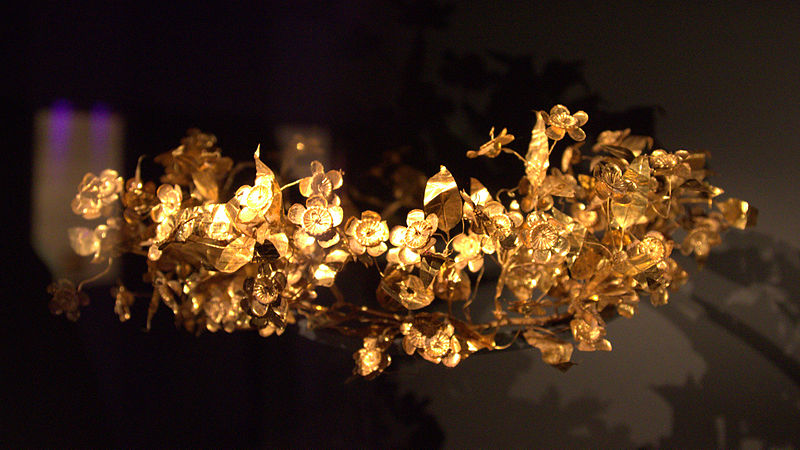
The famous case of the 4th-century BC gold wreath from Macedonia which was once worn by an unknown nobleman is just one of the best-known and most visually spectacular of these looted antiquities.

Used as a case study by Greek scholar Bettina Tsigarida as part of her master’s thesis, the infamous theft was the result of not only the original looting but of Greek and other authorities looking the other way, as well, allowing such cultural theft to take place. In addition, the Getty Museum’s acquisition of the golden wreath was made possible by what can only be charitably described as sloppy record-keeping on the part of one of the world’s largest museums.

The sum total of what can happen to a looted objet d’art or artifact can be seen in the Odyssey taken by the gold wreath in its journey from a grave to the Getty Museum, located in in Los Angeles, California.

Finally taking its rightful place in the Archaeological Museum of Thessaloniki in 2007, there was no guarantee that this happy ending would ever become a reality.

And it would not have happened at all without the likes of Dr. Tsirogiannis; journalist Nikolas Zirganos; prosecutor Ioannis Diotis; the then-head of the Greek police’s art squad, the late police Captain Giorgos Gligoris; and two Greek lawyers, Costantinos Kyriopoulos and Renia Stamatoudi.

They not only successfully liberated the priceless golden wreath from Macedonia but a marble archaic kore statue from Paros, a funerary stela from Orchomenos and a votive relief from Thasos Island as well, which had all been in the holdings of the huge Los Angeles museum.

The golden wreath, depicting myrtle flower branches, even still has some traces of green and blue enamel on it after the passage of millennia. Dating back to late 4th century BC, its first appearance on the black market for looted art dates back to 1990.

 An Italian man called Gianfranco Becchina received two photographs of the wreath that had been sent to him by a Greek smuggler in 1990. However, they did not come to an agreement as to the price for the wreath; it then somehow appeared in Munich in 1992.

It was part of an art exhibition in February of that year in Germany. A Serbian who went by the name of Kovacevits, and two Greek men named Tsatalis and Kagia, feasted their eyes on the treasure as part of the exhibition.

A painter, George Seliachas, told the three men that if they wanted to make deal for it, a good person to contact might be Christophe Leon — who ended up being the one to sell the wreath to Getty after stating on the official acquisition papers that it had come from a “private Swiss collection.” Conveniently, Leon hadn’t even filled in the box for the name of the country of origin for the priceless wreath. The Getty gave Leon a cool $1,150,000 for the looted grave goods, which had once graced the head of a Macedonian nobleman or noblewoman. However, questions had been asked of officials in Greece and Italy as to the provenance of the artifact and whether or not it had been stolen — to which the Greek officials answered in the negative.

After the Greek Art Squad asked the Ministry of Culture to work with it to get to the bottom of the theft, the Ministry refused, telling them in a confidential memorandum that it was taking care of the issue by diplomatic means. Greek journalist Nikos Zirganos unearthed these documents, publishing his exposé of the case in Epsilon magazine.

Eventually, Greek officials made a 180-degree turn, opening up a criminal investigation –not only of the Getty Museum but its curator as well. As a consequence, Marion True, Christoph Leon, the two Greek looters (now named as Georgios Tsatalis and Georgios Kagias) and the Serb middleman, Kovasevic, had charges brought against them in November of 2006.

Thanks to the tireless work of Tsirogiannis and the others, Greece negotiated the return of three other antiquities from the Getty as well — resulting in the repatriation of a 5th century BC marble relief from Thassos, a grave stele from Boeotia dating back to 400 BC. and a Kore statue.

All of the priceless looted artifacts finally returned home to Greece on March 26, 2007. The wreath now is displayed in all its splendor in the Archaeological Museum of Thessaloniki.

A special exhibit titled “The End of Antiquities Trafficking” was staged in 2007 at the Museum to highlight the cultural theft represented by these repatriated treasures. With a special section titled “The Abduction of History,” it highlighted the extraordinary objects that thankfully had been repatriated due to the efforts of Tsirogiannis and others.

Tsirogiannis told Greek Reporter in an exclusive interview this week “This wreath is a unique late 4th century B.C. artifact made by a highly-skilled Greek artist in central Macedonia, at the area around Thessaloniki. Other wreaths made with this technique and characteristics are attributed to the same Greek workshop.

“This wreath was most probably looted from a tomb, which remains unknown to us, so the story of the distinguished ancient Greek who was buried with this wreath and an unknown number of other artefacts, is erased and lost forever, because some people chose to steal from all of us and profit by selling our looted common heritage.

The subsequent trafficking took this wreath in the early 1990s to Germany and then to California, at the Getty museum, before we managed to bring it back to our homeland in 2007. I will always be proud for being one of the six-member team that represented Greece and brought this significant archaeological object back.”

But that kind of dogged determination on the part of art sleuths is rarely rewarded with such spectacular results. In its recent video on the subject of looted art, Interpol officials say that, tragically, there has been no letup recently in the trade of looted art and antiquities; quite the opposite is the case.

“The coronavirus has created a global crisis that threatens our shared cultural heritage. The antiquities coalition has already documented a worrisome increase in conditions that make the looting and the illicit trafficking of cultural material more likely right now. Tragically, we expect to see more looted artifacts on the market.” 

The Antiquities Coalition is now taking action to combat this shameful global trade.

Perhaps most disturbingly, looting — including from national museums — is helping to fund insurgency and civil war in a country that the UN says is suffering the worst humanitarian crisis in the world, Interpol notes. A case in point is a stunning alabaster stone with inscriptions from the third century AD that was taken from the Awam temple in Marib, Yemen as a result of the ongoing insurgency in that embattled nation.

For his part, Tsirogiannis is happy to continue to do what he can do ensure that priceless works of art that are part of his own heritage are returned to their rightful owners in Greece. He says that he is gratified that his life’s work has had an impact, stating “I am glad as a Greek, but also as a citizen of the world, I am contributing to helping governments repatriate their cultural property.” He tells Greek Reporter that his respect for our ancient ancestors is what drives him:

“It is the responsibility we have to our ancient ancestors and their feelings that have been brutally violated by the barbaric extraction of these objects. Some of these objects were buried in the tombs of the ancient people. They were dedicated to them. People grieved for their loss. They put these objects there with love and affection. Other objects were at the homes of ancient people, or they were dedicated to ancient gods, placed in sanctuaries and temples.” 

Tsirogiannis says “Thousands of years later, it is sacrilege for these antiquities to be looted for money and profit. This is what drives me mostly to continue my research.”

Oh, this is fun! Podcaster Dan has created a historic tour of Ancient Hellas using Assassin’s Creed The Odyssey to create a magnificent view of the Acropolis back in its glorious days. Learn about the history of ancient Hellas both in audio and video and check your understanding at the end of the episode. 


Ephesus, an ancient Hellenic city on the coast of Ionia, is one of the greatest archaeological treasures on Earth, with the entire city listed as a UNESCO World Heritage site. The great city, which went through endless transformations over the years as a result of earthquakes, wars and conquests, was founded in the 10th century BC on the site of the former Arzawan capital by Attic and Ionian Greek colonists.


The city was famous in its day for the nearby Temple of Artemis (completed around 550 BC), which was considered one of the Seven Wonders of the Ancient World. Its many monumental buildings included the Library of Celsus and a theater capable of holding no less than 24,000 spectators. Archaeologists estimate that the population of any ancient city was ten times that of the capacity of its largest theater; therefore, they believe the population of Ephesus was approximately 250,000.

Ephesus also had one of the “seven churches of Asia” referred to in the Book of Revelation. The Gospel of John may also have been written there, and it was the site of several 5th-century Christian Councils, including the Councils of Ephesus that took place in 431, 449 and 475 AD.

The city was destroyed by the Goths in their invasion in the year 263; although it was rebuilt, its great importance as a commercial center declined as its harbor was slowly silted up by the Meander River. In the year 614, it was partially destroyed by an earthquake. Eventually abandoned, this might have been a blessing in disguise for Ephesus, as its ancient ruins lie in plain sight, rather than being buried under centuries of buildings.

Today, the ancient city of Ephesus is a huge draw for international tourists and scholars because of its ancient provenance and its many historical treasures.

The areas around Ephesus were settled as far back as the Neolithic Age (about 6000 BC), as shown by evidence from excavations at the nearby artificial mounds known as “tells” in Arvalya and Cukurici. After being founded as an Attic-Ionian colony in the 10th century BC, the ruler Androklos drove away most of the native Carian and Lelegian inhabitants of the city and united his people with the remainder. He was a successful warrior, and as a king he was able to join the twelve cities of Ionia together into the Ionian League. During his reign the city began to prosper. Androklos and his dog are depicted on the Hadrian temple frieze, dating from the 2nd century.

A temple dedicated to the Egyptian god Serapis, which was also rediscovered in the ancient Greek city, was built in the 2nd century A.D. as a symbol of devotion to the Egyptian god; it is considered the best preserved and largest temple in all of Anatolia. It was constructed in an area measuring an astounding 7,700 square meters (194,520,997 square feet) while  the building alone measures over 1,000 square meters (10,764 square feet).

Although it was shaken by the earthquake, almost all of the temple’s pieces are still intact. The Ephesus Foundation has undertaken the restoration project, following the restoration of the city’s illustrious Celsius Library.

The Goddess Artemis and the great Anatolian Goddess Kybele were identified and worshipped together as “Artemis of Ephesus.” The many-breasted “Lady of Ephesus”, identified with Artemis, was venerated in the Temple of Artemis, which was the largest building in the ancient world, according to Pausanias.

The Temple of Artemis, one of the Seven Wonders of the Ancient World, once stood 418 feet by 239 feet with over 100 marble pillars each 56 feet high. The temple earned the city the title “Servant of the Goddess”.

Pliny tells us that the magnificent structure took 120 years to build but is now represented only by one lonely column, revealed during an archaeological excavation by the British Museum in the 1870s and still standing alone in the center of the ruins in a grassy field.

About 560 BC, Ephesus was conquered by the Lydians under King Croesus, who treated the inhabitants with respect and even became the main contributor to the reconstruction of the temple of Artemis. His signature has been found on the base of one of the columns of the temple (now on display in the British Museum). The city later fell to the Persian army commander Harpagos in 547 BC. The Persians then incorporated the Greek cities of Asia Minor into their Achaemenid Empire.

Ephesians participated in the Ionian Revolt against Persian rule in the Battle of Ephesus in 498 BC, which instigated the Greco-Persian wars. In 479 BC, the Ionians, together with Athens, were able to oust the Persians from the shores of Asia Minor. In 478 BC, the Ionian cities with Athens entered into the Delian League against the Persians.

During the Classical Roman period, which lasted from 129 BC to 395 AD, Ephesus, as part of the kingdom of Pergamon, became a subject of the Roman Republic, coming under its yoke in 129 BC after the revolt of Eumenes III was suppressed. Mark Antony was welcomed by Ephesus when he was proconsul of Rome; and again in 33 BC with Cleopatra ,when he gathered his fleet of 800 ships before the decisive Battle of Actium with Octavius. When Augustus became emperor in 27 BC, he made Ephesus the capital of proconsular Asia. According to the geographer Strabo, it was second in importance and size only to Rome.

Ephesus also served as an important center for early Christianity beginning as early as the AD 50s. From 52–54, the apostle Paul lived in Ephesus, working with the congregation and apparently organizing missionary activity into the hinterlands of Asia Minor. Initially, according to the Acts of the Apostles, Paul attended the Jewish synagogue in Ephesus, but after three months he became frustrated with the stubbornness of some of the Jews, and moved his base to the school of Tyrannus. Later a silversmith named Demetrios stirred up a mob against Paul, saying that he was endangering the livelihood of those making silver Artemis shrines.

Between 53 and 57 AD Paul wrote the letter known as 1 Corinthians from Ephesus — possibly from the “Paul tower” near the harbor, where he was imprisoned for a short time. Later, he wrote his Epistle to the Ephesians while he was in prison in Rome, around 62 AD. The Gospel of John might have been written in Ephesus a bit later, c. 90–100. Ephesus was one of the seven cities addressed in the Book of Revelation, indicating that the church of the city was already a major presence.

According to Eusebius of Caesarea, Saint Timothy was the first bishop of Ephesus. A legend, which was first mentioned by Epiphanius of Salamis in the 4th century, purported that the Virgin Mary may have spent the last years of her life in Ephesus. The Ephesians derived the argument from the apostle John’s presence in the city, and Jesus’ instructions to John to take care of his mother, Mary, after his death. Epiphanius, however, pointed out that while the Bible says John was leaving for Asia, it does not say specifically that Mary went with him. He later stated that she was buried in Jerusalem.

Since the 19th century, The House of the Virgin Mary, about 7 km (4 miles) from Selçuk, has been considered to have been the last home of Mary. It is still a popular place of Catholic pilgrimage. The city and temple were destroyed by the Goths in 263. This marked the first precipitous decline of the city’s ages of splendor. However, the emperor Constantine the Great rebuilt much of the city and even constructed new public baths. The Church of Mary near the harbor of Ephesus was the setting for the Third Ecumenical Council in 431, which resulted in the condemnation of Nestorius. A Second Council of Ephesus was held in 449.

Ephesus remained the most important city of the Byzantine Empire in Asia, however, after Constantinople, in the 5th and 6th centuries.The basilica of St. John was built during the reign of emperor Justinian I in the 6th century.

The importance of the city as a commercial center declined as the harbor was slowly silted up by the river despite repeated dredging during the city’s history. The loss of its harbour caused Ephesus to lose its access to the Aegean Sea, which was important for trade. People started leaving the city for the surrounding hills.

Eventually, the ruins of its great temples were tragically used as building blocks for new homes. Precious marble sculptures from antiquity were ground to powder to make lime for plaster. Sackings by the Arabs, first in the year 654–655 and later in 700 and 716, hastened the decline of the great city of Ephesus even further. By the time the Seljuk Turks conquered Ephesus in 1090, it was just a small village.

The Byzantines resumed control in 1097 and changed the name of the town to Hagios Theologos. They kept control of the region until 1308 — but by that time, the exquisite Temple of Artemis had been completely forgotten by the local population. It would have been lost to human memory completely if it were not for the excavation and restoration efforts of modern archaeologists.

The town surrendered, on October 24, 1304, to a Turkish warlord. Nevertheless, contrary to the terms of the surrender the Turks pillaged the church of Saint John and deported most of the local population to Thyrea, Greece. During these events many of the remaining inhabitants were cruelly massacred. The once-shining city of Ephesus, with its sweeping public spaces, temples and library, was completely abandoned by the 15th century.

But the city is still beloved by those who walk its broad, stone-paved central street and take in the breathtaking ruins of days gone by. Moreover, the ancient Greek city is set to once again have a harbor on the Aegean coast, as the result of an ambitious new project.

In the ancient era Ephesus, which is today one of Turkey’s top tourist attractions, was connected to a harbor on the Aegean Sea with a spacious canal, but the port and the canal became silted up by the river in the years since.

An ambitious canal project proposed by Turkey in 2018 pledged to uncover the canal and eventually link the ancient harbor city to the sea once again after a 6,130-meter length of the canal became covered with alluvial deposits over the centuries. So far, however, nothing has been done to make this project a reality.

The ruins of the once-glorious city still stand, however, and welcome visitors today from all over the world, continuing to tell the stories of its many illustrious inhabitants over the millennia.

The ancient Hellenic cremation burial site known as the “Tomb of Nestor’s Cup” found in 1954 on the island of Ischia in Italy has revealed some of its secrets, according to researchers, Live Science (LS) reported on October 6. Previously thought to contain the remains of a child, new analysis found that the nearly 3,000-year-old tomb “instead held the remains of at least three adults,” LS reported.

“This could help to explain a longstanding mystery: the presence in the tomb of a cup with a racy inscription that seemed out of place in a child's grave,” LS reported, adding that “the clay vessel, known as Nestor's Cup, bears a three-line boast ending with a promise that whoever drank from the cup would be smitten with desire for Aphrodite, goddess of beauty and love” and “experts have long puzzled over why such a message would be preserved in the burial of a child, and the recent findings may help to explain it, scientists reported in a new study.

“We can say that we re-opened a cold case,” lead study author Melania Gigante, a postdoctoral researcher in the Department of Cultural Heritage at the University of Padua in Italy, told LS in an email.

The burial is part of an ancient site called Pithekoussai, an ancient Greek city and necropolis on the island of Ischia in Italy,” LS reported, noting that “it dates to the eighth century BC, and archaeologists excavated approximatel LS reported, noting that “it dates to the eighth century BC, and archaeologists excavated approximately 1,300 tombs there between 1952 and 1982.”

"One of the tombs, identified as ‘Cremation 168,’ is more widely known as the ‘Tomb of Nestor's Cup’ after an inscribed vessel for drinking wine, known as a kotyle, that was discovered there,” LS reported, adding that “the cup bears one of the oldest surviving examples of Greek writing, the study authors reported Oct. 6 in the journal PLOS One.

In the epic Greek poem The Iliad, Homer described a beautiful golden cup that only its owner, the hero Nestor, could lift,” LS reported, noting that “according to legends of the time, adventurers would drink a fortifying beverage from its depths.

“By comparison, the clay vessel found in Tomb 168 is a simple cup,” LS reported, pointing out that “its inscription claims otherwise in a nod to Nestor's mythical goblet, according to the Joukowsky Institute for Archaeology and the Ancient World at Brown University in Providence, RI.

Three lines of text in the Greek alphabet are written on the clay cup in hexameter (a line of verse with six accents), thought to be an allusion to Homer's poetry,” LS reported, adding that “the text reads: ‘I am Nestor's cup, good to drink from. Whoever drinks this cup empty, straightaway Desire for beautiful-crowned Aphrodite will seize him,’ according to the institute.

“The burial held 195 bone fragments, and the researchers used microscopy to examine details in the surfaces and internal tissues, with some conclusive results on 175 fragments,” LS reported, noting that “to their surprise, they found that only 130 of the bones were human; 45 bone fragments came from animals. Some of those bones likely belonged to sheep, and other bones may have belonged to dogs and birds, but the pieces were so broken that the scientists were unable to identify most of the fragments with certainty, according to the study.

“When the scientists looked at the human bones — mostly bits of large bones from the arms and legs — they examined formations that emerge as bone tissue renews itself over time,” LS reported, adding that “by comparing the density of these formations across specimens, they saw that the fragments belonged to three individuals” and “the bones also indicated that the people were adults that were no longer growing; while it wasn't possible to determine how old they were or if they were related, the findings ruled out the possibility that the tomb held a child, the researchers wrote.

“Unfortunately, given the high fragmentation of the samples and the fire action, we are unable to say more. Human and animal remains showed similar burn patterns, hinting that they were burned together or using the same methods, and the animals in the grave may represent food offerings for the dead ‘or companions in the journey to the afterlife,’ according to the study.

I am not surprised to have received yet another confirmation of how much there is still to be discovered about Pithekoussai,” Gigante told LS. “This study is only the first step towards a more complete interpretation not only of the Tomb of Nestor's Cup, but also of the customs and funerary uses at the dawn of Magna Graecia [Greater Greece].” y 1,300 tombs there between 1952 and 1982.”

One of the tombs, identified as ‘Cremation 168,’ is more widely known as the ‘Tomb of Nestor's Cup’ after an inscribed vessel for drinking wine, known as a kotyle, that was discovered there,” LS reported, adding that “the cup bears one of the oldest surviving examples of Greek writing, the study authors reported Oct. 6 in the journal PLOS One.

In the epic Greek poem The Iliad, Homer described a beautiful golden cup that only its owner, the hero Nestor, could lift,” LS reported, noting that “according to legends of the time, adventurers would drink a fortifying beverage from its depths.

By comparison, the clay vessel found in Tomb 168 is a simple cup,” LS reported, pointing out that “its inscription claims otherwise in a nod to Nestor's mythical goblet, according to the Joukowsky Institute for Archaeology and the Ancient World at Brown University in Providence, RI.

Three lines of text in the Greek alphabet are written on the clay cup in hexameter (a line of verse with six accents), thought to be an allusion to Homer's poetry,” LS reported, adding that “the text reads: ‘I am Nestor's cup, good to drink from. Whoever drinks this cup empty, straightaway Desire for beautiful-crowned Aphrodite will seize him,’ according to the institute.

The burial held 195 bone fragments, and the researchers used microscopy to examine details in the surfaces and internal tissues, with some conclusive results on 175 fragments,” LS reported, noting that “to their surprise, they found that only 130 of the bones were human; 45 bone fragments came from animals. Some of those bones likely belonged to sheep, and other bones may have belonged to dogs and birds, but the pieces were so broken that the scientists were unable to identify most of the fragments with certainty, according to the study.

When the scientists looked at the human bones — mostly bits of large bones from the arms and legs — they examined formations that emerge as bone tissue renews itself over time,” LS reported, adding that “by comparing the density of these formations across specimens, they saw that the fragments belonged to three individuals” and “the bones also indicated that the people were adults that were no longer growing; while it wasn't possible to determine how old they were or if they were related, the findings ruled out the possibility that the tomb held a child, the researchers wrote.

Unfortunately, given the high fragmentation of the samples and the fire action, we are unable to say more. Human and animal remains showed similar burn patterns, hinting that they were burned together or using the same methods, and the animals in the grave may represent food offerings for the dead ‘or companions in the journey to the afterlife,’ according to the study.

I am not surprised to have received yet another confirmation of how much there is still to be discovered about Pithekoussai,” Gigante told LS. “This study is only the first step towards a more complete interpretation not only of the Tomb of Nestor's Cup, but also of the customs and funerary uses at the dawn of Magna Graecia [Greater Greece].”

The source of marble for a statue of Apollon on the Greek island of Delos has been a mystery to art historians and archaeologists for decades. The stone’s chemistry pointed geochemists to the southern end of the nearby island of Naxos, but no one thought there were ancient marble quarries there. A geoarchaeologist believes he found the source.

“We had actually been told that we were not going to find what we were looking for,” says geoarchaeologist Scott Pike of Willamette University. But after two field seasons traipsing across Mediterranean shrublands, Pike believes he has found the source. He is presenting his findings on Monday, 11 October 2021 at the Geological Society of America’s GSA Connects 2021 annual meeting in Portland, Ore.

The Greek Archaic period (approximately 800 to 480 B.C.E.) is known in part for its “larger-than-life” kouros statues, which depicted young men. Together, the massive Apollon kouros on Delos would stand around ten meters (33 feet) high, although today it is broken into several parts. The massive marble chunks are white and worn; at a glance, some of the pieces hardly resemble parts of a human figure. But the statue has drawn researchers all the same. Searching for its source was sparked in part by an ambiguous inscription at its base, roughly translated as, “I am of the same stone, statue and plinth,” with a later addition stating that the kouros was “from the Naxians, to Apollo,” according to Pike.

It was not clear whether the inscription referred to the statue’s structure, being hewn from a single piece of marble, or the origin of its stone. Pike sampled various parts from the statue — a hand, the upper and lower torso, a bit of leg — and analyzed its carbon and oxygen isotopic composition. That composition can be used to trace the marble source by comparing it against other analyzed marbles, like finding a fingerprint match in a database.

“The analyses showed the marble came from Naxos, but from a region where there hasn’t been any evidence of ancient quarrying. We know that there are two quarries in the northern part of the island, where there are still large kouroi in place in the quarries. But we didn’t know of any ancient quarries in the south,” says Pike.

Pike headed to the southern side of Naxos, despite locals assuring him his efforts were in vain. He relied on local knowledge of other archaeological sites and geologic maps to guide him as he “scoured the landscape” looking for, essentially, outcrops of white marble and possible small pits. Remnants of Archaic quarries bear little resemblance to the vast open-pit mines humans create today and were difficult for Pike to find.

After a couple of weeks of searching, Pike began finding small bands of white marble that were not marked on the geologic maps. Some were close to archaeological sites, giving Pike some confidence that these small quarries could be the source.

“Finding what we were looking for was exciting because being told several times that you’re not going to find anything is discouraging, but we knew,” Pike says. “The evidence pointed to the south. I felt the most Indiana Jones I’ll ever be.”

Back in the lab, Pike analyzed his marble samples and found that two of the newly-uncovered southern white marbles were good matches for the Apollon kouros at Delos. Knowing that these early marble quarries exist in the south of the island will be helpful for tracing the source for other ancient marble artifacts, such as older Bronze Age Cycladic figurines that have puzzled geoarchaeologists. It also has implications for knowledge of commerce at the time.

“Knowing now that there is a marble source on Naxos for these Bronze Age statues and figurines will place the region more in the center of commerce, trade and influence than had been previously understood,” Pike says.


The British government has said that it will not abide by a recent UNESCO decision on the Parthenon Marbles.

It also insisted that “the Parthenon Sculptures were acquired legally” and rejected UNESCO’s call to reconsider its position and to negotiate with Greece on the return of the 2,500-year-old cultural treasures. Speaking to Greek newspaper Ta Nea, a government spokesperson said that the UK government “disagrees” with the decision, adding that it intends to challenge it before UNESCO.

The response came after the UNESCO’s Intergovernmental Committee for Promoting the Return of Cultural Property (ICPRCP) voted unanimously for the first time at its 22nd session to include the return of the Parthenon Marbles in its decision document, marking a major step forward since Greece first introduced the request to the meeting’s agenda in 1984.

ICPRCP’s decision says that Greece’s request for the return of the Parthenon Sculptures is “legitimate and rightful” and calls on Britain “to reconsider its stand and proceed to a bona fide dialogue with Greece on the matter”.

Most importantly, the Committee acknowledges for the first time that “the case has an intergovernmental character and, therefore, the obligation to return the Parthenon Sculptures lies squarely on the UK Government “.

This is in stark contrast to the UK government’s assertion that it is for the British Museum, not the government, to discuss the issue and make decisions related to it.

“We disagree with the Committee’s decision adopted in the closing minutes of the session and are raising issues relating to fact and procedure with UNESCO,” a UK government spokesperson told Ta Nea.

A British Museum spokesperson told Ta Nea that “the Trustees of the British Museum have a legal and moral responsibility to preserve and maintain all the collections in their care,” adding that “the Parthenon Sculptures are an integral part of (the Museum’s collection) story and a vital element in this interconnected world collection”.

Greece insists that it is the rightful owner of the Parthenon Marbles. The Greek government says that the sculptures were illegally removed from the Parthenon during the Ottoman occupation of Greece in the early 1800s.

In his first interview with a European newspaper since becoming the UK’s prime minister, Boris Johnson dashed Greece’s hopes of getting the Marbles back, telling Greek daily Ta Nea that they were “legally acquired by Lord Elgin under the appropriate laws of the time and have been legally owned by the British Museum’s Trustees since their acquisition.”

Britain had previously rejected Greece’s request to hold talks on returning the Marbles after Athens proposed a meeting between experts from the two countries.

“We are all very glad about the outcome of the UNESCO meeting in Paris last week, where the Parthenon Sculptures were an item on the Agenda, and this now for nearly 40 years, ever since Melina Mercouri raised the issue in 1984. We congratulate Greece for its efforts to achieve this outcome and do hope that the UK will finally reconsider its stand and enter in a dialogue with Greece”, Dr Christiane Tytgat, President of the International Association for the Reunification of the Parthenon Sculptures (IARPS), told Ta Nea.

“The Trustees and the British Museum cannot eternally ignore the growing pressure to return the Parthenon Sculptures, nor can they close their eyes for a growing consciousness when it comes to the legitimated acquisition of artefacts. The day will come when we see the Parthenon Sculptures reunited in the Acropolis Museum. At least, there they can be seen, shining through the glass wall of the Parthenon room, even if the Museum is closed, day and night, 7 days a week, at the foot of the Acropolis, in visual contact with the Parthenon,” Dr Tytgat added.


The British Museums’ comment to Ta Nea in full:

“The British Museum has a long history of collaboration with UNESCO and admires and supports its work. The Trustees of the British Museum have a legal and moral responsibility to preserve and maintain all the collections in their care and to make them accessible to world audiences. The Trustees want to strengthen existing good relations with colleagues and institutions in Greece, and to explore collaborative ventures directly between institutions, not on a government-to-government basis. This is why we believe that working in partnership across the world represents the best way forward. Museums holding Greek works, whether in Greece, the UK or elsewhere in the world, are naturally united to show the importance of the legacy of ancient Greece. The British Museum is committed to playing its full part in sharing the value of that legacy.

“The Museum takes its commitment to be a world museum seriously. The collection is a unique resource to explore the richness, diversity and complexity of all human history, our shared humanity. The strength of the collection is its breadth and depth which allows millions of visitors an understanding of the cultures of the world and how they interconnect – whether through trade, migration, conquest, conflict, or peaceful exchange.

“The Parthenon Sculptures are an integral part of that story and a vital element in this interconnected world collection, particularly in the way in which they convey the influences between Egyptian, Persian, Greek and Roman cultures. We share this collection with the widest possible public, lending objects all over the world and making images and information on over four million objects from the collection available online.

“The approach of the Acropolis Museum and the British Museum are complementary: the Acropolis Museum provides an in-depth view of the ancient history of its city, the British Museum offers a sense of the wider cultural context and sustained interaction with the neighbouring civilisations of Egypt and the Near East which contributed to the unique achievements of ancient Greece”.

On the day of the Hene kai Nea, I post a monthly update about things that happened on the blog and in projects and organizations related to it. I will also announce Elaion's coming PAT rituals.


Statistics:
PAT rituals for Pyanepsion:
  • 6 Pyanepsion - 13 October - Proerosia - agricultural festival for Demeter held at Eleusis
  • 7 Pyanepsion - 14 October - Pyanepsia - festival in honor of Apollon and Theseus
  • 7 Pyanepsion - 14 October - Oskhophoria - festival of the vintage (grapes)
  • 8 Pyanepsion - 15 October - Theseia - festival in honor of Theseus
  • 9 Pyanepsion - 16 October - Stenia - women's festival in honor of Demeter and Persephone
  • 11-13 Pyanepsion - 18 - 20 October - Thesmophoria - festival in honor of Demeter
  • 14 Pyanepsion - 21 October - Sacrifice to The Heroines at Erkhia
  • 16 Pyanepsion - 24 October - Apatouria - paternity festival. The first day (Dorpia) was celebrated with a communal feast within the brotherhood, the second day ('Anarrhusis') sacrifice were made to Zeus Phratrios and Athena Phratria, and the third day ('Koureotis') young boys admitted to their father's brotherhood.
  • 30 Pyanepsion - 5 November - The Khalkeia - festival in honor of Athena and Hephaestus.

Anything else?
Are you looking for an online shop to buy incenses and other Hellenistic basics from? Try The Hellenic Handmaid on Etsy.

Would you like to support me? Buy me a coffee.