Showing posts with label Persephone. Show all posts

How about a little overview today? An overview of the fertility gods of Hellenismos. I'm going to start off with a lesser known deity: Priapos (Πριαπος), protector of sheep, goats, bees, the vine and of all garden produce. He was depicted with a huge male member, and can be petitioned for aid with any issues regarding the male genitalia. He was native to the Mysian city of Lampsakos on the Hellespont but the ancient Hellenes adopted the God as the son of either Hermes or Dionysos. His mother was usually Aphrodite. Fun fact: primitive statues of Priapos were traditionally set-up in vegetable plots to promote fertility with the added benefit of functioning as a type of 'scarecrow' scaring away birds.


Rhea (Ρεα), wife of Kronos, is a female fertility Goddess--amongst other things. She also looks after mothers and children, and is one of the great mother Goddesses in the pantheon having obviously given birth to the Olympians. Anything female-related (including issues with fertility) can be put before Her. Hera, by the way, has many of the same domains as Her mother--logical as she is the new generation's mother figure.

Aphrodite is also a fertility Goddess. She along with Zeus, Hera, Eileithyia and Hymenaios were the Theoi Gamelioi (Gods of Marriage) who presided over the wedding rites. She was invoked as the Goddess of the consummation of marriage and the fertility of the bride.

Speaking of which, Eileithyia (Ειλειθυια) is the Goddess of childbirth and labour pains. According to some there were two Eileithyiai, one who furthered birth and one who protracted the labour. Her name means 'she who comes to aid'.

Demeter and Persephone were regarded as fertility Goddesses in the Eleusinian Tradition, and during Their Thesmophoria festival, women actively asked for fertility from Them. Demeter, especially, is obviously also very important for the growth of plant life.

Dionysos is mostly associated with the fertility of the soil, and especially in regards to the grape vine, but human fertility is amongst His descriptors. Pan is regarded as much the same, as are many of the Satyrs and daimons connected to Them--like Tykhon, Konisalos, and Orthannes.

Phanes (Φανης) is the Protogenos of procreation in the Orphic cosmogony. He is the primal generator of life, and was the driving force behind reproduction in the early cosmos. Phanes was hatched from the world egg when it was split into its constituent parts by the ancient gods Khronos and Ananke. Arguably, He still drives the process of reproduction, be it in plants, animals, or humans.

 Some plants in Greece are so deeply connected with Hellenic history, mythology, and tradition that is hard to find a starting point. Perhaps the most prominent is the pomegranate. Maybe the oldest report about the pomegranate bush is by Homer, who first called this beautiful bush ‘Ria’ and this name remained until it was replaced with ‘Rodia’ in modern Greek. Punica granatum, the scientific name of pomegranate may derive from punicum, meaning red color in Latin. The name pomegranate is derived from the Latin words pomum and granum meaning apple and seed respectively.


Homer described this plant in the gardens of king of Faiakon (Kerkira island nowadays). A famous myth featured Persephone, daughter of Demeter and Zeus who was taken to the Underworld by Hades. He offered Persephone seven seeds of pomegranate, which symbolized marriage. In this way, the couple was bonded forever and for six months Persephone was ‘above’ and for six she was ‘down’ in the Underworld Hades. This is how it was explained, in tradition and from mythology to modern art, that some for some months Earth is sleeping and then she is ‘reborn’ in Spring.

For example, it was used by a symbolist poet melodized by Mikis Theodorakis about a lover who left, symbolized as pomegranate. Also, pomegranate was depicted in statues of Hera, Goddess of marriage and fertility, but was also associated with Aphrodite, Goddess of passion and love. Therefore, in ancient Hellas it was cultivated as a shrub of love, fertility, family, and good luck.

When the outer surface is dried, the inner seeds are juicy ready to be consumed, another reason for this fruit’s symbolization of death and life.

Its nutritional value is quite high. Bit its sour taste is undesirable for some palates due to the high amounts of antioxidants, tannins, and vitamins. A great way to consume it raw is in a green salad with kefalotyri or parmesan cheese and some ‘ntakos’, dried Cretan bread or croutons. Also, it can used fresh in every sweet recipe with fresh fruits like strawberries or blueberries.

I get a lot of questions from readers, and most of the time, the answers are fairly short. When I feel the question or the reply would be valuable to others as well, I make a post with a collection of them and post them in one go. Today is one of those posts.


"This is a rather personal question but does your girlfriend participate in your festivals ans libations?"

My wife doesn't believe in the existence of any Gods. She supports my worship but she does not understand it, nor does she join in. If I ask her to do something simple like touch something to cleanse her of miasma, she will, but that is about where her involvement ends :)

***

"Is it appropriate to do nighttime daily rituals standing up next to the main household altar? Or have they got a more chthonic character?"

'Khthonic', when it comes to ritual and worship in general, has to do with the Gods being worshipped, not the time of day. Yes, the Khthonic Gods frequently received nighttime worship but not all nighttime worship is khthonic. As such, what you should look at are the Gods. Are they ouranic? Then the ritual should be ouranic in nature as well. Khthonic? Then a Khthonic rite. Khthonic rites should not take place on or even near the household altar, but household worship for ouranic deities performed at night is perfectly suited for the household altar.

I always do my nighttime rites to Selene, Hypnos, Morpheus, etc. before I go to bed, so at night, at my household altar. It is an ouranic rite. I invoke Hestia.

***

"In this time of the year, when I generally come home after sunset, I can still hold the daily ritual to the Ouranic Gods, which I do at daytime in other months?"

Well, sort of. The ancient Hellenes started the new day at dusk--so once it started getting dark. My nighttime rituals are my first rituals of the day, followed by my morning rituals. Technically, your nighttime rituals 'count' for the day after. If you would like to transition to this system now you come home after dark, do them twice on a day you are off, once in the daylight hours for that day and then once in the nighttime hours for the day after. Then you're caught up :)
 
***
 
"Hello I was wondering if Dionysus and Persephone count as Kthonic Theoí? If so in their festivals and libations should one worship and honour them in a kthonik way or a uranic way? Thank you."
 
Both Dionysos and Persephone are Ouranic deities with Kthonic epithets. An epithet is an attachment to the name of a God or Goddess, used to indicate either a specific domain of the Deity, a specific origin myth or region from which the Deity came, or an entirely different entity, through either domain or origin. Their worship, on the whole, is Ouranic, but in very, very speciffic cases, it can be Kthonic. Overall, you can safely assume that any God that has access to Mount Olypos in mythology is Ouranic and should be worshipped that way, unless the rite involves the underworld or the dead.
 
 
***
 
"Hello! Do you have any elaborate ritual to Athena and/or Apollo? :)"
 
I have a couple!
 
Apollon:
 
Athena:
 
For all currently avaialble rituals by Elaion, go here.
 
***
 
"Is it possible to be a hellenic polytheist and worship norse gods as well!? I've been going back and again between the two for almost 5 years and i feel a strong conection with the Theoi and hellenic way of life as well as with Yggdrasil and the norse gods. Is there any historical evidence of greeks adopting northern gods or vice versa? Thank you!"
 
Yes, it is. Pure Recon on either might be troublesome, but it's possible to worship two pantheons and perform their worship in a traditional manner.  As for adoption of either by other side, I have not found any. The problem seems to be in the timeline. The Germanic people who were tied to the ancient Norse Gods rose to greatness about 200 BC, a lot later than the Hellenic age. Ceasar reached that territory during his (Roman age) campaign but I don't have any evidence at hand that the ancient Hellenes made contact with the Germanic people at all.

 I get a lot of questions from readers, and most of the time, the answers are fairly short. When I feel the question or the reply would be valuable to others as well, I make a post with a collection of them and post them in one go. Today is one of those posts.


"Do you know of any Greek names? I would like my future children to have names connected to ancient Greece...! Maybe some with a religious connotation?"

I actually did a post on this before. Short version: children were often named after the Theoi, but names were often switched around a bit. To gift a child with the exact name of a Theos or Theia was considered hubris. The eldest son was usually named after his paternal grandfather and subsequent children after other relatives. Sons were rarely named after their father, although it was acceptable to give a child an altered version of the father's name. Female names came to be largely through the same customs, but were 'feminized' by editing the endings of the word. From '-es' or '-ias' to '-eis', '-e' or '-a' for example, as can be seen with the male name 'Agapias' and female name 'Agapia'.

As for specific names, Dion (after Dionysos), Dia (loosely after Aphrodite), Alex or Alexander, Cassandra, Cleo, Irene, Leo, and Tamara come to mind. Here is a link to a whole bunch of them: link. Good luck!


"Do you have an advice for someone trying to actively worship three deities at the same time? It seems like I do not have enough time for them all :/"

I recently wrote about how the major difference between reconstructive religions and modern ones—especially Pagan ones—is the way worship is conducted. Individual worship of Gods as well as patronage is perfectly acceptable in modern religions, but in Recon religions and the ancient Traditions they were based upon, worship tends to be of the pantheon, not so much the one God or Goddess. Worship was generalized in such a way that multiple Gods and Goddesses were worshipped in one rite—and usually in the same way.

I worship a pantheon, and I don't have 'patrons' as it wasn't the Hellenic way. So... sadly I don't have advice for you. If you feel called to exclusively worship three Gods, then you will need to make time to do so. In general, it is easier to worship a pantheon than singular Gods; in that way, you try to emulate an ancient Hellenic worshipper and not an ancient Hellenic priest of three deities. I wish you the best of luck; it sounds like a time-consuming but hopefully rewarding calling.


"Why do you blog?"

I started blogging simply as a way to organise my dive into Hellenismos. Along the way, Baring the Aegis became more of a general resource for the Hellenic community. There is a personal note in there, but I am a private person by nature, so not too much. Any and all UPG comes with a big fat warning label. As for why I do it: I like doing it. Sure, because I have a daily blog there are times when time or energy are sparse and it becomes a bit of a chore to do, but in general, I find it a good experience. It's also a way for me to keep researching, to keep reading--I want to be able to present new bits of information or understand the ancient Hellenic society better. I enjoy maintaining a general Hellenistic blog, with a bit of everything--mythology, ancient society, current events, personal practice, general contemplation on the religion, etc.That is what keeps me interested as well.


"Can you tell us about Persephone? She's quite an overlooked goddess but i think she's very important. Could you also speak about her role in spells?"

This anonymous question has been sitting in my inbox Tumblr inbox for a fairly long time, which is why I'm posting my reply here because the original asker may not check there anymore for a reply. Every time I thought about answering this message, I found myself without words. You see, I think Persephone is one of the most honoured Goddesses both today and in ancient Hellas. She was one of the most honoured Goddesses in the Eleusinian Mysteries and especially in modern Paganism, Persephone is everyone's sweetheart. As for her place in spells... my dear, I can't help you there. I'm a Traditional Hellenist and magic wasn't part of the ancient Hellenic religion. I'm sorry, please try a more Neo-Pagan oriented person on Tumblr; I'm not the right person to answer this.


"I visit your blog site from time to time and I was wondering if your practice involves Chthonic deities? and if you don't, if there's any that you at the very least find interesting. It seems to me that not many Hellenic Polytheists really involve themselves with Chthonic deities so I thought it would be an interesting question to ask."
 
I give sacrifice to the Khthonic deities when the situation warrants it. I honour Hermes Khthonios when someone I love has passed away, for example, and I give sacrifice to Hekate at the Deipnon. I honour Persephone (and Demeter) on dates which were important for the Eleusinian Mysteries and appease the Erinyes when so required.
 
I have other experiences than you, though, when it comes to the wider Pagan community and even Hellenists. Especially non-Traditional Hellenists often worship or are dedicated to Haides in his Underworld epithets, and Persephone has a huge modern cult following. I hope this answers your question :)

Of all the mysteries celebrated in ancient times, the mysteries at Eleusis are assumed to be of great importance to a large portion of the ancient Hellenes. The cult itself likely has origins dating back to the Mycenean period of around 1600 to 1100 BC and it is believed that the cult of Demeter Herself was established in 1500 BC. 

The Eleusinian mysteries (Ἐλευσίνια Μυστήρια) had festivals throughout the year, which were tied to agriculture through Demeter's refusal to perform her duties as an agricultural Theia while her daughter Persephone is with Hades, and to the afterlife and Underworld through Persephone's return to the surface of the earth after Her mandatory stay with Hades has ended. Initiation ceremonies were held every year at Eleusis. The Mysteries were mysteries for a reason and revealing information of these involved rituals carried the punishment of death (or at least, that is what the ancient sources say). We still have been able to piece together quite a bit of information however, and I would like to create a masterpost of sorts.


Mythological connections and sources of the Mysteries:
- The Eleusinian Mysteries 
A short introduction to the Mysteries, which includes the mythological reason for the festival and the rewards for being initiated.
- On Persephone and Spring 
A writer's perspective on the myth of Persephone's abduction. 
- Iakkos 
The personification of the ritual cry of joy called ‘iakhe’ of the procession of the initiates. 
- On 'Kore' versus 'Persephone' 
...and why They are not always the same.


Eleusinian festivals:
A summary of the festivals included in the cycle of the Mysteries. It also includes a description of the way the days of the Mysteries would have been spent--as well as we can gather about a mystery tradition, of course. The cycle consists of: the Greater Mysteries (13-23 Boedromion), Proerosia (6 Pyanepsion), Stenia (9 Pyanepsion), Thesmophoria (11-13 Pyanepsion), Haloa (26 Poseideon), the Lesser Mysteries (20-26 Anthesterion), and the Skiraphoria (12 Skirophorion). These are placed in sequence of the Athenian year. Also linked to the Mysteries because they fall during either the Lesser of Greater Mysteries: the Diasia and the Epidauria.


Periferal points of interest connected to the Mysteries:
- On attending women-only festivals as a male
Some of the eleusinian rites are women-only. Can you attend as a male?
- On attending women-only festivals as non-binary
Some of the eleusinian rites are women-only. Can you attend if you identify as non-binary?
- On maidens, the Stenia and the Thesmophoria 
On attending women-only festivals as an unmarried woman.
- On the binding of hair 
As part of Eleusinian ritual.
- Dadoukhoi: torch bearers 
On the importance of torches and torch bearers in the Eleusinian Mysteries.
- The ancient tradition of Martes 
Martes were pieces of string, worn around the wrist. The innitiates of the Mysteries recieved yellow ones on the way to Eleusis.
- On ending the Mysteries
On why the ending rites of the Mysteries matters.
- On fasting for the Eleusinian Mysteries
Fasting is a part of the Greater Mysteries as well as the Thesmophoria. Here is how to do it safely.
- On the forbidden foods of the Eleusinian Mysteries 
Some things not to eat during these days.
- On the 'hiera' of the Eleusinian Mysteries
The heira are the 'sacred objects'.
- On kykeon 
A barley beverage sacred to Demeter and used to break a sacred fast within the Eleusinian Mysteries as well as in preparatory rites for some of the most sacred--and secret--rites within Eleusis. 
- Pelanoi, the cakes of the Athenians 
Athenian sacrifical cakes that were often used in the Lesser mysteries.
- Snakes, the ancient Hellenes and the Eleusinian Mysteries 
Snakes were used in the Lesser Mystery rites. Why?

At dusk on January 10th, the Haloa (῾Αλῶα) starts. This ancient Hellenic festival was held in honor of Demeter, Dionysos and a little bit in honor of Persephone. Like all festivals of Demeter and Persephone's 'Kore' persona, women were the only ones who were allowed to handle the religious and sacrificial side of it. Women, will you join me in celebrating freedom and fertility come 10 am EST?


The Haloa is part of the Mysteries, and thus linked to the festivals of Proerosia (6 Pyanepsion), Thesmophoria (11-13 Pyanepsion), the Lesser Mysteries (20-26 Anthesterion), Stenia (9 Pyanepsion), Skirophoria (12 Skirophorion) and the Greater Mysteries themselves, which were held 13-23 Boedromion. It was a rural festival, meaning it wasn't state-organized and widely spread, so most details are incredibly fuzzy. Here's what we do know about it:

The Haloa is assumed to be a celebration of the pruning of the vines and the tasting of the wine after its first fermentation, or it may be to encourage the growth of corn from the seed. It is named after the hálōs (ἅλως), which means both threshing floor and garden. Since the first sense of the word would be inapplicable to a festival celebrated in January, scholars--including Nilsson in his 'Greek Popular Religion'--insist it must have been a gardening festival.

Some time during the festival, the entire population was invited by the priests of Dionysos and the priestesses of Demeter and Kore to give sacrifice to these Theos; to Demeter and Kore for the fertility of the earth in which the grapevines grew, and to Dionysos in remembrance of Ikários, who was such a fine winemaker that he could produce wine so strong, those who drank it appeared to be poisoned. His skill turned out to be his undoing; Íkaros was killed by those who drank his wine, thinking the wine maker was out to kill them. This sense of being poisoned might have come from permanent erections brought on by the wine; they only went away when an oracle told the men to put out clay phallus-shaped objects. When they did so, their limpness returned. This event was celebrated at home, by the men, but the women traveled to Eleusis.

In the earliest times the religious part of the festival might have been restricted to married women, but after the fourth century BCE its celebration may have been limited to hetairai (ἑταῖραι, female companions, a term used non-sexually for women, about women, but used by men to indicate a woman hired for entertainment, often leading to sex), or they were simply also allowed to hold their own symposium during the Haloa, either at home or at Eleusis. The Haloa would have been the day on which they were initiated into the Mysteries. The Eleusinian Arkhontes (Ἄρχοντες, male magistrates of the Mysteries) prepared a huge banquet on this day, with a huge variety, including phallus- and vagina-shaped cakes, but not foods forbidden in the Mysteries: pomegranates, apples, eggs, fowls, some types of fish were out. Animal sacrifice was also disallowed on this day: Demeter received offerings of fresh fruit.

After preparing the food, the Arkhontes left, leaving the women to eat, to drink lots and lots of wine, and to celebrate being a woman and fertile (or the wish to be fertile). The Arkhontes went to the men who were waiting outside of Eleusis for their part in the Mysteries, and told them the story of Eleusis, and how the Eleusinians had discovered nourishment for the entire human race. A giant phallus is often assumed to have been set up on the hálōs, and the women would dance around it carrying clay models of phalli and vaginas, but it is more likely the phallus was never there, but depicted on artwork abbot the Haloa to indicate the fertility aspects of the festival and the dances that occurred there. As part of the festivities, the women engaged in sexualized conversation with each other. As part of the sacrifice, the women carried kernoi (κέρνοι, offering dishes) on their heads, containing incense, grains or other offerings, which they tipped onto the giant phallus or, and this is probably far more accurate, onto the altar.

After the feast and sacrifice, the men who had been waiting were admitted to the grounds, and the women were encouraged by each other--including the priestesses--to take secret lovers for the night. A priest and priestess--with torches representing Demeter and Persephone--apparently sat watch on chests as they presided over the fertility celebration.

The Haloa is the perfect time to organize an adult 'girl's night' with your closest female friends. Watch a movie with erotic tones, drink wine together, gorge yourselves on chocolate and gossip about your partners. If you have an agreement about it with your partner, you could find a lover for the night. If not, go home to him or her and spend the night together in your own 'fertility rite'. If you're single and have no one to fill your bed... well... a girl can get creative, can't she?

For the men, the Haloa might have had an extra ritual part as well; honoring Poseidon as an agricultural Theos. There is evidence that the men built a huge bonfire and had their own conversations around it. Afterwards, they joined the women, when possible (and desired). Single men; I'm sure you can be as creative as the single women reading this.

So, ladies, will you join me on January 10th, at 10 am EST? The community page can be found here and the ritual here. Enjoy your Haloa celebration! Be safe, happy, and sated! 

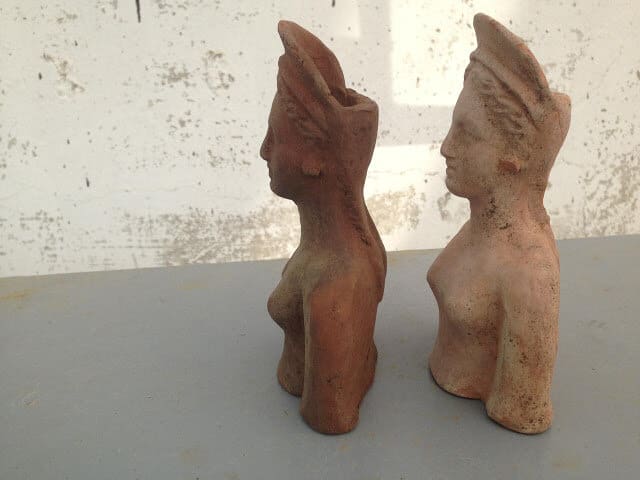
Statuettes of the ancient Hellenic Goddesses Demeter and Persephone have been discovered in Anapa, a town in Russia.

The discovery was carried out by the staff of the Institute for History and Mathematics of the Russian Academy of Sciences. The two intact terracotta semi-figures made more than two thousand years ago were found at a swimming pool construction site in a sanatorium in Anapa. They will be donated to the Anapa museum.

The excavation was carried on the western outskirts of the ancient Greek city of Gorgippia that was there in the 4th-2nd century B.C. Other objects discovered: Turkish smoking pipes, coffee cups, and Russian silver coins dating back to 1818-1913. 


The Thesmophoria was another harvest festival tied to the Eleusinian Mysteries and the mythology surrounding Demeter and Persephone. This is another female only festival. Will you join us for it from 29 September to 1 October, all at 10 am EDT?


Two days after the Stenia, the three day festival of Thesmophoria took place. There was a male and female encampment at the Thesmophorian and the division was clearly set; no men were allowed in the female encampment, and no women in the male encampment. Sex was not allowed. From what I have been able to gather, the three days in the female encampment followed a strict regime.

On the first day, called Anodos ('ascent') and Kathodos ('descent'), the women sacrificed the rotting piglets to Demeter and Persephone. The remains were mixed with seeds and would be ploughed into the earth after the festival to assure a good harvest. The piglets were fertility symbols, but also related to the myth of Demeter, Persephone and Hades, because it is said that, when Hades opened a chasm to swallow up Persephone, a swineherd called Eubouleus was grazing his pigs and they were swallowed up in the chasm as well. The women ate on this day, but only food which would not upset Demeter. Pomegranate fruits were off the menu.

The second day was called Nēsteia ('feast of lamentation'). On this day, the women did not eat. They recreated the time before Demeter taught humankind to cultivate the fields. It was a dark time, a time of hunger and pain. At the same time, this day was also used to remember the time when Demeter sought her daughter and neglected her duties as a harvest Goddess. This had also been a time of great hunger.

The third day, Kalligeneia ('she who is of beautiful birth'), was a happy one. The women prayed to Demeter and Persephone for fertility for themselves, their loved ones and the earth. They celebrated the magic of new life, fertility and the kindness of the Gods.

Needless to say, this festival was huge. All free women, except for maidens, were allowed to participate. While we can never be entirely sure why this is, I dare to wager an educated guess. The Stenia and Thesmophoria were festivals in honour of Demeter Thesmophoros, the law-giver. She was seen as the foundation of law and society: agriculture allowed settlements to thrive, allowed societies to be built, and humanity to evolve into what it was now. In short, Demeter was at the root of modern life. A huge part of that modern life was the institution of marriage, which was far more important then as it was now.

Demeter is, perhaps, ancient Hellas' most famous mother, and marriage allowed for the continuation of the family line. Children born out of wedlock were frowned upon, and as such, maidens were excluded from a festival intended to raise fertility in the ground and the women who took part in it. As women married young, maidens were often teens, and they would represent Persephone more than Demeter--and since the Stenia and Thesmophoria commemorated Demeter's separation from her daughter, the inclusion of maidens was most likely discouraged because of that fact.

The Stenia and especially the Thesmophoria were festivals intended for mothers, for those who sought to bear children. They acknowledge the powerful position of women in a patriarchal society. It was because of that that women could say no to their husbands when it came to sex, and why they all left their marital homes. Many women rarely left their homes, and never overnight. To do so for not one but two nights was huge. These were powerful festivals for women because they celebrated their fertility: the one thing they were always respected and honoured for by the men in their lives.

We don't know what happened for the men on these days (sorry), so this is another female only festival. You can find the rituals here and join the community here.

On September 27, we'll host a PAT ritual for the Stenia. The Stenia is connected to the Eleusinian Mysteries, Demeter, and Persephone.


The Stenia is celebrated on 9 Pyanepsion. It was a festival dedicated solely to Demeter and Persephone and was held three days before the Thesmophoria. Not much information about this festival has survived, but because bits and pieces have survived of the Thesmophoria and the preceding Skiraphoria, we can put parts of the festival back together.

A little background first: On 12 Skirophorion, the Skiraphoria was celebrated. The Skiraphoria was one of the few days when the women of ancient Athens would gather in public to honor Demeter and bless the harvest. They refused to sleep with the men on this day and took part in a very odd tradition: casting piglets down into a chasm where they were left to rot until the Stenia.

During the Stenia, women came together and begun the extensive purification rituals needed to partake in the Thesmophoria. How, exactly, the women purified themselves is unknown but it is known that the women engaged in Aiskhrologia, insulting each other and using foul language. To understand this practice, it's important to know the mythology behind it. Nearly all festivals where Demeter is included, recount the myth of Kore/Persephone who was abducted by Hades. While Demeter grieved and vowed to get her daughter out, Persephone was seduced to eat of the pomegranate fruit. This decision allowed Hades to keep Persephone in the Underworld for a part of the year, while she was allowed to rejoin her mother for the rest of it. While Demeter grieved, there was only one who could make her laugh: the strange old woman Iambe. From the Homeric Hymn 2: To Demeter:

"But Demeter bringer of seasons and giver of perfect gifts, would not sit upon the bright couch, but stayed silent with lovely eyes cast down until careful Iambe placed a jointed seat for her and threw over it a silvery fleece. Then she sat down and held her veil in her hands before her face. A long time she sat upon the stool without speaking because of her sorrow, and greeted no one by word or by sign, but rested, never smiling, and tasting neither food nor drink, because she pined with longing for her deep-bosomed daughter, until careful Iambe - who pleased her moods in aftertime also - moved the holy lady with many a quip and jest to smile and laugh and cheer her heart." [188]

I believe that a large part of the Stenia was to make the other women laugh by shouting witty insults, making crude jokes or any other way they could think of that was out of character and liberal. It's a laughing day. Yet, there was also a serious note to it. At the Stenia, some women, called 'Bailers', hiked to the chasm where the piglets had been thrown into months ago. Then, in a gruesome display of devotion, the women hauled out the rotting corpses of the piglets and carried them to the Thesmophorion, a site probably on the hillside of the Pnyx, in preparation for the Thesmophoria.

The Stenia is a female only festival, sorry guys! We can't really provide you with laughter and jokes, so here is my suggestion: get all your friends together and have a girl's night. Find Magic Mike on Netflix and break out the wine and popcorn. The ritual will focus on the religious part. You can find the ritual  here and chat amongst yourselves here.

The Greater Eleusinian Mysteries are upon us again, so it's time for the Masterpost to come back. Of all the mysteries celebrated in ancient times, the mysteries at Eleusis are assumed to be of great importance to a large portion of the ancient Hellenes. The cult itself likely has origins dating back to the Mycenean period of around 1600 to 1100 BC and it is believed that the cult of Demeter Herself was established in 1500 BC. 

The Eleusinian mysteries (Ἐλευσίνια Μυστήρια) had festivals throughout the year, which were tied to agriculture through Demeter's refusal to perform her duties as an agricultural Theia while her daughter Persephone is with Hades, and to the afterlife and Underworld through Persephone's return to the surface of the earth after Her mandatory stay with Hades has ended. Initiation ceremonies were held every year at Eleusis. The Mysteries were mysteries for a reason and revealing information of these involved rituals carried the punishment of death (or at least, that is what the ancient sources say). We still have been able to piece together quite a bit of information however, and I would like to create a masterpost of sorts.


Mythological connections and sources of the Mysteries:
- The Eleusinian Mysteries 
A short introduction to the Mysteries, which includes the mythological reason for the festival and the rewards for being initiated.
- On Persephone and Spring 
A writer's perspective on the myth of Persephone's abduction. 
- Iakkos 
The personification of the ritual cry of joy called ‘iakhe’ of the procession of the initiates. 
- On 'Kore' versus 'Persephone' 
...and why They are not always the same.


Eleusinian festivals:
A summary of the festivals included in the cycle of the Mysteries. It also includes a description of the way the days of the Mysteries would have been spent--as well as we can gather about a mystery tradition, of course. The cycle consists of: the Greater Mysteries (13-23 Boedromion), Proerosia (6 Pyanepsion), Stenia (9 Pyanepsion), Thesmophoria (11-13 Pyanepsion), Haloa (26 Poseideon), the Lesser Mysteries (20-26 Anthesterion), and the Skiraphoria (12 Skirophorion). These are placed in sequence of the Athenian year. Also linked to the Mysteries because they fall during either the Lesser of Greater Mysteries: the Diasia and the Epidauria.


Periferal points of interest connected to the Mysteries:
- On attending women-only festivals as a male
Some of the eleusinian rites are women-only. Can you attend as a male?
- On attending women-only festivals as non-binary
Some of the eleusinian rites are women-only. Can you attend if you identify as non-binary?
- On maidens, the Stenia and the Thesmophoria 
On attending women-only festivals as an unmarried woman.
- On the binding of hair 
As part of Eleusinian ritual.
- Dadoukhoi: torch bearers 
On the importance of torches and torch bearers in the Eleusinian Mysteries.
- The ancient tradition of Martes 
Martes were pieces of string, worn around the wrist. The innitiates of the Mysteries recieved yellow ones on the way to Eleusis.
- On ending the Mysteries
On why the ending rites of the Mysteries matters.
- On fasting for the Eleusinian Mysteries
Fasting is a part of the Greater Mysteries as well as the Thesmophoria. Here is how to do it safely.
- On the forbidden foods of the Eleusinian Mysteries 
Some things not to eat during these days.
- On the 'hiera' of the Eleusinian Mysteries
The heira are the 'sacred objects'.
- On kykeon 
A barley beverage sacred to Demeter and used to break a sacred fast within the Eleusinian Mysteries as well as in preparatory rites for some of the most sacred--and secret--rites within Eleusis. 
- Pelanoi, the cakes of the Athenians 
Athenian sacrifical cakes that were often used in the Lesser mysteries.
- Snakes, the ancient Hellenes and the Eleusinian Mysteries 
Snakes were used in the Lesser Mystery rites. Why?

 As a basic viewpoint, Elaion believes that the Mysteries need not be pursued; they are not a spiritual ‘formula’ that experimentation will eventually rediscover. That said, we also acknowledge that it's a festival many have been drawn to--both then and now--and we want to give our members a chance to celebrate it in a way that is as Recon as possible once you accept that we know far too little about it to ever accurately be so. Since the proceedings of the Eleusinian Mysteries were kept secret in fear of the punishment of death, we will never be able to restore these rites. But we do know a few basics and we have formulated our celebration accordingly. Please read through all information as well as the rituals before deciding to join.


The Eleusinian Mysteries (Ἐλευσίνια Μυστήρια) had festivals throughout the year, which were tied to agriculture through Demeter's refusal to perform her duties as an agricultural Goddess while her daughter Persephone is with Hades, and to the afterlife and Underworld through Persephone's return to the surface of the earth after Her mandatory stay with Hades has ended. Initiation ceremonies were held every year at Eleusis. Of all the mysteries celebrated in ancient times, the mysteries at Eleusis were assumed to be of great importance to a large portion of the ancient Hellenes. The cult itself likely had origins dating back to the Mycenean period of around 1600 to 1100 BC, and it is believed that the cult of Demeter Herself was established in 1500 BC.

The Eleusinian Mysteries consist mostly of two festivals, but the worship of Demeter and Persephone consist of a cycle of seven festivals: the Greater Mysteries (13-23 Boedromion), the Proerosia (6 Pyanepsion), the Stenia (9 Pyanepsion), the Thesmophoria (11-13 Pyanepsion), the Haloa (26 Poseideon), the Lesser Mysteries (20-26 Anthesterion), and the Skiraphoria (12 Skirophorion). These are placed in sequence of the Athenian year.

Mythologically, the foundations of the Eleusinian Mysteries can be found in the Homeric Hymn to Demeter. Within the hymn, Demeter travels the globe in her grief over losing Her daughter. She eventually settles at the home of Keleus. Demeter plans to make one of his sons immortal in return for his hospitality but She is interrupted. Instead, she tells Keleus to build Her a temple and altar so she can teach human beings the knowledge they need to have a good life.

The Mysteries were obviously celebrated to honor Demeter--Demeter Eleusinia, specifically. Through the honoring of Demeter, the ancient Hellenes prayed for a good harvest, and through the worship of Persephone--Kore--those who were initiated in the Mysteries assured they would be looked upon favorably in the Afterlife.

For those who wish to join us, the Eleusinian Mysteries will be a ten day event, starting on September 3rd with a rite meant to emulate the walk to Eleusis from Athens that all initiates eventually undertook. The procession would have started from the shine of Iakkhos, and Iakkhos was invited to come along to Eleusis by those in the procession. The mystai would sacrifice at all shrines along the way. The mystai would arrive in darkness, or at least guided by torchlight, as Demeter searched for Her daughter with a torch in hand. Upon arrival, sacrifices were made to Demeter. After undertaking this rite, we encourage everyone articipating to put on a króki. Króki were pieces of string (wool), worn around the wrist. The initiates of the Mysteries recieved yellow ones on the way to Eleusis.

For the continuation of the days, you can make daily sacrifices to Demeter and Persephone, as laid out in the rituals provided. All have a different character and different steps to undertake so reading through them ahead of time is quite important. While not mandatory, we also encourage those who join to potentially limit or cut out their intake of pomegranates, apples, eggs, fowls, and fish as the ancient Hellenes would have done for the duration of the Mysteries.

Then, we have prepared a rite for the Epidauria. The Epidauria was a festival of Asklepios placed smack in the middle of the Mysteries--exactly six months after the other major festival of Asklepios in Athens: the one during the Greater Dionysia. The day was named after Asklepios healing centre to the south at Epidauros. It was said that on this day, the cult of Asklepios and Hygeia joined the Eleusinian Mysteries rites in Athens.

What, exactly, happened during the Epidauria is unclear as discussing the rites that took place at Eleusis  carried a death sentence, but I think we can safely say that the rites at Eleusis involving Asklepios were most likely similar to the rites to Asklepios that took place at other places--including Epidauros. What we do know is that the rites of sacrifices were held at Demeter’s Eleusinion temple in Athens to honour Asklepios, His daughter Hygeia, and Demeter and Persephone, who also were revered as healing deities.

Asklepios' worship almost always included a 'night watch'; a night time period of meditation and contemplation at a temple to Asklepios; the Asklepion. the initiates would most likely sit, contemplate, and cleanse themselves of ailments, distress, and anything that might distract them form the proceedings to follow. The temple of Asklepios was built near the enclosure of a sacred spring in a small cave and it included an abaton, a sleeping hall sacred to Asklepios where initiates could sleep while watched over by priests of Asklepios who prayed to Asklepios to visit these initiates in their sleep and give them messages intended to heal and cleanse. The following morning, initiates would tell their dream to a priest of Asklepios or Hygeia, called 'therapeutes'. The initiate would then be encouraged to put the advice he or she had gotten into practice. We ask you to take part in this night time practice and follow it up with sacrifices to Asklepios and His daughter the day after.

The day after the epidauria was the day the initiates would have traveled to Eleusis. We moved this to the start as a way to introduce you to the Mysteries themselves, but for the ancient Hellenes, this was a walk that ended in darkness, with a torch lit procession to the shrine of Demeter and an offering that was not burned but buried. In the case of the ancient Hellenes, this was most likely a pig but we leave it to you what you want to offer to the Goddess.

We can say with a relative degree of certainty, that the day before the actual initiation was a day on which the initiates fasted in preparation of the main initiatory rite that took place in the nighttime hours of the next day. If you wish to join us for that fast, we would encourage you to stop eating at dusk on 6 September and consume nothing but water (or juice, if you need to!) until after the main rite that takes place after dusk on 7 September, once it's completely dark out.

While the Eleusinian Mysteries were held largely out of gratitude for the agricultural knowledge provided to us by Demeter, the ancient Hellenes became initiates for an entirely different reason: to be looked more favourably upon by the Theoi in death. Through the worship of Demeter and Persephone, participants hoped that Persephone would talk to Her Husband and the Judges of the dead. It is this focus that all rituals have: the rites of being initiated into the Mysteries in order to be well taken care of after death.

After the main initiatory right, the festival winded down. It's quite possible the initiated didn't sleep throughout the night of their initiation and the attested sacrifice to Demeter and Persephone the next day, we feel, was most likely done at dusk. Feel free to hold it at the standard PAT ritual time of 10 AM EDT, though. the focus of this sacrifice was the complete tipping out of two jugs of water onto the eath by the initiated, one to Demeter and one to Persephone, most likely in gratitude of the experience and knowledge gleamed the previous night.

The following day, we are unsure of what happened, exactly, but we take it to be a resting day and have prepared a simple rite to the Theoi for it. Day nine is another, general, rite, but we encourage you--as the initiated were--to add prayers and hymns to the Theoi you feel closest to to it with the goal of reestablishing the connection with Them after being so immersed in rites with a Kthonic character.

On the final day, we have prepared a closing rite which thanks the Theoi for guiding you on this journey and has you take off the króki you tied around your wrist on the first day. This will signal the end of the Mysteries.

To make things easier, we have laid out a time table:

  • September 3 / 15 Boedromion: starting ritual 
  • September 4 / 16 Boedromion: purification rite
  • September 5 / 17 & 18 Boedromion: sacrifices to Demeter and Persephone / prayers to Asklepios for prophetic dreams and healing (nighttime)
  • September 6 / 18 Boedromion: Epidauria ritual
  • September 6 / 19 Boedromion: sacrifices to Demeter (nighttime) (fasting day)
  • September 7 / 20 Boedromion: initiation rite (nighttime) 
  • September 8 / 20 Boedromion: tipping out of water jugs to Demeter and Persephone
  • September 9 / 21 Boedromion: sacrifices to Demeter and Persephone 
  • September 10 / 22 Boedromion: sacrifices to Demeter and Persephone + personal sacrifices
  • September 11 / 23 Boedromion: closing rite

  • We truly hope you will join us for this event. You can share your experience with the community here and all rituals can be found here. Note, these are ALL rituals, eleven of them in total. One for every day, plus one extra. Read the explanation above and see the schedule for clarification. It is highly encouraged you read through them all before the Mysteries start! We are very excited about the opportunity of offering this experience to you and we hope you will find a glimmer of what the ancient Hellenes might have experienced during the most anticipated days of the year.
    A biannual event started on the 15th of Metageitnion at Eleusis: the Eleusinia. This year the festival starts on August 5th (so, today!). Will you join us for the first and last day celebrations of it on August 5th and August 8th at the usual 10 am EDT?


    From the 15th day to the 18th day of Metageitnion, the Eleusinia took place. It was a festival that served as a prelude to the Mysteries and consisted mostly of sporting events. It was not part of the Eleusian Mysteries, however. The Eleusinia was held on the 4th year of every Olympiad, and on a lesser scale on the 2nd year. The festival included a religious procession and sacrifices on the first day, as well as games the second and third. The winner's prize was a quantity of grain. This is noted in Pindar's Scholia:

    "It is celebrated there [in Eleusis], the agon in honor of Kore and Demeter, which is called Eleusinia; the prize consists of barley grains... this is the first agon ever celebrated. In fact, ...after Demeter found the fruit of strength, men made show of it and performed in this competition..." [Ol. 150a/b]

    The first day boasted at least a general procession but there are reports of a procession of the youths and a sacrifice on their part of oxen as well. This could have been on the first or third day, we are not sure. We are sure, however, that they were held at Eleusis, as were the games. Eleusis boasted a stadium, a race track and also a theater, after all. In modern times all these are now lost due to the construction of factories.

    We know from several sources that the main sporting events were running races, in particular the stadion and the race in arms, but we also know of other competitions: pancratium, pentathlon at the Megala ('Greater' Eleusinia), diaulos and horse racing at the Megala, dolichos, boxing, a horse race and a chariot race. there was even a musical competition and an 'ancestral competition', although we are not entirely sure what that entailed.

    A list of expenditures for the celebrations informs us that the competitions were essentially the same, but at the Megala the prizes were most valuable. A report drawn up by the treasurers of Eleusis remembered uses of the wheat grown in the sacred plain of Rharos: among those mentioned, there are also the medimnai awarded to the winners at the Eleusinian competitions: 70 to the winners of the Mikra, and 260 to those of the Megala.

    Will you join us for this event? The rituals can be found here and the event page can be found here.
    For the second PAT ritual of the month, Elaion would like to present to you the rituals for the Skiraphoria. The Skira(phoria) was celebrated mainly by women, perhaps to contrast the Greater Dionysia celebrated mostly by men, but we have created a separate ritual for men which excludes portions of the festival but does allow them to participate. Will you join us on June 4th at 10 AM EDT?


    The Skira, or Skiraphoria was celebrated over a three day period and we have few details about it. What we do know is that the Skira is most likely a fertility festival, mostly of the earth so that a good harvest was ensured for the following year, which started a little more than half a month later. Demeter was certainly honored during the festival, as well as her daughter Kore, as the Goddess of spring growth. Yet, many other deities are tied to the harvest and the success of the nation in some way, especially in Athens from where most of the surviving material originated. There, Athena Skiras and Poseidon Pater also had a role to play.

    What we know of the rites is that a gathering left Athens on the day of the Skira, and another delegation left Eleusis. At Skiron, a precinct on the road to Eleusis, stood a sanctuary dedicated to Athena Skiras, Poseidon Pater, Demeter and Kore. Here, the two delegations met, and the priests and priestesses of all Theoi involved interacted in some way; Plutarch mentions that one of the three 'sacred plowings' of the Athenians took place at this time. It is, perhaps, possible that at this time, the priestesses of Athena and the priests Poseidon made amends with the priestesses of Demeter and Kore--there was bad blood between them for, as Apollodorus reminds us:

    "Athena, therefore, called the city Athens after herself, and Poseidon in hot anger flooded the Thriasian plain and laid Attica under the sea." [3.14.1]

    The Thriasian plain is where Eleusis is located, and it would have been entirely flooded during this episode. Perhaps the Athenian deities ritually made amends for this during the Skira? Alternatively, or perhaps additionally, during the reign of Erechtheus in Athens, war broke out against the Eleusinians, who were assisted by Eumolpus, whose mother was Khione, daughter of Boreas, and whose father was said to be Poseidon Himself. Eumolpus attacked Ahens because, as he put it, that land belonged to his father. Could the rituals of the Skira be penance for this war as well, where Poseidon (and Athena) 'rode out' to meet Demeter and Kore in the middle for a rite that would settle their grievances?

    The details of the procession to the Skiron and the subsequent ritual are largely lost to us. Although debated by certain scholars, it seems that those in the procession--or perhaps only the priests and priestesses--carried umbrella-type canopies over their heads which were of a bright white color. It is possible that this was only one large canopy per group, and it was held over the heads of the priests and priestesses by others in the procession. The canopy was or were called 'skiron' as well. Of the sanctuary itself, we know very little besides its location and deities. It is, however, said to have been the place where the first sowing took place, tying the Skira rituals back in with the purpose of fertility.

    The Skira was celebrated over a three day period, but when this procession took place is unclear. To bring fertility, the women abstained from intercourse on these days, and to this end they ate garlic to keep the men away. We also know that during the Skira, offerings were thrown into the sacred caves of Demeter located in a cliff at Eleusis: cakes shaped like snakes and phalluses, and very real piglets. These became the Thesmoi--'things laid down'--that were removed in the Thesmophoria. The piglets were fertility symbols but also related to the myth of Demeter, Persephone and Hades, because it is said that when Hades opened a chasm to swallow up Persephone--the caves of Demeter--a swineherd called Eubouleus was grazing his pigs and they were swallowed up in the chasm as well.

    For the men, there was a race in which they carried vine-branches from the sanctuary of Dionysos to the temple of Athena Skiras. The winner was given the Fivefold Cup, or 'pentaploa', containing wine, honey, cheese, some corn and olive oil. Only the winner was allowed to pour libations to Athena from the cup, and ask Her to bless these fruits of the season.

    For these rites, we will honor Demeter, Kore, Athena, and Poseidon. The female version of the rite which includes Demeter and Kore as well as the Thesmoi, and that of the men has sacrifices to Poseidon, Athena, and Demeter. We also encourage the men to perform some sort of athletic feat afterwards to honour Athena.

    The PAT ritual will take place on the 4th of June, at the usual 10 am EDT. The rituals can be found here for the women, and here for the men. We look forward to your participation and if you would like to discuss the rite or festival with others, feel free to join us on Facebook on the event page. We hope you will join us!