Showing posts with label Iliad. Show all posts

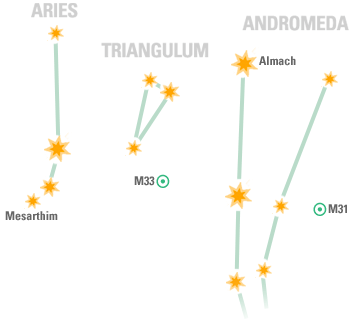
Did you know there was a constellation called 'the triangle'? And that the ancient Hellenes were aware of it, too? Triangulum is a small constellation in the northern sky. It was one of the 48 constellations listed by the second century astronomer Ptolemy, and so named for its three brightest stars, which form a long and narrow triangle. The Ancient Hellenes called Triangulum 'Deltoton' (Δελτωτόν), after the upper-case letter delta (Δ). Hellenic astronomers such as Hipparchos and Ptolemy called it Trigonon (Τρίγωνον).


There is not a lot of mythology connected to this tiny constellation, but the lore that it has is quite important. Hyginus, in his 'Astronomica' explains the options:

"This constellation, which has three angles like the Greek letter Delta, is so named for that reason.
Mercury [Hermes] is thought to have placed it above the head of Aries, so that the dimness of Aries might be marked by its brightness, wherever it should be, and that it should form the first letter in the name of Jove [Zeus] (in Greek, Dis).
Some have said that it pictures the position of Egypt; others, that of Aethiopa and Egypt where the Nile marks their boundaries. Still others think that Sicily is pictured there.
Others, say that three angles were put there because the gods divided the universe into three parts." [II.19]

The latter is the only one that might need some explaining. Zeus, the greatest of the Olympian Gods, and the father of Gods and men, was a son of Kronos and Rhea, a brother of Poseidon, Hades, Hestia, Demeter, Hera. When Zeus and His brothers drew lots for the rule of the world, Poseidon obtained the sea, Hades the lower world, and Zeus the heavens and the upper regions, but the earth belonged to them all. To quote the 'Iliad' by Hómēros:

"Poseidon was very angry and said, "Great heavens! strong as Zeus may be, he has said more than he can do if he has threatened violence against me, who am of like honour with himself. We were three brothers whom Rhea bore to Kronos--Zeus, myself, and Hades who rules the world below. Heaven and earth were divided into three parts, and each of us was to have an equal share. When we cast lots, it fell to me to have my dwelling in the sea for evermore; Hades took the darkness of the realms under the earth, while air and sky and clouds were the portion that fell to Zeus; but earth and great Olympus are the common property of all." [XV.187]

The constellation Triangulum is visible at latitudes between +90° and −60°, and best visible at 21:00 (9 p.m.) during the month of December.

It's Olympics time again! And as conflicted as I am about this version (hello, covid, hello, discrimination, hello host of issues!), they do hold a special place in my heart. One thing is certain: the ancient Hellenes would have trouble recognizing the Olympics in its current carnation, not in the least because they practiced very different sports. Especially towards the end of the Games, there was great variety in sporting events, although not as much as the modern Olympics give us. Today, I want to discuss these various sports.


Harmatodromia (ἁρματοδρομία) - Harmatodromia, or chariot racing, was one of the most popular ancient Hellenic sports. In the ancient Olympic Games, as well as the other Panhellenic Games, there were both four-horse (tethrippon, τέθριππον) and two-horse (synoris, συνωρὶς) chariot races. Distances varied according to the event. The chariot racing event was first added to the Olympics in 680 BC with the games expanding from a one-day to a two-day event. We don't know when they were added to the other Panhellenic games, but probably around the same time or a little later.

Hómēros in his Iliad describes a chariot race in vivid detail:

"As one, they raised their whips, shook the reins, and urged their teams on. Swiftly the horses galloped over the plain, leaving the ships behind. A whirlwind cloud of dust rose to their chests, and their manes streamed in the wind. Now the chariots ran freely over the solid ground, now they leapt in the air, while the hearts of the charioteers beat fast as they strove for victory, and they shouted to their horses, flying along in the storm of dust. 
It was not till the galloping horses were heading back towards the grey sea that each team showed its mettle, and the charioteers forced the pace. Eumelus’ swift-footed mares shot to the front, chased by Diomedes’ stallions, hot on their heels, as if they might  mount  Eumelus’ chariot, and their heads were at his back as they flew, blowing hot breath on his neck and shoulders. Diomedes would have passed him now, or at least drawn level, if Phoebus Apollo in resentment had not struck the gleaming whip from his hand. Diomedes saw the mares run on, while his own horses slowed without the effect of the whip, and tears of anger filled his eyes. But Athene saw that Apollo had interfered, and speeding after, returned the whip and inspired the team. Then in her anger she chased down Eumelus, and shattered the yoke of his chariot, so the mares swerved from side to side and the broken pole struck the ground, while Eumelus himself was hurled to the earth beside the wheel. The skin was stripped from his elbows, nose and cheeks, his forehead bruised, while his eyes filled with tears and he was robbed of speech. 
Meanwhile Diomedes passed the wreck and drove his powerful horses on, far in the lead. Athene had strengthened his team and given him the glory. And red-haired Menelaus, the son of Atreus, ran second. But Antilochus called to his father’s team: ‘On now, show me how you can run. You’ll not catch Diomedes’ pair, for Athene grants them strength and him the glory. But chase down Menelaus’ team, don’t let them beat you, or Aethe the mare will put you to shame. Why so slow, my beauties? I’ll tell you this, if we win a lesser prize, there’ll be no sweet fodder at Nestor’s hands, he’ll slit your throats with his keen blade. So on, as fast as you can, and I’ll contrive to pass them where the course narrows: that’s my chance.’
With this the horses, responding to his threat, speeded up for a while, and soon the steadfast Antilochus saw a narrow place in the sunken road ahead, where a stream swollen by winter rain had eroded the track and hollowed out the course. Menelaus drove on assuming no one could overtake, but Antilochus veered alongside, almost off the track. Then Menelaus called to him, in alarm: ‘Rein in Antilochus, that’s recklessness! The track’s wider further on. Pass there if you can, mind my chariot, don’t wreck us both!’
He shouted loud enough, but Antilochus, pretending not to hear, plied his whip and drove the more wildly. They ran side by side a discus length, as far as a young athlete testing his strength can hurl it from the shoulder, then Menelaus held back, and his pair gave way, fearing the teams might collide and overturn the light chariots, hurling their masters in the dust, for all their eagerness to win. Red-haired Menelaus stormed at Antilochus: ‘You’re a pest Antilochus, we Achaeans credited you with more sense. All the same, you’ll not win a prize, when I force you to answer on oath to this.’ 
With that he addressed his team: ‘Don’t flag, and don’t lose heart. Their legs will weaken sooner than yours, they’re carrying more years.’ And his pair, responding to his call, increased their speed and closed on the pair in front.
[...] Diomedes soon arrived, whipping the high-stepping horses hard, as they sped towards the goal. Showers of dust clung to him, and the wheel rims hardly left a trace on the powdery ground, as the swift-footed pair flew onwards pulling the chariot, decorated with gold and tin. He drew to a halt in the centre of the ring, sweat pouring to the ground from his horses’ chests and necks. He himself leapt to the ground from his gleaming chariot, and leant the long whip against the shaft. Nor did his squire Sthenelus lose a moment in claiming the prize, but eagerly his joyful friends led away the women and carried off the eared tripod, while he un-harnessed the horses." [Bk XXIII:362]

Pále (πάλη) - This event was similar to the modern wrestling sport--with three successful throws necessary to win a match. It was the most popular organized sport in Ancient Hellas and was the first competition to be added to the Olympic Games that was not a footrace. It was added in 700 BC. An athlete needed to throw his opponent on the ground, landing on a hip, shoulder, or back for a fair fall. Biting and genital holds were illegal.

Pankration (παγκράτιον) - This rough contact sport was a combination of boxing and wrestling. Biting and gouging an opponent's eyes, nose, or mouth with fingernails was not allowed, but everything else was allowed. Deaths happened. Unlike at the boxing competitions, the fighters did not wrap their hands, so it was a bare knuckle fight.Like the other combat sports, a fighter could surrender or fight until knock out. Pankration was not a free-for-all, though; fighters were in excellent form, and there were a large variety of fighting stances and techniques. In fact, many of these are still known, or have been reconstructed and especially in modern Greece, pankration is a sport you can take part in today.

Pentathlon (πένταθλον) - A pentathlon incruded a combination of five separate disciplines: discus, javelin, jump, running, and wrestling. The event was first held at the 18th Ancient Olympiad, around 708 BC. The discus throw was similar to the modern event, with the implement made from stone, iron, bronze, or lead. The javelin event was also similar to the modern event, although the javelin was made of wood and had a thong for attaching the thrower's fingers. Unlike in the modern jumping events, the participants held onto lead or stone jump weights (called halteres (ἁλτῆρες)) which were thrown backwards during the jump to propel them forward and increase the length of their jump. Halteres were made of stone or metal, and weighed between 12 and 35 kg (26 and 77 lb).

The running event was called the 'stadion' (στάδιον), and was a a 200-yard (about 180-metre) sprint. From the years 776 to 724 BC, the stadion was the only event that took place at the Olympic Games and the victor gave his name to the entire four-year Olympiad. This allows scholars to know the names of nearly every ancient Olympic stadion winner. For a description of the wrestling matches, see 'Pále' above.

Pygmachia (Πυγμαχία, 'fist fighting') - Pygmachia, or boxing, was a brutal sport, and had few rules. There were no rounds, and if an opponent was down, he was fair game. Also, the fighters were chosen by lot, and there were no weight categories: if luck was not at your side, you could end up facing a much heavier opponent. Winners were declared by K.O. of the other fighter, or if the other fighter surrendered. Instead of gloves, ancient boxers wrapped leather thongs called 'himantes' around their hands and wrists which left their fingers free. These were thongs of ox hide approximately 3 to 3.7 meters long that were wrapped around the hands and knuckles for protection and extra punch. Somewhere prior to 400 BC, 'oxys' were introduced to boxing. They consisted of several thick leather bands encircling the hand, wrist, and forearm. A sweatband wrapped around the arm was also added. Around 400 BC 'sphairai' were introduced, which were essentially himantes, but they contained a padded interior and the exterior of the thong was more rigid and hard. The Boxer of Quirinal (depicted left) dated to about 300–200 BC shows these straps.

We actually have a very good description about how these boxing matches would have gone: Hómēros in his Iliad describes the boxing match between Epeius and Euryalus:

"Godlike Euryalus alone stood up to fight him, the son of King Mecisteus, Talaus’ son, who at the funeral games for Oedipus, in Thebes, defeated every Cadmeian opponent. Diomedes, the spearman, eager to see him win, helped Euryalus to prepare, and gave him encouragement. He buckled on his belt, and bound the ox-hide thongs carefully on his hands. When the two contestants were ready, they stepped to the centre of the arena, and raising their mighty arms, set to. Each landed heavy blows with their fists, and they ground their teeth, as the sweat poured over their limbs. Euryalus sought an opening, but noble Epeius swung and struck his jaw, and he went straight down, his legs collapsing under him. Like a fish that leaps in the weed-strewn shallows, under a ripple stirred by the North Wind, then falls back into the dark wave, so Euryalus leapt when he was struck, but the big-hearted Epeius, lifted him and set him on his feet, and all his friends crowded round, and supported him from the ring his feet trailing, his head lolling, as he spat out clots of blood. He was still confused when they sat him down in his corner, and had to fetch the cup, his [second] prize, themselves." [Bk XXIII:651]

Riding - Riding--like the chariot races--were for the wealthy. The winners were not the riders themselves, but the owners of the horse. As such, there were actually women who won equestrian events. In the Olympic riding events, held over 6 laps around the track (about 4.5 miles), the jockeys rode bareback. There were separate races for adult horses and foals.


Running - The Olympic Games originally contained one event: the stadion (or "stade") race, a short sprint the length of the stadium. Runners had to pass five stakes that divided the lanes: one stake at the start, another at the finish, and three stakes in between.

The Diaulos (Δίαυλος), or two-stade race, was introduced in 724 BC, during the 14th Olympic games. The race was a single lap of the stadium, approximately 400 metres (1,300 ft), a turn around a post (either an individual one, or a single one) and then the return journey.

A third foot race, the Dolichos (Δόλιχος), was introduced in 720 BC. The length of the race was somewhere between 18–24 laps, or about three miles (5 km). At Olymia, the race started and ended at the stadium, but then wound its way throughout the grounds, passing by important shrines and statues, including the Nike statue by the temple of Zeus. This race was closest to our modern marathon.

The last running event added to the Olympic program was the Hoplitodromos (Ὁπλιτόδρομος), or 'Hoplite race', introduced in 520 BC and traditionally run as the last race of the Olympic Games. The runners would run either a single or double diaulos (see above) in full or partial armour, carrying a shield and additionally equipped either with greaves or a helmet. The armor was a huge hindrance for the otherwise bare runners, as an armor avaraged out between 50 and 60 lb (27 kg). Although many events on the Games were throwbacks to war, the hoplitodromos emulated the speed and stamina needed for warfare. As depicted to the side, runners sometimes dropped their shields because of the weight, and runners would have to jump over it to keep from falling.

From Hómēros, we again have a description:

"Swift Ajax the Lesser, and Odysseus, the cunning, stepped forward, with the fastest of the young men, Antilochus, Nestor’s son. They took their places at the start, and Achilles pointed out the turning post. Off they ran, and  Ajax, son of Oïleus, hit the front, with noble Odysseus at his heels, as close as a woman weaving holds the shuttle to her chest, as she draws it along skilfully passing its spool through the warp. He trod in Ajax’s footsteps before the dust had settled, and his breath beat on Ajax’s neck as they ran swiftly on. The Greeks shouted for Odysseus as he strained for victory, urging him on to the utmost. As they were nearing the finish, Odysseus prayed urgently in his heart to bright-eyed Athene: ‘Goddess, hear me, help me if you will and quicken my legs.’ He prayed and Athene heard, making his limbs seem lighter, and just as they reached the line, Pallas Athene made Ajax slip on a patch of offal from the sacrifice of bellowing bulls that fleet-footed Achilles had made in honour of Patroclus. He fell and his mouth and nostrils were filled with offal, while Odysseus came in first, and claimed the silver bowl, leaving the ox for noble Ajax. He stood there, spitting out the offal, grasping the ox’s horn, and complained to the Argives: ‘There, did you see how the goddess made me slip, she who’s always at Odysseus side, helping him!'" [Bk XXIII:740]

 I have already written quite a lot about the Hellenic hero Hēraklēs, whose name was later Romanized as 'Hercules'. In fact, I am writing a continuing series about his labours. That said, this post will not be just about him, because there were others associated with the myth, despite the name.


The name of the constellation in ancient Hellas was Ἐγγόνασιν, The Kneeler, or On His Knees. That said, the ancient Hllenes already associated the myth with the hero Hēraklēs. Hyginus, for example, in his 'Atronomica' describes:

"Eratosthenes says he is Hercules, placed above the dragon we have already mentioned, and prepared to fight, with his left hand holding his lion skin, and his right the club. He is trying to kill the dragon of the Hesperides, which, it is thought, never was overcome by sleep or closed its eyes, thus offering more proof it was placed there as a guard. Panyassis in the Heraclea says of the sign that Jupiter, in admiration of their struggle, placed it among the stars; for the dragon has its head erect, and Hercules, resting on his right knee, tires to crush the right side of its head with his left foot. His right hand is up and striking, his left extended with the lion skin, and he appears to be fighting with all his strength.

Aeschylus, in the play entitled Prometheus lyomenos, says that he is Hercules, fighting not with the dragon, but with the Ligurians. For he says that at the time Hercules was driving away the cattle of Geryon, he journeyed through the territory of the Ligurians. They joined forces in trying to take the herd from him, and pierced many of the beasts with arrows. But after Hercules’ weapons failed, worn out by the number of the barbarians and lack of arms, he fell to his knees, already suffering from many wounds. Jove, however, out of pity for his son, provided that there should be a great supply of stones around him. With these Hercules defended himself and put the enemy to flight. And so Jove [Zeus] put [t]he image of his fighting form among the constellations." [II.6]

Yet, Hyginus also mentions other possibilities and other noteworthy people who have an opinion on the matter; Araethus, for example, who calls this figure Ceteus, son of Lycaon, and father of Megisto:

"He seems to be lamenting the change of his daughter to bear form, kneeling on one knee, and holding up outstretched hands to heaven, asking for the gods to restore her to him." [II.2]

For those who these names are unfamiliar, Megisto is in some writers another form for Kallistô, the mother of Arcas, who is also called Themisto. I have discussed the happenings with this family before, for the constellation Boötes, but will recap for the unity of this post. Arcas (Ἀρκάς), son of Zeus and Kallistô (Καλλιστω). After Arcas was born, Hera caught wind of the affair and turned Kallistô into a bear. Alternatively, Kallistô was a priestess of Artemis, and Artemis punished her for losing her virginity by turning her into a bear. Because of the metamorphosis, the boy was raised by his maternal grandfather Lycaon, who would later kill and serve up his grandson to the Theoi as dinner, for which he was turned into a (were)wolf. When Arcas grew up, he went out to hunt and found a beautiful bear. He chased her through the woods. The bear--his transformed mother Kallistô--ran towards him as soon as she recognized her son. Arcas was terrified and raised his bow to shoot her. Zeus intervened swiftly and placed Kallistô and her son in the sky. Kallistô became Ursa Major and Arcas either Ursa Minor or Boötes.

Hyginus goes on to quote Hegesianax, who says that:

"...he is Theseus, who seems to be lifting the stone at Troezene. Aegeus is thought to have put [corrupt] and a sword under it, and warned Aethra, the mother, not to send him to Athens until he could lift the stone by his own strength and bring the sword to his father. And so he seems to try to lift the stone as high as he can. In this connection, too, some have said that the Lyre, placed nearest this sign, is the lyre of Theseus, for he was skillful in all the arts and seems to have learned the lyre as well. This, too, Anacreon says: Near Theseus, son of Aegeus, is the Lyre." [II.6]

Theseus was fathered by Aegeus and Poseidon, whom had both slept with his mother Aethra, and was thus destined to become a hero. In order to claim his rightful place as ruler over Athens, he had to uncover his father's sandals and sword from under a stone in his mother's birth land where Theseus grew up, and bring it to his mortal father. Theseus lifting the stone at Troezene would have been his first heroic act, and thus worthy of immortalization in the stars.

Hyginus offers a few more options:

"Others call him Thamyris, blinded by the Muses, kneeling as a suppliant; others, Orpheus, killed by the Thacian women because he looked on the rites of Father Liber. Again, some have said that he is Ixion with his arms bound, because he tried to attack Juno. Others say he is Prometheus, bound on Mt. Caucasus." [II.6]
 
I have written about the affairs with Ixion and Prometheus, so for reference, please visit those posts. I have also written about Orpheus, but with a different constellation: Cygnus: the swan. In it I describe how Orpheus wanders the world after loosing his wife for good, and stumbles upon revelers who rip him apart. His lyre is placed into the sky and Plato describes that Orpheus is turned into the constellation Cygnus because he does not want to be reincarnated as a woman, a risk he would run if he stayed in human form. It seems others thought he was put into the sky as a man regardless, and near his lyre at that.

Thamyris  (Θάμυρις) is new to this blog. He was the son of Philammon and the nymph Argiope, and a Thracian singer who was so proud of his skill that he boasted he could outsing the Muses. He competed against them and lost. As punishment for his presumption they blinded him, and took away his ability to make poetry and to play the lyre. Hómēros outlines the tale in the Iliad:

"From Pylos, and lovely Arene; from the ford of the Alpheius at Thryum, from well-built Aepy, from Cyparisseis, and Amphigeneia, Pteleos, Helos, and Dorium, where Thamyris the Thracian met the Muses, as he came from Eurytus’ house in Oechalia, and they put an end to all his singing: he who had boasted he would win his contest with those aegis-bearing daughters of Zeus, they blinding him in anger, robbing him of his sweet gift of song, so he forgot the cunning of his harp; in their fleet of ninety hollow ships the warriors came, led by Nestor the Gerenian charioteer." [II: 581-644]

It seems there is great variety in the interpretation of the person the constellation depicts, but whomever it is, they are visible at latitudes between +90° and −50°, and best visible at 21:00 (9 p.m.) during the month of July.
The Iliad (Ἰλιάς) is an ancient Hellenic epic poem, traditionally attributed to Homeros. It's set during the Trojan War, the ten-year siege of the city of Troy (Ilium) by a coalition of Hellenic states, it tells of the battles and events during the weeks of a quarrel between King Agamemnon and the warrior Achilles. Although the story covers only a few weeks in the final year of the war, the Iliad mentions or alludes to many of the Hellenic legends about the siege; the earlier events, such as the gathering of warriors for the siege, the cause of the war, and related concerns tend to appear near the beginning. Then the epic narrative takes up events prophesied for the future, such as Achilles' imminent death and the fall of Troy, although the narrative ends before these events take place. However, as these events are prefigured and alluded to more and more vividly, when it reaches an end the poem has told a more or less complete tale of the Trojan War. Over the course of the story, many Gods are invoked and petitioned, and I'd like to collect some of these invocations here today, for use in your own rites.

An invocation is a request for the spiritual presence and blessing of a deity during a rite. To invoke is to call upon earnestly, so an “invocation” in the context of prayer is a serious, intentional calling upon a God or Goddess. In Hellenic ritual, it's common for prayers of invocation to be offered every time a new deity is invoked, so we can be sure They will the hymns and prayers of petition offered to Them. Invocations fit into the rite like so:

- Lighting of the incense burner with frankincense
- Invocation to Demeter: Khaire Demeter, you who taught us to work the earth and provides for us so bountifully… 
- Libation of a kykeon and sacrifices
- Orphic Hymn 40 To Eleusinian Demeter
- Prayers

Apollon:
"O god of the silver bow, that protectest Chryse and holy Cilla, and rulest Tenedos with thy might..."
"Hear me O king from your seat, may be in the rich land of Lycia, or may be in Troy, for in all placesyou can hear the prayer of one who is in distress, as I now am..."

Athena:
"Hear me, daughter of aegis-bearing Zeus, unweariable..."
"Holy Athena, protectress of [Athens], mighty goddess..."
"Hear me, daughter of aegis-bearing Zeus, you who spy out all my ways and who are with me in all my hardships; befriend me in this mine hour..."

Erinyes:
"I call the Erinyes who dwell below and take vengeance on him who shall swear falsely..."

Helios:
"Oh Sun, that seest and givest ear to all things, Earth and Rivers..."

Zeus:
"Zeus, most glorious, supreme, that dwellest in heaven, and ridest upon the storm-cloud..."
"Father Zeus that rulest in Ida, most glorious in power..."
"Zeus, most great and glorious, and ye other everlasting gods..."
"King Zeus, lord of Dodona, god of the Pelasgi, who dwellest afar, you who hold wintry Dodona in your sway, where your prophets the Selli dwell around you with their feet unwashed and their couches made upon the ground- if you heard me when I prayed to you aforetime, [...]vouchsafe me now the fulfilment of yet this further prayer..."
Today is International Transgender Day of Visibility, and I am here for it. While I'm a cis-woman, I know some awesome transgendered or otherwise genderqueer individuals, and I want to celebrate their awesomeness today! In true Baring the Aegis style, I'll do this by sharing the myths of some intersexed, gender-shifting, gender-merging or otherwise genderqueer individuals.

I must, of course, start with Hermaphroditos (Ἑρμαφρόδιτος), who is the child of Aphrodite and Hermes. He became a minor deity of bisexuality and effeminacy, and was portrayed as a female figure with male genitals. In the myth told by the Roman poet Ovid, Hermaphroditos was born fully male. As a young man, he wandered the lands and encountered a nymph, Salmacis (Σαλμακίς), in her pool. Salmacis fell for the boy right away, tried to seduce him. Hermaphroditos rebuked her, but she still jumped him when undressed for a bath in her pool. As he tried to fight her off, Salmacis cried out for the Theoi to let them stay forever merged--upon which the Theoi agreed: the two fused together, becoming the first hermaphrodite.

I've mentioned before that Ovid's myths aren't reflective of ancient Hellenic mythology--and in Hellenic myth, Hermaphroditos was either born with both male and female part, or he was simply very feminine in that he had pale skin and was very delicate, while still possessing the strength of a male. Especially in the latter case, there is a beautiful gender duality in Hermaphroditos that I much appreciate.

Ovid's 'Metamorphoses' is the source for a few other Hellenic-inspired Roman myth: the myth about the immensely strong warrior Kaineus (Καινεύς), for example, who was born as a woman named Kainis, and asked to be transformed into a male after being raped by Poseidon (or Hermes). Poseidon agrees, and makes Kaineus impervious to mortal weapons to boot, making him a capable warrior. Kaineus is mentioned in ancient classics like the Illiad, but without the gender-shift. In the Illiad, he is one of the earlies heroic, and extraordinary, warriors.

Another of Ovid's metamorphoses happens to Teiresias (Τειρεσίας), the blind prophet from Thebes. There is more Hellenic support for this myth, however. As the story goes, Teiresias was out one day, and came upon a pair of snakes, who were mating in the bush. He swiftly hit them over the head with a stick and killed both of them. Hera witnessed his actions and was not pleased: she transformed Teiresias into a woman. After recovering from the shock, Teiresias accepted her fate and married. She also became a priestess of Hera to make up for her crime. Eventually, Teiresias had children and a decent life. Yet, when he came upon another pair of mating snakes seven years later, he either clubbed them to death again, or left them alone. Either action let to another change of sex: Teiresias was male again. How his husband dealt with this is unclear. In a later myth, Hera blinds the prophet when he is asked to settle a dispute between her and Zeus: who enjoys sex more, male or female. Teiresias, who has experienced both, must side with Zeus: women most definitely enjoy sex more.

A myth of which only fragments have survived is the story of Siproites of Krete, who saw Artemis bathing in the woods one day, and was changed by her into a woman. Why this exact punishment was placed upon Siproites is unclear.

The last myth I'll retell today is the one about Leucippus (Λεύκιππος), who was born female to Lamprus and Galatea. Lamprus had warned Galatea that he would only accept a male child, so when Leucippus turned out to be female, Galatea hid the gender of the child from her husband and raised Leucippus as male. Of course, once Leucippus reached adolescence, her gender became hard to hide. In some versions of the myth, Leucippus fell for the girl next door, making it even more prudent that Leucippus became the male she wanted to be. And so, Galatea went to the temple of Leto and prayed to turn her daughter into the son she had promised her husband. Leto, moved by the mother's plea, did as she was asked. The people of Phaistos, there the myth took place, honored Leto by her epithet 'Phytia' (to grow, φύω), in reference to Leucippus' newly grown penis. The people of Phaistos also founded a feast called the 'Ekdysia' (undressing, ἑκδύω), because Leucippus was no longer forced to wear women's clothes. It also became custom for the women of Phaestus to lie next to the statue of Leucippus before their wedding.

I doubt the ancient Hellens had any concept of the term 'transgendered', or even related to it--I think the societal gender roles were too strict too even question if your sex matched your gender. Yet, gender and sex were definitely themes in mythology. There are many more examples. To my readers I would ask to become trans* allies--if you are not already--to speak out against injustice, to stand up against hate. Too many people are killed, beaten up, sexually or verbally abused over trans* issues. It's time for the hate to stop, and to remember those who have already lost their lives while living the life they were meant to live. Stop violence, end ignorance, fight hate. Remember, and most of all, celebrate!
A room of classics students is about to get a lesson in ancient literature via a very unexpected method: Instructor Brandon Bourgeois — clad in black, a gold medallion depicting the face of Medusa slung around his neck — is ready to rap.

3,000 years ago, a Greek poet whose name was Homer composed a flow for his feta, he was a real rov-uh.
He spun and spread a tale of lust, war, rage and revenge.
A tapestry, a masterpiece, words stitched together without a pen.
A story — rather gory in detail:
10 years of bloody battle waged by Greeks over a female — hell, you heard-uh Helen.
She sailed to Asia with a prince named Paris already married to a Spartan king named Menelaus.
Ran to his brother — the great king Agamemnon: “What happened to my queen?!” The brotha told him to stay strong: “We out for blood!
“Grab your weapons, spread the message to all the kings in Greece. We’ll have your Helen home in no time, a matter of weeks.”


The lyrics are his hip-hop adaptation of the prologue to The Iliad, delivered as a rap lecture in staccato bursts to music Bourgeois composed using Apple’s GarageBand app. It’s his way of making the classic poem — one of the foundational texts of Western civilization — relevant to a modern audience. But it’s also more than that. For centuries, The Iliad passed from generation to generation by spoken word.

Homer lived in the eighth century B.C. and told a story that dated from the 12th century B.C., Bourgeois said. It wasn’t until the third or fourth century B.C. that scholars in Alexandria committed the sprawling epic to the page.

Bourgeois believes that the oral tradition that kept The Iliad alive bears remarkable similarities to modern rap. Both tell tales of everyday life, hardship, violence, love lost and gained. Both are histories.

"Homer is at the end of a long line of bards just like him,” Bourgeois noted. “And he happens to be the best at it. He happens to do things with the stories that no one else has done before. It’s like having Jay-Z. Jay-Z’s not the first rapper ever, but he’s in the tradition."

Bourgeois arrived this summer at the USC Dornsife College of Letters, Arts and Sciences as a freshly minted assistant professor of classics. His primary area of research focuses on Roman political tradition.

Bourgeois acknowledges that the classics have long been considered the domain of white scholars. The glory of Greece and Rome have even been invoked by white supremacists to allege their superiority. But he notes that the classics have also been used as a tool for emancipation.

Frederick Douglass was inspired and informed by a primer on classical oratory that he spirited from the room of his owner’s son. Enslaved Africans across America in the 18th century absorbed the classics to promote insurgency.

And it didn’t end there. Bourgeois added that Black Panther Party co-founder Huey Newton reportedly taught himself to read by reading Plato’s The Republic; Newton’s autobiography,

It’s hard to imagine that Bourgeois would end up as a classics professor, much less an accomplished rapper, based on his early academic aspirations. The son of a nurse and a pharmaceutical executive, Bourgeois headed to the University of Chicago as an economics major.

"I wanted to be filthy rich. I wanted to be one of those guys that you would see in a limo or something, and people would shout down the street, ‘Die, you capitalist pig.’ I wanted to be that rich."

There was only one problem: He hated economics. His path began to change thanks to a fraternity friend who spoke 16 languages and dabbled in classics. That led Bourgeois to courses in the subject and, ultimately, a PhD from Ohio State University.

Bourgeois’ ability to translate The Iliad into rap lyrics comes from more than his knowledge of ancient tomes. He was an avid actor in high school, even becoming the national president of the Junior Thespian Society. He also plays guitar and plinks the piano when he visits his parents.
Those diverse talents and interests have coalesced into his performance project, which he calls Hype 4 Homer. His ultimate goal is to render the entire Iliad in rap — what he calls “The Trilliad” (“Trill” is hip-hop slang for true).

"The project is not just a marriage between hip hop and ancient Greek poetry,” he said, “but a marriage between Homer and I."
I'm blatantly copying this post from Sententiae Antiquae today, as they have worded this wonderfully! Dr. Deborah Beck at the University of Texas had her students produce podcasts on specific passages from Homer’s Iliad. Each podcast lasts about 12 minutes and can be listened to in sequence or as a standalone piece. Dr. Beck starts the project off herself with a nice introduction and a discussion of Iliad 22.199-213. In looking at Hektor’s flight from Achilles provides her an opportunity to think about divine engagement in the war “helps to …make the Iliad a universal story of loss and war rather than a more simplistic and less interesting victory song of the Greeks.”

The first student presentation by Ethan Russo looks at Achilles’ reflection on Hektor and his treatment of the body. Ethan emphasizes the emotive experience of reading the passage out-loud as a method in re-embodying the text. The third episode turns to Andromache’s laments for Hektor and how the narrator characterizes her ignorance (“evoking the distance between Andromache’s expectations and reality”). Sam Ross’s reflections on presenting this text in class are a personal and useful reminder of what it is like for anyone to plan a class.

Altogether the podcasts provide an intimate view of the tools and assumptions that shape the way we read Homer together. Claudia Cockerell brings us to the beginning of book 23 in the 4th episode and asks us to think about the catharsis of the coming funeral. She starts with a reading of the appearance of Patroklos at the beginning of the book and “the fact that Patroklos thinks they will be able to embrace one more time further underlines how little he knows of the current situation”. Claudia communicates her own deep conflict in witnessing the dream sequence and being unsure of which character deserves our pity.

In Episode 5, Austin McDow expands on the simile which precedes Priam’s supplication of Achilles in the middle of book 24 (24.424-506). Austin does a great job of invoking the basic themes of Priam’s katabasis before turning to the simile–he summarizes how his fellow students responded to his simile and the potentially ungovernable range of responses to such a charged moment.

In Episode 6, Rachel Pritchett focuses on Achilles’ response to Priam’s request–she surveys each of Achilles’ speeches in book 24 to show how each one of them emphasizes “important insights into the character’s worldview, emotions, and sympathies.” Staying with this movement, Trey Timson uses Episode 7 to talk about Achilles’ myth of Niobe in book 24. This paradeigma (a hero’s telling of a previous myth for a specific purpose) is one of the more hotly debated topics in Homeric scholarship.  Trey brings together multiple interpretations and the conventional tale to bear on the strangeness and power of this moment. He notes smartly that ancient audiences might not be troubled by contradictions–he sees a blend of different traditions operative at the same time. (He spends an extra bit of time focusing on the importance of sitos (“grain”) in this passage.)

Episode 8 (which comes a bit out of order) looks at the final 100 lines of the Iliad. Lauryn Hanely  provides a proud overview of the poem’s end, starting with a tangent about the importance of a three-act structure for works of art, separating the poem into three parts. For her, books 23 and 24 present the denouement of the three-part movement. Lauren goes through the powerful laments that close the epic’s final book.
How relevant and influential is the legacy of the ancient Hellenes to the western civilisation even today, is a question that has often been asked by many. The truth is the effects of the ancient Hellenic world have been ingrained so deeply into the West’s collective unconscious that we do not even notice it.

The recognition of the impact of the ancient Hellenes was once more highlighted by a BBC poll about the “100 stories that shaped the World”. Homer’s Odyssey topped the poll of 100 Stories that Shaped the World, with the other famous Homeric poem “The Iliad” coming in 10th spot. Natalie Haynes of the BBC looks at why the epic poem has survived for millennia.

"If any story can be considered the greatest tale ever told, Homer’s Odyssey has a better claim than most. Twenty-four books long, it runs to more than 12,000 lines of hexameter verse (the poetic form used in Greek epic and Latin epic after it) and follows the adventures of the wily, complicated Greek hero, Odysseus, in the aftermath of the Trojan War. The Odyssey has been valued as a cultural highpoint for millennia: in the 5th Century BCE, the Athenian playwright Aeschylus referred to his tragedies as “slices from the banquet of Homer”.

Writers from Dante to James Joyce to Margaret Atwood have taken inspiration from this original quest story. But Odysseus’ quest itself is an almost mundane affair, amid the gods and monsters which populate the poem. Because it is not about sailing off to find something wondrous and new (a golden fleece, for example, or an undiscovered land). It’s about a man trying to get home at the end of a 10-year war."

These are the top 10 book that changed the world:

1. The Odyssey (Homer, 8th Century BC)
2. Uncle Tom’s Cabin (Harriet Beecher Stowe, 1852)
3. Frankenstein (Mary Shelley, 1818)
4. Nineteen Eighty-Four (George Orwell, 1949)
5. Things Fall Apart (Chinua Achebe, 1958)
6. One Thousand and One Nights (various authors, 8th-18th Centuries)
7. Don Quixote (Miguel de Cervantes, 1605-1615)
8. Hamlet (William Shakespeare, 1603)
9. One Hundred Years of Solitude (Gabriel García Márquez, 1967)
10. The Iliad (Homer, 8th Century BC)
One thing is certain: the ancient Hellenes would have trouble recognizing the Olympics in its current carnation, not in the least because they practiced very different sports. Especially towards the end of the Games, there was great variety in sporting events, although not as much as the modern Olympics give us. Today, I want to discuss these various sports.


Harmatodromia (ἁρματοδρομία) - Harmatodromia, or chariot racing, was one of the most popular ancient Hellenic sports. In the ancient Olympic Games, as well as the other Panhellenic Games, there were both four-horse (tethrippon, τέθριππον) and two-horse (synoris, συνωρὶς) chariot races. Distances varied according to the event. The chariot racing event was first added to the Olympics in 680 BC with the games expanding from a one-day to a two-day event. We don't know when they were added to the other Panhellenic games, but probably around the same time or a little later.

Hómēros in his Iliad describes a chariot race in vivid detail:

"As one, they raised their whips, shook the reins, and urged their teams on. Swiftly the horses galloped over the plain, leaving the ships behind. A whirlwind cloud of dust rose to their chests, and their manes streamed in the wind. Now the chariots ran freely over the solid ground, now they leapt in the air, while the hearts of the charioteers beat fast as they strove for victory, and they shouted to their horses, flying along in the storm of dust. 
It was not till the galloping horses were heading back towards the grey sea that each team showed its mettle, and the charioteers forced the pace. Eumelus’ swift-footed mares shot to the front, chased by Diomedes’ stallions, hot on their heels, as if they might  mount  Eumelus’ chariot, and their heads were at his back as they flew, blowing hot breath on his neck and shoulders. Diomedes would have passed him now, or at least drawn level, if Phoebus Apollo in resentment had not struck the gleaming whip from his hand. Diomedes saw the mares run on, while his own horses slowed without the effect of the whip, and tears of anger filled his eyes. But Athene saw that Apollo had interfered, and speeding after, returned the whip and inspired the team. Then in her anger she chased down Eumelus, and shattered the yoke of his chariot, so the mares swerved from side to side and the broken pole struck the ground, while Eumelus himself was hurled to the earth beside the wheel. The skin was stripped from his elbows, nose and cheeks, his forehead bruised, while his eyes filled with tears and he was robbed of speech. 
Meanwhile Diomedes passed the wreck and drove his powerful horses on, far in the lead. Athene had strengthened his team and given him the glory. And red-haired Menelaus, the son of Atreus, ran second. But Antilochus called to his father’s team: ‘On now, show me how you can run. You’ll not catch Diomedes’ pair, for Athene grants them strength and him the glory. But chase down Menelaus’ team, don’t let them beat you, or Aethe the mare will put you to shame. Why so slow, my beauties? I’ll tell you this, if we win a lesser prize, there’ll be no sweet fodder at Nestor’s hands, he’ll slit your throats with his keen blade. So on, as fast as you can, and I’ll contrive to pass them where the course narrows: that’s my chance.’
With this the horses, responding to his threat, speeded up for a while, and soon the steadfast Antilochus saw a narrow place in the sunken road ahead, where a stream swollen by winter rain had eroded the track and hollowed out the course. Menelaus drove on assuming no one could overtake, but Antilochus veered alongside, almost off the track. Then Menelaus called to him, in alarm: ‘Rein in Antilochus, that’s recklessness! The track’s wider further on. Pass there if you can, mind my chariot, don’t wreck us both!’
He shouted loud enough, but Antilochus, pretending not to hear, plied his whip and drove the more wildly. They ran side by side a discus length, as far as a young athlete testing his strength can hurl it from the shoulder, then Menelaus held back, and his pair gave way, fearing the teams might collide and overturn the light chariots, hurling their masters in the dust, for all their eagerness to win. Red-haired Menelaus stormed at Antilochus: ‘You’re a pest Antilochus, we Achaeans credited you with more sense. All the same, you’ll not win a prize, when I force you to answer on oath to this.’ 
With that he addressed his team: ‘Don’t flag, and don’t lose heart. Their legs will weaken sooner than yours, they’re carrying more years.’ And his pair, responding to his call, increased their speed and closed on the pair in front.
[...] Diomedes soon arrived, whipping the high-stepping horses hard, as they sped towards the goal. Showers of dust clung to him, and the wheel rims hardly left a trace on the powdery ground, as the swift-footed pair flew onwards pulling the chariot, decorated with gold and tin. He drew to a halt in the centre of the ring, sweat pouring to the ground from his horses’ chests and necks. He himself leapt to the ground from his gleaming chariot, and leant the long whip against the shaft. Nor did his squire Sthenelus lose a moment in claiming the prize, but eagerly his joyful friends led away the women and carried off the eared tripod, while he un-harnessed the horses." [Bk XXIII:362]

Pále (πάλη) - This event was similar to the modern wrestling sport--with three successful throws necessary to win a match. It was the most popular organized sport in Ancient Hellas and was the first competition to be added to the Olympic Games that was not a footrace. It was added in 700 BC. An athlete needed to throw his opponent on the ground, landing on a hip, shoulder, or back for a fair fall. Biting and genital holds were illegal.

Pankration (παγκράτιον) - This rough contact sport was a combination of boxing and wrestling. Biting and gouging an opponent's eyes, nose, or mouth with fingernails was not allowed, but everything else was allowed. Deaths happened. Unlike at the boxing competitions, the fighters did not wrap their hands, so it was a bare knuckle fight.Like the other combat sports, a fighter could surrender or fight until knock out. Pankration was not a free-for-all, though; fighters were in excellent form, and there were a large variety of fighting stances and techniques. In fact, many of these are still known, or have been reconstructed and especially in modern Greece, pankration is a sport you can take part in today.

Pentathlon (πένταθλον) - A pentathlon incruded a combination of five separate disciplines: discus, javelin, jump, running, and wrestling. The event was first held at the 18th Ancient Olympiad, around 708 BC. The discus throw was similar to the modern event, with the implement made from stone, iron, bronze, or lead. The javelin event was also similar to the modern event, although the javelin was made of wood and had a thong for attaching the thrower's fingers. Unlike in the modern jumping events, the participants held onto lead or stone jump weights (called halteres (ἁλτῆρες)) which were thrown backwards during the jump to propel them forward and increase the length of their jump. Halteres were made of stone or metal, and weighed between 12 and 35 kg (26 and 77 lb).

The running event was called the 'stadion' (στάδιον), and was a a 200-yard (about 180-metre) sprint. From the years 776 to 724 BC, the stadion was the only event that took place at the Olympic Games and the victor gave his name to the entire four-year Olympiad. This allows scholars to know the names of nearly every ancient Olympic stadion winner. For a description of the wrestling matches, see 'Pále' above.

Pygmachia (Πυγμαχία, 'fist fighting') - Pygmachia, or boxing, was a brutal sport, and had few rules. There were no rounds, and if an opponent was down, he was fair game. Also, the fighters were chosen by lot, and there were no weight categories: if luck was not at your side, you could end up facing a much heavier opponent. Winners were declared by K.O. of the other fighter, or if the other fighter surrendered. Instead of gloves, ancient boxers wrapped leather thongs called 'himantes' around their hands and wrists which left their fingers free. These were thongs of ox hide approximately 3 to 3.7 meters long that were wrapped around the hands and knuckles for protection and extra punch. Somewhere prior to 400 BC, 'oxys' were introduced to boxing. They consisted of several thick leather bands encircling the hand, wrist, and forearm. A sweatband wrapped around the arm was also added. Around 400 BC 'sphairai' were introduced, which were essentially himantes, but they contained a padded interior and the exterior of the thong was more rigid and hard. The Boxer of Quirinal (depicted left) dated to about 300–200 BC shows these straps.

We actually have a very good description about how these boxing matches would have gone: Hómēros in his Iliad describes the boxing match between Epeius and Euryalus:

"Godlike Euryalus alone stood up to fight him, the son of King Mecisteus, Talaus’ son, who at the funeral games for Oedipus, in Thebes, defeated every Cadmeian opponent. Diomedes, the spearman, eager to see him win, helped Euryalus to prepare, and gave him encouragement. He buckled on his belt, and bound the ox-hide thongs carefully on his hands. When the two contestants were ready, they stepped to the centre of the arena, and raising their mighty arms, set to. Each landed heavy blows with their fists, and they ground their teeth, as the sweat poured over their limbs. Euryalus sought an opening, but noble Epeius swung and struck his jaw, and he went straight down, his legs collapsing under him. Like a fish that leaps in the weed-strewn shallows, under a ripple stirred by the North Wind, then falls back into the dark wave, so Euryalus leapt when he was struck, but the big-hearted Epeius, lifted him and set him on his feet, and all his friends crowded round, and supported him from the ring his feet trailing, his head lolling, as he spat out clots of blood. He was still confused when they sat him down in his corner, and had to fetch the cup, his [second] prize, themselves." [Bk XXIII:651]

Riding - Riding--like the chariot races--were for the wealthy. The winners were not the riders themselves, but the owners of the horse. As such, there were actually women who won equestrian events. In the Olympic riding events, held over 6 laps around the track (about 4.5 miles), the jockeys rode bareback. There were separate races for adult horses and foals.

Running - The Olympic Games originally contained one event: the stadion (or "stade") race, a short sprint the length of the stadium. Runners had to pass five stakes that divided the lanes: one stake at the start, another at the finish, and three stakes in between.

The Diaulos (Δίαυλος), or two-stade race, was introduced in 724 BC, during the 14th Olympic games. The race was a single lap of the stadium, approximately 400 metres (1,300 ft), a turn around a post (either an individual one, or a single one) and then the return journey.

A third foot race, the Dolichos (Δόλιχος), was introduced in 720 BC. The length of the race was somewhere between 18–24 laps, or about three miles (5 km). At Olymia, the race started and ended at the stadium, but then wound its way throughout the grounds, passing by important shrines and statues, including the Nike statue by the temple of Zeus. This race was closest to our modern marathon.

The last running event added to the Olympic program was the Hoplitodromos (Ὁπλιτόδρομος), or 'Hoplite race', introduced in 520 BC and traditionally run as the last race of the Olympic Games. The runners would run either a single or double diaulos (see above) in full or partial armour, carrying a shield and additionally equipped either with greaves or a helmet. The armor was a huge hindrance for the otherwise bare runners, as an armor avaraged out between 50 and 60 lb (27 kg). Although many events on the Games were throwbacks to war, the hoplitodromos emulated the speed and stamina needed for warfare. As depicted to the side, runners sometimes dropped their shields because of the weight, and runners would have to jump over it to keep from falling.

From Hómēros, we again have a description:

"Swift Ajax the Lesser, and Odysseus, the cunning, stepped forward, with the fastest of the young men, Antilochus, Nestor’s son. They took their places at the start, and Achilles pointed out the turning post. Off they ran, and  Ajax, son of Oïleus, hit the front, with noble Odysseus at his heels, as close as a woman weaving holds the shuttle to her chest, as she draws it along skilfully passing its spool through the warp. He trod in Ajax’s footsteps before the dust had settled, and his breath beat on Ajax’s neck as they ran swiftly on. The Greeks shouted for Odysseus as he strained for victory, urging him on to the utmost. As they were nearing the finish, Odysseus prayed urgently in his heart to bright-eyed Athene: ‘Goddess, hear me, help me if you will and quicken my legs.’ He prayed and Athene heard, making his limbs seem lighter, and just as they reached the line, Pallas Athene made Ajax slip on a patch of offal from the sacrifice of bellowing bulls that fleet-footed Achilles had made in honour of Patroclus. He fell and his mouth and nostrils were filled with offal, while Odysseus came in first, and claimed the silver bowl, leaving the ox for noble Ajax. He stood there, spitting out the offal, grasping the ox’s horn, and complained to the Argives: ‘There, did you see how the goddess made me slip, she who’s always at Odysseus side, helping him!'" [Bk XXIII:740]
Sorry, kind readers, I am swamped! I'm going to share a very interesting lecture with you about the contemporary relevance of the Iliad. The lecturer is Erwin Cook, Ph.D., murchison Distinguished Professor, Classical Studies, at Trinity University.

The Iliad (Ἰλιάς) is an ancient Hellenic epic poem, traditionally attributed to Homeros. It's set during the Trojan War, the ten-year siege of the city of Troy (Ilium) by a coalition of Hellenic states, it tells of the battles and events during the weeks of a quarrel between King Agamemnon and the warrior Achilles. Although the story covers only a few weeks in the final year of the war, the Iliad mentions or alludes to many of the Hellenic legends about the siege; the earlier events, such as the gathering of warriors for the siege, the cause of the war, and related concerns tend to appear near the beginning. Then the epic narrative takes up events prophesied for the future, such as Achilles' imminent death and the fall of Troy, although the narrative ends before these events take place. However, as these events are prefigured and alluded to more and more vividly, when it reaches an end the poem has told a more or less complete tale of the Trojan War. Over the course of the story, many Gods are invoked and petitioned, and I'd like to collect some of these invocations here today, for use in your own rites.

An invocation is a request for the spiritual presence and blessing of a deity during a rite. To invoke is to call upon earnestly, so an “invocation” in the context of prayer is a serious, intentional calling upon a God or Goddess. In Hellenic ritual, it's common for prayers of invocation to be offered every time a new deity is invoked, so we can be sure They will the hymns and prayers of petition offered to Them. Invocations fit into the rite like so:

- Lighting of the incense burner with frankincense
- Invocation to Demeter: Khaire Demeter, you who taught us to work the earth and provides for us so bountifully…
- Libation of a kykeon and sacrifices
- Orphic Hymn 40 To Eleusinian Demeter
- Prayers

Apollon:
"O god of the silver bow, that protectest Chryse and holy Cilla, and rulest Tenedos with thy might..."
"Hear me O king from your seat, may be in the rich land of Lycia, or may be in Troy, for in all places you can hear the prayer of one who is in distress, as I now am..."

Athena:
"Hear me, daughter of aegis-bearing Zeus, unweariable..."
"Holy Athena, protectress of [Athens], mighty goddess..."
"Hear me, daughter of aegis-bearing Zeus, you who spy out all my ways and who are with me in all my hardships; befriend me in this mine hour..."

Erinyes:
"I call the Erinyes who dwell below and take vengeance on him who shall swear falsely..."

Helios:
"Oh Sun, that seest and givest ear to all things, Earth and Rivers..."

Zeus:
"Zeus, most glorious, supreme, that dwellest in heaven, and ridest upon the storm-cloud..."
"Father Zeus that rulest in Ida, most glorious in power..."
"Zeus, most great and glorious, and ye other everlasting gods..."
"King Zeus, lord of Dodona, god of the Pelasgi, who dwellest afar, you who hold wintry Dodona in your sway, where your prophets the Selli dwell around you with their feet unwashed and their couches made upon the ground- if you heard me when I prayed to you aforetime, [...]vouchsafe me now the fulfilment of yet this further prayer..."
Every once in a while, I take it upon myself to introduce Gods and Goddesses my readers might not be familiar with. Today, this is the Goddess Hebe.

Hebe (Ἡβη) is the Goddess of youth and the cupbearer of the Gods who serves ambrosia at the heavenly feasts. She is also the patron Goddess of the young bride and an attendant of Aphrodite. This is unsurprising when you know Her father is Zeus and Her mother is Hera. Her husband is the hero Hēraklēs.

       Khaos ------------ Gaea
           |         |
Ouranos --- |
                 Kronos --- Rhea
                      |
                      Zeus --- Hera
                      |
                    Hebe

For a relatively minor Goddess, Hebe has quite a bit of mythology to Her name. Her parentage is mentioned by Hesiod, Apollodorus, Kallimachos, Pausanias and Hyginus. According to the ancient writers, Hebe's day was taken up by to major jobs: be a cupbearer to the Gods and be a handmaiden to her mother Hera. She also tended to Her brother Ares when He returned from war. A few choice selections of Homeros, in 'The Iliad', on these tasks:

"Now the gods at the side of Zeus were sitting in council over the golden floor, and among them the goddess Hebe (Youth) poured them nectar as wine, while they in the golden drinking-cups drank to each other, gazing down on the city of the Trojans." [4. 1]

"Hera, high goddess, daughter of Kronos the mighty, went away to harness the gold-bridled horses. Then Hebe in speed set about the chariot the curved wheels eight-spoked and brazen, with an axle or iron both ways. Golden is the wheel's felly imperishable, and outside it is joined, a wonder to look upon, the brazen running-rim, and the silver naves revolve on either side of the chariot, whereas the car itself is lashed fast with plaiting of gold and silver, with double chariot rails that circle about it, and the pole of the chariot is of silver, to whose extremity Hebe made fast the golden and splendid yoke, and fastened the harness, golden and splendid, and underneath the yoke Hera, furious for hate and battle, led the swift-running horses." [5. 720]

"Hebe washed him [Ares returning from battle] clean and put delicate clothing upon him." [5. 905]

To the ancient Hellenes, youth was of great importance as it was linked to aesthetic beauty--an ideal held very high throughout Hellas. It was said (in part because She poured it) that the nectar of the Gods was what kept Them forever youthful and thus immortal. Hebe was the epitome of subservience and thus was a role model for maidens and an ideal to men. This side of her also aided in Her coming to fulfil another role in ancient Hellenic society: that of a Goddess of pardons and extended forgiveness. Freed prisoners sacrificed to Her in order to restore some of their youthful innocence. In fact, at Hebe's sanctuary at Phlius, prisoners would hang their chains on the branches of the trees in the grove dedicated to her as a form of supplication. This is mentioned by Pausanias in his 'Description of Greece':
 
"On the Phliasian citadel [at Phlios in Argolis] is a grove of cypress trees and a sanctuary which from ancient times has been held to be peculiarly holy. The earliest Phliasians named the goddess to whom the sanctuary belongs Ganymeda; but later authorites call her Hebe, whom Homer mentions in the duel between Menelaos (Menelaus) and Alexandros (Alexander), saying that she was the cup-bearer of the gods; and again he says, in the descent of Odysseus to Haides, that she was the wife of Herakles. Olen [a legendary Greek poet], in his hymn to Hera, says that Hera was reared by the Horai (Horae, Seasons), and that her children were Ares and Hebe. Of the honours that the Phliasians pay to this goddess the greatest is the pardoning of suppliants. All those who seek sanctuary here receive full forgiveness, and prisoners, when set free, dedicate their fetters on the trees in the grove. The Phliasians also celebrate a yearly festival which they call Kissotomoi (Ivy-cutters). There is no image, either kept in secret of openly displayed, and the reason for this is set forth in a sacred legend of theirs though on the left as you go out is a temple of Hera with an image of Parian marble." [2. 13. 3]

Herakles, perhaps the greatest of all ancient Hellenic heroes, received Hebe as his wife once he ascended to Olympos as a God. Homeros mentions it, Hesiod does, it's even in the Homeic Hymns. The best explination of why Herakles was given Hebe especially as his wife is perhaps best given by Philostratos, though, in his 'Images':

"Before long you [Herakles] will live with them in the sky, drinking, and embracing the beautiful Hebe; for you are to marry the youngest of the gods and the one most revered by them, since it is through her that they also are young." [2. 20]