Showing posts with label Ariadne. Show all posts

Because it's been a while since the last constellation, and yesterday's blog post hardly counted, I'm going to give you not one but two constellations today (also because it's much easier to describe both in one post, seeing as the mythology surrounding these two has mixed throughout the years, so I'm really just making it easier on myself).


The Corona Australis, the southern crown, is located in the southern hemisphere, next to the constellation Sagittarius. As such, it is often linked to that constellation and regarded as the wreath that fell off of the head of one of the kĆ©ntauros that particular constellation is linked to. In the same regard, it is also linked to the kĆ©ntauros 'Centaurus'.

Corona Australis is most often regarded as a wreath, but in some descriptions and depictions, the Corona Australis is a crown. There is, however, one myth in which the Corona Australis does not depict a wreath or crown: in this myth, the constellation represents Ixion, king of the Lapits, who fell in love with Hera after being invited up to Olympos by Zeus. Zeus decided to test his integrity after He discovered His guest' lust for Hera, but Ixion failed miserably. Ixion was expelled from Olympus and blasted with a thunderbolt for failing his test. Zeus then ordered Hermes to bind Ixion to a winged fiery wheel that was always spinning. Therefore, Ixion is bound to a burning solar wheel for all eternity, at first spinning across the heavens, then into Tartaros. The Corona Australis is this very wheel, with Ixion tied to it.

The most famous of myths associated with the Corona Australis is the story of the birth of Dionysos, and the death of His mother Semele. In this version of the myth, Dionysos is born from Semele and Zeus, and while Semele is pregnant with Him, Hera plants seeds of doubt in her mind about the father of the child truly being Zeus. Semele asks Zeus to reveal Himself to her in His true form, and when He is left with no other option, He does so, killing her in the process. Zeus takes pity on His child, and takes Him into either His thigh or testicle, where He is eventually born from. When Dionysos grows up, He raises Semele to Olympos and grants her eternal life. He also places a wreath into the sky to honor her. The wreath would be made of myrtle leaves, for Dionysos left a gift of myrtle in the Underworld in return for His mother, and the followers of Dionysos wore crowns of myrtle.

Interestingly enough, Roman author Hyginus ascribes this myth to the Corona Borealis, and adds that Dionysos first received this wreath--now a golden crown--from Aphrodite. He gave it to His beloved Ariadne, daughter of Minos. According to Hyginus, it was the light that reflected off of this crown, that led Theseus from the labyrinth after slaying the minotaur. Hyginus then goes on to retell the story above, and says that Dionysos did not want to take the crown into the Underworld in fear of it being contaminated with miasma. When He returned from the Underworld, he threw the golden crown into the sky as a memorial.

Hyginus also gives another account for the the northern crown, the Corona Borealis:

"It is said that when Theseus came to Crete to Minos with seven maidens and six youths, Minos, inflamed by the beauty of one of the maidens, Eriboea by name, wished to lie with her. Theseus, as was fitting for a son of Neptune[Poseidon], and one able to strive against a tyrant for a girl’s safety, refused to allow this. So when the dispute became one not about the girl but about the parentage of Theseus, whether he was the son of Neptune or not, Minos is said to have drawn a gold ring from his finger and cast it into the sea. 

He bade Theseus bring it back, if he wanted him to believe he was a son of Neptune; as for himself, he could easily show he was a son of Jove [Zeus]. So, invoking his father, he asked for some sign to prove he was his son, and straightway thunder and lightning gave token of assent. For a similar reason, Theseus, without any invoking of his father or obligation of an oath, cast himself into the sea. And at once a great swarm of dolphins, tumbling forward over the sea, led him through gently swelling waves to the Nereids. 

From them he brought back the ring of Minos and a crown, bright with many gems, from Thetis, which she had received at her wedding as a gift from Venus [Aphrodite]. Others say that the crown came from the wife of Neptune, and Theseus is said to have given it to Ariadne as a gift, when on account of his valor and courage she was given to him in marriage. After Ariadne’s death, Liber [Dionysos] placed it among the constellations."

As you can see, there are many myths surrounding the two crowns. The Hellenic poet Aratos named them 'Stephanoi' (Στεφάνοι) around 300 BC, but did not differnetiate between the two, although they are not placed close together. As such, the Stephanoi are visible and best viewed at different times throughout the year. The Corona Australis is visible at latitudes between +40° and −90°, and best visible at 21:00 (9 p.m.) during the month of August. The Corona Borealis, located near the constellations of Hēraklēs and Boƶtes, is visible at latitudes between +90° and −50°, and best visible at 21:00 (9 p.m.) during the month of July.

As you may have noticed, it's a new month and thus many festivals are taking place in the coming days. Two today: the Pyanepsia and the Oskhophoria. The Pyanepsia will take place on the 25th of September, at 10 am EDT and the Oskophoria at 11 am.


The Pyanepsia


The Pyanepsia (Ī Ļ…Ī±Ī½Ī­ĻˆĪ¹Ī±) was one of the many harvest festivals of the season, but instead of focusing on the actual harvest, the Pyanepsia focusses almost completely on the myth of Theseus and the Minotaur.

Theseus (Ī˜Ī·ĻƒĪµĻĻ‚) was fathered by Aegeus and Poseidon, whom had both slept with his mother Aethra, and was thus destined to become a hero. In order to claim his rightful place as ruler over Athens, he had to uncover his father's sandals and sword from under a stone in his mother's birth land where Theseus grew up, and bring it to his mortal father. He did, taking the long and dangerous route over land, and fought many Khthonic creatures and mortal bandits in the process. This was long before he would vow to bring down the Minotaur and thus, set in motion the events that led up to the strange festival of Pyanepsia.

Theseus' father, Aegeus, had taken Medea as his new wife. Afraid hat Theseus would claim the throne and take her position of power from her, Medea pressed Theseus to capture the Marathonian Bull. This, he did, but upon returning, Medea tried to poison him. Aegeus recognized his son just in time and Medea fled while father and son reunited. Theseus then heard about the Minotaur of Crete, and the nine-yearly sacrifices to it. These sacrifices were a punishment by King Minos of Crete for the death of his son Androgeus, at the hands of Athenian assassins.

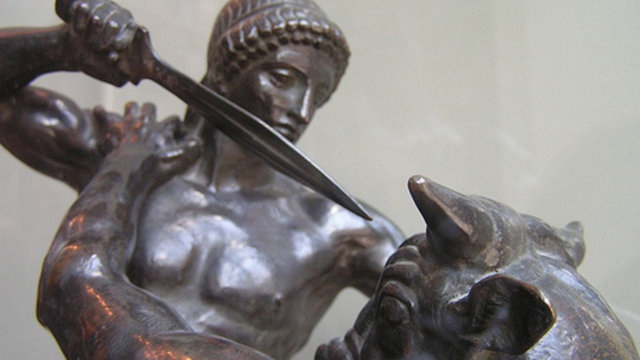
Theseus offered to be one of the youths who sailed for Crete. Once there, Ariadne, daughter of the king, fell for him and offered him a ball of yarn so he would be able to find his way out off the labyrinth that housed the Minotaur the youths would be sacrificed to. Theseus defeated the Minotaur and took Ariadne and her sister Phaedra from their home in thanks for their help. That night, they slept on the beach but Athena woke up Theseus and told him to sail out now, and to leave Ariadne and Phaedra behind. He did, although it pained him greatly. In his dismay, he forgot to sail with the white sails he had promised his father to sail with if he was alive. As he reached the main land, Aegeus saw the black sails and figured his son dead. He then cast himself off of the cliffs overlooking the sea, and drowned.

Theseus blamed himself for his father's death, but was very relieved to be home none the less. He wished to thank Apollon for his safe journey and his victory over the Minotaur and thus, he ordered his men to gather all the foodstuffs that remained. This was mostly beans and grains, and he ordered the food to be cooked up for a feast and a sacrifice.

In celebration, Theseus then put together an eiresiĆ“ne (Īµį¼°ĻĪµĻƒĪ¹ĻŽĪ½Ī·), a branch of olive or laurel bound with purple or white wool. It was decorated with fruits of the season, pastries, and small jars of honey, oil and wine. The eiresiĆ“ne was also called a 'supplicant branch', as it was intended as a thank-offering for blessings received, and at the same time as a prayer for similar blessings and protection against evil in future. He walked through the streets of Athens with his eiresiĆ“ne, to signal his victory and the end of scarcity.

In ancient Hellas, and especially Athens, both observances were conglomerated into the Pyanepsia, and boys tended to carry their home made eiresiĆ“ne through the streets in a Halloween-esque manner. They knocked on the doors of every house and sang a song. In return, they expected a gift. The eiresiĆ“ne song from Plutarch, Life of Theseus, 22.5, goes as follows:

'eiresiƓne suka pherei kai pionas artous
kai meli en kotulĆŖi kai elaion apopsĆŖsasthai
kai kulik' euzÓron, hÓs an methuousa katheudêi.'

Modern Greek pronunciation:
(Capitalized syllables are emphasized according to the poetic meter)
'EE-re-si-ON-NE SEE-ka fe-RE KE PEE-on-as AR-tous
KE me-lee EN ko-tee-LEE ke e-LE-on a-POP-SEE-SAS-the
KE kee-lik EF-ZO-RON, OS AN me-thee-OU-sa ka-THEV-dee.'

Plutarch has the song:
“Eiresione for us brings figs and bread of the richest,
brings us honey in pots and oil to rub off from the body,
Strong wine too in a cup, that one may go to bed mellow.”

A special eiresiĆ“ne was brought to the temple of Apollon by a boy whose parents were both alive. He was encouraged to recite the song during the procession. By the Classical Period an eiresione was hung over almost every door in Athens and remained here a full year before being replaced by a new one.

The sacrifice to Apollon was upheld for a long while as well. The ship Theseus used on his return from Crete to Athens was kept in the Athenian harbor as a memorial for several centuries. It was maintained and kept in proper shape. Often, this meant replacing parts of the ship, a practice which led to the question if the ship could still ethically be called the ship of Theseus after so much of it had been replaced. This dilemma became known as the 'Ship of Theseus paradox'. 

At any rate, the ship was sailed out to the island of Delos--which housed a sanctuary of Apollon--yearly after Theseus' return. To ensure the sanctity of the sacrifice, executions were not allowed to take place during the weeks it took to sail to Delos and back.

You can join us for this event on Facebook. The ritual for it can be found here. We would love for you to share your experiences and images of your eiresiĆ“ne.


The Oskhophoria


The Oskhophoria (į½€ĻƒĻ‡ĪæĻ†ĻŒĻĪ¹Ī±), or Oschophoria when Latinized, was an ancient Hellenic festival dedicated to Dionysos, Ariadne, Athena Skiras, and Apollon. This month, festivals are either related to the Eleusinian Mysteries or the mythology surrounding Theseus. This festival is one of the latter. It was a vintage festival and we would like to invite you to celebrate with us.

The Oskhophoria falls during the vintage season in Attica. The principal feature of this festival, the procession, featured ripe grapevines. As such, we can assume that this festival was a thanksgiving for the grape harvest. In fact, branches of vines with fresh grapes were carried in a great procession from the temple of Dionysos in Athens, to the ancient temple of Athena Skiras in Phalerus. This was the main feature of the festival. After Theseus, hero and king, the festival was augmented to include the recounting of his many exploits with accommodation to earlier traditions. It seems that this recounting was done at the banqueting after the ritual and there would be much recounting indeed. Because the festival adopted features from mythology, Apollon also became one of the Theoi sacrificed to, as He is closely tied to the mythology of Theseus.

Many sources have snippits of information about the Oskhophoria and most disagree, as we have come to expect. We can be fairly certain the ancient Hellenes attributed the mythical foundation of the festival to Theseus, however, and many details of the festival relate back to his journey to Krete:
  • the procession featured two youthful men in female attire, said to recall the trick of Theseus in which he substituted two of the seven female tributes with young male fighters
  • mothers carrying dinner baskets also featured, representing the mothers of the fourteen tributes who made a last meal for their children before they sailed
  • the Oskophoria was an occasion for storytelling, as the youths sailing to Krete would have needed their spirits raised
Plutarch's account, in 'Theseus', recounts the origins of the festival as follows, obviously trying to make a coherent whole out of contradictory evidence:

"The feast called Oschophoria, or the feast of boughs, which to this day the Athenians celebrate, was then first instituted by Theseus. For he took not with him the full number of virgins which by lot were to be carried away, but selected two youths of his acquaintance, of fair and womanish faces, but of a manly and forward spirit, and having, by frequent baths, and avoiding the heat and scorching of the sun, with a constant use of all the ointments and washes and dresses that serve to the adorning of the head or smoothing the skin or improving the complexion, in a manner changed them from what they were before, and having taught them farther to counterfeit the very voice and carriage and gait of virgins so that there could not be the least difference perceived, he, undiscovered by any, put them into the number of the Athenian maids designed for Crete. At his return, he and these two youths led up a solemn procession, in the same habit that is now worn by those who carry the vine-branches.
Those branches they carry in honour of Bacchus and Ariadne, for the sake of their story before related; or rather because they happened to return in autumn, the time of gathering the grapes. The women, whom they call Deipnopherae, or supper-carriers, are taken into these ceremonies, and assist at the sacrifice, in remembrance and imitation of the mothers of the young men and virgins upon whom the lot fell, for thus they ran about bringing bread and meat to their children; and because the women then told their sons and daughters many tales and stories, to comfort and encourage them under the danger they were going upon, it has still continued a custom that at this feast old fables and tales should be told.
 For these particularities we are indebted to the history of Demon. There was then a place chosen out, and a temple erected in it to Theseus, and those families out of whom the tribute of the youth was gathered were appointed to pay tax to the temple for sacrifices to him. And the house of the Phytalidae had the overseeing of these sacrifices, Theseus doing them that honour in recompense of their former hospitality."

In the myth of Theseus and the minotaur, Theseus, looking to become king of Athens, hears about the Minotaur of Krete, and the nine-yearly sacrifices to it. These sacrifices were a punishment by King Minos of krete for the death of his son Androgeus, at the hands of Athenian assassins. Theseus offered to be one of the youths who sailed for Krete. Once there, Ariadne, daughter of the king, fell for him and offered him a ball of yarn so he would be able to find his way out off the labyrinth that housed the Minotaur the youths would be sacrificed to. Theseus defeated the Minotaur and took Ariadne and her sister Phaedra from their home in thanks for their help. That night, they slept on the beach but Athena woke up Theseus and told him to sail out now, and to leave Ariadne and Phaedra behind. He did, although it pained him greatly. It was here, Dionysos found Ariadne and fell in love with her. He would later end up marrying her and she became his immortal wife.

Because the Oskophoria is in many ways two festivals in one, it is a hard one to pin down in terms of modern worship. The Oschophoria was essentially a banquet celebration in honor of Theseus and the rescue of youths and maidens and even more so, an older celebration of the vintage combining traditions of Salamis and Athens. Well into the fourth century BC, two branches of the Salaminians were involved in preparation, were Deipnophoroi, and received equal portions of the meat. The vintage rituals of the Salamic Goddess Skiras became associated with Athena Skiras and naturally Dionysos. The various Theseus mythos was explained through the numerous recounting which we have added to the ritual.

We hope you join us in celebrating this festival. You can join the Facebook community here and find the ritual here.

 Rather randomly, I thought of Ariadne today. You'll know Ariadne best from her role in the myth about Theseus and the Minotaur. Theseus was fathered by Aegeus and Poseidon, whom had both slept with his mother Aethra, and was thus destined to become a hero. All heroes were given at least one divine parent, usually one connected to their later deeds. When he heard about the Minotaur of Krete, and the nine-yearly sacrifices to it--a punishment by King Minos of Krete for the death of his son Androgeus, at the hands of Athenian assassins--Theseus offered to be one of the youths who sailed for Krete. 


Once there, Ariadne, daughter of the king, fell for him and offered him a ball of yarn so he would be able to find his way out off the labyrinth that housed the Minotaur the youths would be sacrificed to. With Ariadne's aid, Theseus defeated the Minotaur and took Ariadne and her sister Phaedra from their home in thanks for their help. That night, they slept on the beach but Athena woke up Theseus and told him to sail out now, and to leave Ariadne and Phaedra behind. He did, although it pained him greatly.

This is the best known version of the myth, but there are others. Plutarch already summarized them in 75 AC in "Theseus." I'd like to quote those passages to you today. 


“There are many other versions circulated about these matters still and also about Ariadne, none of which agree. For some say that she hanged herself after she was abandoned by Theseus. Others claim that after she was taken to Naxos by sailors she lived with Oinaros a priest of Dionysus and that she was abandoned by Theseus because he loved another.

“A terrible lust for AiglĆŖ the daughter of Panopeus ate at him” [fr. 105]—this is a line Hereas the Megarean claims Peisistratus deleted from the poems of Hesiod, just as again he says that he inserted into the Homeric catalogue of dead “Theseus and Perithoos, famous children of the gods” [Od. 11.631] to please the Athenans. There are some who say that Ariadne gave birth to OinipiĆ“n and Staphulos with Theseus. One of these is Ion of  Khios who has sung about his own city “OinopiĆ“n, Theseus’ son, founded this city once.” [fr. 4D]

The most reputable of the myths told are those which, as the saying goes, all people have in their mouths. But PaiƓn the Amathousian has handed down a particular tale about these events. For he says that Theseus was driven by a storm, to Cyprus and that he had Ariadne with him, who was pregnant and doing quite badly because of the sea and the rough sailing. So he set her out alone and he was carried back into the sea from the land while he was tending to the ship. The native women, then, received Ariadne and they tried to ease her depression because of her loneliness by offering her a counterfeit letter written to her by Theseus and helping her and supporting her during childbirth. They buried her when she died before giving birth.

PaiĆ“n claims that when Theseus returned he was overcome with grief and he left money to the island’s inhabitants, charging them to sacrifice to Ariadne and to have two small statues made for her—one of silver and one of bronze. During the second day of the month of Gorpiaon at the sacrifice, one of the young men lies down and mouns and acts as women do during childbirth. They call the grove in which they claim her tomb is that of Ariadne Aphrodite.

Some of the Naxians claim peculiarly that there were two Minoses and two Ariadnes. They claim one was married to Dionysus on Naxos and bore the child Staphulos, and the young one was taken by Theseus and left when he came to Naxos with a nurse named KorkunĆŖ—whose tomb they put on display. They claim that Ariadne died there and has honors unequal to those of the earlier one. The first has a festival of singing and play; the second has one where sacrifices are performed with grief and mourning.”
As you may have noticed, it's a new month and thus many festivals are taking place in the coming days. Two today: the Pyanepsia and the Oskhophoria. The Pyanepsia will take place on the 6th of October, at 10 am EDT and the Oskophoria at 11 am.

The Pyanepsia


The Pyanepsia (Ī Ļ…Ī±Ī½Ī­ĻˆĪ¹Ī±) was one of the many harvest festivals of the season, but instead of focussing on the actual harvest, the Pyanepsia focusses almost completely on the myth of Theseus and the Minotaur.

Theseus (Ī˜Ī·ĻƒĪµĻĻ‚) was fathered by Aegeus and Poseidon, whom had both slept with his mother Aethra, and was thus destined to become a hero. In order to claim his rightful place as ruler over Athens, he had to uncover his father's sandals and sword from under a stone in his mother's birth land where Theseus grew up, and bring it to his mortal father. He did, taking the long and dangerous route over land, and fought many Khthonic creatures and mortal bandits in the process. This was long before he would vow to bring down the Minotaur and thus, set in motion the events that led up to the strange festival of Pyanepsia.

Theseus' father, Aegeus, had taken Medea as his new wife. Afraid hat Theseus would claim the throne and take her position of power from her, Medea pressed Theseus to capture the Marathonian Bull. This, he did, but upon returning, Medea tried to poison him. Aegeus recognized his son just in time and Medea fled while father and son reunited. Theseus then heard about the Minotaur of Crete, and the nine-yearly sacrifices to it. These sacrifices were a punishment by King Minos of Crete for the death of his son Androgeus, at the hands of Athenian assassins.

Theseus offered to be one of the youths who sailed for Crete. Once there, Ariadne, daughter of the king, fell for him and offered him a ball of yarn so he would be able to find his way out off the labyrinth that housed the Minotaur the youths would be sacrificed to. Theseus defeated the Minotaur and took Ariadne and her sister Phaedra from their home in thanks for their help. That night, they slept on the beach but Athena woke up Theseus and told him to sail out now, and to leave Ariadne and Phaedra behind. He did, although it pained him greatly. In his dismay, he forgot to sail with the white sails he had promised his father to sail with if he was alive. As he reached the main land, Aegeus saw the black sails and figured his son dead. He then cast himself off of the cliffs overlooking the sea, and drowned.

Theseus blamed himself for his father's death, but was very relieved to be home none the less. He wished to thank Apollon for his safe journey and his victory over the Minotaur and thus, he ordered his men to gather all the foodstuffs that remained. This was mostly beans and grains, and he ordered the food to be cooked up for a feast and a sacrifice.

In celebration, Theseus then put together an eiresiĆ“ne (Īµį¼°ĻĪµĻƒĪ¹ĻŽĪ½Ī·), a branch of olive or laurel bound with purple or white wool. It was decorated with fruits of the season, pastries, and small jars of honey, oil and wine. The eiresiĆ“ne was also called a 'supplicant branch', as it was intended as a thank-offering for blessings received, and at the same time as a prayer for similar blessings and protection against evil in future. He walked through the streets of Athens with his eiresiĆ“ne, to signal his victory and the end of scarcity.

In ancient Hellas, and especially Athens, both observances were conglomerated into the Pyanepsia, and boys tended to carry their home made eiresiĆ“ne through the streets in a Halloween-esque manner. They knocked on the doors of every house and sang a song. In return, they expected a gift. The eiresiĆ“ne song from Plutarch, Life of Theseus, 22.5, goes as follows:

'eiresiƓne suka pherei kai pionas artous
kai meli en kotulĆŖi kai elaion apopsĆŖsasthai
kai kulik' euzÓron, hÓs an methuousa katheudêi.'

Modern Greek pronunciation:
(Capitalized syllables are emphasized according to the poetic meter)
'EE-re-si-ON-NE SEE-ka fe-RE KE PEE-on-as AR-tous
KE me-lee EN ko-tee-LEE ke e-LE-on a-POP-SEE-SAS-the
KE kee-lik EF-ZO-RON, OS AN me-thee-OU-sa ka-THEV-dee.'

Plutarch has the song:
“Eiresione for us brings figs and bread of the richest,
brings us honey in pots and oil to rub off from the body,
Strong wine too in a cup, that one may go to bed mellow.”

A special eiresiĆ“ne was brought to the temple of Apollon by a boy whose parents were both alive. He was encouraged to recite the song during the procession. By the Classical Period an eiresione was hung over almost every door in Athens and remained here a full year before being replaced by a new one.

The sacrifice to Apollon was upheld for a long while as well. The ship Theseus used on his return from Crete to Athens was kept in the Athenian harbor as a memorial for several centuries. It was maintained and kept in proper shape. Often, this meant replacing parts of the ship, a practice which led to the question if the ship could still ethically be called the ship of Theseus after so much of it had been replaced. This dilemma became known as the 'Ship of Theseus paradox'. 

At any rate, the ship was sailed out to the island of Delos--which housed a sanctuary of Apollon--yearly after Theseus' return. To ensure the sanctity of the sacrifice, executions were not allowed to take place during the weeks it took to sail to Delos and back.

You can join us for this event on Facebook. The ritual for it can be found here. We would love for you to share your experiences and images of your eiresiƓne.


The Oskhophoria


The Oskhophoria (į½€ĻƒĻ‡ĪæĻ†ĻŒĻĪ¹Ī±), or Oschophoria when Latinized, was an ancient Hellenic festival dedicated to Dionysos, Ariadne, Athena Skiras, and Apollon. This month, festivals are either related to the Eleusinian Mysteries or the mythology surrounding Theseus. This festival is one of the latter. It was a vintage festival and we would like to invite you to join us for it at 11:00 am EDT on October 6th.

The Oskhophoria falls during the vintage season in Attica. The principal feature of this festival, the procession, featured ripe grapevines. As such, we can assume that this festival was a thanksgiving for the grape harvest. In fact, branches of vines with fresh grapes were carried in a great procession from the temple of Dionysos in Athens, to the ancient temple of Athena Skiras in Phalerus. This was the main feature of the festival. After Theseus, hero and king, the festival was augmented to include the recounting of his many exploits with accommodation to earlier traditions. It seems that this recounting was done at the banqueting after the ritual and there would be much recounting indeed. Because the festival adopted features from mythology, Apollon also became one of the Theoi sacrificed to, as He is closely tied to the mythology of Theseus.

Many sources have snippits of information about the Oskhophoria and most disagree, as we have come to expect. We can be fairly certain the ancient Hellenes attributed the mythical foundation of the festival to Theseus, however, and many details of the festival relate back to his journey to Krete:
  • the procession featured two youthful men in female attire, said to recall the trick of Theseus in which he substituted two of the seven female tributes with young male fighters
  • mothers carrying dinner baskets also featured, representing the mothers of the fourteen tributes who made a last meal for their children before they sailed
  • the Oskophoria was an ocassion for storytelling, as the youths sailing to Krete would have needed their spirits raised
Plutarch's account, in 'Theseus', recounts the origins of the festival as follows, obviously trying to make a coherent whole out of contradictory evidence:

"The feast called Oschophoria, or the feast of boughs, which to this day the Athenians celebrate, was then first instituted by Theseus. For he took not with him the full number of virgins which by lot were to be carried away, but selected two youths of his acquaintance, of fair and womanish faces, but of a manly and forward spirit, and having, by frequent baths, and avoiding the heat and scorching of the sun, with a constant use of all the ointments and washes and dresses that serve to the adorning of the head or smoothing the skin or improving the complexion, in a manner changed them from what they were before, and having taught them farther to counterfeit the very voice and carriage and gait of virgins so that there could not be the least difference perceived, he, undiscovered by any, put them into the number of the Athenian maids designed for Crete. At his return, he and these two youths led up a solemn procession, in the same habit that is now worn by those who carry the vine-branches.
Those branches they carry in honour of Bacchus and Ariadne, for the sake of their story before related; or rather because they happened to return in autumn, the time of gathering the grapes. The women, whom they call Deipnopherae, or supper-carriers, are taken into these ceremonies, and assist at the sacrifice, in remembrance and imitation of the mothers of the young men and virgins upon whom the lot fell, for thus they ran about bringing bread and meat to their children; and because the women then told their sons and daughters many tales and stories, to comfort and encourage them under the danger they were going upon, it has still continued a custom that at this feast old fables and tales should be told.
 For these particularities we are indebted to the history of Demon. There was then a place chosen out, and a temple erected in it to Theseus, and those families out of whom the tribute of the youth was gathered were appointed to pay tax to the temple for sacrifices to him. And the house of the Phytalidae had the overseeing of these sacrifices, Theseus doing them that honour in recompense of their former hospitality."

In the myth of Theseus and the minotaur, Theseus, looking to become king of Athens, hears about the Minotaur of Krete, and the nine-yearly sacrifices to it. These sacrifices were a punishment by King Minos of krete for the death of his son Androgeus, at the hands of Athenian assassins. Theseus offered to be one of the youths who sailed for Krete. Once there, Ariadne, daughter of the king, fell for him and offered him a ball of yarn so he would be able to find his way out off the labyrinth that housed the Minotaur the youths would be sacrificed to. Theseus defeated the Minotaur and took Ariadne and her sister Phaedra from their home in thanks for their help. That night, they slept on the beach but Athena woke up Theseus and told him to sail out now, and to leave Ariadne and Phaedra behind. He did, although it pained him greatly. It was here, Dionysos found Ariadne and fell in love with her. He would later end up marrying her and she became his immortal wife.

Because the Oskophoria is in many ways two festivals in one, it is a hard one to pin down in terms of modern worship. The Oschophoria was essentially a banquet celebration in honor of Theseus and the rescue of youths and maidens and even more so, an older celebration of the vintage combining traditions of Salamis and Athens. Well into the fourth century BC, two branches of the Salaminians were involved in preparation, were Deipnophoroi, and received equal portions of the meat. The vintage rituals of the Salamic Goddess Skiras became associated with Athena Skiras and naturally Dionysos. The various Theseus mythos was explained through the numerous recounting which we have added to the ritual.

We hope you join us in celebrating this festival. You can join the Facebook community here and find the ritual here.
Today is a day for Dionysos, for His maddening touch, for His destructive needs, and His cleansing desire. A poem, then, in his honour, written by Friedrich Nietzsche, published in the 1890's. It's part of his Dionysian-Dithyrambs, and while I won't liken myself to Ariadne, I relate today.


Friedrich Nietzsche - Ariadne's Lament

Who will warm me, who loves me still?
Give warm hands!
Give the heart's brazier!
Prone, shuddering
Like one half dead, whose feet are warmed;
Shaken, alas! by unknown fevers,
Trembling at pointed arrows of glacial frost,
Hunted by you, Thought!
Nameless! Cloaked! Horrid!
You hunter behind clouds!
Struck down by your lightning,
Your scornful eye, glaring at me out of the dark!
Thus I lie,
Writhing, twisted, tormented
By all the eternal afflictions,
Struck
By you, cruelest hunter,
You unknown—god ...

Strike deeper!
Strike one more time!
Stab, break this heart!
Why all this affliction
With blunt-toothed arrows?
How can you gaze evermore,
Unweary of human agony,
With the spiteful lightning eyes of gods?
You do not wish to kill,
Only to torment, torment?
Why torment—me,
You spiteful unknown god?

Aha!
You creep closer
Around midnight? ...
What do you want?
Speak!
You push me, press upon me,
Ah, already much too close!
You hear me breathing,
You eavesdrop on my heart,
Most jealous one! —
What are you jealous of anyway?
Away! Away!
What's the ladder for?
Do you want inside,
Would you get into my heart,
And enter
My most secret thoughts?
Shameless one! Unknown! Thief!
What do you wish to steal for yourself?
What do you wish to hear for yourself?
What will you gain by torture,
You torturer!
You—executioner-god!
Or am I, like a dog,
To wallow before you?
Devoted, eager due to my
Love for you—fawning over you?
In vain!
It stabs again!
Cruelest sting!
I am not your dog, only your prey,
Cruelest hunter!
Your proudest prisoner,
You robber behind clouds ...
Speak finally!
You, cloaked by lightning! Unknown! Speak!
What do you want, highwayman, from—me?...

What?
A ransom?
What do you want for ransom?
Demand much—so advises my pride!
And talk little—my pride advises as well!

Aha!
Me?—you want me?
Me—all of me? ...

Aha!
And tormenting me, fool that you are,
You wrack my pride?
Give me love—who warms me still?
Who loves me still?
Give warm hands,
Give the heart's brazier,
Give me, the loneliest one,
Ice, alas! whom ice sevenfold
Has taught to yearn for enemies,
Even for my enemies
Give, yes, surrender to me,
Cruelest enemy —
Yourself! ...

Gone!
He has fled,
My only companion,
My splendid enemy,
My unknown,
My executioner-god! ...

No!
Come back!
With all your afflictions!
All my tears gush forth
To you they stream
And the last flames of my heart
Glow for you.
Oh, come back,
My unknown god! my pain!
My ultimate happiness! ....

A lightening bolt. Dionysus becomes visible in emerald beauty.

Dionysus:

Be clever, Ariadne! ...
You have little ears; you have my ears:
Put a clever word in them! —
Must one not first hate oneself, in order to love oneself? ...
I am your labyrinth ...