Showing posts with label Minos. Show all posts

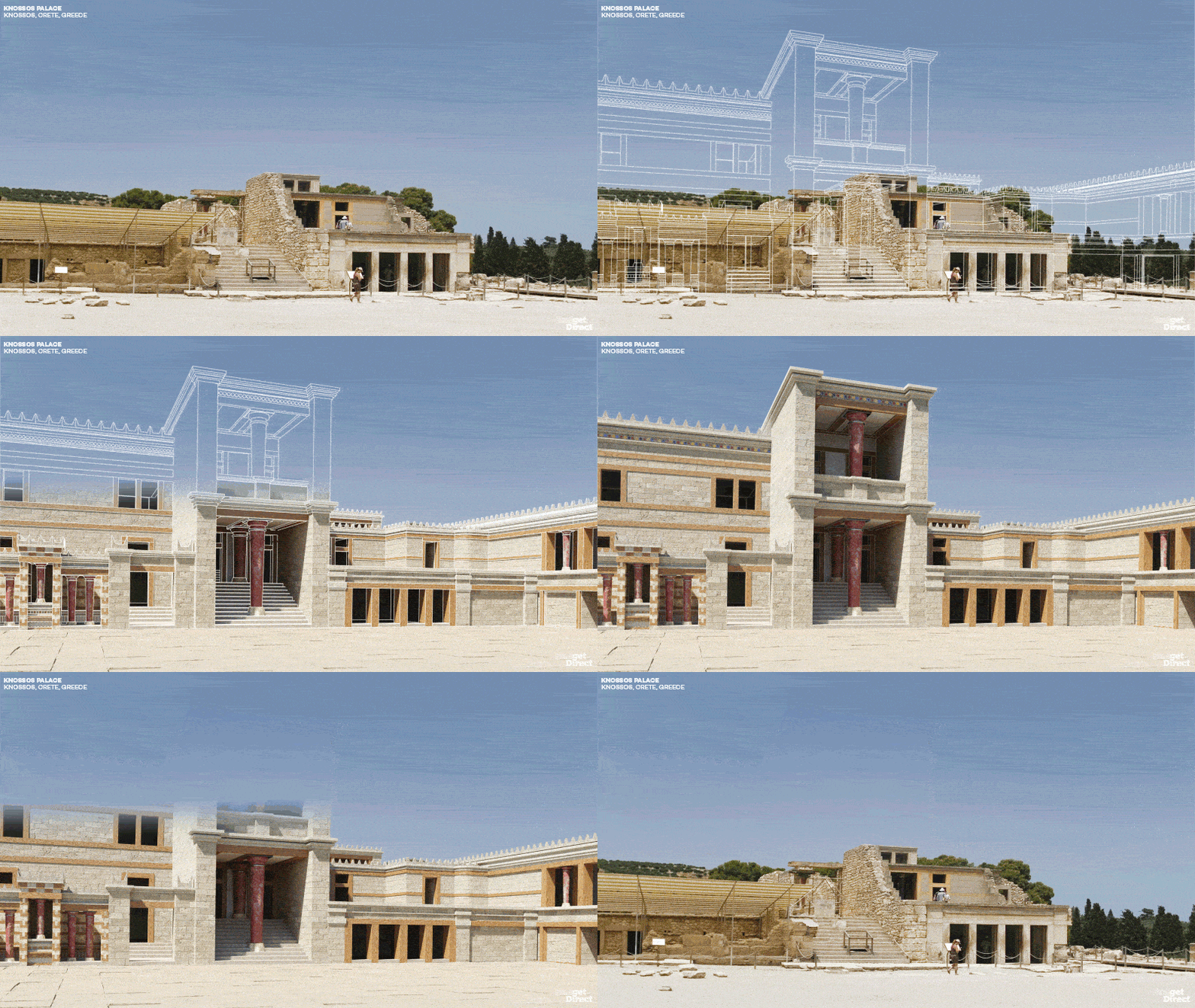
Following on from the popularity of their reconstruction of European Castles and Ancient Wonders  award winning Australian insurance company Budget Direct decided to restore a selection of palaces from across the globe, one of these being Greece’s Ancient Knossos Palace. For this project, with the help of a team of architects and a lot of desk research, Budget Direct virtually reconstructed seven ruined palaces around the world including the Knossos Palace.

The town of Knossos, which surrounds Knossos Palace, is considered to be Europe’s oldest city. It was settled as early as the Neolithic period around 700BC and by 1500BC had a population of 100,000 people. The largest Bronze Age archaeological site on Crete, the Palace of Knossos is located just south of modern-day Heraklion near the north coast of Crete.

Constructed around 1700BC, Knossos Palace is the most complex in Greece and thought to be the first palace built in the Middle Minoan IO period.The palace was abandoned sometime in Late Minoan IIIC, 1380 – 1100BC, for reasons which are largely unknown.

During the Bronze Age, Knossos Palace was the ceremonial, religious, economic and political centre of the Minoan Civilization. The archaeological site of Knossos Palace covers about 20,000 square metres, spread over three acres of land and comprises over 1,500 rooms. Excavation of the site has provided historians with a wealth of insight into the Minoan Civilization. Tools such as clay and stone incised spools and whorls are indicative of a cloth-making industry in existence.

Artefacts as well as the many vibrant frescoes on the wall of the ruins provide a further understanding of the Minoan culture. Painted in a style emphasising movement and grace, these frescoes illustrate scenes of lithe young athletes, ladies gossiping and dancing, and dolphins and other animals in magical gardens. One frescoe depicts the ancient sport of bull-leaping, a sport which may have given rise to the legend of the mythical Minotaur, a creature of later Hellenic mythology that was half- man and half bull.

The possibility that there existed a Minotaur became more acceptable once it was understood that, in the Minoan sport of bull-jumping, the male athlete ‘became one with the bull’ as he vaulted over the bull’s horns. It could therefore make sense that this sport may have evoked in ancient consciousness the ‘myth’ of the Minotaur through the impression that these athletes were half men and half bulls.

The ruins of the palace foundations reveal a vast interconnected maze of small corridors, staircases and private rooms containing residential dwellings, workshops, administrative areas. Since the intricate interior of Knossos Palace has been uncovered it has been speculated that this complex structure, combined with bull symbolism ever-present throughout the ruins, has provided the distant inspiration behind the labyrinth in the Greek myth of Theseus and the Minotaur. Timber stairways led to large upper rooms have not survived the ages, but probably once rose five stories in height.

An elaborate and advanced system of drains, conduits, and terra-cotta pipes provided water and sanitation. Vertical shafts in the structure known as light-wells were designed to bring natural light to the lower levels, created an airy and comfortable atmosphere.

Despite the fact that Knossos Palace was first excavated a century ago, it is still somewhat shrouded in mystery and researched have many questions about the palace and the people who inhabited it. The controversial restoration of parts of the palace over the years has remained the centre of historical debate, with many saying that the rebuilding has been based on “historically incorrect creative licence.”

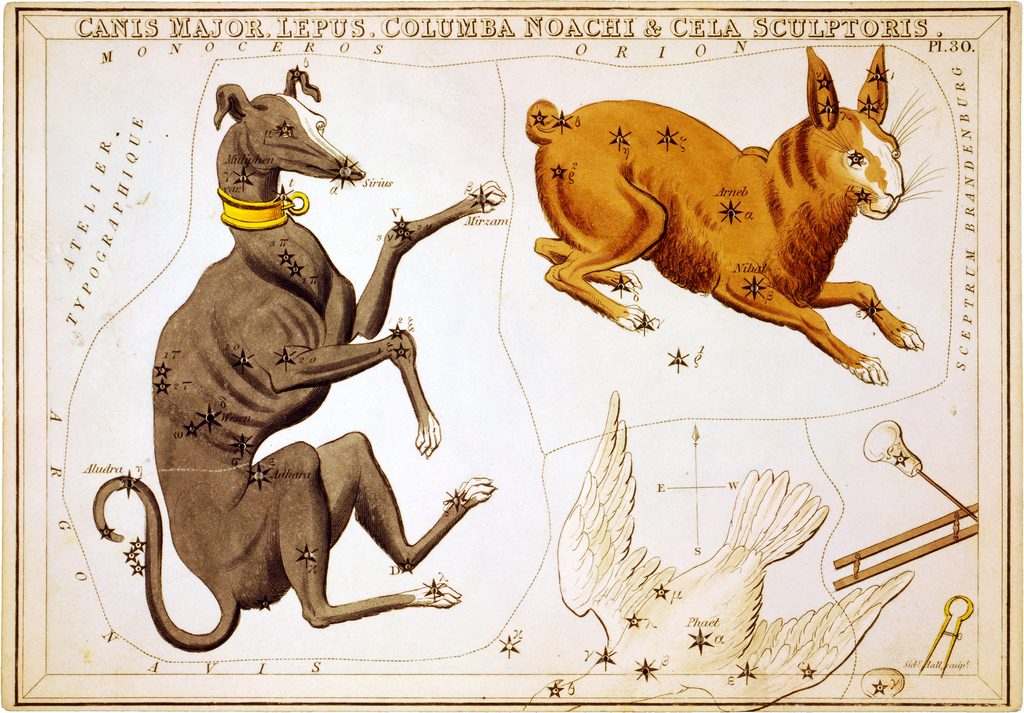
Because it's been a while since the last constellation, and yesterday's blog post hardly counted, I'm going to give you not one but two constellations today (also because it's much easier to describe both in one post, seeing as the mythology surrounding these two has mixed throughout the years, so I'm really just making it easier on myself).


The Corona Australis, the southern crown, is located in the southern hemisphere, next to the constellation Sagittarius. As such, it is often linked to that constellation and regarded as the wreath that fell off of the head of one of the kéntauros that particular constellation is linked to. In the same regard, it is also linked to the kéntauros 'Centaurus'.

Corona Australis is most often regarded as a wreath, but in some descriptions and depictions, the Corona Australis is a crown. There is, however, one myth in which the Corona Australis does not depict a wreath or crown: in this myth, the constellation represents Ixion, king of the Lapits, who fell in love with Hera after being invited up to Olympos by Zeus. Zeus decided to test his integrity after He discovered His guest' lust for Hera, but Ixion failed miserably. Ixion was expelled from Olympus and blasted with a thunderbolt for failing his test. Zeus then ordered Hermes to bind Ixion to a winged fiery wheel that was always spinning. Therefore, Ixion is bound to a burning solar wheel for all eternity, at first spinning across the heavens, then into Tartaros. The Corona Australis is this very wheel, with Ixion tied to it.

The most famous of myths associated with the Corona Australis is the story of the birth of Dionysos, and the death of His mother Semele. In this version of the myth, Dionysos is born from Semele and Zeus, and while Semele is pregnant with Him, Hera plants seeds of doubt in her mind about the father of the child truly being Zeus. Semele asks Zeus to reveal Himself to her in His true form, and when He is left with no other option, He does so, killing her in the process. Zeus takes pity on His child, and takes Him into either His thigh or testicle, where He is eventually born from. When Dionysos grows up, He raises Semele to Olympos and grants her eternal life. He also places a wreath into the sky to honor her. The wreath would be made of myrtle leaves, for Dionysos left a gift of myrtle in the Underworld in return for His mother, and the followers of Dionysos wore crowns of myrtle.

Interestingly enough, Roman author Hyginus ascribes this myth to the Corona Borealis, and adds that Dionysos first received this wreath--now a golden crown--from Aphrodite. He gave it to His beloved Ariadne, daughter of Minos. According to Hyginus, it was the light that reflected off of this crown, that led Theseus from the labyrinth after slaying the minotaur. Hyginus then goes on to retell the story above, and says that Dionysos did not want to take the crown into the Underworld in fear of it being contaminated with miasma. When He returned from the Underworld, he threw the golden crown into the sky as a memorial.

Hyginus also gives another account for the the northern crown, the Corona Borealis:

"It is said that when Theseus came to Crete to Minos with seven maidens and six youths, Minos, inflamed by the beauty of one of the maidens, Eriboea by name, wished to lie with her. Theseus, as was fitting for a son of Neptune[Poseidon], and one able to strive against a tyrant for a girl’s safety, refused to allow this. So when the dispute became one not about the girl but about the parentage of Theseus, whether he was the son of Neptune or not, Minos is said to have drawn a gold ring from his finger and cast it into the sea. 

He bade Theseus bring it back, if he wanted him to believe he was a son of Neptune; as for himself, he could easily show he was a son of Jove [Zeus]. So, invoking his father, he asked for some sign to prove he was his son, and straightway thunder and lightning gave token of assent. For a similar reason, Theseus, without any invoking of his father or obligation of an oath, cast himself into the sea. And at once a great swarm of dolphins, tumbling forward over the sea, led him through gently swelling waves to the Nereids. 

From them he brought back the ring of Minos and a crown, bright with many gems, from Thetis, which she had received at her wedding as a gift from Venus [Aphrodite]. Others say that the crown came from the wife of Neptune, and Theseus is said to have given it to Ariadne as a gift, when on account of his valor and courage she was given to him in marriage. After Ariadne’s death, Liber [Dionysos] placed it among the constellations."

As you can see, there are many myths surrounding the two crowns. The Hellenic poet Aratos named them 'Stephanoi' (Στεφάνοι) around 300 BC, but did not differnetiate between the two, although they are not placed close together. As such, the Stephanoi are visible and best viewed at different times throughout the year. The Corona Australis is visible at latitudes between +40° and −90°, and best visible at 21:00 (9 p.m.) during the month of August. The Corona Borealis, located near the constellations of Hēraklēs and Boötes, is visible at latitudes between +90° and −50°, and best visible at 21:00 (9 p.m.) during the month of July.

This is not the first time I wrote about dogs on this blog. I wrote about guard and hunting dogs before, in relation to ancient Hellenic society, as well as mythology. Yet, none of the myths I tackled in that post, relate to the constellation of Canis Major.

Canis Major might represent a number of different hounds. The first is Laelaps (Λαῖλαψ), the dog who was gifted to Eurṓpē (Ευρώπη) by Zeus to protect her from mortal and immortal danger as He hid her away, waiting for Hera to give up the scent of His adultery. The same dog, or a namesake of his, was gifted or passed down to Kephalos, who decided to use the hound to hunt the Teumessian fox, a fox that could never be caught. Laelaps was a dog who would always catch his prey and the fox was a pray that could never be caught. Zeus, stunned by the display, rewarded them both and placed them in the sky.

Another explanation is that the dog was one of Orion's hunting dogs. Orion (Ὠρίων) was a famed hunter who has a lot of mythology to his name. He is also included in a lot of existing mythology. The constellation Canis Major might represent his entire pack or one of them, who are/is eternally pursuing Lepus the Hare or helping Orion fight Taurus the Bull. Aratos, Homer and Hesiod support this theory. In the prime of his life, Orion joined with the Goddess Artemis and Her mother Leto, for an epic hunt in which Orion threatened to kill every beast on Earth. Gaea revolted and sent a giant scorpion to kill Orion. Orion, although very powerful, was overcome by the creature, but Artemis and Leto requested to Zeus he'd be immortalized in the night's sky. The Scorpion was admitted into the heavens as well.

That having been said, Sirius was considered a dog in its own right, and even more so, in early Hellenic mythology Sirius was the second head of a two-headed dog. This dog may be the fabled two-headed guard dog Orthus, who guarded the cattle of Geryon and whom Hēraklēs had to surpass for his tenth labor. Sad to say, Hēraklēs batted Kerberos' brother away pretty easily. As a reward for a valid try, Orthus was placed into the sky.

Canis Major is visible at latitudes between +60° and −90°, and best visible at 21:00 (9 p.m.) during the month of February.

 "...but most of all I love Icarus, who knew the wax would melt but still flew towards the sun."

 -- 'Ik hou van Icarus' - Tjitske Jansen (translated from Dutch)

One of my all-time favorite Hellenic myths is about Íkaros; Daidalos' son who escaped the labyrinth on the island of Krete with wings made of feathers and wax. He was warned not to fly too high because the sun would melt the wax, or too low because wet feathers wouldn't carry him, yet Íkaros got too caught up with the marvel of flying, and did fly too high or too low. As a result, he drowned somewhere between the island and the main land.

Daidalos (Δαίδαλος) was an inventor, a craftsman, who had murdered a gifted student of his--his nephew--in a fit of jealousy. This caused him to flee his home town (most often referred to as Athens, although there are some timeline problems if this was the case) and find refuge on Krete. King Minos saw in Daidalos a gifted man, and asked him to draw and constructed the labyrinth of the Minotaur, son of King Minos. Because he knew the secrets of the labyrinth, and the deformations of the Minotaur, he was never permitted to leave the island.

As often, many details of this myth come from the Roman poet Ovid. In earlier versions of the tale, the labyrinth is an actual labyrinth: it has one pathway that leads inexorably from the entrance to the goal, albeit by the most complex and winding of routes. In Ovid's version--and other like him--the labyrinth is not a labyrinth at all, but a maze: a design with choices in pathways, aimed to confuse the seeker. In fact, Ovid's version of the 'labyrinth' is so complex that Daidalos himself almost gets lost in it:

"Great Daedalus of Athens was the man
That made the draught, and form'd the wondrous plan;
Where rooms within themselves encircled lye,
With various windings, to deceive the eye.
As soft Maeander's wanton current plays,
When thro' the Phrygian fields it loosely strays;
Backward and forward rouls the dimpl'd tide,
Seeming, at once, two different ways to glide:
While circling streams their former banks survey,
And waters past succeeding waters see:
Now floating to the sea with downward course,
Now pointing upward to its ancient source,
Such was the work, so intricate the place,
That scarce the workman all its turns cou'd trace;
And Daedalus was puzzled how to find
The secret ways of what himself design'd."
(The Labyrinth)

It takes many years for Daidalos to get restless on the island, but when he does, he goes to King Minos and asks to be set free. Minos refuses him every time, and eventually, Daidalos is forced to think of another plan. Being a master craftsman, he constructs wings of feathers, wax, and string, and creates one for his young son, Íkaros (Ἴκαρος) as well. Apollodorus describes the tale in a very compact manner in his Epitome:

"On being apprized of the flight of Theseus and his company, Minos shut up the guilty Daedalus in the labyrinth, along with his son Icarus, who had been borne to Daedalus by Naucrate, a female slave of Minos. But Daedalus constructed wings for himself and his son, and enjoined his son, when he took to flight, neither to fly high, lest the glue should melt in the sun and the wings should drop off, nor to fly near the sea, lest the pinions should be detached by the damp.
 But the infatuated Icarus, disregarding his father's injunctions, soared ever higher, till, the glue melting, he fell into the sea called after him Icarian, and perished. But Daedalus made his way safely to Camicus in Sicily. [E.1.12 / E.1.13]

It's important to note that not all historians and writers in ancient Hellas quite agreed with the story of Íkaros and his wings. Pausanias mentions that it were not wings at all that carried Daidalos and Íkaros, but boats, crafted especially well by Daidalos:

"Here [at Thebes] is a sanctuary of Herakles. The image, of white marble, is called Promakhos (Champion), and the Thebans Xenokritos and Eubios were the artists. But the ancient wooden image is thought by the Thebans to be by Daidalos, and the same opinion occurred to me. It was dedicated, they say, by Daidalos himself, as a thank-offering for a benefit. For when he was fleeing from Krete in small vessels which he had made for himself and his son Ikaros, he devised for the ships sails, an invention as yet unknown to the men of those times, so as to take advantage of a favorable wind and outsail the oared fleet of Minos. Daidalos himself was saved, but the ship of Ikaros is said to have overturned, as he was a clumsy helmsman. The drowned man was carried ashore by the current to the island, then without a name, that lies off Samos. Herakles came across the body and recognized it, giving it burial where even to-day a small mound still stands to Ikaros on a promontory jutting out into the Aegean. After this Ikaros are named both the island and the sea around it." (Description of Greece 9.11.1.)

Daidalos makes it to the main land. The island Íkaros' body washed upon, was called 'Ikaria' (Ικαρία) from that point on. It still carries that name, and is located ten nautical miles (nineteen kilometers) southwest of Samos. Minos was of no mind to let Daidalos go, however, and so he went from court to court, knowing that a mind as sharp as Daidalos' would be noticed wherever he went. King Minos posed a riddle to every king, as described by Apollodorus:

"And Minos pursued Daedalus, and in every country that he searched he carried a spiral shell and promised to give a great reward to him who should pass a thread through the shell, believing that by that means he should discover Daedalus. And having come to Camicus in Sicily, to the court of Cocalus, with whom Daedalus was concealed, he showed the spiral shell. Cocalus took it, and promised to thread it, and gave it to Daedalus;
And Daedalus fastened a thread to an ant, and, having bored a hole in the spiral shell, allowed the ant to pass through it. But when Minos found the thread passed through the shell, he perceived that Daedalus was with Cocalus, and at once demanded his surrender. Cocalus promised to surrender him, and made an entertainment for Minos; but after his bath Minos was undone by the daughters of Cocalus; some say, however, that he died through being drenched with boiling water." [E.1.14 / E.1.15]

And this was the end of King Minos' hunt and his life. Depending on the source, it might have been Daidalos himself who poured boiling water over King Minos, leading to his death. What happens to Daidalos afterward is unclear. I hope he found a place to remember his son, and build more of his wonderful inventions.

This myth encourages people to look at the consequences of their actions, even those--or especially those--with good intentions. Daidalos' genius cost him his son. On the other hand, whenever I read this myth, Íkaros reminds me that, although great risk comes with a leap of faith, it might just be worth it sometimes. Íkaros chose the dangerous path, and while it led to his death, it also led to one of the most beautiful moments of his life. I'm a cautious person, a tempered person, and remembering Íkaros is a great help in my life sometimes. It reminds me to hunt for happiness, even though the quest requires me to let go of the familiar. I live my life looking for small flights of Íkaros, and I wish the same for you.

 Time for a minor history lesson courtesy of The Greek Reporter. The story of the ring known as the “Ring of King Minos” sounds like a tale made in Hollywood, a mix of ancient Greek history, mythology and a plot involving a poor boy, a cunning priest, an English archaeologist and hidden treasure.


The story starts in 1928, when a boy, Michalis Papadakis (1918-1974), found a ring by accident at the archaeological site of Knossos. The place of discovery alone meant that the ring certainly had a very long history behind it, probably even going back to the Minoan civilization.

Indeed, several decades later, the shiny gold seal ring proved to be 3,500 years old (1,500-1,400 BC), as archaeologists assured him — and his was the most significant discovery of Minoan Civilization.

The boy’s father, a destitute farmer named Emmanouil, for some  unknown reason, hid the ring from his wife and, for another unknown reason, two years later he handed it over to the village priest, Father Nikolaos Polakis. Yet, before giving it away, he carved a line on the ring with his knife in order to mark its originality.

Father Polakis initially presented it to English archaeologist Sir Arthur Evans with the intention of selling it. However, there was no deal struck between the two, since the priest demanded an astronomical amount of money.

In 1933 or 1934, Father Polakis decided to take the ring to the Heraklion Museum. At the time, the distinguished archaeologists Nikolaos Platon and Spyridon Marinatos were on the staff of the institution. Platon decided that the ring was genuine while Marinatos believed the ring was a fake.

Since both archaeologists could not come to an agreement, they decided it was best to return the ring to the priest.

The King Minos Ring at the Heraklion Archaeological Museum. Credit: Bokeras/Twitter

However, Platon kept a copy of the ring by casting it in plasticine. (The cast was later found in Platon’s archive). Several years later, he manifested a new interest in the ring and went back to the priest to ask for it. Father Polakis told him that he had given it to his wife for safekeeping — but she had lost it.

Platon wrote a treatise on the ring saying that it depicts three themes: the Minoans’ rule of the seas (“thalassocracy”), tree worship (dendrolatry), and a goddess descending from heaven to earth and getting into a row boat.

There are other, more recent interpretations of the depictions of the ring including the worship of goddesses, including Mother Dimitra, and offerings to the Great Mother Rhea and to Great Mother Artemis.

For some time, all traces of the ring were lost. The only information about the ring came from the copies that had been made and a number of archaeological reports which were associated with those copies.

Many years later, when Father Polakis was in his last days, he felt great regret about the “disappearance” of the precious ring. He called Evangelia Papadakis, the wife of the farmer Emmanouil, and apologized for lying to her family. He admitted that he had actually sold the ring ro the English archaeologist Evans for 100,000 drachmas back in 1938.

However, that was one last lie by the cunning priest. What he had actually sold to Evans was a fine replica of the ring.

Evans had returned to England with the belief that he had bought the actual ring, along with a copy, and donated both, along with other precious artifacts to the Ashmolean Museum. Today, two replicas of the legendary ring are still exhibited at the Ashmolean.

The story of the ring was forgotten for decades. But in the early 2000s, Giorgos Kazantzis, a retired police officer, inherited the house of the priest who was the last person in Greece who had had possession of the priceless artifact.

During renovation work, Kazantzis found a jar hidden inside the wall next to the fireplace. Inside the jar was a ring — which indeed proved to be the original Ring of King Minos. It even had the scratch made by Papadakis over 70 years ago.

Kazantzis delivered the precious artifact to the state and in 2002 the Central Archaeological Council and a panel of expert archaeologists confirmed the authenticity of the ring. The actual monetary value of the ring was estimated to be €400,000, although its cultural value is incalculable.

Yet, for finding the ring and promptly delivering it to the appropriate authorities, Kazantzis was given a measly finder’s fee of €440.

Today the priceless gold Minoan ring is exhibited in all its splendor at the Heraklion Archaeological Museum.

Since the late nineteenth century, archaeologists, documentary-makers and novelists have asserted that the Cretan Labyrinth – the lair of the terrifying Minotaur – was a real place. But now a major paper suggests that the legendary maze was just that – legend, a figment of collective imagination.


The labyrinth is popularly held to have been in the Palace of Knossos, built around 1950 BCE, the ruins of which stand near the city of Heraklion on the north coast of Crete. This is wrong, according to Antonis Kotsonas, a classical archaeologist from the University of Cincinnati, US. In a paper published in the American Journal of Archaeology, the researcher, using a cross-disciplinary study, points to the absence of any actual evidence that Iron Age Cretans built any form of monumental labyrinth in Knossos. Kotsonas suggests the Cretan Labyrinth is a monument only in memory, regardless of it being “considered a monument that once actually existed”. Yet the search for a maze under or the near the very real Bronze Age Knossos site has taken on legendary proportions.

As myth has it, Daedalus, the head architect of the tyrannical King Minos of Crete, built a complex maze under his palace. The maze housed the Minotaur, the monstrous half-man-half-bull that fed on seven virgin men and seven virgin girls from Athens every three years. Theseus kills the Minotaur and ends the tradition.

Kotsonas notes that the earliest surviving versions of the story – from Homer, Herodotus and Pherecydes – make no mention of a Cretan Labyrinth. For Plato and beyond, the term labyrinth is used only to describe “structures and metaphorically situations that are hard to escape”. Kallimachos, a third century BCE writer from Alexandria in Ptolemaic Egypt, is the first source Kotsonas cites that specifically links the Minotaur with the Cretan Labyrinth. He suggests that Kallimachos kne of the Egyptian labyrinth – an undoubtedly real structure built by King Amenemhet III sometime before his death in 1770 BCE – and simply “spread … the term in Cretan mythology”.

Two later Hellenistic references to the Cretan Labyrinth also come from scholars in Ptolemaic Egypt.
The real currency of the Cretan Labyrinth rose after the Roman annexation of Crete around 66 BCE. The Romans treated its existence as real, and placed its location explicitly in Knossos. It was essentially a political decision. Romans anchored their imperial power on their own re-imagined vision of themselves as inheritors of Classical Greece.

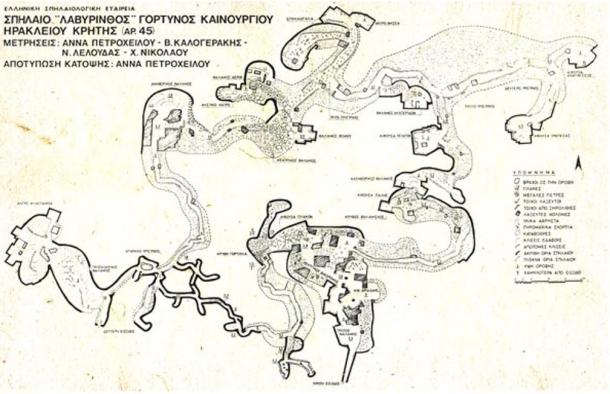
However, there are real labyrinthine cave structures carved out of limestone near the ancient Roman city of Gortyn, in the heartland of Crete, which also add to speculation. Possibly pre-Hellenic mines, the caves were used as hiding places for Christians during various Ottoman Turkish massacres – a fact frequently ignored by classicists and antiquarians determined to place the labyrinth in Knossos.

In the end, though, there is no conclusive evidence that a labyrinth, much less the fearsome bull-hybrid, ever existed in Knossos. Kotsonas weaves a detailed account of how Western anxieties, values, and politics, melded with a newly created Greek national identity in the battle against Ottoman imperialism, may have given birth to a monument that lives only in memory.
However, despite the fact that it never existed, the Cretan Labyrinth will no doubt maintain its role as a place of fear and dread, wonder and enlightenment – as a reference in popular culture from Disney to Coke, featuring the Minotaur and his lair.

For the full article, please visit Cosmos Magazine.
"...but most of all I love Icarus, who knew the wax would melt but still flew towards the sun."
 -- 'Ik hou van Icarus' - Tjitske Jansen (translated from Dutch)

One of my all-time favorite Hellenic myths is about Íkaros; Daidalos' son who escaped the labyrinth on the island of Krete with wings made of feathers and wax. He was warned not to fly too high because the sun would melt the wax, or too low because wet feathers wouldn't carry him, yet Íkaros got too caught up with the marvel of flying, and did fly too high or too low. As a result, he drowned somewhere between the Island and the main land.

Daidalos (Δαίδαλος) was an inventor, a craftsman, who had murdered a gifted student of his--his nephew--in a fit of jealousy. This caused him to flee his home town (most often referred to as Athens, although there are some timeline problems if this was the case) and find refuge on Krete. King Minos saw in Daidalos a gifted man, and asked him to draw and constructed the labyrinth of the Minotaur, son of King Minos. Because he knew the secrets of the labyrinth, and the deformations of the Minotaur, he was never permitted to leave the Island.

As often, many details of this myth come from the Roman poet Ovid. In earlier versions of the tale, the labyrinth is an actual labyrinth: it has one pathway that leads inexorably from the entrance to the goal, albeit by the most complex and winding of routes. In Ovid's version--and other like him--the labyrinth is not a labyrinth at all, but a maze: a design with choices in pathways, aimed to confuse the seeker. In fact, Ovid's version of the 'labyrinth' is so complex that Daidalos himself almost gets lost in it:

"Great Daedalus of Athens was the man
That made the draught, and form'd the wondrous plan;
Where rooms within themselves encircled lye,
With various windings, to deceive the eye.
As soft Maeander's wanton current plays,
When thro' the Phrygian fields it loosely strays;
Backward and forward rouls the dimpl'd tide,
Seeming, at once, two different ways to glide:
While circling streams their former banks survey,
And waters past succeeding waters see:
Now floating to the sea with downward course,
Now pointing upward to its ancient source,
Such was the work, so intricate the place,
That scarce the workman all its turns cou'd trace;
And Daedalus was puzzled how to find
The secret ways of what himself design'd."
(The Labyrinth)

It takes many years for Daidalos to get restless on the Island, but when he does, he goes to King Minos and asks to be set free. Minos refuses him every time, and eventually, Daidalos is forced to think of another plan. Being a master craftsman, he constructs wings of feathers, wax, and string, and creates one for his young son, Íkaros (Ἴκαρος) as well. Apollodorus describes the tale in a very compact manner in his Epitome:

"On being apprized of the flight of Theseus and his company, Minos shut up the guilty Daedalus in the labyrinth, along with his son Icarus, who had been borne to Daedalus by Naucrate, a female slave of Minos. But Daedalus constructed wings for himself and his son, and enjoined his son, when he took to flight, neither to fly high, lest the glue should melt in the sun and the wings should drop off, nor to fly near the sea, lest the pinions should be detached by the damp.
 But the infatuated Icarus, disregarding his father's injunctions, soared ever higher, till, the glue melting, he fell into the sea called after him Icarian, and perished.15 But Daedalus made his way safely to Camicus in Sicily. [E.1.12 / E.1.13]

It's important to note that not all historians and writers in ancient Hellas quite agreed with the story of Íkaros and his wings. Pausanias mentions that it were not wings at all that carried Daidalos and Íkaros, but boats, crafted especially well by Daidalos:

"Here [at Thebes] is a sanctuary of Herakles. The image, of white marble, is called Promakhos (Champion), and the Thebans Xenokritos and Eubios were the artists. But the ancient wooden image is thought by the Thebans to be by Daidalos, and the same opinion occurred to me. It was dedicated, they say, by Daidalos himself, as a thank-offering for a benefit. For when he was fleeing from Krete in small vessels which he had made for himself and his son Ikaros, he devised for the ships sails, an invention as yet unknown to the men of those times, so as to take advantage of a favorable wind and outsail the oared fleet of Minos. Daidalos himself was saved, but the ship of Ikaros is said to have overturned, as he was a clumsy helmsman. The drowned man was carried ashore by the current to the island, then without a name, that lies off Samos. Herakles came across the body and recognized it, giving it burial where even to-day a small mound still stands to Ikaros on a promontory jutting out into the Aegean. After this Ikaros are named both the island and the sea around it." (Description of Greece 9.11.1.)

Daidalos makes it to the main land. The island Íkaros' body washed upon, was called 'Ikaria' (Ικαρία) from that point on. It still carries that name, and is located ten nautical miles (nineteen kilometer) southwest of Samos. Minos was of no mind to let Daidalos go, however, and so he went from court to court, knowing that a mind as sharp as Daidalos' would be noticed wherever he went. King Minos posed a riddle to every king, as described by Apollodorus:

"And Minos pursued Daedalus, and in every country that he searched he carried a spiral shell and promised to give a great reward to him who should pass a thread through the shell, believing that by that means he should discover Daedalus. And having come to Camicus in Sicily, to the court of Cocalus, with whom Daedalus was concealed, he showed the spiral shell. Cocalus took it, and promised to thread it, and gave it to Daedalus;
And Daedalus fastened a thread to an ant, and, having bored a hole in the spiral shell, allowed the ant to pass through it. But when Minos found the thread passed through the shell, he perceived that Daedalus was with Cocalus, and at once demanded his surrender. Cocalus promised to surrender him, and made an entertainment for Minos; but after his bath Minos was undone by the daughters of Cocalus; some say, however, that he died through being drenched with boiling water." [E.1.14 / E.1.15]

And this was the end of King Minos' hunt and his life. Depending on the source, it might have been Daidalos himself who poured boiling water over King Minos, leading to his death. What happens to Daidalos afterwards is unclear. I hope he found a place to remember his son, and build more of his wonderful inventions.

This myth encourages people to look at the consequences of their actions, even those--or especially those--with good intentions. Daidalos' genius cost him his son. On the other hand, whenever I read this myth, Íkaros reminds me that, although great risk comes with a leap of faith, it might just be worth it sometimes. Íkaros chose the dangerous path, and while it led to his death, it also led to one of the most beautiful moments of his life. I'm a cautious person, a tempered person, and remembering Íkaros is a great help in my life sometimes. It reminds me to hunt for happiness, even though the quest requires me to let go of the familiar. I live my life looking for small flights of Íkaros, and I wish the same for you.
I get a lot of questions from readers, and most of the time, the answers are fairly short. When I feel the question or the reply would be valuable to others as well, I make a post with a collection of them and post them in one go. Today is one of those posts.


"Do you think that, everytime people with Hellenic blogs reblog an aeshetic/moodboard of a certain deity or reblog a hymn, then that counts as a form of devotion? Kinda like an indirect prayer? Or maybe even buying new crystals for altars or something small like that? I like to think that when I reblog a post for my gods it's a way of showing my devotion without actually praying or pouring libations."

The traditional manner of prayer is accompanied by physical sacrifice and is performed in a ritual context. A sacrifice to the Gods is a way of bonding, of kharis. It's a way of showing our devotion to the Gods and bringing Them, actively, into our homes and lives. It's a way of acknowledging Their greatness and recognizing our loyalty to Them.

Traditionally, dedicating activity is not a way to honour the Gods. After all, it does not relate to Them directly, does not strengthen our bond with Them and They get nothing out of it. The energy is directed at other people, not upwards to the Gods. A small portion of that energy might 'bleed' up to Them but it's not going to establish kharis in the same way as sacrifice does.

Being actively engaged with your worship through blogging, shopping, prettying and cleaning shrines and even talking about Them with others, in my opinion, is something you do for you, not for the Theoi, but it does have value. It keeps the Theoi at the forefront of your mind and helps you practice arete, the act of living up to one's full potential.

If you are actively engaged with the Theoi on a day to day basis, you'll have an easier time motivating and reminding yourself of your actual practice. Daily sacrifices become easier to integrate, the Theoi become a priority much more easily than when you are not actively engaged with Them, and you'll simply feel more... Hellenistic. It helps. But I do feel like you do it for you; the Theoi get nothing out of it directly. They do, however, end up with a more engaged worshipper and that most certainly has its own (great) value!

~~~

"I frequently hear the list of Olympians ending in "either Hestia or Hermes (or Dionysus)" and this kind of confuses me. I know it doesn't matter that specifically if I worship all 12 (or 14 it seems) of the small part of the pantheon that compiles the Olympians, but personally I'd like to and I'm unsure how this roster is decided I guess?"

The ancient Hellenes did not have a consensus on the Dodekatheon; what mattered was that there was a council of twelve, the Dodekatheon, at all. Who resided on the golden thrones atop Snowy Olympos was subject to debate and varied per location.

The most canonical version of the Dodekatheon is represented in a relief currently located at the Walters Art Museum. The relief dates back to the 1st century BC to the 1st century AD and depicts the Twelve Olympians carrying their attributes in procession: from left to right, Hestia (scepter), Hermes (winged cap and staff), Aphrodite (veiled), Ares (helmet and spear), Demeter (scepter and wheat sheaf), Hēphaistos (staff), Hera (scepter), Poseidon (trident), Athena (owl and helmet), Zeus (thunderbolt and staff), Artemis (bow and quiver), and Apollon (cithara). No mention of Dionysos.

There is a story floating about the internet and even some modern texts on Hellenic mythology, that Hestia gave up Her throne to Dionysos. Apparently, this is an ancient myth, and the ancient Hellenes would have believed this as well. It's a story so frequently told, one that is so common-knowledge, that very few people bother to check the source. Well, the source is Robert Graves' 'The Greek Myths', written in 1955. From that book (27.12):

"Finally, having established his worship throughout the world, Dionysus ascended into Heaven, and now sits at the right hand of Zeus as one of the Twelve Great Gods. The self-effacing goddess Hestia resigned her seat at the high table in his favour; glad of any excuse to escape the jealous wranglings of her family, and knowing that she could always count on a quiet welcome in any Greek city which it might please her to visit."

Graves provides two sources for this story: Apollodoros’ Bibliotheka 3.5.3, and and Pausanias’ Hellados Periegesis 2.31.2. As you can read for yourself, there is no mention what so ever of Hestia giving up Her throne. In fact, the sources only address the part of Graves' text that follows afterwards, about Dionysos bringing His mother Semele up to Olympos as well.
 
So, did Graves lie? Well, yes and no. Graves is a storyteller; he spun stories based on facts he could find. If he could not find a fact, he made it up to fit the story. Because of this, his books are a great read but they are not reliable as far as ancient mythology goes.
 
Obviously, Theoi who were held in high regard in a certain city-state would have held the thrones, according to the people who lived in that city-state. This means that it's quite likely there were people in ancient Hellas who firmly believed that Dionysos occupied one of the thrones of the Dodekatheon. Most likely, there were also people who believed Hestia did not occupy one of the thrones. It's entirely possible that some people--perhaps even the same people who believed Dionysos was part of the Dodekatheon, but not Hestia--believed that Hestia gave up Her seat to Dionysos. The problem is that there are no ancient sources to support this, and there was most certainly not a wide-spread myth to this effect that held sway in ancient Hellas.

In my personal practice, who hold the thrones of the Dodekatheon is nearly irrelevant. I follow the festival calendar and have my daily ritual practice. through that, all 'major' Theoi are honoured and many of the 'lesser' as well. The pantheon, after all, is much larger than just the children of Kronos and Rhea.

~~~

"I wanted to ask you, if you could make a post about the Underworld and how the judges judge exactly. Because I cannot find anything about it."

I actually did write about that twice, both in a long post about the Hellenic Underworld and in a post specifically dedicated to the Judges of the Underworld. I did not go into detail, however, about how judgement is passed. Mostly because we don't know exactly how and what we do know, well, except for being naked pretty much matches the (ancient Hellenic) court proceedings.

Naked? Yep! You are judged in your birthday suit. Why? Let Plato, in his Gorgias, enlighten you:

"The cases [of the dead] are now indeed judged ill and it is because they who are on trial are tried in their clothing, for they are tried alive. Now many,' said he, `who have wicked souls are clad in fair bodies and ancestry and wealth, and at their judgment appear many witnesses to testify that their lives have been just. Now, the judges are confounded not only by their evidence but at the same time by being clothed themselves while they sit in judgment, having their own soul muffled in the veil of eyes and ears and the whole body. Thus all these are a hindrance to them, their own habiliments no less than those of the judged.
 
Well, first of all,' he said, 'we must put a stop to their foreknowledge of their death; for this they at present foreknow. However, Prometheus has already been given the word to stop this in them. Next they must be stripped bare of all those things before they are tried; for they must stand their trial dead. Their judge also must be naked, dead, beholding with very soul the very soul of each immediately upon his death, bereft of all his kin and having left behind on earth all that fine array, to the end that the judgment may be just.
 
Now I, knowing all this before you, have appointed sons of my own to be judges; two from Asia, Minos and Rhadamanthus, and one from Europe, Aiakos. These, when their life is ended, shall give judgment in the meadow at the dividing of the road, whence are the two ways leading, one to the Isles of the Blest, and the other to Tartaros. And those who come from Asia shall Rhadamanthys try, and those from Europe, Aiakos; and to Minos I will give the privilege of the final decision, if the other two be in any doubt; that the judgment upon this journey of mankind may be supremely just." 
 
It seems the dead were allowed to plead their case, explaining why they felt they had lived as good people. If the judges agreed, they judged favourably. If not, well...
Ancient Origins recently posted a very interesting article about Minos' labyrinth. For those of you not aware of it, the Labyrinth is related to the myth of Theseus and the Minotaur. Theseus (Θησεύς) was fathered by Aegeus and Poseidon, whom had both slept with his mother Aethra, and was thus destined to become a hero. When he heard about the Minotaur of Krete, and the nine-yearly sacrifices to it--a punishment by King Minos of Krete for the death of his son Androgeus, at the hands of Athenian assassins--Theseus offered to be one of the youths who sailed for Krete. Once there, Ariadne, daughter of the king, fell for him and offered him a ball of yarn so he would be able to find his way out off the labyrinth that housed the Minotaur the youths would be sacrificed to. With Ariadne's aid, Theseus defeated the Minotaur, and brought the sacrificial children home.


The labyrinth was supposedly located at Knossos. The palace there certainly existed. Knossos was  the capital of Minoan Krete. The ruins of the palace are located about twenty minutes south of the modern port town of Iraklio. Knossos was inhabited for several thousand years, from the neolithic to 1375 BC, when it was abandoned after its destruction. The first palace on the low hill beside the Krairatos river was built around 1900 BC on the ruins of previous settlements. It--and many of the other buildings--were destroyed around 1700 BC by an earthquake or invaders. It was rebuild and destroyed or damaged again and again by earthquakes, volcano eruption, invaders and fires, until its abandonment. With its demise came the demise of the Minoan civilization.

Ancient Origins now discusses the possibility of the Labyrinth not being located at Knossos but on Krete, at Labyrinth Cave. As Ancient Origins reports: the Labyrinth Cave is an ancient quarry-cave located near the town of Gortyn, in the southern part of Krete. In the past, there were three different places speculated to be the ‘true’ Labyrinth. For many of the island’s locals, it was the Labyrinth Cave near Gortyn that was the Labyrinth of the Minotaur myth.

Labyrinth Cave is not a maze but rather, a complex system of corridors which may give a ‘labyrinthine’ impression to those visiting the cave for the first time. Indeed, within the Labyrinth Cave there are tunnels longer than 2.5 km (1.6 miles) and several rooms that led nowhere.These chambers actually served as quarries for the extraction of stone that was then used in the construction of buildings in nearby towns and cities. Constructions believed to have come from this quarry include: Phaestus, a Minoan palace, and the town of Gortyn when the island was under Roman rule.

For more on the cave and many pictures, please visit Ancient Origins. I think the cave is fascinating and it could easily be the birthplace of the myth of the Minotaur.
The Minoan civilization was an Aegean Bronze Age civilization that arose on the island of Krete and flourished from approximately 2000 to 1450 BC. Although not Hellenic per se, the Minoans had a great influence on Hellenic society, as well as it's mythology.

As the article says: Krete has long been known as the subject of myth and legend. Fearing the wrath of her husband Kronos, who had devoured his other children, the Goddess Rhea secretly gave birth to Her son Zeus in the Dikteon Cave in the mountains of central Krete. It was back to Krete, too, that Zeus, in the form of a white bull, took the Phoenician woman Europa, where she became queen of the island and mother to King Minos. And for the Athenians of the Golden Age, their great hero and king, Theseus, also had a Kretan past, for it was on the island that he slew the Minotaur and escaped the prison of King Minos’ labyrinth.

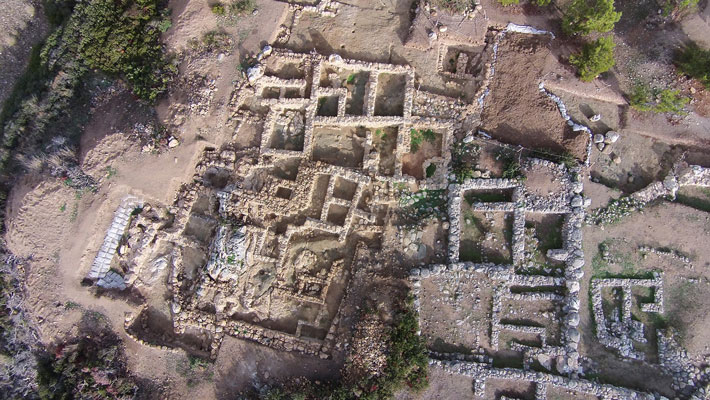
Archaeology.org has a very interesting piece up on the discovery and subsequent research done on Minoan society and one of its major towns: 'Gournia'. The article focusses on how Harriet Boyd and her colleague Blanche Wheeler were brought to Gournia by a local farmer who was aware of a multitude of 'old things' to be found at the site.

Over several hours on May 19, 1901, Boyd collected a few potsherds and located the tops of several ancient walls, enough to convince her it was worth sending a team of workmen to the site the next morning. When she arrived at Gournia on the afternoon of the 20th, Boyd was astonished to see the men holding a bronze spear and sickle and numerous fragments of stone and pottery vessels, and clearing the threshold of a house and a well-paved road complete with a clay gutter. The following day Boyd returned with 51 workmen, and within three days, additional houses and roads had been uncovered, as well as more vases and bronze tools, making her certain that she had found what she was seeking—a Bronze Age settlement of what she called 'the best period of Cretan civilization'.

During three seasons ending in 1904, Boyd and her team, which averaged more than a hundred workmen along with a number of local girls whose job was to wash the finds, excavated the remains of an ancient town that had lain buried and unknown for nearly 3,500 years. Of all the sites in the prehistoric Aegean, Gournia gives the best idea of what a Minoan town looked like, which Harriet Boyd understood after just three years of working there. She wrote in her site publication:

“The chief archaeological value of Gournia is that it has given us a remarkably clear picture of the everyday circumstances, occupations, and ideals of the Aegean folk at the height of their true prosperity.”

The entire article is a very interesting read about the history of excavations and discoveries on the island. If you are interested in the Minoan culture, please head over to Archaeology.org for a very interesting read.

Image: The well-preserved remains of the ancient Minoan town of Gournia in eastern Krete still stand after more than 3,500 years. Copyright: Chronis Papanikolopoulos.
It's a sad day today: no new Atlantis episode on Saturday, so no new recap on Monday. Atlantis will be back next Saturday after a brief hiatus to make room for a special Doctor Who event, and we will get to see the boys travel to the Underworld in good, oldfashioned, hero style. To leave you with something today that may at least fill the void a little, I have taken my cue from last week's mini-breakdown of the real Pythagoras and will bring you a few character portraits of the characters and the mythological or actual people they were based upon.

Jason (Jack Donnelly)
Jason, obviously, is going to be the one without a counterpart in Hellenic mythology. That said, he is reflective of all the great heroes: he is strong, athletic, noble and shrewed. He has a keen mind, sharp senses and a drive to do good. Like any good mythological hero, he has daddy issues and he's taken over many a hero's role so far, but mostly Theseus comes to mind, who took down the Minotaur in the original Hellenic myth--and temporarily snatched up Ariadne, I should add. He also took Iásōn's name, the hero who commanded the ship Argo and led the Argonauts to the Golden Fleece and back.

Jason combines the best aspects of Hellenic heroism: a convoluted background, a sharp mind, a trained body, and a kind heart. Jason in the series also acts as the eyes of the audience as he came over from our world to Atlantis, and is still getting the hang of the ancient Hellenic culture as portrayed by the BBC.

Hercules (Mark Addy)
Hercules in the series is perhaps not the epithomy of human achievement--and a far cry from the hero we respect and worship--but he's a good guy at heart. That much is clear. I will be the first to admit that watching Atlantis' Hercules is often a bit difficult: to see arguably the greatest of Hellenic heroes avoid doing the right thing as long as he can because all other options are simpler/easier/cost less energy or money is a bit unsettling. That said, Heracles is still an intelligent man, with a good heart, who cares deeply for his friends. He would go to hell and back for them--and in the coming episode, it looks like he will do exactly that.

The ancient Hellenic Hēraklēs is a child (and great grand child) of Zeus. Hēraklēs was conceived by Zeus upon Alkmene, as He disguised Himself as her husband, returning early from war. Alkmene accepted Him in her bed gladly, as she was happy to see her husband again. When The real Amphitryon did return later that night, Alkmene realized what had happened, and told her husband. Amphitryon accepted her in his bed, regardless, and so she became pregnant with twins, one fathered by Zeus, and one by her mortal husband.

Hera, hearing of the affair, took an instant disliking to the unborn child. When it became time for Alkmene to give birth, Hera made Zeus swear a vow that a child born in the line of Perseus on this day would become King. Zeus agreed, and Hera hurried off to delay the birth of Hēraklēs and Iphikles, and hurry along the birth of Eurystheus (Εὐρυσθεύς), grandson of Perseus. Due to Hera's jealousy, he was stricken mad and killed the five sons he had by his wife. When he was released from his madness by a hellebore potion--provided by Antikyreus--and realized what he had done, he cried out in anguish, and went on a long journey to cleanse himself of the miasma caused by these killings. In the end, Hēraklēs became a God and ascended to Olympus where he became one of the primary heroes prayed to by the ancient Hellenes and  worshippers today.

Pythagoras (Robert Emms)
Pythagoras iss actually not a person from myth but an actual person. Pythagoras of Samos (Πυθαγόρας ὁ Σάμιος) was an Ionian Hellenic philosopher, mathematician, and founder of the religious movement called Pythagoreanism. He was an influential voice in philosophy, religion, mysticism and science in the late 6th century BC, and is best known for the Pythagorean theorem which bears his name. Because almost everything we now know about Pythagoras was written down centuries later, it may very well be that the theorem as well as anything else attributed to Pythagoras was discovered by his colleagues, students, successors, or even his mother.

Pythagoras in the series could very well resemble a young Pythagoras who has a penchant for triangles. He's very smart, analythical, and would do anything for his friends. He is incredibly loyal and while he would prefer to handle everything with words, he's not above taking out a butter knife in defense.

Medusa (Jemima Rooper)
I miss you, Medusa, please come back! Okay, with that out of the way: Medusa. It might be obvious, but the Medusa from the series is a far cry from the mythological one. She is obviously based off of Ovid's version of the myth, where she was a human woman--possiby a priestess to Athena--who was raped by Poseidon (within the temple walls) and punished by Athena for her transgression.

The link above leads to a long and detailed account of the varying myths of Médousa, and it's perhaps best to suffice here by saying that the snake-haired Gorgon known from mythology is mostly a Roman invention; in the Hellenic era, the head of Médousa brought protection and was thus placed on shields and armors, but also on ovens to keep children away from them.

Medusa from the series is kind-hearted, funny, independant and doomed to have something horrible happen to her--as predicted by the Oracle, at least to Jason. If the show sticks with Ovid, that terrible someting is not something I want to watch (thank you very much) and also doesn't fall into the age bracket of the show, so we will see if Medusa ends up with snakes for hair or not.

Pasiphaê (Sarah Parish)
As the Evil Queen, Parish is currently only riveled by Lana Parrilla's Regina Mills on Once Upon A Time when it comes to milti-layered depictions of an evil caricature. Pasiphaê is the wife of King Minos and stepmother to Ariadne, love interest of Jason. She is a true 'evil' Queen; plotting to further the agenda of her husband and manipulating said agenda so she gets the best out of it. Her plans were recently thwarded by Jason and mostly Ariadne, who called off the wedding between her and Heptarian--Pasiphaê's puppet. Pasiphaê's redeeming features lie in the scenes where she comforts and counsels Ariadne and shows that--whatever she is doing--she believes it to be for the best of the Royal House and the citizens of Atlantis; as misguided as that may be.

Pasiphaê is part of the Myth of the Minotaur. Minos, king of Krete, requested Poseidon raise a bull from the sea, which the King promised to sacrifice; but when Minos refused to do so, Poseidon caused his wife Pasiphaê to fall in love with the bull. The child that came from this union was deformed in such a way that he had the head of a bull and the body of a man. I am fairly certain the original Pasiphaê did not have magical powers, but the series version definitely has.

Ariadne (Aiysha Hart)
Ariadne is the daughter of King Minos. When Theseus came to the island of Krete, she fell for him and offered him a ball of yarn so he would be able to find his way out off the labyrinth that housed the Minotaur. Theseus defeated the Minotaur and took Ariadne and her sister Phaedra from their home in thanks for their help. That night, they slept on the beach but Athena woke up Theseus and told him to sail out now, and to leave Ariadne and Phaedra behind. He did, although it pained him greatly.

Ariadne was devastated but was found by the God of wine, Dionysos, and He took her as His wife. Ariadne gained immortality and is still married to her God, being a Goddess in her own right now.

Ariadne in the series is not quite there yet. Our Theseus-substitute has declared his love but there is no running away or actual cordship involved. Set up as the show's One True Pairing, I doubt Jason is going to leave her in the end so she can be snatched up by a God. Ariadne is developing into one fo the most interesting of the series--from the myth's lovesick young woman to a strong princess who would do anything to protect the people she loves and the subjects of Atlantis, whom she cares about as well. In her youthful ignorance, she has managed to antagonize her stepmother Pasiphaê who retaliated by having Ariadne's friend and servant killed, and thus, Ariadne is currently getting a steady dose of reality shoved her way. I, for one, hope she comes out of it stronger on the other side and that Korinna's death can serve as a catalist for this proccess.

How to you feel about the re-imaging of these classical characters? Is there anything you would change back or anything that stands out as a good writing choice for the creators? How do you feel about Atlantis in general, ad are you happy it will be back on Saturday? Let me know!

Image property: character portraits by BBC ONE, classical art by Wikipedia Commons.
It's been a little while since we last met Hēraklēs for a labour. Last time, he managed to fashuion a rattle to scare off the blood thirsty Stymphalian Birds, completing that labour rather effortlessly thanks to the Gods. Now, Hēraklēs is sent on a mission which--in theory--is far tougher: to capture the Cretan Bull.

To many, the Cretan Bull will be familiar, either because of it's own part in the tale or the fallout, namely the Minotaur. The classic myth goes as follows: Minos, king of Krete, requested Poseidon raise a bull from the sea, which the King promised to sacrifice; but when Minos refused to do so, Poseidon caused his wife Pasiphaê to fall in love with the bull. The child that came from this union was deformed in such a way that he had the head of a bull and the body of a man. In the labours of Hēraklēs, the story changes a little depending on the source. Diodorus agrees with the myth, saying in his 'Library of History':

"The next Labour which Heracles undertook was to bring back from Crete the bull of which, they say, Pasiphaê had been enamoured." [4.13.4]

Apollodorus, for example, has a different story to tell, not just about the Cretan Bull, but also about the story of King Minos. It seems the Bull had become feral, terrorizing the land and scaring the inhabitants of the island. From his 'Library':

"The seventh labour he enjoined on him was to bring the Cretan bull. Acusilaus says that this was the bull that ferried across Europa for Zeus; but some say it was the bull that Poseidon sent up from the sea when Minos promised to sacrifice to Poseidon what should appear out of the sea. And they say that when he saw the beauty of the bull he sent it away to the herds and sacrificed another to Poseidon; at which the god was angry and made the bull savage." [2.5.7]

From Philostratus the Elder we get a description of the bull, based off of the description of his second Image Book:

"Pasiphaë outside the workshop in the cattlefold gazes on the bull, thinking to draw him to her by her beauty and by her robe, which is divinely resplendent and more beautiful than any rainbow. She has a helpless look – for she knows what the creature is that she loves – and she is eager to embrace it, but takes no notice of her and gazes at its own cow. The bull is depicting with proud mien, the leader of the herd, with splendid horns, white, already experienced in love, its dewlap low and its neck massive, and it gazes fondly at the cow; but the cow in the herd, ranging free and all white but for a black head, disdains the bull. For its purpose suggests a leap, as of a girl who avoids the importunity of a lover." [1.16]

Contrary to the other labours, there is actually not alot known about how Hēraklēs managed to wrangle in the bull and take him back to the main land. Both versions, however, agree that Minos helped him do it, or at least offered Hēraklēs assistance. If I was Minos, I would want that bull away from my wife and people too! Diodorus literally suffices with a single line on the capture of the Bull:

"[A]nd sailing to the island he secured the aid of Minos the king and brought it back to the Peloponnesus, having voyaged upon its back over so wide an expanse of sea." [4.13.4]

Apollodorus is a little bit more forthcoming:

"To attack this bull Hercules came to Crete, and when, in reply to his request for aid, Minos told him to fight and catch the bull for himself, he caught it and brought it to Eurystheus, and having shown it to him he let it afterwards go free. But the bull roamed to Sparta and all Arcadia, and traversing the Isthmus arrived at Marathon in Attica and harried the inhabitants." [2.5.7]

How Hēraklēs captured the Bull will most likely always remain a mystery. I like to envision him wrestling it down and tying it like the bull capturers; risking life and limb in a heroic effort to make better the lives of the citizens of Krete. And so another labour is completed. Next time we will cover the little break that follows the seventh labour in which Hēraklēs establishes the Olympic Games and frees the Titan Prometheus--amongst other things.

Image Source: Wikipedia Commons.