Showing posts with label Russia. Show all posts

An ancient Corinthian helmet was found recently in a fifth century BC grave in the Taman Peninsula, southwest Russia. Made of bronze, ancient Corinthian helmets covered the entire head and neck, with slits for the eyes and mouth, protruding cheek covers (paragnathides) and a curved protrusion in the back to protect the nape of the neck.
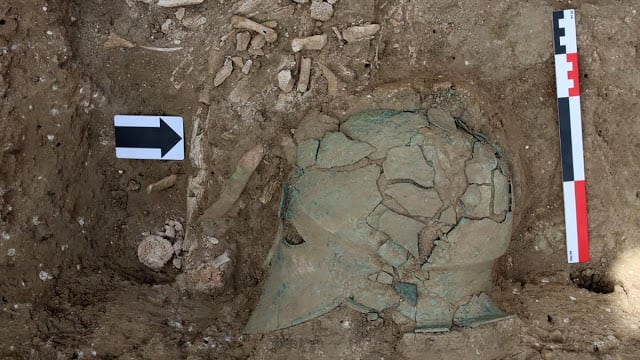
The helmet has a padded interior made of fabric or leather to protect the warrior’s skull. These helmets were essential for the Hellenic hoplites, the famous foot soldiers of the phalanxes. While the Corinthian helmet is named after the ancient Greek city state of Corinth, where it originated, it was used across Hellas in ancient times, from the sixth century to the first, when it fell out of fashion.

The helmet found in Russia is corroded and highly fragmented, but its discovery is extremely important for historical purposes. The Corinthian helmet found in southwest Russia is the only one of its kind discovered north of the Black Sea. 

Corinthian helmets appeared in Hellas around the 6th century BC and is one of the symbols of ancient Hellas. Athena and the famed Athenian statesman Pericles are both frequently depicted wearing them in ancient Hellenic art.

In antiquity, when a warrior died his helmets would be buried next to him. According to Roman Mimohod, director of the expedition of the Institute of Archaeology of the Russian Academy of Sciences (IA RAS), “the helmet of the Taman peninsula belongs to the Corinthian Hermione-type and would date back to the first quarter of the fifth century BC,” as stated to the Archaeology News Network.

For two years now, Russian archaeologists have excavated a necropolis of 600 burial mounds where many Hellenic warriors of the Bosporus kingdom are buried. The kingdom, with Panticapaion as its capital, lasted almost a millennium, with the last written traces going back to the 5th century AD.

It was a place where the Hellenic culture merged with the successive nomadic cultures of the steppe, be it the Scythians or the Sarmatians. Between the 6th and 3rd centuries BC, Hellenes and Scythians maintained extremely close cultural as well as commercial ties.

Several Hellenic colonies were established in the region. Their settlement extends from the end of the 7th century BC until the second quarter of the 4th century BC.

The Hellenics founded large cities on the northern coast of the Black Sea. The main ones were Olbia, at the mouth of the Dnieper, Panticapaion, today’s Kerch in the extreme west of the Crimea, and Chersonese (Sevastopol) on the Russian bank.

One of the ancient Hellenic settlements in the area, Phanagoria (Taman), also gave name to to the peninsula on which the Corinthian helmet was discovered.

The columns of the Prytaneion, a facility where members of government met in the period of ancient Greece, at the excavations of Panticapaeum have collapsed in Kerch, Crimea.


On January 28, they were reinforced by supporting blocks so that they would not fall, but it did not work, according to the local news outlet Kerch.FM. All fallen parts of the columns were withdrawn by museum staff, journalists said.

According to the administration of the East Crimean Historical and Cultural Reserve, the collapse occurred due to fluctuating temperatures and weather conditions.

Panticapaeum was an ancient Greek city on the eastern shore of Crimea, which the Greeks called Taurica. The city was built on Mount Mithridat, a hill on the western side of the Cimmerian Bosporus. It was founded by Milesians in the late 7th or early 6th century BC.

The ruins of the site located in the city of Kerch belong to Ukraine's cultural heritage.
An ancient Hellenic altar untypical of Hellenic colonies on the Black Sea coast has been unearthed at the site of the antique city of Phanagoria on the Taman Peninsula in Russia's southern Krasnodar Territory.


Vladimir Kuznetsov, who leads the Phanagoria archaeological expedition, told TASS on Monday:

"The complex is dated back to the mid-6th century B.C., or the period when Phanagoria was founded. This rarest find is one of the oldest and most unique ancient Greek sanctuaries in Russia. As far as I know, such complexes have not been found anywhere else on the Black Sea coast. Moreover, they are quite rare for the Mediterranean region in general. The layout of this altar is absolutely unparalleled - there have been found no other similar altars with so highly specific elements."

The clay-brick building was entrenched in the natural soil layer to a depth of two meters. A stairway leading from the vault ended in a small platform in front of a rectangular altar made of bricks. An 80 cm diameter bowl was placed at the edge of the altar and a deep pit was dug near it, with the altar’s surface and the pit’s verge showing traces of fire and ash.

"The complex requires serious study and our task is to try to understand how this structure functioned."

Kuztensov added that archaeologists believe the building used to serve as a sanctuary dedicated to gods associated with the underworld. According to archaeologists, the altar was used to place a sacrifice on it, with the blood trickled to the bowl so that it would not be sprinkled on the altar. The pit, judging by the bone finds, was used to dispose of flesh.

The ancient city of Phanagoria was founded on the Taman Peninsula in the mid-6th century B.C. by the Greeks. For a long time, it was one of the two capitals of the ancient Kingdom of Bosporus (beginning from the 5th century B.C.), the most ancient state in the territory of today's Russia.
The Greeks were driven out of the Taman Peninsula by the bellicose Hun tribes in the 4th century A.D.

Archaeological excavations at the site have been conducted since the 19th century. Currently, excavations are sponsored by Volnoye Delo Fund run by businessman Oleg Deripaska. The fund also financed the establishment of a research and culture center on the Taman Peninsula in 2012.
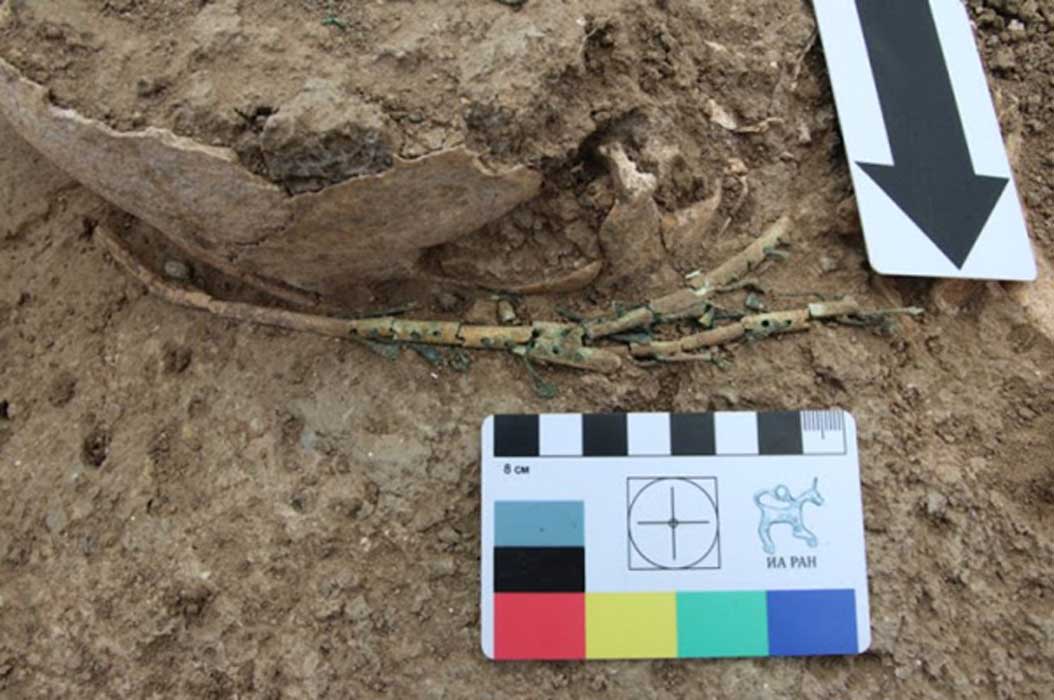
According to the News Agency TASS, a team of archaeologists has uncovered fragments of two ancient Hellenic musical instruments during an excavation in the Taman Peninsula, in southern Russia. The unearthing of remnants of musical instruments is quite rare, and the discovery is the first of its kind in many years. The discovery is an exciting one and it is showing the extent of the Hellenic presence in the Black Sea area in ancient times. The find will allow experts to have a better understanding of the local Hellenic societies.


The Hellenes colonized the north Black Sea area from at least the 8th century BC, drawn to the region by its rich natural resources. They established a series of colonies in the area, especially in what is now southern Russia. Over time, these became city-states or polis that became rich and powerful because of the trade in fish, grain, and slaves. The settlements remained largely Hellenic in culture, but they also interacted with the Steppe nomads such as the Scythians.  The Taman Peninsula became the core area of the Bosporan Kingdom that endured in one form or another from the 4th century BC to the 4th century AD.

The find was in an area of southern Russia, that is located near the Crimea. Two important urban centers were situated there in antiquity, which became capitals of the Bosporan Kingdom. There have been extensive archaeological finds related in the Taman area in recent decades, that have deepened our understanding of Hellenic society in southern Russia.

The find was made by archaeologists of the Russian Academy of Sciences, led by Roman Mimokhod, who have been working in the area for three years. They made the discovery of the fragments near Volna, which is located near an extensive ancient Hellenic settlement. The fragments were unearthed at a large necropolis and they were buried with individuals, a common practice in antiquity.

The remains of the instruments are only the latest important discovery from the archaeological site. The team of archaeologists have excavated some 600 tombs in the necropolis and have made many discoveries that have thrown a light on Hellenic society in the region and the level of their interactions with local groups.

The fragments unearthed were a piece of a harp and a lyre and they have been dated to be from the 6th century BC.  The instruments are only partially preserved because they were made from perishable material, namely wood. Because of this, such musical instruments are very rare to find and most of what we know about them is from images on vases. The discovery of the pieces of a harp and lyre are particularly important as, Tass quotes Mimokhad as stating that,

"...the harp unearthed in Taman is one of the most ancient and well-preserved as far as ancient Hellenic musical instruments are concerned. The fragments of the instruments, according to the News Network Archaeology are believed to be older than previous significant discoveries, including those at the ‘Piraeus necropolis in Athens and the tuning pegs of a harp uncovered from a necropolis in Taranto, southern Italy."

The find of the fragments of a harp and a lyre was unexpected and demonstrates the archaeological importance of the necropolis near the Volna settlement. The musical instruments will be investigated further and compared to the few other examples from antiquity. Such discoveries in the Taman Peninsula underline how the settlements north of the Black Sea remained culturally Hellenic, despite their interactions with native groups.
A Corinthian helmet was found in a 5th century BC grave in the Taman Peninsula, southwest Russia, according to RIA Novosti news agency. Made of bronze, Corinthian helmets covered the entire head and neck, with slits for the eyes and mouth, protruding cheek covers (paragnathides) and a curved protrusion in the back to protect the nape of the neck.


The helmet has a padded interior made of fabric or leather to protect the warrior’s skull. These helmets were essential for the Greek hoplites, the famous foot soldiers of the phalanxes.
The one found is corroded and highly fragmented, but its discovery is extremely important for historical purposes. The Corinthian helmet is the only one of its kind discovered north of the Black Sea. Corinthian helmets appeared in Greece around the 6th century BC and is one of the symbols of ancient Hellas. Athena and Pericles are frequently depicted wearing them.

When a warrior died, his helmets would be buried next to him. According to Roman Mimohod, director of the expedition of the Institute of Archaeology of the Russian Academy of Sciences (IA RAS), “the helmet of the Taman peninsula belongs to the Corinthian Hermione-type and would date back to the first quarter of the fifth century BC,” an Archaeology News Network report says.

For two years now, Russian archaeologists study a necropolis of 600 burial mounds where many Greek warriors of the Bosporus kingdom are buried. Several Greek colonies were established in the region. Their settlement extends from the end of the 7th century BC until the second quarter of the 4th century BC.

The Greeks founded large cities on the northern coast of the Black Sea. The main ones were Olbia, at the mouth of the Dnieper; Panticapaion, today’s Kerch, in the extreme west of the Crimea, and Chersonese (Sevastopol); on the Russian bank, one found Phanagoria (Taman), also the name given to the peninsula on which the Corinthian helmet was discovered.

According to the Archaeology News Network report, the Kingdom of the Bosporus was created in 480 BC around the Kerch Strait and the Taman Peninsula, west of the Bosporus.

The kingdom, with Panticapaion as its capital, lasted almost a millennium, the last written traces going back to the 5th century AD. It was a place where the Greek culture merged with the successive nomadic cultures of the steppe, be it the Scythians or the Sarmatians. Between the 6th and 3rd centuries BC, Greeks and Scythians maintained extremely close cultural as well as commercial ties.