Showing posts with label food. Show all posts

 I get a lot of questions from readers, and most of the time, the answers are fairly short. When I feel the question or the reply would be valuable to others as well, I make a post with a collection of them and post them in one go. Today is one of those posts.


"Regarding the overhaul to the setup of the blog: I only have one item that I'm concerned about, and that's the fact that all posts appear to be undated now. I liked having dates, as it makes it easier to cite entries on this blog as sources for academic purposes. Can we have the dates back, please? :)"

So, I hadn't even noticed that! Thank you for pointing it out! It's back now, in the bottom beam, next to the share buttons, above the labels. I'm still tweaking things, by the way, on the new lay-out. Nothing major but still. If you notice something amiss or missing, let me know!


***

"I was curious if there was a specific reason that milk wasn't drunk by the Ancient Greeks?"

Mostly, the ancient Hellenes considered anything their non-Greek speaking neigbours did 'barbaric'--and their neighboors drank milk. Peasants drank milk--because hey, precious food--but most likely they used most of the milk they got from their sheep, cows, and goats to make cheese. It's an old custom to link milk to barbarism, by the way. It's already in Hómēros' 'Odysseia' in which the cyclops that tried to eat Odysseus and his crew drank milk:

"He curdled half the milk and set it aside in wicker strainers, but the other half he poured into bowls that he might drink it for his supper." [IX]

This observation follows after it's minutely detailed how the crew ate only cheese and sacrificed only cheese as well. Speaking of sacrifice: milk was also an oft-given gift to the dead. We, generally speaking, avoid eating things we associate with the dead to avoid miasma. So cheese is fine, yoghurt is fine, but milk is not.


***

"Can I be a Hellenic Polytheist if I worship just a few Olympian gods, and two of them aren't Zeus and Hera? I mean... I don't want to be disrespectful to any of the Theoi, is just that I don't feel a connection with the 12 (and Poseidon kind of scares me) but if worship all the Olympians is the 'right' thing to do, I will do it the best I could. Sorry if my doubts are dumb, i'm new in this."

There are no dumb questions, I promise. Okay, so, short answer: yes, technically, you can be an Hellenic Polytheist as long as you worship more than one Hellenic God. 'Recon' is out but 'Polytheist' would still work. This is technically. Personally, I feel anyone who wishes to call themselves an Hellenic Polytheist needs to understand that the Theoi come as a package deal, a family, a world ecompassing whole that cannot function if a piece is missing.

Roughly divided, all our Gods and heroes (who were often raised up to become Gods in their own right) fit into five generational categories. These are the:
  • Protogenoi
  • Uranides
  • Titanes
  • Olympic Gods
  • Heroes/deified mortals
The Protogenoi are the Gods from which the universe is made. They are Gods like Khaos, Gaia, Ouranos, and Nyx. In general, these Theoi are more abstract and less defined than, say, the Olympians. They are cruder, more powerful Gods who, together, form the tapistry of earth and life. We simply could not live without Them as They are the air we breath, the earth we walk on, the water we drink and the death that eventually lays us to rest. and yet, neither we, nor the ancient Hellenes revered them often. They are distant and hav very little to do with the individual's lifecycle.

The Uranides formed the world created by the Protogenoi into the world we know now. They are the children of the Protogenoi and They are in charge of  more specific domains. They give us the constellations, intellect, light, memory, navigation, and many other things without which we simply would not be able to live the life we live. Like the Protogenoi, these Gods make up the tapestry of the universe and did not recieve much direct worship in state festivals.

The Titanes are Gods with whom we are more familiar. They are Helios, Hekate, Lêtô, Selênê and many others. This is the first generation of Gods we are more familiar with by name than function--and also the first generation whose names don't always directly relate to the domains they are familiar with, although we know them through mythology. Lêtô, for example, is identified as the Goddess of motherhood and protectress of the young while we mostly know her as mother of Apollon and Artemis. These Gods often times--but not always--recieved individual worship and were sometimes included in state festivals. They feature in mythology and possess well-rounded personalities that we know (unlike, say, the Protogenoi).

We all know the Olympic Gods. They are the Gods we worship most. They are also the sole 'generation' of Gods who span two generations: they are the children of the Uranides (like the Titanes), and the children of the Olympians. Zeus and His brothers and sisters for example, were born from Rhea and Kronos (both Uranides), but Their children (Hēphaistos, Artemis, Apollon, etc.) are also counted amongst the Olympians. In general, if a Gods is said to reside on Mount Olympos, They are known as an Olympic God. Alternatively--or perhaps erroneously--the Olpmpic Gods are interpreted to be solely the Dodekatheon, the Twelve Olympians who ruled over humanity and the Gods from the top of the mountain. The most canonical version of the Dodekatheon is: Aphrodite, Apollon, Ares, Artemis, Athena, Demeter, Hēphaistos, Hera, Hermes, Hestia, Poseidon, and Zeus. Theoi who were held in high regard in a certain city-state would have held the thrones, according to the people who lived in that city-state, and many different Gods have been counted amongst the Dodekatheon over the centuries. Needless to say, most (state) worship in ancient times focussed on the Olympians.

The heroes of Hellenismos recieve(d) quite a bit of worship. Many heroes were local ones, but we have all heard of Hēraklēs, of Perseus and Theseus, of Atalanta and Odysseus. These heroes represent the most powerful, most virtuoes of all humans and teach us the qualities the Theoi enjoy seeing in us. Many of these heroes were fathered (and sometimes mothered) by the divine and they are thus part of the divine line. In fact, the heroes can be counted amongst the Olympians.

While the main body of our worship focusses on the Olympians, the Olympians did not come to power in a vacuum. The Old Gods presided over the building blocks of the previous generation, like the Olypmians preside over the building blocks of all three. Looking over the list, it's easy to trace the domains of the Olympians back to their predecessors--or even the God or Goddess They hold sway over directly. While the Olympian generation of Gods rule our daily lives, They operate in the framework of the Titans, the Uranides and the Protogenoi. These intricate lines built a web that is of vital importance to see in order to understand not only Hellenic mythology but also the Gods themselves.
Hellenic Recons (and a portion of Hellenic Polytheists) are aware of these generations and they can trace familial lines of influence down through the generations of the Gods. They understand that all Gods play a vital role in the tapestry of the world and that they need to be revered alongside Their brothers, sisters, parents, and sometimes even Their children.

Seeing the Gods as separate from each other like we often do in modern Paganism would not even have occurred to the ancient Hellenes. They did not see themselves separate from their spouse, their children, their parents, their cousins, etc., so why would they think of the Gods that way?

That said, not every God needs to be worshipped daily. The cycle of festivals provided enough moments to honour all major Gods throughout the year, after all. every household focussed on those Gods that were inportant to their family, either through (percieved) geneology, experience, or practical matters like making a living. A soldier would pay regular homage to Ares and Athena, a blacksmith to Hephaistos, and so on. But even if they only paid homage to Asklepios during His festivals, they would go to His temple to pray in case someone fell ill. If a sea voyage was in the cards, the family would pay tribute to Poseidoneven if they never sacrificed to Him during household worship.

I don't know if the ancient Hellenes thought any Ouranic God was frightening. I doubt it. All of the Gods were revered with respect and proper etiuette so as not to upset Them. That's simply good form when drawing the attention of someone a lot more powerful than you onto yourself.

So, that's the long answer: yes, you can, but I can't think of a reason why you would want to if you truly wish to commit to the ancient Hellenic Gods.

The diet of the ancient Hellenes is fascinating for so many reasons. They had impressively varied eating habits by any measure, but they naturally contrasted in many ways to ours — with the most characteristic difference being that they ate much less than we do today.

In ancient Hellas, people would begin their day with a very lean breakfast, which included a little barley bread, dipped in lukewarm wine, and figs. Another common breakfast food was actually a drink, called “Kykeonas,” a libation made of boiled barley, flavored with mint or thyme, which was believed to have healing properties.

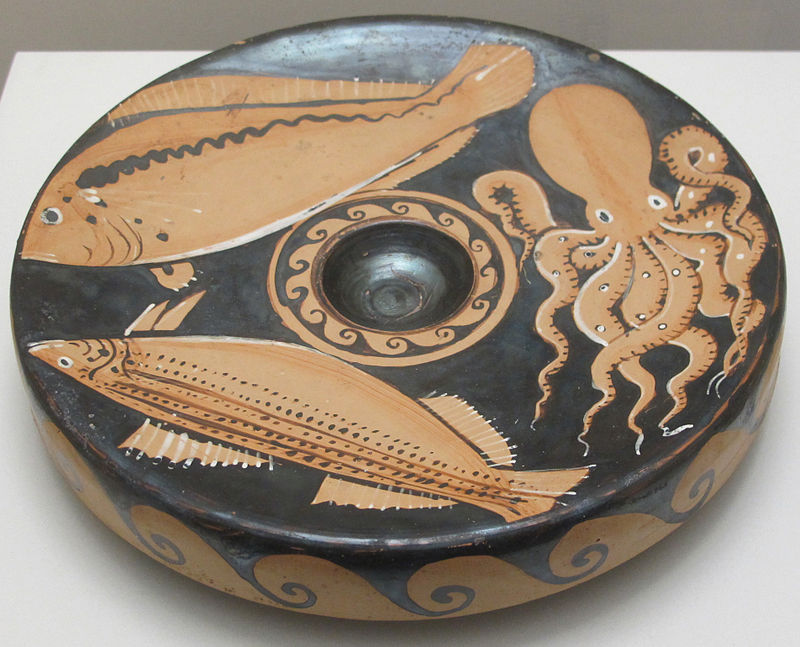
Hellenes of that time were very fond of fish, perhaps even more than we are today. For lunch, they would routinely dine on any fresh fish that was available, including sea bream, mullet, sardines and eels. There was always an assortment of legumes from which to choose, including lentils, beans, chickpeas, peas and broad beans, to eat with their fish. The eternal European staple of bread was always part of the midday meal, accompanied by cheese, olives, eggs, nuts and fruits.

Ancient Hellenes considered dinner to be the most important and enjoyable meal of the day. Although health specialists today recommend that we should eat particularly lightly in the evening, ancient Hellenes actually spent a lot of time together at the table at the end of the day, and ate fairly heavily at that meal. Dinner in ancient Greece was usually accompanied by desserts, the so-called “tragimata,” which could be composed of fresh or dried fruit, including figs, as well as nuts and grapes or honey-based sweets.

Regarding their meats, it was not often consumed in ancient Hellas. Usually only after public sacrifices, either on the day of, or sold in shops after. In their diet, the ancient Hellenes showed a particular preference for pork and veal, while they rarely ate goat or lamb. They also loved hunting, especially small birds such as thrush and quail, but they were not averse to taking deer as well, so venison was not unheard of at the ancient Hellenic table. Perhaps most surprisingly, the Hellenes also loved their snails; it is recorded that Cretans had eaten them since the time of Minos.

Fruits and vegetables were always present on the table, although not in the variety that we find today. Pears, pomegranates, apples, figs, berries, cherries and plums were always in high demand. Athenians were known to cultivate vegetables in their gardens, and they had a particular love for onions, garlic, lettuce, cucumbers, peas, artichokes, celery, dill and mint. Mushroom, fennel, asparagus, and even tender, edible nettles, were to be found in abundance in the fields.

As almost all of us still do, ancient Hellenes also loved their bread, and they would bake many different varieties of it, from flat breads to semolina bread, and even a coarse type of bread made from millet. They frequently dined on the types of fish which lived right along the rocky shores of the Aegean, but they also enjoyed fish from the open seas, such as tuna, a much-sought-after delicacy. They also enjoyed mackerel, bonito and anchovies, which were abundant during their season and were easy to catch with nets. “Garos,” a type of sauce made from a fried, salted fatty fish, was another basic element of the diet along the coast in ancient Hellas. High quality garos, made of tuna offal and blood, was actually quite expensive.

The kitchen shelves of an ancient Greek house were always stocked with an impressive variety of herbs and spices, including oregano, basil, mint, thyme, cardamom, coriander, capers and sesame, which they would add liberally to their dishes.

Most foods were particularly light, as they were baked in the oven and on a skewer, and the same was true for sweets, which were made from pastry, with dried or fresh fruit, and honey.

Every meal was accompanied by wine, of course, and olive oil was always on the table, especially for Athenians, as they considered it to be the goddess Athena’s gift to their city. They believed that the purpose of food was to satisfy the palate and not to actually fill the stomach. In that sense, and that sense only, one can even say that they were gourmands.

The only exception to this overall rule were the people of Sparta, who were by far the lightest eaters of all. True to form, even in their diet, they followed a laconic austerity, with their daily food consisting of a bowl of “black broth” and a piece of bread, while on special occasions and feasts, they would have boiled pork, accompanied by a little wine and some pita bread. But everywhere else in Hellas, there was a great variety of food at each and every meal, and people took an obvious delight in it.

On 20 March, at 10 AM EDT, Elaion hosts a PAT ritual for the Galaxia. This rather obscure festival was held in many places in ancient Hellas, but most notably at Olympia. The Galaxia was closely linked to the vernal equinox, which was used to date it and was (amongst others) in honor of Kronos and Rhea.


The Galaxia is a festival held in honor of the Mother (of the Gods), who in Hellenic mythology is Rhea, although the title is also strongly associated with Gaia and Kybele, who have similar functions. She was worshipped as the mother of Zeus and the Galaxia celebrated His birth just as much as Her giving birth to him. Kronos--as Her consort and His father--was most likely also sacrificed to, along with Hera, who as Zeus' wife deserved honor alongside Him. In our ritual, we have included Helios and the Horai as well, as the Galaxia was associated so closely with the Spring Equinox.

The Galaxia had a special beverage attached to it--well, a special food item: a milk and barley porridge that may have been sacrificed to the Mother, but which was at least consumed at the festival. Pliny the Elder names the porridge a 'puls', which seems to have been a more general term which included pastes made from lentils and beans as well as from grain. On barley-based porridge, he has the following to say in his 'Natural History':

"There are several ways of making barley porridge: the Greeks soak some barley in water and then leave it for a night to dry, and next day dry it by the fire and then grind it in a mill. Some after roasting it more thoroughly sprinkle it again with a small amount of water and dry it before milling; others however shake the young barley out of the ears while green, clean it and while it is wet pound it in a mortar, and wash it of husk in baskets and then dry it in the sun and again pound it, clean it and grind it. But whatever kind of barley is used, when it has been got ready, in the mill they mix in three pounds of flax seed, half a pound of coriander seed, and an eighth of a pint of salt, previously roasting them all. Those who want to keep it for some time in store put it away in new earthenware jars with fine flour and its own bran. Italians bake it without steeping it in water and grind it into fine meal, with the addition of the same ingredients and millet as well." [XVIII-XIV]

Sources which mention the festival speak only of a milk and barley beverage that can be poured. Fundamentally, porridge is made by mixing oats with a fluid (normally water and or milk) and then heating it. Combine barley, water, and salt in a heavy saucepan. Cover, and bring to a boil over high heat, stirring continuously. Turn the heat to low and steam until grains are soft and all the liquid is absorbed. Add the milk once the water level drops below the level of the barley. Cooking time depends on the form of barley used. Use one cup dry barley on three cups of water.

- Hulled barley is unprocessed and takes the longest to boil, about an hour and 15 minutes before it's soft.
- Pearl Barley or Pearled Barley is the most common form of barley available and is sold in most supermarkets. Because the outer hulls including the bran have been removed, the grains have a pearly white color. Cooking time: 50-60 minutes.
- Quick Barley, or instant barley is pearl barley that is pre-steamed then dried, shortening the cooking time considerably, about 10 to 12 minutes.
- Barley Grits are processed similar to bulghur wheat. The grain is cracked, and toasted or parboiled, then dried, making it a quick-cooking product--about 2-3 minutes. As such, add a little less water or milk.
- Barley Flakes, Pressed Barley, or Rolled Barley have the appearance of rolled oats and are often included in muesli-type cereals. The cooking time is about 30 minutes.
- Barley Flour is hulled barley that is finely ground and has a lightness and delicate sweetness. It can be stirred into milk until the right consistency is reached.
To get a consistency where the puls can be poured, add milk or water to thin the porridge. If you want to sweeten the porridge a little, add warmed honey to the mixture.

We hope you will join us today, on March 20 at the usual 10 AM. The ritual can be found here and you can join the community here.
On 21 March, at 10 AM EDT, Elaion hosts a PAT ritual for the Galaxia. This rather obscure festival was held in many places in ancient Hellas, but most notably at Olympia. The Galaxia was closely linked to the vernal equinox, which was used to date it and was (amongst others) in honor of Kronos and Rhea.


The Galaxia is a festival held in honor of the Mother (of the Gods), who in Hellenic mythology is Rhea, although the title is also strongly associated with Gaia and Kybele, who have similar functions. She was worshipped as the mother of Zeus and the Galaxia celebrated His birth just as much as Her giving birth to him. Kronos--as Her consort and His father--was most likely also sacrificed to, along with Hera, who as Zeus' wife deserved honor alongside Him. In our ritual, we have included Helios and the Horai as well, as the Galaxia was associated so closely with the Spring Equinox.

The Galaxia had a special beverage attached to it--well, a special food item: a milk and barley porridge that may have been sacrificed to the Mother, but which was at least consumed at the festival. Pliny the Elder names the porridge a 'puls', which seems to have been a more general term which included pastes made from lentils and beans as well as from grain. On barley-based porridge, he has the following to say in his 'Natural History':

"There are several ways of making barley porridge: the Greeks soak some barley in water and then leave it for a night to dry, and next day dry it by the fire and then grind it in a mill. Some after roasting it more thoroughly sprinkle it again with a small amount of water and dry it before milling; others however shake the young barley out of the ears while green, clean it and while it is wet pound it in a mortar, and wash it of husk in baskets and then dry it in the sun and again pound it, clean it and grind it. But whatever kind of barley is used, when it has been got ready, in the mill they mix in three pounds of flax seed, half a pound of coriander seed, and an eighth of a pint of salt, previously roasting them all. Those who want to keep it for some time in store put it away in new earthenware jars with fine flour and its own bran. Italians bake it without steeping it in water and grind it into fine meal, with the addition of the same ingredients and millet as well." [XVIII-XIV]

Sources which mention the festival speak only of a milk and barley beverage that can be poured. Fundamentally, porridge is made by mixing oats with a fluid (normally water and or milk) and then heating it. Combine barley, water, and salt in a heavy saucepan. Cover, and bring to a boil over high heat, stirring continuously. Turn the heat to low and steam until grains are soft and all the liquid is absorbed. Add the milk once the water level drops below the level of the barley. Cooking time depends on the form of barley used. Use one cup dry barley on three cups of water.

- Hulled barley is unprocessed and takes the longest to boil, about an hour and 15 minutes before it's soft.
- Pearl Barley or Pearled Barley is the most common form of barley available and is sold in most supermarkets. Because the outer hulls including the bran have been removed, the grains have a pearly white color. Cooking time: 50-60 minutes.
- Quick Barley, or instant barley is pearl barley that is pre-steamed then dried, shortening the cooking time considerably, about 10 to 12 minutes.
- Barley Grits are processed similar to bulghur wheat. The grain is cracked, and toasted or parboiled, then dried, making it a quick-cooking product--about 2-3 minutes. As such, add a little less water or milk.
- Barley Flakes, Pressed Barley, or Rolled Barley have the appearance of rolled oats and are often included in muesli-type cereals. The cooking time is about 30 minutes.
- Barley Flour is hulled barley that is finely ground and has a lightness and delicate sweetness. It can be stirred into milk until the right consistency is reached.
To get a consistency where the puls can be poured, add milk or water to thin the porridge. If you want to sweeten the porridge a little, add warmed honey to the mixture.

We hope you will join us tomorrow, on March 21 at the usual 10 AM. The ritual can be found here and you can join the community here.
Ancient Hellenes may be known for their love of wine, but it seems they also had an affinity to beer, according to a study by the Aristotle University of the northern city of Thessaloniki. Two Bronze Age brewers that were recently unearthed prove that ancient Hellenes would brew beer on a regular basis 4,000 years ago.


Archaeologists from the Aristotle University of Thessaloniki located several archaeobotanical remains of a cereal that could have been used in beer brewing. Similar remains found in the Archontiko area in the island of Corfu were also discovered in Argissa in Zakynthos.

At Archontiko, archaeologists found about 100 individual cereal seeds dating back to the early Bronze Age from 2100 to 2000 BC. In Argissa, they found about 3,500 cereal seeds going back to the Bronze Age, approximately from 2100 to 1700 BC.

Moreover, archaeologists discovered a two-room structure that seems to have been carefully constructed to maintain low temperatures in the Archontiko area, suggesting it was used to process the cereals for beer under the right conditions. This discovery is the earliest known evidence of beer consumption in Greece, but not in the planet.

Beer is one of the oldest beverages humans have produced, dating back to at least the 5th millennium BC in Iran, and was recorded in the written history of ancient Egypt and Mesopotamia and spread throughout the world.

As almost any cereal containing certain sugars can undergo spontaneous fermentation due to wild yeasts in the air, it is possible that beer-like beverages were independently developed throughout the world soon after a tribe or culture had domesticated cereal. Chemical tests of ancient pottery jars reveal that beer was produced as far back as about 7,000 years ago in what is today Iran. This discovery reveals one of the earliest known uses of fermentation and is the earliest evidence of brewing to date. In Mesopotamia, the oldest evidence of beer is believed to be a 6,000-year-old Sumerian tablet depicting people drinking a beverage through reed straws from a communal bowl. A 3900-year-old Sumerian poem honouring Ninkasi, the patron goddess of brewing, contains the oldest surviving beer recipe, describing the production of beer from barley via bread. In China, residue on pottery dating from between 5400 and 4900 years ago shows beer was brewed using barley and other grains.

The invention of bread and beer has been argued to be responsible for humanity's ability to develop technology and build civilization.The earliest chemically confirmed barley beer to date was discovered at Godin Tepe in the central Zagros Mountains of Iran, where fragments of a jug, from between 5400 and 5000 years ago was found to be coated with beerstone, a by-product of the brewing process.

Beer may have been known in Neolithic Europe as far back as 5,000 years ago, and was mainly brewed on a domestic scale.

Most if this is not new, I wrote about it five years ago, but it's good to see it confirmed form new findings.
On Monday, 27 March, at 10 AM EDT, Elaion hosts a PAT ritual for the Galaxia. This rather obscure festival was held in many places in ancient Hellas, but most notably at Olympia. The Galaxia was closely linked to the vernal equinox, which was used to date it and was (amongst others) in honor of Kronos and Rhea.


The Galaxia is a festival held in honor of the Mother (of the Gods), who in Hellenic mythology is Rhea, although the title is also strongly associated with Gaia and Kybele, who have similar functions. She was worshipped as the mother of Zeus and the Galaxia celebrated His birth just as much as Her giving birth to him. Kronos--as Her consort and His father--was most likely also sacrificed to, along with Hera, who as Zeus' wife deserved honor alongside Him. In our ritual, we have included Helios and the Horai as well, as the Galaxia was associated so closely with the Spring Equinox.

The Galaxia had a special beverage attached to it--well, a special food item: a milk and barley porridge that may have been sacrificed to the Mother, but which was at least consumed at the festival. Pliny the Elder names the porridge a 'puls', which seems to have been a more general term which included pastes made from lentils and beans as well as from grain. On barley-based porridge, he has the following to say in his 'Natural History':

"There are several ways of making barley porridge: the Greeks soak some barley in water and then leave it for a night to dry, and next day dry it by the fire and then grind it in a mill. Some after roasting it more thoroughly sprinkle it again with a small amount of water and dry it before milling; others however shake the young barley out of the ears while green, clean it and while it is wet pound it in a mortar, and wash it of husk in baskets and then dry it in the sun and again pound it, clean it and grind it. But whatever kind of barley is used, when it has been got ready, in the mill they mix in three pounds of flax seed, half a pound of coriander seed, and an eighth of a pint of salt, previously roasting them all. Those who want to keep it for some time in store put it away in new earthenware jars with fine flour and its own bran. Italians bake it without steeping it in water and grind it into fine meal, with the addition of the same ingredients and millet as well." [XVIII-XIV]

Sources which mention the festival speak only of a milk and barley beverage that can be poured. Fundamentally, porridge is made by mixing oats with a fluid (normally water and or milk) and then heating it. Combine barley, water, and salt in a heavy saucepan. Cover, and bring to a boil over high heat, stirring continuously. Turn the heat to low and steam until grains are soft and all the liquid is absorbed. Add the milk once the water level drops below the level of the barley. Cooking time depends on the form of barley used. Use one cup dry barley on three cups of water.

- Hulled barley is unprocessed and takes the longest to boil, about an hour and 15 minutes before it's soft.
- Pearl Barley or Pearled Barley is the most common form of barley available and is sold in most supermarkets. Because the outer hulls including the bran have been removed, the grains have a pearly white color. Cooking time: 50-60 minutes.
- Quick Barley, or instant barley is pearl barley that is pre-steamed then dried, shortening the cooking time considerably, about 10 to 12 minutes.
- Barley Grits are processed similar to bulghur wheat. The grain is cracked, and toasted or parboiled, then dried, making it a quick-cooking product--about 2-3 minutes. As such, add a little less water or milk.
- Barley Flakes, Pressed Barley, or Rolled Barley have the appearance of rolled oats and are often included in muesli-type cereals. The cooking time is about 30 minutes.
- Barley Flour is hulled barley that is finely ground and has a lightness and delicate sweetness. It can be stirred into milk until the right consistency is reached.
To get a consistency where the puls can be poured, add milk or water to thin the porridge. If you want to sweeten the porridge a little, add warmed honey to the mixture.

We hope you will join us next week, on March 27 at the usual 10 AM. The ritual can be found here and you can join the community here.
Remember when I posted about the possible foods and entertainment at a Hellenic banquet? Guess what I stumbled upon today: Louis Chrysostomou, spoke to Greek newspaper Ta Nea about his ambitious project to introduce ancient Hellenic cuisine to London’s multinational population, at Life Goddess restaurant.


Chrysostomou has 17 years of experience as a chef in Greece and Britain. He is the head chef of the Greek Embassy in London, and owner of Lamda Delta Catering and Events.cWith the project "Secrets and Flavors from Ancient Greece," the Greek chef hopes to introduce the unique tastes not only to the thousands of Greeks living in the British capital, but also to the British and other nationals.

"Our goal is to present to the British public the Greek cuisine in its entirety, starting from Ancient Greece and its nutritional secrets. This is a vision that finally becomes reality. It is the product of an exhaustive study of prescriptions and sources of nutrition in ancient Greece, starting with the texts of Archestratos and Athineos."

Chrysostomou admits that there is no way of knowing how these dishes tasted thousands of years ago, but the ingredients are known:

"The truth is that we can not know how the food that ancient Greeks ate tasted. However, we use exactly the same ingredients that they chose to make up their meals."

These dishes include the famous “black broth” that the ancient Spartans ate, “mypotos” (a kind of spinach pie) and “melicraton” (a sweet with nuts, honey, and pollen) and are some of the dishes that will be served during theme gastronomic nights that aspire to be a transformation of the ancient Greek symposiums.

After the “Ancient Greek dinners”, other themes will be presented, such as the Pythagorean diet (vegetarian oriented), the Hippocratic diet (prevention and treatment of diseases through food) and evenings dedicated to the local cuisines of Greece (Macedonia, Thrace, Peloponnese etc).

I know the ingredients for the ancient Spartan melas zomos (μέλας ζωμός), or black soup / black broth: it was a staple soup made of boiled pigs' legs, blood, salt and vinegar. It is thought that the vinegar was used as an emulsifier to keep the blood from clotting during the cooking process. The armies of Sparta mainly ate this. It was not a delicacy, but used for sustenance and strength. I'd be very interested in trying this and the other dishes!
On Monday, 20 March, at 10 AM EDT, Elaion hosts a PAT ritual for the Galaxia. This rather obscure festival was held in many places in ancient Hellas, but most notably at Olympia. The Galaxia was closely linked to the vernal equinox, which was used to date it and was (amongst others) in honor of Kronos and Rhea.


The Galaxia is a festival held in honour of the Mother (of the Gods), who in Hellenic mythology is Rhea, although the title is also strongly associated with Gaia and Kybele, who have similar functions. She was worshipped as the mother of Zeus and the Galaxia celebrated His birth just as much as Her giving birth to him. Kronos--as Her consort and His father--was most likely also sacrificed to, along with Hera, who as Zeus' wife deserved honour alongside Him. In our ritual, we have included Helios and the Horai as well, as the Galaxia was associated so closely with the Spring Equinox.

The Galaxia had a special beverage attached to it--well, a special food item: a milk and barley porridge that may have been sacrificed to the Mother, but which was at least consumed at the festival. Pliny the Elder names the porridge a 'puls', which seems to have been a more general term which included pastes made from lentils and beans as well as from grain. On barley-based porridge, he has the following to say in his 'Natural History':

"There are several ways of making barley porridge: the Greeks soak some barley in water and then leave it for a night to dry, and next day dry it by the fire and then grind it in a mill. Some after roasting it more thoroughly sprinkle it again with a small amount of water and dry it before milling; others however shake the young barley out of the ears while green, clean it and while it is wet pound it in a mortar, and wash it of husk in baskets and then dry it in the sun and again pound it, clean it and grind it. But whatever kind of barley is used, when it has been got ready, in the mill they mix in three pounds of flax seed, half a pound of coriander seed, and an eighth of a pint of salt, previously roasting them all. Those who want to keep it for some time in store put it away in new earthenware jars with fine flour and its own bran. Italians bake it without steeping it in water and grind it into fine meal, with the addition of the same ingredients and millet as well." [XVIII-XIV]

Sources which mention the festival speak only of a milk and barley beverage that can be poured. Fundamentally, porridge is made by mixing oats with a fluid (normally water and or milk) and then heating it. Combine barley, water, and salt in a heavy saucepan. Cover, and bring to a boil over high heat, stirring continuously. Turn the heat to low and steam until grains are soft and all the liquid is absorbed. Add the milk once the water level drops below the level of the barley. Cooking time depends on the form of barley used. Use one cup dry barley on three cups of water.

- Hulled barley is unprocessed and takes the longest to boil, about an hour and 15 minutes before it's soft.
- Pearl Barley or Pearled Barley is the most common form of barley available and is sold in most supermarkets. Because the outer hulls including the bran have been removed, the grains have a pearly white color. Cooking time: 50-60 minutes.
- Quick Barley, or instant barley is pearl barley that is pre-steamed then dried, shortening the cooking time considerably, about 10 to 12 minutes.
- Barley Grits are processed similar to bulghur wheat. The grain is cracked, and toasted or parboiled, then dried, making it a quick-cooking product--about 2-3 minutes. As such, add a little less water or milk.
- Barley Flakes, Pressed Barley, or Rolled Barley have the appearance of rolled oats and are often included in muesli-type cereals. The cooking time is about 30 minutes.
- Barley Flour is hulled barley that is finely ground and has a lightness and delicate sweetness. It can be stirred into milk until the right consistency is reached.
To get a consistency where the puls can be poured, add milk or water to thin the porridge. If you want to sweeten the porridge a little, add warmed honey to the mixture.

We hope you will join us a week from now, on March 20 at the usual 10 AM. The ritual can be found here and you can join the community here.
I have a recipe up on my blog for honey cakes, which consist of barley flour, water, clear honey and olive oil. I have also mentioned I have a rather serious grain intollerance. Needless to say, the two don't match. So, for a while now, I have been using an adapted recipe and I can't believe I haven't shared it with you guys yet! Yesterday I got an ask on Tumblr that prompted this realization:

"Hi Elani! I was curious....I am a Hellenist and for the Noumenia celebrations, I really wanted to make honey cakes to sacrifice to the Gods (using the recipe posted on your blog). My issue is that I have a gluten intolerance that is agitated by eating glutinous grains like barley. Would it be appropriate to switch the barley out for a grain I'm capable of eating? I know it wouldn't be as "authentic" but if I were to partake in sacrifices, I'd have to eat it. What do you think?"

I can't eat grains of any kind and I did want to partake in the sacrifice--I find that part of the sacrifice more important than using ingredients the ancient Hellenes would have had access to--so I made my own recipe long ago. It is based off of the recipe for honey cakes but uses coconut and tapioca flour instead and it doesn't use olive oil although you can add a drop once it's done. I have found that adding it to the recipe keeps them from firming up enough not to break once taken off of the tray. Without it, they stay nice and firm and a little gooey on the inside. Delicious! The recipe below makes one hand-sized cake or, like I ususally do, four smaller cookies, the size of an Oreo.

Ingredients:
- 10 grams of coconut flour
- 5 grams of tapioca flour
- 5 grams of honey
- luke warm water

Let me run through these real quick. Cocunut flour is one of the few non-grain flours that sucks up moisture and becomes a paste. It's a thickener and you need that. Tapioca flour is what makes the cake crispy on the outside but gooey on the inside. You can use 15 grams of coconut flour but it won't come out as nice, in my opinion. you can use more honey if you want but it'll mess with the consistency a bit. Also: coconut flour is very sweet already and you really don't need more than 5 grams for the taste. I'll show you what it needs to look like below, but you add water until the consistency of the dough is crumbly but sticky. Just add a liiiiitle bit at a time. Make sure the water is a little warm to help the honey dissolve later on.

Once you are done with the dough, you need to form it into the shape you want. The dough will want to fall apart just a little but you can use a knife to press it down and scrape it off of the counter to add to a baking tray. Pre-heat the oven to 180 degrees and slide the plate into the center. Turn them after 5 to 7 minutes, when the edges start to brown. You might have to scrape them off and turn them carefully! Then bake them until the new top edges have browned again, probably another 5 to 7 minutes.Voila! Honey cakes!

 
Coconut flour, tapioca flour and luke warm water mixed to a crumbly consistency

 
With added honey--you really don't need more than this for consistency or flavour

 
Oreo sized cookies or one big one

 
Bake until the edges turn golden, then turn with a knife to bake until the edges are golden again

 
Done! Crispy on the outside, gooey on the inside and deliciously sweet!

Ancient Hellas is one of the oldest and most important wine-producing civilizations, with evidence of production dating back 6,500 years. Because of the climate, soil and the native vine stocks of the Hellenic islands, ancient Hellenic wine was of great quality. It was a major trade good throughout Europe, and was grown throughout the Hellenic nation--in what is now modern day Italy, Iberia, Sicily, and the south of France. People as far away as modern-day Austria and Russia, as well as many other ancient societies--like the Etruscans, the Phoenicians, the Celts, the Scythians and the Romans--were influenced to some extent by the ancient Hellenic wine making business and culture. But what sort of wines did they drink and how was it made?


The ancient Hellenes called the cultivated vine 'hemeris' (ἡμερίς), after their adjective for 'tame' (ἥμερος), differentiating it from its wild form. They practiced an early form of pigeage when grapes were ready for crushing: wicker baskets filled with grapes were placed inside wooden or earthenware vats with a rope or plank above. Vineyard workers grasped the rope for balance to crush the grapes with their feet, occasionally to the accompaniment of a flute played in a festive manner. After crushing, the grapes were placed in large pithoi, jars where fermentation took place.

Both Hesiod's writings and Homer's Odyssey include some of the earliest mentions of straw wine production: laying out freshly harvested grapes on mats to dry nearly to raisins before pressing. A wine made on Lesbos known as 'protropon' was among the first known to be made exclusively from free-run juice, drawn from grape clusters expressing their contents under their own weight. Other Hellenic innovations include the harvest of deliberately unripe grapes in producing a more acidic wine for blending. The boiling of grape must was discovered as another means of adding sweetness to the wine.

The Ancient Hellenes believed wine could also be improved by adding resin, herbs, spice, seawater, brine, oil and perfume.Ancient Hellenic wine was sweet and aromatic. One form--called Retsina--includes pine resin and has a very special, although acquired, taste. In ancient Hellas, the resin was only added to the wine because the lid of the amphorae were sealed with it, but modern Retsina has the resin added to it directly. The range of ancient Hellenic wine was broad; from inky black to dark red, red, light red, or white. It was never drunk undiluted; the ancient Hellens considered the drinking of undiluted wine to be barbaric.

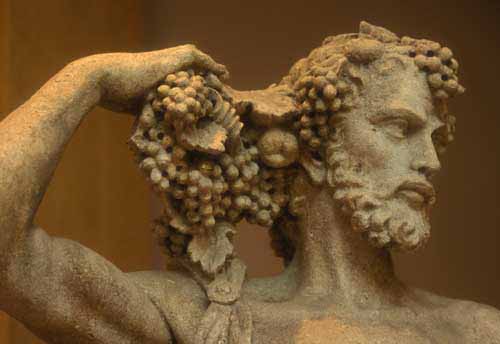
In addition to its significance as a trade commodity, wine also served important religious, social and medical purposes in ancient Hellenic society. Wine, wine making and wine drinking was, almost needless to say the domain of the Theos of Wine Himself: Dionysos. The medicinal use of wine was frequently studied by the ancient Hellenes, including Hippocrates, who did extensive research on the topic. He used wine as a cure for fevers, to ease convalescence and as an antiseptic. He also studied the effect of wine on his patients' stool. Various types of wine were prescribed by ancient Hellenic doctors for use as an analgesic, diuretic, tonic and digestive aid. They were also aware of some negative health effects, especially those arising from the consumption of wine beyond moderation.
On Thursday, 24 March, at 10 AM EDT, Elaion is hosting a PAT ritual for the Galaxia. This rather obscure festival was held in many places in ancient Hellas, but most notably at Olympia. The Galaxia was closely linked to the vernal equinox, which was used to date it and was (amongst others) in honor of Kronos and Rhea.


The Galaxia is a festival held in honour of the Mother (of the Gods), who in Hellenic mythology is Rhea, although the title is also strongly associated with Gaia and Kybele, who have similar functions. She was worshipped as the mother of Zeus and the Galaxia celebrated His birth just as much as Her giving birth to him. Kronos--as Her consort and His father--was most likely also sacrificed to, along with Hera, who as Zeus' wife deserved honour alongside Him. In our ritual, we have included Helios and the Horai as well, as the Galaxia was associated so closely with the Spring Equinox.

The Galaxia had a special beverage attached to it--well, a special food item: a milk and barley porridge that may have been sacrificed to the Mother, but which was at least consumed at the festival. Pliny the Elder names the porridge a 'puls', which seems to have been a more general term which included pastes made from lentils and beans as well as from grain. On barley-based porridge, he has the following to say in his 'Natural History':

"There are several ways of making barley porridge: the Greeks soak some barley in water and then leave it for a night to dry, and next day dry it by the fire and then grind it in a mill. Some after roasting it more thoroughly sprinkle it again with a small amount of water and dry it before milling; others however shake the young barley out of the ears while green, clean it and while it is wet pound it in a mortar, and wash it of husk in baskets and then dry it in the sun and again pound it, clean it and grind it. But whatever kind of barley is used, when it has been got ready, in the mill they mix in three pounds of flax seed, half a pound of coriander seed, and an eighth of a pint of salt, previously roasting them all. Those who want to keep it for some time in store put it away in new earthenware jars with fine flour and its own bran. Italians bake it without steeping it in water and grind it into fine meal, with the addition of the same ingredients and millet as well." [XVIII-XIV]

Sources which mention the festival speak only of a milk and barley beverage that can be poured. Fundamentally, porridge is made by mixing oats with a fluid (normally water and or milk) and then heating it. Combine barley, water, and salt in a heavy saucepan. Cover, and bring to a boil over high heat, stirring continuously. Turn the heat to low and steam until grains are soft and all the liquid is absorbed. Add the milk once the water level drops below the level of the barley. Cooking time depends on the form of barley used. Use one cup dry barley on three cups of water.

- Hulled barley is unprocessed and takes the longest to boil, about an hour and 15 minutes before it's soft.
- Pearl Barley or Pearled Barley is the most common form of barley available and is sold in most supermarkets. Because the outer hulls including the bran have been removed, the grains have a pearly white color. Cooking time: 50-60 minutes.
- Quick Barley, or instant barley is pearl barley that is pre-steamed then dried, shortening the cooking time considerably, about 10 to 12 minutes.
- Barley Grits are processed similar to bulghur wheat. The grain is cracked, and toasted or parboiled, then dried, making it a quick-cooking product--about 2-3 minutes. As such, add a little less water or milk.
- Barley Flakes, Pressed Barley, or Rolled Barley have the appearance of rolled oats and are often included in muesli-type cereals. The cooking time is about 30 minutes.
- Barley Flour is hulled barley that is finely ground and has a lightness and delicate sweetness. It can be stirred into milk until the right consistency is reached.
To get a consistency where the puls can be poured, add milk or water to thin the porridge. If you want to sweeten the porridge a little, add warmed honey to the mixture.

We hope you will join us on Thursday. The ritual can be found here and you can join the community here.
I get a lot of questions from readers, and most of the time, the answers are fairly short. When I feel the question or the reply would be valuable to others as well, I make a post with a collection of them and post them in one go. Today is one of those posts.


"Regarding the overhaul to the setup of the blog: I only have one item that I'm concerned about, and that's the fact that all posts appear to be undated now. I liked having dates, as it makes it easier to cite entries on this blog as sources for academic purposes. Can we have the dates back, please? :)"

So, I hadn't even noticed that! Thank you for pointing it out! It's back now, in the bottom beam, next to the share buttons, above the labels. I'm still tweaking things, by the way, on the new lay-out. Nothing major but still. If you notice something amiss or missing, let me know!


***

"I was curious if there was a specific reason that milk wasn't drunk by the Ancient Greeks?"

Mostly, the ancient Hellenes considered anything their non-Greek speaking neigbours did 'barbaric'--and their neighboors drank milk. Peasants drank milk--because hey, precious food--but most likely they used most of the milk they got from their sheep, cows, and goats to make cheese. It's an old custom to link milk to barbarism, by the way. It's already in Hómēros' 'Odysseia' in which the cyclops that tried to eat Odysseus and his crew drank milk:

"He curdled half the milk and set it aside in wicker strainers, but the other half he poured into bowls that he might drink it for his supper." [IX]

This observation follows after it's minutely detailed how the crew ate only cheese and sacrificed only cheese as well. Speaking of sacrifice: milk was also an oft-given gift to the dead. We, generally speaking, avoid eating things we associate with the dead to avoid miasma. So cheese is fine, yoghurt is fine, but milk is not.


***

"Can I be a Hellenic Polytheist if I worship just a few Olympian gods, and two of them aren't Zeus and Hera? I mean... I don't want to be disrespectful to any of the Theoi, is just that I don't feel a connection with the 12 (and Poseidon kind of scares me) but if worship all the Olympians is the 'right' thing to do, I will do it the best I could. Sorry if my doubts are dumb, i'm new in this."

There are no dumb questions, I promise. Okay, so, short answer: yes, technically, you can be an Hellenic Polytheist as long as you worship more than one Hellenic God. 'Recon' is out but 'Polytheist' would still work. This is technically. Personally, I feel anyone who wishes to call themselves an Hellenic Polytheist needs to understand that the Theoi come as a package deal, a family, a world ecompassing whole that cannot function if a piece is missing.

Roughly divided, all our Gods and heroes (who were often raised up to become Gods in their own right) fit into five generational categories. These are the:
  • Protogenoi
  • Uranides
  • Titanes
  • Olympic Gods
  • Heroes/deified mortals
The Protogenoi are the Gods from which the universe is made. They are Gods like Khaos, Gaia, Ouranos, and Nyx. In general, these Theoi are more abstract and less defined than, say, the Olympians. They are cruder, more powerful Gods who, together, form the tapistry of earth and life. We simply could not live without Them as They are the air we breath, the earth we walk on, the water we drink and the death that eventually lays us to rest. and yet, neither we, nor the ancient Hellenes revered them often. They are distant and hav very little to do with the individual's lifecycle.

The Uranides formed the world created by the Protogenoi into the world we know now. They are the children of the Protogenoi and They are in charge of  more specific domains. They give us the constellations, intellect, light, memory, navigation, and many other things without which we simply would not be able to live the life we live. Like the Protogenoi, these Gods make up the tapestry of the universe and did not recieve much direct worship in state festivals.

The Titanes are Gods with whom we are more familiar. They are Helios, Hekate, Lêtô, Selênê and many others. This is the first generation of Gods we are more familiar with by name than function--and also the first generation whose names don't always directly relate to the domains they are familiar with, although we know them through mythology. Lêtô, for example, is identified as the Goddess of motherhood and protectress of the young while we mostly know her as mother of Apollon and Artemis. These Gods often times--but not always--recieved individual worship and were sometimes included in state festivals. They feature in mythology and possess well-rounded personalities that we know (unlike, say, the Protogenoi).

We all know the Olympic Gods. They are the Gods we worship most. They are also the sole 'generation' of Gods who span two generations: they are the children of the Uranides (like the Titanes), and the children of the Olympians. Zeus and His brothers and sisters for example, were born from Rhea and Kronos (both Uranides), but Their children (Hēphaistos, Artemis, Apollon, etc.) are also counted amongst the Olympians. In general, if a Gods is said to reside on Mount Olympos, They are known as an Olympic God. Alternatively--or perhaps erroneously--the Olpmpic Gods are interpreted to be solely the Dodekatheon, the Twelve Olympians who ruled over humanity and the Gods from the top of the mountain. The most canonical version of the Dodekatheon is: Aphrodite, Apollon, Ares, Artemis, Athena, Demeter, Hēphaistos, Hera, Hermes, Hestia, Poseidon, and Zeus. Theoi who were held in high regard in a certain city-state would have held the thrones, according to the people who lived in that city-state, and many different Gods have been counted amongst the Dodekatheon over the centuries. Needless to say, most (state) worship in ancient times focussed on the Olympians.

The heroes of Hellenismos recieve(d) quite a bit of worship. Many heroes were local ones, but we have all heard of Hēraklēs, of Perseus and Theseus, of Atalanta and Odysseus. These heroes represent the most powerful, most virtuoes of all humans and teach us the qualities the Theoi enjoy seeing in us. Many of these heroes were fathered (and sometimes mothered) by the divine and they are thus part of the divine line. In fact, the heroes can be counted amongst the Olympians.

While the main body of our worship focusses on the Olympians, the Olympians did not come to power in a vacuum. The Old Gods presided over the building blocks of the previous generation, like the Olypmians preside over the building blocks of all three. Looking over the list, it's easy to trace the domains of the Olympians back to their predecessors--or even the God or Goddess They hold sway over directly. While the Olympian generation of Gods rule our daily lives, They operate in the framework of the Titans, the Uranides and the Protogenoi. These intricate lines built a web that is of vital importance to see in order to understand not only Hellenic mythology but also the Gods themselves.
Hellenic Recons (and a portion of Hellenic Polytheists) are aware of these generations and they can trace familial lines of influence down through the generations of the Gods. They understand that all Gods play a vital role in the tapestry of the world and that they need to be revered alongside Their brothers, sisters, parents, and sometimes even Their children.

Seeing the Gods as separate from each other like we often do in modern Paganism would not even have occurred to the ancient Hellenes. They did not see themselves separate from their spouse, their children, their parents, their cousins, etc., so why would they think of the Gods that way?

That said, not every God needs to be worshipped daily. The cycle of festivals provided enough moments to honour all major Gods throughout the year, after all. every household focussed on those Gods that were inportant to their family, either through (percieved) geneology, experience, or practical matters like making a living. A soldier would pay regular homage to Ares and Athena, a blacksmith to Hephaistos, and so on. But even if they only paid homage to Asklepios during His festivals, they would go to His temple to pray in case someone fell ill. If a sea voyage was in the cards, the family would pay tribute to Poseidoneven if they never sacrificed to Him during household worship.

I don't know if the ancient Hellenes thought any Ouranic God was frightening. I doubt it. All of the Gods were revered with respect and proper etiuette so as not to upset Them. That's simply good form when drawing the attention of someone a lot more powerful than you onto yourself.

So, that's the long answer: yes, you can, but I can't think of a reason why you would want to if you truly wish to commit to the ancient Hellenic Gods.
If you have been followign along with my posts about our Eleusinian Mysteries celebration, you know that today is a voluntary fasting day. But why are we fasting? And should you do it?

The mythical foundation for the Eleusinian rites is of course described in the second Homeric hymn, to Demeter, as assumed to be written by Pámphōs (Πάμφως), an early Hellenic poet, who is mentioned by Pausanias to have lived earlier than Hómeros himself. Pámphōs was the author of various hymns to deities, including the hymn to Demeter, and was connected to the mysteries as such. From the Homeric hymn to Demeter:

"Bitter pain seized [Demeter's] heart, and she rent the covering upon her divine hair with her dear hands: her dark cloak she cast down from both her shoulders and sped, like a wild-bird, over the firm land and yielding sea, seeking her child. But no one would tell her the truth, neither god nor mortal men; and of the birds of omen none came with true news for her. Then for nine days queenly Demeter wandered over the earth with flaming torches in her hands, so grieved that she never tasted ambrosia and the sweet draught of nectar, nor sprinkled her body with water."
 
Initiates were also instructed to fast each day from dawn until sunset, following the example of Demeter who would neither eat nor drink while searching for her lost daughter. In the evenings initiates could eat and drink, except for the traditionally forbidden foods.
 
Fasting is a very ancient phenomenon. In fact, an original starting date cannot be given. Fasting is the act of voluntarily withholding food from your body for a longer period of time than you would normally be without it. Great thinkers like Hippocrates, Plato and most of their students were avid practitioners and promoters of medicinal fasts and felt that a fast helped them think clearer.

I have fasted in the past, finding it a very useful tool for cleansing my body, clearing my mind and regaining focus on the things that matter. Regulars fasts have been proven to be very healthy, if you do it right. There is a method to fasting, and it depends greatly on the length of the fast. A fast is a cathartic tool because it cleans up the toxins in our organs and blood. It's a natural purge. Fasting also strengthens the will, and allows us to focus on something other than meals and snacks. It frees us up to pursue intellectual endeavor, and that process is also part of katharmos.

Fasting is a beautiful practice and I feel it should be a regular part of the Hellenic Tradition, but it's important to listen to your body before even attempting it. A short fast should only be done when your body needs it or, in this case, when your body is in a good enough shape to do it for a religious festival. If not, cheat a little and use the fruit shakes. If that's also too much, pick something else you love to go without; if you smoke, vow to go without cigarettes for the day, if you're a big coffee drinker, give it up for the duration of your 'fast'. What matters is that you give something up. That you go without.

So, for today, grieve with Demeter over the loss of Her daughter and remember a time when people went without food because Demeter had not shared Her secrets yet. Once you get hungry, remmeber to be grateful of the source of your food. Take no bit for granted once you have completed your night time 'initiation' rite and make sure to thank Demeter for Her gentle care.
I get a lot of questions from readers, and most of the time, the answers are fairly short. When I feel the question or the reply would be valuable to others as well, I make a post with a collection of them and post them in one go. Today is one of those posts.


"Hi! Can you please help me? Do you know someone who Worships Circe/Kirke? Do you know any books that are not the Argonautics and Odyssey I can use? Thank you so much."

I, personally, do not know of someone who is–as is the Pagan term–devoted to Kirkê, but I would hope all Hellenists worship Her! Please make yourself known if you feel especially drawn to Her, everyone!

As for books… I am going to make a list including the ones you mentioned, just so others can enjoy them, too. There are more with short mentions, but these actually have stories about Her–most about the Argonauts or Odysseus, but they all have different details.
--
 
"Hi, I was just wondering, what's the difference between revivalism and reconstructionism?"
 
In my opinion, reconstructionism is a scale. On the one end of the spectrum are the Traditional Reconstructionists who tend to rely first and foremost on historical or archaeological sources in shaping their religion, then, with that information in hand, approach the Gods in accordance with what they have learned. On the other end of the spectrum is the ‘working with, summon into a circle, all Gods are the same’-Neo-Pagans who tend to go with an ‘if it feels right, go for it, no matter if the ancient Hellenes would have recognised it as worship’-approach.

Then there is everything inbetween.

I would say a revivalist is somewhere in the middle, give or take a bit. They may approach the Gods in a somewhat traditional manner based on historic evidence but incorporate Neo-Pagan ideas to interpret the experience or the other way around. I don’t think there is a hard line, though, and at the end of the day it’s all a matter of semantics; words used to make it easier to explain our views to others.

---
 
"Hey there! Would it be cultural appropriation if I were to start practicing Hellenismos as a religion even though I am not related to it in any way? I am interested in it as a genuine way of life, not just a whimsy, and I'm honestly conflicted."
 
I’m not Greek. I do not speak Greek (sadly). I worshp the Hellenic Gods with every fiber of my being. Personally, I feel that what matters is your devotion to the Theoi, not your heritage.
 
---
 
"Did the ancient greeks have anything they didn't eat? Like Muslims don't eat pork, should I (as a Hellenic recon) be cutting anything out of my meals?? they didn't drink unmixed wine, right? And during specific festivals they had some dietary restrictions, but in general was there anything they didn't eat? Thank you and I love your blog! :)"
 
The main diet of the ancient Greeks consisted of bread, olives, olive oil, figs, cheeses, fish, squid, grapes, apples and other fruits, and honey. Meat was expensive and thus rarely eaten. Domesticated animals were only eaten after being sacrificed to the Gods. To not do so was barbaric and impure. Also considered barbaric was to drink wine which was not watered down and to drink milk. Breakfast and lunch consisted of bread dipped in wine, with olives, figs, cheese or dried fish added to the lunch menu. Dinner usually consisted of vegetables, fruit, fish, and possibly honey cakes.

As you have said, the ancient Hellenes had dietary restrictions around specific festivals. Certain foods were forbidden to eat during the Greater Mysteries, for example, and perhaps also during the lesser mysteries–pomegranates, apples, eggs, fowls, and some varieties of fish.

On that (diluted) wine–wine was rarely drunk during dinner, but only after. Drunkenness was frowned upon and all that was allowed for a grown man was less undiluted wine than a single standard wineglass of modern times, diluted. So why diluted wine? Rituals and sacrifices to the Ouranic deities and/or positive occasions were performed with diluted wine, while sacrifices to Khthonic deities and/or for negative occasions were performed with undiluted wine. To drink undiluted wine for any day-to-day happening was therefore not done and most likely carried some religious taboo or at least superstition.

In short: no, no dietary restrictions unless a specific festival or wine was concerned, but I stay away from milk (all other dairy products are acceptable) because it was frowned upon to drink milk in ancient Hellas.