Showing posts with label Atlas. Show all posts

 In Greek, the term 'Atlantis' means 'island of Atlas' (Ἀτλαντὶς νῆσος), and it may very well have applied to the island of Santorini. It was Plato who brought life--and myth--to Atlantis. According to him, Poseidon fell in love with Cleito, the daughter of Evenor and Leucippe, who bore him five pairs of male twins. The eldest of these, Atlas, was made rightful king of the entire island and the ocean--called the Atlantic Ocean in his honor--and was given the mountain of his birth and the surrounding area to rule over. It was also Plato who wrote that Poseidon made Atlantis--a huge island with a volcano at its center--His home after Zeus, Hades and He divided the world.


Plato's description of Atlantis would have fit the ancient hellenic version of Santorini well. It was a large, mountainous, island, with an active volcano at its center. The large settlement on the island was build around said volcano. Poseidon's influence on the island isn't a stretch of the imagination at all; there was sea and ocean all around and from time to time, the entire island would tremble due to the volcano.

The volcano eruption decimated the settlement, but from what archeologists and scholars have been able to piece together, the settlement was a sight to behold while it stood. It had walls eight meters tall, three story houses, beautiful frescos and a rich economic climate. The volcano eruption preserved much of the ancient city of Akrotiri, despite the huge lagoon the eruption left at the center of the island.

One of Atlantis' marvels was the much-praised and highly valuable metal called 'orichalcum'. It was called 'aurichalcum' by the Romans and is a metal mentioned in several ancient writings, including the story of Atlantis in the Critias dialogue, recorded by Plato. In it, he says:

"Some of their buildings were simple, but in others they put together different stones, varying the colour to please the eye, and to be a natural source of delight. The entire circuit of the wall, which went round the outermost zone, they covered with a coating of brass, and the circuit of the next wall they coated with tin, and the third, which encompassed the citadel, flashed with the red light of orichalcum."

The name derives from the Greek ὀρείχαλκος, oreikhalkos (from ὄρος, oros, mountain and χαλκός, chalkos, copper or bronze), meaning literally 'mountain copper' or 'copper mountain'.

In January 2015, a team of divers have discovered dozens of pieces of ancient metal from a shipwreck, aged 2,600 years, off the coast of Sicily island, in the south of Italy. The lumps of metal were arriving to Gela in southern Sicily, possibly coming from Greece or Asia Minor. The ship that was carrying them was likely caught in a storm and sunk just when it was about to enter the port. They were unlike any metal ever found. Analyzed with X-ray fluorescence, the 39 ingots turned to be an alloy made with 75-80 percent copper, 15-20 percent zinc and small percentages of nickel, lead and iron.

The mining of orichalcum would have made Atlantis (or Santorini) very wealthy as it seems the metal was only mined there, and orichalcum was considered second only to gold in value.

The ancient Hellenes viewed the Earth as a round disk divided into equal parts by the Mediterranean Sea and the (Black) Sea (first called the Inhospitable Sea by Pindar, then the Hospitable Sea once the shores became inhabited). Okeanos, a mystical river, flowed around the entire disk, and mysterious peoples—the Hyperboreans in the north, the Ethiopians in the far south and the Kimmerians in parts unknown—lived outside Okeanos' perimeter. 

The ancient Hellenes also believed that the heaven was made up of celestial spheres. The celestial spheres, or celestial orbs, were the fundamental entities of the cosmological models developed by great philosophers and astronomers like Plato, Aristotle, and Ptolemy. It was believed that the stars were fixed and did not change their positions relative to one another. As such, it was argued that they must be on the surface of a single starry sphere. The apparent motions of the fixed stars and the planets are accounted for by treating them as embedded in rotating spheres made of an aetherial, transparent fifth element (quintessence).

According to the Homeric hymns, the ancient Hellenes also believed that there are columns that keep apart earth and heaven. It's most likely these columns or pillars were mountains in the centre of the disk, or at the edge of the disk. It were these pillars that Atlas guarded, or he was the actual pillar who held up the spheres--and thus the actual mountain. As Hesiod writes in the Theogony

"[At the ends of the earth, where lie the roots of earth, sea, Tartaros :] There stands the awful home of murky Nyx wrapped in dark clouds. In front of it [Atlas] the son of Iapetos stands immovably upholding the wide heaven upon his head and unwearying hands." [744]

Now we are on the topic, it also depends upon tradition if Atlas held up the celestial orbs as punishment, or if he was chosen to do it as an honour to him. The punishment part is perhaps best described by Hyginus in his Fabulae:

"After Juno [Hera] saw that Epaphus, born of a concubine, ruled such a great kingdom, she saw to it that he should be killed while hunting, and encouraged the Titanes to drive Jove [Zeus] from the kingdom and restore it to Saturn [Kronos]. When they tried to mount to heaven, Jove with the help of Minerva [Athene], Apollo, and Diana [Artemis], cast them headlong into Tartarus. On Atlas, who had been their leader, he put the vault of the sky; even now he is said to hold up the sky on his shoulders." [150]

Hómēros, in his Odysseia, takes an opposite--or at least milder--view, implying the honour in Atlas' position:

"Atlas the baleful; he knows the depths of all the seas, and he, no other, guards the tall pillars that keep the sky and earth apart." [1.52]

It makes sense, in fact, to have holding up the heavens be an honour: if Atlas slacks even a moment, the celestial spheres would crash down onto Earth and destroy it, killing everyone. It's a huge responsibility, and to give that to someone pissed off for losing a war seems foolish. 

Like many of the myths concerning the ancient Titans, there are versions of mythology where Atlas no longer bears the heaven. In this case: Pindar describes it as such in the Pythian Odes:

"Does not even now great [Titan] Atlas struggle to bear up the weight of heaven, far from his fathers’ land and his possessions? But almighty Zeus set free the Titanes, for as time passes and the breeze abates, the sails are set anew." [4]

The Farnese Atlas is a 2nd-century Roman marble copy of a Hellenistic sculpture of Atlas kneeling with the celestial spheres, not a globe, weighing heavily on his shoulders. It is the oldest extant statue of Atlas, as well as the oldest known representation of the celestial sphere. The globe shows a depiction of the night sky as seen from outside the outermost celestial sphere, with low reliefs depicting 41 (some sources say 42) of the 48 classical Hellenic constellations distinguished by Ptolemy. The sphere is made up of solid marble, and contains no actual stars. This may have aided the formation of the common misconception that Atlas was forced to hold the Earth on his shoulders. I hope this post clears up a bit of the confusion.

Back in July, I reported on plans by Roberto Sciarratta, director of the archaeological park on Sicily, to build a giant Atlas statue in front of the temple of Zeus. We have some more information!


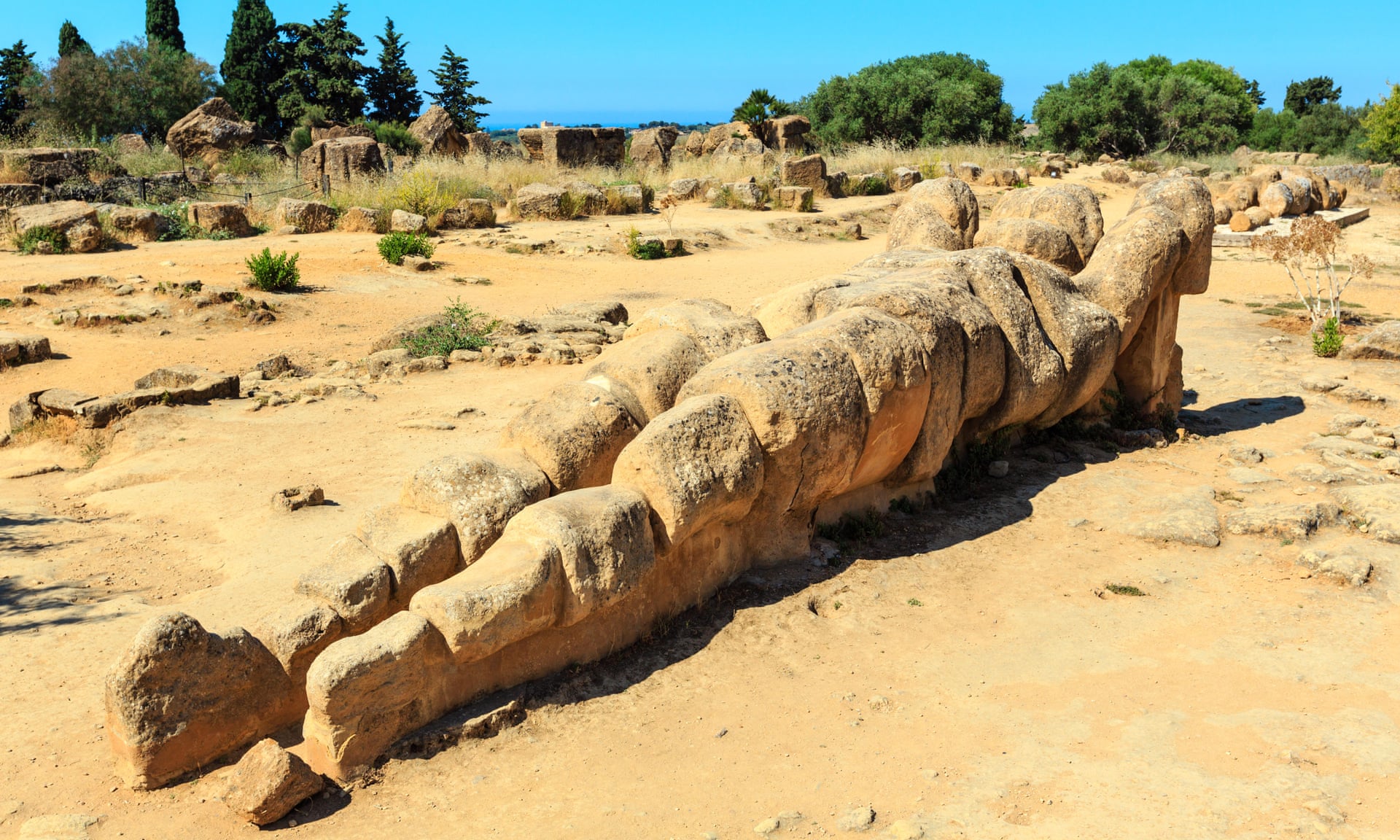
A reassembled, 26-foot-tall statue of the mythological Titan Atlas will soon stand guard over the Temple of Zeus in Agrigento, Sicily. As Franz Lidz reports for the New York Times, Roberto Sciarratta, director of the Valley of the Temples archaeological park, commissioned the “Franken-Atlas”—which will feature fragments from eight of the temple’s original limestone Atlases within a steel-ribbed contemporary likeness of the Titan—in honor of the 2,600th anniversary of Akragas’ (now known as Agrigento) founding.

Once home to 38 towering Atlas statues, each of which seemingly supported a section of the structure’s architrave, or main beam, the Temple of Zeus was the largest Doric temple ever constructed. Built during the fifth century B.C. but never completed, the architectural wonder is now in ruins.

Speaking with the Guardian’s Lorenzo Tondo in July, when the project was first announced, Sciarratta said, “The re-installment of the statue of Atlas is the culmination of a more comprehensive restoration [of the temple].”

He added, “In the last decade, we’ve recovered and cataloged numerous artifacts that were once a part of the original structure. … The goal is to recompose piece-by-piece the trabeation [beams] of the Temple of Zeus to restore a portion of its original splendor.”

Just one of the 38 Atlases—also known as telamones—remains partially intact today. But excavations over the past 15 years have recovered pieces of the ancient statues, as well as dozens of other artifacts dated to the temple’s heyday, enabling archaeologists to reconstruct a version of the Titan. (A replica of the sole surviving statue currently lies near the ruins, but as park spokesperson Leonardo Guarnieri tells the Times, “It is not authentic.”)

Atlas was a major figure in Greek mythology. One of the Titans, a race of pre-Olympian gods descended from Uranus (the Sky or Heavens) and Gaia (the Earth), he was forced to hold the world atop his shoulders after losing a war against Zeus and the other Olympian gods—a burden mirrored in the Temple of Zeus’ telamones.

“The idea is to reposition one of these Atlases in front of the temple,” Sciarratta told the Guardian. “So that it may serve as a guardian of the structure dedicated to the father of the gods.”

According to Livius’ Joana Lendering, the Temple of Zeus was built around 480 B.C. to commemorate the tyrant Theron’s defeat of the Carthaginians. Theron likely relied on enslaved prisoners of war to construct the enormous structure.

During the fifth century, Akragas hosted more than 100,000 people, per the Guardian. But its fortunes waned over the years, with residents eventually repurposing parts of the ancient monuments for new buildings. The temple’s current state of disrepair is the result of 2,000 years of “earthquakes and pilfering,” notes the Times.

Plans to resurrect one of the Atlas statues have attracted criticism, with some archaeologists arguing that the project is in poor taste because it fails to offer an authentic portrayal of the temple and the objects around it.

“No archaeologist would endorse the use of ancient sculpture, no matter how fragmentary, to create a modern sculpture, even if the purpose is to highlight the site’s antiquity,” C. Brian Rose, an archaeologist at the University of Pennsylvania Museum of Archaeology and Anthropology, tells the Times.

Still, it’s worth noting that Italian news outlet Agrigento Notizie has disputed the claim that the resurrected statue is a “deceptive” reconstruction. In fact, Agrigento Notizie points out, the sheet of steel set to surround the original Atlas fragments will mainly serve to protect the fragile stone from erosion and keep the reassembled blocks in place.

In Greek mythology, Atlas was a Titan or god who was forced to bear the sky on his shoulders after being defeated by Zeus, one of the next generation of gods called Olympians. The city’s archaeological park announced that the artwork, one of the most celebrated sculptures on the island, will be raised upright in front of the Temple of Zeus.


The statue, eight metres high and built in the 5th century BC, was one of nearly 40 that adorned the ancient building, considered the largest Doric temple ever built, even if it was never completed and now lies in ruins. Roberto Sciarratta, director of the archaeological park, stated:

“The reinstalment of the statue of Atlas is the culmination of a more comprehensive restoration [of the temple]. In the last decade, we’ve recovered and catalogued numerous artefacts that were once a part of the original structure … The goal is to recompose piece-by-piece the trabeation [beams] of the Temple of Zeus to restore a portion of its original splendour.”

 A view of Agrigento’s Valley of the Temples. Photograph: Murdo MacLeod/The Guardian
Archaeologists and architects will soon start work to raise the statue in Sicily’s Valley of the Temples on the occasion of the founding of the ancient city of Akragas (now Agrigento) 2,600 years ago.

It was one of the leading population centres in the region during the golden age of Ancient Greece and holds seven well-preserved Greek temples.

Built on a high ridge over a span of 100 years, they remain among the most magnificent examples of Greek architecture. In the 5th century, more than 100,000 people lived there and, according to the philosopher Empedocles, they would “party as if they’ll die tomorrow, and build as if they will live for ever”.

The city was destroyed in 406 BC by the Carthaginians, and its prosperity did not return until the rise of Timoleon in the late third century BC. During the Punic wars, the Carthaginians defended the settlement against the Romans, who seized control of the city in 210 BC.

During the Roman era, the city – renamed Agrigentum (subsequently known as Girgenti) – underwent a period of monumental urban redevelopment with new public buildings, including at least two temples.

Over the centuries, brickwork from the old monuments of the ancient city was taken for use in the construction of the buildings around Girgenti and the ancient harbour of Porto Empedocle.

Historians also maintained that the Temple of Zeus was never finished because it was still lacking a roof when Akragas was conquered by the Carthaginians.


Outside the temple, huge statues of Atlas were frozen in the act of supporting the temple.

“The idea is to reposition one of these Atlases in front of the temple,” says Sciarratta, “so that it may serve as a guardian of the structure dedicated to the father of the gods.”
Every day, the average human utters about 16.000 words. A good portion of those are idioms and figures of speech--the use of a word or words diverging from its usual meaning--or sayings. Today, I wanted to share some of the figures of speech and sayings that can be traced back to ancient Hellas and/or Hellenic myth. Some of these I have posted before, but I've collected another few in the mean time. These are marked with a *.


"A Herculean Effort"
Meaning: a great effort.
Source: Hēraklēs, son of Zeus and the mortal Alcmene--who was a bane in Hera's life, simply for being born--was stricken mad by the Queen of the Gods and killed his five sons by his wife Megara, oldest daughter of Kreōn of Thebes. When he was released from his madness by a hellebore potion--provided by Antikyreus--and realized what he had done, he cried out in anguish, and went on a long journey to cleanse himself of the miasma caused by these killings. First, he visited the oracle at Delphi, who, unbeknownst to him, was whispered to by Hera. The Oracle told Hēraklēs to serve the king of Tiryns, Eurystheus, for ten years and do everything Eurystheus told him to do. Eurystheus gladly provided Hēraklēs with these labors--ten of them, one for each year--and eventually ended up adding two more, resulting in the Twelve Labors of Hēraklēs. Hēraklēs was told to: slay the Nemean Lion, slay the nine-headed Lernaean Hydra, capture the Golden Hind of Artemis, capture the Erymanthian Boar, clean the Augean stables in a single day, slay the Stymphalian Birds, capture the Cretan Bull, steal the Mares of Diomedes, obtain the girdle of Hippolyta, Queen of the Amazons, obtain the cattle of the monster Geryon, steal the apples of the Hesperides, and to capture and bring back Kerberos. All of these tasks were incredibly hard, and required every ounce of strength Hēraklēs possessed.

"A Sisyphean task"
Meaning: (performing) an endless or repetitive task.
Source: Sísyphos was a scheming and conniving king, who tried to pull a fast one on the Gods many times over. He betrayed Zeus, tried to trick Thanatos, Persephone and Hades, and killed innocent travelers on his roads--an offense against xenia. For all these offenses, Sísyphos was sentenced to push a boulder uphill for all eternity, as the boulder would roll down the slope again the second he reached the top.

"Achilles' heel"
Meaning: one's weakness or weak spot.
Source: Achilles was a great warrior, destined to live one of two lives: a long and boring one, or a short but heroic one. Knowing her son would choose the latter, his divine mother Themis tried to limit the risk of Achilles dying a premature death by dipping him in the river Styx. As such, Achilles became impenetrable to harm, save for his heel, where his mother had held him as she dipped him in the water. This spot eventually became his downfall, and Achilles died on the battlefield of Troy. The stories of his invulnerability were a later invention, around the first century AD. Before that, the myth simply stated that Achilles was shot in the heel with an arrow, and he eventually died of that wound, because it would not heal.

"Bearing the weight of the world (on one's shoulders)" *
Meaning: a very heavy burden of worry or responsibility.
Source: This is a reference to Atlas, the Titan who was forced to carry the heavens on his shoulders after he and his brethren rebelled against Zeus in the Titanomachy. Depending on the source, however, it was actually a great honour to be asked to protect the whole of the earth from being crushed under the weight of the sky.

"Beware of Greeks bearing gifts"
Meaning: be weary of those with something to offer, they may have ulterior motives.
Source: In the war for Troy, the Hellenes needed a way to conquer the walls of the city. They tried to fight for it, but were unable to. In Virgil's Aeneid, it is written that the Hellenes built a wooden horse, and hid away in it. The horse was offered to the Trojans as a gift, and the structure was accepted into the city. At night, the Hellenes snuck out of the horse, attacked the city, and conquered Troy.

"Caught between a rock and a hard place"
Meaning: making a hard choice; choosing between two undesirable options.
Source: During Odysseus' travels to get home, he must run his ship through a narrow passage. One the one side are rocks with a cavern. In this cavern, Skylla, sea monster with six heads, lived, and she would take one of Odysseus' men with each of her heads. On the other side lay Kharybdis, a great whirlpool which would suck in any ship that came too close. It is up to Odysseus to choose one or the other. Eventually, he chooses Skylla, and looses many brave men, his ship, however, is in tact. As such, Odysseus had to choose between a rock and a hard place.

"Cupid's arrows" *
Meaning: rapidly falling in love--as if struck.
Source: The ancient Hellenes were just as mystified by love as we are today--more so, perhaps, because a least we know what happens chemically in our bodies when it happens. Their answer to the mystery of falling in love was that the arrow of Eros struck. Eros had two types of arrows: the golden-tipped arrow brought love and attraction, the lead-tipped arrow brought hate and repulsion. Cupid is the Roman version of Eros.

"Dog is man's best friend"
Meaning: the loyalty of dogs is undisputed
Source: In the Odysseia, Odysseus finally returns home after many, many long years of travel, and long years of war. He is in disguise when he reaches his house, which is overrun by suiters of his wife. His fateful hunting dog, Argos, has waited for him all these years, and recognizes his master right away. Finally reunited with his master, the old dog dies, happy, and at peace.

"Food of the Gods"
Meaning: food so delicious, it is almost divine
Source: Nectar--the drink of the Gods--and ambrosia--the food of the Gods--are the dish of choice on Olympos. If a mortal man or woman would eat or drink either of the two, they, too, would become immortal, or at least their aging would stop for a while.

"Gordian knots"
Meaning: an extremely perplexing puzzle or problem.  
Source: It seems that king Gordius of Phrygia laid out a task for whomever wanted to be the ruler of Asia Minor: he tied a know so complex, no one managed to untie is. Eventually, Alexander the Great came to the land, and cut the know with his sword, thus 'passing' the test. 'Cutting the knot' became a saying for taking something by force, or making a decisive action. 

"Having the Midas touch"
Meaning: a fortunate person, someone able to make everything a success.
Source: In Hellenic mythology, Midas was the king of Pessinus. It seems some of the peasants under Midas' commands brought the king the unconscious satyr Seilenos, who had drunk himself into a stupor. Alternatively, Seilenos toppled over in Midas' garden. No matter how he got there, Midas took good care of him, and as a token of appreciation, Dionysos--Seilenos' student--offered Midas a wish. Midas wished that everything he touched, turned to gold. This is where the saying comes from.

"Hounds of Hell"
Meaning: something frightening, or evil.
Source: Guarding the entrance to Underworld is a great dog, either with just one head, or three, or fifty. His name is Kerberos, and you can pass him once, on your way in, but never again, as there is no way out.

"Leave No Stone Unturned"
Meaning: search everywhere.
Source: The catch-phrase was first recorded by Euripides in his tragedy 'Heracleidae'. The play focusses on King Eurystheus, who hunts the children of Hēraklēs after he passes away. The actual quote comes from the line: "Now, after he was taken hence, was I not forced, by reason of these children's hatred, and because I was conscious of an hereditary feud, to leave no stone unturned by slaying, banishing, and plotting against them?"

"Oedipus Complex"
Meaning: a child's unnatural desire of their parent of the opposite sex, and jealousy of the parent of the same sex. Freudian theory.
Source: Oedipus was born to King Laius and Queen Jocasta. King Laius was fortold his son would kill him and marry his mother, and so he left him to die on a mountainside. The child was found, however, and raised by King Polybus and Queen Merope. Oedipus eventually heard of the prophecy about him and fled, not wanting to hurt his adoptive parents, who he believed to be his biological ones. Fate would have him end up on the same road as King Laius, and in an argument over whom would step out of the way, Oedipus killed his father. He then traveled on and eventually met and married his mother. The myth continues on, but this is the part where the figure of speech comes from.

"Pandora's box"
Meaning: to perform an action that may seem small or innocuous, but that turns out to have severe and far-reaching consequences.
Source: I've written quite a bit about Pandôra on this blog. Pandôra was created by the Theoi as punishment on humanity after Prometheus stole fire from the Gods. Pandôra showed up on the doorstep of Prometheus' brother Deukalion, with a pithos she was told never to open. Eventually, curiosity got the better of her,a nd she opened the jar. In some versions of the myth, all evils of the word flew out, but Pandôra managed to trap hope in the jar. There are many, many inconsistencies in the myth, but the figure of speech stuck.

"Pregnant with thought" *
Meaning: to be about to put forth a (great) idea.
Source: Potentially, this idiom comes from Greek mythology--namely the birth of Athena from the head of Zeus. Athena, as Goddess of wisdom represents a literal birth of ideas--which is pretty much the meaning.

"Siren's song" *
Meaning: an alluring utterance or appeal, especially one that is seductive or deceptive.
Source: In the Odysseia, Circe warned Odysseus not to listen to the Sirens--mythological mermaids--because their haunting music would drive him mad. Or if he did, at least have his sailors tie him to the mast to keep him from throwing himself overboard, and to plug his rowers ears’ with beeswax so they would be impervious to the sweet high song.

"Stygian darkness" *
Meaning: pitch black, sometimes dreary, darkness.
Source: The river Styx was the boundary between the upper world of the living and the underworld of the dead. It was so inky black that anything under its surface disappeared from sight.

"The face that launched a thousand ships"
Meaning: one person causing a terrible event.
Source: One fateful day, three Goddesses got into an argument about whom was most beautiful. Hera, Aphrodite, and Athena, all laid claim to a golden apple tossed into the crowd at a banquet held on honor of Peleus and Thetis. Eris had thrown the apple, which was labeled 'for the most beautiful'. The Goddesses could not decide who was the fairest, and so They asked Zeus. Zeus appointed Paris, A Trojan mortal, to choose in his stead. All three Goddesses undressed for Paris when asked, and all offered him gifts, if he would choose them. Aphrodite, however, promised him the most beautiful of wives, and PAris chose Her. Aphrodite picked Helen of Sparta as Paris' new wife, but Helen was already married, to Menelaus, who would eventually bring war down upon Troy to reclaim the wife he lost. Helen became the woman whose face 'launched a thousand ships' in war.

"To rise from the ashes"
Meaning: to be reborn
Source: No singular myth about the famous bird survives, but the phoenix was know to the ancient Hellenes. It was a mythical bird that lived its life, immolated, and was reborn from the ashes of its previous incarnation.
In Greek, the term 'Atlantis' means 'island of Atlas' (Ἀτλαντὶς νῆσος), and it may very well have applied to the island of Santorini. It was Plato who brought life--and myth--to Atlantis. According to him, Poseidon fell in love with Cleito, the daughter of Evenor and Leucippe, who bore him five pairs of male twins. The eldest of these, Atlas, was made rightful king of the entire island and the ocean--called the Atlantic Ocean in his honor--and was given the mountain of his birth and the surrounding area to rule over. It was also Plato who wrote that Poseidon made Atlantis--a huge island with a volcano at its center--His home after Zeus, Hades and He divided the world.

Plato's description of Atlantis would have fit the ancient hellenic version of Santorini well. It was a large, mountainous, island, with an active volcano at its center. The large settlement on the island was build around said volcano. Poseidon's influence on the island isn't a stretch of the imagination at all; there was sea and ocean all around and from time to time, the entire island would tremble due to the volcano.

The volcano eruption decimated the settlement, but from what archeologists and scholars have been able to piece together, the settlement was a sight to behold while it stood. It had walls eight meters tall, three story houses, beautiful frescos and a rich economic climate. The volcano eruption preserved much of the ancient city of Akrotiri, despite the huge lagoon the eruption left at the center of the island.

One of Atlantis' marvels was the much-praised and highly valuable metal called 'orichalcum'. It was called 'aurichalcum' by the Romans and is a metal mentioned in several ancient writings, including the story of Atlantis in the Critias dialogue, recorded by Plato. In it, he says:

"Some of their buildings were simple, but in others they put together different stones, varying the colour to please the eye, and to be a natural source of delight. The entire circuit of the wall, which went round the outermost zone, they covered with a coating of brass, and the circuit of the next wall they coated with tin, and the third, which encompassed the citadel, flashed with the red light of orichalcum."

The name derives from the Greek ὀρείχαλκος, oreikhalkos (from ὄρος, oros, mountain and χαλκός, chalkos, copper or bronze), meaning literally 'mountain copper' or 'copper mountain'.

In January 2015, a team of divers have discovered dozens of pieces of ancient metal from a shipwreck, aged 2,600 years, off the coast of Sicily island, in the south of Italy. The lumps of metal were arriving to Gela in southern Sicily, possibly coming from Greece or Asia Minor. The ship that was carrying them was likely caught in a storm and sunk just when it was about to enter the port. They were unlike any metal ever found. Analyzed with X-ray fluorescence, the 39 ingots turned to be an alloy made with 75-80 percent copper, 15-20 percent zinc and small percentages of nickel, lead and iron.

The mining of orichalcum would have made Atlantis (or Santorini) very wealthy as it seems the metal was only mined there, and orichalcum was considered second only to gold in value.
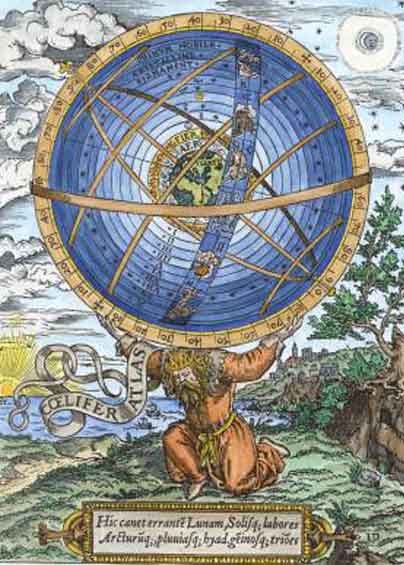
Um, guys? When I tell you Atlas holds/held up the heavens and not the earth, none of you is surprised, right? I got into a friendly discussion about the topic with someone who is--admittedly--not a Hellenist and now I just want to make sure all of you understand this little fact from Hellenic mythology. As Hesiod writes in the Theogony:

"[At the ends of the earth, where lie the roots of earth, sea, Tartaros :] There stands the awful home of murky Nyx wrapped in dark clouds. In front of it [Atlas] the son of Iapetos stands immovably upholding the wide heaven upon his head and unwearying hands." [744]

Here is the thing: the ancient Hellenes viewed the Earth as a round disk divided into equal parts by the Mediterranean Sea and the (Black) Sea (first called the Inhospitable Sea by Pindar, then the Hospitable Sea once the shores became inhabited). Okeanos, a mystical river, flowed around the entire disk, and mysterious peoples—the Hyperboreans in the north, the Ethiopians in the far south and the Kimmerians in parts unknown—lived outside Okeanos' perimeter.

The ancient Hellenes also believed that the heaven was made up of celestial spheres. The celestial spheres, or celestial orbs, were the fundamental entities of the cosmological models developed by great philosophers and astronomers like Plato, Aristotle, and Ptolemy. It was believed that the stars were fixed and did not change their positions relative to one another. As such, it was argued that they must be on the surface of a single starry sphere. The apparent motions of the fixed stars and the planets are accounted for by treating them as embedded in rotating spheres made of an aetherial, transparent fifth element (quintessence).

According to the Homeric hymns, the ancient Hellenes also believed that there are columns that keep apart earth and heaven. It's most likely these columns or pillars were mountains in the centre of the disk, or at the edge of the disk. It were these pillars that Atlas guarded, or he was the actual pillar who held up the spheres--and thus the actual mountain.

Now we are on the topic, it also depends upon tradition if Atlas held up the celestial orbs as punishment, or if he was chosen to do it as an honour to him. The punishment part is perhaps best described by Hyginus in his Fabulae:

"After Juno [Hera] saw that Epaphus, born of a concubine, ruled such a great kingdom, she saw to it that he should be killed while hunting, and encouraged the Titanes to drive Jove [Zeus] from the kingdom and restore it to Saturn [Kronos]. When they tried to mount to heaven, Jove with the help of Minerva [Athene], Apollo, and Diana [Artemis], cast them headlong into Tartarus. On Atlas, who had been their leader, he put the vault of the sky; even now he is said to hold up the sky on his shoulders." [150]

Hómēros, in his Odysseia, takes an opposite--or at least milder--view, implying the honour in Atlas' position:

"Atlas the baleful; he knows the depths of all the seas, and he, no other, guards the tall pillars that keep the sky and earth apart." [1.52]

It makes sense, in fact, to have holding up the heavens be an honour: if Atlas slacks even a moment, the celestial spheres would crash down onto Earth and destroy it, killing everyone. It's a huge responsibility, and to give that to someone pissed off for losing a war seems foolish.

Like many of the myths concerning the ancient Titans, there are versions of mythology where Atlas no longer bears the heaven. In this case: Pindar describes it as such in the Pythian Odes:

"Does not even now great [Titan] Atlas struggle to bear up the weight of heaven, far from his fathers’ land and his possessions? But almighty Zeus set free the Titanes, for as time passes and the breeze abates, the sails are set anew." [4]

The Farnese Atlas is a 2nd-century Roman marble copy of a Hellenistic sculpture of Atlas kneeling with the celestial spheres, not a globe, weighing heavily on his shoulders. It is the oldest extant statue of Atlas, as well as the oldest known representation of the celestial sphere. The globe shows a depiction of the night sky as seen from outside the outermost celestial sphere, with low reliefs depicting 41 (some sources say 42) of the 48 classical Hellenic constellations distinguished by Ptolemy. The sphere is made up of solid marble, and contains no actual stars. This may have aided the formation of the common misconception that Atlas was forced to hold the Earth on his shoulders. I hope this post clears up a bit of the confusion.