Showing posts with label Artemis Elaphêbolos. Show all posts

On the sixth of the month of Elaphebolion, the people of Athens and Phocis (Φωκίδα), and perhaps other cities and city-states, held a modest festival for Artemis that gave lended name to the month: the Elaphebolia (Έλαφηβόλια). Will you join us on March 20th at the usual 10 am EDT in celebrating the rite?


It appears that the festival was a major festival in honor of Artemis Elaphêbolos (Αρτεμις Ελαφηβολος) down to the time of Plutarch. It was mainly observed at Hyampolis, to commemorate a Phocian victory over the Thessalians. Afterwards, it seems to have lost its grander, most likely in the face of the Greater Dionysia which was held only a few days later, starting on the tenth of the month, and the Asklepia, held on the eighth.

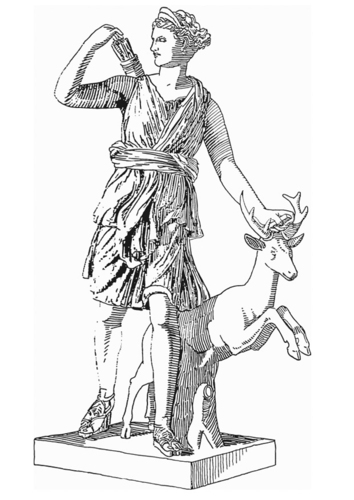
Artemis Elaphêbolos is the stag-killer, the shooter of deer, the huntress who relishes the chase. She's the slayer of prey, both animal and human, and in ancient Hellas, she guarded Hyampolis and the surrounding cities from the horrors of war.

The festival was most likely quite grand right after the war, but slowly became a festival which consisted almost entirely of a single offering. In the early days, the offering was always a stag, one per family, most likely. As the years went on, however, and the expansion of cities drove the stag far into the Athenian hills, only the city's elite was able to offer a stag to the Goddess. Everyone else made due with cakes in the shape of stags. It seems these stag cakes--called 'elaphos' (ἔλαφος)--were made out of the basic dough mixture with honey, and sesame seeds.

You can find the ritual here, and we really hope you will join us on the community page here.
On the sixth of the month of Elaphebolion, the people of Athens and Phocis (Φωκίδα), and perhaps other cities and city-states, held a modest festival for Artemis that gave lended name to the month: the Elaphebolia (Έλαφηβόλια). Will you join us on March 13th at the usual 10 am EDT in celebrating the rite?


It appears that the festival was a major festival in honor of Artemis Elaphêbolos (Αρτεμις Ελαφηβολος) down to the time of Plutarch. It was mainly observed at Hyampolis, to commemorate a Phocian victory over the Thessalians. Afterwards, it seems to have lost its grander, most likely in the face of the Greater Dionysia which was held only a few days later, starting on the tenth of the month, and the Asklepia, held on the eighth.

Artemis Elaphêbolos is the stag-killer, the shooter of deer, the huntress who relishes the chase. She's the slayer of prey, both animal and human, and in ancient Hellas, she guarded Hyampolis and the surrounding cities from the horrors of war.

The festival was most likely quite grand right after the war, but slowly became a festival which consisted almost entirely of a single offering. In the early days, the offering was always a stag, one per family, most likely. As the years went on, however, and the expansion of cities drove the stag far into the Athenian hills, only the city's elite was able to offer a stag to the Goddess. Everyone else made due with cakes in the shape of stags. It seems these stag cakes--called 'elaphos' (ἔλαφος)--were made out of the basic dough mixture with honey, and sesame seeds.

You can find the ritual here, and we really hope you will join us on the community page here.
On the sixth of the month of Elaphebolion, the people of Athens and Phocis (Φωκίδα), and perhaps other cities and city-states, held a modest festival for Artemis that gave lended name to the month: the Elaphebolia (Έλαφηβόλια). Will you join us on March 24th at the usual 10 am EDT in celebrating the rite?


It appears that the festival was a major festival in honor of Artemis Elaphêbolos (Αρτεμις Ελαφηβολος) down to the time of Plutarch. It was mainly observed at Hyampolis, to commemorate a Phocian victory over the Thessalians. Afterwards, it seems to have lost its grander, most likely in the face of the Greater Dionysia which was held only a few days later, starting on the tenth of the month, and the Asklepia, held on the eighth.

Artemis Elaphêbolos is the stag-killer, the shooter of deer, the huntress who relishes the chase. She's the slayer of prey, both animal and human, and in ancient Hellas, she guarded Hyampolis and the surrounding cities from the horrors of war.

The festival was most likely quite grand right after the war, but slowly became a festival which consisted almost entirely of a single offering. In the early days, the offering was always a stag, one per family, most likely. As the years went on, however, and the expansion of cities drove the stag far into the Athenian hills, only the city's elite was able to offer a stag to the Goddess. Everyone else made due with cakes in the shape of stags. It seems these stag cakes--called 'elaphos' (ἔλαφος)--were made out of the basic dough mixture with honey, and sesame seeds.

You can find the ritual here, and we really hope you will join us on the community page here.
On the sixth of the month of Elaphebolion, the people of Athens and Phocis (Φωκίδα), and perhaps other cities and city-states, held a modest festival for Artemis that gave lended name to the month: the Elaphebolia (Έλαφηβόλια). Will you join us on March 5th at the usual 10 am EST in celebrating the rite?


It appears that the festival was a major festival in honor of Artemis Elaphêbolos (Αρτεμις Ελαφηβολος) down to the time of Plutarch. It was mainly observed at Hyampolis, to commemorate a Phocian victory over the Thessalians. Afterwards, it seems to have lost its grander, most likely in the face of the Greater Dionysia which was held only a few days later, starting on the tenth of the month, and the Asklepia, held on the eighth.

Artemis Elaphêbolos is the stag-killer, the shooter of deer, the huntress who relishes the chase. She's the slayer of prey, both animal and human, and in ancient Hellas, she guarded Hyampolis and the surrounding cities from the horrors of war.

The festival was most likely quite grand right after the war, but slowly became a festival which consisted almost entirely of a single offering. In the early days, the offering was always a stag, one per family, most likely. As the years went on, however, and the expansion of cities drove the stag far into the Athenian hills, only the city's elite was able to offer a stag to the Goddess. Everyone else made due with cakes in the shape of stags. It seems these stag cakes--called 'elaphos' (ἔλαφος)--were made out of the basic dough mixture with honey, and sesame seeds.

You can find the ritual here, and we really hope you will join us on the community page here.
The festival season is starting up again, and Elaion is on a mission to host PAT festivals for all of them, so instead of spamming you with four posts for upcoming rituals, you are getting just one--with two of them, the Elapebolia, and the Asklepieia--today, and to--the Dionysia and the Pandia--in a few days.


The Elaphebolia
On the sixth of the month of Elaphebolion, the people of Athens and Phocis (Φωκίδα), and perhaps other cities and city-states, held a modest ritual that gave its name to the month: the Elaphebolia (Έλαφηβόλια). It appears that the festival was a major festival in honor of Artemis Elaphêbolos (Αρτεμις Ελαφηβολος) down to the time of Plutarch. It was mainly observed at Hyampolis, to commemorate a Phocian victory over the Thessalians. Afterwards, it seems to have lost its grander, most likely in the face of the Greater Dionysia which was held only a few days later, starting on the tenth of the month, and the Asklepia, held on the eighth.

Artemis Elaphêbolos is the stag-killer, the shooter of deer, the huntress, who relishes the chase. She's the slayer of prey, both animal and human, and in ancient Hellas, she guarded Hyampolis and the surrounding cities from the horrors of war.

The festival was most likely quite grand right after the war, but slowly became a festival which consisted almost entirely of a single offering. In the early days, the offering was always a stag, one per family, most likely. As the years went on, however, and the expansion of cities drove the stag far into the Athenian hills, only the city's elite was able to offer a stag to the Theia. Everyone else made due with cakes in the shape of stags. It seems these stag cakes--called 'elaphos' (ἔλαφος)--were made out of the basic dough mixture with honey, and sesame seeds.

The Elaphebolia was an important festival of Artemis. The 2015 festival day starts at dusk on the twenty-sixth of March, and will continue until dusk the day after. As Artemis Elaphêbolos is Ouranic, the sacrifice should be made during the daylight hours, so Elaion is hosting a PAT ritual for the Elapebolia on the 27th of March, at the usual 10 AM EDT. You can find the ritual here, and we really hope you will join us again.


The Asklepieia
Two days later, on the eighth day of Elaphebolion, the Asklepieia (Ἀσκληπίεια) was held in honor of Asklēpiós, who was honored monthly on the eighth. The Asklepieia is linked to the Epidausia, celebrated six months later, as both were special days where those in the medical profession--as well as those seeking medical counsel--made sacrifices to Asklēpiós.

In 242 BC, during the Mercenary War, the sanctuary at Epidaurus was granted immunity from war, and the Asklepieia Megala was established as a festival of athletic and musical competitions, held every four years, for a nine day period. Theater performances were also a huge part of the festival, and the famous theater of Epidaurus still stands today, one of the seven wonders of ancient Hellas.

The first of the festival days was spent preparing for the actual festival. The second day, religious exercises were undertaken. All temples and shrines were richly decorated and sacrifices were made to Apollon, Asklēpiós, Artemis, and Leto. Perhaps and the children of Asklēpiós--Hygieia (health, cleanliness, and sanitation), Iaso (recuperation from illness), Aceso (the healing process), Aglaea (beauty, splendor, glory, magnificence, and adornment), and Panakea (universal remedy)--also received sacrifice. Apollon received the first offering along with Asklēpiós: a cock, the fowl associated with Asklēpiós. They also received barley meal, wheat, and wine. Asklēpiós was then gifted a bull, a second bull was sacrificed to His male associates, and a cow to His female associates.

On the eve of the third day, a statue of Asklēpiós was driven through the precinct, and followed by torch-bearers and priests, who sung hymns to Him. The priests sang and spoke the praise of the Theos. There were vigils throughout the night, and during the daylight hours of the third day, there were feasts. The succeeding days were given up to athletic contests in the stadium, races, wrestling contests, singing contests and theater performances.

The Asklepieia Megala was only held at Epidaurus; all other asklepieia--as well as at Epidausus the other three years--held only a small ceremony for the Theos. The festival did not include athletic games outside of the Asklepieia Megala, but there might have been a focus on singing, and there might have been large banquets, held after sacrifices were made to the Theos.
 
On the twenty-ninth of March, Elaion is hosting a PAT ritual for the Asklepieia, at the usual 10 AM EDT. You can find the ritual here, and we really hope you will join us for this one, too!
Today at dusk, we enter a day sacred to Artemis Elaphêbolos (Αρτεμις Ελαφηβολος), a day which used to have the public sacrifice of a deer attached to it, but which by the fourth century BC had turned mostly into a household sacrifice of a deer-shaped cake. I have written about the Elaphebolia (Έλαφηβόλια) before. It was a festival celebated mostly in Athens and Phocis down to the time of Plutarch. It was mainly observed at Hyampolis, to commemorate a Phocian victory over the Thessalians. Afterwards, it seems to have lost its grander, most likely in the face of the Greater Dionysia which was held only a few days later, starting on the tenth of the month, and the Asklepia, held on the eighth.

There are signs that the cult of Artemis Elaphêbolos far pre-dates the war, and that annual sacrifices of a stag were part of the religious practices. Back in those days, deer were most likely easier to find than they were during the Classical era, and it's likely that even the cult soon had to transition to honey cakes for their sacrifices.

Last year, I cut out my own elaphoi ('stag') out of very non-traditional store-bought cake. Although I'm quite aware how to make the proper cakes now--with the standard honeyed dough and sesame seeds--I'm not going to, I think, because of my food intollerances. I'm making my own bread-substitute and using a part of that to cut out a sacrifice; at least in that way, I get to eat part of the sacrifice, as is customary for sacrifices to Ouranic deities.

The Elaphebolia is a minor festival--and most likely it always was--celebrated with a state-funded sacrifice of a deer or a large cake by the cult of Artemis Elaphêbolos and household sacrifices with cakes by anyone who cared enoug to participate during the preparations for the Dionysia. Any Hellenist today can perform this modest sacrifice themselves, adding hymns to Artemis and asking for blessings of prosperity.
On the sixth of the month of Elaphebolion, the people of Athens and Phocis (Φωκίδα), and perhaps other cities and city-states, held a modest ritual that gave its name to the month: the Elaphebolia (Έλαφηβόλια). It appears that the festival was a major festival in honor of Artemis Elaphêbolos (Αρτεμις Ελαφηβολος) down to the time of Plutarch. It was mainly observed at Hyampolis, to commemorate a Phocian victory over the Thessalians. Afterwards, it seems to have lost its grander, most likely in the face of the Greater Dionysia which was held only a few days later, starting on the tenth of the month, and the Asklepia, held on the eighth.

Artemis Elaphêbolos is the stag-killer, the shooter of deer, the huntress, who relishes the chase. She's the slayer of prey, both animal and human, and in ancient Hellas, she guarded Hyampolis and the surrounding cities from the horrors of war.

The festival was most likely quite grand right after the war, but slowly became a festival which consisted almost entirely of a single offering. In the early days, the offering was always a stag, one per family, most likely. As the years went on, however, and the expansion of cities drove the stag far into the Athenian hills, only the city's elite was able to offer a stag to the Theia. Everyone else made due with cakes in the shape of stags. It seems these stag cakes--called 'elaphos' (ἔλαφος)--were made out of a basic dough, honey, and sesame seeds.

It's always striking to me that Artemis was--and is--worshipped as both a nurse and midwife, as well as a hunter and a Theia who would take lives instantly; especially the lives of women and girls. Apollon, her brother, took the men and boys. Artemis holds the balance between life and death, and she does so without judgement. All who are born must die, eventually. Yet, why offer male animals to a Theia who takes the lives of females? Perhaps it is simply a matter of a prized hunting animal: even to this day, bringing down a stag garners a lot of prestige in the hunting community. Perhaps the stag--as a male--represents active fertility, and to end his in sacrifice to Artemis gives her dominance over the cycle of life and death in some way.

Whatever the case, the Elaphebolia was an important festival of Artemis. The 2013 festival day started at dusk on the seventeenth of March, and will continue until dusk today. As Artemis Elaphêbolos is Ouranic, the sacrifice would have been made during the daylight hours. For modern practitioners, reconstructing the sacrifice is relatively easy: stag-shaped cakes, sacrificed to Artemis Elaphêbolos. Various hymns to Artemis have survived which can be recited. In the end, it's about recognizing Artemis' power over life and death on a day sacred to Her. A most worthy reason for a festival, if I ever heard one.

Image found: here.