Showing posts with label Egyptian. Show all posts

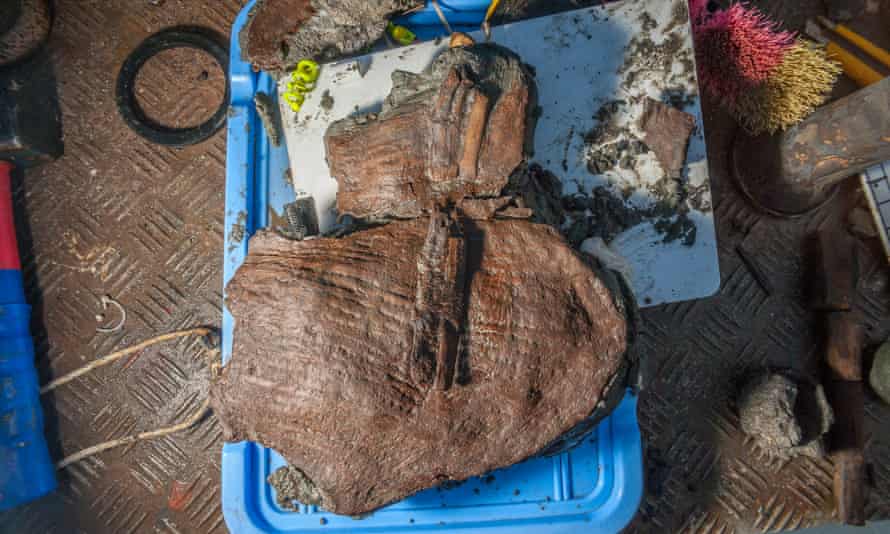
Wicker baskets filled with fruit that have survived from the 4th century BC and hundreds of ancient ceramic artefacts and bronze treasures have been discovered in the submerged ruins of the near-legendary city of Thonis-Heracleion off the coast of Egypt.
They have lain untouched since the city disappeared beneath the waves in the second century BC, then sank further in the eight century AD, following cataclysmic natural disasters, including an earthquake and tidal waves.

Thonis-Heracleion – the city’s Egyptian and Greek names – was for centuries Egypt’s largest port on the Mediterranean before Alexander the Great founded Alexandria in 331BC. But the vast site in Aboukir Bay near Alexandria was forgotten until its re-discovery by the French marine archaeologist Franck Goddio two decades ago, in one of the greatest archaeological finds of recent times. Colossal statues were among treasures from an opulent civilisation frozen in time. Some of the discoveries were shown in a major exhibition at the British Museum in 2016.

Goddio has been taken aback by the latest discoveries. He told the Guardian that the fruit baskets were “incredible”, having been untouched for more than 2,000 years. They were still filled with doum, the fruit of an African palm tree that was sacred for the ancient Egyptians, as well as grape-seeds.

“Nothing was disturbed. It was very striking to see baskets of fruits.”

One explanation for their survival may be that they were placed within an underground room, Goddio said, noting a possible funerary connotation. It is within an area where Goddio and his team of archaeologists have discovered a sizeable tumulus (a mound raised over graves) – about 60 metres long by 8 metres wide – and sumptuous Greek funerary offerings.

They date from the early fourth century BC when Greek merchants and mercenaries lived in Thonis-Heracleion. The city controlled the entrance to Egypt at the mouth of the Canopic branch of the Nile. The Greeks were allowed to settle there during the late Pharaonic period, constructing their own sanctuaries. Goddio said of the tumulus:

“It is a kind of island surrounded by channels. In those channels, we found an unbelievable amount of deposits made of bronze, including a lot of statuettes of Osiris [the ancient Egyptian fertility god]. On that island, something totally different. We found hundreds of deposits made of ceramic. One above the other. These are imported ceramic, red on black figures from Attic.”

The finds are all the more intriguing because there were vast quantities of miniature ceramics – high-quality Ancient Greek examples, including amphorae– under the tumulus. Bronze artefacts were around the tumulus, including mirrors and statuettes.

Goddio also found extensive evidence of burning, suggesting a “spectacular” ceremony that led to people being barred from entering this site again. It appears to have been sealed for hundreds of years as none of the artefacts found were from later than the early fourth century, even though the city lived on for several hundred years.

“There’s something very strange here. That site has been used maybe one time, never touched before, never touched after, for a reason that we cannot understand for the time being. It’s a big mystery.”

He hopes to find answers within some of the treasures, which include the well-preserved remains of a wooden sofa for banquets, a large Attic vase and a gold amulet of “exquisite quality”.

About 350 metres away, the archaeologists also found a unique Ptolemaic galley, 25 metres in length. While built in the classical tradition, with mortise-and-tenon joints, it also contains features of ancient Egyptian construction, with a flat-bottomed design that would have been perfect for navigation on the Nile and in the delta.

The European Institute for Underwater Archaeology, led by Goddio, works in close cooperation with Egypt’s ministry of tourism and antiquities and with the support of the Hilti Foundation. The finds will be studied and preserved before being put on display in museums.

The potential for further discoveries is tantalising. Even after conducting repeated excavations over the past two decades, Goddio estimates that only about 3% of the area has been explored so far.

Another side-step today, but hey, it's my blog and I'm excite! Paramount Pictures has acquired the rights for a historical epic centered around Cleopatra, and Gal Gadot is set to team-up with director Patty Jenkins once again for the film. Gadot is attached to star as the Egyptian queen herself in the film, which is tentatively titled Cleopatra, Deadline reports. Jenkins, meanwhile, will serve as the director. 


Gadot and Jenkins previously worked together on Wonder Woman and its upcoming sequel Wonder Woman 1984, with Jenkins as director for both films and as a producer on the latter. The deal for the film, which was Gadot's idea, closed yesterday following pitches for the film across Zoom. Laeta Klogridis, who has written screenplays for films such as Shutter Island and more recently Alita: Battle Angel, will pen the script and serve as executive producer. The deal was reportedly expedited because Paramount is looking to put together a heavy-hitting theatrical release relatively quickly, possibly over concerns as to how coronavirus has stalled film and TV productions across the world.

Reactions to the casting have ranged from positive to outright confusion on social media. While an Egyptian queen, scholars have often identified Cleopatra as someone of Greek ancestry with debates regarding some Persian and Syrian ancestry, too. Gadot is an Israeli actress, and some have raised questions regarding whether she is fit to play the role. Personally, I would much prefer her over Lady Gaga, Angelina Jolie, or Scarlett Johansson, who are all various shades of 'much whiter' than Gadot. 

Cleopatra VII Philopator (Κλεοπάτρα Φιλοπάτωρ), who lived from 69 – 10 or 12 August 30 BC, was the last active ruler of the Ptolemaic Kingdom of Egypt. As a member of the Ptolemaic dynasty, she was a descendant of its founder Ptolemy I Soter, a Macedonian Greek general and companion of Alexander the Great. After the death of Cleopatra, Egypt became a province of the Roman Empire, marking the end of the second to last Hellenistic state and the age that had lasted since the reign of Alexander (336–323 BC).  Her native language was Koine Greek, and she was the only Ptolemaic ruler to learn the Egyptian language.

In 58 BC, Cleopatra presumably accompanied her father, Ptolemy XII, during his exile to Rome after a revolt in Egypt (a Roman client state) allowing his daughter Berenice IV to claim the throne. Berenice was killed in 55 BC when Ptolemy returned to Egypt with Roman military assistance. When he died in 51 BC, the joint reign of Cleopatra and her brother Ptolemy XIII began, but a falling-out between them led to open civil war. After losing the 48 BC Battle of Pharsalus in Greece against his rival Julius Caesar (a Roman dictator and consul) in Caesar's Civil War, the Roman statesman Pompey fled to Egypt. Pompey had been a political ally of Ptolemy XII, but Ptolemy XIII, at the urging of his court eunuchs, had Pompey ambushed and killed before Caesar arrived and occupied Alexandria. Caesar then attempted to reconcile the rival Ptolemaic siblings, but Ptolemy's chief adviser Potheinos viewed Caesar's terms as favoring Cleopatra, so his forces besieged her and Caesar at the palace.

Shortly after the siege was lifted by reinforcements, Ptolemy XIII died in the 47 BC Battle of the Nile; Cleopatra's half-sister Arsinoe IV was eventually exiled to Ephesus for her role in carrying out the siege. Caesar declared Cleopatra and her brother Ptolemy XIV joint rulers, but maintained a private affair with Cleopatra that produced a son, Caesarion. Cleopatra traveled to Rome as a client queen in 46 and 44 BC, where she stayed at Caesar's villa. After the assassinations of Caesar and (on her orders) Ptolemy XIV in 44 BC, she named Caesarion co-ruler.

In the Liberators' civil war of 43–42 BC, Cleopatra sided with the Roman Second Triumvirate formed by Caesar's grandnephew and heir Octavian, Mark Antony, and Marcus Aemilius Lepidus. After their meeting at Tarsos in 41 BC, the queen had an affair with Antony. He carried out the execution of Arsinoe at her request, and became increasingly reliant on Cleopatra for both funding and military aid during his invasions of the Parthian Empire and the Kingdom of Armenia. The Donations of Alexandria declared their children Alexander Helios, Cleopatra Selene II, and Ptolemy Philadelphus rulers over various erstwhile territories under Antony's triumviral authority. This event, their marriage, and Antony's divorce of Octavian's sister Octavia Minor led to the Final War of the Roman Republic. 

Octavian engaged in a war of propaganda, forced Antony's allies in the Roman Senate to flee Rome in 32 BC, and declared war on Cleopatra. After defeating Antony and Cleopatra's naval fleet at the 31 BC Battle of Actium, Octavian's forces invaded Egypt in 30 BC and defeated Antony, leading to Antony's suicide. When Cleopatra learned that Octavian planned to bring her to his Roman triumphal procession, she killed herself by poisoning (contrary to the popular belief that she was bitten by an asp).

Cleopatra's legacy survives in ancient and modern works of art. Roman historiography and Latin poetry produced a generally critical view of the queen that pervaded later Medieval and Renaissance literature. In the visual arts, her ancient depictions include Roman busts, paintings, and sculptures, cameo carvings and glass, Ptolemaic and Roman coinage, and reliefs. In Renaissance and Baroque art she was the subject of many works including operas, paintings, poetry, sculptures, and theatrical dramas. She has become a pop culture icon of Egyptomania since the Victorian era, and in modern times Cleopatra has appeared in the applied and fine arts, burlesque satire, Hollywood films, and brand images for commercial products.
Mortuary portraits were popular as an artistic medium in the 1st century AD during the Roman Empire's rule over Egypt, which was dominated by an upper class of ethnic Greeks. This blending of Roman, Greek, and Egyptian cultures in the imperial province of Egypt resulted in a unique art form that drew influences from Classical Greece and Egypt while at the same time utilizing materials provided by Rome's flourishing economy.


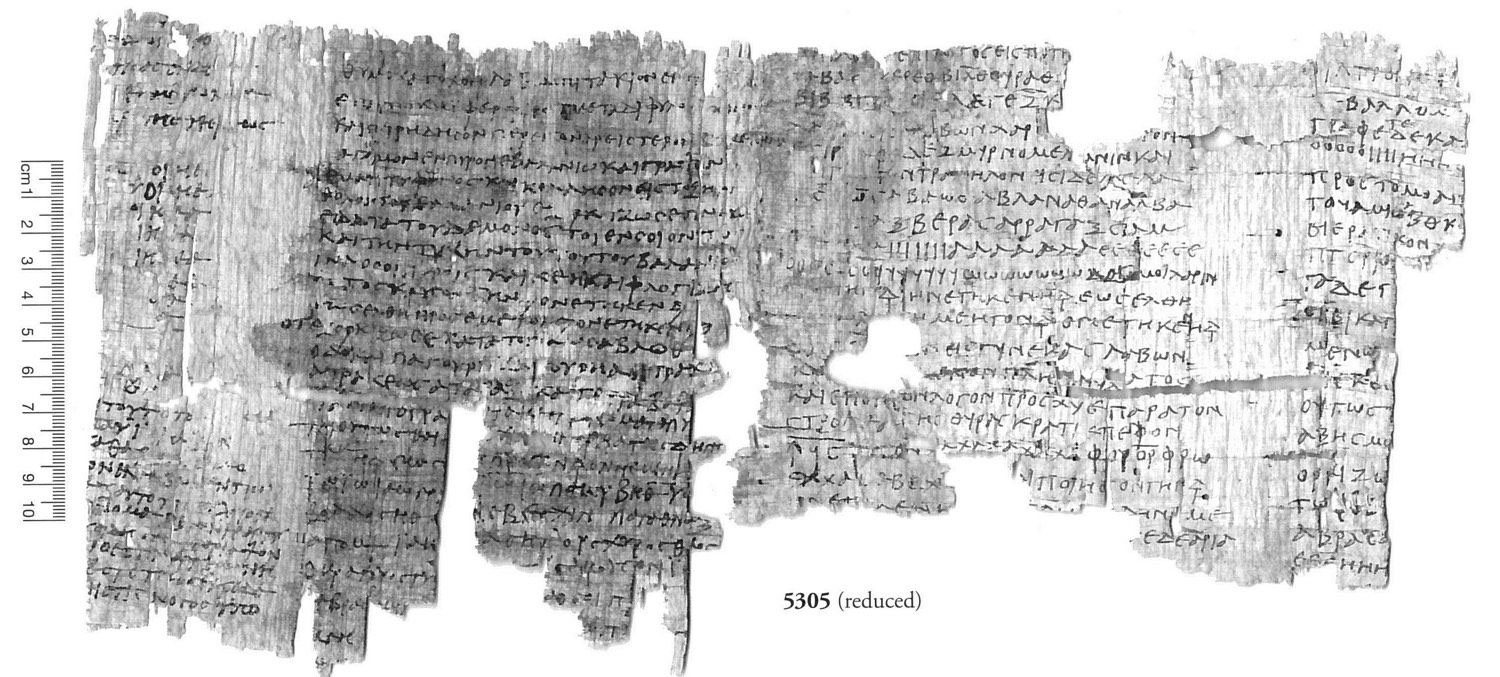
A number of ancient papyri from Oxyrhynchus, part of the Egypt Exploration Society’s collection, have been identified as part of the lot allegedly offered for sale by Professor Dirk Obbink to the American chain Hobby Lobby. The Society has issued a statement on the matter.

“On 25 June 2019 the Egypt Exploration Society (EES) posted a statement on its website that it was working with the Museum of the Bible (MOTB) to clarify whether any texts from the EES Oxyrhynchus collection had been sold or offered for sale to Hobby Lobby or its agents, and if so, when and by whom. This was in response to the online publication by Dr Brent Nongbri, following its release by Professor Michael Holmes of the MOTB, of a redacted copy of a contract of 17 January 2013 between Professor Dirk Obbink and Hobby Lobby Stores for the sale of six items to Hobby Lobby, including four New Testament fragments probably of EES provenance. This statement reports our findings to date.

“With the help of photographs provided by the MOTB, the EES has so far identified thirteen texts from its collection, twelve on papyrus and one on parchment, all with biblical or related content, which are currently held by the MOTB (see the attached list). These texts were taken without authorisation from the EES, and in most of the thirteen cases the catalogue card and photograph are also missing. Fortunately, the EES has back-up records which enable us to identify missing unpublished texts. For clarity, we note that the four texts specified in the handwritten list made public alongside the 2013 contract, which are probably the texts of that contract, remain in the EES collection, and two have been published as P.Oxy. LXXXIII 5345 and 5346.

“The Board of Trustees of the MOTB has accepted the EES claim to ownership of the thirteen pieces identified to date, and is arranging to return them to the EES. The EES is grateful to the MOTB for its co-operation, and has agreed that the research on these texts by scholars under the auspices of the MOTB will receive appropriate recognition when the texts are published in the Oxyrhynchus Papyri series.

“The MOTB has informed the EES that 11 of these pieces came into its care after being sold to Hobby Lobby Stores by Professor Obbink, most of them in two batches in 2010. In August 2016 the EES did not re-appoint Professor Obbink as a General Editor of the Oxyrhynchus Papyri primarily because of unsatisfactory discharge of his editorial duties, but also because of concerns, which he did not allay, about his alleged involvement in the marketing of ancient texts, especially the Sappho text. In June 2019 the EES banned him from any access to its collection pending his satisfactory clarification of the 2013 contract. Oxford University is now investigating, with EES help, the removal from University premises and alleged sale of EES texts.

“The EES is also pursuing identification and recovery of other texts, or parts of texts, which have or may have been illicitly removed from its collection. Systematic checking of the EES collection will be a long process because of its size. Meanwhile, our primary aim remains the authoritative publication for public benefit of the texts of all types in our collection.

“We cannot comment here on any broader legal issues arising from these findings, except to note that they are under consideration by all the institutions concerned.

EES papyri being returned by the MOTB (MOTB inventory number in square brackets)

Genesis 5:  P.Oxy. inv. 39 5B.119/C(4-7)b.  [PAP.000121]
Genesis 17:  P.Oxy. inv. 20 3B.30/F(5-7)b.   [PAP.000463]
Exodus 20-21:  P.Oxy. inv. 102/171(e).   [PAP.000446]
Exodus 30.18-19:  P.Oxy. inv. 105/149(a).   [PAP.000388]
Deuteronomy:  P.Oxy. inv. 93/Dec. 23/M.1.   [PAP.000427]
Psalms 9.23-26:   P.Oxy. inv. 8 1B.188/D(1-3)a.   [PAP.000122]
Sayings of Jesus:  P.Oxy. inv. 16 2B.48/C(a).   [PAP.000377]
Romans 3:  <related to P.Oxy. inv. 101/72(a)>.   [PAP.000467]
Romans 9-10:  P.Oxy. inv. 29 4B.46/G(4-6)a.   [PAP.000425 one part]
1 Corinthians 7-10:  P.Oxy. inv. 106/116(d) + 106/116(c).   [PAP.000120 three small fragments]
Quotation of Hebrews:  P.Oxy. inv. 105/188(c).   [PAP.000378]
Scriptural homily:  P.Oxy. inv. 3 1B.78/B(1-3)a.   [PAP.000395]
(parchment) Acts of Paul:  P.Oxy. inv. 8 1B.192/G(2)b.   [MS.000514]”.


The Oxyrhynchus Papyri are a group of manuscripts discovered during the late nineteenth and early twentieth centuries by papyrologists Bernard Pyne Grenfell and Arthur Surridge Hunt at an ancient rubbish dump near Oxyrhynchus in Egypt (28°32′N 30°40′E, modern el-Bahnasa). The manuscripts date from the time of the Ptolemaic (3rd century BC) and Roman periods of Egyptian history (from 32 BC to the Muslim conquest of Egypt in 640 AD). 

Only an estimated 10% are literary in nature. Most of the papyri found seem to consist mainly of public and private documents: codes, edicts, registers, official correspondence, census-returns, tax-assessments, petitions, court-records, sales, leases, wills, bills, accounts, inventories, horoscopes, and private letters.

Although most of the papyri were written in Greek, some texts written in Egyptian (Egyptian hieroglyphics, Hieratic, Demotic, mostly Coptic), Latin and Arabic were also found. Texts in Hebrew, Aramaic, Syriac and Pahlavi have so far represented only a small percentage of the total. Since 1898 academics have puzzled together and transcribed over 5000 documents from what were originally hundreds of boxes of papyrus fragments the size of large cornflakes. This is thought to represent only 1 to 2 percent of what is estimated to be at least half a million papyri still remaining to be conserved, transcribed, deciphered and catalogued.
A Ptolemaic tomb has been rediscovered and fully documented by Oxford-based team of archaeologists working at Elkab, Egypt.

During its last fieldwork season, the Oxford Epigraphic Expedition to Elkab, in southern Egypt, successfully rediscovered a Ptolemaic painted tomb. The tomb had originally discovered in the 19th century but its exact whereabouts had since become unknown.

Originally located by iconic archaeologist K.R. Lepsius (1810-1884) in 1844, the tomb had never been the subject of proper scientific investigation.

During its last fieldwork season, the Oxford Epigraphic Expedition to Elkab located the tomb in the Graeco-Roman sector of the main necropolis. According to a statement:

“Through its inscriptions, we can precisely date the tomb to the reign of King Ptolemy III (3rd century BC), at the time of the Greek rule of Egypt. Despite the fading of much of the tomb’s decoration, digital technologies have allowed us to record and study it in all its original beauty.”

Ptolemy III Euergetes (Πτολεμαῖος Εὐεργέτης, Ptolemaĩos Euergétēs was the third king of the Ptolemaic dynasty in Egypt from 246 to 222 BC. He maintained his father's foreign policy of subduing Macedonia by supporting its enemies. Ptolemy backed the Achaean League, a collaboration of Hellenic city-states, and enemies of Macedonia, but switched his support to Sparta when it came into conflict with the Achaean League and proved itself more apt to fighting the Macedonians. He continued his predecessor's work on Alexandria, especially in the Great Library. He had every book unloaded in the Alexandria docks seized, had copies made of each one, and gave the copies to the previous owners while the original copies were kept in the Library. It is said that he borrowed works of Aeschylus, Sophocles, and Euripides from Athens but decided to forfeit the considerable deposit he paid for them, keeping them for the Library rather than returning them. The Ptolemaic kingdom reached the height of its power during this reign.

A first description of the tomb along with a description of the Oxford Epigraphic Expedition’s research and documentation work there is available through Egyptian Archaeology 53 (2018): 4–12. Accessible via Academia.edu.

Archaeologists have recently discovered an ancient shipwreck which proves the Greek Historian Herodotos was accurate in his description, almost 25 centuries ago, regarding the construction of a Nile river boat called a 'baris'.


An artistic rendition of the discovered shipwreck. The upper half of the model illustrates the wreck
as excavated. Below this, unexcavated areas are mirrored to pro­duce a complete vessel outline
[Credit: Christoph Gerigk/Franck Goddio/Hilti Foundation]

The shipwreck, discovered recently off the Mediterranean coast of Egypt near the ancient, and now sunken, city of Thonis-Heracleion was of a vessel called a ”baris. This exact type of ship was described in great detail by Herodotos in his book Historia following a visit he made to the port city of Thonis-Heracleion in Egypt. Herodotos was impressed by the way people were constructing the ship, which was used to sail across the Nile River.

For centuries, scholars and archaeologists believed that the type of ship Herodotos described never actually existed, because such ships had never once been found by anyone on the planet. This theory was recently blown up when a group of archaeologists discovered a well-preserved shipwreck off the coast of Egypt in the Canopic Mouth of the Nile, in the Mediterranean Sea. What the archaeologists saw witnessed when they dove into the waters was exactly the kind of vessel Herodotos had perfectly described in his book exactly 2,469 years ago.

The 28-metre long vessel was one of the first ships used by the Egyptians to trade during ancient times. The vessels Herodotos described in his book must have been the exact same type of ship, but were only slightly smaller. Dr. Damian Robinson, the director of Oxford University’s center for maritime archaeology, points out that 

”...where planks are joined together to form the hull, they are usually joined by mortise and tenon joints which fasten one plank to the next. Here we have a completely unique form of construction, which is not seen anywhere else.”

Most likely, this unique construction was the reason why Herodotos was so amazed when he saw this type of ship. The eminent historian was also astonished by the peculiar types of wood they were using to construct the ships, which to him was completely unknown.

Archaeologists believe that what Herodotos saw could have even been constructed in the very same shipyard as the vessel they discovered, as a word-by-word analysis of Herodotos’ text exactly matches the appearance of the ship.

Belov's exploration of the ship's construction has been published in a monograph by the Oxford Centre for Maritime Archaeology, Ship 17: a baris from Thonis-Heracleion.
Pursuit recently published an article concerning the luckiest fiends of ancient history. I've filtered out the Hellenic ones for you.


Dr Brent Davis: The Rosetta Stone
The story of the Rosetta Stone starts with Napoleon Bonaparte, who invaded Egypt in 1798 on one of his many campaigns to become master of the world.

In 1799, a group of French soldiers working near the town of Rosetta in the Nile Delta tore down an ancient Egyptian wall so they could use the stones to repair a French fort. One of these stones was the Rosetta Stone, an inscribed slab of granite now in the British Museum.

The stone is inscribed in three different scripts: the top section is in full hieroglyphs, the middle section is in Demotic (a cursive form of hieroglyphs), and the bottom section is in Greek which, of course, could easily be read.

Scholars quickly realised that the stone contains the same text written three times, once in each script.
Everyone saw that this stone might unlock the secret of hieroglyphs—as indeed it did. In 1822, the brilliant French scholar Jean-François Champollion made a major breakthrough in deciphering the hieroglyphic portion, giving birth to the modern field of Egyptology.

Professor Louise Hitchcock: Linear A and B
One of the last frontiers in the discovery and decipherment of ancient texts are the Aegean scripts Linear A and Linear B. These are the scripts of the Minoan, Cypriot and Mycenaean civilisations of ancient Greece – Homer’s Age of heroes.

The decipherment of Linear B, an early form of Ancient Greek preserved mostly on clay tablets, was dramatically announced in a famous 1952 radio announcement on the BBC by architect and war time codebreaker, Michael Ventris.

As a fourteen-year-old, young Ventris had heard Sir Arthur Evans – the discoverer of the Knossos palace on Crete fabled as the home of the Minotaur – present a lecture on the Linear B texts, and made it his lifetime dream to decipher it.

Linear B dates to the era of Mycenaean palaces around 1500 to 1200 BCE, and pushes the study of classical languages back into the Bronze Age, the time before the Trojan war.

However, these are not texts recording events or deeds by famous people. Rather they are temporary administrative palace documents consisting of allocations of goods or labour to the likes of smiths, temples, ships, cloth workers, and chariot makers. They give us valuable insights into the structure of the Mycenaean political system, as well as trade, manufacturing, and the economy.

But the language written in the earlier Linear A script is yet to be deciphered.

It originated on Crete initially as a hieroglyphic or pictographic script around 1900 to 1700 BCE and is preserved on clay tablets, stone libation tables, gold jewellery and even on magic bowls inscribed with octopus ink.

So far, we simply haven’t discovered enough Linear A to decipher it, which means archaeologists and codebreakers continue to dream of cracking it.

Dr James H.K.O. Chong-Gossard: Sappho’s poems
“My knees, that were once swift for the dance like little fawns, do not carry me. I lament this often, but what can I do? To be ageless when one is mortal, is not possible.” So writes the incomparable ancient Greek poetess Sappho in the late 7th century BCE in the “Tithonus poem”, a gem of only twelve lines that speaks to us across centuries of the sadness of ageing.

But fragments of the poem had long been lost, including these beautiful lines, and it is only because of a material similar to papier-mâché that they have been preserved for publication in 2004.
Sappho’s poetry highlights the agelessness of human feeling. Picture: ‘Sappho and Alcaeus’ by Sir Lawrence Alma-Tadema/Wikipedia

The original fragments of the poem had survived on papyri from 2nd to the 3rd century CE Roman Egypt, and had been unearthed at Oxyrhynchus in the early 20th century.

But, in 2002, the Cologne Papyrus Collection acquired from a private collector papyri that preserved the rest of Sappho’s poem.

These missing fragments had survived as “cartonnage” – a hard material comprising papyri, linen and plaster that was used in ancient times as book covers and mummy cases.

Another rediscovered Sappho poem first published in 2014, the “Brothers Poem,” was similarly preserved in cartonnage and was only uncovered when the papyrus fragments were separated by dissolving the cartonnage in warm water.

Some 2,600 years ago, Sappho lamented that people cannot be ageless, but the continual re-discovery of her words is proving the agelessness of her poetry.
One of those days, people... one of those days... I'm going to have to leave you with a bit of ancient text, and I want to broaden the horizon a little today by giving you one of the spells/prayers from the Papyri Graecae Magicae, also known as the 'Greek Magical Papyri'. They are a body of papyri from Graeco-Roman Egypt, which each contain a number of magical spells, formulae, hymns and rituals. The materials in the papyri date from the 2nd century BC to the 5th century AD. The manuscripts came to light through the antiquities trade, from the 18th century onwards. As part of the papyri, spells for a variety of things were recorded. Two include prayers to Helios. I'd like to share those today.


Prayer to Helios: A charm to restrain anger and for victory and for securing favor
Instructions: Say to the Sun (Helios) seven times, and anoint your hand with oil and wipe it on your Head and Face.

"Rejoice with me, You who are set over the East Wind and the World, for whom all the Gods serve as Body-Guards at Your Good Hour and on Your Good Day, You who are the Good Daimon (God) of the World, the Crown of the Inhabited World, You who arise from the Abyss, You who Each Day rise a Young Man and set an Old Man. I beg You, Lord, do not allow me to be Over-Thrown, to be Plotted Against, to receive Dangerous Drugs, to go into Exile, to fall upon Hard Times. Rather, I ask to obtain and receive from You Life, Health, Reputation, Wealth, Influence, Strength, Success, Charm, Favor with all Men and all Women, Victory over all Men and all Women. Yes, Lord, accomplish this Matter which I want, by means of Your Power.”
[PGM XXXVI.211-30]

Spell to Helios: Consecration for All Purposes
“I invoke You, the Greatest God, Eternal Lord, World Ruler, who are over the World and under the World, Mighty Ruler of the Sea, rising at Dawn, shining from the East for the Whole World, setting in the West. Come to me, Thou who risest from the Four Winds, benevolent and lucky Agathos Daimon, for whom Heaven has become the Processional Way. I call upon Your Holy and Great and Hidden Names which You rejoice to hear. The Earth flourished when You shone forth, and the Plants became fruitful when you laughed; the Animals begat their Young when You permitted. Give Glory and Honor and Favor and Fortune and Power to this, NN, Stone which I consecrate today (or to the Phylactery [charm] being consecrated) for [or in relation to] NN. I invoke You, the greatest in Heaven, the Shining Helios, giving Light throughout the Whole World. You are the Great Serpent, Leader of all the Gods, who control the Beginning of Egypt and the End of the Whole Inhabited World, who mate in the Ocean. You are He who becomes Visible each Day and Sets in the Northwest of Heaven, and Rises in the Southeast.

In the 1st Hour You have the Form of a Cat.
Give Glory and Favor to this Phylactery.
In the 2nd Hour You have the Form of a Dog.
Give Strength and Honor to this Phylactery, or to this Stone, and to [name].
In the 3rd Hour You have the Form of a Serpent.
Give Honor to the God [name].
In the 4th Hour You have the Form of a Scarab.
Mightily strengthen this Phylactery in this Night, for the Work for which it is consecrated.
In the 5th Hour You have the Form of a Donkey.
Give Strength and Courage and Power to the God, [name].
In the 6th Hour You have the Form of a Lion, the Ruler of Time.
Give Success to this Phylactery and Glorious Victory.
In the 7th Hour You have the Form of a Goat.
Give Sexual Charm to this Ring (or to this Phylactery, or to this Engraving).
In the 8th Hour You have the Form of a Bull, who becomes visible everywhere.
Let all Things done by the use of this Stone be accomplished.
In the 9th Hour You have the Form of a Falcon, the Lotus Emerged From the Abyss.
Give Success and Good Luck to this Phylactery.
In the 10th Hour You have the Form of a Baboon.
[Prayer for gift omitted?]
In the 11th Hour You have the Form of an Ibis.
Protect this great Phylactery for Lucky Use by [name], from this Present Day for All Time.
In the 12th Hour You have the Form of a Crocodile.
[Prayer for gift omitted?]

You who have set at Evening as an Old Man, who are over the World and under the World, Mighty Ruler of the Sea, hear my Voice in this Present Day, in this Night, in these Holy Hours, and let all done by this Stone, or for this Phylactery, be brought to fulfillment, and especially NN matter for which I consecrate It. Please, Lord! I conjure Earth and Heaven and Light and Darkness and the Great God who created All, SAROUSIN, You, Agathon Daimon the Helper, to accomplish for me everything done by the Use of this Ring or Stone!”

When you complete the Consecration, say, “The one Zeus is Serapis!”
[PGM IV.1596-1715]
Ornaments: decorative patterns and floral designs added to the foot, rim, handles and borders of vessels. Lotus, palmettes, ivy, meander, rays, tongues and rosettes were the most popular to the ancient Hellenes.  Why should you care? Well, you don't have to, but a lot of you enjoy making some form of art or decorations for shrines and as little gifts to the Gods, so I figured you might be interested. The most important ones are listed below:

I think most of those are rather self-explanatory, but let me note a bit about the two most important subgroups, the palmettes and the meander.

It is thought that the palmette originated in ancient Egypt 2,500 years BC and has influenced Hellenic art. Egyptian palmettes (or 'anthemion', in Greek, from 'ανθέμιον', a flower were originally based on features of various flowers, including the papyrus and the lotus or lily representing lower and upper Egypt and their fertile union, before it became associated with the palm tree. From earliest times there was a strong association with the sun and it is probably an early form of the halo.

The essence of the palmette is a symmetrical group of spreading 'fronds' that spread out from a single base, normally widening as they go out, before ending at a rounded or fairly blunt pointed tip. There may be a central frond that is larger than the rest. The number of fronds is variable, but typically between five and about fifteen. In the repeated border design commonly referred to as anthemion the palm fronds more closely resemble petals of the honeysuckle flower, as if designed to attract fertilizing insects.

A meander or meandros (Μαίανδρος) is a decorative border constructed from a continuous line, shaped into a repeated motif. Such a design is also called the Greek fret or Greek key design, although these are modern designations. The meander often represents a labyrinth in linear form and may have symbolized infinity and unity. The many versions with rounded shapes are called running scrolls.

Meanders are common decorative elements in Hellenic and Roman art. In ancient Hellas they appeared in many architectural friezes, and in bands on the pottery from the Geometric Period onwards. They were among the most important symbols in ancient Hellas and many ancient temples incorporated the sign of the meander. Hellenic vases, especially during their Geometric Period, were probably the main reason for the widespread use of meanders.

Image copyright Ori Keren, uploaded by Mark Cartwright.
Many people--myself included--sometimes forget how extensive the ancient Hellenic empire was. It wasn't just what is now modern Greece. It extended all the way down to, for example, Syria. Today: Hippos.


Hippos (Ἵππος) is an archaeological site in Israel, located on a flat-topped foothill 2 kilometres (1.2 mi) east of and 350 metres (1,150 ft) above the Sea of Galilae. The site is just on the Israeli side of the 1949 UN-demarcated border between Syria and Israel, near modern Kibbutz Ein Gev.

Between the 3rd century BC and the 7th century AD, Hippos was the site of a Graeco-Roman city, which then declined under Muslim rule and was abandoned after an earthquake in 749. Besides the fortified city itself, Hippos controlled two port facilities on the lake and an area of the surrounding countryside. Hippos was part of the Decapolis, or Ten Cities, a region in Roman Jordan, Syria and Israel that were culturally tied more closely to Hellas and Rome than to the Semitic ethnoi around.

Established as Antioch of Hippos (Ἀντιόχεια τοῦ Ἵππου) by Seleucid settlers, the city is named after the Greek language word for horse, Hippos, and a common name of Seleucid monarchs, Antiochus. The Seleucis Empire, by the way, was a Hellenistic state ruled by the Seleucid dynasty, which existed from 312 BC to 63 BC; it was founded by Seleucus I Nicator following the division of the Macedonian empire vastly expanded by Alexander the Great.The Aramaic name, Sussita (Hebrew: סוסיתא‎‎), was also adopted into Hebrew and also means horse, while the Arabic name, Qal'at al-Hisn, means 'Fortress of the Horse/Stallion'. Other names include the alternate spelling Hippus and the Latinized version of the Greek name: Hippum. The precise reason why the city received this name is unknown.

Excavations in Hippos have revealed traces of habitation from as early as the Neolithic period. The site was again inhabited in the third century BC by the Ptolemies, though whether it was an urban settlement or a military outpost is still unknown. During this time, Coele-Syria served as the battleground between two dynasties descending from captains of Alexander the Great, the Ptolemies and the Seleucids. It is likely that Hippos, on a very defensible site along the border lines of the 3rd century BC, was founded as a border fortress for the Ptolemies. The city of Hippos was most likely established in the middle of the second century BC.

As the Seleucids took possession of all of Coele-Syria, Hippos grew into a full-fledged polis, a city-state with control over the surrounding countryside. Antiochia Hippos was improved with all the makings of an Hellenic polis: a temple, a central market area, and other public structures. The availability of water limited the size of Hellenistic Hippos. The citizens relied on rain-collecting cisterns for all their water; this kept the city from supporting a very large population.

Hellas' rule did not last. The Maccabean revolt resulted in an independent Jewish kingdom under the Hasmonean dynasty in 142 BC. In c. 83-80 BC, Alexander Jannaeus led a Hasmonean campaign to conquer lands east of the Jordan River.

In 63 BC the Roman general Pompey conquered Coele-Syria, including Judea, and ended Hasmonean independence. Pompey granted self-rule to roughly ten ten cities on Coele-Syria's eastern frontier; this group, of which Hippos was one, came to be called the Decapolis and was incorporated into the Roman Provincia Syria. Under Roman rule, Hippos was granted a certain degree of autonomy. The city minted its own coins, stamped with the image of a horse in honor of the city's name.

Its rule exchanged hands several more times before the Romans created the province of Palaestina in 135, of which Hippos was a part. This was the beginning of Hippos' greatest period of prosperity and growth. It was rebuilt along a grid pattern, centered around a long decumanus maximus running east-west through the city. The streets were lined with hundreds of red granite columns imported from Egypt. The great expense required to haul these columns to Palestine and up the hill is proof of the city's wealth. Other improvements included a Kalybe (a shrine to the Emperor), a theatre, an odeon, a basilica, and new city walls. The most important improvement, however, was the aqueduct, which led water into Hippos from springs in the Golan Heights, 50 km away. The water, collected in a large, vaulted cistern, allowed a large population to live in the city.

When Christianity became officially tolerated in the Roman Empire, Palestine became the target of Imperial subsidies for churches and monasteries, and Christian pilgrims brought additional revenue. Industry expanded and more luxury goods became available to common people. Christianity came slowly to Hippos. There is no evidence of any Christian presence before the 4th century. A Byzantine-era pagan tomb of a man named Hermes has been found just outside the city walls, attesting to the relatively late presence of pre-Christian religions here. Gradually, however, the city was Christianized, becoming the seat of a bishop by at least 359. One Bishop Peter of Hippos is listed in surviving records of church councils in 359 and 362.

The Muslim armies of the Rashidun period invaded Palestine in the 7th century, completing their conquest by 641. Hippos' new Arab rulers allowed the citizens to continue practicing Christianity, a policy then continued by the Umayyad Caliphate. However, the population and economy continued to decline. The earthquake of 749 destroyed Hippos and it was abandoned permanently.

Archaeological surveys were conducted here in the late 19th C by Gottlieb Schumacher. During the early 50s there were clashes on this border, and the IDF fortified the Sussita hill as a front post. This is an archaeologist's dream--the ruins were mostly undisturbed, and the treasures found under the debris are fascinating. However, it will take years to complete this enormous task of excavation, reconstruction and preservation.
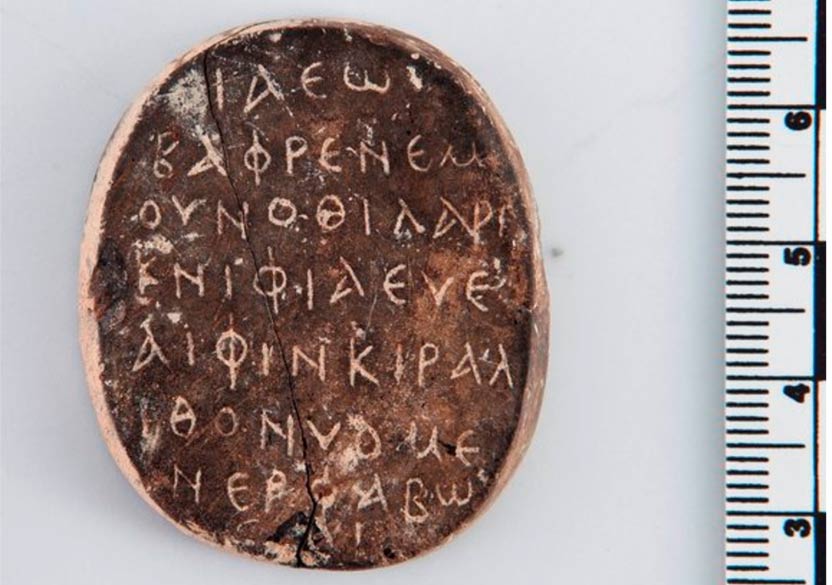
Ancient Origins reports that archaeologists in Cyprus have unearthed a 1,500-year-old amulet in the ancient city of Nea Paphos in Cyprus, which contains a curious palindrome inscription--a text that reads the same both backwards and forwards--as well as several images believed to represent Egyptian god Osiris, god of silence, Harpocrates, and a dog-headed mythical being.


Live Science reports that the discovery was made by archaeologists with the Paphos Agora Project, who have been excavating an ancient agora (gathering place) at Nea Paphos, the most famous and important place for worshipping Aphrodite in the ancient world. According to UNESCO, Paphos, which has been inhabited since the Neolithic period, was a centre of the cult of Aphrodite and of pre-Hellenic fertility deities. Aphrodite’s legendary birthplace was on the island of Cyprus, where her temple was erected by the Myceneans in the 12th century BC and continued to be used until the Roman period. The site is a vast archaeological area, with remains of villas, palaces, theatres, fortresses and tombs. These illustrate Paphos’ exceptional architectural and historic value and contribute extensively to our understanding of ancient architecture, ways of life, and thinking.

The amulet found at Nea Paphos, which measures 1.4 x 1.6 inches (3.5 x 4.1 cm), contains a 59-letter palindrome inscription on one side, and several images on the other side. The inscription, written in Greek, reads:

ΙΑΕW ΒΑΦΡΕΝΕΜ ΟΥΝΟΘΙΛΑΡΙ ΚΝΙΦΙΑΕΥΕ ΑΙΦΙΝΚΙΡΑΛ ΙΘΟΝΥΟΜΕ ΝΕΡΦΑΒW ΕΑΙ (“Iahweh is the bearer of the secret name, the lion of Re secure in his shrine”)

The use of palindromes is believed to date back at least 2,000 years, and became popular during the Middle Ages. This practice was continued in many other churches throughout Europe. On the other side of the amulet are several images, including a mummy lying on a boat, which is believed to represent the Egyptian God Osiris. According to Egyptian mythology, Osiris, God of the underworld, was killed by Set, God of storms, disorder and violence, who shut Osiris in a coffin and threw it in the Nile river. After his body was recovered by Isis, Set tore His body into pieces and threw them back into the river. Isis collected all the pieces and bandaged the body together. This form of Osiris traveled to the underworld in a boat and became God of the dead.

Another image etched on the back of the amulet is of the god of silence, Harpocrates, who is shown sitting on a stool with his right hand to his lips.  Harpocrates was adapted by the ancient Hellenes from the Egyptian child god Horus. To the ancient Egyptians, Horus represented the newborn Sun, rising each day at dawn. The final image found on the amulet was a cynocephalus, a mythical dog-headed creature, which is shown holding a paw up to its lips, as if mimicking Harpocrates' gesture.  Cynocephaly was familiar to the Ancient Hellenes from representations of the Egyptian gods Hapi (the son of Horus) and Anubis (the Egyptian God of the dead).

Jagiellonian University professor Ewdoksia Papuci-Wladyka, who led the research, told Live Science that the features of the amulet suggest that the ancient people of Cyprus, were continuing to practice their traditional, polytheistic beliefs even after Christianity had become the official religion, and that such amulets were used for protection from harm and danger.