Showing posts with label Poseidon. Show all posts

 Poseideon is the sixth month of the Hellenic calendar and we are slowly moving towards it. Poseideon is a special month; it was the month that would have been repeated (in a minor way) should the ancient calendar not line up with the phases of the moon (which it didn't, after a while). You can read more about that here as it is beyond the scope of this post. What I would like to talk to you about today is the divine triad that oversaw Poseideon (the quartet, actually, but we'll get to that) and its significance.

Poseideon was ruled by Poseidon (honoured during the Poseideia), Zeus (during the Plerosia and a seperate sacrifice to Zeus Horios) and Dionysos (during the Lesser Dionysia and secondarily during the Haloa). Poseideon is the first true winter month; the first harvest was over, seafaring had ceased and thus war had come to an end. The focus was on the home and preparation for true, deep winter: the weather turned and the crops needed protecting. Because of this, it was also a month of threat; if the crops failed, if the seas became too rough when a daring fisherman was out on it, or if a river went out of bounds and flooded a well populated area there would be death.

I get on my soapbox a lot on my blog. One of my main points is that everything is connected in the ancient Hellenic religion. That everything was constructed the way it was for a reason; the pantheon, the calendar, the festivals, the way festivals were celebrated--if you spend time to sort out the why, you will discover it's all part of an intricate web that formed an entire civilization. Nothing--absolutely nothing--in our religion and in the ancient civilization it was formed in ended up in it by accident. We have lost a lot of knowledge and understanding of this society but we can try to piece things together if we put in the effort. So today I will put in a little effort to explain why Poseideon was ruled by Poseidon, Zeus and Dionysos. And why it mattered that it were Them.

During the Poseideia, Poseidon as savior of ships, protector of those who voyage in ships, and God of the lapping waters both salt and fresh important for agriculture, is thanked for the many gifts that came from faraway places that were likely given at that time. The immense trade and distribution was nearly all through shipping, relatively little overland, whether it be perfume from Cyprus or pottery from Corinth. One of Poseidon’s epithets is prosklystios, 'of the lapping water'. He is also invoked as Poseidon phytalmios which implies natural fertility and human procreation.

The Plerosia is a harvest festival of sorts. It was held to honour Zeus but presumably als Demeter. Poseideon marks the time to return home, take stock, and stay warm. It's a time to thank the Theoi for all that has been recieved and all that will get us through the winter. The word ‘plerosis’ means fulfillment, satiated, filled. Important note: the Plerosia seems to have been a women-only festival, perhaps because now that winter is upon us, we turn to the domain of the women: the house(hold). As such, it is her prerogative to thank the Gods for the food she can feed her family with.

The lesser Dionysia, a vintage festival, was celebrated in the various demes of Attica in the month of Poseideon. It was probably a very ancient festival, perhaps not originally associated with Dionysos. The Dionysia was a time when classes came together in order to celebrate their shared origins in the natural world; it was a vintage festifal for all.

The Haloa was held in honor of Demeter, Dionysos and a little bit in honor of Persephone. Like all festivals of Demeter and Persephone's 'Kore' persona, women were the only ones who were allowed to handle the religious and sacrificial side of it. The Haloa is assumed to be a celebration of the pruning of the vines and the tasting of the wine after its first fermentation, or it may be to encourage the growth of corn from the seed.

A few links between Poseidon, Zeus and Dionysos are clear instantly from the descriptions of these festivals. Poseidon and Dionysos are linked through water--moisture, actually. Plutarch already noted that Dionysos was a God of moisture--in particular the moisture associated with life and vigour as can be seen in plants and trees and most telling in the wine produced from the fruits of the vine. Poseidon is all but the personification of water of all kinds. Furthermore, one of the epithets of Dionysos is Dendrites, ‘of the trees’, connects him to branching life. The tree was similarly a metaphor for rivers whose branching nature was morphologically similar. This links Dionysos to Poseidon even more.

And what of Poseidon and Zeus? Poseidon is the brother of Zeus and Hades, and together they form a triumvirate who represents the dominion of the sea, the sky and the underworld respectively. In Hellenic mythology, the underworld is seen as an exact mirror and equally valid version of the ‘celestial’ world. In other words: Zeus is Hades inverted and Poseidon is the synthesis of both. Dionysos therefore unifieds these god-themes and manifested them in the mundane world.

This brings us to Hades, the fourth member of this triad. He is worshipped too, just not directly--never directly. the ancient Hellenes very rarely honoured Hades, not even Plouton, His ouranic epithet. But Hades' influence was most definitely felt; he's the third of the triumvirate, He is prevalent in the threat of death that hangs over the month and He is appeased though a medium who is perhaps unlikely: Demeter.

Mythological and epithological links exist between Demeter and Hades. Hades was celebrated as an important divine figure in the Eleusinian Mysteries. The seasonal drama of nature was said to depend on her annual passage into the underworld in the depths of winter when fruitfulness and vegetation dies back. Through Kore (Persephone) Hades and Demeter rule over the harvest. Hades takes and Demeter gives--or more accurately: Hades causes Demeter to take instead of give. In praying for fruitfulness of the earth to Demeter, it is also Hades who is spoen to and appeased, which makes Him an unofficial member of the triad (this is likewise true for Demeter and even Kore/Persephone).

To compelete the circle, Dionysos and Demeter are worshipped together during the Haloa, which drives home the agricultural ties all these five deities have  and the way they link to the mundane issues of this time of year; Demeter and Hades (Plouton) through the fruitful earth (underworld), Zeus through mild weather (sky) and Poseidon and Dionysos through sweet water (the intermediate). Because of Their links and domains, it can be only these deities that govern Poseideon.

An invocation is a request for the spiritual presence and blessing of a deity during a rite. To invoke is to call upon earnestly, so an “invocation” in the context of prayer is a serious, intentional calling upon a God or Goddess. In Hellenic ritual, it's common for prayers of invocation to be offered every time a new deity is invoked, so we can be sure They will the hymns and prayers of petition offered to Them. Invocations fit into the rite like so:


- Lighting of the incense burner with frankincense
- Invocation to Demeter: Khaire Demeter, you who taught us to work the earth and provides for us so bountifully…
- Libation of a kykeon and sacrifices
- Orphic Hymn 40 To Eleusinian Demeter
- Prayers

A few days ago, I put up a list of invocations from the Iliad. People seemed to like it, so let's do another one today: from the Odysseia, because that is the logical step! The Odyssey (Ὀδύσσεια) is, in part, a sequel to the Iliad, the other work ascribed to Homeros. The Odyssey was composed near the end of the 8th century BC and focuses mainly on the hero Odysseus, king of Ithaca, and his journey home after the fall of Troy. It takes Odysseus ten years to reach Ithaca. In his absence, it is assumed Odysseus has died, and his wife Penelope and son Telemachus must deal with a group of unruly suitors, who compete for Penelope's hand in marriage. Needless to say, Odysseus keeps his lady love! There aren't as many invocation in this story as most of the characters tell their story themselves, but there are a few.

Artemis:
"Great Goddess Artemis, daughter of Zeus..."

Athena:
"Hear me, daughter of Aegis-bearing Zeus, unweariable..."

Eos:
"Rosy-fingered Eos, child of morning..."

Poseidon:
"O thou that encirclest the earth, vouchsafe to grant the prayers of thy servants that call upon thee..."

Themis:
"I pray you by Themis, who is the beginning and the end of councils..."

Zeus:
"Hear me, O King..."
"Father Zeus, and all you other gods who live in everlasting bliss..."
"Father Zeus, you who rule over heaven and earth, you have thundered from a clear sky without so much as a cloud in it, and this means something for somebody; grant the prayer, then, of me your poor servant who calls upon you..."

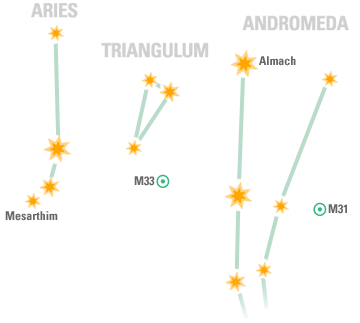
Did you know there was a constellation called 'the triangle'? And that the ancient Hellenes were aware of it, too? Triangulum is a small constellation in the northern sky. It was one of the 48 constellations listed by the second century astronomer Ptolemy, and so named for its three brightest stars, which form a long and narrow triangle. The Ancient Hellenes called Triangulum 'Deltoton' (Δελτωτόν), after the upper-case letter delta (Δ). Hellenic astronomers such as Hipparchos and Ptolemy called it Trigonon (Τρίγωνον).


There is not a lot of mythology connected to this tiny constellation, but the lore that it has is quite important. Hyginus, in his 'Astronomica' explains the options:

"This constellation, which has three angles like the Greek letter Delta, is so named for that reason.
Mercury [Hermes] is thought to have placed it above the head of Aries, so that the dimness of Aries might be marked by its brightness, wherever it should be, and that it should form the first letter in the name of Jove [Zeus] (in Greek, Dis).
Some have said that it pictures the position of Egypt; others, that of Aethiopa and Egypt where the Nile marks their boundaries. Still others think that Sicily is pictured there.
Others, say that three angles were put there because the gods divided the universe into three parts." [II.19]

The latter is the only one that might need some explaining. Zeus, the greatest of the Olympian Gods, and the father of Gods and men, was a son of Kronos and Rhea, a brother of Poseidon, Hades, Hestia, Demeter, Hera. When Zeus and His brothers drew lots for the rule of the world, Poseidon obtained the sea, Hades the lower world, and Zeus the heavens and the upper regions, but the earth belonged to them all. To quote the 'Iliad' by Hómēros:

"Poseidon was very angry and said, "Great heavens! strong as Zeus may be, he has said more than he can do if he has threatened violence against me, who am of like honour with himself. We were three brothers whom Rhea bore to Kronos--Zeus, myself, and Hades who rules the world below. Heaven and earth were divided into three parts, and each of us was to have an equal share. When we cast lots, it fell to me to have my dwelling in the sea for evermore; Hades took the darkness of the realms under the earth, while air and sky and clouds were the portion that fell to Zeus; but earth and great Olympus are the common property of all." [XV.187]

The constellation Triangulum is visible at latitudes between +90° and −60°, and best visible at 21:00 (9 p.m.) during the month of December.

 Poseidon is the God of the Mediterranean seas, who can strike down His trident and create fresh water springs, or disastrous earthquakes. He is also the Lord of horses, presumably because of the foamy waves rising up like a herd of horses before crashing on the shore. He has made His home underwater, with his wife Amphitrite and other water creatures, many of which immortal. He's a powerful God, one of three brothers who rule the sky, the sea and the underworld.


Claudius Aelianus (Κλαύδιος Αἰλιανός), commonly called Aelian, was born at Praeneste around 175 AD. He was a Roman author and teacher of rhetoric who spoke Greek so perfectly that he was called "honey-tongued" (meliglossos). He preferred Greek authors, and wrote in a slightly archaizing Greek himself. "On the Nature of Animals" (Περὶ Ζῴων Ἰδιότητος) is a collection of seventeen books. All contain brief stories of natural history, sometimes selected with an eye to conveying allegorical moral lessons, sometimes because they are just so astonishing. He also quotes other authors and in the collection, he quotes a hymn to Poseidon I'd like to share with you today. It was originally written by Arion, son of Cycleus, it seems. He wrote the poem in thanks to Poseidon for saving his life. He focusses on dolphins. It goes as follows and probably stems from the fifth century BC:


"Highest of the Gods, Lord of the sea, Poseidon of the golden trident, earth-shaker in the swelling brine, around thee the finny monsters in a ring swim and dance, with nimble flingings of their feet leaping lightly, snub-nosed hounds with bristling neck, swift runners, music-loving dolphins, sea-nurslings of the Nereid maids divine, whom Amphitrite bore, even they that carried me, a wanderer on the Sicilian mean, to the headland of Taenarum in Pelops' land, mounting meupon their humped backs as they clove the furrow of Nereus' plain, a path untrodden, when deceitful men had cast me from their sea-faring hollow ship into the purple swell of ocean."

 Two PAT ritual announcements, both for September 10th. We will hold a PAT ritual for the Niketeria, followed by the Plataia.

The Niketeria
We are coming upon another festival celebrated in ancient Athens: the Niketeria. Surviving sources date the festival to the third of Boudromion, and it was in honor of one of the most important events in Athens' history: its naming and tutelage by Athena. We will be celebrating it at the usual 10 AM EDT.


Many of us know there was a contest between Poseidon and Athena over who would rule the growing city of Athens (in the name it had before being called 'Athens'), and it is clear who won that contest. The earliest reference to this event we still have access to is from the fourth century BC by Plato, but it does not quite have the poetic touch Ovid's account has. For that reason, I will give the account of Ovid, and build from there. From the Metamorphoses, (trans. Melville):

"The rock of Mavors [Ares] in Cecrops' citadel is Pallas' [Athena's] picture [in her weaving contest with Arakhne] and that old dispute about he name of Athens. Twelve great gods, Jove [Zeus] in their midst, sit there on lofty thrones, grave and august, each pictured with his own familiar features: Jove [Zeus] in regal grace, the Sea-God [Poseidon] standing, striking the rough rock with his tall trident, and the wounded rock gushing sea-brine, his proof to clinch his claim. Herself she gives a shield, she gives a spear sharp-tipped, she gives a helmet for her head; the aegis guards her breast, and from the earth struck by her spear, she shows an olive tree, springing pale-green with berries on the boughs; the gods admire; and Victoria [Nike] ends the work." [6. 70]

Ancient Hellenic Neoplatonist philosopher Proklos (Πρόκλος) in 'On the Timaeus of Plato' speaks of this event as well, and notes that there is still a festival held to commemorate this event in his time (between 412 and 485 AD)

 "Farther still, the victories of Minerva are celebrated by the Athenians, and there is a festival sacred to the Goddess, in consequence of her having vanquished Neptune, and from the genesiurgic being subdued by the intellectual order, and those that inhabit this region betaking themselves to a life according to intellect, after the procurement of necessaries. For Neptune presides over generation; but Minerva is the inspective guardian of an intellectual life." [p. 153]

When this was celebrated, Proklos does not mention, but Plutarch does. One of these is in the Quaestiones Convivales, from the Moralia. Here, he answers the question: 'What is Signified by the Fable About the Defeat of Neptune? And Also, Why Do the Athenians Omit the Second Day of the Month Boedromion?'.

"While all were making a disturbance, Menephylus, a Peripatetic philosopher, addressing Hylas: You see, he said, how this investigation is no foolery nor insolence. But leave now, my dear fellow, that obstinate Ajax, whose name is ill-omened, as Sophocles says, and side with Poseidon, whom you yourself are wont to tell has often been overcome, once by Athene here, in Delphi by Apollo, in Argos by Here, in Aegina by Zeus, in Naxos by Bacchus, yet in his misfortunes has always been mild and amiable. Here at least he shares a temple in common with Athene, in which there is an altar dedicated to Lethe. And Hylas, as if he had become better tempered: One thing has escaped you, Menephylus, that we have given up the second day of September [Boudromion], not on account of the moon, but because on that day the gods seemed to have contended for the country." [Book 9, question 5]

Because of this, the official view of Elaion is that the festival of Niketeria--'Victory'--was celebrated not on the second of Boudromion as many modern researchers say, but on the third. The second day, after all, was no longer a part of the month. The question remains why the victory of one Goddess over one God was commemorated at all, and there is no adequate ancient explanation. None of the surviving works mention why and how the festival was celebrated. All we know is that it was noted--it might not even have been a true festival at all. We believe that by omitting the second day, the defeat of Poseidon was omitted, so as not to anger Him. A day later--in a somewhat unrelated fashion to Poseidon's defeat--there was a (possibly somewhat subdued) celebration of the victory of Athena, with sacrifices to Athena, Niké, and perhaps even Poseidon for the many wonderful gifts They had provided--and would hopefully continue to provide--for the city of Athens.

We will hold a subdued PAT ritual in honor of the Niketeria at 10 AM EDT on August 22rd. Will you be joining us? The ritual can be found here and you can join the community here.


The Plataia
The Plataia (or Plataea) seems to have been a commemorative festival, for the Hellenes fallen at the battle of Plataea. The Battle of Plataea was the final land battle during the second Persian invasion of Hellas. It took place in 479 BC near the city of Plataea in Boeotia, and was fought between an alliance of the Greek city-states, including Sparta, Athens, Corinth and Megara, and the Persian Empire of Xerxes I. Some 38,700 Hellenes stood their ground against 300.000 Persians. The Hellenes marched out of the Peloponnesus and the Persians retreated to Boeotia and built a fortified camp near Plataea. The Hellenes surrounded the camp, but refused to enter the bare terrain surrounding the camp. They waited for eleven days, and then found their supplies dwindled. They attempted to retreat, and Persian general Mardonius ordered his forces to pursue them. The Hellenes, however--particularly the Spartans, Tegeans and Athenians--stood their ground, and won a great victory over the Perians. The Persian infantry was slaughtered, and Mardonius killed. Plutarch gives the date for the battle to be the fourth of this month, but also attested that the Athenians commemorated the event on the third. In Boeotia (and especially in Plataea), the remembrance seems to have been held on the fourth.

Herodotus, in his Histories (9. 52. 1), and Plutarch, in his 'Life of Arestides' both remark the following about what is most likely this battle:

"The seer slew victim after victim, Pausanias turned his face [historical general of the Persian Wars], all tears, toward the Heraion, and with hands uplifted prayed Kithaironion Hera and the other gods of the Plataian land that, if it was not the lot of the Hellenes to be victorious, they might at least do great deeds  before they fell."[Life of Aristides, 18. 1]

As such we can assume that, besides the fallen, a sacrifice to Hera was also made. For this ritual, you can join us here. The ritual can be found here. We'll perform the ritual at 11 am EDT.

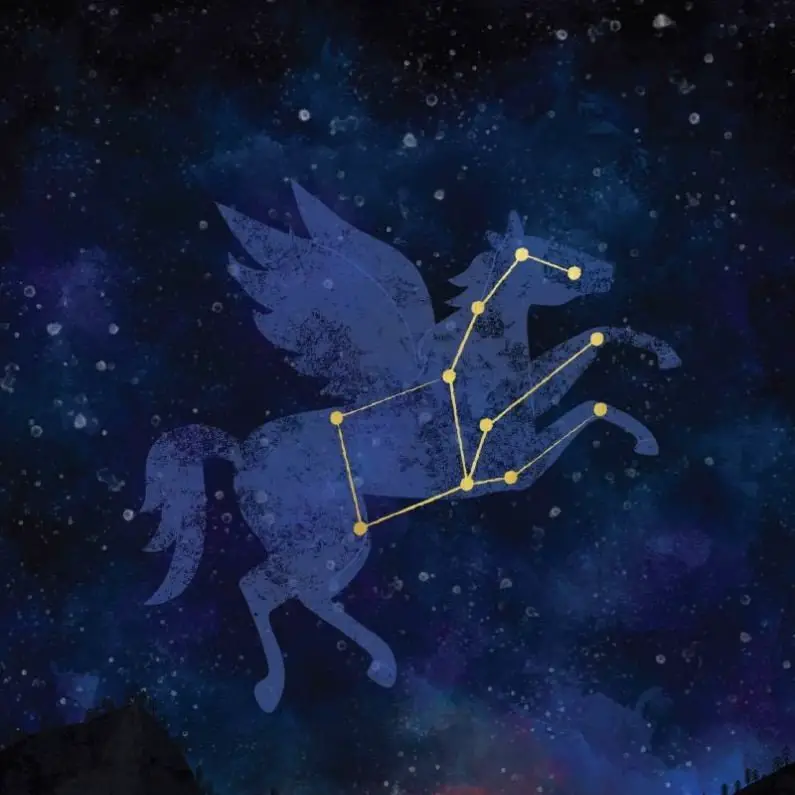
Welcome to another constellation post; this one is one of my favourites. Who doesn't love a winged horse? The constellation is called 'Hippos' (the Horse) in Greek and has some badass mythology attached to it.


Pegasos was originally only one winged horse, born from the neck of Médousa when she was beheaded by the hero Perseus. Poseidon, Tamer of Horses, is his father. Hesiod describes in his 'Theogony' the curious circumstances of his birth:


"...Medusa who suffered a woeful fate: she was mortal, but the two [of her Gorgon sisters] were undying and grew not old. With her lay the Dark-haired One [Poseidon] in a soft meadow amid spring flowers. And when Perseus cut off her head, there sprang forth great Chrysaor and the horse Pegasus who is so called because he was born near the springs [pegae] of Ocean [Okeanos]; and that other, because he held a golden blade [aor] in his hands. Now Pegasus flew away and left the earth, the mother of flocks, and came to the deathless gods: and he dwells in the house of Zeus and brings to wise Zeus the thunder and lightning." [ll 270-294]

Pegasos was tamed by Bellerophon, a Korinthian hero, who rode him into battle against the fire-breathing Khimaira. Pindar, in his beautiful Olympian Odes describes this cooperation wonderfully:

"Bellerophon, who once suffered greatly when beside the spring he wanted to harness Pegasus, the son of the snake-entwined Gorgon; until the maiden Pallas brought to him a bridle with golden cheek-pieces. The dream suddenly became waking reality, and she spoke: “Are you sleeping, king, son of Aeolus? Come, take this charm for the horse; and, sacrificing a white bull, show it to your ancestor, Poseidon the Horse-Tamer.” The goddess of the dark aegis seemed to say such words to him as he slumbered in the darkness, and he leapt straight up to his feet. He seized the marvellous thing that lay beside him, and gladly went to the seer of the land,  and he told the son of Coeranus the whole story: how, at the seer's bidding, he had gone to sleep for the night on the altar of the goddess, and how the daughter herself of Zeus whose spear is the thunderbolt had given him the spirit-subduing gold. The seer told him to obey the dream with all speed; and, when he sacrificed a strong-footed bull to the widely powerful holder of the earth, straightaway to dedicate an altar to Athena, goddess of horses. The power of the gods accomplishes as a light achievement what is contrary to oaths and expectations. And so mighty Bellerophon eagerly stretched the gentle charmed bridle around its jaws and caught the winged horse. Mounted on its back and armored in bronze, at once he began to play with weapons. And with Pegasus, from the chilly bosom of the lonely air,7 he once attacked the Amazons, the female army of archers, [90] and he killed the fire-breathing Chimaera, and the Solymi. I shall pass over his death in silence; but Pegasus has found his shelter in the ancient stables of Zeus in Olympus." [13. 63]

As a constellation, it's arrival in the sky notes the arrival of the warmer weather of spring and seasonal rainstorms, which is also why it got the job and title of thunderbolt-bearer of Zeus. Hyginus in his 'Astronomica' speaks of the events that led up to Pegasos' immortalization in the sky:

"Others say that at the time Bellerophon came to visit Proetus, son of Abas and king of the Argives, Antia, the king’s wife, smitten with love for the guest, begged to visit him, promising him her husband’s kingdom. When she couldn’t obtain this request, out of fear that he would accuse her to the king, she anticipated him by telling Proetus that he had offered violence to her. Proetus, who had been fond of Bellerophon, was reluctant to inflict punishment himself, but knowing that he had the horse Pegasus, sent him to the father of Antia (some call her Sthenoboea), for him to defend his daughter’s chastity and send the youth against the Chimera, which at that time was laying waste with flames the country of the Lycians.

Bellerophon was victor, and escaped, but after the creation of the spring, as he was attempting to fly to heaven, and had almost reached it, he became terrified looking down at the earth, and fell off and was killed. But the horse is said to have flown up and to have been put among the constellations by Jove [Zeus]. Others have said that Bellerophon fled from Argos not because of Antia’s accusations, but so as not to hear any more proposals which were distasteful to him, or to be distressed by her entreaties." [II.18]

Although most would agree that it is Pegasos whom the constellation denotes, there is one other explanation, there because her mythology is usually tied to the constellation Equuleus: the little horse. Her name is Melanippe (Εὐίππη), daughter of the kéntauros Kheiron. She became pregnant and could not let her father know. As such, she begged the Gods to be transformed into a mare. Also from Hyginus's Astronomica:
 
"Euripides in his Melanippe, says that Melanippe, daughter of Chiron the Centaur, was once called Thetis. Brought up on Mount Helicon, a girl especially fond of hunting, she was wooed by Aeolus, son of Hellen, and grandson of Jove, and conceived a child be him. When her time drew near, she fled into the forest, so that her father, who supposed her a virgin, might not see that she had given birth to a grandchild. And so when her father was looking for her, she is said to have begged the power of the gods not to let her father see her in childbirth. After the child was born, by the will of the gods she was changed into a mare which was placed among the stars."

He also gives another reason for her change:

"Some say that she was a prophetess, and because she used to reveal the plans of the gods to men, she was changed into a mare. Callimachus says that because she ceased hunting and worshipping Diana [Artemis], Diana changed her into the shape we have mentioned. For the reason above, too, she is said to be out of sight of the Centaur, who some say is Chiron, and to show only half her body, since she didn’t want her sex to be known."

The constellation is visible at latitudes between +90° and −60°, and best visible at 21:00 (9 p.m.) during the month of October.

Busy day, sorry, so have a hymn to Poseidon, hidden away in Aristophanes's The Knights. It's sung by two of the characters and is quite lovely, so I thought I'd share.


Oh, Lord! Oh, Lord, protector and lover of horses!
Lover of the brazen clang and thud of the horses’ hooves, lover of the horses’ neighing. Lover, too, of the swift war ships with their blue emblems of rams at the prow!
Oh, God, whose heart gladdens at the sight of the rich booty those ships carry! A heart that also gladdens at the sight of young men in contest, particularly when they climb proudly upon their chariots chasing their Fate -victory or defeat, no matter!
Come, God of the horse, come now and join our dance!
Poseidon, God of the golden trident, come join us!
God, chief of the dolphins!
God whose name is praised at Sounion!
God, son of Kronos, Geraestus!
God, most loved by the folk of Phormion to whom you granted a naval victory!
God most loved by all the citizens of Athens at this hour of their naval need!

 I greatly enjoy watching the Olympics. I enjoy watching sport in general, but this is a competition which started in Greece, by the people who worshipped the same Gods as I do, people whose lives I'm trying to reconstruct. Watching the Olympics is religious for me. Did you know all of this about the Olympics?


An artist's impression of Altis, the sanctuary in Olympia
  1. The Olympic Games were held every four years, like they are now, from 776 B.C. to A.D. 394. They were, however, part of a cycle of sports events, known as the Panhellenic Games. The Olympic Games were dedicated to Zeus, were held in Olympia, Elis, and were held every four years. The Pythian Games were dedicated to Apollon, were held in Delphi and were held every four years, starting three years after the Olympic Games. The Nemean Games were dedicated to Zeus also, were held in Nemea, Corinthia, and were held every two years. Lastly, the Isthmian Games were dedicated to Poseidon, were held in Corinth, and were also held every two years.
  2. The most important events at the Olympic Games weren't the sport events; they were the sacrifices, offerings and other dedicatory practices which were continually performed during the five day event. There were also artistic happenings; writers, sculptures and painters showed what they could do in their given trade. Palmistry was practiced, wine flowed freely and there were a lot of prostitutes, who made more money in these five days than in the whole of a year without the sporting event. The Olympics were a festival unlike any other and every four years Hellas went nuts for it.
  3. The opening ceremony was as spectacular as it is today, but in an entirely different manner; athletes filed into the arena and were presented to the audience. Then, they were presented to a towering statue of Zeus, who carried a thunderbolt and a heft scowl. They swore on a bloody slice of boar's meat that they would obey the rules of the competition and not cheat to gain victory.
  4. The torch relay I take great joy in, was not practiced in Ancient Greece. In fact, it was introduced in 1936 by Hitler in response to an idea by Carl Diem to further the reign of the Nazi's and, in their eyes, glorify the Aryan super race, the Spartans. 
  5. Not everyone was allowed to participate in the games; non-Hellenics and women were unable to compete. There were exceptions made for non-Hellenics, like Roman Emperor Nero, when the situation called for it, but women were never allowed to compete. Married women weren't even allowed to enter the arena. There was, however, a secondary series of sporting events held in honor of Hera where women competed.
  6. The Olympic sport events back then were: chariot racing, wrestling, boxing, pankration, foot races, and the pentathlon which consisted of wrestling, stadion, long jump, javelin throw, and discus throw. Pankration was a fighting sport in which everything went. It was a kind of mixed martial-arts event in which broken bones were the norm, choke holds were encouraged and the only thing that you really couldn't do was gauge someone's eyes out. Everything else went. You won when the other guy went K.O.
  7. Except the chariot races, all Olympic sports were performed naked. This included the Pankration, so you can imagine where most of the pain was inflicted. The woman weren't completely naked, but participated with one breast exposed, in honor of the Amazonian women who were said to be so incredible at sports and warfare alike. 
  8. Over 40.000 people came to watch the Games. Olympia was in the middle of nowhere. If you came from Athens, it meant a 340 kilometer (210 mile) long walk just to get to Altis. Because of the festival and the presence of the Gods, all these people traveled the distance anyway.
  9. The end of the Olympic Games is guestimated to 394 A.D. after a decree to cease all pagan festivals by Christian emperor Theodosius I.
  10. Winners of the Olympic Games got rather minor rewards; Olympic winners received a garland of olives, Pythian winners received a laurel wreath, Nemean winners received a wild celery garland and the Isthmian winner received a pine garland. There was no runner-up; you won or you lost. All athletes were bathed in fame and glory until they lost, but the winner was brought home to his polis a king. He would never have to work again, was covered in riches and women, and his name and family name would be forever remembered and honored.

 In Greek, the term 'Atlantis' means 'island of Atlas' (Ἀτλαντὶς νῆσος), and it may very well have applied to the island of Santorini. It was Plato who brought life--and myth--to Atlantis. According to him, Poseidon fell in love with Cleito, the daughter of Evenor and Leucippe, who bore him five pairs of male twins. The eldest of these, Atlas, was made rightful king of the entire island and the ocean--called the Atlantic Ocean in his honor--and was given the mountain of his birth and the surrounding area to rule over. It was also Plato who wrote that Poseidon made Atlantis--a huge island with a volcano at its center--His home after Zeus, Hades and He divided the world.


Plato's description of Atlantis would have fit the ancient hellenic version of Santorini well. It was a large, mountainous, island, with an active volcano at its center. The large settlement on the island was build around said volcano. Poseidon's influence on the island isn't a stretch of the imagination at all; there was sea and ocean all around and from time to time, the entire island would tremble due to the volcano.

The volcano eruption decimated the settlement, but from what archeologists and scholars have been able to piece together, the settlement was a sight to behold while it stood. It had walls eight meters tall, three story houses, beautiful frescos and a rich economic climate. The volcano eruption preserved much of the ancient city of Akrotiri, despite the huge lagoon the eruption left at the center of the island.

One of Atlantis' marvels was the much-praised and highly valuable metal called 'orichalcum'. It was called 'aurichalcum' by the Romans and is a metal mentioned in several ancient writings, including the story of Atlantis in the Critias dialogue, recorded by Plato. In it, he says:

"Some of their buildings were simple, but in others they put together different stones, varying the colour to please the eye, and to be a natural source of delight. The entire circuit of the wall, which went round the outermost zone, they covered with a coating of brass, and the circuit of the next wall they coated with tin, and the third, which encompassed the citadel, flashed with the red light of orichalcum."

The name derives from the Greek ὀρείχαλκος, oreikhalkos (from ὄρος, oros, mountain and χαλκός, chalkos, copper or bronze), meaning literally 'mountain copper' or 'copper mountain'.

In January 2015, a team of divers have discovered dozens of pieces of ancient metal from a shipwreck, aged 2,600 years, off the coast of Sicily island, in the south of Italy. The lumps of metal were arriving to Gela in southern Sicily, possibly coming from Greece or Asia Minor. The ship that was carrying them was likely caught in a storm and sunk just when it was about to enter the port. They were unlike any metal ever found. Analyzed with X-ray fluorescence, the 39 ingots turned to be an alloy made with 75-80 percent copper, 15-20 percent zinc and small percentages of nickel, lead and iron.

The mining of orichalcum would have made Atlantis (or Santorini) very wealthy as it seems the metal was only mined there, and orichalcum was considered second only to gold in value.

It's time for a new constellation post! This one is going to be all about horses, so if you're a horse lover, rejoice. If not, well, then there is at least some interesting mythology here.

 
Equuleus, or 'little horse' is the second smallest of all of Ptolemy's constellations. It is depicted by solely a horse's head, and seems almost hidden away behind the much larger horse constellation Pegasus. There is a mythological reason for this hiding behavior: Equuleus is said to represent Hippe (Ἵππη), or Melanippe (Εὐίππη), daughter of the kéntauros Kheiron. She became pregnant and could not let her father know. As such, she begged the Gods to be transformed into a mare. From Hyginus's Astronomica:
 
"Euripides in his Melanippe, says that Melanippe, daughter of Chiron the Centaur, was once called Thetis. Brought up on Mount Helicon, a girl especially fond of hunting, she was wooed by Aeolus, son of Hellen, and grandson of Jove, and conceived a child be him. When her time drew near, she fled into the forest, so that her father, who supposed her a virgin, might not see that she had given birth to a grandchild. And so when her father was looking for her, she is said to have begged the power of the gods not to let her father see her in childbirth. After the child was born, by the will of the gods she was changed into a mare which was placed among the stars."
 
He also gives another reason for her change:
"Some say that she was a prophetess, and because she used to reveal the plans of the gods to men, she was changed into a mare. Callimachus says that because she ceased hunting and worshipping Diana [Artemis], Diana changed her into the shape we have mentioned. For the reason above, too, she is said to be out of sight of the Centaur, who some say is Chiron, and to show only half her body, since she didn’t want her sex to be known."
 
The constellation is also known as Eguus Primus, the 'first horse' because it rises just before Pegasus. Because it rises first, it is sometimes identified as the offspring of Pegasus, Celeris, whom he had with his wife, Euippe (or Ocyrrhoe). The second child out of that marriage was Melanippe, a common female name when associated with horses, as it means 'mare'.
 
The third and last horse that this constellation is connected to it the horse that was born the moment Poseidon's trident struck the ground in the battle for patronage of the city of Athens:
 
"The common tradition about Poseidon creating the horse is as follows : -- when Poseidon and Athena disputed as to which of them should give the name to the capital of Attica, the gods decided, that it should receive its name from him who should bestow upon man the most useful gift. Poseidon their created the horse, and Athena called forth the olive tree, for which the honour was conferred upon her. [Serv. ad Virg. Georg. 1.12.]
 
The constellation Equuleus is visible at latitudes between +90° and −80°, and best visible at 21:00 (9 p.m.) during the month of September.

Because it's been a while since the last constellation, and yesterday's blog post hardly counted, I'm going to give you not one but two constellations today (also because it's much easier to describe both in one post, seeing as the mythology surrounding these two has mixed throughout the years, so I'm really just making it easier on myself).


The Corona Australis, the southern crown, is located in the southern hemisphere, next to the constellation Sagittarius. As such, it is often linked to that constellation and regarded as the wreath that fell off of the head of one of the kéntauros that particular constellation is linked to. In the same regard, it is also linked to the kéntauros 'Centaurus'.

Corona Australis is most often regarded as a wreath, but in some descriptions and depictions, the Corona Australis is a crown. There is, however, one myth in which the Corona Australis does not depict a wreath or crown: in this myth, the constellation represents Ixion, king of the Lapits, who fell in love with Hera after being invited up to Olympos by Zeus. Zeus decided to test his integrity after He discovered His guest' lust for Hera, but Ixion failed miserably. Ixion was expelled from Olympus and blasted with a thunderbolt for failing his test. Zeus then ordered Hermes to bind Ixion to a winged fiery wheel that was always spinning. Therefore, Ixion is bound to a burning solar wheel for all eternity, at first spinning across the heavens, then into Tartaros. The Corona Australis is this very wheel, with Ixion tied to it.

The most famous of myths associated with the Corona Australis is the story of the birth of Dionysos, and the death of His mother Semele. In this version of the myth, Dionysos is born from Semele and Zeus, and while Semele is pregnant with Him, Hera plants seeds of doubt in her mind about the father of the child truly being Zeus. Semele asks Zeus to reveal Himself to her in His true form, and when He is left with no other option, He does so, killing her in the process. Zeus takes pity on His child, and takes Him into either His thigh or testicle, where He is eventually born from. When Dionysos grows up, He raises Semele to Olympos and grants her eternal life. He also places a wreath into the sky to honor her. The wreath would be made of myrtle leaves, for Dionysos left a gift of myrtle in the Underworld in return for His mother, and the followers of Dionysos wore crowns of myrtle.

Interestingly enough, Roman author Hyginus ascribes this myth to the Corona Borealis, and adds that Dionysos first received this wreath--now a golden crown--from Aphrodite. He gave it to His beloved Ariadne, daughter of Minos. According to Hyginus, it was the light that reflected off of this crown, that led Theseus from the labyrinth after slaying the minotaur. Hyginus then goes on to retell the story above, and says that Dionysos did not want to take the crown into the Underworld in fear of it being contaminated with miasma. When He returned from the Underworld, he threw the golden crown into the sky as a memorial.

Hyginus also gives another account for the the northern crown, the Corona Borealis:

"It is said that when Theseus came to Crete to Minos with seven maidens and six youths, Minos, inflamed by the beauty of one of the maidens, Eriboea by name, wished to lie with her. Theseus, as was fitting for a son of Neptune[Poseidon], and one able to strive against a tyrant for a girl’s safety, refused to allow this. So when the dispute became one not about the girl but about the parentage of Theseus, whether he was the son of Neptune or not, Minos is said to have drawn a gold ring from his finger and cast it into the sea. 

He bade Theseus bring it back, if he wanted him to believe he was a son of Neptune; as for himself, he could easily show he was a son of Jove [Zeus]. So, invoking his father, he asked for some sign to prove he was his son, and straightway thunder and lightning gave token of assent. For a similar reason, Theseus, without any invoking of his father or obligation of an oath, cast himself into the sea. And at once a great swarm of dolphins, tumbling forward over the sea, led him through gently swelling waves to the Nereids. 

From them he brought back the ring of Minos and a crown, bright with many gems, from Thetis, which she had received at her wedding as a gift from Venus [Aphrodite]. Others say that the crown came from the wife of Neptune, and Theseus is said to have given it to Ariadne as a gift, when on account of his valor and courage she was given to him in marriage. After Ariadne’s death, Liber [Dionysos] placed it among the constellations."

As you can see, there are many myths surrounding the two crowns. The Hellenic poet Aratos named them 'Stephanoi' (Στεφάνοι) around 300 BC, but did not differnetiate between the two, although they are not placed close together. As such, the Stephanoi are visible and best viewed at different times throughout the year. The Corona Australis is visible at latitudes between +40° and −90°, and best visible at 21:00 (9 p.m.) during the month of August. The Corona Borealis, located near the constellations of Hēraklēs and Boötes, is visible at latitudes between +90° and −50°, and best visible at 21:00 (9 p.m.) during the month of July.

When a whole family gets uplifted into the sky, the breakdown of their constellations gets a little repetitive over time, sorry about that. When we last saw the Aethiopia ruling family, we discussed the constellations Androméda and Cassiopeia. Today, we close the trilogy with Capheus, father of Andromeda, and husband to Cassiopeia, and add a good bit of info to the myth.

Cepheus was king of Aethiopia when he heard his wife Cassiopeia boast that her daughter was more beautiful than the Nereids. Shocked, he tried to silence his wife, but it was too late. The father of the Nereids, the sea God Nereus, heard Cassiopeia's prideful boast and brought his grievance to Poseidon. Poseidon ruled in favor of Nereus and sent Cetus, a huge sea monster, to ravage the coasts of Aethiopia. It destroyed villages, kept fishermen off of the sea and caused huge floods that killed hundreds at a time. A cry went up from the people for Cepheus to remedy the situation and to appease the Gods. Cepheus, desperate, traveled to the oracle of Apollon (or Zeus) to hear how he could solve the suffering of his people. The Oracle told him that Nereus would only be appeased when he sacrificed his daughter to Cetus.

Stricken with grief, Cepheus raised his hands to the sky--the position he was immortalized in--and prayed for another resolve of the situation that would not lead to the death of his much beloved daughter. The Theoi, however, remained silent. Cepheus resisted the oracle's message as long as he could, but eventually, the anguish of his people became too much for a king to withstand. In other versions of the myth, Androméda (like Iphigeneia) offered herself up to be sacrificed, as she realized her life was not worth the lives of all those who were dying now.

Androméda was chained to the cliffs near the palace, and awaited her faith there, while both Cepheus and Cassiopeia looked on with immense sadness. Thankfully, Androméda was rescued from her fate by Perseus, on his way back from defeating Médousa. King Cepheus hosted a huge wedding banquet at his palace to celebrate the wedding. There was one problem, however: Androméda had already been promised to Phineus, Cepheus' brother. While the celebrations were in progress, Phineus and his followers bursted in, demanding that Androméda be handed over, which Cepheus refused to do--too grateful to Perseus for rescuing his daughter from certain death. Ovid has described the battle that ensued in the Metamorphoses, but before the battle begins, we first get a speech by Cepheus to his brother, who begs him to let his claim to Androméda go:

"Hold, brother, hold; what brutal rage has made your frantick mind so black a crime conceive? 
Are these the thanks that you to Perseus give? This the reward that to his worth you pay, whose timely valour sav'd Andromeda? Nor was it he, if you would reason right, that forc'd her from you, but the jealous spight of envious Nereids, and Jove's high decree; And that devouring monster of the sea, that ready with his jaws wide gaping stood to eat my child, the fairest of my blood. 

You lost her then, when she seem'd past relief, and wish'd perhaps her death, to ease your grief 
With my afflictions: not content to view Andromeda in chains, unhelp'd by you, her spouse, and uncle; 
will you grieve that he expos'd his life the dying maid to free? And shall you claim his merit? 
Had you thought her charms so great, you shou'd have bravely sought that blessing on the rocks, where fix'd she lay: but now let Perseus bear his prize away, by service gain'd, by promis'd faith possess'd; 
To him I owe it, that my age is bless'd still with a child."

Phineus refused to listen to reason, and threw a spear at Perseus, who barely managed to dodge it. After that, all hell broke loose. Perseus cut down many of his attackers, turning the remainder to stone by showing them the head of Médousa. Eventually, he hailed victorious, and got to carry off his bride. In doing so, he left Cassiopeia and her husband to the fate of Poseidon, who would still have His revenge. As such, He took both Cassiopeia and Cepheus up into the sky and placed them near each other in the heavens. Poseidon placed Cassiopeia close to the North Celestial Pole on her throne, spending half of her time clinging to it so she does not fall off. In old portraits of the constellation, she is seen as either tied to her throne--which most often resembles a torture device--or desperately clinging to it. Later on, she was depicted as holding a mirror (or palm leaf) to show her vanity. 

However, because Cepheus had nothing to do with Cassiopeia's original declaration, because he had done everything in his power to make things right afterwards, and he had plead his case to the Gods again and again, Cepheus was placed into the sky unchained--either regally on his throne or with his hands raised in pious prayer--and a little further away from the pole. He still circles it in punishment, but his position is a lot less precarious than that of his wife. 

The constellation Cepheus is visible at latitudes between +90° and −10°, and best visible at 21:00 (9 p.m.) during the month of November, the same as the constellations of his wife and daughter.

PAT ritual for the Theogamia

Around Valentine's day, us Hellenists honour a beautiful festival of love and social stability: the Theogamia, also known as the Gamelia or Hieros Gamos. This festival celebrates the anniversary of the marriage (gamos, γάμος) of Zeus Teleios (Τελειος, Of the Marriage Rites) and Hera Teleia (Τέλεια, same). Zeus Teleios and Hera Teleia are considered the patron Gods of marriage. To celebrate this divine marriage and ask for blessings upon the romantic ties we may have in life, Elaion is organising a PAT ritual on 10 February. The time is set for 10 AM EST. Will you join us?


We know very little about the actual Theogamia festival. In ancient sources it's sometimes called 'hieros gamos', the sacred marriage, and was referred to as a domestic festival. A day to spend at home, with your wedded partner. Hera Teleia was the primary deity of the festival, with Zeus Teleios being of secondary importance. It was celebrated for sure in Athens, and most likely also in city-states around Athens. It included a shared dinner, and presumably lovemaking, between husband and wife. Unmarried men were most likely free of religious obligations, and were free to dine out.

There seems to be a suggestion that the gamos of Zeus and Hera was enacted as part of the rituals of a hieros gamos festival, but there is no concrete evidence for this. The closest we get to a Hellenic 'Great Rite' is a ritual performed near Knossos in Krete, but the details are so very vague that we can't be sure about anything.

It doesn't take much imagination to fill in how to best celebrate this festival. If you are married or have a partner, have a nice dinner together, have some romance, spent the night together and bond. Think about ways in which you will help, honor and love your partner in the year to come. And, of course, join our ritual! I want to leave you with a quote from the Ilias that has nothing to do with the Theogamia itself but does describe the eternal love between Zeus and Hera so very beautifully.

“Zeus, the Cloud-Driver, saw her, and instantly his sharp mind was overwhelmed by longing, as in the days when they first found love, sleeping together without their dear parents’ knowledge. [...] ‘Hera, [...] let us taste the joys of love; for never has such desire for goddess or mortal woman so gripped and overwhelmed my heart, not even when I was seized by love for Ixion’s wife, who gave birth to Peirithous the gods’ rival in wisdom; or for Acrisius’ daughter, slim-ankled Danaë, who bore Perseus, greatest of warriors; or for the far-famed daughter of Phoenix, who gave me Minos and godlike Rhadamanthus; or for Semele mother of Dionysus, who brings men joy; or for Alcmene at Thebes, whose son was lion-hearted Heracles; or for Demeter of the lovely tresses; or for glorious Leto; or even for you yourself, as this love and sweet desire for you grips me now.’” (Iliad XIV)

The ritual can be found here and you can join the community here. Enjoy the Theogamia, everyone!


PAT ritual for the Kourotrophos, Hera, Zeus Teleios & Poseidon

On the Erkhian calendar, Kourotrophos, Hera, Zeus, and Poseidon are all sacrificed to on 27 Gamelion, at the same location: the temple of Hera. Also, as Kourotrophos Herself was often honored first with other deities and especially on this occasion, it seems to make sense that it was one ritual with four sacrifices as listed on the calendar. Will you join us for this sacrifice on February 10, after the ritual for the Theogamia? We've set the time at 11 AM EST.


The Kourotrophoi are mostly female deities who watch over growing children. Specific offerings to Them are known from the demos Erkhia (or Erchia), but duplicate similar offerings on the Acropolis of Athens. Especially at Erkhia, it varied per sacrifice which Kourotrophos was/were sacrificed to. In this case, where no specific deity is listed, none of the above were most likely honored. The deity in question was Kourotrophos Herself, a deity whose main function was to watch over nursing children and their mothers.

You can find the ritual here and join the community here.

Poseideon is the sixth month of the Hellenic calendar . It was the month that would have been repeated should the ancient calendar not line up with the phases of the moon (which it didn't, after a while). We're in that repeat month now. You can read more about the process here as it is beyond the scope of this post. What I would like to talk to you about today is the divine triad that oversaw Poseideon (the quartet, actually, but we'll get to that) and its significance. 

Poseideon was ruled by Poseidon (honoured during the Poseideia), Zeus (during the Plerosia and a seperate sacrifice to Zeus Horios) and Dionysos (during the Lesser Dionysia and secondarily during the Haloa). Poseideon is the first true winter month; the first harvest was over, seafaring had ceased and thus war had come to an end. The focus was on the home and preparation for true, deep winter: the weather turned and the crops needed protecting. Because of this, it was also a month of threat; if the crops failed, if the seas became too rough when a daring fisherman was out on it, or if a river went out of bounds and flooded a well populated area there would be death.

I get on my soapbox a lot on my blog. One of my main points is that everything is connected in the ancient Hellenic religion. That everything was constructed the way it was for a reason; the pantheon, the calendar, the festivals, the way festivals were celebrated--if you spend time to sort out the why, you will discover it's all part of an intricate web that formed an entire civilization. Nothing--absolutely nothing--in our religion and in the ancient civilization it was formed in ended up in it by accident. We have lost a lot of knowledge and understanding of this society but we can try to piece things together if we put in the effort. So today I will put in a little effort to explain why Poseideon was ruled by Poseidon, Zeus and Dionysos. And why it mattered that it were Them.

During the Poseideia, Poseidon as savior of ships, protector of those who voyage in ships, and God of the lapping waters both salt and fresh important for agriculture, is thanked for the many gifts that came from faraway places that were likely given at that time. The immense trade and distribution was nearly all through shipping, relatively little overland, whether it be perfume from Cyprus or pottery from Corinth. One of Poseidon’s epithets is prosklystios, 'of the lapping water'. He is also invoked as Poseidon phytalmios which implies natural fertility and human procreation. 

The Plerosia is a harvest festival of sorts. It was held to honour Zeus but presumably als Demeter. Poseideon marks the time to return home, take stock, and stay warm. It's a time to thank the Theoi for all that has been recieved and all that will get us through the winter. The word ‘plerosis’ means fulfillment, satiated, filled. Important note: the Plerosia seems to have been a women-only festival, perhaps because now that winter is upon us, we turn to the domain of the women: the house(hold). As such, it is her prerogative to thank the Gods for the food she can feed her family with.

The lesser Dionysia, a vintage festival, was celebrated in the various demes of Attica in the month of Poseideon. It was probably a very ancient festival, perhaps not originally associated with Dionysos. The Dionysia was a time when classes came together in order to celebrate their shared origins in the natural world; it was a vintage festifal for all.

The Haloa was held in honor of Demeter, Dionysos and a little bit in honor of Persephone. Like all festivals of Demeter and Persephone's 'Kore' persona, women were the only ones who were allowed to handle the religious and sacrificial side of it. The Haloa is assumed to be a celebration of the pruning of the vines and the tasting of the wine after its first fermentation, or it may be to encourage the growth of corn from the seed.

A few links between Poseidon, Zeus and Dionysos are clear instantly from the descriptions of these festivals. Poseidon and Dionysos are linked through water--moisture, actually. Plutarch already noted that Dionysos was a God of moisture--in particular the moisture associated with life and vigour as can be seen in plants and trees and most telling in the wine produced from the fruits of the vine. Poseidon is all but the personification of water of all kinds. Furthermore, one of the epithets of Dionysos is Dendrites, ‘of the trees’, connects him to branching life. The tree was similarly a metaphor for rivers whose branching nature was morphologically similar. This links Dionysos to Poseidon even more.

And what of Poseidon and Zeus? Poseidon is the brother of Zeus and Hades, and together they form a triumvirate who represents the dominion of the sea, the sky and the underworld respectively. In Hellenic mythology, the underworld is seen as an exact mirror and equally valid version of the ‘celestial’ world. In other words: Zeus is Hades inverted and Poseidon is the synthesis of both. Dionysos therefore unifieds these god-themes and manifested them in the mundane world.

This brings us to Hades, the fourth member of this triad. He is worshipped too, just not directly--never directly. the ancient Hellenes very rarely honoured Hades, not even Plouton, His ouranic epithet. But Hades' influence was most definitely felt; he's the third of the triumvirate, He is prevalent in the threat of death that hangs over the month and He is appeased though a medium who is perhaps unlikely: Demeter. 

Mythological and epithological links exist between Demeter and Hades. Hades was celebrated as an important divine figure in the Eleusinian Mysteries. The seasonal drama of nature was said to depend on her annual passage into the underworld in the depths of winter when fruitfulness and vegetation dies back. Through Kore (Persephone) Hades and Demeter rule over the harvest. Hades takes and Demeter gives--or more accurately: Hades causes Demeter to take instead of give. In praying for fruitfulness of the earth to Demeter, it is also Hades who is spoen to and appeased, which makes Him an unofficial member of the triad (this is likewise true for Demeter and even Kore/Persephone).

To compelete the circle, Dionysos and Demeter are worshipped together during the Haloa, which drives home the agricultural ties all these five deities have  and the way they link to the mundane issues of this time of year; Demeter and Hades (Plouton) through the fruitful earth (underworld), Zeus through mild weather (sky) and Poseidon and Dionysos through sweet water (the intermediate). Because of Their links and domains, it can be only these deities that govern Poseideon.

On December 23th or the night of the 22th, Elaion will organize a PAT ritual for the Poseidea. During this festival, Poseidon as savior of ships, protector of those who voyage in ships, and God of the lapping waters both salt and fresh important for agriculture, is thanked for the many gifts that came from faraway places that were likely given at that time. Will you join us at 10 am EST on the 23th or your evening on the 22th?


The most complete account of the festival is Noel Robertson's article Poseidon's Festival at the Winter Solstice, The Classical Quarterly, New Series, Vol. 34, No. 1. (1984), pp. 1-16:

"The record shows that Poseidon was once worshipped in every part of Greece as a god of deneral importance to the community. [...] The festival falls near the winter solstice, and the ritual business marked by jollity and license, belongs to the general type of solstice festival known the world over.  At Poseidon’s festival, however, the sportive conduct has a definite purpose; this purpose arises from the fundamental agrarian background if Mediterranean society, and may bring us close to the origin of solstice festivals.

It has scarcely been noticed that festivals of Poseidon, more than those of any other Greek deity, fall at just this time of year; yet the evidence is extensive. [...] The festival Poseidea and some of the rites in question are often claimed for Poseidon the sea-god, but at this season sailing is furthest from one’s mind, and fishing on the shore is by no means an overriding concern.  Such details as we have point elsewhere, to Poseidon as the god of fresh water who fructifies Demeter’s fields."

One of Poseidon’s epithets is prosklystios, 'of the lapping water'. He is also invoked as Poseidon phytalmios which implies natural fertility and human procreation. There are also implications in the legends that imply bonfires at the winter solstice.

Noel Robertson concludes:

"…the celebrants feast to satiety, then turn to lascivious teasing. What is the ritual purpose of such conduct?  It obviously suits Poseidon’s mythical reputation as the most lustful of gods, who far surpasses Apollo and Zeus in the number of his liaisons and his offspring. Poseidon the seducer is the god of springs and rivers; his women typically succumb while bathing or drawing water; the type of the river god is a rampant bull. But the ritual likewise treats Poseidon as a procreant force; witness the epithets phytalmios, genesios, pater, etc. as interpreted above. The myths and the ritual reflect the same belief. The rushing waters are a proponent male power, just as the fields which they fertilize are a prolific female.  Both water and the fields, both Poseidon and Demeter, can be made to operate by sympathetic magic.  The rites of our winter festival rouse Poseidon and bring the rushing waters."

It is interesting that that Theophrastus tells us that the silver fir was important in ship building, especially for masts. The ‘tannenbaum’ is a silver fir. It is also interesting to compare with the Roman Saturnalia which may very well have borrowed from the Poseidea.

Celebrating Poseidon's Festival seems to be lost in modern practice. It likely entailed bonfires, feasting, cutting of trees (probably decorated), and very likely gift giving. As God of begetting, that aspect was not forgotten. We'll bring at least the ritual for Poseidon back on December 23, at 10 am EST, or your evening on the 22th. You can find the community page here and the ritual here.

Two PAT ritual announcements, both for today, August 22rd, we will hold a PAT ritual for the Niketeria, followed by the Plataia.

The Niketeria
We are coming upon another festival celebrated in ancient Athens: the Niketeria. Surviving sources date the festival to the third of Boudromion, and it was in honor of one of the most important events in Athens' history: its naming and tutelage by Athena. We will be celebrating it at the usual 10 AM EDT.


Many of us know there was a contest between Poseidon and Athena over who would rule the growing city of Athens (in the name it had before being called 'Athens'), and it is clear who won that contest. The earliest reference to this event we still have access to is from the fourth century BC by Plato, but it does not quite have the poetic touch Ovid's account has. For that reason, I will give the account of Ovid, and build from there. From the Metamorphoses, (trans. Melville):

"The rock of Mavors [Ares] in Cecrops' citadel is Pallas' [Athena's] picture [in her weaving contest with Arakhne] and that old dispute about he name of Athens. Twelve great gods, Jove [Zeus] in their midst, sit there on lofty thrones, grave and august, each pictured with his own familiar features: Jove [Zeus] in regal grace, the Sea-God [Poseidon] standing, striking the rough rock with his tall trident, and the wounded rock gushing sea-brine, his proof to clinch his claim. Herself she gives a shield, she gives a spear sharp-tipped, she gives a helmet for her head; the aegis guards her breast, and from the earth struck by her spear, she shows an olive tree, springing pale-green with berries on the boughs; the gods admire; and Victoria [Nike] ends the work." [6. 70]

Ancient Hellenic Neoplatonist philosopher Proklos (Πρόκλος) in 'On the Timaeus of Plato' speaks of this event as well, and notes that there is still a festival held to commemorate this event in his time (between 412 and 485 AD)

 "Farther still, the victories of Minerva are celebrated by the Athenians, and there is a festival sacred to the Goddess, in consequence of her having vanquished Neptune, and from the genesiurgic being subdued by the intellectual order, and those that inhabit this region betaking themselves to a life according to intellect, after the procurement of necessaries. For Neptune presides over generation; but Minerva is the inspective guardian of an intellectual life." [p. 153]

When this was celebrated, Proklos does not mention, but Plutarch does. One of these is in the Quaestiones Convivales, from the Moralia. Here, he answers the question: 'What is Signified by the Fable About the Defeat of Neptune? And Also, Why Do the Athenians Omit the Second Day of the Month Boedromion?'.

"While all were making a disturbance, Menephylus, a Peripatetic philosopher, addressing Hylas: You see, he said, how this investigation is no foolery nor insolence. But leave now, my dear fellow, that obstinate Ajax, whose name is ill-omened, as Sophocles says, and side with Poseidon, whom you yourself are wont to tell has often been overcome, once by Athene here, in Delphi by Apollo, in Argos by Here, in Aegina by Zeus, in Naxos by Bacchus, yet in his misfortunes has always been mild and amiable. Here at least he shares a temple in common with Athene, in which there is an altar dedicated to Lethe. And Hylas, as if he had become better tempered: One thing has escaped you, Menephylus, that we have given up the second day of September [Boudromion], not on account of the moon, but because on that day the gods seemed to have contended for the country." [Book 9, question 5]

Because of this, the official view of Elaion is that the festival of Niketeria--'Victory'--was celebrated not on the second of Boudromion as many modern researchers say, but on the third. The second day, after all, was no longer a part of the month. The question remains why the victory of one Goddess over one God was commemorated at all, and there is no adequate ancient explanation. None of the surviving works mention why and how the festival was celebrated. All we know is that it was noted--it might not even have been a true festival at all. We believe that by omitting the second day, the defeat of Poseidon was omitted, so as not to anger Him. A day later--in a somewhat unrelated fashion to Poseidon's defeat--there was a (possibly somewhat subdued) celebration of the victory of Athena, with sacrifices to Athena, Niké, and perhaps even Poseidon for the many wonderful gifts They had provided--and would hopefully continue to provide--for the city of Athens.

We will hold a subdued PAT ritual in honor of the Niketeria at 10 AM EDT on August 22rd. Will you be joining us? The ritual can be found here and you can join the community here.


The Plataia
The Plataia (or Plataea) seems to have been a commemorative festival, for the Hellenes fallen at the battle of Plataea. The Battle of Plataea was the final land battle during the second Persian invasion of Hellas. It took place in 479 BC near the city of Plataea in Boeotia, and was fought between an alliance of the Greek city-states, including Sparta, Athens, Corinth and Megara, and the Persian Empire of Xerxes I. Some 38,700 Hellenes stood their ground against 300.000 Persians. The Hellenes marched out of the Peloponnesus and the Persians retreated to Boeotia and built a fortified camp near Plataea. The Hellenes surrounded the camp, but refused to enter the bare terrain surrounding the camp. They waited for eleven days, and then found their supplies dwindled. They attempted to retreat, and Persian general Mardonius ordered his forces to pursue them. The Hellenes, however--particularly the Spartans, Tegeans and Athenians--stood their ground, and won a great victory over the Perians. The Persian infantry was slaughtered, and Mardonius killed. Plutarch gives the date for the battle to be the fourth of this month, but also attested that the Athenians commemorated the event on the third. In Boeotia (and especially in Plataea), the remembrance seems to have been held on the fourth.

Herodotus, in his Histories (9. 52. 1), and Plutarch, in his 'Life of Arestides' both remark the following about what is most likely this battle:

"The seer slew victim after victim, Pausanias turned his face [historical general of the Persian Wars], all tears, toward the Heraion, and with hands uplifted prayed Kithaironion Hera and the other gods of the Plataian land that, if it was not the lot of the Hellenes to be victorious, they might at least do great deeds  before they fell."[Life of Aristides, 18. 1]

As such we can assume that, besides the fallen, a sacrifice to Hera was also made. For this ritual, you can join us here. The ritual can be found here. We'll perform the ritual at 11 am EDT.